Category: Germany
Free Public Transport: Why Now of All Times?
This is the second in a series of four posts about the poor state of political transit advocacy in the United States, following a post about the Green Line Extension in metro Boston, to be followed by the topics of operating aid and an Urban Institute report by Yonah Freemark.
There’s a push in various left-wing places to make public transportation free. It comes from various strands of governance, advocacy, and public transport, most of which are peripheral but all together add up to something. The US has been making some pushes recently: Boston made three buses fare-free as a pilot program, and California is proposing a three-month stimulus including free transit for that period and a subsidy for car owners. Germany is likewise subsidizing transport by both car and public transit. It’s economically the wrong choice for today’s economy of low unemployment, elevated inflation, and war, and it’s especially troubling when public transport advocates seize upon it as their main issue, in lieu of long-term investments into production of transit rather than its consumption.
Who’s for free public transit?
Historically, public transit was expected to be profitable, even when it was publicly-run. State-owned railroads predate the modern welfare state, and it was normal for them to not just break even but, in the case of Prussia, return profits to the state in preference to broad-based taxes. This changed as operating costs mounted in the middle of the 20th century and competition with cars reduced patronage. The pattern differs by country, and in some places (namely, rich Asia), urban rail remained breakeven or profitable, but stiff competition bit into ridership even in Japan. The norm in most of the West has been subsidies, usually at the local or regional level.
As subsidies were normalized, some proposed to go ahead and make public transport completely free. In the American civil rights movement, this included Ted Kheel, a backer of free public transit advocates like the activist Charles Komanoff and the academic Mark Delucchi. Reasons for free transit have included social equality (since it acts as a poll tax on commuters) and environmental benefits (since it competes with cars).
Anne Hidalgo has attempted and so far failed to find the money for free public transport in Paris, and other parts of Europe have settled for deep discounts in lieu of going fully fareless: Vienna charges 365€ for an annual pass (Berlin, which breaks even on the U-Bahn as far as I can tell, does so charging 86€/month).
In the United States, free transit has recently become a rallying cry for DSA, where it crowds out any discussion of improvement in the quality of service. Building new rail lines is the domain of wonks and neoliberals; socialists call for making things free, in analogy with their call for free universal health care. Boston has gotten in on the act, with conventional progressive (as opposed to DSA) mayor Michelle Wu campaigning on free buses within the municipality and getting the state-run MBTA to pilot free buses on three routes in low-income neighborhoods.
What’s wrong with free transit?
It costs money.
More precisely, it costs money that could be spent on other things. In Ile-de-France, as of 2018, fare revenues including employer benefits amounted to 4 billion euros, out of a total budget of 10.5 billion. The region can zero out this revenue, but on the same budget it can expand the Métro network by around 20-25 km a year – and the Métro is as far as I can tell profitable, subsidies going to suburban RER tails and buses. For that matter, the heavy subsidies to the suburbs, which pay the same cheap monthly rate as the city, could be replaced with investment in more and better lines.
The experiments with actually-free transit so far are in places with very weak revenues, like Estonia. Some American cities like it in context where public transport is only used by the desperate and no attempt is made at making service attractive to anyone else. Boston is unique in trying it in a context with higher fare revenue – but the buses are rail feeders, so the early pilot piggybacks on this and spends relatively little money in lost revenue, ignoring the long-term costs of breaking the (limited) fare integration between the buses and the subway.
What’s wrong with free transit now?
Free transit as deployed in the California proposal is in effect a stimulus project: the government gives people money in various ways. Germany is doing something similar, in a package including 9€ monthly tickets, a 0.30€ fuel tax cut, and a cut in energy taxes.
In Germany, unemployment right now is 2.9% and core inflation (without food and energy) is 3%. This is a country that spent a decade thinking going over 2% was immoral, and now the party that considers itself the most budget hawkish is cutting fuel taxes, in a time of conflict with an oil and gas exporter and a rise in military spending.
In the United States, unemployment is low as well, and inflation is high, 6.4%. This is not the time for stimulus or investments in consumption. It’s time for investments in production and suppression of consumption. So what gives?
Institutional Issues: Dealing with Technological and Social Change
I’ve covered issues of procurement, professional oversight, transparency, and proactive regulations so far. Today I’m going to cover a related institutional issue, regarding sensitivity to change. It’s imperative for the state to solve the problems of tomorrow using the tools that it expects to have, rather than wallowing in the world of yesterday. To do this, the civil service and the political system both have to be sensitive to ongoing social, economic, and technological changes and change their focus accordingly.
Most of this is not directly relevant to construction costs, except when changes favor or disfavor certain engineering methods. Rather, sensitivity to change is useful for making better projects, running public transit on the alignments where demand is or will soon be high using tools that make it work optimally for the travel of today and tomorrow. Sometimes, it’s the same as what would have worked for the world of the middle of the 20th century; other times, it’s not, and then it’s important not to get too attached to nostalgia.
Yesterday’s problems
Bad institutions often produce governments that, through slowness and stasis, focus on solving yesterday’s problems. Good institutions do the opposite. This problem is muted on issues that do not change much from decade to decade, like the political debate over overall government spending levels on socioeconomic programs. But wherever technology or some important social aspect changes quickly, this problem can grow to the point that outdated governance looks ridiculous.
Climate change is a good example, because the relative magnitudes of its various components have shifted in the last 20 years. Across the developed world, transportation emissions are rising while electricity generation emissions are falling. In electricity generation, the costs of renewable energy have cratered to the point of being competitive from scratch with just the operating costs of fossil and nuclear power. Within renewable energy, the revolution has been in wind (more onshore than offshore) and utility-scale solar, not the rooftop panels beloved by the greens of last generation; compare Northern Europe’s wind installation rates with what seemed obvious just 10 years ago.
I bring this up because in the United States today, the left’s greatest effort is spent on the Build Back Better Act, which they portray as making the difference between climate catastrophe and a green future, and which focuses on the largely solved problem of electricity. Transportation, which overtook electricity as the United States’ largest source of emissions in the late 2010s, is shrugged off in the BBB, because the political system of 2021 relitigates the battles of 2009.
This slowness cascades to smaller technical issues and to the civil service. A slow civil service may mandate equity analyses that assume that the needs of discriminated-against groups are geographic – more transit service to black or working-class neighborhoods – because they were generations ago. Today, the situation is different, and the needs are non-geographic, but not all civil service systems are good at recognizing this.
The issue of TOD
Even when the problem is static, for example how to improve public transit, the solutions may change based on social and technological changes.
The most important today is the need to integrate transportation planning with land use planning better. Historically, this wasn’t done much – Metro-land is an important counterexample, but in general, before mass motorization, developers built apartments wherever the trains went and there was no need for public supervision. The situation changed in the middle of the 20th century with mass competition with the automobile, and thence the biggest successes involved some kind of transit-oriented development (TOD), built by the state like the Swedish Million Program projects in Stockholm County or by private developer-railroads like those of Japan. Today, the default system is TOD built by private developers on land released for high-density redevelopment near publicly-built subways.
Some of the details of TOD are themselves subject to technological and social change:
- Deindustrialization means that city centers are nice, and waterfronts are desirable residential areas. There is little difference between working- and middle-class destinations, except that city center jobs are somewhat disproportionately middle-class.
- Secondary centers have slowly been erased; in New York, examples of declining job centers include Newark, Downtown Brooklyn, and Jamaica.
- Conversely, there is job spillover from city center to near-center areas, which means that it’s important to allow for commercialization of near-center residential neighborhoods; Europe does this better than the United States, which is why at scale larger than a few blocks, European cities are more centralized than American ones, despite the prominent lack of supertall office towers. Positive New York examples include Long Island City and the Jersey City waterfront, both among the most pro-development parts of the region.
- Residential TOD tends to be spiky: very tall buildings near subway stations, shorter ones farther away. Historic construction was more uniformly mid-rise. I encourage the reader to go on some Google Earth or Streetview tourism of a late-20th century city like Tokyo or Taipei and compare its central residential areas with those of an early-20th century one like Paris or Berlin.
The ideal civil service on this issue is an amalgamation of things seen in democratic East Asia, much of Western and Central Europe, and even Canada. Paris and Stockholm are both pretty good about integrating development with public transit, but only in the suburbs, where they build tens of thousands of housing units near subway stations. In their central areas, they are too nostalgic to redevelop buildings or build high-rises even on undeveloped land. Tokyo, Seoul, and Taipei are better and more forward-looking.
Public transit for the future
Besides the issue of TOD, there are details of how public transportation is built and operated that change with the times. The changes are necessarily subtle – this is mature technology, and VC-funded businesspeople who think they’re going to disrupt the industry invariably fail. This makes the technology ideal for treatment by a civil service that evolves toward the future – but it has to evolve. The following failures are regrettably common:
- Overfocus on lines that were promised long ago. Some of those lines remain useful today, and some are underrated (like Berlin’s U8 extension to Märkisches Viertel, constantly put behind higher cost-per-rider extensions in the city’s priorities). But some exist out of pure inertia, like Second Avenue Subway phases 3-4, which violates two principles of good network design.
- Proposals that are pure nostalgia, like Amtrak-style intercity trains running 1-3 times per day at average speeds that would shame most of Eastern Europe. Such proposals try to fit to the urban geography of the world of yesterday. In Germany, the coalition’s opposition to investment in high-speed rail misses how in the 21st century, German urban geography is majority-big city, where a high-speed rail network would go.
- Indifference to recent news relevant to the technology. Much of the BART to San Jose cost blowout can still be avoided if the agency throws away the large-diameter single-bore solution, proposed years ago by people who had heard of its implementation in Barcelona on L9 but perhaps not of L9’s cost overruns, making it by far Spain’s most expensive subway. In Germany, the design of intercity rail around the capabilities of the trains of 25 years ago falls in this category as well; technology moves on and the ongoing investments here work much better if new trains are acquired based on the technology of the 2020s.
- Delay in implementation of easy technological fixes that have been demonstrated elsewhere. In a world with automatic train-mounted gap fillers, there is no excuse anywhere for gaps between trains and platforms that do not permit a wheelchair user to board the train unaided.
- Slow reaction time to academic research on best practices, which can cover issues from timetabling to construction methods to pricing to bus shelter.
Probably the most fundamental issue of sensitivity to social change is that of bus versus rail modal choice. Buses are labor-intensive and therefore lose value as the economy grows; the high-frequency grid of 1960s Toronto could not work at modern wages, hence the need to shift public transit from bus to rail as soon as possible. This in turn intersects with TOD, because TOD for short-stop surface transit looks uniformly mid-rise rather than spiky. The state needs to recognize this and think about bus-to-rail modal shift as a long-term goal based on the wages of the 21st century.
The swift state
In my Niskanen piece from earlier this year, I used the expression building back, quickly, and made references to acting swiftly and the swift state. I brought up the issue of speeding up the planning lead time, such as the environmental reviews, as a necessary component for improving infrastructure. This is one component of the swift state, alongside others:
- Fast reaction to new trends, in technology, where people travel, etc. Even in deeply NIMBY areas like most of the United States, change in urban geography is rapid: job centers shift, new cities that are less NIMBY grow (Nashville’s growth rates should matter to high-speed rail planning), and connections change over time.
- Fast rulemaking to solve problems as they emerge. This means that there should be fewer layers of review; a civil servant should be empowered to make small decisions, and even the largest decisions should be delegated to a small expert team, intersecting with my previous posts about civil service empowerment.
- Fast response time to civil complaints. It’s fine to ignore a nag who thinks their property values deserve state protection, but if people complain about noise, delays, slow service, poor UI, crime, or sexism or racism, take them seriously. Look for solutions immediately instead of expecting them to engage in complex nonprofit proof-of-work schemes to show that they are serious. The state works for the people, and not the other way around.
- Constant amendment of priorities based on changes in the rest of society. A state that wishes to fight climate change must be sensitive to what the most pressing sources of emissions are and deal with them. If you’re in a mature urban or national economy, and you’re not frustrating nostalgics who show you plans from the 1950s, you’re probably doing something wrong.
In all cases, it is critical to build using the methods of the world of today, aiming to serve the needs of the world of tomorrow. Those needs are fairly predictable, because public transit is not biotech and changes therein are nowhere near as revolutionary as mRNA and viral vector vaccines. But they are not the same as the needs of 60 years ago, and good institutions recognize this and base their budgetary and regulatory focus on what is relevant now and not what was relevant when color TVs were new.
Express Rail Tunnels and Regional Rail Capacity
In three cities that I know of, there are plans to deal with an incipient regional rail capacity crunch by building a new tunnel: Tel Aviv, Hamburg, London. The route in question in all cities already has regional rail service making frequent urban stops as well as longer-distance intercity trains. Setting Tel Aviv aside – new tracks are not necessary there at all – both Hamburg and London have a choice of what to build in the tunnel. In both cases, the answer must be intercity rail and not regional rail. This affects Crossrail 2 in London, currently shelved but still in active planning, as well as plans for Hamburg Hauptbahnhof-Altona capacity improvements.
The dominant factor in the cost of an expensive urban railway in a constrained environment is the stations. Low-cost countries build very cheap stations, but that’s true in outlying areas, urban as they may be, and not in city center areas under and around older subways. What’s more, Britain and Germany are not low-cost countries. German costs are somewhat higher than the global median, British costs among the world’s highest. Thus, keeping down station costs is paramount – and express tunnels have fewer stations than local tunnels.
Normally, the express vs. local issue is not relevant to a new urban rail line. Yes, more stations are more expensive, but on a line designed to open up service to a new area, more stations also provide more access, so the extra cost is often worth it. This is true even for urban subways that act as relief lines, like Second Avenue Subway, a relief line for the Lexington Line: more stations provide better local access and therefore increase the line’s relief value.
However, when the problem comes from regional or longer-distance capacity, all of this goes out the door. Crossrail 2 includes a long tunnel from Central London all the way to Wimbledon not because of purely local needs but because of very high rail usage along the South West Main Line. In Hamburg the problem is similarly about the main line between Hauptbahnhof and Altona – local traffic is saturated on the S-Bahn, and all other trains have to squeeze on the remaining two tracks of the Verbindungsbahn. Thus, capacity expansion should involve a tunnel with the fewest number of stations, on the most express services.
And yet both cities are doing it wrong. Hamburg is planning an S-Bahn tunnel, with the existing S-Bahn route then given over to regional trains, to be segregated away from the intercity trains. But there are already two Hauptbahnhof-Altona S-Bahn routes – that’s not where the service need is. Instead, new tunnels should go between the stations without stopping, to reduce costs, hosting intercity trains while regional trains take over the existing intercity tracks.
London is likewise planning on an undulating connection between Clapham Junction and Wimbledon, with links to other parallel north-south lines in the area. This is not good planning – those new stations are inordinately expensive and not needed for network connectivity. If there is no way to six-track the South West Main Line above-ground by replacing the sloped berm with retaining walls, it’s the fastest trains that should go underground, to save money on stations. Crossrail 2 is a £31.2 billion project; I don’t think Paris has spent this money on all Métro and RER lines in the region to date combined, and Grand Paris Express, at a broadly similar cost, includes 160 km of tunnel. It’s necessary to economize and build the tunnels that are necessary, and not the ones London would like to have.
I Voted, but There’s no YIMBY Politics in Germany
It’s the first time in my life I’m eligible to vote in a national election. I thought it would be faster than it was; the line took 1:10, of which the first 10 minutes were taken standing in the wrong line – there were two precincts at the same physical location. It felt weird, feeling out of place and yet knowing, approximately for the first time in my life (unless one counts the European Parliament election), that I had a right to be there no matter what.
I voted Green, up and down the ballot, which is a vote for prioritizing public transportation over cars and climate protection over coal jobs and cheap Russian natural gas, but is not a YIMBY vote. And there’s the rub: a YIMBY political party does not exist here, and neither does even a YIMBY movement.
YIMBY is not exactly a movement about more development. It’s specifically about development in the most in-demand urban areas, through infill. It’s about aggressive transit-oriented development; when YIMBYs cite a success case, it’s the TOD of Tokyo and Seoul, and to a lesser extent what’s happening in Stockholm (where the term YIMBY originates) and the Paris suburbs, and not the equally fast but exclusively suburban and auto-oriented development in the Austin area.
And this does not exist here. SPD supports building housing in Tempelhofer Feld; the Greens are against it, treating it as common parkland, where in reality the treeless field makes a poor park and is adjacent to actual wooded parks in Kreuzberg and Neukölln. So in that sense SPD is the YIMBYer party – but SPD also built a freeway cutting through Neukölln last decade, going into coalition with CDU rather than with the Greens in order to build it. The Greens, in contrast, oppose freeways and support bike lanes and road diets – but they oppose new housing, want to downscope a proposed high-rise building in Alexanderplatz, and prefer bike lanes and city center tram expansion to extending the U- and S-Bahn.
And there’s the rub. The central tenet of YIMBYism is that cities are predominantly loci of production, and people choose where to move based on work more than anything else; building more housing is the central policy proposal, in recognition that economic production is done predominantly in city centers. And this does not exist, because every political faction that wants to build more housing pairs this with more roads and more peripheral locations for new development. The idea that post-car cities represent growth rather than stagnation does not exist in German politics, at least not yet. People still think of cars as the industrial future, rather than as what people thought the future would be 70 years ago, about as relevant to the world of tomorrow as what people thought of agriculture in the 19th century was in the middle of the 20th. The Greens just want to slow that industrial future down instead of building the information future – and nobody in German politics wants to build that future, the right preferring more cars and more gas.
I suspect there’s room for such YIMBY politics in Germany, cobbled together from the most left-wing fringes of FDP, the younger and less NIMBY Greens, and sundry SPD members. Already, most Green voters in Berlin support Tempelhof redevelopment, albeit at much narrower margins than SPD, FDP, and CDU voters. At the climate march two years ago, I saw a single anti-nuclear sign carried by two older people; new nuclear is out of the question here due to costs, but it matters that younger Greens aren’t animated by Green boomers’ anti-nuclear activism. There was a bigger sign carried by a few people opposing urban development, but it was one sign, not the thousands of generic signs about climate change and many hundreds opposing coal power, oil, and cars. Up the Elbe, younger G/EFA parties like the Czech Pirates are pro-digital.
What Berlin Should Be Building
A week and a half ago, I crayoned Berlin U- and S-Bahn expansion on video. With some tweaks, here is the final product:

Here is the full-size version. (I know I’ve been asked to provide lighter JPGs, but my attempt at JPG compression turned 86 MB to 37 MB, hardly a coup de grâce.)
This is based on ongoing U-Bahn expansion plans plus the 2030 S-Bahn plan.
S-Bahn
The most significant variation is that the dashed S-Bahn line from Gesundbrunnen to Hauptbahnhof and Potsdamer Platz, dubbed S21, is turned into a northwest-southeast trunk line in my plan, following a proposal by Felix Thoma in Zukunft Mobilität. The plan for S21 today is to stay north-south and link with Südkreuz and Schöneberg, beefing up frequency on the north-south S-Bahn.
I believe my routing to be superior, due to traffic on the Görlitzer Bahn, seen below (source, p. 6):

Currently, peak traffic on both the Stadtbahn and the North-South Tunnel is 18 trains per hour in each direction. This is low; Munich achieves 30 tph with very short signal blocks and more branching than Berlin has, splitting into seven branches on each direction rather than three or four. 30 is a limit value, but 24 is more common, and would substantially simplify operations.
The North-South Tunnel splits into a western branch, currently carrying S1 via Schöneberg to Wannsee every 10 minutes, and an eastern, carrying S2/S25/S26 via Südkreuz every 10/20/20 minutes; since the two branches have roughly equal ridership, each should run every 5 minutes, unlike today, where only Südkreuz gets such service. To the north, each of the two main branches can run every 5 minutes as well.
The Stadtbahn is asymmetric. Only 12 out of 18 tph continue west of Westkreuz: Spandau and Potsdam get 10-minute service, and in addition S5, turning at Westkreuz, runs every 10 minutes. As such, all growth in traffic on the western branches should be encouraged. This is thankfully already done, with expansion plans west of Spandau. To the east, traffic is the most overloaded, and will remain so even with the opening of the U5 extension last year. Going up from 18 to 24 maximum tph means 10-minute service on each of the four branches – S3 to Erkner, S5 to Strausberg-Nord, S7 to Ahrensfelde, S75 to Wartenberg (proposed to be extended into a loop going northwest). Today, S3 runs every 20 minutes, and S75 doesn’t run through but rather only runs from Warschauer Strasse east, and conversely, S9 curves from the Stadtbahn to the Görlitzer Bahn to the airport.
Rerouting S21 to connect to the Görlitzer Bahn means that trunk, currently carrying 18 trains per hour, can all run through to city center, and then either go to the Siemensbahn or loop from Hauptbahnhof to Gesundbrunnen. Such service also removes reverse-branching from the rest of the system, allowing all services to run more regularly and reliably since each of the four trunks, including the Ring, would run independently of the others, and delays wouldn’t propagate.
U-Bahn
U-Bahn expansion in Berlin is mostly mothballed. The city prefers trams, even where they are inappropriate due to low speed over long stretches or forced transfers. Plans for U-Bahn expansion to Märkisches Viertel are uncertain, unfortunately. Plans for expansion to Tegel along a branch of U6 look dead, hence my resurrection of an older unbranched U5 extension; the current plan is to connect the Urban Tech Republic complex with the rest of the city via tram. Trams are cheaper but you get what you pay for; the ideal use of a tram is for cross-city routes, not primary routes to the center.
Hence various extensions that I think should be built. U7 to the airport looks like a done deal, and U7 to Staaken is favorable too, as is the low-cost, low-ridership one-stop extension of U3 to Mexikoplatz. U9 to Pankow and U2 to Pankow-Kirche are much-discussed, as is U8 to Märkisches Viertel, whose current cost/rider projection is favorable by international standards.
My additions are U1 extensions at both ends, the U5 extension to Tegel and then looping to intersect U6 and U8 in Reinickendorf, and the resurrection of the U10 plan as a U3 link (and not as a line to Steglitz, which gets extra S-Bahn service either way). The U1 extension to the west is forced to use cut-and-cover since the U1 tunnel under Kurfürstendamm is 1900s cut-and-cover, which is disruptive but cheaper than bored tunnel. The other two lines are long-term desires of the city and have been safeguarded for decades, with intersecting stations built to accommodate them.
Whether lines run in this configuration or another is up for debate. At Wittenbergplatz it’s easiest to link the new U10 system to U1 to Uhlandstrasse and then connect U3 to Krumme Linke with the existing Warschauer Strasse terminus. This would be an awkward system of U1, U2, and U3 in which the line going farthest north going east also goes farthest north going west and the line going farthest south to the east goes farthest south also to the west. If there’s a way to flip the situation, pairing U10 with present-day U1-west, U2-east with U3-west, and U3-east with U2-west, it should be done; this system in general has undergone many such changes over the generations.
Leisure Travel by Public Transit
I’ve written before about tourism by rail, but only in an intercity context, and it’s worthwhile talking about leisure travel by rail at more local and regional scale too. Most travel is local, and this includes leisure travel.
Local neighborhood travel
A trip to dinner in a neighborhood well-known for a specific kind of cuisine is a type of local leisure trip. Ethnic enclaves abound in diverse cities and people routinely go to other neighborhoods to enjoy food; this kind of trip is so common that it’s not even treated as a leisure trip, just as ordinary consumption.
This can be done by car or by public transportation. The advantage of cars is that such trips tend to happen outside rush hour, when there’s less traffic; that of public transport is that usually ethnic business districts are in busy areas, where there’s more traffic, even if they’re not at city center. The best example of a diverse auto-oriented city is Los Angeles, where getting from one region to another takes too long even off-peak, making it cumbersome for a Westsider to have Chinese food in San Gabriel Valley or Vietnamese food in Orange County regularly. New York and London do a lot better on access to such amenities, thanks to their greater centralization of destinations and public transport networks.
Regional travel
Regional travel starts including things people conceive of as leisure trips more regularly. These can include any of the following:
- Museums, galleries, and other cultural amenities
- Concerts, sports games, conventions, and other special events
- Beaches
- Non-urban outdoor recreation such as hiking and biking trails
- Historic towns that have fallen into the orbit of a larger city
It is striking, in retrospect, how local such travel is. For example, when I LARPed at Intercon, in 2012-6, I was almost the only person flying in from another country, and a large majority of the attendees were local to the Boston area rather than flying in from far away – and the top locations people were coming in from otherwise were New York and Albany, not Chicago or California. This is equally true of conventions in general, except for a handful of international and national ones like Worldcon or Comic Con.
These are all regional rather than local destinations. If they’re not tethered to a geographic feature like a beach or a mountain, they try to locate based on the transportation network as far as possible, so that the biggest and richest conventions are in city center. New York Comic Con is on the Far West Side, but Dexcon is in Morristown. The upshot is that such events want to be close to public transportation and the issue is then about providing both good transit and sufficient event space in central areas.
The issue of TOD
Transit-oriented development is usually thought of as permitting more residential and commercial buildings near public transport. But this is equally true of leisure destinations. The term TOD did not exist then, but early urban renewal involved building event spaces in or near city centers, for example Lincoln Center.
This is equally true of outdoor places. Of course, TOD can’t create a beach or a suitable hilly region for hiking. But it can promote growth at particular places. Historically, New York had excursion railways to Coney Island, which then became much of the subway in Southern Brooklyn, and the same companies that owned the early railways also developed beachfront hotels. Later, amusement parks developed in the area, back when the main uses of other city waterfront were industrial.
Trails, too, can be served by public transportation if it is there. Germany has patches of forest, rehabilitated in the last 200 years, and some of these patches are near train stations so that people can walk through. The Appalachian Trail has segments accessible by commuter rail from New York, even if the weekend frequency leaves a lot to be desired.
Good transit practices
Leisure travel practically never takes place during commute hours. It peaks on weekends, to the point that in areas close to regional leisure destinations, like the Museum of Natural History or Yankee Stadium or Coney Island, trains have as many riders on weekends as on weekdays or even more.
The point of running regional rail on an all-day, everyday takt is that it facilitates such travel, and not just commuter travel. The same timetable can be used for work trips, errand trips, school trips, intercity trips, and leisure trips, each peaking at a different time. Some trains from Berlin to leisure destinations like the trolleyferry are filled with commuters, others with tourists; either way, they run every 20 minus to Strausberg.
This remains best practice even if there aren’t obvious leisure destinations nearby. A transit city like New York is full of transit users, and providing better suburban service is likely to gradually create transit-oriented leisure in the suburbs catering to these millions of carless city residents. Those can be beaches near convenient train stations, or hiking trails, or historic and cultural places like Sleepy Hollow. But the transit has to be there for any such development to happen.
The Leakage Problem
I’ve spent more than ten years talking about the cost of construction of physical infrastructure, starting with subways and then branching on to other things, most.
And yet there’s a problem of comparable size when discussing infrastructure waste, which, lacking any better term for it, I am going to call leakage. The definition of leakage is any project that is bundled into an infrastructure package that is not useful to the project under discussion and is not costed together with it. A package, in turn, is any program that considers multiple projects together, such as a stimulus bill, a regular transport investment budget, or a referendum. The motivation for the term leakage is that money deeded to megaprojects leaks to unrelated or semi-related priorities. This often occurs for political reasons but apolitical examples exist as well.
Before going over some examples, I want to clarify that the distinction between leakage and high costs is not ironclad. Sometimes, high costs come from bundled projects that are costed together with the project at hand; in the US they’re called betterments, for example the $100 million 3 km bike lane called the Somerville Community Path for the first, aborted iteration of the Green Line Extension in Boston. This blur is endemic to general improvement projects, such as rail electrification, and also to Northeast Corridor high-speed rail plans, but elsewhere, the distinction is clearer.
Finally, while normally I focus on construction costs for public transport, leakage is a big problem in the United States for highway investment, for political reasons. As I will explain below, I believe that nearly all highway investment in the US is waste thanks to leakage, even ignoring the elevated costs of urban road tunnels.
State of good repair
A month ago, I uploaded a video about the state of good repair grift in the United States. The grift is that SOGR is maintenance spending funded out of other people’s money – namely, a multiyear capital budget – and therefore the agency can spend it with little public oversight. The construction of an expansion may be overly expensive, but at the end of the day, the line opens and the public can verify that it works, even for a legendarily delayed project like Second Avenue Subway, the Berlin-Brandenburg Airport, or the soon-to-open Tel Aviv Subway. It’s a crude mechanism, since the public can’t verify safety or efficiency, but it’s impossible to fake: if nothing opens, it embarrasses all involved publicly, as is the case for California High-Speed Rail. No such mechanism exists for maintenance, and therefore, incompetent agencies have free reins to spend money with nothing to show for it. I recently gave an example of unusually high track renewal costs in Connecticut.
The connection with leakage is that capital plans include renewal and long-term repairs and not just expansion. Thus, SOGR is leakage, and when its costs go out of control, they displace funding that could be used for expansion. The NEC Commission proposal for high-speed rail on the Northeast Corridor calls for a budget of $117 billion in 2020 dollars, but there is extensive leakage to SOGR in the New York area, especially the aforementioned Connecticut plan, and thus for such a high budget the target average speed is about 140 km/h, in line with the upgraded legacy trains that high-speed lines in Europe replace.
Regionally, too, the monetary bonfire that is SOGR sucks the oxygen out of the room. The vast majority of the funds for MTA capital plans in New York is either normal replacement or SOGR, a neverending program whose backlog never shrinks despite billions of dollars in annual funding. The MTA wants to spend $50 billion in the next 5 years on capital improvements; visible expansion, such as Second Avenue Subway phase 2, moving block signaling on more lines, and wheelchair accessibility upgrades at a few stations, consists of only a few billion dollars of this package.
This is not purely an American issue. Germany’s federal plan for transport investment calls for 269.6 billion euros in project capital funding from 2016 to 2030, including a small proportion for projects planned now to be completed after 2031; as detailed on page 14, about half of the funds for both road and rail are to go to maintenance and renewal and only 40% to expansion. But 40% for expansion is still substantially less leakage than seen in American plans like that for New York.
Betterments and other irrelevant projects
Betterments straddle the boundary between high costs and leakage. They can be bundled with the cost of a project, as is the case for the Somerville Community Path for original GLX (but not the current version, from which it was dropped). Or they can be costed separately. The ideal project breakdown will have an explicit itemization letting us tell how much money leaked to betterments; for example, for the first Nice tramway line, the answer is about 30%, going to streetscaping and other such improvements.
Betterments fall into several categories. Some are pure NIMBYism – a selfish community demands something as a precondition of not publicly opposing the project, and the state caves instead of fighting back. In Israel, Haifa demanded that the state pay for trenching portions of the railroad through the southern part of the city as part of the national rail electrification project, making specious claims about the at-grade railway separating the city from the beach and even saying that high-voltage electrification causes cancer. In Toronto, the electrification project for the RER ran into a similar problem: while rail electrification reduces noise emissions, some suburbs still demanded noise walls, and the province caved to the tune of $1 billion.
Such extortion is surplus extraction – Israel and Toronto are both late to electrification, and thus those projects have very high benefit ratios over base costs, encouraging squeaky wheel behavior, raising costs to match benefits. Keeping the surplus with the state is crucial for enabling further expansion, and requires a combination of the political courage to say no and mechanisms to defer commitment until design is more advanced, in order to disempower local communities and empower planners.
Other betterments have a logical reason to be there, such as the streetscape and drainage improvements for the Nice tramway, or to some extent the Somerville Community Path. The problem with them is that chaining them to a megaproject funded by other people’s money means that they have no sense of cost control. A municipality that has to build a bike path out of its own money will never spend $100 million on 3 km; and yet that was the projected cost in Somerville, where the budget was treated as acceptable because it was second-order by broader GLX standards.
Bad expansion projects
Sometimes, infrastructure packages include bad with good projects. The bad projects are then leakage. This is usually the politically hardest nut to crack, because usually this happens in an environment of explicit political negotiation between actors each wanting something for their own narrow interest.
For example, this can be a regional negotiation between urban and non-urban interests. The urban interests want a high-value urban rail line; the rest want a low-value investment, which could be some low-ridership regional rail or a road project. Germany’s underinvestment in high-speed rail essentially comes from this kind of leakage: people who have a non-urban identity or who feel that people with such identity are inherently more morally deserving of subsidy than Berlin or Munich oppose an intercity high-speed rail network, feeling that trains averaging 120-150 km/h are good enough on specious polycentricity grounds. Such negotiation can even turn violent – the Gilets Jaunes riots were mostly white supremacist, but they were white supremacists with a strong anti-urban identity who felt like the diesel taxes were too urban-focused.
In some cases, like that of a riot, there is an easy solution, but when it goes to referendum, it is harder. Southern California in particular has an extreme problem of leakage in referendums, with no short- or medium-term solution but to fund some bad with the good. California’s New Right passed Prop 13, which among other things requires a 2/3 supermajority for tax hikes. To get around it, the state has to promise somthing explicit to every interest group. This is especially acute in Southern California, where “we’re liberal Democrats, we’re doing this” messaging can get 50-60% but not 67% as in the more left-wing San Francisco area and therefore regional ballot measures for increasing sales taxes for transit have to make explicit promises.
The explicit promises for weak projects, which can be low-ridership suburban light rail extensions, bond money for bus operations, road expansion, or road maintenance, damage the system twice. First, they’re weak on a pure benefit-cost ratio. And second, they commit the county too early to specific projects. Early commitment leads to cost overruns, as the ability of nefarious actors (not just communities but also contractors, political power brokers, planners, etc.) to demand extra scope is high, and the prior political commitment makes it too embarrassing to walk away from an overly bloated project. For an example of early commitment (though not of leakage), witness California High-Speed Rail: even now the state pretends it is not canceling the project, and is trying to pitch it as Bakersfield-Merced high-speed rail instead, to avoid the embarrassment.
The issue of roads
I focus on what I am interested in, which is public transport, but the leakage problem is also extensive for roads. In the United States, road money is disbursed to the tune of several tens of billions of dollars per year in the regular process, even without any stimulus funding. It’s such an important part of the mythos of public works that it has to be spread evenly across the states, so that politicians from a bygone era of non-ideological pork money can say they’ve brought in spending to their local districts. I believe there’s even a rule requiring at least 92% of the fuel tax money generated in each state to be spent within the state.
The result is that road money is wasted on low-growth regions. From my perspective, all road money is bad. But let’s put ourselves for a moment in the mindset of a Texan or Bavarian booster: roads are good, climate change is exaggerated, deficits are immoral (German version) or taxes are (Texan version), the measure of a nation’s wealth is how big its SUVs are. In this mindset, road money should be spent prudently in high-growth regions, like the metropolitan areas of the American Sunbelt or the biggest German cities. It definitely should not be spent in declining regions like the Rust Belt, where due to continued road investment and population decline, there is no longer traffic congestion.
And yet, road money is spent in those no-congestion regions. Politicians get to brag about saving a few seconds’ worth of congestion with three-figure million dollar interchanges and bypasses in small Rust Belt towns, complete with political rhetoric about the moral superiority of regions whose best days lay a hundred years ago to regions whose best days lie ahead.
Leakage and consensus
It is easy to get trapped in a consensus in which every region and every interest group gets something. This makes leakage easier: an infrastructure package will then have something for everyone, regardless of any benefit-cost analysis. Once the budget rather than the outcome becomes the main selling point, black holes like SOGR are easy to include.
It’s critical to resist this trend and fight to oppose leakage. Expansion should go to expansion, where investment is needed, and not where it isn’t. Failure to do so leads to hundreds of billions in investment money most of which is wasted independently for the construction cost problem.
Commuter Rail Express Service Best Practices
After my last post on poor timetabling in the New York area, I got a lot of feedback comparing New York’s zonal system with existing high-quality commuter rail networks. Some of it was in comments, but most interesting was a post by the pseudonymous socialist Emil Seidel, who compares the situation in New York with that of Munich.
I’m going to go over some best practices here – this is not intended as a highlight of poor American practices. That said, because of the application to New York, I’m going to go over Paris and Tokyo, as they’re both very large cities, in addition to cleaner German examples, including Berlin (where I live), Nuremberg (where Herbert in comments lives and where a Twitter commenter pointed out express service), and finally Emil’s example of Munich.
The upshot is that yes, commuter trains do often have express service, and it’s common for the express service to run local on an outer segment and then express closer in. However, this is not really the New York zone theory. Most importantly, high-quality local service always comes first, and everything else is an overlay. This is common to all of the examples we will look at, and is the most fundamental fact of commuter rail: S-Bahn service is urban rail on mainline tracks.
Infrastructure for local trains
Local service always comes first, ahead of any longer-range regional service. This can be readily seen in infrastructure allocation: in all examples I know of in the German-speaking world, Paris, and Tokyo, when there’s scarce infrastructure built for through-service, local trains get it ahead of longer-range regional ones.
- In Paris, the RER is defined as what runs through on newly-built tunnels, whereas Transilien service terminates at one of the historic terminals of Paris. This distinction is fundamental and precedes other distinctions, such as frequency – there are sections of Transilien H, J, and L that have higher frequency than some RER branches. And where the two systems run side-by-side, the RER is the more local one.
- In Germany, newly-built tunnels are for S-Bahn service. For example, in Munich, the S-Bahn gets to use the tunnel, while other trains terminate on the surface; this is also the case in Frankfurt, Stuttgart (until the upcoming Stuttgart 21), and Berlin (until the North-South Main Line opened).
- In Zurich, there are two through-tunnels under Hauptbahnhof. The older one is used principally by the S-Bahn; the newer one is used by the S-Bahn as well as longer-distance trains. But many long-distance trains stay on the surface.
- In Tokyo, local commuter trains get preference in JR through-running. The original set of through-tracks at Tokyo Station was used for local trains on the Yamanote and Keihin-Tohoku Line, while faster, longer-distance regional trains were demoted, and through-running ceased entirely when the Shinkansen took their space in the 1990s. Regional trains only resumed through-running when the Ueno-Tokyo Line opened in 2015. The Shinkansen’s use of space over regional train is justified because it serves large secondary cities in the Tohoku region and not just suburbs.
Timetabling for local trains
Local trains are also the most important priority for high frequency. In all of the five example cities for this post, local frequency is high, even on branches. In Tokyo and Paris, the trunks don’t really run on takts; Japan and France overall have less rigid takts than Germany but do have off-peak takt patterns, it’s just not very important to passengers when a train on the RER A or the Chuo Line comes every 4-5 minutes off-peak.
Elsewhere, there are takts. There are also takts on the branches in Paris. Typical frequencies are a train every 10, 15, or 20 minutes; they may be lower on outer branches, especially ones that are operationally half-branches, i.e. branches of branches like the two halves of S1 and S2 in Munich. All of this depends on city size; Berlin is bigger than Munich, which is bigger than Nuremberg.
- In Berlin, S-Bahn branches run every 10 or 20 minutes, but the ones running every 10 usually have short-turning variants, so the outer portions only get 20-minute service. The outer ends of 10-minute service – Spandau, Buch, Frohnau, Friedrichshagen, Teltow Stadt, Grünau – tend to be 15-18 km from the center, but one, Potsdam, is almost 30 km out.
- In Munich, S-Bahn branches likewise run every 10 or 20 minutes at rush hour, with some tails that have ugly 40-minute headways. Off-peak, the numbered branches run every 20 minutes.
- In Nuremberg, frequency is weaker, as it is a small city. But S2 has a 20-minute takt up to Schwabach, about 15 km out.
Let us now compare larger cities. Just as Berlin has higher frequency at a given radius than Munich and Nuremberg, so does Paris have even higher frequency, and Tokyo yet higher. On the RER A, branches run every 10 minutes all day; Marne-la-Vallée, home to Disneyland Paris as well as a suburban office park, sees trains every 10 minutes off-peak, 37 km outside city center. At the other end, Cergy sees a train every 10 minutes all day at similar distance, and at rush hour this rises to 5 minutes, but half the trains run on Transilien L rather than the RER.
Some of these Parisian RER trains run express. The RER B, off-peak, has a pattern with three services, each running every 15 minutes: at each end these go minor branch (Robinson or Mitry-Claye), major branch express (major stops to Massy and then local to Saint-Rémy or nonstop to CDG), major branch local (local to Massy or CDG). So yes, nonstop trains exist, in the special context of an airport, but local trains still run every 15 minutes as far as 20-30 km from city center. At rush hour, frequencies rise and there’s no more room for express trains to the north, so trains run every 6 minutes to each of CDG or Mitry, all local: local service always comes first.
Tokyo has even higher local frequency. Rapid lines tend to have their own dedicated pair of tracks, there is so much traffic. For example, the Chuo Line has four tracks to Mitaka: the local tracks carry the Chuo-Sobu Line, and the express tracks carry the Chuo Rapid Line farther out. Both patterns are very frequent.
What Tokyo does have is a melange of express services with names like Special Rapid, Limited Express, or Liner. However, they are timetabled around the local services, or the regular rapid ones if there’s a rapid track pair as on Chuo, even in environments with competition between private railways for commuter traffic. The Chuo Rapid Line’s basic pattern, the vanilla rapid, runs irregularly every 3-8 minutes off-peak, with Special Rapid trains making limited stops timetabled around those, with timed overtakes at major stations. Thus frequency stays very high even as far out as Tachikawa, 37.5 km from Tokyo Station. Moreover, at rush hour, where frequency is denser, there is less, sometimes no, special express service.
Timetabling for express trains
All of our five example cities have express trains. In Berlin, Munich, and Nuremberg, they’re branded as RegionalBahn, distinct from the S-Bahn. In Paris, some RER trains run express, but mostly Transilien provides extra express service. In Tokyo, it’s all branded as part of the Kanto area commuter rail network. This is the core of Emil’s argument: express service exists in Germany, but has separate branding.
Nonetheless, there are best practices for how to do this. In Jarrett Walker’s bus-based terminology, it is better to run limited, that is make major stops, than to run express, that is have long nonstop sections from outer areas to city center. Sometimes patterns are somewhat of a hybrid, like on some New York subway lines, but the basic principle is that regional trains never skip major stations.
- In Berlin, the Stadtbahn, built in the 1880s, has four tracks, two dedicated to local S-Bahn trains and two to everything else. Intercity trains on the Stadtbahn only stop at Hauptbahnhof and Ostbahnhof, but regional trains make roughly every other S-Bahn stop. Elsewhere, some stations are never missed, like Lichtenberg and Wannsee. Note also that as in Paris, Berlin likes its airport express service, branded FEX, which skips the RegionalBahn station and S-Bahn branch point Schöneweide.
- In Munich, some RegionalBahn services express from the S-Bahn terminal, where they always stop, to Hauptbahnhof; some also make a few stops on the way. It depends on the line – Dachau and Laim are both popular RegionalBahn stops.
- In Nuremberg, I encourage people to look at the map. Express trains abound, at fairly high frequency, each named service running hourly, and they always make certain major stations like Erlangen and Fürth.
The stopping pattern can be more local once there’s no S-Bahn, but it’s not really local. For example, at both ends of Berlin’s RE 1, a half-hourly regional line between Brandenburg an der Havel and Frankfurt an der Oder with half the trains continuing west to Magdeburg and south awkwardly to Cottbus, there are stops spaced 7-10 km apart between the built-up area of Berlin-Potsdam and those of Brandenburg and Frankfurt.
In Paris and Tokyo, similarly, express trains stop at major stations. The RER B’s express pattern does run nonstop between Gare du Nord and CDG, but to the south of Paris, it makes major stops like Bourg-la-Reine rather than trying to run nonstop from Massy to Paris; moreover, the RER trains make all stops within the city core, even neighborhood stops like Cité-Universitaire or Nation. Tokyo’s Special Rapids likewise stop at major stations like Kokubunji, and don’t run nonstop from outer suburban branches to Shinjuku and Tokyo.
What this means for New York
New York does not run its commuter rail in the above way. Not even close. First, local frequency is weak. The pre-corona timetables of the New Haven and Harlem Lines have 30-40 minute gaps at rush hour at radii where Berlin still has some 10-minute service. Off-peak the schedule is more regular but still only half-hourly. Hourly S-Bahn systems exist, for example in Mannheim, but those are mocked by German railfans as not real S-Bahns but barely upgraded regional rail systems using the term S-Bahn for marketing.
And second, express trains are not designed to provide an express overlay on top of local trains with transfers where appropriate. When they’re zoned, they only make a handful of stops at rush hour and then express, often without overlapping the next zone for a transfer. This is the case even where the infrastructure is a four-track line set up for more normal express service: the Hudson Line is set up so that Ossining, Tarrytown, and Yonkers have express platforms, but its timetable largely ignores that in favor of long nonstops, with 20-minute gaps at Yonkers.
In the future, it is critical to focus on a high-quality local takt, with frequency depending on city size. In Boston, a Berlin-size city, the TransitMatters plan calls for a 15-minute takt, sometimes 10 minutes, generally as far out as 20-30 km. But New York is a larger city, and needs 5 minutes within the city and 10 well into suburbia, with a strong local schedule that express trains can go around if appropriate. S-Bahn service, by whatever name or brand it has, is always about using mainline infrastructure to operate urban rail and extend the city into the suburbs.
Meme Weeding: Polycentricity and High-Speed Rail
There is a common line among German rail advocates that high-speed rail is not a good fit for Germany’s urban geography because the country is more polycentric than Japan or France. Per such advocates, it’s more important to connect small cities to a national network of trains averaging 120 km/h. It’s based on a wrong understanding of what polycentrism really means in the context of an entire country, and I’d like to explain why. A correct understanding would lead to a national effort to complete a high-speed rail program connecting all of the major cities at higher average speeds than 200 km/h, potentially going up to the 230-250 km/h range typical of France.
How Germany and France differ
When Germans speak of the superiority of the German InterCity concept to high-speed rail, the main comparison is France, which Germans are primed to think of as a nation of lazy spendthrifts. So it’s most valuable to compare the urban geographies of these two countries, and only secondarily rely on either other European countries or on Asian examples.
The most glaring difference is that there is no Paris in Germany. Ile-de-France has about 20% of France’s population, and is far and away the richest region, concentrating all the important corporate headquarters, basing its economy not on a specific industry but on its status as France’s primate city. Germany has nothing like this. The largest single-core metropolitan region here is Berlin, which at 5 million people is around 6% of national population. Moreover, cities are somewhat economically specialized, so the wealth of the richest cities is split across Munich’s heavy industry, Frankfurt’s finance, and so on.
Supposedly, this makes high-speed rail a poorer fit for Germany – there’s no Paris to just connect to every other city. But in reality, a high-speed rail network would still connect all the major cities: Berlin, Hamburg, Hanover, Bremen, the Rhine-Ruhr complex, Dresden, Leipzig, Frankfurt, Nuremberg, Mannheim, Munich, Stuttgart, Karlsruhe. Some of the smaller cities, like Erfurt and Fulda, happen to lie on lines between larger cities and are already connected, just not at as high a speed since German high-speed lines almost always have long legacy segments with a top speed of 160 km/h or even less.
And once all the cities are included, Germany turns into better geography for high-speed rail than France. Precise numbers depend on definitions, but around half of the German population lives in the above-listed 13 metropolitan areas of at least 1 million. In France, it’s only one third, and the median French person lives in a metro area of about 350,000; TGVs are thus forced to spend much of their running time on classical lines at low speed to reach cities like Grenoble and Saint-Etienne, and even some larger cities including Nantes, Toulon, Nice, and Toulouse are not on LGVs.
High-speed rail and connectivity
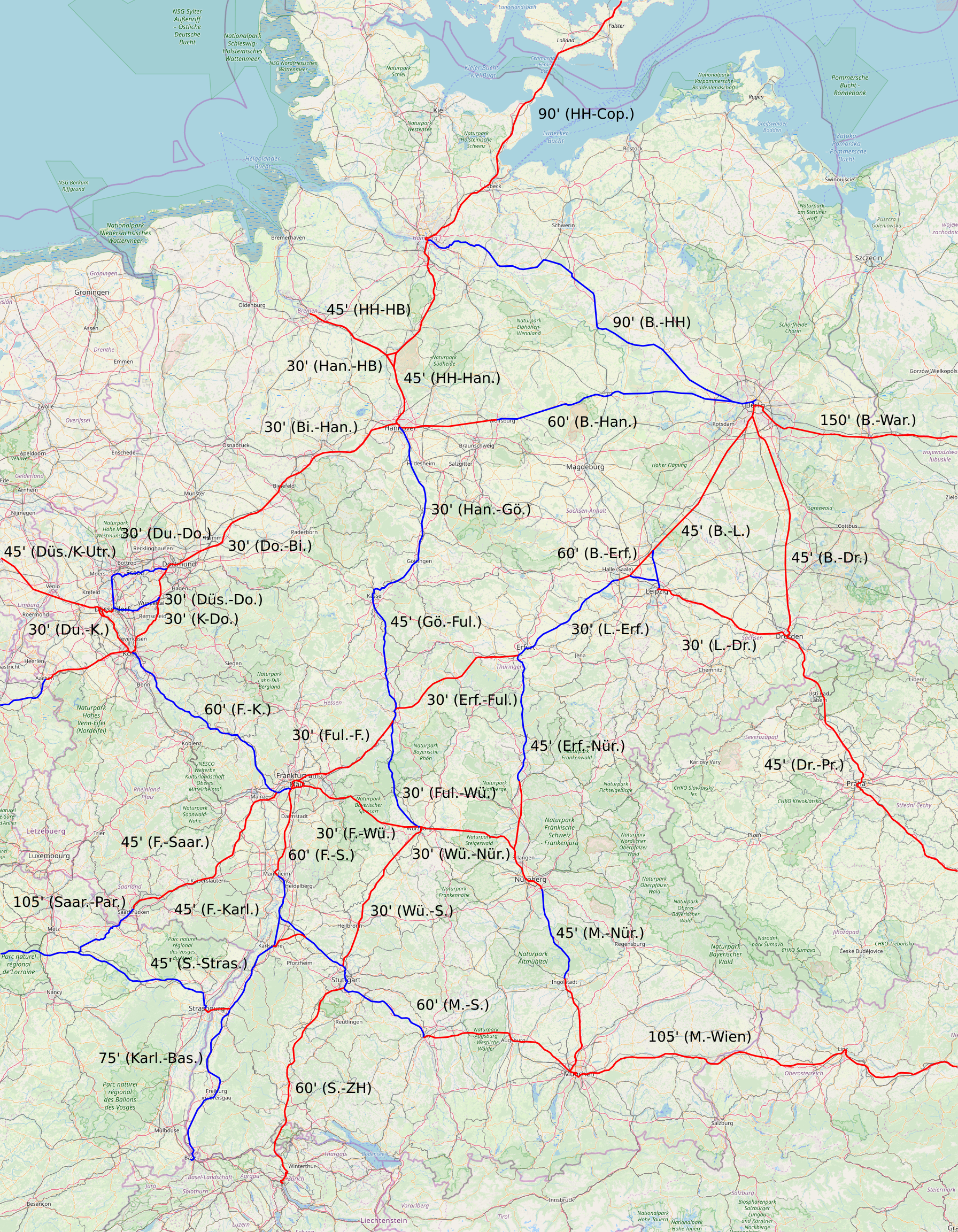
In the above map, the trip times are very aggressive – Berlin-Hanover in an hour is doable nonstop but barely and the sort of advocates who think train performance levels are still stuck in the 1990s may think it is impossible to do better than 1:30. But the 2020s are not the 1990s, thankfully.
The important thing to note is that not only does it connect all major city pairs, but also there is no alternative that has that feature. The Deutschlandtakt without further investments in speed connects Berlin and Munich in 4 hours, which is borderline for high-speed rail; in Cascetta-Coppola, the elasticity of ridership with respect to travel time in Italy ranges between -2.2 and -1.6, so going from 4 hours to 2.5 more than doubles ridership, for less cost than it’s taken to get to 4 hours so far since Germany has built the hardest segment first and much of what remains is in the pancake-flat North German Plain. With high-speed rail, the longest distance between two major cities, Hamburg-Munich, is 3:45, compared with 5:20 in the D-takt.
This also cascades to the roughly half of Germany that lives outside the metropolitan areas. A smaller city like Rostock, Münster, Regensburg, or Halle gets a connection to the national network either way; the D-takt actually only gives Rostock and Regensburg two-hourly rather than hourly connections to the nearest major node. It takes an hour under the D-takt to get between Regensburg and Nuremberg; the connections between Regensburg and the rest of the country depend primarily on how fast trains are between Nuremberg and the other million-plus urban areas.
Germany benefits from having centrally-located train stations everywhere, making transfers already easier than in France, where Paris has four distinct TGV terminals. Getting between two Parisian stations’ lines requires using a bypass, on which trains run at low frequency, at best stopping at Marne-la-Vallée and CDG, both 30 km from city center. In contrast, Germany train stations are set up for through service except Frankfurt, which is about to get an announcement for a through-service tunnel. To the extent that any bypasses are needed here, they’re because a station’s tracks point the wrong way for some through-service, as in Cologne and (even after through-service opens) Frankfurt; in both cases there’s a convenient near-center station, that is Deutz within walking distance of Cologne Hbf and Frankfurt Airport 10 km from Hbf, and at any rate the lines would have far more demand if speeds between major cities rose to French levels, so the frequency wouldn’t suffer.
Polycentricity and high-speed rail
Polycentricity does not make high-speed rail an inappropriate choice for intercity transportation. It’s neutral, and the urban geography of Germany, in terms of density and city size, is conducive to such a network. The question at this point is not about building a single line like Paris-Lyon, but about completing the half-built system that Germany has, and at that scale, having many major cities is not a problem at all.
So why do German activists keep bringing up polycentricity? I have a few explanations, none legitimate:
- Germans look down on France, and bring up the most glaring differences to justify not learning. I’ve spent more than a decade watching Americans make up the silliest reasons why they can’t learn from Europe, reasons that are often unrecognizable to a European (“American cities weren’t bombed in WW2” – but neither was Paris). The same is visible internally to Europe, where Germany will not learn from France or Southern Europe.
- Polycentricity is a convenient excuse to morally elevate rural and pretend-rural life over the big city, a common romantic trope in an arc from 19th-century nationalism to the modern New Left. High-speed rail breaks this pretense: it centers the largest cities, and tells the rest that their participation in national transport comes from their connections to large cities, which the romantics find deeply immoral. For the same reason, the German New Left finds subways less moral than streetcars.
- Older activists are stuck in the past, when they were younger. In the 1980s, European high-speed rail meant Paris-Lyon, and not the national TGV network. At the scale of Paris-Lyon, Germany’s lack of a Paris indeed weakens high-speed rail. But it’s not the 1980s anymore; at this point the question is about completing fast links like Hamburg-Hanover and Erfurt-Frankfurt, not building the first link. My impression is that younger Greens support high-speed rail more than older ones, who joined the party to express opposition to nuclear power rather than support for immigration.
Looking forward rather than backward, nothing in Germany’s urban geography is an obstacle to a connected high-speed rail network. With central stations and less of the population living in truly isolated rural and small-city communities, Germany can expect to greatly surpass any other Western intercity rail network if it builds high-speed rail, more than reaching DB’s pre-corona 250 million ridership target.
Quick Note: Deterioration of Speed
A regrettable feature of rail transport is that often, the speed of a line deteriorates over time after it opens or finishes a major upgrade. This can come from deferred maintenance or from proper maintenance that includes stricter speed limits or more timetable padding; in either case, it’s because maintaining the original schedule is not seen as a priority, and thus over time service degrades. In some cases, this can also include a deterioration of frequency over time, usually due to inattention.
This is not excusable behavior. The networks where this feature exists, including the US, France, and Germany, are not better-run than the Shinkansen, where I have not seen any such deterioration of Shinkansen speed in many years of poking around timetables on Hyperdia, or the system in Switzerland. Switzerland’s timed transfers make it impossible for gradual deterioration of speed to accumulate – trains are scheduled to just make connections to other trains at major nodes, and so if they slow down too much then they can’t make the transfers and the entire network degrades.
I wish I could say degradation is a purely American phenomenon. It’s very common in the United States, certainly – on the subway in New York the deterioration made citywide news in 2017 (including one piece by me), on the trains between New York and New Haven the schedule is visibly slower now than it was in the late 2000s, on Amtrak the Northeast Corridor has degraded since the 2000s. Speed is not viewed as a priority in the US, and so there are always little excuses that add up, whether they’re flagging, the never ending State of Good Repair program on the New Haven Line under which at no point in the last 20-25 years have all four tracks been in service at the same time, or just inattention to reliability.
But no. France and Germany have had this as well. The TGV used to run between Paris and Marseille in 3:03 every two hours and in 3:06 every other hour; today I see a 3:04 itinerary every four hours and the rest start at 3:11. And here, the Berlin-Hamburg trains were timetabled at 1:30 in the mid-2000s, giving an average speed of 189 km/h, the highest in Germany even though the top speed is only 230 and not 300; the fastest itinerary I can find right now is 1:43, averaging only 165 km/h.
I stress that such deterioration does not have any benefits. It’s an illusory tradeoff. When New York chose to slow down the L trains’ braking rate as part of CBTC installation, this was not seen in reduced systemwide maintenance costs; speed just wasn’t a priority, so the brakes were derated. The 7 train, as I understand it, will instead speed up when CBTC comes online, a decision made under Andy Byford’s program to speed up service.
Nor has France saved anything out of the incremental slowdowns in TGV service. Operating costs are up, not down. The savings from slowdowns are on the illusory to microscopic spectrum, always trumped by increases in cost from other sources, for example the large increases in wages in the 2010s due to the cheminot strikes.
By far the greatest cost of speed is during construction. During operations, faster service means lower crew costs per km. This is where the Swiss maxim of running trains as fast as necessary comes from. This isn’t about derating trains’ acceleration – on the contrary, Switzerland procures high-performance trains. It’s about building the least amount of physical infrastructure required to maintain a desired timetable, and once the infrastructure is built, running that timetable.
 Pedestrian Observations
