Category: Germany
Berlin’s U-Bahn Expansion Plan
An obscure change in German benefit-cost analysis regulations has led to expansive proposals for urban rail construction in Germany. In Berlin, where ongoing coalition negotiations between CDU and SPD are leading in a developmentalist cars-and-trains direction, this led BVG to propose a massive program for growing the U-Bahn from its current 155 km of route-length to 318. The BVG proposal is split fairly evenly between good lines and lines that duplicate the S-Bahn and have little transportation value, and yet I’ve not seen much discussion of the individual technical merit of the program. Instead, anti-developmental activists who think they’re being pro-environment, such as BUND, regurgitate their anti-U-Bahn conspiracy theories and go to the point of associating subway tunneling with the Nazis. (I, unlike native Europeans, associate the Nazis with the Holocaust instead.)
What is the BVG proposal?
A number of media outlets have produced maps of the proposal; here is Tagesspiegel’s, reproduced here because it shows S-Bahn and regional lines as thin but visible lines.

All nine lines of the U-Bahn are to be extended, most in both directions; U3 and U4, currently a branch of U1 and a low-ridership shuttle line respectively, are to be turned into full main lines via Mitte. In addition, a ring line called U0 is to be built, duplicating the Ringbahn on its western margin and taking over some lines currently planned as radial extensions to Tegel, and running as a circumferential at consistently larger radius than the Ring to the south, east, and north.
Background
The immediate news leading BVG to propose this plan is a combination of federal and city-level changes. The federal change is obscure and I only saw it discussed by one low-follower account on Twitter, Luke Horn. Luke points out that after years of red tape, the federal government finally released its updated benefit-cost analysis regulations. As those are used to score projects, city and state governments are required to follow exact rules on which benefits may be counted, and at what rate.
One of these benefits is modal shift. It’s notoriously hard to measure, to the point that anti-U-Bahn advocates argued based on one low-count measurement that U-Bahn construction generated more emissions than it saved through modal shift; their study has just been retracted for overestimating construction emissions, but the authors are unrepentant.
At any rate, on the 21st, the new federal rules were finally published. Greenhouse gas emissions avoided through modal shift are to be counted as a benefit at the rate of 670€ per metric ton of CO2 (see PDF-p. 243). This is a high number, but it’s only high when it comes to pushing carbon taxes through a political system dominated by old climate denialists; by scientific consensus it’s more reasonable – for example, it’s close to the Stern Report estimates for the 2020s. If Germany imposed a carbon tax at this rate, and not the current rate of 55€/t, the fuel price here would grow by around 1.50€/liter, roughly doubling the price and helping kill the growing market for SUVs and luxury cars. If that is the rate at which modal shift is modeled, then even with an undercount of how urban rail construction substitutes for cars, many otherwise marginal lines pencil out.
The city-level change is that Berlin just had a redo of the 2021 election, and while technically the all-left coalition maintained its majority, CDU got the most votes, which gave Mayor Franziska Giffey (SPD) the excuse she needed to break the coalition and go into a grand coalition negotiation with CDU. Giffey had had to resign from the federal cabinet in the late Merkel era when it turned out that she had plagiarized her thesis, leading the university to revoke her degree, but out of shamelessness she remained Berlin SPD’s mayoral candidate and won in 2021. The Greens thought little of having to serve under such a scandalized mayor, and out of personal pettiness, Giffey, politically well to the right of most SPD voters anyway, accused them of personally disrespecting her and went into negotiations with CDU.
The importance of this is that the Greens (and Die Linke) are a pro-tram, anti-U-Bahn, NIMBY party. When CDU and SPD said they’d finally develop the parade of Tempelhofer Feld with housing, an advisor to a Green Bundestag member accused them of wanting to develop the area out of personal spite, and not, say, out of wanting Berlin to have more housing. Under the all-left coalition, U-Bahn planning continued but at a slow pace, and by far the most important extension on a cost per rider basis, sending U8 north to Märkisches Viertel, was deprioritized; CDU’s campaign in the election was mostly about parking and opposition to road diets, but it also hit the Greens on their opposition to U-Bahn development.
The plan as it stands has a few sops to CDU. The U0 ring is the most significant: in a country where the median age is 45, under-18s can’t vote, and CDU is disproportionately an old people’s party, CDU’s median voter was an adult through the era of the Berlin S-Bahn Boycott, as both halves of the S-Bahn were run by the East during the Cold War. Where CSU supports the Munich S-Bahn as a vehicle for conservatives to move away from the left-wing city while still having access to city jobs, Berlin CDU is uniquely more negative toward the S-Bahn. Thus, the plan has a line that mostly duplicates the Ring. The U2 expansion to the west duplicates the S-Bahn as well, especially west of Spandau. Finally, the proposed western terminus of U1 is explicitly billed as a park-and-ride, which type of service Berlin CDU has long supported.
But other than the U0 ring, the plan is not too different from things that have long been planned. The longest segment other than U0 is the U3 extension to the northeast; this was part of the 200 km plan already in the 1950s, except originally the plan for this extension was not to hook into U3 as on post-Cold War plans but to run along an alignment closer to that of U9, whose southern terminus at Rathaus Steglitz was even built with room for this line, then numbered U10. A fair number of other sections on BVG’s map have a long history of languishing in unfavorable benefit-cost ratios. Other than U0, the plan is rather similar to what was studied in 2019:
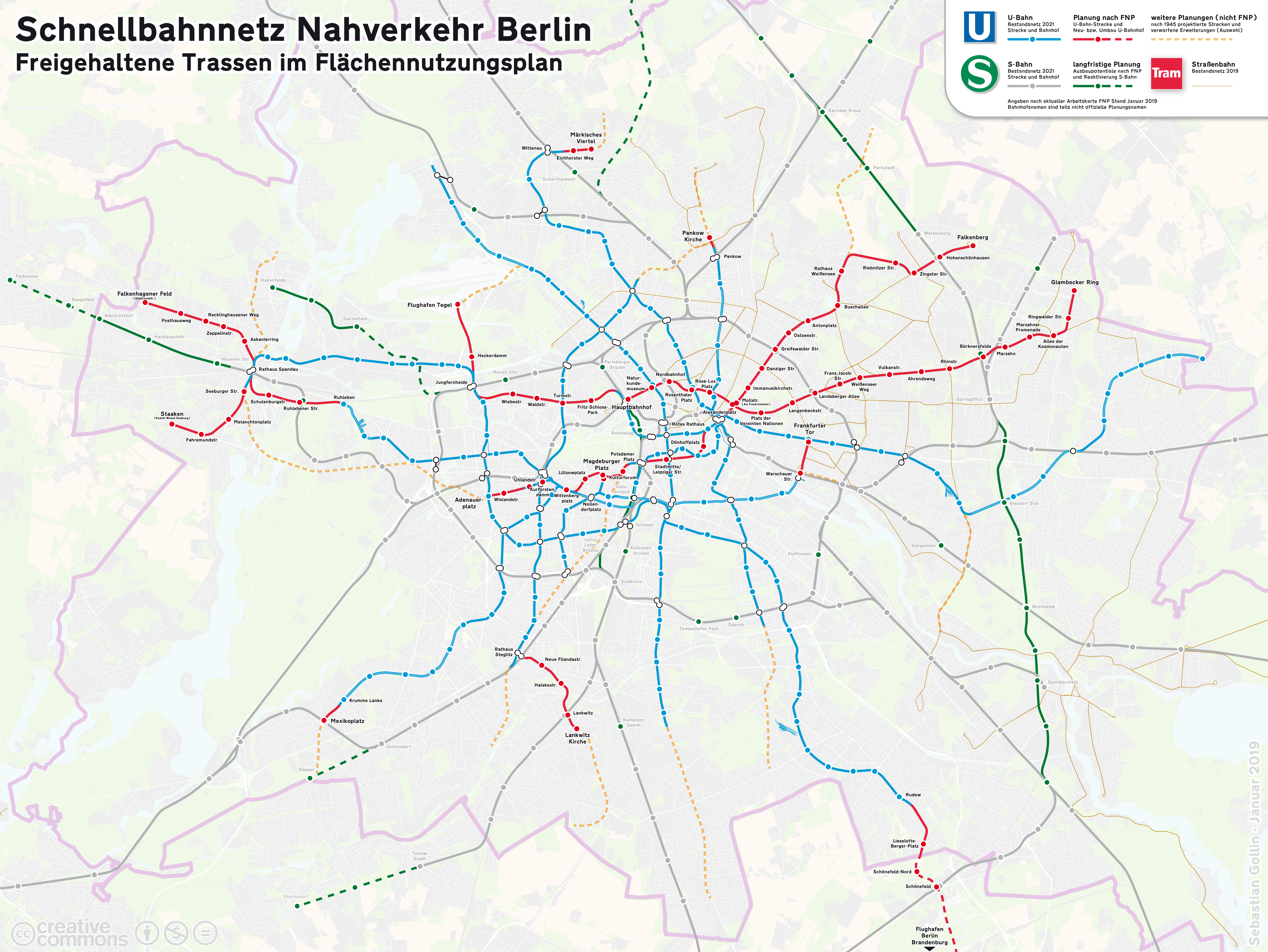
However, this history has not prevented people from literally comparing BVG’s plan to the Nazis. The more prosaic reality is that the 1938 Welthauptstadt Germania U-Bahn expansion plan, other than its ring (built inside of the Ringbahn, the opposite of U0), made it to the 200 km plan and most of the lines it proposed were built, the largest change being that Cold War realities made West Berlin build U7 and U9 to serve the center of West Berlin at the Zoo rather than as additional lines serving Mitte.
The issue of costs
I have not seen an official cost estimate. BUND, which opposes the plan on the grounds that building tramways is better, says that it would cost 35 billion euros. Judging by recent construction costs of realized and proposed lines in Berlin, I think this estimate is broadly correct, if the project is run well.
The estimate is then about 210 million €/km, which looks realistic. The construction of the U5 extension from Alexanderplatz to Brandenburger Tor opened in 2020 at a cost of 280 million €/km in 2022 prices, but that was in the very center of the city, including a station at Museumsinsel mined directly beneath the Spree, for which BVG had to freeze the sandy soil. Conversely, the estimates of outer extensions that were already under planning before a week ago are lower: U7, the most advanced of these, is projected at 890 million € for about 8 km, or 110 million €/km, in an unusually easy (not really urbanized) tunneling environment.
The risk is that such a large project, done all at once, would strain the planning capacity of Berlin and Brandenburg. This exact risk happened in Paris: at 205 million €/km for 80% underground construction Grand Paris Express is more expensive per km than smaller Métro extensions built in the 2010s as it’s so large the region ran out of in-house planning capacity, and its response, setting up a British-style special purpose delivery vehicle (SPDV) along the lines of Crossrail, has resulted in British-style permanent loss of state capacity. Now, even the short Métro extensions, like the planned eastern M1 extension, cost more like GPE and not like similar projects from 10 years ago.
Notably, while France and the Nordic countries are seeing growing construction costs (France from a medium-low level and the Nordic countries from a very low one), Germany is not. I haven’t been able to find historic costs for Berlin with few exceptions. One of those exception, the last section of U9, cost 235 million € in 2022 prices for 1.5 or 1.6 km, or around 150 million €/km; this was built in 1968-74, in a relatively easy area, albeit with extra costs as noted above preparing for the U10 line. Another exception is the final section of U7 to Spandau, which cost around 800 million € for 4.9 km, or around 160 million €/km. Taken together with some numbers I posted here, it’s notable that in the 1970s, the construction costs per km in Italy, Germany, and the UK were all about the same but since then German costs have stayed the same or at worst inched up, Italian costs have fallen due to the anti-corruption laws passed in the wake of mani pulite, and British costs have quadrupled.
The most frustrating part of this discourse is that I’ve yet to see a single German rail advocate express any interest in the issue of costs. The critics of U-Bahn and other rail transport expansion plans who cite costs, of which BUND is a prime example, never talk about how to make metro construction in Germany cheaper; instead, they use it as an argument for why building underground railways is a waste of money, and urban rail must take the form of streetcars, which are held to be not only cheaper but also more moral from a green point of view as they annoy drivers. The same problem crops up in the discourse on high-speed rail, where Germany makes fairly easily fixable mistakes, generally falling under the rubric of over-accommodation of NIMBYs, and thus instead of figuring out how to build more lines, advocates write the idea off as impractical and instead talk about how to run trains on slow lines.
Can Berlin make do with streetcars?
No.
The problem with streetcars is that, no matter how much priority they get over other street traffic, they’re still slow. T3 in Paris, about the most modern urban tramway I’ve seen, running in a grassy reservation in the middle of the 40 meter wide Boulevards des Maréchaux, averages 18 km/h. The Berlin streetcars average 17.6 km/h; they don’t have 100% dedicated lanes at places, but for the most part, they too are run to very high standards, and only minor speedups can be seriously expected. Meanwhile, the U-Bahn averages 30.5 km/h, which is on the high side for the 780 m stop spacing, but is without driverless operations, which raised Paris’s average speed on M1 with its 692 m interstation from 24.4 to 30 km/h, at least in theory. The best Berlin can do with tramway modernization is probably around 20 km/h; the best it can do with the U-Bahn is probably 35 km/h, and with the S-Bahn maybe 45 km/h.
And Berlin is already large enough to need the speed. Leipzig is a good example of an Eastern city maintaining modal split with no U-Bahn, just streetcars and a recently-opened S-Bahn tunnel; in 2018, its modal split for work trips was 47% car, 20% public transport, 22% bike, 11% pedestrian (source, p. 13). But most of the walkable urban area of Leipzig is contained within a four kilometer radius of the main train station, a large majority of the city’s population is within six, and by eight one is already in the suburbs. Slow transportation like bikes and trams can work at that scale, to an extent.
In contrast with Leipzig’s smaller scale, I live four km from Berlin Hauptbahnhof and I’m still in Mitte, albeit at the neighborhood’s southeastern corner where Hbf is at the northwestern one. From the most central point, around Friedrichstrasse, both the Zoo and Warschauer Strasse are four km away, and both have high-rise office buildings. At eight km, one finally gets to Westkreuz and ICC-Messe, Steglitz, Lichtenberg, and the former airport grounds of Tegel; Gropiusstadt, a dense housing project built as transit-oriented development on top of U7, is 13 km from Friedrichstrasse by straight line.
The actual average speed, door-to-door, is always lower than the in-vehicle average speed. There’s access time, which is independent of mode, but then wait times are shorter on a high-intensity metro system than on a more diffuse streetcar network, and extra time resulting from the fact that rail lines don’t travel in a straight line from your home to your destination scales with in-vehicle travel time.
Leipzig’s modal split for work trips is 47% car, 20% public transport. Berlin’s is 28% car, 40% public transport. This is partly because Berlin is bigger, but mostly related to the city’s U-Bahn network; closer to Leipzig’s size class, one finds Prague, with a larger per capita urban rail ridership than Berlin or even Paris, with a system based on metro lines fed by streetcars and high-intensity development near the metro.
Berlin’s multiple centers make this worse. The same tram-not-subway NIMBYs who oppose U-Bahn development believe in building polycentric cities, which they moralize as more human-scale than strong city centers with tall buildings (apparently, Asia is inhuman). The problem is that when designing transportation in a polycentric city, we must always assume the worst-case scenario – that is, that an East Berliner would find work near the Zoo or even at ICC and a Spandauer would find it in Friedrichshain. The Spandauer who can only choose jobs and social destinations within streetcar distance for all intents and purposes doesn’t live in Berlin, lacking access to any citywide amenities or job opportunities; not for nothing, Spandauers don’t vote for NIMBYs, but for pro-development politicians like Raed Saleh.
Truly polycentric cities are not public transport-oriented. Upper Silesia is auto-oriented while Warsaw has one of Europe’s strongest surface rail networks. In Germany, the Rhine-Ruhr is an analog: its major cities have strong internal Stadtbahn networks, but most of the region’s population doesn’t live in Cologne or Essen or Dortmund or Dusseldorf, and the standard way to get between two randomly-selected towns there, as in Silesia, is by car.
The reason BUND and other NIMBYs don’t get this is a historical quirk of Germany. The Stadtbahn – by which I mean the subway-surface mode, not the Berlin S-Bahn line – was developed here in the 1960s and 70s, at a time of rapidly rising motorization. The goal of the systems as built in most West German cities was to decongest city center by putting the streetcars underground; then, the streetcar lines that fed into those systems were upgraded and modernized, while those that didn’t were usually closed. The urban New Left thus associates U-Bahn construction with a conspiracy to get trains out of cars’ way, and Green activists have reacted to the BVG plan by saying trams are the best specifically because they interfere with cars.
That belief is, naturally, hogwash. The subway-surface trolley, for one, was invented in turn-of-the-century Boston and Philadelphia, whose centers were so congested by streetcars, horsecars, and pedestrians that it was useful to bury some of the lines even without any cars. The metro tunnel was invented in mid-Victorian London for the same reason: the route from the train terminals on Euston Road to the City of London was so congested with horsecars there was demand for an underground route. Today, there’s less congestion than there was then, but only because the metro has been invented and the city has spread out, the latter trend raising the importance of high average speed, attainable only with full grade separation.
BUND and others say that the alternative to building 170 km of U-Bahn is building 1,700 km of streetcar. Setting aside that streetcars tend to be built in easier places and I suspect a more correct figure than 1,700 is 1,000 km, Berlin can’t really use 1,700 or 1,000 or even 500 km of tramway, because that would be too slow. Saturating every major street within the Ring with surface rail tracks would run into diminishing returns fast; the ridership isn’t there, getting it there requires high-density development that even SPD would find distasteful and not just the Greens, and streetcars with so many intersections with other streetcars would have low average speed. I can see 100-200 km of streetcar, organized in the Parisian fashion of orbital lines feeding the U- and S-Bahn; M13 on Seestrasse is a good example. But the core expansion must be U- and S-Bahn.
Okay, but is the BVG plan good?
Overall, it’s important for Berlin to expand its U- and S-Bahn networks, both by densifying them with new trunk lines and by expanding them outward. However, some of the lines on the BVG map are so out there that the plan is partly just crayon with an official imprint.
Core lines
The way I see it, the proposal includes 2.5 new trunk lines: U3 (again, formerly planned as U10), U4, and the western extension of U5.
Of those, U3 and U5 are unambiguously good. Not for nothing, they’ve been on the drawing board for generations, and many of their difficult crossings have already been built. Jungfernheide, where U5 would connect with U7, was built with such a connection in mind; the plan was and to an extent remains to extend U5 even further, sending it north to what used to be Tegel Airport and is now a planned redevelopment zone as the Urban Tech Republic, but the new BVG proposal gives away the Tegel connection to the U0 ring.
The U3 and U4 trunks in fact are planned along the routes of the two busiest tramways in the city, the M4 and combined M5/M6/M8 respectively (source, p. 7). The U3 plan thus satisfies all criteria of good subway construction – namely, it’s a direct radial line, in fact more direct than U2 (built around and not on Leipziger Strasse because the private streetcar operator objected to public U-Bahn development on its route), replacing a busy surface route. The U4 expansion mostly follows the same criterion; I am less certain about it because where M5 and M6 today serve Alexanderplatz, the proposed route goes along that of M8, which passes through the northern margin of city center, with some employment but also extensive near-center residential development near the Mitte/Gesundbrunnen boundary. I’m still positive on the idea, but I would rate it below the U3 and U5 extensions, and am also uncertain (though not negative) on the idea of connecting it from Hbf south to U4.
The U5 extension parallels no streetcar, but there’s high bus ridership along the route. The all-left coalition was planning to build a streetcar instead of an U-Bahn on this route. If it were just about connecting Jungfernheide to Hbf I’d be more understanding, but if the Urban Tech Republic project is built, then that corner of the region will need fast transportation in multiple directions, on the planning principle outlined above that in a polycentric city the public transport network must assume the worst-case scenario for where people live and work.
Outward extensions
All of Berlin’s nine U-Bahn lines are planned with at least one outward extension. These are a combination of very strong, understandable, questionable, and completely drunk.
The strongest of them all is, naturally, the U8 extension to Märkisches Viertel. In 2021, it was rated the lowest-cost-per-rider among the potential extensions in the city, at 13,160€/weekday trip; the U7 extension to the airport is projected to get 40,000 riders, making it around 22,000€/trip. It has long been to the city’s shame that it has not already completed this extension: Märkisches Viertel is dense, rather like Gropiusstadt on the opposite side of the city except with slightly less nice architecture, and needs a direct U-Bahn connection to the center.
Several other extensions are strong as well – generally ones that have been seriously planned recently. Those include U7 to the airport, the combination of the one-stop expansion of U2 to Pankow Kirche and the northeastern extension of U9 to intersect it and then terminate at the S-Bahn connection at Pankow-Heinersdorf, and U7 to the southwest to not just the depicted connection to U1 at Gatower Strasse but also along the route that the new plan gives to U1 to Heerstrasse.
The U3 expansion to the southwest is intriguing in a different way. It’s a low-cost, low-benefit extension, designed for network completeness: a one-stop extension to the S-Bahn at Mexikoplatz is being planned already, and the BVG plan acknowledges near-future S-Bahn plans adding a new southwestern branch and connect to it at Düppel.
Unfortunately, most of the other radial extensions go in the opposite direction from U3: where U3 acknowledges S-Bahn expansion and aims to connect with it, these other plans are closely parallel to S-Bahn lines that are not at capacity and are about to get even more capacity soon. Spandau, in particular, sees a train every 10 minutes; the Stadtbahn’s core segment has three trains in 10 minutes, with more demand from the east than from the west, so that a train every 10 minutes goes to Spandau, another goes to Potsdam, and a third just turns at Westkreuz since demand from the west is that weak. Creating more demand at Spandau would rebalance this system, whereas building additional U-Bahn service competing with current S-Bahn service (especially the U1 plan, which loses benefit west of the Ring) or with future expansion (such as U2 – compare with the expansion on the 2019 plan) would just waste money.
The southern extensions are a particularly bad case of not working with the S-Bahn but against it. The North-South Tunnel has 18 peak trains per hour, like the Stadtbahn; this compares with 30 on the trunk of the Munich S-Bahn. The ongoing S21 project should divert southeast, but as currently planned, it’s essentially a second North-South Tunnel, just via Hbf and not Friedrichstrasse, hence plans to beef up service to every five minutes to Wannsee and add branches, such as to Düppel. This massive increase in S-Bahn capacity is best served with more connections to the S-Bahn south of the Ring, such as east-west streetcars feeding the train; north-south U-Bahn lines, running more slowly than the S-Bahn, are of limited utility.
Finally, the extension of U1 to the northeast is a solution looking for a problem. U1’s terminus is frustratingly one S-Bahn stop away from the Ring, and perhaps the line could be extended east. But it points north, and is elevated, and past the U5 connection at Frankfurter Tor there’s no real need to serve the areas with another line to Friedrichshain.
The ring
The radial component of the BVG plan includes good and bad ideas. In contrast, the U0 ring is just a bad idea all around. The problem is that it doesn’t really hit any interesting node, except Tegel and Westkreuz, and maybe Steglitz and Pankow; Alt-Mariendorf, for example, is not especially developed. Berlin is polycentric within the Ring, but the importance of destinations outside it is usually low. This should be compared with Grand Paris Express’s M15 ring, passing through La Défense and the Stade de France.
Where circumferential service is more useful is as a feeder to S- and U-Bahn lines connecting people with the center. However, metro lines don’t make good feeders for other metro lines; this is a place where streetcars are genuinely better. The required capacity is low, since the constraints are on the radial connection to the center. The expected trip length is short and a transfer is required either way, which reduces the importance of speed – and at any rate, these outer circumferential routes are likely less congested, which further reduces the speed difference. The differences in cost permit streetcars to hit multiple stations on each line to connect with (though this means two parallel lines, not ten); this is not the same as fantasies about 1,700 km of streetcar in areas where people vote Green.
Is this a good plan?
Well, it’s about half good. Of the 163 km in BVG’s proposal, I think around 68 are good, and the rest, split between the U0 ring and the less useful outer extensions, should be shelved. That’s the crayon element – parts of the plan feel like just drawing extra extensions, by which I mean not just U0 but also the southern extensions.
However, substantial expansion of the U-Bahn is obligatory for Berlin to maintain healthy growth without being choked by cars. NIMBY fantasies about deurbanizing workplace geography would make the city more like Los Angeles than like their ideal of a 15-minute bikable small city center. Berlin needs to reject this; small is not beautiful or sustainable, and the city’s transport network needs to grow bigger and better with a lot more subway construction than is currently planned.
What’s more, the fact that construction costs in Germany are fundamentally the same in real terms as they were 40-50 years ago means that the country should accelerate its infrastructure construction program. Benefits for the most part scale with national GDP per capita – for example, the value of time for commuters, students, and other travelers so scale. Ignoring climate entirely, lines that were marginal in 1980 should be strong today; not ignoring climate, they are must-builds, as is high-density housing to fill all those trains and enable people to live in a desirable city with low car usage.
FDP and Vice Signaling
Finance Minister Christian Lindner (FDP) just tweeted that more investment in roads is good – because if traffic flows more smoothly then there will be less greenhouse gas emissions. Reaction was not positive, and as of when I’m writing, 16 hours later, it is mildly ratioed. People understand that this is wrong. Lindner himself probably gets this too. Understanding what’s going on here requires talking about bullshit in the philosophical sense of Harry Frankfurt, and about something that I don’t have a better name for than vice signaling.
Is it true?
Absolutely not. It’s standard in transport studies that the construction of more highways in high-demand areas induces more traffic, as people take advantage of the greater convenience of driving. Drivers drive to new destinations that they forwent or chose to take public transport to, and new developments are built in areas opened by new highway development.
There may be exceptions to this in declining areas. The United States loves building new grade-separated interchanges in declining regions. This doesn’t generate new demand, because traffic is already uncongested, and the purpose of roadbuilding there is a political statement more than transport policy. But that’s not Germany. The roads under discussion here are in growth regions: there’s a plan to widen the beltway around Munich, A99, to 10 lanes, and the federal and Berlin FDP have both badgered Berlin to build a further stage of A100 parallel to the Ringbahn, which the city wants not to under the influence of the Green Party. Both motorway projects are likely to lead to adverse mode shift if built, and Lindner knows this.
There’s a developmental argument that induced demand is actually good. Matt Yglesias has made it before, saying that if road building induces more traffic then it means people get to take more trips and are better off. Many roadbuilders have made that very argument, and others were aware of it; Robert Moses, for example, was perfectly aware that his parkways and bridges were inducing more car traffic, and was fine with it, because he thought more driving was good. But that’s not what Lindner is saying: Lindner is saying that building new motorways and keeping them without a speed limit reduces greenhouse gas emissions, which is just bullshit.
Bullshit
The term “bullshit” has a precise meaning in analytic philosophy, due to Harry Frankfurt. It comprises a type of deception about the speaker’s mindset, rather than about the facts, unlike an ordinary lie. A politician who denies a scandal they are involved with is lying: their goal is to get you to believe that they are innocent of this scandal. A politician who, having been caught in said scandal, launches a series of schlock patriotic speeches is bullshitting: their goal is to get you to think they are fundamentally aligned with your values. From Frankfurt’s original essay, we have,
Telling a lie is an act with a sharp focus. It is designed to insert a particular falsehood at a specific point in a set or system of beliefs, in order to avoid the consequences of having that point occupied by the truth. This requires a degree of craftsmanship, in which the teller of the lie submits to objective constraints imposed by what he takes to be the truth. The liar is inescapably concerned with truth-values. In order to invent a lie at all, he must think he knows what is true. And in order to invent an effective lie, he must design his falsehood under the guidance of that truth. On the other hand, a person who undertakes to bullshit his way through has much more freedom. His focus is panoramic rather than particular. He does not limit himself to inserting a certain falsehood at a specific point, and thus he is not constrained by the truths surrounding that point or intersecting it. He is prepared to fake the context as well, so far as need requires. This freedom from the constraints to which the liar must submit does not necessarily mean, of course, that his task is easier than the task of the liar. But the mode of creativity upon which it relies is less analytical and less deliberative than that which is mobilized in lying. It is more expansive and independent, with mare spacious opportunities for improvisation, color, and imaginative play. This is less a matter of craft than of art. Hence the familiar notion of the “bullshit artist.”
The statement “widening roads reduces CO2 emissions” is this kind of bullshit. It is not quite a lie: it is false, but Lindner is not especially concerned with whether it is true or false. His goal is not to persuade people that building another section of A100 and widening A99 is good for climate; nobody who cares about climate change thinks that. Rather, his goal is to position himself as the sort of person who doesn’t listen to climate advocates and will just push for road widenings. The deception is part of the positioning: if he’d said that he understands the Greens’ argument against road investment but roads are important for economic development, he’d come off as too reasonable, which is not his intention.
Sounding deliberately unreasonable is the domain of populist politicians, and Frankfurt himself and many of his followers have noticed how political bullshit is on the rise as populism grows more normalized. Nigel Farage, for example, bullshitted that smoking isn’t bad for your health. And FDP is a populist party, despite its liberal origins and relatively moderate political positioning; it swung from deficit scold at the start of the current government to tax scold precisely as inflation rose last year, the opposite of what one should expect of a Washington Consensus-following economically orthodox party.
Vice signaling
There’s a pseudo-academic term going around the web, virtue signaling. The idea is that individuals and organizations engage in actions to signal that they’re better people than they really are; companies hire consultants on diversity, equity, and inclusion (DEI) without ever doing anything about their glass ceiling and harassment problems.
But it may be more fruitful to discuss its opposite – that is, vice signaling. This is when people take actions to portray themselves as terrible people, for any number of reasons:
- Loyalty: criminal gangs are deliberately threatening and often require that prospective members commit murder (this is a requirement to become a made man in the Italian-American mafia), because this forces new members to have crossed both a moral and a legal event horizon from which they can’t come back; populist political movements don’t require crimes, but do require ridiculous beliefs
- Novelty: this is what in the online language of the early 2010s was called the Slate Pitch – a take that aims to be novel by saying something really out there, often by writers who can’t separate themselves from the rest of the pack by any more productive means
- Love of power: some people lie to you, with your full knowledge that they’re lying, just to flex that they can get away with it
Lindner loves this kind of vice signaling, I think out of novelty more than anything. FDP could be a party of YIMBYism, fiscal conservatism, and digital governance; younger members of the party who identify with neoliberalism wish that it were that party. The problem is that the difference between such a party and SPD is not large; Scholz ran on building more housing Germany-wide, and there’s a fair amount of consensus in favor of this in the party’s wings. SPD’s worst attributes so far are its officious leadership anchored in the Lower Saxony clique and consequently its sluggish governance and refusal to do more to support Ukraine – but FDP has the exact same problems, Lindner having told Ukraine when it asked for aid as the war started that there was no point since they’d fall in hours either way.
So to distinguish themselves from everyone else, FDP engages in vice signaling about climate and transport. They’re not trying to convince anyone that their policies are good for climate change. Rather, they’re doing the exact opposite: they’re trying to convince center-right voters that they’re an internal opposition within a coalition that is engaging in modal shift in federal funding priorities, and that they are explicitly against any climate action, because cars are good and only annoying hippies prefer trains.
Free Public Transport, Fare Integration, and Capacity
There’s an ongoing debate about free public transport that I’m going to get into later, but, for now, I want to zoom in on one aspect of the 9€ ticket, and how it impacted public transport capacity in Germany. A commenter on the Neoliberal Reddit group claimed that during the three months of nearly free public transport fares, there was a capacity crunch due to overuse. But in fact, the impact was not actually significant on urban rail, only on regional trains, in a way that underscores the importance of fare integration more than anything.
What was the 9€ ticket?
Last year, in the wake of the Russian invasion of Ukraine, fuel prices shot up everywhere. This created populist pressure to alleviate the price of fuel through temporary tax cuts, which further exacerbated last year’s high inflation. The center-right element within the German coalition, FDP, moved away from its traditional position as deficit scold and demanded a cut in the fuel tax; as a compromise, the Greens agreed to it on condition that during the three months of reduced fuel tax, June through August, public transport fares would be cut as well. Thus the 9€ monthly was born.
The 9€ ticket applied throughout Germany. The key feature wasn’t just the deep discount but also the fact that on one ticket, people could travel all over Germany; normally, my Berlin monthly doesn’t let me ride the local trains in Leipzig or Munich. This stimulated massive domestic tourism, since people could travel between cities on slow regional trains for free and then also travel around their destination city for free as well.
What now?
The 9€ ticket clearly raised public transport ridership in the three months it was in effect. This led to demands to make it permanent, running up against the problem that money is scarce and in Germany ticket fares generate a significant proportion of public transport revenue, 7.363 billion € out of 14.248 billion € in expenses (source, p. 36).
One partial move in that direction is a 29€ monthly valid only within Berlin, not in the suburbs (zone C of the S-Bahn) or outside the system; unlike the 9€ ticket, which was well-advertised all over national and local media and was available at every ticketing machine, the 29€ monthly is only available via annual subscription, which requires a permanent address in the city, and the regular machines only sell the usual 86€ monthly and don’t even let you know that a cheaper option exists. The subscription is also not available on a rolling basis – one must do it before the start of the month, which is not advertised, and Ant6n‘s family was caught unaware one month.
Negotiations for a nationwide 49€ ticket are underway, proceeding at the pace of a German train, or perhaps that of German arms deliveries to Ukraine. This was supposed to start at the beginning of 2023, then in April, and now it’s expected to debut in May. I’m assuming it will eventually happen – German trains get you there eventually, if hours late occasionally.
What’s the impact on capacity?
The U- and S-Bahn systems didn’t at all get overcrowded. They got a bit more crowded than usual, but nothing especially bad, since the sort of trips induced by zero marginal cost are off-peak. Rush hour commuters are not usually price-sensitive: whenever one’s alternative to the train is a car, the difference between a 9€ monthly and an 86€ one is a fraction of the difference between either ticket and the cost of owning and using a car, and at rush hour, cars are limited by congestion as well. Off-peak ridership did visibly grow, but not to levels that congest the system.
But then the hourly regional trains got completely overcrowded. If you wanted to ride the free trains from Berlin to Leipzig, you’d be standing for the last third of the trip. This is because the regional rail system (as opposed to S-Bahn) is designed as a low-capacity coverage-type system for connecting to small towns like Cottbus or Dessau.
The broader issue is that there is always a sharp ridership gradient between large cities and everywhere else, even per capita. In some places the gradient is sharper than elsewhere; the difference between New York and the rest of the United States is massive. But even in Germany, with a smaller gradient than one might be used to from France or the UK or Japan, public transport ridership is disproportionately dense urban or perhaps suburban, on trams and U- and S-Bahns.
The regional trains are another world. Really, European and Japanese trains can be thought of as three worlds: very high-use urban and suburban rail networks, high-use intercity rail connecting the main cities usually at high speed, and low-usage, highly-subsidized regional trains outside the major metropolitan regions. Germany has relatively good trains in the last category, if worse than in Switzerland, Austria, or the Netherlands: they run hourly with timed connections, so that people can connect between them to many destinations, they just usually don’t because cities the size of Dessau don’t generate a lot of ridership. The 9€ ticket gave people a free intercity trip if they chained trips on these regional trains, at the cost of getting to Leipzig in a little less than three hours rather than 1:15 on the ICE; the regional trains were not expanded to meet this surge traffic, which is usually handled on longer intercity trainsets, creating standing-room only conditions on trains where this should not happen off-peak or perhaps ever.
The issue of fare integration
The overcrowding seen on the regional trains last summer is really an issue of fare integration, which I hope is resolved as the 49€ gives people free trips on such trains permanently. A cornerstone of good public transport planning is that the fare between two points should be the same no matter what vehicle one uses, with exceptions only for first-class cars if available. Ein Ticket für alles, exclaims the system in Zurich, to great success. Anything else slices the market into lower-frequency segments, providing worse service than under total fare integration. Germany understands this – the Verkehrsverbund was invented in Hamburg in 1965, and subsequently this idea was adopted elsewhere until the country has been divided into metropolitan zones with internal fare integration.
The regional trains that cross Verkehrsverbund zones have their own fares, and normally that’s okay. Intercity trains were never part of this system, and that’s okay too – they’re not about one’s usual trip, and so an intercity ticket doesn’t include free transfers to local public transport unless one pays extra for that amenity. The fares between intercity trains and chains of regional trains were not supposed to be integrated, and normally that’s fine too, because any fare savings from chaining trips on slower trains are swamped both by the headache of buying so many tickets and by the difference in trip time and reliability.
The 9€ ticket broke that system, and the 49€ ticket will have the same effect: for three months, trips on slower trains were free, leading to overcrowding on a low-capacity network that normally isn’t that important to the country’s overall public transport system.
Worse, the operating costs of slow trains are higher than those of fast trains: they are smaller and so have a higher ratio of crew to passengers than ICEs, and their slowness means that crew and maintenance costs per kilometer are higher than those of fast trains. Even energy costs are higher on slow trains, because high-speed lines run at 300 km/h over long stretches, whereas regional lines make many stops (which had very little usage compared with the train’s volume of passengers last summer) and have slow zones rather than cruising at 130 or 160 km/h over long stretches. So the system gave people a price incentive to use the higher-cost trains and not the lower-cost ones.
This is the most important thing to resolve about any future fare reductions. Some mechanism is needed to ensure that the most advantageous way to travel between two cities is the one that DB can provide the most efficiently, which is IC/ICE and not RegionalBahn.
Push and Pull Factors and Measuring Modal Shift
There’s a longstanding debate among activists and academics about what the best way of effecting modal shift from cars to public transport is. Pull factors concern making public transport better through building more rail lines, running them more frequently, improving service convenience, or reducing fares. Push factors concern making driving harder through speed limits, fuel taxes, congestion pricing, and reallocation of street space from cars to public and non-motorized transport. There’s a tendency on the New Left to favor push factors (but the East Asian developmental states are best characterized as push-before-pull and not pure pull).
This has been refined by researchers at the climate research institute, the Ariadne Project, who published a paper in late 2021 rating various push and pull policies on effectiveness for reducing transport emissions. They conclude that push factors dominate, and pull factors are small, with construction of new public transit almost insignificant, only worth a reduction of around 300,000 tons of CO2 a year Germany-wide, 0.039% of national emissions as of 2021; instituting a 120 km/h speed limit on the Autobahn is said to have about 10 times that effect, while the biggest effects yet would come from carbon taxes. The study laments that pull factors are so much more popular than push factors, which they admit suppress society-wide consumption.
The research suffers from the same problem as other work in this direction, in that it is bad at estimating the impact of public transport on mode shift. It briefly argues that construction of public transport increases overall consumption and therefore doesn’t do much to reduce emissions. This way, it’s like 2020’s carbon critique of U-Bahn expansion, which I criticized two months ago; the carbon critique argues that each kilometer of U-Bahn built only reduces CO2 emissions by 714 tons a year through mode shift, under the assumption that only 20% of public transport riders are diverted from cars.
This doesn’t pass a sanity check. 300,000 divided by 714 is 420 km, which is about comparable to the total route length of the four grade-separated U-Bahn systems in Germany plus the Wuppertal Schwebebahn; I think the two figures, 300,000 and 714/km, come from different sources, and judging by the other elements in the study, I suspect 300,000 assumes less construction than a full doubling of Germany’s rapid transit network length. Nonetheless, even under a more generous assumption, this is far too low compared with macro trends in public transport usage.
The best way to use macro trends as a sanity check is to look at some cases with much more and much less public transport than the present. Do they look like it’s a total difference of 0.039%? No, and that’s even taking into account that transit cities tend to be wealthier, stimulating more consumption and more production. As I pointed out in my post two months ago, while Germany averages 9.15 t-CO2/capita, Berlin only does 5.38, and while Germany averages 580 cars per 1,000 people, Berlin only does 327. The difference is largely about Berlin’s pull factors. Push factors in the city are not extensive, and what exists is implemented only in areas that already have very low car use.
Even lower household emissions in Berlin must be viewed as downstream of the density that is enabled by the presence of a large urban rail network. Cars are a low-capacity mode of transport, so an auto-oriented region, like American metro regions, has to spread out its homes and destinations to limit congestion, and this increases household emissions (single-family houses emit more than apartment buildings) and also encourages people to travel longer distances for their commute and routine non-commute trips.
This is not easy to measure. Public transport projects have gotten fairly good in the last generation at estimating ridership, but estimating the responsibility of one particular project to modal shift is hard. It interacts with the entire city region. For example, building one rail line can be measured to shift modes in the neighborhoods it serves, but it also encourages destinations to locate in city center since people from the neighborhoods the line serves can now access it, and the increase in office, retail, and community development then leads to a small modal shift citywide. Worse, trying to tease out the effect of the rail line on modal shift sufficiently carefully may lead researchers to count this citywide effect negatively, since one econometric technique is to compare the neighborhoods near the line with neighborhoods in the same city not on the line.
In practice, the construction of rail lines tends to co-occur with other policies that improve public transport, which may be pull or push factors. This means that it’s very easy to misattribute the effect of urban rail expansion to those other factors. I am convinced that this is what is happening here; the proper comparison must be at the level of an entire region, looking at the emissions of different regions with different levels of public transport usage.
The upshot is that if it is hard to measure the effect of public transport construction on modal shift and emissions, then the uncertain factors should not be set to zero. Rather, they should be set to sanity-check levels. For example, one can compare New York with the rest of the United States, since it’s a starker difference between a transit city and an auto-oriented country than anywhere in Europe, and correct for non-transport effects like climate and electricity mix, both of which are easy to measure.
Within Germany, Berlin has 42% lower emissions than the rest of the country per capita. Berlin achieves this with an urban rail network that, in 2019, got 1,289 million rail trips, nearly all within the city of 3.7 million, a minority in the suburban region of perhaps 1.3 million. This is around 250 trips/person regionwide, and 320/person citywide assigning around 20% of S-Bahn ridership to suburbs like Potsdam and Oranienburg. What’s more, Germany doesn’t start from zero; this is not the United States, with multiple large cities with around 10 annual rail trips per capita. Netting out buses from VDV’s data (p. 25) gets around 6.3 billion rail trips in Germany in 2019 including trams, or 75 per capita.
The difference between 320 and 75 is around 250 – I know it’s actually 245 but at this point I’m deliberately reducing precision because those are sanity-check estimates and I don’t want people thinking they’re correct to three significant figures (try 1.5). If we attribute the entire Berlin-Germany difference of about 3.8 t-CO2/capita to public transport and downstream changes to the urban layout, then we get 0.015 t saved per annual trip generated. To get from there to 300,000 tons saved, we just need 20 million annual rail riders, or around 65,000 daily ones, which is easy to generate on a single line; the approximately 2 km extension of U8 to Märkisches Viertel that Berlin keeps postponing is estimated to generate 25,000-30,000.
Now, to sanity-check the sanity check, the estimate here is that every trip on urban rail saves 15 kg-CO2. This is an aggressive figure; new cars nowadays average 100 g/km and averaged 180 g/km in 2001 (source, PDF-p. 15), and the average displaced car trip is not 150 km or even 80 km – Americans average around 45 km/day, or somewhat more when only adults are considered. Rather, the issue is a combination of factors:
- Because the limiting factor to car transport is capacity, in practice what happens in an auto-oriented region is that it fills from the inside outward, and any modal shift ends up displacing the outermost and longest car trips. I proposed a model for that in a blog post from four years ago.
- Public transport displaces car trips on a more than one-to-one basis (and certainly more than 20% as in the carbon critique of the U-Bahn). This is because public transport users also walk and bike, and transit cities have high modal splits for active transport by the standards of auto-oriented cities, if not by the standards of Dutch cities. Berlin’s all-trip modal split in 2018 was 26% car, 27% public transport, 18% bike, 30% walking – and the high active transport modal split exists not because of road diets, which are few and far between, but because of the presence of a large core fed by the U- and S-Bahn.
- Public transport reduces household energy usage by encouraging people to live in apartment buildings with shared walls rather than in single-family houses, which have much greater heating requirements; this is also the mechanism through which transit cities have relatively high usage of active transport even without trying very hard.
I don’t think these factors fully explain away the gap between 45 km/day and 150 km per trip (so around 300/day), but they explain a large enough fraction of it that the installation of a system like what Berlin has – or, better, what Tokyo has – should be a climate priority. If your model says it doesn’t, it needs a lot more work than to just talk about the consumption effects of more public transport (if you’re bothered by how Berlin is poor for its size, compare New York with the rest of the United States).
In fact, if estimating modal shift is hard, then it’s best to approximate it by ridership. It’s imperfect because there is the effect of walking and biking; some lines really do just compete with walking, like city-center streetcars, but usually, to first order, it’s a good enough estimate. If it’s hard to estimate the benefits then they should not be set to zero, but rather set proportionally to something easier to measure, in this case ridership. Investment should follow ridership-maximizing strategies, and only deviate from them in corner cases.
Paris-Berlin Trains, But no Infrastructure
Yesterday, Bloomberg reported that Macron and Scholz announced new train service between Paris and Berlin to debut next year, as intercity rail demand in Europe is steadily rising and people want to travel not just within countries but also between them. Currently, there is no direct rail service, and passengers who wish to travel on this city pair have to change trains in Frankfurt or Cologne. There’s just one problem: the train will not have any supportive infrastructure and therefore take the same eight hours that trains take today with a transfer.
This is especially frustrating, since Germany is already investing in improving its intercity rail. Unfortunately, the investments are halting and partial – right now the longest city pair connected entirely by high-speed rail is Cologne-Frankfurt, a distance of 180 km, and ongoing plans are going to close some low-speed gaps elsewhere in the system but still not create any long-range continuous high-speed rail corridor connecting major cities. With ongoing plans, Cologne-Stuttgart is going to be entirely fast, but not that fast – Frankfurt-Mannheim is supposed to be sped up to 29 minutes over about 75 km.
Berlin-Paris is a good axis for such investment. This includes the following sections:
- Berlin-Halle is currently medium-speed, trains taking 1:08-1:16 to do 162 km, but the flat, low-density terrain is easy for high-speed rail, which could speed this up to 40-45 minutes at fairly low cost since no tunnels and little bridging would be required.
- Halle-Erfurt is already fast, thanks to investments in the Berlin-Munich axis.
- Erfurt-Frankfurt is currently slow, but there are plans to build high-speed rail from Erfurt to Fulda and thence Hanau. The trip times leave a lot to be desired, but newer 300 km/h trains like the Velaro Novo, and perhaps a commitment to push the line not just to Hanau but closer to Frankfurt itself, could do this section in an hour.
- Frankfurt-Saarbrücken is very slow. Saarbrücken is at the western margin of Germany and is not significant enough by itself to merit any high-speed rail investment. Between it and Frankfurt, the terrain is rolling and some tunneling is needed, and the only significant intermediate stops are Mainz (close enough to Frankfurt it’s a mere stop of opportunity) and Kaiserslautern. Nonetheless, fast trains could get from Frankfurt to the border in 45 minutes, whereas today they take two hours.
Unfortunately, they’re not talking about any pan-European infrastructure here. Building things is too difficult, so instead the plan is to run night trains – this despite the fact that Frankfurt-Saarbrücken with a connection to the LGV Est would make a great joint project.
The Four Quadrants of Cities for Transit Revival
Cities that wish to improve their public transportation access and usage are in a bind. Unless they’re already very transit-oriented, they have not only an entrenched economic elite that drives (for example, small business owners almost universally drive), but also have a physical layout that isn’t easy to retrofit even if there is political consensus for modal shift. Thus, to shift travel away from cars, new interventions are needed. Here, there is a distinction between old and new cities. Old cities usually have cores that can be made transit-oriented relatively easily; new cities have demand for new growth, which can be channeled into transit-oriented development. Thus, usually, in both kinds of cities, a considerably degree of modal shift is in fact possible.
However, it’s perhaps best to treat the features of old and new cities separately. The features of old cities that make transit revival possible, that is the presence of a historic core, and those of new cities, that is demand for future growth, are not in perfect negative correlation. In fact, I’m not sure they consistently have negative correlation at all. So this is really a two-by-two diagram, producing four quadrants of potential transit cities.
Old cities
The history of public transportation is one of decline in the second half of the 20th century in places that were already rich then; newly-industrialized countries often have different histories. The upshot is that an old auto-oriented place must have been a sizable city before the decline of mass transit, giving it a large core to work from. This core is typically fairly walkable and dense, so transit revival would start from there.
The most successful examples I know of involve the restoration of historic railroads as modern regional lines. Germany is full of small towns that have done so; Hans-Joachim Zierke has some examples of low-cost restoration of regional lines. Overall, Germany writ large must be viewed as such an example: while German economic growth is healthy, population growth is anemic, and the gradual increase in the modal split for public transportation here must be viewed as more intensive reuse of a historic national rail network, anchored by tens of small city cores.
At the level of a metropolitan area, the best candidates for such a revival are similarly old places; in North America, the best I can think of for this are Philadelphia, Boston, and Chicago. Americans don’t perceive any of the three as especially auto-oriented, but their modal splits are comparable to those of small French cities. But in a way, they show one way forward. If there’s a walkable, transit-oriented core, then it may be attractive for people to live near city center; in those three cities it’s also possible to live farther away and commute by subway, but in smaller ones (say, smaller New England cities), the subway is not available but conversely it’s usually affordable to live within walking distance of the historic city center. This creates a New Left-flavored transit revival in that it begins with the dense city center as a locus of consumption, and only then, as a critical mass of people lives there, as a place that it’s worth building new urban rail to.
New cities
Usually, if a city has a lot of recent growth from the era in which it has become taken for granted that mobility is by car, then it should have demand for further growth in the future. This demand can be planned around growth zones with a combination of higher residential density and higher job density near rail corridors. The best time to do transit-oriented development is before auto-oriented development patterns even set in.
There are multiple North American examples of how this works. The best is Vancouver, a metropolitan area that has gone from 560,000 people in the 1951 census to 2.6 million in the 2021 census. Ordinarily, one should expect such a region to be entirely auto-oriented, as most American cities with almost entirely postwar growth are; but in 2016, the last census before corona, it had a 20% work trip modal split, and that was before the Evergreen extension opened.
Vancouver has achieved this by using its strong demand for growth to build a high-rise city center, with office towers in the very center and residential ones ringing it, as well as high-density residential neighborhoods next to the Expo Line stations. The biggest suburbs of Vancouver have followed the same plan: Burnaby built an entirely new city center at Metrotown in conjunction with the Expo Line, and even more auto-oriented Surrey has built up Whalley, at the current outer terminal of the line, as one of its main city centers. Housing growth in the region is rapid; YIMBY advocacy calls for more, but the main focus isn’t on broad development (since this already happens) but on permitting more housing in recalcitrant rich areas, led by the West Side, which will soon have its Broadway extension of the Millennium Line.
Less certain but still interesting examples of the same principle are Calgary, Seattle, and Washington. Calgary, a low-density city, planned its growth around the C-Train, and built a high-rise city center, limiting job sprawl even as residential sprawl is extensive; Seattle and the Virginia-side suburbs of Washington have permitted extensive infill housing and this has helped their urban rail systems achieve high ridership by American standards, Seattle even overtaking Philadelphia’s modal split.
The four quadrants
The above contrast of old and new cities misses cities that have positive features of both – or neither. The cities with both positive features have the easiest time improving their public transportation systems, and many have never been truly auto-oriented, such as New York or Berlin, to the point that they’re not the best examples to use for how a more auto-oriented city can redevelop as a transit city.
In North America, the best example of both is San Francisco, which simultaneously is an old city with a high-density core and a place with immense demand for growth fueled by the tech industry. The third-generation tech firms – those founded from the mid-2000s onward (Facebook is in a way the last second-generation firm, which generation began with Apple and Microsoft) – have generally headquartered in the city and not in Silicon Valley. Twitter, Uber, Lyft, Airbnb, Dropbox, and Slack are all in the city, and the traditional central business district has expanded to South of Market to accommodate. This is really a combination of the consumption-oriented old-city model, as growing numbers of employees of older second-generation firms chose to live in the city and reverse-commute to Silicon Valley, and the growth-oriented new-city model. Not for nothing, the narrower metropolitan statistical area of San Francisco (without Silicon Valley) reached a modal split of 17% just before corona, the second highest in the United States, with healthy projections for growth.
But then there is the other quadrant, comprising cities that have neither the positive features of old cities nor those of new cities. To be in this quadrant, a city must not be so old as to have a large historic core or an extensive legacy rail network that can be revived, but also be too poor and stagnant to generate new growth demand. Such a city therefore must have grown in a fairly narrow period of time in the early- to mid-20th century. The best example I can think of is Detroit. The consumption-centric model of old city growth can work even there, but it can’t scale well, since there’s not enough of a core compared with the current extent of the population to build out of.
Berlin Greens Know the Price of Everything and Value of Nothing
While trying to hunt down some numbers on the costs of the three new U5 stations, I found media discourse in Berlin about the U-Bahn expansion plan that was, in effect, greenwashing austerity. This is related to the general hostility of German urbanists and much of the Green Party (including the Berlin branch) to infrastructure at any scale larger than that of a bike lane. But the specific mechanism they use – trying to estimate the carbon budget – is a generally interesting case of knowing the costs more certainly than the benefits, which leads to austerity. The underlying issue is that mode shift is hard to estimate accurately at the level of the single piece of infrastructure, and therefore benefit-cost analyses that downplay ridership as a benefit and only look at mode shift lead to underbuilding of public transport infrastructure.
The current program in Berlin
In the last generation, Berlin has barely expanded its rapid transit network. The priority in the 1990s was to restore sections that had been cut by the Berlin Wall, such as the Ringbahn, which was finally restored with circular service in 2006. U-Bahn expansion, not including restoration of pre-Wall services, included two extensions of U8, one north to Wittenau that had begun in the 1980s and a one-stop southward extension of U8 to Hermannstrasse, which project had begun in the 1920s but been halted during the Depression. Since then, the only fully new extension have been a one-stop extension of U2 to Pankow, and the six-stop extension of U5 west from Alexanderplatz to Hauptbahnhof.
However, plans for much more expansive construction continue. Berlin was one of the world’s largest and richest cities before the war, and had big plans for further growth, which were not realized due to the war and division; in that sense, I believe it is globally only second to New York in the size of its historic unrealized expansion program. The city will never regain its relative wealth or size, not in a world of multiple hypercities, but it is growing, and as a result, it’s dusting off some of these plans.
Most of the lines depicted in red on the map are not at all on the city’s list of projects to be built by the 2030s. Unfortunately, the most important line measured by projected cost per rider, the two-stop extension of U8 north (due east) to Märkisches Viertel, is constantly deprioritized. The likeliest lines to be built per current politicking are the extensions of U7 in both directions, southeast ti the airport (beyond the edge of the map) and west from Spandau to Staaken, and the one-stop extension of U3 southwest to Mexikoplatz to connect with the S-Bahn. An extension to the former grounds of Tegel is also considered, most likely a U6 branch depicted as a lower-priority dashed yellow line on the map rather than the U5 extension the map depicts in red.
The carbon critique
Two days after the U5 extension opened two years ago, a report dropped that accused the proposed program of climate catastrophe. The argument: the embedded concrete emissions of subway construction are high, and the payback time on those from mode shift is more than 100 years.
The numbers in the study are, as follows: each kilometer of construction emits 98,800 tons of CO2, which is 0.5% of city emissions (that is, 5.38 t/person, cf. the German average of about 9.15 in 2021). It’s expected that through mode shift, each subway kilometer saves 714 t-CO2 in annual emissions through mode shift, which is assumed to be 20% of ridership, for a payback time of 139 years.
And this argument is, frankly, garbage. The scale of the difference in emissions between cities with and without extensive subway systems is too large for this to be possibly true. The U-Bahn is 155 km long; if the 714 t/km number holds, then in a no U-Bahn counterfactual, Berlin’s annual greenhouse gas emissions grow by 0.56%, which is just ridiculous. We know what cities with no or minimal rapid transit systems look like, and they’re not 0.56% worse than comparanda with extensive rapid transit – compare any American city to New York, for one. Or look again at the comparison of Berlin to the German average: Berlin has 327 cars per 1,000 people, whereas Germany-wide it’s 580 and that’s with extensive rapid transit systems in most major cities bringing down the average from the subway-free counterfactual of the US or even Poland.
The actual long-term effect of additional public transport ridership on mode shift and demotorization has to be much more than 20%, then. It may well be more than 100%: the population density that the transit city supports also increases the walking commute modal split as some people move near work, and even drivers drive shorter distances due to the higher density. This, again, is not hard to see at the level of sanity checks: Europeans drive considerably less than Americans not just per capita but also per car, and in the United States, people in New York State drive somewhat shorter distance per car than Americans elsewhere (I can’t find city data).
The measurement problem
It’s easy to measure the embedded concrete of infrastructure construction: there are standardized itemized numbers for each element and those can be added up. It’s much harder to measure the carbon savings from the existence of a better urban rail system. Ridership can be estimated fairly accurately, but long-term mode shift can’t. This is where rules of thumb like 20% can look truthy, even if they fail any sanity check.
But it’s not correct to take any difficult to estimate number and set it to zero. In fact, there are visible mode shift effects from a large mass transit system. The difficulty is with attributing specific shifts to specific capital investments. Much of the effect of mode shift comes from the ability of an urban rail system to contribute to the rise of a strong city center, which can be high-rise (as in New York), mid-rise (as in Munich or Paris), or a mix (as in Berlin). Once the city center anchored by the system exists, jobs are less likely to suburbanize to auto-oriented office parks, and people are likelier to work in city center and take the train. Social events will likewise tend to pick central locations to be convenient for everyone, and denser neighborhoods make it easier to walk or bike to such events, and this way, car-free travel is possible even for non-work trips.
This, again, can be readily verified by looking at car ownership rates, modal splits (for example, here is Berlin’s), transit-oriented development, and so on, but it’s difficult to causally attribute it to a specific piece of infrastructure. Nonetheless, ignoring this effect is irresponsible: it means the carbon benefit-cost analysis, and perhaps the economic case as well, knows the cost of everything and the value of little, which makes investment look worse than it is.
I suspect that this is what’s behind the low willingness to invest in urban rail here. The benefit-cost analyses can leave too much value on the table, contributing to public transport austerity. When writing the Sweden report, I was stricken by how the benefit-cost analyses for both Citybanan and Nya Tunnelbanan were negative, when the ridership projections were good relative to costs. Actual ridership growth on the Stockholm commuter trains from before the opening of Citybanan to 2019 was enough to bring cot per new daily trip down to about $29,000 in 2021 PPP dollars, and Nya Tunnelbanan’s daily ridership projection of 170,000 means around $23,000/rider. The original construction of the T-bana cost $2,700/rider in 2021 dollars, in a Sweden that was only about 40% as rich as it is today, and has a retrospective benefit-cost ratio of between 6 and 8.5, depending on whether broader agglomeration benefit are included – and these benefits are economic (for example, time savings, or economic productivity from agglomeration) scale linearly with income.
At least Sweden did agree to build both lines, recognizing the benefit-cost analysis missed some benefits. Berlin instead remains in austerity mode. The lines under discussion right now are projected between 13,160€ and 27,200€ per weekday trip (and Märkisches Viertel is, again, the cheapest). The higher end, represented by the U6 branch to Tegel, is close to the frontier of what a country as rich as Germany should build; M18 in Paris is projected to be more than this, but area public transport advocates dislike it and treat it as a giveaway to rich suburbs. And yet, the U6 branch looks unlikely to be built right now. When the cost per rider of what is left is this low, what this means is that the city needs to build more infrastructure, or else it’s leaving value on the table.
S-Bahn Frequency and Job Centralization
Commuter rail systems with high bidirectional frequency succeed in monocentric cities. This can look weird from the perspective of rail advocacy: American rail advocates who call for better off- and reverse-peak frequency argue that it is necessary for reverse-commuters. The present-day American commuter rail model, which centers suburban commuters who work in city center between 9 am and 5 pm, doesn’t work for other workers and for non-work trips, and so advocates for modernization bring up these other trips. And yet, the best examples of modern commuter rail networks with high frequency are in cities with much job centralization within the inner areas and relatively little suburbanization of jobs. What gives?
The ultimate issue here is that S-Bahn-style operations are not exactly about the suburbs or about reverse-commutes. They’re about the following kinds of trips, in roughly descending order of importance:
- Urban commuter trips to city center
- Commuter trips to a near-center destination, which may not be right at the one train station of traditional operations
- Urban non-work trips, of the same kind as subway ridership
- Middle-class suburban commutes to city center at traditional midcentury work hours, the only market the American commuter rail model serves today
- Working-class reverse-commutes, not to any visible office site (which would tilt middle-class) but to diffuse retail, care, and service work
- Suburban work and non-work trips to city center that are not at traditional midcentury hours
- Middle-class reverse-commutes and cross-city commutes
The best example of a frequent S-Bahn in a monocentric city is Munich. The suburbs of Munich have a strong anti-city political identity, rooted in the pattern in which the suburbs vote CSU and the city votes SPD and Green and, increasingly, in white flight from the diverse city. But the jobs are in the city, so the suburbanites ride the commuter trains there, just as their counterparts in American cities like New York do. The difference is that the same trains are also useful for urban trips.
I don’t know the ridership by segment in Munich, but I do know it in Berlin, as of 2016 (source, p. 6):

Between Ostkreuz and Hauptbahnhof, just west of the meeting point with the North-South Tunnel, the east-west Stadtbahn has 160,000 daily riders. The proper suburbs are mostly less than 10,000 each, and even the more suburban neighborhoods of the city, like Wannsee, don’t contribute much. Overall, the majority of S-Bahn traffic is urban, consisting of trips taken either within the Ring or in the more urban outside-the-Ring areas, like Pankow, Steglitz, and especially Lichtenberg.
The high-frequency model of the S-Bahn works not because there is a mass of people who work in these outer areas. I don’t know the proportion of jobs in the Berlin region that are within the Ring, but I doubt it’s low. For reference, about 35% of Ile-de-France jobs are in a 100 km^2 blob (about the same area enclosed by the Ring) consisting of Paris, La Défense, and the suburbs in between. New York likewise has about 35% of metro area jobs in a 100 km^2 blob chosen to include Manhattan and the major non-Manhattan job centers like Downtown Brooklyn, Long Island City, and the Jersey City waterfront. I imagine Berlin should be the same or even somewhat higher (this proportion is inversely correlated with city population all else being equal) – Berlin is polycentric but all of its centers are on or within the Ring.
Rather, the reason the high-frequency model works is that there is a lot more ridership in urban areas than in low-density suburbs generating strictly unidirectional trips. The main users of the S-Bahn are city residents, or maybe residents of dense inner suburbs in regions with unusually tightly drawn city limits like Paris. If the highest demand is by people whose trip is 20 minutes and not 90 minutes, then the trains must run very frequently, or else they won’t ride. And if the highest demand is by people who are traveling all over the urban core, even if they travel to the central business district more than to other inner neighborhoods, then the trains must have good connections to the subway and buses and many urban stops.
In this schema, the suburbs still get good service because the S-Bahn model, unlike the traditional metro model (but like the newer but more expensive suburban metro), is designed to be fast enough that suburb-to-city trips are still viable. This way, middle-class suburbanites benefit from service whose core constituency is urban, and can enjoy relatively fast, frequent trips to the city and other suburbs all day.
I emphasize middle-class because lower-income jobs are noticeably less centralized. I don’t have any European data on this, but I do have American data. In New York, as of 2015, 57% of $40,000-a-year-and-up workers worked in Manhattan south of 60th Street, but only 37% of under-$40,000-a-year workers did. Moreover, income is probably a better way of conceptualizing this than the sociological concept of class – the better-off blue-collar workers tend to be centralized at industrial sites or they’re owner-operators with their own vans and tools and in either case they have very low mass transit ridership. The sort of non-middle-class workers who high-frequency suburban transit appeals to are more often pink-collar workers cleaning the houses of the middle class, or sometimes blue-collar workers with unpredictable work assignments, who might need cross-city transit.
In contrast, the sort of middle-class ridership that is sociologically the same as the remnants of the midcentury 9-to-5 suburban commuters but reverse-commutes to the suburbs is small. American commuter rail does take it into account: Metro-North has some reverse-peak trains for city-to-White Plains and city-to-Stamford commuters, and Caltrain runs symmetric peak service for the benefit of city-to-Silicon Valley commuters. And yet, even on Caltrain ridership is much more traditional- than reverse-peak; on Metro-North, the traditional peak remains dominant. There just isn’t enough transit-serviceable ridership in a place like Stamford the way it looks today.
So the upshot of commuter rail modernization is that it completely decenters the suburban middle class with its midcentury aspirations of living apart from the city. It does serve this class, because the S-Bahn model is good at serving many kinds of trips at once. But the primary users are urban and inner-suburban. I would even venture and presume that if, on the LIRR, the only options were business-as-usual and ceasing all service to Long Island while providing modern S-Bahn service within city limits, Long Island should be cut off and ridership would increase while operating expenses would plummet. The S-Bahn model does not force such a choice – it can serve the suburbs too, on local trains making some additional city stops at frequencies and fares that are relevant to city residents – but the primacy of city ridership means that the system must be planned from the inside out and not from the outside in.
Eno’s Project Delivery Webinar
Eno has a new report out about mass transit project delivery, which I encourage everyone to read. It compares the American situation with 10 other countries: Canada, Mexico, Chile, Norway, Germany, Italy, South Africa, Japan, South Korea, and Australia. Project head Paul Lewis just gave a webinar about this, alongside Phil Plotch. Eno looks at high-level governance issues, trying to figure out if there’s some correlation with factors like federalism, the electoral system, and the legal system; there aren’t any. Instead of those, they try teasing out project delivery questions like the role of consultants, the contracting structure, and the concept of learning from other people.
This is an insightful report, especially on the matter of contract sizing, which they’ve learned from Chile. But it has a few other gems worth noting, regarding in-house planning capacity and, at meta level, learning from other people.
How Eno differs from us
The Transit Costs Project is a deep dive into five case studies: Boston, New York, Stockholm (and to a lesser extent other Nordic examples), Istanbul (and to a lesser extent other Turkish examples), and the cities of Italy. This does not mean we know everything there is to know about these cases; for example, I can’t speak to the issues of environmental review in the Nordic countries, since they never came up in interviews or in correspondence with people discussing the issue of the cost escalation of Nya Tunnelbanan. But it does mean knowing a lot about the particular history of particular projects.
Eno instead studies more cases in less detail. This leads to insights about places that we’ve overlooked – see below about Chile and South Korea. But it also leads to some misinterpretations of the data.
The most significant is the situation in Germany. Eno notes that Germany has very high subway construction costs but fairly low light rail costs. The explanation for the latter is that German light rail is at-grade trams, the easiest form of what counts as light rail in their database to build. American light rail construction costs are much higher partly because American costs are generally very high but also partly because US light rail tends to be more metro-like, for example the Green Line Extension in Boston.
However, in the video they were asked about why German subway costs were high and couldn’t answer. This is something that I can answer: it’s an artifact of which subway projects Germany builds. Germany tunnels so little, due to a combination of austerity (money here goes to gas subsidies, not metro investments) and urbanist preference for trams over metros, that the tunnels that are built are disproportionately the most difficult ones, where the capacity issues are the worst. The subways under discussion mostly include the U5 extension in Berlin, U4 in Hamburg, the Kombilösung in Karlsruhe, and the slow expansion of the tunneled part of the Cologne Stadtbahn. These are all city center subways, and even some of the outer extensions, like the ongoing extension of U3 in Nuremberg, are relatively close-in. The cost estimates for proposed outer extensions like U7 at both ends in Berlin or the perennially delayed U8 to Märkisches Viertel are lower, and not too different per kilometer from French levels.
This sounds like a criticism, because it mostly is. But as we’ll see below, even if they missed the ongoing changes in Nordic project delivery, what they’ve found from elsewhere points to the exact same conclusions regarding the problems of what our Sweden report calls the globalized system, and it’s interesting to see it from another perspective; it deepens our understanding of what good cost-effective practices for infrastructure are.
The issue of contract sizing in the Transit Costs Project
Part of what we call the globalized system is a preference for fewer, larger contracts over more, smaller ones. Trafikverket’s procurement strategy backs this as a way of attracting international bidders, and thus the Västlänken in Gothenburg, budgeted at 20,000 kronor in 2009 prices or around $2.8 billion in 2022 prices, comprises just six contracts. A planner in Manila, which extensively uses international contractors from all over Asia to build its metro system (which has reasonable elevated and extremely high underground costs), likewise told us that the preference for larger contracts is good, and suggested that Singapore may have high costs because it uses smaller contracts.
While our work on Sweden suggests that the globalized system is not good, the worst of it appeared to us to be about risk allocation. The aspects of the globalized system that center private-sector innovation and offload the risk to the contractor are where we see defensive design and high costs, while the state reacts by making up new regulations that raise costs and achieve little. But nothing that we saw suggested contract sizing was a problem.
And in comes Eno and brings up why smaller contracts are preferable. In Chile, where Eno appears to have done the most fieldwork, metro projects are chopped into many small contracts, and no contractor is allowed to get two adjacent segments. The economic logic for this is the opposite of Sweden’s: Santiago wishes to make its procurement open to smaller domestic firms, which are not capable of handling contracts as large as those of Västlänken.
And with this system, Santiago has lower costs than any Nordic capital. Project 63, building Metro Lines 3 and 6 at the same time, cost in 2022 PPP dollars $170 million/km; Nya Tunnelbanan is $230 million/km if costs don’t run over further, and the other Nordic subways are somewhat more expensive.
Other issues of state capacity
Eno doesn’t use the broader political term state capacity, but constantly alludes to it. The report stresses that project delivery must maintain large in-house planning capacity. Even if consultants are used, there must be in-house capacity to supervise them and make reasonable requests; clients that lack the ability to do anything themselves end up mismanaging consultants and making ridiculous demands, which point comes out repeatedly and spontaneously for our sources as well as those of Eno. While Trafikverket aims to privatize the state on the British model, it tries to retain some in-house capacity, for example picking some rail segments to maintain in-house to benchmark private contractors against; at least so far, construction costs in Stockholm are around two-fifths those of the Battersea extension in London, and one tenth those of Second Avenue Subway Phase 1.
With their broader outlook, Eno constantly stresses the need to devolve planning decisions to expert civil servants; Santiago Metro is run by a career engineer, in line with the norms in the Spanish- and Portuguese-language world that engineering is a difficult and prestigious career. American- and Canadian-style politicization of planning turns infrastructure into a black hole of money – once the purpose of a project is spending money, it’s easy to waste any budget.
Finally, Eno stresses the need to learn from others. The example it gives is from Korea, which learned the Japanese way of building subways, and has perfected it; this is something that I’ve noticed for years in my long-delayed series on how various countries build, but just at the level of a diachronic metro map it’s possible to see how Tokyo influenced Seoul. They don’t say so, but Ecuador, another low-cost Latin American country, used Madrid Metro as consultant for the Quito Metro.
The Nine-Euro Ticket
A three-month experiment has just ended: the 9€ monthly, valid on all local and regional public transport in Germany. The results are sufficiently inconclusive that nobody is certain whether they want it extended or not. September monthlies are reverting to normal fares, but some states (including Berlin and Brandenburg) are talking about restoring something like it starting October, and Finance and Transport Ministers Christian Lindner and Volker Wissing (both FDP) are discussing a higher-price version on the same principle of one monthly valid nationwide.
The intent of the nine-euro ticket
The 9€ ticket was a public subsidy designed to reduce the burden of high fuel prices – along with a large three-month cut in the fuel tax, which is replaced by a more permanent cut in the VAT on fuel from 19% to 7%. Germany has 2.9% unemployment as of July and 7.9% inflation as of August, with core inflation (excluding energy and food) at 3.4%, lower but still well above the long-term target. It does not need to stimulate demand.
Moreover, with Russia living off of energy exports, Germany does not need to be subsidizing energy consumption. It needs to suppress consumption, and a few places like Hanover are already restricting heating this winter to 19 degrees and no higher. The 9€ ticket has had multiple effects: higher use of rail, more domestic tourism, and mode shift – but because Germany does not need fiscal stimulus right now and does need to suppress fuel consumption, the policy needs to be evaluated purely on the basis of mode shift. Has it done so?
The impact of the nine-euro ticket on modal split
The excellent transport blog Zukunft Mobilität aggregated some studies in late July. Not all reported results of changes in behavior. One that did comes from Munich, where, during the June-early July period, car traffic fell 3%. This is not the effect of the 9€ ticket net of the reduction in fuel taxes – market prices for fuel rose through this period, so the reduction in fuel taxes was little felt by the consumer. This is just the effect of more-or-less free mass transit. Is it worth it?
Farebox recovery and some elasticities
In 2017 and 2018, public transport in Germany had a combined annual expenditure of about 14 billion €, of which a little more than half came from fare revenue (source, table 45 on p. 36). In the long run, maintaining the 9€ ticket would thus involve spending around 7 billion € in additional annual subsidy, rising over time as ridership grows due to induced demand and not just modal shift. The question is what the alternative is – that is, what else the federal government and the Länder can spent 7 billion € on when it comes to better public transport operations.
Well, one thing they can do is increase service. That requires us to figure out how much service growth can be had for a given increase in subsidy, and what it would do to the system. This in turn requires looking at service elasticity estimates. As a note of caution, the apparent increase in public transport ridership over the three months of more or less free service has been a lot less than what one would predict from past elasticity estimates, which suggests that at least fare elasticity is capped – demand is not actually infinite at zero fares. Service elasticities are uncertain for another reason: they mostly measure frequency, and frequency too has a capped impact – ridership is not infinite if service arrives every zero minutes. Best we can do is look at different elasticity estimates for different regimes of preexisting frequency; in the highest-frequency bucket (every 10 minutes or better), which category includes most urban rail in Germany, it is around 0.4 per the review of Totten-Levinson and their own work in Minneapolis. If it’s purely proportional, then doubling the subsidy means increasing service by 60% and ridership by 20%.
The situation is more complicated than a purely proportional story, though, and this can work in favor of expanding service. Just increasing service does not mean doubling Berlin U-Bahn frequency from every 5 to every 2.5 minutes; that would achieve very little. Instead, it would bump up midday service on the few German rail services with less midday than peak frequency, upgrade hourly regional lines to half-hourly (in which case the elasticity is not 0.4 but about 1), add minor capital work to improve speed and reliability, and add minor capital work to save long-term operating costs (for example, by replacing busy buses with streetcars and automating U-Bahns).
The other issue is that short- and long-term elasticities differ – and long-term elasticities are higher for both fares (more negative) and service (more positive). In general, ridership grows more from service increase than from fare cutting in the short and long run, but it grows more in the long run in both cases.
The issue of investment
The bigger reason to end the 9€ ticket experiment and instead improve service is the interaction with investment. Higher investment levels call for more service – there’s no point in building new S-Bahn tunnels if there’s no service through them. The same effect with fares is more muted. All urban public transport agencies project ridership growth, and population growth is largely urban and transit-oriented suburban.
An extra 7 billion € a year in investment would go a long way, even if divided out with direct operating costs for service increase. It’s around 250 km of tramway, or 50 km of U-Bahn – and at least the Berlin U-Bahn (I think also the others) operationally breaks even so once built it’s free money. In Berlin a pro-rated share – 300 million €/year – would be a noticeable addition to the city’s 2035 rail plan. Investment also has the habit to stick in the long term once built, which is especially good if the point is not to suppress short-term car traffic or to provide short-term fiscal stimulus to a 3% unemployment economy but to engage in long-term economic investment.


