Category: New York
Cops on Public Transportation
I wrote a post about American moral panics about fare evasion two months ago, which was mirrored on Streetsblog. I made a mistake in that post that I’d like to correct – and yet the correction itself showcases something interesting about why there are armed police on trains. In talking about BART’s unique belts-and-suspenders system combining faregates with proof-of-payment fare inspections, I complained that BART uses armed police to conduct inspections, where the German-speaking world happily uses unarmed civilians. BART wrote me back to correct me – the inspections are done by unarmed civilians, called ambassadors. The armed cops on the trains are unrelated.
I’d have talked about my error earlier, but I got the correction at the end of November. The American Christmas season begins around Thanksgiving and ends after Sylvester, and in this period both labor productivity and news readership plummet; leave it to Americans to have five weeks a year of low productivity without giving workers those five weeks in vacation time. With that error out of the way – again, BART conducts inspections with unarmed ambassadors, not armed cops – it’s worth talking about why, then, there are armed cops on trains at all, and what it means for fare enforcement.
The answer to the “why armed cops on the train?” question is that among the broad American public, the police is popular. There are hefty differences by party identification, and in the Bay Area, the opinions of Republicans are mostly irrelevant, but even among Democrats; there are also hefty differences by race, but blacks are at their most anti-police divided on the issue. A Pew poll about trust in institutions asks a variety of questions about the police, none of which is “would you like to see more cops patrol the subway?”, but the crosstabs really don’t scream “no.” Vox cites a poll by Civis Analytics that directly asks about hiring more police officers, and even among black people the results are 60-18 in favor. In New York, NYPD Commissioner James O’Neill had positive net approval among all racial groups shortly before leaving office, the lowest rate being 43-28 among Hispanics.
The crosstabs only go so far, and it’s likely that among certain subgroups the police is much less popular, for example black millennials. It’s normal for a popular institution to still generate intense opposition from specific demographic, class-based, or ideological groups, and it’s even normal for a popular institution to be bad; I should know, Massachusetts’ Charlie Baker is one of America’s most popular governors and yet his do-nothing approach to infrastructure planning makes him unpopular at TransitMatters. But this doesn’t change the fact that, as a positive rather than normative statement, the police enjoys consensus support from the urban American public.
What this means is that there are cops on the subway in New York and on BART not because of an inherent necessity of the fare collection system, but because in the eyes of the people who run these systems, crime is a serious concern and having more cops around is the solution. Evidently, BART layers cops on top of two distinct fare enforcement mechanisms – fare barriers and the ambassadors. In New York, too, NYPD’s justification for arresting people for jumping the turnstiles is that a significant fraction of them have outstanding warrants (many of which are about low-level offenses like being behind on court payments).
I bring this up because there’s a growing argument on the American left that public transportation should be free because that way people won’t be arrested for fare-dodging. This argument slides in an assumption, all too common to socialists who are to the left of the mainline liberal or social democratic party, that there is a leftist majority among the public that is just waiting to be activated by a charismatic leader rejecting neoliberal or otherwise moderate political assumptions.
But in the real world, there is no such leftist majority. The median voter even in a very left-wing area like New York or San Francisco may not support the more violent aspects of tough-on-crime politics, but is mostly okay with more police presence. The average self-identified leftist may be more worried that having police patrols will lead to more brutality than that not having them will lead to more crime, but the average self-identified leftist is not the average voter even in the Bay Area.
In this reality, there are cops on the subway because a lot of people worry about crime on the subway and want to see more police presence. The cops themselves, who are well to the right of the average voter pretty much anywhere, may justify this in terms of fare beating, but what matters is what voters near the median think, and they worry about ordinary property and violent crime. Those worries may well be unfounded – for one, New York is very safe nowadays and has been getting steadily safer, so the recent binge of hiring more cops to patrol the subway is a waste of money – but so long as voters have them, there will be police patrols.
The upshot is twofold. First, fare enforcement and the politics of criminal justice have very little to do with each other. Cops patrol crowded public spaces that require payment to enter, like the subway, as they do crowded public spaces that do not, like city squares. If public transportation fares are abolished, cops will likely keep patrolling subway stations, just as they patrol pieces of transportation infrastructure that are fare-free, like the concourses of major train stations.
If the left succeeds in persuading more people that the police is hostile to their interests and the city is better off with less public police presence, then cops will not patrol either the subway or most city squares. In the future, this is not outside the realm of possibility – in fifteen years the popularity of same-sex marriage in the US went from about 2-to-1 against to 2-to-1 in favor, and the trend in other democracies is broadly similar. But in New York and San Francisco in 2020, this is not the situation.
And second, fare enforcement can be conducted with unarmed inspectors regardless of the political environment. Multiple Americans who express fear of crime have told me that inspections have to be done with armed police, because fare beaters are so dangerous they would never submit to an unarmed inspector. And yet, even in San Francisco, where a large fraction of the middle class is worried about being robbed, inspections are done without weapons.
I’ve recurrently told American cities to tear down the faregates. BART’s belts-and-suspenders fare enforcement is unnecessary, borne of a panic rather than of any calculation of costs and benefits to the system. But what BART should get rid of is not the ambassadors, but the faregates. The most successful transit city the rough size of San Francisco – Berlin – has no faregates and leaves most stations unstaffed to reduce costs. Berlin encourages compliance by making it easier to follow the law, for example by offering cheap monthly passes, rather than by hitting passengers in the face with head-level fare barriers.
If cops patrol the subway because most voters and most riders would prefer it this way, then there is no need to connect the politics of policing with the technical question of what the most efficient way to collect fares is. There is a clear best practice for the latter, and it does not involve faregates in a rapid transit system with fewer than multiple billions of annual riders. What the police does is a separate question, one that there is no reason to connect with how to raise money for good public transportation.
The Different Travel Markets for Regional Rail
At a meeting with other TransitMatters people, I had to explain various distinctions in what is called in American parlance regional rail or commuter rail. A few months ago I wrote about the distinction between S-Bahn and RegionalBahn, but made it clear that this distinction was about two different things: S-Bahns are shorter-distance and more urban than RegionalBahns, but they’re also more about service in a contiguous built-up area whereas RegionalBahns have the characteristics of interregional service. In this post I’d like to explore the different travel markets for regional rail not as a single spectrum between urban and long-range service, but rather as two distinct factors, one about urbanity or distance and one about whether the line connects independent centers (“interregional”) or a monocentric urban blob (“intraregional”).
This distinction represents a two-dimensional spectrum, but for simplicity, let’s start with a 2*2 table, so ubiquitous from the world of consulting:
| Connection \ Range | Short | Long |
| Intraregional | Urban rail, S-Bahn | Big-city suburban rail |
| Interregional | Polycentric regional rail | RegionalBahn |
The notions of mono- and polycentricity are relative. Downtown Providence, Newark, and San Jose all have around 60,000 jobs in 5 km^2. But Caltrain and the Providence Line are both firmly in the RegionalBahn category, the other end being Downtown San Francisco or Boston, 70-80 km away with 300,000-400,000 jobs in 5-6 km^2. Newark, in an essentially contiguous urban area with New York, 16 km from Midtown and its 1.2 million jobs in 6 km^2, is relatively weaker and does not fit into the interregional category; a New York-Newark line is an S-Bahn.
Size matters
On the 2*2 table, the appellations “big-city” and “polycentric” are necessary. This is because longer-range rail lines are likelier to get out of the city and its immediate suburbs and connect to independent urban centers. Exceptions mostly concern the size of the primary urban cluster. If it is large, like New York, it can cast a shadow for tens of kilometers in each direction: commuter volumes are high from deep into Long Island, as far up the Northeast Corridor as Westport, as far up the Hudson as northern Westchester, and so on. In Paris, I wouldn’t be comfortable describing any of the RER and Transilien lines as RegionalBahn. In London, the closest independent cities of reasonable size are Cambridge, Brighton, Oxford, and Portsmouth, the first two about 80 km away and the last two about 100.
Tokyo, about as big as New York and London combined, casts an even longer shadow. In my post on S-Bahns and RegionalBahns I called some of its outer regional rail branches RegionalBahn, giving the examples like the Chuo Line past Tachikawa. But even that line is not really interregional in any meaningful way. It stays within the Tokyo prefecture as far as Takao, 53 km from Tokyo Station, and commuter service continues until Otsuki at kp 88, but everything along the line is bedroom communities for Tokyo or outright rural. The branching and short-turns at Tachikawa mean that the Chuo Line through Tachikawa is a long S-Bahn, and past Tachikawa is really a suburban commuter line too long to be an S-Bahn but too monocentric and peaky to be Regionalbahn (the peak-to-base frequency ratio is about 2:1, whereas German RegionalBahn is more commonly 1:1).
At the other end, we can have regional rail that is short-range but connects two distinct centers. This occurs when relatively small cities are in proximity to each other. In a modern first-world economy, these cities would form a polycentric region, like the Rhine-Ruhr or Randstad. Smaller regions with these characteristics include the Research Triangle, where relatively equal-size Raleigh and Durham are 40 rail kilometers apart, and Nord, where Lille is 30-50 km from cities like Douai and Valenciennes. This may even occur in a region with a strong primary center, if the secondary center is strong enough, as is the case for Winterthur, 28 km from Zurich, which has Switzerland’s fourth highest rail ridership.
Size is measured in kilometers, not people. Stockholm is a medium-size city region, but Stockholm-Uppsala is firmly within RegionalBahn territory, as the two cities are 66 km apart. Randstad’s major cities are all closer to each other – Amsterdam-Rotterdam is about 60 km – and that’s a region of 8 million, not 3 million like Stockholm and the remainder of Uppland and Södermanland.
The issue of frequency
The importance of the 2*2 table is that distance and urban contiguity have opposite effects on frequency: high frequency is more important on short lines than on long lines, and matching off-peak frequency to peak frequency is more important on interregional than intraregional lines.
Jarrett Walker likes to say that frequency is freedom, but what frequency counts as freedom depends on how long passengers are expected to travel on the line. Frequency matters insofar as it affects door-to-door travel time including wait time, so it really ought to be measured as a fraction of in-vehicle travel time rather than as an absolute number. An urban bus with an average passenger trip time of 15 minutes should run every 5 minutes or not much longer; if it runs every half hour, it might as well not exist, unless it exists for timed connections to longer-range destinations. But an intercity rail line where major cities are 2 hours apart can easily run every half hour or even every hour.
The effect of regional contiguity is more subtle. The issue here is that an intraregional line is likely to be used mostly by commuters at the less dense end. The effect of distance can obscure this, but within a large urban area, a 45-minute train will be full of commuters traveling to the primary city in the morning and back to the suburbs in the afternoon or evening; the same train between two distinct cities, like Boston and Providence, will not have so many commuters. In contrast, the same 45-minute trip will get much more reverse-commute travel and slightly more non-commute travel if it connects two distinct cities, because the secondary city is likelier to have destinations that attract travelers.
In no case are the extreme peak-to-base ratios of American commuter lines justifiable. Lines with tidal commuter flows can run 2:1 peak-to-base ratios, as is common in Tokyo, but much larger ratios waste capacity. The marginal cost of service between the morning and afternoon peaks is so low until it matches peak service that having less midday than peak service at all is only justifiable in very peaky environments. The 45-minute suburbs of New York, Tokyo, and other huge cities can all live with a 2:1 ratio, but other lines should have lower ratios, and interregional lines should have a 1:1 ratio.
The implication is that just as peak-to-base ratios going as high as 2:1 are acceptable for long-range intraregional lines, short-range interregional lines must run a constant, high frequency all day. I would groan at the thought of even half-hourly frequency on a 40-km interregional line; the worst I’m comfortable with is 15-20 minutes all day. Of note, such lines are necessarily pretty fast, since by assumption they make few intermediate stops to speed up travel between the two main cities – if there are significant cities in the middle then the lines connect even shorter-range cities and should be even more frequent.
Urban, suburban, intercity
Individual lines may have the characteristics of multiple variants of regional rail. They pass through urban neighborhoods on their way to outlying areas, which may be suburbs or independent cities; they may also pass through multiple kinds of independent areas.
In practice, in big cities this leads to three tiers on the same line: urban at the inner end, suburban at the middle end, interregional at the outer end. Inversions, in which there are independent cities and then suburbs, are possible but extremely rare – I can’t think of any in Paris, London, or New York, and arguably only three in Tokyo (Chiba, Saitama, Yokohama); fundamentally, if there are suburbs of the primary city beyond your municipality, then your municipality is likely to itself be popular as a suburb of the primary city.
That regional lines have these three tiers of demand type does not mean that every single regional line does. Some lines don’t reach any significant independent city. Some don’t usefully serve close-in urban areas – for example, the Providence Line barely serves anything urban, since the stop spacing is wide in order to speed up travel to high-demand suburbs and to Providence and the closest-in urban neighborhoods have Orange Line subway service. In rare cases, the suburban tier may be skipped, because there just isn’t much tidal suburban commuter ridership; in Boston, the Newburyport Line is an example, since its inner area has unbroken working-class urban development almost all the way to Salem, and then there’s almost nothing between Salem and Newburyport.
This does not mean that suburbs are always in between urban areas and independent cities – this is just a specific feature of large metropolitan areas. In smaller ones, the middle tier between urban and long-range interregional service is occupied by short-range interregional service rather than suburban commuter rail. Skipping the suburban tier, which is rare enough in large cities that in the cities I think about most often the only example I can come up with is the Newburyport Line, is thus completely normal in smaller cities.
Conclusion
There are common best practices for commuter rail: electrification, level boarding, frequent clockface schedules, timed transfers, fare integration, proof of payment fare collection.
However, high frequency means different things on lines of different characteristics. An interregional line should be running consistent all-day frequency, and if it is long enough could make do with half-hourly trains with timed connections to suburban buses; an urban line should be running every few minutes as if it were a metro line. Regional rail lines with characteristics off the main diagonal of the S-Bahn to RegionalBahn spectrum have different needs – suburban lines can have high peak frequency to reduce road congestion, although they should still have useful off-peak frequency; short-range interregional lines should run every 10-20 minutes all day.
The distinctions between intraregional and interregional lines and between short- and long-range lines may also affect other aspects of planning: station spacing, connections to local surface transit, connections at the city center end, through-running, etc. Even when the best industry practices are the same in all cases, the relative importance of different aspects may change, which changes what is worth spending the most money on.
Since an individual line can serve multiple markets on its way from city center to a faraway outlying terminal, it may be useful to set up a timetable that works for all of these markets and their differing needs. For example, urban lines need higher frequency than suburban and interregional ones, so a regional line with significant urban service should either branch or run short-turn trains to beef up short-range frequency. If there is a suburban area in the middle with demand for high peak frequency but also a secondary city at the outer end, it may be useful to give the entire line high all-day frequency, overserving the line off-peak just because the cost of service is low.
Ultimately, regional rail is about using mainline rail to fulfill multiple functions; understanding how these functions works is critical for good public transportation.
Queens Bus Redesign
New York City Transit has just released its draft redesign for the Queens bus network. It’s a further-reaching reform than what was planned for the Bronx. I’m still seriously skeptical about a number of aspects, but this redesign is genuinely a step forward. The required changes are for the most part tweaks, with just one big change in concept.
What’s in the redesign?
The redesign goes over the local and express bus routes in Queens. I am not going to look at the changes to the express buses, which are not an important part of the network anyway; Queens has a total of 674,000 local bus passengers per weekday and only 15,000 express passengers.
The changes to the local buses include a from-scratch redesign of the network; four new color-coded brands for the local buses; stop consolidation depending on color coding, of which the tightest spacing proposed is 400 meters; and a list of priority corridors where buses are to get dedicated lanes. The scope is only the Queens buses, but there are some new Brooklyn connections: the Metropolitan and Flushing Avenue routes (the new QT3, QT4) keep running through, as they do today, but the Myrtle Avenue route, the current Q55 and new QT55, stops at Ridgewood with a forced transfer to the Brooklyn Myrtle Avenue route.
The four color-coded brands are an unusual, though not unheard of, system. There are four distinct brands among the redesigned Queens buses: blue, red, purple, green. Blue is essentially select bus service, retaining the long stop spacing (“over a mile”), potentially intersecting some bus routes without a transfer; the point is to connect high-demand areas like Flushing with Jamaica. The other three are for various regular local routes. Red routes are distinguished exclusively in having slightly wider stop spacing, 660 meters versus 450 for purple and 400 for green, but otherwise look similar on the network map. Purple and green routes are distinguished in that purple routes are branded for neighborhoods far from the subway and intended to get people from outlying points to subway stations.
What’s good about it?
Stop consolidation is important and I’m glad to see it get play in New York. The choice of interstation across the non-blue routes is solid and close enough to the theoretical optimum that the exact value should depend on ensuring every intersection has an interchange rather than on squeezing a few extra seconds of door-to-door trip time for non-transfer passengers.
The same goes for the decision to designate 21 corridors as top priorities for dedicated bus lanes. The plan does not promise bus lanes on all of them, since the ultimate decision is in the hands of NYCDOT and not the state-owned MTA/NYCT. But it does the best it can, by putting the proposal front and center and announcing that these corridors should be studied as candidates for bus priority. Most of the important streets in Queens are on the list; the only glaring omissions are Union Turnpike, Myrtle, and Metropolitan.
The above two points are not strictly about the redesign. This is fine. When Eric Goldwyn and I tried estimating the benefits of our Brooklyn bus redesign plan, we found that, taking speed, access time, and frequency into account, the redesign itself only contributed 30% of the overall improvement. Stop consolidation and bus lanes contributed 30% each, and off-board fare collection 10%. The Queens plan at the very least has stop consolidation, off-board fare collection as planned when the OMNY smartcard is fully rolled out, and partial use of bus lanes.
But the bus network as redesigned has notable positive features as well. There’s greater reliance on the full network, for one. The JFK AirTrain is free for passengers boarding at Lefferts Avenue or Federal Circle rather than at the subway connection points at Jamaica and Howard Beach, and so the Lefferts Avenue route to JFK, the current Q10 and future QT14, stops at the AirTrain station instead of going all the way to the terminals.
Elsewhere, the bus network is more regular, with fewer bends. The network does not assume away the borough’s important nodes: you can still figure out where Flushing and Jamaica are purely from looking at the map. But it does offer some routes that bypass these nodes for crosstown traffic, for example the redesigned QT65, straightening the current Q65.
What’s bad about it?
The four-color system is just bad. The blue routes are understandable but still bad: they split frequency, so that passengers living next to the local stations on shared routes like Main Street get poor service. The red-purple-green distinction is superfluous – the map really does not make it clear how a red route differs from the others, and the purple and green routes are really the same kind of local bus, just one with a distinguished node at a subway stop and one where there may be multiple distinguished nodes.
The frequencies offered are also weak. Some routes are proposed to run every 8 minutes all day, namely QT route numbers 6, 10, 11, 14, 15, 16, 17, 19, 20, 32, 52, 55, 58, 66, 69, 70. Exactly one is proposed to run more frequently, the QT44 every 5 minutes. The rest run every 10-12 minutes or worse. On weekends, even the 8-minute routes drop to 10-15 minutes. Many routes are quite peaky and there’s no easy distinction between routes for which the report proposes an all-day headway (including all the 8-minute ones above) and ones for which the report proposes separate peak and base headways; the purple routes in general look somewhat peakier than the others, but it’s not a consistent distinction.
If the frequencies are weak, then it means that either the buses are too slow, or there are too many route-km to split a fixed service-hours budget across. NYCT mistakenly thinks that bus costs scale with service-km rather than service-hours, so the planned speedups can in fact be spent on more frequency, but it’s not enough to create a vigorous frequent network. Some pruning is needed; overall the network seems very dense to me, even in areas with decent subway coverage.
A few individual routes are weak too – I don’t think the QT1 idea, paralleling the Astoria Line on 21st Street and then the G train to Downtown Brooklyn, is a good idea. There are two more north-south routes running through to Williamsburg, where the relevant buses are pretty weak and pruning is advisable in order to redeploy service-hours to areas with more demand. If there’s somehow money that can only be spent on north-south service through Williamsburg, it’s better to increase frequency on the G train, which is faster than any bus could ever be.
Is this redesign valuable, then?
Yes! Between the stop consolidation, partial installation of bus lanes, and some of the aspects of the new network, the proposal looks like a two-thirds measure, at worst. It can’t be a full measure because there are serious drawbacks to the plan, not just on the level of details (i.e. too much service to Williamsburg) but also on the conceptual level of the four distinct brands. But it is a noticeable improvement over the current system, and I expect that if it is implemented, even with its many current flaws, then Queens will see a serious increase in bus patronage.
Moreover, the flaws in the plan are not inherent to it. If someone showed me the bus map without the color coding, just with stops and frequencies, I would not even notice the red-green-purple distinction. The blue routes I would notice, and suggest be reduced to the usual stop spacing of everything else; but the others, I wouldn’t. So even the most fundamentally bad part of the plan can be jettisoned while retaining all the good. Everything else is a tweak, and I expect that tweaks will happen one way or another.
Right now comes the community meetings stage, in which existing riders who have too much time will yell, and potential riders who don’t currently take the bus because it’s too slow don’t show up at all. The plan will be tweaked, and the tweaks may well make it worse rather than better. But what good transit activists in New York say matters, and so far the reaction should be positive, demanding certain changes but keeping the gist of the redesign.
Off-Peak Public Transport Usage
Earlier this year, I slowly stumbled across something that I don’t think is well-known in comparative public transportation: European cities have much higher public transport ridership than someone experienced with American patterns would guess from their modal splits. From another direction, Europe has much lower mode share than one would guess from ridership. The key here is that the mode share I’m comparing is for work trips, and overall ridership includes all trip purposes. This strongly suggests that non-work public transportation usage is much higher in European than in American cities even when the usage level for work trips is comparable. Moreover, the reason ought to be better off-peak service in Europe, rather than other factors like land use or culture, since the comparison holds for New York and not only for truly auto-oriented American cities.
Modal shares and ridership levels
My previous post brings up statistics for work trip mode share in England and France. For the purposes of this post, I am going to ignore England and focus on France and wherever I can find data out of Germany and Austria; the reason is that in the secondary cities of England, public transport is dominated by buses, which are hard to find any ridership data for, let alone data that doesn’t have severe double-counting artifacts for transfer passengers. For the same reason, I am not going to look at Canada – too many transfer artifacts.
In contrast, French and German-speaking metro areas with rail-dominated public transport make it relatively convenient to count rail trips per capita, as do the more rail-oriented American metro areas, namely Boston, New York, and Washington. A secondary check involving both bus and rail can be obtained from The Transport Politic, comparing the US with France.
| City | Population | Definition | Trips/year | Trips/person | Mode share |
| Boston | 4,900,000 | Subway, commuter rail | 204,000,000 | 42 | 12% |
| New York | 20,000,000 | Subway, PATH, LIRR, MN, NJT Rail | 2,050,000,000 | 103 | 31% |
| Washington | 6,200,000 | Metro, MARC (daily*280), VRE (daily*250) | 245,000,000 | 40 | 12% |
| Vienna | 3,700,000 | U-Bahn, trams, S-Bahn (PDF-p. 44) | 822,000,000 | 222 | 40% |
| Berlin | 5,000,000 | U-Bahn, trams, S-Bahn | 1,238,000,000 | 248 | 35% |
| Hamburg | 3,100,000 | U-Bahn, S-Bahn | 531,000,000 | 171 | 26% |
| Stuttgart | 2,400,000 | Stadtbahn, S-Bahn, Regionalbahn | 223,000,000 | 93 | 26% |
| Lyon | 2,300,000 | Métro, trams, funiculars, 0.5*TER | 325,000,000 | 141 | 20% |
| Marseille | 1,800,000 | Métro, trams (daily*280), 0.5*TER | 139,000,000 | 77 | 16% |
| Toulouse | 1,300,000 | Métro, trams | 125,700,000 | 97 | 13% |
| Bordeaux | 1,200,000 | Light rail | 105,500,000 | 88 | 13% |
| Lille | 1,200,000 | Métro, trams | 108,500,000 | 90 | 17% |
Note that New York, with a 31% mode share, has not much more rail ridership per capita than French metro areas with mode shares in the teens, and is a quarter below Lyon, whose mode share is only 20%. This is not an artifact of transfers: just as the subway dominates ridership in New York, so does the metro dominate Lyon, Toulouse, and Lille, and so does the tram dominate Bordeaux. If anything, it’s Stuttgart, the only European city on this list with comparable ridership per unit of mode share to the US, that should have the most overcounting due to transfers.
Also note that French rail ridership nosedives in the summer, when people go on their 5-week vacations, and I presume that this equally happens in Germany and Austria. The ratio of annual to weekday ridership in France where it is available is fairly low, not because weekend ridership is weak, but because the weekday chosen to represent daily ridership is never in the summer vacation season.
Why?
Off-peak public transportation in the United States is quite bad. In New York, 10-minute frequency on most lettered routes is the norm. In Washington, the off-peak frequency is 12 minutes. In Boston, it varies by line; on the Red Line each branch is supposed to come every 12-13 minutes off-peak, but in practice trains don’t run reliably and often leave the terminal bunched, alternating between 3- and 10-minute gaps.
Moreover, commuter trains are so useless except for peak-hour commutes to city center that they might as well not exist. Hourly gaps and even worse are routine, and even the busiest New York commuter lines have at best half-hourly off-peak frequency. These lines are only about 15% of rail ridership in New York and Boston and 6% of rail ridership in Washington, but they contribute a decent volume of commuters who drive for all non-work purposes.
In Berlin, the off-peak frequency on the U-Bahn is a train every 5 minutes most of the day on weekdays. On Sundays it drops to a train every 8 minutes, and in the evening it drops to a train every 10 minutes far too early, leading to overcrowding on the first train after the cut in frequency around 9 pm. The S-Bahn trunks run frequently all day, but the branches in the suburbs only get 10-minute frequency, and the Ring has a 2-hour midday period with 10-minute gaps. The suburban areas with only S-Bahn service get comparable service to neighborhoods on New York subway branches, while closer-in areas get better service. No wonder people use it for more than just work – the train is useful for shopping and socializing at all hours of the day.
Why?
The people who manage public transportation in the United States do not have the same profile as most riders. They work traditional hours, that is 9 to 5 on weekdays only, at an office located in city center. Many senior managers do not use their own system. That NYCT President Andy Byford does not own a car or know how to drive and takes the subway and buses to events is unusual for such a senior person, and early media reports noted that some managers looked askance at his not driving.
Growing segments of the American middle class commute by public transportation. In Boston and Washington, transit commuters slightly outearn solo drivers, and in New York they do not but it is close. But those segments have different travel behavior from public-sector planners. For example, lawyers work long hours and depend on the subway at 8 or 9 pm, and programmers work shifted hours and both show up to and leave work hours after the traditional times. But public transportation agencies still work 9 to 5, and thus the middle-class transit-using behavior they are most familiar with is that of the denizen of the segregated suburb, who drives to all destinations but city center.
In such an environment, off-peak service is treated as a luxury. When there is a deficit, agencies cut there first, leading to frequency-ridership spirals in which lower frequency deters riders, justifying further cuts in service until little is left. In New York, there are guidelines for frequency that explicitly state it is to be adjusted based on ridership at the most crowded point of the route, without regard for whether cuts depress ridership further. There is a minimum acceptable frequency in New York, but it is set at 10 minutes on weekdays and 12 on weekends. For a similar reason, the planners tend to split buses between local and limited routes if each can support 10-12 minute headways, at which point the buses are not useful for short trips.
In contrast, in Germany and France, there is a mixture of drivers and public transportation users among managers. German planning stresses consistent schedules throughout the day, so the midday off-peak often gets the same frequency as the peak. French planning does vary frequency, but maintains a higher base frequency even late into the night. The Paris Métro runs every 5 to 7 minutes at 11 pm. The idea of running a big city metro line every 12 minutes is unthinkable.
The Brooklyn Bus Redesign is Out!
Marron just published my and Eric Goldwyn’s Brooklyn bus redesign proposal (with many thanks to Juliet Eldred for doing the graphics and design). The substance isn’t really changed from what we discussed last year. The delay in publication has had a few causes, of which I believe the biggest is that I completely missed that the links to many of the references in the lit review were dead and thus could not be typeset.
Instead of retyping an old blog post, I want to emphasize a few things that have come up in the last year. Some are specific to New York, others more general within the US. The idea of a bus redesign, introduced to the American discourse by Jarrett at the beginning of this decade, has gotten steadily more popular, and New York is beginning its own process, starting with the Bronx; in that context, it’s worthwhile pointing out specifics that Eric and I have learned from the Brooklyn process.
The redesign is a process, not a one-and-done program
Cities change. The point of a bus redesign is to let the bus network reflect the city of today and not that of when bus routes were set, typically when the streetcars were removed in the postwar era. The upshot is that the city can expect to change in the future, which means further bus redesigns may be necessary.
Instead of letting bus networks drift away from serving the city as is and doing a big redesign once in a generation, cities should change buses on an ongoing basis. American transit agencies are learning the principles of bus redesign this decade. They can and should use these principles for forward planning, tweaking bus routes as needed. Any of the following changes can trigger small changes in bus service:
- New development
- Shifts in commuting patterns even without new development
- Changes in traffic patterns
- Changes in the urban rail network
- Long-term changes in driver labor, maintenance, etc.
- Changes in bus technology, such as ride quality, dispatching, or pollution levels
In New York, the biggest ongoing change is probably the urban rail network. There are no subway extensions planned for Brooklyn, but there is expansion of subway accessibility, which changes the optimal bus network since some buses, like the B25 and B63, have no reason to exist if the subway lines they parallel are made accessible. There has been extensive activism about priorities here. To its credit, the MTA is accelerating accessibility retrofits, even though construction costs are extremely high.
New York’s current redesign process is flawed
Eric and I have heard negative feedback from various people involved in the process. Some are planners. One is a community activist, enough of a railfan and busfan not to NIMBY changes for the sake of NIMBYism, but nonetheless disaffected with how the Bronx redesign went.
As far as I can tell, the problem with the current process is that it’s too timid. In the Bronx, this timidity is understandable. The borough’s bus network is mostly good enough. The most important change in the Bronx is to speed up the buses through off-board fare collection, stop consolidation, bus lanes on main streets, and conditional signal priority, and plug the extra speed into higher frequency.
The MTA treats it as part of a separate process – select bus service (“SBS”) – and even though planning these two aspects separately is workable, the MTA does not understand that they are related and that speedups provide crucial resources for higher frequency. The problem here is with operating cost estimation. Like the other American agencies where I’ve asked, the MTA assumes bus costs scale with service-km, and thus higher speeds don’t change frequency. In reality, bus costs, dominated by driver wages, scale with service-hours. Higher speeds can be plugged one-to-one into higher frequency. In Brooklyn, only 30% of the benefits we estimate come from changing the network, and the other 70% come from speeding up the buses.
But Brooklyn is not the Bronx. The Bronx is largely good enough, in ways Brooklyn isn’t. Brooklyn is not terrible, but the bus network has too many circuitous or duplicative routes. Eric and I have consolidated about 530 km of bus route down to 350, without any of the coverage vs. ridership tradeoffs common to areas with less isotropic population density than Brooklyn. The MTA needs to be bolder in Brooklyn, and even bolder than that in Queens, if the redesign is to succeed.
The 14th Street bus lane
Eric and I encountered some political resistance to the idea of mass installation of bus lanes. Local interests listen to people with local connections, who are usually drivers. Transit riders are disproportionately riding to city center jobs, and have citywide rather than local political identities. When I went to an Open New York meeting, people began with a round of introductions in which people say their names and where they live, and the about 20 attendees represented maybe 15 different city neighborhoods. The upshot is that like Open New York’s mission of building more housing, the mission of diverting scarce street space from drivers to bus riders is best done on a citywide rather than street-by-street basis.
There is some hope of such a transformation happening. The bus lane on 14th Street survived a nuisance lawsuit, and ridership rose 17% almost immediately after it opened. The success is stark enough that a citywide increase in installation is plausible. City council speaker Corey Johnson promised to install 48 km of bus lane per year were he to be elected mayor, which is too passive but could do some good on the busiest routes.
I’m Giving a Talk About Construction Costs Tomorrow
By popular demand, I’m giving the talk I gave 2 weeks ago at NYU, again. The database will be revised slightly to include more examples (like Ukraine, which I added between when I gave the talk and when I blogged about it), and I may switch around a few things, but it should be similar to what I already said.
Where? Halyards in Brooklyn at 3rd Avenue and 6th Street, near the 4th Avenue/9th Street subway stop where the F/G and R intersect.
When? Monday December 2nd at 9 pm, for an hour.
Do I need to RSVP? No.
Will there be food? To some extent – the bar has minimal selection, although what it does have on the menu seems better for the price than most American bar food (which, to be fair, is like saying “better public transportation than Los Angeles”).
What Does Private Affluence, Public Squalor Mean?
I’d like to compare three cities: Paris, New York, Boston. They’re about equally wealthy, and I’ve lived years in two and spent a lot of time in the third. Americans dismiss New York and Boston too often as Not Real America, but they’re both excellent examples of how the US differs from Europe.
Private affluence and squalor at home
Visit the home of a middle-class person in the city. (I mean “middle-class” in the European sense of “reasonably educated professional,” not the American one of “not homeless.”) If you’re used to a certain suburban American standard of normality then the New York apartment will look small to you, but the one in Boston will not, and a few years seeing how Europeans live will disabuse you of any notion that New York apartments are small.
Parisian apartments are tiny. I had 40 square meters near Nation, but the citywide average is 31 per person; in New York, it’s 50 if I understand the Census Factfinder correctly. There are studios in Paris well below 20 m^2 – even Stockholm tends to stick to micro-units in the 20-25 m^2 area. There is something called studettes going down to 9 m^2 in the most extreme cases, many inherited from servant attic units built in the Second Empire and Belle Epoque. In New York it’s more or less prohibited by regulation, with the attendant high rents, but the regulations are about bedrooms, not unit size, hence the common experience of living 3 or 4 people to a large apartment, one that in Continental Europe is largely restricted to lower-income cities like Lisbon or Berlin.
In the 1950s, when John Galbraith coined the expression private affluence and public squalor, the American home had amenities unheard of in Europe, like universal ownership of appliances. This is not as stark a distinction today. Europeans have televisions and fast Internet connections for cheaper prices than in the US. But Europeans don’t have driers or air conditioning and don’t have dishwashers as commonly as Americans. I don’t want to exaggerate the difference in housing quality – for one, insulation is a lot better in Paris (and Berlin) than in New York and Boston, so the experience of living on the 3rd floor facing a city street is a lot noisier west of the Pond than east of it. For another difference, American air conditioning is window units in all but the highest-end apartments, which would have central air in Europe too. But the difference exists, and is noticeable.
Public affluence and squalor on the street
Let’s leave the inside of our houses now. How does the public sphere look?
The recent reporting of New York as trash city can make people think that this is literally about the street. To some extent, this is – but it’s not just about trash. For one, the street lighting is better in Paris, and better in Manhattan than in Cambridge, in what I think is an artifact of high density and not just wealth. For two, I don’t remember having to dodge puddles in the rain in Paris; in New York and Boston it’s a common occurrence whenever there’s heavier rain than a drizzle. For three, in the snow, Cambridge becomes mostly impassable to pedestrians, and while Paris does not get serious enough snow for shoveling to ever be a big issue, Stockholm does and the sidewalks in Central Stockholm are shoveled just fine.
The importance of Paris’s wealth and density is that Berlin is not this nice. The street lighting in Berlin is not great by Parisian standards (or, as I recall, by Stockholm ones?). Walking around Bernauer Strasse (let alone Neukölln, one of inner Berlin’s poorest neighborhoods), one never gets the feeling the area is as well-off as Nation, which is itself lower middle-class by Parisian standards. I’m saying this knowing the comparative income levels of Berlin and Paris, and perhaps it’s unfair, but from what I’ve seen, it’s fairly easy to compare France and Germany, their relative levels of public and private affluence are similar.
Public services
Most Americans know, on some level, that various public services are better in Western Europe. Life expectancy in France is higher than in the US by 3-4.5 years depending on source, and life expectancy in Germany is higher by 2-3 years. New York and Massachusetts are wealthy states and outlive the rest of the country by a margin, but they’re still not French, let alone Parisian.
Public health is there in various statistics, but the same is true of transportation. This is not even just public transportation – my recollection of the handful of times I’ve found myself in a taxi in Paris is that it’s a much more pleasant experience than the potholed American streets I’ve taken taxis or ridden with other people on. But it’s much more glaring in public transit than on roads, because public transit inherently requires more public competence. Parisians do not think the RER is particularly good, but it’s a marvel compared with any American commuter rail network, and involves a level of interagency coordination in fares, schedules, and services that is unheard of in the United States.
Worse, public transit in the United States has the reputation of a social service. In metro New York the incomes of transit and car commuters are very close, and in metro Boston transit commuters slightly outearn car commuters, but in both areas, anything that is not a segregated suburban middle-class commuter line is treated as a social service, run by managers who do not use their own system and do not consider use cases beyond their own 9-to-5 work travel.
Squalor and incompetence
Squalor and incompetence feed each other. This does not mean poverty is a moral failing or a result of weakness or stupidity. But it does mean that someone who is denied access to good work will, over a lifetime, learn to do lower-value things and, even if the job denial at 18 was entirely random or a matter of discrimination, be worse at high-value jobs by 50. I don’t think it’s a coincidence that countries with more income mobility and less persistent poverty – for examples, Canada, Australia, and the Nordic countries – do not determine people’s careers by how they did at 18 at the university admissions the way the US, UK, and France do. Talented Canadians who get worse grades in high school because of obstructive teachers will have opportunities to shine at 23 that their French or American counterparts, denied the ability to go to the most prestigious universities, will simply not get.
I bring this up because the US has a cycle of public squalor. Public-sector wages are uncompetitive, so workers are either nerds with particular personal or social interest in the field (sanitation, public transit, etc.), or people who couldn’t get better private-sector work – and this is particularly acute at the management level, especially senior management, since the best managers can leak to the private sector and get better pay there. Weak civil service in turns reduces the political will to pay civil servants high salaries, especially among politicians, who encounter senior managers much more often than they do hard-working train drivers, sanitation workers, and individual teachers.
There’s perhaps an analog of private affluence and public squalor, in which Americans are individually diligent and collectively lazy. Some of this has to be political: ambitious politicians get ahead by doing nothing and packaging it as bravery. I can name multiple national Republicans who became nationally famous by saying no to spending, and not a single Democrat who became nationally famous by successfully pushing through a major government program, such statewide universal health care or a green transition. But it’s not just politicians and their political appointees – there’s punch-clock behavior and agency turf battles below that level.
Is there a solution?
Unambiguously, yes. It’s not evident from just reading about the history of the Anglosphere, since Britain took forever to develop its civil service and thus assumes the process would be equally long in South Korea or Finland (“first 500 years are hardest“). It requires political will, and often a good model – I suspect Finland was able to develop good government so quickly because it consciously imitated Swedish governance. It doesn’t even require setting everything on fire first – South Korea and Taiwan engaged in land reform but did not kill the entire middle class the way some communist countries did.
The good news is that most public-sector workers in the US are not incompetent political appointees. The people I talk to in New York and Boston are sharp and informed and often difficult to keep up with because of how much they understand that I don’t, and for the most part I get the impression that they don’t think their colleagues are morons. The competence level on average decreases as one goes upward, partly because of negative selection of management, but it’s possible and desirable to internally promote people and raise wages to retain talent.
Fundamentally, the US needs to let go of the idea that the public is inferior to the private. But this isn’t just about what’s in Americans’ heads. They need to treat the public commons well, and I don’t just mean building monuments that look nice now and will rust in 10 years. I mean investing in public services, and paying the people who provide them competitively. Public squalor is a choice the US makes every day that it can stop making.
Fare Evasion
There’s a moralistic discourse in the United States about fare evasion on public transport that makes it about every issue other than public transport or fares. It’s a proxy for lawlessness, for police racism, for public safety, for poverty. In lieu of treating it as a big intra-urban culture war, I am going to talk about best practices from the perspective of limiting revenue loss to a minimum.
This is an issue where my main methodology for making recommendations for Americans – looking at peer developed countries – is especially useful. The reason is that Americans practically never look at other countries on hot-button culture war issues, even less than (say) the lip service the center-left pays to foreign universal health care systems. Americans who support immigration liberalization practically never listen when I try bringing up the liberal work visa, asylum, and naturalization policies of Germany or Sweden. Knowing stuff about the rest of the world is a type of competence, and competence is not a factor in a culture war. The upshot is that successful policies regarding fare collection in (for example) Germany are obscure in the United States even more than policies regarding wonkier transportation issues like train frequency.
The current situation in New York
In the summer, Governor Cuomo announced a new initiative to hire 500 cops to patrol the subway. The justification for this scheme has varied depending on who was asking, but the primary goal appears to be to defeat fare evasion. Per Cuomo’s office, fare evasion costs $240 million a year on the subway and buses, about 5% of total revenue. The MTA has also mentioned a higher figure, $300 million; I do not know if the higher figure includes just urban transit or also commuter rail, where conductors routinely miss inspections, giving people free rides.
But New York fare evasion is mostly a bus problem: the rate on buses is 22%. On the subway the rate is only 4%, and there is somewhat more revenue loss on buses than on subways. This, in turn, is because bus fares are enforced by drivers, who for years have complained that fare disputes lead to assaults on them and proposed off-board fare collection as an alternative. On many buses, drivers just let it go and let passengers board without paying, especially if nearly all passengers are connecting from the subway and therefore have already paid, as on the B1 between the Brighton Beach subway station and Kingsborough Community College or on the buses to LaGuardia.
So realistically the subway fare evasion level is closer to $110 million a year. The total cost of the new patrol program is $56 million in the first year, escalating by 8% annually thanks to a pre-agreed pay hike scale. Whereas today the program is a net revenue generator if it halves subway fare evasion, a level that already seems strained, within ten years, assuming normal fare escalation, it will need to cut fare evasion by about 90%, which is a complete fantasy. A sizable proportion of riders who do not pay would just stop riding altogether, for one. The governor is proposing to spend more on fare enforcement than the MTA can ever hope to extract.
The American moral panic about fare evasion regrettably goes far beyond New York. Two years ago, BART announced that it would supplement its fare barriers with proof-of-payment inspections, done by armed cops, and lied to the public about the prevalence of such a belts-and-suspenders system. More recently, it trialed a new turnstile design that would hit passengers in the face, but thankfully scrapped it after public outcry. Boston, too, has its moral panic about fare evasion, in the form of campaigns like the Keolis Ring of Steel on commuter rail or Fare is Fair.
There is another way
In talking to Americans about fare evasion, I have found that they are generally receptive to the idea of minimizing revenue loss net of collection costs. However, what I’ve encountered more resistance about is the idea that people should just be able to walk onto a bus or train.
In the urban German-speaking world, everyone with a valid fare can walk onto a bus, tram, or train without crossing fare barriers or having to pay a driver. This system has been copied to American light rail networks, but implementation on buses and subways lags (except on San Francisco buses). In New York, the SBS system uses proof of payment (POP), but passengers still have to validate fares at bus stops, even if they already have paid, for example if they have a valid monthly pass.
In the vast majority of cities, no excuse exists to have any kind of overt fare control. Tear down these faregates. They are hostile to passengers with disabilities, they cost money to maintain, they constrain passenger flow at busy times, and they don’t really save money – evidently, New York’s subway fare evasion rate is within the range of Berlin, Munich, and Zurich. Fare enforcement should be done with POP alone, by unarmed civilian inspectors, as in Berlin. Some people will learn to dodge the inspectors, as is the case in Berlin, and that’s fine; the point is not to get fare evasion to 0%, but to the minimum level net of enforcement costs.
New York itself may have an excuse to keep the faregates: its trains are very crowded, so peak-hour inspections may not be feasible. The question boils down to how New York crowding levels compare with those on the busiest urban POP line, the Munich S-Bahn trunk. But no other American city has that excuse. Tear down these faregates.
What’s more, the fare inspection should be a low-key affair. The fine in Berlin is €60. In Paris on the RER I can’t tell – I believe it’s three figures of which the first is a 1. Inspectors who can’t make a citation without using physical violence should not work as inspectors.
Make it easy to follow the law
The most important maxim when addressing a low-level crime is to make it easy to follow the law. Mistakes happen; I’ve accidentally fare-dodged in Berlin twice, only realizing the error at the end of the trip. This is much more like parking violations or routine mistakes in tax filing.
The turnstile acts as a reminder to everyone to pay their fare, since it’s not possible to fare-dodge without actively jumping it. (I did turnstile-jump in Paris once, with a valid transfer ticket that the turnstile rejected, I think because Paris’s turnstile and magnetic ticket technology is antediluvian.) However, turnstiles are not necessary for this. A better method is to ensure most passengers have prepaid already, by offering generous monthly discounts. My fare dodges in Berlin happened once before I got monthlies and once on my way to the airport on my current trip, in a month when I didn’t get a monthly since I was only in Berlin 6 days.
New York does poorly on the metric of encouraging monthlies. Passengers need to swipe 46 times in a 30-day period to justify getting a monthly pass rather than a pay-per-ride. This is bad practice, especially for passengers who prefer to refill at a ticketing machine rather than at home or on their phone with an app, since it means passengers visit the ticketing machines more often, requiring the agency to buy more to avoid long lines. In Berlin, the breakeven point is 36 trips. In Zurich, it’s 20 trips; ZVV does whatever it can to discourage people from buying single tickets. In both cities, there are further discounts for annual tickets.
Unfortunately, the problem of indifference to monthlies on urban rail is common around the Anglosphere. Singapore has no season passes at all. In Vancouver, Cubic lobbying and a New Right campaign about fare evasion forced TransLink to install faregates on SkyTrain, and when the faregate project had predictable cost overruns, the campaigners took that as evidence the agency shouldn’t get further funding. London’s fare capping system is weekly rather than monthly – there are no monthly passes, and all fares are set at very high levels. Britain generally overuses faregates, for example on the commuter trains in London. London generally gives off an impression of treating everyone who is not a Daily Mail manager as a criminal. Paris is better, but not by much. The German-speaking world, as irrational as Britain and France about urban crime rates that are far lower than they were a generation ago, still treats the train and bus rider as a law-abiding customer unless proven otherwise.
Social fares
American transit agencies and activists resist calls for large monthly discounts, on a variety of excuses. The most common excuse is revenue loss, which is weird since realistically New York would transition to a large discount through holding the monthly fare constant and hiking the single-ride fare. It’s the second most common excuse that I wish to deal with here: social fares, namely the fact that many low-income riders don’t have the savings to prepay for an entire month.
On social fares, as on many other socioeconomic issues, it is useful for Americans to see how things work in countries with high income compression and low inequality under the aegis of center-left governments. In Paris, various classes of low-income riders, such as the unemployed, benefit from a solidarity fare discount of 50-75%. In both Paris and Stockholm, the monthly pass is flat regionwide, an intentional program of subsidizing regular riders in the suburbs, which are on average poorer than the city.
The flat fare is not really applicable to American cities, except possibly the Bay Area on BART. However, the large fare reductions to qualifying low-income riders are: a number of cities have used the same definition, namely Medicaid eligibility, and give steep discounts for bikeshare systems. On the same principle, cities and states can discount fares on buses and trains.
The right way to view fares
Fares are an important component of public transport revenue; the taxes required to eliminate fares are significant enough that there are probably better uses for the money. By the same token, the issue of fare evasion should be viewed from the lens of revenue loss, rather than that of crime and disorder. The transit agency is not an individual who is broken by being mugged of $100; it should think in terms of its own finances, not in terms of deterrence.
Nor is making it easier to follow the law going to encourage more crime – to the contrary. Transit agencies should aim at a fare system, including enforcement, that allows passengers to get on and off trains quickly, with minimum friction. Turnstiles do not belong in any city smaller than about 10 million people. The fare structure should then encourage long-term season passes, including annual passes, so that nearly all residents who take public transport have already paid. Random inspections with moderate fines are the layer of enforcement, but the point is to make enforcement largely unneeded.
And tear down the faregates.
When Reliability Matters Above All Else
This post is about situations in which the most important thing for transportation is reliability, more so than average speed or convenience. It’s inspired by two observations, separated by a number of years: one is my own about flying into or out of Boston, the other is from a New York Times article from yesterday describing a working-class subway rider’s experience.
My observation is that over the years, I’ve used Logan Airport a number of times, sometimes choosing to connect via public transportation, which always involves a bus as the airport is not on the rail network, and other times via taxi or pickup. My choice was always influenced by idiosyncratic factors – for example, which Boston subway line my destination is on, or whether I was visiting someone with a car and free time. However, over the last eight years, a consistent trend is that I am much more likely to use the bus arriving at the airport to the city than departing. I know my own reasoning for this: the bus between South Station and the airport is less reliable than a cab, so when in a crunch, I would take a train to South Station (often from Providence) and then hail a taxi to the airport.
The New York Times article is about a work commute, leading with the following story:
Maribel Burgos barely has time to change into her uniform before she has to clock in at the McDonald’s in Lower Manhattan where she works, even though she gives herself 90 minutes to commute from her home in East Harlem.
It does not take 90 minutes to get between East Harlem and Lower Manhattan on the subway. The subway takes around half an hour between 125th Street and Bowling Green, and passengers getting on at one of the local stations farther south can expect only a few minutes longer to commute with a cross-platform change at Grand Central. Taking walking and waiting time into account, the worst case is around an hour – on average. But the subway is not particularly reliable, and people who work somewhere where being five minutes late is a firing offense have to take generous margins of error.
When is reliability the most important?
What examples can we think of in which being late even by a little bit is unacceptable? Let us list some, starting with the two motivating examples above:
- Trips to the airport
- Work trips for highly regimented shift work
- Trips to school or to an external exam
- Work trips for safety-critical work such as surgery
- Trips to an intercity train station
In some of these cases, typically when the riders are of presumed higher social class, the system itself encourages flexibility by arranging matters so that a short delay is not catastrophic. At the airport, this involves recommendations for very early arrival, which seasoned travelers know how to ignore. At external exams, there are prior instructions of how to fill in test forms, de facto creating a margin of tolerance; schools generally do not do this and do mark down students who show up late. Doctors as far as I understand have shifts that do not begin immediately with a life-critical surgery.
But with that aside, we can come up with the following commonalities to these kinds of trips:
- They are trips to a destination, not back home from it
- They are trips to a fairly centralized and often relatively transit-oriented destination, such as a big workplace, with the exception of regimented shift work for retail (the original NY Times example), which pays so little nobody can afford to drive
- They are disproportionately not peak trips, either because they are not work trips at all, or because they are work trips for work that is explicitly not 9-to-5 office work
- They are disproportionately not CBD-bound trips
The first point means that it’s easy to miss this effect in mode choice, because people can definitely split choice between taxis and transit or between different transit modes, but usually not between cars and transit. The second means that driving is itself often unreliable, except for people who cannot afford to drive. The third means that these trips occur at a point in time in which frequency may not be very high, and the fourth means that these trips usually require transfers.
What does reliability mean?
Reliability overall means having low variance in door-to-door trip time. But for the purposes of this discussion, I want to stress again that trips to destinations that require unusual punctuality are likely to occur outside rush hour. Alas, “outside rush hour” does not mean low traffic, because midday and evening traffic in big cities is still quite bad – to take one New York example with shared lanes, the B35 steadily slows down in the first half of the day even after the morning peak is over and only speeds up to the 6 am timetable past 7 pm. Thus, there are twin problems: frequency, and traffic.
Traffic means the vagaries of surface traffic. Buses are generally inappropriate for travel that requires any measure of reliability, or else passengers have to use a large cushion. Everything about the mixed traffic bus is unreliable, from surface traffic to wait times, and bunching is endemic. Dedicated lanes improve things, but not by enough, and unreliable frequency remains a problem even on mostly segregated buses like the Silver Line to the airport in Boston.
Frequency is the harsher problem. The worker commuting from Harlem to Lower Manhattan is if anything lucky to have a straight-short one-seat ride on the 4 and 5 trains; most people who need to be on time or else are not traveling to city center and thus have to transfer. The value of an untimed transfer increases with frequency, and if every leg of the trip has routine 10-minute waits due to bunching or just low off-peak frequency guidelines, the trip gets intolerable, fast.
What’s the solution?
Bus redesigns are a big topic in the US right now, often pushed by Jarrett Walker; the latest news from Indianapolis is a resounding success, boasting 30% increase in ridership as a result of a redesign as well as other changes, including a rapid bus line. However, they only affect the issue of reliability on the margins, because they are not about reliability, but about making base frequency slightly better. New York is replete with buses and trains that run every 10-15 minutes all day, but with transfers, this is not enough. Remember that people who absolutely cannot be late need to assume they will just miss every vehicle on the trip, and maybe even wait a few minutes longer than the maximum advertised headway because of bunching.
Thus, improving reliability means a wider toolkit, including all of the following features:
- No shared lanes in busy areas, ever – keep the mixed traffic to low-traffic extremities of the city, like Manhattan Beach.
- Traffic signals should be designed to minimize bus travel time variance through conditional signal priority, focusing on speeding up buses that are running slow; in combination with the above point, the idea of giving a late bus with 40 passengers the same priority at an intersection as a single-occupant car should go the way of the dodo and divine rights of kings.
- Off-peak frequency on buses and trains needs to be in the 5-8 minute range at worst.
- Cross-platform transfers on the subway need to be timed at key transfer points, as Berlin manages routinely at Mehringdamm when it’s late and trains run every 10 minutes (not so much when they run every 5); in New York it should be a priority to deinterline and schedule a 4-way timed pulse at 53rd/7th.
- Branch scheduling should be designed around regular gaps, rather than crowding guidelines – variation between 100% and 130% of seats occupied is less important to the worker who will be fired if late than variation between waiting 4 and waiting 8 minutes for a train.
- Suburban transit should run on regular clockface schedules every 30, 20, or 15 minutes, with all transfers timed, including with fare-integrated commuter trains.
New York City Zoning and Subway Capacity
I got a bunch of accolades and a bunch of flaming replies over a tweetstorm imagining a bigger, better New York. Some people complained about my claim that subway trains in Brooklyn are underfull; I urge everyone to read my analysis of data from 2016 – it’s still relevant today, as the only big change is that Second Avenue Subway has reduced Upper East Side crowding. The point of this post is to demonstrate where zoning should definitely focus on adding more apartments, to fill trains that are not yet full.
The map
Instead of using the current subway map, let us start with a deinterlined map:

The reason for using this map is that it’s cleaner than the real map, since there is no track-sharing between routes of different colors, and not much route-sharing (one color local, one express). Getting from here to this map is cheap but not free, as it requires certain junction rebuilds, especially on the 2/3. I ask that my commenters resist the temptation to argue over the details of this map, since the point about zoned capacity does not really depend on questions like whether the E runs local in Queens and the F runs express or the reverse.
Where there is capacity
In 2016, three directions on the subway were truly at capacity, surpassing 4 standees per square meter: the 2/3 and 4/5 coming into Midtown from Uptown, and the L. The analysis looks at crowding on trains entering the Manhattan core, so it lumps lines from Queens based on which tunnel they enter from, which underestimates crowding on the E, since it shares tracks with the under-capacity M. Counted properly, the express Queens Boulevard trains should be viewed as near or at capacity as well, the F having 3.33 standees per square meter and the E having somewhat more.
Additional lines with capacity crunches, with about 3 standees per square meter or more, include the A/D coming in from Uptown, the 6, and the Astoria Line (then the N/Q, now the N/W). The 1 and 7 trains have capacity crunches as well in outlying areas: the 7 is overcrowded until it hits the transfer points to the E/F and N/W but has plenty of space in Long Island City, and the 1 is fairly crowded north of the junction with the express trains and then unloads passengers onto the overcrowded 2/3. These areas should not be deemed to have much spare capacity until such time as operations on the subway improve, permitting higher frequency and eventually more lines.
In contrast, the remaining lines have space, often plenty of space. Everything in Brooklyn except the L and to some extent the J/M/Z is underfull: these trains have high frequency as determined by crowding guidelines at the Uptown or Queens end, but in Brooklyn there are fewer people today so the ridership is weaker. The local lines on the Upper West Side both have plenty of space on the trains as well as space on the tracks for more trains if need be. The 7 downstream of Queensboro Plaza has plenty of space, and the local Queens Boulevard trains downstream of Jackson Heights have nowhere for passengers to transfer to an overcrowded express service.
Since I’m relying on data from 2016, there’s no accounting for Second Avenue Subway. Even then, the 4/5 was only the third most overcrowded trunk line entering the Manhattan core, and it’s likely that there’s additional capacity coming from the new line. There’s certainly space on the tracks for more trains on Second Avenue, and one of the goals of deinterlining specifically is to make it feasible to run more service on this line, which currently only runs a train every 6-8 minutes at rush hour.
The map of where New York could add housing
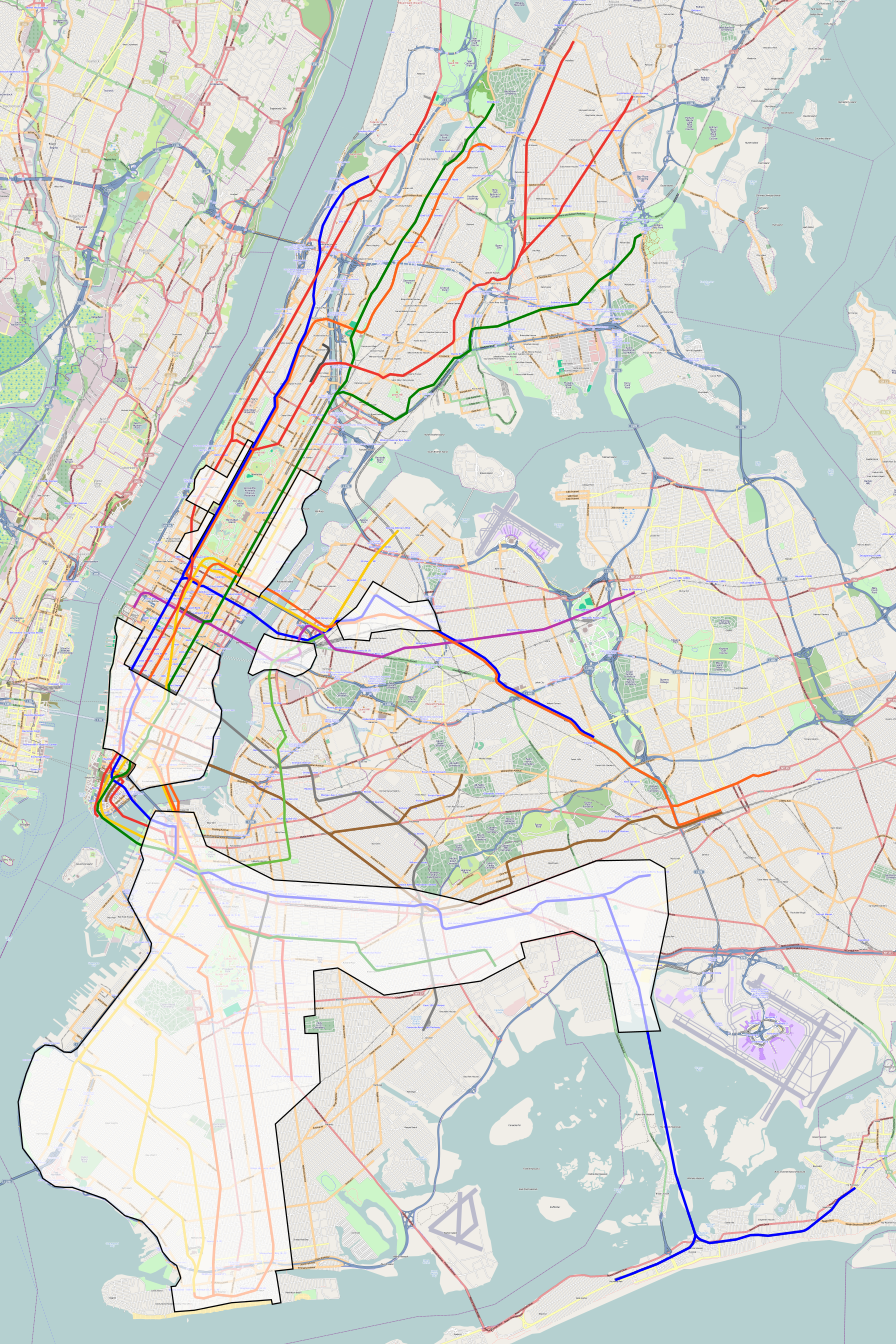
The map excludes parts of Lower and Midtown Manhattan where the highest and best use is commercial rather than residential. But the boundaries there are deliberately crude: Downtown Brooklyn, NYU, and the Meatpacking District are drawn, to avoid excessive fragmentation of the drawn area, while Chelsea and Hell’s Kitchen are excluded as too close to Midtown.
The map also does not look at considerations other than capacity. Some of the highlit areas on the Upper East and West Sides and Lower East Side are already built to very high density, at least on the avenues and major streets; these areas should be the template of how the rest of the city should look. At the other end, East New York has too weak demand for massive construction, especially if everything to its west is upzoned.
However, large swaths of desirable, close-in areas with relatively short buildings are highlit. Rich inner Brooklyn neighborhoods like Park Slope and South Brooklyn are currently built to missing middle density, with a floor area ratio of about 1.5 away from corner lots. A more appropriate floor area ratio in these neighborhoods is 12, corresponding to tapering buildings in the 20-30 story range, as on the avenues on the Upper East and West Sides. Park Slope is half an hour from Midtown by subway, and less than that from Lower Manhattan. The population of these neighborhoods is perhaps 150,000, and should be more than a million given their proximity to job centers.
Subway deserts and future additions
The map is designed to work with more or less the same service as today, maybe with slightly more frequency on lines that could handle it easily (that is, Second Avenue Subway). But what about future service? The L train is overcrowded, but only runs 19 trains per hour at the peak due to electrical limitations, and could go up to 26 with better electrical capacity, or for that matter lighter trains drawing less power during acceleration. Further extensions of Second Avenue Subway could more effectively relieve pressure off the 4/5, to the point of creating more capacity in the Bronx, which remains well below peak population. Commuter rail modernization opens up large swaths of Queens. Decades in the making extensions on Nostrand and Utica fill in the transit desert in southeast Brooklyn, currently served by buses that nominally come every 2 minutes and in practice comes in platoons of 4 every 8 minutes.
As with the map above, a hypothetical map of development sites assuming reasonable subway expansion includes areas that would be unlikely to actually see new development. Williamsburg and Greenpoint may turn into forests of towers given the opportunity, but in neighborhoods like Sheepshead Bay and East Flatbush developers might well stick to the occasional 6-to-10-story mid-rise building that would not look out of place in Paris. In Eastern Queens, the desired density is probably spiky, with clusters of tall buildings around LIRR stations surrounded by single-family houses and missing middle, much like the structure of density in Toronto and Vancouver.
 Pedestrian Observations