Category: New York
Construction Costs: Metro Stations
It is relatively easy to come up with a database of urban rail lines and their construction costs per kilometer. Construction costs are public numbers, reported in the mass media to inform citizens and taxpayers of the costs of public projects. However, the next step in understanding what makes American construction costs (and to a lesser extent common law construction costs) so high is breaking down the numbers. The New York Times published an excellent investigative piece by Brian Rosenthal looking at why Second Avenue Subway specifically is so expensive, looking at redundant labor and difficulties with contractors. But the labor examples given, while suggestive, concern several hundred workers, not enough for a multibillion dollar cost difference. More granularity is needed.
After giving examples of high US construction costs outside New York, I was asked on social media whether I have a breakdown of costs by item. This motivated me to look at station construction costs. I have long suspected that Second Avenue Subway splurged on stations, in two ways: first, the stations have full-length mezzanines, increasing the required amount of excavation; and second, the stations were mostly excavated from inside the tunnel, with only a narrow vertical access shaft, whereas most subway lines not crossing under older lines have cut-and-cover stations. The data I’m going to present seems to bear this out.
However, it is critical to note that this data is much sparser than even my original post about construction costs. I only have data for three cities: New York, London, and Paris.
In New York, Second Avenue Subway consisted of three new stations: 96th Street, 86th Street, and 72nd Street. Their costs, per MTA newsletters: 72nd Street cost $740 million, 86th Street cost $531 million, 96th Street cost $347 million for the finishes alone (which were 40% of the costs of 72nd and 86th). MTA Capital Construction also provides final numbers, all somewhat higher: 72nd Street cost $793 million, 86th Street cost $644 million, 96th Street cost $812 million. The 96th Street cost includes the launch box for the tunnel-boring machine, but the other stations are just station construction. The actual tunneling from 96th to 63rd Street, a little less than 3 km, cost $415 million, and systems cost another $332 million. Not counting design, engineering, and management costs, stations were about 75% of the cost of this project.
In Paris, Metro stations are almost a full order of magnitude cheaper. PDF-p. 10 of a report about Grand Paris Express gives three examples, all from the Metro rather than GPX or the RER, and says that costs range from €80 million to €120 million per station. Moreover, the total amount of excavation, 120,000 m^3, is comparable to that involved in the construction of 72nd Street, around 130,000 m^3, and not much less than that of 86th Street, around 160,000 m^3 (both New York figures are from an article published in the Gothamist).
A factsheet about the extension of Metro Line 1 to the east breaks down construction costs as 40% tunneling, 30% stations, 15% systems, and 15% overheads. With three stations and a total cost of €910 million over 5 km, this is within the range given by the report for GPX. The tunneling itself is according to this breakdown €364 million. An extension of Line 12 to the north points toward similar numbers: it has two stations and costs €175 million, with all tunneling having already been built in a previous extension. Piecing everything together, we get the following New York premiums over Paris:
Tunneling: about $150 million per km vs. $90 million, a factor of 1.7
Stations: about $750 million per station vs. $110 million, a factor of 6.5
Systems: about $110 million per km vs. $35 million, a factor of 3.2
Overheads and design: 27% of total cost vs. 15%, which works out to a factor of about 11 per km or a factor of 7 per station
Rosenthal’s article documents immense featherbedding in staffing the TBMs in New York, explaining much more than a factor of 1.7 cost difference. This is not by itself surprising: Parisian construction costs are far from Europe’s lowest, and there is considerable featherbedding in operations (for example, train driver productivity is even lower than in New York). It suggests that Paris, too, could reduce headcounts to make tunnel construction cheaper, to counteract the rising construction costs of Grand Paris Express.
But the situation with the stations is not just featherbedding: the construction technique New York chose is more expensive. The intent was to reduce street disruption by avoiding surface construction. Having lived on East 72nd Street for a year during construction, I can give an eyewitness account of what reducing disruption meant: there was a giant shaft covering about half the width of Second Avenue, reducing sidewalk width to 7 feet, between 72nd and 73rd Streets. This lasted for years after I’d moved away, since this method is so expensive and time-consuming. Under cut-and-cover, this disruption would cover several blocks, over the entire length of the station, but it would be finished quickly: the extension of Line 12 is currently in the station digging phase, estimated to take 18 months.
London provides a useful sanity check. Crossrail stations are not cut-and-cover, since the line goes underneath the entirety of the Underground network in Central London. Canary Wharf is built underwater, with 200,000 m^3 of excavation and 100,000 m^3 of water pumped; it’s technically cut from the top, but is nothing like terrestrial cut-and-cover techniques. The cost is £500 million. It’s a more complex project than the comparably expensive stations of Second Avenue Subway, but helps showcase what it takes to build stations in areas where cut-and-cover is not possible.
Another useful sanity check comes from comparing subway lines that could use cut-and-cover stations and subway lines that could not. Crossrail is one example of the latter. The RER A’s central segment, from Nation to Auber, is another: Gare de Lyon and Chatelet-Les Halles were built cut-and-cover, but in the case of Les Halles this meant demolishing the old Les Halles food market, excavating a massive station, and moving the Metro Line 4 tunnel to be closer to the newly-built station. The total excavated volume for Les Halles was about 560,000 m^3, and photos show the massive disruption, contributing to the line’s cost of about $750 million per km in today’s money, three times what Paris spends on Metro extensions. In London, all costs are higher than in Paris, but without such difficult construction, the extension of the Underground to Battersea is much cheaper than Crossrail, around $550 million per km after cost overruns and mid-project redesigns.
The good news is that future subway extensions in the United States can be built for maybe $500-600 million per km rather than $1.5-2 billion if stations are dug cut-and-cover. This is especially useful for Second Avenue Subway’s phase 2, where the segments between the station boxes already exist thanks to the aborted attempt to build the line in the 1970s, and thus cut-and-cover stations could simply connect to already-dug tunnels. It could also work for phases 3 and 4, which cross over rather than under the east-west lines connecting Manhattan with Queens and Brooklyn. The same technique could be used to build outer extensions under Utica and Nostrand in Brooklyn. Among the top priorities for New York, only a crosstown subway under 125th Street, crossing under the north-south line, would need the more expensive station construction technique; for this line, a large-diameter TBM would be ideal, since there would be plenty of space for vertical circulation away from the crossing subway lines.
There would still be a large construction cost premium. Changing the construction method is not enough to give New York what most non-English-speaking first-world cities have: getting down to $200 million per kilometer would require changes to procurement and labor arrangements, to encourage competition between the contractors and more efficient use of workers. Evidently, overheads are a larger share of Second Avenue Subway cost than of Parisian costs. But saving money on stations could easily halve construction costs, and aspirationally reduce them by a factor of three or four.
High-Speed Rail from New Rochelle to Greens Farms: Impacts, Opportunities, and Analysis
I was asked by Greg Stroud of SECoast to look at HSR between New Rochelle and Greens Farms. On this segment (and, separately, between Greens Farms and Milford), 300+ km/h HSR is not possible, but speedups and bypasses in the 200-250 area are. The NEC Future plan left the entire segment from New York to New Haven as a question mark, and an inside source told me it was for fear of stoking NIMBYism. Nonetheless, SECoast found a preliminary alignment sketched by NEC Future and sent it to me, which I uploaded here in Google Earth format – the file is too big to display on Google Maps, but you can save and view it on your own computer. Here’s my analysis of it, first published on SECoast, changed only on the copy edit level and on English vs. metric units.
The tl;dr version is that speeding up intercity trains (and to some extent regional trains too) on the New Haven Line is possible, and requires significant but not unconscionable takings. The target trip time between New York and New Haven is at the lower end of the international HSR range, but it’s still not much more than a third of today’s trip time, which is weighed down by Amtrak/Metro-North agency turf battles, low-quality trains, and sharp curves.
The New Haven Line was built in the 1840s in hilly terrain. Like most early American railroads, it was built to low standards, with tight curves and compromised designs. Many of these lines were later replaced with costlier but faster alignments (for example, the Northeast Corridor in New Jersey and Pennsylvania), but in New England this was not done. With today’s technology, the terrain is no problem: high-speed trains can climb 3.5-4% grades, which were unthinkable in the steam era. But in the 170 years since the line opened, many urban and suburban communities have grown along the railroad right of way, and new construction and faster alignments will necessarily require significant adverse impacts to communities built along the Northeast Corridor.
This analysis will explain some of the impacts and opportunities expanding and modernizing high-speed rail infrastructure on or near the New Haven Line—and whether such an investment is worthwhile in the first place. There are competing needs: low cost, high speed, limited environmental impact, good local service on Metro-North. High-speed rail can satisfy each of them, but not everywhere and not at the same time.
The Northeast Corridor Future (NEC Future) preferred alternative, a new plan by the Federal Railroad Administration to modernize and expand rail infrastructure between Washington and Boston, proposes a long bypass segment parallel to the New Haven Line, between Rye and Greens Farms. The entire segment is called the New Rochelle-Greens Farms bypass; other segments are beyond the scope of this document.
Structure and Assumptions
The structure of this write-up is as follows: first, technical explanations of the issues with curves, with scheduling commuter trains and high-speed trains on the same track, and with high-speed commuting. Then, a segment-by-segment description of the options:
- New Rochelle-Rye, the leadup to the bypass, where scheduling trains is the most difficult.
- Rye-Cos Cob, the first bypass.
- The Cos Cob Bridge, a decrepit bridge for which the replacement is worth discussing on its own.
- Cos Cob-Stamford, where the preferred alternative is a bypass, but a lower-impact option on legacy track is as fast and should be studied.
- Stamford-Darien, where another bypass is unavoidable, with significant residential takings, almost 100 houses in one possibility not studied in the preferred alternative.
- Norwalk-Greens Farms, a continuation of the Darien bypass in an easier environment.
The impacts in question are predominantly noise, and the effect of takings. The main reference for noise emissions is a document used for California High-Speed Rail planning, using calibrated noise levels provided by federal regulators. At 260 km/h, higher than trains could attain in most of the segment in question, trains from the mid-1990s 45 meters away would be comparable to a noisy urban residential street; more recent trains, on tracks with noise barriers, would be comparable to a quiet urban street. Within a 50-meter (technically 150 feet) zone, adverse impact would require some mitigation fees.
At higher speed than 260 km/h, the federal regime for measuring train noise changes: the dominant factor in noise emissions is now air resistance around the train rather than rolling friction at the wheels. This means two things: first, at higher speed, noise emissions climb much faster than before, and second, noise barriers are less effective, since the noise is generated at the nose and pantograph rather than the wheels. At only one place within the segment are speeds higher than about 260 km/h geometrically feasible, in Norwalk and Westport, and there, noise would need to be mitigated with tall trees and more modern, aerodynamic trains, rather than with low concrete barriers.
This analysis excludes impact produced by some legacy trains, such as the loud horns at grade crossings; these may well go away in a future regulatory reform, as the loud horns serve little purpose, and the other onerous federal regulations on train operations are being reformed. But in any case, the mainline and any high-speed bypass would be built to high standards, without level crossings. Thus noise impact is entirely a matter of loud trains passing by at high speed.
Apart from noise and takings, there are some visual impacts coming from high bridges and viaducts. For the most part, these are in areas where the view the aerials block is the traffic on I-95. Perhaps the biggest exception is the Mianus River, where raising the Cos Cob Bridge has substantial positive impact on commuter train operations and not just intercity trains.
Curves
The formula for the maximum speed on a curve is as follows:

If all units are metric, and speed is in meters per second, this formula requires no unit conversion. But as is common in metric countries, I will cite speed in kilometers per hour rather than meters per second; 1 m/s equals 3.6 km/h.
Lateral acceleration is the most important quantity to focus on. It measures centrifugal force, and has a maximum value for safety and passenger comfort. But railroads decompose it into two separate numbers, to be added up: superelevation (or cant), and cant deficiency (or unbalanced superelevation, or underbalance).
Superelevation means banking the tracks on a curve. There is an exact speed at which trains can run where the centrifugal force exactly cancels out the banking, but in practice trains tend to run faster, producing additional centrifugal force; this additional force is called cant deficiency, and is measured as the additional hypothetical cant required to exactly balance.
If a train sits still on superelevated track, or goes too slowly, then passengers will feel a downward force, toward the inside of the curve; this is called cant excess. On tracks with heavy freight traffic, superelevation is low, because slow freight trains would otherwise be at dangerous cant excess. But the New Haven Line has little freight traffic, all of which can be accommodated on local tracks in the off-hours, and thus superelevation can be quite high. Today’s value is 5” (around 130 mm), and sometimes even less, but the maximum regulatory value in the United States is 7” (around 180 mm), and in Japan the high-speed lines can do 200 mm, allowing tighter curves in constrained areas.
Cant deficiency in the United States has traditionally been very low, at most 3” (75 mm). But modern trains can routinely do 150 mm, and Metro-North should plan on that as well, to increase speed. The Acela has a tilting mechanism, allowing 7”; the next-generation Acelas are capable of 9” cant deficiency (230 mm) at 320 km/h; this document will assume the sum total of cant and cant deficiency is 375 mm (the new Acela trainsets could do 200 mm cant deficiency with 175 mm cant, or Japanese trainsets could do 175 mm cant deficiency with 200 mm cant). This change alone, up from about 200 mm today, enough to raise the maximum speed on every curve by 37%. At these higher values of superelevation and cant deficiency, a curve of radius 800 meters can support 160 km/h.
Scheduling and Speed
The introduction of high-speed rail between New York and New Haven requires making some changes to timetabling on the New Haven Line. In fact, on large stretches of track on this line, especially in New York State, the speed limit comes not from curves or the physical state of the track, but from Metro-North’s deliberately slowing Amtrak down to the speed of an express Metro-North train, to simplify scheduling and dispatching. This includes both the top speed (90 mph/145 km/h in New York State, 75 mph/120 km/h in Connecticut) and the maximum speed on curves (Metro-North forbids the Acela to run at more than 3”/75 mm cant deficiency on its territory).
The heart of the problem is that the corridor needs to run trains of three different speed classes: local commuter trains, express commuter trains, and intercity trains. Ideally, this would involve six tracks, two per speed class, much like the four-track mainlines with two speed classes on the subway in New York (local and express trains). However, there are only four tracks. This means that there are four options:
- Run only two speed classes, slowing down intercity trains to the speed of express commuter trains.
- Run only two speed classes, making all commuter trains local.
- Expand the corridor to six tracks.
- Schedule trains of three different speed classes on just four tracks, with timed overtakes allowing faster trains to get ahead of slower trains at prescribed locations.
The current regime on the line is option #1. Option #2 would slow down commuters from Stamford and points east too much; the New Haven Line is too long and too busy for all-local commuter trains. Option #3 is the preferred alternative; the problem there is the cost of adding tracks in constrained locations, which includes widening viaducts and rebuilding platforms.
Option #4 has not been investigated very thoroughly in official documents. The reason is that timed overtakes require trains to be at a specific point at a specific time. Amtrak’s current reliability is too poor for this. However, future high-speed rail is likely to be far more punctual, with more reliable equipment and infrastructure. Investing in this option would require making some targeted investments toward reliability, such as more regular track and train maintenance, and high platforms at all stations in order to reduce the variability of passenger boarding time.
Moreover, at some locations, there are tight curves on the legacy New Haven Line that are hard or impossible to straighten in any alignment without long tunnels. South of Stamford, this includes Rye-Greenwich.
This means that, with new infrastructure for high-speed rail, the bypass segments could let high-speed trains overtake express commuter trains. The Rye-Greenwich segment is especially notable. High-speed rail is likely to include a bypass of Greenwich station. Thus, express commuter trains could stop at Greenwich, whereas today they run nonstop between Stamford and Manhattan, in order to give intercity trains more time to overtake them. A southbound high-speed trains would be just behind an express Metro-North train at Stamford, but using the much greater speed on the bypass, it would emerge just ahead of it at Rye. This segment could be built separately from the rest of the segment, from Stamford to Greens Farms and beyond, because of its positive impact on train scheduling.
It is critical to plan infrastructure and timetable together. With a decision to make express trains stop at Greenwich, infrastructure design could be simpler: there wouldn’t be a need to add capacity by adding tracks to segments that are not bypassed.
High-Speed Commuting
A junior consultant working on NEC Future who spoke to me on condition of anonymity said that there was pressure not to discuss fares, and at any rate the ridership model was insensitive to fare.
However, this merits additional study, because of the interaction with commuter rail. If the pricing on high-speed rail is premium, as on Amtrak today, then it is unlikely there will be substantial high-speed commuting to New York from Stamford and New Haven. But if there are tickets with low or no premium over commuter rail, with unreserved seating, then many people would choose to ride the trains from Stamford to New York, which would be a trip of about 20 minutes, even if they would have to stand.
High-speed trains are typically longer than commuter trains: 16 cars on the busier lines in Japan, China, and France, rather than 8-12. This is because they serve so few stops that it is easier to lengthen every platform. This means that the trains have more capacity, and replacing a scheduled commuter train with a high-speed train would not compromise commuter rail capacity.
The drawback is that commuters are unlikely to ride the trains outside rush hour, which only lasts about 2 or 3 hours a day in each direction. In contrast, intercity passengers are relatively dispersed throughout the day. Capital investment, including infrastructure and train procurement, is based on the peak; reducing the ratio of peak to base travel reduces costs. The unreserved seat rule, in which there is a small premium over commuter rail for unreserved seats (as in Germany and Japan) and a larger one for reserved seats, is one potential compromise between these two needs (flat peak, and high-speed commuter service).
New Rochelle-Rye
The track between New Rochelle and Rye is for the most part straight. Trains go 145 km/h, and this is because Metro-North slows down intercity trains for easier dispatching. The right-of-way geometry is good for 180 km/h with tilting trains and high superelevation; minor curve modifications are possible, but save little time. The big item in this segment concerns the southern end: New Rochelle.
At New Rochelle, the mainline branches in two: toward Grand Central on the New Haven Line, and toward Penn Station on the Hell Gate Line, used by Amtrak and future Penn Station Access trains. This branching is called Shell Interlocking, a complex of track switches, all at grade, with conflicts between trains in opposite directions. All trains must slow down to 30 mph (less than 50 km/h), making this the worst speed restriction on the Northeast Corridor outside the immediate areas around major stations such as Penn Station and Philadelphia 30th Street Station, where all trains stop.
The proposed (and only feasible) solution to this problem involves grade-separating the rails using flyovers, a project discussed by the FRA at least going back to 1978 (PDF-p. 95). This may involve some visual impact, or not—there is room for trenching the grade-separation rather than building viaducts. It is unclear how much that would cost, but a flyover at Harold Interlocking in Queens for East Side Access, which the FRA discussed in the same report, cost $300 million dollars earlier this decade. Harold is more complex than Shell, since it has branches on both sides and is in a more constrained location; it is likely that Shell would cost less than Harold’s $300 million. Here is a photo of the preferred alignment:
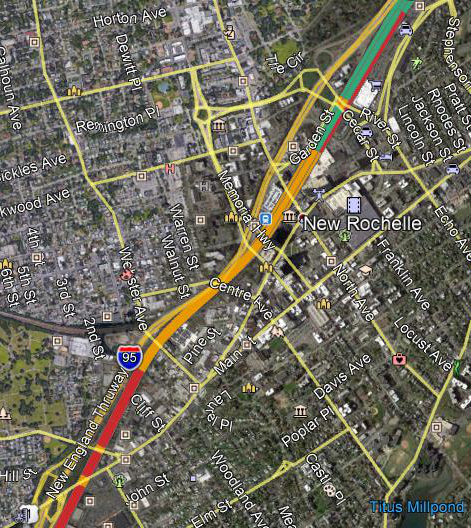
The color coding is, orange is viaducts (including grade separations), red is embankments, and teal is at-grade. This is the Northeast Corridor, continuing south on the Hell Gate Line to Penn Station, and not the Metro-North New Haven Line, continuing west (seen in natural color in the photo) to Grand Central.
A Shell fix could also straighten the approach from the south along the Hell Gate Line, which is curvy. The curve is a tight S, with individual curves not too tight, but the transition between them constraining speed. The preferred alignment proposes a fix with a kilometer of curve radius, good for 180 km/h, with impact to some industrial sites but almost no houses and no larger residential buildings. It is possible to have tighter curves, at slightly less cost and impact, or wider ones. Slicing a row of houses in New Rochelle, east of the southern side of the S, could permit cutting off the S-curve entirely, allowing 240 km/h; the cost and impact of this slice relative to the travel time benefit should be studied more carefully and compared with the cost per second saved from construction in Connecticut.
The main impact of high-speed rail here on ordinary commuters is the effect on scheduling. With four tracks, three train speed classes, and heavy commuter rail traffic, timetabling would need to be more precise, which in turn would require trains to be more punctual. In the context of a corridor-wide high-speed rail program, this is not so difficult, but it would still constrain the schedule.
Without additional tracks, except on the bypasses, there is capacity for 18 peak Metro-North trains per hour into New York (including Penn Station Access) and 6 high-speed trains. Today’s New Haven Line peak traffic is 20 trains per hour (8 south of Stamford, 12 north of which 10 run nonstop from Stamford to Manhattan), so this capacity pattern argues in favor of pricing trains to allow commuters to use the high-speed trains between Stamford and New York.
Rye-Greenwich
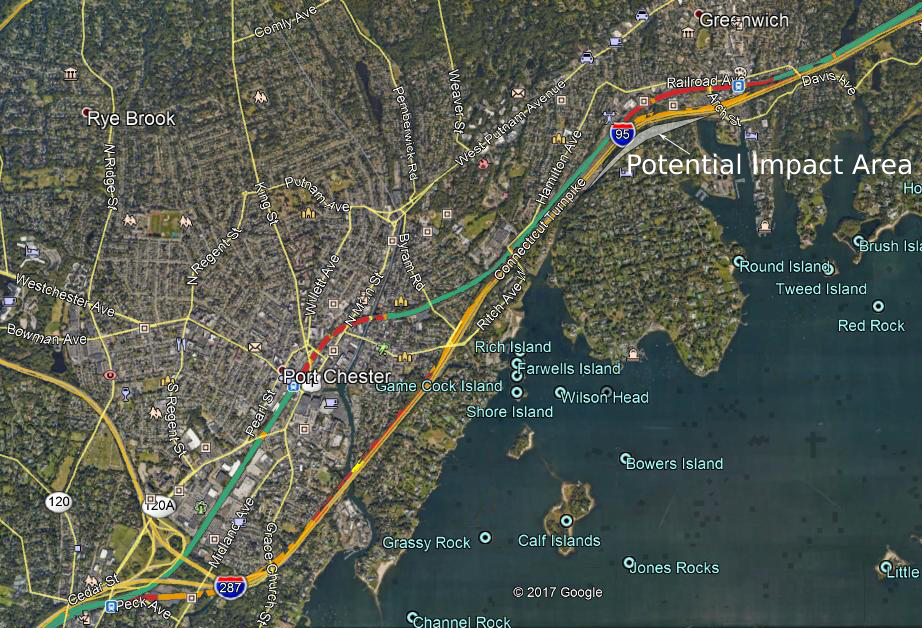
Rye is the first place, going from the south, where I-95 is straighter than the Northeast Corridor. This does not mean it is straight: it merely means that the curves on I-95 in that area are less sharp than those at Rye, Port Chester, and Greenwich. Each of these three stations sits at a sharp S-curve today; the speed zone today is 75 mph (120 km/h), with track geometry that could allow much more if Metro-North accepted a mix of trains of different speed, but Rye and Greenwich restrict trains to 60 mph/95 km/h, and Port Chester to 45 mph/70 km/h at the state line. The segment between the state line and Stamford in particular is one of the slowest in the corridor.
As a result, the NEC Future plan would bypass the legacy line there alongside the Interstate. Currently, the worst curve in the bypassed segment, at Port Chester, has radius about 650 meters, with maximum speed much less than today’s trains could do on such a curve because of the sharp S. At medium and high speed, it takes a few seconds of train travel time to reverse a curve, or else the train must go more slowly, to let the systems as well as passengers’ muscles adjust to the change in the direction of centrifugal force. At Rye, the new alignment has 1,200-meter curves, with gentle enough S to allow trains to fully reverse, without additional slowdowns; today’s tracks and trains could take it at 140 km/h, but a tilting train on tracks designed for higher-speed travel could go up to 195.
Within New York State, the bypass would require taking a large cosmetics store, and some houses adjacent to I-95 on the west; a few townhouses in Rye may require noise walls, as they would be right next to the right-of-way where trains would go about 200-210 km/h, but at this speed the noise levels with barriers are no higher than those of the freeway, so the houses would remain inhabitable.
In Connecticut, the situation is more delicate. When the tracks and I-95 are twinned, there is nothing in between, and thus the bypass is effectively just two extra tracks. To the south, just beyond the state line, the situation is similar to that of Rye: a few near-freeway houses would be acquired, but nothing else would, and overall noise levels would not be a problem.
But to the north, around Greenwich station, the proposed alignment follows the I-95 right-of-way, with no residential takings, and one possible commercial taking at Greenwich Plaza. This alignment comes at the cost of a sharp curve: 600 meters, comparable to the existing Greenwich curve. This would provide improvements in capacity, as intercity trains could overtake express commuter trains (which would also stop at Greenwich), but not much in speed.
Increasing speed requires a gentler curve than on I-95; eliminating the S-curve entirely would raise the radius to about 1,600 meters, permitting 225 km/h. This has some impact, as the inside of the curve would be too close to the houses just south of I-95, requiring taking about seven houses.
However, the biggest drawback of this gentler curve is cost: it would have to be on a viaduct crossing I-95 twice, raising the cost of the project. It is hard to say by exactly how much: either option, the preferred one or the 225 km/h option, would involve an aerial, costing about $100 million according to FRA cost items, so the difference is likely to be smaller than this. It is a political decision whether saving 30 seconds for express trains is worth what is likely to be in the low tens of millions of dollars.
Cos Cob Bridge
The Cos Cob Bridge restricts the trains, in multiple ways. As a movable bridge, it is unpowered: trains on it do not get electric power, but must instead coast; regular Metro-North riders are familiar with the sight of train lights, air conditioning, and electric sockets briefly going out when the train is on the bridge. It is also old enough that the structure itself requires trains to go more slowly, 80 km/h in an otherwise 110 km/h zone.
Because of the bridge’s age and condition, it is a high priority for replacement. One cost estimate says that replacing the bridge would cost $800 million. The Regional Plan Association estimates the cost of replacing both this bridge and the Devon Bridge, at the boundary between Fairfield and New Haven Counties, at $1.8 billion. The new span would be a higher bridge, fully powered, without any speed limit except associated with curves; Cos Cob station has to be rebuilt as well, as it is directly on the approaches, and it may be possible to save money there (Metro-North station construction costs are very high—West Haven was $105 million, whereas Boston has built infill stations for costs in the teens).
In any high-speed rail program, the curves could be eased as well. There are two short, sharp curves next to the bridge, one just west to the Cos Cob station and the other between the bridge and Riverside. The replaced bridge would need long approaches for the deck to clear the Mianus River with enough room for boats to navigate, and it should not cost any more in engineering and construction to replace the two short curves with one long, much wider curve. There is scant information about the proposed clearance below and the grades leading up to the bridge, but both high-speed trains and the high-powered electric commuter trains used by Metro-North can climb steep grades, up to 3.5-4%, limiting the length of the approaches to about 400 meters on each side. This is the alternative depicted as the potential alternative below; the Cos Cob Bridge is the legacy bridge, and the preferred alignment is a different bypass (see below for the Riverside-Stamford segment):
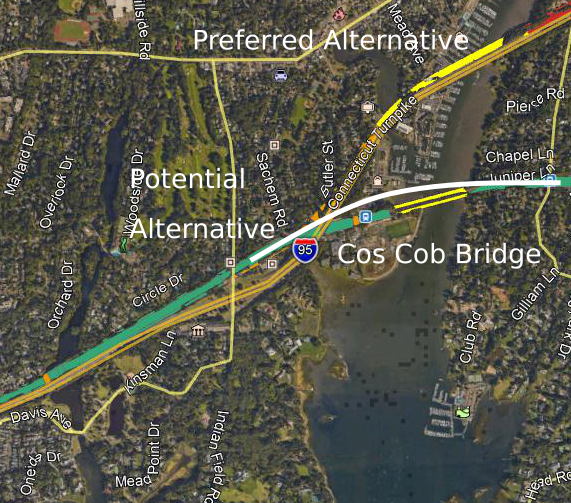
The color coding is the same as before, but yellow means major bridge. White is my own drawing of an alternative.
The radius of the curve would be 1,700 meters. A tilting train could go at 235 km/h. Commuter rail would benefit from increased speed as well: express trains could run at their maximum speed, currently 160 km/h, continuing almost all the way east to Stamford. The cost of this in terms of impact is the townhouses just north of the Cos Cob station: the viaduct would move slightly north, and encroach on some, possibly all, of the ten buildings. Otherwise, the area immediately to the north of the station is a parking lot.
The longer, wider curve alternative can be widened even further. In that case, there would be more impact on the approaches, but less near the bridge itself, which would be much closer in location to the current bridge and station. This option may prove useful if one alignment for the wider curve turns out to be infeasible due to either unacceptable impact to historic buildings or engineering difficulties. The curve radius of this alternative rises to about 3,000 meters, at which point the speed limit is imposed entirely by neighboring curves in Greenwich and Stamford; trains could go 310 km/h on a 3,000-meter curve, but they wouldn’t have room to accelerate to that speed from Greenwich’s 225 km/h.
Riverside-Stamford
Between the Mianus River and Stamford, there are two possible alignments. The first is the legacy alignment; the second is a bypass alongside I-95, which would involve a new crossing of the Mianus River as well. The NEC Future alignment appears to prefer the I-95 option:

The main benefit of the I-95 option is that it offers additional bypass tracks for the New Haven Line. Under this option, there is no need for intercity trains and express commuter trains to share tracks anywhere between Rye and Westport.
However, the legacy alignment has multiple other benefits. First, it has practically no additional impact. Faster trains would emit slightly more noise, but high-speed trains designed for 360 km/h are fairly quiet at 210. In contrast, the I-95 alignment requires a bridge over the Greenwich Water Club, some residential takings in Cos Cob, and possibly a few commercial takings in Riverside.
Second, it is cheaper. There would need to be some track reconstruction, but no new right-of-way formation, and, most importantly, no new crossing of the Mianus River. The Cos Cob Bridge is in such poor shape that a replacement is most likely necessary even if intercity trains bypass it. The extra cost of the additional aerials, berms, and grade separations in Riverside is perhaps $150-200 million, and that of the second Mianus River crossing would run into many hundreds of millions. This also means somewhat more visual impact, because there would be two bridges over the river rather than just one, and because in parts of Riverside the aerials would be at a higher level than the freeway, which is sunken under the three westernmost overpasses
In either case, one additional investment in Stamford is likely necessary, benefiting both intercity and commuter rail travelers: grade-separating the junction between the New Canaan Branch and the mainline. Without at-grade conflicts between opposing trains on the mainline and the New Canaan Branch, scheduling would be simpler, and trains to and from New Canaan would not need to use the slow interlocking at Stamford station.
The existing route into Stamford already has the potential to be fast. The curves between the Mianus and Stamford station are gentle, and even the S-curve on the approach to Stamford looks like a kilometer in radius, good enough for 180 km/h on a tilting train with proper superelevation.
Stamford-Darien
Between New York and Stamford, the required infrastructure investments for high-speed rail are tame. Everything together except the Mianus crossing should be doable, based on FRA cost items, on a low 9-figure budget.
East of Stamford, the situation is completely different. There are sharp curves periodically, and several in Darien and Norwalk are too tight for high-speed trains. What’s more, I-95 is only available as a straight alternative right-of-way in Norwalk. In Darien, and in Stamford east of the station, there is no easy solution. Everything requires balancing cost, speed, and construction impact.
The one saving grace is that there is much less commuter rail traffic here than between New York and Stamford. With bypasses from Stamford until past Norwalk, only a small number of peak express Metro-North trains east of Greens Farms would ever need to share tracks with intercity trains. Thus the scheduling is at least no longer a problem.
The official plan from NEC Future is to hew to I-95, with all of its curves, and compromise on speed. The curve radius appears to be about 700-750 meters through Stamford and most of Darien, good for about 95 mph over a stretch of 5.5 miles. This is a compromise meant to limit the extent of takings, at the cost of imposing one of the lowest speed limits outside major cities. While the official plan is feasible to construct, the sharp curves suggest that if Amtrak builds high-speed rail in this region, it will attempt a speedup, even at relatively high cost.
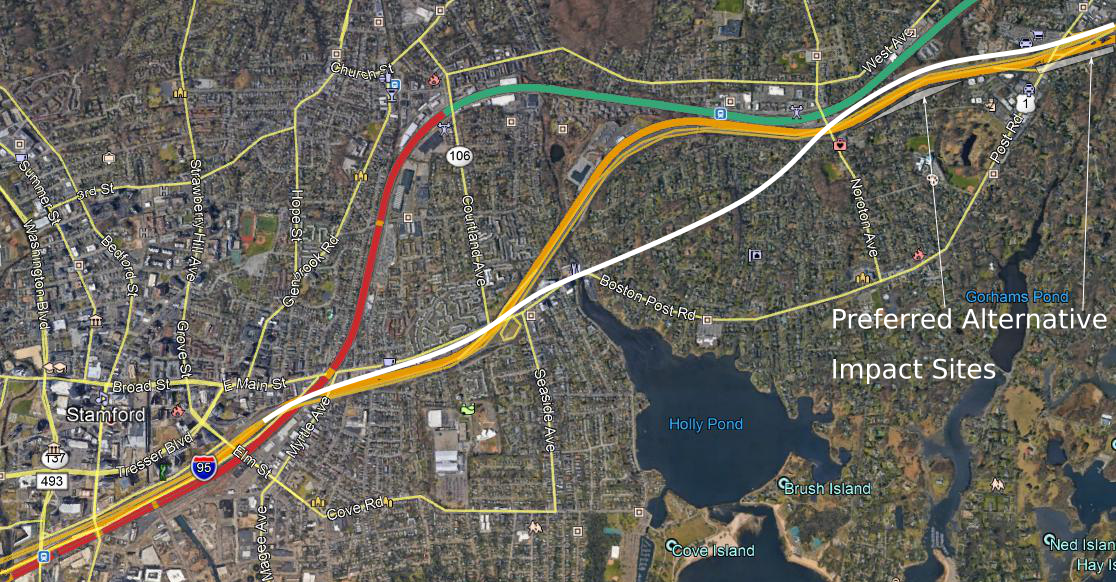
There is a possible speedup, involving a minimum curve radius of about 1,700-2,000 meters, good for 235-255 km/h. This would save 70-90 seconds, at similar construction cost to the preferred alignment. The drawback is that it would massively impact Darien, especially Noroton. It would involve carving a new route through Noroton for about a mile. In Stamford, it would require taking an office building or two, depending on precise alignment; in Noroton, the takings would amount to between 55 and 80 houses. The faster option, with 2,000-meter curves, does not necessarily require taking more houses in Noroton: the most difficult curves are farther east. In the picture, this speedup is in white, the preferred alternative is in orange, and the legacy line in teal:
Fortunately, east of Norton Avenue, there is not much commercial and almost no residential development immediately to the north of I-95, making things easier:
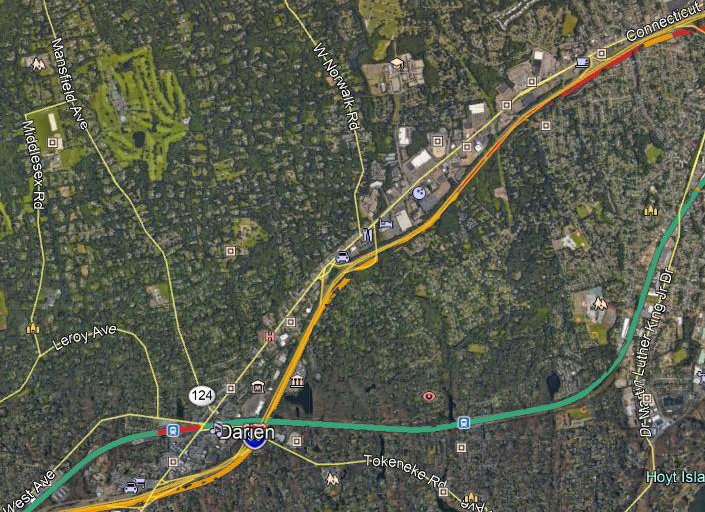
The preferred alignment stays to the south of the Turnpike. This is the residential side; even with tight curves, some residential takings are unavoidable, about 20 houses. Going north of I-95 instead requires a few commercial takings, including some auto shops, and one or two small office buildings east of Old Kings Highway, depending on curve radius. Construction costs here are slightly higher, because easing one curve would require elevated construction above I-95, as in one of the Greenwich options above, but this is probably a matter of a few tens of millions of dollars.
The main impact, beyond land acquisition cost, is splitting Noroton in half, at least for pedestrians and cyclists (drivers could drive in underpasses just as they do under highways). Conversely, the area would be close enough to Stamford, with its fast trains to New York, that it may become more desirable. This is especially true for takings within Stamford. However, Darien might benefit as well, near Noroton Heights and Darien stations, where people could take a train to Stamford and change to a high-speed train to New York or other cities.
As in Greenwich, it is a political decision how much a minute of travel time is worth. Darien houses are expensive; at the median price in Noroton, 60-80 houses would be $70-90 million, plus some extra for the office buildings. Against this extra cost, plus possible negative impact on the rest of Noroton, are positive impacts coming from access, and a speedup of 70-90 seconds for all travelers from New York or Stamford to points north.
Norwalk-Greens Farms
In Norwalk, I-95 provides a straight right-of-way for trains. This is the high-speed rail racetrack: for about ten kilometers, until Greens Farms, it may be possible for trains to run at 270-290 km/h.
Here is a photo of Norwalk, with the Walk and Saga Bridges in yellow, a tunnel in the preferred alternative in purple, a possible different alignment in white, and impact zones highlighted:
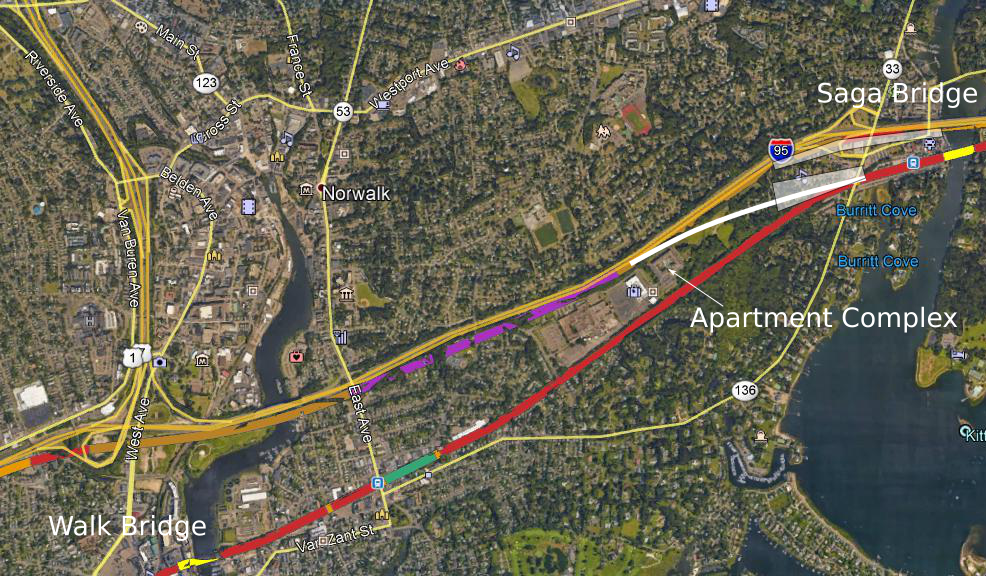
Three question marks remain about the preferred alignment.
The first question is, which side of the Turnpike to use? The preferred alignment stays on the south side. This limits impact on the north side, which includes some retail where the Turnpike and U.S. 1 are closely parallel, near the Darien/Norwalk boundary; a north side option would have to take it. But the preferred alignment instead slices Oyster Shell Park. A third option is possible, transitioning from the north to the south side just east of the Norwalk River, preparing to rejoin the New Haven Line, which is to the south of I-95 here.
The second question is, why is the transition back to the New Haven Line so complex? The preferred alignment includes a tunnel in an area without any more impacted residences than nearby segments, including in Greenwich and Darien. It also includes a new Saga Bridge, bypassing Westport, with a new viaduct in Downtown Westport, taking some retail and about six houses. An alternative would be to leverage the upcoming Saga Bridge reconstruction, which the RPA plan mentions is relatively easy ($500 million for Saga plus Walk, on the Norwalk River, bypassed by any high-speed alignment), and transition to the legacy alignment somewhat to the west of Westport.
A complicating factor for transitioning west of Westport is that the optimal route, while empty eight years ago, has since gotten a new apartment complex with a few hundred units, marked on the map. Alternatives all involve impact to other places; the options are transitioning north of the complex, taking about twenty units in Westport south of the Turnpike and twenty in Norwalk just north of it.
The third question, related to the second, is, why is Greens Farms so complicated? See photo below:
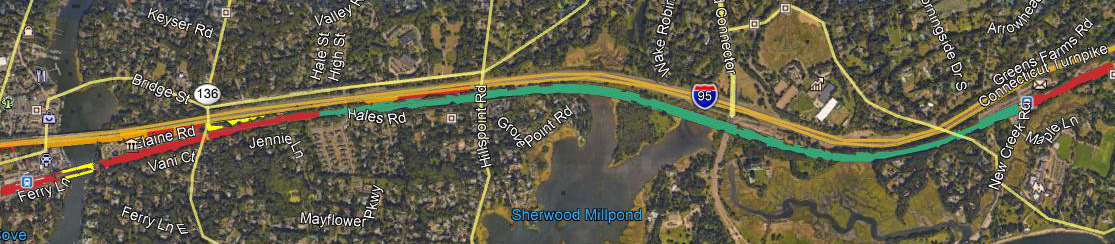
The area has a prominent S-curve, and some compromises on curve radius are needed. But the preferred alternative doesn’t seem to straighten it. Instead, it builds an interlocking there, with the bypass from Darien and points west. While that particular area has little impact (the preferred alignment transitions in the no man’s land between the New Haven Line and the Turnpike), the area is constrained and the interlocking would be expensive.
No matter what happens, the racetrack ends at Greens Farms. The existing curve seems to have a radius of about a kilometer or slightly more, good for about 190 km/h, and the best that can be done if it is straightened is 1,300-1,400 meters, good for about 200 km/h.
These questions may well have good answers. Unlike in Darien, where all options are bad, in Norwalk and Westport all options are at least understandable. But it’s useful to ask why go south of the Turnpike rather than north, and unless there is a clear-cut answer, both options should be studied in parallel.
RPA Fourth Regional Plan: LaGuardia Airport and the Astoria Line
This is the second post based on a Patreon poll about the RPA Fourth Regional Plan. See the first post, about Third Avenue, here.
The most worrisome part of the RPA Fourth Regional Plan is the LaGuardia Airport connector. The regional rail system the RPA is proposing includes some truly massive wastes of money, but what the RPA is proposing around LaGuardia showcases the worst aspects of the plan. On Curbed I explained that the plan has an unfortunate tendency to throw in every single politically-supported proposal. I’d like to expand on what I said in the article about the airport connector:
The most egregious example is another transit project favored by a political heavyweight: the LaGuardia AirTrain, championed by Governor Andrew Cuomo. Though he touts it as a one-seat ride from Midtown to LaGuardia, the vast majority of airport travelers going to Manhattan would have to go east to Willets Point (a potential redevelopment site) before they could go west. Even airport employees would have to backtrack to get to their homes in Jackson Heights and surrounding neighborhoods. As a result, it wouldn’t save airport riders any time over the existing buses.
Once again, it’s proven unpopular with transit experts and advocates: [Ben] Kabak mocked the idea as vaporware, and Yonah Freemark showed how circuitous this link would be. When Cuomo first proposed this idea, Politico cited a number of additional people who study public transportation in the region with negative reactions. Despite its unpopularity—and the lack of an official cost for the proposal—the AirTrain LaGuardia is included in the RPA’s latest plan.
But there is an alternative to Cuomo’s plan: an extension of the N/W train, proposed in the 1990s, which would provide a direct route along with additional stops within Astoria, where there is demand for subway service. Community opposition killed the original proposal, but a lot can change in 15 years; Astoria’s current residents may well be more amenable to an airport connector that would put them mere minutes from LaGuardia. Cuomo never even tried, deliberately shying away from this populated area.
And the Fourth Plan does include a number of subway extensions, some of which have long been on official and unofficial wishlists. Those include extensions under Utica and Nostrand avenues (planned together with Second Avenue Subway, going back to the 1950s), which also go under two of the top bus routes in the city, per [Jarrett] Walker’s maxim [that the best argument for an urban rail line is an overcrowded bus line, as on Utica and Nostrand].
There is also an extension of the N/W trains in Astoria—though not toward LaGuardia, but west, toward the waterfront, where it would provide a circuitous route to Manhattan. In effect, the RPA is proposing to stoke the community opposition Cuomo was afraid of, but still build the easy—and unsupported—airport connector Cuomo favors.
My views of extending the Astoria Line toward LaGuardia have evolved in the last few years, in a more positive direction. In my first crayon, which I drew in 2010, I didn’t even have that extension; I believed that the Astoria Line should be extended on Astoria Boulevard and miss the airport entirely, because Astoria Boulevard was the more important corridor. My spite map from 2010, give or take a year, connects LGA to the subway via a shuttle under Junction, and has a subway branch under Northern, a subway extension that I’ve been revising my views of negatively.
The issue, to me, is one of branching and capacity. The Astoria Line is a trunk line on the subway, feeding an entire tunnel to Manhattan, under 60th Street; the Queens Boulevard Line also feeds the same tunnel via the R train, but this is inefficient, since there are four trunk lines (Astoria, Flushing, and Queens Boulevard times two since it has four tracks), four tunnels (63rd, 60th, 53rd, Steinway/42nd), and no way to get from the Astoria Line to the other tunnels. This was one of my impetuses for writing about the problems associated with reverse-branching. Among the four trunks in Queens, the Astoria Line is the shortest and lowest-ridership, so it should be extended deeper into Queens if it is possible to do so.
The RPA is proposing to extend the Astoria Line, to its credit. But its extension goes west, to the waterfront. This isn’t really a compelling destination. Development isn’t any more intense than farther east, and for obvious reasons it isn’t possible to extend this line further; the RPA’s proposal would only add one stop to the subway. In contrast, an eastern extension toward LGA could potentially rebuild the line to turn east on Ditmars (with some takings on the interior of the curve at Ditmars and 31st), with stops at Steinway and Hazen before serving the airport. The intensity of development at Steinway is similar to that at 31st and Ditmars or at 21st, and Hazen also has some housing, albeit at lower density. Then, there is the airport, which would be about 8 minutes from Astoria, and 26 minutes from 57th and 7th in Manhattan. This is a different route from that proposed in the Giuliani administration, involving going north above 31st and then east farther out, running nonstop to the airport (or perhaps serving a station or two) through less residential areas, but I believe it is the best one despite the added impact of running elevated on Ditmars.
LGA is not a huge ridership generator; total O&D ridership according to the Consumer Airfare Report is around 55,000 per day, and 33% mode share is aspirational even with fast direct service to Manhattan hotels and an easy connection to the Upper East Side. But it still provides ridership comparable to that of Astoria Boulevard or Ditmars on the line today, and Steinway and Hazen are likely to add more demand. If the MTA closes the 11th Street Connection, taking the R from 60th Street Tunnel to the Queens Boulevard Line, in order to reduce the extent of reverse-branching, then the Astoria Line will run under capacity and need this additional demand. The total number of boardings at all stations, including Queensboro Plaza, is 80,000 per weekday today, plus some transfer volumes from the 7, which empties at Queensboro Plaza as 60th Street Tunnel provides a faster route to most Manhattan destinations than the Steinway Tunnel. An LGA extension should add maybe 40,000 or 50,000 weekday riders, without much of a peak since airport travel isn’t peaky, and make it easier to isolate the Astoria Line from the other Queens lines. This is not possible with a short extension to the waterfront as the RPA proposes.
I’ve seen someone suggest somewhere I don’t remember, perhaps on Twitter, that the reason the RPA plan involves an extension of the Astoria line to the west is to insidiously get the correct extension to LGA passed. If the RPA can propose an el in Astoria and not be killed by NIMBYs, then it will prove to Cuomo that NIMBYism is not a problem and thus he can send the subway to the airport directly, without the circuitous air train project that even less acerbic transit writers like Ben and Yonah hate.
I disagree with this line, on two different grounds. The first is that the RPA has two other reasons to support a western extension of the Astoria Line: it connects to the waterfront (which, following de Blasio and his support for the waterfront tramway, the RPA wants to develop further), and it got a station on Triboro in the Third Regional Plan, in the 1990s. I can no longer find the map with the stations on Mike Frumin’s blog, but the plan was to have a station every 800 meters, with a station to the west of Ditmar/31st still in Queens, around 21st Street; only in the more recent plan did the RPA redesign the idea as Crossboro, with much wider stop spacing.
The second grounds for disagreement is that the RPA presented a long-term vision. If Cuomo’s flawed LGA connector is there, then it will embolden him to find money to build this connection, even though it’s slower than taking a bus to the subway today. It will not embolden anyone to look for funding for the extension of the Astoria Line to the west, since there is no force clamoring for such extension – not the neighborhood, and not even the RPA, which includes this line on a long list of proposals.
As I said on Curbed, the RPA has been around for 90 years. Cuomo is just a governor, not even the leader of a real political movement (unlike Bernie Sanders, who seems to be interested in his leftist agenda more than in himself). There is no reason for an organization so venerable to tether itself to a politician who isn’t likely to be around for more than a few more years. On the contrary, it can provide cover for Cuomo to change his plan, if it does some legwork to prove that people in Astoria actually are interested in subway expansion to the east.
RPA Fourth Regional Plan: the Third Avenue Trunk Line
Based on a Patreon poll, the top two priorities for this blog for critiquing the RPA Fourth Regional Plan are its mess of the LGA connection and the Astoria Line, and the proposed commuter rail trunk line on Third Avenue. The third priority is multi-tracking existing lines and timetable-infrastructure integration.
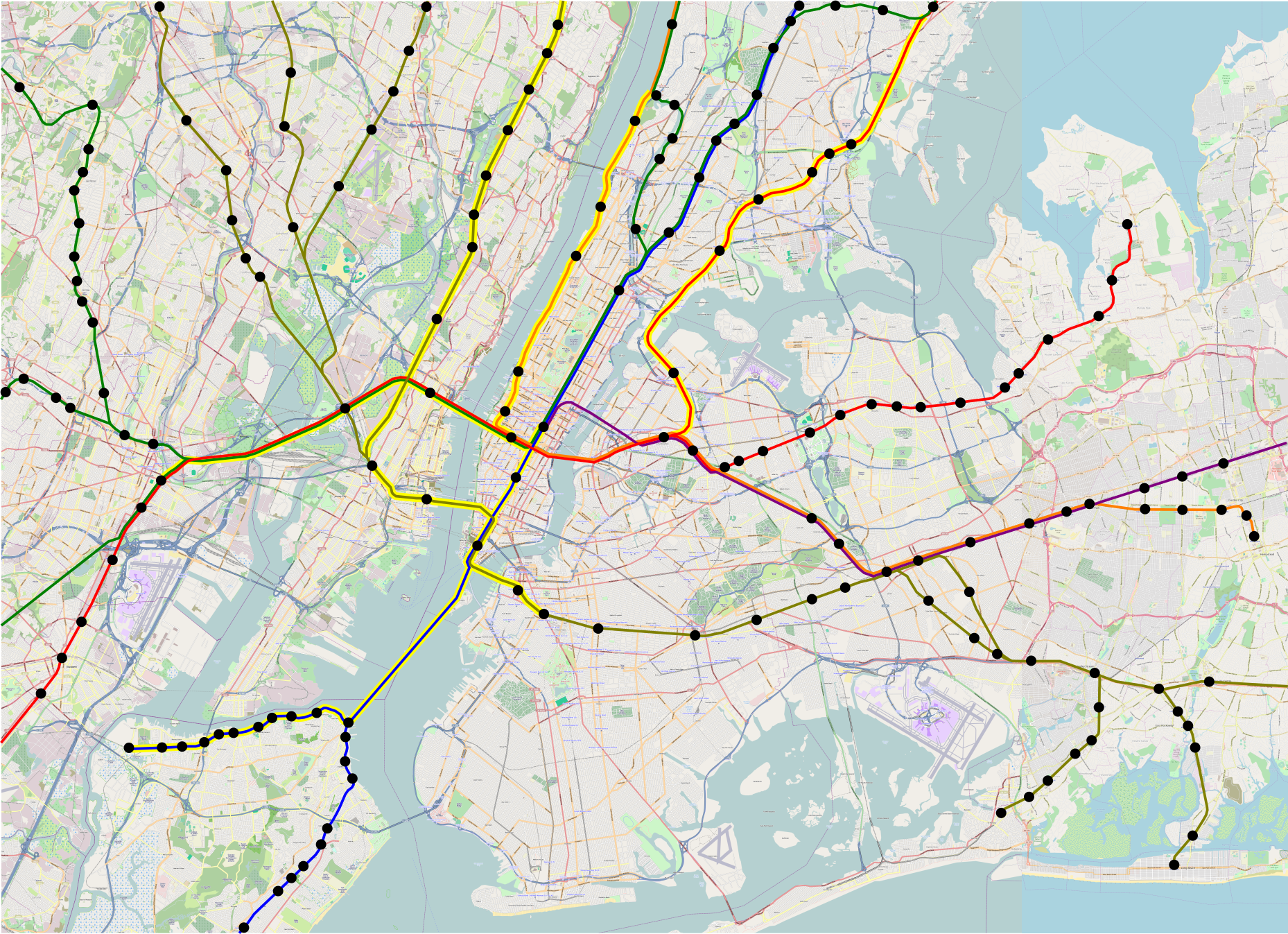
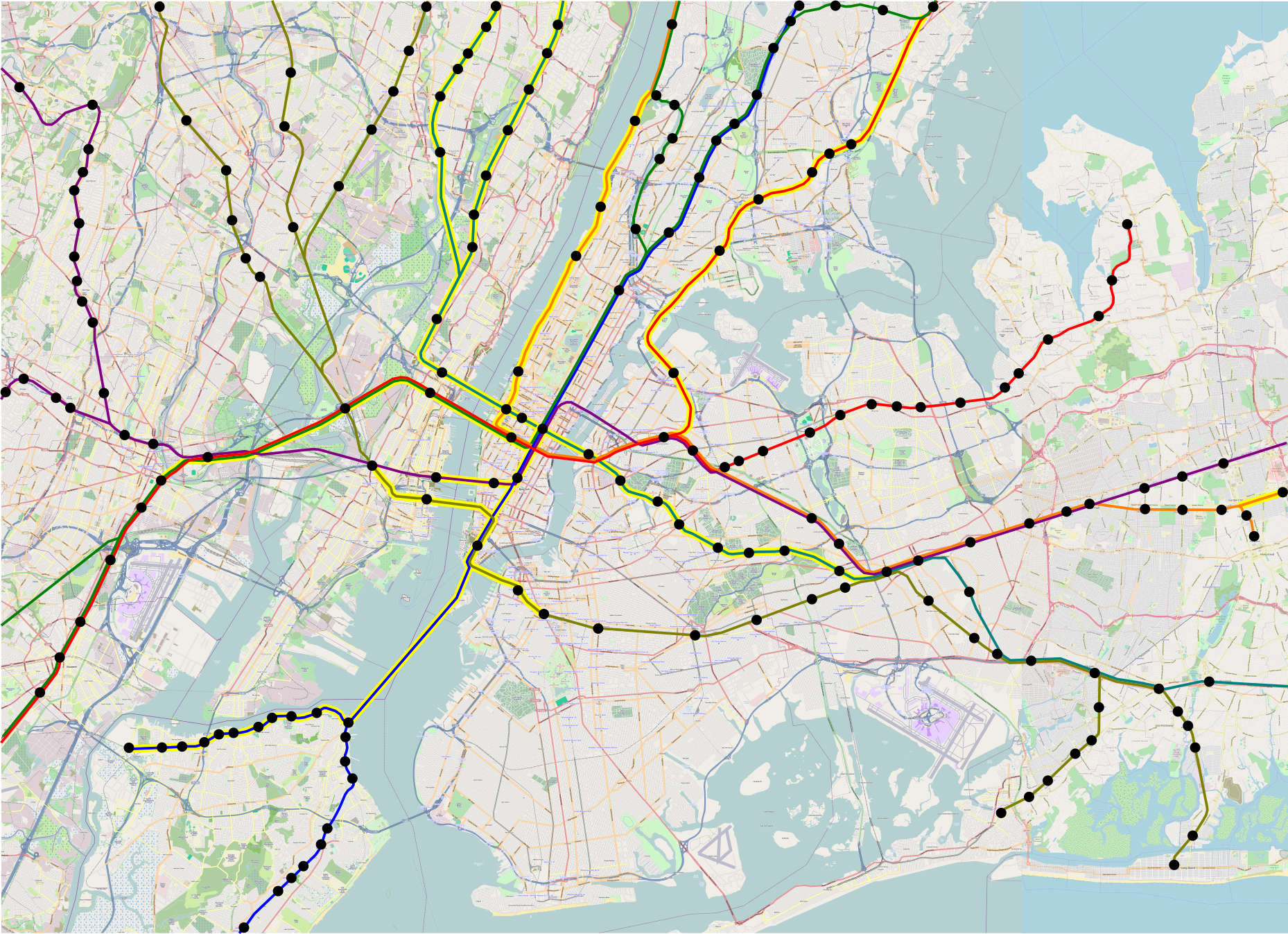
New York’s existing regional rail network suggests a north-south trunk line, starting from the Harlem Line in the north and continuing south to Lower Manhattan and beyond. Such a line would run parallel to the Lexington Avenue Line, providing additional express service, running fast not just between 125th Street and City Hall but also farther north and south. Going back to 2009, I have proposed such a line, controversially continuing on to Staten Island:
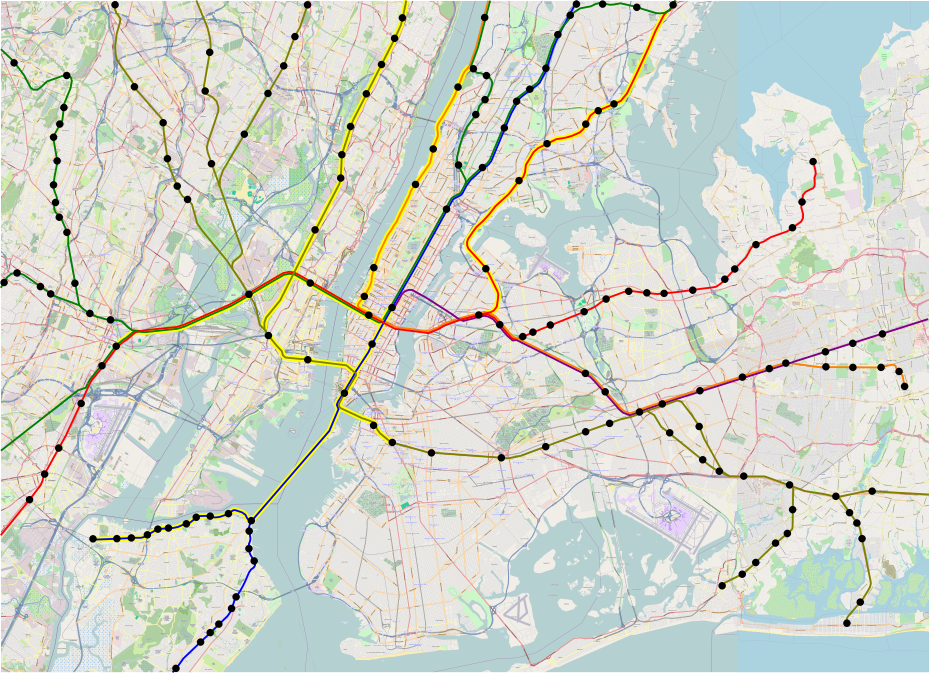
Of note, the depicted regional rail network makes use of the entirety of Grand Central’s approach tracks. There are four tracks, two used by Line 2 to Penn Station (the green line) and two by Line 4 (the blue line), the north-south trunk under discussion. In contrast, here is the RPA version:
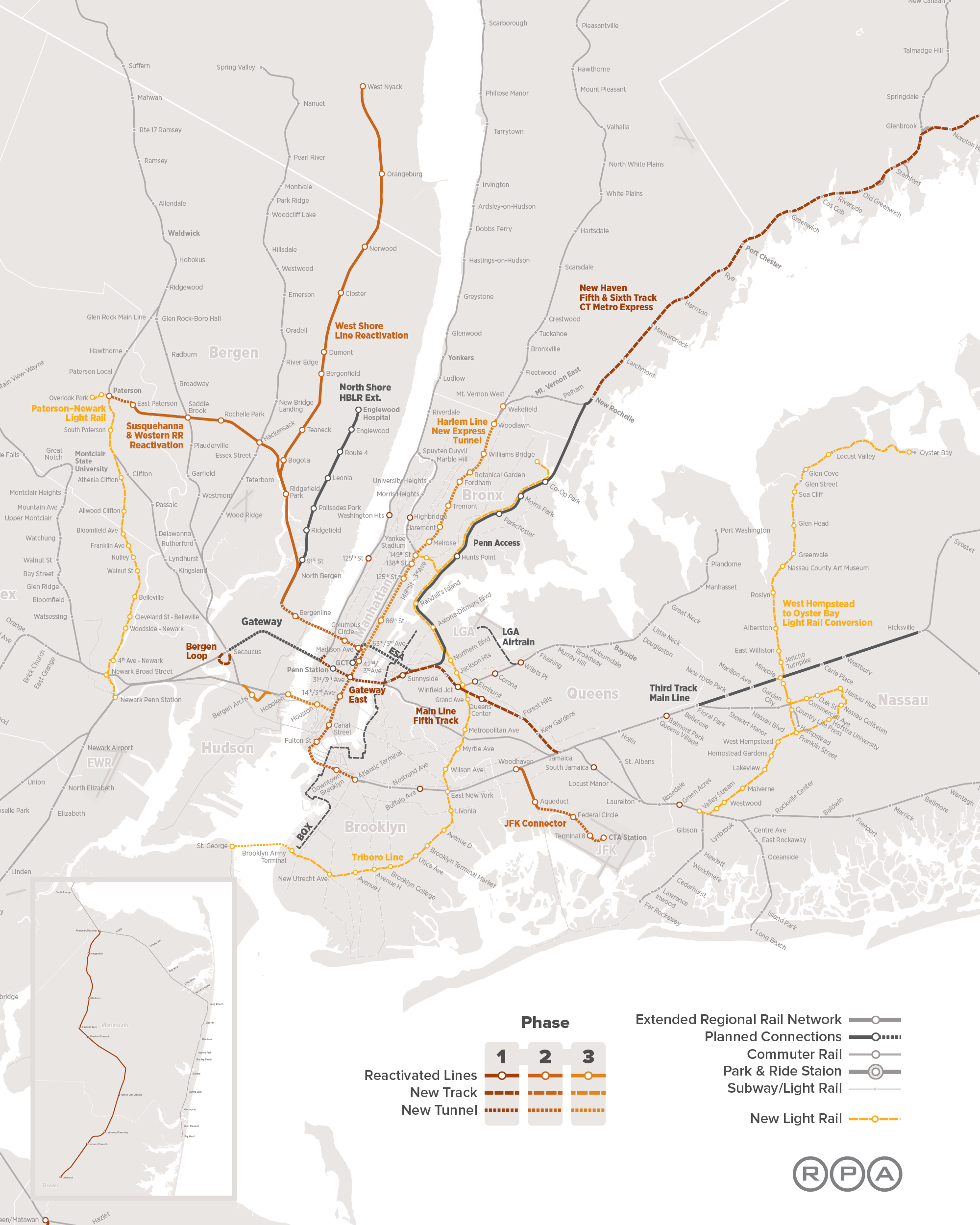
There is a lot more going on in the RPA version – more tunnels, some light rail lines – but the important thing to focus on in this post is the north-south trunk. The RPA is proposing the following items:
- A north-south trunk line under Third Avenue, with an onward connection to Brooklyn.
- Stops at 125th, 86th, 42nd, 31st, 14th, Canal, and Fulton Street.
- Two tunnels to New Jersey (in addition to Gateway), at 57th and Houston Streets, using Third Avenue to connect between them.
- A tunnel directly under the Harlem Line in the Bronx, called an express tunnel but making more stops, with infill at 138th and 149th Street, to intersect the 6 and 2/5 trains respectively.
I contend that all three elements are problematic, and should not be built without major changes.
1. Third Avenue
The RPA plan bypasses the existing tracks to Grand Central entirely. This simplifies scheduling, in the sense that all trains using Third Avenue are captive to the reorganized system from the start. It also serves the Upper East Side and East Harlem slightly better: there is more population density east of Third Avenue than west of it, so it materially benefits riders to have a commuter rail station on Third rather than on Park, where the current line goes.
Unfortunately, these advantages are swamped by the fact that this means the Fourth Regional Plan is proposing about 8 kilometers of tunnel, from 138th Street to 42nd, redundant with the existing Grand Central approach. At the cost I think is appropriate for urban tunnels, this is around $2 billion. At what New York seems to actually spend, start from $13 billion and go up.
Because this trunk line would have to be built from scratch, it also has necessarily limited capacity. The Grand Central approach has four tracks; Third Avenue is as far as I can tell based on the plan just two. Many trains on the Hudson and New Haven Lines would need to keep terminating at the existing Grand Central station, with no through-service; any transfer to the Third Avenue trunk would involve walking a long block between Park and Third Avenues, 310 meters apart.
The capacity limitation, in turn, forces some reverse-branching onto Metro-North, on top of that coming from future Penn Station Access lines (the connections from the New Haven and Hudson Lines to Penn Station, depicted on both the RPA map and my map). It is possible to avoid this by connecting just one of Metro-North’s line to the new trunk, probably the Harlem Line, and then make passengers from the other two lines go to the existing Grand Central. But at least as depicted in the map, this service pattern seems unlikely: the High Bridge infill stop suggests some Hudson Line trains would go to the trunk, too. Unfortunately, even without reverse-branching, service would not be great, since connections between the old and new system (especially with the Hudson Line) would require a long walk at 125th Street or Grand Central.
The long walk is also a problem for the trunk line from Grand Central south. According to OnTheMap, the center of gravity of Midtown jobs seems to be between Fifth and Sixth Avenues, with few jobs east of Third. While this trunk line is good for scooping Upper East Side passengers, it isn’t good for delivering them to their exact destination.
2. Stop Spacing
The RPA stop spacing is too local. The 4 and 5 trains stop at 125th, 86th, 59th, Grand Central, Union Square, City Hall, and Fulton Street. It’s for this reason that my map’s Line 4 is so express, stopping only at 125th Street, Grand Central, Union Square, and Fulton Street: the line parallels the Lexington Avenue Line so closely that it should offer a different stopping pattern. For the same reason, observe that I do not include any infill on the LIRR Main Line west of Jamaica, where is it closely parallel to the Queens Boulevard Line with its E and F express trains; on lines not so close to express subways, I have extensive infill instead.
In contrast, the RPA wants trains to make the same number of stops between Harlem and Lower Manhattan as the 4 and 5 subway lines, just at slightly different locations: 31st instead of 59th, Canal instead of City Hall.
The Canal Street location is understandable. Chinatown is a major destination, overshadowed by Midtown and Lower Manhattan but important in its own right; the Canal Street complex on the 6, N/Q/R/W, and J/Z is the 18th busiest subway station in New York on weekdays and the 11th busiest on weekends. It’s also an intersection point between the north-south trunk line and the N/Q trains (in addition to Union Square) and the J/Z trains (in addition to Fulton Street). I think it’s overall not a good idea to include this location, because the 4/5/6 exist, and the connections to the N/Q and J/Z also exist elsewhere, but I think the alternatives analysis for this project should include this station as an option.
In contrast, 31st Street is inexcusable. On the surface, the rationale for it is clear: provide a transfer point with the east-west tunnels feeding Penn Station. In practice, it is weak. The area is just frustratingly out of walking range from Midtown jobs for train riders. The transfer is good in theory, but in practice requires a new tunnel from Penn Station to Long Island, one that the RPA included because Long Island’s turf warriors wanted it despite complete lack of technical merit; the cost of this tunnel, according to RPA head Tom Wright, would be $7 billion. The only reason to include this connection in the first place is that RPA decided against a connection between Grand Central and Penn Station.
3. The New Jersey Tunnels
In New Jersey, the RPA believes in making no little plans, proposing three two-track Hudson crossings: Gateway, and two new tunnels, one connecting Bergen and Passaic Counties with 57th Street, and one from Hoboken to Houston Street. Tunnels in the general vicinity of these are good ideas. But in this plan, there’s one especially bad element: those tunnels link into the same Third Avenue trunk line.
The RPA has a tendency, going back to at least the Third Regional Plan, to hang many elements on one central piece of infrastructure. The Third Plan proposed Second Avenue Subway as a four-track line, with many branches hitting all the other priorities: regional rail, an express rail connection to JFK, more lines in Brooklyn and the Bronx – see schematic on PDF-p. 13 of the executive summary and more detail on PDF-pp. 204-207 of the full plan. Most of these elements were good on their own, but the connection to Second Avenue Subway made them more awkward, with extensive conventional- and reverse-branching, and a JFK connection that would miss all Midtown hotels.
On this plan, the need to link the new elements to the Third Avenue trunk leads to incoherent lines. High-frequency east-west trunks would make a lot of sense, complementing the north-south trunk, but instead of connecting Hoboken with Brooklyn and 57th Street with Long Island, both end up hooking to the north-south trunk and loop back to connect to each other. The proposed tunnels are already there, in the form of Gateway East and the trunk connection to Brooklyn, they just don’t align. Instead, the only east-west alignment that fully goes through is Gateway, with just one stop in Manhattan at Penn Station, except in the tunnel that also has an additional stop at off-Midtown 31st and 3rd.
4. Harlem Line Tunnel
Between Grand Central and Wakefield, the Harlem Line has four tracks. In the South Bronx, the Hudson Line splits off, but the rest of the Harlem Line still has four tracks. Thus, the Bronx effectively has six tracks feeding four in Manhattan. It is this configuration that probably led the RPA to believe, in error, that two additional regional rail tracks in Manhattan were required. In this situation, it is unlikely there will ever be capacity problems on the Harlem Line in the Bronx – the bottleneck is further south. So why is the RPA proposing to add two more tracks to the Harlem Line, in a tunnel?
In section 1 of this post, I defined the Third Avenue trunk’s unnecessary part as running from Grand Central to 138th Street, a total of 8 km. This tunnel, from 138th to the depicted northern end at Woodlawn, where the Harlem and New Haven Lines split, is 11 km. In a city with reasonable cost control, this should be around $2.5 billion. In New York, it would be much more – I can’t tell how much, since it is likely to be cheaper than the recent subway projects (Second Avenue Subway Phase 1, and the 7 extension), both of which were in Manhattan, but I would guess about $10 billion is in line with existing New York costs. Is there any valid reason to spend so much money on this tunnel?
When I interviewed Tom Wright and Foster Nichols for my above-linked Streetsblog piece, I only saw the plans around Gateway, and was aware of the Third Avenue trunk idea but not of any of the details, so I never got a chance to ask about the Harlem Line express tunnel. So I can only guess at why the RPA would propose such a line: it got some pushback from the suburbs about wanting more express trains. The RPA could try to explain to suburbanites that the new system would not be so slow in the Grand Central throat: Metro-North does the 6.6 km from 125th to Grand Central in 10 minutes; the trains are capable of doing it in 5-6 minutes, but the last 15 blocks are excruciatingly slow, which slowness would be eliminated with any through-running, via the existing tunnels or via Third Avenue. Instead, for the same reason the organization caved to Long Island pressure to include Gateway East, it caved to Westchester pressure to include more express tracks.
In reality, this tunnel has no merit at all. The way the existing suburban lines are laid out points to a clear service pattern: the Harlem Line on the local tracks, the New Haven Line on the express tracks (regardless if those trains run local or express on the New Haven Line farther out). Wakefield has four tracks and two platforms, but the Harlem and New Haven Lines split just short of it; perhaps new local platforms on the New Haven Line could connect to it, or perhaps the junction could be rebuild north of Wakefield, to enable transfers. With much of the New Haven Line capacity occupied by the reverse-branch to Penn Station Access, there wouldn’t be much of a capacity crunch on the express tracks; in a counterfactual in which reverse-branching is not a problem, some Harlem Line trains could even be routed onto the spare capacity on the express tracks.
Build a Network, Not One Line With Branches
In the short run, the biggest thing the RPA is proposing for regional rail in New York is Gateway plus tie-ins. But this doesn’t really distinguish it from what the politicians want. The real centerpiece of the Fourth Plan, as far as regional rail goes, is the Third Avenue trunk line – even taking over some functionality of Second Avenue Subway, which the RPA proposes to not build south of 63rd Street.
Unfortunately, this trunk line, while almost good, doesn’t quite work. It has 19 km of superfluous tunneling, from Grand Central to Woodlawn, adding no new service to the system, nor new connections to existing service, nor more capacity on lines that really need it. And it insists on linking new east-west tunnels beyond Gateway to the same trunk, ensuring that they couldn’t really work as east-west trunks from New Jersey to Brooklyn, Queens, and Long Island. In centering the trunk, the RPA is in effect ruining the possibility for additional trunks creating a bigger system.
Building a north-south trunk leveraging the Harlem Line is a no-brainer. When I sent Yonah Freemark my first regional rail proposal in 2009, he responded with some draft he’d been working on, I think as an RPA intern, proposing a through-running network using the Harlem Line, with an extension to the south with an onward connection to Brooklyn much like the RPA’s current Third Avenue trunk south of 42nd Street. It’s something that different people with an interest in improving New York’s transit system could come up with independently. What matters is the details, and here, the Fourth Regional Plan falls short.
Agency Turf Battles and Construction Costs
This is a touched-up version of an article I tried publishing earlier this year, changed to be more relevant to regular blog readers, who know e.g. what Gateway is.
I’ve talked a lot about high rail construction costs in the US, especially in New York: see here for a master list of posts giving cost figures, and here and here for posts about things that I do not think are major reasons. In this post, I’d like to talk about one thing that I do think is relevant, but not for every project: agency turf battles.
The German/Swiss planning slogan, organization before electronics before concrete, means that transit agencies should first make sure all modes of public transit are coordinated to work together (organization) before engaging in expensive capital construction. In the US, most urban transit agencies do this reasonably well, with integrated planning between buses and trains (light rail or subway); there’s a lot of room for improvement, but basics like “don’t run buses that duplicate a subway line” and “let people take both buses and subways on one ticket” are for the most part done. Readers from the San Francisco Bay Area will object to this characterization, but you guys are the exception; New York in contrast is pretty good; Chicago, Boston, and Philadelphia are decent; and newer cities run the gamut, with Seattle’s bus reorganization for its light rail being especially good.
But then there’s mainline rail, with too many conflicting agencies and traditions. There is no place in the US that has commuter rail and successfully avoids agency turf battles, even regions where the integration of all other modes is quite good, such as New York and Boston. I have complained about this in Philadelphia, and more recently criticized the RPA’s Fourth Regional Plan for letting Long Island claim the East River Tunnels as its own fief.
But all of this pales compared with what is actually going on with the Gateway tunnel. The New York region’s political leaders have demanded funding for a $25 billion rail tunnel between New York Penn Station and New Jersey. When Donald Trump had just won the election, Schumer proposed Gateway as a project on which he could cooperate with the new president; Booker got some federal money earlier, in the Obama administration.
The circumstances leading to the Gateway announcement are themselves steeped in inter-agency intrigue. Gateway is the successor to an older scheme to build a rail tunnel under the Hudson, called ARC. In 2010, Chris Christie acquired some notoriety for canceling it as construction started.
Earlier, in 2003, Port Authority studied three ARC alternatives. Alt P would just serve Penn Station with a new cavern adding more terminal tracks; Alt G would serve Penn Station and build a new tunnel connecting to Grand Central; Alt S would serve Penn Station and build a new tunnel to Long Island, at Sunnyside. The three options each cost about $3 billion, but Alt G had the highest projected ridership. Alt G had the opportunity to unite New Jersey Transit’s operations with those of Metro-North. Instead, Alt P was chosen, and the cavern was involved in the cost escalations that led Christie to cancel the project, saying the then-current budget of $9 billion would run over to $12.5 billion.
It is hard to say why Port Authority originally chose Alt P over Alt G. Stephen Smith spent years sending freedom of information requests to the relevant agencies, but never received the full study. Agency turf battles between New Jersey Transit and Metro-North are not certain, but likely to be the reason.
I talked to Foster Nichols a few months ago, while researching my Streetsblog piece criticizing the RPA plan for kowtowing to Long Island’s political demands too much. Nichols oversaw the reconstruction of Penn Station’s LIRR turf in the 1990s, which added corridors for passenger circulation and access points to the tracks used by the LIRR; he subsequently consulted on the RPA plan for Penn Station. Nichols himself supports the current Gateway plan, which includes the $7 billion Penn Station South complex, but he admitted to me that it is not necessary, just useful for simplifying planning. The Pennsylvania Railroad designed Penn Station with provisions for a third tunnel going east under 31st Street, which Alts S and G would leverage; Alts S and G are still possible. The one caveat is that the construction of Sixth Avenue Subway, decades after Penn Station opened, may constrain the tunnel profile – the ARC documents assumed locomotive-friendly 2% grades, but with EMU-friendly 4% grades it’s certainly possible.
With this background, I believe Alt G was certainly feasible in the mid-2000s, and is still feasible today. This is why I keep pushing it in all of my plans. It’s also why I suspect that the reason Port Authority decided not to build Alt G was political: the hard numbers in the study, and the background that I got from Nichols, portray Alt G as superior to Alt P. The one complaint Nichols had, track capacity, misses the mark in one crucial way: the limiting factor is dwell times at Penn Station’s narrow platforms, and having two Midtown stations (Penn Station and Grand Central) would allow trains to dwell much less time, so if anything capacity should be higher than under any alternative in which trains only serve one of the two.
The upshot is that Christie had legitimate criticism of ARC; he just chose to cancel it instead of managing it better, which Aaron Renn called the Chainsaw Al school of government. After Christie canceled ARC, Amtrak stepped in, creating today’s Gateway project. Even without the cavern, Gateway’s estimate, $13.5 billion in 2011, was already higher than when Christie canceled ARC; it has since risen, and the highest estimate I’ve seen (by Metro, so caveat emptor) is $29 billion. This includes superfluous scope like Penn South, which at one point was supposed to cost $6 billion, but more recently Nichols told me it would be $7 billion.
While bare tunnels would provide the additional capacity required at lower cost, they would require interagency cooperation. Amtrak, New Jersey Transit, and the LIRR would need to integrate schedules and operations. Some trains from New Jersey Transit might run through to the east as LIRR trains and vice versa. This would make it easier to fit traffic within the existing station, and only add bare tunnels; the Penn Station-Grand Central section, at the southern end of the station, would keep dwell times down by having two Midtown stations, and the section connecting New Jersey Transit with Long Island (probably just Penn Station Access and one LIRR branch, probably the Port Washington Branch) would have 8 station tracks to play with, making dwell times less relevant. Unfortunately, this solution requires agencies to share turf, which they won’t – even the Penn Station concourses today are divided between Amtrak, New Jersey Transit, and LIRR zones.
Gateway is not the only rail project suffering from cost blowouts; it is merely the largest. The LIRR is building East Side Access (ESA), to connect to Grand Central; right now, it only serves Penn Station. ESA uses an underwater tunnel built in the 1960s and 70s to get to Manhattan, and is now boring a 2 km tunnel to Grand Central, at a cost of $10 billion, by far the most expensive rail tunnel in the world per unit length. But the tunnel itself is not the biggest cost driver. Instead of having the LIRR and Metro-North share tracks, ESA includes a deep cavern underneath Grand Central for the LIRR’s sole use, similar to the one in ARC that Christie canceled. About $2 billion of the cost of ESA is attributed to the cavern alone.
Agency turf wars are not unique to New York. In California, the same problem is driving up the costs of California HSR. In inflation-adjusted dollars, the project’s cost has risen from $33 billion in 2008 to $53 billion today. Most of the overrun is because the project includes more tunnels and viaducts today than it did in 2008. Much of that, in turn, is due to conflicts between different agencies, especially in the San Francisco Bay Area. The worst example is San Jose Diridon Station.
Diridon Station is named after still-living former California HSR Authority board member Rod Diridon, previously responsible for the disaster that is VTA Light Rail, setting nationwide records for low ridership and poor cost recovery. The station’s main user today is Caltrain. California HSR is planned to serve it on its way between Los Angeles and San Francisco, while Caltrain and smaller users plan to grow, each using its own turf at the station. The planned expansion of track capacity and new viaducts for high-speed rail is estimated to cost about a billion dollars. Clem Tillier calls it “Diridon Pan-galactic” and notes ways this billion-dollar cost could be eliminated, if the users of the stations shared turfs. Clem identifies $2.7 billion in potential savings in the Bay Area through better cooperation between high-speed rail, Caltrain, and other transit systems.
It is not a coincidence that the worst offenders – Gateway, East Side Access, and California High-Speed Rail – involve mainline rail. American and Canadian passenger railroads tend to be technologically and managerially conservative. Most still involve conductors punching commuter tickets as they did in the 1930s; for my NYU presentation, I found this picture from 1934.
I suspect that this comes from a Make Railroading Great Again attitude. Old-time railroaders intimately understand the decline of mainline rail in the United States in the middle third of the 20th century, turning giants like the Pennsylvania Railroad into bankrupt firms in need of federal bailouts. This means that they think that what needs to be done is in line with what the railroads wanted in the 1920s, 30s, 40s, and 50s. Back then, people lived in the suburbs and commuted downtown at rush hour, so there was no need for intra-suburban service, for in-city stops (those were for working- and middle-class city residents, not rich suburbanites in Westchester), or for high off-peak frequency. There was no need for cooperation between different railroads then, since commuters would rarely need to make an onward connection, which led to a culture encouraging competition over cooperation.
Among all the explanations for high construction costs, turf battles is the single most optimistic. But Americans should be optimistic about building cost-effective passenger rail. If this is the main culprit – and it is in the Bay Area, and one of several big culprits in New York – then all it takes to fix the cost problem is bringing organizational practices to the 21st century, which is cheap. It is too late for East Side Access, but it is possible to drastically reduce the cost of Gateway by removing unnecessary items such as Penn Station South. This can be repeated for smaller projects in the San Francisco Bay Area and everywhere in the US where two separate transit agencies fight over station space.
Am I optimistic that Americans will actually do this? I am not. Even outfits that should know better (again, the RPA) seem too conservative and too politically constrained; the RPA is proposing systemwide integration in its Fourth Plan, but in a way that incorporates each player’s wishlist rather than in a way that uses integration to reduce capital investment needs. In California, the HSR Authority seems to be responding to demands for value engineering by procrastinating difficult decisions, and it comes down to whether in the moment of truth it will have politicians in the state and federal governments who are willing to pay billions of dollars of extra money.
However, I do think that a few places might be interested in running public transit better. Americans are not incorrigible, and can learn to adapt best industry practices from other countries, given enough pressure. From time to time, there is enough pressure, it’s just not consistent enough to ensure the entire country (or at least the most important transit cities, led by New York) modernizes.
The RPA’s Fourth Regional Plan
The RPA has just put up its Fourth Regional Plan, recommending many new subway and commuter rail lines in New York, ranging from good (125th Street subway, Brooklyn-Lower Manhattan regional rail) to terrible (Astoria Line extension to the west rather than to LaGuardia, which gets a people mover heading away from Manhattan). I have a poll for Patreon supporters for which aspects I should blog about; I expect to also pitch some other aspects – almost certainly not what I said in my poll – to media outlets. If you support me now you can participate in the poll (and if you give $5 or more you can see some good writings that ended up not getting published). If you want to be sneaky you can wait a day and then you’ll only be charged in January. But you shouldn’t be sneaky and you should pledge today and get charged tomorrow, in December.
It’s hard to really analyze the plan in one piece. It’s a long plan with many components, and the problems with it don’t really tell a coherent story. One coherent story is that the RPA seems to love incorporating existing political priorities into its plan, even if those priorities are bad: thus, it has the AirTrain LaGuardia, favored by Cuomo, and the Brooklyn-Queens Connector (BQX), favored by de Blasio, and even has tie-ins to these plans that don’t make sense otherwise. Some of the regional rail money wasters, such as Penn Station South and the new East River tunnels from Penn Station to the LIRR, come from this story (the LIRR is opposed to any Metro-North trains going to Penn Station under the belief that all slots from points east to Penn Station belong to Long Island by right). However, there remain so many big question marks in the plan that are not about this particular story that it’s hard to make one criticism. I could probably write 20,000 words about my reaction to the plan, which is about 15 published articles, and there are, charitably, 5 editors who will buy it, and I’m unlikely to write 10 posts.
I’ll wait to see how the poll on Patreon goes, and what editors may be interested in. There are interesting things to say about the plan – not all negative – in areas including rail extensions, transit-oriented development, and livable streets. But for now, I just want to zoom in on the crayon aspects. I previously put up my 5-line map (4 MB version, 44 MB version). The RPA proposal includes more tunnels, for future-proofing, and is perhaps comparable to a 7-line map I’ve been working on (4 MB version, 44 MB version):
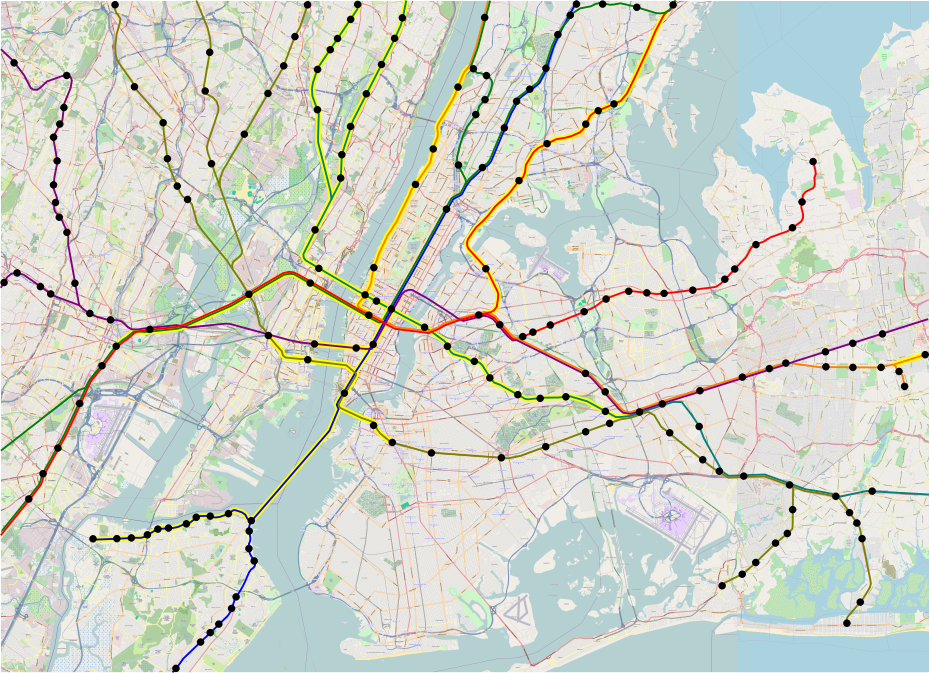
I was mildly embarrassed by how much crayon I was proposing, which is why what I put in my NYU presentation 3 weeks ago was the 5-line system, where Line 1 (red) is the Northeast Corridor and the Port Washington Branch, Line 2 (green) is much the same but through the new Hudson tunnels, Line 3 (orange) is the Empire Connection and the Hempstead Branch, Line 4 (blue) connects the Harlem Line and Staten Island, Line 5 (dark yellow) connects the Erie Lines with the Atlantic Branch and Babylon Branch, and Line 6 (purple) is just East Side Access. In the 7-line system, Line 6 gets extended to Hoboken and takes over the Morris and Essex Lines, and Line 7 (turquoise) connects the Montauk Line with the Northern Branch and West Shore Line via 43rd Street, to prune some of the Line 5 branches.
With all this extra tunneling, the map has 46 new double-track-km of tunnel. With just Lines 1-5, it has 30; these figures include Gateway and the other tunnels highlighted in yellow (but not the highlighted at-grade lines, like Lower Montauk), but exclude East Side Access. In contrast, here’s what the RPA is proposing:
Counting the Triboro-Staten Island tunnel and Gateway starting from the portal (not at Secaucus as the map portrays), this is 58 route-km, and about 62 double-track-km of tunnel (the Third Avenue trunk line needs four tracks between 57th and Houston at a minimum), for substantially the same capacity. The difference is that the RPA thinks Metro-North needs two more tracks’ worth of capacity between Grand Central and 125th, plus another two-track tunnel in the Bronx; from Grand Central to Woodlawn, the Fourth Regional Plan has 19 km, slightly more than 100% of the difference between its tunnel length and mine. My plan has more underwater tunnel, courtesy of the tunnel to Staten Island, but conversely less complex junctions in Manhattan, and much more austere stations (i.e. no Penn Station South).
As I said, I don’t want to go into too much detail about what the RPA is doing, because that’s going to be a series of blog posts, most likely a series of Streetsblog posts, and possibly some pieces elsewhere. But I do want to draw a contrast between what the RPA wants for regional rail and what I want, because there are a lot of similarities (e.g. look at the infill on the Port Washington Branch in both plans), but some subtle differences.
What I look for when I think of regional rail map is an express subway. I’ve been involved in a volunteer effort to produce a regional rail plan for Boston, with TransitMatters, in which we start by saying that our plan could be a second subway for Boston. In New York, what’s needed is the same, just scaled up for the city’s greater size and complexity. This means that it’s critical to ensure that the decision of which lines go where is, for lack of a better word, coherent. There should be a north-south line, such as the Third Avenue trunk in the Fourth Regional Plan or my Line 4; there should be an east-west line, such as the lines inherited from the legacy Northeast Corridor and LIRR; and so on.
The one big incoherence in my plan is the lack of a transfer station between Line 4/6 and Line 1/3 at Madison and 33rd. This is on purpose. Line 2 connects Penn Station and Grand Central, Madison/33rd is well to the south of Midtown’s peak job density, and Lines 4 and 6 shouldn’t be making more stops than the 4 and 5 subway lines, which go nonstop between Grand Central and Union Square.
The other weirdness is that in the 7-line system, unlike the 5-line system, there is no way to get between the Northern Branch or the West Shore Line and the rest of New Jersey without going through Manhattan. In the first map of this system that I made on my computer, Line 7 has an awkward dip to serve the same Bergenline Avenue station as Line 2. But I think what I posted here, with two separate stations, is correct: Lines 6 and 7 are lower priorities than a subway under Bergenline Avenue, which would make intra-state connections much easier. It’s difficult to depict rail extensions at different scales on one geographically accurate map, and doing a schematic map like the London Underground isn’t useful for depicting new lines, which should make it clear to readers where they go. But the 7-line system must be accompanied by subway extensions, some covered by the RPA (Utica, Nostrand) and some not (Bergenline, again).
I recently had to give a short description of my program for good transit, and explained it as, all aspects of planning should be integrated: operations and capital planning, buses and light rail and subways and regional rail, infrastructure and rolling stock and scheduling, transit provision and development. When I make proposals for regional rail, they may look out there, but the assumption is always that there’s a single list of priorities; the reason I depict a 7-line map, or even a 9-line map (in progress!), is to be able to plan lines 1-3 optimally. Everything should work together, and if agencies refuse to do so, the best investment is to make sure those agencies make peace and cooperate. The RPA plan sometimes does that (it does propose some regional rail integration), but sometimes it’s a smörgåsbord of different politically-supported proposals, not all of which work together well.
Suburban Transit-Oriented Development
Here’s a Google Maps image of Southport, a section of Fairfield, Connecticut with its own Metro-North commuter rail station:
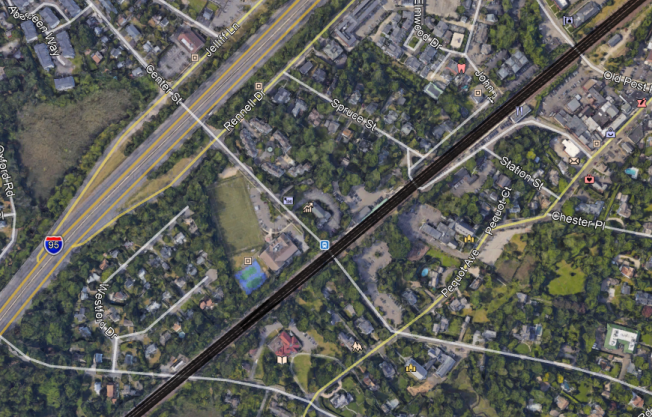
Here’s an image at the same scale of Bourg-la-Reine, an inner suburb of Paris on the RER B, at the junction between the line’s two southern branches:
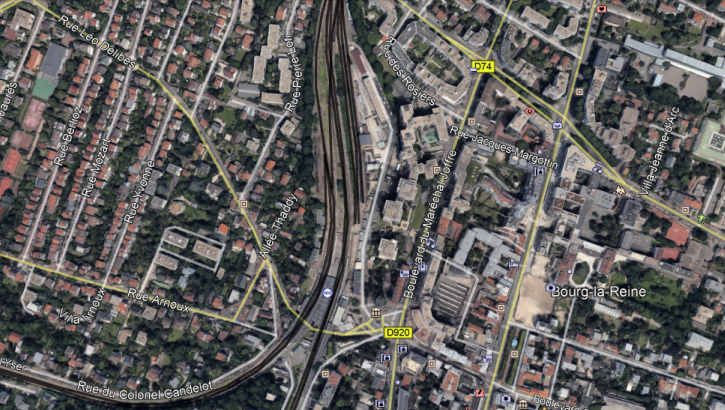
At Bourg-la-Reine, the buildings just east of the station are high-rise. There are local community amenities, including walkable schools, supermarkets, and pharmacies, and people can comfortably live in this suburb without a car. This generates significant RER traffic at all hours of day: outbound trains are often standing-room only until they reach this station even in midday, outside rush hour.
At Southport, there are a few townhouses near the station. But the roads are wide and hostile to pedestrians, and the nearest supermarket closes at 6 pm, too late for commuters returning from the city. Car ownership approaches 100%, and nobody rides the trains except to get to office jobs at the traditional peak hour in Manhattan (or perhaps Stamford).
The difference between the two places is so stark that they can barely be compared. Southport has 317 inbound boardings per weekday. Of those, 263, or 83%, are in the morning rush hour; the Metro-North-wide average is 63%, and the average on the SNCF-operated parts of the RER and Transilien is about 46%. Bourg-la-Reine has 4.5 million annual riders, about 16,000 on an ordinary working day.
A huge part of the difference is about service provision – Bourg-la-Reine has a train every five minutes midday, Southport a train every hour. But it’s not just about service. The RER has stations farther out, with somewhat less intense service, such as a train every 15 minutes, with comparable ridership. And the LIRR and Metro-North have little off-peak ridership even at stations with more frequent service, such as Mineola and Hicksville. Transit-oriented development (TOD) is as important as good service in such cases.
I bring up Southport because the RPA just dropped a study about suburban TOD that grades every New York commuter rail station between 0 and 3, and gives Southport the highest mark, 3. The RPA study looks at zoning within 800 meters of each station and considers whether there’s a parcel of land that permits multifamily housing with a floor are ratio higher than 1.25. Southport has such lots, supporting some townhouses, so according to the RPA it gets full marks, even though, by RER standards, it is like every other American car-oriented suburb.
Based on this methodology, the RPA identifies a number of good suburbs, and even comes to policy conclusions. It proposes more TOD in the mold of existing exurban New York examples, such as Patchogue. The model for the program is the real reason the RPA study is so weak: rather than calling into attention the big differences between land use at suburban stations in New York versus in Paris (or any number of big European cities with suburban rapid transit), it overfocuses on small differences within auto-oriented suburbia.
Some of the ultimate conclusions are not terrible. For example, the RPA is proposing linking federal infrastructure development to permitting more multifamily housing. This would improve things. However, the problem with this is twofold. First, it is unrealistic – the federal government gave up decades ago on enforcing fair housing laws, and has no interest in attempting to make exclusionary suburbs behave. Were I to propose this, hordes of American commenters would yell at me for not understanding American politics. And second, it misunderstands the nature of the problem, and ends up proposing something that, while unrealistic, is still low-impact.
The best way to understand the problem with the study is what author Moses Gates told me on Twitter when I started attacking it. He said that the RPA was looking at zoning rather than actual development. Since there is zoning permitting multifamily development within the prescribed radius at Southport, it gets full marks. With my understanding of what good TOD looks like, I would be able to say that this is clearly so bad the methodology must be changed; on Twitter I suggested looking at zoning within 300 meters of the station rather than 800, since the highest-intensity development should be right next to the station. I also suggested looking at supportive nonresidential uses, especially supermarkets. A development that isn’t walkable to retail at reasonable hours is not TOD.
The RPA does not think in this language. It thinks in terms of internal differences within the US. Occasionally it deigns to learn from London, but London’s suburban development is auto-oriented by European standards (transit mode share in the London commuter belt is at best in the teens, often in the single digits). Learning from anywhere else in the world, especially places that don’t speak English, is too difficult. This means that the RPA could not reach the correct conclusion, namely, that there is no such thing as an American suburb with TOD. The only exception I can come up with in the United States involves Arlington, on the Washington Metro, and Arlington is no longer considered a suburb, but really a full-fledged city in a different state, like Jersey City.
The other thing the RPA missed is that it drew too large a radius. TOD at a train station should include townhouses 800 meters out – but it’s more important to include high-rise residential construction next to the train station and mid-rise apartment buildings 500 meters out. Giving American suburbs latitude to place TOD so far from the station means they will act like Southport and allow small amounts of multifamily housing out of the way, while surrounding the station itself with parking, a tennis court, and large single-family houses with private swimming pools. This is not hypothetical: suburbs in New Jersey have reacted to court rulings mandating affordable housing by permitting apartments at the edge of town, far from supporting retail and jobs, and keeping the town core single-family.
Because the RPA missed the vast differences in outcomes between the US and France, it missed some useful lessons:
- States should centralize land use decisionmaking rather than give every small suburb full autonomy.
- TOD doesn’t need to be fully mixed-use, but there should be some local retail right next to housing.
- Housing should be high-density right next to the station. A floor area ratio of 1.25 is not enough.
- Publicly-funded social housing should be next to train stations, in the city as well as in the suburbs, and this is especially important in expensive suburbs, which aren’t building enough affordable housing.
Without suburban TOD, any regional rail system is incomplete. I wish I could have covered it at my talk, but I didn’t have time. Good service needs to run to dense suburbs, or at least suburbs with dense development within walking distance of the station. It needs to extend the transit city deep into suburbia, rather than using peak-only commuter rail to extend the auto-oriented suburbs into the city.
I Gave a Talk About Regional Rail
I expect there will be writeups about the talk (e.g. on Streetsblog). But meanwhile, here are my slides (warning: 17 MB, because of pictures). These are identical to what was shown at the talk, with two differences: I fixed one small mistake (Fordham Road vs. Pelham Parkway), and I consolidated the pauses, so each slide is a page, rather than a few pages, each page adding a line.
There were light fantasy maps in the talk. Because of size, I’m not embedding them in the post. But there are links:
- Infill stops without new tunnels: low-res/3.5 MB, high-res/20 MB
- The 3-line system (Gateway and realigned Empire Connection): low-res/4 MB, high-res/44 MB
- The 5-line system (the Lower Manhattan lines): low-res/4 MB, high-res/44 MB
Yellow highlights around a line indicate it’s new; Gateway is highlighted in one direction since it’s an existing two-track line to be four-tracked. On the infill map, solid circles are existing stations, gray circles are planned stations, white circles are my suggestions for additional infill.
Fix DeKalb Avenue
In New York, there are two dedicated subway tracks on the Manhattan Bridge offering a bypass of Lower Manhattan. Between DeKalb Avenue in Brooklyn and Canal Street in Chinatown in Manhattan, Q trains run nonstop for 3.5 km, while the R train goes the long way, taking 5.5 km and making 2 intermediate stops in Downtown Brooklyn and 4 in Lower Manhattan. The N skips DeKalb Avenue, with a 4.5 km nonstop segment between Canal Street and the Atlantic/Pacific/Barclays station complex.
The Q and N should be immense time savers. Instead, the Q does the trip in 8 minutes and the N in 10, both of which average 26-27 km/h. The subway’s overall average speed, weighed down by local trains stopping every 700 meters, is 29 km/h. The Q and N are still time savers, though, because the R does the 5.5 km in 18 minutes, an average speed of 16 km/h – far less than the systemwide average, and even less than the slowest Paris Metro line, Line 4 with its 500-meter interstations and 20 km/h average speed. Between DeKalb and Pacific, about 800 meters, the R takes 3 minutes. Unfortunately, New York City Transit is not taking any measures that would fix this, and when I asked about one possibility, I got excuses.
There are two reasons why this part of the subway is so slow. The first is something called signal timers. Timers are devices installed at frequent intervals on long interstations, such as the bridges and tunnels connecting Manhattan with Brooklyn and Queens, limiting train speed. These timers have always been around, but after fatal accidents in the 1990s, New York City Transit tightened them, reducing speed further; for some more background, see my Vox piece from last summer. The timers are more safety theater than safety. The biggest conclusion I reached from looking at the accident postmortem on the NTSB and some NYCT information was “make sure your trains’ brakes work as intended”; NYCT derated the trains’ service and emergency braking rates later in the 90s, which marginally reduces maintenance costs but is bad for safety and brutal for train speed.
The second reason is the switches at DeKalb Avenue. DeKalb is a six-track station, with four tracks feeding the Manhattan Bridge and two feeding the tunnel through Lower Manhattan. The two tunnel tracks then continue to the south as local tracks on the Fourth Avenue Line, carrying the R; this is the least used of all subway trunk lines into Manhattan, because the detour and low speed make it useless for most Midtown-bound passengers. The four bridge tracks include two express tracks at DeKalb going to the Brighton Line, and two super-express tracks skipping DeKalb continuing to the south as express Fourth Avenue tracks. Today, there is a splitting and recombining of branches. The B and D run together from Sixth Avenue to the Manhattan Bridge, and the N and Q run together from Broadway, but just north of DeKalb they recombine as B and Q running to Brighton, and D and N running super-express down Fourth Avenue.
This recombination at DeKalb slows down trains considerably, in two ways. First, the interlocking is complex. You can see it on this map on NYCSubway.org; in addition to splitting and recombining the B, D, N, and Q, it also has a non-revenue connection allowing R trains to serve the Brighton Line. Trains on diverging turnouts go at glacial speeds. And second, trains from four lines influence one another’s schedules, and delays propagate. Supervising train movements is thus difficult, and control center has to have a camera watching the trains enter the interlocking to ensure they adhere to schedule; timetables have to take the resulting delays into account.
When I first complained about reverse-branching in New York, I talked about capacity limits imposed by having more trunk lines than branches, a situation that is still to some extent true going north and east of Midtown. At DeKalb, there are six tracks going in and six going out, but the recombination makes things slower, and should be removed. NYCT should make a decision between having B and D trains run on the Brighton Line and the N and Q on Fourth Avenue, or the reverse. The interlocking permits either option, with entirely grade-separated junctions, allowing the trains on the two lines to no longer interfere with each other’s operations.
I in fact asked NYCT about it by proxy. NYCT dismissed the idea, on the grounds that transfer volumes between the B/D and N/Q would be too big. At Atlantic/Pacific, the Pacific side has a cross-platform transfer between the local R and express D/N, but going between the Pacific side and the Atlantic side (the B/Q, and separately the 2/3/4/5) involves a lot of walking. NYCT believes that passengers would flood the corridors looking for a train to their preferred destination, and the transfer volumes would require trains to have long dwell times. NYCT said nothing about whether the overall speed would actually fall, but I believe that based on the large transfer volumes NYCT predicts, passenger trip times (including transfer times) would rise. The only problem: I don’t believe NYCT’s prediction is true at all.
The B and D trains go express up Sixth Avenue, making stops at Grand Street in Chinatown, Broadway-Lafayette on Houston Street, West Fourth Street in the Village, and Herald Square. The N and Q trains go express up Broadway, serving Canal Street in Chinatown, Union Square, and Herald Square. North of Herald Square the two lines are never more than one long block apart until they leave Midtown. Passengers going toward Midtown are unlikely to have strong opinions about which of the two lines they would prefer.
Passengers going to destinations between Manhattan Bridge and Midtown might register stronger preferences. Union Square is the fourth busiest subway station in New York, and is quite far from the B and D. The closest alternative using the B and D is to change cross-platform to the M or F at West Fourth, and get off at 14th Street and Sixth Avenue, two long blocks from Union Square. Three more stations are potential concerns: Canal Street ranks 18th, West Fourth ranks 21st, and Broadway-Lafayette ranks 25th. Getting to Broadway-Lafayette from the N or Q is easy: the station and Canal Street are both on the 6, and passengers can transfer to the 6 at Canal.
West Fourth and Canal remain concerns, but they are not huge ones; they are secondary destinations. Canal is only a major destination for Chinese-New Yorkers, and in Brooklyn they cluster in Sunset Park along Fourth Avenue, suggesting that the Fourth Avenue express tracks should carry the N and Q and the Brighton tracks should carry the B and D. The urban geography of Chinese-New Yorkers is changing due to the combination of fast immigration and fast integration and migration to the suburbs, but this is a service decision, not an infrastructure investment; it can be reversed if demographics change.
Moreover, as a destination, West Fourth is predominantly used for NYU. The Village is a dense residential neighborhood, and West Fourth allows its residents to easily reach Lower Manhattan, Downtown Brooklyn, and two different four-track trunk lines through Midtown. But it has few jobs, outside NYU, which lies mostly between Sixth Avenue and Broadway. Union Square can adequately serve people going toward NYU, and stations on the R and 6 to the south can serve people going to NYU even better. The one problem is that the transfer between the R and the N/Q at Canal Street is not cross-platform; the cross-platform transfers start at Union Square. But with coverage of multiple stations walkable to NYU, the loss of the one-seat ride to West Fourth is not fatal. Even the transfer to the A, C, and E trains at West Fourth has alternative options: passengers from the N or Q going to the E can transfer to the F or M at Herald Square and reach the same stations, and passengers going to the A or C can transfer to the 1 at Times Square and to the A or C at Columbus Circle, both of which transfers are not much harder than climbing two flights of stairs at West Fourth.
With so many options, not many riders would be connecting at Atlantic/Pacific, and trains could keep dwell times short. If anything, dwell times might be shorter, because missing a train would be less fatal: the next train on the same track would serve the same destinations in Midtown, so riders would only need to wait about 3 minutes at rush hour, and 5 minutes off-peak. The gain in speed would be substantial, with the interlocking imposing fewer operational constraints.
NYCT might need to slightly rework the switches, to make sure the chosen matching of the lines in Manhattan and Brooklyn takes the straight and not the diverging direction at the turnouts; typically, the straight direction imposes no speed limit (up to full line speed on high-speed rail lines), but the diverging direction is slow. A matching in which the B and D go on Brighton and the N and Q on Fourth Avenue express to my understanding already involves only one diverging move, if I am reading the track map linked on NYCSubway.org correctly. At the same time, NYCT could fix the switches leading to the R: there was through-service from the Brighton Line to the tunnel tracks the R uses today, but there no longer is, so this out-of-service connection should get diverging and not straight moves. But even with the R, the capital investment involved is minimal.
I do not know the potential travel time gains between DeKalb and Canal Street (or Grand Street) with no timers or reverse-branching. With straight tracks across Manhattan Bridge, and wide curves toward Grand Street, 3.5-minute trips are aspirational, 4-minute trips are still possible, and 5-minute trips should be easy. From Pacific Street, add one more minute, corresponding to cruising at 50 km/h, a speed limit the subway routinely attains even on local tracks. This saves passengers from DeKalb about 4 minutes, and passengers from Pacific about 5. The average trip across the system is about 21 minutes, and the average delay (“excess journey time“) is 3 minutes. The saving would be immense, and contribute to both more casual ridership between Brooklyn and Manhattan, and lower operating costs coming from faster trips.
NYCT should not make excuses for this. The timers may have been originally justified as a safety improvement, but reducing train braking rates had the opposite effect. And, uniquely among the various reverse-branch points in New York, DeKalb feeds two Manhattan trunks that are very close to each other, especially in Midtown, to the point that one-seat rides to every stop have limited value. It should make a decision about whether to run the B/D together on Fourth Avenue and the N/Q on Brighton (switching the Q and D) or the reverse (switching the B and N), based on origin-and-destination data. Some passengers might bemoan the loss of one-seat rides, but most would cheer seeing their trips sped up by 4-5 minutes.
Little Things That Matter: Vertical Circulation
Chatelet-Les Halles has a problem with passenger circulation. It has exceedingly wide platforms – the main platforms, used by the RER A and B, are 17 meters wide – but getting between the platform level and the rest of the station runs into a bottleneck. There are not enough stairs and escalators between the platform and the mezzanine, and as a result, queues develop after every train arrival at rush hour. Similar queues are observed at the Gare du Nord RER platforms. The situation at Les Halles is especially frustrating, since it’s not a constrained station. The platforms are so wide they could very easily have four or even six escalators per access point flanking a wide staircase; instead, there are only two escalators, an acceptable situation at most stations but not at a station as important as Les Halles.
This is generally an underrated concern in the largest cities. In smaller cities, the minimum number of access points required for coverage (e.g. one per short subway platform, two per long platform) is enough even at rush hour. But once daily ridership at a station goes into the high five figures or the six figures, a crunch is unavoidable.
There are two degrees of crunch. The first, and worse, is when the capacity of the escalators and stairs is not enough to clear all passengers until the next train arrives. In practice, this forces trains to come less often, or to spread across more platforms than otherwise necessary; Penn Station’s New Jersey Transit platforms are that bad. The situation at Les Halles and Gare du Nord is a second, less bad degree of crunch: passengers clear the platform well before the next train arrives, but there’s nonetheless a significant queue at the bottom of the escalator pits. This adds 30-60 seconds to passenger trip times, a nontrivial proportion of total trip time (it’s a few percent for passengers within the city and inner suburbs). Avoiding even the less bad crunch thus has noticeable benefits to passengers.
The capacity of a horizontal walkway is 81 passengers per minute per meter of width (link, p. 7-10). This is for bidirectional travel. Unidirectional capacity is a little higher, multidirectional capacity a little lower. Subway platforms and passages are typically around 5 meters wide, so they can move 400 passengers per minute – maybe a little more since the big crunch is passengers heading out, so it’s unidirectional with a few salmons (passengers arrive at the station uniformly but leave in clumps when the train arrives). Busier stations often have exits at opposite ends of the platform, so it’s really 400*2 = 800. Queues are unlikely to form, since trains at best arrive 2 minutes apart, and it’s uncommon for a train to both be full and unload all passengers at one station.
An escalator step can be 60 cm, 80 cm, or 1 meter wide, with another 60 cm of handrail and gear space on both sides. On public transit, only the widest option is used, giving 1.6 meters of width. The theoretical capacity is 9,000 passengers per hour, but the practical capacity is 6,000-7,000 (link, p. 13), or 100-120 per minute. This is more than pedestrian walking capacity per unit of step width, but less per unit of escalator pit width. So a pedestrian walkway ending in a battery of escalators will have a queue, unless the width of the escalator bank is more than that of the walkway leading to it.
Moreover, escalators aren’t just at the end of the station. The busiest train stations have multiple access points per platform, to spread the alighting passengers across different sections of the platform. But mid-platform access points have inherently lower capacity, since they compete for scarce platform width with horizontal circulation. It appears that leaving around 2 meters on each side, and dedicating the rest to vertical circulation, is enough to guarantee convenient passenger access to the entire platform; in a crunch, most passengers take the first access point up, especially if there’s a mezzanine (which there is at Les Halles).
Should New York invest in better commuter rail operations, it will face a bigger risk of queues than Paris has. This is for two reasons. First, New York has much higher job density in Midtown than Paris has anywhere, about 200,000/km^2 vs. perhaps 100,000 around La Defense and the Opera (my figures for both areas in Paris have huge fudge factors; my figure for New York comes from OnTheMap and is exact). And second, Manhattan’s north-south orientation makes it difficult to spread demand across multiple CBD stations on many commuter rail lines. One of the underrated features of a Penn Station-Grand Central connection is that through-trains would have passengers spread across two CBD stops, but other through-running regional rail lines would not have even that – at best they’d serve multiple CBDs, with one Midtown stop (e.g. my line 4 here).
When I computed the needs for vertical circulation at a Fulton Street regional rail station in this post, I was just trying to avoid the worse kind of crunch, coming up with a way to include 16 platform-end escalators (12 up, 4 down in the morning peak) and 16 mid-platform escalators (8 up, 8 down) on a 300-meter long two-level station. It’s likely that the escalator requirement should be higher, to avoid delaying passengers by 1-1.5 minutes at a time. With four tracks (two on a Grand Central-Staten Island line, two on a Pavonia-Brooklyn line) and 12-car trains arriving every 2 minutes, in theory the station could see 240,000 incoming passengers per hour, or 4,000 per minute. In reality, splitting passengers between Grand Central and the Financial District on what I call line 4 means that a sizable majority of riders wouldn’t be getting off in Lower Manhattan. When I tried to compute capacity needs I used a limit passenger volume of 120,000 per hour, and given Midtown’s prominence over Lower Manhattan, even 90,000 is defensible.
90,000 per hour is still 1,500 per minute, or 3,000-4,000 if we are to avoid minute-long queues. A single up escalator is limited to about 100-120 people per minute, which means that twenty up escalators is too little; thirty or even forty are needed. This requires a wider platform, not for horizontal passenger circulation or for safety, but purely for escalator space, the limiting factor. I proposed an 8-meter platform, with space for four escalators per end (two ends per platform, two platforms on two different levels), but this suggests the tube diameter should be bigger, to allow 10-meter platforms and six escalators per end, giving four up escalators per end. This is 16 up escalators. Another 16-20 up escalators can be provided mid-platform: the plan for eight up escalators involved eight access points interspersed along the platform, and 10-meter platforms are wide enough width to include three escalators (two up, one down) per bank and on the border of allowing four (three up, one down).
The situation at the Midtown stations in New York is less constrained. Expected volumes are higher, but Grand Central and Penn Station both spread passengers among multiple platforms. In the near term, Penn Station needs to add more vertical circulation at the New Jersey Transit platforms. The LIRR remodeled its section of the station to add more access points in the 1990s (e.g. West End Concourse), but New Jersey Transit is only doing so now, as part of phase 1 of Moynihan Station, and it’s still not adding as many, since its platforms are shorter and don’t extend as far to the west.
Nonetheless, given the number of proposals out there for improving Penn Station, including ReThinkNYC and Penn Design’s plan, it’s important to think of longer-term plans for better vertical circulation. When I proposed eliminating Penn Station’s above-ground infrastructure, I came up with a design for six approach tracks (including a new Hudson tunnel connecting to Grand Central), each splitting into two platform tracks facing the same platform; the six platforms would each be 15 meters wide, but unlike Les Halles, each of six access points would have six escalators, four up and two down in the morning peak, or alternatively four escalators and a wide staircase (the climb is 13 meters, equivalent to a five-floor walkup). There would be ample capacity for anything; emptying a full 12-car train would take forty seconds, and it’s unlikely an entire 12-car train would empty.