Category: New York
New York-Area Governments to Form a Coordinated Transportation Planning Agency
Governors Andrew Cuomo (D-NY) and Phil Murphy (D-NJ) announced that they would cooperate to form a Lower Hudson Transportation Association, or LHTA, to supersede what they described as antiquated 20th-century thinking and bring the region’s transportation into the 21st century. LHTA would absorb the transportation functions of Port Authority, which senior New York state officials speaking on condition of anonymity called “irredeemably corrupt,” and coordinate planning across the region. Negotiations with the state of Connecticut are ongoing; according to planners in New Jersey, the timing for the announcement was intended to reassure people that despite the lack of federal funding for Gateway, a lower-cost modified version of the project would go forward.
But the first order of business for LHTA is not Gateway. The governors’ announcement mentioned that LHTA would begin by integrating the schedules and fares throughout the region. By 2019, passengers will be able to transfer between the New York City Subway and PATH for free, and connect from the subway to the AirTrain JFK paying only incremental fare. Engineering studies for removing the false walls between PATH and F and M subway platforms are about to begin.
Commuter rail fare integration is also on the table. Currently, the fare on the subway is a flat $2.75. On commuter rail, it is higher even within New York City: a trip between Jamaica Station and New York Penn Station, both served by the E line of the subway, is $10.25 peak or $7.50 off-peak on the Long Island Railroad (LIRR). The governors announced that they would follow the lead of European transportation associations, such as Ile-de-France Mobilités in Paris, and eliminate this discrepancy under LHTA governance, which also includes revenue sharing across agencies. Detailed studies are ongoing, but in 2019, LHTA will cut commuter rail fares within New York City and several inner cities within New Jersey, including Newark, to be the same as the subway fare, with free transfers.
Simultaneously, LHTA will develop a plan for schedule integration, coordinating New Jersey Transit, the LIRR, Metro-North, and suburban bus agencies. In order to make it easier for suburban passengers to reach commuter rail stations, the suburban buses will be timed to just meet the commuter trains, with a single ticket valid for the entire journey. Today most passengers in the suburbs drive to the commuter rail stations, but the most desirable park-and-rides are full. Moreover, the states would like to redevelop some of the park-and-rides as transit-oriented development, building dense housing and retail right next to the stations in order to encourage more ridership.
Moreover, the LIRR and New Jersey Transit’s commuter trains currently stub-end at Penn Station in opposite directions. LHTA is studying French and German models for through-running, in which trains from one suburb run through to the other instead of terminating at city center. Planners within several agencies explain that the systems on the Long Island and New Jersey side are currently incompatible – for example, LIRR trains are electrified with a third rail whereas New Jersey Transit trains are electrified with high-voltage catenary – but reorganizing these systems for compatibility can be done in a few years, well before the Gateway project opens.
In response to a question about the cost of this reorganization, one of the planners cited the Swiss slogan, “electronics before concrete.” Per the planner, electronics include systems, electrification, and software, all of which are quite cheap to install, whereas pouring concrete on new tunnels and viaducts is costly. The planner gave the example of resignaling on the subway: the New York Times pegged the cost of modernizing subway signals at $20 billion, and this could increase capacity on most lines by 25 to 50 percent. But the cost of building the entire subway from scratch at today’s costs in New York is likely to run up to $200 billion.
But while the immediate priorities involve fare and schedule integration, LHTA’s main focus is the Gateway project. There are only two commuter rail tracks between New Jersey and Penn Station, and they are full, running a train every 2.5 minutes at rush hour. The Gateway project would add two more tracks, doubling capacity. The currently projected cost for the tunnel is $13 billion, but sources within New York said that this number can be brought down significantly through better coordination between the agencies involved. This way, it could be funded entirely out of local and state contributions, which add up to $5.5 billion. When pressed on this matter, officials and planners refused to say outright whether they expect $5.5 billion to be enough to cover the tunnel, but some made remarks suggesting it would be plausible.
Previous estimates for the costs of Gateway adding up to $30 billion include substantial extra scope that is not necessary. Sources on both sides of the Hudson report that the main impetus for the formation of LHTA was to coordinate schedules in a way that would make this extra scope no longer necessary. “With last decade’s ARC, there was a cavern under Penn Station to let trains reverse direction and go back to New Jersey,” explains one of the planners; ARC was a separate attempt to add tracks to the Hudson rail crossing to Penn Station, which Republican Governor Chris Christie canceled in 2010 shortly after his election. “With Gateway, there was the plan for Penn Station South, condemning an entire Manhattan block for the station for $7 billion. With the plans we’re developing with LHTA we don’t need either Penn South or a cavern to let trains run between stations.”
Moreover, some planners suggested reactivating plans to connect Penn Station and Grand Central as part of Gateway. They refused to name a cost estimate, but suggested that at the low end it could be funded out of already-committed state money. Under this plan, there would be through-running between not just New Jersey Transit and the LIRR but also Metro-North, serving the northern suburbs of New York and Connecticut. Sources at the Connecticut Department of Transportation said they are studying the plan and have reservations but are overall positive about it, matching the reports of sources within New York, who believe that Connecticut DOT will join LHTA within six months.
Officials are optimistic about the effects of LHTA on the region both privately and publicly. The joint press release referred to the metro area as “a single region, in which decisions made in far apart areas of New York nonetheless affect people in New Jersey and vice versa.” Planners in both states cited examples of friends and family in the other state who they would visit more often if transportation options were better. With better regional rail integration, they said, people would take more trips, improving regional connectivity, and take fewer trips by car, reducing traffic congestion and pollution.
Job Sprawl in the US vs. Europe
Both American and European cities have prominent central business districts with high job density. But when jobs sprawl beyond the CBDs, they do so in very different manners on the two sides of the Pond, which is both a cause and an effect of higher US automobile usage. Much of this job sprawl happens in places that people on the other side of the Pond would not recognize as part of The City. Besides the obvious misunderstandings, this can compromise the quality of analysis of urbanism and the transportation required to serve it. In short, the European model, for which my models are Stockholm and Paris, is that jobs sprawl contiguously from the CBD, enlarging its physical area, whereas the North American model, for which my models are New York and Washington, is that jobs leap large swaths of residential neighborhoods into auto-oriented suburbia.
CBDs and job density
Office towers are rare in European CBDs. Paris is largely built up to 6 to 9 stories, and the higher end is more common in residential areas like Nation than in the CBD, which stretches from Les Halles to Saint-Lazare and Etoile. Stockholm has a total of five towers in its center, none especially tall. Contrary to the common European belief that high-rises don’t add density, the mid-rise character of most European CBDs leads to a real limit on their ability to agglomerate. The job-densest arrondissement of Paris, the 2nd, has 60,000 jobs in a square kilometer (look for table EMP T6 here); Midtown Manhattan has about 800,000 jobs in 4 square kilometers.
Not all jobs are in the CBD. Some are local community facilities, such as schools, supermarkets, and hospitals. But even more exportable jobs are not all in the CBD. Some industries cluster in sections of the CBD (such as advertising on Madison Avenue in New York or, traditionally, the media on Fleet Street in London), and similarly some cluster in off-CBD locations, perhaps near one firm that located idiosyncratically. In the other direction, not even the job density of Midtown can contain every workplace that wants a central location, and this pushes out firms that can’t compete for CBD office rents. The difference between the North American and European models is where these firms are likely to locate.
Contiguous sprawl
In both Paris and Stockholm, the solution to the restricted job density of their city centers is, superficially, high-rise clusters in a particular suburban place: La Defense in Paris, Kista in Stockholm. The job density at the center of La Defense is actually higher than in the 2nd arrondissement, though it drops drastically outside the very center, whereas the Paris CBD maintains a density of about 50,000 jobs per km^2 over 4 or 5 square kilometers. In both cases, this leads to spatial inequality: in Paris, the richest suburbs are in the west and southwest, and La Defense is west of the city; in Stockholm, Kista itself is surrounded by working- and middle-class areas, and the favored quarter is separated from it by a lake, but the ill-favored quarter to the south is the farthest away.
However, there is much more to Paris employment than the CBD and suburban office towers. Paris has a total of 1.8 million jobs, with only around one eighth to one sixth of them in the CBD. There are corporate headquarters in La Defense and a number of other suburbs on the RER, but there are job clusters all over the city. My arrondissement, the 12th, has 120,000 jobs in a little more than 6 square kilometers, giving it the same job density as is average for the city. According to OnTheMap, Upper Manhattan, defined to be north of East 96th and West 110th Streets, has 150,000 jobs in 19 square kilometers, and the Upper East and West Sides, defined to be north of 62nd Street so as to exclude Columbus Circle jobs, have a total of 175,000 jobs in 9 square kilometers. While the Upper East and West Sides hold their own, in large part thanks to the hospital cluster around Weill-Cornell, Upper Manhattan does not.
These clusters in Paris are everywhere. In my arrondissement the cluster in question is Bercy, home to the Ministry of Finance; there’s also the university cluster in the Latin Quarter, an under-construction judicial cluster around Clichy-Batignolles, and high-end professional services spillover west of the CBD in the 16th and 17th arrondissements. In effect, office uses are sprawling into otherwise-residential neighborhoods.
In Stockholm, the same situation occurs. Spotify is headquartered two T-Bana stops north of T-Centralen, a short walk from where I used to live in Roslagstull (in fact, one of the people viewing my apartment as I was leaving it worked there). There’s also a prominent peak travel flow of students heading to KTH and the University on the trains from points south. In the south, Södermalm has its own secondary CBD around Slussen, the second busiest T-Bana station after T-Centralen.
Office park sprawl
North American cities do not have high overall job density in the core when one counts both the CBD and surrounding inner neighborhoods, which are typically entirely bedroom communities like Upper Manhattan. Instead, there is discontinuous job sprawl: jobs hop over residential areas into farther-away places, typically suburban office parks. The most famous in American urbanist discourse is Tysons Corner in Northern Virginia, but the Washington metropolitan area is generally replete with edge cities, including Reston, Bethesda, and Silver Spring, all located in the northern and western favored quarters of the region. Kista is really a high-rise version of these edge cities.
Washington is the purest example of office job sprawl. However, even there, there is a complication: there are some nearer job clusters like the Pentagon. New York and other large American cities are the same, with even more complications like this. In New York, the in-state side of the metro area has large suburban job clusters such as White Plains and Stamford, but the New Jersey side includes the formerly independent Downtown Newark, contiguous job sprawl in Jersey City directly facing Lower Manhattan, and very decentralized job sprawl in Middlesex County, contrasting with the centralized office sprawl of White Plains.
Robert Lang and Jennifer Lefurgy call Central Jersey edgeless cities and White Plains and Tysons edge cities. While edge cities exist in Europe, edgeless cities do not. Exurban retail in France resembles American exurban retail, with Carrefour inventing the hypermarket at the same time Wal-Mart did, but there is almost no equivalent of the small American office park. The closest I am aware of, Sophia-Antipolis, is an edge city with a large concentration of jobs, just built at automobile scale without any walkability.
New York is large enough to have an intermediate form: namely, a secondary CBD that’s not contiguous with the main city center. Downtown Brooklyn arose as such a CBD, serving Brooklyn, even though it’s contiguous with Lower Manhattan across the water. Jamaica is the best example, as it is quite far from Manhattan. La Defense should be put in this category as well – it is contiguous with the dense built-up area, if not with the CBD itself, and it is closer to Les Halles than Jamaica is to Midtown.
Favored quarters
There are multiple instances of large American firms moving their entire headquarters to be close to where the CEO lives. IBM moved to Armonk and General Electric moved to Fairfield, both leaving New York, to avoid making executives drive in Manhattan traffic. In Europe, too, the edge cities tend to be in rich areas. The corporate headquarters around Paris cluster in La Defense and to a lesser extent northwestern and southern suburbs, and not in Seine-Saint-Denis.
This is a straightforward consequence of the fact that rich Americans left city centers starting in the early 20th century, culminating in middle-class white flight in the 1950s, whereas Paris and Stockholm remain richer than their suburbs. The inhabitants of the 16th arrondissement of Paris are unlikely to be interested in job sprawl. Instead, the Paris CBD is slowly migrating westward, as retail and office rents at the western end (Etoile) are higher than in the center (the Opera) and eastern end (just west of Les Halles).
One would suspect that in American cities that are richer than their suburbs, the phenomenon of job sprawl would not occur. The problem is that there is no clean example today. Boston is still poorer than its suburbs; Cambridge is quite rich, but is functionally one favored-quarter wedge. San Francisco is overall richer than most of its suburbs, but really the entire strip of land from San Francisco down to San Jose is rich, and at any rate Silicon Valley formed in a then-independent metro region, rather than sprawling out of the center the way White Plains and Tysons Corner did.
However, as white flight is giving way to gentrification, and American cities are economically outgrowing their suburbs, this theory would predict that job sprawl should decrease, with more corporate jobs shifting back to the cities. This seems to indeed be happening: General Electric moved from Fairfield to Downtown Boston, and United-Continental moved its headquarters to the Sears Tower in the Chicago Loop; Aaron Renn periodically talks about the resorting of the American economy, in which the highest-end jobs are back to city centers whereas lower-end jobs are in the suburbs and smaller cities.
Is the US Europeanizing?
There is some evidence to suggest that American cities not only are reducing the extent of job sprawl in the highest pay categories, but also adopting the European pattern of contiguous CBD sprawl. This process is haphazard, and many urban boosters overrate the extent to which near-CBD locations like the West Loop in Chicago or the Seaport in Boston are attracting jobs, but these areas are nonetheless growing.
Boston is perhaps the best example of this trend. Locally, urban boosters anxiously talk about transportation connections to the Seaport, but the biggest action is happening in the other direction. Kendall Square is growing as the Cambridge CBD, with a cluster of tech firms, two stops out on the subway from the central transfer points. Boston is unique that Back Bay is a nearly-contiguous secondary CBD as well, based on extensive postwar urban renewal next to a rich residential neighborhood. This situation is especially notable given that both Cambridge and the Seaport are separated from the CBD by water, with unpleasant walking environments on the bridges, making the organic process of CBD extension more difficult.
Outside Boston, several more examples are notable. In San Francisco, tech jobs within the city cluster not in the Financial District but in the adjacent South of Market (“SoMa”) area. In Chicago, in addition to some growth in the West Loop, there is some job growth on the Near North Side. In New York, the tech jobs cluster in the Meatpacking District: the Google building, which I believe is the second largest Google office after the Googleplex, occupies the block between 8th and 9th Avenues and 15th and 16th Streets. But even before Google, there was growth in adjacent secondary CBDs across the water: Jersey City and Long Island City. Lang and Lefurgy’s writeup on edgeless cities classifies Jersey City as a secondary CBD rather than an edge city because “its context is old”: it’s built out of a near-CBD residential and industrial area, rather than developed from scratch near a road or rail intersection.
Starting last decade, urbanist writers in the United States noted that the US was Europeanizing in its pattern of rich cities and poor suburbs. Brookings was writing about suburbanization of poverty in 2010, describing a 2000-8 trend. The growth of near-CBD office clusters in Boston, New York, San Francisco, and Chicago suggests that the US is also Europeanizing in its pattern of how jobs spill over from the center. Instead of the traditional auto-oriented office park near the CEO’s residence, the highest-income, highest-prestige jobs in the US are decamping to the same near-CBD locations where they can be found in Paris or Stockholm, leaving the sprawl for the poor.
More on Weekend Service Changes and Redundancy
I’m visiting New York again, and the subway is noticeably deteriorating in speed and frequency. But it’s not the speed I’d like to discuss (it’s been covered in the media, both by me and by others) – it’s the weekend service changes. With its 24/7 subway service, New York relies on selective closures of line segments on nights and weekends for maintenance. Expressions like “the D is running on the F and the F is running on the D” are well-known to regular subway riders. However, I don’t think the way the MTA is choosing which lines to shut down every weekend is optimal. I wrote about how different subway lines can be used to substitute for each other in Boston last year; this year, I encountered a big change in New York that, while not as destructive as what I saw in Boston in November, was avoidable.
The trip itself was between Central Harlem and Inwood. I’m staying in Harlem near the 2 and 3 trains, and was visiting friends in Inwood near the A. The most direct path would have been to walk to 125th and St. Nicholas to take the A, but this was blocked because the A was not running north of 168th. The second best option would have been to ride the 2 or 3 to 96th and change wrong-way to the 1, but this was also blocked since the 2 and 3 were not running at all on their Harlem trunk line. The route I took was to walk to 125th and St. Nicholas to take the A up to the 1, changing at 168th Street, an inconvenient transfer involving an elevator (the 1 is deep and only elevator-accessible at 168th).
It was not an especially egregious change. The trip took around 45 minutes and was all-rail; without the changes, it would have been about half an hour. In Boston, the subway shutdowns forced me onto multiple buses in mixed traffic, and a trip that should have taken 40 minutes ended up taking maybe an hour and a half. However, the extra transfer penalty and the difficulty of finding a good all-rail route are real.
In the post about Boston, I argued that even in relatively sparse rail networks, like Boston’s, rail lines are redundant with one another. In New York, this needs no argument, judging by conversations with many New Yorkers, even ones who aren’t railfans, who recognize the extent of redundancy in the system. It would be useful to design weekend service changes to take advantage of this redundancy and not shut down multiple lines that could substitute for each other. In the case of last weekend, if a full shutdown of the 2 and 3 between 96th Street and the Bronx was unavoidable, then the other north-south lines through Upper Manhattan should not be shut down.
Thus, the first principle I’d like to propose for weekend shutdowns is, if one line is shut for repairs, then parallel lines should be fully open. This should cover shutdowns as well as one-way running, in which one direction is only served by express trains and passengers wishing to access local stations are told to ride an express trains and change to a local train going in the opposite direction.
In fact, given the extent of redundancy in the core, I would propose that if local service is shut down in one direction, then it should be shut down in the other direction as well. Backtracking is cumbersome and rarely worth it: stop spacing is often close enough that walking from the express stop is faster, and in Manhattan it’s usually easier to just go on a parallel line instead.
Then, to compensate for loss of service on a line that’s being closed for repairs, there should be more service on parallel lines. Subway service changes in New York, called general orders, or GOs, fall under a labor agreement in which train operators and conductors are still paid for the time they would’ve had to work if service had run normally. The MTA should negotiate a change in which those drivers and conductors can be redistributed to nearby subway lines without this counting as overtime. If express trains on a route are closed, then there should be more local service, and if a trunk line is closed, as the 2 and 3 were last weekend, then there should be more service on parallel lines (in this case, the 1, 4, 5, A, and D) to absorb the extra ridership. With reduced service, the trains can get quite busy, more so than the crowding guidelines indicate, if my weekend trips are any indication.
Finally, the MTA should build crossovers and switches to enable more efficient single-tracking. This is unlikely to work on four-track lines, since trains would have to cross three tracks to get around a work zone, but on two-track lines, including the L, the 7, and most tails outside the Manhattan core, it would be useful, especially on lines that use island platforms rather than side platforms. On the newest lines, which use bored tunnel, it’s easy to do maintenance on one track without disturbing the other track, as long as there are crossovers at regular locations. On the older lines the situation is the opposite: trains need to slow near work zones, unless some hard barriers are built between parallel tracks, but installing new crossovers is relatively easy. More shutdowns may be required to install such switches, but the subsequent benefits to making weekend trackwork easier are substantial.
Off-Peak Subway Service in New York
New York City Comptroller Scott Stringer has a new report out about the poor state of off-peak subway service. It’s a topic I’ve talked about a lot here (e.g. here), but there’s a big difference in focus: I normally talk about midday service for efficiency reasons, and as far as I remember this is the bulk of what I discussed with report author Adam Forman, but the report itself highlights non-traditional commutes in the early morning and evening:
| Traditional commuters (depart 7-9 am) |
Early morning commuters (depart 5-7 am) |
|
| Median Income | $42,300 | $35,000 |
| Bachelor’s Degree or Higher (Age 25+) | 52% | 31% |
| Foreign Born | 47% | 56% |
| Person of Color | 64% | 78% |
| Work in Healthcare, Hospitality, Retail, Food Services, or Cultural industries | 36% | 40% |
| Growth in the Last Quarter Century | 17% | 39% |
Citywide, there are 1,888,000 commuters leaving to go to work between 7 and 9 am, and 711,000 leaving between 5 and 7. The latter group has to contend with much worse subway frequencies: the report has a table (chart 8) detailing the reduction in frequency, which is typically about half. The report does not say so, but an additional hurdle facing early-morning commuters is that some express trains run local: for example, the northbound A train only starts running express at 6 in the morning, forcing a substantial minority of early morning commuters to ride what’s effectively the C train.
The one saving grace in the early morning, not mentioned in the report, is that buses aren’t as slow. For example, the B6 limited takes 1:11 end-to-end at 6 am, compared with 1:26 at rush hour. However, this is a 16 km route, so even the faster speed at 6 am corresponds to an average speed of 13.7 km/h, which is not competitive with a bicycle. Moreover, in practice, slow circumferentials like the B6 are used in situations where transferring between subway lines is not viable or convenient, such as early in the morning, when subway frequencies are low; this means that far from a substitute for slower rush hour buses, early morning buses have to substitute for much faster subway lines.
The report has charts about subway and bus service by the time the route begins operation. As expected, there’s a prominent morning peak, and a slightly less prominent afternoon peak. In the evening there’s a dropoff: 350 subway runs begin around 9 pm compared with just under 600 subway runs in the morning peak, a reduction of 40%. For buses, the dropoff is larger: about 1,700 versus 3,700, a 54% reduction. The most worrying trend is that the buses peak at the same time as the subway in the afternoon, starting at 4:30 or so; in reality, buses are often a first-mile rather than a last-mile connector, which means that people returning from work typically ride the subway and then the bus, so we should expect buses to peak slightly later than trains, and drop off in the evening at a slower rate. Instead, what we see is the same peak time and a faster dropoff.
Some of this can be attributed to operating costs. Buses have lower fixed costs than trains and higher marginal costs, so the economics of running them at less busy times are weaker than those of running trains. However, in reality buses and trains in New York run as a combined system; running just the subway in the evening but not the buses means that people can’t come home from work if they live in neighborhoods not connected to the subway.
Evening frequencies on many routes are low enough that they are almost certainly negatively impacting ridership. Some individual subway routes run every 11-12 minutes in the evening, including the B, C, D, W, and 5; in the every 9-10 minutes category are the 2, 3, A, F, J, N, and R. Other than the J, these are all branches sharing track with other lines, but they branch off the trunks and recombine. A Bronx-bound rider on the 2 and 3 can only ride the 2, and a Flatbush-bound rider can choose between the 2 and a 3-to-5 transfer, both of which are infrequent. Without timed transfers, the effective frequency as experienced by the rider remains low, about every 10 minutes.
This isn’t how other top metro systems work – in Paris the trains on Metro Line 9, not one of the top lines in the system, come every 7 minutes at 10 or 11 at night. The RER is less frequent on individual branches, but the individual branch points are all outside the city except on the RER C, sometimes well outside it. Other than on the RER C heading west, the branch points are at worst 6 km outside the center (at Vincennes), more typically 10 km (such as Nanterre and Bourg-la-Reine), and at best 16-18 km out (Aulnay and Villeneuve-Saint-Georges). In New York, the R and W branch at Lexington and 60th, a little more than 2 km outside Times Square, and the Q and N branch even earlier; the A-B-C-D branch and recombine at Columbus Circle, and branch again at 145th Street, 8.5 km out of Port Authority. This branching affects a majority of bedroom communities in the city, including almost the entire Bronx, much of Upper Manhattan, all of Queens except the 7, and Central and Southern Brooklyn.
To my knowledge, there is no public study of the effect of frequency on ridership. Occasionally there are ridership screens that incorporate it, but the examples I know are designed around the needs of specific project studies. There can be rules of thumb about frequency at different scales (the smaller the scale, the higher the minimum frequency is), but without more careful analysis, I can only bring up some best industry practices. It does not seem common to run metro trains every 10 minutes in the evening. On the Piccadilly line, there are 22 northbound trains departing Leicester Square between 9 and 10 in the evening, of which 19 go all the way to Cockfosters. On the Central line, 24 trains depart Oxford Circus eastbound, 9 going to Epping (in Essex, 31 km from Oxford Circus and 27 km from Bank), and another 13 serving Newbury Park, in outer East London.
Evening service also has one more complication: it serves several distinct markets. There are commuters working non-traditional hours, themselves split into shift workers and professionals who work late (I spoke to several Manhattan lawyers who told me that they work from 10 in the morning to 8 in the evening). There are tourists and local leisure travelers, some coming late from work after dinner and some coming from a non-work destination. Non-work trips don’t always have the same centers as work trips: in London, non-work trips are dominated by the West End, with little contribution from the City, whereas in New York, presumably Lower Manhattan punches below its weight while Union Square punches above its weight. New York already takes care of non-work trips in the evening, with high frequencies on the 1, L, and 42nd Street Shuttle (“GS” in chart 8), but its frequency guidelines are unfriendly to commuters who are working late.
Missed Connections
I’ve discussed before the topic of missed connections on subway systems, both here and on City Metric. I’ve for the most part taken it for granted that on a rapid transit network, it’s important to ensure that whenever two lines intersect, they offer a transfer. This seems like common sense. The point of this post is not to argue for this principle, but to distinguish two different kinds of missed connections: city center misses, and outlying misses. Both are bad; if I had to say which is worse I’d say it’s the city center miss, but city center misses and outlying misses are bad for distinct reasons.
A useful principle is that every pair of rapid transit lines should intersect, unless one is a shuttle, or both are circumferential. If the city is so large that it has multiple circular lines at different radii (Beijing has two, and London vaguely has two as well depending on how one counts the Overground), then they shouldn’t intersect, but rapid transit networks should be radial, and every radial line should connect to every other line, with all radial-radial transfers ideally located within the center. City center misses weaken the network by making some radials not connect, or perhaps connect at an inconvenient spot. Outlying misses often permit more central transfers, and their problem is that they make it harder to transfer to the better or less crowded radial on the way to the center. London supplies a wealth of examples of the latter without the former.
What counts as a missed connection?
Fundamentally, the following picture is a missed subway connection:

The red and blue lines intersect without a transfer. Even if a few stations later there is a transfer, this is a miss. In contrast, the following picture is not a missed connection:
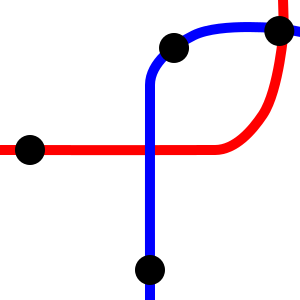
It might be faster for riders to transfer between the southern and western leg if there were a station at the exact physical intersection point, but as long as the next station on the red line has a transfer to the blue line it counts, even if the blue line has one (or more) stations in the middle. Washington supplies an example of this non-miss: it frustrates riders that there’s no connection between Farragut West and Farragut North, but at the next station south from the intersection on the Red Line, Metro Center, there is a transfer to the Blue and Orange Lines. London supplies another pair of examples: the Northern line and the Waterloo and City line appear to intersect the District line without a transfer, but their next station north from the physical intersection point, Bank, has an in-system transfer to Monument on the District.
There are still a few judgment calls in this system. One is what to do at the end of the line. In this case, I rule it a missed connection if the terminal clearly has an intersection without a transfer; if the terminal is roughly between the two stations on the through-line, it doesn’t count. Another is what to do about two lines that intersect twice in close succession, such as the Bakerloo and Hammersmith and City lines in London, and Metro Lines 4 and 10 in Paris. In such cases, I rule that, if there’s just one station on the wrong side (Paddington on Bakerloo, Mabillon on M10) then I rule it a single intersection and allow transfers at the next station over, by which standard London has a missed connection (Edgware Road has no Bakerloo/H&C transfer) and Paris doesn’t (Odeon has an M4/M10 transfer).
How many missed connections are there?
In Paris, there are three missed connections on the Metro there is one missed connection on the Metro (update: see comments below): M9/M12, M5/M14, M9/M14. As I discuss on City Metric, it’s no coincidence that two of these misses involve this miss involves Line 14, which has wide stop spacing. Narrow stop spacing makes it easier to connect within line-dense city centers, and Paris famously has the densest stop spacing of any major metro system. M9/M12 and M9/M14 morally should connect at Saint-Augustin and Saint-Lazare, but in fact there is no in-system transfer. M5/M14 should connect at Gare de Lyon, but when M5 was built it was not possible to get the line to the station underground and then have it cross the Seine above-ground, so instead it meets M1 at Bastille, while M14 doesn’t serve since it expresses from Gare de Lyon to Chatelet. A fourth missed connection is under construction: the extension of M14 to the north misses M2 at Rome, prioritizing long stop spacing over the connection to the M2/M6 circumferential.
In Tokyo, there are many misses. I am not sure why this is, but judging by line layout, Tokyo Metro and Toei try to stick to major roads whenever possible, to avoid tunneling under private property, and this constrains the ability of newer lines to hit station locations on older lines. If I understand this map correctly, there are 19 missed connections: Ginza/Hibiya (Toranomon and Kasumigaseki should connect), Ginza/Mita, Ginza/Yurakucho, Ginza/Shinjuku, Marunouchi/Mita (Ginza and Hibiya should connect), Marunouchi/Yurakucho, Asakusa/Yurakucho, Asakusa/Hanzomon, Hibiya/Namboku, Hibiya/Yurakucho (Tsukiji and Shintomicho should connect), Hibiya/Hanzomon, Hibiya/Shinjuku, Hibiya/Oedo, Tozai/Oedo, Tozai/Fukutoshin, Mita/Oedo, Chiyoda/Oedo twice, and Oedo/Fukutoshin. Oedo is particularly notable for being a circumferential line that misses a large number of transfers.
In New York, there are even more misses. Here the culprit is clear: the two older layers of the subway, the IRT and BMT, have just two missed connections. One, 3/L at Junius Street and Livonia Avenue, is an outlying miss. The other is central: Bowling Green on the 4-5 and Whitehall on the R-W should connect. But the newer layer, the IND, was built to drive the IRT and BMT into bankruptcy through competition rather than to complement them, and has a brutal number of misses: ABCD/2-3, ACE/1-2-3, AC-F/2-3-4-5, AC-G/2-3-4-5-BQ-DNR, BD/NQRW, BDFM/NQRW, BD/JZ, E/1, E/F, M/NW, R/7, F/BD-NQ, F/NRW, F-Q/4-5-6, F/NW, G/7, G/JMZ. Counting individual track pairs, this is 46 misses, for a total of 48 including the two IRT/BMT misses; I’m excluding local-only transfers, such as Columbus Circle and 53rd/Lex, and counting the 42nd Street Shuttle as an express version of the 7, so it doesn’t miss the BDFM transfer.
Finally, London only has eight misses. In Central London there are three: the Metropolitan or Hammersmith and City line misses the Bakerloo line as discussed above, and also the Victoria line and Charing Cross branch of the Northern line at Euston. The other five are outlying: the Central line misses the Hammersmith and City line at Wood Lane/White City, and its branches miss the Piccadilly line’s Uxbridge branch three times; the fifth miss is Metropolitan/Bakerloo. But one more miss is under construction: the Battersea extension of the Northern line is going to intersect the Victoria line without a transfer.
The difference between the two kinds of miss
Many misses are located just a few stations away from a transfer. In New York, some misses are just a station away from a transfer, including the G/7 miss in Long Island City, the E/1 miss between 50th Street and 59th Street, and several more are a few stations away, such as the various BDFM/NQRW misses. In London, these include two of the three Central London transfers: there is an H&C/Bakerloo transfer at Baker Street and an H&C-Met/Victoria transfer at King’s Cross-St. Pancras. As a result, not counting the Waterloo and City line, only two trunk lines in the system do not have any transfer: the Charing Cross branch of the Northern line and the Metropolitan/H&C line.
On a radial network, if two lines don’t have any transfer, then the network is degraded, since passengers can’t easily connect. In New York, this is a huge problem: some station pairs even within the inner networks require two transfers, or even three counting a cross-platform local/express transfer. My interest in subway networks and how they function came about when I lived in Morningside Heights on the 1 and tried socializing with bloggers in Williamsburg near the JMZ.
In Paris the three misses are also a problem. Line 4 is the only with a transfer to every other main line. Line 9 intersects every other line, and Line 14 will when its northern extension opens, but both miss connections, requiring some passengers to take three-seat rides, in a city infamous for its labyrinthine transfer stations. Fundamentally, the problem is that the Paris Metro is less radial than it should be: some lines are laid out as grid routes, including Lines 3, 5, and 10; moreover, Lines 8, 9, 12, and 13 are radial but oriented toward a different center from Lines 1, 4, 7, and 11.
In London, in contrast, there is almost no pair of stations that require a three-seat ride. The Charing Cross branch of the Northern line doesn’t make any stop that passengers from the H&C or Met line can’t get to from another line with one interchange (Goodge Street is walking distance to Warren Street). A bigger problem is the lack of interchange to the Central line on the west, which makes the connections between the H&C stations on the west and some Central line stations awkward, but it’s still only a small number of stations on each line. So the problem in London is not network robustness.
Rather, the problem in London is severe capacity limitations on some lines. Without good outlying interchanges, passengers who want to get between two lines need to ride all the way to the center. Most likely, passengers between the Piccadilly and Central line branches to the west end up driving, as car ownership in West London is relatively high. Passengers without a car have to instead overload the Central line trunk.
The same problem applies to misses that are strictly speaking not missed connections because the two lines do not actually intersect. In Paris, this occurs on Line 7, which swings by the Opera but doesn’t go far enough west to meet Lines 12 and 13. In London, the best example is Hammersmith station: the H&C and District lines have separate stations without an interchange, but they do not intersect since it’s the terminus of the H&C line and therefore I don’t count it as a miss. But morally it’s an outlying miss, preventing District line riders from changing to the H&C line to reach key destinations like Euston, King’s Cross, and Moorgate without overloading the Victoria or Northern line.
In New York this problem is much less acute. The only outlying misses are the 3/L and the ABCD/2-3; the 3/L connects two very low-ridership tails, so the only serious miss is on the Upper West Side. There, passengers originating in Harlem can walk to either line, since the two trunks are two long blocks apart, and passengers originating in Washington Heights can transfer from the A-C to the 1 at 168th Street; at the other end, passengers bound for Midtown can transfer at Columbus Circle, using the underfull 1 rather than the overcrowded 2 and 3.
The role of circumferential lines
Outlying transfers are useful in distributing passengers better to avoid capacity crunches, but they are incidental. They occur when formerly competing suburban lines get shoehorned into the same subway network, or when two straight roads intersect, as in Queens. But the task of distributing passengers between radial lines remains important and requires good connections between as many pairs of radials as possible.
The usual solution to this is a circumferential line. In Moscow, there are several missed connections in the center (Lines 3/6, 3/7, 6/9) and one more planned (8/9), but the Circle Line helps tie in nearly all the radii together, with just one missed connection (to Line 10 to the north) and one more under construction (to Line 8 to the west). The point of the Circle Line is to allow riders to connect between two outlying legs without congesting the center. This is especially important in the context of Moscow, where there are only a handful of interchange stations in the center, most of which connect more than two lines.
In London, the Overground is supposed to play this role. However, the connections between the Underground and Overground are weak. From Highbury and Islington clockwise, the Overground misses connections to the Central line, the Victoria line, the main line of the District line, the Piccadilly line, the Hammersmith and City line, both branches of the Northern line, and the Piccadilly line (it also misses the Metropolitan line, but that’s on a four-track stretch where it is express and local service is provided by the Jubilee line, with which there is a transfer). Much of this is an unforced error, since the Underground lines are often above-ground this far out, and stations could be moved to be better located for transfers.
In New York, the only circumferential line is the G train, which has uniquely bad transfers, legacy of the IND’s unwillingness to build a system working together with the older subways. Triboro RX (in the original version, not the more recent version) would play this role better: with very little tunneling, it could connect to every subway line going counterclockwise from the R in Bay Ridge to the B-D and 4 at Yankee Stadium. On the way, it would connect to some major intermediate centers, including Brooklyn College and Jackson Heights, but the point is not just to connect to these destinations in the circumferential direction but also to facilitate transfers between different lines.
Going forward, cities with large metro network should aim to construct transfers where feasible. In New York there are perennial proposals to connect the 3 and L trains; these should be implemented. In London, the missed outlying transfers involve above-ground stations, which can be moved. The most important miss, White City/Wood Lane, is already indicated as an interchange on the map, but does not to my understanding have an in-system transfer; this should be fixed.
Moreover, it is especially important to have transfers from the radial lines to the circumferential ones. These improve network connectivity by allowing passengers to change direction (from radial to circumferential, e.g. from east-west to north-south within Queens), but also help passengers avoid congested city centers like outlying radial-radial transfers. Where circumferential lines don’t exist, they should be constructed, including Triboro in New York and Line 15 in Paris; where they do, it’s important to ensure they don’t miss connections the way the Overground does.
The MTA Genius Challenge is as Bad as Expected
A year ago, Governor Andrew Cuomo declared a competitive $2.5 million grant, to be disbursed by what he dubbed the Genius Challenge. I wrote about it at the time, expressing skepticism that it would lead to anything useful. The panel of eight judges had only one person with background in the transportation industry, a former FRA administrator. The word “genius” itself is a tech mainstay that to me mostly means “I don’t know any Fields Medalists.” And the topics within the scope of the grant seemed more about what the tech industry thought were the most pressing issues and not what the lowest-hanging actually were. I had very low expectations, and the announcement of the winning entries met them.
The grant has three topics: signaling, rolling stock (interpreted broadly), and underground mobile or wireless service. The last three is by far the least important; it also got only half a million dollars, whereas each of the other two got a full million. Each of the two main ideas shows how weak the very concept of the genius grant is, but they do so in dramatically different ways.
The rolling stock winners included a vendor asking for a grant for New York to use its rolling stock (CRRC); the problems with that idea are more akin to those of the signaling section, so I will cover them there. A second rolling stock winner was a proposal to use better data collection to facilitate preventive maintenance; this idea may or may not work, it’s hard to tell from layers of obfuscating business language. It’s the third idea that deserves the most attention, and the most scorn: lengthening trains but not platforms.
The crank Idea: lengthening trains
The genius competition gave a $330,000 grant for the idea of lengthening trains from 10 to 14 cars without lengthening the platforms. Trains would alternate between only berthing the first 10 cars and only berthing the last 10. Transit Twitter has already dumped on this idea, and for good reason: the proposal reads like a crank paper purporting to prove the Riemann hypothesis or another famous result, starting with a lot of trivial observations and then making a leap of logic buried somewhere in the middle.
The basic problem with running trains that are longer than the platforms is that passengers need to be able to move to the correct car, which takes time. The report says that this is done on the London Underground, which is true, but only at outlying stations – as is the case on the subway in New York. The conductor announcement “only the first five cars will open” is familiar to anyone riding the 3 train and was familiar to anyone riding the 1 train before the new South Ferry station opened. This is fine as long as the station in question is low-volume enough that the extra dwell time does not interfere with operations. Lengthening trains beyond the platforms at busier stations than Harlem-148th Street 145th Street or South Ferry would result in a shuffle forcing passengers to scramble within the train (if moving between cars is possible) or on the platform (if it isn’t). The dwell times would be brutal and would almost certainly reduce capacity measured in passengers per hour.
The proposal handwaves this critical flaw by saying that dwell times would decrease because crowding would decrease. This assumes that dwell times are a function exclusively of on-train crowding, rather than of the number of passengers getting on or off the train. The same number of passengers would have the same platform space, but would actually only be able to use a fraction of it: many would only be able to use the 6 cars that go to their chosen destination, and at those cars, the volume of passengers per unit of platform length would rise.
The second handwave is unlimited stations, with longer platforms. Acknowledging that the busiest stations should have all doors open, the proposal says,
[P. 20] Third, 18.5% of rides occur through just 10 stations in Manhattan. In the medium term, the platforms can, and should, be extended at these 10 stations to enable customers that embark and disembark at them to use any car at both ends of their trip. Accordingly, 9.25% of the customers that presently need to use the middle cars could instead use the end cars.
This is the equivalent of the logical leap from trivial to wrong in a crank paper. First, the number of central stations that would need to be lengthened is much more than 10, including some key origins (86th/Lex, Jamaica Center, etc.) and transfer points (West 4th, Canal, 96th/Broadway). And second and more importantly, the busiest stations are multilevel complexes, where just adding more pedestrian circulation is hard; London is spending a considerable amount of money on that at Bank. Lengthening platforms at these stations is prohibitively expensive. This problem is discussed in cities with constrained underground platforms in the CBD, such as Vancouver, where nearly all Expo Line stations are above-ground (thus, relatively easy to lengthen), but the most crowded in Downtown Vancouver are in a tunnel, where platform reconstruction costs too much to be economic.
The bigger question is why the judges did not catch the error. The proposal brings up London as an example, which serves to bring the magic of the foreign to people who are unfamiliar with best industry practices. Saying that New York does the same is equally true, and in a way more relevant to the proposal (since New York doesn’t let people move between cars, making this more challenging than in London), but would raise questions like “can the dwell times of relatively light stations like South Ferry or Harlem-145th be replicated at the top 40 stations?”. London is Anglophone and some reformist New Yorkers have used it as a source of foreign ideas the way they wouldn’t use non-Anglophone cities. But the judges didn’t do the basic due diligence of checking whether London really implements the idea as widely as the proposal implies, and if not, then why not.
The rent-seeking idea: CBTC by another name
New York State awarded four applicants $250,000 each for ideas about signaling. All four ideas boiled down to the same thing: introducing new technology for communication between trains permitting the functional equivalent of moving-block signaling, at a lower cost than preexisting communication-based train control (CBTC) installations.
The grantees all have experience in the transportation industry. Rail signaling vendors Thales and Ansaldo propose to use cameras to read automated signals; train sensor provider Metrom Rail and veteran rail manager and consultant Robert James propose ultra-wide broadband to improve train location precision. There’s nothing obviously wrong about their proposals. Nor is there anything outlandish, which is why each of the two technologies has two independent applicants behind it. Thales and Ansaldo in particular have experience in advanced signaling – Thales supplied CBTC to the L 7 train in New York and to Metro Line 13 in Paris, and Ansaldo supplied rail automation to Copenhagen and CBTC to a number of Paris Metro lines.
Even then, questions about cost remain. Robert James’ and Metrom’s proposals leave a bad taste in my mouth for their cost estimates. James has a systemwide cost estimate somewhat less than $200 million, not much more than $500,000 per km; Metrom says its system costs “$3 million per mile” and compares itself positively with legacy CBTC systems at $20 million per mile. Actual costs of CBTC without automation in Paris on Line 13 were about 5 million euros per km according to Wikipedia, and this includes modification of the railyards and not just the signaling system. So the Metrom system’s claimed figure is still cheaper, but not by quite as much. Metrom also complains that in Boston, CBTC would not improve capacity much because it would prohibit double-berthing, an issue that is only relevant to a subway-surface system and not to a full metro.
The broader problem with this part of the grant is that if the MTA put out an RFP about CBTC on the subway, it would get bids from Ansaldo, Thales, and Metrom, and James might well bid or consult for a bidder. It would be able to judge the technical merit of each proposal in much closer detail than given in the competition. Instead, the state is paying vendors to market their technology to the public, which would influence future procurement.
While the grant asks about whether the technology is proprietary, it makes no attempt at establishing a multi-vendor standards. Such standards exist: Thales and Ansaldo are both listed as ERTMS vendors. In France there’s already a discussion in the trade press about whether using ERTMS is better than using CBTC; the discussion specifically mentions New York’s uniqueness as a network with connected rather than isolated lines, and says CBTC is designed for isolated lines whereas ERTMS is designed for shared lines, such as the RER system. European experts might well recommend that New York use ERTMS for the subway, even though it’s a system originally designed for mainline rail.
New York’s highly-branched system means it must be more conservative with new technology – there’s nowhere to test it, now that the L and 7 already have CBTC. The shuttles might be useful test cases, or the 1 and 6 trains on weekdays, but without isolated lines, the cost of a mistake in procurement or technological failure is much higher. This suggests the MTA should try to reduce the complexity of branching (which is what I would’ve proposed if it had been within the grant’s scope), and until then concentrate on imitating proven technology rather than innovating. This is especially important given the potential for rent-seeking, in which the vendors use the grant to market themselves to the state over competitors selling similar product.
The judges don’t know any better
Would a panel of judges with more familiarity with metro operations around the first world have come to better decisions? Probably. Through blogs, railfan forums, and comments, I know people with great knowledge of existing operations in a number of cities in the first world, and for the most part they think highly enough of their local systems that they’d ask of any innovation, “why hasn’t it been implemented here already?”.
I wrote in 2011 that people in the US who make technical arguments in favor of public transit tend to be skeptical of many proposals, to the point of finding existing US agencies incompetent. This is US-specific: London Reconnections is a technical blog but it tends to support Transport for London’s process, Swiss and Japanese railfans seem to trust their local rail operators, and even Transport Paris is more positive about STIF’s capital investment than New York-based blogs are about the MTA’s. Experts (and not just bloggers like me) could point out innovations their cities have that can be imported into New York, as well as shoot down bad ideas for which “why doesn’t London/Paris/Tokyo do it?” is a useful sanity check.
Note that sometimes there is a legitimate reason to do something that nobody else has tried. New York’s highly branched network makes ERTMS a better deal there than on other metro systems, and an RFI would be prudent. But because the details of implementation matter more than the idea of innovative genius, it has to go through the regular procurement process.
Cuomo attempted to inject the inventions of the American tech industry into the subway. Instead, he created space for cranks to promulgate their ideas and for vendors to have a leg up over their competitors in any future bid. In effect, his attempt to improve the economic productivity of the public sector to be more in line with that of the American tech industry is going to make the public sector less productive, through weaker institutions (namely, a less robust CBTC bid) and distraction (namely, the useless train lengthening idea).
New Hudson Tunnels Are Canceled. Again.
Amtrak’s Gateway project, spending $30 billion on new tunnels from New Jersey to Penn Station, just got its federal funding yanked. Previously the agreement was to split funding as 25% New York, 25% New Jersey, 50% federal; the states had committed to $5.5 billion, which with a federal match would build the bare tunnels but not some of the ancillary infrastructure (some useful, some not).
When Chris Christie canceled ARC in 2010, then estimated at $10-13 billion, I cheered. I linked to a YouTube video of the song Celebration in Aaron Renn‘s comments. ARC was a bad project, and at the beginning Gateway seemed better, in the sense that it connected the new tunnels to the existing station tracks and not to a deep cavern. But some elements (namely, Penn Station South) were questionable from the start, and the cost estimate was even then higher than that of ARC, which I attributed to both Amtrak’s incompetence and likely cost overruns on ARC independent of who managed it.
But I’m of two minds about to what extent good transit advocates should cheer Gateway’s impending demise. The argument for cheering is a straightforward cost-benefit calculation. The extra ridership coming from Gateway absent regional rail modernization is probably around 170,000 per weekday, a first-order estimate based on doubling current New Jersey Transit ridership into Penn Station. At $40,000 per weekday rider, this justifies $7 billion in construction costs, maybe a little more if Gateway makes it cheaper to do maintenance on the old tunnels. Gateway is $30 billion, so the cost is too high and the tunnel should not be built.
Moreover, it’s difficult to raise the benefits of Gateway using regional rail modernization. On the New Jersey side, population density thins fast, so the benefits of regional rail that do not rely on through-running (high frequency, fare integration, etc.) are limited. The main benefits require through-running, to improve access on Newark-Queens and other through-Manhattan origin-destination pairs. Gateway doesn’t include provisions for through-running – Penn Station South involves demolishing a Manhattan block to add terminal tracks. Even within the existing Penn Station footprint, constructing a new tunnel eastward to allow through-running becomes much harder if the New Jersey Transit tracks have heavy terminating traffic, which means Gateway would make future through-running tunnels more expensive.
But on the other hand, the bare tunnels are not a bad project in the sense of building along the wrong alignment or using the wrong techniques. They’re just extremely expensive: counting minor shoring up on the old tunnels, they cost $13 billion for 5 km of tunnel. Moreover, sequencing Gateway to start with the tunnels alone allows dropping Penn South, and might make it possible to add a new tunnel for through-running mid-project. So it’s really a question of how to reduce costs.
The underground tunneling portion of Second Avenue Subway is $150 million per km, and that of East Side Access is $200 million (link, PDF-p. 7). Both figures exclude systems, which add $110 million per km on Second Avenue Subway, and overheads, which add 37%. These are all high figures – in Paris tunneling is $90 million per km, systems $35 million, and overhead a premium of 18% – but added up they remain affordable. A station-free tunnel should cost $350 million per km, which has implications to the cost of connecting Penn Station with Grand Central. Gateway is instead around $2 billion per km.
Is Gateway expensive because it’s underwater? The answer is probably negative. Gateway is only one third underwater. If its underwater character alone justifies a factor of six cost premium over Second Avenue Subway, then other underwater tunnels should also exhibit very high costs by local standards. There aren’t a lot of examples of urban rail tunnels going under a body of water as wide as the Hudson, but there are enough to know that there is not such a large cost premium.
In the 1960s, one source, giving construction costs per track-foot, finds that the Transbay Tube cost 40% more than the bored segments of BART; including systems and overheads, which the source excludes, BART’s history gives a cost of $180 million, equivalent to $1.38 billion today, or $230 million per km. The Transbay Tube is an immersed tube and not a bored tunnel, and immersed tubes are overall cheaper, but a report by Transport Scotland says on p. 12 that immersed tubes actually cost more per linear meter and are only overall cheaper because they require shorter approaches, which suggests their overall cost advantage is small.
Today, Stockholm is extending the T-bana outward in three direction. A cost breakdown per line extension is available: excluding the depot and rolling stock, the suburban tunnel to Barkarby is $100 million per km, the outer-urban tunnel to Arenastaden in Solna is $138 million per km, and the part-inner urban, part-suburban tunnel to Nacka is $150 million per km. The tunnel to Nacka is a total of 11.5 km, of which about 1 is underwater, broken down into chunks using Skeppsholmen, with the longest continuous underwater segment about 650 meters long. A 9% underwater line with 9% cost premium over an underground line is not by itself proof of much, but it does indicate that the underwater premium is most likely low.
Based on the suggestive evidence of BART and the T-bana, proposing that bare Hudson tunnels should cost about $2-2.5 billion is not preposterous. With an onward connection to Grand Central, the total cost should be $2.5-3 billion. Note that this cost figure does not assume that New York can build anything as cheaply as Stockholm, only that it can build Gateway for the same unit cost as Second Avenue Subway. The project management does not have to be good – it merely has to be as bad as that of Second Avenue Subway, rather than far worse, most likely due to the influence of Amtrak.
The best scenario coming out of canceling Gateway is to attempt a third tunnel project, this time under a government agency that is not poisoned by the existing problems of either Amtrak or Port Authority. The MTA could potentially do it; among the agencies building things in the New York area it seems by far the least incompetent.
If Gateway stays as is, just without federal funding, then the solution is for Amtrak to invest in its own project management capacity. The cost of the Green Line Extension in Boston was reduced from $3 billion to $2.3 billion, of which only $1.1 billion is actual construction and the rest is a combination of equipment and sunk cost on the botched start of the project; MBTA insiders attribute this to the hiring of a new, more experienced project manager. If Gateway can be built for even the same unit cost as Second Avenue Subway, then the existing state commitments are enough to build it to Grand Central and still have about half the budget left for additional tunnels.
Transit and Scale Variance Part 3: Grids
This is my third post about scale variance in transit planning; see parts 1 and 2. In part 1, I discussed how good bus networks exist at a certain scale, which can’t easily be replicated at larger scale (where the slowness of city buses makes them less useful). In part 2, I went over a subway planning feature, especially common in the communist bloc, that again works only at a specific scale, namely cities with enough population for 3-4 subway lines; it gets more complex in larger cities, and cannot be imported to bus networks with 3-4 lines. In this post, I will focus on one scale-variant feature of surface transit: the grid.
The grid works only for surface transit and not for rapid transit, and only at a specific scale, so constrained as to never be maximally useful in an entire city, only in a section of a city. This contrasts with what Jarrett Walker claims about grids. Per Jarrett, grids are the perfect form of a transit network and are for the most part scale-invariant (except in very small networks). One of the impetuses for this post is to push back against this: grids are the most useful at the scale of part of a transit city.
Grid Networks Versus Radial Networks
I’ve written a few posts exhorting subway planners to build their networks in a certain way, which, in the most perfect form, is radial. In particular, tangential subway lines, such as the G train in New York (especially when it ran to Forest Hills), Line 10 in Paris, and Lines 3 and 6 in Shanghai, are weak. When the G train was running to Forest Hills, most local passengers would switch from it to the next Manhattan-bound train, leading New York City Transit to send more Manhattan-bound local subways to Forest Hills and eventually to cut back the G to Long Island City. Based on these examples, I contend that on a subway network, every line should be either radial, serving the CBD, or circumferential, going around the CBD.
My post about New York light rail proposes a network with some lines that are neither: in the Bronx, my proposal is essentially a grid, with north-south routes (Grand Concourse, Webster, 3rd) and east-west ones (161st, Tremont, Fordham) and one that combines both (145th-Southern). Regular commenter NewtonMARunner criticized me for this on Twitter. I answered that the lines in my proposal are based on the busiest buses in the Bronx, but this simply shifts the locus of the question to the existing network: if transit lines should be radial or circumferential, then why are the tangential Bx19 bus (145th-Southern) or the Bx40/42 and Bx36 (Tremont, with a long radial eastern tail) so successful?
To answer this requires thinking more carefully about the role of circumferential routes, which by definition don’t serve the most intensely-used nodes. In Paris, Lines 2 and 6 form a ring that misses five out of six train stations and passes just outside the CBD, and yet they are both busy lines, ranking fourth and fifth in ridership per km. The reason is that they are useful for connecting to radial Metro lines and to some RER lines (namely, the RER A and the southern half of the RER B). Tangential lines miss connections much more easily: in the west, Line 10 here has a decent transfer to Line 9 and a somewhat decent one to Line 8, but to Lines 12 and 13 it’s already not very direct. The G train in New York has the same problem to the south – few connections to lines that actually do go into Manhattan.
Consider the following three possible networks:
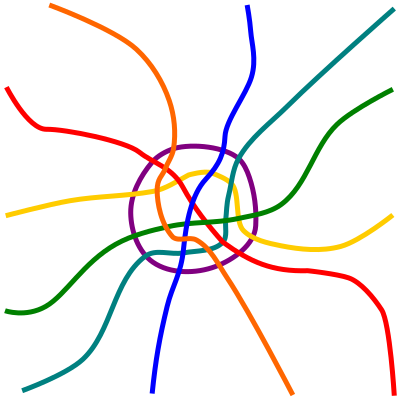


The radial network is a typical subway network. The full grid lets you go from everywhere to everywhere with just one transfer, at the cost of having far more route length than the radial network. The partial grid no longer lets you go from everywhere to everywhere easily, and has the outer two lines in each service direction missing city center, but still has more overall route-length than the radial network. The principle here is that a grid plan is useful only if the grid can be complete.
The scale, then, is that rapid transit is so expensive that there’s no money for a complete grid, making a radial plan more appropriate. But surface transit, especially by bus, can be spread across a grid more readily. The Bronx’s size, density, and bus ridership patterns are such that a mostly complete grid is feasible within the western two-thirds of the borough, supplemented by the subway. In this environment, a tangential route is fine because it hits all the radial routes it could, and could provide useful two-seat rides to a large variety of destinations.
Are Grids Really Grids?
Chicago has a relentless bus grid. The three busiest north-south routes are the tangential 8 (Halsted), 9 (Ashland), and 49 (Western), which are 22, 29, and 26 km long respectively. None enters the Loop; Halsted, the easternmost, is at the closest approach 800 meters from the Loop, across a freeway. The two busiest east-west routes, the 77 (Belmont) and 79 (79th), are also far from the Loop.
However, I contend that these routes don’t really form a grid, at least not in the sense that passengers ride between two arbitrary points in Chicago by riding a north-south bus and connecting to an east-west bus. Instead, their outer ends form tails, which people ride to the L, while their inner ends are standard circumferentials, linking two L branches. The L in turn is purely radial and doesn’t follow the Chicago grid, with the Blue Line’s O’Hare Branch, the Orange Line, and the Brown Line all running diagonally.
Vancouver is similar. The north-south routes are radial, veering to enter Downtown. The east-west ones are more circumferential than tangential: they connect the Expo and Canada Lines, and most also connect to UBC. The Broadway buses (9 and 99) pass so close to Downtown Vancouver they’re more tangential, but they also offer the shortest path between the Expo and Canada Lines (making them a strong circumferential) while at the same time serving high job density on Central Broadway (giving them some characteristics of a radial).
In the absence of a radial rail network to connect to, long grid routes are less useful. Cities have a center and a periphery, and the center will always get more ridership, especially transit ridership. The outermost grid routes are often so weak that they should be pruned, but then they weaken the lines they connect to, making it necessary to prune even more lines until the grid is broken.
The Optimal Scale for a Grid
A strong transit grid will not form in a city too small for it. There needs to be a large enough center with enough demand for transit ridership to justify more than a purely radial bus network with a timed transfer. At the same time, the city cannot be too big, or else the arterial buses are too slow to be useful for ordinary work and leisure trips, as in Los Angeles.
What’s more, there is no Goldilocks zone, just right for a grid. Chicago is already too big for a bus grid without the radial rail layer. It’s also too big for what Jarrett calls grid accelerators – that is, rapid transit routes that replace bus grid lines: the Red Line is plausibly a grid accelerator, but the other lines in Chicago are not, and if there were L lines only at grid points, then the Red Line and the one east-west route would get overcrowded heading toward the Loop. Even Vancouver, a compact metro area hemmed by mountains and the ocean, relies on the diagonal Expo Line to serve Downtown and doesn’t really have a grid beyond city limits. A less dense city in the same land area could have a grid, but without much traffic or a strong CBD, cars would always beat transit on time and only the poor would ride the bus.
The scale in which grid networks work more or less on their own seems to be that of Vancouver proper, or that of the Bronx. Vancouver is 115 km^2 and the Bronx is 110 km^2; Vancouver’s bus grid spills over to Metrotown and the Bronx’s to Upper Manhattan, but in both cases these are small increases in the relevant land area.
Tellingly, Vancouver still relies on the bus network to feed SkyTrain; the Canada Line is a grid accelerator, but the Expo Line is not. The Bronx is the more interesting case, because it is not a city or even the center of the city, but rather a dense outlying portion of the city with an internal arterial grid. In both cases, the grid is supplementary to the radial rail core, even if the routes that use it have a lot of independent utility (Metro Vancouver has higher bus ridership than rail ridership, and the Bronx buses combined have slightly more ridership than the combined number of boardings on the Bronx subway stations).
Geographical constraints matter as well. The Bronx and Upper Manhattan are hemmed by water and by the administrative border of the city (which also includes a sharp density gradient), and Vancouver is hemmed by water and by a density gradient in the east. This makes it easier to equip both with grids that are close enough to the complete grid in the middle image above rather than the incomplete one in the third image. The Bronx’s lower-density eastern tails happen to meet up with those of Queens, forming circumferential routes, and also have enough north-south subway lines to feed that they remain useful.
In a transit city, the grid cannot come first. Even if there is a street grid, the spine of the network has to be radial as soon as there is demand for more than two rapid transit lines. The role of surface transit remains feeding rapid transit. Grids look attractive, but the optimal scale for them is awkward: large-scale surface transit grids are too slow, forcing the city to have a rapid transit backbone, and if the city is too small for that then the arterial grid provides too good auto access for public transit to be useful.
The RPA Construction Cost Report
A much-awaited Regional Plan Association report about construction costs in New York has come out, as a supplement to the Fourth Regional Plan, and I’m unimpressed. I thought that I would either enjoy reading the RPA’s analysis, or else be disappointed by it. Instead, I’ve found myself feeling tepid toward most of the analysis; my objections to the report are that its numbers have serious mistakes, that the recommendations at the end conflict with the analysis, and that it seems to overvalue other English-speaking countries, even when their construction costs are the highest in the world outside the US.
The big contrast is with Brian Rosenthal’s expose in the New York Times. The main comparison city to New York there is Paris, where the extension of Metro Line 14 resembles New York’s subway extensions; for the article, Brian talked to construction managers here, and either visited the site himself or talked to people who did, to compare the situation with that of New York. As a result, I learned things from Brian’s article that I did not know before (namely, that the excavation per station for the Line 14 extension wasn’t less voluminous than for Second Avenue Subway). The RPA report gives a few details I wasn’t familiar with, such as escalators’ share of construction costs, but nothing that seems big.
I feel like I slag on the RPA a lot nowadays – it started with their report from three years ago about Outer Borough transit and continued with their wrong approach to Triboro, but more recently I didn’t think much of their take on suburban TOD, or the Gateway project, or the Fourth Regional Plan in general. This isn’t out of malice or jealousy; when I talked to Tom Wright six months ago I sympathized with the political constraints he was operating under. The problem is that sometimes these constraints lead either to unforced errors, or to errors that, while I understand where they come from, are big enough that the organization should have pushed and made sure to avoid them. In the case of the construction cost report, the errors start small, but compound to produce recommendations that are at times counterproductive; agency officials reading this would have no way of reducing costs.
Mistakes in the Numbers
The RPA is comparing New York’s costs unfavorably with those of other cities around the world, as well as one American city (Los Angeles). However, at several points, the numbers appear different from the ones I have seen in the news media. Three places come to mind – the first is a nitpick, the second is more serious but still doesn’t change the conclusions, the third is the most egregious in its implications.
The first place is right at the beginning of the report. In the executive summary, on page 2, the RPA gives its first example of high New York costs:
The Second Avenue Subway (SAS), for example, has the distinction of being the world’s most expensive subway extension at a cost of $807 million per track mile for construction costs alone. This is over 650% more per mile than London’s Northern Line extension to Battersea — estimated at $124 million per track mile.
Both sets of numbers are incorrect – in fact, contradicted by the rest of the document. SAS is $1.7 billion per route-km, which is $850 million per track-km. The Northern line extension to Battersea is also much more expensive. I can’t tell whether these figures are missing something, such as stations or overheads, but as headline numbers, they’re both lowballed.
The second place is when the report discusses station construction costs. Not having seen any advance copy, I wrote about this issue two weeks ago, just before the report came out: the three new SAS stations cost $821, $649, and $802 million, according to the Capital Program Dashboard. In contrast, on pp. 16-17, the RPA gives lower figures for these stations: just $386 million, $244 million, and $322 million. The RPA’s source is “Capital Construction Committee reports,” but my post on station costs looked at some of those and found costs that are not much lower than those reported in the Dashboard. The RPA figures for the last two stations, 86th and 72nd, seem close to the costs of finishes alone, and it’s possible that the organization made a mistake and confused the cost of just finishes (or perhaps just excavation) with the total cost, combining both excavation and finishes.
With the correct costs, the difference from what Paris spends on a station (about $110 million on average) seems so stark that the recommendations must center station construction specifically, and yet they don’t.
The third and most problematic mistake is table 10 on page 50, which lists a number of subway projects and their costs. The list is pretty short, with just 11 items, of which 3 are in New York, another is in Los Angeles, one is in Toronto, and 2 are in London. The Toronto project, the Spadina subway extension to Vaughan, and one of the London projects, the Northern line extension, are both lowballed. The RPA says that the Northern line extension’s cost is $1.065 billion, but the most recent number I’ve seen is £1.2 billion, which in PPP terms is $1.7 billion. And the Vaughan extension, listed as $1.961 billion in the report, is now up to C$3.2 billion, about $2.55 billion in PPP terms. Perhaps the RPA used old numbers, before cost escalations, but in such a crucial report it’s important to update cost estimates even late in the process.
But most worryingly, the costs on table 10 also include mistakes in the other direction, in Paris and Tokyo. The cost estimate listed for Line 14 South in Grand Paris Express is $4.39 billion. But the Cour des Comptes’ report attacking Grand Paris Express’s cost overruns lists the line’s cost as only €2.678 billion, or about $3.3 billion; this is in 2012 euros, but French inflation rates are very low, well below 1% a year, and at any rate, even applying American inflation rates wouldn’t get the cost anywhere near $4 billion. In Tokyo, the RPA similarly inflates the cost of the Fukutoshin Line: it gives it as $3.578 billion, but a media report after opening says the cost was ¥250 billion, or about $2.5 billion in today’s PPP conversion, with even less inflation than in France.
I can understand why there would be downward mistakes. Reports like this take a long time to produce, and then they take even longer to revise even after they are supposedly closed to further edits; I am working on a regional rail report for TransitMatters that has been in this situation for three months, with last-minute changes, reviews by stakeholders, and printing delays. However, the upward mistakes in Paris and Tokyo are puzzling. It’s hard to explain why, since the RPA’s numbers are unsourced; it’s possible they heard them from experts, but didn’t bother to write down who those experts were or to check their numbers.
The Synthesis Doesn’t Follow the Analysis
Manuel Melis Maynar’s writeup in Tunnelbuilder about how as CEO of Madrid Metro he delivered subway construction for, in today’s money, around $60 million per km, includes a number of recommendations. The RPA report cites his writeup on several occasions, as well as his appearance at the Irish Parliament. It also cites secondary sources about Madrid’s low construction costs, which appear to rely on Melis’s analysis or at least come to the same conclusions independently. However, the RPA’s set of recommendations seems to ignore Melis’s advice entirely.
The most glaring example of this is design-build. Melis is adamant that transit agencies separate design from construction. His explanation is psychological: there are always some changes that need to be made during construction (one New York-based construction manager, cited on p. 38 of the RPA study, says “there is no 100% design”), and contractors that were involved in the design are more likely to be wedded to their original plans and less flexible about making little changes. This recommendation of Melis’s is absent from the report, and on the contrary, the list of final recommendations includes expansion of design-build, a popular technique among reformers in New York and in a number of English-speaking cities.
Another example is procurement. I have heard the same explanation for high New York costs several times since I first brought up the issue in comments on Second Avenue Sagas: the bidding process in New York picks the lowest-cost proposal regardless of technical merit (Madrid, in contrasts, scores proposals 50% on technical merit, 30% on cost, and 20% on speed), and to avoid being screwed by dishonest contractors, the state writes byzantine, overexacting specs. As a result, nobody wants to do business with public works in New York, which means that in practice very few companies bid, leading to one-bid contracts. Brian’s article in the New York Times goes into how contractors have an MTA premium since doing business with the MTA is so difficult, and there’s also less competition, so they charge monopoly rates.
The RPA report’s analysis mentions this (pp. 3-4):
In addition, the MTA’s practice of selecting the lowest qualified bidder, even though they are permitted to issue Requests-for-Proposals, has resulted in excessive rebidding and the selection of teams that cannot deliver, resulting in millions of dollars in emergency repairs.
However, the list of recommendations at the end does not include any change to procurement practices to consider technical merit. The recommendations include post-project review for future construction, faster environmental review, reforms to labor rules, and value capture, but nothing about reforming the procurement process to consider technical merit.
Finally, the report talks about the problem of change orders repeatedly, on pp. 3, 15-16, and 38-39, blaming the proliferation of change orders for part of the cost escalation on SAS. Melis addresses this question in his writeup, saying that contracts should not be awarded for a lump sum but rather be itemized, so that change orders come with pre-agreed costs per item. None of this made it to the final recommendations.
There’s a World Outside the Anglosphere
If the report’s recommendations are not based on its own analysis, or on correct construction cost figures, then what are they based on? It seems that, like all failed reform ideas around the US, the RPA is shopping for ideas from other American cities or at least English-speaking ones that look good. Its recommendations include “adopt London’s project delivery model” and “expand project insurance and liability models,” the latter of which is sourced to the UK and Australia. Only one recommendation so much as mentions a non-English-speaking city: “develop lessons learned and best-practice guidance as part of a post-project review” mentions Madrid in passing, but focuses on Denver and Los Angeles.
This relates to the pattern of mistakes in the cost figures. Were the numbers on table 10 right, the implication would be that London, Paris, and Tokyo all have similar construction costs, at $330, $350, and $400 million per km, and Toronto is cheaper, at $230 million per km. In this situation, London would offer valuable lessons. Unfortunately, the RPA’s numbers are wrong. Using correct numbers, London’s costs rise to $550 million per km, while those of Paris and Tokyo fall to $260 and $280 million. Toronto’s costs rise to $300 million per km, which would be reasonable for an infill subway in a dense area (like the Fukutoshin Line and to some extent the Metro Line 14 extension), but are an outrage for a suburban extension to partly-undeveloped areas.
Using correct numbers, the RPA should have known to talk to people in countries that don’t speak English. Many of the planners and engineers in those countries speak English well as a second language. Many don’t, but New York is a large cosmopolitan city with immigrants with the required language skills, especially Spanish.
Nonetheless, the RPA report, which I am told cost $250,000 to produce, does not talk to experts in non-English-speaking countries. The citations of Melis are the same two English-language ones I have been citing for years now; there is no engagement with his writings on the subject in Spanish or his more recent English-language work (there’s a paper he coauthored in 2015 that I can’t manage to get past the paywall update: kind souls with academic access sent me a copy and it’s not as useful as I’d hoped from the abstract), nor does the RPA seem to have talked to managers in Madrid (or Barcelona) today. Across more than 200 footnotes, 30-something are sourced to “expert interviews,” and of those all but a handful are interviews with New York-based experts and the rest are interviews with London-based ones.
As a result, while the report is equipped to explain New York’s internal problems, it fails as a comparative piece. The recommendations themselves are primarily internal, based on things Americans have been discussing among themselves for years: streamlining environmental review, simplifying labor rules, expanding design-build.
The labor reforms mentioned include exactly one specific case of excessive staffing, reported in the New York Times (and, beforehand, on an off-hand remark by then-MTA Capital Construction chief Michael Horodniceanu), about the number of workers it takes to staff a tunnel-boring machine. The New York Times article goes into more detail about the entire process, but the RPA report ignores that in favor of the one comparison that had been going around Transit Twitter for years. Instead of proposing specifics for reducing headcounts, the report talks about changing the way workers are paid for each day, relying on internal reforms proposed by people dissatisfied with the unions rather than on any external analysis.
The Cycle of Failure
I’ve been reading policy papers for maybe a decade – mostly American, a few Israeli or Canadian or British or French. There’s a consistent pattern in that they often treat the practices of what they view as a peer city or country as obvious examples of what to do. For example, an American policy paper on Social Security privatization might explain the Chilean system, and recommend its implementation, without much consideration of whether it’s really best industry practice. Such papers end up at best moving sideways, and at worst perpetuate the cycle of failure, by giving governments the appearance of reform while they in fact cycle between bad options, or occasionally stumble upon a good idea but then don’t understand how to implement it correctly.
If New York wants to study whether design-build is a good idea, it’s not enough to put it in the list of recommendations. It needs to do the legwork and read what the best experts say (e.g. Melis is opposed to it) and look at many cities at once to see what they do. I would feel embarrassed writing a long report like this with only 7 case studies from outside the US. I’d want to examine many more: on the cheap side, Stockholm, Milan, Seoul, Barcelona, Madrid, Athens, Naples, Helsinki; on the expensive side, London, Singapore, Hong Kong, Toronto, Melbourne, Munich, Amsterdam; in between, Paris, Tokyo, Brussels, Zurich, Copenhagen, Vienna. On anything approaching the RPA’s budget for the paper, I’d connect with as many people in these places as I could in order to do proper comparative analysis.
Instead, the RPA put out a paper that acknowledges the cost difference, but does not make a real effort to learn and improve. It has a lot of reform ideas, but most come from the same process that led to the high construction costs New York faces today, and the rest come from London, whose construction costs would astound nearly everyone in the world outside the US.
One of the things I learned working with TransitMatters is that some outside stakeholders, I haven’t been told who, react poorly to non-American comparison cases, especially non-English-speaking ones. Ignorant of the world beyond their borders, they make up excuses for why knowledge that they don’t have is less valuable. Even within the group I once had to push back against the cycle of failure when someone suggested a nifty-looking but bad idea borrowed from a low-transit-use American city. The group’s internal structure is such that it’s easy for bad ideas to get rejected, but this isn’t true of outside stakeholders, and from my conversation with Tom Wright about Gateway I believe the RPA feels much more beholden to the same stakeholders.
The cycle of failure that the RPA participates in is not the RPA’s fault, or at least not entirely. The entire United States in general and New York in particular is resistant to outside ideas. The political system in New York as well as the big nonprofits forms an ecosystem of Americans who only talk to other Americans, or to the occasional Canadian or Brit, and let bad ideas germinate while never even hearing of what best industry practices are. In this respect the RPA isn’t any worse than the average monolingual American exceptionalist, but neither is it any better.
The Subway in New York is not at Capacity
It seems to be common wisdom that the subway in New York is at capacity. Last year, the New York Times ran an article that repeated the MTA’s claims that growing delays come from overcrowding (which they don’t). A few weeks ago the NY Times quoted Riders Alliance campaign manager Rebecca Bailin saying “Our system is at capacity” and “subways are delayed when people can’t fit in them.” So far so good: some parts of the subway have serious capacity issues, which require investment in organization and electronics (but not concrete) to fix. But then some people make a stronger claim saying that the entire system is at capacity and not just parts of it, and that’s just wrong.
A few days ago there was an argument on Twitter involving the Manhattan Institute’s Nicole Gelinas and Alex Armlovich on one side and Stephen Smith on the other. Stephen made the usual YIMBY point that New York can expect more population growth in the near future. Nicole argued instead that no, there’s no room for population growth, because the subway is at capacity. Alex chimed in,
People are not going to be willing to pay market rents for places they can’t commute from. A large number of folks underestimate the self-regulation of NYC housing–it just can’t get that bad, because people can always just move to Philly
Like, if upzone Williamsburg, people who move into new housing aren’t going to try to ride the L–they’ll only come if they can walk/bike or ride in off-peak direction. Just like people are leaving in response to the shutdown. Neighborhoods and cities are in spatial equilibrium!
I responded by talking about rents, but in a way my response conceded too much, by focusing on Williamsburg. The L train has serious crowding problems, coming from lack of electrical capacity to run more than 20 trains per hour per direction (the tracks and signals can handle 26 trains, and could handle more if the L train had tail tracks at its 8th Avenue terminal). However, the L train is atypical of New York. The Hub Bound Report has data on peak crowding into the Manhattan core, on table 20 in appendix II. The three most crowded lines entering the Manhattan core, measured in passengers per floor area of train, are the 2/3, 4/5, and L. Those have 3.6-3.8 square feet per passenger, or about 3 passengers per m^2, counting both seated and standing passengers; actual crowding among standees is higher, around 4 passengers per m^2. Using a study of seating and standing capacity (update 2020-2-25: this is a non-link-rotted version of the study), we can get exact figures for average space per standee, assuming all seats are occupied:
| Line | Peak tph | Seats | Standee area | Passengers | Passengers/m^2 |
| 1 | 18 | 7,920 | 3,312 | 13,424 | 1.66 |
| 2/3 Uptown | 23 | 9,200 | 4,393 | 28,427 | 4.38 |
| A/D | 17 | 9,792 | 3,980 | 23,246 | 3.38 |
| B/C | 13 | 6,994 | 2,899 | 12,614 | 1.94 |
| 4/5 Uptown | 24 | 8,640 | 4,752 | 28,230 | 4.12 |
| 6 | 21 | 9,240 | 3,864 | 21,033 | 3.03 |
| F Queens | 13 | 5,967 | 3,560 | 17,816 | 3.33 |
| N/Q/R | 23 | 10,908 | 6,179 | 29,005 | 2.93 |
| E/M | 22 | 8,568 | 5,856 | 22,491 | 2.38 |
| 7 | 24 | 9,504 | 5,227 | 20,895 | 2.18 |
| L | 19 | 6,080 | 4,321 | 23,987 | 4.14 |
| J/M/Z | 19 | 6,384 | 4,363 | 16,657 | 2.68 |
| F Brooklyn | 14 | 6,426 | 3,834 | 14,280 | 2.05 |
| B/D/N/Q (4 tracks) | 38 | 18,612 | 10,008 | 43,550 | 2.49 |
| A/C | 20 | 10,112 | 4,504 | 21,721 | 2.58 |
| 2/3 Brooklyn | 16 | 6,400 | 3,056 | 13,536 | 2.34 |
| R | 8 | 4,608 | 1,873 | 5,595 | 0.53 |
| 4/5 Brooklyn | 20 | 7,200 | 3,960 | 16,504 | 2.35 |
Three additional snags are notable: crowding in 53rd Street Tunnel looks low, but it averages high crowding levels on the E with low crowding levels on the M (see review), and the 1 and 7 achieve peak crowding well outside Midtown (the 1 at 96th at the transfer to the 2/3 and the 7 at Jackson Heights at the transfer to the E/F) whereas the table above only counts crowding entering Manhattan south of 59th Street. But even with these snags in mind, there is a lot of spare capacity on the Upper West Side away from 72nd and Broadway, and in Queens in Long Island City, where passengers can take the undercrowded 7 or M. Crowding in Brooklyn is also low, except on the L. In both Brooklyn and on the West Side locals there’s also track capacity for more trains if they are needed, but New York City Transit doesn’t run more trains since peak crowding levels are well below design guidelines.
This isn’t a small deal. Williamsburg is where there is the most gentrification pressure, but the Upper West Side is hardly a slum – it’s practically a byword for a rich urban neighborhood. The trains serving Brooklyn pass through some tony areas (Park Slope) and gentrified ones (South Brooklyn), as well as more affordable middle-class areas further south. From NYCT’s perspective, developing South Brooklyn and Southern Brooklyn is especially desirable, since these areas are served by trains that run through to Queens, Uptown Manhattan, and the Bronx, and with the exception of the B are all much more crowded at the other end; in effect, lower subway demand in Brooklyn means that NYCT is dragging unused capacity because of how its through-service is set up.
Actual perceived crowding is always higher than the average. The reason is that if there is any variation in crowding, then more passengers see the crowded trains. For example, if half the trains have 120 passengers and half have 40, then the average number of passengers per train is 80 but the average perceived number is 100, since passengers are three times likelier to be on a 120-person train than on a 40-person train.
Subway in New York has high variation in crowding, probably unusually high by international standards, on account of the extensive branching among the lines. The E/M example is instructive: not only are the E trains more crowded than the M trains, but also they come more often, so instead of a perfect E-M alternation through 53rd Street, there are many instances of E-E-M, in which an E train following the M is more crowded than an E train following another E train. I criticized NYCT’s planning guidelines on this account in 2015, and believe it contributes to higher crowding levels on some lettered lines than the table shows. However, the difference cannot be huge. Evidently, in the extreme example of trains with 40 or 120 passengers, the perceived crowding is only 25% higher than the actual average, and even the maximum crowding is only 50% higher. Add 50% to the crowding level of every branching train in Brooklyn and you will still be below the 2/3 and 4/5 in Uptown Manhattan.
So on the Upper West Side and in Long Island City and most of Brooklyn, there is spare capacity. But there’s more: since the report was released, Second Avenue Subway opened, reducing crowding levels on the Upper East Side. Second Avenue Subway itself only has the Q, and could squeeze additional trains per hour by shuffling them around from other parts of the system. In addition, the 4/5 and 6 have reportedly become much more tolerable in the last year, which suggests there is spare capacity not only on the Upper East Side but also in the Bronx.
Moreover, because the local trains on Queens Boulevard aren’t crowded, additional development between Jackson Heights and Queens Plaza wouldn’t crowd the E or F trains, but the underfull M and R trains. This creates a swath of the borough, starting from Long Island City, in which new commuters would not have a reason to use the parts of the system that are near capacity. It’s especially valuable since Long Island City has a lot of new development, which could plausibly spill over to the east as the neighborhood fills; in contrast, new development on the Upper West Side runs into NIMBY problems.
Finally, the residential neighborhoods within the Manhattan core, like the Village, are extremely desirable. They also have active NIMBY groups, fighting tall buildings in the guise of preservation. But nowhere else is it guaranteed that new residential development wouldn’t crowd peak trains: inbound trains from Brooklyn except the 4/5 are at their peak crowding entering Lower Manhattan rather than Midtown, so picking up passengers in between is free, and of course inbound trains from Uptown and Queens drop off most of their peak morning load in Midtown.
It’s not just a handful of city neighborhoods where the infrastructure has room. It’s the most desirable residential parts of Manhattan and Brooklyn, and large swaths of middle-class areas in Brooklyn and parts of Queens. In those areas, the subway is not at capacity or even close to it, and there is room to accommodate new commuters at all hours of day. To the extent there isn’t new development there, the reason is, in one word, NIMBYism.