Category: New York
The Official Brooklyn Bus Redesign is Out
The MTA just released a draft of the Brooklyn bus redesign it and its consultant had been working on. It is not good. I’m not completely sure why this is – the Queens redesign was a good deal better, and our take on it at the Effective Transit Alliance was decidedly positive. But in the case of Brooklyn, the things that worked in Queens are absent. Overall, the theme of this is stasis – the changes to the network are minor, and the frequencies are to remain insufficiently low for good service. The only good thing about this is stop consolidation, which does not require spending any money on consultants and is a straightforward fix.
This is especially frustrating to me because my first project for Marron, before the Transit Costs Project, was a redesign proposal. The proposal can be read here, with discussion in blog posts here, here, and here. The official reaction we got was chilly, but the redesign doesn’t look anything like a more politic version, just one produced at much higher consultant cost while doing very little.
The four-color scheme
The Brooklyn project retains the Queens redesign’s four-color scheme of buses, to be divided into local (green), limited (red), Select Bus Service (blue), and rush (purple). The local buses are supposed to stop every 300-400 meters, which is not the best (the optimum for Brooklyn is about 400-500) but is a good deal better than the current spacing of about 200-250. The other three kinds of buses are more express, some running on the same routes as local buses as express overlays and some running on streets without local service.
In Queens, this four-way distinction emerges from the pattern in which in neighborhoods beyond the subway’s reach, bus usage is extremely peaky toward the subway. The purpose of the rush route is to get people to the subway terminal, such as Flushing or Jamaica, with not just longer stop spacing but also long nonstop sections close to the terminal where local service exists as an overlay, imitating the local and express patterns of peaky commuter rail operations in New York. I still think it’s not a good idea and buses should run at a more uniform interstation at higher frequency. But over the long stretches of Eastern Queens, the decision is fairly close and while rush routes are not optimal, they’re not much worse than the optimum. In contrast, Brooklyn is nothing like Queens: people travel shorter distances, and long routes are often used as circumferential subway connectors with ample turnover.
Ironically, this is something the MTA and its consultants understood: the Brooklyn map is largely green, whereas that in Queens has a more even mix of all four colors. Nonetheless, some rush routes are retained and so are some limited-only routes, in a way that subtracts value: if nearly all buses in Brooklyn offer me something, I should expect it on the other buses as well, whereas the rush-only B26 on Halsey Street is different in a way that isn’t clear.
In general, the notable feature of our redesign, unlike the more common American ones, is that there is no distinction among the different routes. Some are more frequent than others, but all have very high base frequency. This is because Brooklyn has unusually isotropic travel: density decreases from the East River south- and eastward, but the subway network also thins out and these effects mostly cancel out, especially with the high density of some housing projects in Coney Island; the busiest buses include some running only within Southern Brooklyn, like the B6 and B82 circumferentials.
In contrast, small-city redesigns tend to occur in a context with a strong core network and a weak peripheral network (“coverage routes,” which exist to reassure loud communities with no transit ridership that they can get buses too), and the redesign process tends to center this distinction and invest in the stronger core network. Queens has elements that look like this, if you squint your eyes sufficiently. Brooklyn has none: the isotropic density of most of the borough ensures that splitting buses into separate classes is counterproductive.
Frequency
The frequency in the proposed system is, frankly, bad. The MTA seems to believe that the appropriate frequency for urban mass transit is a train or bus every 10 minutes. This is acceptable in the suburban neighborhoods of Berlin or the outermost parts of New York, like the Rockaways and the eastern margin of Queens. In denser areas, including all of Brooklyn, it is not acceptable. People travel short distances: citywide, the average trip distance before corona was 3.4 km, which works out to 18 minutes at average New York bus speed (source: NTD 2019). In Brooklyn, the dense mesh of buses going between subway lines rather than to them makes the average even slightly lower. This means that very high frequency is a high priority.
So bad is the MTA’s thinking about frequency that core routes in the borough are split into local and limited variants, each running every 10 minutes off-peak, including some of the busiest corridors in the borough, like the outer circumferential B6 and B82 and the more inner-circumferential B35 on Church (split in the plan into a local B35 and an SBS B55). This is not changed from the current design, even though it’s easy to do so in the context of general consolidation of stops.
To make this even worse, there does not appear to be any increase in service-km, judging by the plan’s lack of net increase in frequency. This is bad planning: bus operating costs come from time (driver’s wage, mainly) and not distance, and the speedup provided by the stop consolidation should fuel an increase in frequency.
The Battery Tunnel
The most annoying aspect, at least to me, is the lack of a bus in the Brooklyn-Battery Tunnel, connecting Manhattan with Red Hook. Red Hook is isolated from the subway and from the rest of Brooklyn thanks to the freeway, and has bus connections only internally to Brooklyn where in fact a short bus route through the tunnel would beat bus-subway connections to Lower Manhattan.
We got the idea for the inclusion of such a bus service from planners that we spoke to when we wrote our own redesign. The service is cheap to provide because of the short length of the route, and would complement the rest of the network. It was also popular in the neighborhood meetings that tee consultants ran, we are told. And yet, it was deleted on a whim.
Stop Imitating the High Line
I streamed a longer version of this on Twitch on Tuesday, but the recording cut out, so instead of uploading to YouTube as a vlog, I’m summarizing it here
Manhattan has an attractive, amply-used park in the Meatpacking District, called the High Line. Here it is, just west of 10th Avenue:

It was originally a freight rail branch of the New York Central, running down the West Side of Manhattan to complement the railroad’s main line to Grand Central, currently the Harlem Line of Metro-North. As such, it was a narrow el with little direct interface with the neighborhood, unlike the rapid transit els like that on Ninth Avenue. The freight line was not useful for long: the twin inventions of trucking and electrification led to the deurbanization of manufacturing to land-intensive, single-story big box-style structures. Thus, for decades, it lay unused. As late as 2007, railfans were dreaming about reactivating it for passenger rail use, but it was already being converted to a park, opening in 2009. The High Line park is a successful addition to the neighborhood, and has spawned poor attempt at imitation, like the Low Line (an underground rapid transit terminal since bypassed by the subway), the Queensway (a similar disused line in Central Queens), and some plans in Jersey City. So what makes the High Line so good?
- The neighborhood, as can be seen above in the picture, has little park space. The tower-in-a-park housing visible to the east of the High Line, Chelsea-Elliott Houses, has some greenery but it’s not useful as a neighborhood park. The little greenery to the west is on the wrong side of 12th Avenue, a remnant of the West Side Highway that is not safe for pedestrians to cross, car traffic is so fast and heavy. Thus, it provides a service that the neighborhood previously did not have.
- The area has very high density, both residential and commercial. Chelsea is a dense residential neighborhood, but at both ends of the line there is extensive commercial development. Off-screen just to the south, bounded by Eighth, Ninth, 15th, and 16th, is Google’s building in New York, with more floor area than the Empire State Building and almost as much as One World Trade Center. Off-screen just to the north is the Hudson Yards development, which was conceived simultaneously with the High Line. This guarantees extensive foot traffic through the park.
- The linear park is embedded in a transit-rich street grid. Getting on at one end and off at the other is not much of a detour to the pedestrian tourist, or to anyone with access to the subway near both ends, making it a convenient urban trail.
These three conditions are not common, and trying to replicate the same linear park in their absence is unlikely to produce good results. For example, consider the Rockaway Cutoff, or Rockaway Beach Branch:
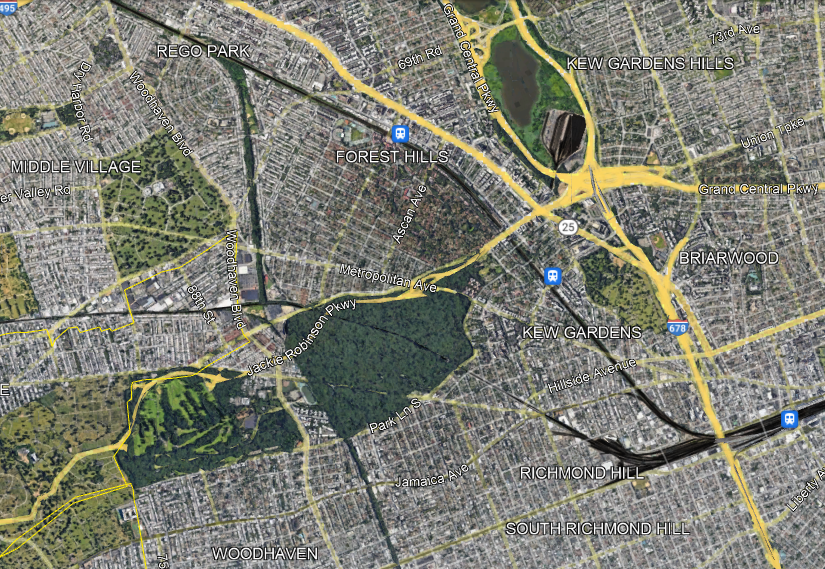
The Cutoff has two competing proposals for what to do with this disused LIRR branch: the Queenslink, aiming to convert it to a rapid transit branch (connecting to the subway, not the LIRR), and the Queensway, aiming to convert it to a linear park. The Queenslink proposal is somewhat awkward (which doesn’t mean it’s bad), but the Queensway one is completely drunk. Look at the satellite photo above and compare to that of the High Line:
- The area is full of greenery and recreation already, easily accessible from adjoining areas. Moreover, many residents live in houses with backyards.
- The density is moderate at the ends (Forest Hills and Woodhaven) and fairly low in between, with all these parks, cemeteries, and neighborhoods of single-family houses and missing middle density. Thus, local usage is unlikely to be high. Nor is this area anyone’s destination – there are some jobs at the northern margin of the area along Queens Boulevard (the wide road signed as Route 25 just north of the LIRR) but even then the main job concentrations in Queens are elsewhere.
- There is no real reason someone should use this as a hiking trail unless they want to hike it twice, one way and then back. The nearest viable parallel transit route, Woodhaven, is a bus rather than a subway.
The idea of a park is always enticing to local neighborhood NIMBYs. It’s land use that only they get to have, designed to be useless to outsiders; it is also at most marginally useful to neighborhood residents, but neighborhood politics is petty and centers exclusion of others rather than the actual benefits to residents, most of whom either don’t know their self-appointed neighborhood advocates or quietly loathe them and think of them as Karens and Beckies. Moreover, the neighborhood residents don’t pay for this – it’s a city project, a great opportunity to hog at the trough of other people’s money. Not for nothing, the Queensway website talks about how this is a community-supported solution, a good indication that it is a total waste of money.
But in reality, this is not going to be a useful park. The first park in a neighborhood is nice. The second can be, too. The fifth is just fallow land that should be used for something more productive, which can be housing, retail, or in this case a transportation artery for other people (since there aren’t enough people within walking distance of a trail to justify purely local use). The city should push back against neighborhood boosters who think that what worked in the Manhattan core will work in their explicitly anti-Manhattan areas, and preserve the right-of-way for future subway or commuter rail expansion.
It’s Easy to Waste Money
As we’re finalizing edits on our New York and synthesis reports, I’m rereading about Second Avenue Subway. In context, I’m stricken by how easy it is to waste money – to turn what should be a $600 million project into a $6 billion one or what should be a $3 billion project into a $30 billion one. Fortunately, it is also not too hard to keep costs under control if everyone involved with the project is in on the program and interested in value engineering. Unfortunately, once promises are made that require a higher budget figure, getting back in line looks difficult, because one then needs to say “no” to a lot of people.
This combination – it’s easy to stay on track, it’s easy to fall aside, it’s hard to get back on track once one falls aside – also helps explain some standard results in the literature about costs. There’s much deeper academic literature about cost overruns than absolute costs; the best-known reference is the body of work of Bent Flyvbjerg about cost overruns (which in his view are not overruns but underestimations – i.e. the real cost was high all along and the planners just lied to get the approval), but the work of Bert van Wee and Chantal Cantarelli on early commitment as a cause of overruns is critical to this as well. In van Wee and Cantarelli, once an extravagant promise is made, such a 300 km/h top speed on Dutch high-speed rail, it’s hard to walk it back even if it turns out to be of limited value compared with its cost. But equally, there are examples of promises made that have no value at all, or sometimes even negative value to the system, and are retained because of their values to specific non-state actors, such as community advocacy, which are incorrectly treated as stakeholders rather than obstacles to be removed.
In our New York report, we include a flashy example of $20 million in waste on the project: the waste rock storage chamber. The issue is that tunnel-boring machines (TBMs) in principle work 24/7; in practice they constantly break down (40% uptime is considered good) and require additional maintenance, but this can’t be predicted in advance or turned into a regular cycle of overnight shutdowns, and therefore, work must be done around the clock either way. This means that the waste rock has to be hauled out around the clock. The agency made a decision to be a good neighbor and not truck out the muck overnight – but because the TBM had to keep operating overnight, the contractor was required to build an overnight storage chamber and haul it all away with a platoon of trucks in the morning rush hour. The extra cost of the chamber and of rush hour trucking was $20 million.
Another $11 million is surplus extraction at a single park, the Marx Brothers Playground. As is common for subway projects around the world, the New York MTA used neighborhood parks to stage station entrances where appropriate. Normally, this is free. However, the New York City Department of Parks and Recreation viewed this as a great opportunity to get other people’s money; the MTA had to pay NYC Parks $11 million to use one section of the playground, which the latter agency viewed as a great success in getting money. Neither agency viewed the process as contentious; it just cost money.
But both of these examples are eclipsed by the choice of construction method for the stations. Again in order to be a good neighbor, the MTA decided to mine two of the project’s three stations, instead of opening up Second Avenue to build cut-and-cover digs. Mined stations cost extra, according to people we’ve spoken to at a number of agencies; in New York, the best benchmark is that these two stations cost the same as cut-and-cover 96th Street, a nearly 50% longer dig.
Moreover, the stations were built oversize, for reasons that largely come from planner laziness. The operating side of the subway, New York City Transit, demanded extravagant back-of-the-house function spaces, with each team having its own rooms, rather than the shared rooms typical of older stations or of subway digs in more frugal countries. The spaces were then placed to the front and back of the platform, enlarging the digs; the more conventional place for such spaces is above the platform, where there is room between the deep construction level and the street. Finally, the larger of the two station, 72nd Street, also has crossovers on both sides, enlarging the dig even further; these crossovers were included based on older operating plans, but subsequent updates made them no longer useful, and yet they were not descoped. Each station cost around $700 million, which could have been shrunk by a factor of three, keeping everything else constant.
Why are they like this?
They do not care. If someone says, “Give me an extra,” they do not say, “no.” It’s so easy not to care when it’s a project whose value is so obvious to the public; even with all this cost, the cost per rider for Second Avenue Subway is pretty reasonable. But soon enough, norms emerge in which the appearance of neighborhood impact must always be avoided (but the mined digs still cause comparable disruption at the major streets), the stations must be very large (but passengers still don’t get any roomy spaces), etc. Projects that have less value lose cost-effectiveness, and yet there is no way within the agency to improve them.
Who Through-Running is For
Shaul Picker is working on an FAQ for the benefit of people in the New York area about the concept of commuter rail through-running and what it’s good for. So in addition to contributing on some specific points, I’d like to step back for a moment and go over who the expected users are. This post needs to be thought of as a followup from what I wrote a month ago in which I listed the various travel markets used by modern commuter rail in general, making the point that this is a predominantly urban and inner-suburban mode, in which suburban rush hour commuters to city center are an important but secondary group, even where politically commuter rail is conceived of as For the Suburbs in opposition to the city, as in Munich. My post was about all-day frequency, but the same point can be made about the physical infrastructure for through-running, with some modifications.
The overall travel markets for regional rail
The assumption throughout is that the city region has with a strong center. This can come from a few square kilometers of city center skyscrapers, as is the norm in the United States (for example, in New York, Chicago, or Boston, but not weaker-centered Los Angeles), or from a somewhat wider region with office mid-rises, as is the norm in European cities like Paris, Stockholm, Munich, Zurich, and Berlin. Berlin is polycentric in the sense of having different job centers, including Mitte, City-West at the Zoo, and increasingly Friedrichshain at Warschauer Strasse, but these are all within the Ring, and overall this inner zone dominates citywide destinations. In cities like this, the main travel markets for commuter rail are, in roughly descending order of importance,
- Urban commuter trips to city center
- Commuter trips to a near-center destination, which may not be right at the one train station of traditional operations
- Urban non-work trips, of the same kind as subway ridership
- Middle-class suburban commutes to city center at traditional mid-20th century work hours, the only market the American commuter rail model serves today
- Working-class reverse-commutes, not to any visible office site (which would tilt middle-class) but to diffuse retail, care, and service work
- Suburban work and non-work trips to city center that are not at traditional mid-20th century hours
- Middle-class reverse-commutes and cross-city commutes
I center urban commuter trips because even in places with extensive suburbanization, commutes are more urban than suburban. Long Island, an unusually job-poor, commuter-oriented suburb, has 2.9 million people as of the 2020 census and, per OnTheMap, 191,202 Manhattan-bound commuters and 193,536 outer borough-bound commuters. Queens has 2.4 million people, 871,253 in-city commuters, 384,223 Manhattan-bound commuters, and 178,062 commuters to boroughs other than itself and Manhattan. The Metro-North suburbs – Westchester, Putnam, Dutchess, and Fairfield Counties (New Haven omitted as it’s not really a suburb) – have 2.35 million people and 143,862 Manhattan-bound commuters and 79,821 outer borough-bound commuters. To work regionwide, commuter rail needs to be usable by the largest commute market; it’s urban rail that’s capable of also serving the suburbs without building suburban metro tunnels, rather than predominantly suburban rail.
Through-running
Through-running means that trains run from one side of the region to the other through city center, rather than terminating at a traditional city terminal. Rarely, this means running trains through a city center station that already has through-tracks, like Penn Station or Stockholm Central; usually, this requires building new tunnels to connect different terminals, as it would to get to Grand Central and as it did in the other European comparison cases.
This rearranges the travel markets for commuter rail, but only somewhat. The largest group, urban commuters to city center, shrinks somewhat: terminating trains to some extent already serve it. The qualifiers come from the fact that city center is rarely entirely within walking distance of the terminal; it is in Stockholm, but it’s small and I suspect the reason Stockholm’s monocentric CBD is walking distance from the intercity station is that it opened as a through-station in 1871 already. In Boston, most of the CBD is close to South Station, but much of it isn’t, and little is within walking distance of North Station. In New York, the CBD is large enough that service to multiple destinations is desirable when feasible, for example both East Side and West Side destinations in Midtown and even Lower Manhattan, requiring additional through-running commuter rail tunnels.
What really shines with through-running is urban trips that are not commutes, or are commutes to a near-center destination on the wrong side of the CBD (for example, south of it for commuters from Uptown Manhattan or the Bronx). New York is unusually asymmetric in that there’s much more city east of Manhattan than west of it, where there’s just the urban parts of Hudson County and Newark. But even there, New Jersey-Brooklyn and New Jersey-Queens commutes matter, as do Bronx-Brooklyn commutes.

Even then, the urban commutes are significant: there are 55,000 commuters from the Bronx to Manhattan south of 23rd Street. These in-city travel markets are viable by subway today, but are for the most part slow even on the express trains – the A train’s run from Inwood to Jay Street and the 4’s run from Woodlawn to Brooklyn Bridge are both scheduled to take 45 minutes for 22.5 km, an average speed of 30 km/h. And then the New Jersey-to-outer borough commutes are largely unviable by public transportation – they cost double because there’s no fare integration between PATH and the subway and the transfers are onerous and slow, and besides, PATH’s coverage of the urban parts of North Jersey leaves a lot to be desired.
Adapting the city
Berlin is in a way the most S-Bahn-oriented city I know of. It’s polycentric but all centers are within the Ring and close to either the Stadtbahn or (for Potsdamer Platz) the North-South Tunnel. This shouldn’t be surprising – the Stadtbahn has been running since the 1880s, giving the city time to adapt to it, through multiple regime changes, division, and reunification. Even Paris doesn’t quite compare – the RER’s center, Les Halles, is a retail but not job center, and the five-line system only has two CBD stops, the RER A’s Auber and the RER E’s Haussmann-Saint-Lazare.
Can New York become more like Berlin if it builds through-running? The answer is yes. Midtown would remain dominant, and overall the region would become less rather than more polycentric as better commuter rail service encouraged job growth in the Manhattan core. But it’s likely any of the following changes would grow the market for commuter rail to take advantage of through-running over time:
- Job growth in Lower Manhattan, which has struggled with office vacancy for decades
- Job growth in non-CBD parts of Manhattan that would become accessible, like Union Square, or even Midtown South around Penn Station, which is lower-rise than the 40s and 50s
- Job growth in near-center job centers – Downtown Brooklyn may see a revival, and Long Island City is likely to see a larger upswing than it is already seeing if it becomes more accessible from New Jersey and not just the city
- Residential location adjustment – Brooklyn workers may choose to depend on the system and live in the Bronx or parts of New Jersey with good service instead of moving farther out within Brooklyn or suburbanizing and driving to work
- Residential transit-oriented development near outlying stations, in urban as well as suburban areas
Quick Note on My New York Trip
I am back in Europe now (in London until Tuesday), but I was in New York for nearly three weeks, and it was interesting reconciling what I was seeing with what everyone else is saying about the city. It and my March 2022 trip were both enlightening in a way because I’d last been in the US at the end of 2019, so many New Yorkisms that I was used to in the 2000s and 2010s suddenly jarred me as foreign to what I had grown used to in Europe.
As one might expect based on the subject of this blog, I took the subway a lot. I took it so much that I was using weekly passes, and the last week I had a weekly pass for just three days and still I took 13 trips on those days, justifying its cost (which is like that of 12 single trips). I saw things, and notably didn’t see others.
What I did see: abject unreliability. I snapped a photo whenever the train arrival board was showing something weird, like low frequency or bunching; if you’re reading this post as it’s being posted and not going on a deep archive run, then go to my Twitter media and look at the last few weeks of pictures. Out of 19 days, something was going wrong 10 times, usually on the train I used to get between my Queensbridge hotel and Marron, the F train – and that’s without counting a few trips when the train frequency looked good but then I was delayed 10-20 minutes due to incidents. Something would always come up: signal failure, medical emergency, mechanical failure, cascading delays. Uday Schultz, a railfan who scares me with the depth of his knowledge of operations, maintenance, and rail history, points out how one such delay compounded due to bad interlining.
This is not normal. Berlin has delays but nowhere nearly this often – not on the U-Bahn but also not on the S-Bahn, whose interlining complexity is comparable to that of the New York City Subway. Low-frequency sections due to single-tracking for maintenance exist in Berlin, but it’s rare, and trains do not run worse than every 10 minutes except on the suburban periphery of the city. Over a similar period of time in Berlin I might see an incident bad enough to complain to BVG about it on Twitter maybe once or twice, not 10 times.
What I didn’t see: significant crime. I point out that I was staying near Queensbridge because the area is negatively stereotyped by suburbanites and city residents with I-hate-(the-rest-of-)the-city identity politics. Nothing there looked scary, at any time of day. There’s a large housing project there, which I mostly associate with people playing the Halloween theme song on 10/31 for what I imagine was a showing of the film and with some people wearing delightfully scary costumes. The worst I saw was someone selling swipes illegally when there was an unusually long line for the ticketing machines; there were cops on the platform who must have passed this person by and apparently done nothing.
I point this out because the city is convinced that the subway is dangerous. There are annoying announcements all the time: “this is an important message from the New York City Police Department…” It makes for some awful user experience – there’s no possibility of quiet on the train, for which those announcements contribute more than anything, since the panhandlers are much less common and the background noise is easier to tune out. People who speak limited English or can’t make out the phonemes garbled over bad announcer systems learn to tune everything out, including the occasional useful announcement of service changes.
And the police loves how annoying it is, which it justifies by appealing to safety theater. When Sarah Meyer tried reducing the annoyance levels, she ran into some real and some made-up technical problems, and one political problem in that nobody in management cares about UX. The police said they need those announcements, annoying and counterproductive as they are (telling tourists to watch their belongings gets them to grasp their wallets in fear, alerting every thief to the location of the wallet on their person); nobody at the agency thought to push back. In the last few days, a new disturbance has been added: the conductors announce at nearly every stop that cops are on the platform should people need assistance. This is in a safe city. Just stop this.
Quick Note on Transit Expansion and Development
I’ve been thinking a lot about where subway extensions can go in New York. One of the appendices we’re likely to include down the line in the Transit Costs Project is a proposal for what New York could do if its construction costs were more reasonable, and this means having to think about plausible extensions. Leaving aside regional rail and systematic investments for now, this may roughly be it:
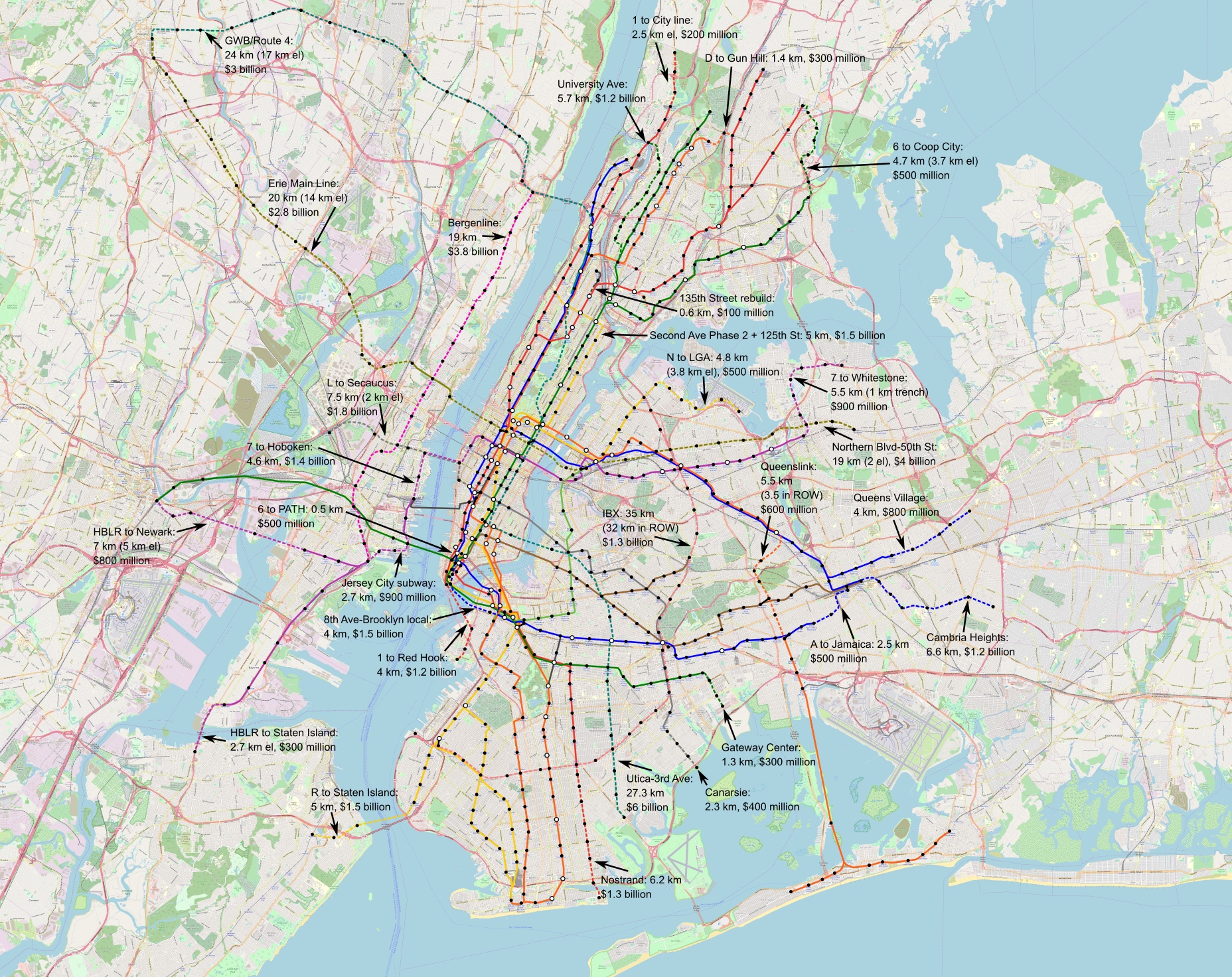
The full-size image (warning: 52 MB) can be found here.
The costs depicted are about twice as high as what I wrote in 2019 with Nordic costs as the baseline, because nominal Nordic costs have doubled since then, partly due to updating price levels from the early 2010s to the early 2020s, but mostly because of the real cost explosion in the Nordic countries. These costs are about $200 million/km in outlying areas, $300 million/km in Manhattan or across water, somewhat less than $100 million/km above ground or in an open trench, and higher than $300 million/km when reconstruction of existing tunnel complexes is proposed; everything is rounded to the nearest $100 million, which creates some rounding artifacts for short extensions that cancel one another out.
But the precise map is not what I think is the most interesting. The point is to build to the frontier of the cost per rider that is acceptable in American cities today, so by definition the marginal line for inclusion on the map, such as the D extension to Gun Hill Road to meet with the 2 train, is also socioeconomically marginal. What I think is more interesting is how important transit-oriented development is for the prospects of lines beyond the most obvious ones (Second Avenue Subway Phase 2, 125th Street, Utica, Nostrand, IBX, and maybe also the 7 to College Point).
The current land use in New York is largely frozen from the middle of the 20th century; the 1961 zoning law was the watershed. Since then, change has been slow, in contrast with rapid redevelopment in places that have chosen a pro-growth path. If the pace of change stays slow, then fewer lines are viable; if the city instead chooses not to keep anti-developmental neighborhood interests in the loop, then more are.
This, in turn, feeds into growth plans. Nordic and Italian planning bundles the question of where the regional housing growth goes with where the subway goes. (Our other positive case study, Turkey, works differently; the answer to both questions is “everywhere.”) This means that subway service goes to areas where substantial quantities of transit-oriented development will be permitted and built, often in negotiations with NIMBY municipalities that would rather just get the infrastructure without the housing; in Stockholm the scale involved is tens of thousands of units per tranche of Nya Tunnelbanan.
In the case of New York, this affects the shape of the map above more than anything. The 6 extension to Coop City is likely good either way, but the other radial extensions in the Bronx are more questionable and depend on where new housing in the borough will be built. The same is true in Queens: more housing in Northeast Queens may argue even in favor of further lines not depicted on the map, for example extending the 7 even further.
How Sandbagged Costs Become Real
Sandbagging is the practice of making a proposal one does not wish to see enacted look a lot weaker than it is. In infrastructure, this usually takes the form of making the cost look a lot higher than it needs to be, by including extra scope, assuming constraints that are not in fact binding, or just using high-end estimates for costs and low-end estimates for benefits. Unfortunately, once a sandbagged estimate circulates, it becomes real: doing the project cleanly without the extras and without fake constraints becomes politically difficult, especially if the sandbaggers are still in charge.
Examples of sandbagging
I’ve written before about some ways Massachusetts sandbags commuter rail electrification and the North-South Rail Link. In both cases, Governor Charlie Baker and the state’s Department of Transportation are uninterested in commuter rail modernization and therefore ensured the studies in that direction would put their fingers on the scale to arrive at the desired conclusion. As we will see, the electrification sandbag is one example of how sandbagged estimates can become real.
In New York, the best example is of sandbagging alternatives. Disgraced then-governor Andrew Cuomo wanted to build a people mover to LaGuardia Airport in the wrong direction, and to that effect, Port Authority made a study that found ways to sandbag other alignments; here at least there’s a happy ending, in that as soon as Cuomo left office, the process was restarted and the rapid transit options studied the most seriously are the better ones.
Another example I have just seen is in Philadelphia. There have long been calls for extending the subway to the northeast along Roosevelt Boulevard; Pennsylvania DOT has just released a cost estimate of $1-4 billion/mile ($600 million-$2.5 billion/km). The high end would beat both phases of Second Avenue Subway, in an environment that both is objectively easier to tunnel in and has a recent history of building and operating services much less expensively than New York.
How to sandbag public transportation
An obstructionist manager who does not care much for public transit, or doesn’t care about the specific project being proposed, has a number of tools with which they can make costs appear higher and benefits appear lower. These are not hard to bake into an official proposal. These include the following:
- Invocation of NIMBYs as a reason not to build. The NIMBYs in question can be a complete phantom – perhaps the region in question is supportive of transit expansion, or perhaps there was NIMBYism in recent memory but the NIMBYs have since died or moved away. Or they can be real but far less powerful than the obstructionist says, with a recent history of the state beating NIMBYs in court when it cares.
- Scope creep. Complex public transportation projects often require additional scope to be viable – for example, regional rail tunnels often require additional spending on surface improvements for the branches that are to use the tunnels. How much extra scope is required is a subtle technical question and there is usually room for creative innovation for how to schedule around bottlenecks (whence the Swiss slogan electronics before concrete). The obstructionist can take a maximalist approach for the scope and just avoid any attempt to optimize, making the costs appear higher.
- Scope deflection. This is similar to scope creep in that the project gets laden with additional items, but differs from scope creep in that the items are what the obstructionist really wants to build, rather than lazy irrelevances.
- Excessive contingency. Cost estimates are uncertain and the earlier the design is, the more uncertain they are. Adding 40% contingency is a surefire way to ensure the money will be spent, as is citing a large range of costs as in the above-mentioned case in Philadelphia.
How sandbags become real
Normally, the purpose of a sandbag is to block or delay the entire project; the scope deflection point is an exception to this. And yet, once a sandbagged estimate is announced, it often turns into the real cost. Philadelphia was recently planning subway expansion for not much more than the international cost, but now that numbers comparable to Second Avenue Subway are out there, area advocates should expect them to turn into the real cost, absent a strong counterforce, involving public dismissal and humiliation of people engaged in such tactics.
The reason for this is that cost control doesn’t always occur naturally, unless one is already used to it. It’s very easy to waste money on irrelevant extras, some with real value to another group (“betterments”), some without. Second Avenue Subway has stations that are two to three times as big as they needed to be, without any sandbagging – different requirements just piled up, including mechanical rooms, crew rooms with each department having its own space, and additional crossovers, and nobody said “Wait a minute, this is too much.” The station designs are also not standardized, again without a sandbag, and it’s very easy to promise neighborhood groups bespoke design just to make them feel important, even if the bespoke design isn’t architecturally notable or useful for passengers.
Likewise, if there’s any conflict between different users, for example different utilities and infrastructure providers in a city, then it takes some effort to rein it in and coordinate. The same situation occurs for conflict between different users of the same tracks on mainline rail: it takes some effort to coordinate timetables between local and long-distance rail services. The planning effort required is ultimately orders of magnitude cheaper than the cost of segregating the uses – hence the electronics before concrete maxim – but people who don’t care for coordination can find ways to define a project in a way that makes additional concrete (on mainline rail) or extra work with utilities (in urban subways) seem unavoidable.
Moreover, a betterment, non-standardized design, concrete-instead-of-electronics, or scope deflection occurs in context of other people’s money (OPM). If a light rail project pays for a municipality’s streetscaping, the municipality will not try to value-engineer any of it, resulting in unusually high costs.
In New York, one of the reasons for high accessibility costs on the subway, beyond the usual problems of procurement and utility conflict, is scope deflection. The agency doesn’t care about disabled people, and treats disability law as a nuisance. Thus it sandbags elevator installations by bundling them with other projects that it does care about, like adding more staircases or renewing the station finishes, and charging those projects to the accessibility bucket and telling judges how much it is spending on mandated accessibility.
Political advocacy is unwittingly one of the mechanisms for this cost blowout. Transit advocates tend to value transit more than the average person, by definition, and therefore are okay with pushing for projects at higher costs than are acceptable to most. Once a sandbagged budget is out there, such groups often say that even at the higher estimate the project is a bargain and should go ahead. And once there’s political support, it’s easy to spend money with nothing to show for it.
I Gave Two Talks About Construction Costs Yesterday
We gave two talks about construction costs yesterday, as I said in my invite earlier this week. There are no slides to upload, so I’ll just give brief overviews.
The 11 am talk had with Aaron Gordon as moderator and comprised me, Eric, Elif, and Marco, in front of an audience of about 40, including a few people in official capacity from the MTA or the more reform-oriented sections of politics. It was recorded, and the video has been uploaded via the Marron channel. The four of us went over our backgrounds and what brought us to this issue, and then we talked about what we’d done – we tallied around 200 personal interviews and correspondences and countless academic and gray studies reviewed – and what the conclusions are (see above link for some of them).
Audience questions were markedly friendly, and so were followup conversations Eric had with people at the MTA about this; Eric and I had spent the previous day catastrophizing about what if we’d encounter a hostile audience with questions insisting that no, New York can’t possibly be an order of magnitude more expensive to build subways in than our comparison cases, but none of that happened there.
The political response is also interesting. I’m not going to name names but I’ve found it striking that there’s interest in this from both politicians who ideologically identify with the radical left and the Democratic Socialists of America and ones who ideologically identify with the neoliberal movement (currently rebranding itself as New Liberals, in parallel with the New Democrat Coalition).
In a way, it’s not too surprising. Both groups are motivated by ideology and not by the petty concerns that lead to NIMBYism and to the politics of delay for its own sake. More subtly, while the term neoliberalism evokes a retreat from state methods and toward privatization, in practice the people who use the label today talk about state capacity all the time, they just have a vision of the state that centers efficiency. The sight of a New York that can, on its present capital budget, build 200 km of rail tunnel in 10 years while also completing investments in accessibility and high-capacity signaling is uplifting to such movements, even if those movements may disagree about driverless trains.
This does not mean everyone is on board, unfortunately. I can’t tell what exactly goes on at the MTA; clearly, there are some people there who are unhappy, although I can’t tell who except in the broadest, least certain outline. In politics, I will say that the people I’ve talked to are not nearly as well-known or powerful as Alexandria Ocasio-Cortez or the staff of Pete Buttigieg.
The 8 pm talk was much less formal and was just me in front of a crowd of about 25 that was more advocacy-oriented. It was from the start the secondary event, designed for people who would like to come but couldn’t make it during business hours. I expected 12 people and got 25, with an awkward signup process at the lobby of the building, for which I am grateful to security for being understanding. I managed to possess the AV system in the room with the help of an audience member and share my screen to showcase some more examples and talk more about our report, but there was no recording.
Audience questions covered a variety of topics: the applicability of our work to California High-Speed Rail (I went on a long rant about the problems of early commitment), how the different factors mentioned in the link at the start of this post interact, what the role of utilities is, etc.
A more interesting question, which I didn’t immediately have an answer to, was what advocates can do about it. People don’t vote based on subway construction costs, or at least not directly. I did bring up the political popularity of mani pulite and the anti-corruption reforms in Italy that have helped bring down costs, and, echoing more experienced activists who I’d asked, recommended that people raise the issue with their state legislator, member of City Council, or mayor if they’re in an inner suburb and not the city. In an American context, there is no criminal corruption that we’ve found, unlike in Italy in the 1970s and 80s, but instead of mani pulite, a popular process for making government more efficient is viable. Even people whose entire political career is built on wrecking the ability of the state to do anything talk about how It’s Time to Build or about Getting to Yes.
I want to say I’m optimistic based on what we saw, but not everything has gone as smoothly, and there are people in powerful positions who should not have them – they just didn’t show up this time. So we’ll see; I’ll know much more at the end of the year.
I Gave a Talk About Through-Running
The ReThink NYC online panel earlier today was strange in a lot of ways: in delivery, in tone, in emphasis. Perhaps the full slide deck will be uploaded and I will be able to more easily point this out. For now, look at my slides; they’re a very condensed version of this post, criticizing the Empire State Development report saying that through-running at Penn Station is impossible.
The technical issue is that as you can see, my slides are a Beamer PDF. The version that I delivered was line-by-line, as is the norm for math presentations; you can click through to see what it means and why every presentation I upload on this blog is modified to be slide-by-slide and therefore has “2” in the file name. Everyone else was on PowerPoint or Google Slides, with centralized control; I took control for my portion, which was not designed around having an assistant who I tell “next slide please” periodically, and the system wasn’t as responsive to my clicks as I’d hoped.
The tone issue is that somehow I was the least offensive person on the panel. Moderator Sam Turvey was complaining that the MTA called the panel a private event as a reason not to send anyone to attend; I just stuck to some technical critiques, even with my background of calling for people to be fired here and on Twitter. I’m not sure how that came to be. But I somehow was the most polite person to the decision makers, I think, and that’s always jarring, when within the Transit Costs Project team I’m the least polite and least charitable (why should I be charitable to $2 billion/km subway builders?).
And then there’s the emphasis issue. I was trying to give a 10-minute technical primer about the value of through-running and suggest one way of doing so (in practice, more like 15 minutes – everyone ran over). There are some differences between my concept and ReThink’s that I think are worth going over:
- On the level of crayon, I think through-running at Penn Station should connect to Grand Central (similar to the old Alternative G from the early 2000s). ReThink prefers pure East River through-running, I can’t tell whether via the existing tunnels or via a new two-track tunnel (called Alternative S in the 2000s, S standing for Sunnyside), which you can see one version of on Tri-State’s generally excellent report on the subject.
- My conception of commuter rail is a predominantly urban service, using infrastructure that can then also be used for secondarily important suburban service. I wrote the linked blog post after seeing some discussion on Twitter, without realizing what ReThink was planning; next day, they told me about their conception of commuter rail as a system for decentralizing employment to suburban centers.
- I think much more about non-crayon issues like junctions, high platforms, electrification of tails than do other advocacy organizations. That’s what I mean by electronics before concrete: fix the surface issues before or during construction of tunneled megaprojects.
- I’m pretty rigidly against expansion of the footprint of Penn Station. It’s unnecessary (see for example this post), and so expensive it should only be done if absolutely critical; it’s fine to make compromises on platform amenities to avoid such expense. ReThink is against the full demolition of the block south of Penn Station but is open to moderate expansion of the footprint, as is Tri-State.
- I’m openly YIMBY. I think Penn Station is the best place in the United States to put new commercial skyscrapers – the area is very well-served by mass transit, and the commuter trains are underfull by the crowding standards used to determine subway service. I see fully recovered rail ridership where I live and where I last lived and slower but noticeable corona recovery in New York. ReThink… all I’ll say is that they’re not YIMBY.
And none of this was really discussed. I can’t tell if it’s because everyone ran over, or because audience questions had a different focus, or because some of the other panelists were more critical of the plans to redevelop the area around Penn Station than of the technical merits of different paradigms of rail service. In a way, that kind of advocacy space is the wrong space to decide technical matters like Grand Central vs. no Grand Central through-running, but it might be useful to introduce the options and go over some pros and cons.
The Transit Costs Project Conclusion is Out!
Here it is. This is the result of many months and years of work, and a lot of editing, and it should not be viewed as my work but rather as joint work of mine with Eric Goldwyn, Elif Ensari, and Marco Chitti. People should read the report, which talks about how to build in-house capacity and institutional support that does not involve American-style micromanagement and politiciziation.
We’re going to present on this in person at NYU in a day and a half, on Wednesday 10/26, at 11 am (moderated by Aaron Gordon) and again at 8 pm for people who can’t make it during work hours; this is at Marron’s office at 370 Jay Street on the 12th floor, room 1201. (I’m also separately on this panel about through-running, online, 10/25 at 6 pm New York time.)
We’ve managed to decompose much of the cost premium of New York over low-to-medium-cost comparison cases, in the following manner:
Labor
Labor costs are a total of 20-30% in our comparison cases (Turkey, Italy, Sweden). Sweden is the most relevant, as the highest-wage example; Citybanan’s costs were 23% labor. In the Northeastern United States, labor is 40-60% of the cost. Picking 25% vs. 50% as the respective averages, this means that labor costs in the Northeast are three times what they should be, and the difference contributes to a factor of 1.5 cost difference. This includes both blue- and white-collar labor – this isn’t just overstaffing of unionized workers (although that exists too) but also different agencies such as utilities demanding that their own supervisors be in the tunnel during construction. In Boston, the overhead ratio was 40-65% higher on the Green Line Extension than the norm for Bostonian construction.
Soft costs and design
In New York, and as far as we can tell across the Anglosphere, design and management add a hefty additional share. Of note, what counts as soft costs differs by country. For example, insurance is a soft cost in Italy, but in New York it’s bundled into the regular contracts. British cost breakdowns list contingency separately, but American ones do not. Taking just the project management and design contracts – what counts as soft costs for New York contracting – they add 21% on top of the other contracts. The norm in France and Italy is 5-10%. However, 21% is on top of an inflated base: while extra physical construction means a roughly proportionate increase in oversight costs, the extra labor costs do not, and so, relative to a right-size labor cost (that is, overall project cost falling by a factor of 1.5), this is 31%. This contributes a factor of about 1.2.
Procurement
Procurement problems, including lack of competition, poor management of the contractors (called “the [name of agency] factor” where this can be any American transit agency), change order litigation, risk compensation, and contingency, overall double New York’s overall construction costs. Some of this is recent enough to only have been instituted when Andrew Cuomo was governor, like debarment, a heavyhanded attempt to blacklist contractors who run over the estimated cost that leads to higher initial bids for risk compensation. But the privatization of risk goes back earlier and the closedness to working like in the rest of the world goes back much earlier. Moreover, the tendency to privatize risk and alternate between micromanaging contractors and not knowing how to supervise them at all appears pan-US.
As a note of caution, it’s perhaps best to think of procurement and soft costs together as contributing a factor of about 2.5: under different definitions from New York’s, for example those of Britain, some procurement problems like contingency and excessive contractor profit (due to risk compensation – this isn’t a freeroll for the contractors) are folded into the soft cost account.
Overbuilding
Subway stations should be built cut-and-cover, in a box barely longer than the longest train that is expected to run through them. Italian and French examples are maybe 5-10% longer than the train, and Odenplan on Citybanan is 17% (250 m box, 214 m trains). American stations are often oversize: Second Avenue Subway’s two mined stations are on average about 100% longer, and cut-and-cover 96th Street is almost 200% longer. Moreover, designs must be standardized across each project, whereas in the US they are not, to the point that there were two distinct escalator vendors for the three stations of Second Avenue Subway.
This is not seen as nicer passenger spaces – those stations still look pretty crummy compared with the standardized stations of the Nordic countries or Italy or Turkey. It goes without saying that non-standardized escalator placement does not make stations more pleasant. Moreover, the extra space is just used for back offices with full segregation between different functions and work teams that no legacy station has anywhere, or unnecessary crossovers; Odenplan looks much nicer without much superfluous digging. Political insistence on signature stations in the United States leads to waste without any improvement in user experience resulting from it.
This factor also absorbs conflict with utilities, which is seen in decisions to dig too deep and build mined stations, avoiding cut-and-cover even when the costs are more favorable. (Utility relocation costs should be reduced too, but those are second-order in New York.)
In New York, stations are 77% of the hard costs; systems and tunnels are 23%. Cutting station costs by a factor of 3 (or slightly more, counting utility conflict) means cutting overall costs by a factor of a little more than 2. In fact the overall cut should be bigger because there’s some overdesign in the systems as well. The paused, restarted, and budget-overrunning Paris Metro Line 1 extension budget is split as 30% stations, 55% tunnels and systems, but that’s for trains half the size of New York’s, and Länsimetro Phase 1, with trains three quarters the size of New York’s split about evenly between the two. With systems and tunneling made cheaper as well through scale and standardization, the overall cost difference is a factor of 2.5-3.
What does this mean?
It means you should read the report, linked at the very start of this post. But mostly it means the causes of high American (especially New York) costs are institutional, and fixable, without a revolutionary upending of the legal or social system. We can’t tell you how New York can build for the costs of Nuremberg or Turkey, both around $100 million per km, but $200 million per km, slightly higher than Italy and slightly lower than Sweden, is achievable. Moreover, because institutional problems with procurement and soft costs occur throughout (and also conflict with utilities, a bigger issue for smaller projects than subway expansion), the same reforms that should bring down tunneling costs should also bring down the costs of non-tunneling improvements like elevator accessibility and platform edge doors.
 Pedestrian Observations