Category: New York
Quick Note: Andy Byford and Through-Running
At an event run by ReThinkNYC, Andy Byford spoke for five minutes in support of through-running at Penn Station. They put out the press release, so I feel it’s fine to reprint it in full here with some comments.
The timing works well for what I’m involved in. The Transportation and Land Use program at Marron is about to release a playable 3D model of a reimagined Penn Station designed around through-running and around maximally efficient passenger egress, with above-ground structures like Madison Square Garden removed; I was hoping for the model to come out in June in time for the debate about whether to extend the Garden’s operating permit, but that debate seems to be going the right way regardless, and the Garden itself is open to moving, for a price. Then, the Effective Transit Alliance is about to release a long report explaining the issue of through-running, why it’s good for New York, and how to implement it.
The bulk of what we’re about to do on this side of the TLU program for the next year is figure out timetable coordination for regional and intercity rail, so showing how everything would fit together should take some time, but the question of feasibility has already been answered; the work is about how to optimize questions like “where do high-speed bypasses go?” or “which curves is it worthwhile to fix?” or “which junctions should be grade-separated?”.
First of all I am honored to be in a conversation with people that I regard as absolutely luminaries in the transit space, people like Prof. [Robert] Paaswell, people like Dr. [Vukan] Vuchic. These are luminaries to me in the field of, not only transport planning, but in the particular area we’re talking about today, namely through-running.
I was very encouraged to hear Assemblymember [Tony] Simone talk about the benefit of avoiding demolishing a beautiful part of New York City, which although I live in D.C. now, is a city that is so dear to my heart. I feel I’m an adopted New Yorker, I love that place and it would break my heart to see beautiful buildings torn down on Eighth and Seventh Aves. when they don’t need to be.
I should say at the get-go, that I’m not speaking on behalf of Amtrak. I’m speaking as a railway professional. I’ve worked in transit now for 34 years. But I just feel this is a golden opportunity — and the assembly member mentioned that — and one of the other speakers also mentioned the benefits of through-running and made reference to what happened in London. London learned that lesson. There are two effectively two cross London railroads.
There’s the Elizabeth Line, which I had the pleasure of opening with Her Majesty the Queen back in 2022, and that’s has been transformative in that where people used to have to jump on the Central Line, had to get off at Paddington and then go down to the Central Line and or down to Lancaster Gate and go through Central London to go to East London to Liverpool St. and then go out the other side, now they don’t have to.
The Central Line has been immediately relieved of pressure and you’ve got a state of the art, very high speed actually, through-service state of the art railway, under the wires. Beautiful stations, air conditioned, which at a stroke has been a game changer for London, connecting not only the key parts of Central London, but also Heathrow Airport, Paddington, Liverpool St., Canary Wharf and the City of London. It is a game changer. People in Frankfurt, people in Amsterdam, people in Paris and dare I say, New York, are probably gnashing their teeth because that was a game changer for London.
Well, I live in the States now, I’m going to be an American hopefully in a few years time and I want to do my bit for the States. So it seems to me that this is a golden opportunity for the U.S. and for New York City to have something similar to the Elizabeth Line, to have something that has that economic regenerative impact in New York.
And the other corridor of course, was Thameslink, that preceded Crossrail, but that’s the north/south corridor. There again, once upon a time you used to rock up in South London and have to get on the Tube you’ll be getting on the Vic Line or you’re getting on the Northern and have to go up to Euston or Kings Cross to go north.
Now, you don’t have to do that and what London has seen is the benefit of that cross-London traffic and that through-running because you’ve got not only the economic benefits of the City but the knock-on effect of north, south, east and west of businesses popping up, of housing being developed and of relief to the existing transport lines.
So I don’t know how this is going to pan out, but what I would say, Sam [Turvey]: is good for you for at least calling the question. This is a golden opportunity. It’s not just about building something that’s more aesthetically pleasing — important as though that is, Penn Station is kind of an embarrassment — but you can’t fix it by just putting in a few light boxes, by just heightening the ceilings, by just widening a few corridors.
If we’re going to do all of that, why not take the opportunity to fix the damn thing once and for all, which is, I’m going to say: get rid of the pillars, which means move MSG, but at the very least, do something with the track configuration to enable through-running.
So that’s it, that’s my pitch. I do stress that’s my personal opinion. I’m not speaking on behalf of Amtrak. I don’t know all the facts. If it was the case that someone asked me to have a look at this, I’ll be honored to do that, but I’m just speaking as a private person who cares about New York City, who cares about the States and who’s seen what good looks like along with people far smarter than me like Prof. Paaswell and Dr. Vuchic. So thank you so much.
The Hudson Tunnel Project is Funded!
Two days ago, the federal government announced that it was funding the Hudson Tunnel Project, adding two new tunneled tracks between New Jersey and New York Penn Station. The total grant is $6.88 billion, representing slightly less than half of the projected cost, which is officially still $16 billion in year-of-expenditure dollars but may rise to $17 billion; nearly all of the rest of the budget is already matched in state grants from New York and New Jersey, and so for all intents and purposes, the project should be considered fully funded. Frustratingly, it’s an extremely expensive project, and yet its benefits are high that it may still pass a benefit-cost analysis – and the more operational improvements there are down the line, the higher the benefits.
The grant only covers the bare tunnels and a $2 billion project to do long-term repairs to the existing tunnels after damage suffered in Hurricane Sandy. The $14 billion new tunnels are the centerpiece of the wider $40 billion Gateway Program, which includes other items that are said to be necessary for an increase in capacity. But most of those items by cost are duds, such as the completely useless $7 billion Penn Station Expansion program to condemn an entire city block to add tracks, or the useful but not at this price $6 billion Penn Station Reconstruction program to improve pedestrian circulation at the existing station. There still remain necessary improvements on the surface to go along the Hudson Tunnel Project, but they are small – a junction fix here, some double-tracking of a single-track branch there, some high-platform projects to improve reliability yonder.
The reporting on the project says that it will be overseen by the Federal Transit Administration (FTA), not the mainline-specific Federal Railroad Administration (FRA). It looks like this is coming from the general bucket of money for mass transit in the Bipartisan Infrastructure Law, rather than from the $30 billion dedicated to the Northeast Corridor; thus, the budget for other Northeast Corridor improvements should remain $30 billion, rather than $23.12 billion.
The issue of costs
The Hudson Tunnel Project is about five kilometers in length, from the portal on the western slope of the Palisades to the existing Penn Station:
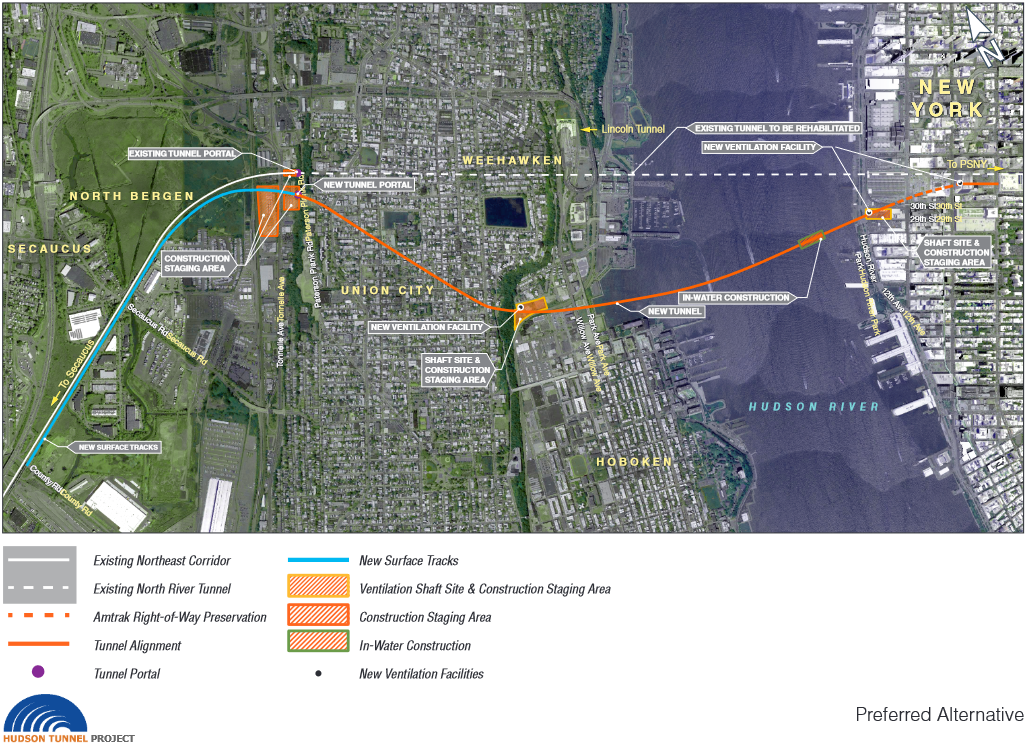
The alignment, as can be seen in the picture, is not closely parallel to the existing tunnels. On the Manhattan side, the alignment is fixed in place, due to the construction of the Hudson Yards project since the project was first mooted in the early 2000s, when it was called Access to the Region’s Core (ARC); the only available alignment between building foundations is as depicted. Under the Hudson and in New Jersey, there are no such constraints.
What is far more suspicious is that 5 km of double-track tunnel, even partly underwater, even partly in Manhattan between skyscraper foundations, are said to cost $14 billion in total. This is not just the usual problem of high New York costs. Second Avenue Subway’s hard costs were 77% stations and station finishes and only 23% tunnels and systems; excluding the stations, and pro-rating the soft costs, the costs in 2022 dollars were only about $500 million per km. There is an underwater premium, but it doesn’t turn $500 million per km into nearly $3 billion per km, nor is the expected inflation rate over the project’s 2023-35 lifetime high enough to make a difference.
What’s more, the underwater premium is highest where the costs are already the lowest. The New York cost premium for civil infrastructure is rather small, only about a factor of around 3 over comparable European projects. Systems and finishes have a considerably higher premium, due to lack of standardization; stations have an even higher premium, due to overbuilding (the Second Avenue Subway stations were 2-3 times as big as necessary, and the two smaller ones were also deep-mined at an additional cost). The installation of systems like electrification and cables should not cost more underwater than underground – the construction of the tunnel and its lining is where the premium is. Whatever we think the underwater construction premium is – a factor of 2 is consistent with some Stockholm numbers and also with the original BART construction in the 1960s and early 70s – it should be lower in New York.
Some of it must come from ever worse project management and soft costs. The destruction of state capacity in the English-speaking world, and increasingly in nonnative English-speaking countries influenced by the UK like the Netherlands, is not a completed process; it is still ongoing. Soft costs keep rising, and the response to every failure is to add yet another layer of consultants or another layer of review. Second Avenue Subway phase 2 manages slightly higher per-km costs than phase 1, despite having less overbuilding, and from my encounters with the people in charge of capital construction at the MTA, it’s not hard to see why.
And yet, even relative to the highest costs of phase 2, Gateway is overpriced. The level of experience the people running this project have with capital construction at this scale is less than that of the MTA, and this should matter. And yet, even that doesn’t explain the large jump in costs.
Is it possible to do better?
Well, once the almost $16 billion for the project is there, it will be spent. The main reason one might oppose overpriced projects like Second Avenue Subway phase 2 even if their benefit-cost ratio is okay (which, for both phase 2 and the Hudson Tunnel Project, is iffy, though not obviously bad), is that pressure to reduce costs before approval can result in efficiencies. But once a budget is approved, nobody will make a serious effort to go significantly below it.
That said, the only smoking gun I have for how to make this project cheaper pertains to the $2 billion for fixing the existing tunnels. Currently, the timetables for both Amtrak and New Jersey Transit trains across the tunnels are written so that on weekends, only one of the two single-track tubes is in operation. Thus, maintenance work can be done on the other tunnel for an uninterrupted 55-hour period. However, Amtrak rarely takes advantage of this. In fact, reporting in the New York Daily News has found that over the last few years, only about once every three months – 13 times in a four-year period from mid-2017 to mid-2021 – has there been a full weekend repair job in one of the tunnels. Accelerated repairs would be able to reduce the costs of the fixes through greater efficiency, and, since American government budgeting is done in nominal dollars, a lower price level than in the mid-2030s.
It’s likely that such egregious examples also exist for the main project, the $14 billion new tunnels. I don’t know of any such example, and I don’t think it’s worthwhile stopping the project over this; but it’s important to remain vigilant and remember that while the tunnels are fully funded for all intents and purposes, a small gap remains and should be fillable without new money.
The benefits of the tunnels
The costs are very high. But what are the benefits?
In isolation, the benefits are that capacity across the Hudson would double. This would enable doubling commuter rail traffic. Before corona, the trains were very crowded, to the point of suppressing demand; ridership is lower now than it was then, but east of the Hudson, Metro-North is at 78% of pre-corona ridership and rising fast. Moreover, the prospects of future growth in commuting in New Jersey are better than those in suburban New York and Connecticut, since New Jersey permits housing at an almost healthy rate, 4 annual housing units per 1,000 people, whereas Long Island permits about 1, Westchester 2-3, and Fairfield County 1.5-2.5. There’s enough pressure in New Jersey even in the short term that a ridership flop like that of East Side Access is very unlikely.
That said, New Jersey Transit only had about 310,000 weekday riders in 2019, double-counting transfers (of which there aren’t many, unlike on the LIRR). Not many more than half those trips even originated or ended at Penn Station – one of the adaptations to overcrowding on New Jersey Transit is to send about half the trains from the Morris and Essex Lines to Hoboken, from which passengers take PATH into the city, and another is for passengers to get off at Newark and transfer to PATH there. Penn Station’s ridership in 2019 was 94,000 boardings, or 188,000 trips; that is the number that could potentially be doubled. So, $14 billion for 188,000 trips; this is $74,000 per rider, which is too high, and if that is the only benefit, then the project should be canceled.
However, the Hudson Tunnel Project interacts positively with every operational improvement in commuter rail. If off-peak frequencies are increased so that passengers can use the trains not just for rush hour commuting, then ridership will rise. Of course, peak frequency is not really relevant to off-peak ridership – but there are advantages from the new tunnels to off-peak service, such as more cleanly separating Northeast Corridor service from Morris and Essex service, improving reliability for both.
And then there are all the necessary small improvements, such as electrification. For example, right now, the Raritan Valley Line today is unelectrified, and passengers have to transfer at Newark to either PATH or a Northeast Corridor or North Jersey Coast Line train to Manhattan; only a handful of trains run to Manhattan using dual-mode locomotives, none at rush hour. The current service plan with the new tunnels is to run ever more trains with dual-mode locomotives, which are exceptionally expensive, heavy, and unreliable. However, the new tunnels interact positively with electrifying the Raritan Valley Line, currently the busiest diesel line in New Jersey, and with wiring short unelectrified tails on the North Jersey Coast and Morris and Essex Lines. These would raise both peak and off-peak ridership – and the extra capacity provided by the new tunnels improves the business case for them, even if the business case is healthy even purely on off-peak travel.
The same is true of platforms. The low platforms at most stations impede efficient boardings. They take too long at rush hour, and they’re inaccessible unless a conductor manually operates a wheelchair lift; conductors are not really cost-effective on commuter trains even at the wages of the 2020s, let alone those of the future. As with electrification, the case for converting all stations to high platforms for level boarding is strong even on off-peak ridership; the benefits are high and the costs are low (New Jersey Transit appears capable of raising platforms for $25 million per station). However, commuter rail managers and suburban politicians are squeamish and ignorant of best practices and only really get peak ridership; thus, the higher peak ridership expected from the new tunnels not only improves the already-strong business case for high platforms, but also makes this business case easier to explain to people who think that off-peak, everyone must drive.
With such improvements to speed and reliability – modern rolling stock (which none of the region’s agencies is interested in acquiring), electrification, high platforms, some junction fixes, and better timetabling (which the region will have to adopt for greater peak throughput) combine to a speed increase of a factor of about 1.5, with all the benefits that this entails.
Necessary efficiencies
Much of the benefit of the Hudson Tunnel Project comprises necessary improvements on the surface, some of which I expect to happen as ancillaries. But then there is also the issue of necessary efficiencies in New York.
The issue is that the current operating paradigm involves very long turns at Penn Station. LIRR trains terminate from the east and New Jersey Transit trains terminate from the west, and neither railroad turns trains especially quickly. The turn times are on the order of 20 minutes; mainline trains in the United States can reverse direction in service in 10 minutes when they need to (for example, if they’ve arrived late), and even eight minutes look possible, and outside the United States, constrained terminals like Tokyo Station on the Chuo Line or Catalunya on FGC do it much faster.
The relevance is that agency officials keep saying, falsely, that Penn Station Expansion is necessary for the full increase in capacity coming from the new tunnels. But they are not going to get the money for the expansion; it competes with so many other priorities for a pool of money, $30 billion for the entire Northeast Corridor, that is large compared to normal-world costs but small compared to American ones. This means that they’re going to have to make necessary efficiencies.
Through-running is one such efficiency. But there are others – chiefly, turning faster at terminals, since the new tunnels would mainly feed stub-end tracks. This, in turn, means better service in general, with lower operating costs and (if there’s through-running) better service for passengers.
On just a raw estimate of extra peak capacity, there just isn’t enough ridership to justify $14-16 billion in funding for new tunnels. But once all the necessary improvements and efficiencies come in, the benefit-cost analysis looks much healthier. It doesn’t mean anyone should be happy about the budget – agencies and area advocates should do what they can to make sure money is saved and the same budget can build more things (like all these necessary improvements) – but it could be more like the extremely high-cost and yet high-benefit Second Avenue Suwbay phase 1 and not like the failure that is East Side Access.
The LIRR and East Side Access
East Side Access opened in February, about four months ago, connecting the LIRR to Grand Central; previously, trains only went to Penn Station. The opening was not at all smooth – commuters mostly wanted to keep going to Penn Station, contrary to early-2000s projections, and stories of confused riders were common in local media. I held judgment at the time because big changes take time to show their benefits, but in the months since, ridership has not done well. On current statistics, it appears that the opening of the new tunnel to Grand Central has had no benefit at all, making this project not just the world leader in tunneling cost per kilometer (about $4 billion) but also one with no apparent transportation value.
What is East Side Access?
Traditionally, of New York’s two main train stations, Penn Station only served Amtrak, New Jersey Transit, and the LIRR, whereas Grand Central only served Metro-North. East Side Access is a tunnel from the LIRR Main Line to Grand Central, permitting trains to serve either of the two stations; an under-construction project called Penn Station Access likewise will permit one Metro-North line to serve Penn Station.

The tunnel across the East River was built in the 1970s and 80s together with the tunnel that now carries the F train; East Side Access was the project to build the connection from this tunnel to Grand Central as well as to the LIRR Main Line in Queens. The Grand Central connection does not lead to the preexisting Metro-North terminal with its tens of tracks, but to a deep cavern:

What was East Side Access supposed to serve?
Penn Station’s location is at the southwestern margin of the job concetration of Midtown Manhattan. Grand Central’s location is better; the studies done for the project 20 years ago found that for the majority of LIRR commuters, Grand Central was closer to their job than Penn Station. In 2019, there were 589,770 jobs within 1 km of Penn Station’s northeast corner at 7th and 33rd, of whom 48,460 lived on Long Island; within 1 km of Grand Central’s southern entrance at Park and 42nd, the corresponding numbers are 680,586 and 57,457.
Based on such analysis, the plan was to send as many trains as possible to Grand Central, at the expense of trains that used not to enter Manhattan at all but instead diverted to Downtown Brooklyn (within 1 km of Atlantic and Flatbush there were 41,360 jobs in 2019, of which 3,895 were held by Long Islanders). The central transfer point at Jamaica was reconfigured to no longer permit cross-platform transfers between Brooklyn- and Penn Station-bound trains in order to facilitate more direct trains to Grand Central.
The state promised large increases in both capacity and ridership; in 2022, joint Metro-North and LIRR head Catherine Rinaldi said they were increasing service by 40%. Unfortunately, ridership has flopped.
Ridership is a flop
The most recent publication about New York commuter rail ridership is from a week ago. LIRR ridership in May was about 5.6 million, with a peak of 229,000 passengers per weekday; ridership before corona was 316,000 per weekday. Metro-North, with no opening comparable to that of East Side Access, had 5.43 million riders in May with a peak of 215,000 passengers – but pre-corona ridership was 276,000. Metro-North has held up better the LIRR and recovered faster: May 2023 was 28% above May 2022, whereas for the LIRR, it was only 23%.
The same publication speaks of East Side Access positively – as it must, as an official report. It says the share of LIRR ridership is transitioning toward 65% Penn Station, 35% Grand Central. But this by itself already raises questions. The easier access to Grand Central and the extra capacity should have raised ridership; in the report, no surge is apparent since February of this year. Judging by the example of Metro-North, it appears that no net ridership has appeared as a result of the new project.
What’s going on here?
I’ve spent many years criticizing reverse-branching, in which a trunk line outside city center splits into branches in the core, in this case some trains serving Penn Station and others serving Grand Central. For East Side Access, my recommendation was to have one specific track pair, such as the express Main Line tracks, only carry trains to Grand Central, and the rest, such as the local tracks and Port Washington Branch tracks, only carry trains to Penn Station. The disappointing ridership of East Side Access has led some area transit advocates to criticize the MTA on the grounds that the problem is one of reverse-branching.
The media stories in late winter and early spring of confused commuters are certainly consistent with my criticism of reverse-branching. Everything that’s happened is consistent with that criticism, and yet I’m not certain that this is what’s going on. After all, East Side Access also adds new service and new capacity. Potentially, it’s about the loss of Jamaica transfers, but then which trains would people even want to transfer from?
The main mechanisms by which reverse-branching hurts ridership are that it makes schedule planning too complex and thereby reduces reliability, and that the frequency on each reverse-branch is reduced. LIRR scheduling is already extremely complex, with one-off express patterns and trains weaving around one another at rush hour; in 2015, I looked at some rush hour schedules and compared them with the rolling stock’s technical capabilities and found that even relative to the derated capabilities of the trains, the timetables are padded by 32% on the Main Line. (Metro-North seems comparably padded.) East Side Access would hardly make this much worse. The second mechanism is frequency – but at rush hour, frequency at each suburban station is decent, if not great.
But then, I can’t think of anything else that fits. The issue could not be some permanent decrease in commuting, or some permanent decrease in commuting to Grand Central specifically, since Metro-North ridership has recovered better and all trains there go to Grand Central. It could potentially be some force of habit inducing LIRR commuters to stay on the trains they’re familiar with, but then we should see gradual increase in ridership since opening and we’re not seeing that at any higher rate than at Metro-North.
Assume Normal Costs: An Update
The maps below detail what New York could build if its construction costs were normal, rather than the highest in the world for reasons that the city and state could choose to change. I’ve been working on this for a while – we considered including these maps in our final report before removing them from scope to save time.
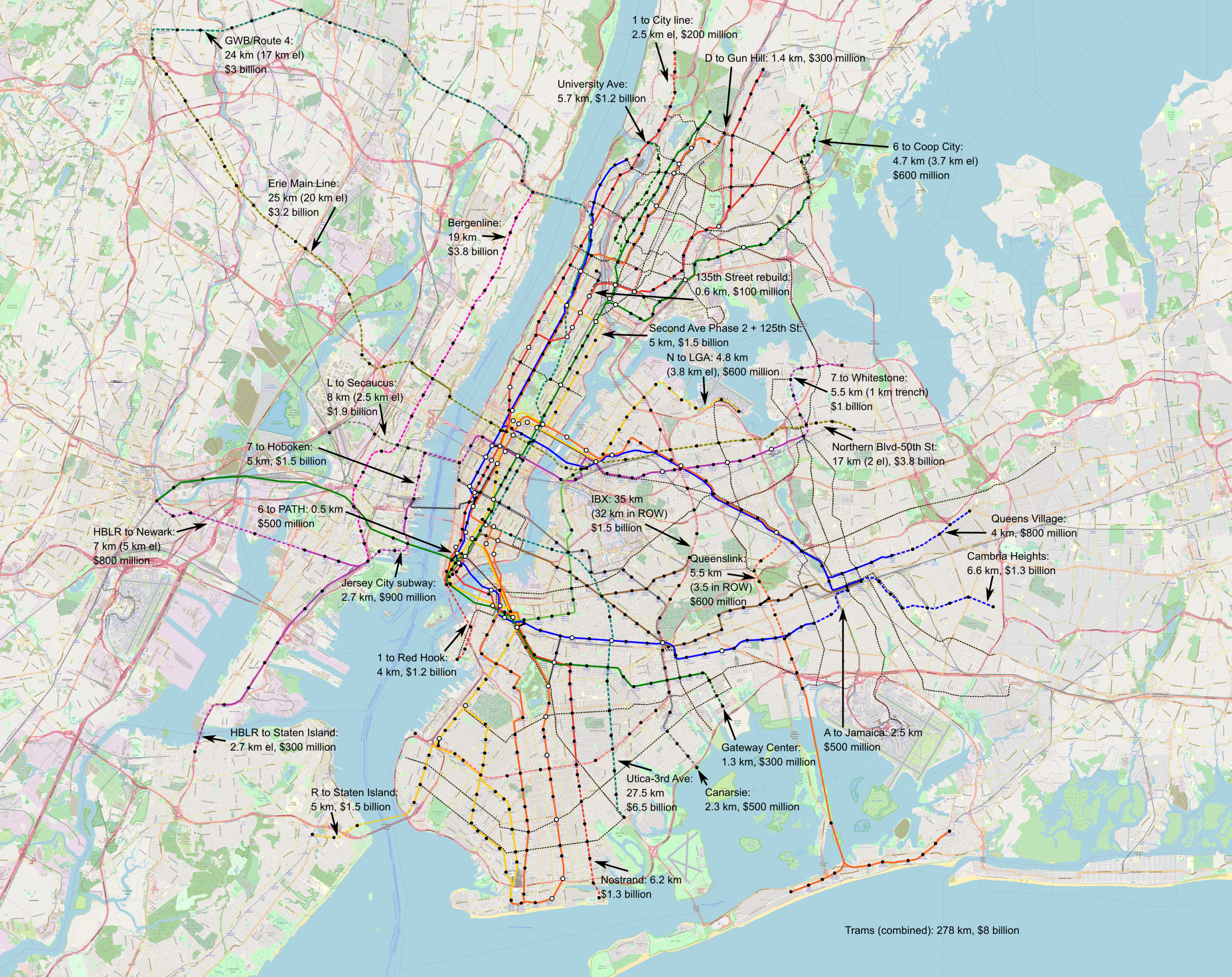
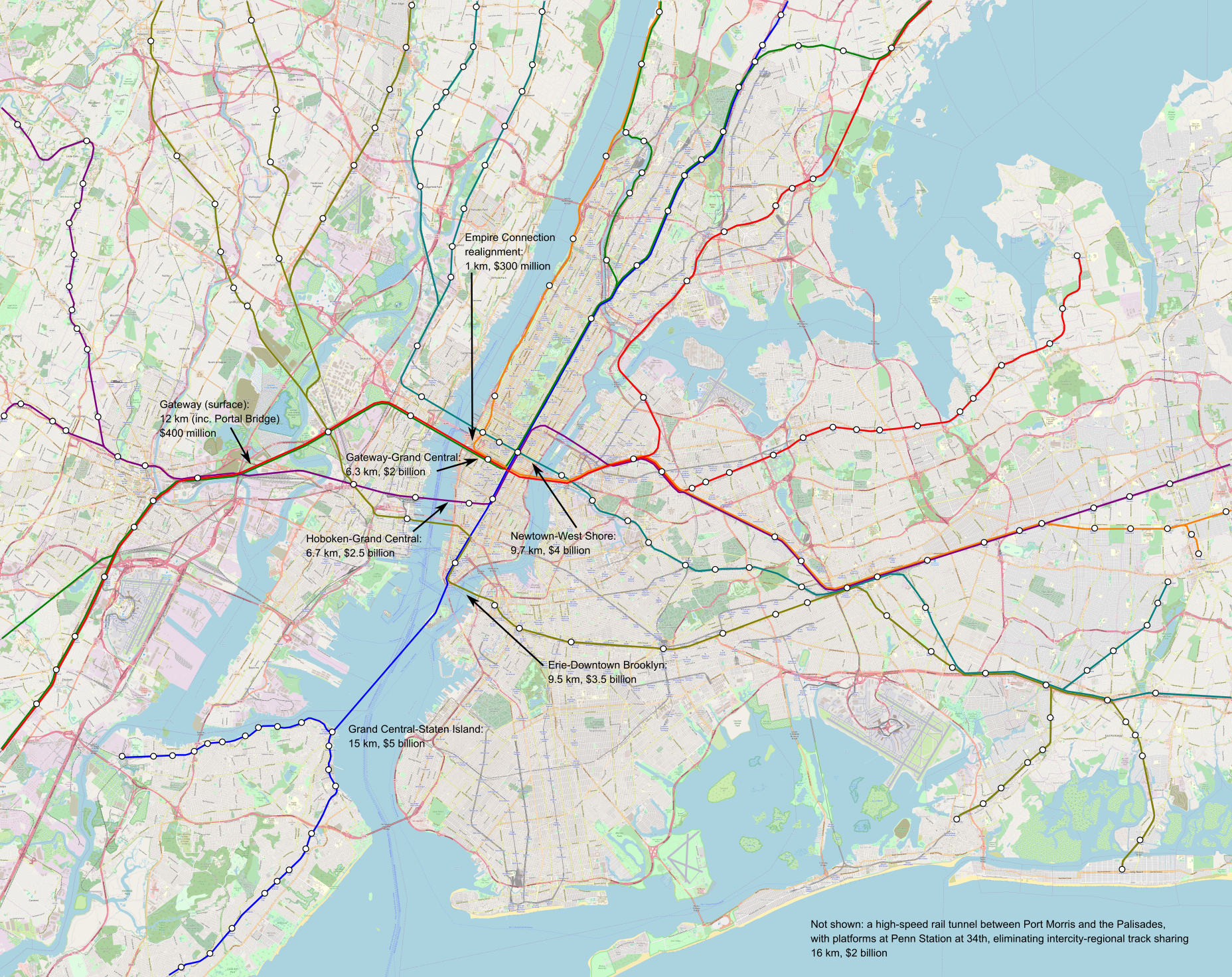
Higher-resolution images can be found here and here; they’re 53 MB each.
Didn’t you do this before?
Yes. I wrote a post to a similar effect four years ago. The maps here are updated to include slightly different lines – I think the new one reflects city transportation needs better – and to add light rail and not just subway and commuter rail tunnels. But more importantly, the new maps have much higher costs, reflecting a few years’ worth of inflation (this is 2022 dollars) and some large real cost increases in Scandinavia.
What’s included in the maps?
The maps include the following items:
- 278 km of new streetcars, which are envisioned to be in dedicated lanes; on the Brooklyn and Queensborough Bridges, they’d share the bridges’ grade separation from traffic into Manhattan, which in the case of the Brooklyn Bridge should be an elevated version of the branched subway-surface lines of Boston, Philadelphia, San Francisco, and most German cities. Those should cost $8 billion in total, based on Eno’s European numbers plus some recent urban German projects.
- 240 km of new subway lines, divided as 147.6 km in the city (97.1 km underground) and 92.4 km across the Hudson and in New Jersey (45.2 km underground). Of those 240 km, 147.5 km comprise four new trunk lines, including the already-planned IBX, and the rest are extensions of existing lines. Those should cost $25.2 billion for the city lines and $15.4 billion for the New Jersey lines.
- Rearrangement of existing lines to reduce branching (“deinterlining“) and improve capacity and schedule robustness; the PATH changes are especially radical, turning the system into extensions of the 6 and 7 trains plus a Hoboken-Herald Square shuttle.
- 48.2 km of commuter rail tunnels, creating seven independent trunk lines across the region, all running across between suburbs through the Manhattan core. In addition to some surface improvements between New York and Newark, those should cost $17.7 billion, but some additional costs, totaling low single-digit billions, need to be incurred for further improvements to junctions, station platforms, and electrification.
The different mode of transportation are intended to work together. They’re split across two maps to avoid cluttering the core too much, but the transfers should be free and the fares should be the same within each zone (thus, all trains within the city must charge MetroCard/OMNY fare, including commuter rail and the JFK AirTrain). The best way to connect between two stations may involve changing modes – this is why there are three light rail lines terminating at or near JFK not connecting to one another except via the AirTrain.
What else is included?
There must be concurrent improvements in the quality of service and stations that are not visible on a map:
- Wheelchair accessibility at every station is a must, and must be built immediately; a judge with courage, an interest in improving the region, and an eye for enforcing civil rights and accessibility laws should impose a deadline in the early to mid 2030s for full compliance. A reasonable budget, based on Berlin, Madrid, and Milan, is about $10-15 million per remaining station, a total of around $4 billion.
- Platform edge doors at every station are a good investment as well. They facilitate air conditioning underground; they create more space on the platform because they make it easier to stand closer to the platform edge when the station is crowded; they eliminate deaths and injuries from accidental falls, suicides, and criminal pushes. The only data point I have is from Paris, where pro-rated to New York’s length it should be $10 million per station and $5 billion citywide.
- Signaling must be upgraded to the most modern standards; the L and 7 trains are mostly there already, with communications-based train control (CBTC). Based on automation costs in Nuremberg and Paris, this should be about $6 billion systemwide. The greater precision of computers has sped up Paris Métro lines by almost 20% and increased capacity. Together with the deinterlining program, a single subway track pair, currently capped at 24 trains an hour in most cases, could run about 40 trains per hour.
- Improvements in operations and maintenance efficiency don’t cost money, just political capital, but permit service to be more reliable while cutting New York’s operating expense, which are 1.5-2.5 time a high as the norm for large first-world subway systems.
The frequency on the subway and streetcar lines depicted on the map must conform to the Six-Minute Service campaign demand of Riders Alliance and allies. This means that streetcars and subway branches run very six minute all day, every day, and subway trunk lines like the 6, 7, and L get twice as much frequency.
What alternatives are there?
Some decisions on the map are set in stone: an extension of Second Avenue Subway into Harlem and thence west along 125th Street must be a top priority, done better than the present-day project with it extravagant costs. However, others have alternatives, not depicted.
One notable place where this could easily be done another way is the assignment of local and express trains feeding Eighth and Sixth Avenues. As depicted, in Queens, F trains run local to Sixth Avenue and E trains run express to Eighth; then, to keep the local and express patterns consistent, Washington Heights trains run local and Grand Concourse trains run express. But this could be flipped entirely, with the advantage of eliminating the awkward Jamaica-to-Manhattan-to-Jamaica service and replacing it with straighter lines. Or, service patterns could change, so that the E runs express in Queen and local in Manhattan as it does today.
Another is the commuter rail tunnel system in Lower Manhattan. There are many options for how to connect New Jersey, Lower Manhattan, and Brooklyn; I believe what I drew, via the Erie Railroad’s historic alignment to Pavonia/Newport, is the best option, but there are alternatives and all must be studied seriously. The location of the Lower Manhattan transfer station likewise requires a delicate engineering study, and the answer may be that additional stops are prudent, for example two stops at City Hall and South Ferry rather than the single depicted station at Fulton Street.
What are those costs?
I encourage people to read our costs report to look at what goes into the numbers. But, in brief, we’ve identified a recipe to cut New York subway construction costs by a factor of 9-10. On current numbers, this means New York can cut its subway construction costs to $200-250 million per kilometer – a bit less in the easiest places like Eastern Queens, somewhat more in Manhattan or across water. Commuter rail tunnel costs are higher, first because they tend to be built only in the most difficult areas – in easier ones, commuter rail uses legacy lines – and second because they involve bigger stations in more constrained areas. Those, too, follow what we’ve found in comparison cases in Southern Europe, the Nordic countries, Turkey, France, and Germany.
In total, the costs so projected on the map, $66.3 billion in total, are only slightly higher than the total cost of Grand Paris Express, which is $60 billion in 2022 dollars. But Paris is also building other Métro, RER, and tramway extensions at the same time; this means that even the program I’m proposing, implemented over 15 years, would still leave New York spending less money than Paris.
Is this possible?
Yes. The governance changes we outline are all doable at the state level; federal officials can nudge things and city politician can assist and support. There’s little confidence that current leadership even wants to build, let alone knows what to do, but it’s all doable, and our report linked in the lede provides the blueprint.
Through-Running and American Rail Activism
A bunch of us at the Effective Transit Alliance (mostly not me) are working on a long document about commuter rail through-running. I’m excited about it; the quality of the technical detail (again, mostly not by me) is far better than when I drew some lines on Google Maps in 2009-10. But it gets me thinking – how come through-running is the ask among American technical advocates for good passenger rail? How does it compare with other features of commuter rail modernization?
Note on terminology
In American activist spaces, good commuter rail is universally referred to as regional rail and the term commuter rail denotes peak-focused operations for suburban white flighters who work in city center and only take the train at rush hour. If that’s what you’re used to, mentally search-and-replace everything I say below appropriately. I have grown to avoid this terminology in the last few years, because in France and Germany, there is usually a distinction between commuter rail and longer-range regional rail, and the high standards that advocates demand are those of the former, not the latter. Thus, for me, a mainline rail serving a metropolitan area based on best practices is called commuter and not regional rail; there’s no term for the traditional American system, since there’s no circumstance in which it is appropriate.
The features of good commuter rail
The highest-productivity commuter rail systems I’m aware of – the Kanto area rail network, the Paris RER, S-Bahns in the major German-speaking cities, and so on – share certain features, which can be generalized as best practices. When other systems that lack these features adopt them, they generally see a sharp increase in ridership.
All of the features below fall under the rubric of planning commuter rail as a longer-range subway, rather than as something else, like a rural branch line or a peak-only American operation. The main alternative for providing suburban rapid transit service is the suburban metro, typical of Chinese cities, but the suburban metro and commuter rail models can coexist, as in Stockholm, and in either case, the point is to treat the suburbs as a lower-density, longer-distance part of the metropolitan area, rather than as something qualitatively different from the city. To effect this type of planning, all or nearly all of the following features are required, with the names typically given by advocates:
- Electrification/EMUs: the line must run modern equipment, comprising electric multiple units (self-propelled, with no separate locomotive) for their superior performance and reliability
- Level boarding/standing space: interior train design must facilitate fast boarding and alighting, including many wide doors with step-free boarding (which also provides wheelchair accessibility) and ample standing space within the car rather than just seated space, for example as in Berlin’s new Class 484
- Frequency: the headway between trains set at a small fraction of the typical trip time – neighborhoods 10 km from city center warrant a train every 5-10 minutes, suburbs 20-30 km out a train every 10-20 minutes, suburbs farther out still warrant a train every 20-30 minutes
- Schedule integration: train timetables must be planned in coordination with connecting suburban buses (or streetcars if available) to minimize connection time – the buses should be timed to arrive at each major suburban station just before the train departs, and depart just after it arrives
- Pedestrian-friendliness: train stations designed around connections with buses, streetcars if present, bikes, and pedestrian activity – park-and-rides are acceptable but should be used sparingly, and at stations in the suburbs, the nearby pedestrian experience must come first, in order to make the station area attractive to non-drivers
- Fare integration/Verkehrsverbund: the system may charge higher fares for longer trips, but the transfers to urban and suburban mass transit must be free even if different companies or agencies run the commuter trains and the city’s internal bus and rail system
- Infill: stations should be spaced regularly every 1-3 km within the built-up area, including not just the suburbs but also the city; slightly longer stop spacing may be acceptable if the line acts as an express bypass of a nearby subway line, but not the long stretches of express running American commuter trains do in their central cities
- Through-running: most trains that enter city center go through it, making multiple central stops, and then emerge on the other side to serve suburbs in that direction
Is through-running special?
Among the above features, through-running has a tendency to capture the imagination, because it lends itself to maps of how the lines fit together in the region; I’ve done more than my share of this, in the 2009 post linked in the intro, in 2014, in 2017, and in 2019. This is a useful feature, and in nearly every city with mainline rail, it’s essential to long-term modernization; the exceptions are cities where the geography puts the entirety of suburbia in one direction of city center, and even there, Sydney has through-running (all lines go west of city center) and Helsinki is building a tunnel for it (all lines go north).
The one special thing about through-running is that usually it is the most expensive item to implement, because it requires building new tunnels. In Philadelphia, this was the Center City Commuter Connection, opened in 1984. In Boston, it’s the much-advocated for North-South Rail Link. In Paris, Munich, Tokyo, Berlin, Copenhagen, London, Milan, Madrid, Sydney, Zurich, and other cities that I’m forgetting, this involved building expensive city center tunnels, usually more than one, to turn disparate lines into parts of a coherent metropolitan system. New York is fairly unique in already having the infrastructure for some through-running, and even there, several new tunnels are necessary for systemwide integration.
But there are so many other things that need to be done. In much of the United States, transit advocacy has recently focused on the issue of frequency, brought into the mainstream of advocacy by Jarrett Walker. Doing one without the other leads to awkward situations: after opening the tunnel, Philadelphia branded the lines R1 through R8 modeled on German S-Bahns while still running them hourly off-peak, even within the city, and charging premium fares even right next to overcrowded city buses.
This is something advocates generally understand. There’s a reason the TransitMatters Regional Rail program for commuter rail modernization puts the North-South Rail Link on the back burner and instead focuses on all the other elements. But there’s still something about through-running that lends itself to far more open argumentation than talking about off-peak frequency. Evidently, the Regional Plan Association and other organizations keep posting through-running maps rather than frequency maps or sample timetables.
Through-running as revolution
I suspect one reason for the special place of through-running, besides the attractiveness of drawing lines on a map, is that it most blatantly communicates that this is no longer the old failed system. There are good ways of running commuter rail, and bad ways, and all present-day American commuter rail practices are bad ways.
It’s possible to make asks about modernization that don’t touch through-running, such as integrating the fares; in Germany, the Verkehrsverbund concept goes back to the 1960s and is contemporary with the postwar S-Bahn tunnels, but Berlin and Hamburg had had through-running for decades before. But because these asks look small, it’s easy to compromise them down to nothing. This has happened in Boston, where there’s no fare integration on the horizon, but a handful of commuter rail stations have their fares reduced to be the same as on the subway, still with no free transfers.
Through-running is hard to compromise this way. As soon as the lines exist, they’re out there, requiring open coordination between different railroads, each of which thinks the other is incompetent and is correct. It’s hard to sell it as nothing, and thus it has to be done as a true leap generations forward, catching up with where the best places have been for 50+ years.
CNBC Video on Construction Costs
There’s a CNBC video about construction costs. It references our data a bunch, and I’d like to make a few notes about this.
Urban rail and GDP
CNBC opens by saying better urban rail would increase American GDP by 10%, sourcing the claim to our report. This isn’t quite right: our report references Hsieh-Moretti on upzoning in New York and the Bay Area; they estimate that relaxing zoning restrictions in those two regions to the US median starting in 1964 would have, assuming perfect mobility, raised American GDP by 9% in the conditions of 2009 (and the effect size should have grown since).
The relevance of transportation is that the counterfactual involves both regions growing explosively: New York employment grows by 1,010% more than in reality, so by a factor of about five compared with actual 1960s population and about 3.6 compared with actual 2009 (in 1969-2009, metro employment grew 35.4%), and likewise San Francisco would be 3.9 times bigger than in reality in 2009 and San Jose, having had much faster growth in the previous decades in reality, would have still been 2.5 times bigger. Hsieh-Moretti assume infrastructure expands to accommodate this growth. But if it can’t, then the growth in GDP is lower and the growth in consumer welfare is massively lower due to congestion externalities, hence our citation of Devin Bunten’s paper on this subject.
So the issue isn’t really that building subways would increase American GDP by 10%. It’s that building subways paired with transit-oriented development, the latter proceeding at levels that would raise regional population at a somewhat faster rate than in 1900-30, would do so. The issue of costs in the United States is only peripherally connected with the lack of transit-oriented development, an American peculiarity in which more housing is built in poorer regions than in the largest, richest metro areas. In contrast, Canada gets TOD right and yet is rapidly converging to American construction costs, Toronto’s reaching around US$1 billion/km per the latest estimates. Germany, conversely, is rather NIMBY, although its rich cities still build much more than New York or the Bay Area, and is capable of building subways just fine.
The portrayal of Second Avenue Subway
The portrayal looks mostly good. It points out the tension between Second Avenue Subway’s extreme cost per km and reasonable cost per rider, the latter comparing very favorably with Los Angeles and about on a par with Grand Paris Express. Second Avenue Subway Phase 1 was a bad project in the sense that it was severely overbuilt and poorly managed, but were it not possible to build it for cheaper (which it was), it would be a good value proposition, and even Phase 2 is marginal rather than bad. The issue is that New York’s cost-effectiveness frontier, at current costs, makes it capable of building a few km of subway per generation, whereas that of Paris, a city that isn’t especially cheap to build in, enables the 200 km Grand Paris Express.
The video goes over our comparison of station to tunnel costs, and connects this with various forms of surplus extraction; Eric gives examples of how cities demand betterments and do general micromanagement and threaten to withhold permits unless they get what he calls bribes. It gets the picture well for how important actors, up to and including the mayor of New York, just treat infrastructure as an opportunity to grab surplus for other priorities.
There are a few errors, all minor:
- The visualization of Second Avenue Subway has it running down First Avenue in Midtown and Downtown Manhattan, which was certainly not in the original plan and I think still is not.
- The video states the cost of Grand Paris Express at $38 billion, I think out of converting euros to dollars at exchange rate, whereas in PPP terms it’s $47 billion in 2012 prices and $60 billion in 2022 dollars, either way about 10 times the absolute cost of Second Avenue Subway Phase 1 for 10 times the projected ridership and 70 times the overall length. But the costs per rider are correct, at least.
- I’m not sure why, but the Madrid numbers are stated to be around $200 million/km, which is a cost that I don’t think exists there – costs in our database don’t include the latest lines there, but the ongoing expansion program is 40.5 km for 2 billion euros, which in PPP terms is around $70 million/km, I think all underground.
- The section on soft costs says that they were 21% of Second Avenue Subway’s overall costs, compared with a norm of 5-10% elsewhere. This is not quite true – they were 21% of the hard costs (and the same is true of the 5-10% figure); their share of overall costs was therefore a bit lower.
Carmen Bianco and Robert Puentes
Three people are extensively interviewed in the video. The first is Carmen Bianco, who was New York City Transit head in 2013-5. The second is Eric. The third is Eno’s Robert Puentes. The interviews are pretty good (by which I mean those with Bianco and Puentes – I of course find what Eric says good I’m the least impartial judge on this). There’s also a short quote from Bent Flyvbjerg about construction productivity, which isn’t quite true (productivity is rising in Sweden, just at lower rates than general growth).
Puentes talks about standardization, comparing the custom-designed stations in the United States with the standardized ones in Copenhagen. He also talks about the benefits of utilitarian stations and connects this with standardization – American subway and light rail stations aren’t particularly nice (the overbuilding goes to crew break rooms and crossovers, not passenger facilities), but one way local political actors get to feel important is making each station a bit different, and I’m glad he highlights this connection between overbuilding and poor standardization. But I think he somewhat errs in that he says that one cause of this among a few is that American cities build little subway tunneling. Copenhagen, after all, built its first line in the 1990s and early 2000s (using consultants, since there was no preexisting in-house staff and no political appetite to staff up); it just made the right design decision to standardize, which has helped it build a subway even at not especially low costs, in a fairly small city.
Then there’s Bianco, who I think appears talking more than anyone else, even Eric. He gives the standard list of problems in New York: it’s a dense city with a lot of complex underground infrastructure, utility relocation is difficult, and so on. At least on camera, he doesn’t make excuses. It’s just, complex historic utilities are not unique to New York, and I don’t know to what extent he understands that New York can learn this from Italian cities (or from London, which I believe has very good underground utility mapping). I assume Bianco isn’t generally great about this since he was in charge in 2013-5 and didn’t reform this system, but he doesn’t come off as repulsive, and it’s plausible that he’s more reasonable knowing not what he may not have 10 years ago.
Quick Note: New Jersey Highway Widening Alternatives
The Effective Transit Alliance just put out a proposal for how New Jersey can better spend the $10 billion that it is currently planning on spending on highway widening.
The highway widening in question is a simple project, and yet it costs $10.7 billion for around 13 km. I’m unaware of European road tunnels that are this expensive, and yet the widening is entirely above-ground. It’s not even good as a road project – it doesn’t resolve the real bottleneck across the Hudson, which requires rail anyway. It turns out that even at costs that New Jersey Transit thinks it can deliver, there’s a lot that can be done for $10.7 billion:
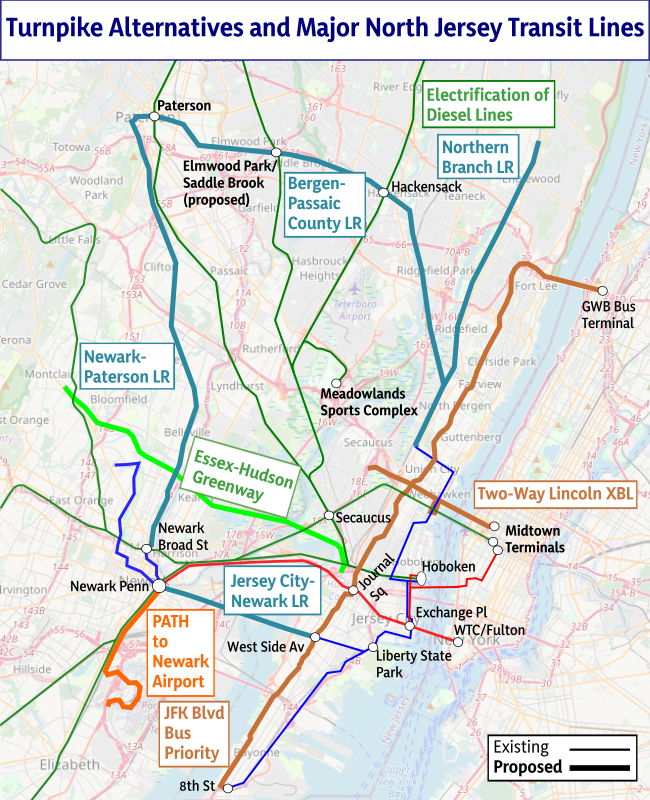
I contributed to this project, but not much, just some sanity checks on costs; other ETA members who I will credit on request did the heavy pulling of coming up with a good project list and prioritizing them even at New Jersey costs, which are a large multiple of normal costs for rail as well as for highways. I encourage everyone to read and share the full report, linked above; we worked on it in conjunction with some other New Jersey environmental organizations, which supplied some priorities for things we are less familiar with than public transit technicalities like bike lane priorities.
Doing Projects Right and Doing the Right Project
I’d like to develop a distinction between two modes of success or failure in infrastructure projects, which I’ve mentioned in brief in past post. An infrastructure project may be done right or wrong – that is, it could be built at a reasonable lifecycle cost and offer high quality of service or it could fail to do this, typically through very high upfront construction costs with no future benefit. But it could also be the right project to build or the wrong one – that is it could be the right priority for the region that builds it based on expected usage and future development or it could be a low priority, typically due to politicization of engineering and planning. Those are distinct judgments, and I’m not even sure they are strongly correlated.
The right project, done wrong
I’ve mentioned in a few past posts as well as videos that New York is for the most part building the right projects right now. Based on any reasonable cost per rider calculation, the highest priorities in the region excluding mainline rail are Second Avenue Subway phases 1 and 2, an extension of phase 2 under 125th Street, subway extensions under Nostrand and Utica Avenues, an orbital line following the Bay Ridge Branch toward Jackson Heights and Yankee Stadium, and a subway extension to LaGuardia Airport. Phase 1 has been built, and the current priorities are phase 2 and the orbital line under the moniker IBX, the latter giving the governor’s personal imprimatur to this important project. The only lower-priority extension built ahead of these is the 7 extension to Hudson Yards, which is a small fraction of the good projects by total cost.
In mainline rail, on the New Jersey side, the biggest priority is the Gateway tunnel and this is indeed what the state and Port Authority are most invested in. Even on the New York side, mainline rail is invested in in roughly the right priority order, especially if one fixes the assumption of bad present-day operations; the only real problem is that due to politics from the late 1990s, the MTA overinvested in New York-side mainline rail (that is, East Side Access) to secure suburban Republican support for Second Avenue Subway phase 1.
The problem for New York is that every single project it touches is executed in almost the worst way possible. It can’t build, and to an extent it doesn’t even want to build. The $50 billion in New York-side capital investment every five years are a large multiple of what peer cities spend, and what this buys is a few kilometers of subway every decade, escalating maintenance costs, and a vague promise to not quite finish making the subway accessible in the 2050s. But the little it does build is, for the most part, the right project.
New York is not the only city in this situation. The prioritization in Toronto seems fine to me, including the Downtown Relief Line rebranded as the Ontario Line, electrification and general modernization of commuter rail as part of the RER project, and rail on Eglinton. London, likewise, seems to be building projects in the right priority order, but it lost its ability to build in the 1980s and 90s so that its urban rail growth rate is roughly one new line per monarch and its step-free access program is proceeding at a slower pace than that of any peer except New York (which can’t build anything) and Paris (which can and does but doesn’t believe in accessibility).
Wrong projects
In contrast with the example of New York or Toronto, there are places where the prioritization is completely out of whack. The best example I can give of is Los Angeles. Like New York and other English-speaking cities, Los Angeles can’t build; unlike New York, it clearly wants to build, and has a large expansion program based on two separate sales tax referenda, with lines programmed through the 2060s due to the extreme construction costs. However, the capital prioritization is just wrong, in several ways:
- The priority list puts low-usage extensions to the suburbs, like the Foothills Extension of the Gold Line and the West Santa Ana Branch, above core lines replacing high-usage buses like South Vermont and connectivity projects like linking Burbank and Pasadena directly.
- The suburban extensions often use the wrong mode or alignment – Los Angeles loves freeway medians for light rail rights-of-way, is building some lines parallel to or even in the right-of-way of commuter rail in lieu of improving Metrolink, and was starting to run into capacity problems on the shared street-running section of the Expo and Blue Lines before corona even on an otherwise low-intensity system.
- There is no transit-oriented development plan – the region is likely the NIMBY capital of the United States, and perhaps the developed world, with large swaths of valuable near-center land that’s about to get subway stations that’s still zoned single-family; in the state legislature, YIMBY bills increasing housing production typically get a large majority of the votes of politicians representing the Bay Area and a small minority of those representing the Los Angeles region.
- Much of the referendum money is not even rail expansion, but road programs, including new freeway lanes.
The upshot is that while New York builds the right projects wrong, Los Angeles builds the wrong projects, besides its issue of very high construction costs.
In reality, most places are on a spectrum, or even evolve from one to the other based on political changes. San Francisco built the almost totally useless Central Subway due to demands by people in Chinatown who don’t even ride public transportation; the line is so short and deep that even ignoring its construction costs, its trip time benefit over the buses it’s replacing is maybe 30 seconds. However, the future projects it wants to build but can’t due to high costs – the Downtown Extension tunnel taking Caltrain from its present near-center terminus to the actual city center and a second BART tube across the Bay with an extension under Geary – are exactly the right priorities, and would have long been built anywhere that could tunnel for $250 million/km and not $1 billion/km.
Boston, likewise, is building the right priorities at the level of what lines are visible on the map, but it has the second of Los Angeles’s four problems in droves. The Green Line Extension should have been commuter rail; the commuter rail electrification project should be all-catenary and not the current plan of a combination of catenary and experimental battery technology; the deelectrification of the trolleybuses was just embarrassing. But the actual alignments – the Green Line Extension, the planned Red-Blue Connector, and the Regional Rail project – are the right priorities, at least.
The wrong project, done right
So far I’ve given American examples of poor construction practices. But there are also examples of places that build effectively but have poor prioritization. My own city, Berlin, is the best example I can think of: its construction costs are pretty average – higher than in Southern Europe, lower than anywhere that uses international English-dominant consultants – but its project prioritization is terrible.
The obviously lowest-cost-per-rider extension, that of U8 to Märkisches Viertel (see some references linked here), has been deprioritized due to bad politicking. The Green Party and the heir to the East German communist party, Die Linke, both oppose subway construction on ideological grounds and prefer trams, the Greens because they associate subway construction with making room on the surface for cars and Die Linke for a combination of being used to East German trams and general wrecker politics. In the outgoing coalition, the pro-subway Social Democrats pushed for the lines that were the most important for its own priorities and those happen to be in Spandau and at the airport rather than Märkisches Viertel; thus, the U8 extension was placed behind those.
As with the American examples in the previous two sections, here we must qualify judgment in that it’s rather common for cities to be on a spectrum. Even Berlin has better project prioritization than Los Angeles: for one, it is not as NIMBY, and the U7 airport extension does come with a transit-oriented development plan.
A more typical example is perhaps Paris. Paris’s project prioritization raises some questions, but there is no obviously low-hanging fruit like U8 that remains unbuilt due to East Germany and 1970s New Left dead-enders. The current expansion plans underrate core capacity, by which I mean separating the RER B and D tunnels, currently shared between Gare du Nord and Châtelet-Les Halles; but such a project would be disruptive if highly beneficial, and another core capacity project, namely the expansion of the RER E through the city to La Défense and western suburbs, is proceeding. The outward expansion of the Métro seems to be largely in line with what the most important priorities are; Grand Paris Express is a mix of good lines, that is Métro Lines 14, 15, and 16, and bad that is Line 17 to the airport and Line 18 linking two rich suburbs with little density in-between.
Moreover, the Paris suburbs, where practically all expansion is done, are fairly YIMBY. Francilien housing production in the late 2010s was 80,000-90,000 a year (in 2019 it was 82,000, or 6.7/1,000 people), with virtually no construction in the city proper – and moreover, the housing built in the suburbs tends to be infill replacing disused industrial land, or else it’s on top of planned Grand Paris Express or RER stations.
Why?
The poor project prioritization in the cities I’ve given the most attention to – Los Angeles but also Berlin and San Francisco and glimpses of Paris and New York – is entirely about politics. As the worst city of the bunch, Los Angeles has illuminating features that we can use to judge the others.
In Southern California, the most significant misfeature is the statewide requirement that all tax increases be approved in a referendum by a two-thirds majority. In San Francisco, the electorate is so left-wing that this hurdle is not hard to clear, and agencies can plan as always. In Los Angeles and San Diego, it is not, and to secure enough votes, agencies have to essentially bribe clientelistic actors with specific lines on a map that those actors will never use but still take credit for. This leads to all of the following misfeatures:
- Ballot propositions that include not just expansion of the rail network but also subsidies to reduced fares for people with local New Left politics who identify politically against state planning, road expansion money for local notables who don’t mind rail expansion but think it’s too political to prioritize rail over cars, and long-term maintenance for unambitious bureaucrats who love spending that isn’t expected to produce concrete results.
- An expansion program that gives each subregion its own line – in Los Angeles, this is the Orange Line BRT for the Valley, the Gold Line for San Gabriel Valley, and so on; the core is a subregion in its own right and can get a project too, like the Regional Connector subway, but it can’t be expected to get too many projects, and interregional connections are less important since the regions they serve already have their lines.
- The planning is haphazard and avoids paradigmatic changes like modernizing the commuter rail system – Los Angeles has some advocates pushing for electrification, like Paul Dyson, and long-term plans to actually do it, but those plans are far behind what Caltrain electrification in the Bay Area (a perfect example of the right project done wrong) and what technical advocates are doing in Philadelphia and Boston.
In effect, a constitutional change intended to prevent California from wasting taxpayer money has had the opposite effect: the two-thirds majority requirement for tax hikes ensures that in Southern California, every petty actor is a veto point and therefore can get extra money. The New Left may comprise 1970s dead-enders trying and failing to reconcile their NIMBYism with the challenges of the 21st century, but it’s the New Right that destroyed the ability of the state to build anything.
With this in mind, we can look at the deviations in Berlin, San Francisco, and New York through the same lens. Berlin lacks any kind of New Right veto point system for investment; a majority in the Abgeordnetenhaus is sufficient, and its typical party of government, SPD, has decently developmental and YIMBY views, hobbled just now by an atypically bad leader and federal headwinds. However, the coalitions it’s in require it to provide sops to either NIMBYs (that is, the Greens) or drivers (that is, CDU). The outgoing all-left coalition deprioritized the U-Bahn to build trams, while the incoming CDU-SPD coalition wants U-Bahns but with park-and-rides and cessation of road diet programs. The difference is that the system in Los Angeles requires agencies to offer sops to both groups at once in addition to others.
One of the other actors, not present in Berlin beyond their influence on CDU, is the local notables. These are typically business owners, who as a constituency drive and overestimate the share of their customers who drive. In the United States (but not France or Germany) they may also trade on an ethnically marked identity, which is usually local and pro-car again since the (say) Chinese-Californians who take the train are usually Downtown San Francisco workers who socialize outside the neighborhood. The Central Subway was specifically a demand of such interests from Chinatown, who had opposed the removal of the Embarcadero Freeway and demanded something that would look like a replacement, and in a way is, in the sense that neither the freeway nor the Central Subway is of any use for urban travel. Here, the difference with drivers as an interest is that drivers want more car infrastructure that feels to them like it makes their trips more convenient, whereas local notables want to be seen extracting money from the city or state to prove to their clients that they are powerful; for the notables, the cost is itself the benefit.
Excessive empowerment of local notables – that is, any empowerment – leads to both poor project prioritization and high costs. I don’t think there’s a high correlation between the two judgments, but it’s telling that the best example I know of of bad prioritization is high-cost Los Angeles, while medium-cost Berlin is much less bad. The other political mechanisms seem independent of costs: a system in which the state and developmental interests are hobbled by NIMBYism or by actors who want to annoy Greta Thunberg will underbuild or build the wrong things, but NIMBYs rarely manage to meaningfully raise costs and were entirely absent from any of the mechanisms we’ve found for high costs in our New York and Boston reports.
New York’s MTA Hates Transparency
The New York Post just published its piece, by Nolan Hicks, doing some construction cost comparisons. Nolan spoke to me multiple times on the subject of finding proper comparisons to New York’s subway station construction; he settled on the single most difficult Roman station, at the Colosseum, as well as a more prosaic station at Grand Paris Express and one on the Battersea extension in London. The goal was to look at the issue of New York’s overbuilt stations, with their full-length mezzanines and excessive back office space; New York’s stations turn out to be three to four times too expensive in his analysis.
So far, so good. But then there’s the official response to the story, which tells me that MTA head Janno Lieber is bad at his job – presuming that he views his job as about delivering good service, rather than stonewalling and kissing ass.
The Post quotes Lieber as saying, “you have to be careful with that subculture” and “those people get a lot of their cost information from the internet.” This is not too different from what he said when asked about our report by Jose Martinez: he got aggressive, said that we “group sourced” our data, and disclaimed responsibility for things that happened long ago, in the 2000s (Lieber at the time worked on the new World Trade Center).
People on Twitter are roasting Lieber about the phrases “that subculture” and “those people,” but I mind those appellations a lot less than what they are about. Lieber is in effect complaining that we use public sources for costs, which we access via the Internet, the same way we talk to other people in 2023. Using the Internet, for example, I can poke around for Swedish construction contracts, which are transparent with published lists of bidders and the winning bid, or I can look for historic German construction costs as reported in official channels and reputable media, and Marco can look for the same in Italy including publicly itemized costs, and Elif can look for the same in Turkey. What Lieber means when he says “information from the Internet” is really “articles in trade media and newspapers of record and detailed government reports, calibrated with some in-depth case studies to ensure we didn’t miss anything important.”
It jars him, perhaps because he’s used to secrecy. The idea that a report about the cost overruns of Grand Paris Express would just be out there, while the project was still going on, available to the public to review, may confuse Americans who are used to their country’s much lower level of transparency. In the US, everything requires affirmatively filing a freedom of information request that agencies can and often will deny on flimsy grounds. In Sweden, everything is online and I’ve been able to learn exactly how things work there from talking to not many people thanks to the wealth of public information about procurement strategy and individual contracts. The same is true of the issue of back office space and overbuilt station boxes – the MTA has not released blueprints, whereas in Sweden they’re available to the public in 3D.
Perhaps this is why Lieber talks to reporters with aggression and derision that fit would-be autocrats trying to put democratic media in its place. The idea that people would put all this information out there, voluntarily, seems weird to both, in the same way that a politician in an autocracy might find it jarring that politicians in democracies are subject to free media scrutiny.
This culture of secrecy cascades to itemized contracts. In our work, we’ve found that low-construction cost countries itemize their most complex rail infrastructure contracts, and the items are public. In the United States, contracts are fixed-price, and when agencies have itemized estimates as private benchmarks, they keep them from the public as a trade secret. MTA Construction and Development head Jamie Torres-Springer defended this system in November, saying that if the MTA revealed the numbers, contractors might use them as a floor.
Torres-Springer clearly stated a doctrine of the institutional culture that he and Lieber know. We can rate, overall, whether this culture is worth retaining, through seeing whether New York can build. It, of course, cannot. Lieber takes credit for delivering some projects for less than the budgeted amount, but the budget was inflated with large contingency figures; when someone promises to build something for $70 million and delivers it for $65 million, you don’t give credit for going under budget when other systems deliver it for $12 million. (These are all rough costs of making a subway station that is not a transfer wheelchair-accessible using three elevators in New York and some comparison cases respectively.)
Meanwhile, other systems, outside the high-cost Anglosphere (update 3-28: here is Ontario engaging in the same repulsive behavior toward Global News on the costs of the Ontario Line), can deliver. Germany doesn’t want to build much infrastructure unfortunately, but when it wants, it gets it done at reasonable if not low costs – and those costs are barely higher now in real terms than they were in the 1970s, having inched from maybe 150 million euros per km of subway to 200. Paris is building 200 km of mostly underground driverless metro, for about the same cost as one five-year MTA capital plan. Istanbul builds many metro lines all at once and may be the world’s top city in total route-length built this decade if Chinese investment slows down – Turkey is not a rich country but it has figured out how to build cheaply so that it can afford it. Seoul is expanding so rapidly, using so many different networks, that I can’t even track how much it builds. Italy not only can keep building infrastructure despite not having much money, but also managed to cut its real costs by adopting transparency as a core principle in the 1990s; contra Torres-Springer, contractors use published itemized costs as an anchor and not a floor.
But New York is the city that can’t, in the state that can’t. It treats a three-station subway expansion as a generational project. It clings to its way of doing things in face of obvious evidence that this way does not work; when it wants to do something different, it privatizes the state to consultants and huge design-build contractors, which has consistently raised costs wherever it is implemented. It’s not even aware of how success looks. Its leadership is rather like a Russian general who, seeing the army throw countless soldiers to take individual blocks of Bakhmut, population 70,000, insists things are going great and there is no need for anyone to learn anything about NATO standards, before ordering another wave of assault.
The press is ahead of the curve on this, since it does not need to kiss ass. I’ve been a source for New York media and for US-wide wonk networks for years, and the great majority of journalists I’ve spoken with, veterans and newcomers, generalists and specialists, have been curious and intelligent and could tell me important things I didn’t know before, including, in particular, reporters on this beat at all major city papers, such as Nolan. I sadly cannot say the same of MTA management: the career civil servants are good below the managerial level, the managers are hit-or-miss, and the political appointees are more miss than hit. The way the latter try to pull rank on good journalists like Martinez and Nolan is supercilious, authoritarian, and just plain nasty.
And if New York wants to avoid looking as ridiculous as that Russian general, it had better learn how successful cities do it, and invite in people who are intimately familiar with these cities to take in-house leadership jobs to implement the required reforms. This means, among other things, fostering a culture of openness and transparency. No more putdowns of journalists who ask hard questions, no more hiding behind NDAs and trade secrets, no more black boxes with no itemization beyond “this contract is $1 billion.” It’s easier than for Russia – the American field-grade officers who could do every Russian general’s job better don’t at all have Russia’s interests at heart, whereas the Continental European and East Asian transit managers who New York can bring it can be hired to have the MTA’s interests at heart, just as Andy Byford was. Learn from the best and face the reality that right now New York is the worst.
New York Can’t Build, LaGuardia Rail Edition
When Andrew Cuomo was compelled to resign, there was a lot of hope that the state would reset and finally govern itself well. The effusive language I was using at the time, in 2021 and early 2022, was shared by local advocates for public transportation and other aspects of governance. A year later, Governor Hochul has proven herself to be not much more competent than Cuomo, differing mainly in that she is not a violent sex criminal.
Case in point: the recent reporting that plans for rail to LaGuardia Airport are canceled, and the option selected for future development is just buses, makes it clear that New York can’t build. It’s an interesting case in which the decision, while bad, is still less bad than the justification for it. I think an elevated extension of the subway to LaGuardia is a neat project, but only at a normal cost, which is on the order of maybe $700 million for a 4.7 km extension, or let’s say $1 billion if it’s mostly underground. At New York costs, it’s fine to skip this. What’s not fine is slapping a $7 billion pricetag on such an endeavor.
LaGuardia rail alignments
On my usual base map of a subway system with some lines swapped around to make the system more coherent but no new construction, here are the various rail alignments to the airport:
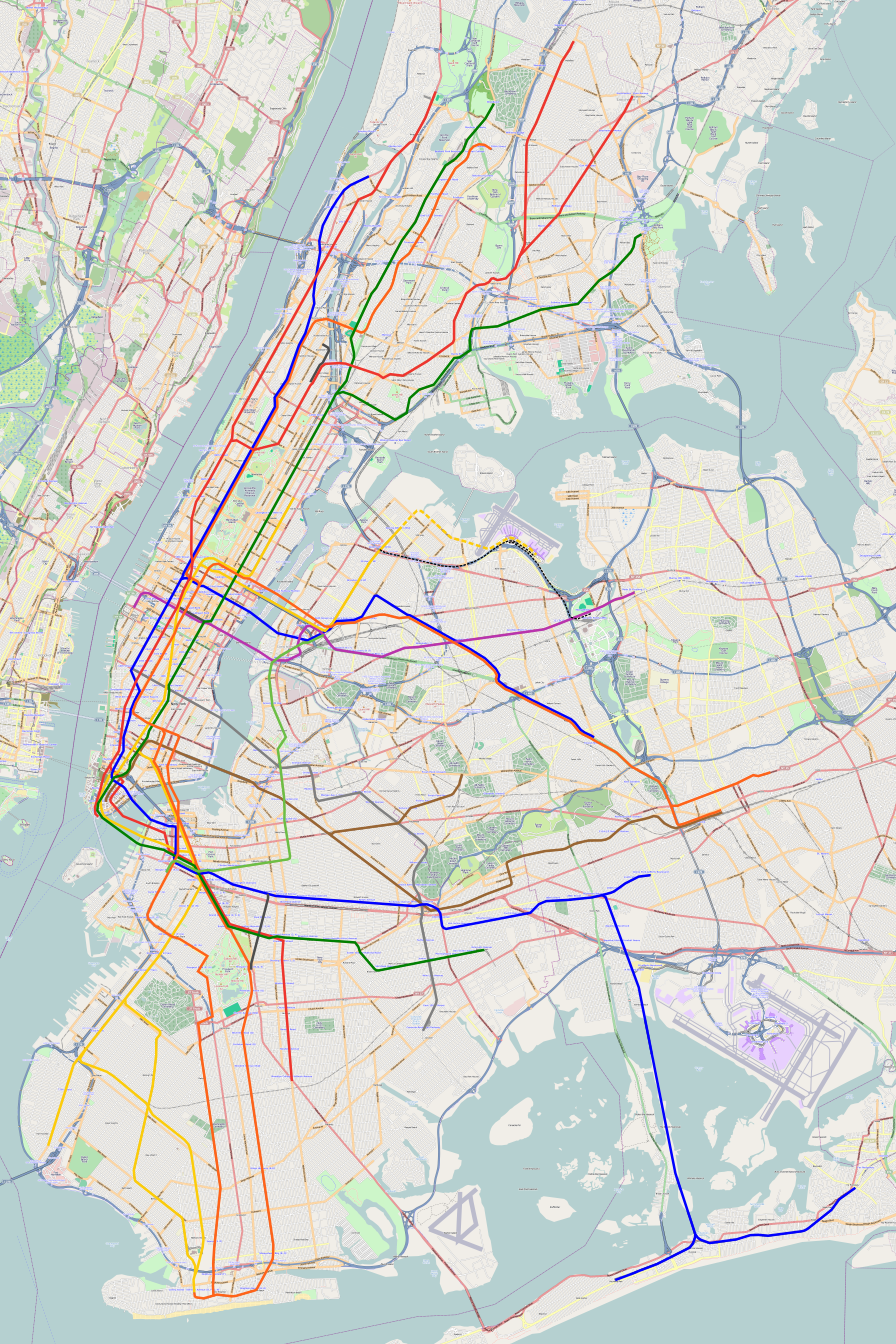
A full-size image can be found here. All alternatives are depicted as dashed lines; the subway extension is depicted in yellow in the same color as the Astoria Line, and would be elevated until it hit airport grounds, while the other two options, depicted as thinner black lines, are people movers or air trains. The air train option going east of airport grounds was Cuomo’s personal project and, since it went the wrong way, away from Manhattan, it was widely unpopular among anyone who did not work for Cuomo and was for all intents and purposes dead shortly after Hochul took office.
The issue of construction costs
Here’s what the above-linked New York Times article says about the rail alignments.
The panel’s three members — Janette Sadik-Khan, Mike Brown and Phillip A. Washington — said in a statement that they were unanimous in recommending that instead of building an AirTrain or extending a subway line to the airport, the Port Authority and the transportation authority should enhance existing Q70 bus service to the airport and add a dedicated shuttle between La Guardia and the last stop on the N/W subway line in Astoria.
The panel agreed that extending the subway to provide a “one-seat ride” from Midtown was “the optimal way to achieve the best mass transportation connection.” But they added that the engineers that reviewed the options could not find a viable way to build a subway extension to the cramped airport, which is hemmed in by the Grand Central Parkway and the East River.
Even if a way could be found to extend the subway that would not interfere with flight operations at La Guardia, the analysis concluded, it would take at least 12 years and cost as much as $7 billion to build.
The panel realized that the best option is an extension of the subway. Such an extension would be about 4.7 km long and around one third underground, or potentially around 5 km and entirely above-ground if for some reason tunneling under airport grounds were cost-prohibitive. This does not cost $7 billion, not even in New York. We know this, because Second Avenue Subway phase 1 was, in today’s money, around $2.2 billion per km, and phase 2 is perhaps a little more. There are standard subway : elevated cost ratios out there; the ones that emerge from our database tend to be toward the higher end perhaps, but still consistent with a ratio of about 2.5.
Overall, this is in theory pretty close to $7 billion for a one-third underground extension from Astoria to the airport. But in practice, the tunneling environment in question is massively easier than both phases of Second Avenue Subway – there’s plenty of space for cut-and-cover boxes in front of the terminal, a more controllable utilities environment, and not much development in the way of the elevated sections, which are mostly in an industrial zone to be redeveloped.
Does New York want to build?
New York can’t build. But to a significant extent, New York doesn’t even want to build. The report loves finding excuses why it’s not possible: they are squeamish about tunneling under the runways, they are worried an above-ground option would take lanes from the Grand Central Parkway (which a rail link would substitute for at higher capacity), they are worried about federal waivers.
In truth, in a constrained city, everything is under a waiver. In comments years ago, Richard Mlynarik pointed out that the desirable standard for railroad turnouts is that they should be straight – that is, the straight path should be on straight track, while the speed-restricted diverging path should curve away. But in practice, German train stations are full of curved turnouts, on which both paths are on a curve, because in a constrained urban zone it’s not possible to realize the desired standard, and a limit value is required. The same is true of any other engineering standard for a railroad, such as curve radii.
The issue of waivers is not limited to engineering or to rail. Roads are supposed to follow design standards, but land-constrained urban motorways are routinely on waivers. Even matters of safety can be grandfathered occasionally on a case-by-case basis. Financial and social standards are waived so often for urban megaprojects that it’s completely normal to decide them on a case-by-case basis; the United States doesn’t even have formal benefit-cost analyses the way Europe does.
And I’ve seen how American agencies are reluctant to even ask for waivers for things that politicians don’t really care about. Richard again brings up the example of platform heights on the San Francisco Peninsula: Caltrain rebuilt all platforms to a standard that didn’t have any level boarding, on the grounds that high platforms would interfere with oversize freight, which does not run on the line, and which the relevant state regulator, CPUC, indicated that they’d approve a waiver from if only the railroad asked. I have just seen an example of a plan to upgrade some stations in the Northeast that is running into trouble because the chosen construction material isn’t made in the United States, and even though “there’s no suitable made in America alternative” is legal grounds for a waiver from Buy America rules, the agency doesn’t so far seem interested in asking.
In general, New York can’t build. But in this case, it seems uninterested in even trying.
The bus alternative
Instead of a rail link, the plan now is to improve bus service. Here’s the New York Times story again:
The estimated $500 million in capital spending would also go toward creating dedicated bus lanes along 31st Street and 19th Avenue in Queens and making the Astoria-Ditmars Blvd. station on the N and W lines accessible to people with disabilities, the Port Authority said. Some of that money could also be spent to create a mile-long lane exclusive to buses on the northbound Brooklyn-Queens Expressway between Northern Boulevard and Astoria Boulevard, the Port Authority said.
Among the criticisms of the AirTrain plan was its indirect route. Arriving passengers bound for Manhattan would have had to travel in the opposite direction to catch a subway or L.I.R.R. train at Willets Point. The Port Authority chose that route, alongside the parkway, to minimize the need to acquire private property. Community groups were also concerned about the impact on property values in the neighborhoods near La Guardia in northern Queens.
To be very clear, it does not cost $500 million to make a station wheelchair-accessible. In New York, the average cost is around $70 million in 2021 dollars, with extensive contingency, planned by people who’d rather promise 70 and deliver 65 than promise 10 and deliver 12. In Madrid, the cost is around 10 million euros per station, with four elevators (the required minimum is three), and in Milan, shallow three-elevator station retrofits are around 2 million per station. Transfer stations cost more, proportionately to the number of lines served, but Astoria-Ditmars is not a transfer station and has no such excuse. So where is the other $430 million going?
The answer cannot just be bus lanes on 31st Street (on which the Astoria Line runs) or 19th Avenue (the industrial road the indicated extension on the map would run on). Bus lanes do not cost $430 million at this scale. They don’t normally cost anything – red paint and “bus only” markings are a rounding error, and bus shelter is $80,000 per stop with Californian cost control (to put things in perspective, I heard a $10,000-15,000 quote, in 2020 dollars, from a smaller American city).