Category: High-Speed Rail
InnoTrans is Souring Me on On-Rail Competition
I’m at InnoTrans this week, which means I get to both see a lot of new trainsets and talk to vendors for things I am interested in. Those are interesting conversations and much of the content will make it to our upcoming report on high-speed rail in the Northeast and to some ETA reports. But then, in broad stroke, the presentations about the trains here have deeply bothered me, because of how they interact with the issue of on-rail competition. The EU has an open access mandate, so that state-owned and private railways can compete by running trains on tracks throughout the Union, with separation of operations and infrastructure (awkwardly, state railways do both but there are EU regulations prohibiting favoritism, with uneven enforcement). As a result, I’m seeing a lot of pitches geared specifically for potential open access operators, all of which remind me why I’m so negative about the whole concept: it treats infrastructure as a fixed thing and denigrates the idea that it could ever be improved, while enthroning airline-style business analysis.
Proponents of the model cite higher ridership and lower fares due to the introduction of competition in Italy and Spain, but even then, it’s never really invented anything new, and only gotten some city pairs in those two countries to the service quality that integrated state-provided services have always had in France and Germany. In effect, the EU is mandating a dead-end system of managing trains and making a collective decision not to invest in what worked – namely, building and running high-speed lines.
For people unfamiliar with the argument, I wrote a year ago about TGV ridership and traffic modeling. The TGV overperforms a model trained on Shinkansen ridership, which can be explained based on lower fares, leisure travel to the Riviera, and underdeveloped air competition in small metro areas whose residents mostly drive to larger ones to fly. Relative to the same model, Italian and Spanish ridership underperformed the TGV before competition, and rose to roughly match the TGV or be slightly deficient after competition. So competition did lead to growth in ridership, as the competitors added service and lowered fares – but it only created what the French state did by itself. The German state seems to have French-like results: the trains here are much slower than in France, but relative to that, ridership seems to be in line with a TGV-trained model on the handful of city pairs for which I have any data.
This is causing quite a lot of the buzz in the intercity rail industry in Europe to center cross-border competition and new entrants. But this is, judging by the examples the proponents of competition look up to, not creating anything new. It’s not moving rail forward. It’s just filling in gaps that some state-owned railways – but not the largest two – have in their operations.
And worse, it’s making the long-term issues of intercity rail in Europe worse. There’s practically no cross-border high-speed rail construction in Europe, nor any serious push for making it happen. After a great deal of activism by Jon Worth (and others), the European Commission is announcing regulatory measures in its agenda, starting with passenger rights in case of delays. Physical construction is nowhere on the horizon, nor is there any serious advocacy for (say) a Paris-Frankfurt high-speed line or a Bordeaux-Basque Country one. This is a recent development: in the 2000s there was more optimism about high-speed rail, leading to plans like Perpignan-Figueres. But since then, the TEN-T corridor plans turned into low-speed lines and vaporware, and there’s no real interest in fixing that.
Instead, the interest is in letting the private sector lead. State-built high-speed railways – more or less the only high-speed railways – are not in fashion. The private sector is not going to step in and build its own (despite the sad Hyperloop capsule on display at InnoTrans), but instead look for underserved city pairs to come into, competing with state railways. It’s a story of business analysts using techniques brought in from the airline industry rather than one of infrastructure builders.
And it’s exactly those airline-imitating business analysts who are why RENFE, FS, and Eurostar underprovided service to begin with. The airline world lives off of segmenting the market; there are periodic attempts at all-business class airlines, and low-cost carriers entering and exiting the market frequently. It does not build its own infrastructure, not think in terms of things that could work if the infrastructure were a little bit better. A railway that thinks in the same terms might still build, but will not build in coordination with what it runs. It will do the exact opposite of what Switzerland has done with its tight integration of infrastructure and operations planning; therefore, it will get results inferior to those of Switzerland or even France and Germany.
The trains on display at InnoTrans announce proudly that they are homologated for cross-border travel, listing the countries they can operate in. The main high-speed rail vendors here – Siemens, Hitachi, Talgo, Alstom – all talk about this, explicitly; Alstom had a presentation about the Avelia Horizon, awkwardly given in an American accent while talking about how the double-decker cars with 905 mm seat pitch (Shinkansen: 1 meter) minimize track access charges per seat.
In contrast, I have not seen anything about building new lines. I have not seen booths by firms talking about their work building LGVs or NBSes. I have not seen anything by ADIF selling its expertise in low-cost construction; there are some private engineering consultants with booths, but I haven’t seen ADIF, and the French state section of the conference didn’t at all center French construction techniques. The states that have figured out how to build high-speed rail efficiently seem uninterested in doing more with it than just completing their capital-to-provinces networks; even Germany is barely building. Naturally, they’re also uninterested in pitching their construction, even though they do do some public-sector consulting (SNCF does it routinely for smaller French cities). It’s as if the construction market is so small they’re not even going to bother.
Every other booth at the conference talks about innovation with so many synonyms that they swamp what the firm actually does. But beneath the buzzwords, what I’m seeing, at least as far as physical infrastructure goes, is the exact opposite of innovation. I’m seeing filling in small gaps caused by last generation’s bad airline imitation with a different kind of airline imitation, and nothing that moves intercity rail forward.
Costing Northeast Corridor High-Speed Rail
As our high-speed rail project draws to a close, we need to not just write down what is needed for running the trains but also how much it costs. This post should be viewed as a work in progress, and it will not surprise me if I’m missing things that will make it to the report later this year.
The rule for this post is that costs only matter going forward, not backward. If it’s already committed, it’s not part of the budget; in particular, the $6 billion Frederick Douglass Tunnel, already fully funded and in the design and engineering phase, is not part of the budget. In addition, only infrastructure is costed, not rolling stock (new rolling stock may well have negative cost relative to current plans, through buying standard EMUs and not esoteric trainsets like Massachusetts’ battery train idea or nonstandard LIRR/Metro-North-style EMUs).
Bypasses
All bypasses can be seen on this map, but not all bypasses are part of the plan – in particular, nothing between Stamford and New Haven seems worth it for now.
The main bypass we’re proposing, between New Haven and Kingston, is 120 km in relatively easy terrain, including two constrained river bridges (Quinnipiac and Thames; the Connecticut is easier), but no tunnels. The cost should be in line with non-tunneled high-speed lines in Europe, which in 2024 dollars would be around $5 billion.
The secondary bypass, around Port Chester and Greenwich, is 7 km of complex els crossing I-95 multiple times, and should be costed at the upper end of els, which is high hundreds of millions. Call it $1 billion together with a new bridge across the Mianus. The current projected cost for the Cos Cob Bridge replacement is higher, but it should be easier to rebuild the bridge a bit upstream to straighten the approach curves than to do it in situ; with a short section of 4% grades on each side, it should be possible to clear I-95 west of the river and keep the Riverside station east of the river while also having around 23 meters of clearance below the bridge. (4% grades are routine for EMUs; freight trains are so long that they can ascend these grades just fine, since what matters is the grade averaged over the length of the train.)
Frankford Junction is about 2 km of complex urban el, including a rail-on-rail grade separation; the per km cost is likely high, in the very low three-figure millions, but it’s 2 km and so $300 million should cover it.
The other bypasses are very short and in easy environments, for example easing the curve at Kingston (also discussed here), with costs dominated by the track connections rather than the physical construction of 1-2 km of at-grade track outside urban areas. Call this entire portion $6.5 billion total.
Grade separations
The starting point is that NJ Transit thinks that Hunter Flyover should be $300 million in 2022 prices (source, PDF-p. 151). This is as close as can be to a nonnegotiable element of the program.
At the other end of the New York metro area, there’s Shell Interlocking/CP 216, which must be grade-separated as well, and is even more nonnegotiable. I have not seen recent cost figures; it should be comparable to Hunter or somewhat more expensive given the right-of-way constraints. A $500 million placeholder is probably right.
Further north, the junction with the New Canaan Branch is flat and needs to be grade-separated, at a cost likely similar to Hunter, in a similarly built-up area. The Danbury and Waterbury Branches have flat junctions too, but traffic is low enough that they may be kept so (especially Waterbury), but if not, Danbury seems comparable in difficulty to Hunter and New Canaan.
In Philadelphia, the Chestnut Hill West Line (former R8) has a flat junction with the Northeast Corridor, and there are a variety of proposals for what to do with it; for decades, an advocate wish was the Swampoodle Connection, to have it transition to a closely parallel line letting it enter the city via the Reading side rather than the former Pennsylvania Railroad side that it’s on. It’s largely dropped off the wishlist, and instead a grade separation could be done for a cost comparable to that of Hunter, or maybe less (potentially much less) if it’s possible to abuse the line’s low ridership and close proximity to the Chestnut Hill East Line to have shutdowns to speed up the work.
On the other side of Philadelphia, the junction between the intercity and commuter rail approaches to 30th Street is flat as well, which also incorporates the branch to Media/Elwyn (former R3); this should be grade-separated as well.
In Boston, there are two flat junctions on the Providence Line. Canton Junction separates it from the Stoughton Line, and looks routine to either grade-separate (it’s a low-density area) or, potentially, even turned into a shuttle with timed connections to the Providence Line if absolutely necessary, given the demand mismatch between the two branches. The Franklin Line, farther north, has a similar flat junction around Readville, technically within Boston but in an area with plenty of space, but can be sent over to the Fairmount Line if there are difficulties, and may even preferentially go to Fairmount regardless (the main argument against it is service to Back Bay). The answer to “how much should this cost?” is “no more than around $150 million each or else it’s better not to do it at all.”
In total, these should be around $1.8 billion, with New Canaan and Canton but not Danbury or Readville.
Note that rail-on-rail grade separations for bypasses are already priced in, especially New Haven-Kingston, which is of comparable length to European high-speed lines that have been built, with grade-separated connections to legacy lines.
Portal Bridge
The Hudson Tunnel Project within the Gateway Program is funded, but some tie-ins are not. Most (such as Penn Expansion) are useless, but one is essential: a second Portal Bridge, to ensure four tracks of capacity from New York to Newark. The current favored alternative is a lift bridge, budgeted at $800 million; it is a movable and not fixed bridge, but it is not a causeway and has some clearance below, and would only need to open when a sludge barge comes from upriver, which can be scheduled overnight.
High platforms
Everything that touches the Northeast Corridor needs high platforms at all stations. The definition of “touches the Northeast Corridor” is complicated; for example, in New Jersey, there are 68 low-platform stations on the lines that go through Newark Penn or Newark Broad Street, of which 26 are funded for high-platform conversions for around $23 million each ($683 million/30 stations; the other four are on the Erie lines), but of the 68, only 10 are on the lines that would be using the North River Tunnels after the Hudson Tunnel Project opens (see map in ETA’s report). Even taking all 42 as required, it’s around $1 billion at NJ Transit costs, with nearly all benefits accruing to commuter lines.
In Massachusetts, the definition is easier – everything on the Providence and Stoughton Lines needs to be raised; the TransitMatters report explains that there are eight stations, plus two potential infills, with the eight costing around $200 million in 2020 prices, which should be closer to $250 million in 2024 prices. If Franklin Line work is also desired then it should be another $200 million, split across more stations but with shorter platforms. Note that the second phase of South Coast Rail, if it is built, would extend the Stoughton Line, but as the stations are all new construction, they will already have high platforms.
In Pennsylvania, nearly total separation of intercity traffic from SEPTA is possible from the get-go – the only track sharing is peripheral, in and around Wilmington, at low frequency on SEPTA. If the entire Wilmington/Newark Line is to be upgraded, it’s a total of 12 stations, all in four-track territory; SEPTA’s construction costs for high platforms are lower than those of the MBTA and NJ Transit, but much of its construction has been single-platform stations with shorter trains, and my guess is that those 12 stations are around $200 million total. The seven inaccessible stations on the Trenton Line, which, to be clear, does not need to share tracks with intercity trains at all, should be another $100-150 million (it’s a busier line, so, longer trains, and North Philadelphia is more complex).
In Maryland, two stations on the Penn Line are inaccessible, West Baltimore and Martin State Airport. West Baltimore is being upgraded as part of the Douglass Tunnel program, while Martin State Airport has a separate program, which appears funded.
In total, all of this is around $1.8 billion, with the benefits going to commuters at such rate that state matches would be expected; in Massachusetts at least, there are talks about doing it as part of the Regional Rail program, but no firm commitment.
Electrification
The variable-tension catenary south of New York, as users of the Northeast Corridor were reminded two months ago, is substandard. It’s long been a wish to replace it with constant-tension catenary, to both improve reliability and permit unrestricted speeds, up from today’s 135 mph (217 km/h).
Unfortunately, precisely because it’s a longstanding Amtrak project, the project definitions have been written in a way that is not compatible with any cost-effective construction. For example, Amtrak is under the impression that the catenary poles have to be redone because higher speeds require denser pole spacing; in fact, catenary systems sold routinely by European vendors allow high speeds at spacing that exists already on the legacy Northeast Corridor system.
This makes costing this more difficult; Amtrak’s official figures are of little relevance to a project that has even cursory levels of interest in adopting European practices. With the poles and substations already usable, the wire tensioning should cost less than installing new wires; around half of the cost of new-build electrification is the substations and transformers and the other half is the wires, so take the cost of new-build systems outside the US and Canada, cut in half, and then double back to take into account that it’s a four-track corridor. This is around $3 million/km, so around $1 billion corridor-wide.
Commuter rail lines that touch the Northeast Corridor need to be wired as well, and then it’s a matter of which ones count as touching, as with the high platform item. This includes 25 km of the North Jersey Coast Line, 72 km of the Raritan Valley Line, 31 km of the Morristown Line, 30 km of the Montclair-Boonton Line, 38 km of the Danbury Branch, a few hundred meters of Providence Line siding tracks, 6 km of the Stoughton Line, 34 km of the Franklin Line, and 15 km of the Fairmount Line. Much of the unwired territory is single-track, so lower per-km costs can be expected, on the order of $600 million total.
Together, this is about $1.6 billion.
Total
The sum of all of the above lines is $12.5 billion. It’s possible to go lower than this: the high platform and electrification costs are partly modernizing commuter rail that may not quite use the Northeast Corridor, and the Greenwich bypass may be dropped at the cost of 80 seconds (more, if Cos Cob Bridge speed limits have to be lower than what right-of-way geometry allows). A numerological $10 billion limit can still be met this way.
The Northeast Corridor Should not Host Diesel Through-Service
The vast majority of traffic on the Northeast Corridor comprises captive trains, only running internally to the corridor. However, a noticeable minority of trains run south of Washington, swapping the electric locomotive for a diesel locomotive. Those trains have a certain logic to them today – through-service is valuable, and north of Washington they more or less substitute for Northeast Regional service. But drawbacks to reliability remain, and if the corridor modernizes its operations, they will need to be removed; several elements of modern operations are not compatible with keeping either the Virginia trains or the long-distance ones on the corridor. Instead, these trains should be cut to Washington, with transfers to much faster, more frequent Northeast Corridor trains. Potentially, some Virginia lines could be electrified and then through-service could be offered, if they can fill the same size of train that future Northeast Corridor service could.
Fortunately, this tradeoff still leaves the South with better service than it gets today. The forced transfer considerably speeds up the trip for New York-bound passengers, by more than the average transfer penalty even for passengers with heavy luggage. Nonetheless, a tradition of direct through-service from New York to diesel territory in the South will need to end.
Future Northeast Corridor service
Upgraded service, for example in our ongoing project at Marron for how to blend intercity and commuter rail on the corridor, should have all of the following features:
- High speed: our current timetables have New York-Washington trains taking 1:53, at a top speed of 320 km/h; a blanket speed restriction to 217 km/h, the upper limit of the catenary today, would only slow down the trains to 2:04, the rest of the difference in speed from current trip times coming from reliability improvements, higher curve speed, higher acceleration, and minor curve fixes.
- All-EMU configuration: nearly the entire world passenger rail market is electric multiple units rather than separated locomotives and coaches, EMUs outperforming locomotive-hauled cars in every aspect, and the exceptions are the less modern intercity and regional lines.
- Single-class service: trains may have first- and second-class seats, but the trains should not be differentiated by speed – Spain has trains of different speeds on its high-speed line and charges more for the faster ones, and the resulting hit to frequency and interchangeability of tickets explains why Europe’s longest high-speed rail network has a fraction of the per capita ridership of France, Germany, or Japan, which (largely) lack this misfeature.
- Affordable fares: the average fare should be in line with French and German norms, around $0.15 per p-km.
A train that does New York-Washington for a bit less than two hours and charges a bit more than $50 one-way on average – the current average is $106 on the Regional and $192 on the Acela – can comfortably expect ridership to quadruple, based on my two usual references on elasticity of high-speed rail ridership with respect to travel time and fares (Börjesson says -1.12 and -0.61 respectively, Cascetta-Coppola say -2 and -0.37 respectively). This forces running more frequency and longer trains. Frequency is a welcome addition provided there is capacity on the tracks for it; fortunately, there is capacity for an intercity train every 10 minutes in a post-Gateway timetable. The trains in question should be as long as possible, with platform lengthening where necessary to support 16-car trains, to maximize capacity.
The incompatibility of diesel trains
Very few diesel trains run on the Northeast Corridor today, and none run by Amtrak. The through-trains to the South run with engine changes: all Amtrak service today is run with locomotives, and at Washington, the trains change between diesel and electric locomotives. Nonetheless, even electric locomotive service as it is conceived today is incompatible with Northeast Corridor modernization, and future changes would still not make it compatible.
First, to the point on capacity: there is no way to run 16-car trains into the South. There isn’t enough demand for such trains. The Silver Star today runs nine coaches and the Silver Meteor runs 10, and on both trains, three coaches don’t sell seats but are used for baggage, lounge, and dining; the Palmetto runs six coaches, the Crescent seven, and the Cardinal five, each including two non-seat selling coaches. Speeding up the Northeast Corridor by an hour and a half can lead to ridership explosion internally to the corridor, but not on trains that take 30 hours today.
And second, there is no reasonable rolling stock for this, even if there were demand for a train with 16 cars or close to it. Locomotive-hauled trains would necessarily run slow, compromising not just top speed but also acceleration and, owing to the current equipment’s problems, reliability. The example train we’re using in our calculations, the Velaro Novo, has a power-to-weight ratio of 20 kW/t and an initial acceleration rate of 0.65 m/s^2. A pair of ACS-64 locomotives dragging 14 Airo coaches gets 14 kW/t but cannot accelerate faster than around 0.25 m/s^2 at any speed. The unpadded trip time for high-speed rail making one stop per state is 1:46; the unpadded trip time with the additional acceleration time of this example train and with a 217 km/h (135 mph) speed restriction is 2:09. If the timetable buffer time is still 7% then the trip time is 2:18, which means the train would be overtaken by about two faster trains, and this in turn would slow the trains further as more schedule contingency would be required for this more complex system. If the ACS-64’s problems or any interface with the freight-run Southern network forces more padding, then make it three overtakes.
The TGV used to couple a diesel locomotive in front of a high-speed trainset to reach Les Sables d’Olonne, before the branch to it was electrified. This option would eliminate the speed difference on the Northeast Corridor, but would also mean that expensive 16-car high-speed trainsets would be spending an entire day going to Florida at low speed and another going back, without being able to make back the cost through intensive operations measured in train-km per day.
Exceptions and the tail wagging the dog
The basic reason for prioritizing the Northeast Corridor’s internal traffic over through-traffic is the large mismatch in travel volumes. In fiscal 2023, the Northeast Corridor got 12,122,466 riders. The Virginia services got 1,300,776, the Carolinian 315,781, and the long-distance trains 1,308,211. A 4:1 ratio should tilt planners toward prioritizing the core over the long-distance trains.
Note that I have not, up until now, talked about Keystone service and trains to Springfield. This is because Keystone trains can run through to the corridor just fine. None of the reasons why the long-distance trains cannot do so applies: the Keystone corridor is electrified all the way to Harrisburg, and New York-Philadelphia is a significant enough portion of it that boosting speeds in the core (and acceleration everywhere) would lead to sufficient ridership increases to justify 16-car trains. Springfield service is currently unelectrified, and Amtrak generally runs shuttles with timed connections because of the mismatch in demand; it should be electrified, and through-service instituted.
On Keystone and the New Haven-Springfield line, the mismatch in capacity actually works in favor of through-service. The New York-Philadelphia section has the most demand, so having one third of the trains branch off to Harrisburg rather than continuing to Washington is a good way of assigning capacity. New Haven is not Philadelphia, but has so much commuter demand to New York that giving New York-New Haven an intercity train every 10 minutes is not so stupid; in contrast, unless a lot more is built, I suspect that 16-car trains running every 10 minutes between New York and Boston would end up emptier than most planners would prefer. Years ago, before I started looking at the track charts and the possible schedules systematically, I even used the greater demand of New York-Philadelphia to argue in favor of diverting some trains not just at New Haven to Springfield, but at Penn Station, to Jamaica and Long Island; as it is, my primary argument against sending intercity trains to the LIRR is timetabling complexity.
With Keystone and Springfield added back in, the traffic on the Northeast Corridor rises from 12,122,466 to 13,680,273. The ridership of the trains to the South that are to be cut from the corridor is 2,924,768, or 21% of the internal ridership; the tail should not wag the dog.
Is this even bad for the trains to be cut?
No. As mentioned above, the trip times would get a lot faster, it’s just that turning a 30-hour trip into a 28-hour one does not lead to a large ridership boom.
The extra transfer is annoying, but should be compared with the time cost of both running a slower train to New York and changing the engine at Washington Union Station. As explained above, the slower train would take a minimum of 2:09 between New York and Washington, stopping once per state. The scheduled time would be at least 2:18, and likely more, maybe 2:28 with 15% buffer time. The engine change takes about 20 minutes judging by southbound schedules on Virginia service trains; the wait time at Union Station is much longer northbound, because the train has to have more schedule contingency on the less reliable freight-owned section to make its slot on the more precisely timetabled Northeast Corridor. The most charitable interpretation, ignoring the extra required schedule padding, is that making passengers change trains in Washington would save them 45 minutes minus the wait time for the next train (at most 15 minutes).
The transfer penalty is extensively studied in the modal choice literature. For example, studying intercity trips in the Netherlands, de Keizer-Kouwenhoven-Hofker find that the penalty is 23 minutes, which already incorporates an imputed additional waiting time of 15 minutes. This penalty rises by seven minutes if the transfer is not cross-platform; a cross-platform transfer at Union Station would require the through-tracks to be upgraded with high platforms, as they are currently low-platform. It rises by a further seven minutes for passengers with heavy luggage. Even with all of those penalties, 23+7+7 = 37 < 45. And 45 is in a way a best-case scenario; there is a lot of padding involved in making a long-distance or even Virginia train make a specific slot on the corridor, as opposed to guaranteeing passengers a seat on the next available train, and this adds on the order of half an hour, counting both Alexandria-Washington and on-corridor buffer times.
The upshot is that while trains cannot run through from Virginia to a modernized Northeast Corridor, little is lost in making passengers transfer at Union Station. The transfer penalty is real but limited, even with luggage, and the speed gain from letting such passengers transfer to a faster train is noticeable, if small compared with the total length of a night train trip. It would break tradition, but offer a modest improvement in the quality of rail service on the long-distance trains using the corridor and the Virginia trains, in conjunction with the much larger improvement in the quality of internal Northeast Corridor service.
Tradeoffs in Reliability and Shutdowns
I am writing this post riding trains between Brussels and Berlin. My connection in Cologne was canceled as the connecting train was moved to depart earlier than my first train’s arrival time, and somehow, it is faster to stay on the train until Frankfurt and connect there, the trains between Cologne and Berlin are so disturbed this summer. Cologne-Berlin, normally a direct hourly connection in 4-4.5 hours, is slowed to 5.5 hours every two hours this summer. It got me thinking about something Jon Worth said last month about the importance of public transport being there, including at night, because it reminded me of how there are always tradeoffs. Train service cannot literally run 24/7 without changes; maintenance windows are required. So it’s a question of tradeoffs – when service must run less reliably, or not at all. Deutsche Bahn has unfortunately chosen a grossly wrong side of the tradeoff, leading to summertime shutdowns and slowdowns that its French and Japanese peers simply do not have. Those shutdowns, in turn, are, these days, leading to catastrophic levels of popular mistrust in DB.
The tradeoffs
I wrote six weeks ago about the problems of summer maintenance in Germany. But, more generally, there is a tradeoff between span of service on a railway and how consistently service can be delivered. A railway that runs overnight will not have regular maintenance windows, and therefore have to pick some low-traffic period for a special disturbance. On the New York City Subway, this is the weekend: New York City Transit exploits its four-track mainlines and high levels of redundancy in most of the city to shut down individual sections of track on weekends and tell passengers to use alternatives. In Europe, it’s more common for this to be the summer period, when local travel is lower as people go on vacation; unfortunately, in Germany, this extends to intercity rail, during the high season of travel.
Jon says that, “That 5am train with a dozen building workers on it, or the last train home in the evening matter for the trust and reliability of the system, even if those individual trains make heavy losses and are largely empty.” But the point is that knowing that I can book a train in July and have it run as expected without being rerouted onto the slow line is, like the 5 am train, a matter of trust and reliability too. It’s just a matter of which matter of reliability is easier to compromise on.
Then there is a tradeoff of all of this against maintenance efficiency. It is more efficient from the perspective of minimum total gross hours of shutdown to have a long continuous period of shutdown, such as the four-month period planned for the Riedbahn. Nighttime shutdowns require an hour of preparation and disassembly at each end, so that a five-hour nighttime shutdown only yields three hours of maintenance work. Some systems don’t make that work even with regular nighttime shutdowns, such as the London Underground or American systems that are not New York; notably, the Berlin U-Bahn manages to avoid this even with overnight service on weekends.
The situation in Germany
DB’s response to the tradeoffs outlined above is to attempt to run all day, including occasionally at night. There are night trains between Hamburg and southern Germany on the Frankfurt-Cologne high-speed line, so even this line, without any nighttime freight (the grades are far too steep), does not have the regular maintenance windows that LGVs and Shinkansen lines have. As a result, last month, the line was shut for maintenance, and trains were diverted to the old line, taking an hour longer. Right now, the same diversions apply to Cologne-Berlin trains, slowing them by about an hour.
These are not peripheral connections. Frankfurt-Cologne is not quite the busiest intercity line in Germany – that would be the Riedbahn – but it’s a fairly close second, with the same planned traffic level in the Deutschlandtakt of six trains per hour in each direction. It’s the primary connection between the Rhine-Ruhr and not just Frankfurt but also all of southern Germany. Then, Berlin-Cologne connects the two largest metro areas in Germany; the Rhine-Ruhr is close in population to Ile-de-France, while Berlin and Brandenburg have more people than Rhône-Alpes or PACA, which has implications for how much traffic this connection would have if it were fast and reliable, which it is neither (government officials fly between Berlin and Bonn instead of relying on DB).
Is this unavoidable?
No. France has none of these daytime shutdowns on its main lines. Neither does Japan.
German rail advocates sneer at France and ignore Japan, finding all manners of reasons to avoid learning from countries that, on this point, are Germany’s superiors. A common line from within Germany is that its secondary lines are in better shape than France’s, so there is nothing to learn from France. But then, the reason there are routine hour-long delays (or longer) in the summer on the main lines is not that DB runs better service to a city like Siegen or Münster or Jena than SNCF does to their French peers.
The path forward has to be, at the technical level, to institute regular nighttime maintenance windows, and stop trying to make night trains happen. At infrastructure level, it must be to avoid building dual-use infrastructure, and build passenger-dedicated high-speed lines; if freight capacity is needed that the old lines with just slow regional trains can’t provide, then build a separate freight line, based on the needs of freight, at costs that are going to be lower than the long tunnels required for dual-use lines.
But the most important change has to be at the level of governance and culture. Germany believes itself to be at the top of the world. To borrow a joke about Japanese technological stagnation, there is an element here that visiting a German infrastructure system in 2005 had a futuristic vibe like visiting the year 2015, and visiting it today is still like visiting the year 2015. There’s a slew of problems in Germany for which the solution really is “be less German and more French,” and this is one of them, no matter what people who think all French people are unemployed rioters think.
Why New York-New Haven Trains Crawl
Between New York and New Haven, a distance of 120 km (from Penn Station) or 116 km (from Grand Central), the two fastest intercity trains of the day take 1:35 to travel, an average of 75 km/h. Most do the trip in about 1:40, averaging about 72 km/h. Commuter trains to Grand Central do it in about 1:40 three times a day, averaging 70 km/h, but the vast majority of even the rush express trains are slower, a few doing it in 1:52 and most in about two hours, averaging 58 km/h. This is not normal for a primary intercity corridor; the Acela averages about 120 km/h between New York and Washington and between New Haven and Boston, which is typical for non-high-speed intercity lines in Europe, while high-speed ones usually average 200 km/h or more. I’ve been asked by some big names in online transit content creation why this is so, and hope to explain why the trains are slow, and what it would take to reduce 40 minutes from the one-way trip time.
The contrast should be with the high-speed rail proposal that I’m working on at Marron, which cuts the intercity trip time between New York and New Haven to about 52 minutes, on the existing right-of-way, and the express commuter rail trip time to Grand Central to about 1:16. The result is not high-speed rail, but is a fast upgraded intercity rail line, on a par with the faster British and Swedish lines. Changes in right-of-way geometry, including buyouts of houses in expensive suburbs in Connecticut, could reasonably cut the intercity trip time to about 45 minutes; these are mapped here, the 52-minute trip corresponding to the alternatives that stay on the existing right-of-way and the 45-minute one to the alternatives that use the bypasses where they exist.
The primary culprit for the slow trip times today is poor scheduling practices. Those practices, in turn, come from mutual abuse between Amtrak and the commuter rail operators, in this case Metro-North and the Connecticut Department of Transportation, both of which display terminal incompetence on all matters related to rail. The state of the tracks contributes to the slowness, and thus the second most important issue is poor maintenance practices leading to unreliable infrastructure, which then feeds into poor scheduling. Metro-North and CTDOT are again especially bad even by American standards. Physical infrastructure problems add minutes here and there, but the most important interventions are cheap and for the most part can only work with better timetabling rather than on their own.
Of note, it is common to blame the low speeds on curves. However, the curves are not especially onerous – few restrict trains to slower speeds than about 150 km/h given good operating practices. In fact, the Northeast Corridor gets if anything curvier east of New Haven until after it crosses into Rhode Island, but the speed there is higher, as there is less dense commuter traffic complicating the schedule, and Amtrak’s level of incompetence is bad but less bad than that of CTDOT.
Timetable padding
Every rail timetable has to include contingency or buffer time. This takes into account primarily the need for trains to recover from delays, and secondarily suboptimal driver behavior, such as starting to brake a little too early. Switzerland pads its timetables 7%; the TGV network can only do about 10-13%, and the ICE network about 25%. What I and others have seen on Amtrak and Metro-North trains as well as what train drivers have told me suggests that the buffer time between New York and New Haven is 25% or even maybe 30%.
More complex networks require more padding, since delays on one train cascade to others. The ICE network mixes intercity trains together with much slower regional ones on the same tracks, all over Germany, and delays can cascade across the entire country, to the point that some people have begun to advocate that Germany build a separate high-speed rail network, not for speed (which activists here don’t care much about), but for the reliability of having a fast network and a slow network rather than one mixed network. The more segregated TGV network thus does better; the almost entirely dedicated-track Shinkansen system does even better, and JR East suggested 4% padding in its review of California High-Speed Rail. Switzerland is like Germany in having a single mixed-speed network, but it has more systematic processes for avoiding delays, such as strategic investment in bypasses around known bottlenecks.
The Northeast Corridor is not an especially complex network. It is a single line with branches, rather than a two-dimensional mesh like the German rail network. There is little freight traffic, which makes it possible to control freight through regular slots, with the number of potential slots greatly exceeding actual traffic so that if a train misses its slot, it can wait 10 or 15 minutes for the next one. Passenger traffic is high on all lines serving the corridor, and thus there is no need to cut corners on reliability (such as signals, or platforms) on any of the branches. It is a mixed-speed line, but nearly all of it has four tracks, and where commuter trains share tracks with intercity trains, they run express and the speed difference is not large. In the timetables we developed at Marron with Devin Wilkins, express commuter trains do Stamford-Grand Central in 28 minutes if they run as today, stopping only at Harlem-125th, and in 29 if they also stop at New Rochelle; intercity trains do Stamford-Penn Station in 25 minutes, on a marginally longer route into New York. Slotting intercity and express commuter trains on the same tracks between Stamford and New Rochelle is annoying, but is not an objectively hard scheduling problem.
This does not mean that Amtrak and Metro-North could just shave minutes off of the existing timetables, change nothing else, and run trains to the faster schedules. Other elements of the schedule would make the trains too unreliable. But it is possible to realign the schedules appropriately and cut the trip time by a factor of about 1.3/1.07 = 1.2.
Timetable complexity
The ideal schedule is one with as few variations as possible. This way, planners can write one schedule, ensure that it works, and, if there are problems with it, then develop an infrastructure program that builds around the bottlenecks. Switzerland, as usual, sets the standard, with its all-day repeating clockface timetable, or Takt. Swiss trains repeat regularly every hour, and on the busy lines every half hour; planners need to make sure one pattern works and then repeat it all day. It’s the planning equivalent of economies of scale in manufacturing.
New York planning, relative to the ideal, represents the list of what not to do, and it’s worse on busier lines such as the New Haven Line than on less busy lines. In effect, the New Haven Line schedule is the planning equivalent of rules for writing prose that illustrate each rule by breaking it – remember to not split infinitives, the passive voice should be avoided, eschew obfuscation, and so on – except that it is meant to be taken seriously. It has all of the following problems:
- Where good planning begins with one peak hour and repeats it all day, the New Haven Line has few repeating patterns, and practically none at the peak.
- Where good planning aims to have trains make consistent stops for legibility and for ease of planning around bottlenecks, the New Haven Line has bespoke stopping patterns – not counting branches, there are 16 trains entering Grand Central at the peak hour, which make 13 distinct stopping patterns.
- Where good regional rail planning keeps the peak-to-base ratio low – Switzerland is almost 1:1, and even very large cities that need a huge volume of commuter trains at rush hour like Paris or Tokyo do not exceed 2:1 (and London is well below it) – the New Haven Line has, with branches, 20 trains entering Grand Central at the peak hour and 4 entering each off-peak hour.
- Where good planning runs more or less the same service on weekends as in the off-peak on weekdays, the New Haven Line’s midday off-peak and weekend schedules are different even as they run the same number of trains (two express and two local per hour).
- Where good planning aims to use the timetable for a prolonged period of time to reduce the need to redo the schedule, for example updating annually as in Switzerland, New York-area practice is to update several times a year, in what looks like a 3-6 month period.
- Where good planning keeps the trains spaced far enough based on signal system constraints by default, Metro-North timetables somehow have trains on the shared trunk between Harlem and Grand Central sometimes arriving within less than the 2 minute minimum on the same track, requiring special speed restrictions, even with unimpressive traffic levels by urban commuter rail trunk standards.
- Where good maintenance is done when trains are not running, that is, at night, in order to avoid disturbing weekday traffic, American planning assumes that daytime maintenance will always take some track out of service; the New Haven Line’s track renewal program has been so mismanaged that at no point since it began in the 1990s have all four tracks between New York and New Haven been operable along the entire line – some section is always shut down. Daytime maintenance is also a problem in Germany, and is a factor behind the poor schedule reliability here.
The constant tweaks to the timetable are also a feature of the New York City Subway, with its substantially simpler stopping patterns. There, the services are consistent, and change at a rate of a handful per decade (most recently, when Second Avenue Subway opened; the previous time was during the 2010 service cuts). However, frequency is micro-targeted based on crowding guidelines, so the planners never have time to optimize one schedule; moreover, with 24/7 service, daytime closures for maintenance are unavoidable. This way, where planners at healthy railroads write schedules, planners at American passenger railroads write service changes. The New York City Subway at least has the partial excuse of 24/7 service; Metro-North has no such excuse. The maxim that the Northeast Corridor is held together with duct tape, and is managed by people who are unfamiliar with any more advanced tools than duct tape, also applies to timetabling.
In contrast with today’s morass, the schedule we’ve been writing aims to simplify whenever possible. Branches are slotted into windows that could be used by local or express main line trains depending on the desired service pattern. From New Haven south, everything is on a repeating 10-minute Takt. The New Haven Line is reduced to four stopping patterns – local Stamford-Grand Central, local Stamford-Penn Station, express New Haven-Grand Central, intercity New Haven-Penn Station – each running every 10 minutes. It took weeks to find a pattern that worked with all the constraints of the right-of-way and allowed some future desired infrastructure changes, and even that required some track changes detailed below. Off-peak, the commuter train patterns could run every 20 minutes instead, using every other slot; the timetable should not be tweaked further.
It is particularly important to avoid timetable complexity beyond local and express trains east of Stamford. The line has four tracks, and could be run with commuter trains on the local tracks, making all stops before transitioning to the express tracks at Stamford, and intercity trains on the express tracks, running nonstop between Stamford and New Haven. In theory, this means this section could be run with less than 7% schedule padding, for example the Shinkansen’s 4%, but in practice, I suspect it cancels out with the more complex situation between Stamford and New Rochelle, so 7% is the best that can be squeezed with maximally simple schedules.
Speed zones and curves
The New Haven Line is rather curvy, having been built in the 1840s. But its speed limits are still too low for its curves. I wrote here about cant and cant deficiency, and am not going to repeat myself too much. But, in brief, the speed on curves is governed by the formula

where v is speed, a is lateral acceleration in the horizontal plane, and r is curve radius. The value of a is usually expressed not in units of acceleration, but in units of distance, scaled so that, on standard-gauge track, 150 mm (of cant) correspond to 1 m/s^2 lateral acceleration. Typical maximum regulatory limits on cant range between 160 and 180 mm; the US permits 7″, but nowhere is more than 6″ used, and the New Haven Line’s curves mostly range between 3″ and 5″ cant. Cant deficiency limits depend on the train – regular passenger trains typically do 130-150 mm at the relevant speeds, but in the US, the normal practice is to limit commuter trains to 3″ cant deficiency, and only use 5″ on Amtrak Regional trains (the Acela tilts and is capable of 7″ today, with the new trains rated for 9″).
The curves on the New Haven Line are, for the most part, built to a standard of 2° radius, or, in metric units, r = 873. The most aggressive common cant and cant deficiency limits, 180 and 150 mm respectively, allow a = 2.2, and thus v = 43.82 m/s = 157.77 km/h; our timetables limit commuter trains to 150 km/h, and there are surprisingly few curves with tighter limits. In contrast, current practice restricts a to about 1.2, which means trains take the same curves at a speed of about 116 km/h, which is rounded down to 70 mph.
The slowdowns also affect intercity rail more than is required. While Amtrak trains are cleared for 5″ cant deficiency, Metro-North prefers to timetable all trains at its own trains’ speed on curves. Then, because there are so few opportunities under current standards for trains to run faster than 70-75 mph within CTDOT territory, the entire line from the state line to New Haven is maintained to those standards, and thus even on relatively straight sections, there is no opportunity to gain speed. East of New Haven, the curves are if anything tighter, but Amtrak dominance means the tracks are cleared for 100-125 mph, cant is higher, and cant deficiency is higher as well.
All of these restrictions can be lifted. The work required to redo a line from 110 km/h to 160 km/h or even more is rather routine, as long as it can be done within the right-of-way. The standards for track irregularity get tighter as speed increases, but all of this can be handled with track laying machines, which use the track itself to do the work, at a pace of about 0.5 km/h, or about 1.5 km in a three-hour nighttime work window; the entire New Haven Line can be regraded in about a year this way.
Unfortunately, Metro-North is used to manual track inspections rather than modern machinery. It finally bought a track laying machine on the model of Amtrak, but appears not to use it very well; the productivity I hear quoted is one tenth what was expected. But what is hard for Metro-North and CTDOT is not objectively hard, and even other Northeastern American railroads are often capable of it.
Supportive infrastructure
Infrastructure construction and timetabling work in tandem normally. Swiss practice is to use insights from the timetable in theory and in practice to inform where to build new tracks. American practice does no such thing – for one, Metro-North is allergic to systematic track improvement, so over the generations, the timetable has diverged from the infrastructure that could support it.
In fact, a very high-frequency peak schedule requires eliminating at-grade conflicts whenever it is even remotely feasible. Shell Interlocking at CP 217, just south of New Rochelle, is a flat junction on which trains from the north can go to either Grand Central or Penn Station. Grade-separating the junction was occasionally on the wishlist for Northeast Corridor improvements, but Metro-North is not currently asking for it, even though it is especially important as Penn Station Access is about to open. The junctions with the branches farther north – New Canaan, Danbury, Waterbury – are flat as well, for which the solutions can be a forced transfer (as is sometimes practiced with Waterbury, the weakest of the three) or grade-separation. This does not cost a large amount of money – New Jersey Transit is applying for money for its equivalent of Shell, Hunter Flyover connecting the Raritan Valley Line to the Northeast Corridor, and the budget is $300 million in the plan and, I’ve been told, $400 million with recent inflation and perhaps some small cost overrun.
Then there is the issue of the Grand Central approaches. The current throat limits trains to 10 mph on the last mile into the station. In other words, the last mile takes six minutes. It should take about two, based on actual throat and turnout geometry; the turnouts are #12 until around 700 meters from the end of the platform, and in Germany, a 1:12 switch is 60 km/h, and closer to the platforms, the turnouts are #7 and (on one cluster of tracks) #6.5, where in a Germany, a 1:7 is 40 km/h. Even with bumper tracks, the last mile has no reason to take longer than two minutes, saving all Metro-North travelers to Grand Central four minutes. The turnouts would need to be regraded to tangential standards, but this can be done within their existing footprint; the cost of a new turnout in a selection of European countries and also on American freight railroads is around $250,000 in the prices of the 2010s, whereas Metro-North’s switches cost perhaps five times much in the same era.
Finally, the movable bridges impose certain speed restrictions. Those are the biggest projects currently in planning for speeding up the New Haven Line. In truth, the slowdowns imposed are secondary (though our timetables still assume they are fixed). They are also extremely expensive – one of them is currently slated for in situ replacement for $1 billion, for a span of 220 meters from tower to tower, on a river about 100 m wide. CTDOT rail projects are generally absurdly expensive even by American standards – infill stations on the Hartford Line are coming in at $50 million or more, twice the cost of suburban Boston and more than twice that of suburban Philadelphia – for which the culprit must be poor project management and lack of in-house expertise.
Conclusion
The New Haven Line is a busy railroad at the peak, but nothing about it is special. It is old, but no older than faster sections of the Northeast Corridor or fast legacy intercity main lines in parts of Europe, especially the United Kingdom. It is busy, but its total ridership is unimpressive by European S-Bahn standards – the single trunk line in Munich with its seven branches on each side generates about 900,000 daily riders, perhaps a bit more than all three New York-area commuter railroads combined. It is branched, but the branching is simpler than on the busier systems, and the graph of the Northeast Corridor overall is acyclic, simplifying planning.
The reason the trains are slow is not the infrastructure. The elements of the infrastructure that need to be fixed to shorten the trip times from about 1:35 intercity and 2:00 commuter to 0:52 intercity and 1:16 commuter are cheap. Rather, the reason is that the line is managed not just by Americans, which is usually bad enough, but specifically by Metro-North and CTDOT. The schedules are designed not to work; the maintenance is designed not to work either and is too expensive.
Northeast Corridor Realignment Webtool
Here is an interactive webtool for the Northeast Corridor alignment options we’re timetabling. All credit for the data visualization goes to Devin Wilkins; my contribution is to draw the options in a more static format.
There are still some tweaks to the system, but the physical location of the tracks should be considered secure, and the same is true of the curve database. The units are mixed; curves use the formula 1° = 1,746 meter radius, and speeds are in metric units, with lateral acceleration in the horizontal plane of 2.2 m/s^2 (330 mm total equivalent cant) at low and medium speed and 2.07 at high speed (310), both of which are limit values but do exist in this part of the world and are a rounding error away from American limit values. If there is any discrepancy between the listed speed and the curve radius, the curve radius is correct, and corresponds to the correct speed in our timetable spreadsheets.
Deviations from the current alignment are marked with yellow triangles. The bigger ones are presented as alternatives: it’s possible to build the deviation or stay on the present course. This is especially notable in Connecticut, with many build-or-no-build choices for New Haven Line bypasses as well as for the longer New Haven-Kingston bypass; at one place, Milford, there are two build options, a bypass along I-95 and a straightening of the route close to its current alignment.
I believe but am not completely certain the choice alignment we’ll present will include the bypasses east of New Haven but few to none west of it, of which the likeliest is the one in Greenwich and Cos Cob, where the bypass would provide a six-track section where there are three speed classes (commuter local, commuter express, intercity). South of New York, the curve easement in Metuchen is not currently part of our timetables – it’s too much property acquisition for too little speed gain – but the deviations in Frankford Junction and northeast Maryland are, and the Douglass Tunnel in Baltimore is already funded and in the design phase before physical construction.
Reports on High-Speed Rail and the Northeast Corridor
Two reports that I’ve collaborated on are out now, one about high-speed rail planning for Marron and one about Northeast Corridor maintenance for ETA. A third piece is out, not by me but by Nolan Hicks, about constant-tension catenary and its impact on speed and reliability. The context for the latter two pieces is that the Northeast Corridor has been in a recurrent state of failure in the last three weeks, featuring wire failures, circuit breaker failures, track fires, and transformer fires. The high-speed rail planning piece is of different origin – Eric interviewed officials involved in California High-Speed Rail and other American projects that may or may not happen and this led to synthesizing five planning recommendations, which aren’t really about the Northeast Corridor but should be kept in mind for any plan there as well.
The broader context is that we’re going to release another report specific to the Northeast Corridor, one that’s much more synthetic in the sense of proposing an integrated infrastructure and service planning program to cut trip times to about 1:53 New York-Washington and 2:00 New York-Boston, informed by all of these insights. Nolan’s piece already includes one key piece of information that’s come out of this work, about the benefits of constant-tension catenary upgrades: 1:53 requires constant-tension catenary, and if it is not installed, the trip time is 2:04 instead, making this the single biggest piece of physical infrastructure installation the Northeast Corridor needs.
The catenary issue
Trying to go to Philadelphia, I was treated to a train stuck at Penn Station without air conditioning, until finally, after maybe 45 minutes of announcements by the conductor that it would be a while and they’d make announcements if the train was about to move, I and the other passengers got out to the station, waiting for anything to change, eventually giving up as the train and several subsequent ones were canceled. My post from three days ago about Germany has to be read with this context – while publishing I was waiting for all three pieces above to appear.
I encourage people to read the ETA report for more detail about the catenary. In brief, overhead wires can be tensioned by connecting them to fixed places at intervals along the tracks, which leads to variable tension as the wires expand in the heat and contract in the cold; alternatively, they can be tensioned with spring wires or counterweights, which automatically provide constant tension. The ETA report explains more, with diagrams, some taken from Garry Keenor’s book on rail electrification, some made by Kara Fischer (the one who made the New Mexico public transit maps and others I’ll credit upon request, not the USDOT deputy chief of staff). The catenary on the Northeast Corridor has constant tension north of New York, and for a short stretch in New Jersey, but not on the vast majority of the New York-Washington half of the line.
Variable-tension catenary is generally unreliable in the heat, and is replaced with constant-tension catenary on main lines even in Europe, where the annual temperature range is narrower than in the United States. But it also sets a blanket speed limit; on the Northeast Corridor, it is 135 mph, or 217 km/h – the precision in metric units is because 217 km/h is the limiting speed of a non-tilting train on a curve of radius 1,746 meters, a common radius in the United States as it is a round number in American units (it’s 1°, the degree being the inverse of curve radius). This blanket speed limit slows trains by 11 minutes between New York and Washington, subject to the following assumptions:
- The tracks otherwise permit the maximum possible speed based on curvature, up to 320 km/h; in practice, there are few opportunities to go faster than 300 south of New York. There is an FRA rule with little justification limiting trains to 160 mph, or a little less than 260 km/h, on any shared track; the rule is assumed removed, and if it isn’t, the cost is about one minute.
- Trains have the performance of the Velaro Novo, which trainset is being introduced to the United States with Brightline West. Other trainsets may have slightly better or worse performance; the defective Avelia Liberty sets are capable of tilt and therefore the impact of maximum speed is larger.
- Intercity trains make one stop per state, counting the District of Columbia as a state.
- Intercity and regional trains are timetabled together, on a clockface schedule with few variations. If a train cannot meet these requirements, it stays off the corridor, with a forced transfer at Philadelphia or Washington. All train schedules are uniformly padded by 7%, regardless of the type of catenary. If variable-tension catenary requires more padding, then the impact of constant-tension catenary is increased.
The bulk of the difference between 1:53 and the current trip time of about 2:50 is about timetabling, not infrastructure – when the trains are running smoothly, there is extensive schedule padding, in one case rising to 35 minutes south of New York on a fast Regional. Rolling stock quality provides a boost as well, to both reliability and acceleration rates. Faster speeds on curves even without tilt matter too – American standards on this are too conservative, and on a built-out line like the Northeast Corridor, being able to run with 180 mm of cant and 130 mm of cant deficiency (see explanation here) is valuable. But once the regulatory and organizational issues are fixed, the biggest single piece of infrastructure investment required is constant-tension catenary, simultaneously reducing trip times and improving reliability.
Nolan’s piece goes more into costs for catenary repair, and those are brutal. The Northeast Corridor Project Inventory includes $611 million to just replace the catenary between Newark and New Brunswick, without constant-tension upgrades. This is 36.5 route-km, some four- and some six-track; the $16.7 million/cost electrifies a new line from scratch around six times over in non-English-speaking countries, and while the comparison is mostly to double-track lines, around half the cost of electrification is the substations and transformers, and those aren’t part of the project in New Jersey.
State of Good Repair projects always end up as black holes of money, because if half the money is spent and there’s no visible improvement, it’s easy for Amtrak to demand even more money, without having to show anything for it. An improvement project would be visible in higher speeds, better ride quality, higher reliability, and so on, but this is free money in which the cost is treated as a positive (jobs, the appearance of work, etc.) and not something to be minimized in pursuit of another goal. One conclusion of this is that no money should be given to catenary renewal. Money can be spent on upgrades with visible results, in this case constant-tension catenary. On all else, Amtrak cannot be trusted.
High-speed rail planning
The report we wrote on high-speed rail planning at Marron is longer than the ETA report, but I encourage people to read it as well, especially anyone who wishes to comment here. In brief, we give five broad recommendations, based on a combination of reviewing the literature on high-speed rail, cost overruns, and public infrastructure management, and interviewing American sources in the field.
- The federal government needs to nurture local experimentation and support it with in-house federal expertise, dependable funding, and long-term commitment.
- The FRA or another federal entity should have consistent technical standards to ensure scale and a clear operating environment for contractors.
- The federal government should work with universities to develop the technology further, which in this case means importing standards that work elsewhere – high-speed rail in 2024 is a mature technology, not requiring the inventions of new systems that underlay the Japanese, French, and German networks.
- Agencies building high-speed rail should have good project delivery, following the recommendations we gave in the subway construction costs report. Using consultants is unavoidable, but there needs to be in-house expertise, and agencies should avoid being too reliant on consultants or using consultants to manage other consultants.
- Agencies and states should engage in project planning before environmental reviews and before making the decision whether to build; the use of environmental reviews as a substitute for planning leads to rushed designs, which lead to mistakes that often prove fatal to the project.
Currently, all American high-speed rail plans should be treated as case studies of what to avoid. However, this does not mean that all of them fail on all five criteria. For one, California High-Speed Rail largely used pan-European technical standards in its planning; Caltrain did not in related planning including the electrification project and the associated resignaling (originally intended to be the bespoke CBOSS). The criterion on technical standards becomes more important as different projects interact – for example, Brightline West is inconsistent about what it’s using. Then there’s Texas Central, which uses turnkey Shinkansen standards, but as it’s turned over to Amtrak is bound to get modifications that conflict with what Japan Railways considers essential to the Shinkansen, such as total lack of any infrastructure mixing with legacy trains.
Notably, none of this is about the Northeast Corridor directly. My own interpretation of the report’s recommendations points out to other problems. For example, the Northeast Corridor’s technical standards are consistent but also bad, coming from an unbroken legacy of American railroader traditions whose succors can barely find Germany on a map, let alone bother to learn from it or any other foreign country. This way, the New Haven Line, which with modern trainsets and associated standards has few curves limiting trains to less than 150 km/h, is on a blanket speed limit of 75 mph, or 121 km/h, in Connecticut, with several further slowdowns for curves. There’s long-term planning for the corridor, and it’s bipartisan, but this long-term planning involves agencies that fight turf wars and mostly want to get the others out of what they perceive as their own turfs. There is lush funding, but it goes to the wrong things – Moynihan Train Hall but no improvements at the track level of Penn Station, extensive track renewal at 1.5 orders of magnitude higher cost than in Germany, in-place bridge replacements on curvy track instead of nearby bypasses.
The current planning does use too many consultants – in fact, Penn Reconstruction’s interagency agreement stipulates that they use consultant-centric project delivery methods, with one possibility, progressive design-build (what most of the world calls design-build; what New York calls design-build is different and better), not even legal in New York state law, but the local power brokers are trying to legalize it and break their own construction cost records. But it’s not quite the same as not bothering to develop in-house talent – there is some, and sometimes it isn’t bad, but poor project management and lack of interagency coordination has caused the budgets for the big-ticket items that Amtrak wants to explode beyond anyone’s ability to manage. The five recommendations, applied to the Northeast, mostly speak to the low quality of the existing agencies, rather than to a hodgepodge of standards as is happening at the interface between California High-Speed Rail and Caltrain or Brightline West.
The ultimate problem on the Northeast Corridor is that it is held together with duct tape, by people who do not know how to use more advanced tools than duct tape. They constantly fight fires, sometimes literally, and never ask why fires always erupt when they’re around; it’s not the heat, because the Northeast isn’t any warmer than Japan or South Korea or Italy, and it’s not underinvestment 30+ years ago, because Germany has that history too. Nolan points out the electric traction backlog on the Northeast Corridor grew from less than $100 million in 2018 to $829 million today; the people in charge are substantially the same ones who deferred this much maintenance over the six-year period that included the Bipartisan Infrastructure Law. I didn’t get into this project in order to study other people’s failures again, as we did with the construction costs report. But everything I’m seeing on the Northeast Corridor, even more than in California or Texas, points to what may be the worst intercity rail planning of any even vaguely modern country.
Germany and Summer Maintenance
I’ve been looking at some intercity rail trips in Germany for later this summer, and was reminded of how nonfunctional the system is this season. I was asked specifically about Cologne-Frankfurt trips, and discovered that for later this month, they’re timetabled to take 2.5 hours. These cities are 180 km apart on the high-speed line, where trains normally take a little longer than an hour, but right now the trains don’t seem to be using the line – rather, they’re on the classical line, which follows the Rhine and is not at all fast. This is not the only line or the only summer that this is happening; since I moved to Germany, my summer travel plans have been constrained by these seasonal slowdowns, and between them and the mediocre average speed of most German intercity lines, I’ve forgone trips I would have made at French speeds and reliability. The rationale for these summer closures for maintenance is wholly without merit on intercity rail, and this practice holds back rail travel at the time when demand is highest. Deutsche Bahn should cease this practice and instead do like neighbors with year-round intercity rail travel.
Why?
Rail lines must have regular closures for maintenance. The norm is that this is done overnight, on both urban rail and mainline rail. However, overnight closures are sometimes supplemented by daytime closures, especially for longer-term renewal; daytime closures are especially common on lines that don’t close overnight at all. Readers from New York with its 24/7 service are all too familiar with weekend service changes, which may shut down entire line segments and direct riders to alternative routes. German U-Bahns don’t run 24/7, but do run overnight on weekends, so there are only five nights of maintenance windows and not seven. New York-style weekend closures are not common in Berlin, but occasionally some segments are shut, though in my experience it’s more common on the S-Bahn.
To be clear, there are good and bad reasons to engage in daytime shutdowns. Long maintenance windows allow higher productivity, so agencies prefer them when they can get away with them. The balance of when agencies and rail companies use daytime maintenance windows depends on all of the following factors:
- Traffic: daytime shutdowns are used more often during less busy times – for example, RATP uses them in the summer, when everyone is on vacation and so Métro traffic is reduced.
- Redundancy: systems on which passengers can bypass closed sections, such as the New York City Subway or the German national rail networks, can reroute passengers onto alternatives, which does not eliminate the cost to passengers of the closure but does reduce it. RATP also uses the redundancy of the Métro with the RER to do summertime shutdowns and tells passengers to transfer.
- Single-tracking options: this is specific to weekend closures rather than longer-term ones, but, if the system is set up in a way that permits trains to single-track around obstacles, which is common in twin-bore tunnels, then weekend closures are rather easy. The Copenhagen Metro’s combination of twin-bore tunneling and driverless operations permits single-tracking even overnight, permitting 24/7 service without weekend service changes.
- Agency culture: some agencies are just more accepting of disruptions than others. MBTA insiders insist to me that concrete curing requires weekend shutdowns, often of multiple lines at once, even though Boston has regular nighttime shutdowns; evidently, Japanese subways manage to run without this.
The situation of German intercity rail
Germany uses long-term shutdowns, measured in months, to do rail infrastructure renewal. These are usually in the summer, because, in Germany as in Paris, this is vacation season and therefore people are less likely to be going to work. The national network here is highly redundant, and intensive summertime shutdowns slow down passengers but do not make trips literally impossible: the Cologne-Frankfurt work is evidently adding about 1.5 hours to trips, and work previously done on the Frankfurt-Mannheim line slowed passengers by about 40 minutes (while still permitting some timed connections); in contrast, unscheduled breakdowns on the Northeast Corridor due to summer heat lead to trip cancellations.
The stupid thing about this is that while summer vacation travel reduces demand on urban rail, it has the opposite effect on intercity rail. The summer is consistently high season for intercity travel, precisely because it’s when people take vacations. In France, at least on domestic TGVs, fast trains are in plenty. But not here – instead, the trains are the least likely to be running, due to maintenance.
Much of the problem is that, unlike Shinkansen lines and LGVs, most German high-speed lines do not have regular nighttime closure windows. They run mixed traffic – passenger trains during the day, freight trains during the night. This feature allows for more flexibility of freight rail, but raises the construction and maintenance costs. Mixed lines must be built with freight-friendly features including gentler grades and lower superelevation (see explanation for superelevation here), the latter requiring wider curves to allow high speeds on passenger trains; both features require more tunneling, and as a result, German high-speed lines are much tunnel-heavier than French ones, raising costs. Maintenance is more difficult as well due to the lack of regular nighttime shutdowns.
That said, the Cologne-Frankfurt line is not a mixed line. It’s a passenger-only line, with a ruling grade of 4%, higher than any other high-speed line I know of (LGVs use 3.5%). It also has the tightest curves I know of on newly-built high-speed lines relative to speed, running at 300 km/h on 3.35 km radius curves, a lateral acceleration in the horizontal plane of 2.07 m/s^2; only the Shinkansen has faster lateral acceleration, and that’s on older lines running tilting trains. Consequently, it’s actually the least tunnel-heavy of the German high-speed lines. Nonetheless, it evidently does not run every day, every year, the way LGVs and Shinkansen lines do.
This is where I suspect agency culture comes into play. American cities other than New York and to some extent Chicago shut down their subway systems overnight, but still force passengers onto bus diversions on weekends for maintenance, where their foreign counterparts do no such thing; this has to be understood as a combination of managers not really caring about weekend service (leading to lower base frequency as well) and comparing themselves to New York even without 24/7 service. In Germany, the culture is that high-speed lines should be built to mixed standards, even if they are useless for freight, for political reasons, and renewal should consequently be done in long-term shutdowns with accelerated work, and this culture is evidently also affecting a line that is built to passenger-only standards. This may also be compounding with the European culture of summer vacations, leading to reduced urban rail service during summers – I am not sure, having seen explicit service reductions in Paris and Stockholm but not here.
Conclusion
Long-term closures have tradeoffs. In some cases they are legitimate, especially when the time cost to passengers is greatly reduced and when traffic is lower. However, neither of these two conditions applies in the case of intercity rail traffic in Germany. The closures are happening during the busiest time of intercity travel, and delaying passengers by an hour or even more. Worse, this practice is used not just on mixed lines like Hanover-Würzburg but also on passenger-dedicated Cologne-Frankfurt, which has regular nighttime work windows. When the reason for the closures is cultural, it ceases to be legitimate; it instead points out to an agency that refuses to think outside of its box, and will not assimilate better practices from elsewhere.
Scheduling Trains in New Jersey with the Gateway Project
Devin and I have draft timetables for intercity and commuter trains on every segment of the Northeast Corridor; what is left is to merge the segments together and see how they interact, tweak based on further constraints, and look at some alternatives. The good news is that in New Jersey, the last area we looked at, sharing tracks turns out to be easy. It’s a happy accident of how the Northeast Corridor has been designed that, with 21st-century train specs, the places where fast trains need to overtake slow ones already have long sections with additional tracks. Work is still required on grade-separating some junctions (chiefly Hunter Interlocking) and fixing some curves largely within the right-of-way, but it’s rather minor. The upshot is that local commuter trains can do New York-New Brunswick in 38 minutes and would do New York-Trenton in an hour, the express commuter trains can do New York-Trenton in 51 minutes, and the intercity trains can do New York-Philadelphia in 45 minutes, all with new rolling stock but few expensive investments in infrastructure beyond what’s already funded as part of the Hudson Tunnel Project for Gateway.
Three speed classes
The Northeast Corridor near New York presents two planning difficulties. First, there is a very large volume of peak commuter traffic into Manhattan, which forces agencies to build infrastructure at the limit of track capacity. And second, there is a long stretch of suburbia from Manhattan, which means that some express commuter rail service is unavoidable. This means that both the New Haven Line and the NJ Transit Northeast Corridor Line have to be planned around three speed classes: local commuter, express commuter, and intercity; moreover, the total volume of trains across these classes must be large, to accommodate peak demand, reaching 24 peak trains per hour. This is why the Hudson Tunnel Project is being built: the existing tunnels run 24 trains per hour already split across many different commuter rail branches, and all of the trains are crowded.
The difficulties in New Jersey and in Metro-North territory are different; for a taste of what is needed for Metro-North, see here. In New Jersey, the quality of the right-of-way is high, and the outer stretches are already cleared for a maximum speed of 160 mph, and with if the Federal Railroad Administration (FRA) had more faith in the quality of rolling stock windows they could run much faster than this. The inner stretches are slower but still straight enough for fairly high speed – there are long stretches straight enough for 250 km/h and one section where trains could even briefly reach 300 km/h. Thus, the express commuter trains are noticeably slower than the intercity trains on these segments despite running nonstop from Newark to Metropark.
All trains are significantly faster than today. Little of the speedup comes from any curve modification; rather, it comes from reduced timetable padding (down to Swiss-standard 7%), plus about 1.5 minutes of speedup in the Penn Station throat from better switch geometry.
Six-track overtakes
The Northeast Corridor is largely quad-track, but two sections have six tracks, both in New Jersey: around Newark Airport, and from just south of Elizabeth to just south of Rahway, where the North Jersey Coast Line branches off. The four-track section through Elizabeth is annoying, and I was hoping that it would not be necessary to delicately schedule around it. It is fortunate that my hopes have proved correct.
Below is a rough line chart. For one, it does not have any schedule padding. For two, there are still some additional slowdowns not coming from right-of-way geometry not incorporated into it, and in particular there’s a minute of Penn Station and tunnel delay not yet depicted for the intercity train and another 30 seconds of same for the commuter trains. For three, all station dwell times are set at 30 seconds, whereas the intercity needs a minute. In total, the last two factors delay the intercity by a minute relative to all commuter trains by when they depart Newark. All of these factors figure into the trip times above, but not the line chart below.
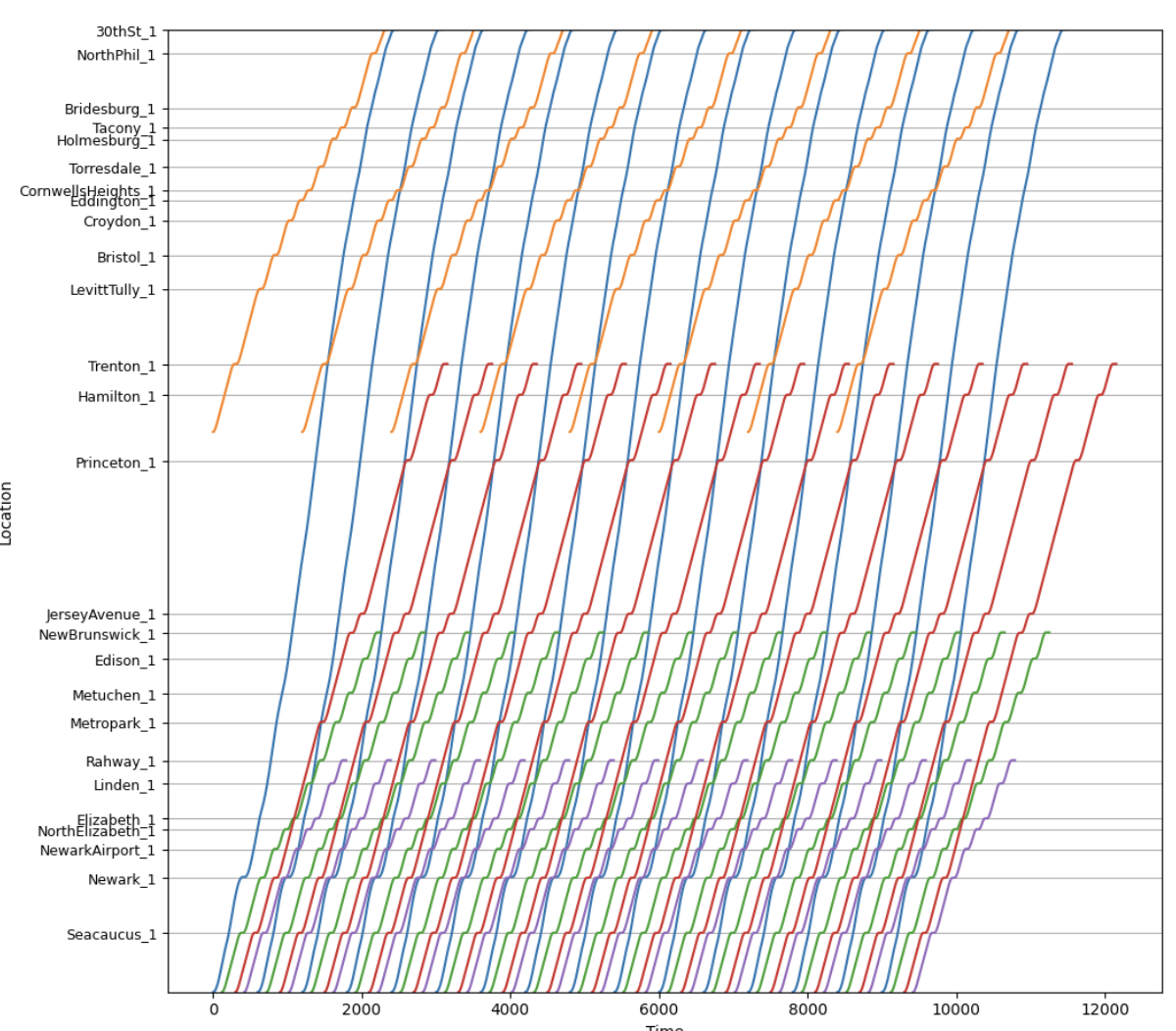
The blue lines are intercity trains, the red lines are express commuter trains, the green lines are local commuter trains to New Brunswick or Jersey Avenue, the purple lines are local commuter trains branching to the North Jersey Coast Line, and the gold lines are SEPTA trains.
Of note, the intercity trains do not share tracks with the local commuter trains except in the tunnel to Penn Station; the current plan after the Hudson Tunnel Project is finished is for the above-depicted trains to use the old tunnel and for other lines (Morris and Essex, Montclair-Boonton, Raritan Valley) to use the new tunnel. This provides just enough separation that there isn’t much interlining to worry about. The express commuter trains are the only ones with any surface track-sharing with trains of different speed classes.
As the line chart shows, the red/green overtake occurs at Elizabeth, where the express commuter trains then need to be on the inner express tracks. Just south of Elizabeth, the line widens to six tracks, and the express commuter trains can be kept separate from both local trains and intercity trains; all that’s required is installing switches to allow this, for a very small number of millions of dollars for high-speed switches or hundreds of thousands for slower switches. By the time the intercity and express commuter trains are within the signal system’s two-minute limit of each other, the express commuter trains don’t need to return to the inner tracks again. Past Rahway, the express and local commuter trains need to use the same tracks, but are adequately separated from each other.
Robustness check
We are still looking at options for how to match this segment with other segments, in particular how this could through-run east of Penn Station. Most likely, the local trains would run through to the Port Washington Branch of the LIRR and the express commuter trains would become local commuter trains to Stamford via Penn Station Access.
The upshot is that the train most likely to be delayed from the north is the express commuter train. It can afford to be about two minutes behind schedule before it messes up the order of trains using the tunnel; the schedule padding up to Elizabeth can recover one of these two minutes, and then, with the extra minute of slowdown of intercities not depicted in the line chart, the express commuter trains are still well clear of the intercities where they share tracks at Elizabeth.
Fares on High-Speed Trains
American journalists sometimes ask me to discuss high-speed rail fares. I’ve written from time to time about how Northeast Corridor fares are significantly higher than French, German, and Japanese high-speed rail fares, but the links to this information are never in the same place. The purpose of this post is to collect all the links together for easy retrieval, with updates to the 2020s whenever possible. Unfortunately, international high-speed rail fares connecting to France are also much higher than domestic ones, which contributes to the poor ridership of those trains relative to city size.
France
ARAFER releases statistics annually. The most recent year for which there is data is 2022; here’s the report in French, and here’s a summary in English. The relevant information is in sections 5-6. The TGV system including international trains averages fare revenue of 6,213M€ for 61 billion passenger-km; in English this is called “non-PSO,” since these are the profitable trains that SNCF runs outside the passenger service obligation system for money-losing slow trains. This works out to 0.102€/p-km. The PPP rate these days is about 1€ = $1.45, making this about $0.15/p-km.
The split between domestic and international trains is large, and the French report has the domestic trains as just 0.093€/p-km, taking a weighted average from pp. 23 and 31. Nominal fares per p-km on domestic TGVs were down 4% from 2019 to 2022, despite 7.5% cumulative inflation over this period.
The international trains, in contrast, are much more expensive: the report doesn’t give exact numbers, but from some weighted averaging and graph eyeballing it looks like it’s around 0.17€/p-km. The all-high-speed international trains – Eurostar and Thalys – are more expensive than the trains running partly at low speed in Germany and Switzerland, like Lyria; this big difference in fares helps explain their disappointing ridership. Domestic TGVs run from Paris to Lyon 28 times on the 5th of June this year, counting only trains to Lyon Part-Dieu or Perrache, which do not continue onward, and not counting trains that stop at Saint-Exupéry on their way to points south, and those trains are rather full 16-car bilevels. In contrast, on the same day I only see 16 Eurostars from London to Paris. This is despite the fact that London is a far larger city than Lyon, and the in-vehicle travel time is only moderately longer.
Germany
Germany lacks France’s neat separation of low- and high-speed trains. The intercity rail network here is treated as a single system, and increasingly all trains are ICEs even if they spend the majority of the trip on legacy lines at a top speed of 200 km/h.
Overall intercity rail passenger revenue here was 5.1 billion € in 2022; the expression to look for is “SPFV.” Ridership was 42.9 billion p-km per a DB report of 2022-3, PDF-p. 7, averaging 0.119€/p-km, which is $0.17/p-km in PPP US dollars. 2022 was still slightly below 2019 levels, when ridership was 44.7 billion p-km and fares averaged 0.112€/p-km; the three-year increase was less than the cumulative inflation over this period, which was 10.3%.
Japan
Japanese fares are higher than European fares on high-speed rail. JR East’s presentation from 2021, showing depressed ridership during the pandemic (p. 50), reports ¥189.6 billion in Shinkansen revenue on 7.95 billion p-km, or ¥23.8/p-km, and projects recovery to ¥428.9 billion/17.313 billion p-km by 2022, or ¥24.8/p-km. JR Central’s 2020 report says (p. 37) that its Shinkansen service got ¥1.2613 trillion in revenue in the year ending March 2020 on 54.009 billion p-km, or ¥23.4/p-km. JR West’s 2020 factsheets for revenue and ridership show ¥457 billion/21.338 billion p-km in 2019, or ¥21.4/p-km.
The PPP rate for 2020-1 was $1 = ¥100. Taking 9% dollar inflation from 2020 to 2022 into account, this is, in 2022 prices, around $0.25/p-km.
Northeast Corridor
Amtrak publishes monthly performance reports; the fiscal year is October-September, so the September reports, covering an entire fiscal year, are to be preferred. Here are 2022 and 2023; 2022 still shows a considerable corona depression, unlike in France and Germany. The 2023 report shows that Northeast Corridor revenue splits as $495.9 million/581.1 million p-miles Acela, or $0.53/p-km, and $768.2 million/1.6269 billion p-miles Regional, or $0.293/p-km Regional. Altogether, this is $0.356/p-km, which is nearly 50% higher than the Shinkansen, 2.1 times as expensive as the ICE, and 2.4 times as expensive as the TGV.
Discussion
High operating costs on Amtrak are the primary reason for the premium fares. The mainland JRs are all highly profitable; DB Fernverkehr is profitable, as is the TGV network (though SNCF writ large isn’t, the slow intercities falling under the PSO rubric). All five companies pay track access charges for the construction of high-speed rail infrastructure; the ARAFER report goes over these charges in France and a selection of other European countries, designed to prevent state subsidies to intercity rail operations through underpriced track access, since track construction is always done by the state but operations may be done by a private operator or a foreign state railway. The Northeast Corridor is profitable as well – Amtrak doesn’t have to pay track access charges, but the access charges for legacy 19th-century lines would not be significant. However, if Amtrak charged European fares or even Japanese ones, it wouldn’t be. Northeast Corridor rail operations in fiscal 2023 earned $1.266 billion in passenger revenue plus $28.5 million in non-ticket revenue but spent $1.0917 billion, or $0.307/p-km.
A portion of the Amtrak cost premium also comes from adversarial profit maximization, also seen on Thalys and Eurostar. The domestic TGVs and ICEs aim at making a base rate of profit while providing a service for the general public; SNCF doesn’t apply the same logic to Thalys and Eurostar and instead aims at serving only business trips to avoid the possibility of extracting less than maximum fares from international travelers. On Amtrak, the need to subsidize the rest of the system has increased Northeast Corridor fares, though to be clear, in fiscal 2023 the operating margin was small enough that this is at most a secondary factor. Performance reports from the 2000s and 10s showed a larger operating margin, but criticism from advocacy groups centering non-Northeast Corridor passengers alleging that Amtrak accounting was making the Northeast Corridor look better and the night trains look worse led to a recalculation, used in the most recent reports, in which Northeast Corridor operations still turn out to be profitable but not by a large margin.
 Pedestrian Observations