Category: Transportation
Quick Note: Why Not Fly?
I was asked a deceptively simple question on Twitter: why would people bother with taking a train when flying is available? In my (admittedly primitive) modeling for high-speed rail ridership in the US, I’m including some nontrivial ridership and revenue coming from cities at a distance that people do fly, like Boston-Washington, New York-Cleveland, and so on. What gives?
The simplest answer is that evidently people do take trains at such distances. Statista has some examples, all with more rail than air travel; an Air2Rail paper by Arie Bleijenberg has some numbers within Europe in Annex B. The main factor is rail travel time, with a malus for markets with poor rail connectivity (such as anything crossing the Channel). When trains take four hours, as on Paris-Toulon, they have a small majority of the travel market (source, p. 14 – look at the 2009 numbers, the 2023 numbers being a speculation); Paris-Nice manages to have respectable modal split even at 5.5 hours.
But that answer is frustrating. Why do people take trains for 4-5 hours when it’s possible to fly in an hour?
The first answer is door-to-door travel time. This includes all of the following features:
- Airports are far from city centers whereas train stations are almost universally within them; even taking into account that most people don’t live in city center, they tend to have easier access to the train station than to the airport, and then destinations are massively centralized in the city.
- Trains have no security theater to delay passengers, and passengers can get from the station entrance to the platform in 10 minutes if the station is exceptionally labyrinthine and they’re unfamiliar with its layout and two minutes if it’s not or they are.
- Passengers with luggage can take it on the train and don’t have to be further delayed for baggage claim.
All of these features work to make trains more pleasant than planes even when the door-to-door trip times are equal. The sequential queuing for security and then boarding on a plane is a hassle in addition to extra time; of note, in the Air2Rail link, the most glaring underperformance in high-speed rail modal split relative to trip times is for routes crossing the Channel, because they have such queuing courtesy of British paranoia about terrorism in the Chunnel and also charge higher fares.
The advantages of planes over trains are elsewhere. First, planes are faster airport-to-airport than trains are station-to-station, and as a result, a longer distances they are much faster door-to-door and therefore dominant. And second, trains travel in lines whereas planes travel point-to-point; it’s not hard to come up with city pairs that have no reason to have an even semi-direct high-speed railway between them even though they are at rail-appropriate range, for example Nice-Geneva (290 km) or Cincinnati-Charlotte (540 km).
But once the lines exist, they should get substantial passenger traffic – and the modal split with air is very well-documented in the literature and the overall traffic is still fairly well-modeled as well.
Vancouver, Stockholm, and the Suburban Metro Model
I was asked by an area advocate about SkyTrain, and this turned into a long email with various models to compare Vancouver with. In my schema contrasting suburban metro systems and S-Bahns, Vancouver is firmly in the first category: SkyTrain is not commuter rail, and Vancouver’s commuter rail system, the West Coast Express, is so weak it might as well not exist. The suburban metro model forces the region to engage in extensive transit-oriented development, which Vancouver has done. Has it been successful? To some extent, yes – Vancouver’s modal split is steadily rising, and in the 2016 census, just before the Evergreen Line opened, was 20%; supposedly it is 24% now. But it could have done better. How so?
Could Vancouver have used the S-Bahn model?
No.
There is a common line of advocacy; glimpses of it can be found on the blog Rail for the Valley, by a writer using the name Zweisystem who commented on transit blogs like Yonah and Jarrett‘s in the 2000s. Using the name of Karlsruhe’s tram-train as inspiration, Zwei has proposed that Vancouver use existing commuter rail corridors in suburban and exurban areas and streetcars in the urban core.
The problem with this is that Vancouver has very little legacy mainline rail infrastructure to work with. There are two mainlines serving city center: the Canadian Pacific, and Canadian National. The CP line hugs the coast, full of industrial customers; the CN line is farther inland and has somewhat more fixable land use, but the Millennium Line partly parallels it and even after 20 years its ridership is not the strongest in the system. Most of the urban core is nowhere near a rail mainline.
This is completely unlike the Central European S-Bahn-and-streetcars systems, all of which have legacy commuter lines radiating in all directions, and use legacy streetcars rather than newly-built light rail lines. In the last generation they’ve expanded their systems, building connections and feeding rapid transit, but none of these is a case of completely getting rid of the streetcars and then restoring them later; the busiest system that’s entirely new, that of Paris, is largely orbitals and feeders for the Métro and RER.
Vancouver did in fact reuse old infrastructure for the suburban metro concept. The Expo Line involved very little greenfield right-of-way use. Most of the core route between the historic core of Vancouver and New Westminster is in the private right-of-way of a historic BC Electric interurban; this is why it parallels Kingsway but does not run elevated over it. The tunnel in Downtown Vancouver is a disused CP tunnel; this is why the tracks are stacked one over the other rather than running side by side – the tunnel was single-track but tall enough to be cut into two levels. This limited the construction cost of the Expo Line, which the largely-elevated Millennium Line and the partly underground, partly elevated Canada Line could not match.
The Stockholm example
In my post about S-Bahns and suburban metros, I characterized Stockholm as an archetypal suburban metro. Stockholm does have an S-Bahn tunnel nowadays, but it only opened 2017, and ridership so far, while rising, is still a fraction of that of the T-bana.
Stockholm’s choice of a full metro system in the 1940s, when it had about a million people in its metro area, had its critics at the time. But there wasn’t much of a choice. The trams were fighting growing traffic congestion, to the point that some lines had to be put in a tunnel, which would later be converted for the use of the Green Line as it goes through Södermalm. Working-class housing was overcrowded and there was demand for more housing in Stockholm, which would eventually be satisfied by the Million Program.
And there were too few commuter lines for an S-Bahn system. Swedes were perfectly aware of the existence of the S-Bahn model; Berlin and Hamburg both had S-Bahns running on dedicated tracks, and Copenhagen had built its own system, called S-Tog in imitation of the German name. But they didn’t build that. None of this was the integrated Takt timetable that Munich would perfect in the 1970s, in which branches could be left single-track or shared with intercity trains provided the regular 20-minute headways could be scheduled to avoid conflicts; the track sharing required in the 1940s would have been too disruptive. Not to mention, Stockholm had too few lines, if not so few as Vancouver – only two branches on each of two sides of city center, with most of the urban core far from the train.
So Stockholm built the T-bana, with three highly branched lines all meeting at T-Centralen, the oldest two of the three having a cross-platform transfer there and at the two stations farther south. The roughly 104 km system (57 km underground) cost, in 2022 US dollars, $3.6 billion. Stockholm removed all the regular streetcars; a handful running all or mostly in private rights-of-way were retained with forced transfers at outlying T-bana stations like Ropsten, as was the narrow-gauge Roslagsbana (with a forced transfer at KTH, where I worked for two years).
At the same time the T-bana was under construction, the state built the Million Program, and in the Stockholm region, the housing projects were designed to be thoroughly oriented around the system. The pre-Million Program TOD suburb of Vällingby was envisioned as part of a so-called string of pearls, in which towns would radiate from each T-bana station, with local retail and jobs near the station surrounded by housing. In 2019, the T-bana had 1,265,900 riders per workday, Citybanan had 410,300, and the remaining lines 216,100; Sweden reports modal split for all trips and not just work trips, but the commute modal split appears to be 40% or a little higher, a figure that matches Paris, a metro area of 13 million that opened its first metro line in 1900.
So why is Stockholm better?
There are parallels between Stockholm and Vancouver – both are postwar cities with 2.5 million people in their metropolitan areas with rapid growth due to immigration. Their physical geographies are similar, with water barriers inhibiting the contiguous sprawl of many peers. Both extensively employed TOD to shape urban geography around the train: Stockholm has Vällingby and other, less famous examples of TOD; Vancouver has Metrotown and smaller examples of residential TOD along the Expo Line, alongside a famously high-rise downtown. But the T-bana has more than twice the annual ridership of SkyTrain, and Stockholm has around twice the modal split of Vancouver – this is not a matter of Canadians riding buses more than Europeans do. So what gives?
Part of it is about TOD models. Stockholm is an exceptionally monocentric city, and this has created a lot of demand for urban rail to Central Stockholm. But Vancouver’s high-rise city center has a lot of jobs, and overall, around 30% of Metro Vancouver jobs are in the city or the University Endowment Lands (that is, UBC), and the proportion of Stockholm County jobs within an equivalent area is similar. Vancouver has never built anything as massive as the Million Program, but its housing growth rate is one of the highest in the world (around 11 gross units/1,000 people per year in the 2010s), and much of that growth clusters near the Expo Line and increasingly also near the worse-developed Millennium and Canada Lines.
I suspect that the largest reason is simply the extent of the systems. SkyTrain misses the entire West Side of Vancouver west of Cambie, has poor coverage in Surrey and none in Langley, and does not cross the Burrard Inlet. The T-bana has no comparable lacunae: Roslag is served by Roslagsbanan, and the areas to be served by the under-construction extensions are all target TOD areas with much less present-day density than North Vancouver, the cores of Fairview and Kitsilano, or the town centers in Surrey other than Whalley.
What’s more, Stockholm’s construction costs may be rising but those of Vancouver (and the rest of Canada) are rising even faster and from a higher base. Nya Tunnelbanan is currently budgeted at $3.6 billion in PPP terms – 19 underground km for about the same cost as the existing 104 – but Vancouver is building half of the most critical SkyTrain extension, that under Broadway, for C$2.83 billion (US$2.253 billion in PPP terms) for just 5 km, not all underground. The projected cost per rider is still favorable, but it’s less favorable for the planned extension to Langley, and there’s no active plan for anything to the North Shore.
The silver lining for Vancouver is that the West Side is big and underdeveloped. The region has the money to extend SkyTrain not just to Arbutus as is under construction but all the way to UBC, and the entire swath of land between Central Broadway and UBC screams “redevelop me.” The current land use is a mix of mid-rise, townhouses (“missing middle”), and single-family housing; Shaughnessy, whose northern end is within a kilometer of under-construction SkyTrain stations, is single-family on large lots, and can be redeveloped as high-rise housing alongside closer-in areas. Canada does not have Europe’s allergy to tall buildings, and this is a resource that can be used to turn Vancouver into a far more transit-oriented city along the few corridors where it can afford to build. The suburban metro is always like this: fewer lines, more development intensity along them.
In-Motion Charging is not for Trains
Streetsblog Massachusetts editor Christian MilNeil has just asked a very delicate question on Twitter about battery power for public transportation. In-motion charging (IMC) is a positive technological development for buses, wiring part of a route in order to provide electric coverage to a much broader area. So why not use it for trains? The context is that the government of Massachusetts is doing everything in its power to avoid wiring commuter rail; its latest excuse is that a partly-wired system with battery-electric trains is cheaper. So how come IMC works for buses but not trains?
The answer is that trains and buses differ in ways that make fully wiring a train much more advantageous for equipment cost while costing less compared with IMC-style partial wiring – and the size of trains makes the equipment cost much more prominent.
Equipment cost
The cost of a single-deck electric multiple unit (EMU) other than high-speed rail is about $100,000 per linear meter of length, and appears to have changed little over the last 10-20 years. I have a list of recent tramways built in Europe for that cost, a shorter one of subways (including more outliers due to procurement problems or bespoke designs), and some standard citations for commuter rail EMUs. For the latter, here is a recent example of a Coradia Continental order in Germany: 200M€ for 32 trainsets, 20 with five 18-meter cars and 12 with four, or 75,000€ per linear meter.
In contrast, battery-EMUs (BEMUs) are far more expensive. Comparing like with like, here is a recent Coradia Continental BEMU order for Leipzig-Chemnitz, which line should have long been wired: 100M€ for 11 three-car, 56-meter long trainsets, or 160,000€ per linear meter.
Buses do not display such a premium. Trolleybus advocate Martin Wright writes a comparison of battery-electric and trolleybuses for Vancouver, and suggests that equipment costs are largely the same in the North American market (which is expensive by European standards). TU Berlin’s Dominic Jefferies and Dietmar Göhlich find that the base cost of an electric 12-meter bus is 450,000€, rising to 600,000€ with battery (p. 25); this is a premium, but it’s small, almost an order of magnitude less than that for trains per unit of length. Kiepe says that the cost of rebuilding 16 12-meter trolleybuses with IMC for Solingen is in the single-digit millions.
Why?
How come trains display such a large premium for batteries over electric traction supplied by trackside distribution (catenary wire or third rail) and buses don’t? This is not about the cost of the batteries: Jeffries-Göhlich cite a cost of 500-800€/kWh for a battery pack on a bus, and while Alstom hasn’t said what the battery capacity of the Coradia is in kWh, based on the range (120 km) and this slide deck about BEMUs (or PDF-p. 22 of a VDE study about EMUs and BEMUs), the capacity is likely around 700 kWh for the entire three-car train, with a cost about an order of magnitude less than the observed cost premium over EMUs.
Rather, the issue is likely about fitting the batteries on the train. Railvolution reports that to fit the batteries, Alstom had to demotorize one of the three powered bogies, reducing the maximum power drawn from 2.16 MW to 1.44. As a byproduct, this also somewhat hurts performance, increasing the stop penalty from the train’s maximum speed of 160 km/h by 15-20 seconds (46 empty or 51 full for an EMU, 60 and 71 respectively for a BEMU).
The cost of wiring
The cost of trolleybus wiring, at least judging by industry brochures such as that of UITP, is linear in route-km. This makes IMC attractive in that it cuts said cost by a factor of 2 to 3 on a single route, or even more on a route that branches out of a common trunk. For this reason, IMC is ideally suited for branched bus networks such as that of Boston, and is less valuable on grids where it’s uncommon for multiple bus routes to run together for a significant portion, such as the systems in Chicago, Toronto, and Vancouver.
But rail electrification does not quite work this way. Overall, the cost of wiring is mostly proportional to route-length, but the cost appears to be split evenly between the wire and the substations. A full-size commuter train in a major metropolitan area like Boston would be drawing around 7 MW while accelerating; a Citaro bus has a 220 kW diesel engine, or 125 in the electric version. Even taking into account that buses are slower and more frequent than trains and thus run at much higher frequency per route-km, there’s nearly a full order of magnitude between the substation costs per km for the two modes.
The upshot is that while IMC saves the cost of installing wire, it does not save a single penny on the cost of installing substations. The substations still need to fully charge a train in motion – and derating the train’s power as Alstom did does not even help much, it just means that the same amount of energy is applied over a longer period while accelerating but then still needs to be recharged on the wire.
How benefits of electrification scale
Electrification has a number of benefits over diesel power:
- No local air pollution
- Much less noise, and none while idling
- Higher reliability
- Higher performance
- Much lower lifecycle costs
The first three are shared between externally-supplied electric and battery-electric power, at least when there’s IMC (pure battery power is unreliable in cold weather). The fourth is a mix: BEMUs have better performance than DMUs but worse than EMUs – whereas with buses this flips, as trolleybuses have performance constraints at trolleywire junctions. The fifth is entirely an EMU benefit, because of the high cost of BEMU acquisition.
The first two benefits are also much more prominent for buses than for trains. Buses run on streets; the pollution affects nearby pedestrians and residents as well as waiting riders, and the idling noise is a nuisance at every intersection and whenever there’s car traffic. Bus depots are an air quality hazard, leading to much environmental justice activism about why they’re located where they are. Trains are more separated from the public except when people wait for them.
In contrast, the last benefit, concerning lifecycle costs, is more prominent on trains. The benefits of electrification scale with the extent of service; that the acquisition cost of EMUs is around half that of BEMUs, and the lifecycle cost is around half that of DMUs, means that the return on investment on electrification can be modeled as a linear function of the fleet size in maximum service.
A US-standard 25 meter railcar costs $2.5 million at global EMU prices (which the US was recently able to achieve, though not anymore), and twice that at BEMU prices. 40-year depreciation and 4% interest are $162,500/year; a single train per hour, per car, is around $3,000/km (this assumes 50-60 km/h average speed counting turnaround time), or $6,000 counting both directions, and lifecycle maintenance costs appear to be similar to initial acquisition cost, for a total of around $12,000/km. At $2.5 million/km, this means electrification has an ROI of 0.5% per peak car per hour; a single 8-car train per hour is already enough for 4% ROI.
The numbers don’t work out this way for buses. Workhorse city buses run every 5 minutes at rush hour, and may occasionally run articulated buses, but the capacity is still only equivalent to a single hourly train; in the absence of IMC, electrification of buses is therefore hard to justify without the additional environmental benefits. But those environmental benefits can be provided at much lower cost with IMC.
Why electrify?
The upshot of the above discussion is that the reasons to electrify buses and trains are not the same. Bus electrification benefits center environmental and environmental justice: diesel buses are noisy and polluting and have poor ride quality. The only reason to wire buses at all rather than go for unwired battery-electric buses (BEBs) is that BEBs are not reliable in freezing temperatures and cost far more than diesels due to their downtime for charging.
But rail electrification is different. The environmental benefits are real, but less important. Train depots have not been major sources of air pollution since the steam era, unlike bus depots. The primary reasons are technical: equipment acquisition costs, maintenance costs, performance, reliability. And those overall advantage EMUs over BEMUs with IMC.
Suburban Metros and S-Bahns
Liam O’Connell just wrote a deep dive into the history of PATH in the 1970s. I recommend people read it; as the unprofitable Hudson and Manhattan (H&M) system was transferred to Port Authority’s control, to be subsidized via the toll revenue from the Hudson bridges that had killed ridership starting in the 1930s, there were plans for expansion deep into suburbia, as far out as Plainfield. The expansion was a twofer: the H&M was unprofitable and needed change, and the same was true of mainline rail in the Northeast. Liam goes over the history of the proposal to expand service to Plainfield, and calls it an S-Bahn, comparing it to existing American examples of suburban metro like BART as well as to actual S-Bahn-type systems like the German ones bearing the name but also the Paris RER and the Tokyo subway.
In reality, there is a distinction between suburban metro service and S-Bahn service. Liam gets at one of the issues that derailed the Plainfield extension (it attempted to use high-cost capital expansion to paper over operational problems). But the distinction goes far deeper than that, and applies even to suburban metro services with a fraction of the operating costs of PATH, like BART. These are not S-Bahns, and understanding how they differ is critical.
The basic difference is that S-Bahns run on mainline rail tracks; suburban metros do not. This distinction has implications for capital planning, urban network shape, and urban growth planning. In reality it’s more complicated than that, but instead of drawing a sharp boundary, it’s better to begin by going over the core features of each of the two service types (in linguistics this is called prototypes).
S-Bahn
The core feature of an S-Bahn is that it runs on mainline track and combines urban and suburban rail service. Every S-Bahn service I know of that bears that name or is otherwise associated with the core of the model shares track with other mainline services, but the busier ones (Berlin, Paris, Tokyo) do it only peripherally, because core lines are limited by track capacity.
The reason to use mainline track is that it’s already there, cutting construction costs. In most cases it also fits into a growth plan around existing town centers, such as the Finger Plan. Cities that build S-Bahn systems often have a surplus of industrial track serving declining manufacturing uses that can be redeveloped, for example the goods yards of historic rail terminals in European cities.
With a surplus of mainline track to use, S-Bahn systems employ extensive branching. There are more branches in the suburbs than urban trunk lines to feed them, so the system maximizes use of existing track this way. Conversely, the urban trunk lines need very high frequency to be usable as urban rail whereas the suburban branches can make do with a train every 10-20 minutes, so the branching structure generally matches frequency to both demand and passenger convenience.
Suburban metro
It is sometimes desirable to extend a metro system isolated from the mainline rail network into the suburbs. This is most commonly done when there are too few mainlines for adequate suburban service; China makes extensive use of suburban metro lines, and the commuter lines it does have are not run to S-Bahn standards (for example, the Beijing Suburban Railway is infrequent). Seoul, whose first subway line is an S-Bahn, employs greenfield suburban metros extensively as well, for example the Shin-Bundang Line.
Without an extensive system of existing lines to tap into, suburban metros necessarily cost more than S-Bahns. This means that there are fewer lines, so each line or branch has to be shorter, more frequent, and more intensively developed. Stockholm provides a ready-made example: it did not build an urban S-Bahn like the Copenhagen S-Tog, and instead built the three-line T-bana to a range of 10-20 km out of city center, with Million Program projects centered on T-bana stations.
In reality, it’s common for S-Bahn systems to also build greenfield suburban lines. For example, the RER A’s Marne-la-Vallée branch is greenfield, and does not look too different from the lines inherited from mainline rail; but it’s embedded in a mainline-compatible system, running through to legacy track on the other side of the city.
American postwar suburban rapid transit
American cities extending their urban rail networks into the suburbs ended up building suburban metros: they were never integrated with mainline rail. BART even runs on a different track gauge from the mainline network. Many of the other systems run alongside legacy lines instead of on them, at high cost. The high costs meant that there were fewer lines – the Washington Metro has complex interlining for a three-line metro, but by S-Bahn standards, it’s poor in branches.
Some of these systems had older metros to integrate with, including the Rockaways extension of the A in New York and the Green Line D Branch and the Red Line to Braintree in Boston; all three were taken over from disused commuter rail. The Braintree extension is notable in that the Old Colony Lines go much further than Braintree, but the conversion costs meant there would be no subway extension into suburbia past Braintree, and more recently the region awkwardly reopened the Old Colony Lines as low-frequency diesel commuter rail, with parts of the right-of-way encroached by the subway.
The PATH extension was to cost $402 million in 1975, or $2.2 billion today, about $80 million/km for an above-ground system that could run entirely on existing track. Newark-Elizabeth, on the Northeast Corridor, had plenty of spare capacity then and still does now – only after Gateway opens does the section need additional tracks, and parts of it are already six-track. Relative to what was required, the construction cost was extremely high. The projected two-way ridership was 28,200/day, or $78,000/rider, in an economy with less than half the average income of today.
The failure of postwar American rapid transit
Liam’s post mentions BART in the same sentence as the RER or the Tokyo subway system. This is a provocation, and Liam knows this. BART’s annual ridership before corona was not much higher than just the total number of boardings and alightings at Gare du Nord. The Bay Area’s modal split is comparable to that of provincial French metro areas like Marseille and Toulouse, with an urban light metro or light rail system and thoroughly auto-oriented character outside the historic core. So what gives?
This isn’t quite a shortcoming of the suburban metro model. Stockholm uses it, and so does all of China. Rather, it’s a combination of several problems.
- The suburban metro model requires extensive transit-oriented development to compensate for the narrower reach of the system. Stockholm built Vällingby and countless other suburbs on top of the T-bana. Washington built a handful of TOD centers like Arlington and Bethesda, and the other American examples built nothing, preferring parking lots and garages at stations.
- American construction costs were too high even then. The cost of the proposed PATH extension was $2.2 billion for 27 km on existing above-ground right-of-way. The actually-built Washington Metro cost $9.3 billion in current dollars by 2001, around $25 billion in today’s money, for a 166 km system of which 72 are underground. In contrast, the T-bana cost, in today’s PPP money, around $3.6 billion for 104 km of which 57 are underground, around one fifth the per-km cost of WMATA. As a result, not much was built, and in many cases what has been built follows freeway medians to economize, leading to further ridership shortfalls.
- BART specifically suffers from poor urban service. As pointed out more than 15 years ago by Christof Spieler, it has very little service in San Francisco outside city center; Oakland service is awkward too, with most residential areas on a separate branch from Downtown Oakland. The Washington Metro has done this better.
- The A train in New York has the opposite problem as BART: the Rockaways tail was tacked on so awkwardly, at the end of a line that runs express but is still not fast enough – Far Rockaway-Times Square takes 1:08-1:10 for a distance of 37 km. The Green Line D Branch takes 46 minutes peak, 40 off-peak to traverse 19 km from Riverside to Government Center. PATH to Plainfield would likely have had the same problem; the core system is not fast, and with no through-service beyond its Manhattan terminals, it would have had cumbersome transfers for onward travel.
Conclusion
There are two models for how to extend rapid transit into the suburbs: the commuter rail model of the S-Bahn systems, Tokyo, and the RER, and the suburban metro model of Stockholm and China; Seoul uses the S-Bahn model where legacy lines exist and the suburban metro model otherwise. The segregation of mainline rail from all other forms of mass transit forced postwar America to select the latter model.
But implementation fell short. Construction costs were far too high even in the 1970s. Transit-oriented development ranged from mediocre in Washington to nonexistent elsewhere; the systems were built to interact with cars, not buses or streetcars or subways or commuter rail. And most of the lines failed at the basic feature of providing good urban and suburban service on the same system – they either were too slow through the city or didn’t make enough city stops.
Moreover, much of this failure has to be viewed in light of the distinction between S-Bahns and suburban metro systems. S-Bahns had better turn their outlying stations into nodes with bus service (timed with the train unless frequency is very high) and local retail, but Berlin is full of park-and-rides and underdeveloped stations and suburban Zurich is low-density. In contrast, suburban metros have to have the TOD intensity of Stockholm or suburban Seoul – their construction costs are higher, so they must be designed around higher ridership to compensate. This should have been especially paramount in the high-cost American context. But it wasn’t, so ridership is low relative to cost, and expansion is slow.
New York Commuter Rail Rolling Stock Needs
Last night I was asked on Twitter about the equipment needs for an integrated commuter rail system in New York, with through-running from the New Jersey side to the Long Island and Connecticut side. So without further ado, let’s work this out, based on different scenarios for how much infrastructure is built and how much capacity there is.
Assumptions on speed
The baseline assumptions in all scenarios should be,
- The rolling stock is new – this is about a combined purchase of trains, so the trains should be late-model international EMUs with the appropriate performance specs.
- Trains are single-deck, to speed up boarding and alighting in Manhattan.
- The entire system is electrified and equipped with high platforms, to enable rapid acceleration and limit dwell times to 30 seconds, except at Grand Central and Penn Station, where they are 2 minutes each.
- Non-geometric speed limits (such as difficult turnouts) are lifted through better track maintenance standards and the use of track renewal machines, and geometric speed limits are based on 300 mm of total equivalent cant, or a lateral acceleration of 2 m/s^2 in the horizontal plane.
- However, speed limits through new urban tunnels, except those used by intercity trains, are at most 130 km/h even when interstations are long.
- Every junction that needs to be grade-separated for reliability is.
- Peak and reverse-peak service are symmetric (asymmetric service may not even save rolling stock if the peak is long enough).
- Urban areas have infill stations as needed to provide coverage, except where lines are parallel to the subway, such as the LIRR Main Line west of Jamaica.
- Timetables are padded 7% over the technical travel time, and the turnaround time is set at 10 minutes per terminal.
Line trip times
With the above assumptions in mind, let’s compute end-to-end trip times by line. Note that we do not care which lines match up with which lines east and west of Penn Station – the point is not to write complete timetables, but to estimate rolling stock needs. The shortcut we can take is that trains are sufficiently frequent at the peak that artifacts coming from the question of which lines match with which likes are not going to matter. Trip times without links are directly computed for the purposes of this post, and should be viewed as somewhat less certain, within a few percent in each direction.
| Terminus | Service pattern | Trip time |
| Great Neck | Local | 0:32 |
| Port Washington | Local | 0:39 |
| Hempstead | Local | 0:37 |
| East Garden City | Local | 0:37 |
| Far Rockaway | Local | 0:39 |
| Long Beach | Local | 0:40 |
| West Hempstead | Local | 0:36 |
| West Hempstead Dinky | Local | 0:10 |
| Babylon | Local | 0:58 |
| Montauk | Local | 2:20 |
| Huntington | Express west of Floral Park | 0:43 |
| Port Jefferson | Express west of Floral Park | 1:10 |
| Ronkonkoma | Express west of Floral Park | 0:57 |
| Greenport | Express west of Floral Park | 1:42 |
| Oyster Bay Dinky | Local | 0:25 |
| New Rochelle (via NEC) | Local | 0:26 |
| New Rochelle (to GCT) | Local | 0:21 |
| Stamford (via NEC) | Local | 0:50 |
| Stamford (to GCT) | Local | 0:45 |
| New Haven (to GCT) | Express south of Stamford | 1:18 |
| New Canaan (to GCT) | Express south of Stamford | 0:43 |
| Danbury (to GCT) | Express south of Stamford | 1:15 |
| Waterbury (to GCT) | Express south of Stamford | 1:40 |
| North White Plains | Local | 0:40 |
| Southeast | Local | 1:16 |
| Wassaic | Local | 1:48 |
| Yonkers (to GCT) | Local | 0:25 |
| Yonkers (via West Side) | Local | 0:23 |
| Croton-Harmon (to GCT) | Local | 0:52 |
| Croton-Harrmon (via West Side) | Local | 0:50 |
| Poughkeepsie (to GCT) | Express south of Croton | 1:12 |
| Poughkeepsie (via West Side) | Express south of Croton | 1:10 |
| Jersey Avenue | Local | 0:41 |
| Trenton | Local | 1:01 |
| Trenton | Express north of New Brunswick | 0:52 |
| Princeton Dinky | Local | 0:03 |
| Long Branch | Local | 1:01 |
| Bay Head | Local | 1:23 |
| Raritan | Local | 0:47 |
| High Bridge | Local | 1:04 |
| Dover (via Summit) | Local | 1:00 |
| Dover (via Montclair) | Local | 1:04 |
| Hackettstown (via Summit) | Local | 1:22 |
| Montclair State University | Local | 0:33 |
| Gladstone | Local | 1:08 |
| Summit | Local | 0:34 |
| Suffern (via Paterson) | Local | 0:50 |
| Suffern (via Radburn) | Local | 0:47 |
| Port Jervis (via Radburn) | Local | 1:50 |
| Spring Valley | Local | 0:50 |
| Nyack | Local | 0:51 |
| Tottenville (to GCT) | Local | 0:47 |
| Port Ivory (to GCT) | Local | 0:28 |
| GCT-Penn (with dwells) | Local | 0:04 |
| Jamaica-FiDi adjustment | Local | 0:02 |
The last two adjustment numbers are designed to be added to other lines: Grand Central-Penn Station with 2 minute dwell times at each stop adds 4 minutes to the total trip time, net of savings from no longer having bumper tracks at Grand Central. The Staten Island numbers are also net of such savings. The Jamaica-Lower Manhattan adjustment reflects the fact that, I believe, Jamaica-Lower Manhattan commuter trains with several infill stops would take 0:19, compared with 0:17 on local trains to Penn Station (also with infill).
The 3-line system
The 3-line system is a bare Gateway tunnel with a continuing tunnel to Grand Central (Line 2) and a realignment of the Empire Connection to permit through-service to the northern tunnel pair under the East River (Line 3); Line 1 is, throughout this post, the present-day Hudson tunnel paired with the southern tunnel pair under the East River.
With no Lower Manhattan service, the Erie lines and the Staten Island lines would not be part of this system. Long Island would need to economize by cutting the West Hempstead Branch to a shuttle train connecting to frequent Atlantic Branch and Babylon Branch trains at Valley Stream. The Harlem Line would terminate at Grand Central. Moreover, the weakest tails of the lines today, that is to say Wassaic, Waterbury, Greenport, and Montauk, would not be part of this system – they should be permanently turned into short dinkies.
The table below makes some implicit assumptions about which lines run through and which do not; those that do only require one turnaround as they are paired at the Manhattan end. Overall this does not impact the regionwide fleet requirement.
Total peak service under this is likely to be,
| Terminus | Trip time | Tph | Fleet size |
| Great Neck | 0:32 | 6 | 8 |
| Port Washington | 0:39 | 6 | 9 |
| Hempstead | 0:37 | 12 | 17 |
| Far Rockaway | 0:39 | 6 | 10 |
| Long Beach | 0:40 | 6 | 10 |
| West Hempstead Dinky | 0:10 | 6 | 4 |
| Babylon | 0:58 | 12 | 28 |
| Huntington | 0:43 | 6 | 11 |
| Port Jefferson | 1:10 | 6 | 16 |
| Ronkonkoma | 0:57 | 12 | 27 |
| Oyster Bay Dinky | 0:25 | 3 | 4 |
| Stamford (via NEC) | 0:50 | 6 | 11 |
| Stamford (to GCT, via Alt G) | 0:49 | 6 | 11 |
| New Haven (via Alt G) | 1:22 | 6 | 18 |
| New Canaan (via Alt G) | 0:47 | 3 | 6 |
| Danbury (via Alt G) | 1:19 | 3 | 9 |
| North White Plains | 0:40 | 12 | 20 |
| Southeast | 1:16 | 12 | 35 |
| Yonkers (to GCT, via Alt G) | 0:29 | 6 | 7 |
| Croton-Harmon (via West Side) | 0:50 | 6 | 11 |
| Poughkeepsie (via West Side) | 1:10 | 6 | 15 |
| Jersey Avenue | 0:41 | 6 | 10 |
| Trenton | 1:01 | 6 | 14 |
| Long Branch | 1:01 | 3 | 7 |
| Bay Head | 1:23 | 3 | 9 |
| Raritan | 0:47 | 3 | 6 |
| High Bridge | 1:04 | 3 | 7 |
| Dover (via Summit) | 1:00 | 3 | 7 |
| Dover (via Montclair) | 1:04 | 3 | 7 |
| Hackettstown | 1:22 | 3 | 9 |
| Montclair State U | 0:33 | 3 | 4 |
| Gladstone | 1:08 | 3 | 8 |
| Summit | 0:34 | 3 | 4 |
This totals 379 trainsets; most should be 12 cars long, and only a minority should be as short as 8 cars; only the dinkies should be shorter than that. Off-peak, service is likely to be much less frequent – perhaps half as frequent on most lines, with some less frequent lines reduced to dinkies with timed connections to maintain base 20-minute frequencies – but the peak determines the capital needs, not the off-peak.
The 5-line system
The Lower Manhattan tunnels connecting Jersey City (or Hoboken) with Downtown Brooklyn and Grand Central with Staten Island make for a Line 4 (Harlem-Grand Central-Staten Island) and a Line 5 (Erie-Atlantic Branch). With such a system in place, more service can be run. The Babylon Branch no longer needs to use the Main Line west of Jamaica, making room for very frequent service on the Hempstead Line, with very high frequency to East Garden City.
In addition to the 379 trainsets for the 3-line system, rolling stock needs to be procured for Staten Island, the Erie lines, and incremental service for extra LIRR trains. In the table below, trip times for the Erie lines absorb the 2-minute adjustment for the LIRR trains they connect to; Staten Island lines are already reckoned from Grand Central. Dwell times for such lines are not included at all, as they are already included in the 3-line table.
The table also omits Port Jervis, as a tail of the Erie Main Line.
| Terminus | Trip time | Tph | Fleet size |
| East Garden City | 0:37 | 12 | 19 |
| Suffern (via Paterson) | 0:52 | 6 | 6 |
| Suffern (via Radburn) | 0:49 | 6 | 5 |
| Spring Valley | 0:52 | 6 | 6 |
| Nyack | 0:53 | 6 | 6 |
| Tottenville | 0:47 | 12 | 19 |
| Port Ivory | 0:28 | 12 | 12 |
This is an extra 73 trainsets, for a total of 452.
Further lines
Most of my maps also depict a Line 6 through-tunnel, connecting East Side Access with Hoboken and completely separating the Morris and Essex system from the Northeast Corridor. This only adds trains in New Jersey, including 6 on the M&E system (say, all turning at Summit, roughly at the outer end of high-density suburbanization), and presumably 6 on the Raritan Valley Line (all turning at Raritan or even closer in, such as at Westfield) and 12 on the Northeast Corridor and North Jersey Coast Line (say, 6 to Jersey Avenue, 3 to Long Branch, and 3 to Bay Head). This adds a total of 37 trainsets. As a sanity check, this is really half a line – all timetables, including the 3-line one, assume East Side Access exists – and the 5-line system with its extra 73 trainsets really only adds 2.5 half-lines (the Harlem Line and 5-minute Atlantic Branch service preexist) and those lines are shorter than average.
More speculative is a Line 7, connecting the Lower Montauk Line with an entirely new route through Manhattan to add capacity to New Jersey; this is justified by high commuter volumes from the Erie lines, which under the 6-line system have the highest present-day commute volume to New York divided by peak service. On the Long Island side, it entails restoring through-service to the West Hempstead Branch instead of reducing it to a dinky, changing a 4-trainset shuttle line into a 19-trainset ((36+10)*2*12/60) through-line, and also doubling service on the Far Rockaway and Long Beach Branches, adding a total of 20 trainsets, a total of 35 for the half-line. On the New Jersey side, it depends on what the service plan is for the Erie Lines and on what is done with the West Shore Line and the Susquehanna; the number of extra trainsets is likely about 40, making the 7-line system require about 600 trainsets.
If ridership grows to the point that outer tails like Wassaic, Waterbury, Greenport, and Montauk justify through-service, then this adds a handful of trains to each. Every hourly train to Southeast that extends to Wassaic requires slightly more than one extra trainset; every hourly train to Greenport requires 1.5 (thus, half-hourly requires 3); every hourly train to Montauk requires three. Direct service to Waterbury, displacing trains going to New Haven, is slightly less than one trainset per hourly train; the most likely schedule that fits everything else is a peak train every 20 minutes, which requires 2 extra trainsets.
What Does Pete Buttigieg Think the US has to Teach the World?
On the 27th, Secretary of Transportation Pete Buttigieg announced the creation of a new program called Momentum, to export what he calls best practices around the world. Buttigieg said he invites global civil society to engage with USDOT, linking to the Momentum website – not so that the US can learn from the rest of the world, but so that the rest of the world can learn from the United States on matters of transportation and climate change.
It’s remarkable that the areas covered by Momentum are consistently ones on which the only thing to learn from the United States is what not to do. There are seven target areas: transport infrastructure projects, climate change mitigation, transport safety, regional corridors, logistics supply chains, emerging tech (e.g. smart cities), good regulatory practices.
That the US has the world’s worst urban rail construction costs is just the beginning. Climate change, so central to this plan, is another example of American failure; Wikipedia’s list has the US near the top in CO2 emissions per capita, and the US is lagging in not just decarbonizing transport, which the entire developed world is failing at, but also in installing renewable energy (or nuclear power). Transport safety is almost always better in rich countries than in poor ones, but in 2018 the US had the highest per capita car accident death rate in the developed world, and rates rose during corona (in Germany, they fell). The supply chain issues in the US are often localized to the one country – the baby formula shortage is worse than in Europe. Good regulatory practices are to be learned from countries with strong apolitical civil service apparatuses, and not from the US, with its grabbing-hand regulators and government by lawsuit.
There is approximately one thing the US has to teach other countries, but it’s nowhere within USDOT’s portfolio: people who are familiar with the history of infrastructure construction in the early 20th century, when it was labor-intensive because everything was labor-intensive then by today’s standards, should teach these methods to countries with similar GDP per capita to Gilded Age and Progressive Era America, like India or Nigeria, so that they can use their advantage in low-cost labor and avoid importing expensive machinery or use techniques that only make sense with modern first-world wages.
However, exporting that history requires taking the exact opposite approach of Momentum. Momentum tells other places “you can be like the US!”. The historical approach tells them “your GDP per capita is $5,000, get over your cultural cringe and your tendency toward isomorphic mimicry and think how to get from $5,000 to $20,000.” As it is, any country that participates in the Momentum program is likely to be importing bad practices, including a politicized civil service, anti-housing NIMBYism, slow government that is supposed to protect civil rights and environmental standards but doesn’t, and a can’t-do attitude.
I don’t know where the idea for such a stupid scheme came. I know USDOT was interested in dialog with other countries to learn best practices, but I don’t know how far up that idea went. Not knowing Washingtonian well, I can’t tell from Buttigieg’s language whether his junket trip to Germany impressed him with how public transport here is run. But somewhere in that game of telephone, the notion that the US should learn from other countries turned into that the US should teach other countries, and that’s just wrong.
I’ve heard the Momentum program analogized to having Saudi Arabia export its human rights practices. And this analogy, unfortunately, goes further than intended. It’s not just that Saudi Arabia is a notorious human rights abuser and the US is (among people with comparative knowledge) notorious for the poor state of its transport infrastructure. It’s that Saudi Arabia does in fact export its human rights practices – dictators all over the world are impressed by Mohammed bin Salman and wish they had the ability to murder international journalists with a US green card. Countries with wealth or cultural cachet have soft power like this.
And unfortunately, this is not just hypothetical when it comes to infrastructure. A lot of public transit construction badness originates in the United Kingdom, where the privatization of the state in the late 20th century exerts considerable soft power anywhere that interacts with the London elite. The peripheral Anglosphere learned those practices and has subsequently seen its construction costs explode: Canada, Singapore, and Hong Kong all built subways at reasonable costs until, depending on the country, 15-25 years ago, and in Canada the explosion can be traced to the adoption of bad practices like design-build contracts and poor oversight of consultants. The Nordic countries and France are British-curious as well – the bibliography of the Stockholm cost report, to appear very soon, is replete with papers discussing how Sweden should privatize infrastructure construction and maintenance on the British model, written by the Swedish civil service or by academics who are contracted to do research for it, none questioning whether such privatization is wise.
The US has fortunately not been able to export its own variety of dysfunction so far, which differs in some key ways from the British dysfunction that consultants so often recommend. This is because Americans have been insular in both directions so far; after the failure of programs in the 1960s to create heaven on Earth (and defeat communism) within the span of one presidential administration, the US reduced its global presence, and now it’s much more likely that a poor country seeking infrastructure advice will buy Japanese or Chinese dysfunction (and almost never the positive things in those countries’ infrastructure – Chinese investments in African railways build palatial stations outside city centers, but not actual high-speed rail).
Unfortunately, Momentum seems set up to export this dysfunction after decades of neglect. And even more unfortunately, American dysfunction is worse than British dysfunction and much worse than Japanese or Chinese dysfunction. Japan builds subways domestically for maybe $400 million per km – more in Central Tokyo, less in very suburban areas; Japanese-financed projects elsewhere in Asia, such as the Jakarta, Ho Chi Minh, and Dhaka Metros, are largely elevated, but correcting for that, they’re more expensive, and the mostly-but-not-wholly-underground Dhaka MRT manages to get up to $600 million per km even without such correction. But Los Angeles, San Jose, and Seattle are all worse than this, and New York is worse than all three with its $2 billion/km projects. Far from acknowledging that these are all failures, the Biden administration named San Jose’s Nuria Fernandez as the head of the Federal Transit Administration, and in her capacity as FTA head, Fernandez gave a keynote talk at Eno’s symposium on construction costs that displayed total indifference to the problem and consisted of a litany of excuses.
I hope that nobody should make the mistake of participating in the Momentum program. USDOT should take it down and replace its pretense of teaching the world with the humility of learning from it. The Bipartisan Infrastructure Law touted by Buttigieg in the video spends tens of billions on urban mass transit and tens more on intercity rail. Done right – that is, done not in the American way – it can create amazing things for American transportation and set up a success that will leave Americans wanting more and then going ahead and building more. But the US needs to lower its head and learn from places that build urban rail for $150 million/km instead of stepping on a soapbox and towering over everyone else.
Quick Note: Bureaucratic Legalism in the United States
After I wrote about the absurdly high construction cost of wheelchair accessibility in New York and the equally absurd timeline resulting from said cost, I got some criticism from people I respect, who say, in so many words, that without government by lawsuit, there’s no America. Here, for example, is Alex Block extolling the notion of accessibility as a right, and talking about how consent decrees can compel change.
But in reality, accessibility is never a right. Accessibility is a feature. The law can mandate a right to certain standards, but the practice of accessibility law in the United States is a constant negotiation. The Americans with Disabilities Act mandated full accessibility everywhere – but even the original text included a balancing test based on the cost of compliance. In practice, legacy public transportation providers negotiated extensive grandfather clauses, and in New York the result was an agreement to make 100 key stations accessible by 2020. Right now, the negotiation has been extended to making 95% of the system accessible by 2055.
And this is why adversarial legalism must be viewed as a dead-end. The courts are not expert on matters of engineering or planning, and in recognizing their technical incompetence they remain extremely deferential to the state on matters of fact. If the MTA says “we can’t,” the courts are not going to order the system shut down until it is compliant, nor do they have the ability to personally penalize can’t-do or won’t-do managers. They can impose consent decrees but the people implementing those decrees can remain adversarial and be as difficult as possible when it comes to coordinating plans; the entire system assumes the state cannot function, and delivers as intended.
So as adversarial legalism is thrown into the ashbin of history as it should be, what can replace it? The answer is, bureaucratic legalism. This already has plenty of precedents in the United States:
- Drug approval is a bureaucratic process – the courts were only peripherally involved in the process of corona vaccination policy.
- The US Army Corps of Engineers can make determinations regarding environmental matters, for example the wetlands that the deactivated railway to be restored for South Coast Rail passes through, with professional opinions about mitigations required through Hockomock and Pine Swamp.
- Protection of National Parks is a bureaucratic process: the National Park Service can impose regulations on the construction of infrastructure, and during the planning for the Washington Metro it demanded that the Red Line cross Rock Creek in tunnel rather than above ground to limit visual impact.
- While the ADA is said to be self-enforcing via the courts, in practice many of the accessibility standards in the US, such as ramp slope, maximum gap between train and platform, elevator size, maximum path of travel, and paratransit availability are legislative or regulatory.
Right now, there’s an attempt by the FTA to improve public transit access to people with limited English proficiency. This, too, can be done the right way, that is bureaucratically, or the wrong way, that is through lawsuits. Last year, we wrote a response to an RFI about planning for equity highlighting some practices that would improve legibility to users who speak English poorly. Mandating certain forms of clarity in language to be more legible to immigrants who speak poor English and recommending others on a case-by-case basis does not involve lawsuits. It has no reason to – people who don’t speak the language don’t have access to the courts except through intermediaries, and if intermediaries are needed, then they might as well be a regulator with ethnographic experience.
What’s more, the process of government by lawsuits doesn’t just fail to create value (unless 95% accessibility by 2055 counts as value). It also removes value. The constant worry about what if the agency gets sued leads to kludgy solutions that work for nobody and often create new expected and unexpected problems.
Public Transportation in the Southeastern Margin of Brooklyn
Geographic Long Island’s north and south shores consist of series of coves, creeks, peninsulas, and barrier islands. Brooklyn and Queens, lying on the same island, are the same, and owing to the density of New York, those peninsulas are fully urbanized. In Southeastern Brooklyn, moreover, those peninsulas are residential and commercial rather than industrial, with extensive mid-20th century development. Going northeast along the water, those are the neighborhoods of Manhattan Beach, Gerritsen Beach, Mill Basin, Bergen Beach, Canarsie, Starrett City, and Spring Creek. The connections between them are weak, with no bridges over the creeks, and this affects their urbanism. What kind of public transportation solution is appropriate?
The current situation
The neighborhoods in the southeastern margin of Brooklyn and the southern margin of Queens (like Howard Beach) are disconnected from one another by creeks and bays; transportation arteries, all of which are currently streets rather than subway lines, go north and northwest toward city center. At the outermost margin, those neighborhoods are connected by car along the Shore Parkway, but there is no access by any other mode of transportation, and retrofitting such access would be difficult as the land use near the parkway is parkland and some auto-oriented malls with little to no opportunity for sprawl repair. The outermost street that connects these neighborhoods to one another is Flatlands, hosting the B6 and B82 buses, and if a connection onward to Howard Beach is desired, then one must go one major street farther from the water to Linden, hosting the B15.
For the purposes of this post, the study area will be in Brooklyn, bounded by Linden, the Triboro/IBX corridor, and Utica:
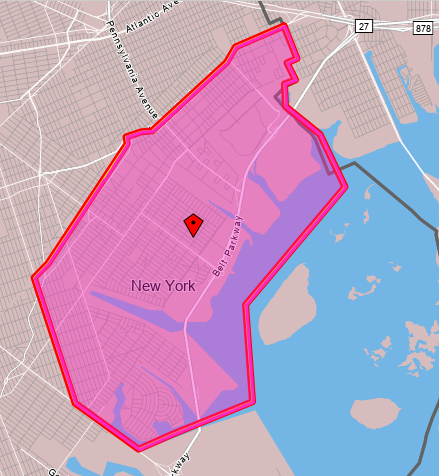
This is on net a bedroom community. In 2019, it had 85,427 employed residents and 39,382 jobs. Very few people both live and work in this area – only 4,005. This is an even smaller proportion than is typical in the city, where 8% of employed city residents work in the same community board they live in – the study zone is slightly smaller than Brooklyn Community Board 18, but CB 18 writ large also has a lower than average share of in-board workers.
In contrast with the limited extent of in-zone work travel, nearly all employed zone residents, 76,534, work in the city as opposed to its suburbs (and 31,685 of the zone’s 39,382 jobs are held by city residents). Where they work looks like where city workers work in general, since the transportation system other than the Shore Parkway is so radial:
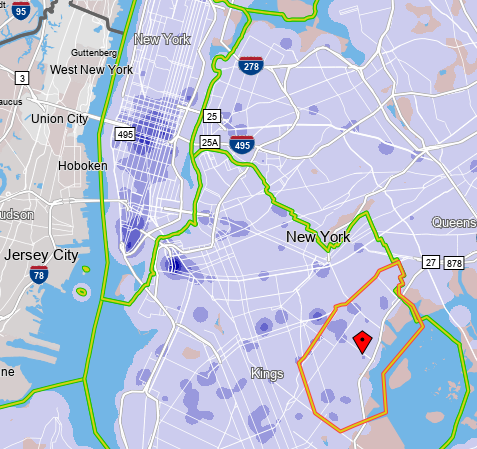
Within the zone, the southwestern areas, that is Mill Basin and Bergen Beach, are vaguely near Utica Avenue, hosting the B46 and hopefully in the future a subway line, first as an extension of the 4 train and later as an independent trunk line.
To the northeast, Canarsie, Starrett City, and Spring Creek are all far from the subway, and connect to it by dedicated buses to an outer subway station – see more details on the borough’s bus map. Canarsie is connected to the L subway station named after it by the B42, a short but high-productivity bus route, and to the 3 and 4 trains at Utica by the B17, also a high-productivity route. Starrett City does not have such strong dedicated buses: it is the outer terminus of the circumferential B82 (which is very strong), but its dedicated radial route, the B83 to Broadway Junction, is meandering and has slightly below-average ridership for its length. Spring Creek is the worst: it is a commercial rather than residential area, anchored by the Gateway Center mall, but the mall is served by buses entering it from the south and not the north, including the B83, the B84 to New Lots on the 3 (a half-hourly bus with practically no ridership), the rather weak B13 to Crescent Street and Ridgewood, and the Q8 to Jamaica.
The implications for bus design
The paucity of east-west throughfares in this area deeply impacts how bus redesign in Brooklyn ought to be done, and this proved important when Eric and I wrote our bus redesign proposal.
First, there are so few crossings between Brooklyn and Queens that the routes crossing between the two boroughs are constrained and can be handled separately. This means that it’s plausible to design separate bus networks for Brooklyn and Queens. In 2018 it was unclear whether they’d be designed separately or together; the MTA has since done them separately, which is the correct decision. The difficulty of crossings argues in favor of separation, and so does the difference in density pattern between the two boroughs: Brooklyn has fairly isotropic density thanks to high-density construction in Coney Island, which argues in favor of high uniform frequency borough-wide, whereas Queens grades to lower density toward the east, which argues in favor of more and less frequent routes depending on neighborhood details.
Second, the situation in Starrett City is unacceptable. This is an extremely poor, transit-dependent neighborhood, and right now its bus connections to the rest of the world are lacking. The B82 is a strong bus route but many rush hour buses only run from the L train west; at Starrett City, the frequency is a local bus every 10-12 minutes and another SBS bus every 10-12 minutes, never overlying to produce high base frequency. The B83 meanders and has low ridership accordingly; it should be combined with the B20 to produce a straight bus route going direct on Pennsylvania Avenue between Starrett City and Broadway Junction, offering neighborhood residents a more convenient connection to the subway.
Third, the situation in Spring Creek is unacceptable as well. Gateway Center is a recent development, dating only to 2002, long after the last major revision of Brooklyn buses. The bus network grew haphazardly to serve it, and does so from the wrong direction, forcing riders into a circuitous route. Only residents of Starrett City have any direct route to the mall, but whereas Starrett City has 5,724 employed residents (south of Flatlands), and Spring Creek has 4,980 workers, only 26 people commute from Starrett City to Spring Creek. It’s far more important to connect Spring Creek with the rest of the city, which means buses entering it from the north, not the south. Our bus redesign proposal does that with two routes: a B6/B82 extension making this and not Starrett City the eastern anchor, and a completely redone B13 going directly north from the mall to New Lots and thence hitting Euclid Avenue on the A/C and Crescent Street on the J/Z.
What about rail expansion?
New York should be looking at subway expansion, and not just Second Avenue Subway. Is subway expansion a good solution for the travel needs of this study zone?
For our purposes, we should start with the map of the existing subway system; the colors indicate deinterlining, but otherwise the system is exactly as it is today, save for a one-stop extension of the Eastern Parkway Line from New Lots to the existing railyard.

Starrett City does not lie on or near any obvious subway expansion; any rail there has to be a tram. But Canarsie is where any L extension would go – in fact, the Canarsie Line used to go there until it was curtailed to its current terminus in 1917, as the trains ran at-grade and grade-separating them in order to run third rail was considered impractically expensive. Likewise, extending the Eastern Parkway Line through the yard to Gateway Center is a natural expansion, running on Elton Street.
Both potential extensions should be considered on a cost per rider basis. In both cases, a big question is whether they can be built elevated – neither Rockaway Parkway nor Elton is an especially wide street most of the way, about 24 or 27 meters wide with 20-meter narrows. The Gateway extension would be around 1.3 km and the Canarsie one 1.8 km to Seaview Avenue or 2.3 km to the waterfront. These should cost around $250 million and $500 million respectively underground, and somewhat less elevated – I’m tempted to say elevated extensions are half as expensive, but this far out of city center, the underground premium should be lower, especially if cut-and-cover construction is viable, which it should be; let’s call it two-thirds as expensive above-ground.
Is there enough ridership to justify such expansion?
Let’s start with Canarsie, which has 28,515 employed residents between Flatlands and the water. Those workers mostly don’t work along the L, which manages to miss all of the city’s main job centers, but the L does have good connections to lines connecting to Downtown Brooklyn (A/C), Lower Manhattan (A/C again), and Midtown (4/5/6, N/Q/R/W, F/M, A/C/E). Moreover, the density within the neighborhood is uniform, and so many of the 28,515 are not really near where the subway would go – Rockaway/Flatlands, Rockaway/Avenue L, Rockaway/Seaview, and perhaps Belt Parkway for the waterfront. Within 500 meters of Rockaway/L and Rockaway/Seaview there are only 9,602 employed residents, but then it can be expected that nearly all would use the subway.
The B42 an B17 provide a lower limit to the potential ridership of a subway extension. The subway would literally replace the B42 and its roughly 4,000 weekday riders; nearly all of the 10,000 riders of the B17 would likely switch as well. What’s more, those buses were seeing decreases in ridership even before corona due to traffic and higher wages inducing people to switch away from buses – and in 2011, despite high unemployment, those two routes combined to 18,000 weekday riders.
If that’s the market, then $500 million/18,000 weekday riders is great and should be built.
Let’s look at Gateway now. Spring Creek has 4,980 workers, but first of all, only 3,513 live in the city. Their incomes are very low – of the 3,513, only 1,030, or 29%, earned as much as $40,000/year in 2019 – which makes even circuitous mass transit more competitive with cars. There’s a notable concentration of Spring Creek workers among people living vaguely near the 3/4 trains in Brooklyn, which may be explained by the bus connections; fortunately, there’s also a concentration among people living near the proposed IBX route in both Brooklyn and Queens.
The area is the opposite of a bedroom community, unlike the other areas within the study zone – only 1,114 employed people live in it. Going one block north of Flatlands boosts this to 1,923, but a block north of Flatlands it’s plausible to walk to a station at Linden at the existing railyard. 51% of the 1,114 and 54% of the 1,923 earn at least $40,000 a year. Beyond that, it’s hard to see where neighborhood residents work – nearly 40% work in the public sector and OnTheMap’s limitations are such that many of those are deemed to be working at Brooklyn Borough Hall regardless of their actual commute destination.
There’s non-work travel to such a big shopping center, but there are grounds to discount it. It’s grown around the Shore Parkway, and it’s likely that every shopper in the area who can afford a car drives in; in Germany, with generally good off-peak frequency and colocation of retail at train stations, the modal split for public transit is lower for shopping trips than for commutes to work or school. Such trips can boost a Gateway Center subway extension but they’re likely secondary, at least in the medium run.
The work travel to the mall is thankfully on the margin of good enough to justify a subway at $50,000/daily trip, itself a marginal cost. Much depends on IBX, which would help deliver passengers to nearby subway nodes, permitting such radial extensions to get more ridership.
Adversarial Legalism and Accessibility
New York State just announced that per the result of a legal settlement, it is committing to make 95% of the subway accessible… by 2055. Every decade, 80-90 stations will be made accessible, out of 472. Area advocates for disability rights are elated; in addition to those cited in the press release or in the New York Times article covering the news, Effective Transit Alliance colleague Jessica Murray speaks of it as a great win and notes that, “The courts are the only true enforcement mechanism of the Americans with Disabilities Act.” But to me, it’s an example not of the success of the use of the courts for civil rights purposes, in what is called adversarial legalism, but rather its failure. The timeline is a travesty and the system of setting the government against itself with the courts as the ultimate arbiter must be viewed as a dead-end and replaced with stronger administration.
The starting point for what is wrong is that 2055 is, frankly, a disgrace. By the standards of most other old urban metro systems, it is a generation behind. In Berlin, where the U-Bahn opened in 1902, two years before the New York City Subway did, there has been media criticism of BVG for missing its 2022 deadline for full accessibility; 80% of the system is accessible, and BVG says that it will reach 100% in 2024. Madrid is slower, planning only for 82% by 2028, with full accessibility possible in the 2030s. Barcelona is 93% accessible and is in the process of retrofitting its remaining stations. Milan has onerous restrictions such that only one wheelchair user may board each train, but the majority of stations have elevators, and 76% have elevators or stairlifts. In Tokyo, Toei is entirely accessible, and so is nearly the entirety of Tokyo Metro. Even London is 40% accessible, somewhat ahead of New York. Only Paris stands as a less accessible major world metro system.
The primary reason for this is costs. The current program to make 81 stations accessible by 2025 is $5.2 billion. This is $64 million per station, and nearly all are single-line stations requiring three elevators, one between the street and the outside of fare control and one from just inside fare control to each of two side platforms. Berlin usually only requires one elevator as it has island platforms and no fare barriers, but sometimes it needs two at stations with side platforms, and the costs look like 1.5-2 million € per elevator. Madrid the cost per elevator is slightly higher, 3.2 million €. New York, in contrast, spends $20 million, so that a single station in New York is comparable in scope to the entirety of the remainder of the Berlin U-Bahn.
And this is what adversarial legalism can’t fix. The courts can compel the MTA to install elevators, but have no way of ensuring the MTA do so efficiently. They can look at capital plans and decree that a certain proportion be spent on accessibility; seeing $50 billion five-year capital plans, they can say, okay, you need to spend 5-10% of that on subway accessibility. But if the MTA says that a station costs $64 million to retrofit and therefore there is no room in the budget to do it by 2030, the courts have to defer.
This, in turn, is a severe misjudgment of what the purpose of civil rights legislation is. Civil rights laws giving individuals and classes the right to sue the government already presuppose that the government may be racist, sexist, or ableist. This is why they confer individual and group rights to sue under Title VI (racial equality in transportation and other facilities), Title IX (gender equality in education), and the ADA. If the intention was to defer to the judgment of government agencies, no such laws would be necessary.
And yet, the nature of adversarial legalism is that on factual details, courts are forced to defer to government agencies. If the MTA says it costs $64 million to retrofit a station, the courts do not have the power to dismiss managers and hire people who can do it for $10 million. If the MTA says it has friction with utilities, the courts cannot compel the utilities to stop being secretive and share the map of underground infrastructure in the city or to stop being obstructive and start cooperating with the MTA’s contractors when they need to do street work to root an elevator. Judges are competent in legal analysis and incompetent in planning or engineering, and this is the result.
Worse, the adversarial process encourages obstructive behavior. The response to any request from the public or the media soon becomes “make me”; former Capital Construction head and current MTA head Janno Lieber said “file a Freedom of Information request” to a journalist who asked what 400 questions federal regulators asked regarding congestion pricing. Nothing goes forward this way, unless accessibility in 33 years counts, and it shouldn’t.
How Washington Should Spend $10 Billion
The planned $10 billion expansion of Washington Union Station is a waste of money, but this does not mean that money appropriated for public transportation in the National Capital Region is a waste. The region has real transportation needs that should be addressed through urban rail expansion – just not through a rebuild of the intercity rail station. Those needs include local and regional travel, to be addressed through investment in both the Metro and the commuter rail networks. It is fortunate that when I probed on Twitter, there was broad if imperfect agreement among area advocates about what to do.
A $10 billion budget should be spent predominantly on new Metro Rail lines, carefully chosen to satisfy multiple goals at once: physical expansion of the reach of the system, additional core capacity, and deinterlining to improve reliability and increase the capacity of existing lines. For the purposes of the question I posed to area advocates, I set the expansion budget at $7.5 billion, good for 30 km at average global prices, leaving the rest for commuter rail improvements.
What to do about commuter rail
Washington does not have a large legacy commuter rail network, unlike New York, Chicago, Boston, or Philadelphia. It is not as old as those cities, and its conception as the southern end of an East Coast region stretching up to Boston is postwar, by which point investment in passenger rail was largely relegated to the past. Nonetheless, it does have some lines, three to the north as the MARC system and two to the south as the VRE system. They should be upgraded to better commuter rail standards.
Union Station already has the infrastructure for through-running. The junction between the through-tunnel and the terminal tracks is flat, and almost all intercity trains terminate and most will indefinitely no matter how much investment there is in high-speed rail to points south. This requires delicate scheduling, which is good up to about 18 trains per hour in each direction, either six through- and 12 terminating or the other way around. Running half-hourly all-day service on each of the lines, with some additional urban overlay in Virginia and extra service on the Penn Line to Baltimore, should not be too difficult.
Thus, the main spending items on the agenda are not new tracks, but electrification and high platforms. MARC runs diesel trains even under catenary on the Northeast Corridor, which problem requires no additional electrification to fix, but its other two lines are unelectrified, and VRE has no electrification infrastructure. Those lines total 327 route-km of required wiring, with extensive single-tracking reducing per-km cost; this should be around $600 million. But note that they all carry significant freight traffic, and additional accommodations may be necessary.
As far as platforms go, there are nearly 50 stations requiring high platforms (I think 49 but I may have miscounted). At Boston costs it should be $1 billion or a bit more, but that’s for long trains, and MARC trains are not so long, and a system based on shorter trains at higher frequency would be somewhat cheaper. Infill stations are probably unnecessary – there are Metro Rail lines along the inner sections of most of the lines providing the urban rail layer.
Metro Rail expansion
The most pressing problem WMATA’s trains have is poor reliability. Two changes in the late 2000s and 2010s made the system worse: the 2009 elimination of automatic (though not driverless) operations worsened ride quality and reducing capacity, and the 2014 opening of the Silver Line introduced too much interlining reducing both reliability and capacity. WMATA is aware of the first problem and is working to restore ATO; the Silver Line’s problems should be fixed through judicious use of deinterlining. Deinterlining by itself only requires a short extension of the Yellow Line to separate the lines, but it can be bundled with further expansion.
Consensus among area advocates is that there should be separate tunnels for the Yellow and Blue Lines and a new trunk line under Columbia Pike, which three lines total 21 km. Additional lines can consist of another trunk line going northeast from Union Station between the Brunswick and Camden Lines or an extension of the Columbia Pike line from Bailey’s Crossroads, the present outer limit of high density, to Annandale, which would require extension transit-oriented development along the line.
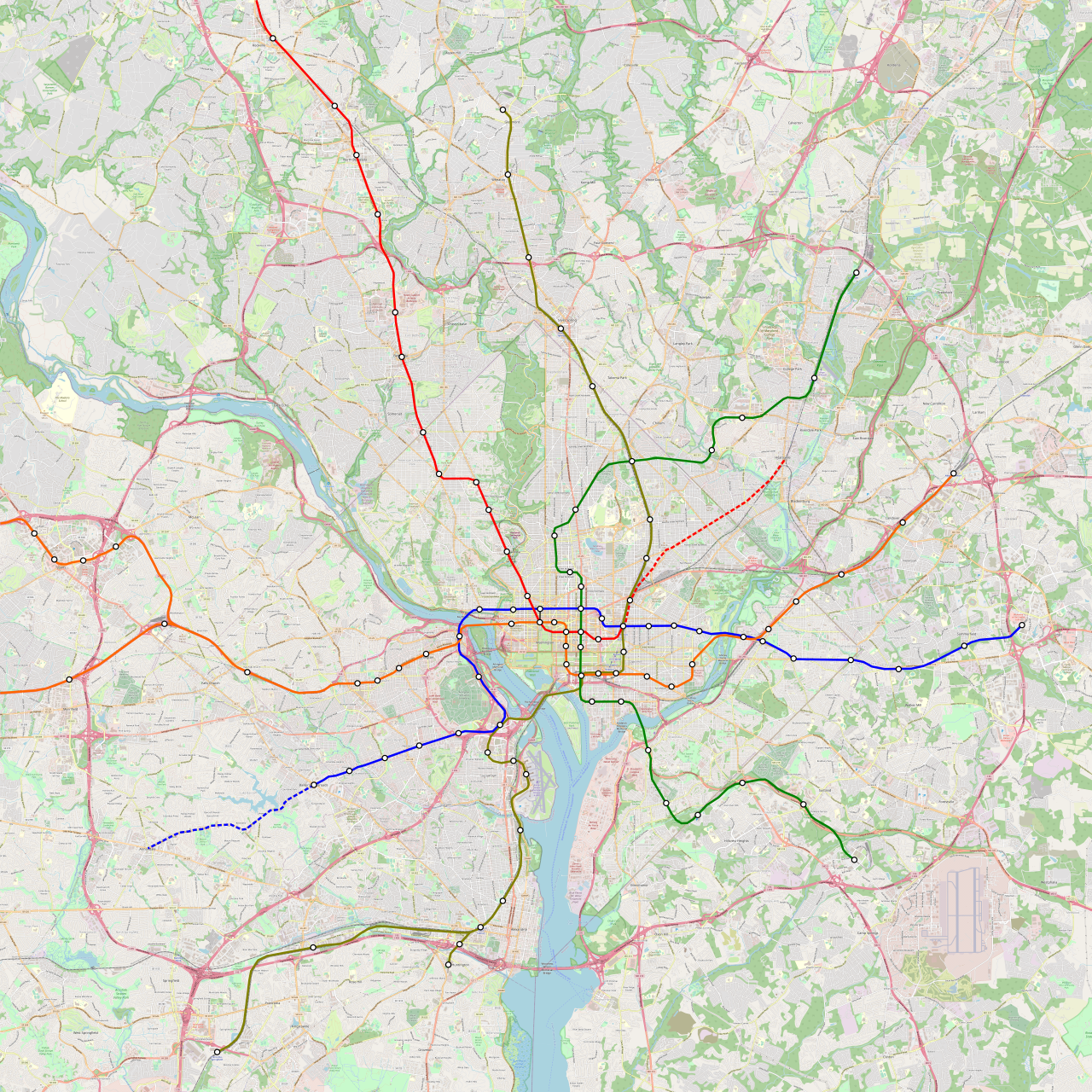
A full-size version can be found here; note that the lines at Union Station are moved around to get rid of the Red Line’s awkward U-shape. The northeast extension option is colored red but should be a Blue Line extension, but the Red Line taking over H Street and going to Largo.
 Pedestrian Observations