Category: Transportation
Trust and Environmentalism
I’m at Ecomodernism 2018, a conference by the Breakthrough Institute in exurban Northern Virginia. It’s not much of an infrastructure or transportation conference (although Breakthrough tells me they are getting interested in these subjects), so I instead went to a breakout session about nuclear power. The session was better than other parts of the conference, but was still not great in the sense that what I saw of it made me less sympathetic to nuclear power than I was before. I want to describe my thought process here, not because nuclear power is a relevant subject to this blog (whatever opinion on it I hold is tepid) but because it showcases how trust works and how people in power need to listen to critics.
Before I go further, I want to make it clear that I did not go to the entire session. It was a two-hour discussion in a circle; an hour in I had to run to the bathroom, and while there I discovered that my flight back to Paris got canceled due to airline bankruptcy and had to run to my room to look for alternatives. So it’s entirely possible my concerns were addressed in the second hour, although judging by where the discussion was going when I left, I doubt it.
What I saw at the discussion concerned technical issues regarding costs and regulations. As far as I remember, everyone at the 19-person discussion other than me had some ties to nuclear advocacy or the industry, except possibly one law professor who was involved in the debate over nuclear regulations. People with background in the industry talked about how American regulations are excessively cautious about safety zones (and in response to my question told me the rest of the world mostly follows American regulations). The law professor asked if modernizing the regulations would always mean loosening controls or if there were places where tightening was required; two people gave convoluted replies that basically said they were only talking about loosening rules without explicitly saying so.
Missing from the entire discussion as far as I could see was the issue of trust. Nuclear power requires immense personal trust in the firms building the plants and in the state. Nuclear advocates keep explaining that first-world regulatory regimes are a lot stronger than whatever the Soviet Union had during Chernobyl. But it’s hard to understand to what extent this is true without very deep ties to the conversation. On a car or a train, it’s easy for a passenger to feel that something is wrong – that there is a lot of sway, that the train driver is overrunning platforms, that the road is visibly in poor condition, etc. There’s no need to trust that the system is safe because passengers can readily see that it is safe. A nuclear plant is different: one minute it’s working, the next minute it’s blowing up.
In cultural theory, trust is mostly an egalitarian issue. To the egalitarian, the exact details of the regulations don’t matter nearly as much as the population’s ability to trust that the regulators are honest. Producing this kind of honesty is hard.
Even hierarchical institutions are full of folklore about people in power being stupid or dishonest. World War Two, the epitome of hierarchy, still produced Catch-22 and copious enlisted folklore about obstructive officers. Even my grandfather at one point asked if the anonymous commander of his resistance group in the ghetto was helping dig shelters or whether he was just telling grunts to do so (later he learned that the person he was asking this question of, while they dug the shelters together, was the anonymous commander). Even at their best, hierarchical organizations are necessarily compartmentalized and secret, and never immune to the occasional social climber, narcissist, or asshole (in fact the word “asshole” came out of WW2 lexicon referring to obstructive officers).
To the extent there is a direct connection to transportation, the mode of transportation that elicits the biggest trust concerns is the self-driving car. The airplane elicits a similar fear, but the airline industry has spent the last few decades ruthlessly prioritizing safety over anything else – cost, comfort, flexibility, speed, fuel efficiency. In contrast, the tech industry’s “move fast and break things” ethos not only causes visible accidents (such as Tesla’s occasional crashes or Uber’s fatal AV crash) but also reminds the public that to the industry, safety is a secondary concern to world domination.
This problem gets worse when the industry or the state does not understand it has a trust deficit. In France, I’m pro-nuclear. In the US, I’m more skeptical, because of the morass of conflicting federal and state regulations, local NIMBYism, and industry efforts; at the discussion, when someone brought up financing, I explicitly asked about the state-built plants of South Korea, which the moderator had brought up in a report about nuclear plant costs, and was told that this is not on the agenda for the US.
French regulators have proven themselves more trustworthy to me than American ones, so when Macron calls for expanding nuclear energy I react more positively than when third way American thinktanks do. Similarly, France simultaneously implements or at least tries to implement parallel green policies, such as building more public transit, which helps convince me that Macron’s vision of the future treats decarbonization as a priority. In contrast, Ecomodernism 2018 saw fit to treat “is climate change a serious problem?” as a debate that reasonable people may disagree about, and treats oil and gas expansion as a respectable minority opinion within the movement, which helps convince me its support of nuclear is about pissing off the mainstream green movement and not about providing an extra tool for base load power to avoid the intermittency problem of renewable energy.
If the people who are responsible for implementing such technology misunderstand that they have a trust deficit, they will not do anything about it. At worst, they will talk about how to market the technology, as if the problem is about convincing the public that they’re trustworthy and not about actually putting safety first.
In rationalism, there is something called “steelmanning.” To steelman a position is to find the strongest possible argument for it, even if it is not what one’s interlocutor exactly said. This contrasts with strawmanning, i.e. finding the weakest possible argument and attacking it as unreasonable. Ecomodernism 2018’s first proper session, a discussion with people who changed their minds on environmental issues, brought this term up as a positive, contrasting it with partisan polarization.
As far as I saw at the discussion, the discussion of nuclear power did not steelman the anti-nuclear movement and its emphasis on trust and (in Germany and Japan) the issue of American military involvement.
That said, I don’t believe in steelmanning, because if a movement recurrently fails to make what I think the strongest arguments for its position is, I reserve the right to use it to judge what it considers important. This way I dismiss movement libertarians’ opposition to public transit, because they seem indifferent to cost comparisons; those are a free shot at many US transit projects, but make transit look like a reasonable proposition in some circumstances and suggest improvements that would make it cost-effective, conflicting with Wendell Cox’s maximalist attitude that cars are always superior.
But by the same token, I am compelled to dismiss the ecomodernist line about nuclear energy, which I was sympathetic to until the conference began. There are strong arguments in favor of nuclear power: its safety record in developed countries in the last few decades has been positive, it is less intermittent than solar power, and Germany’s decommissioning of nuclear plants without adequate renewable replacement has not been great for its carbon footprint. On the bus shuttle from Washington to the conference I sat next to someone who convincingly made some of these arguments, explaining that solar costs per watt are understated due to intermittency. But at least the first half of the discussion I attended today neither brought them up (except in the context of the desirability of loosening regulations) nor adequately wrestled with the opposition.
In public transit and urbanism, the same issue sometimes occurs. It’s not as stark as with nuclear plants because people can see changes more readily, but getting people to trust public transit authorities that have recurrently proven themselves incompetent or dishonest is not a trivial task. It is imperative that people who support good transit make it clear that everything has tradeoffs: cost-effective subway lines involve surface disruption (which can be reduced but not eliminated), regional rail modernization means people at some suburban stations will no longer be guaranteed a seat and will definitely not be guaranteed first-class status elevated over the urban working class, fare integration usually comes with an increase in base fares for people who don’t transfer, bus network redesigns make some people’s trips longer and are net negative for passengers with especially high transfer and walking penalties.
Transit is a world of heterogeneous preferences. An optimal network is necessarily a compromise between many different people’s personal weights on reliability, walking time, in-vehicle travel time, etc. As a compromise, it will piss some people off, and it’s necessary to make it very clear what is happening, as agencies reform themselves from the swamp of most American operators to proper transport associations. Trust is critical: just as passengers’ trust in the schedule is crucial to ensure they wait for the bus or train rather than driving or forgoing the trip, people’s trust in the authority to make good decisions is crucial to ensure they participate in and respect the process rather than checking out and treating transportation as an imposition to be avoided whenever possible.
Phased Implementation of Bus Redesign
Jarrett has a good post about the new Auckland bus redesign, which he had been involved in when he worked for international consultancy MRCagney, before he opened his own. He mentions one peculiar aspect of Auckland – namely, that it is so divided by water boundaries that different areas of it have independent surface transit networks – that facilitates gradual implementation. In contrast, in a city with a more connected street network, every route affects every other route, so redesign has to be implemented together, without any intermediate phases. He brings up Brooklyn (together with Queens) as one example of such a connected network, and I feel like I need to explain why a phased approach is appropriate there.
But this is not just about Brooklyn. The question of whether to implement changes abruptly or gradually generalizes to every scale, up to and including the type of regime (democratic, militaristic, communist, etc.). The scope of this post concerns bus networks anywhere. The arguments I bring up in favor of a phased approach in Brooklyn should also give correct answers in other cities, regardless of whether they end up recommending gradualism.
Sharp edges
Jarrett brings up one factor influencing whether phased implementation is appropriate: sharp edges between different parts of the city. In New York, the East River has few road crossings and many rail crossings; only one local bus crosses it in Brooklyn, the half-hourly B39, and only four cross it in Queens.
But even edges that look less sharp than the East River or the Hudson can be so stark so as to permit separate planning on their two sides. The Harlem River is one example: many Bronx buses cross it, but their routes in Manhattan are constrained based on which avenue or street the bridge connects to, so there’s not much scope for creative recombination.
Brooklyn itself has few internal sharp edges. The closest thing to a sharp edge is the combination of Greenwood Cemetery and Prospect Park, separating on one side Park Slope and South Brooklyn and on the other side Flatbush and Southern Brooklyn. A few marginal neighborhoods are sharply divided from the rest of the borough, especially Red Hook. But for those neighborhoods, the question of where in the rest of the borough they should connect to depends on the shape of the rest of the system.
That said, it’s plausible to talk about how the new network would look in various neighborhoods, if there are choke points or generally agreed upon spines. Red Hook is an especially good example, since it has a strong connection to Manhattan via the Brooklyn-Battery Tunnel (hence, our proposed tunnel bus to Lower Manhattan). But as the arguments in comments here over Williamsburg show (and as my constant refrain about the north-south Bed-Stuy routes shows), it’s possible to discuss individual neighborhoods even if they’re more strongly connected, as long as it’s clear that it’s in the context of a greater network.
However, in one aspect, Jarrett and the MTA make a mistake: they treat the edge between Brooklyn and Queens as less sharp than it really is. In the north, the Newtown Creek choke point forces buses to all go up to Long Island City along a single bridge. In the center, a few route mergers passing through Bushwick and Ridgewood (especially the B54/Q55 on Myrtle) are reasonable, but fully integrated planning would not create very many connections. It’s possible to design the network for Brooklyn alone and then notate where Queens connections would happen, just as it’s possible to design a Manhattan network and point out that the M60 goes into Queens.
The subtle issue regarding Brooklyn and Queens concerns what happens in the south. At TransitCenter we were asked about connections to Howard Beach, but when I looked, I ran across a subtle geographic divide. The southeastern margin of Brooklyn and Queens is a series of small peninsulas with weak connections between them: Gerritsen Beach, Mill Basin, Bergen Beach, Canarsie, Starrett City, Spring Creek, Howard Beach, Old Howard Beach. When I crayoned a metro network for Lagos, which has the same problem in the west and northwest, I had to assume new metro bridges connecting various neighborhoods. On a surface transit network in a developed country, such bridges are unlikely to happen, forcing buses to use the main through-routes today, like Flatlands and Linden.
Is it good enough today?
The entire reform versus revolution discourse depends on how bad things are today. It’s unavoidable in discussions of socialism and Marxism. Socialists and even some social democrats hold that mid-20th century social reforms (like the New Deal) saved capitalism from itself, by making the working class’s situation less desperate. As a result, there is a contingent of leftists who call themselves accelerationists, who prefer to make things as bad as they can be (for example, by refusing to back the center-left against the far right) hoping that this would accelerate the revolution.
The “is it good enough today?” principle scales down to any level. When it comes to bus networks, it really asks, how much would the optimal route network differ from today’s situation?
The highly radial buses of San Jose today, Houston before Jarrett’s redesign, and Barcelona before Nova Xarxa all differ greatly from the redesigned networks. This encourages abrupt implementation, in two ways. First, the old routes are generally weak, increasing the pressure to get rid of them. And second, the old routes don’t feed the new grid trunk lines well, whereas the grid trunks feed one another. Nova Xarxa (which is a six-year process, retaining many old lines) has seen its phase 1 lines grow in ridership as each subsequent phase was implemented, making the early stages much less useful than the entire system.
In contrast, Brooklyn is firmly in the good enough basket. This does not mean its current network design is objectively good; it isn’t. But it does mean that most of its key trunk lines should survive redesign with at most light modifications. Among the 15 busiest Brooklyn routes today measured by ridership per km, only three see big changes: the B1 (straightened into a Southern Brooklyn grid), the B82 (cut to Kings Highway, its tails on both sides given to the B6), and the B41 (cut north of the B/Q subway connection at Prospect Park). A few more are merged into longer routes, like the B42 and the B60, but maintain their current route, just with through-service elsewhere. Key grid routes like Lafayette, Church, Nostrand, Avenue M, and Myrtle survive almost unchanged.
The Brooklyn redesign is not predominantly about starting from scratch, since the network today already has the characteristics of an imperfect grid. It’s about consolidating weak and weak-ish routes, straightening some buses that are too circuitous, and switching around buses to serve destinations that have grown stronger since the 1970s redesign. The East New York network in particular has a lot of meanders that should be fixed regardless of what happens anywhere else; the rest of the bus and subway network is good enough that people from East New York can then transfer to it even if increasing trunk frequency happens later.
Future changes
Bus redesigns are not immutable, to be done once in a few decades with long periods of stasis in between. Cities change, and the optimal bus network for 2025 may be different from that for 2019 in some situations. In a city where there’s relative stasis in development intensity, traffic, and any rail trunk, an abrupt change makes more sense. Realistically, such a change would come not when the first phase of a gradual implementation would have been done but when the middle or last phases would have. Thus, if the redesign is a long-lasting product it’s easier to wait for the first phase (which in an abrupt implementation is also the last phase) and not change much afterward.
This relates to California Transit Twitter’s biggest criticism of Jarrett’s San Jose redesign: that it does not incorporate the recent BART extension to Warm Springs. Jarrett unveiled his redesign for VTA in the spring of 2017, expecting BART to be extended from Warm Springs to the San Jose Flea Market at Berryessa by the end of the year, as BART had projected. Based on this expectation, he designed the network around an abrupt implementation, to go into effect shortly after trains would start running to Berryessa. Since then, BART has announced delays to the extension, talking about opening it only at the end of 2019. Trusting BART’s early promises of 2017 opening is an understandable error; Jarrett did not cause the BART timetable slip. But the outcome is that the VTA bus redesign is delayed.
The upshot is that in a city with a rapidly-growing rapid transit network, bus redesigns should be done on a continuous basis, tweaked every time a new subway line opens. The Bay Area is not generally such a city, but BART is expanding into San Jose, so in that part of the region, phased implementation with updates every few years is warranted. By the same principle, a city with rapid changes in where people live and work should expect recurrent changes to its surface transit network; this is less relevant to San Jose, since the growth nodes are the CBD (e.g. the upcoming Google building) and the Apple headquarters in Cupertino, but it’s relevant to cities in which residential areas are commercializing, such as San Francisco with SoMa.
New York, of course, has a static subway system, courtesy of extreme construction costs. It also has a relatively static workplace geography. However, in one respect, it is undergoing rapid change: it is gradually making its subway network accessible. When I say that the optimal networks for 2018, 2022, and 2026 are all different, I say this in reference to upcoming subway accessibility upgrades, as well as potential changes (i.e. de-interlining) that would increase subway frequency at the cost of one-seat rides. In Brooklyn, our plan to get rid of the B25 depends on upcoming accessibility upgrades for Broadway Junction, without which the bus should probably stay as an accessible alternative to the A and C trains. Likewise, our plan to retain the B63 comes from plans to only make the outermost R stations accessible but not the ones in Sunset Park or South Slope.
What about Nova Xarxa?
On two out of three metrics, Barcelona’s layout recommends an abrupt approach: it lacks internal sharp edges, and its preexisting network was too radial to be useful. On the third, it does not: it is rapidly expanding its metro network; however, the implementation of Nova Xarxa as far as I can tell has not been timed for the opening of L9/L10. So why is it phased there?
The fact that the early-phase lines of the network have seen further increases in ridership as the rest of the network has come online suggests that, on purely technical criteria, gradual implementation was not the right choice in Barcelona. However, in political reality, Nova Xarxa could not replace the entire radial network. Most bus routes in Barcelona today are still not Nova Xarxa. The system’s characteristic as an overlay that took over old lines that became superfluous forced it to be done in phases.
Conflicting excuses
In comments, people here have warned that a phased implementation can be an excuse to do nothing: put the few things everyone agrees on in the first phase, do that, and then postpone future phases indefinitely. This is a real risk. However, abrupt change has its own risks as well: it can be used as an excuse not to do low-cost or negative-cost things that can be implemented fast, such as merging the two Myrtle routes, redoing the East New York bus network in advance of the L train shutdown, and opening the Red Hook-Lower Manhattan route.
The upshot is that the question of gradualism seems independent from the question of obstructive bureaucrats and apparatchiks. There may well arise a local situation in which one answer to the main question is less vulnerable to political sabotage than the other, but it depends on idiosyncratic factors and is unlikely to be the case in general.
With the political criteria uncertain, the answer to whether network redesign should be done in one go or in stages should depend only on technical criteria. These differ from city to city and from region to region depending on local physical and urban geography. In New York, they suggest a phased implementation would work; elsewhere, they may not.
Brooklyn Bus Redesign Version 1.2
About two weeks ago, Eric Goldwyn and I unveiled our Brooklyn bus redesign. It consolidates the borough from 550 route-km to about 350, and cuts the number of stops along the surviving lines from 1580 to 706; the increase in speed coming from stop consolidation and other treatments (i.e. bus lanes and prepayment) and the route consolidation together permit doubling the frequency with the same resources available today, guaranteeing that each bus route have at worst 6-minute frequency between 6 am and 10 pm. The first version we released was 1.0, and the version I blogged was 1.1. In this post I’d like to introduce changes as well as explain why we made certain decisions that have been criticized in comments here and elsewhere.
Version 1.2
V1.2 differs from v1.1 in just two ways. First, it was pointed out to me that we made a mistake in the map: the route we proposed for the B6 to take across the structure of the Brighton Line of the subway, at Avenue H, was not in fact a street crossing. At Avenue H the structure goes from trenched to the north to elevated in the south, and as a result the street does not go through. We fixed this error by restoring the present-day route, and also slightly changing the route of the B11 to follow what must be a high-quality bus lane.
And second, months ago, in arguments with former MTA planner Allan Rosen (who comments on blogs by the name BrooklynBus and has his own proposed redesign), there came the question of the route of the B9. Allan was supportive of the idea of running the B9 on Veterans Avenue, taking over what is now a B41 branch, rather than going to Kings Plaza as it does today, legacy of an era when Kings Plaza was a more important shopping destination. I also asked about straightening the route, which currently goes on a combination of Avenues L and M; Avenue M provides a straighter route connecting to the important destinations (the eastern end of the route, and the main drag in Midwood at Avenue M). Allan explained that no, a reroute to Avenue M is not feasible, as east of the heart of Midwood it’s a narrower residential street, forcing the bus to use the wider Avenue L. The only reason the straighter Avenue M route appeared on v1.0 and v1.1 is that I forgot to change it; after we went public with the map, he reminded us.
There are some associated changes to the stop spacing to accommodate the new routes (or, rather, the retention of old routes that we were wrong to try to change before), but overall there is practically no impact on overall trip times. The B9 is a few hundred meters longer than in v1.0 and v1.1, but the cost in on the order of 20 service-hours per weekday, which by itself is a lot lower than my uncertainty in the underlying numbers (which is about 100 hours).
Service-hours vs. fleet requirement
When putting together the redesign, we aimed at one cost metric: service-hours. This is the correct metric for variable bus operating costs, as they are dominated by the driver’s wage (which is hourly, not per km) and to a lesser extent maintenance costs (which are partly distance-based and partly time-based, as the frequent acceleration cycles common to slow bus traffic stress the engine). The MTA costs buses by distance and not time, which is not a bad approximation when all buses are about equally fast, but generates wrong results when the subject of the discussion is speeding up the buses, as we propose.
But there’s one more metric we did not consider: fleet requirement. Our redesign actually saves money there, which should not be a surprise, as it has more off-peak service, which implies less service at the peak. Our 10,000-hour schedule requires a fleet of 1,007 buses, which compares with 1,129 today excluding the MTA Bus-operated B100 and B103 (which look like they require about 40 vehicles between them). Our proposed v1.2 schedule has 7.5% fewer service-hours than today – not because we propose a cut but because we expect future additions and politicized slowdowns to add hours – but 14% fewer buses. The smaller fleet is to be used more intensively and somewhat more efficiently thanks to the removal of short, infrequent routes.
Since the goal is to keep the redesign roughly cost-neutral, it’s likely that overall service-hour figures will rise: higher operating costs will be balanced by slightly lower capital costs, as the MTA will need to procure slightly fewer buses and not need to expand depots for them as much. In 2008-11, the MTA spent $500,000 per bus on procurement; in 2014, this was the cost per standard bus (which is the vast majority of the MTA Bus and NYCT fleet), while articulated buses were $750,000. This is a premium of about 50% over London bus costs.
Overall the fleet requirement looks like a small proportion of the cost. A $500,000 bus, say $600,000 at today’s higher prices, operates for 12 years, and requires a team of about five drivers, each earning around $140,000 a year with benefits. This is just about market wage – San Francisco and Boston, which pay about the same, have trouble finding and retaining drivers; high bus driver wages should be viewed as similar to high wages for oil rig workers, compensating for poor work conditions. Excluding the costs of depot enlargement, the overall exchange rate seems to be about one bus = 40-45 daily service-minutes. At best, our redesign can squeeze maybe 100 extra daily hours out of better fleet utilization.
The Williamsburg issue
As Eric and I have always emphasized in our communications, our redesign is necessarily win-lose – it’s just that there’s overall much more winning than losing. This is true across neighborhoods as well as within neighborhoods. The diciest case is that of Williamsburg, where we are proposing to consolidate a number of routes into 1.5 north-south trunk lines: one is a continuation of the B44 running up Bedford, and the other goes up Graham and thence either Manhattan Avenue (connecting to the G) or McGuinness (a straighter route on a wider street). This guts service to South Williamsburg, especially west of the BQE, where the only remaining stops are the Marcy Avenue J/M/Z subway stop and another stop on Broadway at Bedford.
It’s not an optimal situation. However, it’s a necessary cut, for a number of reasons:
- The existing north-south lines in Williamsburg are for the most part quite weak. The average weekday ridership per route-km in Brooklyn is about 1,100. The Williamsburg routes are at 945 (B43), 613 (B62), 414 (B67), 358 (B48), 225 (B24), and 152 (B32). The strongest two run along the routes that we are retaining for north-south service, but the rest are so weak that consolidation is required; for the same reason, we are replacing the B48 and B69 (which is at 453) in Clinton Hill with a compromise route on Washington.
- The Williamsburg routes are not just weak but also wasteful, measured in ridership per service-hour. Borough average is 55, and the overall strong routes cluster in the 60s, with high ridership balanced by high service. The top three routes are the B74 (98), B1 (82), and B36 (70), serving short-hop trips in Southern Brooklyn. Among the Williamsburg, only the B43 (49) holds up; the B62 (42), B67 (39), B32 (35), B24 (35), and B48 (32) are weak, the last three all falling in the borough’s bottom six.
- The main north-south route in South Williamsburg west of the BQE is Bedford. Unfortunately, a continuous route up Bedford misses the all-important connection to the subway at Marcy. The B62 resolves this issue by detouring to serve Marcy, which slows down through-riders.
- Williamsburg streets are narrow. Even Bedford is only 18 meters wide, comparable to a Manhattan street. Bus speeds are unlikely to be high in such a situation, and bus lanes are guaranteed to be contentious due to the removal of on-street parking and loading access.
- The eastern margins of Williamsburg and Greenpoint are awkwardly just too far away for some people to walk to the subway (Meeker Avenue’s easternmost residential area, at Van Dam, is 960 meters from the nearest bus stop in our plan and 1,370 from the G train), but just close enough that most people will still walk rather than take a bus unless the bus is extremely frequent. Without the travel intensity found in Coney Island and at Kingsborough Community College, there is no hope for the travel volumes justifying very high frequency on the routes there, especially the B1. A frequency-ridership spiral is unavoidable, helping explain the poor performance of the B24 and B48.
The only possible compromise is to keep the B44’s current route on Lee, which in our plan we slightly straightened to reach the Marcy subway station faster. Keeping the northbound direction on Bedford, which serves South Williamsburg more centrally than Lee, is out of the question: south of Flushing Avenue, Nostrand is unambiguously more important, and the northern tail of the B44 is too weak to be allowed to drive the placement of the entire route. The cost of restoring the Lee/Taylor bus stop is small, around 12 daily service-hours, and this can be incorporated into the next version. However, it still only serves the area peripherally, and slows through-riders by around 1.5 minutes each way.
Brooklyn-Queens connections
People have told us that interborough connections are the new hot thing, to replace the borough-by-borough bus planning that currently exists. We are not depicting any on our map beyond what currently exists: one route to JFK, the aforementioned north-south Williamsburg route to Long Island City, and a bunch of east-west routes through Bed-Stuy terminating slightly east of the borough line. We are willing to be convinced otherwise, but so far it seems like adding more connections is difficult, for several unrelated reasons.
Hard boundaries
The Brooklyn-Queens border may not be as stark as the East River or the Harlem River, but it is nonetheless mostly hard. East of the Greenpoint/LIC border, the border follows a polluted industrial creek; the B24 crosses it twice and is very weak, and there’s no good route until the cluster of Grand, Metropolitan, and Flushing around Ridgewood. Metropolitan and Grand do go through, and we indicate them on our map. Flushing doesn’t; there’s no good route in Queens to connect it to except maybe a hybrid of the Q18 and Q47 to LaGuardia, and even that is uncertain.
Beyond Ridgewood, there is another hard boundary consisting of several cemeteries. The B13 goes through today, but is a weak route (473 riders/km, 38/hour) and should be cut to just a north-south subway feeder. To the immediate south of the cemeteries, several Queens buses go through to key connection points in Brooklyn. Only the southernmost zone, around Howard Beach, has weak connections.
Queens is not Brooklyn
Brooklyn is relatively uniformly dense, making a grid with uniformly high frequency tenable. Queens is not. East Elmhurst is several times denser than Queens Village. Central and Eastern Queens have a street hierarchy, in which the list of which streets get bus routes is preordained: Lefferts, Jamaica, Union Turnpike, Main, etc.; it’s not the relatively flat grid hierarchy that characterizes most of Brooklyn. There are multiple town centers to serve, with too sparse a rail network for buses to work purely as a rail feeder. The LIRR has so many stations that there are two distinct optimal maps, one assuming fare and schedule integration with commuter rail and one assuming today’s lack of integration.
What this means is that maybe a uniform 6-minute frequency is not right for Queens. Maybe the larger geographic size of Queens, with longer bus routes, permits slightly lower frequency, say every 8 minutes at the base (maybe even every 10). Combining routes is not always the right approach in this situation; there are going to be frequency-based seams.
Depot locations
There are some potential combinations of Brooklyn and Queens bus routes, most obviously on Avenue, which hosts the B54 and Q55. The B12 could even be combined with the Q56 and Q24 as branches. The Q58, an extremely strong circumferential, could be combined with the B38, the busiest Brooklyn route near its terminus. The problem is that the break points today tend to be very close to bus depots, and often they’re major destinations in their own right, such as the subway connection point at Broadway Junction or at Myrtle/Wyckhoff.
The B54/Q55 combination seems relatively easy, but the rest are more strained. At East New York Depot especially the loss of the easy pullout is unlikely to justify cutting the transfer to the few through-riders.
The City Line problem
At TransitCenter, we were asked specifically about the southernmost part of the Brooklyn/Queens border, covering City Line and Spring Creek on the Brooklyn side and Lindenwood and Howard Beach on the Queens side. The bus network there today is glaring in its gaps: there is no east-west connection south of the Q7 (the B15 looks like a connection on a map, but runs nonstop from Brooklyn to JFK). The street network itself is poorly connected, but even the existing connection at Linden doesn’t host local buses.
And yet, there’s not much room for serious improvements. The B15 could make a stop just over the border on the Queens side, but its route to the airport takes it through a highway with nowhere to stop; a BRT lane with some stops at north-south arteries like Woodhaven might be possible, but would not be a pleasant place to transfer at.
Worse, going on Linden and then southeast toward Howard Beach raises a difficult question: where does such a route go on the Brooklyn side? There are too many options: Gateway Center, New Lots on the 3, Euclid on the A/C. Reverse-branching is out of the question. Of those, probably the best is New Lots – Euclid serves a subway line that Howard Beach can get to more easily without the bus, and Gateway will always be too circuitous compared with driving on the Belt Parkway.
Tweaks vs. redesign
There are tweaks that improve Brooklyn-Queens connectivity, like merging the two Myrtle routes, giving the Brooklyn-JFK route dedicated lanes to facilitate a stop at Woodhaven, and changing the Metropolitan and Grand routes slightly to improve intra-Williamsburg east-west service (already depicted on our map). However, this is not the same as a redesign. In some parts of Brooklyn our proposal is a tweak, for example the east-west routes in Bed-Stuy, but in Southern Brooklyn and East New York we are rationalizing nearly everything into a grid, and in Bushwick and Canarsie we are proposing extensive changes.
Additional routes?
Based on the shape of our proposal, there are a few potential additions. One involves a 16th Avenue north-south route, possibly veering east to follow Cortelyou and Beverly. Another involves an Ocean Parkway bus to Church. A third involves extending the B17 up through Bed-Stuy to provide a second interpolating route between Nostrand and Malcolm X, which is available today (as the B15 and B43) but not on our map. A fourth involves going up Smith Street between Red Hook and Downtown Brooklyn until the subway stops in South Brooklyn are made wheelchair-accessible.
However, all of those add a hefty number of service-hours. Whether they’re tenable depends on how strictly NYC DOT implements our recommendations for dedicated lanes on every bus route. If no bus routes are added on top of the ones that exist today, v1.2 requires 11,050 revenue-hours and 1108 buses. This is still more or less achievable with current resources (it requires about a 1-1.5% increase in costs), but there is no room for any additional routes, or for restoring the B25. And that’s without taking into account compromises on bus stop spacing and bus route reliability.
In contrast, things are rosier if the reliability improvements we prescribe are implemented, and if every bus that needs a dedicated lane (i.e. nearly all of them) gets it even if motorists complain. There’s room in the budget for additional service. The above bus routes, excluding B25 restoration, total about 30 km including some possible tie-ins elsewhere in the system, creating nearly 800 new service-hours, bringing the system to the same place it is today, maybe just 1% short given additional efficiency and fleet savings.
And if higher ridership brings in more revenue for the same expense, there should be room for more service increases. The network in v1.2 could support maximum 5-minute peak headways on all routes for 210 more hours, which should not be hard to accommodate even with more routes. Going down to 4-minute peak headways requires another 370 hours, and going to 5-minute off-peak headways requires another 890.
To do all of this, another 1,300 hours or so are needed net of efficiency gains. To keep the subsidy per rider constant, this requires a 12% gain in overall linked trips, which isn’t outlandish (it would still leave Brooklyn with less bus ridership than at the 2002 peak). Making such expansion cost-neutral is harder: a linked trip nets about $2 in revenue, and this expansion would cost about $95 million annually, and then the required growth in ridership, 47.5 million, is 25% over Brooklyn’s unlinked bus ridership. It still looks achievable but very ambitious, relying on a positive frequency-ridership spiral.
Will this happen?
Some variant of a bus redesign will definitely happen. It’s in vogue in the US right now, and the MTA is taking this as an excuse to rationalize its bus service, which has accumulated a lot of oddities and historical artifacts that no longer make much sense.
The question is, will a good redesign happen? That I don’t know. I believe our redesign is good. The conversations I’ve had with bus planners at the MTA have been positive and suggest to me that, barring political interference, they are likely to come up with good redesigns as well, sharing the same overall characteristics as ours. We are working from the same set of best practices, for the most part.
But then the political question looms large. Physically separated bus lanes and signal priority require the city to give a damn about bus riders. Stop consolidation requires the MTA to stick to a long interstation even if minority of people who are hurt by it (e.g. by having high walk penalties and low wait penalties) complain. All of this requires political appointees at DOT and the MTA to consciously think how they can provide better public transit to the city they serve. Will they deliver?
Our Brooklyn Bus Redesign
Eric Goldwyn and I spent about six months working on a Brooklyn bus redesign. I mentioned some aspects of it before here, on social media, and in blog comments, but not the overall shape. Eric and I gave a pair of presentations about our plan, one two days ago at the MTA in front of senior MTA planners and NYC DOT people and one today at TransitCenter in front of activists and mid-level MTA planners. We have a still-unreleased writeup explaining everything we’re doing with references to both public reports from various cities and peer-reviewed literature. Here I’m going to condense the 8,000-word writeup into a blog post length, going over the main points, including of course the proposed map.
The map, in brief
The depicted version is 1.1. You can see a lower-resolution version 1.0 on Streetsblog, albeit with a different color code (the map we made for the presentation, reproduced on Streetsblog, uses red for the highest-frequency routes and blue for the lowest-frequency ones whereas the Google Earth version linked above is the opposite). It has 353 route-km, down from about 550 today, not including Grand and Metropolitan Avenues, which are Queens bus routes, shown on the map for completeness’s sake, without stopping pattern.
Some tails are cut due to low ridership or duplication of rail:
- The B25 on Fulton goes.
- The B37 on Third Avenue is consolidated into the B63 on Fifth.
- The B45 and B65 are merged into one compromise route.
- The B15 is cut east of the Long-Term Parking JFK AirTrain station (where service is free); ideally it would be cut east of City Line with passengers taking the subway to the AirTrain (as was the case in version 1.0), but I do not expect Port Authority to integrate AirTrain fares with the subway.
- The B41 is cut north of Parkside Avenue, at the transfer to the B/Q.
- Instead of two routes in Bed-Stuy between Nostrand (i.e. B44) and Malcolm X (i.e. B46), today’s B15 and B43, there’s just one route.
- The B57 segment on Court and Smith Streets in South Brooklyn goes, as the subway serves the area in several directions.
- The B39 over the Williamsburg Bridge goes.
- The B32 and B62, providing north-south service through Williamsburg up to Long Island City, are merged into one compromise route.
- The East New York bus network is circuitous (buses go to Gateway Center the long way around) and is straightened here.
- In version 1.0, the B26 on Halsey was cut west of Franklin with a forced transfer to the subway, but the short distance to Downtown Brooklyn argues in favor of continuing to at least Flatbush.
Overall, this is a cut from 54 routes (including the separately-managed MTA Bus routes B100 and B103) to 37. The smaller network is far more frequent. The minimum frequency is,
- Every 6 minutes between 6 am and 10 pm every day.
- Every 10 minutes between 5 and 6 am and between 10 pm and midnight.
- Every 30 minutes between midnight and 5 am; every 20 minutes with timed transfers to the subway is aspirational, but the subway doesn’t run reliably on a timetable overnight for such a system to be viable. The 30-minute night network could potentially involve mini-pulses in Downtown Brooklyn and smaller hubs (like East New York and Bay Ridge).
Routes depicted in red on the Google Maps link, or in blue on the map in the Streetsblog link, have exactly the minimum frequency. Routes depicted in green have higher frequency at the peak; routes depicted in blue on Google Maps or red on Streetsblog have higher frequency peak and off-peak. Higher frequency than the minimum is depicted as “Utica [2/4]” (buses on Utica run every 2 minutes peak, 4 off-peak) or “Avenue U [5/6]” (buses on Avenue U run every 5 minutes peak, 6 off-peak). Peak means 7-9 am and 5-7 pm on weekdays, in both directions; the morning peak is a little earlier and the afternoon peak a little later than the subway peak, but as buses are still mostly subway feeders, an earlier morning peak and a later afternoon peak are justifiable.
Speedup treatments
Pruning the network is not the only or even most important part of bus reform. Buses have to be sped up to be useful for people except as last-resort transit. In interviews about unrelated topics, people have volunteered to me that they do not take trips they used to take due to the degradation in bus speed and reliability. New York City Transit bus ridership peaked in 2002; the fare hike in 2003 led to a small dip in ridership that the mid-2000s oil crisis didn’t quite erase, and then in the recession and subsequent recovery bus ridership crashed. In Manhattan it’s 30% below the 2007 level; in Brooklyn it’s 20% below the 2007 level, with buses extending the subway or letting people connect to a better line (like the B41 and B35) particularly hit.
The current average speed in Brooklyn is about 11 km/h. Excluding limited-stop buses, it’s 10.8. We’re proposing to increase it to 15, even though the redesign is pruning buses in faster areas more than in slower ones. This is using four speedup treatments.
Prepayment
Today, New York prefers to treat off-board fare collection as a special product available only on select buses (i.e. SBS). This should be changed to citywide prepayment, with all-door boarding. German-speaking cities do it; so does San Francisco. Data from San Francisco and from the TRB (PDF-p. 20) suggests a gain of about 2.5-3 seconds per passenger boarding, counting both boarding and alighting time. At Brooklyn’s bus ridership level, this suggests a saving of around 400-450 revenue-hours, or about 4% of total service-hours. This is not a big change, but it helps stabilize the schedule by slowing down the mechanism by which buses bunch.
How to get passengers to pay if not on-board remains an open question; there are several approaches. The Zurich model involves placing a ticket-vending machine (TVM) at every bus stop. While New York severely pays for TVMs on SBS (the RPA says $75,000 per stop), an ATM costs $3,000, so installing the required infrastructure need not cost a lot. But more commonly, passengers can board freely if they have transfers or unlimited monthlies and pay the driver (potentially after the bus has begun moving) otherwise.
Of note, the bus drivers are particularly interested in prepayment. Eric and I explained the issue in a CityLab article a few months back: the drivers are worried about being assaulted by riders who don’t want to pay.
Stop consolidation
About 60% of the time saving in our plan relative to current practices comes from stop consolidation. I discussed the issue here, and our forthcoming report has references to many studies in the literature optimizing stop spacing for minimum door-to-door travel time. With each deleted stop saving 20-30 seconds (say 25 seconds on average), our proposed stop consolidation, from an average of 220 meters to 490 excluding long tails (i.e. the B15’s long nonstop segment toward JFK) saves around a minute per km, cutting travel time from 5.5 minutes per km to 4.5.
Conceptually, stop spacing should be longer when trips are longer, or when relative density is less uniform. New York City Transit bus trips are short, as many are subway extenders, but relative density is extremely spiky, as a large number of people get off at a few dominant stops at the subway connection points. If the on/off density on a route is uniform, then lengthening the stop spacing means passengers have to walk longer at both ends; but if passengers are guaranteed a connection at one end (because of transfer points with the subway or other buses) then they only have to walk longer at the other end. Based on this principle, Utica and Nostrand get particularly long stop spacing. Conversely, routes with extremely short trips, like the Mermaid route inherited from the B74, have shorter stop spacing.
To improve network legibility, we have tried as far as possible to have buses stop on consistent streets. For example, south of Fulton Street (where it’s awkwardly between Nostrand and Franklin), Bedford Avenue gets a stop on every intersecting bus, including east-west routes but also the diagonal B41.
Every bus stop should have shelter. In Central Florida, North Florida, and London, this costs $10,000 per stop, give or take. Our 707-stop plan (700 in version 1.0) would cost $14 million at this cost. Even at Santa Ana’s higher cost of $35,000, it’s $50 million. NIMBYs who oppose stop consolidation argue that having many stops is necessary for people with disabilities, but people with disabilities would benefit from benches and shelter, without needing to stand for 15 minutes waiting for bunched buses.
Bus lanes
Every bus in an area with congestion should get dedicated lanes. SBS implementations so far, imperfect as they are, have saved around 30 seconds per km in traffic. Physically-separated median lanes should do better; the MTA and NYCDOT have so far avoided them on the theory that local and limited bus routes should coexist on the same route and limiteds should pass locals, but in reality, a single stopping pattern is better, and then there are no drawbacks to physical separation.
On wide streets, this is not a problem. On narrow ones, it is. The real headache is Nostrand, about 25 meters wide building to building, enough for just four lanes. The correct thing to do is a moving lane and a bus lane in each direction, with merchants told to park on side streets. If parking is unavoidable, then a contraflow bus lane, with parking on one side, is also feasible, but less safe for pedestrians (Boulevard Saint-Michel has this configuration and has to remind pedestrians crossing the street to look left).
Two-way buses are essential whenever streets are widely separated, as on avenues, in Brooklyn as well as Manhattan. Nostrand is just more important than Rogers and New York Avenue, where northbound B44s go today; today’s configuration forces east-west buses to make too many stops (the B35 limited makes 4 stops in a kilometer).
Signal priority
Buses should get priority at intersections and not just on the street. The studies we’ve seen find a 4-7% gain, bus only on individual bus routes, not gridded networks. In our proposed trip times we are not assuming any speedup from signal priority, just better timekeeping as more delayed buses get priority to stabilize the schedule. This is a counter-bunching mechanism more than a straight speedup.
A process, not an immutable product
Jarrett Walker’s bus network redesigns tend to come as complete products, changed rapidly from radial low-frequency networks. What we’re proposing is a longer process. Nova Xarxa began implementation in 2012 and is wrapping up now, installing a few routes at a time by cannibalizing parallel routes. The map we’re showing is what we estimate would be a good fit for 2022-3. Beyond that, more subway stops are going to be wheelchair-accessible, making it easier to prune more subway-parallel buses (like the B63).
Gradual implementation means starting from the easier parts of the network. East New York’s current network is so circuitous that straightening it should not be too controversial. Our proposed redesign there is also better at connecting to the 2, 3, 4, and 5 trains and not just the L, which should prove valuable during the L shutdown. In Southern Brooklyn, we are proposing more service, but this could be paired with stop consolidation. Central Brooklyn and Bed-Stuy require the most street redesigns and the most robust frequency network-wide (as they are already transfer-based grids, and nobody transfers at 12-15 minute off-peak frequency) and could be done later; the B25 itself should probably not be eliminated until Broadway Junction is made accessible on the A and C lines.
We are not even wedded to the map as a proposal for 2022. Some variations are always possible, as already seen in the differences between versions 1.0 and 1.1. The biggest addition we can think of is adding a second north-south route through Bed-Stuy: the existing one would be moved from Marcus Garvey to Throop (hitting the subway better), while the B17 could be extended up Troy and Lewis.
Overall, Brooklyn has 10,800 service-hours today. Our redesign uses just 10,000, with a 1% gain in efficiency from location relative to bus depots on top of that. There is room for service increases, or restoration of marginal routes required for political reasons, or slowdowns imposed by political unwillingness to install bus lanes.
Win-lose
In a modern developed country, it’s rare to find win-win situations. The US is blessed with these in transit (i.e. it’s so inefficient at construction it might as well be third-world), but not in urban bus networks. Stop consolidation is a net benefit to the average user of the route, but a few people would still see longer trips, e.g. those living at the exact midpoint between two widely-spaced stops. Route consolidation (as in Ocean Hill) is the same thing.
There are sociopolitical groups that would win out: labor would see higher ridership, reducing the pressure to cut jobs; regular commuters (who generally have low transfer penalties) would see faster trips; people with disabilities that make it difficult for them to stand (as is true of some people with chronic pain) would be able to sit at bus stops and wouldn’t need to sit for long. In contrast, small business owners would sometimes lose the ability to park in front of their stores, and occasional users who usually drive would see longer perceived trips because of stiff transfer penalties.
This is equally true on the level of neighborhoods. Southern Brooklyn generally gains, and Borough Park in general gains an extra north-south route (though this is canceled out by high transfer and access penalty among Haredis: in Israel they just won’t walk longer to better service). East New York sees much more direct routes. Flatbush and East Flatbush don’t see much change in network structure but do gain off-peak frequency. Red Hook gains a direct connection to Manhattan. But then Bed-Stuy loses north-south routes, South Brooklyn’s buses are completely gutted, and Williamsburg loses north-south routes.
A political system based on citywide (or nationwide) ideological groups could find the will to build the network we’re proposing or something like it. Could a system based on local representation, treating retirees and small business owners as a vanguard class, deliver the same? We will see in the next year or two.
High-Speed Rail in India
India’s economic development lags China’s by about 15 years, so it shouldn’t be surprising that it’s beginning to construct a high-speed rail network. The first line, connecting Mumbai and Ahmedabad via Surat, began construction at the end of last year, with completion targeted within four years; the two states served, Maharashtra and Gujarat, are more or less India’s two richest large states, and are also both deeply right-wing, with nearly every constituency backing Modi. There are some severe problems with the system, stemming from its use of turnkey Japanese technology. But more broadly, India’s geography is just difficult for high-speed rail, especially by comparison with other high-population density countries at similar level of development, like Pakistan and Indonesia.
Japanese technology
The Mumbai-Ahmedabad corridor is to use imported Shinkansen technology, with Japanese financing. India has a vast railway network using broad gauge, with extensive regional rail (the Mumbai Suburban Railway has 2.6 billion riders per year) as well as legacy intercity rail.
However, to maintain Shinkansen compatibility, India has chosen to use standard gauge. This is based on a misunderstanding of why HSR uses standard gauge. Spain uses near-Indian gauge on its legacy network but standard gauge on HSR to maintain compatibility with the French TGV network, and Japan has narrow gauge on the legacy network and standard gauge on Shinkansen because narrow-gauge trains can’t run as fast. Neither of these justifications applies to India, and evidently, in another country where they don’t apply, Russia, HSR is to use broad gauge. With standard gauge, India will not be able to run HSR through to the legacy network, connecting to cities beyond the initial line, such as Delhi, nor will it be able to stage future construction to build lines in phases, the way France did, with through-service to lower-speed territory.
Even worse, alone in the world, India is using the Shinkansen’s loading gauge on HSR: trains are 3.35 meters wide, enough for 5-abreast seating. Indian Railways has a loading gauge allowing 3.66 meter trains, enough for 6-abreast seating with the same compromises on comfort familiar to every airline economy passenger. I don’t know what the standards for track centers are to be on India’s HSR: Indian Railways’ manual says 5.3 meters, which is wide enough for everything, but Shinkansen standards specify 4.3 meters, which is tight enough that a future widening of the track and loading gauges may pose difficulties for passing at high speed (at low speed it’s easy, India’s legacy track centers are 4.265 meters, and standard-gauge America’s are 3.7 meters on the slower parts of the Northeast Corridor).
During construction, the decision to use the wrong-size trains is fixable. Even after service opens, if the track centers are not too narrow, it’s possible to add a third rail to permit a transition to broad gauge. If the track centers are as narrow as the Shinkansen then might still be possible, if the third rails are on the outside (it would widen the track centers by the difference between the gauges, or 23.3 cm), but then the platforms would need to be shaved for wider trains. In the medium and long runs, such gauge widening is critical as India builds out its network.
But today, so complete is India’s reliance on Japanese technology that the training for drivers will be conducted in Japan, in Japanese; train drivers will be required to speak Japanese, as the Shinkansen trainers will not all speak English. It goes without saying that without a large body of Japanese speakers, India will be forced to pay first-world or near-first-world wages, forgoing its advantage in having low labor costs.
Construction costs
The projected construction cost of the 508-kilometer line is 1.1 trillion (“lakh crore”) rupees, which is $15 billion in exchange rate terms and about $55 billion in PPP terms. Per Wikipedia, the route includes only one tunnel, a 21-km approach to Mumbai with suburban and underwater tunneling (even if the gauges were compatible, using existing tracks like TGVs is impossible due to the use of every approach track by overcrowded Suburban Railway trains). The rest of the route is predominantly elevated, but the decision to runs the trains elevated rather than at-grade is only responsible for about 10% of its cost.
Despite the complexity of such a tunnel, there is no excuse for the high construction cost. In exchange rate terms it’s reasonable. Japan’s domestic Shin-Aomori extension of the Shinkansen cost about $55 million per kilometer, including a 26 km tunnel consisting of a third of the route and additional tunnels totaling a majority of the route. More recently, Japan’s new bout of Shinkansen construction costs about $30 billion for 389 km, but tunneling is extensive, with the Hokkaido route planned to be 76% in tunnel.
With India’s complete reliance on Japanese technology, paying the same as Japan in exchange rate terms is not surprising. It’s a disaster for India, which has to pay in depreciated rupees instead of leveraging its low-cost labor, but as far as Japan is concerned, it’s a perfect copy of the domestic Shinkansen system. Similar high costs can be observed for some Asian metro projects using Japanese financing, namely Dhaka (the world’s highest-cost elevated metro, even worse than in the US) and Jakarta.
In contrast, where India improves its rail network by tapping into Indian Railways’ own expertise, costs are low. Nearly half of India’s rail network is electrified, and to save money on expensive fuel, the country is rapidly electrifying the system, targeting 100% electrification. A plan to electrify 13,675 route-km in the next four years is to cost 12,134 crore rupees, about $123,000/km in exchange rate terms or $450,000/km in PPP terms. In the developed world, $1-1.5 million/km for electrification is reasonable, and the unreasonably expensive UK, US, and Canada go up to $5-10 million/km. Left to its own devices, Indian Railways can build things cheaply.
Network structure
India’s geography for high-speed rail is not easy. Mumbai, Surat, and Ahmedabad are the only three cities in the top 20 that lie on a straight line at easy HSR range. Delhi-Mumbai, Delhi-Kolkata, and Mumbai-Chennai are all just outside the best range for HSR (and Kolkata-Chennai is well outside it), having to rely on intermediate cities like Ahmedabad, Hyderabad, and Kanpur for ridership. Within Uttar Pradesh, Kanpur and Lucknow are both large cities, but the line connecting them is almost perpendicular to that connecting Delhi and Kolkata, so that only one can be served on the main line. In the South, there is a similar situation with Mumbai-Chennai, via either Bangalore or Hyderabad (and there, both routes should be built as Bangalore and Hyderabad are both near-megacities). Mumbai itself requires extensive tunneling in all directions: north toward Gujarat and Delhi, south toward Pune, and possibly also northeast toward the interior cities of Maharashtra.
I drew a possible map for a nationwide network. The total length is 17,700 double-track-km. It’s about the same length as most American proposals, and less than half as much as what China aims to build by 2025, but India has four times the population of the US and far higher population density, and its density is also several times that of China. For a better comparison, consider Pakistan: it is slightly less dense than India and has about 15% India’s population, and yet two spines totaling about 1,800 km, Karachi-Lahore and Lahore-Islamabad-Peshawar, would connect nearly every major city. Lying on the Indus, much of Pakistan has a linear population distribution, facilitating rail connections.
With a difficult urban geography for HSR, India has to take especial care to reduce construction costs. This means, in turn, that it needs to rely on indigenous expertise and standards whenever possible. When imported technology is unavoidable, it needs to provide its own financing (with an annual budget of 29 trillion rupees, it can afford to do so) and force Japanese, Korean, and European vendors to compete. A Chinese-style tech transfer (read: theft) is not possible – the vendors got burned once and won’t agree to the same again – but domestic driver training, with the foreign role restricted to the rolling stock (built to Indian standards) and engineering, is essential and unlikely to bother the global industry.
Sioux City: Straightening Buses and Getting Route-Length Right
A few days ago, Sandy Johnston linked to a diagram of the single bus route in South Sioux City, Nebraska, a suburb of Sioux City, Iowa. While South Sioux City has a traditional main street in Dakota Avenue, the bus does not follow it; it meanders, hitting destinations on and off Dakota. Many destinations are on US Route 77, an arterial bypass around the built-up area, with recent auto-oriented retail and office uses, including a Wal-Mart (in small-town America often the biggest bus trip generator). The discussion around what to do with this region’s bus network made me realize a crucial concept in planning infrequent transit: getting route-length right. To start with, here is a map of the bus, numbered Route 9 within the Sioux City area:
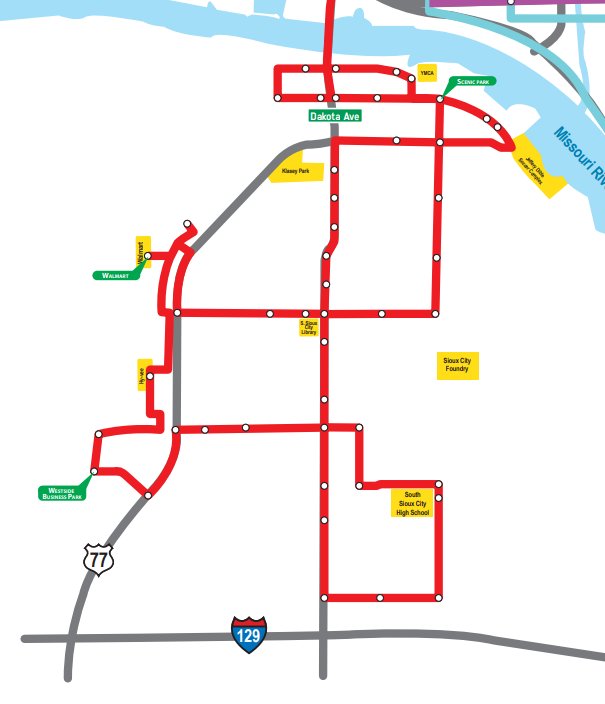
Here is a PDF map of the entire network. It has 10 routes, using 12 buses running hourly, with a timed meet at the center of Sioux City (just off the above map) at :30 every hour. Most routes run as loops, with highly separated inbound and outbound legs. Route 9 above runs one-way southbound on Dakota Avenue in the northern and southern legs but then meanders to run southbound on Route 77; the Dakota Avenue leg in between the two major east-west runs is one-way northbound.
I asked, why need it be so complicated? The major destinations are all on Dakota or Route 77. It should be easy to run two distinct routes, one on each, right? Without the east-west meanders, there would be the same total service-hours, right?
But no. The route runs hourly. The scale of the map is small: from the bridge over the Missouri in the north to I-129 in the south it’s 4.1 km. There is so little traffic that in the evening rush Google Maps said it would be just 10 minutes by car from Downtown Sioux City to the southern edge of Dakota Avenue near I-129. The roundtrip time would be 25-30 minutes, so the bus would sit idle half the time due to the hourly pulse.
Getting route-length right
When designing regional rail schedules, as well as my take on night buses in Boston (since reduced to a single meandering route), I’ve taken great care to deal with roundtrip route length not always being an integer multiple of the headway. A train that comes every half hour had better have a roundtrip length that’s just less than an integer or half-integer number of hours, counting turnaround times, to minimize the time the train sits at the terminal rather than driving in revenue service. The same is true of buses, except that scheduling is less precise.
In Boston, the plan at the time was for hourly buses, and has since changed to half-hourly, but the principle remains. The roundtrip length of each leg of the night bus network, should it expand beyond one (double-ended) route, should be an integer or half-integer number of hours. In practice this means a one-way trip time of about 25-26 minutes, allowing for a little recovery time and for delays for passengers getting on or off; overnight there is no traffic and little ridership, so 25 minutes of driving time correspond to just less than 30 minutes of actual time.
Thus, on each corridor, the bus should extend about 25 minutes of one-way nighttime driving time from the connection point, and the choice of which routes to serve and where to end each route should be based on this schedule. Of course on some shorter routes 12 minutes (for a half-hour roundtrip) and on some long routes 38 minutes (for a 90-minute roundtrip) are feasible with half-hourly frequencies, but in Boston’s case the strong night bus routes in practice would all be 25.
Length and frequency
In the case of Sioux City, hourly buses meeting at the center should have a one-way trip time of 25 minutes. However, the city is so lightly populated that there is little traffic, and the average traffic speed is so high that 25 minutes puts one well outside the built-up area. The driving time from city center to the edge of the built-up area, around I-129, Lakefront Shopping Center, and the various Wal-Marts ringing the city, is around 10 minutes.
Moreover, a car travel time of 10 minutes corresponds to not much longer on a bus. Frequent commenter Zmapper notes that in small American cities, taking the driving time in traffic and multiplying by 1.2, or 1.3 with recovery time, is enough. A one-way driving time of 11-12 minutes involves a roundtrip bus time of half an hour.
With such a small urban extent, then, the bus frequency should be bumped to a bus every half hour, leveraging the fact that few important destinations lie more than 11-12 minutes outside city center. The question is then how to restructure the network to allow for doubling frequency without doubling operating expenses.
The importance of straight routes
Some of Sioux City’s bus routes go beyond the 12-minute limits, such as route 6 to the airport. But most stay within that limit, they’re just incredibly circuitous. Look at the map of route 9 again. It jumps between two main corridors, has multiple loops, and enters the parking lots of the Wal-Mart and other destinations on US 77.
The reason for the meanders is understandable. US 77 is a divided highway without sidewalks or crosswalks, and none of the destinations thereon fronts the road itself. From the wrong side of the road to Wal-Mart it’s 330 meters, and a few other retail locations are more than 100 meters off. Many agencies wince at making passengers walk this long.
However, understandable does not mean justifiable. Traversing even 330 meters takes only about 4 minutes, and even with a hefty walking penalty it’s much less than the inconvenience caused by hourly headways. The other routes in the Sioux City area have the same problem: not a single one runs straight between city center and its outer destination.
With straighter routes, the savings in service-hours would permit running every half hour. A single bus could run every half hour if the one-way car travel time were at most 11-12 minutes; up to 23 minutes, two buses would provide half-hourly service. With 12 buses, there is room to replace route 9 with two routes, one on Dakota and one on US 77 (possibly entering the Wal-Mart, since the route is so short it may be able to get closer to Wal-Mart while still staying under 12 minutes). The Lakeport Commons and Southern Hills Mall area could get buses at the entrance, as it is the logical end of the line (route 1, to Southern Hills).
Some pruning would still be required. Some low-density areas far from the main corridors would have to be stranded. Some circumferential lines would be pruned as well, such as route 10 (to the Commons) on US 75 and route 2 (on Pierce Jackson) to Wal-Mart. Circumferential lines at such a low frequency are not useful unless the transfers to the spokes are timed, which is impossible without breaking the city center interchange since the lines take different amounts of time to get between city center with the plausible connection point. Ultimately, replacing the hourly routes with half-hourly routes would guarantee better service to everyone who’d still get any service, which is nearly everyone.
It’s not just Sioux City
I focus on Sioux City because it’s a good toy model, at such scale that I could redesign the buses in maybe two weeks of part-time work. But it’s not the only place where I’ve seen needlessly circuitous routes wreck what should be a decent bus network for the city’s size and density. In 2014 Sandy wrote about the bus network in New Haven, which has okay trunks (I only needed to hitchhike because of a bus delay once – the other four or five times I took the bus it was fine) but splits into indescribably complex branches near its outer ends.
More recently, I looked at the network in Ann Arbor, partly out of prurient interest, partly out of having gone to two math conferences there and had to commute from the hotel to the university on the city’s most frequent bus, route 4. Zoomed out, the Ann Arbor map looks almost reasonable (though not quite – look at routes 5 and 6), but the downtown inset shows how route 4 reverse-branches. Ann Arbor is a car-oriented city; at my last math conference, in Basel, a professor complained that despite the city’s leftist politics, people at the math department were puzzled when the professor biked to campus. The buses are designed to hit every destination someone who’s too poor to own a car might go to, with speed, frequency, and reliability not the main concerns.
The underlying structure of bus networks in small American cities – radial buses converging on city center, often with a timed transfer – is solid. The problem is that the buses run every hour when cities should make an effort to run them every half hour, and the routes themselves are circuitous. In very small cities like Sioux City, increasing the base frequency is especially urgent, since their built-up extent is so compact a direct bus would reach the limit of the serviceable area in 10-12 minutes, perfect for a half-hourly schedule, and not the 25 minutes more typical of hourly schedules. Sometimes, scaling down requires maintaining higher frequency than the bare minimum, to avoid wasting drivers’ time with low-value meanders.
Cities and Cultural Cringe
Following up on my last post’s promise to tackle both cultural theory of risk and cultural cringe, here is my take on the latter issue.
It is normal for people to have some degree of national pride and fervor. Cultural cringe refers to the opposite trend: when, in some circumstances, people in certain countries feel national shame and develop an inferiority complex. The term cultural cringe itself was coined by A. A. Phillips in 1950, describing Australia’s inferiority complex toward Britain in literary fields: Australians thought their literature was too provincial and perhaps too incomprehensible to the British readers, and as a result many authors were uncomfortable making the local references celebrated in the literary canon of Britain, France, Russia, the US, etc. This notion has been generalized elsewhere. Amos Oz says he felt uncomfortable writing books in such a peripheral country as Israel until he read Sherwood Anderson’s Winesburg, Ohio, showing how literature of and by the provinces can thrive.
From its origin in Australian literature, the idea of the cultural cringe has expanded to other fields, including the law, social relations, technology, and business. It seems endemic in former colonies, especially ones that are not rich. One writer in Nigeria argues how best practices thinking is cultural cringe by giving an example of a recent legal importation that turns out to already exist in traditional Yoruba law. In Australia itself, political scientist L. J. Hume pushed back against the notion that there is cultural cringe, arguing it is true of literature but not economics of other fields. But in mass culture, the vast majority of countries, both developed and developing, consider American film and television superior to their own and have domestic industries that focus on arthouse films or low-budget flicks.
Cultural cringe in legal, political, or technological fields remains endemic in many other developed countries. In one recent example, Emmanuel Macron said France is inherently resistant to change and (by implication) ungovernable, comparing it negatively with Denmark. In business, 1980s-era America was replete with books telling managers how to think like a Japanese or German, which trend ended when the Japanese lost decade and the economic crisis of German unification made these countries less fashionable.
Lying in the intersection of business, politics, and technology, urbanism and transportation are amenable to analysis using this concept. As in the Nigerian example, the third world tends to have too much cultural cringe and too much faith in the merits of importing first-world methods. Conversely, the United States (and to a large extent Canada) today is resistant to outside ideas and does not know how to be a periphery.
Urban layout: there’s a world outside Europe
During the SB 827 debate in California, supporters reassured restive city residents that the density the bill promoted – up to 7 floors right next to transit lines and up to 5 a little farther away – was gentle. “Paris density,” they said. Everyone likes Paris as a tourist. Everyone recognizes Paris as good urbanism.
There is very little cultural cringe in the United States – on the contrary, Americans are solipsistic in every field. However, one of very few exceptions is that the American middle class vacations in Europe and is familiar with how walkable European cities are. (It’s even referenced on Mad Men when a minor character goes on walks in their car-oriented New York suburb.) Paris is the largest and richest city Americans of a certain wealth and education level can be expected to be familiar with and like, but by the same token the YIMBYs could mention Barcelona, Amsterdam, and Rome.
But it’s useful to think of what was not mentioned. Certainly not Hong Kong or Dubai, which seem to be mentioned almost exclusively negatively in Western discourse. Not Tokyo, which Westerners are much less likely to visit to the point that the Western blogs talking about Japanese urbanism (like Urban Kchoze) are notable for it. Nothing in the middle-income world, including some old cities (like Mexico City and Istanbul) that have building height, street width, and stylistic variation that first-world urbanists would approve of (and do if they’ve been there).
In this situation, the invocation of famous European cities feels less like a dialogue and more like an attempt to induce cringe defensively, to make people feel less attached to their cities’ American auto-oriented character. In effect, it’s an attack on “it will change the character of our neighborhood,” a line that’s much less common in countries that are used to thinking of themselves as inferior to whatever they consider the metropolitan core (such as the first world writ large in Israel, or the former colonial master in ex-colonies).
Transportation: a little cringe is good, but not too much
In the developing world, there is extensive cringe. Without using that term, I suggested it as a reason behind high construction costs in the third world, which are similar to the costs of the first world today and several times as high as those of the first world from back when its income levels were comparable to those of subway-building third-world countries, in the early 1900s. In Latin America and China, development is more inward-looking, and China in particular learned to build subways from the USSR in the 1950s, not a rich country. In former colonies, there seems to be a greater willingness to import methods from either the former colonizer or from countries that aggressively invest in third-world infrastructure, like Japan and China; the result is very high construction costs for projects for which I have data in India and other countries of that development level.
In some cases, like India’s high-speed rail program, the country imports technology wholesale, and Japan (or China) may insist on an exact copy of its methods. As it is, Japan refuses to call Taiwan High-Speed Rail a Shinkansen system even though it runs Shinkansen rolling stock: construction methods were European, so Japan only calls THSR a high-speed rail system using Shinkansen-based technology.
However, decisions like India’s standard-gauge metro lines happen even in indigenous systems. Delhi Metro uses standard gauge not for some turnkey technological import, but purely because it feels more modern whereas Indian mainline trains feel dinghy and dangerous. Evidently, Delhi Metro electrification is 25 kV, which is standard on mainline trains but unheard of on first-world metros; modifying subways for high-voltage electrification requires expensive concrete pouring, since high-voltage catenary requires more generous clearances to avoid arcing, whereas modifying rail gauge is routine since the European vendors are used to selling to broad-gauge Finland and Spain and the Japanese ones are used to their country’s multitude of gauges.
And if India errs on the side of too much shiny adoption of foreign technology, the US errs on the side of adopting too little. Americans do not think their country is inferior. American authors do not think they need to experience another country or speak another language before they write. There was a time when the American business community felt outcompeted, but today it feels like it’s at the top of the world, Silicon Valley having long left Japanese corporations in the dust; I stopped seeing complaints that American cars were inferior to German and Japanese ones not long after Obama’s auto industry bailout.
The American policy sphere seems especially constrained. There is some cultural cringe toward London, leading thinktanks like the Regional Plan Association and TransitCenter to overlearn from London’s peculiarities (like the Oyster fare cap and contactless credit card payment), but not much toward Continental Europe and practically none toward Japan. Instead, the attitude toward non-English-speaking countries is one of dismissal. When Richard Mlynarik pointed out to a Caltrain official consultant that Japanese trains turned much faster at terminals than Caltrain thought possible, the consultant replied, “Asians don’t value life the way we do.” (Update 2020-09-05: since a bunch of people in the Bay Area reference this line, I am reminded that this was not a public employee of Caltrain but a consultant brought in for the Transbay Terminal project.)
If India fails to understand where its own methods could be superior despite being a peripheral country, the United States fails to understand that it’s a peripheral country in the first place. Transportation innovation rarely happens in North America. It happens in Western Europe and Japan, and to some extent in developing countries that have less cultural cringe than former colonies, such as Brazil and Colombia and their invention of BRT or Colombia, Bolivia, and Mexico’s use of aerial gondolas in mountainous suburban areas.
Urban development: you are not New York
I’ve been reading Aaron Renn’s blog, the Urbanophile, since maybe 2008. At the time he was still in Indianapolis, in (I believe) management consulting, writing about how his city was trying to become culturally and economically bigger than it was, and sometimes but not always succeeding. A recurrent theme in his writings has been that Midwestern American cities are desperate for development. They keep saying they need more creative people, more venture capital, or whatever else is in vogue. (In contrast, he says, Rhode Island, where he lived later, doesn’t even understand how peripheral it is.)
However, the way the Midwestern cities he focuses on try to attract this elusive development is through cheap copying. An old post of his I can no longer find contrasts world-class Indianapolis with world class in Indianapolis. The former involves investing in some city institution to make it world-class, or more realistically notable enough that boosters can call it world-class with a straight face. The latter involves inviting a starchitect or another person with international cachet (such as Richard Florida) to build something in Indianapolis that’s notable and is exactly as notable as what this person might build in any other city of that size, with no particular connection to the city itself.
In the transportation field, many American cities build mixed-traffic downtown streetcars and beam with pride if they get 4,000 riders per weekday. Often this mentality overrides any attempt to provide services to city residents: thus, the streetcar in Detroit is not integrated with the city’s bus network, and in fact a bus runs on the same street, on different lanes from the streetcar. This isn’t about some mythical preference for rail over bus: these cities build whatever they hear is in vogue and will get them noticed by New York media, whether it’s peak-only commuter rail, a downtown streetcar, a limited bus that calls itself BRT, or now a bus network redesign around untimed 15-minute frequencies.
Cringe vs. dialogue
It’s important to distinguish dialogue with a foreign culture and cultural cringe toward it. One difference is that cringe implies infatuation; however, infatuation can also develop among immigrants who are steeped in the metropole’s culture after having lived there even while maintaining ties to the old country. A bigger difference is the extent of two-way dialogue. Israelis use the expression “unbroken country” to refer to the mythical average first-world country in which you can get things done without having to tell government bureaucrats that you served in the military with their bosses; however, few have lived abroad long enough to know the details of what makes these countries tick better.
With limited knowledge of the core, the periphery can worship at the feet of the few people who do know, which leads to political bias. This is where moral panics of no-go zones come from: there is an Israeli television show purporting to portray how things are in Europe, but any connection between Belleville (or other racially diverse Paris neighborhoods) and what they depict is completely incidental. In that case, the bias is right-wing. In the opposite direction, left-wing bias can occur when American liberals and socialists are enamored by European health care and education systems and elide a thousand details that distinguish them from American renditions of single-payer health care or free college tuition.
But the biased reaction is only common in places that care little about how to govern. “Well, actually Tower Hamlets is a no-go zone” is not a blueprint for reducing nonwhite immigration to the United States or Israel. Instead, in the policy sphere a more common reaction is a shrug. Dialogue is threatening: the people capable of it are typically not the top pundits on this issue. Instead, it’s more common to aggressively dismiss knowledge that’s hard to access, even among people who at the same time invoke the cringe. In Israel it takes the form of self-denigrating lines like “this is Israel, not Finland.” Cultural cringe leads to lower expectations this way.
When Phillips criticized Australian authors who deracinated their writing to appeal to British taste, he was implicitly saying that Australians couldn’t root their literature in British experience. Oz, similarly, felt constrained about writing when he was young because living in Israel, he could not root his books in Paris, Milan, and other flashy cities whose books he devoured. The economic (or legal, or technological) analogue of this observation is that the reason there is cultural cringe is that people in peripheral areas (which in transportation include the United States) are too unfamiliar with the core and cannot dialogue with it the way people in different parts of the core can.
Urbanism is not literature. One doesn’t need extraordinary sensitivity and a lifetime (short as it may be) in a culture to produce very good insights about transportation, housing, or municipal governance. It’s possible to break out of the cringe by acquiring detailed knowledge of how the core operates. In the case of the third world and subway construction, it means learning enough about current and historical construction methods to be able to propose ways to build infrastructure at low costs commensurate with these cities’ low wages; in the case of the United States, it means learning enough about what makes European, Japanese, Latin American, etc. urbanism tick that it can be adopted domestically.
Urbanism is not literature in a far more important sense: there really are better and worse traditions there. It’s not enough to have pride in what you have when what you have is a third-world city where the poor don’t have running water, or for that matter an American city that would shut down instantly were gas prices to rise to levels necessary to stop global warming. Learning from the core is crucial. It’s just equally important to do so through dialogue and not through the ignorant self-denigration that is cultural cringe.
Cities and Cultural Theory
I ran a Patreon poll about sociological theories as applied to urbanism, offering two options: cultural theory of risk, and cultural cringe. The poll was tied, so I feel compelled to do one post on each (when cultural theory was ahead I was outlining two separate posts on it, one about transit and one about housing).
Psychologists and sociologists have long known that people’s perceptions of risk can vary widely from actual risks (e.g. people are more afraid of flying than of driving even though planes are safer), and, moreover, different people have different evaluations of risk. Early theories analyzed differences in risk perception along lines of class, race, or gender, but subsequently a group of social scientists, many (though not all) libertarians, argued for an ideology-based cultural identity. In 1982, the anthropologist Mary Douglas and the political scientist Aaron Wildavksy published Risk and Culture, arguing for three different identities (later expanded to four). Douglas used her past insights from analyzing premodern societies’ social taboos to analyzing risk perception within industrialized societies, especially the rise of the environmental movement during a time of falling pollution levels.
Urbanism and public transit are intimately connected with environmentalism. A large fraction of transit advocacy is environmental in nature, and both early NIMBYs and present-day YIMBYs come from green progressivism. Even when the arguments are not explicitly ecological, the parallels are unavoidable: Jane Jacobs’ critique of urban renewal has strong similarities with Rachel Carson’s critique of DDT. Legally, the mechanisms that exist to protect both endangered species and neighborhoods are often the same (e.g. the American environmental impact report process). Thus, understanding a sociological theory developed originally to analyze environmentalism should have straightforward applications to cities and urban transportation.
Grid-group typology
Cultural theory begins with the distinction between markets and hierarchies. These are two distinct ways of organizing society, leading to different institutions and different social views. Douglas and Wildavsky’s innovation is to distinguish two different axes of separation between markets and hierarchies, which they call group and grid, leading to a 2*2 chart:
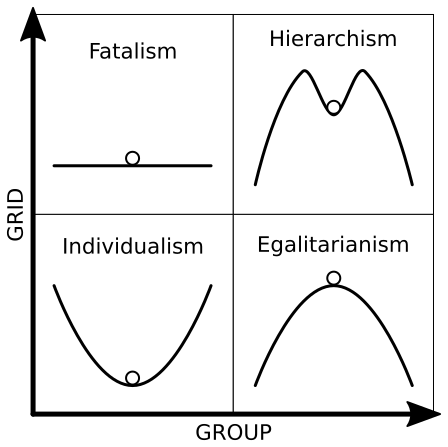
Group measures group solidarity among members of the system; grid measures the restrictions placed on the individual’s ability to exit the system. While individualism and hierarchy are politically stronger than the other two cultural identities, group and grid are fairly independent on the level of personal politics and there are numerous examples of egalitarianism and fatalism.
I strongly recommend reading the original book, but this review does it and the theory’s subsequent developments justice.
Individualism arises in institutions that are atomized and like it. The free market is the best example, but professions with mostly independent workers (like academia and the law, especially historically) also fit. Individualists view nature as resilient, returning to a stable equilibrium no matter what happens, and thus business control of the environment is to be celebrated as development; I had this aspect of cultural theory in mind when I wrote one of my early posts critiquing the idea that cities have a single equilibrium. Rejecting systemic or environmental risks, individualists focus on risks that disrupt the market’s operation, like war or recession.
Hierarchy arises in institutions where everyone has a predetermined role to play. Examples include the military, premodern feudalism, and modern bureaucracies. Hierarchists view nature as perverse or tolerant, capable of adapting to change to an extent but not beyond circumscribed limits, and therefore employ what their society considers expert opinion (e.g. scripture, bureaucratic process, big science, etc.) to figure these limits. Hierarchists focus on risks that indicate social deviance, like crime.
Douglas and Wildavsky call the above two tendencies the center, distinguished from what they call the border, whose growth they ascribe to the erosion of trust in institution in the 1960s and 70s (coming in the US from the Vietnam War and Watergate, in France from the reaction to the social protests of 1968, etc.).
Egalitarianism was the border tendency studied in Risk and Culture, which polemically called it sectarianism. It occurs in groups that rely on intensive solidarity among members but cannot enforce their collective will on the individual, and thus require other mechanisms to encourage people not to leave. These include internal equality, to stave off discontentment, and the precautionary principle, to prevent change from inducing disaffected members to exit. Thus they view nature as fragile, prone to collapse at any moment if the system endures any change in direction, and focus on low-probability, high-impact risks (such as environmental collapse), which enhance the group’s internal solidarity against outside enemies.
One of the key oppositions Douglas and Wildavsky point out is between the Hutterites and the Amish. Both denominations are high-group, socializing almost exclusively among their own kind, adhering to strict religious principles. But despite their common Anabaptist origin, they differ in one crucial aspect: the Hutterites have communal ownership of property, the Amish don’t. This makes the Hutterites high-grid, since members who leave start from zero, whereas Amish who leave get to keep their land. The Amish openly adhere to the precautionary principle, which they famously interpret extremely conservatively; the Hutterites have formal rules for group size and adopt modern farming technology easily.
Fatalism is the last tendency, so politically weak that it was ignored in the original book and only discussed in subsequent refinements of the theory. It arises in institutions whose lower-ranked members (whether by market poverty or low rank in the hierarchy) are disaffected, unable to leave and yet not sharing any of the group’s purported values. They tend to view nature as capricious, moving without clear direction, and do not have any particular risk focus, but tend to be especially concerned about things they do not understand (such as unfamiliar or complex technology). Transgressive fiction like The Wire tends to depict fatalist institutions; geekier readers may also recognize H. P. Lovecraft’s mythos as fatalist, portraying a universe so far beyond human understanding that any who begins to figure any of it out goes insane or slowly becomes a monster.
Some political movements have obvious cultural identities. Libertarianism is individualist. The New Left is egalitarian. The far right is hierarchist: Cas Mudde calls it pathological normalcy, and its issue focus (crime, immigration as genetic pollution, terrorism) is hierarchical, even as it rejects traditional hierarchical institutions. However, the broader left vs. right distinction does not neatly map to any of the four cultural biases. About the only generalization that can be made is that activists are usually not fatalists.
Cultural theory and transportation
Transportation planning is an inherently hierarchical industry. The technologies involved are old and continuously tweaked within well-understood parameters. With so much accumulated knowledge, work experience matters, requiring companies in the industry to adopt a hierarchical setup. Moreover, the transportation network itself is complex and interconnected, with changes in one region cascading to others. Changes to the bus network, the train schedule, etc. are possible but only if the people implementing them know what they’re doing, creating a picture of the network much like the hierarchical view of nature as tolerant up to a limit.
The individualist ethos of tech companies – move fast and break things – works for fast-growing industries. Individualism is by far the fastest of the four biases in reacting to sudden changes. The tech industry’s denigration of public transit as an old hat has to be understood as individualists reacting poorly to an industry that has to be run by a business culture they find alien.
Readers who have been following me closely may ask, well, what about me? I’m an individualist. I evidently talk more to startups than to transportation consulting megacorps. One reader notes that I’ve called for people in positions of authority to be fired for incompetence so many times that a post like this one may read as hesitant purely because I only call for removing the governor of Massachusetts and the secretary of transportation and not also for firing planners.
The answer is that while there is extensive accumulated knowledge about good public transit in Western Europe, Japan, and South Korea, there is very little in the area I’m most involved in, North America. This is especially true when it comes to regional rail: the existing mainline rail in the US should be treated as more or less tabula rasa. Adopting best practices requires extensive expert knowledge, but the methods in which they should be implemented have little to do with the internal bureaucracy of hierarchical organizations, since the railroads that would ordinarily be in charge (like the LIRR or the MBTA) are the problem and not the solution.
But if the actual process of running a transportation network is hierarchical, the politics are completely different. As with left-right politics, the politics of public transit don’t neatly fit into any of the four tendencies. Center-right hierarchists tend to support extensions of the status quo, which means more urban transit in New York, London, Paris, and other large cities, as well as high-speed rail on strong corridors (High Speed 2 in the UK is bipartisan), but more roads everywhere else. Individualists on the right tend to be anti-rail, partly because it looks so hierarchical, partly because of peculiarities like Koch funding of American libertarianism (which has been exported to Israel, at least).
Egalitarian environmentalists tend to be pro-transit, but their discomfort with hierarchy sometimes shows up as mistrust of big infrastructure projects. The radical environmentalist Chris Clarke, opposed early attempts to fast-track California High-Speed Rail and called Robert Cruickshank of California HSR Blog a shill for developer interests. Jane Jacobs herself ended up arguing late in her life that mass transit was at the wrong scale and instead cities should encourage community jitney services.
The process itself has issues of trust that activate egalitarians and fatalists, the latter often reflexively opposing reforms since they assume things must always get worse. It leads to tension between community outreach, which helps defuse this opposition, and speed of implementation.
Cultural theory and housing development
Whereas transportation politics isn’t neatly slotted into the grid-group paradigm, the politics of urban development is: YIMBY is an individualist movement, with near-universal support from people who identify with that cultural bias. The other three tendencies are split. The market urbanist proposition of abolition or near-abolition of zoning doesn’t appeal to hierarchists (who want to be able to control where housing goes) or egalitarians (who worry about the consequences of empowering market actors); but there are egalitarian left-YIMBYs and hierarchical city leaders who favor transit-oriented development.
In fact, when analyzing NIMBYism, it’s useful to slot it not by class or political opinion, but by cultural identity. There is much less difference between working-class and middle-class NIMBYs than leftists posit, and in some cases anti-gentrification politics and racist opposition to fair housing blend together (as in South Tel Aviv, where the local far right has argued black refugees are part of a gentrification ploy).
The key is that egalitarianism really consists of two distinct concepts, both necessary to maintain high group solidarity without grid: internal equality, and strong boundedness (which refers to sharp distinctions between insiders and outsiders). The cultural geographer Stentor Danielson argued once that surveys consistently show people approve of internal equality but not of strong boundedness, which is why egalitarian communities are so rare even though many people agree with most of their tenets.
Thus, when NIMBYs argue that more development would bring outsiders or change the character of the neighborhood, this is as compatible with egalitarianism as with hierarchy. Gentrification is just the name for when these outsiders are not begging for scraps. The real difference is in where this is taken. Egalitarian NIMBYism emphasizes irrevocable change, high-impact risks (e.g. that a new development would induce runaway gentrification), and trust. Hierarchical NIMBYism instead talks about behavioral norms, usually referring to middle-class moral panics about crime, but occasionally flipping to black American fears that white people would call the police more often.
The fatalists, too, have their own criticism of redevelopment – namely, that it represents another sudden change involving forces they have no control over. “Nobody asked us” has to be understood as a fatalist and not egalitarian cry, even though egalitarians often try to organize fatalists.
It’s not really possible to promise any of the other groups what it really wants: protection from change for egalitarians, a more concrete relationship between development and their actual lives for fatalists, or ethnic or other kinds of homogeneity for hierarchists. Nonetheless, alliances are possible with some egalitarians and hierarchists. SF YIMBY has to be viewed as an attempt at an individualist-egalitarian alliance for more housing, ceding ground on rent control to curry favor with ideological socialists (and its East Bay offshoot is run by actual socialists). In the other direction, Theresa May’s making noises about releasing more land for housing to get young people on the “housing ladder,” invoking a hierarchical sense of normality regarding when it’s appropriate to buy a house.
Overbuilding for Future Capacity
I ran a Patreon poll with three options for posts about design compromises: overbuilding for future capacity needs, building around compromises with unfixably bad operations, and where to build when it’s impossible to get transit-oriented development right. Overbuilding won with 16 votes to bad operations’ 10 and development’s 13.
It’s generally best to build infrastructure based exactly on expected use. Too little and it gets clogged, too much and the cost of construction is wasted. This means that when it comes to rail construction, especially mainline rail, infrastructure should be sized for the schedule the railroad intends to run in the coming years. The Swiss principle that the schedule comes first was just adopted in Germany; based on this principle, infrastructure construction is geared around making timed transfers and overtakes and shortening schedules to be an integer (or half-integer) multiple of the headway minus turnaround time for maximum equipment utilization.
And yet, things aren’t always this neat. This post’s topic is the issue of diachronic optimization. If I design the perfect rail network for services that come every 30 minutes, I will probably end up with a massive upgrade bill if ridership increases to the point of requiring a train every 20 minutes instead. (I chose these two illustrative numbers specifically because 30 is not a multiple of 20.) In some cases, it’s defensible to just build for higher capacity – full double-tracking even if current ridership only warrants a single track with passing sidings, train stations with more tracks in case more lines are built to connect to them, and so on. It’s a common enough situation that it’s worth discussing when what is technically overbuilding is desirable.
Expected growth rates
A fast-growing area can expect future rail traffic to rise, which implies that building for future capacity today is good. However, there are two important caveats. The first is that higher growth usually also means higher uncertainty: maybe our two-track commuter line designed around a peak of 8 trains per hour in each direction will need 32 trains per hour, or maybe it will stay at 8 for generations on end – we usually can’t guarantee it will rise steadily to 16.
The second caveat, applicable to fast-growing developing countries, is that high growth raises the cost of capital. Early British railroads were built to higher standard than American ones, and the explanation I’ve seen in the rail history literature is that the US had a much higher cost of capital (since growth rates were high and land was free). Thus mainlines in cities (like the Harlem) ran in the middle of the street in the US but on elevated structures in Britain.
But with that in mind, construction costs have a secular increase. Moreover, in constrained urban areas, the dominant cost of above-ground infrastructure cost is finding land for multiple tracks of railroad (or lanes of highway), and those are definitely trending up. The English working class spent 4-5% of its income on rent around 1800 (source, PDF-p. 12); today, spending one third of income on rent is more typical, implying housing costs have grown faster than incomes, let alone the general price index.
The upshot is that cities that can realistically expect large increases in population should overbuild more, and optimize the network around a specific level of traffic less. Switzerland and Germany, both of which are mature, low-population growth economies, can realistically predict traffic many decades hence. India, not so much.
Incremental costs
The expected growth rate helps determine the future benefits of overbuilding now, including reduced overall costs from fronting construction when costs are expected to grow. Against these benefits, we must evaluate the costs of building more than necessary. These are highly idiosyncratic, and depend on precise locations of needed meets and overtakes, potential connection points, and the range of likely train frequencies.
On the Providence Line, the infrastructure today is good for an intercity train at current Amtrak speed every 15 minutes and a regional train making every stop every 15 minutes. There is one overtake segment at Attleboro, around three quarters of the way from Boston to Providence, and the line is otherwise double-track with only one flat junction, with the Stoughton branch. If intercity trains are sped up to the maximum speed permitted by right-of-way geometry, an additional overtake segment is required about a quarter of the way through, around Readville and Route 128. If the trains come every 10 minutes, in theory a mid-line overtake in Sharon is required, but in practice three overtakes would be so fragile that instead most of the line would need to be four-tracked (probably the entire segment from Sharon to Attleboro at least). This raises the incremental costs of providing infrastructure for 10-minute service – and conversely, all of this is in lightly developed areas, so it can be deferred without excessive future increase in costs.
An even starker example of high incremental costs is in London. Crossrail 2 consists of three pieces: the central tunnel between Clapham Junction and Euston-St. Pancras, the northern tunnel meandering east to the Lea Valley Lines and then back west to connect to the East Coast Main Line, and the southern tunnel providing two extra tracks alongside the four-track South West Main Line. The SWML is held to be at capacity, but it’s not actually at the capacity of an RER or S-Bahn system (as I understand it, it runs 32 trains per hour at the peak); the two extra tracks come from an expectation of future growth. However, the extreme cost of an urban tunnel with multiple new stations, even in relatively suburban South London, is such that the tunnel has to be deferred in favor of above-ground treatments until it becomes absolutely necessary.
In contrast, an example of low incremental costs is putting four tracks in a cut-and-cover subway tunnel. In absolute terms it’s more expensive than adding passing tracks in suburban Massachusetts, but the effect on capacity is much bigger (it’s an entire track pair, supporting a train every 2 minutes), and moreover, rebuilding a two-track tunnel to have four tracks in the future is expensive. Philadelphia most likely made the right choice to build the Broad Street Line four-track even though its ridership is far below the capacity of two – in the 1920s it seemed like ridership would keep growing. In developing countries building elevated or cut-and-cover metros, the same logic applies.
Sundry specifics
The two main aspects of every infrastructure decision are costs and benefits. But we can discern some patterns in when overbuilding is useful:
- Closing a pinch point in a network, such as a single- or double-track pinch point or a flat junction, is usually worth it.
- Cut-and-cover or elevated metro lines in cities that are as large as prewar New York (which had 7 million people plus maybe 2 million in the suburbs) or can expect to grow to that size class should have four tracks.
- On a piece of infrastructure that is likely to be profitable, like high-speed rail, deferring capacity increases until after operations start can be prudent, since the need to start up the profitable system quickly increase the cost of capital.
- Realistic future projections are imperative. Your mature first-world city is not going to triple its travel demand in the foreseeable future.
- Higher uncertainty raises the effective cost of capital, but it also makes precise planning to a specific schedule more difficult, which means that overbuilding to allow for more service options becomes reasonable.
- The electronics before concrete principle extends to overbuilding: it’s better to complete a system (such as ETCS signaling or electrification) even if some branches don’t merit it yet just because of the benefits of having a single streamlined class of service, and because of the relatively low cost of electronics.
Usually cities and countries should not try to build infrastructure ahead of demand – there are other public and private priorities competing for the same pool of money. But there are some exceptions, and I believe these principles can help agencies decide. As a matter of practice, I don’t think there are a lot of places in the developed world where I’d prescribe overbuilding, but in the developing world it’s more common due to higher future growth rates.
The Dynamics of Bus Bunching
I’ve been wanting to write a paper about how to use dynamical systems to analyze failure modes for transportation networks. So far I haven’t been able to analyze this more carefully, but there’s one relatively simple example, namely bunching along a single bus line. This intersects to some extent with what I did in math academia, although the mathematical tools I’m using are fairly primitive within dynamics, going back to the early 20th century and not to the advanced machinery that dynamicists have developed in the last forty years (like the Mandelbrot set). As a caution, despite the math jargon and the math paper structure, it’s a blog post, and not something I’d even be comfortable uploading to the arXiv.
The upshot of the mathematical model in this post is that several already-understood reforms can seriously reduce bus bunching: speeding up boarding through prepayment and all-door boarding, using bigger buses with many doors on the busiest routes, implementing signal priority and enforcing bus lanes better, and improving dispatching to tell bus drivers to maintain even headways leaving each terminus. Section 1 provides mathematical background, and people who know some dynamics can skip it; it’s meant to be accessible to a general audience (if you’ve heard of derivatives, you should be fine). Section 2 constructs the model for bus schedule variations, section 3 explains how the model predicts bunching, and section 4 goes into how the above interventions can improve the situation. The mathematics I’m using is not terribly advanced, but it may benefit from careful reading, especially around the formulas.
1. Background on dynamics and chaos
Before I left academia, when people asked me to explain my research, I’d use the following example. In dynamics, we study what happens when we take a function and iterate it many times. We are specifically interested in chaotic behavior, which arises when two very close numbers can end up widely separated after sufficient iteration. There is no chaos if we only look at linear functions, so the simplest example is quadratic:

The simplest behavior of any number when we apply a function many times is if nothing changes. A point where this happens is called a fixed point. Two numbers are fixed points for the function x^2: 0 and 1. But in practice, it’s useful to view infinity as a number, so that instead of being far away from each other, the numbers 1,000,000, 1,000,000,000, and -1,000,000 should be viewed as all very close to infinity. Under the squaring function, infinity is a fixed point as well.
The key to understanding the dynamics of a function is to look at the behavior of the function near a fixed point. Near the point 0, if we take the square of a number, it gets much smaller. For example, 0.1^2 = 0.01. This means that if a number x is close to zero, then as we iterate the function x^2 we will get closer and closer to 0, very quickly. This behavior is called attracting. Near 0, small changes in initial conditions don’t matter much: the numbers 0.1 and 0.11 are close, and if we keep squaring them, we will approach 0 either way. Infinity is attracting as well once you get used to thinking of very large (or very large with a negative sign) numbers as close to infinity: 1,000 is pretty close to infinity and 1,000^2 = 1,000,000, even larger, i.e. closer.
However, near the point 1, we get the opposite behavior: 1.1^2 = 1.21, which is about twice as far away from 1 as 1.1, and similarly 0.9^2 = 0.81, again about twice as far away from 1 as 0.9. We then say that 1 is a repelling point. Near a repelling point, we have chaotic behavior, because two points that start out close, like 0.9 and 1.1 or even 0.99 and 1.01, end up widely separated after iteration (0.99 eventually approaches 0, 1.01 eventually approaches infinity).
If you’ve learned calculus, your reaction to the line about how 1.21 is about twice as far away from 1 is “the derivative is 2!”. In general, the way to figure out whether a fixed point is attracting or repelling is to take the derivative f‘(x) at the point (technically it’s called the multiplier). If the absolute value of the derivative is less than 1, the point is attracting; if it’s more than 1, the point is repelling; if it’s exactly equal to 1, we say the point is indifferent and then the behavior near the fixed point depends on further details that I don’t want to get into. As a note of caution, taking the derivative anywhere except at a fixed point won’t tell you anything about the function – for example, the derivative of x^2 (which is 2x) is 4 when x = 2 but 2 is not repelling, it’s a non-fixed point that ends up going off to infinity.
(You may wonder what it exactly means to take the derivative at infinity. The answer is that if f is a polynomial, then the multiplier at infinity is always 0. If f is not a polynomial, there is a definition on Wikipedia.)
Attracting points are in every sense nicer to deal with than repelling points. Unfortunately, chaos is everywhere: most points of every nonlinear function are repelling. More precisely: in addition to fixed points, there are periodic points (i.e. fixed points of iterates). The periodic points of x^2 are a little hard to unpack if you’re not used to complex numbers: they’re solutions to equations like x^4 = x, x^8 = x, etc., and these are all complex numbers on the unit circle. We can compute multipliers there too (take the derivative of the iterate for which they’re fixed) and classify them as attracting or repelling. One of the foundational theorems of dynamics is that all but finitely many periodic points are repelling – and the number of non-repelling points is at most 2d-2 where d is the degree of the function (and if the function is a polynomial of degree d, then there are at most d-1, not counting infinity). My main contribution to math is to extend this result to a certain number-theoretic application.
2. Modeling buses using dynamics
The key insight of why buses bunch is that maintaining the exact schedule is a repelling fixed point, so small variations from the schedule (due to traffic, slow passengers, or random noise in passenger numbers) will compound over time, just as the variation of 0.9 or 1.1 from 1 compounds over time as you apply the squaring function.
More precisely, let’s say buses on a certain street run every 10 minutes. Eventually we will call the scheduled headway h, but to make this concrete, let’s say h = 10 minutes. Every few hundred meters, the buses stop to pick up and drop off passengers. Before San Francisco instituted prepayment, each additional passenger took on average 3.9 seconds to board and another 3.9 to disembark (link, PDF-p. 14); the TRB claims the average is 3 seconds to board (link, PDF-p. 20). We will call the extra boarding time per passenger b, and right now set b = 3 seconds = 0.05 minutes.
To understand why bunching occurs, let’s say that our bus falls behind schedule by a minute. It’s now 11 minutes behind the bus ahead (which we’ll assume is on schedule), not 10 minutes. On average, there will be 10% more passengers to pick up at each stop (passengers arrive at stops at a uniform rate). Let’s say the bus gets 60 boardings per hour (which is the Brooklyn-wide average). Typically we expect the bus to get 10 boardings in the next 10 minutes, but because there are 10% more passengers per stop, there will instead be 11 boardings. The one extra boarding will slow the bus down by 3 more seconds. The bus will then be 1:03 minutes behind. It’s a small difference, but over time it compounds.
There will also be more alightings as the bus gets more crowded, with a lag time equal to average passenger trip length. But in practice, to avoid introducing exponential factors, complicating the analysis, it’s best to just think of boardings plus alightings as a single metric, which if there are 60 boardings per hour equals 120 per hour or 2 per minute, and take note that a 1-minute delay only starts accumulating half a lag time in the future (e.g. 10 minutes if the average unlinked passenger trip is 20 minutes, as in New York). We call the number of boardings plus alightings per hour r, and in our example case r = 2.
If we choose our unit of time to be the minute, then the formula for the average delay a minute after our bus was x minutes behind the bus ahead is,

In the example we worked out above, it took 10 minutes to accumulate an additional 6-second delay (3 from boarding, 3 from alighting). Using the numbers h = 10, x = 11, b = 0.05, r = 2, verify that the formula spits out 0.01, or in other words an extra 0.6-second delay per minute. If x = h, that is if the headway between our bus and the bus ahead is exactly as timetabled, then there is no additional delay, making the correct headway a fixed point, but a repelling one. The multiplier is equal to,

Note that choosing units is important. The reason is that the mathematics I’m using assumes there are discrete steps: you apply the squaring function (or any other nonlinear function) once at a time. In reality, time is continuous. So to model it using discrete dynamics, it matters which unit of time we pick; this is the equivalent of choosing between x^2, x^4, x^16, or any other iterate. Fixed points will stay attracting or repelling (or indifferent) no matter what, but the exact value of the multiplier will change.
With this in mind, when our quantum of time is a minute, the multiplier with our usual values of h, b, and r is equal to 1.01. Every minute, a delay multiplies by a factor of 1.01. Within an hour, this factor grows to 1.82. This doesn’t seem too bad – it means a 1-minute delay turns into a 1:49-minute delay within an hour.
3. How bunching occurs
In section 2 we showed that if h is the scheduled headway, b is the average boarding time per passenger, r is the average number of boardings and alightings per unit of scheduled service time, and x is the current distance (in units of time) between our bus and the bus ahead of us, then within a minute we expect the distance to grow to
The multiplier is 1 + rb/h, which doesn’t seem too bad. However, there are complications. For one, the initial delay may be not 1 minute but longer. In Eric Goldwyn’s interviews with drivers, they cited traffic as the top reason why they believed bunching occurs, and barely mentioned passenger boardings. In math we cannot conflate popular perception with reality, but that the drivers complain about traffic suggests that there is widespread variation in the extent of the initial delays coming from missing a light, drivers blocking the bus lane, etc. If the initial delay is 2 minutes, then all delay numbers are naturally doubled over 1 minute.
But more importantly, our delayed bus will never bunch with the bus ahead. It will bunch with the bus behind. And the effect of the model of cascading delays on the bus behind us is exactly double what I described above. The reason is that if our bus is a minute behind – for example, 11 minutes behind the bus ahead when it should be 10 minutes behind – then the bus behind us, if it starts out on schedule, is now a minute ahead, only 9 minutes behind us when it should be 10 minutes. This means that within 10 minutes, we fall 6 seconds behind (and are thus 11:06 behind the bus ahead of us), but by the same token the bus behind us advances 6 seconds ahead (and is thus 8:48 behind us). In practice, the quantity relevant to bunching is the distance between two successive buses, and behind us, the multiplier is not 1.01 but 1.02. Within an hour a 1-minute delay reduces the gap between our bus and the bus behind us by 3:17, and a 2-minute delay reduces it by 6:34, almost two thirds of the way to catching up with us. If the initial delay is 1 minute, the bus behind us will actually catch up with us within 

And third, the multiplier grows as r grows and h falls – that is, it’s higher when the frequency is higher and when there are more riders per service hour. Keeping r at 2 (again, this is 60 boardings and 60 alightings per hour) but lowering h to 5 raises the multiplier to 1.02 ahead of us and 1.04 behind us. A multiplier of 1.04 with a headway of 5 minutes means the bus behind us will catch us within 
The real limiting factor to the capacity of city buses is not minimum stopping distance, unlike with trains. It’s that as the headway h decreases, bunching becomes so routine that adding more buses does not actually add capacity. If a bus runs every 2.5 minutes, keeping b = 0.05 and r = 2 gives us a multiplier of 1 + 0.05*2/2.5 = 1.04 ahead of us and then 1.08 behind us; the bus behind us will catch our bus within 12 minutes.
4. How to reduce bunching
The formula for the multiplier of the dynamical system formed by bus performance is 1 + rb/h where r is the rate at which passengers board and alight, b is boarding time per passenger, and h is scheduled headway. However, since as our bus gets further and further behind, the bus behind us gets further ahead relative to schedule and certainly relative to us, the multiplier relevant to bunching is 1 + 2rb/h. The bus behind us will catch ours in

minutes, where d is the initial delay (so we start the calculation from x = h + d). On very frequent buses, this will happen very quickly: 2.5-minute headways with New Yorkish assumptions on passenger traffic density and conservative assumptions on boarding speed yield a catchup time of just 12 minutes. So how do we prevent this?
4.1. Reduce boarding time per passenger
Off-board fare collection allows passengers to board the bus more quickly, without paying the driver. This has the effect of greatly reducing b, from 3 seconds to about 1.2 per the TRB. Prepayment also allows all-door boarding, effectively halving the average boarding time per passenger at stops without large volumes of disembarking passengers.
But in addition to prepayment, there are other ways of reducing b. Low-floor buses allow passengers to get on and off more easily; the reason San Francisco’s numbers are higher than the TRB’s is that San Francisco assumes a mostly high-floor bus fleet, whereas on the low-floor fleets boarding is much faster (in fact, faster on low-floor buses without prepayment than on high-floor buses with).
Adding more doors is desirable as well. The typical 12-meter bus has two doors, but some cities have purchased three-door buses, such as Nice and Florence. The typical 18-meter accordion bus has three doors, but in Florence I have seen four-door accordion buses; in contrast, the older accordion buses in New York only had two doors, slowing down boarding and alighting at busy stations. Per TRB data, three-door buses reduce b from 3 seconds to 0.9, or 0.015 minutes. One third the multiplier means roughly three times the time it takes to bunch.
4.2. Use bigger buses
The multiplier depends only on the rate at which passengers wish to board our route. Adding more bus service will reduce r (by spreading boardings across more service-hours) and h (by adding more frequency) at the same rate, but make it take less time for bunching to occur. Just running less service means passengers take longer to get on each bus, but also means that the passenger load per stop is less sensitive to fixed delays occurring upstream.
Of course, running less service is cruel to passengers and can discourage ridership due to a negative frequency-ridership spiral or (on the busiest routes) inadequate capacity. But running bigger buses to compensate can provide the necessary capacity while also helping reduce b through faster access and egress. As noted in section 4.1, accordion buses should have four doors, to minimize loading time.
4.3. Reduce random variability
None of this discussion would matter if we were guaranteed that buses would run exactly on schedule. Of course, they don’t and we cannot get such guarantee. However, we can look for treatments that would make initial delays less common. All-door boarding is one such treatment, in addition to its effect on average boarding time per passenger, because one of the factors that can cause delays is an unexpected wave of passengers all getting on and having to queue one at a time, for example if they come off class or transfer from a full train. Schools with synchronized class times can overload transit networks for the first few minutes after classes end. And in Shanghai, I had to wait 20 minute to buy a metro ticket coming off a full intercity train since two of the three ticket machines were broken and the train was full of visitors who didn’t already have the Shanghai Public Transportation Card.
But as Eric’s interviews with drivers suggest, the biggest single source of variability is traffic and not unusual passenger loads. Bus lanes reduce the impact of traffic, but may not reduce variability, since cars may block them unexpectedly. This suggests that better enforcement of bus lanes could improve schedule regularity and reduce bunching further downstream.
Another source of variability is traffic lights. Traffic lights are discrete: they’re red or green, and a bus that misses the light will be delayed by a full phase, which in New York means about 45 seconds (and in Bangkok means 3 or even 5 minutes). Giving buses signal priority even in its weakest form entails lengthening the green phase in the direction the bus travels in for a few seconds to let a bus through and avoid making it wait a full red phase. This would keep a lid on the maximum variability that a single intersection can produce. Note also that it’s very easy for a bus to be delayed at two successive intersections, for example if traffic is such that it’s a hair slower than usual, forcing it to miss two lights in rapid succession. In this case, 1.5-minute initial delays are routine, setting up bunching later.
4.4. Dispatch buses to maintain even headways at terminals
The most brutal way to eliminate bunching is to have dispatchers tell bus drivers to sit still for a few minutes if the bus either behind or ahead of them is too far behind. The subway in New York would do that to the trains to maintain something that to a manager at control center looked like even headways (“wait assessment”), which multiple independent sources have told me is responsible for falling subway speeds and increased delays. This brutal approach is unlikely to provide better service to riders.
However, telling bus drivers to sit still to maintain even headways has no such downside when it is done at the terminus of the bus route. At most, agencies would have to pay bus drivers some overtime, which is probably swamped by the positive effect reducing bunching has on ridership (or for that matter the fact that reducing bunching permits the transit agency to provide the same effective frequency with fewer service-hours).
4.5. More empirical research is needed
This section is a lot less quantitative than sections 1, 2, and 3, owing to the fact that we are stepping away from strict modeling. While quantifying the effect of low floors, more doors, bigger buses, and prepayment is easy within the confines of the model, quantifying the initial shock to ridership discussed in subsection 4.3 is more difficult. There is a range of plausible shocks, and the serious questions to ask are along the lines of “what is the 90% confidence interval of the travel time on each segment?”.
The literature review I’ve done for signal priority in particular is not comprehensive, but suggestive that there is no research yet in that direction. Figuring out exactly how common initial delays are and which treatments can reduce them by how much must be the next step.


