Category: Transportation
Construction Costs: Electrification
Continuing from last week’s post about signaling costs, here is what I’ve found about electrification costs.
Like signaling, electrification usually doesn’t make the industry press, and therefore there are fewer examples than I’d like. Moreover, the examples with concrete costs are all in countries where infrastructure costs are high: the US, Canada, the UK, Israel, New Zealand. However, a check using general reported French costs (as opposed to a specific project) suggests there is no premium in Israel and New Zealand over France, even though both countries’ urban rail tunneling projects are more expensive than Parisian Metro and RER extensions.
In the UK, the recent electrification project has stalled due to extreme cost overruns. Finding exact cost figures by segment is difficult in most of the country, but there are specific figures in the Great Western. Financial Times reports the cost of the Great Western project at £2.8 billion, covering 258 km of intercity mainline (mostly double-track, some four-track) and what I believe to be 141 km of commuter rail lines in South Wales, working from Wikipedia’s graphic and subtracting the canceled electrification to Swansea. In PPP dollars it’s around $10 million per km, but the cost may include items I exclude elsewhere in this post, such as rolling stock. For reference, in the late 2000s the project was estimated at £640 million, but costs then tripled, as the plan to automate wire installation turned out not to work. Taking the headline cost as that of the last link, £1.74 billion, the cost is $6.1 million per km, but there have been further overruns since (i.e. the Swansea cancellation).
In the US, there are three projects that I have numbers for. The most expensive of the three is Caltrain electrification, an 80 km project whose headline cost is $1.9 billion. But this includes rolling stock and signaling, and in particular, the CBOSS signaling system has wasted hundreds of millions of dollars. Electrification infrastructure alone is $697 million, or $8.5 million per km. The explanations I’ve read for this high figure include indifference to best practices (e.g. electrification masts are spaced 50 meters apart where 80 meters is more common) and generally poor contracting in the Bay Area.
The other two US projects are more remote, in two different ways. One is California High-Speed Rail: with the latest cost overrun, the projected electrification cost is $3.7 billion (table 4, PDF-p. 14). The length of route to be electrified is unclear: Phase 1, Los Angeles to San Francisco with a short branch up to Merced, is a little more than 700 km, but 80 km of that route is Caltrain, to which the high-speed rail fund is only contributing a partial amount. If the denominator is 700 km then the cost is $5.3 million per km.
The other remote US project is Amtrak’s electrification of the New Haven-Boston segment of the Northeast Corridor in the late 1990s. Back then, the 250-km double-track route was electrified for $600 million, which is $2.4 million per km, or about $3.5 million per km adjusted for inflation.
In Canada, Toronto is in the process of electrifying most of its regional rail network. The current project includes 262 route-km and has a headline cost of $13.5 billion, but according to rail consultant Michael Schabas, this includes new track, extensive junction modification, unnecessary noise walls (totaling $1 billion), and nearly 100% in contingency just because on the original budget the benefit-cost ratio seemed too good to be true. In a 2013 study, the infrastructure cost of full electrification was estimated at $2.37 billion for 450 route-km in 2010 Canadian dollars. In today’s American dollars it’s about $4.5 million per km.
In France, a report that I can no longer find stated that a kilometer of electrification cost a million euros, in the context of the electrification of a single-track legacy branch to Sables d’Olonne, used by some TGV services. While trying to find this report, I saw two different articles claiming the cost of electrification in France to be a million euros per double-track kilometer. The latter article is from 2006, so the cost in today’s money is a little higher, perhaps as high as $1.5 million per km; the article specifically says the cost includes bridge modification to permit sufficient clearances for catenary.
In Israel, the majority of the national network is currently being electrified, and I’ve argued elsewhere for a completist approach owing to the country’s small size, high density, and lack of rail connections with its neighbors. The project has been delayed due to litigation and possibly poor contractor selection, but a recent article on the subject mentions no cost overrun from the original budget of 3 billion shekels, about $750 million, for 600 km of double-track. This is $1.25 million per km and includes not just wire and substations but also 23 years’ worth of maintenance. This may be similar to the Danish ETCS project, which has been severely delayed but is actually coming in slightly under budget.
In New Zealand, the one electrification project recently undertaken, that of the Auckland regional rail network, cost $80 million in infrastructure. This is New Zealand dollars, so in US terms this is closer to $55 million. The total length of the network is about 80 route-km and 200 track-km, making the cost about $700,000 per km. But the project includes much more than wire: the maintenance facility, included in the Israeli figure, cost another NZ $100 million, and it is unclear whether bridge modifications were in the infrastructure contract or tendered separately.
The big takeaway from this dataset, taking French costs as the average (which they are when it comes to infrastructure), is that Israel and New Zealand, both small countries that use extensive foreign expertise, do not pay a premium, unlike the US, UK, and Canada. In the UK, there is a straightforward explanation: Network Rail attempted to automate the process to cut costs, and the automation failed, creating problems that blew up the budget. Premature automation is a general problem in industry: analysts have blamed it for Tesla’s production problems.
In the US and Canada, the construction cost problem is generally severe. However, it’s important to note that at NZ$2.8-3.4 billion for 3.4 km of tunnel, Auckland’s tunneling cost, around US$600 million per km, isn’t much lower than Toronto’s and is actually slightly higher than the Bay Area’s. My explanation for high costs in Israel, India, Bangladesh, Australia, Canada, New Zealand, Singapore, and Hong Kong used to be their shared English common law heritage, but this is contradicted by the lack of any British premium over French costs in the middle of the 20th century. An alternative explanation, also covering some high-cost civil law third-world countries like Indonesia and Egypt, is that these countries all prefer outside consultants to developing public-sector expertise, which in the richer countries is ideologically associated with big government and in the poorer ones doesn’t exist due to problems with corruption. (China and Latin America are corrupt as well, but their heritages of inward-looking development did create local expertise; after the Sino-Soviet split, China had to figure out how to build subways on its own.)
But Israel Railways clearly has no domestic expertise in electrification. The political system is so unused to this technology that earlier this decade I saw activists on the center-left express NIMBY opposition to catenary, citing bogus concerns over radiation, a line of attack I have never seen in California, let alone the Northeastern US. Nor is Israel Railways good at contracting: the constant delays, attributed to poor contractor choice, testify to that. The political hierarchy supports rail electrification as a form of modernization, but Transport Minister Israel Katz is generally hostile to public transit and runs for office with a poster of his face against a background of a freeway interchange.
What’s more likely in my view is that Israel and New Zealand, with no and very little preexisting electrification respectively, invited experts to design a system from scratch based on best industry practices. I’m unfamiliar with the culture of New Zealand, but Israel has extensive cultural cringe with respect to what Israelis call מדינה מתוקנת (“medina metukenet”), an unbroken country. The unbroken country is a pan-first-world mishmash of American, European, and sometimes even East Asian practices. Since the weakness of American rail is well-known to Israelis, Israel has just imported European technology, which in this case appears easy to install, without the more particular sensitivities of urban tunneling (the concrete side of the electronics before concrete maxim). In contrast, the US is solipsistic, insisting on using domestic ideas (designed by consultants, not civil servants). Canada, as far as I can tell, is as solipsistic as the US: its world extends to Canada and the US; Schabas himself had to introduce British ideas of frequent regional rail service to a bureaucracy that assumed regional rail must be run according to North American peak-only practices.
All of this is speculation based on a small number of cases, so caveat emptor. But it’s fairly consistent with infrastructure construction costs, so long as one remembers that the scope for local variation is smaller in electrification and systems than in civil infrastructure (for one, the scope for overbuilding is much more limited). It suggests that North America could reduce its electrification costs dramatically by expanding its worldview to incorporate the same European (or Asian) companies that build its trains and use European (or Asian) standards.
Construction Costs: Signaling
I launched a Patreon poll about construction cost posts, offering three options: signaling and electrification, rolling stock, and historical costs. Signaling and electrification won with 29 votes to historical costs’ 20 and rolling stock’s 6. This post covers signaling, and a subsequent post will cover electrification.
I was hoping to have a good database of the cost of installing train protection systems. Instead, I only have a few observations. Most metro lines in the world have searchable construction costs given a few minutes on Google, and a fair number of rolling stock orders are reported alongside their costs on Railway Gazette and other trade publications. In contrast, recent numbers for signaling are hard to get.
The gold standard for mainline rail signaling is European Train Control System, or ETCS; together with a specified GSM communications frequency it forms the European Rail Traffic Management System, or ERTMS. It’s a system designed to replace incompatible national standards that are often nearing the end of their lives (e.g. Germany expects that every person qualified to maintain its legacy LZB system will retire by 2026). It’s of especial interest to high-speed lines, since they are new and must be signaled from scratch based on the highest available standard, and to freight lines, since freight rail competes best over long distances, crossing national borders within Europe. Incompatible standards between countries are one reason why Europe’s freight rail mode share is weaker than that of the US, China, or Russia (which is Eurasian rather than European when it comes to freight rail).
As with every complex IT project, installation has fallen behind expectations. The case of Denmark is instructive. In 2008, Denmark announced that it would install ETCS Level 2 on its entire 2,667-km network by 2020, at the cost of €3.2 billion, or about $1.5 million per route-km. This was because, unlike both of its neighbors, Denmark has a weak legacy rail network outside of the Copenhagen S-tog, with little electrification and less advanced preexisting signaling than LZB. Unfortunately, the project has been plagued with delays, and the most recent timetable calls for completion by 2030. The state has had to additionally subsidize equipping locomotives with ETCS, but the cost is so far low, around $100,000 per locomotive or a little more.
That said, costs in Denmark seem steady, if anything slightly lower than budgeted, thanks to a cheap bid in 2011-2. The reason given for the delay is that Banedanmark changed its priorities and is now focusing on electrification. But contracts for equipping the tracks for ETCS are being let, and the cost per kilometer is about €400,000, or $500,000. The higher cost quoted above, $1.5 million per km, includes some fixed development costs and rolling stock costs.
Outside Denmark, ETCS Level 2 installation continues, but not at a nationwide scale, even in small countries. In 2010, SNCB rejected the idea of near-term nationwide installation, saying that the cost would be prohibitive: €4.68 billion for a network of 3,607 km, about $1.6 million per route-km. This cost would have covered not just signaling the tracks but also modifying interlockings; it’s not purely electronics but also concrete.
The Netherlands is planning extensive installation as well. As per Annex V of an EU audit from last year (PDF-pp. 58-59), the projected cost is around $2 million per route-km; the same document also endorses Denmark’s original budget, minus a small reduction as detailed above due to unexpectedly favorable bids. Locomotive costs are said to be not about $100,000 but €300,000 for new trainsets or €500,000 for retrofitting older trainsets.
A cheaper version, ETCS Level 1, is also available. I do not know its cost. Switzerland is about to complete the process of a nationwide installation. It permits a trainset equipped with just ETCS equipment and no other signaling to use the tracks, improving interoperability. However, it is an overlay on preexisting systems, so it is only a good fit in places with good preexisting signaling. This includes Switzerland, Germany, and France, but not Denmark or other countries with weak legacy rail networks, including the US. The Northeast Corridor’s ACSES system is similar to ETCS Level 1, but it’s an overlay on top of a cab signaling system installed by the Pennsylvania Railroad in the 1930s.
Comparing this with American costs is difficult. American positive train control, or PTC, uses lower-capacity overlay signaling, nothing like ETCS Level 2. One article claims that the cost per track-km (not route-km) on US commuter rail is about $260,000. On the MBTA, the projected cost is $517 million for 641 km, or $800,000 per route-km; on the LIRR it’s $1 billion for 513 route-km, or $1.9 million per route-km. Observe that the LIRR is spending about as much on a legacy tweak as Denmark and the Netherlands are on a high-capacity system built from scratch.
Why is Second Avenue Subway Phase 2 So Expensive?
I am only loosely following the news about the second phase of Second Avenue Subway. The project, running from 96th Street to 125th, with a short segment under 125th to Lexington, passing under the 4, 5, and 6 trains, is supposed to be cheap. In the 1970s, work began on Second Avenue Subway before the city went bankrupt, and there are extant tunnel segments built cut-and-cover in East Harlem between the station sites. The stations need to be dug, but the plan dating back to 2003 was to build them cut-and-cover as well, with local disruption for only a few blocks around 106th, 116th, and 125th Streets. Only one part would be difficult: going deep under 125th, under the preexisting subway. And yet, costs are very high, and the design seems to be taking a wrong turn.
In the early 2000s, the cost projections were $3.7 billion for phase 1 (actual cost: $5 billion, but much of the difference is inflation), and $3.3 billion for phase 2 (projected cost: at least $6 billion). Since then, there have been changes. For about a year I heard rumors that the preliminary engineering had been done wrong, and it was impossible to use the preexisting tunnel segments. Then I heard that no, it’s actually possible to use the existing tunnels. But a few days ago I heard that even though it’s possible, the MTA is now planning to demolish the existing tunnels and build the entire project deep underground using tunnel-boring machines.
With the information generally given out at community meetings, it’s hard to know what’s exactly going on. However, the fact that the MTA is talking about this suggests extreme disinterest in cost control. Cut-and-cover construction is cheaper than TBMs, per a 1994 paper by Godard, Barrié, Zhang, et al, looking at French urban rail costs since the 1970s. The tradeoff is that it forces rail lines to go underneath streets, which is disruptive to pedestrians and merchants, or demolish private property. Fortunately, Second Avenue is a wide, straight throughfare, and requires no such demolitions, while the disruption would be localized to areas that are scheduled to get subway stops as part of the project. Metro extensions here and in a number of other European cities are constructing stations cut-and-cover and the tunnels between them with TBMs; Metro Line 12’s online documents state that station construction involves just 18 months of digging.
It’s possible that the need to turn to 125th Street is messing up the plan to do everything cut-and-cover. While the turn itself can be done with minimal demolitions (the inside of the curve has a few small buildings, and there’s also an alignment slightly farther east that goes under vacant land while maintaining a 90-meter curve radius), going underneath the Lexington Avenue Line requires diving deep, and then there is no advantage to cut-and-cover. Building cut-and-cover under existing lines is difficult, and in that case, TBMs are warranted.
If the problem is 125th Street, then I would propose extending phase 2 and then breaking it apart into two subphases. Phase 2.0 would be cut-and-cover and open stations at 106th, 116th, and possibly 125th and 2nd temporarily. Phase 2.5 would involve driving TBMs under 125th Street all the way to Broadway; this could be done with a large-diameter TBM, with the platforms contained within the bore and vertical access dug so as to avoid the intersecting north-south subways. 125th Street has 30,000 crosstown bus boardings according to the MTA, which would make it the busiest bus corridor in the city per km: 10,000 per km, compared with 8,000 on the busiest single route, the M86. It is a priority for subway expansion, and if it’s for some reason not possible to easily build from 96th and 2nd to 125th and Lex in one go then the entire project should be extended to 125th and Broadway, at somewhat higher cost and far higher benefits.
The reason phase 1 was so expensive is that the stations were mined from small digs, rather than built cut-and-cover as is more usual. The idea was to limit street disruption; instead there was street disruption lasting 5 years rather than 1.5, just at small bore sites at 72nd and 86th rather than throughout the station boxes’ footprints. The TBM drive and systems cost together $260 million per kilometer, compared with $125 million on Paris’s Metro Line 1 extension, but the stations cost $750 million each, compared with $110 million.
It’s crucial that the MTA not repeat this mistake in phase 2, and it’s crucial that area transit activists hold the MTA’s feet to the fire and demand sharp cost control. Even taking the existing premiums as a given, cut-and-cover stations should not cost more than $200 million each, which means phase 2 as planned should cost $600 million for stations, about $330 million for systems, and another $350 million for overheads. At $1.3 billion this still represents high cost per kilometer, about $500 million, but it’s based on actual New York cost items, which means it’s plausible today. There is no excuse for $6 billion.
Rapid Transit in Low-Density Boomtowns
Most of my thinking about public transit comes from large, dense cities, especially New York. In those cities, transit ridership is not a problem; only cost is. When such cities have decent cost control, they can build massive expansion programs, as Paris is. But most of the developed world is not New York, Paris, London, Tokyo, or other transit cities. A large and (thanks to differential national population growth rates) growing share of the developed world lives in fast-growing, low-density city regions with no public transit to speak of, such as the American Sunbelt and its counterparts in Canada and Australia.
I’ve had to intellectually grapple with public transit in two American Sunbelt cities in which current transit usage is a rounding error and the built form is wholly auto-oriented: Orlando (which I was asked about by a Twitter mutual) and Nashville (which just voted against a flawed light rail plan by an overwhelming margin). In those areas, there is no chance for any public transit, provided the urban form stays as it is – but fortunately such cities can leverage their high growth rates to change their urban form, as Calgary did in the 1980s and 90s.
Density versus growth
A few months ago I made this chart:

The density and growth demand axes are not meant to come from a single quantitative metric; density is a subjective mix of residential and job density, whereas growth demand refers to either population growth or the demand for more housing as expressed by price signal. In San Francisco, most likely the richest metro area in the world, density is middling, and growth demand is higher than even in New York and London; in the American Rust Belt, density is fairly low and there is also little demand for more; in some cities on the margin of the first world there is little demand for more growth but high preexisting density. It goes without saying that it’s easier to build new rapid transit lines on the upper right corner than on the lower left one.
The situation of the American Sunbelt, most of which goes in the bubble of Texas and Georgia, is difficult. Residential density is extremely low, so the ridership base near potential rail lines is low. Moreover, streets are usually designed exclusively around auto use, so passengers are unlikely to walk a kilometer to the train station the way they routinely do in transit cities. At the destination end, things aren’t much better – American cities have high-rise CBDs, but few jobs locate there or in surrounding dense neighborhoods.
The Orlando CBD has about 80,000 jobs, in a metro area of 2.5 million people. Disney World adds another 37,000, but is not surrounded by any serviceable residential neighborhoods, and has to be at the end of any reasonable transit service coming from the CBD. Nashville, a metro area of nearly 2 million, has a CBD with 36,000 jobs. The medical center to the southwest adds another 33,000, and this time it could plausibly lie on a rail trunk, but most of the useful urban arterials converge on the CBD and not on the medical center. In contrast, Washington, with 5.5 million people, has 280,000 people working at the CBD (from the Green and Yellow Lines to just beyond Dupont Circle and Foggy Bottom), 77,000 in the Rosslyn-Ballston corridor, and 33,000 in Crystal City and at National Airport and the Pentagon. Both the percentages and the absolute numbers (including job density) count: there is a great mass of people who would be interested in taking rail to Washington CBD jobs but not to Orlando or Nashville CBD jobs.
Can regional rail work?
No.
High-growth areas are likely to have been small a few decades ago. For the most part the metro areas in question were too small in the heyday of rail transportation to have inherited a large legacy rail network. Even the ones that did, including Atlanta and Perth, have less legacy rail than older cities of comparable size – compare Atlanta with Philadelphia, or Perth with Brisbane. And most North American boomtowns are not Atlanta. Miami has two north-south mainlines and a handful of east-west connections, none at the right place for commuter rail. Orlando has a north-south trunk with a branch to the north, and Nashville a few branches, but they’re surrounded by industrial land use and not by the sort of suburbs that developed around commuter rail in the Northeast.
A commuter rail-based network can still work, but only with extensive greenfield lines. Disney World is not on any legacy rail line, because it developed long after rail stopped being a relevant mode of transportation outside large urban areas. But even then, gaps in coverage are unavoidable, as the dense neighborhoods of such cities did not develop around legacy rail.
Can transit-oriented development work?
Sort of.
The big question about TOD is, who is it for? In Nashville specifically, the far left opposed the light rail plan, essentially because it would cannibalize funding that could go to public housing. Now, public housing could be used to beef up density along rail corridors. Stockholm built public housing simultaneously with the subway, placing housing projects on top of rail branches, and as a result has per capita ridership today that’s not much lower than the level of Paris, Berlin, or Munich.
The problem is that public housing is horrendously expensive. A house in low-cost American cities costs around $150,000, but apartments cost more, so $200,000 per household is more likely even with some economies about size. Most of this cost is impossible to recover through rent – if low-income households made enough money to pay market rent in nice apartments, they’d just rent these apartments on the open market. The American Sunbelt does not lack for developable suburban land.
Market-rate housing is much easier to construct – for one, developers make a profit on it, and so are eager to put up their own money. The problem is that in cities like Nashville and Orlando, the middle class has close to 100% car ownership, and a large majority of households have one car per adult. The real estate industry is not going to spontaneously build housing with less parking or pedestrian-oriented retail.
In San Diego, developers build more parking than the minimum at University Avenue and 30th Street, according to Duncan McFetridge of the Cleveland National Forest Foundation. University is a bus corridor and not a light rail corridor, but the bus frequency there isn’t terrible, and the area is pretty walkable for a low-density city. In Los Angeles, I’ve read analysis that blames the region’s falling transit ridership on gentrification, explaining that in gentrifying inner neighborhoods like Boyle Heights, the middle class drives whereas the working class takes transit. It’s not like here or in New York, where recent gentrifiers rarely own cars.
How did Calgary make it work?
Calgary is a metro area of somewhat more than a million people. Its economy is based on oil, and when oil prices were higher earlier this decade its average income was comparable to that of San Francisco; its politics is thoroughly conservative, which means there is no progressive impetus for walkability or green transit. Nonetheless, it built light rail lines that get about 100 million annual riders today. Its transit mode share is 16%, higher than that of any American metro area except New York (or, in the most restrictive definition, San Francisco). This is with no residential TOD to speak of: the vast majority of housing in Calgary is single-family and low-density, and from what I’ve seen there’s almost no dense residential development near the stations.
The big thing Calgary did was develop its CBD to be high-rise. In the early 1980s Calgary was a small, monocentric city, and since then it’s grown more monocentric, developing downtown parking lots as high-rise buildings. When I visited it had a more prominent high-rise downtown than Providence, a bigger and older metro area, and walking between the high-rises was reasonably pleasant.
In low-density cities with demand for more growth, the best opportunity appears to be centralizing jobs in the CBD. The straightforward application involves developing parking lots, as in Calgary, and relying on the private market to do the rest of the job. In both Nashville and Orlando, there are also more proactive approaches, specific to their urban layouts. In Nashville, the high job density at the medical center calls for developing a continuous corridor from the CBD, about 3 km long. This corridor could plausibly get an east-west subway, in contrast with the north-south subway in the rejected light rail plan. In Orlando, the Disney World cluster calls for some residential upzoning and sprawl repair around that area, which would strengthen the case for building a rail line between that area and the CBD.
Growing cities can use their growth to support more auto-oriented development (as the big American cities did in the postwar era) or to support more public transit. This is understood in cities that already have a transit-oriented core, but it’s equally true in cities that don’t really have any public transit, like the entire American Sunbelt. Calgary, starting with very low population, managed to build a decent if not great public transit network centered on its light rail system, and the same should be doable in American cities of comparable size and age.
Do Rich and Poor People Work in Different Neighborhoods?
There are workplaces where most employees are high-income, for example office towers (or office parks) hosting tech firms, law firms, or banks. There are workplaces where most employees are working-class, for example factories, warehouses, and farms. Does this lead to a difference in commuting patterns by class? I fired up OnTheMap two days ago and investigated. This is American data, so it stratifies workers by income, education, industry, or race rather than by job class. I generated maps for New York and saw the following:
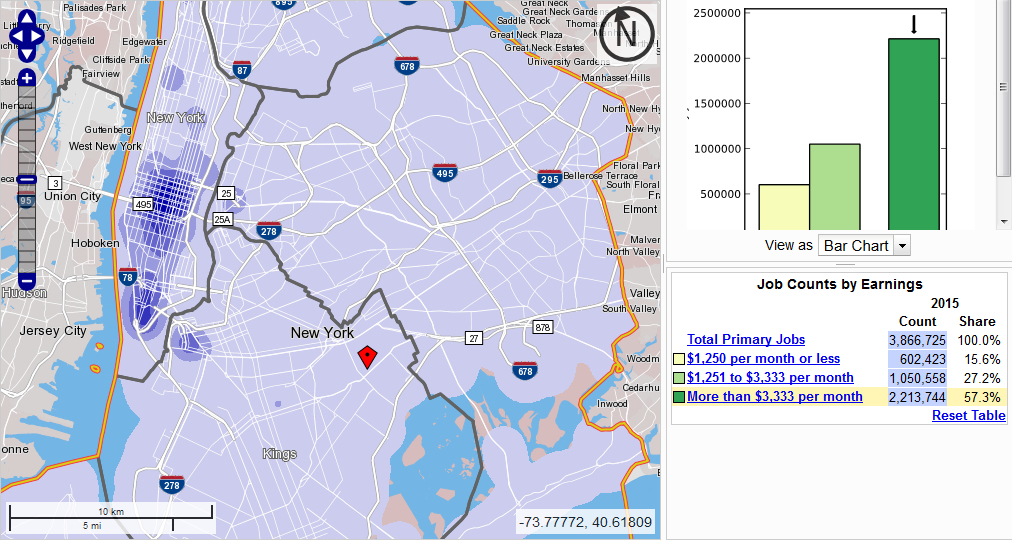
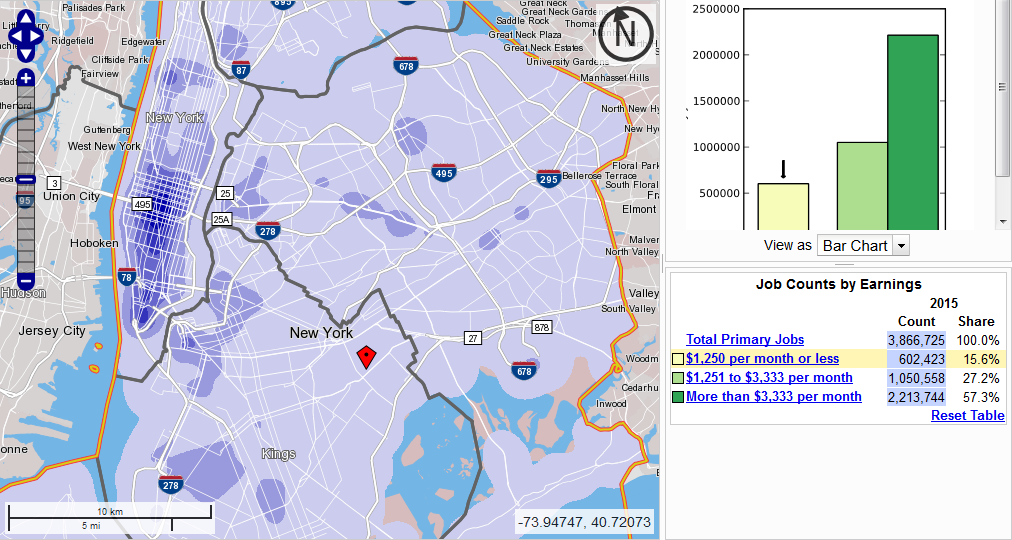
There are three income classes available, and I looked at the bottom and top ones, but the middle one, still skewed toward the working class, looks the same as the bottom class. The biggest observation is that Midtown is dominant regardless of income, but is more dominant for middle-class workers (more than $40,000 a year) than for low-income ones (up to $15,000, or for that matter $15,000-40,000).
The colors are relative, and the deepest shade of blue represents much more density for middle-class workers, even taking into account the fact that they outnumber under-$15,000 workers almost four to one. Among the lowest-income workers we see more work on Queens Boulevard and in Williamsburg, Flushing, and the Hub, but these remain tertiary workplaces at most. The only place outside Midtown, Lower Manhattan, or Downtown Brooklyn (which includes all city workers in Brooklyn due to how the tool works, so it looks denser than it is) that has even the third out of five colors for low-income workers is Columbia, where the low-income job density is one-third that of Midtown, and where there is also a concentration of middle-class workers.
The same pattern – job centers are basically the same, but there’s more concentration within the CBD for the rich – also appears if we look at individual neighborhoods. Here is the Upper East Side versus East Harlem:
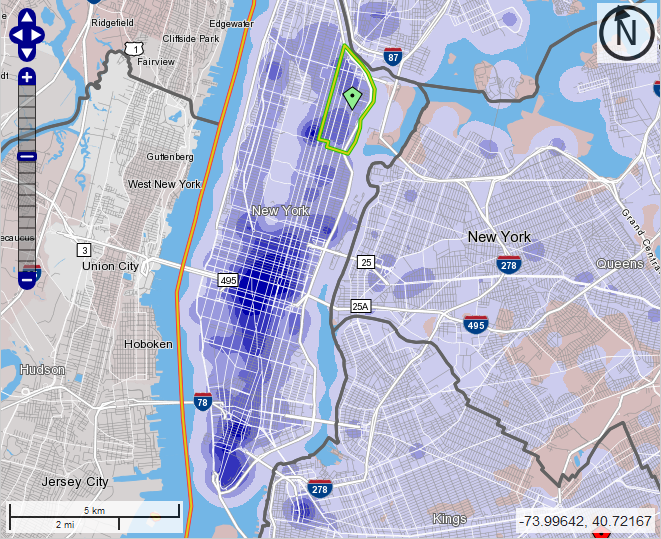
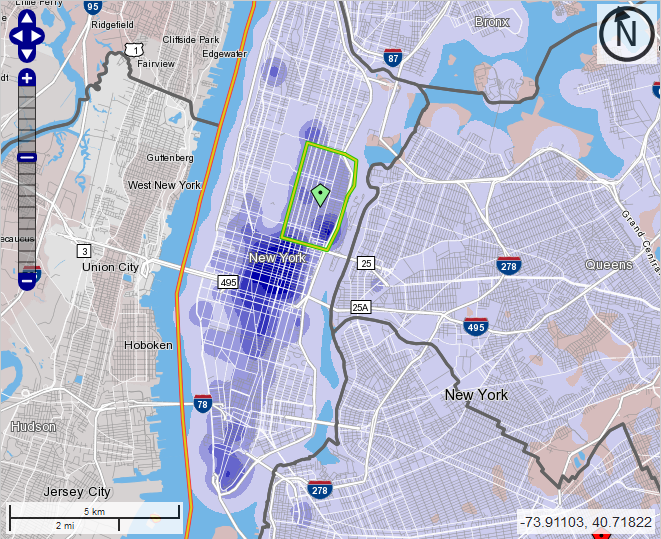
I chose these two neighborhoods to compare because they exhibit very large differences in average income and are on the same subway line. Potentially there could be a difference between where East Siders and West Siders work due to the difficulty of crosstown commuting, so I thought it would be best to compare different socioeconomic classes of people on the same line. With the East Side-only restriction, we see two Uptown job centers eclipse Columbia: Weill-Cornell Medical Center in Lenox Hill at the southeast corner of the Upper East Side, and Mount Sinai Hospital at the northwest corner.
One place where there is a bigger difference is the definition of Midtown. Looking at the general job distribution I’d always defined Midtown to range between 34th and 59th Street. However, there are noticeable differences by income:
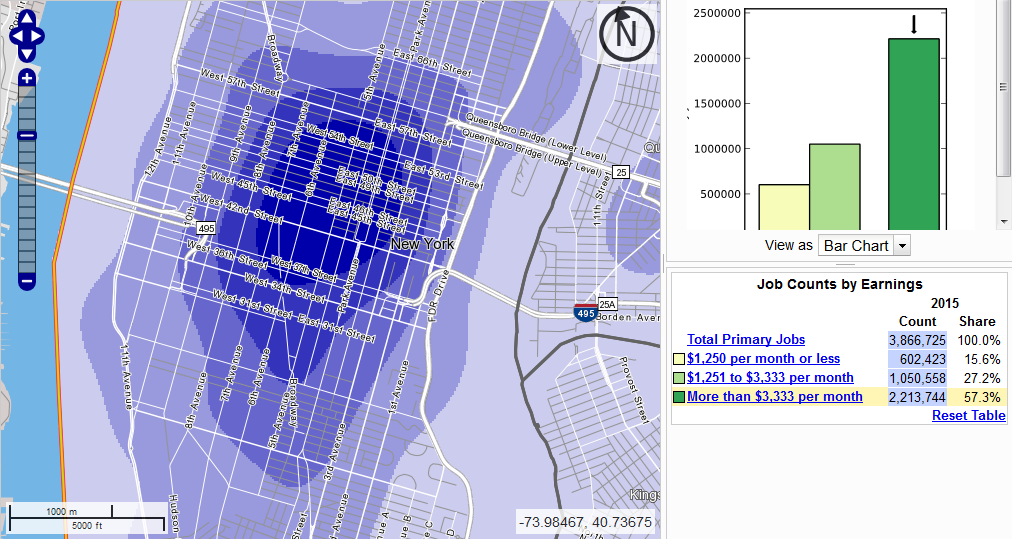
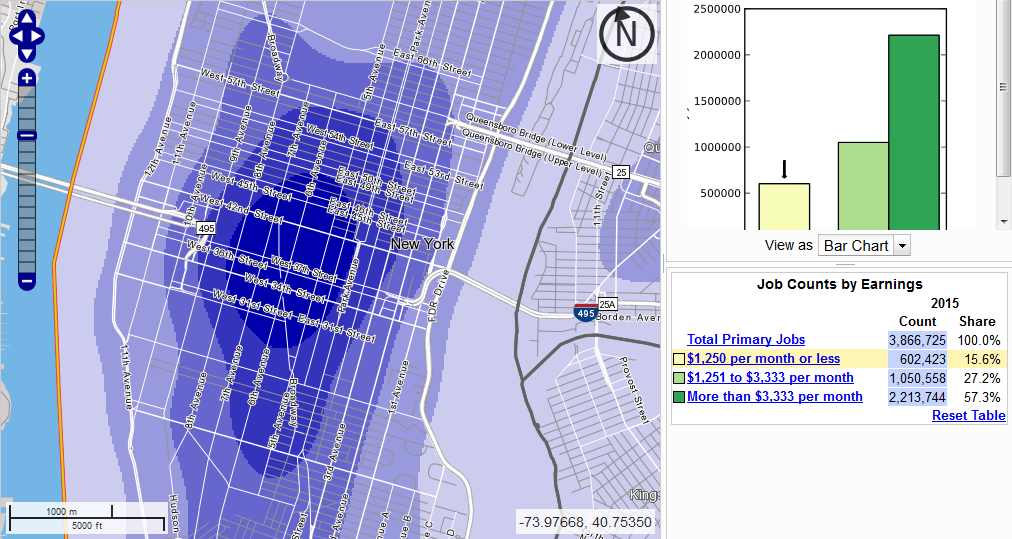
For the middle class, Midtown ranges from 34th to 57th Street and peaks around 47th. For the lowest-income workers, it ranges from 28th to 49th and peaks in the high 30s. My best explanation for this is that Midtown South and Union Square are more retail hubs than office hubs, featuring department stores and shopping centers, where the rich spend money rather than earning it.
In a deindustrialized country like the US or France, the working class no longer works in manufacturing or logistics. There are a lot of truck drivers today – 3.5 million in the US – but in 1920 the American railroad industry peaked at 2.1 million employees (source, PDF-p. 15), nine times today’s total, in a country with one third the population it has today and much less mobility. Manufacturing has plummeted as a share of employment, and is decreasing even in industrial exporters like Germany and Sweden. Instead, most poor people work at places that also employ many high-skill, high-income workers, such as hospitals and universities, or at places where they serve high-income consumption, such as retail and airports.
Since the working class works right next to the middle class, the nature of bosses’ demands of workers has also changed. Low-skill works now involves far more emotional labor; in Singapore, which makes the modern-day boss-worker relationships more explicit than the Anglosphere proper, there are signs all over the airport reminding workers to smile more. Nobody cares if auto workers smile, but they’re no longer a large fraction of the working class.
With the working class employed right next to the middle class, there is also less difference in commuting. For the most part, the same transportation services that serve middle-class jobs also serve working-class jobs and vice versa. This remains true even across racially segregated communities. The patterns of white New York employment are similar to those of middle-class New York employment, and those of black, Hispanic, and Asian employment are similar to those of the working class, with small differences (Asians are somewhat more concentrated in Flushing, and blacks in Downtown Brooklyn, reflecting the fact that blacks are overrepresented in public employment in the US and all city workers in Brooklyn are counted at Court Square).
This is true provided that opportunities for transportation are available without class segregation. This is not the situation in New York today. Commuter rail actually serves working-class jobs better than middle-class jobs, since Penn Station is closer to the department stores of 34th Street than to the office towers in the 50s. However, it’s priced for the middle class, forcing the working class to take slower buses and subway trains.
When I posted the above maps on Twitter, Stephen Smith chimed in saying that, look, the poor are less likely to work in the CBD than the middle class, so everywhere-to-everywhere public transportation is especially useful for them. While Stephen’s conclusion is correct, it is not supported by this specific data. In the $40,000 and up category, 57% of city jobs are in Manhattan south of 60th Street, compared with 37% in the $15,000-40,000 and under-$15,000 categories. It’s a noticeable difference, but not an enormous one. The reason Stephen is correct about how rides crosstown transit is different: people who can afford cars are very likely to drive if the transit option is not good (which it isn’t today), whereas people who can’t are stuck riding slow crosstown buses; in contrast, for CBD-bound commutes, the subway and commuter rail work reasonably well (especially at rush hour) and driving is awful.
Instead of trying to look specifically at low-income and middle- and high-income job centers, it’s better to just plan transit based on general commute patterns, and let anyone take any train or bus. This doesn’t mean business as usual, since it requires transitioning to full fare integration. Nor does this mean ignoring residential segregation by income, which in some cases can lead to transit segregation even in the face of fare integration (for example, the crosstown buses between the Upper East Side and Upper West Side have mostly white, mostly middle-class riders). Finally, this doesn’t mean relying on middle-class transit use patterns as a universal use case, since the middle class drives in the off-hours or to off-CBD locations; it means that relying on middle-class transportation needs could be reasonable. It just means that the rich and poor have substantially the same destinations.
An even bigger implication relates to questions of redevelopment. There have been periodic complaints from the left about gentrification of jobs, in which working-class job sites are turned over to high-end office and retail complexes. For example, Canary Wharf used to be the West India Docks. In New York, Jane Jacobs’ last piece of writing before she died was a criticism of Greenpoint rezoning, in which she specifically talked up the importance of keeping industrial jobs for the working class. But since the big deindustrialization wave, developments brought about by urban renewal, gentrification, and industrial redevelopment have not had any bias against providing employment for the poor. It’s not the factory jobs that the unionized working class still culturally defines itself by, but it’s industries that are hungry for low-skill work, and in many cases are serious target of unionization drives (such as universities).
When are Express Trains Warranted? Part 2: Subways
Last week, I wrote about which regional rail lines should run local and express trains and which should only run locals. I gave various guidelines, specific to that mode of transportation. The same question makes a lot of sense for subways (or elevated lines), and is especially important for large cities building new metro networks, typically in developing countries. The key difference is that subway trains almost always run so frequently that the only way to have local and express services is to build four-track mainlines, like in New York. So really, this is a question about when it’s useful to build four-track subways instead of two-track subways.
Costs
The cost of a four-track subway is higher than that of a two-track subway. However, the difference depends on the method of construction. Cut-and-cover four-track subways do not appear to be much more expensive than two-track subways; in the 1900s, New York had little to no cost premium over London or Paris. The First Subway’s underground segments, slightly less than half of which are four-track, cost $39 million per km in today’s money, compared with about $29 million per km in Paris in the same era (see sources in this post). The Metropolitan line in London cost about the same: £1.3 million for 6 km in the early 1860s, or about $30 million per km.
In contrast, boring four tracks appears to cost twice as much as boring two. It’s hard to find examples, since four-track bores are extremely rare; the examples I do know, such as the East River Tunnels and the tunnel carrying the Lexington Avenue Line under the Harlem River, are short. There are bound to be efficiencies in engineering and sitework reducing the cost of boring, just as there are with cut-and-cover, but the majority of the cost of tunneling is the boring and the systems. The majority of the rest is stations, and the local stations can be built for not much of a premium over stations on a two-track line, but the express stations require considerably more excavation.
What this means is that cities that build cut-and-cover should probably aim to build four tracks rather than two. In retrospect, Paris should have built Metro Line 1 with four tracks: the narrowest street segment, Rue de Rivoli, runs for 3 km and is about 20-23 meters wide, which can take four tracks if there are only local platforms, and everything else is at least 30 meters and could take four tracks and express platforms. The only express station under Rivoli would probably be Chatelet, where there is a wide square where the station footprint could expand.
The question of whether to use cut-and-cover today is a separate issue. It’s easier for the first few lines than for subsequent lines, which have to cross under the old lines. Nonetheless, it’s still in use, for example in China; the lack of express tracks on Chinese subways has led to criticism on some railfan forums, particularly by Japanese railfans, who are used to the fast express trains of the JRs through urban areas. But in India, the longest underground segment in Delhi, on the Yellow Line, appears to be bored, running deep under Old Delhi. The one potential pitfall is that bored tunnels, while generally more expensive to construct than cut-and-cover tunnels if wide streets are available, are nimbler, making it easier to build lines to high standards, with wide curves.
Benefits
The two obvious benefits of express subways are speed and capacity. New York averages a decent speed, just under 30 km/h, buoyed by express trains that average about 36 km/h. When frequency on both the local and express tracks is adequate, which it regrettably isn’t most of the time in New York, it’s possible to use cross-platform local/express transfers to improve trip times even for people on the local stations.
The capacity benefits are sometimes compromised by transfers. In New York, the express tracks are consistently more crowded than the local tracks on the main lines, and the Upper West Side in particular sees the city’s most overcrowded trains on the express tracks run alongside the second least crowded on the local tracks. However, on the East Side, the local and express trains under Lexington are both quite full. The number of passengers they carry would overwhelm any two-track line: to carry the same number of passengers on just two tracks at the current peak frequency, each train would need about 2,100 passengers, more per unit of train floor area than the most crowded Tokyo Metro lines.
There are also indirect effect of four-tracking. The most distant stations are presumably express-only, or, if not, passengers will transfer to an express train at the first opportunity. This means that adding local stops does not increase trip times for passengers far out, which in turn argues in favor of tighter stop spacing on local trains, to provide more coverage. Evidently, New York has one of the smallest interstations (on local trains) of any major metro network in the world, surpassed only by Paris, which built the Metro without regard for the suburbs. Second Avenue Subway, built with just two tracks, has wider stop spacing than other Manhattan north-south mainlines, missing 79th Street, with the planned phase 2 stopping at 106th instead of 103rd and 110th.
Network effects
I have hammered repeatedly that metro systems need to avoid three pitfalls of network planning:
- Tangential lines, starting as radial farther out but becoming circumferential closer in rather than staying radial and serving city center.
- Reverse-branching: a common trunk in an outlying area splitting into branches in city center, the opposite of the more normal branching arrangement.
- Missed connections, in which two lines intersect without a transfer.
It is easier to miss connections when the stop spacing is wider, because city centers are so small that line 1 can easily miss the road that line 6 will later run under. The Paris Metro has just one missed connection (M5/M14), and the city made a failed effort in the 1900s to bring Line 5 to what would be the transfer station, Gare de Lyon. New York has only two missed connections among the lines built from 1900 to the 1920s (Junius/Livonia on the 3/L, Bowling Green/Whitehall on the 4-5/RW), both of which are easy to fix; the city’s tens of misses come from a deliberate decision to avoid transfers in the lines built in the 1930s. Systems with wider stop spacing have more opportunities for missed connections, such as Tokyo, Shanghai, and Moscow.
Four-track mainlines short-circuit this problem doubly. First, fewer lines are required to provide the same coverage and capacity. On the eve of the Great Depression, New York had six subway mainlines, three with four tracks and three with two, and 2 billion annual riders. Even if a city insists that all transfer stations be express (which is the case in New York among lines built before the 1930s, though at one station express platforms were only retrofitted decades later), there are fewer potential intersections; at city center, even the express lines are unlikely to have very wide stop spacing.
Moreover, it’s fine to miss transfers on express lines. The reason missed connections are so bad is that the alternative option typically requires a three-seat ride. For example, the 1 passes between Columbus Circle-59th Street and 50th Street without a connection to the E train, leaving connecting passengers with one of two options: ride to Times Square and transfer there, which is both a detour and a very long walk between the platforms, or change to the B or D at 59th and then again to the E at 53rd; the latter option is the faster one, saving about 5 minutes of in-vehicle time and 3 minutes of transfer time.
But if one of the transfers is cross-platform, then a three-seat ride is less onerous. This is especially true if this transfer is local/express on a long shared trunk line, where the transfer stations usually don’t get as crowded as between two separate trunks. This means that it’s possible, if there is no better option, to have local-only transfers. Two of the top stations in New York, 53rd/Lex and Columbus Circle, are local-only transfers.
Scale
Small cities don’t need to think about express trains very much. Transit cities with about 2 million people in their metro areas, such as Vienna, Stockholm, Prague, Budapest, and Hamburg, make do with a handful of metro lines, sometimes supplemented by regional rail. But as they grow, the number of urban rail lines they need grows to the point that a coherent two-track network is too difficult, not to mention too slow. Paris manages to make do with the RER acting as the express layer, but outside India and Pakistan, cities that are just beginning to build their metro networks don’t have large legacy commuter rail networks to leverage for express service. In Africa between the Sahara and South Africa, nearly everything has to be built from scratch, and the same is true of Bangladesh and much of Southeast Asia and Latin America.
Moreover, in developing countries, a large number of cities either are megacities or can expect to grow to that size class soon. This is less true in Latin America, nearly all of which has at- or below-replacement birth rates, already high urbanization rates, and negative net migration (thus, the main case for four-track subways in Bogota hinges on the fact that the city has absurdly wide roads for cut-and-cover, not on future scale). However, in poor countries with high birth rates and low urbanization rates, cities can expect to increase their population many times over in the next few decades. Lagos and Dhaka are already huge, and midsize cities such as Nairobi, Kampala, Dar es Salaam, Addis Ababa, Khartoum, Accra, Abidjan, Douala, and Sanaa can expect to grow to that size class within a generation, as can midsize cities in countries with lower birth rates, such as Chittagong, Hanoi, and Ho Chi Minh City. In such cities, transportation planning should presume much greater scale than may seem warranted today.
A smaller-scale version of this principle can be found in cities that are growing rapidly due to immigration, especially Singapore but also Sydney, Melbourne, Toronto, Vancouver, and Stockholm. Such cities might want to consider infrastructure investments based not on their present-day population levels, but on those that they can expect after 30 more years of high migration rates. Vancouver and Stockholm are too small for express subways no matter what, and Toronto has already built its central spines with two tracks (and is upgrading its regional rail network to act as an express layer), but Singapore, Sydney, and Melbourne should all think about how to plan for the possibility that they will have 10 million people within 50 years.
The MTA’s Bus Redesign Plan
Two weeks ago I wrote about the Brooklyn bus redesign I’m working on with Eric Goldwyn. The MTA, which is aware of our efforts, came up with its own plan. So far details are scant; there is a presentation available online, which talks about goals (“network redesign,” “higher frequency”) but no specifics (“a more gridded network,” “6-minute off-peak frequency on the main routes”).
At least so far, the goals seem solid. The MTA has the following list of improvements:
- Redesign the network from top to bottom based on customer input, demographic changes, and travel demand analysis. Provide better connectivity and more direct service in every neighborhood
- Optimize the existing network with community consultation by removing closely-spaced and underutilized stops and making street design changes on select corridors in coordination with NYC DOT
- Expand off-peak service on strategic routes using a toolbox of service strategies including increased frequency and demand based service adjustments
- Expand Traffic Signal Priority (TSP) to allow an approaching bus to hold a green light or shorten a red light
- Seek exclusive busways on priority corridors to give buses full access in major congested areas
- Identify opportunities for new bus lanes and queue jumps in 2018
- Advocate for strengthened NYPD enforcement of bus lanes to keep bus stops and travel lanes clear throughout the system
- Recommend dedicated transit-priority traffic teams to focus enforcement in key areas to ensure buses move quickly through trouble spots
- Use Bus Lane Enforcement Cameras mounted on buses to automatically identify violations and issue tickets. Advocate for legislation to expand beyond the existing 16 authorized routes
- Install tap readers to speed up the boarding process so buses spend less time waiting at stops
- Introduce all-door boarding to allow riders to get on through any door of the bus
- Explore options for a future cashless system to maximize reductions in boarding time
- Expand fare enforcement on regular bus service to reduce evasion and restore fare revenue
The main problems only appear toward the end, with the implementation of off-board fare collection and all-door boarding. The insistence on “fare enforcement,” which could mean regular proof of payment (POP) inspections but could also mean worse, such as armed cops (not practiced in New York on SBS but practiced on some other US systems, like BART) or holding the bus during inspection (which New York does practice, unlike Berlin and other German-speaking cities). Overall I’m relatively sanguine about Andy Byford specifically – he’s not American and is not used to American levels of police militarization.
However, another aspect of the POP proposal is troubling: the connection with tap readers. The plan’s full text (which is barely more detailed than what I quote above) mentions that POP should come with the so-called New Fare Payment System, or NFPS, which New York is currently planning to roll out starting in 2019, continuing until 2023. The NFPS is based on worst industry practices cobbled from American and British ideas. Here is my second post ever, discussing the plans for smartcards in New York in 2011. New York ignored (and keeps ignoring) the smartcard implementations in a number of East Asian cities in its zeal to make people treat their credit card as a transit fare card, ensuring the agency can surveil all passengers; perhaps Americans lack the values of freedom and individual privacy of Japan and Singapore.
New York also ignored (and keeps ignoring) the POP implementations in cities with paper tickets, such as most of Central Europe. Smartcards are not required for POP: the German-speaking world has POP with paper tickets, as did Vancouver on SkyTrain and some bus lines even before the Compass Card debacle. In Singapore I saw a ticket inspection on a bus even before EZ-Link; I had a magnetic farecard at the time. Given the enormous waste coming from making passengers line up and pay the driver, it’s imperative to move toward POP as soon as possible, even if it means equipping inspectors with MetroCard readers rather than smartcard readers. MetroCard may only last for five years if the NFPS schedule doesn’t keep slipping, but handheld magnetic card readers are a cheap technology whereas making buses idle while passengers dip cards one at a time is not so cheap.
The zeal to go cash-free is the final troubling aspect of New York’s ideas about fare payment, especially when bundled with the idea that the bank card is the fare card. Not everyone has a local bank account. Tourists don’t (and even cards that are supposed to work abroad don’t always). Low-income city residents don’t, either: 11.7% of New York households have no bank account, and they disproportionately appear to be in poverty, judging by which neighborhoods they are most concentrated in. The MTA has always treated anonymous smartcards as an afterthought, and going cash-free means there is no recourse for the unbanked or even for many tourists.
Nor is cash-free operation even necessary. An on-board farebox is compatible with POP. In this system, riders can board from any door, and the driver will begin moving as soon as all passengers have boarded, even if not all passengers have paid yet. Riders with valid transfers or season passes need not do anything. Riders with a pay-per-ride smartcard and no transfer should tap their card at a validator at any bus door or bus stop (validators are cheap that blanketing the system with them is practically free). The remaining passengers should walk to the farebox and pay there; perhaps some busy stations should get fareboxes, as all SBS stops do in New York today, but if the MTA only expects a few smartcard-free, non-transfer passengers at a stop, then having them pay on board a moving bus should not be a problem.
I’d like to stress that other than the ongoing hiccups of the English-speaking world with fare payment systems (hiccups that it seems to export to Paris), the plan appears good, from what few details the MTA has released. There are plans for increasing the average distance between bus stops, adding more bus lanes, getting serious about signal preemption, raising off-peak frequency, and letting passengers board from all doors. The MTA really is noticing that its bus system is collapsing and really is making serious plans to avert a death spiral.
When are Express Trains Warranted? Part 1: Regional Rail
The Regional Plan Association has a detailed regional rail proposal out. It’s the same one from the Fourth Plan that I’ve criticized here, on Streetsblog, and on Curbed, but with more explanation for how the service should run, with stopping patterns and frequency.
There are some good aspects there, like a section about the importance of electrification and multiple-units, though it stops short of calling for full electrification and replacement of locomotives with EMUs; the focus on off-peak frequency is also welcome. There are also bad ones, like the claim on p. 32 that it’s difficult to impossible to provide through-running using the existing Penn Station tracks used by New Jersey Transit. Foster Nichols told me that there are some difficulties with grades but they should be doable if NJT commits to an all-EMU fleet, and reminded me that the ARC studies judged through-running using these station tracks and new tunnels feasible. What he expressed to me as a difficulty turned into a near-impossibility in the report, in order to justify the $7 billion Penn Station South project.
But I want to focus on one particularly bad aspect of the proposal: the stopping patterns. The RPA is proposing three distinct stopping patterns on pp. 32-45, with three separate brands: Metro, in the city and some inner suburbs; Regional Express (RX), in the suburbs; and Trans-Regional Limited (TRL), providing intercity service to New Haven, Ronkonkoma, Philadelphia, and other major stations outside the built-up area. Even as the plan talks about the importance of making sure suburban trains serve urban stations in order to give them frequent service through overlay, the stopping patterns suggest the opposite.
The proposal involves trains from the suburbs expressing through most city stations (including the infill) even on two-track lines, like the Port Washington Branch. Metro trains would make all current stops plus additional infill to Bayside, and RX trains would only serve Willets Point, Flushing, and Bayside, and then run from Bayside to Port Washington. A similar pattern happens from Jamaica to Valley Stream, resulting in the Babylon, Long Beach, and Far Rockaway Branches all having to share a track pair. Moreover, the RX trains may themselves be divided into local and express trains, for example on the New Haven Line.
This is bad practice. On a two-track line, there’s no real reason to skip a handful of inner stations just to guarantee the outer ones express service. If anything, the need to schedule trains on the same tracks would lead to more fragile timetables, requiring more schedule padding. My analysis from 2.5 years ago found that the LIRR Main Line is padded 32% and the Babylon Branch is padded 19%: that is, the scheduled travel time on the Main Line (up to Ronkonkoma) is 32% more than the travel time imputed from line speed limits and current fleet acceleration performance. Patrick O’Hara, who the RPA study even quotes as a source elsewhere, investigated this issue separately, looking at best-case timetables, and found that some runs are padded 40-50%.
In Switzerland, trains are padded 7%, and I’m told that in Japan, after the Amagasaki accident showcased the safety problems of overly precise schedules, pads are about 5%. Express trains and locals mixed on the same line make it harder to maintain tight enough reliability for low schedule padding; this way, on an all-local line, trip times may match those of express trains on mixed lines, as they do in my analysis above. The best analogy is the RER B going to the north: the express trains are 4 minutes faster than the local trains, skipping 9 stops. The stop penalty on the RER B is higher, closer to 7 minutes over 9 stops, but the shared tracks with local trains (and with the RER D between Gare du Nord and Chatelet-Les Halles) means that there’s a fudge factor in the schedule, so it’s not possible to reliably do better than 4 minutes, and the trains end up visibly crawling on the mainline.
The reader familiar with technical transit advocacy in the Bay Area may interject, what about Caltrain? Clem Tillier has no trouble proposing timetables mixing local trains, express trains, and high-speed rail on the same track pair with timed overtakes, and a 7% pad. So why am I down on this concept in New York? The answer is line complexity. Caltrain is a simple two-track back-and-forth, and HSR is generally more punctual than legacy trains because it runs for long stretches on high-quality dedicated tracks, so it’s unlikely to introduce new variability to the line. In contrast, the RPA plan for regional rail in New York involves extensive branching, so that train schedules depend on trains elsewhere on the line. In this case, introducing more complexity through local/express sharing is likely to require more schedule padding, erasing the speed advantage.
In general, my questions to establish guidelines for where express trains are warranted are,
- How long is the line, measured in the number of stations? More stations encourage more express trains, because more stations can be skipped. In higher speed zones, stop penalties are higher, but at equal line length measured in km, higher speeds and fewer local stations reduce the benefit of express trains.
- How frequent are trains? At low frequency, local stations need more frequency, so express runs are less useful. At very high frequency, there may not be capacity for different stopping patterns unless the line has four tracks. On a two-track line, the optimum frequency for a local/express alternation is about 6-12 trains per hour, 3-6 local and 3-6 express, with a single mid-line overtake. Multiple overtakes on a single line are possible, but more fragile, so they are a bad idea except in special circumstances.
- What is the demand for travel? Express trains work best if there are a few distinguished stations at regular intervals, or else if the line is long and there is strong demand at the far end; if the inner stations are very strong then it’s more important to give them higher local frequency. When performing this analysis, it’s important to make sure station ridership levels reflect genuine demand rather than service. For example, Caltrain express stops have high ridership in large part because of their better service, not nearby density, as shown in Clem Tillier’s analysis. The LIRR Main Line has far more ridership at Mineola and Hicksville than the other stations on the trunk and also far more service, but Patrick explains that this is due to better highway access, so it’s genuine demand and not just a reflection of better service.
Caltrain needs express service because it has about 20 stations between San Francisco and San Jose, depending on the amount of infill and anti-infill desired; a target frequency of 8-10 peak trains per hour; and strong demand on the outer stations, especially for reverse-peak trips. In New York, none of the two-track lines meets the same standard. Some are too short, such as the Port Washington Branch. Others are too busy, such as the Harlem Line, Babylon Branch, and LIRR Main Line. Yet others have too much demand clustering in the inner stations, such as the Erie lines and the North Jersey Coast Line.
On four-track lines, it’s always easier to run express service. This doesn’t mean it should always be run: the upper New Haven Line is a strong candidate for relegating all commuter trains to the local tracks, making all stops, giving the express tracks to intercity trains. The Northeast Corridor Line in New Jersey is a dicey example: past Rahway there are four tracks, but intercity trains could run at very high speeds, making track sharing on the express tracks difficult. My service pattern map has express trains skipping Edison and Metuchen, but it’s just two stations, making it better to just run local beyond Rahway to clear the express tracks for high-speed rail.
It’s tempting to draw proposals involving intense metro-style regional rail service only serving the urban and inner-suburban stations; I’ve had to argue against such plans on some MBTA lines. The problem is that trains from the outer suburbs are still necessary and still going to pass through the inner suburbs, and in most cases they might as well stop at those stations, which need the frequency more than the outer suburbs need the few minutes of speedup.
Buses in Brooklyn: Frequency is Freedom, but 15 Minutes isn’t Frequency
I’ve recently started working part-time on a project for the Marron Institute at NYU about bus restructuring in Brooklyn; at the end of this summer, I expect to release a proposal for service upgrades and a new map. I’m working on this with Marron scholar Eric Goldwyn, who is funded by the TWU, which is worried that ridership collapse may lead to service cuts and job losses, but I’m funded directly by Marron and not by the union.
Some of what’s likely to appear in the final report should be familiar to regular readers of this blog, or of Human Transit, or of the work TransitCenter has been doing. As I wrote in Curbed earlier this year, bus operating costs in New York are unusually high because the buses are slow, as the main operating costs of buses scale with service-hours and not service-km. Thus, it’s important to speed up the buses, which allows either providing higher frequency at the same cost or the same frequency at lower cost. A bus speedup should include systemwide off-board fare collection and all-door boarding (common in the German-speaking world but also in San Francisco), wider stop spacing, dedicated lanes wherever there is room, and signal priority at intersections; the TWU is an enthusiastic proponent of off-board fare collection, for reasons of driver safety rather than bus speed.
While bus speedups are critical, their impact is not as Earth-shattering as it might appear on paper. New York’s SBS routes have all of the above features except signal priority, and do save considerable time, but are still slow city buses at the end of the day. Brooklyn has two SBS routes: the B44 on Nostrand, averaging 15 km/h (local B44: 11.3), and the B46 on Utica, averaging 13.7 (local B46 on the shared stretch: 10.8). Their speed premiums over the local routes are toward the high end citywide, but are still 30%, not the 200% speed premium the subway enjoys. Moreover, the speed premium over non-SBS limited routes is 15-20%; put another way, between a third and a half of the speed premium comes purely from skipping some stops.
I mentioned in my last post that I met Carlos Daganzo at Berkeley. Daganzo was responsible for the Barcelona bus redesign, Nova Xarxa; you can read some details on Human Transit and follow links to the papers from there. The guiding principles, based on my conversation with Daganzo and on reading his papers on the subject, are,
- Barcelona has high, relatively uniform density of people and jobs, so there’s no need for buses to hit one CBD. Brooklyn has about the same average residential density as Barcelona, but has a prominent CBD at one corner, but as this CBD is amply served by the subway, it’s fine for buses to form a mesh within the subway’s gaps.
- Nova Xarxa involved widening the stop spacing in Barcelona from less than 200 meters to three stops per km, or a stop every 300-350 meters; Daganzo recommends even wider stop spacing.
- While Barcelona’s street network is strictly gridded, the buses don’t run straight along the grid, but rather detour to serve key destinations such as metro stops. This is an important consideration for Brooklyn, where there are several distinct grids, and where subway stops don’t always serve the same cross street, unlike in Manhattan, where crosstown routes on most two-way streets are assured to intersect every north-south subway line.
- The percentage of transfers skyrocketed after the network was implemented, standing at 26% at the end of 2015, with the model predicting eventual growth to 44%, up from 11% before the redesign.
- The network was simplified to have 28 trunk routes, the least frequent running every 8 minutes off-peak.
The high off-peak frequency in Barcelona is a notable departure from Jarrett Walker’s American network redesigns; the evidence in Houston appears mixed – ridership is about flat, compared with declines elsewhere in the country – but the percentage of transfers does not seem to have risen. Jarrett says in his book that having a bus come every 10 minutes means “almost show-up-and-go frequency” with no need to look at schedules, but his work in Houston and more recently in San Jose involves routes running every 15 minutes.
Moreover, unreliable traffic in these car-dominated cities, in which giving buses dedicated lanes is politically too difficult, means that the buses can’t reliably run on a schedule, so the buses do not run on a clockface schedule, instead aiming to maintain relatively even headways. (In contrast, in Vancouver, a less congested street network, with priority for all traffic on the east-west main streets on the West Side, ensures that the buses on Broadway and 4th Avenue do run on a fixed schedule, and the 4th Avenue buses have a 12-minute takt that I still remember four years after having left the city.)
I’ve talked about the importance of radial networks in my posts about scale-variant transit. I specifically mentioned the problem with the 15-minute standard as too loose; given a choice between an untimed 15-minute network and a timed 30-minute network, the latter may well be more flexible. However, if the buses come every 5 minutes, the situation changes profoundly. Daganzo’s ridership models have no transfer penalty or waiting penalty, since the buses come so frequently. The models the MTA uses in New York have a linear penalty, with passengers perceiving waiting or transferring time on the subway as equivalent to 1.75 times in-motion time; bus waiting is likely to be worse, since bus stops are exposed to the elements, but if the average wait time is 2.5 minutes then even with a hefty penalty it’s secondary to in-vehicle travel time (about 18 minutes on the average unlinked bus trip in New York).
Unfortunately, that high frequently does not exist on even a single bus line in Brooklyn. Here is a table I created from NYCT ridership figures and timetables, listing peak, reverse-peak, and midday frequencies. Five routes have better than 10-minute midday frequency: the B12, the B6 and B35 limited buses, and the B44 and B46 SBSes, running every 7, 7.5, 8, 8, and 6 minutes respectively. In addition, the B41 limited and B103 have a bus every 9 and 7.5 minutes respectively on their trunks, but the B41 branches on its outer end with 18-minute frequencies per branch and the B103 short-turns half the buses. Another 14 routes run every 10 minutes off-peak, counting locals and limiteds separately.
The problem comes from the split into local and limited runs on the busiest buses. The mixture of stopping patterns makes it impossible to have even headways; at the limited stops, the expected headway in the worst case is that of the more frequent of the two routes, often about 10 minutes. The average ridership-weighted speed of Brooklyn buses is 10.75 km/h. An able-bodied passenger walking at 6 km/h with a 10-minute head start over a bus can walk 2.25 km before being overtaken, which can easily grow to 3 km taking into account walking time to and from bus stops. To prevent such situations, it’s important to run buses much more frequently than every 10 minutes, with consistent stopping patterns.
This does not mean that NYCT should stop running limited buses. On the contrary: it should stop running locals. The SBS stop spacing, every 800 meters on the B44 and B46, is too wide, missing some crossing buses such as the B100 (see map). However, the spacing on the B35 limited is every 400 meters, enough to hit crossing buses even when they run on one-way pairs on widely-spaced avenues. The question of how much time is saved by skipping a stop is difficult – not only do different Brooklyn buses give different answers, all lower than in Manhattan, but also the B35 gives different answers in different directions. A time cost of 30 seconds per stop appears like a good placeholder, but is at the higher end for Brooklyn.
The question of how many stops to add to SBS on the B44 and B46 has several potential answers, at the tight end going down to 400 meters between stops. At 400 meters between stops, the B44 would average 13 km/h and the B46 12 km/h. At the wide end, the B44 and B46 would gain stops at major intersections: on the B44 this means Avenue Z, R, J, Beverly, Eastern Parkway, Dean, Halsey, and Myrtle, for an average interstation of 570 meters and an average speed of 14 km/h, and on the B46 this means Avenue U, Fillmore, St. John’s, and Dean, for an average interstation of 610 meters an average speed of 13 km/h. Consolidating all buses into the same stopping pattern permits about a bus every 2.5 minutes peak and every 4 minutes off-peak on both routes.
On the other routes, consolidating local and limited routes required tradeoffs and cannibalizing some peak frequency to serve the off-peak. While it may seem dangerous to limit peak capacity, there are two big banks that can be used to boost off-peak frequency: time savings from faster trips, and greater regularity from consolidating stop patterns. The B82 is an extremely peaky route, running 7 limited and 10 local buses at the peak and just 6 buses (all local) for a four-hour midday period; but there is a prolonged afternoon shoulder starting shortly after noon with another 6 limited buses. Some peak buses have to be more crowded than others just because of schedule irregularity coming from having two distinct stop patterns. Consolidating to about 15 buses per hour peak and 10 off-peak, cannibalizing some frequency from the peak and some from the shoulders, should be about neutral on service-hours without any additional increase in speed.
The sixth post on this blog, in 2011, linked to frequent maps of Brooklyn, Manhattan, and Bronx buses, using a 10-minute standard. There has been some movement in the top buses since 2011 – for one, the B41 route, once in the top 10 citywide, has crashed and is now 16th – but not so much that the old map is obsolete. A good place to start would be to get the top routes from a 10-minute standard to a 6-minute standard or better, using speed increases, rationalization of the edges of the network, and cannibalization of weak or subway-duplicating buses to boost frequency.
I Gave a Pair of Talks in the Bay Area About Regional Rail
Thanks to the invitation of Adina Levin’s Friends of Caltrain, I came to the Bay Area for a few days, giving two talks about regional rail best industry practices in front of Friends of Caltrain, Seamless Bay Area, and SF Transit Riders. My schedule was packed, including a meeting with a world-leading expert in transportation systems in which I learned about the Barcelona bus service changes; a Q&A about both general and Bay Area-specific issues for Bay City Beacon subscribers; and several other meetings.
My two talks were in Mountain View and San Francisco, and used the same slides, with minor corrections. Here are the slides I used in San Francisco; I consolidated the pauses so that each page is a slide rather than a line in a slide. This was also covered in Streetsblog, which gives more background and gives some quotes from what I said during the presentation, not printed in the slides.
Unlike in my NYU presentation last year, I did not include a proposed map of service improvements. The reason is that in the Bay Area, there are more questions than answers about which service should use which piece of infrastructure. This makes fantasy maps dangerous, as they tend to fix people onto one particular service pattern, which may prove suboptimal based on decisions made elsewhere in the system. This is not a huge problem in New York or Boston, where the alignments naturally follow where the stub-end commuter lines are, with only a few questions; but in the Bay Area, the situation is more delicate, because big questions like “can/should Caltrain get a trans-Bay connection from San Francisco to Oakland and the East Bay?” can go either way.
The role of redevelopment in the area is especially important. Unlike New York, Paris, or other big transit cities, San Francisco does not have much density outside the city proper, Oakland, or Berkeley. Moreover, there is extensive job sprawl in Silicon Valley, which contributes to a last-mile problem for public transit; usually first-mile access is a bigger problem and high-end jobs tend to cluster near train stations. But conversely, the high incomes in the Bay Area and the growth of the tech industry mean that everywhere TOD is permitted in the core and the suburbs, it will be built. This impacts decisions about the total size of transit investment.
At present-day development patterns, San Francisco proper really doesn’t need more rail construction except Geary and the Downtown Extension, depending on construction costs. But general upzoning makes Geary worth it even at $1 billion per km and opens up the possibilities of four-tracking Caltrain within the city (which means expanding some tunnels), giving the N-Judah dedicated tracks and a dedicated tunnel under Mission, and extending the Central Subway to the north and northwest. The land use in the Richmond and Sunset Districts today supports a fair amount of transit, but not new subways if there’s no cost control.

