Category: Urban Transit
Cops on Public Transportation
I wrote a post about American moral panics about fare evasion two months ago, which was mirrored on Streetsblog. I made a mistake in that post that I’d like to correct – and yet the correction itself showcases something interesting about why there are armed police on trains. In talking about BART’s unique belts-and-suspenders system combining faregates with proof-of-payment fare inspections, I complained that BART uses armed police to conduct inspections, where the German-speaking world happily uses unarmed civilians. BART wrote me back to correct me – the inspections are done by unarmed civilians, called ambassadors. The armed cops on the trains are unrelated.
I’d have talked about my error earlier, but I got the correction at the end of November. The American Christmas season begins around Thanksgiving and ends after Sylvester, and in this period both labor productivity and news readership plummet; leave it to Americans to have five weeks a year of low productivity without giving workers those five weeks in vacation time. With that error out of the way – again, BART conducts inspections with unarmed ambassadors, not armed cops – it’s worth talking about why, then, there are armed cops on trains at all, and what it means for fare enforcement.
The answer to the “why armed cops on the train?” question is that among the broad American public, the police is popular. There are hefty differences by party identification, and in the Bay Area, the opinions of Republicans are mostly irrelevant, but even among Democrats; there are also hefty differences by race, but blacks are at their most anti-police divided on the issue. A Pew poll about trust in institutions asks a variety of questions about the police, none of which is “would you like to see more cops patrol the subway?”, but the crosstabs really don’t scream “no.” Vox cites a poll by Civis Analytics that directly asks about hiring more police officers, and even among black people the results are 60-18 in favor. In New York, NYPD Commissioner James O’Neill had positive net approval among all racial groups shortly before leaving office, the lowest rate being 43-28 among Hispanics.
The crosstabs only go so far, and it’s likely that among certain subgroups the police is much less popular, for example black millennials. It’s normal for a popular institution to still generate intense opposition from specific demographic, class-based, or ideological groups, and it’s even normal for a popular institution to be bad; I should know, Massachusetts’ Charlie Baker is one of America’s most popular governors and yet his do-nothing approach to infrastructure planning makes him unpopular at TransitMatters. But this doesn’t change the fact that, as a positive rather than normative statement, the police enjoys consensus support from the urban American public.
What this means is that there are cops on the subway in New York and on BART not because of an inherent necessity of the fare collection system, but because in the eyes of the people who run these systems, crime is a serious concern and having more cops around is the solution. Evidently, BART layers cops on top of two distinct fare enforcement mechanisms – fare barriers and the ambassadors. In New York, too, NYPD’s justification for arresting people for jumping the turnstiles is that a significant fraction of them have outstanding warrants (many of which are about low-level offenses like being behind on court payments).
I bring this up because there’s a growing argument on the American left that public transportation should be free because that way people won’t be arrested for fare-dodging. This argument slides in an assumption, all too common to socialists who are to the left of the mainline liberal or social democratic party, that there is a leftist majority among the public that is just waiting to be activated by a charismatic leader rejecting neoliberal or otherwise moderate political assumptions.
But in the real world, there is no such leftist majority. The median voter even in a very left-wing area like New York or San Francisco may not support the more violent aspects of tough-on-crime politics, but is mostly okay with more police presence. The average self-identified leftist may be more worried that having police patrols will lead to more brutality than that not having them will lead to more crime, but the average self-identified leftist is not the average voter even in the Bay Area.
In this reality, there are cops on the subway because a lot of people worry about crime on the subway and want to see more police presence. The cops themselves, who are well to the right of the average voter pretty much anywhere, may justify this in terms of fare beating, but what matters is what voters near the median think, and they worry about ordinary property and violent crime. Those worries may well be unfounded – for one, New York is very safe nowadays and has been getting steadily safer, so the recent binge of hiring more cops to patrol the subway is a waste of money – but so long as voters have them, there will be police patrols.
The upshot is twofold. First, fare enforcement and the politics of criminal justice have very little to do with each other. Cops patrol crowded public spaces that require payment to enter, like the subway, as they do crowded public spaces that do not, like city squares. If public transportation fares are abolished, cops will likely keep patrolling subway stations, just as they patrol pieces of transportation infrastructure that are fare-free, like the concourses of major train stations.
If the left succeeds in persuading more people that the police is hostile to their interests and the city is better off with less public police presence, then cops will not patrol either the subway or most city squares. In the future, this is not outside the realm of possibility – in fifteen years the popularity of same-sex marriage in the US went from about 2-to-1 against to 2-to-1 in favor, and the trend in other democracies is broadly similar. But in New York and San Francisco in 2020, this is not the situation.
And second, fare enforcement can be conducted with unarmed inspectors regardless of the political environment. Multiple Americans who express fear of crime have told me that inspections have to be done with armed police, because fare beaters are so dangerous they would never submit to an unarmed inspector. And yet, even in San Francisco, where a large fraction of the middle class is worried about being robbed, inspections are done without weapons.
I’ve recurrently told American cities to tear down the faregates. BART’s belts-and-suspenders fare enforcement is unnecessary, borne of a panic rather than of any calculation of costs and benefits to the system. But what BART should get rid of is not the ambassadors, but the faregates. The most successful transit city the rough size of San Francisco – Berlin – has no faregates and leaves most stations unstaffed to reduce costs. Berlin encourages compliance by making it easier to follow the law, for example by offering cheap monthly passes, rather than by hitting passengers in the face with head-level fare barriers.
If cops patrol the subway because most voters and most riders would prefer it this way, then there is no need to connect the politics of policing with the technical question of what the most efficient way to collect fares is. There is a clear best practice for the latter, and it does not involve faregates in a rapid transit system with fewer than multiple billions of annual riders. What the police does is a separate question, one that there is no reason to connect with how to raise money for good public transportation.
Why Do Public Transportation Commuters Outearn Car Commuters in Some American Cities?
More than a year ago, I compared Los Angeles with a number of other large American cities. I brought up issues of public transportation ridership, city center job concentration, and income differences, as in the Los Angeles region people who commute by public transit average barely half the earnings of people who drive alone. One of the things noted in that post is that in the secondary transit cities of the United States – Chicago, San Francisco, Washington, Boston – people who commute by transit outearn people who do not. I didn’t delve deeply into that issue in that post, but in this post I will, because it showcases a serious problem in all four cities. New York lacks this pattern as of 2017 – solo drivers outearn transit commuters, though by a small and declining margin, so by 2020 it may join the secondary cities.
The reason this is a problem is that in none of these cities is public transportation so good as to be a luxury good. Rather, the issue is that public transportation is mostly an option for people traveling to city center, where incomes are higher. Crosstown public transportation options are weak – there is rarely direct rapid transit, and transfer trips are inconvenient. There may also be a peak vs. off-peak artifact, but I have no data confirming that richer Americans are likely to commute at rush hour, when transit frequencies are higher and congestion is worse.
Income by mode of transportation to work
From the 2017 American Community Survey, we can grab data about median earnings for workers by their main mode of travel to work:
| Metro area | Workers | PT mode share | PT income | Solo driver income | Median income |
| New York | 9,821,147 | 31% | $44,978 | $48,812 | $45,150 |
| Chicago | 4,653,591 | 12.2% | $46,796 | $41,817 | $41,232 |
| Philadelphia | 3,320,895 | 9% | $37,213 | $46,638 | $43,472 |
| Washington | 2,915,178 | 12.8% | $60,420 | $53,390 | $52,350 |
| Boston | 2,572,454 | 13.4% | $50,593 | $51,295 | $50,201 |
| San Francisco | 2,371,803 | 17.4% | $62,500 | $54,923 | $54,105 |
| Seattle | 1,997,545 | 10.1% | $51,635 | $50,183 | $41,190 |
Other modes exist too, most notably carpooling, which has lower median incomes than both solo driving and public transport in all of the cities in the table. Also of note, public transportation user income is more polarized – even though the median is comparable to and usually even higher than the overall median, the poverty rate for transit commuters is higher than the general rate everywhere except in San Francisco, where the poverty rates are within the margin of error.
Why?
Car ownership increases with income. In Singapore, the highest-transit use city for which I have this data, the overall mode share is 58.7%, which splits as low 60s for roughly the bottom half of the income distribution and then less in higher categories, bottoming at 43% in the highest income category, covering the top 15%. It’s really weird that in American cities with public transportation we see the opposite pattern – transit usage is higher in higher income brackets.
The explanation has to be about where people work. OnTheMap doesn’t have great income data, but we can still compare the proportion of workers in the highest income category, which is $3,333/month. I’ve used different definitions of city center in different blog posts: the one about Los Angeles used a restricted one, just a few blocks by a few blocks, covering a single-digit percent of the region, whereas more recently I’ve made 100 km^2 blobs, covering one third of workers in some cities, to maintain comparability with Paris. For this post’s purposes, I’m going to use a definition around the center of a radial transit network (as in the LA post), as well as a looser definition corresponding to something like city limits; in Washington and New York the restricted definitions are somewhat looser to take into account the spread of the subway network just outside city center, but in Chicago and San Francisco the LA post’s definition is apt.
| Metro area | Workers | $40,000+ | City | Workers | $40,000+ | CBD | Workers | $40,000+ |
| New York | 9,408,498 | 52.1% | City proper | 4,367,781 | 55.4% | South of 60th | 2,098,740 | 65.7% |
| Chicago | 4,604,044 | 47.9% | City proper | 1,373,969 | 53.2% | LA post | 401,169 | 71.7% |
| Washington | 2,830,896 | 55% | DC, Arl. | 714,075 | 63% | Mass., 395, water | 270,299 | 72.2% |
| Philadelphia | 2,853,154 | 49.5% | City proper | 684,869 | 50.9% | Center City | 240,665 | 61.9% |
| Boston | 2,682,278 | 56.3% | Boston, Cam. | 787,287 | 66% | Arl., Stuart, water | 228,300 | 72.1% |
| San Francisco | 2,400,290 | 59.2% | City proper | 723,907 | 65.5% | LA post | 231,042 | 76.8% |
| Seattle | 1,919,635 | 57.8% | City proper | 585,480 | 64.1% | Jackson, I-5, Denny | 180,482 | 71.2% |
In all cities, the proportion of workers earning $40,000 a year or more is higher in the city than in the rest of the region, and higher yet in the CBD. Moreover, this effect is weakest in Philadelphia, which may explain why there, unlike in the other secondary transit cities, drivers still significantly outearn transit commuters.
Crosstown public transportation
In all the cities studied in this post, public transportation carries a high share of trips into city center, especially at rush hour. This props up its usage numbers among the middle class, especially the upper middle class – professional jobs cluster in city center.
The problem is that not everyone works in city center. Midtown and Downtown Manhattan are 22% of metro New York employment going by OnTheMap’s LEHD numbers, and even that is a pretty hefty area. In smaller cities, there are necessarily fewer rapid transit lines and a smaller zone of intersection in which service is good from all directions. Improving transit service to destinations outside city center, and thus for working- and lower middle-class jobs, requires more than just disjointed center-to-bedroom-communities rail lines.
One way to have vigorous crosstown public transportation is with buses. However, buses are slow, almost by definition slower than cars. Chicago has a pretty good bus grid, but it still has the pattern of transit commuters outearning solo drivers. And that’s in the city proper – in the suburbs it’s not really possible to have a bus grid, because distances are too great and street networks are usually too broken.
Instead, a better solution has to involve diagonal trips on rapid transit, with a transfer in or near city center, and trips that stay outside city center. A good recipe includes all of the following:
- Easy downtown and near-downtown transfers, with no missed connections and a minimum of walking. San Francisco deserves especial demerits for forcing people to transfer between Muni and BART via the street, crossing two sets of faregates.
- High frequency on commuter rail in both directions, with timed bus shuttle connections from stations to office parks too far to walk. In some cases, such buses can do double duty ferrying suburban commuters to those stations for trains to city center.
- Complete fare integration, with free transfers and mode-neutral fares, to avoid forcing low-income commuters onto slow buses while richer ones get faster trains.
- Through-running when feasible, since a worker in one neighborhood may end up finding a job at a suburban job site on another line, even the opposite side of the city, e.g. between Brooklyn or Queens and Newark.
Income differences and universal design
The principles for good crosstown service are largely class-neutral. They have to be: the differences between where rich and poor people work in a deindustrialized country are real but not enormous, enough to be noticeable but not enough to play to populist clichés of two Americas. Nonetheless, better public transportation service to non-CBD destinations is especially useful for the working class, because the working class is less likely to work in the CBD than the middle class.
The relevance of class here is twofold. First, every demographic pattern in transportation mode choice has a reason, and provides hints as to how different people travel. This is the case regardless of whether the socially more dominant group commutes by public transport more (the rich, the educated) or less (the native-born, men, whites in Western countries). It remains the case even when there’s no obvious social dominance hierarchy between the groups we compare, for examples professionals versus small business owners.
And second, the people who manage public transportation agencies are drawn from one social class. They are middle-class managers working in city center at traditional peak hours. They may not be aware of how other people commute, regardless of whether those other people are retail workers working two part-time jobs in two different neighborhoods or tech workers who work 12-8. They provide the service that people who are like them can use, and neglect other use cases.
Queens Bus Redesign
New York City Transit has just released its draft redesign for the Queens bus network. It’s a further-reaching reform than what was planned for the Bronx. I’m still seriously skeptical about a number of aspects, but this redesign is genuinely a step forward. The required changes are for the most part tweaks, with just one big change in concept.
What’s in the redesign?
The redesign goes over the local and express bus routes in Queens. I am not going to look at the changes to the express buses, which are not an important part of the network anyway; Queens has a total of 674,000 local bus passengers per weekday and only 15,000 express passengers.
The changes to the local buses include a from-scratch redesign of the network; four new color-coded brands for the local buses; stop consolidation depending on color coding, of which the tightest spacing proposed is 400 meters; and a list of priority corridors where buses are to get dedicated lanes. The scope is only the Queens buses, but there are some new Brooklyn connections: the Metropolitan and Flushing Avenue routes (the new QT3, QT4) keep running through, as they do today, but the Myrtle Avenue route, the current Q55 and new QT55, stops at Ridgewood with a forced transfer to the Brooklyn Myrtle Avenue route.
The four color-coded brands are an unusual, though not unheard of, system. There are four distinct brands among the redesigned Queens buses: blue, red, purple, green. Blue is essentially select bus service, retaining the long stop spacing (“over a mile”), potentially intersecting some bus routes without a transfer; the point is to connect high-demand areas like Flushing with Jamaica. The other three are for various regular local routes. Red routes are distinguished exclusively in having slightly wider stop spacing, 660 meters versus 450 for purple and 400 for green, but otherwise look similar on the network map. Purple and green routes are distinguished in that purple routes are branded for neighborhoods far from the subway and intended to get people from outlying points to subway stations.
What’s good about it?
Stop consolidation is important and I’m glad to see it get play in New York. The choice of interstation across the non-blue routes is solid and close enough to the theoretical optimum that the exact value should depend on ensuring every intersection has an interchange rather than on squeezing a few extra seconds of door-to-door trip time for non-transfer passengers.
The same goes for the decision to designate 21 corridors as top priorities for dedicated bus lanes. The plan does not promise bus lanes on all of them, since the ultimate decision is in the hands of NYCDOT and not the state-owned MTA/NYCT. But it does the best it can, by putting the proposal front and center and announcing that these corridors should be studied as candidates for bus priority. Most of the important streets in Queens are on the list; the only glaring omissions are Union Turnpike, Myrtle, and Metropolitan.
The above two points are not strictly about the redesign. This is fine. When Eric Goldwyn and I tried estimating the benefits of our Brooklyn bus redesign plan, we found that, taking speed, access time, and frequency into account, the redesign itself only contributed 30% of the overall improvement. Stop consolidation and bus lanes contributed 30% each, and off-board fare collection 10%. The Queens plan at the very least has stop consolidation, off-board fare collection as planned when the OMNY smartcard is fully rolled out, and partial use of bus lanes.
But the bus network as redesigned has notable positive features as well. There’s greater reliance on the full network, for one. The JFK AirTrain is free for passengers boarding at Lefferts Avenue or Federal Circle rather than at the subway connection points at Jamaica and Howard Beach, and so the Lefferts Avenue route to JFK, the current Q10 and future QT14, stops at the AirTrain station instead of going all the way to the terminals.
Elsewhere, the bus network is more regular, with fewer bends. The network does not assume away the borough’s important nodes: you can still figure out where Flushing and Jamaica are purely from looking at the map. But it does offer some routes that bypass these nodes for crosstown traffic, for example the redesigned QT65, straightening the current Q65.
What’s bad about it?
The four-color system is just bad. The blue routes are understandable but still bad: they split frequency, so that passengers living next to the local stations on shared routes like Main Street get poor service. The red-purple-green distinction is superfluous – the map really does not make it clear how a red route differs from the others, and the purple and green routes are really the same kind of local bus, just one with a distinguished node at a subway stop and one where there may be multiple distinguished nodes.
The frequencies offered are also weak. Some routes are proposed to run every 8 minutes all day, namely QT route numbers 6, 10, 11, 14, 15, 16, 17, 19, 20, 32, 52, 55, 58, 66, 69, 70. Exactly one is proposed to run more frequently, the QT44 every 5 minutes. The rest run every 10-12 minutes or worse. On weekends, even the 8-minute routes drop to 10-15 minutes. Many routes are quite peaky and there’s no easy distinction between routes for which the report proposes an all-day headway (including all the 8-minute ones above) and ones for which the report proposes separate peak and base headways; the purple routes in general look somewhat peakier than the others, but it’s not a consistent distinction.
If the frequencies are weak, then it means that either the buses are too slow, or there are too many route-km to split a fixed service-hours budget across. NYCT mistakenly thinks that bus costs scale with service-km rather than service-hours, so the planned speedups can in fact be spent on more frequency, but it’s not enough to create a vigorous frequent network. Some pruning is needed; overall the network seems very dense to me, even in areas with decent subway coverage.
A few individual routes are weak too – I don’t think the QT1 idea, paralleling the Astoria Line on 21st Street and then the G train to Downtown Brooklyn, is a good idea. There are two more north-south routes running through to Williamsburg, where the relevant buses are pretty weak and pruning is advisable in order to redeploy service-hours to areas with more demand. If there’s somehow money that can only be spent on north-south service through Williamsburg, it’s better to increase frequency on the G train, which is faster than any bus could ever be.
Is this redesign valuable, then?
Yes! Between the stop consolidation, partial installation of bus lanes, and some of the aspects of the new network, the proposal looks like a two-thirds measure, at worst. It can’t be a full measure because there are serious drawbacks to the plan, not just on the level of details (i.e. too much service to Williamsburg) but also on the conceptual level of the four distinct brands. But it is a noticeable improvement over the current system, and I expect that if it is implemented, even with its many current flaws, then Queens will see a serious increase in bus patronage.
Moreover, the flaws in the plan are not inherent to it. If someone showed me the bus map without the color coding, just with stops and frequencies, I would not even notice the red-green-purple distinction. The blue routes I would notice, and suggest be reduced to the usual stop spacing of everything else; but the others, I wouldn’t. So even the most fundamentally bad part of the plan can be jettisoned while retaining all the good. Everything else is a tweak, and I expect that tweaks will happen one way or another.
Right now comes the community meetings stage, in which existing riders who have too much time will yell, and potential riders who don’t currently take the bus because it’s too slow don’t show up at all. The plan will be tweaked, and the tweaks may well make it worse rather than better. But what good transit activists in New York say matters, and so far the reaction should be positive, demanding certain changes but keeping the gist of the redesign.
Off-Peak Public Transport Usage
Earlier this year, I slowly stumbled across something that I don’t think is well-known in comparative public transportation: European cities have much higher public transport ridership than someone experienced with American patterns would guess from their modal splits. From another direction, Europe has much lower mode share than one would guess from ridership. The key here is that the mode share I’m comparing is for work trips, and overall ridership includes all trip purposes. This strongly suggests that non-work public transportation usage is much higher in European than in American cities even when the usage level for work trips is comparable. Moreover, the reason ought to be better off-peak service in Europe, rather than other factors like land use or culture, since the comparison holds for New York and not only for truly auto-oriented American cities.
Modal shares and ridership levels
My previous post brings up statistics for work trip mode share in England and France. For the purposes of this post, I am going to ignore England and focus on France and wherever I can find data out of Germany and Austria; the reason is that in the secondary cities of England, public transport is dominated by buses, which are hard to find any ridership data for, let alone data that doesn’t have severe double-counting artifacts for transfer passengers. For the same reason, I am not going to look at Canada – too many transfer artifacts.
In contrast, French and German-speaking metro areas with rail-dominated public transport make it relatively convenient to count rail trips per capita, as do the more rail-oriented American metro areas, namely Boston, New York, and Washington. A secondary check involving both bus and rail can be obtained from The Transport Politic, comparing the US with France.
| City | Population | Definition | Trips/year | Trips/person | Mode share |
| Boston | 4,900,000 | Subway, commuter rail | 204,000,000 | 42 | 12% |
| New York | 20,000,000 | Subway, PATH, LIRR, MN, NJT Rail | 2,050,000,000 | 103 | 31% |
| Washington | 6,200,000 | Metro, MARC (daily*280), VRE (daily*250) | 245,000,000 | 40 | 12% |
| Vienna | 3,700,000 | U-Bahn, trams, S-Bahn (PDF-p. 44) | 822,000,000 | 222 | 40% |
| Berlin | 5,000,000 | U-Bahn, trams, S-Bahn | 1,238,000,000 | 248 | 35% |
| Hamburg | 3,100,000 | U-Bahn, S-Bahn | 531,000,000 | 171 | 26% |
| Stuttgart | 2,400,000 | Stadtbahn, S-Bahn, Regionalbahn | 223,000,000 | 93 | 26% |
| Lyon | 2,300,000 | Métro, trams, funiculars, 0.5*TER | 325,000,000 | 141 | 20% |
| Marseille | 1,800,000 | Métro, trams (daily*280), 0.5*TER | 139,000,000 | 77 | 16% |
| Toulouse | 1,300,000 | Métro, trams | 125,700,000 | 97 | 13% |
| Bordeaux | 1,200,000 | Light rail | 105,500,000 | 88 | 13% |
| Lille | 1,200,000 | Métro, trams | 108,500,000 | 90 | 17% |
Note that New York, with a 31% mode share, has not much more rail ridership per capita than French metro areas with mode shares in the teens, and is a quarter below Lyon, whose mode share is only 20%. This is not an artifact of transfers: just as the subway dominates ridership in New York, so does the metro dominate Lyon, Toulouse, and Lille, and so does the tram dominate Bordeaux. If anything, it’s Stuttgart, the only European city on this list with comparable ridership per unit of mode share to the US, that should have the most overcounting due to transfers.
Also note that French rail ridership nosedives in the summer, when people go on their 5-week vacations, and I presume that this equally happens in Germany and Austria. The ratio of annual to weekday ridership in France where it is available is fairly low, not because weekend ridership is weak, but because the weekday chosen to represent daily ridership is never in the summer vacation season.
Why?
Off-peak public transportation in the United States is quite bad. In New York, 10-minute frequency on most lettered routes is the norm. In Washington, the off-peak frequency is 12 minutes. In Boston, it varies by line; on the Red Line each branch is supposed to come every 12-13 minutes off-peak, but in practice trains don’t run reliably and often leave the terminal bunched, alternating between 3- and 10-minute gaps.
Moreover, commuter trains are so useless except for peak-hour commutes to city center that they might as well not exist. Hourly gaps and even worse are routine, and even the busiest New York commuter lines have at best half-hourly off-peak frequency. These lines are only about 15% of rail ridership in New York and Boston and 6% of rail ridership in Washington, but they contribute a decent volume of commuters who drive for all non-work purposes.
In Berlin, the off-peak frequency on the U-Bahn is a train every 5 minutes most of the day on weekdays. On Sundays it drops to a train every 8 minutes, and in the evening it drops to a train every 10 minutes far too early, leading to overcrowding on the first train after the cut in frequency around 9 pm. The S-Bahn trunks run frequently all day, but the branches in the suburbs only get 10-minute frequency, and the Ring has a 2-hour midday period with 10-minute gaps. The suburban areas with only S-Bahn service get comparable service to neighborhoods on New York subway branches, while closer-in areas get better service. No wonder people use it for more than just work – the train is useful for shopping and socializing at all hours of the day.
Why?
The people who manage public transportation in the United States do not have the same profile as most riders. They work traditional hours, that is 9 to 5 on weekdays only, at an office located in city center. Many senior managers do not use their own system. That NYCT President Andy Byford does not own a car or know how to drive and takes the subway and buses to events is unusual for such a senior person, and early media reports noted that some managers looked askance at his not driving.
Growing segments of the American middle class commute by public transportation. In Boston and Washington, transit commuters slightly outearn solo drivers, and in New York they do not but it is close. But those segments have different travel behavior from public-sector planners. For example, lawyers work long hours and depend on the subway at 8 or 9 pm, and programmers work shifted hours and both show up to and leave work hours after the traditional times. But public transportation agencies still work 9 to 5, and thus the middle-class transit-using behavior they are most familiar with is that of the denizen of the segregated suburb, who drives to all destinations but city center.
In such an environment, off-peak service is treated as a luxury. When there is a deficit, agencies cut there first, leading to frequency-ridership spirals in which lower frequency deters riders, justifying further cuts in service until little is left. In New York, there are guidelines for frequency that explicitly state it is to be adjusted based on ridership at the most crowded point of the route, without regard for whether cuts depress ridership further. There is a minimum acceptable frequency in New York, but it is set at 10 minutes on weekdays and 12 on weekends. For a similar reason, the planners tend to split buses between local and limited routes if each can support 10-12 minute headways, at which point the buses are not useful for short trips.
In contrast, in Germany and France, there is a mixture of drivers and public transportation users among managers. German planning stresses consistent schedules throughout the day, so the midday off-peak often gets the same frequency as the peak. French planning does vary frequency, but maintains a higher base frequency even late into the night. The Paris Métro runs every 5 to 7 minutes at 11 pm. The idea of running a big city metro line every 12 minutes is unthinkable.
On Envying Canada
In England and Wales, 15.9% of workers get to work on public transport, and in France, 14.9% do. In Canada, the figure is close: 12.4%, and this is without a London or Paris to run up the score in. Vancouver is a metro region of 2.5 million people and 1.2 million workers, comparable in size to the metropolitan counties in England and to the metro area of Lyon; at 20.4%, it has a higher public transport modal share than all of them, though it is barely higher than Lyon with its 19.9% share. Calgary, Ottawa, Edmonton, and Winnipeg are likewise collectively respectable by the standards of similar-size French regions, such as the departments of Bouches-du-Rhône (Marseille), Alpes-Maritimes (Nice), Gironde (Bordeaux), Haute-Garonne (Toulouse), and Bas-Rhin (Strasbourg).
As a result, Jarrett Walker likes telling American cities and transit agencies to stop envying Europe and start envying Canada instead. Canada is nearby, speaks the same language, and has similar street layout, all of which contribute to its familiarity to Americans. If Europe has the exotic mystique of the foreign, let alone East Asia, Canada is familiar enough to Americans that the noticeable differences are a cultural uncanny valley.
And yet, I am of two minds on this. The most consistent transit revival in Canada has been in Vancouver, whose modal share went from 14.3% in 1996 to 20.4% in 2016 – and the 2016 census was taken before the Evergreen extension of the Millennium Line opened. TransLink has certainly been doing a lot of good things to get to this point. And yet, there’s a serious risk to Canadian public transport in the future: construction costs have exploded, going from Continental European 15 years ago to American today.
The five legs of good transit
I was asked earlier today what a good political agenda for public transportation would be. I gave four answers, like the four legs of a chair, and later realized that I missed a fifth point.
- Fuel taxes and other traffic suppression measures (such as Singapore and Israel’s car taxes). Petrol costs about €1.40/liter in Germany and France; diesel is cheaper but being phased out because of its outsize impact on pollution.
- Investment in new urban and intercity lines, such as the Madrid Metro expansion program since the 1990s or Grand Paris Express. This is measured in kilometers and not euros, so lower construction costs generally translate to more investment, hence Madrid’s huge metro network.
- Interagency cooperation within metropolitan regions and on intercity rail lines where appropriate. This includes fare integration, schedule integration, and timetable-infrastructure integration.
- Urban upzoning, including both residential densification in urban neighborhoods and commercialization in and around city center.
- Street space reallocation from cars toward pedestrians, bikes, and buses.
We can rate how Canada (by which I really mean Vancouver) does on this rubric:
- The fuel tax in Canada is much lower than in Europe, contributing to high driving rates. In Toronto, gasoline currently costs $1.19/liter, which is about €0.85/l. But Vancouver fuel taxes are higher, raising the price to about $1.53/l, around €1.06/l.
- Canadian construction costs are so high that investment in new lines is limited. Vancouver has been procrastinating building the Broadway subway to UBC until costs rose to the point that the budget is only enough to build the line halfway there.
- Vancouver and Toronto both have good bus-rapid transit integration, but there is no integration with commuter rail; Montreal even severed a key commuter line to build a private driverless rapid transit line. In Vancouver, bus and SkyTrain fares have decoupled due to political fallout from the botched smartcard implementation.
- Vancouver is arguably the YIMBYest Western city, building around 10 housing units per 1,000 people every year in the last few years. Toronto’s housing construction rate is lower but still respectable by European standards, let alone American ones.
- There are bike lanes but not on the major streets. If there are bus lanes, I didn’t see any of them when I lived in Vancouver, and I traveled a lot in the city as well as the suburbs.
Vancouver’s transit past and future
Looking at the above legs of what makes for good public transport, there is only one thing about Canada that truly shines: urban redevelopment. Toronto, a metro area of 6 million people, has two subway mainlines, and Montreal, with 4 million people, has 2.5. Vancouver has 1.5 lines – its three SkyTrain mainlines are one-tailed. By the same calculation, Berlin has 6.5 U- and 3 S-Bahn mainlines, and Madrid has 2 Cercanías lines and 7 metro lines. Moreover, high construction costs and political resistance from various GO Transit interests make it difficult for Canadian cities to add more rapid transit.
To the extent Vancouver has a sizable SkyTrain network, it’s that it was able to build elevated and cut-and-cover lines in the past. This is no longer possible for future expansion, except possibly toward Langley. The merchant lawsuits over the Canada Line’s construction impacts have ensured that the Broadway subway will be bored. Furthermore, the region’s politics make it impossible to just build Broadway all the way to the end: Surrey has insisted on some construction within its municipal area, so the region has had to pair half the Broadway subway with a SkyTrain extension to the Langley sprawl.
Put in other words, the growth in Vancouver transit ridership is not so much about building more of a network, but about adding housing and jobs around the network that has been around since the 1980s. The ridership on the Millennium and Canada Lines is growing but remains far below that on the Expo Line. There is potential for further increase in ridership as the neighborhoods along the Canada Line have finally been rezoned, but even that will hit a limit pretty quickly – the Canada Line was built with low capacity, and the Millennium Line doesn’t enter Downtown and will only serve near-Downtown job centers.
Potemkin bus networks
When Jarrett tells American cities to envy Canada, he generally talks about the urban bus networks. Toronto and Vancouver have strong bus grids, with buses coming at worst every 8 minutes during the daytime off-peak. Both cities have grids of major streets, as is normal for so many North American cities, and copying the apparent features of these grids is attractive to American transit managers.
And yet, trying to just set up a bus grid in your average American city yields Potemkin buses. Vancouver and Toronto have bus grids that rely on connections to rapid transit lines. In both cities, transit usage is disproportionately about commutes either to or from a city core defined by a 5 kilometer radius from city hall. Moreover, the growth in public transport commuting in both cities since 1996 has been almost exclusively about such commutes, and not about everywhere-to-everywhere commutes from outside this radius. Within this radius, public transportation is dominated by rail, not buses.
The buses in Toronto and Vancouver have several key roles to play. First, as noted above, they connect to rapid transit nodes or to SeaBus in North Vancouver. Second, they connect to job centers that exist because of rapid transit, for example Metrotown at the eastern end of Vancouver’s 49. And third, there is the sui generis case of UBC. All of these roles create strong ridership, supporting high enough frequency that people make untimed transfers.
But even then, there are problems common to all North American buses. The stop spacing is too tight – 200 meters rather than 400-500, with frequency-splitting rapid buses on a handful of very strong routes like 4th Avenue and Broadway. There is no all-door boarding except on a handful of specially-branded B-line buses. There are no bus lanes.
One American city has similar characteristics to Toronto and Vancouver when it comes to buses: Chicago. Elsewhere, just copying the bus grid of Vancouver will yield nothing, because ultimately nobody is going to connect between two mixed-traffic buses that run every 15 minutes, untimed, if they can afford any better. In Chicago, the situation is different, but what the city most needs is integration between Metra and CTA services, which requires looking at European rather than Canadian models.
Is Canada hopeless?
I don’t know. The meteoric rise in Canadian subway construction costs in the last 15 years has ensured expansion will soon grind to a halt. Much of this rise comes from reforms that the Anglosphere has convinced itself improve outcomes, like design-build and reliance on outside consultants; in that sense, the US hasn’t been copying Canada, but instead Canada has been copying the US and getting American results.
That said, two positive aspects are notable. The first is very high housing and commercial growth in the most desirable cities, if not in their most exclusive neighborhoods. Vancouver probably has another 10-20 years before its developable housing reserves near existing SkyTrain run out and it is forced to figure out how to affordably expand the network. Nowhere in Europe is housing growth as fast as in Metro Vancouver; among the cities for which I have data, only Stockholm comes close, growing at 7-8 net units per 1,000 people annually.
Moreover, with Downtown Vancouver increasingly built out, Vancouver seems to be successfully expanding the CBD outward: Central Broadway already has many jobs and will most likely have further commercial growth as the Millennium Line is extended there. Thus, employers that don’t fit into the Downtown Vancouver peninsula should find a home close enough for SkyTrain, rather than hopping to suburban office parks as in the US. Right now, the central blob of 100 km^2 – a metric I use purely because of limitations on French and Canadian data granularity – has a little more than 30% of area jobs in Vancouver, comparable to Paris, Lyon, New York, Boston, and San Francisco, and ahead of other American cities.
The second aspect is that Canadians are collectively a somewhat more internationally curious nation than Americans. They are more American than European, but the experience of living in a different country from the United States makes it easier for them to absorb foreign knowledge. The reaction to my and Jonathan English’s August article about Canadian costs has been sympathetic, with serious people with some power in Toronto contacting Jonathan to figure out how Canada can improve. The reaction I have received within the United States runs the gamut – some agencies are genuinely helpful and realize that they’ll be better off if we can come up with a recipe for reducing costs, others prefer to obstruct and stonewall.
My perception of Canadian politics is that even right-populists like Doug Ford are more serious about this than most American electeds. In that sense, Ford is much like Boris Johnson, who could move to Massachusetts to be viceroy and far improve governance in both Britain and Massachusetts. My suspicion is that this is linked to Canada’s relatively transit-oriented past and present: broad swaths of the Ontarian middle class ride trains, as is the case in Outer London and the suburbs of Paris. A large bloc of present-day swing voters who use public transport is a good political guarantee of positive attention to public transport in the future. American cities don’t have that – there are no competitive partisan elections anywhere with some semblance of public transportation.
These two points of hope are solid but still run against powerful currents. Toronto really is botching the RER project because of insider obstruction and timidity, and without a strong RER project there is no way to extend public transportation to the suburbs. Vancouver is incapable of concentrating resources where they do the most good. And all Canadian cities have seen an explosion in costs. Canadians increasingly understand the cost problem, but it remains to be seen whether they can fix it.
The Brooklyn Bus Redesign is Out!
Marron just published my and Eric Goldwyn’s Brooklyn bus redesign proposal (with many thanks to Juliet Eldred for doing the graphics and design). The substance isn’t really changed from what we discussed last year. The delay in publication has had a few causes, of which I believe the biggest is that I completely missed that the links to many of the references in the lit review were dead and thus could not be typeset.
Instead of retyping an old blog post, I want to emphasize a few things that have come up in the last year. Some are specific to New York, others more general within the US. The idea of a bus redesign, introduced to the American discourse by Jarrett at the beginning of this decade, has gotten steadily more popular, and New York is beginning its own process, starting with the Bronx; in that context, it’s worthwhile pointing out specifics that Eric and I have learned from the Brooklyn process.
The redesign is a process, not a one-and-done program
Cities change. The point of a bus redesign is to let the bus network reflect the city of today and not that of when bus routes were set, typically when the streetcars were removed in the postwar era. The upshot is that the city can expect to change in the future, which means further bus redesigns may be necessary.
Instead of letting bus networks drift away from serving the city as is and doing a big redesign once in a generation, cities should change buses on an ongoing basis. American transit agencies are learning the principles of bus redesign this decade. They can and should use these principles for forward planning, tweaking bus routes as needed. Any of the following changes can trigger small changes in bus service:
- New development
- Shifts in commuting patterns even without new development
- Changes in traffic patterns
- Changes in the urban rail network
- Long-term changes in driver labor, maintenance, etc.
- Changes in bus technology, such as ride quality, dispatching, or pollution levels
In New York, the biggest ongoing change is probably the urban rail network. There are no subway extensions planned for Brooklyn, but there is expansion of subway accessibility, which changes the optimal bus network since some buses, like the B25 and B63, have no reason to exist if the subway lines they parallel are made accessible. There has been extensive activism about priorities here. To its credit, the MTA is accelerating accessibility retrofits, even though construction costs are extremely high.
New York’s current redesign process is flawed
Eric and I have heard negative feedback from various people involved in the process. Some are planners. One is a community activist, enough of a railfan and busfan not to NIMBY changes for the sake of NIMBYism, but nonetheless disaffected with how the Bronx redesign went.
As far as I can tell, the problem with the current process is that it’s too timid. In the Bronx, this timidity is understandable. The borough’s bus network is mostly good enough. The most important change in the Bronx is to speed up the buses through off-board fare collection, stop consolidation, bus lanes on main streets, and conditional signal priority, and plug the extra speed into higher frequency.
The MTA treats it as part of a separate process – select bus service (“SBS”) – and even though planning these two aspects separately is workable, the MTA does not understand that they are related and that speedups provide crucial resources for higher frequency. The problem here is with operating cost estimation. Like the other American agencies where I’ve asked, the MTA assumes bus costs scale with service-km, and thus higher speeds don’t change frequency. In reality, bus costs, dominated by driver wages, scale with service-hours. Higher speeds can be plugged one-to-one into higher frequency. In Brooklyn, only 30% of the benefits we estimate come from changing the network, and the other 70% come from speeding up the buses.
But Brooklyn is not the Bronx. The Bronx is largely good enough, in ways Brooklyn isn’t. Brooklyn is not terrible, but the bus network has too many circuitous or duplicative routes. Eric and I have consolidated about 530 km of bus route down to 350, without any of the coverage vs. ridership tradeoffs common to areas with less isotropic population density than Brooklyn. The MTA needs to be bolder in Brooklyn, and even bolder than that in Queens, if the redesign is to succeed.
The 14th Street bus lane
Eric and I encountered some political resistance to the idea of mass installation of bus lanes. Local interests listen to people with local connections, who are usually drivers. Transit riders are disproportionately riding to city center jobs, and have citywide rather than local political identities. When I went to an Open New York meeting, people began with a round of introductions in which people say their names and where they live, and the about 20 attendees represented maybe 15 different city neighborhoods. The upshot is that like Open New York’s mission of building more housing, the mission of diverting scarce street space from drivers to bus riders is best done on a citywide rather than street-by-street basis.
There is some hope of such a transformation happening. The bus lane on 14th Street survived a nuisance lawsuit, and ridership rose 17% almost immediately after it opened. The success is stark enough that a citywide increase in installation is plausible. City council speaker Corey Johnson promised to install 48 km of bus lane per year were he to be elected mayor, which is too passive but could do some good on the busiest routes.
Fare Regulations
Public transportation companies may have the ability to raise fares arbitrarily based on market demands, for examples British buses outside London and American freight railroads. Or they may be subject to regulations capping the fare, for example Japanese railroads. Mixed systems exist as well, such as British rail fares. In Britain, the privatized, mostly deregulated approach is so commonly accepted that a Conservative recently called Labour dangerous socialists for proposing municipalizing bus systems, as in such socialist states as the US, Japan, Germany, etc. In reality, in the case of rail specifically (and perhaps buses as well), there’s a theoretical case with some empirical backing for why reasonable fare caps as in Japan can lead to more investment and more capacity, whereas wholly unregulated fares lead to hoarding and capacity cuts to create shortages.
The model
I’m stealing the economic model for this post from Paul Krugman, who used it to explain the California blackouts of 2000-1. The demand curve is inelastic: the demand is 1,000 units at $20/unit, decreasing to 900 units at $1,000/unit, at which point the curve goes flat. The supply curve is a constant $20/unit, but the market is oligopolistic (say, there are very high barriers to entry because building your own power plant is hard), and there are 5 producers, each with 200 units. If the price is regulated at $20/unit, each producer will supply 200 units. If the price is unregulated, then each producer alone gets an incentive to hold back production, since 100*1000 > 200*20, and then production will be curtailed to 900 units.
The model is simplified in a number of ways: real supply curves slope up; the part about demand going flat at 900 units is unrealistic and exists purely to avoid dealing with optimizing where at 800-something units each producer has an incentive to go back to producing more; capacity constraints involve escalating production costs rather than a God-given restriction on the number of suppliers and their capacity. But with all these caveats, it fits markets that have the following characteristics:
- There are steep barriers to entry, for example if large amounts of capital are required to enter (to build a power plant, set up a rail operating company, etc.).
- Demand is highly inelastic.
- Adding new capacity is expensive.
The issue of capacity
In rail, we can start plugging real numbers for both demand elasticity and the cost of new capacity.
In the above model the price elasticity is -0.0244 in the 900-1,000 units range, which is ridiculously inelastic, on purpose so as to highlight how the model works. TCRP Report 95 says the elasticity in a number of large cities studied is about -0.18, and a VTPI review in a mixture of cities and circumstances (peak vs. off-peak, bus vs. rail, etc.) asserts a short-term average of about -0.3. Unregulated fares will lead to supply reductions if the elasticity times the number of producers is more than -1 (or less than 1 if you flip signs); if no producer has <18% of the market, there will be supply restrictions under unregulated fares, just as a monopolist will hold back supply and raise fares if demand is inelastic.
The cost of new capacity of course depends on the line and the characteristics of competition between different railroads. It’s higher in Japan, where separate railroads run their own lines and trains, than in Britain, where different companies franchise to run trains on the same tracks. But even in Britain, getting a franchise requires a commitment to running service for many years. The significance of this is that the long-run public transport ridership elasticity with respect to fare is more elastic (VTPI recommends a range of -0.6 to -0.9), with a few estimates even going below -1.
For the purposes of this section, we do not distinguish capital from operating costs. Thus, the cost of new capacity is not given in units of capital costs, but in units of operating costs: if increasing service by 1% raises operating expenses by 2% counting the extra investment required, then we say the supply elasticity is 2. Note that supply curves slope up so the elasticity is always positive, but the elasticity can be below 1, for example if economies of scale are more important than the need to invest in new capacity.
Set the following variables: u is quantity of service, r is total revenue (thus, fare is r/u), c is total costs. The railroad is assumed profitable, so r > c. We are interested in the change in profit based on quantity of service, i.e.

The important thing to note is that price controls keep dr/du higher in an oligopoly (but not in a competitive environment, like housing – a single landlord can’t meaningfully create a housing shortage). With price controls, we get

whereas without price controls, with elasticity 

And likewise, with supply elasticity 

Note, moreover, that price controls as construed in Japan let operating companies recover profits, letting them raise prices if they invest in more capacity, so that dr/du is actually higher than r/u.
The real world
I do not know to what extent the lack of fare regulation on many British trains contributes to capacity shortages. However, there is some evidence that the same situation is holding back investment in the United States, on Amtrak. Amtrak is a monopolist facing some fare regulations, for example congressional rules limiting the spread between the lowest and highest fares on a given train, but within its ability to set its own capacity in the medium run, it has relatively free hand, and in fact a strong incentive to maximize fares, in order to subsidize money-losing trains outside the Northeast Corridor.
Amtrak generally runs the trains it has on the Northeast Corridor, without explicitly holding back on capacity. However, this is in an environment with very low utilization rates. There are 20 Acela trainsets, but only 16 run in service at a given time, giving them the moniker “hangar queens.” There is no real interest within Amtrak at raising speed just enough to be able to run consistent service intervals, for example hourly with two trainsets coupled to form a 16-car train south of New York. Nor is there any interest in making small investments to permit such long trainsets to run – most Acela stops from New York to the south have platforms long or almost long enough for such trains, but the rest need to be lengthened, within right-of-way so that the cost is positive but low.
In the future, capacity cliffs may prove serious enough to stymie American passenger rail development. Right now the main obstacle are Amtrak itself and obstructive commuter railroads such as Metro-North, but assuming competent, profit-maximizing investment plans, it is not so expensive to invest in capacity and speed so as to permit around 4 long high-speed trains per hour north of New York (or even New Haven) and 6 south of it. But then the next few trains per hour require further bypasses, for example four-tracking most of the Providence Line. High supply elasticity – let’s say around 2 – is plausible. Then eventually a dedicated pathway to intercity trains through New York becomes necessary, raising supply elasticity even higher. In an environment with uncapped, profit-maximizing fares, a rational Amtrak management may well just keep what it has and jack up prices rather than build more capacity.
Urban Freeways and Rapid Transit
A ride-hailing trip today reminded me of something about freeway travel in cities – namely, it is untethered from the surface street network. Oddly enough, for a different reason this is equally true of rapid transit. The commonality to these two ways of travel is that they change the geography of the city, rather than just extending the range of walking along the usual paths as surface arterial streets and surface transit do.
Rapid transit compression
Rapid transit networks compress distances along the lines, and by the same token magnify distances in orthogonal directions. Manhattan is a good example of how this works: north of Midtown the subway only runs north-south, not east-west, so there are separate East Side and West Side cultures. Moreover, as middle-class gentrifiers are displaced by rising rents coming from even richer gentrifiers, they tend to move along subway lines, and thus people from the Upper West Side and Columbia end up in Washington Heights and Inwood.
The contrast here is with surface transit. Bus networks are far too dense to have the same effect. A citywide bus grid would offer 15 km/h transit in all directions in New York, and a tramway grid like what parts of Berlin have (and what big Eastern European cities like Prague and Budapest have) offers 15-20 km/h transit in all directions. It extends walking, in the sense that the most important throughfares probably get their own routes, or if they don’t they are closely parallel with roads with surface transit.
This is not how rapid transit works. A handful of very strong orthogonal routes can and should get rapid transit, hence the Ringbahn, M2/M6 in Paris, and the under-construction M15 – and by the same token, 125th Street in New York should get a subway extension off of Second Avenue. But that still leaves the city with a wealth of major routes that have no reason to get rapid transit, ever. Most of these are crosstown routes, for example the east-west streets of Manhattan, but in less gridded cities they can just be major streets that don’t quite fit into a regionwide radial metro network.
Rapid transit spikiness
I get a lot of pushback when I talk about this, but rapid transit encourages spiky density. This does not mean that every transit city is spiky and every spiky city is a transit city. Density in Paris within the city is fairly uniform, aided by zoning rules that prohibit high-rises even though many could succeed commercially on top of Métro transfer points or RER stations. In the other direction, some American auto-oriented cities have spiky density near transit, like San Diego’s Mission Valley or Atlanta’s Buckhead, but it’s not big enough a development to permit people to comfortably walk and take transit to all destinations.
Nonetheless, for the most part, rapid transit tends to be associated with spiky development forms, especially if it’s been built more recently and if the interstation is long (as in Vancouver, Singapore, Hong Kong, or Stockholm). This isn’t really how a pedestrian city works: pedestrians have no need for spikiness because they don’t have particular distinguished stations – at most, the corner nodes are distinguished, but that includes all corners, which are placed at far shorter intervals than subway stops.
Freeways as street bypasses
Surface transit promotes urban forms that look like an extended pedestrian city. This is equally true of surface roads designed around car access. The car was originally not supposed to take over the entire city, but merely provide convenient intra-urban transportation at a faster speed than walking. It was originally just a faster, more private, more segregated streetcar. The effect on urbanism was to reduce overall density (as did the streetcars and rapid transit in New York, which used to have inhuman overcrowding levels on the Lower East Side), but not to change the urban form beyond that.
Freeways, like rapid transit, are completely different. This does not mean that they change the city in the same way as rapid transit, just that both operate independently of the usual street grid. Freeways, like rapid transit, compress travel distances along the freeway, and simultaneously lengthen them in all other directions because of the effect of traffic congestion.
Moreover, freeways are different from rapid transit in typical alignments. They are far more land-intensive, which is why they tend to be placed in formerly marginal parts of the city. This can include the waterfront if it is originally industrial and low-value, as it was in midcentury America, rather than a place of high-end residential consumption because of the views.
Interface with the street
How does a surface street transit network interface with either rapid transit or freeways?
With rapid transit, the answer is that surface transit is slow, so it should feed rapid transit using transfers, which may be timed if the trains are not so frequent (say, 15 minutes or worse, as is common on suburban rail branches). Rapid transit should then be constructed to connect with surface transit this way, that is the stations should be at intersections with arterial corridors for bus connections.
With freeways, the answer is that often interface is impossible. San Diego provides a convenient example: there is an arterial road that’s great for buses running northward from city center toward the beachfront neighborhood of Pacific Beach. But there’s also a parallel freeway inland, so drivers mostly use the freeway, and commerce on the north-south arterial is neglected. In contrast, the main east-west arterials feeding the freeway are bustling, and one of them has of the city’s strongest buses. Buses can make stops on these arterials and then express to city center on the freeway, but on the freeway itself the buses are not very efficient since there’s minimal turnover, and chaining a few neighborhoods together on one frequent route is usually not possible.
When Reliability Matters Above All Else
This post is about situations in which the most important thing for transportation is reliability, more so than average speed or convenience. It’s inspired by two observations, separated by a number of years: one is my own about flying into or out of Boston, the other is from a New York Times article from yesterday describing a working-class subway rider’s experience.
My observation is that over the years, I’ve used Logan Airport a number of times, sometimes choosing to connect via public transportation, which always involves a bus as the airport is not on the rail network, and other times via taxi or pickup. My choice was always influenced by idiosyncratic factors – for example, which Boston subway line my destination is on, or whether I was visiting someone with a car and free time. However, over the last eight years, a consistent trend is that I am much more likely to use the bus arriving at the airport to the city than departing. I know my own reasoning for this: the bus between South Station and the airport is less reliable than a cab, so when in a crunch, I would take a train to South Station (often from Providence) and then hail a taxi to the airport.
The New York Times article is about a work commute, leading with the following story:
Maribel Burgos barely has time to change into her uniform before she has to clock in at the McDonald’s in Lower Manhattan where she works, even though she gives herself 90 minutes to commute from her home in East Harlem.
It does not take 90 minutes to get between East Harlem and Lower Manhattan on the subway. The subway takes around half an hour between 125th Street and Bowling Green, and passengers getting on at one of the local stations farther south can expect only a few minutes longer to commute with a cross-platform change at Grand Central. Taking walking and waiting time into account, the worst case is around an hour – on average. But the subway is not particularly reliable, and people who work somewhere where being five minutes late is a firing offense have to take generous margins of error.
When is reliability the most important?
What examples can we think of in which being late even by a little bit is unacceptable? Let us list some, starting with the two motivating examples above:
- Trips to the airport
- Work trips for highly regimented shift work
- Trips to school or to an external exam
- Work trips for safety-critical work such as surgery
- Trips to an intercity train station
In some of these cases, typically when the riders are of presumed higher social class, the system itself encourages flexibility by arranging matters so that a short delay is not catastrophic. At the airport, this involves recommendations for very early arrival, which seasoned travelers know how to ignore. At external exams, there are prior instructions of how to fill in test forms, de facto creating a margin of tolerance; schools generally do not do this and do mark down students who show up late. Doctors as far as I understand have shifts that do not begin immediately with a life-critical surgery.
But with that aside, we can come up with the following commonalities to these kinds of trips:
- They are trips to a destination, not back home from it
- They are trips to a fairly centralized and often relatively transit-oriented destination, such as a big workplace, with the exception of regimented shift work for retail (the original NY Times example), which pays so little nobody can afford to drive
- They are disproportionately not peak trips, either because they are not work trips at all, or because they are work trips for work that is explicitly not 9-to-5 office work
- They are disproportionately not CBD-bound trips
The first point means that it’s easy to miss this effect in mode choice, because people can definitely split choice between taxis and transit or between different transit modes, but usually not between cars and transit. The second means that driving is itself often unreliable, except for people who cannot afford to drive. The third means that these trips occur at a point in time in which frequency may not be very high, and the fourth means that these trips usually require transfers.
What does reliability mean?
Reliability overall means having low variance in door-to-door trip time. But for the purposes of this discussion, I want to stress again that trips to destinations that require unusual punctuality are likely to occur outside rush hour. Alas, “outside rush hour” does not mean low traffic, because midday and evening traffic in big cities is still quite bad – to take one New York example with shared lanes, the B35 steadily slows down in the first half of the day even after the morning peak is over and only speeds up to the 6 am timetable past 7 pm. Thus, there are twin problems: frequency, and traffic.
Traffic means the vagaries of surface traffic. Buses are generally inappropriate for travel that requires any measure of reliability, or else passengers have to use a large cushion. Everything about the mixed traffic bus is unreliable, from surface traffic to wait times, and bunching is endemic. Dedicated lanes improve things, but not by enough, and unreliable frequency remains a problem even on mostly segregated buses like the Silver Line to the airport in Boston.
Frequency is the harsher problem. The worker commuting from Harlem to Lower Manhattan is if anything lucky to have a straight-short one-seat ride on the 4 and 5 trains; most people who need to be on time or else are not traveling to city center and thus have to transfer. The value of an untimed transfer increases with frequency, and if every leg of the trip has routine 10-minute waits due to bunching or just low off-peak frequency guidelines, the trip gets intolerable, fast.
What’s the solution?
Bus redesigns are a big topic in the US right now, often pushed by Jarrett Walker; the latest news from Indianapolis is a resounding success, boasting 30% increase in ridership as a result of a redesign as well as other changes, including a rapid bus line. However, they only affect the issue of reliability on the margins, because they are not about reliability, but about making base frequency slightly better. New York is replete with buses and trains that run every 10-15 minutes all day, but with transfers, this is not enough. Remember that people who absolutely cannot be late need to assume they will just miss every vehicle on the trip, and maybe even wait a few minutes longer than the maximum advertised headway because of bunching.
Thus, improving reliability means a wider toolkit, including all of the following features:
- No shared lanes in busy areas, ever – keep the mixed traffic to low-traffic extremities of the city, like Manhattan Beach.
- Traffic signals should be designed to minimize bus travel time variance through conditional signal priority, focusing on speeding up buses that are running slow; in combination with the above point, the idea of giving a late bus with 40 passengers the same priority at an intersection as a single-occupant car should go the way of the dodo and divine rights of kings.
- Off-peak frequency on buses and trains needs to be in the 5-8 minute range at worst.
- Cross-platform transfers on the subway need to be timed at key transfer points, as Berlin manages routinely at Mehringdamm when it’s late and trains run every 10 minutes (not so much when they run every 5); in New York it should be a priority to deinterline and schedule a 4-way timed pulse at 53rd/7th.
- Branch scheduling should be designed around regular gaps, rather than crowding guidelines – variation between 100% and 130% of seats occupied is less important to the worker who will be fired if late than variation between waiting 4 and waiting 8 minutes for a train.
- Suburban transit should run on regular clockface schedules every 30, 20, or 15 minutes, with all transfers timed, including with fare-integrated commuter trains.
New York City Zoning and Subway Capacity
I got a bunch of accolades and a bunch of flaming replies over a tweetstorm imagining a bigger, better New York. Some people complained about my claim that subway trains in Brooklyn are underfull; I urge everyone to read my analysis of data from 2016 – it’s still relevant today, as the only big change is that Second Avenue Subway has reduced Upper East Side crowding. The point of this post is to demonstrate where zoning should definitely focus on adding more apartments, to fill trains that are not yet full.
The map
Instead of using the current subway map, let us start with a deinterlined map:

The reason for using this map is that it’s cleaner than the real map, since there is no track-sharing between routes of different colors, and not much route-sharing (one color local, one express). Getting from here to this map is cheap but not free, as it requires certain junction rebuilds, especially on the 2/3. I ask that my commenters resist the temptation to argue over the details of this map, since the point about zoned capacity does not really depend on questions like whether the E runs local in Queens and the F runs express or the reverse.
Where there is capacity
In 2016, three directions on the subway were truly at capacity, surpassing 4 standees per square meter: the 2/3 and 4/5 coming into Midtown from Uptown, and the L. The analysis looks at crowding on trains entering the Manhattan core, so it lumps lines from Queens based on which tunnel they enter from, which underestimates crowding on the E, since it shares tracks with the under-capacity M. Counted properly, the express Queens Boulevard trains should be viewed as near or at capacity as well, the F having 3.33 standees per square meter and the E having somewhat more.
Additional lines with capacity crunches, with about 3 standees per square meter or more, include the A/D coming in from Uptown, the 6, and the Astoria Line (then the N/Q, now the N/W). The 1 and 7 trains have capacity crunches as well in outlying areas: the 7 is overcrowded until it hits the transfer points to the E/F and N/W but has plenty of space in Long Island City, and the 1 is fairly crowded north of the junction with the express trains and then unloads passengers onto the overcrowded 2/3. These areas should not be deemed to have much spare capacity until such time as operations on the subway improve, permitting higher frequency and eventually more lines.
In contrast, the remaining lines have space, often plenty of space. Everything in Brooklyn except the L and to some extent the J/M/Z is underfull: these trains have high frequency as determined by crowding guidelines at the Uptown or Queens end, but in Brooklyn there are fewer people today so the ridership is weaker. The local lines on the Upper West Side both have plenty of space on the trains as well as space on the tracks for more trains if need be. The 7 downstream of Queensboro Plaza has plenty of space, and the local Queens Boulevard trains downstream of Jackson Heights have nowhere for passengers to transfer to an overcrowded express service.
Since I’m relying on data from 2016, there’s no accounting for Second Avenue Subway. Even then, the 4/5 was only the third most overcrowded trunk line entering the Manhattan core, and it’s likely that there’s additional capacity coming from the new line. There’s certainly space on the tracks for more trains on Second Avenue, and one of the goals of deinterlining specifically is to make it feasible to run more service on this line, which currently only runs a train every 6-8 minutes at rush hour.
The map of where New York could add housing
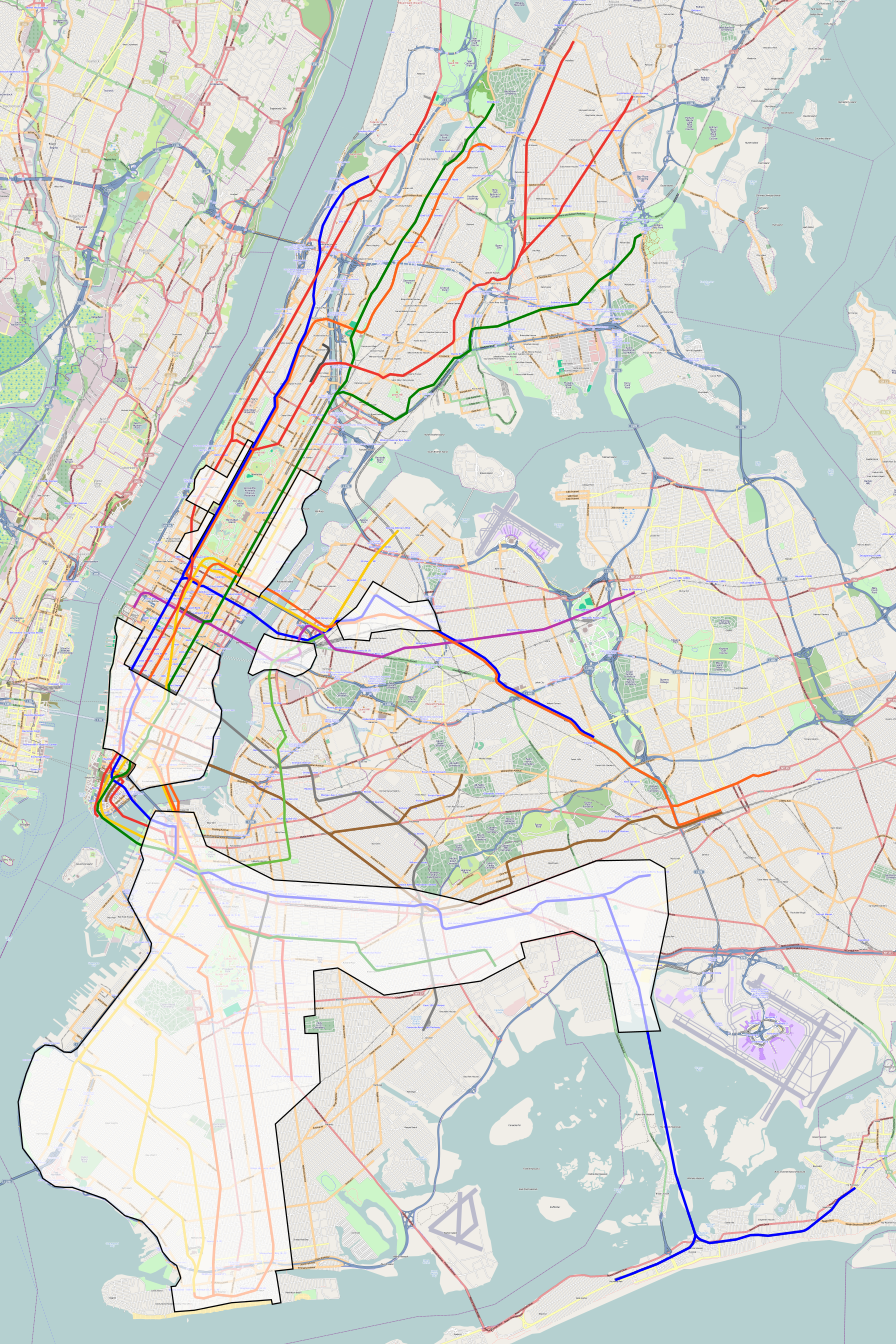
The map excludes parts of Lower and Midtown Manhattan where the highest and best use is commercial rather than residential. But the boundaries there are deliberately crude: Downtown Brooklyn, NYU, and the Meatpacking District are drawn, to avoid excessive fragmentation of the drawn area, while Chelsea and Hell’s Kitchen are excluded as too close to Midtown.
The map also does not look at considerations other than capacity. Some of the highlit areas on the Upper East and West Sides and Lower East Side are already built to very high density, at least on the avenues and major streets; these areas should be the template of how the rest of the city should look. At the other end, East New York has too weak demand for massive construction, especially if everything to its west is upzoned.
However, large swaths of desirable, close-in areas with relatively short buildings are highlit. Rich inner Brooklyn neighborhoods like Park Slope and South Brooklyn are currently built to missing middle density, with a floor area ratio of about 1.5 away from corner lots. A more appropriate floor area ratio in these neighborhoods is 12, corresponding to tapering buildings in the 20-30 story range, as on the avenues on the Upper East and West Sides. Park Slope is half an hour from Midtown by subway, and less than that from Lower Manhattan. The population of these neighborhoods is perhaps 150,000, and should be more than a million given their proximity to job centers.
Subway deserts and future additions
The map is designed to work with more or less the same service as today, maybe with slightly more frequency on lines that could handle it easily (that is, Second Avenue Subway). But what about future service? The L train is overcrowded, but only runs 19 trains per hour at the peak due to electrical limitations, and could go up to 26 with better electrical capacity, or for that matter lighter trains drawing less power during acceleration. Further extensions of Second Avenue Subway could more effectively relieve pressure off the 4/5, to the point of creating more capacity in the Bronx, which remains well below peak population. Commuter rail modernization opens up large swaths of Queens. Decades in the making extensions on Nostrand and Utica fill in the transit desert in southeast Brooklyn, currently served by buses that nominally come every 2 minutes and in practice comes in platoons of 4 every 8 minutes.
As with the map above, a hypothetical map of development sites assuming reasonable subway expansion includes areas that would be unlikely to actually see new development. Williamsburg and Greenpoint may turn into forests of towers given the opportunity, but in neighborhoods like Sheepshead Bay and East Flatbush developers might well stick to the occasional 6-to-10-story mid-rise building that would not look out of place in Paris. In Eastern Queens, the desired density is probably spiky, with clusters of tall buildings around LIRR stations surrounded by single-family houses and missing middle, much like the structure of density in Toronto and Vancouver.

