Category: Urban Transit
The Interborough Study
I was excited about the idea of Interborough Express (IBX) as announced by New York Governor Kathy Hochul, and then last week her office released a preliminary report about the alternatives for it, and I got less excited. But it’s not that the study is bad, or that Hochul is bad. Rather, the study is a by the numbers alternatives analysis, shorter than the usual in a good way; its shortcomings are the shortcomings of all American planning.
The main rub is that the report looks at various options for the IBX route, broken down by mode. There’s a commuter rail option, which bakes in the usual bad assumption about commuter rail operations, including heavier trains (lighter trains are legal on US tracks as of 2018) and longer dwell times that are explained as a product of the heavier trains (dwell times have nothing to do with train mass). That’s par for the course – as we saw yesterday, everything that touches mainline rail in North America becomes stupid even in an otherwise understandable report.
But even excluding commuter rail, the study classifies the options by mode, focusing on bus rapid transit and light rail (and no subway, for some reason). It compares those two options and commuter rail on various measures like expected ridership and trip times. This is normal for American alternatives analyses for new corridors like IBX: they look at different modes as the main decision point.
This is also extraordinarily bad governance. There are some fundamental questions that are treated as afterthoughts, either not studied at all or mentioned briefly as 1-2 sentences:
- How far north should the line go? The IBX plan is to only go from Jackson Heights to the south, in contrast with older Triboro proposals going into the Bronx.
- What should the stop spacing be? The stops can be widely spaced, as in the current proposal, which stops mainly at intersection points with other lines, or more closely spaced, like an ordinary subway line.
- Under a light rail option, should the line be elevated where the trench is too narrow or at-grade?
- Should freight service be retained? What are the benefits of retaining freight rail service on the Bay Ridge Branch and what are the incremental costs of keeping it versus taking over the right-of-way?
- How large should the stations be?
- How frequent should the trains be? If freight service is retained, what frequencies are compatible with running freight on the same tracks for part or all of the line?
A better study must focus on these questions. Some of them, moreover, must be decided early: urban planning depends on whether the line goes into the Bronx or not; and industrial planning depends on what is done with freight service along the corridor.
Those questions, moreover, are more difficult than the modal question. A BRT option on a rail corridor without closely parallel arterial roads should be dismissed with the same ease that the study dismisses options not studied, and then the question of what kind of rail service to run is much less important than the scope of the project.
But American planning is obsessed with comparing public transit by mode rather than by corridor, scope, or any other aspect. Canadian planning has the same misfeature – the studies for the Broadway SkyTrain extension looked at various BRT and light rail options throughout, even though it was clear the answer was going to be SkyTrain, and omitted more fundamental questions regarding the cost-construction disruption tradeoff or even the scope of the project (the original studies from 2012 did not look at truncating to Arbutus, an option that had been talked about before and that would eventually happen due to cost overruns).
So overall, the IBX study is bad. But it is interestingly bad. Andrew Cuomo was a despicable governor who belongs in prison for his crimes. Less criminal and yet similarly loathsome people exist in American public transit. And yet, Hochul and her office are not like that, at all. This is not a sandbag, or a corrupt deal. It’s utterly ordinary in its failure; with all the unique failures of the Cuomo era stripped, what is left is standard American practice, written more clearly than is usual, and it just isn’t up to par as an analysis.
Hochul has been moving on this project very quickly, and good transit advocates should laud this. It should not take long to publish a report comparing alternatives on more fundamental questions than mode, such as scope, the role of freight, and the extent of civil infrastructure to be used. The costs and benefits of IBX heavily depend on the decisions made on such matters; they should not be brushed aside.
New York Publishes a Bad Benchmarking Report
I’ve grown to intensely dislike benchmarking reports. It’s not that the idea of benchmarking bad. It’s that they omit crucial information – namely, the name of the system that one is compared with. The indicators always have a wide variety of values, and not being able to match them with systems makes it impossible to do sanity-checks, such as noticing if systems with high costs per car-km are consistently ones that run shorter trains. This way, those anonymized reports turn into tools of obfuscation and excusemongering.
The MTA in New York recently published such a report, including both US-wide and international benchmarking for the subway as well as commuter rail. The US benchmarking is with comparable American systems – exactly the ones I’d compare, with the systems listed by name as NTD data is wisely not anonymized. The international benchmarking for the subway is with CoMET, which includes most of the larger global systems as well as a handful of smaller ones, like Vancouver; for commuter rail, it’s with ISBeRG, which has an odd list of systems, omitting the RER (which is counted in CoMET), all of Japan except JR East, and any S-Bahn, skipping down to Australian systems, Cape Town, and Barcelona.
That, by itself, makes much of the international benchmarking worthless. The standard metric for operating costs is per car-km. This is covered in pp. 8-9, showing that New York has fairly average costs excluding maintenance, but the second highest maintenance costs. But here’s the problem: I’m seeing a comparison to an undifferentiated mass of other systems. One of them is an outlier in maintenance costs, even ahead of New York, but I do not know which it is, which means that I cannot look at it and see what it does wrong – perhaps it has an unusually old fleet, perhaps it is small and lacks scale, perhaps it is domestically viewed as scandal-ridden.
Far more useful is to look at complete data by name. For example, JICA has complete operating cost data for Japanese metro systems. Its tables are complete enough that we can see, for example, that overall operating costs are around $5/car-km for all systems, regardless of scale; so scale should not be too important, or perhaps Tokyo’s wealth exactly cancels out the scale effect. There are, on table 2.37 on PDF-p. 117, headcounts for most systems from which we can impute labor efficiency directly, using train-km data on PDF-p. 254; Yokohama gets 1,072 train-hours a year per driver at 35 km/h (the rough average speed I get from Hyperdia).
And here’s the thing: without the ability to fill in missing data like average speed, or to look at things the report didn’t emphasize, the report is not useful to me, or to other independent researchers. It’s a statement of excuses for New York’s elevated operating and maintenance cost, with officious proclamations and intimidating numbers.
For example, here’s the excuse for high maintenance costs:
High maintenance costs for NYCT are largely attributable to 24-hour service. Most COMET peer agencies shut down every night, allowing for four hours of continuous daily maintenance. In comparison, NYCT subway’s 24-hour service requires maintenance to occur within 20-minute windows between late night trains, reducing work efficiencies. Additionally, maintenance costs for NYCT have risen recently to support the improvements as part of the Subway Action Plan, which have led to a significant improvement to on-time performance year over year since inception.
Okay, so here we’re seeing what starts like a reasonable explanation – New York doesn’t have regular nighttime maintenance windows. But the other American systems studied do and they’d be above global average too; Boston has regular nighttime work windows but still can’t consign all track maintenance to them, and has almost the same maintenance cost per car-km as New York. Moreover, track maintenance costs per car-km should feature extensive scale effects – only at freight rail loads is the marginal track wear caused by each additional car significant – and New York runs long trains.
Then there is the Subway Action Plan line, which is a pure excuse. Other systems do preventive maintenance too, thank you very much. New York is not unusually reliable by global standards, and the benchmarking report doesn’t investigate questions like mean distance between failures or some measure of the presence of slow restrictions – and because it is anonymized, independent researchers can’t use what it does have and get answers from other sources.
The study has a section on labor costs, showing New York’s are much higher than those of some peer cities. Thankfully, that part is not anonymized, which means I can look at the cities with overall labor costs that are comparable to New York’s, like London, and ignore the rest; New York’s construction labor costs are higher than London’s by a factor of about 2, despite roughly even regionwide average wages. Unfortunately, a key attribute is missing: labor efficiency. The JICA study does better, by listing precise headcounts; but here the information is not given, which means that drawing any conclusion that is not within the purview of MTA’s endless cold war on its unions is not possible. As it happens, I know that New York is overstaffed, but only from other sources, never anonymized.
It’s worse with commuter rail. First of all, at the level of benchmarking, the study’s list of comparisons is so incomplete and so skewed (three Australian systems, again) that nothing it shows can be relevant. And second, commuter rail in North America comes with its own internal backward-looking culture of insularity and incompetence.
The report even kneecaps itself by saying,
While it is true that benchmarking provides useful insights, it is also important to acknowledge that significant differences exist among the railroads that pose challenges for drawing apples-to-apples conclusions, particularly when it comes to comparisons with international peers. Differing local economies, prevailing wages and collective bargaining agreement provisions can have dramatic impacts on respective labor costs. Government mandates, including safety regulations, vary widely, and each railroad exists in a unique operating environment, often with different service schedules, geographic layouts and protocols. Together these factors have also have a significant impact on relative cost structures.
To translate from bureaucratic to plain English, what they’re saying is that American (and Canadian) practices for commuter rail are uniquely bad, but controlling for them, everything is fine. The report then lists the following excuses, all of which are wrong:
• Hours of Operation: LIRR provides 24 hours of service 7 days per week, and MNR provides 20-22 hours of service 7 days a week
• Ungated System: Neither LIRR nor MNR operate gated systems, therefore they require onboard fare validation/collection
• Branch Service: Both LIRR and MNR run service to and from a central business district (New York City) and do not have ability to offer through-running service
• Electrification: Both LIRR and MNR operate over both electrified and non-electrified territory, thereby requiring both electric and diesel fleets
It’s impressive how much fraud – or, more likely, wanton indifference and incuriosity – can fit into just four bullet points. Metro-North’s hours of service are long, but so are those of the JR East commuter lines; the Yamanote Line runs 20 hours a day, which means the nighttime maintenance window is shorter. Ungated systems use proof-of-payment ticketing throughout Europe – I don’t know if Rodalies de Catalunya runs driver-only trains, but the partly-gated RER and the ungated S-Bahns in the German-speaking world do. Through-running is a nice efficiency but not all systems have it, and in particular Melbourne has a one-way loop system akin to that of the Chicago L instead of through-running. Finally, electrification on the LIRR and Metro-North is extensive and while their diesel tails are very expensive, they also sometimes exist in Europe, including in London on a line that’s partly shared with the Underground, though I don’t know if they do in the report’s comparison cases.
The report does not question any of the usual assumptions of American mainline rail: that it must run unusually heavy vehicles, that it run with ticket-punching conductors, etc.
For a much more useful benchmarking, without anonymization, let’s look at German S-Bahns briefly. There is a list of the five largest systems – Berlin, Munich, Hamburg, Frankfurt, Stuttgart – with ridership and headcounts; some more detail about Berlin can be found here. Those five systems total 6,200 employees; the LIRR has 7,671 and Metro-North 6,773. With 2,875 employees, the Berlin S-Bahn has more train-hours than the LIRR, Metro-North, and New Jersey Transit combined; about as many car-km pro-rated to car length as the LIRR times 1.5; and more ridership than all American commuter rail systems combined. The LIRR in other words has more workers than the largest five German S-Bahns combined while the Berlin S-Bahn has more riders than all American commuter rail systems combined.
The excuses in the report highlight some of the reasons why – the US sticks to ticket-punching and buys high-maintenance trains compliant with obsolete regulations – but omits many more, including poor maintenance practices and inefficient scheduling of both trains and crew. But those are not justifications; they are a list of core practices of North American commuter rail that need to be eliminated, and if the workers and managers cannot part with them, then they should be laid off immediately.
Platform Edge Doors
In New York, a well-publicized homicide by pushing the victim onto the subway tracks created a conversation about platform edge doors, or PEDs; A Train of Thought even mentions this New York context, with photos from Singapore.

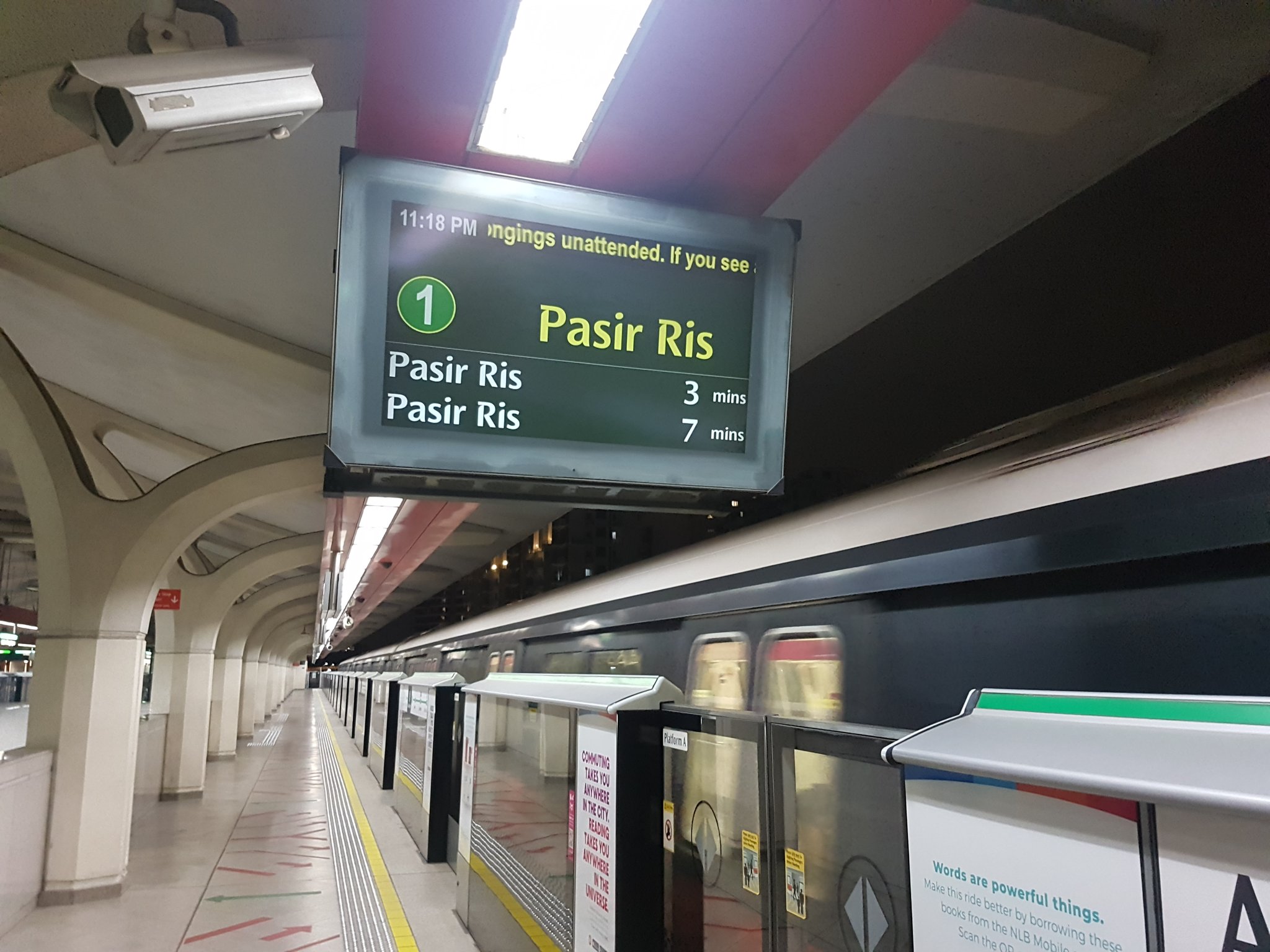
In Paris, the ongoing automation of the system involves installing PEDs. This is for a combination of safety and precision. For safety, unattended trains do not have drivers who would notice if a passenger fell onto the track. For precision, the same technology that lets trains run with a high level of automation, which includes driverless operations but not just, can also let the train arrive with meter-scale precision so that PEDs are viable. This means that we have a ready comparison for how much PEDs should cost.
The cost of M4 PEDs is 106 M€ for 29 stations, or 3.7M€ per station. The platforms are 90 meters long; New York’s are mostly twice as long, but some (on the 1-6) are only 70% longer. So, pro-rated to Parisian length, this should be around $10 million per station with two platform faces. Based on Vanshnook’s track map, there are 204 pairs of platform faces on the IRT, 187 on the IND (including the entire Culver Line), and 165 on the BMT (including Second Avenue Subway). So this should be about $5.5 billion, systemwide.
Here is what the MTA thinks it should cost. It projects $55 million per station – but the study is notable in looking for excuses not to do it. Instead of talking about PEDs, it talks about how they are infeasible, categorizing stations by what the excuse is. At the largest group, it is accessibility; PEDs improve accessibility, but such a big station project voids the grandfather clause in the Americans with Disabilities Act that permits New York to keep its system inaccessible (Berlin, of similar age, is approaching 100% accessible), and therefore the MTA does not do major station upgrades until it can extort ADA funding for them.
Then there is the excuse of pre-cast platforms. These are supposed to be structurally incapable of hosting PEDs; in reality, PEDs are present on a variety of platforms, including legacy ones that are similar to those of New York, for example in Paris. (Singapore was the first full-size heavy rail system to have PEDs – in fact it has full-height platform screen doors, or PSDs, at the underground stations – but there are later retrofits in Singapore, Paris, Shanghai, and other cities.)
The trains in New York do not have consistent door placement. The study surprisingly does not mention that as a major impediment, only a minor one – but at any rate, there are vertical doors for such situations.
So there is a solution to subway falls and suicides; it improves accessibility because of accidental falls, and full-height PSDs also reduce air cooling costs at stations. Unfortunately, for a combination of extreme construction costs and an agency that doesn’t really want to build things with its $50 billion capital plans, it will not happen while the agency and its political leaders remain as they are.
The New Triboro/Interboro Plan
Governor Kathy Hochul announced a policy package for New York, and, in between freeway widening projects, there is an item about the Triboro subway line, renamed Interboro and shortened to exclude the Bronx. The item is brief and leaves some important questions unanswered, and this is good – technical analysis should not be encumbered by prior political commitments made ex cathedra. Good transit advocates should support the program as it currently stands and push for swift design work to nail down the details of the project and ensure the decisions are sound.
What is Triboro?
The Bronx Times has a good overview, with maps. The original idea, from the RPA’s Third Regional Plan in the 1990s, was to use various disused or barely-used freight lines, such as the Bay Ridge Branch, to cobble together an orbital subway from Bay Ridge via East New York and Jackson Heights to Yankee Stadium. Only about a kilometer of greenfield tunnel would be needed, at the northern end.
In the Fourth Plan from the 2010s, this changed. The Fourth Plan Triboro was like PennDesign’s Crossboro idea, differing from the Third Plan Triboro in three ways: first, the stop spacing would be wider; second, the technology used would be commuter rail for mainline compatibility and not subway; and third, the Bronx routing would not follow disused tunnels (by then sealed) to Yankee Stadium but go along the Northeast Corridor to Coop City. Years ago, I’ve said that the Fourth Plan Triboro is worse than the Third Plan.
Unlike the RPA Triboro plans, Hochul’s Interboro plan only connects Brooklyn and Queens, running from Jackson Heights to the south. I do not know why, but believe this has to do with right-of-way constraints further north. The Queens-Bronx connection is on Hell Gate Bridge, which has three tracks and room for a fourth (which historically existed), of which Amtrak uses two and CSX uses one; having the service run to the Bronx is valuable but requires figuring out what to do about CSX and track-sharing. The Third Plan version ignored this, which is harder now, in part because freight traffic has increased from effectively zero in the 1990s to light today.
Stop spacing
The stop spacing in the governor’s plan appears to be more express, as in the Fourth Regional Plan, where the service is to run mostly nonstop between subway connections. In contrast, the Third Regional Plan called for regular stop spacing of 800 meters, in line with subway guidelines for new lines, including Second Avenue Subway.
I’m of two minds on this. We can look at formulas derived here in previous years for optimal stop spacing; the formulas are most commonly applied to buses (see here and follow first paragraph links), which can change their stop pattern more readily, but can equally be used for a subway.
The line’s circumferential characteristic gives it two special features, which argue in opposite directions on the issue of stop spacing. On the one hand, trips are likely to be short, because many people are going to use the line as a way of connecting between two subway spokes and those are for the most part placed relatively close to one another; farther-away connections such as end-to-end can be done on a radial line. But on the other hand, trips are not isotropic, because most riders are going to connect to a line, and the stronger the distinguished nodes are on a line, the longer the optimal interstation is.
On this, further research is required and multiple options should be studied. My suspicion is that on balance the longer stop spacing will prove correct, but it’s plausible that the shorter one is better. A hybrid may well be good too, especially in conjunction with a bus redesign ensuring the stops on the new rail link are aligned with bus trunks.
The issue of frequency
The line’s short-hop characteristic has an unambiguous implication about service: it must be very frequent. The average trip length along the line is likely to be short enough, on the order of 15 minutes, that even 10-minute waits are a drag on ridership. Nor is it possible to set up some system of timed transfers to 10-minute subway lines, first of all because the subway does not run on a clockface timetable, and second because the only transfers that could be cross-platform are to the L train.
This means that all-day frequency must be very high, on the order of a train every 5 minutes. This complicates any track-sharing arrangement, because the upper limit of frequency on shared track with trains that run any other pattern is a bit worse than this. The North London Line runs every 10 minutes and shares track with freight, and I believe there are some short shared segments in Switzerland up to a train every 7.5 minutes.
The upshot is that freight can’t run during normal operations. This is mostly fine, there are only 2-4 freight trains a day on the Bay Ridge Branch, where there are segments of the right-of-way that are only wide enough for two tracks, not four. This means if freight is to be retained, it has to run during light periods, such as 5 in the morning or 11 at night, when it’s more acceptable to run passenger trains every 10 minutes and not 5.
Rapid Transit as an Amenity
An urban rapid transit system needs to be understood as both a consumption amenity and a production amenity. As a consumption amenity, it lets people have access to more of the city, for work as well as recreational travel; people pay a premium to live close to the subway. As a production amenity, it makes it easier to build dense office clusters and expect that people can get to work without too much traffic; businesses pay a premium to locate in city center. This means that such infrastructure is generally good for the city’s economy and the well-being of the people in it, without prominent distributional impact.
City center and rapid transit
I wrote a thread two years ago about CBD job concentration. The thread looks at the total number of jobs in the central 100 km^2 of a metro area, which figure is used because it’s about the land area of Paris plus La Défense and INSEE data only exists at the level of the commune or arrondissement (see for example here). Pointing out that Dallas and Atlanta’s central 100 km^2 have only about as many jobs as Vancouver’s and half as many as San Francisco’s, I talked about the need to build bigger CBDs to entice higher transit ridership.
This looks weird to people who immediately associate European cities with short buildings and polycentricity and American ones with tall buildings and monocentricity. But at the scale of 100 km^2, European cities are far more centralized. Paris has 2.2 million jobs in the central 100 km^2, the Bay Area 850,000, Dallas and Atlanta 400,000 each.
And as I threaded about this, it was pointed out to me that Dallas does not have very strong demand for office space in city center. Parisian commercial rents in the 8th are very high, indicating demand for taller buildings than Europeans find acceptable; Texan commercial rents in city centers indicate no such pent-up demand, and the Dallas CBD has high vacancy rates. In Los Angeles, the center is weak as well – in a metro region 50% larger than Paris, the most gerrymandered central blob, not at all centered on Downtown Los Angeles but rather reaching from Downtown to Century City and UCLA, has around 800,000 jobs. The highest pent-up demand in Downtown LA is residential and not commercial.
I bring this up because this indicates rapid transit is a strong amenity for producers: they pay a premium to locate in city center, provided a large system exists to feed commuters to their offices. This is the case in New York, Paris, and other transit cities, but notably not in large auto-oriented cities like Los Angeles and Dallas.
…but it’s not just about work
Transit cities are not just places of production. The city is simultaneously a production amenity and a consumption amenity. Pure production amenities, like the quality of the harbor, the location relative to logistics facilities, and the tax rate on businesses, do not draw in people except insofar as they lead to higher wages. But transit cities do draw people in – residential rents are higher where job access is better and even where general access to non-work destinations is better.
This effect happens at several levels. The highest level is the regional one: a transit city is less polluted than an auto-oriented alternative of the same size, and clean air is a consumption amenity. The lowest level is the block: the construction of rapid transit raises property values near stations. In between, there are the benefits of access, which like the regionwide benefits are diffuse; it’s hard to point out an exact set of winners and losers.
This is not just a matter of job access. A transit city is good at access to special amenities, of the type that people do not go to very regularly. Ones that people do go to regularly do not require public transit: an auto-oriented medium-size metropolitan region can perfectly well provide high-quality retail choices with plenty of variety. I don’t recall missing anything at the shopping centers of the French Riviera, nor hearing complaints about same from Americans in similar-size regions.
But once the options get more specialized, size and transit accessibility become important. Los Angeles notably has amazing restaurants from just about every ethnic and regional tradition on the planet and also it takes two hours to drive to them because they’re strewn about five counties with no fast transit options. It’s nothing like New York and Paris, which have plentiful options as well but they’re within 30-60 minutes by train.
Specialized restaurants are a convenient example – they won’t cluster in city center because that’s expensive, but they’d like to be in near-center areas, perhaps in the central 100 or 200 or 500 km^2 but not the central 5 or 10 km^2. But the same issue occurs for everything else: museums, visits to friends throughout the region, etc.
The implication of dual amenities
Rapid transit is annoying to analyze in that it doesn’t break down neatly as for one group or another. It’s incredibly diffuse, and the only definitive interest group that benefits from its existence more than anyone else, the providers, is small and doesn’t always benefit from making it more efficient. There are no distributional impacts to mitigate or take advantage of; the environmental impacts are uniformly positive because of the competition with cars and auto-oriented development; the local benefits of access are real but require building an expansive system with hundreds of stations each generating local benefits in a small radius.
The result is that it bores people who enjoy conflict. There is not much there for the marketer to bite on – transit as a product is optimized when everyone uses it. The upshot of the fact that rapid transit is simultaneously a production amenity and a consumption amenity is that there is nothing there for people who enjoy dwelling on class conflict or on postmaterialist New Left notions of conflict, either. Socialist states have built great transit systems once things have settled down and it’s time to rebuild, but would-be socialist revolutionaries in non-socialist states find it boring. Likewise, New Left green politics is much more interested in pure consumption amenities like bike paths and street redesign than in dual amenities like rapid transit, which also benefits the staid corporations green voters define themselves against. From the other direction, people whose political identity is indifference to the needs of anyone who’s not a business don’t find transit interesting, even though it clearly benefits business, because it doesn’t offer opportunity to engage in right-populist or Thatcherite politicking: it’s possible to run the system like a business, but actually kicking out visibly poor people fragments the market and reduces frequency.
Good Practices for State Planning and Local Public Transportation
Earlier this week, I complained about the OPM (other people’s money) problem: federal funding of American public transportation, which is managed locally, leads to cost-raising behavior as local and state governments seek to maximize federal infusion of cash. This is a companion post about more positive and fruitful interactions of government at different levels on this side of the Pond. The examples here often look pointless or acrimonious by local standards, but at the end of the day, they produce cost-effective infrastructure and are positive examples to learn from.
Of note, all the examples below are from unitary, not federal states. This is just an artifact of where I have talked to the most people about this – from what I know of Germany, Austria, Switzerland, and Belgium, they all fall within the spectrum spanned by Italy, Turkey, France, and Sweden when it comes to state-local funding allocation. Moreover, the extent of subnational fiscal autonomy in Germany is not greater than that of Sweden, where there are extensive county and municipal taxes funding subnational government, whereas in Germany nearly all taxes are federal and the Länder mostly rely on transfers.
This is a theme I’ve been investigating ever since I talked to a planner at DOTr. Philippine construction costs are high, although that’s mainly for subways, while elevated lines have fairly average costs. The planner explained to me how planning and procurement are done and specifically how it contrasts with the role of the federal government in the US. Manila Metro projects are planned and designed by DOTr, and ever since that conversation I’ve learned to interpret interviews with European experts in that light.
Sweden: state-local negotiation
The Nordic states practice consensus government. This means that decisions are done by majority vote without veto points, but also there’s no such thing as a majority. In practice, infrastructure involves negotiations between different stakeholders. Bigger projects, including the subway megaprojects we study, require funding from different sources, creating more stakeholders in the process.
In the case of Stockholm, it’s instructive to compare Citybanan and Nya Tunnelbanan. Citybanan is a regional rail tunnel, and therefore the lead agency was the state’s Trafikverket – but even then, Stockholm County had extensive input. Regions send wishlists to the state, and compete for a fixed pot of funding for grants, but there are further negotiations about project details. Nya Tunnelbanan is a subway project led by the county’s SL, but funding comes 25% from local sources, 25% from the county, and 50% from the state.
Crucially, Trafikverket builds rather than just nudges. It has a strong professional civil service capable of designing and supervising the construction of infrastructure megaprojects – and the same pool of civil servants move between agencies within the Swedish public sector, so that some of the people I’ve spoken to have moved between Trafikverket and SL. The example planners I have in mind are mid-level, not top management – this is not a case of a mobile executive suite lording over mid- and low-level career bureaucrats who can’t move between agencies easily.
There is also integration of transport and housing, in the sense that residential upzoning in Stockholm County focuses on areas that have or will soon have urban rail access. Construction rates in Stockholm County are some of the highest in Europe: per SCB, annual completions were around 6.5-7 per 1,000 people in the five years before corona. I’ve been told that it’s a consensual process, with no further elaboration; in Oslo, in contrast, the state has to compel wealthy NIMBY municipalities to upzone as a precondition of giving them subway expansion, but state-local coordination is as far as I can tell otherwise similar to the situation in Stockholm.
Turkey: state-local competition, but no OPM
Turkey has one of the world’s lowest construction cost levels; more details will be available in a report to appear soon, led by Elif Ensari. Wages in Turkey are low by European standards and social protections are weak, but the direct labor share of subway construction is small enough that it is a secondary contributor to the low costs; Turkey dos some things more efficiently than Sweden and others less efficiently.
The situation of state-local relations there is the exact opposite of Sweden’s. There is no collaboration – rather, there are metro tunnels in Istanbul funded and built by the state and others funded and built by the city.
The city is not quite local – the municipality covers the entire metropolitan area of 15.5 million people, and Istanbul politics has an ideological left (i.e. anti-Erdoğan) vs. right (i.e. pro-Erdoğan) characteristic rather than the hyperlocal ties of New York and other American cities. Moreover, now that AKP lost the municipal election and the mayor is CHP’s Ekrem İmamoğlu, who will likely challenge Erdoğan in the 2023 presidential election, there is friction between the state and the city, each trying to argue that it builds more and better infrastructure. There are arguments between pro- and anti-Erdoğan sources over who is to blame, but the city has much less access to state financing now than before İmamoğlu’s victory, which it has been able to replace with financing from the European Investment Bank and other sources of loans, like JICA and Deutsche Bank.
In this situation, there is no coordination, and this is a drag on efficiency – one of the ways Istanbul has been able to keep costs down is finding parks and state land to use for station footprint to keep station construction costs down. However, because there is direct responsibility for the state or the city for infrastructure, there is no OPM problem – İmamoğlu’s political career depends in part on his ability to build infrastructure, and Erdoğan’s ability to interfere is real but limited.
Housing construction is extremely rapid. Istanbul has a housing surplus thanks to the construction of around 160,000 annual housing units; neighborhood character is not a priority there. But I do not know whether it is integrated with subway construction as in Sweden.
France: the capital is the state
France has a convoluted set of local and regional governing mechanisms. However, in Paris, much of the power remains in state and state-appointed organs. The transport association Ile-de-France Mobilités, which would be called a Verkehrsverbund in Germany, is coordinated by the Ile-de-France region, but its two largest components, SNCF and RATP, are both state-owned (though SNCF-RATP agency turf battles remain). Public services that elsewhere in France might be devolved are in Paris often run by the state – for example, the Paris Police Prefecture is part of the National Police, and it’s smaller cities, for example in the Riviera, that have local police departments.
This is not unique to France. In infrastructure, Sweden too exhibits more state involvement in urban rail planning in the capital than in smaller cities – Västlänken in Gothenburg is a Trafikverket project but more of the planning and funding come from the county than was the case for Citybanan. London is a mix: TfL is run by the mayor, offering much more devolution than the Metropolitan Counties of England have, but conversely the construction of infrastructure megaprojects like Crossrail is really within the purview of UK-wide politics.
The issue here is one of scale. Grand Paris Express is a 200 km, 80% tunneled project, and France is a medium- rather than low-cost country. Even the state barely has enough planning capacity for it – the Cour des Comptes report on the cost overruns, not seen before for smaller Métro extensions, blamed the insufficient size of existing planning organs, but unfortunately, the solution arrived at, the special-purpose delivery vehicle (SPDV) GPE, is not good, and is either in imitation of or evolved toward convergence with Crossrail. Nothing below the level of the state could build such a project.
And because the project is so large, it’s been forced into a situation that rhymes with Sweden’s intergovernmental negotiation. It’s also been discussed as part of national politics, with some redesigns stemming from the Sarkozy-Hollande transition. In some cases, this has led to OPM – namely, M18 is unpopular among the region’s public transportation advocates and remains because of pressure by the high-income suburbs it would serve. However, there is no visible impact on unit costs; it’s notable that the OPM the state would dispense is additional infrastructure at per-rider costs that are high for France but common in the United States, rather than extras of little use like signature stations or more expensive construction methods.
Finally, housing construction in Ile-de-France is, as in Stockholm County, among the YIMBYest in Europe. Yonah Freemark’s paper on the subject is indispensable: stating around 2017, the annual construction rate rose to 80,000 units regionwide, around 6.5/1,000 people. Construction is largely in the Petite Couronne suburbs, and not the city, and focuses on regions with current or future urban rail extensions, as in Stockholm.
Italy: state planning and austerity
A full report on Italy will appear soon, on a similar timeline as Turkey, written by Marco Chitti. In Italy, there has been a transition from municipal funding and planning of metros to state funding; in Rome, there was always more state involvement as I understand it.
The situation leading up to the Financial Crisis had similarities with the United States: state funding, municipal or regional responsibility for construction. However, the state always exercised far more oversight. The Italian state builds rather than just nudging. State regulation is done through administrative rather than judicial mechanisms, and thus questions of environmental and historical protection are decided by civil servants trained in engineering, archeology, history, and ecology; there are clear rules, providing similar final outcomes to the Nordic process of negotiation and superior ones to the American process of lawsuit.
More recently, the state has devolved some of the funding to regional, provincial, and municipal governance. This was an artifact of post-Crisis austerity, so the state would fund the majority (I believe 70%) of each project’s budget but not all of it. The result has not been positive – subnational governments have no money, not even wealthy ones like Milan, and to fill in for missing state funding they’ve resorted to PPP financing, which has not impacted construction costs but in effect required hidden loans at high interest bonded to future revenue.
The Other People’s Money Problem
I did a poll on Patreon about cost issues to write about. This is the winning option, with 12 votes; project- vs. budget-driven plans came second with 11 and I will blog about it soon, whereas neighborhood empowerment got 8.
OPM, or other people’s money, is a big impediment to cost reform. In this context, OPM refers to any external infusion of money, typically from a higher-level government from that controlling an agency. Any municipal or otherwise local agency, not able or willing to raise local taxes to fund itself, will look for external grants, for example in a federal budget. The situation then is that the federal grantor gives money but isn’t involved in the design of where the money goes to, leading to high costs.
OPM at ground level
Local and regional advocates love OPM. Whenever they want something, OPM lets them have it without thinking in terms of tradeoffs. Want a new piece of infrastructure, including everything the local community groups want, with labor-intensive methods that also pay the wages the unions hop for? OPM is for you.
This was a big problem for the Green Line Extension’s first iteration. Somerville made ridiculous demands for signature stations and even a bike path (“Somerville Community Path”) thrown in – and all of these weren’t jut extra scope but also especially expensive, since the funding came from elsewhere. The Community Path, a 3 km bike path, was budgeted at $100 million. The common refrain on this is “we don’t care, it’s federally funded.” Once there’s an outside infusion of money, there is no incentive to spend it prudently.
OPM modifying projects
In capital construction, OPM can furthermore lead to worse projects, designed to maximize OPM rather than benefits. Thus, not only are costs high, but also the results are deficient. In my experience talking to New Englanders, this takes the form of trying to vaguely connect to a politician’s set of petty priorities. If a politician wants something, the groups will try pitching a plan that is related to that something as a sales pitch. The system thus encourages advocates and local agencies to invest in buying politicians rather than in providing good service.
This kind of behavior can persist past the petty politician’s shelf life. To argue their cases, advocates sometimes claim that their pet project is a necessary component of the petty politician’s own priority. Then the petty politician leaves and is replaced by another, but by now, the two projects have been wedded in the public discourse, and woe betide any advocate or civil servant who suggests separating them. With a succession of petty politicians, each expressing interest in something else, an entire ecosystem of extras can develop, compromising design at every step while also raising costs.
The issue of efficiency
In the 1960s, the Toronto Transit Commission backed keeping a law requiring it to fund its operations out of fares. The reason was fear of surplus extraction: if it could receive subsidies, workers could use this as an excuse to demand higher wages and employment levels, and thus the subsidy would not go to more service. As it is, by 1971 this was untenable and the TTC started getting subsidies anyway, as rising market wages required it to keep up.
In New York, the outcome of the cycle of more subsidies and less efficiency is clearer. Kyle Kirschling’s thesis points out on PDF-p. 106 that New York City Transit’s predecessors, the IRT and BMT, had higher productivity measured in revenue car-km per employee in the 1930s than the subway has today. The system’s productivity fell from the late 1930s to 1980, and has risen since 1980 but (as of 2010) not yet to the 1930s peak. The city is one of a handful where subway trains have conductors; maintenance productivity is very low as well.
Instead of demanding efficiency, American transit advocates tend to demand even more OPM. Federal funding only goes to capital construction, not operations – but the people who run advocacy organizations today keep calling for federal funding to operations, indifferent to the impact OPM would have on any effort to increase efficiency and make organizations leaner. A well-meaning but harmful bill to break this dam has been proposed in the Senate; it should be withdrawn as soon as possible.
The difference between nudging and planning
I am soon going to go over this in more details, but, in brief, the disconnect between funding and oversight is not a universal feature of state funding of local priorities. In all unitary states we’ve investigated, there is state funding, and in Sweden it’s normal to mix state, county, and municipal funding. In that way, the US is not unique, despite its federal system (which at any case has far more federal involvement in transportation than Canada has).
Where the US is unique is that the Washington political establishment doesn’t really view itself as doing concrete planning. It instead opts for government by nudge. A federal agency makes some metrics, knowing that local and state bodies will game them, creating a competition for who can game the other side better. Active planning is shunned – the idea that the FTA should have engineers who can help design subways for New York is unthinkable. Federal plans for high-speed rail are created by hiring an external consultant to cobble together local demands rather than the publicly-driven top-down planning necessary for rail.
The same political advocates who want more money and care little for technical details also care little for oversight. They say “regulations are needed” or “we’ll come up with standards,” but never point to anything concrete: “money for bus shelter,” “money for subway accessibility,” “money for subway automation,” etc. Instead, in this mentality the role of federal funding is to be an open tab, in which every leakage and every abnormal cost is justified because it employed inherently-moral $80,000/year tradesmen or build something that organized groups of third-generation homeowners in an expensive city want. The politics is the project.
What’s Frustrating About Bus Redesigns
The transit vlogger Alexandra Rose said something deeply disturbing and yet true on Twitter:
More and more I think that bus network redesigns are too often just managed decline. I was really into zero cost change redesigns a few years ago, less so recently. Literally shuffling deck chairs.
The issue isn’t that net zero cost redesigns are bad. They’re not. The results in recent years look pretty good; Nova Xarxa really did lead to ridership growth, the American redesigns were for the most part helpful too, and I stand by the claim in our report, on pp. 36-37, that the Brooklyn bus redesign we propose would raise ridership 20%.
And yet, Alexandra is completely right, because 20% of zero is still zero. Even in New York, what we call would only get New York bus ridership back to where it was on the eve of the Great Recession and the ensuing service cuts. This really concerns two separate problems of bus service and systemwide changes.
Bus decline management
Managing the decline of buses is inevitable. Buses are too labor-intensive in a developed country to remain a cost-effective solution in the long run – and the sort of cities in the first world with both the best public transit and the best prospects for growth also tend to have the highest wages. Bus drivers in New York earn $85,000/year, and that’s market-rate – there aren’t hordes of unemployed people clamoring to work as bus drivers; agencies that pay significantly less relative to local wages, like San Francisco’s Muni, find it hard to recruit drivers.
How labor-intensive are buses? Well, in New York there are around 12,000 bus drivers and 4,000 subway drivers. Subway ridership was 2.5 times bus ridership in 2019, and overall vehicle-hours, counting cars rather than trains, were 60% longer, with subway cars still substantially bigger than buses. And there’s a lot more inefficiency in crew scheduling on the subway than on the bus network – and today it’s possible to automate subways but not buses. A subway train today carries as many passengers as 17 buses on average, and is 2.5 times faster, for an overall labor efficiency factor of 44.5, without automation; it’s in practice less than this taking crew inefficiencies and maintenance into account, but remains well over a full order of magnitude.
The upshot is that the sort of service-hours that could be run with the wages of 60 years ago stopped being financially sustainable 40 years ago, and the service-hours of 20 years ago are not financially sustainable today. Net zero redesigns are about the best that is possible – because service-hours are expensive and getting more so over time.
All of these bus reforms – network redesigns, dedicated lanes, bus shelter, real-time information, signal priority – push back the decline, but they do not halt it. Eventually, something other than labor-intensive buses will be required, most likely some kind of light rail and subway combination as with the railstitutions happening here in Berlin or in Paris.
Compounding growth factors
A 20% increase in systemwide ridership is great! But, 20% of zero is still zero, and 20% of a low number is in absolute terms low growth. The question is what comes next.
If a city builds a subway line and gets noticeable ridership growth, it can compound. The one subway line succeeded, so now it can built more to new areas, not served by this line. Large increases in systemwide ridership can come from a project that is not systemwide, and then in a large city it’s easy enough to add more such projects. This is not mere linear growth as new lines open – a city that builds a subway system automatically makes city center an attractive place for business, leading to naturally-occurring transit-oriented development. It is natural for public transport advocates to be optimistic in such a situation.
Systemwide improvements compound with everything else, but are frustrating one-time affairs. Yes, a redesign can raise ridership 20% – and then what? Our Brooklyn proposal is aggressive – more so than Nova Xarxa, which included a pre-agreed number of routes with dedicated lanes, I believe 12, but nothing like the proposal we made that every route except for a handful in low-traffic areas on the edge of the borough get two-way dedicated lanes.
The only big thing our proposal didn’t touch on is bus shelter, because we didn’t realize how important it is. But bus shelter interacts negatively with interventions that increase bus frequency, since its effect is to reduce the disutility of waiting for the bus, and if the wait has already been reduced to 5-6 minutes then shelter is useful but its impact is not the 30% increase in ridership that my bus shelter post posits. Other than shelter, there’s conditional signal priority making buses less likely to bunch, but it too interacts negatively with everything else, and the speed benefits (as opposed to the more speculative reliability benefits) of signal priority are known and small.
Is it worthless?
No! Just frustrating. Bus upgrades are a one-time thing, holding back the long-term decline of the mode as better alternatives emerge. These ridership increases are nothing to sneeze at, but there’s no alternative to transitioning to rapid transit, maybe with trams as a feeder layer (or as the primary one if you’re a sub-million metro), with enough transit-oriented development that people can just walk to the subway. Everything else can b fine in the short run, but in a wealthy city that run is short indeed.
We Ran a Conference About Rail Modernization (Again)
Modernizing Rail 2021 just happened. Here’s a recording of the Q&A portion (i.e. most) of the keynote, uploaded to YouTube.
As more people send in materials, I’ll upload more. For now, here are the slides I’ve gotten:
- Grecia White’s master’s thesis on gendered perceptions of safety at bus stops.
- Robert Hale’s presentation on New York-New Haven trains, speed, and track maintenance productivity.
- Michael Cornfield’s intro to integrated service planning as done in Central Europe, pitched to Southern California.
- RailPAC’s Paul Dyson’s presentation on Southern California (unfortunately running against Michael Cornfield’s despite the synergy), with supplementary materials by RailPAC’s Brian Yanity including a long article on the subject and two short letters.
- Elif Ensari’s presentation of the Istanbul case for the Transit Costs Project, with full report to be released soon.
A bunch of us tweeted the talks using the hashtag #ModernRail2021, including some that were not recorded.
What Berlin Should Be Building
A week and a half ago, I crayoned Berlin U- and S-Bahn expansion on video. With some tweaks, here is the final product:

Here is the full-size version. (I know I’ve been asked to provide lighter JPGs, but my attempt at JPG compression turned 86 MB to 37 MB, hardly a coup de grâce.)
This is based on ongoing U-Bahn expansion plans plus the 2030 S-Bahn plan.
S-Bahn
The most significant variation is that the dashed S-Bahn line from Gesundbrunnen to Hauptbahnhof and Potsdamer Platz, dubbed S21, is turned into a northwest-southeast trunk line in my plan, following a proposal by Felix Thoma in Zukunft Mobilität. The plan for S21 today is to stay north-south and link with Südkreuz and Schöneberg, beefing up frequency on the north-south S-Bahn.
I believe my routing to be superior, due to traffic on the Görlitzer Bahn, seen below (source, p. 6):

Currently, peak traffic on both the Stadtbahn and the North-South Tunnel is 18 trains per hour in each direction. This is low; Munich achieves 30 tph with very short signal blocks and more branching than Berlin has, splitting into seven branches on each direction rather than three or four. 30 is a limit value, but 24 is more common, and would substantially simplify operations.
The North-South Tunnel splits into a western branch, currently carrying S1 via Schöneberg to Wannsee every 10 minutes, and an eastern, carrying S2/S25/S26 via Südkreuz every 10/20/20 minutes; since the two branches have roughly equal ridership, each should run every 5 minutes, unlike today, where only Südkreuz gets such service. To the north, each of the two main branches can run every 5 minutes as well.
The Stadtbahn is asymmetric. Only 12 out of 18 tph continue west of Westkreuz: Spandau and Potsdam get 10-minute service, and in addition S5, turning at Westkreuz, runs every 10 minutes. As such, all growth in traffic on the western branches should be encouraged. This is thankfully already done, with expansion plans west of Spandau. To the east, traffic is the most overloaded, and will remain so even with the opening of the U5 extension last year. Going up from 18 to 24 maximum tph means 10-minute service on each of the four branches – S3 to Erkner, S5 to Strausberg-Nord, S7 to Ahrensfelde, S75 to Wartenberg (proposed to be extended into a loop going northwest). Today, S3 runs every 20 minutes, and S75 doesn’t run through but rather only runs from Warschauer Strasse east, and conversely, S9 curves from the Stadtbahn to the Görlitzer Bahn to the airport.
Rerouting S21 to connect to the Görlitzer Bahn means that trunk, currently carrying 18 trains per hour, can all run through to city center, and then either go to the Siemensbahn or loop from Hauptbahnhof to Gesundbrunnen. Such service also removes reverse-branching from the rest of the system, allowing all services to run more regularly and reliably since each of the four trunks, including the Ring, would run independently of the others, and delays wouldn’t propagate.
U-Bahn
U-Bahn expansion in Berlin is mostly mothballed. The city prefers trams, even where they are inappropriate due to low speed over long stretches or forced transfers. Plans for U-Bahn expansion to Märkisches Viertel are uncertain, unfortunately. Plans for expansion to Tegel along a branch of U6 look dead, hence my resurrection of an older unbranched U5 extension; the current plan is to connect the Urban Tech Republic complex with the rest of the city via tram. Trams are cheaper but you get what you pay for; the ideal use of a tram is for cross-city routes, not primary routes to the center.
Hence various extensions that I think should be built. U7 to the airport looks like a done deal, and U7 to Staaken is favorable too, as is the low-cost, low-ridership one-stop extension of U3 to Mexikoplatz. U9 to Pankow and U2 to Pankow-Kirche are much-discussed, as is U8 to Märkisches Viertel, whose current cost/rider projection is favorable by international standards.
My additions are U1 extensions at both ends, the U5 extension to Tegel and then looping to intersect U6 and U8 in Reinickendorf, and the resurrection of the U10 plan as a U3 link (and not as a line to Steglitz, which gets extra S-Bahn service either way). The U1 extension to the west is forced to use cut-and-cover since the U1 tunnel under Kurfürstendamm is 1900s cut-and-cover, which is disruptive but cheaper than bored tunnel. The other two lines are long-term desires of the city and have been safeguarded for decades, with intersecting stations built to accommodate them.
Whether lines run in this configuration or another is up for debate. At Wittenbergplatz it’s easiest to link the new U10 system to U1 to Uhlandstrasse and then connect U3 to Krumme Linke with the existing Warschauer Strasse terminus. This would be an awkward system of U1, U2, and U3 in which the line going farthest north going east also goes farthest north going west and the line going farthest south to the east goes farthest south also to the west. If there’s a way to flip the situation, pairing U10 with present-day U1-west, U2-east with U3-west, and U3-east with U2-west, it should be done; this system in general has undergone many such changes over the generations.
 Pedestrian Observations
