A long-running conundrum in American urbanism is that the urban area with the highest population density is Los Angeles, rather than New York. Los Angeles is extremely auto-oriented, with a commute modal split that’s only 5% public transit, same as the US average, and doesn’t feel dense the way New York or even Washington or Chicago or Boston is. In the last 15 years there have been some attempts to get around this, chiefly the notion of weighted or perceived density, which divides the region into small cells (such as census tracts) and averaged their density weighted by population and not area. However, even then, Los Angeles near-ties San Francisco for second densest in the US, New York being by far the densest; curiously, already in 2008, Chris Bradford pointed out that for American metro areas, the transit modal split was more strongly correlated with the ratio of weighted to standard density than with absolute weighted density.
DW Rowlands at Brookings steps into this debate by talking more explicitly about where the density is. She uses slightly different definitions of density, so that by the standard measure Los Angeles is second to New York, but this doesn’t change the independent variable enough to matter: Los Angeles’s non-car commute modal split still underperforms any measure of density. Instead of looking at population density, she looks at the question of activity centers. Those centers are a way to formalize what I tried to do informally by trying to define central business districts, or perhaps my attempts to draw 100 km^2 city centers and count the job share there (100 km^2 is because my French data is so coarse it’s the most convenient for comparisons to Paris and La Défense).
By Rowlands’ more formal definition, Los Angeles is notably weaker-centered than comparanda like Boston and Washington. Conversely, while I think of Los Angeles as not having any mass transit because I compare it with other large cities, even just large American cities, Brookings compares the region with all American metropolitan areas, and there, Los Angeles overperforms the median – the US-wide 5% modal split includes New York in the average so right off the bat the non-New York average is around 3%, and this falls further when one throws away secondary transit cities like Washington as well. So Los Angeles performs fairly close to what one would expect from activity center density.
But curiously, Chicago registers as weaker-centered than Los Angeles. I suspect this is an issue of different definitions of activity centers. Chicago’s urban layout is such that a majority of Loop-bound commutes are done by rail and a supermajority of all other commutes are done by car; the overall activity center density matters less than the raw share of jobs that are in a narrow city center. Normally, the two measures – activity center density and central business district share of jobs – correlate: Los Angeles has by all accounts a weak center – the central 100 km^2, which include decidedly residential Westside areas, have around 700,000 jobs, and this weakness exists at all levels. Chicago is different: its 100 km^2 blob is uninspiring, but at the scale of the Loop, the job density is very high – it’s just that outside the Loop, there’s very little centralization.
There’s a common expression, run it like a business, connoting a set of organizational reforms that intend to evoke private-sector efficiency. Unfortunately, the actual implementation as far as I’ve seen in public transportation agencies has always fallen short. This is not because the private sector is inherently different from the public sector – it is, but not in ways that are relevant here (for example, in marketing). Rather, it’s because the examples I’ve seen always involve bringing in an outside manager with experience in private-sector management but not in the industry, which tends to be a bad practice in the private sector too. Many of the practices bundled with this approach, like the hiring freeze, are harmful to the organization and well-run private firms do not engage in them.
So, instead, what would it mean to run public transportation like a business?
Internal workings
A public transit agency that wants to access the high productivity of frontier private-sector industries in the United States had better imitate common features to large corporations. These include all of the following:
1. Smoother HR. Jobs need to fill quickly, with a hiring process that takes weeks rather than months or years. HR should follow private-sector norms and not civil service exams, which represent the best reform ideas of the 1910s and are absent from the strongest bureaucratic public sector norms out there. Moreover, the pay needs to be competitive and largely in cash, not benefits. Some European countries (like Sweden) get away with having a fully laden cost of employment that’s about twice the gross salary because their tax structures have such high employer-side payroll taxes that this is more or less also the case for the private sector; but in the US, the private-sector norm is a multiplier of about 1.3 and not 2 and the public sector needs to do the same. Benefit cuts should go one-to-one to higher base pay, which should be competitive with high-productivity industries – public transit agencies should want to hire the best engineers, not the engineers who couldn’t get work in the private sector.
2. Promotion by merit and not seniority. Seniority systems in private businesses are a feature of relatively low-productivity countries like Japan, whereas the more productive American and Northern European private sectors promote by merit and have paths for someone to have decisionmaking power in their early 30s if they’re good. In contrast, American public transportation providers are bound by rigid notions of seniority at all levels – including even how bus and train drivers are scheduled (in the German-speaking world, schedulers set everyone’s work schedules on the principle of spreading out the painful shifts equally) – turning one’s 20s into a grueling apprenticeship, and even at my age people are always subordinate to a deadwood manager who last had an idea 20 years ago.
3. Hiring successful leadership, from within the industry if not through internal promotion. In some cases I can see hiring from adjacent industries, but so far this has meant national railroads like Amtrak and SNCF hiring airline executives, who do not understand some critical ways trains differ from planes and therefore produce poor outcomes. The practice of hiring people whose sole expertise is in turnarounds must cease; in Massachusetts, Charlie Baker’s foisting of Luis Ramirez on the MBTA was not a success. In the United States, the best example of a successful outside hire for leadership is Andy Byford, who Andrew Cuomo then proceeded to treat with about the same level of respect that he has for the consent of women in the room with him and for the lives of residents of New York nursing homes. This is really an extension of point #2: people with a track record of success in public transit should run public transit, and not hacks, washouts, and personal friends and allies of the governor.
4. Professional development. A planner earning $60,000 a year, who should probably be earning $90,000 a year, gets to regularly fly to a conference abroad for $2,500 including hotel fees to learn how other countries do things. The core of a high-value-added firm is its employees; the biggest risk when one invests in them is that they then take their skills and go elsewhere, but public transit is a local monopoly and if a New York planner takes their skills and moves to Philadelphia, on net New York has lost nothing, since SEPTA is complementary to its services rather than a competitor.
Note that this list avoids any of the usual tropes of hiring freezes, rank-and-yank systems, or the imposition of a separate class of managerial overlords who get to tell the experienced insiders what to do. These are not features of successful, high-productivity businesses. Some are features of failing companies, like the hiring freeze. Others are a feature of long dead industrial traditions, superseded by more modern ones: the class system in which the recently-hired MBA is always superior to the experienced worker, faithfully reproduced in most militaries with their officer-enlisted distinction, is inferior to the classless system in which people are hired and among them the most successful and most interested in a leadership role are more rapidly promoted.
Outside funding
The above points are about how a public transit agency should restructure itself. But the private sector has some insights about how external funding, such as federal funding in the US, should work.
Central to this is the venture capital insight that the quality of the team of founders matters at least as much as the proposal they bring in front of the VC team. If public transit agencies are to be run as frontier businesses (such as biotech or software-tech), then it stands to reason that federal funding should look at how the VC system funds them. In addition to following the above agency norms for their own hires, grantors like the FTA and FRA should then look at who exactly they’re funding. This means at least three things:
1. YIMBYer regions get more money than NIMBYer ones. New York can still get some money if it has exceptionally strong proposals, but overall, regions with stronger transit-oriented development, which in the US mainly means Seattle, should be getting more funding than regions without. This is on top of the purely public-sector negotiation process, common in the Nordic countries, in which an area that wants rail access to city center jobs is required to plan for more housing, even over local NIMBY objections. The Nordic process is a negotiation, whereas what I’m proposing here is a process in which the FTA and FRA get discretion to invest more money in regions that have pro-growth, pro-TOD politics without rezoning-by-rezoning negotiation.
2. Regions with recurrent corruption problems get defunded. If there’s a history of poor project management (for example, at California High-Speed Rail), or of actual corruption (as in Florida with Rick Scott), or of leakage of federal funds to unrelated goals such as creation of local jobs or overpriced betterments, then outside funding should not be forthcoming. There are other places that need the money and don’t abuse federal funds.
3. Regions with healthy ecosystems of transit advocacy get more money than regions without. NGOs are part of the local governance structure, and this means the FTA and FRA should be interested in the quality of advocacy. The presence of curious, technically literate, forward-looking groups like TransitMatters in Boston and 5th Square in Philadelphia should be a positive mark; that of populist ones like the Los Angeles Bus Riders’ Union with its preposterous claims that trains are racist should be a negative mark. This also extends to the local nonprofit grantors – if they are interested in good governance then it’s a sign the region’s overall governance is healthy and it will not only spend federal money prudently but also find new innovative ways to run better service that can then lead to a nationwide learning process. But if they are ignorant and incurious, as Boston’s Barr Foundation is (see incriminating article here by Barr board member Lisa Jacobson, falsely claiming Britain has no interest in equitable investment and the Netherlands has no interest in pedestrians), this suggests the opposite, and regions with such people in positions of power are likely to waste money that they are given.
Giving the state discretion
A lot of people are uncomfortable with the idea that the public sector should ever have the discretion to make its own decisions. In practice discretion is unavoidable; the American solution to the conundrum has been to bury everyone in self-contradictory paperwork and then any decision can be justified and litigated using some subset of the paperwork. So the same discretion exists but with far too high overheads and with a culture that treats clear language as somewhere between evil and unthinkable.
Because the idea of running the government like a business is disproportionately common among people who don’t like the public sector, programs that aim to do just that are bundled with programs that leash the state. The leash then means politicization, in which personal acquaintances of the mayor, governor, or other such heavyweight run agencies they are not qualified to work at, let alone manage; the professionals are then browbeaten into justifying whatever decision the political appointees come to, which is a common feature of dysfunctional businesses and a rare one at successful ones.
But successful businesses are not leashed. To run the government like a business means to imitate successful business ecosystems, and those are not leashed or politicized, nor are their core office workers subjected to a class system in which their own promotions are based on seniority and not merit whereas their overlords are a separate group of generalists who move from agency to agency. What it does mean is to hire the best people and promote the best among them, pay them accordingly, and give them the explicit discretion to make long-term planning and funding decisions.
As we’re finalizing edits on our New York and synthesis reports, I’m rereading about Second Avenue Subway. In context, I’m stricken by how easy it is to waste money – to turn what should be a $600 million project into a $6 billion one or what should be a $3 billion project into a $30 billion one. Fortunately, it is also not too hard to keep costs under control if everyone involved with the project is in on the program and interested in value engineering. Unfortunately, once promises are made that require a higher budget figure, getting back in line looks difficult, because one then needs to say “no” to a lot of people.
This combination – it’s easy to stay on track, it’s easy to fall aside, it’s hard to get back on track once one falls aside – also helps explain some standard results in the literature about costs. There’s much deeper academic literature about cost overruns than absolute costs; the best-known reference is the body of work of Bent Flyvbjerg about cost overruns (which in his view are not overruns but underestimations – i.e. the real cost was high all along and the planners just lied to get the approval), but the work of Bert van Wee and Chantal Cantarelli on early commitment as a cause of overruns is critical to this as well. In van Wee and Cantarelli, once an extravagant promise is made, such a 300 km/h top speed on Dutch high-speed rail, it’s hard to walk it back even if it turns out to be of limited value compared with its cost. But equally, there are examples of promises made that have no value at all, or sometimes even negative value to the system, and are retained because of their values to specific non-state actors, such as community advocacy, which are incorrectly treated as stakeholders rather than obstacles to be removed.
In our New York report, we include a flashy example of $20 million in waste on the project: the waste rock storage chamber. The issue is that tunnel-boring machines (TBMs) in principle work 24/7; in practice they constantly break down (40% uptime is considered good) and require additional maintenance, but this can’t be predicted in advance or turned into a regular cycle of overnight shutdowns, and therefore, work must be done around the clock either way. This means that the waste rock has to be hauled out around the clock. The agency made a decision to be a good neighbor and not truck out the muck overnight – but because the TBM had to keep operating overnight, the contractor was required to build an overnight storage chamber and haul it all away with a platoon of trucks in the morning rush hour. The extra cost of the chamber and of rush hour trucking was $20 million.
Another $11 million is surplus extraction at a single park, the Marx Brothers Playground. As is common for subway projects around the world, the New York MTA used neighborhood parks to stage station entrances where appropriate. Normally, this is free. However, the New York City Department of Parks and Recreation viewed this as a great opportunity to get other people’s money; the MTA had to pay NYC Parks $11 million to use one section of the playground, which the latter agency viewed as a great success in getting money. Neither agency viewed the process as contentious; it just cost money.
But both of these examples are eclipsed by the choice of construction method for the stations. Again in order to be a good neighbor, the MTA decided to mine two of the project’s three stations, instead of opening up Second Avenue to build cut-and-cover digs. Mined stations cost extra, according to people we’ve spoken to at a number of agencies; in New York, the best benchmark is that these two stations cost the same as cut-and-cover 96th Street, a nearly 50% longer dig.
Moreover, the stations were built oversize, for reasons that largely come from planner laziness. The operating side of the subway, New York City Transit, demanded extravagant back-of-the-house function spaces, with each team having its own rooms, rather than the shared rooms typical of older stations or of subway digs in more frugal countries. The spaces were then placed to the front and back of the platform, enlarging the digs; the more conventional place for such spaces is above the platform, where there is room between the deep construction level and the street. Finally, the larger of the two station, 72nd Street, also has crossovers on both sides, enlarging the dig even further; these crossovers were included based on older operating plans, but subsequent updates made them no longer useful, and yet they were not descoped. Each station cost around $700 million, which could have been shrunk by a factor of three, keeping everything else constant.
Why are they like this?
They do not care. If someone says, “Give me an extra,” they do not say, “no.” It’s so easy not to care when it’s a project whose value is so obvious to the public; even with all this cost, the cost per rider for Second Avenue Subway is pretty reasonable. But soon enough, norms emerge in which the appearance of neighborhood impact must always be avoided (but the mined digs still cause comparable disruption at the major streets), the stations must be very large (but passengers still don’t get any roomy spaces), etc. Projects that have less value lose cost-effectiveness, and yet there is no way within the agency to improve them.
Shaul Picker is working on an FAQ for the benefit of people in the New York area about the concept of commuter rail through-running and what it’s good for. So in addition to contributing on some specific points, I’d like to step back for a moment and go over who the expected users are. This post needs to be thought of as a followup from what I wrote a month ago in which I listed the various travel markets used by modern commuter rail in general, making the point that this is a predominantly urban and inner-suburban mode, in which suburban rush hour commuters to city center are an important but secondary group, even where politically commuter rail is conceived of as For the Suburbs in opposition to the city, as in Munich. My post was about all-day frequency, but the same point can be made about the physical infrastructure for through-running, with some modifications.
The overall travel markets for regional rail
The assumption throughout is that the city region has with a strong center. This can come from a few square kilometers of city center skyscrapers, as is the norm in the United States (for example, in New York, Chicago, or Boston, but not weaker-centered Los Angeles), or from a somewhat wider region with office mid-rises, as is the norm in European cities like Paris, Stockholm, Munich, Zurich, and Berlin. Berlin is polycentric in the sense of having different job centers, including Mitte, City-West at the Zoo, and increasingly Friedrichshain at Warschauer Strasse, but these are all within the Ring, and overall this inner zone dominates citywide destinations. In cities like this, the main travel markets for commuter rail are, in roughly descending order of importance,
Urban commuter trips to city center
Commuter trips to a near-center destination, which may not be right at the one train station of traditional operations
Urban non-work trips, of the same kind as subway ridership
Middle-class suburban commutes to city center at traditional mid-20th century work hours, the only market the American commuter rail model serves today
Working-class reverse-commutes, not to any visible office site (which would tilt middle-class) but to diffuse retail, care, and service work
Suburban work and non-work trips to city center that are not at traditional mid-20th century hours
Middle-class reverse-commutes and cross-city commutes
I center urban commuter trips because even in places with extensive suburbanization, commutes are more urban than suburban. Long Island, an unusually job-poor, commuter-oriented suburb, has 2.9 million people as of the 2020 census and, per OnTheMap, 191,202 Manhattan-bound commuters and 193,536 outer borough-bound commuters. Queens has 2.4 million people, 871,253 in-city commuters, 384,223 Manhattan-bound commuters, and 178,062 commuters to boroughs other than itself and Manhattan. The Metro-North suburbs – Westchester, Putnam, Dutchess, and Fairfield Counties (New Haven omitted as it’s not really a suburb) – have 2.35 million people and 143,862 Manhattan-bound commuters and 79,821 outer borough-bound commuters. To work regionwide, commuter rail needs to be usable by the largest commute market; it’s urban rail that’s capable of also serving the suburbs without building suburban metro tunnels, rather than predominantly suburban rail.
Through-running
Through-running means that trains run from one side of the region to the other through city center, rather than terminating at a traditional city terminal. Rarely, this means running trains through a city center station that already has through-tracks, like Penn Station or Stockholm Central; usually, this requires building new tunnels to connect different terminals, as it would to get to Grand Central and as it did in the other European comparison cases.
This rearranges the travel markets for commuter rail, but only somewhat. The largest group, urban commuters to city center, shrinks somewhat: terminating trains to some extent already serve it. The qualifiers come from the fact that city center is rarely entirely within walking distance of the terminal; it is in Stockholm, but it’s small and I suspect the reason Stockholm’s monocentric CBD is walking distance from the intercity station is that it opened as a through-station in 1871 already. In Boston, most of the CBD is close to South Station, but much of it isn’t, and little is within walking distance of North Station. In New York, the CBD is large enough that service to multiple destinations is desirable when feasible, for example both East Side and West Side destinations in Midtown and even Lower Manhattan, requiring additional through-running commuter rail tunnels.
What really shines with through-running is urban trips that are not commutes, or are commutes to a near-center destination on the wrong side of the CBD (for example, south of it for commuters from Uptown Manhattan or the Bronx). New York is unusually asymmetric in that there’s much more city east of Manhattan than west of it, where there’s just the urban parts of Hudson County and Newark. But even there, New Jersey-Brooklyn and New Jersey-Queens commutes matter, as do Bronx-Brooklyn commutes.
This image was made for a 2017 article and is as of 2015; numbers as of the eve of corona are different and somewhat higher.
Even then, the urban commutes are significant: there are 55,000 commuters from the Bronx to Manhattan south of 23rd Street. These in-city travel markets are viable by subway today, but are for the most part slow even on the express trains – the A train’s run from Inwood to Jay Street and the 4’s run from Woodlawn to Brooklyn Bridge are both scheduled to take 45 minutes for 22.5 km, an average speed of 30 km/h. And then the New Jersey-to-outer borough commutes are largely unviable by public transportation – they cost double because there’s no fare integration between PATH and the subway and the transfers are onerous and slow, and besides, PATH’s coverage of the urban parts of North Jersey leaves a lot to be desired.
Adapting the city
Berlin is in a way the most S-Bahn-oriented city I know of. It’s polycentric but all centers are within the Ring and close to either the Stadtbahn or (for Potsdamer Platz) the North-South Tunnel. This shouldn’t be surprising – the Stadtbahn has been running since the 1880s, giving the city time to adapt to it, through multiple regime changes, division, and reunification. Even Paris doesn’t quite compare – the RER’s center, Les Halles, is a retail but not job center, and the five-line system only has two CBD stops, the RER A’s Auber and the RER E’s Haussmann-Saint-Lazare.
Can New York become more like Berlin if it builds through-running? The answer is yes. Midtown would remain dominant, and overall the region would become less rather than more polycentric as better commuter rail service encouraged job growth in the Manhattan core. But it’s likely any of the following changes would grow the market for commuter rail to take advantage of through-running over time:
Job growth in Lower Manhattan, which has struggled with office vacancy for decades
Job growth in non-CBD parts of Manhattan that would become accessible, like Union Square, or even Midtown South around Penn Station, which is lower-rise than the 40s and 50s
Job growth in near-center job centers – Downtown Brooklyn may see a revival, and Long Island City is likely to see a larger upswing than it is already seeing if it becomes more accessible from New Jersey and not just the city
Residential location adjustment – Brooklyn workers may choose to depend on the system and live in the Bronx or parts of New Jersey with good service instead of moving farther out within Brooklyn or suburbanizing and driving to work
Residential transit-oriented development near outlying stations, in urban as well as suburban areas
While trying to hunt down some numbers on the costs of the three new U5 stations, I found media discourse in Berlin about the U-Bahn expansion plan that was, in effect, greenwashing austerity. This is related to the general hostility of German urbanists and much of the Green Party (including the Berlin branch) to infrastructure at any scale larger than that of a bike lane. But the specific mechanism they use – trying to estimate the carbon budget – is a generally interesting case of knowing the costs more certainly than the benefits, which leads to austerity. The underlying issue is that mode shift is hard to estimate accurately at the level of the single piece of infrastructure, and therefore benefit-cost analyses that downplay ridership as a benefit and only look at mode shift lead to underbuilding of public transport infrastructure.
The current program in Berlin
In the last generation, Berlin has barely expanded its rapid transit network. The priority in the 1990s was to restore sections that had been cut by the Berlin Wall, such as the Ringbahn, which was finally restored with circular service in 2006. U-Bahn expansion, not including restoration of pre-Wall services, included two extensions of U8, one north to Wittenau that had begun in the 1980s and a one-stop southward extension of U8 to Hermannstrasse, which project had begun in the 1920s but been halted during the Depression. Since then, the only fully new extension have been a one-stop extension of U2 to Pankow, and the six-stop extension of U5 west from Alexanderplatz to Hauptbahnhof.
However, plans for much more expansive construction continue. Berlin was one of the world’s largest and richest cities before the war, and had big plans for further growth, which were not realized due to the war and division; in that sense, I believe it is globally only second to New York in the size of its historic unrealized expansion program. The city will never regain its relative wealth or size, not in a world of multiple hypercities, but it is growing, and as a result, it’s dusting off some of these plans.
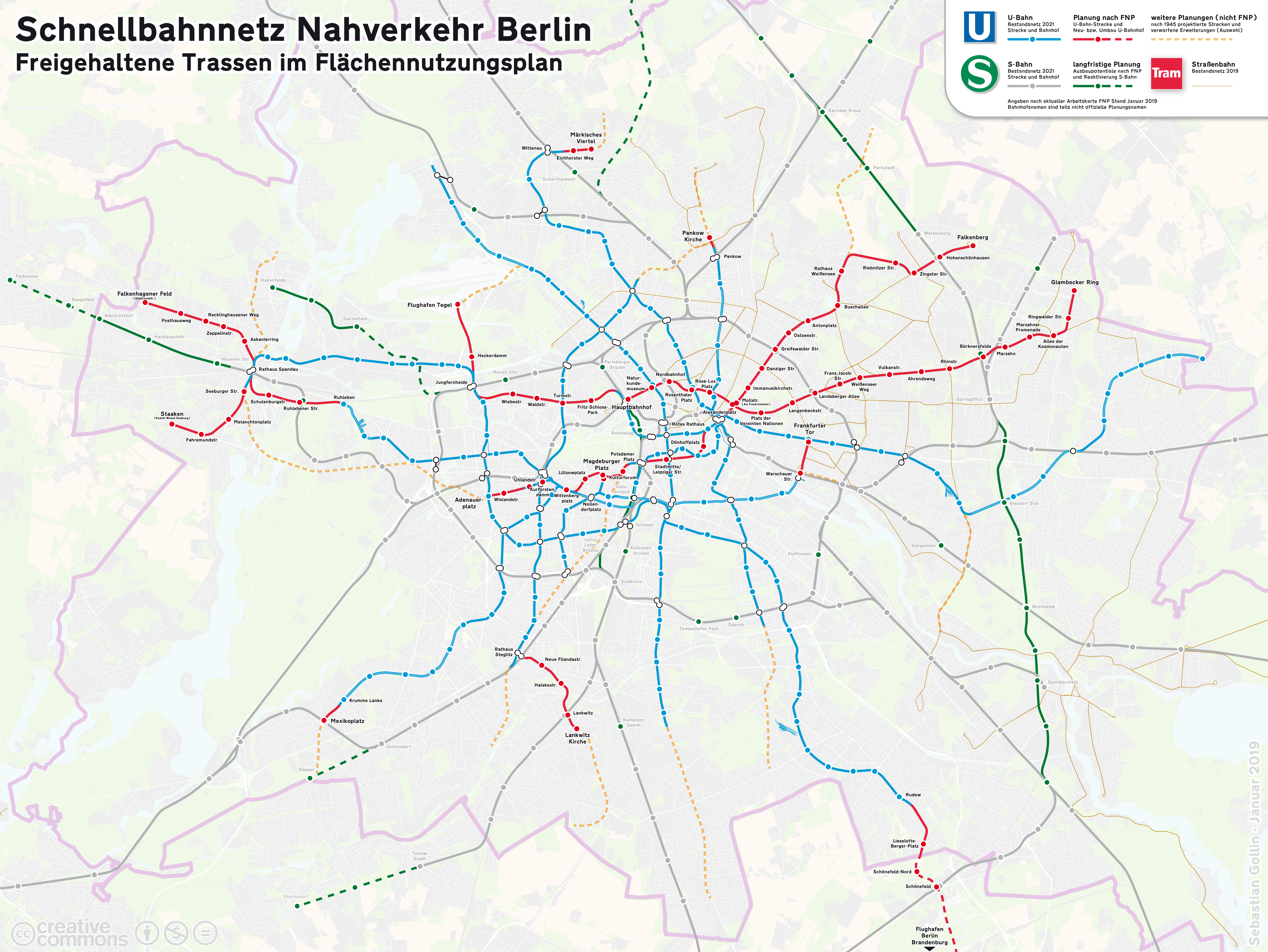
U8 is the north-south line from Wittenau to the southern leg of the Ring – the intersection station, Hermannstrasse, is unlabeled.
Most of the lines depicted in red on the map are not at all on the city’s list of projects to be built by the 2030s. Unfortunately, the most important line measured by projected cost per rider, the two-stop extension of U8 north (due east) to Märkisches Viertel, is constantly deprioritized. The likeliest lines to be built per current politicking are the extensions of U7 in both directions, southeast ti the airport (beyond the edge of the map) and west from Spandau to Staaken, and the one-stop extension of U3 southwest to Mexikoplatz to connect with the S-Bahn. An extension to the former grounds of Tegel is also considered, most likely a U6 branch depicted as a lower-priority dashed yellow line on the map rather than the U5 extension the map depicts in red.
The numbers in the study are, as follows: each kilometer of construction emits 98,800 tons of CO2, which is 0.5% of city emissions (that is, 5.38 t/person, cf. the German average of about 9.15 in 2021). It’s expected that through mode shift, each subway kilometer saves 714 t-CO2 in annual emissions through mode shift, which is assumed to be 20% of ridership, for a payback time of 139 years.
And this argument is, frankly, garbage. The scale of the difference in emissions between cities with and without extensive subway systems is too large for this to be possibly true. The U-Bahn is 155 km long; if the 714 t/km number holds, then in a no U-Bahn counterfactual, Berlin’s annual greenhouse gas emissions grow by 0.56%, which is just ridiculous. We know what cities with no or minimal rapid transit systems look like, and they’re not 0.56% worse than comparanda with extensive rapid transit – compare any American city to New York, for one. Or look again at the comparison of Berlin to the German average: Berlin has 327 cars per 1,000 people, whereas Germany-wide it’s 580 and that’s with extensive rapid transit systems in most major cities bringing down the average from the subway-free counterfactual of the US or even Poland.
The actual long-term effect of additional public transport ridership on mode shift and demotorization has to be much more than 20%, then. It may well be more than 100%: the population density that the transit city supports also increases the walking commute modal split as some people move near work, and even drivers drive shorter distances due to the higher density. This, again, is not hard to see at the level of sanity checks: Europeans drive considerably less than Americans not just per capita but also per car, and in the United States, people in New York State drive somewhat shorter distance per car than Americans elsewhere (I can’t find city data).
The measurement problem
It’s easy to measure the embedded concrete of infrastructure construction: there are standardized itemized numbers for each element and those can be added up. It’s much harder to measure the carbon savings from the existence of a better urban rail system. Ridership can be estimated fairly accurately, but long-term mode shift can’t. This is where rules of thumb like 20% can look truthy, even if they fail any sanity check.
But it’s not correct to take any difficult to estimate number and set it to zero. In fact, there are visible mode shift effects from a large mass transit system. The difficulty is with attributing specific shifts to specific capital investments. Much of the effect of mode shift comes from the ability of an urban rail system to contribute to the rise of a strong city center, which can be high-rise (as in New York), mid-rise (as in Munich or Paris), or a mix (as in Berlin). Once the city center anchored by the system exists, jobs are less likely to suburbanize to auto-oriented office parks, and people are likelier to work in city center and take the train. Social events will likewise tend to pick central locations to be convenient for everyone, and denser neighborhoods make it easier to walk or bike to such events, and this way, car-free travel is possible even for non-work trips.
This, again, can be readily verified by looking at car ownership rates, modal splits (for example, here is Berlin’s), transit-oriented development, and so on, but it’s difficult to causally attribute it to a specific piece of infrastructure. Nonetheless, ignoring this effect is irresponsible: it means the carbon benefit-cost analysis, and perhaps the economic case as well, knows the cost of everything and the value of little, which makes investment look worse than it is.
I suspect that this is what’s behind the low willingness to invest in urban rail here. The benefit-cost analyses can leave too much value on the table, contributing to public transport austerity. When writing the Sweden report, I was stricken by how the benefit-cost analyses for both Citybanan and Nya Tunnelbanan were negative, when the ridership projections were good relative to costs. Actual ridership growth on the Stockholm commuter trains from before the opening of Citybanan to 2019 was enough to bring cot per new daily trip down to about $29,000 in 2021 PPP dollars, and Nya Tunnelbanan’s daily ridership projection of 170,000 means around $23,000/rider. The original construction of the T-bana cost $2,700/rider in 2021 dollars, in a Sweden that was only about 40% as rich as it is today, and has a retrospective benefit-cost ratio of between 6 and 8.5, depending on whether broader agglomeration benefit are included – and these benefits are economic (for example, time savings, or economic productivity from agglomeration) scale linearly with income.
At least Sweden did agree to build both lines, recognizing the benefit-cost analysis missed some benefits. Berlin instead remains in austerity mode. The lines under discussion right now are projected between 13,160€ and 27,200€ per weekday trip (and Märkisches Viertel is, again, the cheapest). The higher end, represented by the U6 branch to Tegel, is close to the frontier of what a country as rich as Germany should build; M18 in Paris is projected to be more than this, but area public transport advocates dislike it and treat it as a giveaway to rich suburbs. And yet, the U6 branch looks unlikely to be built right now. When the cost per rider of what is left is this low, what this means is that the city needs to build more infrastructure, or else it’s leaving value on the table.
I’d like to discuss a bypass of Philadelphia, as a followup from my previous post, about high-speed rail and passenger traffic density. To be clear, this is not a bypass on Northeast Corridor trains: every train between New York and Washington must continue to stop in Philadelphia at 30th Street Station or, if an in my opinion unadvised Center City tunnel is built, within the tunnel in Center City. Rather, this is about trains between New York and points west of Philadelphia, including Harrisburg, Pittsburgh, and the entire Midwest. Whether the bypass makes sense depends on traffic, and so it’s an example of a good investment for later, but only after more of the network is built. This has analogs in Germany as well, with a number of important cities whose train stations are terminals (Frankfurt, Leipzig) or de facto terminals (Cologne, where nearly all traffic goes east, not west).
Philadelphia and Zoo Junction
Philadelphia historically has three mainlines on the Pennsylvania Railroad, going to north to New York, south to Washington, and west to Harrisburg and Pittsburgh. The first two together form the southern half of the Northeast Corridor; the third is locally called the Main Line, as it was the PRR’s first line.
Trains can run through from New York to Washington or from Harrisburg to Washington. The triangle junction northwest of the station, Zoo Junction, permits trains from New York to run through to Harrisburg and points west, but they then have to skip Philadelphia. Historically, the fastest PRR trains did this, serving the city at North Philadelphia with a connection to the subway, but this was in the context of overnight trains of many classes. Today’s Keystone trains between New York and Harrisburg do no such thing: they go from New York to Philadelphia, reverse direction, and then go onward to Harrisburg. This is a good practice in the current situation – the Keystones run less than hourly, and skipping Philadelphia would split frequencies between New York and Philadelphia to the point of making the service much less useful.
When should trains skip Philadelphia?
The advantage of skipping Philadelphia are that trains from New York to Harrisburg (and points west) do not have to reverse direction and are therefore faster. On the margin, it’s also beneficial for passengers to face forward the entire trip (as is typical on American and Japanese intercity trains, but not European ones). The disadvantage is that it means trains from Harrisburg can serve New York or Philadelphia but not both, cutting frequency to each East Coast destination. The effect on reliability and capacity is unclear – at very high throughput, having more complex track sharing arrangements reduces reliability, but then having more express trains that do not make the same stop on the same line past New York and Newark does allow trains to be scheduled closer to each other.
The relative sizes of New York, Philadelphia, and Washington are such that traffic from Harrisburg is split fairly evenly between New York on the other hand and Philadelphia and Washington on the other hand. So this really means halving frequency to each of New York and Philadelphia; Washington gets more service with split service, since if trains keep reversing direction, there shouldn’t be direct Washington-Harrisburg trains and instead passengers should transfer at 30th Street.
The impact of frequency is really about the headway relative to the trip time. Half-hourly frequencies are unconscionable for urban rail and very convenient for long-distance intercity rail. The headway should be much less than the one-way trip time, ideally less than half the time: for reference, the average unlinked New York City Subway trip was 13 minutes in 2019, and those 10- and 12-minute off-peak frequencies were a chore – six-minute frequencies are better for this.
The current trip time is around 1:20 New York-Philadelphia and 1:50 Philadelphia-Harrisburg, and there are 14 roundtrips to Harrisburg a day, for slightly worse than hourly service. It takes 10 minutes to reverse direction at 30th Street, plus around five minutes of low-speed running in the station throat. Cutting frequency in half to a train every two hours would effectively add an hour to what is a less than a two-hour trip to Philadelphia, even net of the shorter trip time, making it less viable. It would eat into ridership to New York as well as the headway rose well above half the end-to-end trip, and much more than that for intermediate trips to points such as Trenton and Newark. Thus, the current practice of reversing direction is good and should continue, as is common at German terminals.
What about high-speed rail?
The presence of a high-speed rail network has two opposed effects on the question of Philadelphia. On the one hand, shorter end-to-end trip times make high frequencies even more important, making the case for skipping Philadelphia even weaker. In practice, high speeds also entail speeding up trains through station throats and improving operations to the point that trains can change directions much faster (in Germany it’s about four minutes), which weakens the case for skipping Philadelphia as well if the impact is reduced from 15 minutes to perhaps seven. On the other hand, heavier traffic means that the base frequency becomes much higher, so that cutting it in half is less onerous and the case for skipping Philadelphia strengthens. Already, a handful of express trains in Germany skip Leipzig on their way between Berlin and Munich, and as intercity traffic grows, it is expected that more trains will so split, with an hourly train skipping Leipzig and another serving it.
With high-speed rail, New York-Philadelphia trip times fall to about 45 minutes in the example route I drew for a post from 2020. I have not done such detailed work outside the Northeast Corridor, and am going to assume a uniform average speed of 240 km/h in the Northeast (which is common in France and Spain) and 270 km/h in the flatter Midwest (which is about the fastest in Europe and is common in China). This means trip times out of New York, including the reversal at 30th Street, are approximately as follows:
Out of both New York and Philadelphia, my gravity model predicts that the strongest connection among these cities is by Pittsburgh, then Cleveland, then Chicago, then Detroit, then Harrisburg. So it’s best to balance the frequency around the trip time to Pittsburgh or perhaps Cleveland. In this case, even hourly trains are not too bad, and half-hourly trains are practically show-up-and-go frequency. The model also predicts that if trains only run on the Northeast Corridor and as far as Pittsburgh then traffic fills about two hourly trains; in that case, without the weight of longer trips, the frequency impact of skipping Philadelphia and having one hourly train run to New York and Boston and another to Philadelphia and Washington is likely higher than the benefit of reducing trip times on New York-Harrisburg by about seven minutes.
In contrast, the more of the network is built out, the higher the base frequency is. With the Northeast Corridor, the spine going beyond Pittsburgh to Detroit and Chicago, a line through Upstate New York (carrying Boston-Cleveland traffic), and perhaps a line through the South from Washington to the Piedmont and beyond, traffic rises to fill about six trains per hour per the model. Skipping Philadelphia on New York-Pittsburgh trains cuts frequency from every 10 minutes to every 20 minutes, which is largely imperceptible, and adds direct service from Pittsburgh and the Midwest to Washington.
Building a longer bypass
So far, we’ve discussed using Zoo Junction. But if there’s sufficient traffic that skipping Philadelphia shouldn’t be an onerous imposition, it’s possible to speed up New York-Harrisburg trains further. There’s a freight bypass from Trenton to Paoli, roughly following I-276; a bypass using partly that right-of-way and, where it curves, that of the freeway, would require about 70 km of high-speed rail construction, for maybe $2 billion. This would cut about 15 km from the trip via 30th Street or 10 km via the Zoo Junction bypass, but the tracks in the city are slow even with extensive work. I believe this should cut another seven or eight minutes from the trip time, for a total of 15 minutes relative to stopping in Philadelphia.
I’m not going to model the benefits of this bypass. The model can spit out an answer, which is around $120 million a year in additional revenue from faster trips relative to not skipping Philadelphia, without netting out the impact of frequency, or around $60 million relative to skipping via Zoo, for a 3% financial ROI; the ROI grows if one includes more lines in the network, but by very little (the Cleveland-Cincinnati corridor adds maybe 0.5% ROI). But this figure has a large error bar and I’m not comfortable using a gravity model for second-order decisions like this.
On my Discord channel, I was reminded of the late-2000s work by some institutional American urbanists about the concept of megaregions. Wikipedia has a good summary of the late-2000s discourse on the subject. In short, there are linear ties across the East Coast from Boston to Washington (“BosWash”), with more or less continuous suburban development in between, and some urbanists tried to generalize this concept to other agglomerations of metropolitan areas, not usually successfully. The American work on this carved most of the country’s population into 10 or 11 megaregions, sometimes annexing portions of Canada, as in the Regional Plan Association’s America 2050 program:
There is a lot to critique about this map. Canada has a strong self-conception as a distinct entity from the United States; while there’s a case for lumping Vancouver with Seattle and Portland as the Pacific Northwest, lumping Toronto with the Midwest is irresponsible. The Hampton Roads region is not meaningfully a periphery of the Northeast, but is rather Southern (for example, it is heavily militarized, and the South has consistently higher enlistment rates than the Northeast). The Rio Grande Valley is not especially connected with New Orleans.
But the core of the program is to propose this as the basis of high-speed rail investment, and that’s where it fails the most visibly. When one of my Discord channel participants posted the map in the channel about high-speed rail, I started talking about my gravitymodel, and pointed out some patterns that emerge.
For this, consult a table of ridership between any pair of American or Canadian cities in the main connected component of my proposed map:
The table omits Texas, California, and the Pacific Northwest. But it includes lines that I initially considered and rejected, going to Kansas City and Birmingham; the reason is that when I calculated it by hand I omitted very weak long-range connections such as between Boston and the Midwest, whereas the table can automatically calculate them and add them in, producing an estimate of 5 million annual riders between Boston and the entire Midwest region. These extra connections make weak lines like those to Birmingham and Kansas City appear stronger, so those lines are included; it’s plausible they could even justify a connection to Texas via both New Orleans and and Tulsa, but those are not included (and would at any case not impact the analysis below).
The following table includes some connections between two adjacent cities in the table, with their total projected passenger counts. Those are very high numbers, higher than you’d expect; this is because they lump in a great many city pairs – for example, New York-Philadelphia includes all connections from New York, Boston, and Albany to Philadelphia and points south and west, and those sum to a much higher number than just the internal trips on the Northeast Corridor, let alone just trips originating in New York and ending in Philadelphia or the reverse. Also, as a note of caution, there may be small inaccuracies if I mistakenly tabulated very weak markets like Chicago-Charlotte as going via the wrong path; they do not change the main conclusion.
City pair
Ridership
Boston-New York
39,299,133
Boston-Springfield
25,482,364
New York-Philadelphia/Harrisburg
139,860,707
Philadelphia-Washington
110,010,205
Washington-Richmond
64,145,050
Richmond-Raleigh
50,425,578
Raleigh-Greensboro
42,654,519
New York-Albany
57,773,629
Philadelphia-Harrisburg
65,639,871
Harrisburg-Pittsburgh
61,110,782
Pittsburgh-Cleveland
62,352,156
Cleveland-Toledo
56,482,182
Cleveland-Columbus
46,046,790
Buffalo-Cleveland
41,584,062
Some observations jump from this (partial) table:
New York-Boston is much weaker than a lot of segments that are by themselves far weaker than the Northeast Corridor. The reason for this is that a full 31.1 million annual riders on New York-Boston are internal to the Northeast Corridor, whereas the other city pairs require large swaths of the network to be built to have such high traffic.
From Philadelphia to points west, traffic density is fairly consistent. There’s no separation between a Northeastern and Midwestern megaregion evident in the data: Cleveland has about the same traffic density going east and west, as does Pittsburgh. Rather, it’s the connections between the East Coast and the Midwest, chiefly Philadelphia-Pittsburgh-Cleveland but also the Empire corridor between Albany and Cleveland, that create high ridership.
Washington-Atlanta is a tail gradually weakening with distance from the Northeast Corridor, rather than an independent corridor.
Outside the US, the same observation about the irrelevance of megaregions to high-speed rail is true. The European attempt to describe a megaregion, the so-called Blue Banana, was constructed explicitly to exclude France – but the highest-traffic density intercity rail link in Europe is between Paris and the bifurcation splitting toward Lyon and Dijon. Frankfurt-Mannheim is a close second, but French intercity trains average around 220 km/h and German ones around 130 km/h depending on the line, and the actually existing high-speed rail network gets higher peak traffic density than the medium-speed one.
Ultimately, high-speed rail as a mode of transportation is a means of connecting metropolitan areas. Whether they fall into megaregions or not is immaterial – some strong links connect distinct regions, like Northeast-Midwest, with higher demand for traffic than some of the internal connections.
I am back in Europe now (in London until Tuesday), but I was in New York for nearly three weeks, and it was interesting reconciling what I was seeing with what everyone else is saying about the city. It and my March 2022 trip were both enlightening in a way because I’d last been in the US at the end of 2019, so many New Yorkisms that I was used to in the 2000s and 2010s suddenly jarred me as foreign to what I had grown used to in Europe.
As one might expect based on the subject of this blog, I took the subway a lot. I took it so much that I was using weekly passes, and the last week I had a weekly pass for just three days and still I took 13 trips on those days, justifying its cost (which is like that of 12 single trips). I saw things, and notably didn’t see others.
What I did see: abject unreliability. I snapped a photo whenever the train arrival board was showing something weird, like low frequency or bunching; if you’re reading this post as it’s being posted and not going on a deep archive run, then go to my Twitter media and look at the last few weeks of pictures. Out of 19 days, something was going wrong 10 times, usually on the train I used to get between my Queensbridge hotel and Marron, the F train – and that’s without counting a few trips when the train frequency looked good but then I was delayed 10-20 minutes due to incidents. Something would always come up: signal failure, medical emergency, mechanical failure, cascading delays. Uday Schultz, a railfan who scares me with the depth of his knowledge of operations, maintenance, and rail history, points out how one such delay compounded due to bad interlining.
This is not normal. Berlin has delays but nowhere nearly this often – not on the U-Bahn but also not on the S-Bahn, whose interlining complexity is comparable to that of the New York City Subway. Low-frequency sections due to single-tracking for maintenance exist in Berlin, but it’s rare, and trains do not run worse than every 10 minutes except on the suburban periphery of the city. Over a similar period of time in Berlin I might see an incident bad enough to complain to BVG about it on Twitter maybe once or twice, not 10 times.
What I didn’t see: significant crime. I point out that I was staying near Queensbridge because the area is negatively stereotyped by suburbanites and city residents with I-hate-(the-rest-of-)the-city identity politics. Nothing there looked scary, at any time of day. There’s a large housing project there, which I mostly associate with people playing the Halloween theme song on 10/31 for what I imagine was a showing of the film and with some people wearing delightfully scary costumes. The worst I saw was someone selling swipes illegally when there was an unusually long line for the ticketing machines; there were cops on the platform who must have passed this person by and apparently done nothing.
I point this out because the city is convinced that the subway is dangerous. There are annoying announcements all the time: “this is an important message from the New York City Police Department…” It makes for some awful user experience – there’s no possibility of quiet on the train, for which those announcements contribute more than anything, since the panhandlers are much less common and the background noise is easier to tune out. People who speak limited English or can’t make out the phonemes garbled over bad announcer systems learn to tune everything out, including the occasional useful announcement of service changes.
And the police loves how annoying it is, which it justifies by appealing to safety theater. When Sarah Meyer tried reducing the annoyance levels, she ran into some real and some made-up technical problems, and one political problem in that nobody in management cares about UX. The police said they need those announcements, annoying and counterproductive as they are (telling tourists to watch their belongings gets them to grasp their wallets in fear, alerting every thief to the location of the wallet on their person); nobody at the agency thought to push back. In the last few days, a new disturbance has been added: the conductors announce at nearly every stop that cops are on the platform should people need assistance. This is in a safe city. Just stop this.
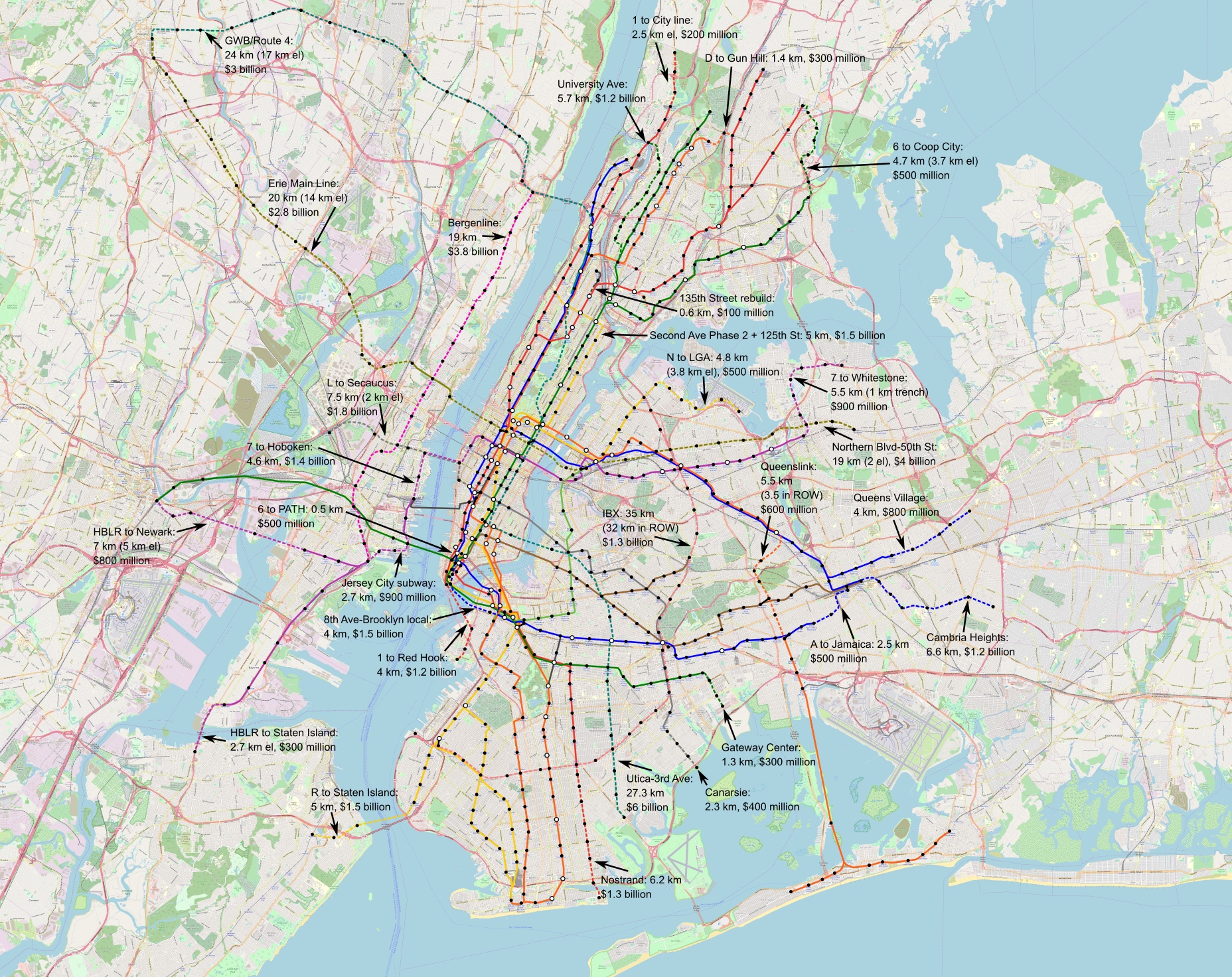
I’ve been thinking a lot about where subway extensions can go in New York. One of the appendices we’re likely to include down the line in the Transit Costs Project is a proposal for what New York could do if its construction costs were more reasonable, and this means having to think about plausible extensions. Leaving aside regional rail and systematic investments for now, this may roughly be it:
The full-size image (warning: 52 MB) can be found here.
The costs depicted are about twice as high as what I wrote in 2019 with Nordic costs as the baseline, because nominal Nordic costs have doubled since then, partly due to updating price levels from the early 2010s to the early 2020s, but mostly because of the real cost explosion in the Nordic countries. These costs are about $200 million/km in outlying areas, $300 million/km in Manhattan or across water, somewhat less than $100 million/km above ground or in an open trench, and higher than $300 million/km when reconstruction of existing tunnel complexes is proposed; everything is rounded to the nearest $100 million, which creates some rounding artifacts for short extensions that cancel one another out.
But the precise map is not what I think is the most interesting. The point is to build to the frontier of the cost per rider that is acceptable in American cities today, so by definition the marginal line for inclusion on the map, such as the D extension to Gun Hill Road to meet with the 2 train, is also socioeconomically marginal. What I think is more interesting is how important transit-oriented development is for the prospects of lines beyond the most obvious ones (Second Avenue Subway Phase 2, 125th Street, Utica, Nostrand, IBX, and maybe also the 7 to College Point).
The current land use in New York is largely frozen from the middle of the 20th century; the 1961 zoning law was the watershed. Since then, change has been slow, in contrast with rapid redevelopment in places that have chosen a pro-growth path. If the pace of change stays slow, then fewer lines are viable; if the city instead chooses not to keep anti-developmental neighborhood interests in the loop, then more are.
This, in turn, feeds into growth plans. Nordic and Italian planning bundles the question of where the regional housing growth goes with where the subway goes. (Our other positive case study, Turkey, works differently; the answer to both questions is “everywhere.”) This means that subway service goes to areas where substantial quantities of transit-oriented development will be permitted and built, often in negotiations with NIMBY municipalities that would rather just get the infrastructure without the housing; in Stockholm the scale involved is tens of thousands of units per tranche of Nya Tunnelbanan.
In the case of New York, this affects the shape of the map above more than anything. The 6 extension to Coop City is likely good either way, but the other radial extensions in the Bronx are more questionable and depend on where new housing in the borough will be built. The same is true in Queens: more housing in Northeast Queens may argue even in favor of further lines not depicted on the map, for example extending the 7 even further.
Sandbagging is the practice of making a proposal one does not wish to see enacted look a lot weaker than it is. In infrastructure, this usually takes the form of making the cost look a lot higher than it needs to be, by including extra scope, assuming constraints that are not in fact binding, or just using high-end estimates for costs and low-end estimates for benefits. Unfortunately, once a sandbagged estimate circulates, it becomes real: doing the project cleanly without the extras and without fake constraints becomes politically difficult, especially if the sandbaggers are still in charge.
Examples of sandbagging
I’ve written before about some ways Massachusetts sandbags commuter rail electrification and the North-South Rail Link. In both cases, Governor Charlie Baker and the state’s Department of Transportation are uninterested in commuter rail modernization and therefore ensured the studies in that direction would put their fingers on the scale to arrive at the desired conclusion. As we will see, the electrification sandbag is one example of how sandbagged estimates can become real.
In New York, the best example is of sandbagging alternatives. Disgraced then-governor Andrew Cuomo wanted to build a people mover to LaGuardia Airport in the wrong direction, and to that effect, Port Authority made a study that found ways to sandbag other alignments; here at least there’s a happy ending, in that as soon as Cuomo left office, the process was restarted and the rapid transit options studied the most seriously are the better ones.
Another example I have just seen is in Philadelphia. There have long been calls for extending the subway to the northeast along Roosevelt Boulevard; Pennsylvania DOT has just released a cost estimate of $1-4 billion/mile ($600 million-$2.5 billion/km). The high end would beat both phases of Second Avenue Subway, in an environment that both is objectively easier to tunnel in and has a recent history of building and operating services much less expensively than New York.
How to sandbag public transportation
An obstructionist manager who does not care much for public transit, or doesn’t care about the specific project being proposed, has a number of tools with which they can make costs appear higher and benefits appear lower. These are not hard to bake into an official proposal. These include the following:
Invocation of NIMBYs as a reason not to build. The NIMBYs in question can be a complete phantom – perhaps the region in question is supportive of transit expansion, or perhaps there was NIMBYism in recent memory but the NIMBYs have since died or moved away. Or they can be real but far less powerful than the obstructionist says, with a recent history of the state beating NIMBYs in court when it cares.
Scope creep. Complex public transportation projects often require additional scope to be viable – for example, regional rail tunnels often require additional spending on surface improvements for the branches that are to use the tunnels. How much extra scope is required is a subtle technical question and there is usually room for creative innovation for how to schedule around bottlenecks (whence the Swiss slogan electronics before concrete). The obstructionist can take a maximalist approach for the scope and just avoid any attempt to optimize, making the costs appear higher.
Scope deflection. This is similar to scope creep in that the project gets laden with additional items, but differs from scope creep in that the items are what the obstructionist really wants to build, rather than lazy irrelevances.
Excessive contingency. Cost estimates are uncertain and the earlier the design is, the more uncertain they are. Adding 40% contingency is a surefire way to ensure the money will be spent, as is citing a large range of costs as in the above-mentioned case in Philadelphia.
How sandbags become real
Normally, the purpose of a sandbag is to block or delay the entire project; the scope deflection point is an exception to this. And yet, once a sandbagged estimate is announced, it often turns into the real cost. Philadelphia was recently planning subway expansion for not much more than the international cost, but now that numbers comparable to Second Avenue Subway are out there, area advocates should expect them to turn into the real cost, absent a strong counterforce, involving public dismissal and humiliation of people engaged in such tactics.
The reason for this is that cost control doesn’t always occur naturally, unless one is already used to it. It’s very easy to waste money on irrelevant extras, some with real value to another group (“betterments”), some without. Second Avenue Subway has stations that are two to three times as big as they needed to be, without any sandbagging – different requirements just piled up, including mechanical rooms, crew rooms with each department having its own space, and additional crossovers, and nobody said “Wait a minute, this is too much.” The station designs are also not standardized, again without a sandbag, and it’s very easy to promise neighborhood groups bespoke design just to make them feel important, even if the bespoke design isn’t architecturally notable or useful for passengers.
Likewise, if there’s any conflict between different users, for example different utilities and infrastructure providers in a city, then it takes some effort to rein it in and coordinate. The same situation occurs for conflict between different users of the same tracks on mainline rail: it takes some effort to coordinate timetables between local and long-distance rail services. The planning effort required is ultimately orders of magnitude cheaper than the cost of segregating the uses – hence the electronics before concrete maxim – but people who don’t care for coordination can find ways to define a project in a way that makes additional concrete (on mainline rail) or extra work with utilities (in urban subways) seem unavoidable.
Moreover, a betterment, non-standardized design, concrete-instead-of-electronics, or scope deflection occurs in context of other people’s money (OPM). If a light rail project pays for a municipality’s streetscaping, the municipality will not try to value-engineer any of it, resulting in unusually high costs.
In New York, one of the reasons for high accessibility costs on the subway, beyond the usual problems of procurement and utility conflict, is scope deflection. The agency doesn’t care about disabled people, and treats disability law as a nuisance. Thus it sandbags elevator installations by bundling them with other projects that it does care about, like adding more staircases or renewing the station finishes, and charging those projects to the accessibility bucket and telling judges how much it is spending on mandated accessibility.
Political advocacy is unwittingly one of the mechanisms for this cost blowout. Transit advocates tend to value transit more than the average person, by definition, and therefore are okay with pushing for projects at higher costs than are acceptable to most. Once a sandbagged budget is out there, such groups often say that even at the higher estimate the project is a bargain and should go ahead. And once there’s political support, it’s easy to spend money with nothing to show for it.




 Pedestrian Observations