Secondary Stops in Cities on Intercity Rail
Intercity trains usually only call at the main cities, and only at their main stations. However, in some cases, they make more than one stop in the same city. Examples include the Northeast Corridor with its two Boston stops, the Shinkansen stopping at Shinagawa and Ueno each a few kilometers out of Tokyo Station, Israel Railways with every train stopping multiple times in Tel Aviv, and ICEs stopping not just at Berlin Hauptbahnhof but also a station in each of the cardinal directions out of the city. This practice is a useful tool in the kit of an intercity rail planner, but is not always appropriate – indeed, anti-examples exist throughout France where this never happens and in most German cities that are not Berlin. The goal of this post is to discuss when it is or isn’t appropriate.
Opposite-side stops
If a city is at the end of a line, then the train may continue shortly past it and serve a secondary center. The main examples are in Berlin: it is at the northeastern end of the country, so trains running north-south either run through northwest to Hamburg or terminate just north of Hauptbahnhof at Gesundbrunnen, and trains running east-west entering Hauptbahnhof on the Stadtbahn run through to Ostbahnhof. This is not done in the other examples I have in mind: Israeli trains run through Tel Aviv, Shinkansen terminate at Tokyo Station rather than continuing to the opposite side, and the Northeast Corridor terminates at Washington Union Station rather than continuing one stop south to Alexandria.
In all cases, the question of whether to do it hinges on infrastructure more than operations. Unlike near-side stops, nobody is being delayed by the extra stop – Ostbahnhof isn’t between Hauptbahnhof and anything except Poland, which is barely even peripheral to the German rail network. The main cost is the extra few minutes of train operating time, on which ridership is necessarily going to be lower than the average because most people will have gotten off at the primary station. Whether it’s worth it depends on where it’s easier to turn, based on specific infrastructure considerations.
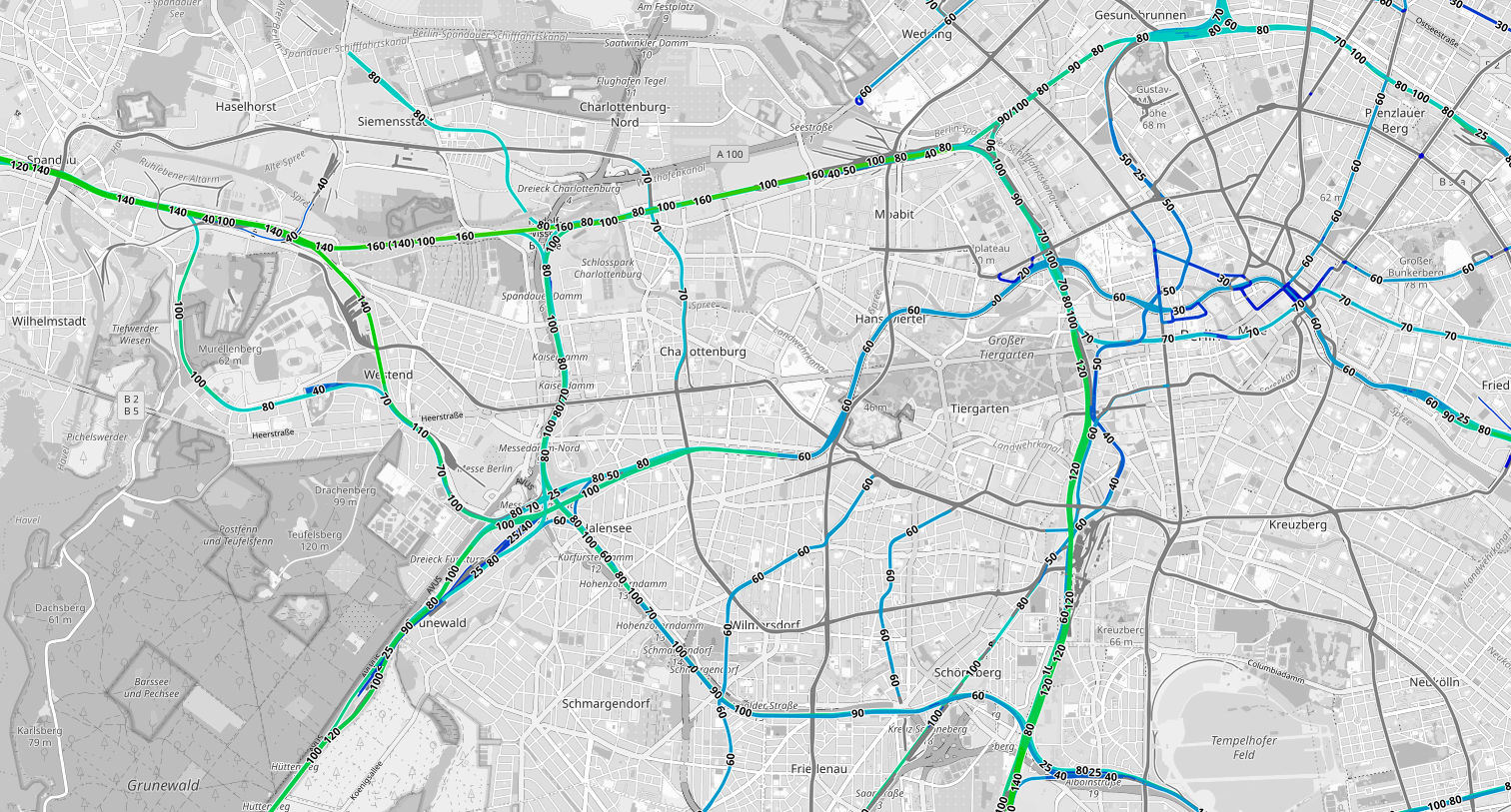
In Berlin, the reason for Ostbahnhof, a station with no connections to any public transport except the Stadtbahn, which also serves Hauptbahnhof, is infrastructural. The station has one more track than Hauptbahnhof (five vs. four on the mainline Stadtbahn tracks); more importantly, the railyard is to the east of the station, so any ICE using the Stadtbahn has to travel via Ostbahnhof anyway, so it might as well stop there. The railyard is also why some east-west trains even use the Stadtbahn with its 60 km/h speed limits to begin with, when those trains entering from the west can divert to the faster North-South Main Line.
In contrast, the Northeast Corridor’s electrification ends at Washington Union Station. In theory, it can be wired to Virginia and some trains can continue to Arlington while still running under wire. In practice, other works are involved – Washington Union Station is a mix of through- and terminating tracks and so far the through-tracks are low-platform, and the only bridge on the Potomac is primarily used by freight and a separate bridge to allow for passenger-dedicated infrastructure is under construction but won’t open until 2030.
Distance from the primary station
The farther away a node is from the primary station, the more appropriate it is as a prospect for a near-side station, because it is less likely to share a travel market with the primary station, and the cost to travelers of backtracking is higher. In a number of cases, it’s debatable whether the station should even properly count as a secondary station in the city, as opposed to a separate city’s stop. In New York, for example, the nearest station to Penn Station is Newark, 16 km away, in a city center that evolved separately and only became part of the New York metro area in the 20th century, long after its location as a station was established.
I emphasize that this logic is only for near-side stations, because for far-side stations, the logic goes in the exact opposite direction: the train is necessarily emptier going past the last primary city on the route, so the longer it has to run relatively empty, the weaker the idea of serving the far-side stop is. Not for nothing, Ostbahnhof and Gesundbrunnen are both very close to Hauptbahnhof, both well within the city center urban fabric.
To return to the case of New York, this is what separates Newark from Long Island City. There is currently no serviceable station in Queens on the Northeast Corridor, but there are occasional plans to build on, either at Queens Boulevard or a bit farther east at what I (and people following me) call Sunnyside Junction to allow for a transfer to East Side Access trains to Grand Central (the map below calls it Harold after the interlocking). MTA plans have called for the former, and occasionally one sees advocates call for the latter (ETA calls it Queens Junction), with official plans for decking Sunnyside Yards that may be connected.
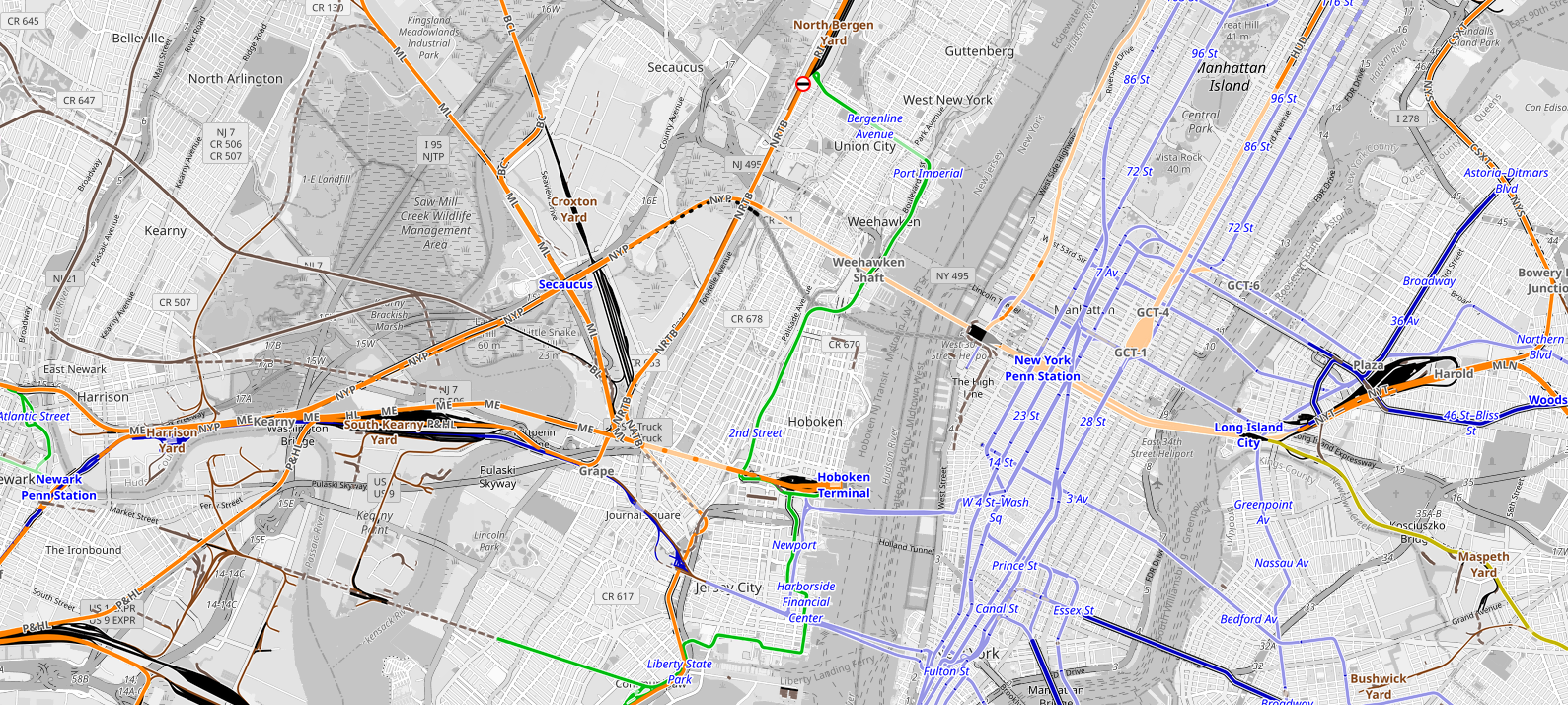
Newark Penn Station is a smaller job center than Long Island City. Within 1 km of Newark Penn are 48,000 jobs, vs. 70,000 within 1 km of the intersection of the NEC/LIRR Main Line with Queens Boulevard (and 35,000 of the plausible Sunnyside Junction location). But any project that builds commuter rail stations in Long Island City automatically makes the area easy to get to from Penn Station, whereas Newark Penn is a longer distance from New York, forcing a longer detour for passengers going to points south.
Track speeds
The main cost of a station stop is the extra time it forces on through-passengers. This means that it’s more justifiable to include more stops in a slow zone than in a fast zone.
In practice, this principle works in the opposite direction from that of distance to the primary station, since slow zones are more commonly encountered in major cities than outside of them. The best location based on synthesizing this and the distance principle is that stations are best placed near slow zones that are nonetheless far from the primary city and yet very difficult to fix. Newark Penn Station is at such a slow zone, the approach from the Dock Bridge to the station having some surprisingly tight curves, and the Harrison curve farther north even tighter. New Rochelle is another such example, next to a tight S-curve with flat junctions; this curve can be eased with a necessary grade separation, but the current maximum track speed there is so low, oscillating between 30 and 45 mph (48-72 km/h) based on track maintenance, that it’s understandable that Amtrak Regionals stop there. Back Bay, in an unfixable slow zone, is likewise a natural candidate for a station despite its proximity to South Station.
On urban through-tracks, the maximum speed is usually low, because the costs of engineering the right-of-way through an already crowded city center underground are high and economies are required. The curves on the Ayalon Railway look good for maybe 100 km/h, Stuttgart 21 is designed for 80-90 km/h and so was the North-South Main Line in Berlin, and the Shinkansen doesn’t go faster than 100-110 km/h through Central Tokyo or faster than 130 km/h to Omiya. Such environments encourage secondary stops, whereas the ability of LGVs to get out of city centers fast helps explain why it was never considered.
Of course, TGVs have another reason not to make secondary stops: they’re not set up for them. The TGVs are the worst high-speed trains in the world from the perspective of either acceleration, since they are hauled by locomotives whereas every other piece of equipment save some Talgos is a multiple unit, or interior car design, since they are single-door pair double-deckers with narrow passageways, not at all designed for fast egress since the concept has always been nonstop trips from a Parisian terminal to a secondary city. Regardless of the speed, a TGV making a second Paris stop would have a minimum 5-minute dwell time. At the other end, the Shinkansen and the Israeli trains have level boarding (as do Chinese high-speed trains but they tend to avoid slow city centers).
Relative strength of destinations
Stop spacing on every public transport vehicle is a matter of relative intensities of usage. Absolute density or intensity matters little; the real question is the intensity of the stop considered for addition or deletion compared with the intensity of the stop pairs through the stop that would be delayed if it were added. On intercity rail, the intensity of demand is a combination of all of the following:
- Commercial density near the station
- Density of other destinations near the station, such as tourist attractions, which can be approximated by looking at hotel capacity
- Connecting urban rail lines and the residential density thereon
Back Bay has, within 1 km of the station, 95,000 jobs, compared with 212,000 within 1 km of South Station. This ratio, 0.45, is atypically high for any American secondary central business district, to the point that people perceive Back Bay as a Boston central business district and not as secondary at times. It also is on the Orange Line, which doesn’t serve South Station, and close to the Green Line, which doesn’t get to South Station either, both with solid ridership (the Green Line is comparable to South Station’s Red Line, the Orange somewhat lower than either).
In New York, in contrast, Manhattan overwhelms everything. The 1 km radius from Penn Station if anything undersells it – it has 565,000 jobs, but Midtown continues beyond it and the 2 km radius has 1,415,000, whereas a 2 km radius from Newak Penn has 83,000 and a 2 km radius from Sunnyside Junction or LIRR/Queens Boulevard has 117,000-122,000. Secondary stations must be justified as origins rather than destinations: Newark Penn keeps up by collecting some commuter rail lines, but suffers since the Morris and Essex Lines only go to New York, not Newark Penn, and holds up mostly because of the slow nearby speeds.
No data as granular as OnTheMap exists in Germany, but one can still model connecting lines and their traffic intensity. The Ring is a high-traffic local corridor, especially its eastern half, including both Gesundbrunnen and Südkreuz; at both stations, its passenger traffic density is barely less than that of the Stadtbahn at Hauptbahnhof. Both also have the North-South Tunnel, which intersects the Stadtbahn at Friedrichstraße rather than Hauptbahnhof, and Gesundbrunnen also has the U8 connection. From quite a lot of the city, even relatively central parts, one of the two north-south secondaries is better than the primary. The east-west situation in Berlin is dicier, since Spandau is much more peripheral, more comparable to Newark than a secondary station within the primary city, and Ostbahnhof really exists as a byproduct of where the railyard is.
One should expect that European cities, with their lower-kurtosis centers, should be better places for secondary stations than American ones, which have very high kurtosis, even outside New York. Other than Back Bay, there really aren’t any strong secondary city centers on American intercity rail lines. California High-Speed Rail’s secondaries, like Burbank, are there for residential catchment, often with easier access by car than the central business district. And yet, one element goes in the opposite direction: larger metro areas tend to have more secondary destinations. Munich is small enough that it can monocentric within walking distance or a short S-Bahn ride from Hauptbahnhof. The sort of American cities that need to think about intercity rail are not; this is how Boston has such a strong secondary, and even New York has decent secondaries immediately outside city limits. Tokyo, with a very strong center but lower kurtosis than New York – high job density is not just in areas near Tokyo Station but also includes Shinagawa, Shinjuku, Shibuya, and Ikebukuro – is a natural place for secondaries, and if there were a Shinkansen line heading west rather than north or south, it goes without saying that it would stop at Shinjuku.


How does “park n’ ride” stations figure into this? These types of stations seem more common in the UK (where I believe they originated in the 1960s) and US with their wealthy suburban sprawl then European nations, like France whose urban development has the wealth living in the center, and poorer folk in the suburbs.
Stockport is also a “park n’ ride” station for Manchester FWIW.
One of the best ways to improve service to the rest of France would be more stops at the edge of Paris.
On the other hand you need fewer platforms in the city centre if the train continues beyond it, plus as long as there’s at least 10% passengers remaining that covers the marginal costs of the train continuing anyway.
Yes, Île-de-France needs a TGV station south-east of Paris. However before saying that “it was never considered” or “never happens” in France, Alon should remember that Massy-TGV opened 13 years before the Shinkansen first stop in Shinagawa, that TGVs have been serving two stations in Lyon and Tours from day one of the LGV Sud-Est and Atlantique operations, that Aix-TGV, closer to Marseille than its airport, is an informal second TGV station for Marseille northern banlieue, and that Nice-Saint Augustin is being rebuilt as a second TGV station for Nice.
Alon thinks that the badly designed TGVs would need a “minimum 5 minute dwell time” in a Paris secondary station. SNCF disagrees. For example, TGV Inoui 12265 has a single stop between Montparnasse and Bordeaux, 3 minutes in Massy.
The fastest Montparnasse-St Jean trains take 2:08, but trains with a single stop in Massy takes 2:16, so that’s 8 mins wasted on a single stop, not even in a high speed 320km/h zone (more like 160-200km/h zone). Even accounting for the 3 mins dwell, the time wasted is still very high, indeed even CAHSR assumes 6 mins total stop penalty including 2 min dwell in 350km/h zones.
Regardless of how you cut it the TGVs are not setup for stops like these.
SNCF has tested and owned various high speed trains. The Sud-Est and TransManche TGVs had 12 engines, eight in the locomotives and two in the first and last passenger cars. The Eurostar e320 EMUs have 32. SNCF added engines for speed record runs and removed them for regular service.
In comparison with their Sud-Est predecessors, the TGVs Atlantique going through Massy-TGV gained two passenger cars and lost two engines. It may seem Alsthom was running out of engines and had extra cars sitting around but this was deliberate. SNCF looked at the maintenance cost of extra engines versus the cost of slower acceleration, the revenue gained by adding seats versus the shorter dwell times possible with additional doors or fewer cars, and made an informed decision. Railfans who don’t have that information, and Alon who said that the TGVs may be the worst high-speed trains in the world from the perspective of acceleration or fast egress, should give SNCF the benefit of the doubt. After all, the Atlantique is one of the rare high speed rail programs whose income was able to pay back construction costs.
CAHSR will demonstrate shorter dwell times can’t compensate for an absurd route choice. Operating losses, which will infuriate California’s taxpayers, are expected.
Just because something works or is profitable, doesn’t make it the optimal solution. Isn’t the point of this blog to learn about what areas each country is doing well at and integrating them into a broader knowledge base? France clearly is able to turn a profit on their LGVs (and returning construction costs), and that is worth learning from, but does that have anything to do with their dwell times, rolling stock acceleration, and operating paradigms? That has more to do with their low cost approach to construction, which we can learn from, while not copying their worst practices.
Japan is just as profitable (if not more) with EMUs and fast dwell times, and German long distance can be too, even with lower speeds. There’s nothing stopping you from copying the low construction costs of France and integrating with Japanese/German operations.
Yes, this blog is an opportunity to learn from others but don’t worry about SNCF. They are well ahead of us.
In the 1950s, most thought that the Tōkaidō line electrification, which was being completed, was all that was needed. The 1954 598 billion Yen five-year plan for JNR only allocated 12 billion to the Tōkaidō line. Most elected officials wanted the Japanese National Railways to address the needs of their rural constituents. Meanwhile, government-financed Japan Airlines was launched and began flying between Tokyo and Osaka while plans were made for a four lane highway between the two cities. Highway and air transportation appeared to be the way of the future in the United States and Europe, and most Japanese officials thought that Japan should follow suit. Shinji Sogō, who came out of retirement to become JNR president in 1955 at the age of 71, disagreed. His Shinkansen plan was opposed by most JNR executives but strongly supported by SNCF who kept sending high ranking executives to learn about it. The French were so present that when the World Bank, solicited for a loan, requested an outside evaluation, the Shinkansen chief engineer Shima, thinking that the French already knew enough and fearing espionage, chose German experts. The two companies kept in touch and Shima congratulated his SNCF friends on the 1981 launch of the “wonderful TGV”. Sogō, whose role had been to find political support, died a week later at the age of 97.
In 1995, SNCF, along with the LGV Nord, launched her controversial Socrate reservation tool derived from American Airlines software. Since 2002, SNCF’s subsidiary Keolis has been involved in transit operations on the five continents, bringing expertise as well as learning from the experience. In 2008, SNCF acquired a 20% share in the Italian AV startup NTV who is competing with the Ferrovie dello Stato with a fleet of Alstom EMUs.
The FS responded by doing what you suggest, runnig nimble EMUs on the French LGVs. Published numbers show that Trenitalia France ticket sales only cover about 50% of its operating expenses. The FS are nevertheless doubling down on their French adventure by building a maintenance base near Paris. Time will tell whether they are succesfull.
Japanese and Swiss precision are much admired in France but SNCF and the French in general think they are out of reach. DB is trying to imitate the Swiss and isn’t succeeding. You say that DB Long Distance operations can be profitable. Maybe they can but they don’t appear to be at the moment. SNCF is looking and is moving more slowly towards clock-face scheduling.
It’s only my opinion but if you think the TGV is succeeding despite its low cost operating paradigm, I say think again.
Slowing the long distance TGVs down by 3-4 mins at Massy (while adopting high acceleration rolling stock) isn’t the difference that will make TGV unprofitable, nor would be the case for a station in SE Paris, or other peripheral stations. This can happen with a low cost operating paradigm, or high cost, despite, or in spite.
Also, Trenitalia is forced to run their EMUs like the TGVs, because the timetable slots are made that way, with long dwell times. So essentially they’re forced to operate in a way which is the worst of both worlds. Optimizing timetables and time slots like this is only really achievable when there is a single vertically integrated operator, or a similar situation to the ECML with centralised control that desires to do better, which isn’t the case in France (SNCF also tried to do its best to maintain the old status quo as a monopoly too).
What I’m saying is that in the American context, we can ignore many of these things because they are simply not relevant for us, especially when trying to design a new vertically integrated system from scratch.
Sia, I am not convinced the French tradition of relatively long dwell times is uniquely linked to TGV entry and exit requirements. Factors like recovery in case of delays, and mandatory reservation may play a larger role. Distracted passengers may wait at the wrong place and only find out once the train is stopped. On crowded and relatively narrow platforms at Lyon Part-Dieu, moving around at the last minute can be difficult. Elsewhere, entry and exits are done in seconds and people step out of the waiting TGV to have a smoke.
Other countries have a different tradition. Once it passes into Italy, the TGV stops are cut to 2 minutes and it works too. Far from complaining about the way schedules or competition are organized in France, Trenitalia is increasing its commitment to the market. Their passengers are satisfied and say they will come back. They just need more of them because track access charges are high, especially on the Paris-Lyon line they are concentrating on with 14 daily return trips. They expect to break even by 2027 or 2028.
You said that SNCF tried its best to maintain the status quo. It would have been more accurate to say that about the Ferrovie dello Stato. Their competitor NTV/Italo rented space in the privately owned ex-Air Terminal at Roma Ostiense station. In the hours before the 2012 inauguration, the FS installed a metallic barrier between the Terminal and the platforms to the effect that passengers had to walk a few hundred meters to reach their train. Politicians invited to the inauguration were photographed delivering their speech inside the terminal with the “gabbia” or cage visible right behind their back. They were not amused and eventually FS had to back down. Competition started in earnest, AV prices went down, traffic went up, as well as losses. Aware that Italians enjoyed low ticket prices, the State bailed everyone out by lowering the track access charges. The lowered tolls only cover maintenance instead of full costs as attempted in France. They attracted more traffic to the effect that the Florence-Roma Direttissima, a 250 km/h AV line electrified at 3 kV DC and used by AV trains as well as regional ones, is running at capacity. The transport regulator}| wants to increase capacity by limiting access to 250 km/h capable trains. This conflicts with the simultaneous homologation by the relevant Italian and European agencies of the 200 km/h Alstom Coradia ordered years ago by the Umbria region for services along the Direttissima. Once again, the State will have to decide. The French congestion charges let the market decide. Breaking even is more difficult but what is the alternative ?
Someday far far in the future the capacity constraints in North America will be around New York City and Mexico City. There aren’t enough people in Saint Louis and beyond for it to be a problem in Chicago. Maybe perhaps through Burbank California.
There isn’t one omnisolving solution even though some railfans think their omniscience has found it. There are solutions. Many that do not involve Stamford Connecticut.
This. And I would expand that to include almost everything, ie. millennials-genZ appear to have a quantum approach to things. They are either totally approved or totally not-approved. For example, apparently the only acceptable AirBnB customer rating is 4.97 (of 5) or above. One wonders how it came to this. Is it thru subconscious training/imprinting by all the online and phone stuff, ie. FB etc; and or early school stuff like “everyone wins a gold star” …
Apart from on all day service and/or service frequency away from Paris.
What kind of brain-dead “Only a Sith deals in absolutes” hot take is this? The “millenials are wrecking the [x] industry” nonsense is so 2010. Move on.
Public Service Announcement:
Should you use the “Stylish” web browser extension (you ought to!) the following rule will make a visit to pedestrianobservations.com a less fraught experience:
li.comment-author-adirondacker12800 > article:first-child,
td[class*=”recentcomments”][title=”adirondacker12800″],
td[class*=”recentcomments”][title=”adirondacker12800″] ~ td[class*=”recentcommentstext”],
li.comment-author-michaelrjames > article:first-child,
td[class*=”recentcomments”][title=”Michael”],
td[class*=”recentcomments”][title=”Michael”] ~ td[class*=”recentcommentstext”],
li.comment-author-matthewhutton1 > article:first-child,
td[class*=”recentcomments”][title=”Matthew Hutton”],
td[class*=”recentcomments”][title=”Matthew Hutton”] ~ td[class*=”recentcomments”]
{
opacity: 50% !important;
font-size: 50% !important;
}
Given there’s one door per carriage in France vs two per carriage in Britain where we have 2 minute standard intercity dwells it’s more aggressive. Given they are also double decker and the more limited stops a three minute French standard dwell isn’t far off a Japanese 1 minute standard dwell given the rolling stock.
Also to be fair beyond Turin they don’t use the high speed line so they are effectively exit-only.
In Germany Karlsruhe and Ulm have only 2 minute dwells, but I do suspect in general that fewer people will be boarding those trains.
What you are describing in Turin, Karlsruhe and Ulm is happening all over France. In Avignon-TGV, the platform for northbound or westbound (so far a single RENFE one) TGVs sees about 98 passengers departing for 2 alighting, and the reverse is true for the opposite one. Fortunately, the station was designed with this feature in mind. The “departure” side it is a slender 400 m long building where one can wait for the TGV on comfortable armchairs next to doors leading to the platform. The arrival side is just an open platform with large exits. Twenty minutes down the line, Aix-TGV station sits on top and offers symmetrical access to the center of the platforms. Departing passengers wait on platforms as exposed to the fierce and cold Mistral wind as anywhere in the Rhône valley.
Today, Trenitalia celebrates one year of operations in the valley. They announced a 50% seat occupancy ratio in low season and 80% in peak one. Trenitalia tickets are indeed often available at much lower cost than in the TGVs running at about the same time. It seems most would be travelers don’t even think about the Frecciarossa option. The remedy is obvious. Trenitalia wants to sell its tickets on the flawed but dominant SNCF site, a courtesy they refuse to provide to their NTV/Italo competitor at home.
Italo now wants to expand to Germany with an order for 30 Siemens high speed trains. DB CEO, an Italian from Bolzano, told her compatriots that there is no room for them in the main nodes of the German network.
>Italo now wants to expand to Germany with an order for 30 Siemens high speed trains. DB CEO, an Italian from Bolzano, told her compatriots that there is no room for them in the main nodes of the German network.
I actually agree with this, it does not make sense given the absolute state of German rail. Right now it looks difficult/slow to get past Karlsruhe coming from Basel, and you can also only with difficulty get from Munich to Berlin or Stuttgart (even if a diversion from Milan to Verona or Zurich is acceptable, at a large time penalty). That basically leaves Italo with maybe Milan-Munich, a substantial fraction of which is not currently HSR.
Yes, the DB CEO was telling the truth about the state of German rail.
Struggling institutions such as NY MTA, HS2 Limited, CA HSR and DB reject outside help, instead asking for time and money. DB got its wish as the federal cabinet approved a Euro 107 billion package through 2029. Is it going to work?
Christian Böttger, a German expert, is skeptical : “The narrative put forward by DB and politicians is that somehow, the country’s rail infrastructure fell into disrepair overnight. No one can explain how it happened, and frankly, nobody seems keen to find out…. Right now, funding is the least of my concerns. Without a serious overhaul of DB’s management structures, outdated technologies and cumbersome regulations, even a generous injection of capital won’t get us far.”
Trying to improve successful rail operations like the TGV from outside, as suggested by Sia, is presumptuous. Swiss, Japanese and Austrian rail, KTX and Taiwan HSR also successfully evolved in their own ways in competitive transport ecosystems. They don’t need help. It is in Germany that things are not happening as planned. Paradoxically, Germany has been the model student, enthusiastically implementing EU and railfans suggestions. Competition and subsidies like Deutschland Ticket boosted regional traffic. Long Distance trains serve central stations in large numbers all day long thanks to the clock face scheduling policy. Rail freight traffic is higher than in other large European countries. More subsidies, this time for legacy infrastructure, will increase German rail problems as lines are shut for modernization. Individual policies can be good in theory, and bad in practice as they collide with each other.
At last a quant! Considering the ratio of direct passengers to operating cost for added stops past center city is important. For intercity esp. HSR, I think you need to consider the benefit of the marginal passengers to the overall revenue of the service. To do that, I believe the determinative statistic is comparison of the average passenger miles per mile (or passenger revenue per mile) over the entire journey, with and without the additional stop(s).
US cities, in fact, often had secondary, even tertiary stations, many of which in my experience lasted almost until Amtrak.
In Chicago, 63rd St on the South side featured Woodlawn on the IC w/NYC’s Big Four, and Michigan Central –the latter moved away in the mid 50s. Moving 2 miles west Englewood hosted Nickel Plate, and PRR as well as co-owners NYC(LS&MS), and Rock Island. This stop featured the fabled 20th Century and Broadway Ltds on opposite sides of a platform) Next west was a station on the Chicago&Western Indiana serving its owners C&EI,Erie,& Wabash. Next at Leavitt, B&O and guest Pere Marquette. Finally, Grand Trunk Western. In the Illinois Central case, people of my mother’s generation spoke of a further north 43rd St station serving what was then a very well off neighborhood. Further south on the B&O was South Chicago which I used until B&O ceased stopping there in the 1960s. That station was incredibly convenient for our family. We would be at our home eating breakfast before the B&O’s finest arrived downtown.
When we used the IC station for entirely different outbound interurban trips, we would see the secondary NO-Chgo (no fancy lounges/diners) disgorge pax closer to their homes than having to back track from down town and departing, the City of New Orleans,)
Moving East I would point to PRR in PHL. Due the route geometry, while today we think of 30th St (Jefferson) as the main station, this was only for N-S trains to DC; PRR’s flagship trains to the West stopped at North Philly as did all of those headed South.
About wires in DC, until Conrail gave up using freight motors on account of gouging fees to Amtrak, the only gap in overhead as far as Alexandria’s Potomac Yard which could be easily restored was the Capitol Hill Tunnel also relatively simple engineering to fill i
And while the B&O’s Silver Spring Station was technically in MD, it was within DC Transit’s city fare zone. it was well used for pax on their feature trains to the West until Amtrak.
If Minneapolis had a downtown-ish Amtrak station in addition to St Paul Union Depot, that would be another reasonable second-station pair.
In Switzerland many intercity trains to Geneva or Zurich continue to (and terminate at) their respective airport, which I have always considered a great way of doing it. Many InterRegio trains to Geneva also continue to the Lancy-Pont-Rouge, where they are trying to establish a secondary financial hub, which attracts lots of commuters, but it’s not the terminus, and those trains then continue into Annemasse (France).
True for Geneva (where the airport is the last significant station before the French border), but not Zurich. Intercity trains don’t usually end at Zurich airport but continue on, either into Zurich or east towards Winterthur and further.
For reasons you mention, opposite side stations present a weaker case than near side stations. However the Shinkansen on either side of Tokyo is incompatible with each other, and both sides are so capacity constrained that it makes no sense to run a train through Tokyo Station but not at least as far as Nagoya/Utsunomiya/Nagano.
The low speed intercity trains do tend to serve opposite side stations when capacity allows, e.g., Hitachi/Tokiwa serves Shinagawa, Narita Express serves Shinjuku, Romancecar occasionally serves Kita-Senju.
San Jose. It’s suburban hell so maybe the 1km radius is unimpressive vs SF proper, but Silicon Valley overall has more jobs.
I think the post was pretty light on what you mean by this. When I hear “secondary stops in cities on intercity rail” I would include Shin-Yokohama and Kyoto in that, but you didn’t mention them at all, presumably as “a separate city’s stop” whatever that means.
But Burbank Airport Station is just a bit closer to LA Union Station than Shin-Yokohama Station is to Tokyo Station.
What about San Francisco? Should it stop twice at Salesforce Transit Center and at 4th and King?
The only people who would be stupid enough to do that are especially frothy foamers on fan extravaganzas. If you want to be taken seriously don’t propose cockamamie railfannery.
If one lives in, say, New Haven or Boston and works at Grand Central this could potentially be worthwhile if the transfer time is reasonable. There are probably not a lot of people to whom this applies. LIC is mostly useful as a stop for people who need to get to/from LIC.
Now, if LIRR ran from Grand Central to Downtown Manhattan and/or Downtown Brooklyn that would be a more interesting transfer proposition, even from the West.
They aren’t that stupid. They will get on a train that goes directly to to Grand Central.
It’s all railfan foamery because the intercity train isn’t going to be stopping every ten blocks. Especially when no one except frothed up transit geeks are proposing a station on both ends of Sunnyside Yards. There will be one. Closer to Long Island City than Alon’s hallucination.
Don’t know about after hypothetically Alon’s plan is adopted, but currently Metro North timetables for New Haven to GC are about twice hourly off peak, which leaves a decent amount of room for a transfer to be worthwhile if the transfer time is small. Similarly, it may be easier to transfer at LIC than New Haven or etc. coming from Boston, depending on timetable. I’m not sure how large the market size for this would be, but I don’t think it’s stupid.
There isn’t going to be two stations, one on the west side of Sunnyside Yards, 15 blocks closer to Long Island City and and another one on the east side of Sunnyside Yards. So that railfans can do stupid train tricks.
I have a feeling you may find this hard to believe but suburbanites all over the world do the same thing you did. They look at the schedule and take train that is going where they want to go, not the train that is going where they don’t want to go. They even manage to get on trains headed to Manhattan when they want to go there and trains headed to Boston when when they want to go in that direction too.
the enabling works for the so called Sunnyside station were performed as part of East Side Access, track realignment, OCS etc but the station was not built. It’s also west of the junctions that take GCT trains off LIRR mainline tracks. So it would be of zero use for what you are suggesting. There is no space between where the revenue tracks connect into Harold Interlocking to place a station before Wood Interlocking separates NEC and LIRR.
If I recall correctly the railroad ops folk really did not want a station just after existing the east river tunnels from Penn and there’s no space further east that makes sense as the station would be marooned in the middle of the busiest interlocking in the US. 800 trains per day.
It looks to me like ETA was suggesting a station complex to the west of Harold Interlocking (based on their referencing the MTA’s Sunnyside Station assessment), not sure how this corresponds with Alon’s suggested station. The complexity and long underground walk would make transfers tricky for sure, also not sure of the slope of the tunnels under the yard; so this really only makes sense if GCM is extended.
What are the technical reasons to not have a station immediately after the East River tunnels? I’m guessing the slope of the climb means trains can easily congest eastbound?
I do wonder if a station complex with Northern Boulevard M/R east of Wood Interlocking would be a better fit for transfers geometry wise. But I’m sure people who know more than myself have already thought about it.
That it would be really really stupid? People already have a way to get to Grand Central. They have been using that method since 1849.
All of Morris and Essex trains go through Newark. Some of them go to Hoboken. With a light rail connection to Penn Station Newark. Normal people, as opposed to frothy railfans, use many different kinds of transportation. In many cases the local bus that goes past the suburban Morris and Essex station has a destination of “Penn Station”. I’m sure rich suburbanites who use a taxi to get to the airport have figured out the same taxicab company will take them to Penn Station. If they don’t want the neighbor to drop them off and pick them up at Newark there is the option of swooping in and out of MetroPark. So will the taxi.
Essex County has almost as much population as metropolitan Center of the Universe, Stamford. Essex and Hudson have as much as Providence. Add in Union County it’s the sameish size as Baltimore. Add in Bergen it’s more people than the whole state of Connecticut. People in Morris County can use the Morris and Essex trains too. People in Passaic County have train service too. And some of them, bus service to Newark.
Squint harder the next time you look across Ninth Avenue.
Is the analysis of Tel Aviv as hosting multiple intercity railway stations even… Fair? Israel Railways wholesale has been described as one massive suburban network, they use suburban stock, operating practices, and most ride patterns are suburban as well as far as I understand it. I assume this is why you did not do a job analysis for Tel Aviv, as Universita and HaHagana would fail while Savidor and HaShalom are on par with each other. Nonetheless calling for trains to skip them doesn’t make sense. If IR had a true “intercity” service that would not be crammed with the suburban network, it would probably only stop at Savidor, anything else would be for operational reasons.
I also wanted to raise Warsaw and Vienna and the way they route intercity trains, what is the situation like there?
In round numbers Israel is New Jersey. Same area and same population. Vaguely the same shape too. Checking statistics rarely occurs to railfans.
Vienna has at least some trains going to the airport I think.
They have been since Union Station opened. They’ve been flitting between Virginia and Washington D.C. since ….railroads .
https://en.wikipedia.org/wiki/Long_Bridge_(Potomac_River)
New Haven already has MNR to give them a one-seat ride to GCT, and a transfer at GCT to the 7 for LIC.
Multiple per week trips from Boston to NYC is predicated on HSR, which itself is predicated on multiple things.
The better option for Alexandria, which has teensy train platforms, is to just run 2 tph per VRE branch all day (4 tph at Alexandria Station), and terminate intercity trains at Union Station.
….. there are trains that go to Virginia from points beyond Union Station. They’ve been able to do that since Union Station opened.
Alon: so in your plans for sub-4 hour high-speed rail on the north-east corridor, would you keep Back Bay and/or Route 128 as stops, drop them entirely, or only have them on select services? You seem to be making an argument here for keeping Back Bay, but previous plans I’ve seen that you’ve been involved only have South Station as far as I could tell.
I know it’s not what Alon has previously proposed but I think the only workable solution is to have 3 classes of train.
Basically I think the Japanese timed boarding and alighting is unrealistic to achieve in full – nor are you going to hit those sorts of padding levels. So in order to hit 4 hours end to end you need to run a very limited stop service with a slower Hikari style service that hits all of the current Acela stops and an even slower Kodama style service to hit the north east regional service.
I think also one way or another you will also need to keep the current long distance services to New York Penn station.
There aren’t enough stations in New England to have three classes of trains. Or demand. It’s not Yokohama.
So if you run 6 trains an hour, 16 hours a day, every day of the year with 750 seats a train that gives you 50 million seats of capacity, if you can have two passengers a seat on average per trip that allows you to have 100 million passengers.
Currently Amtrak has 35 million passengers on the north east corridor as per https://www.trains.com/pro/passenger/intercity/amtrak-sets-ridership-record-in-2025-as-capacity-constraints-continue-analysis/ so if you doubled that say due to the massive speed up (which frankly is pretty conservative) that’d fill all those trains and you’d need to run more.
My HS2 assumptions are assuming you triple ridership by speeding trips up by maybe half an hour – plus adding more capacity.
OK so the Amtrak figure is a total and the north east corridor is only 15 million. But still double wouldn’t be awful by any means in terms of passengers and triple which seems very reasonable given the level of speed up would give you 45 million.
People traveling between Philadelphia and Baltimore don’t want to be on a train in New England. Or a train in New Jersey or New York either. Or Virginia.
Amtrak publishes annual reports. I looked up the fiscal year 2025 reports. Since I copied and pasted the totals into a spreadsheet and summed the column I’m gonna assume my arithmetic is correct. Ridership was 7,953,855 for the New England states.
That includes people north of Boston who don’t use the NEC. and the masochists that take the Lake Shore Limited to or from Boston. Or Vermont passengers that go through Albany, I’m sure this is very very disappointing, without going through Stamford. The summer excursions to Pittsfield.
There are 15 million people in New England. Who want to go places that don’t involve Stamford.
Be very generous and assume it’s 36.5 million a year. Which is an average of 100,000 a day. 50,000 arriving and 50,000 departing. An average of 3,125 an hour over a 16 hour service day. The super express that is skimming off the people traveling between the major stations isn’t going to be a 750 passenger train. 1,000 passenger express, then you need three 750 passenger trains for the other services. And when Acela sells out on Thanksgiving Day Amtrak can use commuter trains to run some “extra” trains.
Alon already ran numbers at https://pedestrianobservations.com/2020/02/13/metcalfes-law-for-high-speed-rail/ – with good operations the Boston-DC line should get just under 80 million passengers per year assuming the line works like other similar cities around the world. While we can debate how differences matter, there is no way to know. The more important point is it seem unlikely there are large differences possible – that is 100 million passengers is likely just barely possible in the most optimistic case so there is no point in planning for more, while 50 million seems too low and so if your proposal can’t handle that many you will be over crowded (again assuming good operations – bad operations can suppress ridership)
That article also gives the ridership density which is typically 35 million and is around 50 million from New York to Philadelphia.
So 6tph with 12 car trains would be enough if there were another 2tph between New York and Philadelphia that could perhaps go on somewhere else or come from somewhere else – or both.
New Jersey is not in New England. Neither is Philadelphia.
Very very generously and assuming the high speed trains go through Long Island and not the center of the universe, pivot of the cosmos and galactic axis, Stamford, there are 23 million people east of Manhattan and the rest of the continent is west of it. There will be more demand across the Hudson River than there is across the East River.
There can be trains that go through Stamford and different trains that go through Farmingdale. And since there are only 23 million people east of Manhattan many the trains – from west of Manhattan = can terminate there. And NOT go to New England.
Alon is going to learn fairly quickly that Back Bay and 128 are not negotiable here.
[Okay, 128, with regional rail, is negotiable, but that is not how we do planning. Back Bay is never negotiable.]
This seems to be another common type of secondary intercity rail station for a given region, like Metropark or Route 128 on the NEC. In France, Aix-en-Provence TGV is one of the few intermediate stations on the TGV that actually sees a substantial number of trains stop at it. How good does the ridership tend to be at stations like this? They definitely aren’t in major slow zones like urban secondary stations can be, Route 128 is in a 120/125mph speed zone and Aix is 300km/h, but they definitely allow connections to a large population that can’t easily catch the train in the city center.
Aix-TGV opened in 2001 with 650 parking places. Annual ridership immediately exceeded the predicted 0.8 to 1 million. In 2024 there were 3.9 million passengers and 3720 fairly expensive parking spaces on site. Improvised parking along access roads still appears to be tolerated. Buses link Aix and its TGV station every 15 minutes. Along the way they run through a 300 places parking lot where the first seven days are free.