More on Suburban Circles
In the last post, I criticized the idea of large-radius suburban circle, using the example of the Berlin Outer Ring, at radius 10-26 km from city center. In comments, Andrew in Ezo brought up a very good point, namely that Tokyo has a ring at that radius in the Musashino Line, and ridership there is healthy enough to fill a train every 10 minutes off-peak. Of course, the Musashino Line’s intersections with the main JR East lines, like Nishi-Kokubunji and Minami-Urawa, have the ridership of a city center station in Germany rather than that of a station 25 km out. So to discuss this further, let’s drop midsize cities like Berlin and look at an actually large city: New York. Consider the following possible circle in New York, at radius 20-25 km:
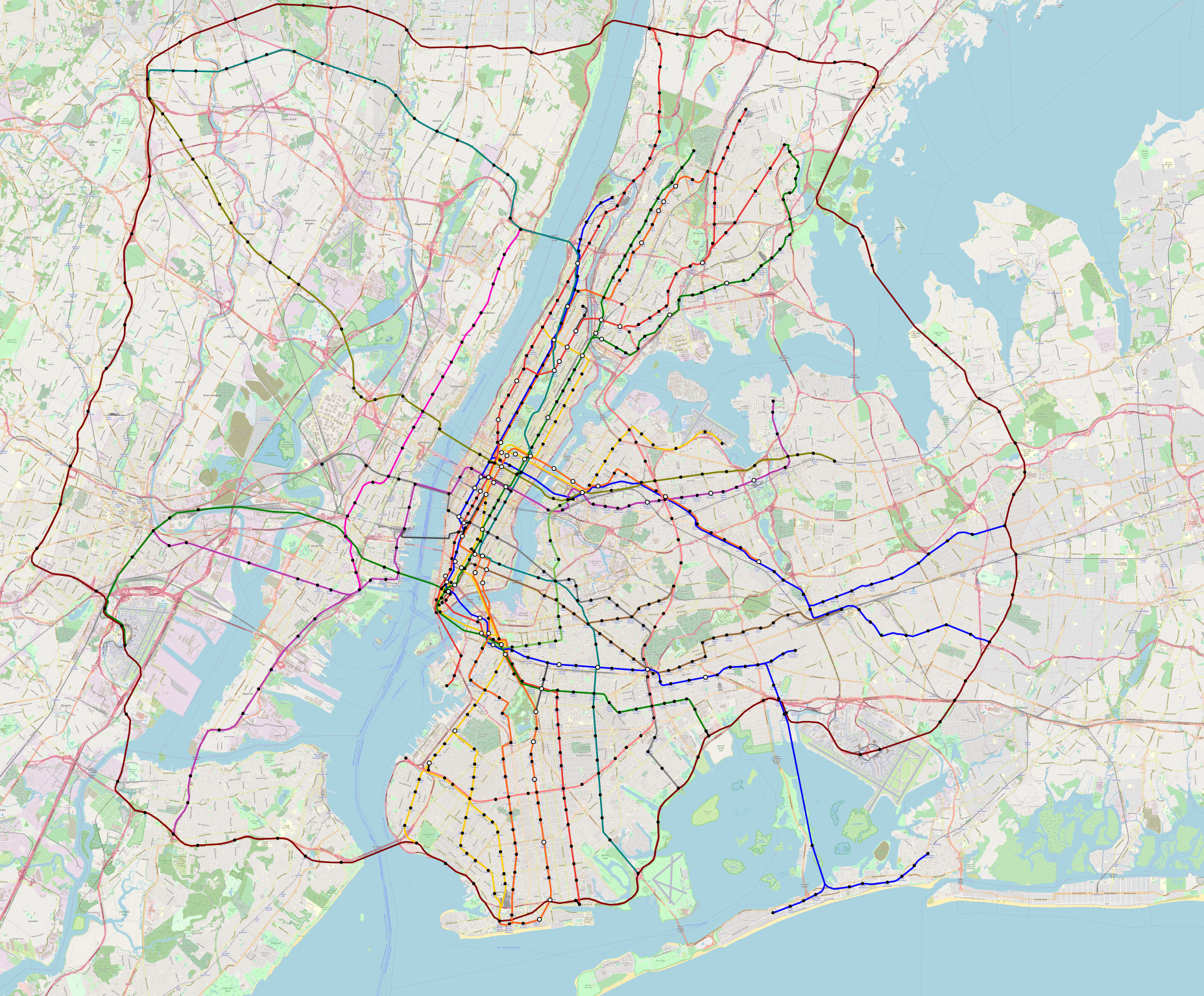
See full-size version here (warning: 55 MB).
Most of the radial extensions I’ve already discussed in previous posts – for example, here. Here these extensions go somewhat further in order to meet the ring, including at Newark Airport, on Staten Island, in Bay Ridge, at Floyd Bennett Park, in Canarsie, at Starrett City, near the Queens/Nassau County line, and in Yonkers.
The ring is 151 km, of which around 87 km would be above ground, mostly replacing highways like the Belt Parkway to reduce costs. Of note, this cannot be done adjacent to an extant highway – the fast car traffic deters nearby development, making transit-oriented development impossible. So key road links around the region have to go, which is fine, since people should be transitioning from driving to taking trains. With some additional elevated construction including through City Island, across the Long Island Sound, and in low-density parts of North Jersey where demolishing houses even at $1 million per unit is cheaper than tunneling, construction costs could be reduced further. But it’s still a $20-25 billion project at average world costs, maybe $15 billion at Nordic or Korean or Southern European or Turkish costs.
The only way to pay off the costs of such a line, not to mention to fill enough trains to support frequency that can take untimed transfers (at worst a train every 10 minutes), is to have very high ridership, on the order of 400,000-500,000 per day. This is for a line that misses Manhattan and all of the big secondary job centers, like Downtown Brooklyn and Long Island City. Is this plausible?
The answer is not an obvious no. Sufficiently aggressive TOD could plausibly create ridership. But it’s still questionable. There are really a few different forces pulling such a line in different directions:
- Using existing rights-of-way to reduce costs, hence the use of the Belt Parkway and not the denser development around Avenue U or even Flatlands.
- Serving secondary nodes like JFK, Coney Island, EWR, and Yonkers. Potentially it would be plausible to veer inward in New Jersey in order to hit Downtown Newark, at the cost of a few extra kilometers of tunnel, making the line radial from Newark’s perspective, whereas the line as depicted above is circumferential from Newark’s perspective since it goes around city center.
- The need to connect to radial subway and commuter rail lines, which means serving stations, opening plausible infill stations, and extending some lines toward the ring.
There are different ways to resolve this tension; the line I depicted is not the only one. For example, a higher-cost, higher-ridership version could veer inward in the Bronx and Queens, aiming to connect to Flushing and Jamaica and then replace the AirTrain JFK, leading to a ring of radius closer to 16 km than to 20-25.
I only bring this up to point out how many things have to work if you want such a ring to work out. Keeping costs to even semi-reasonable levels requires demolishing highways and engaging in aggressive TOD, which is only possible in an environment of total political victory over NIMBY and pro-car interests (note: these two are not the same!).
This is not the history of the Musashino Line. The Musashino Line originates in a freight bypass around the built-up area of Tokyo, which eventually turned into a circumferential passenger line. This is why it connects to the radial lines near but not at the busiest regional stations – at Nishi-Kokubunji and not Kokubunji, at Minami-Urawa and not Urawa, at Shin-Matsudo and not Matsudo or Kashiwa.
But even when the line is new, there are always compromises on right-of-way. Uncompromised right-of-ways are 100% possible, but not at 25 km radius, because the cost is too high to always go to the most important secondary centers. They happen when the radius is smaller, like Paris’s 8-10 km for M15, because then ridership can be high enough (M15 projects nearly a million riders a day). Farther away, ridership drops and costs rise because the line gets longer faster than per-km costs drop, so compromises are inevitable.
I am not proposing the ring above as a definitive crayon. I’m just mentioning it as something that highlights the difficulties of circumferential public transportation in the suburbs. Even as it is, the strongest segment of the ring is most likely the one in the city taking over the Belt Parkway, which could replace busy buses like the B15, B1, B3, B6, and B82. The suburban segments are weaker – there isn’t that much commuting across the Hudson that far north, and building up such commuting requires heavy commercial TOD in Yonkers, Mount Vernon, and New Rochelle.