How Deinterlining Can Improve New York City Transit

New York is unique among the major subways of the world in the extent of interlining its network has. All routes share tracks with other routes for part of the way, except the 1, 6, 7, and L. The advantage of this system is that it permits more one-seat rides. But the disadvantages are numerous, starting with the fact that delays on one line can propagate to nearly the entire system, and the fragile timetables lead to slower trains and lower capacity. New NYCT chief Andy Byford just released a plan calling for investment in capacity, called Fast Forward, focusing on accessibility and improved signaling, but also mentioning reducing interlining as a possibility to increase throughput.

I covered the interlining issue more generally in my article about reverse branching, but now I want to explain exactly what it means, having learned more about this issue in London as well as about the specifics of how it applies to New York. In short, New York needs to reduce the extent of reverse branching as much as possible to increase train speed and capacity, and can expect serious gains in maximum throughput if it does so. It should ultimately have a subway map looking something like this:

Lessons from London

In London, there is extensive interlining on the Underground, but less so than in New York. The subsurface lines form a complex interconnected system, which also shares tracks with one branch of the Piccadilly line, but the Northern, Central, Victoria, Jubilee, and Waterloo and City lines form closed systems (and the Bakerloo line shares tracks with one Overground line). The Northern line reverse-branches: it has two central trunks, one through Bank and one through Charing Cross; one southern segment, with through-trains to both trunks; and two northern branches, each sending half its trains to each trunk. The other closed systems have just one trunk each, and as a result are easier to schedule and have higher capacity.

As the Underground moves to install the same high-capacity signaling on more and more lines, we can see what the outer limit of throughput is on each system. The Northern line’s new moving-block signaling permits 26 trains per hour on the Bank trunk and 22 on the Charing Cross trunk. When the Battersea extension opens, reverse branching on the south will end, pairing the older line to Morden with Bank and the new extension with Charing Cross, and capacity will rise to 32 tph per trunk. Planned improvements to transfer capacity at Camden Town, the northern branch point, will enable TfL to permanently pair each northern branch with one central trunk, raising capacity to 36 tph per trunk. Moreover, TfL expects moving block signaling to raise District line capacity from 24 tph to 32, keeping the current reverse branching. The Victoria line already runs 36 tph and the Jubilee line soon will too, while the Central line runs 35 tph. So 36 vs. 32 seems like the difference coming from the final elimination of reverse branching, while more extensive reverse branching reduces capacity further.

The reason complex branching reduces capacity is that, as delays propagate, the schedule needs to incorporate a greater margin of error to recover from unexpected incidents. It also slows down the trains, since the trains are frequently held at merge points. The general rule is that anything that increases precision increases capacity (such as automation and moving block signaling) and anything that reduces precision reduces capacity; reverse branching reduces timetable precision, because each train can be delayed by incidents on more than one line, making delays more common.

What deinterlining in New York entails

NYCT has its work cut out for it when it comes to deinterlining. There are eight different points in the system where reverse-branching occurs – that is, where lines that do not share track in Manhattan (or on the G trunk outside Manhattan) share tracks elsewhere.

  1. The 2 and 5 trains share tracks on the Nostrand Avenue Line.
  2. The 2 and 5 also share tracks in the Bronx.
  3. The A and C trains share tracks on the two-track narrows through Lower Manhattan and Downtown Brooklyn.
  4. The A and D share the express tracks on Central Park West while the B and C share the local tracks.
  5. The E and F share the express tracks on Queens Boulevard, while the M and R share the local tracks, the E and M share the tunnel from Queens to Manhattan, and the N, R, and W share a different tunnel from Queens to Manhattan.
  6. The B and Q share tracks in Brooklyn, as do the D and N.
  7. The F and G share tracks in South Brooklyn.
  8. The M shares the Williamsburg Bridge tracks with the J/Z but runs in Manhattan on the same tracks as the F.

NYCT should work to eliminate all of the above reverse branches. The easiest to start with is #6: the junction at DeKalb Avenue should be set to keep the B and D trains together and to keep the N and Q together rather than to mix them so that the B shifts to the Q tracks and the D to the N tracks. This requires no changes in physical infrastructure, and has especially high benefits as the junction delays trains by several minutes in each direction. Moreover, the loss of one-seat rides is minimal: the BDFM and NQRW run closely parallel in Manhattan and intersect with a transfer at Herald Square in addition to the inconveniently long BQ/DNR transfer at Atlantic Avenue.

Another relatively easy reverse branch to eliminate is #8, a recent introduction from the 2010 service cuts. Previously, today’s M route in Queens and Manhattan was covered by the V train, which turned on the Lower East Side, while the M ran the same route as the J/Z, merging onto the R and thence the N in Brooklyn at rush hour. Today’s route is thus an M-V merger, which railfans including myself hoped would help decongest the L by creating an alternative route from Williamsburg to Midtown. Unfortunately, such decongestion has not happened, perhaps because gentrification in Williamsburg clusters near the L and not near the J or M.

Harsh decisions

Fixing the reverse-branching at DeKalb Avenue and on the Williamsburg Bridge is painless. The other reverse branches require a combination of hard decisions and new infrastructure.

Fixing reverse branches #3 and #4 requires no capital investment, just political will. Reverse branch #4 is there because there’s demand for two routes’ worth of capacity in the tunnel from Brooklyn but there’s only one express line on Eighth Avenue, and that in turn is the result of reverse branch #3; thus these two issues should be tackled together.

NYCT should decide between having the A and C trains run express between 145th and 59th Streets and the B and D trains run local, or the other way around. This is not an easy decision: either Washington Heights or Grand Concourse would get consigned to local trains. North of 145th the total number of boardings is 102,000 at B/D stations compared with 79,000 on the A/C, but conversely Concourse riders can change to the express 4 trains whereas Washington Heights’ only alternative is the local 1. However the A and C run, express or local, the E should run the opposite in Manhattan – it can merge to either the local or express tracks – and the express trains should continue to Brooklyn. The map I made doesn’t distinguish local from express service, but my suspicion is that Washington Heights should get express trains, on account of its long commutes and lack of fast alternatives.

The same problem of harshness occurs in reverse-branch #5. In theory, it’s an easy fix: there are three track pairs in Queens (Astoria, Queens Boulevard local, Queens Boulevard express) feeding three tunnels to Manhattan (63rd, 60th, and 53rd Streets). In practice, the three Manhattan trunks have astonishingly poor transfers between them in Midtown. Nonetheless, if it does nothing else, NYCT should remove the R from Queens Boulevard and route all 60th Street Tunnel trains to Astoria; together with fixing DeKalb Avenue, this would separate the lettered lines into two closed systems, inherited from the BMT and IND.

However, undoing the connection between the BMT and the IND probably requires constructing a transfer station in Long Island City between Queensboro Plaza and Queens Plaza, which involves a few hundred meters of underground walkway. Even then, the connection cannot possibly be convenient. The saving grace is that Eighth Avenue, Sixth Avenue, and Broadway are close enough to one another that passengers can walk to most destinations from any line.

Subsequently, NYCT should make a decision about whether to send express Queens Boulevard trains to 63rd Street and Sixth Avenue and local trains to 53rd and Eighth, as depicted in the above map, or the other way around. The problem is that the merge point between 53rd and 63rd Street Tunnels is one station east of Queens Plaza, at a local station, and thus the true transfer point is Roosevelt Avenue, far to the east. Riders on the local stations west of Roosevelt would get no choice where to go (though they get little choice today – both the E and M serve 53rd Street, not 63rd). The argument to do things as I depict them is to give the local stations access to 53rd Street; the argument to switch the lines is that there is more demand on 53rd than 63rd and also more demand on the express tracks than the local tracks, so the busiest lines should be paired. However, this in turn runs into turnback capacity limitations on the E in Manhattan, at the World Trade Center bumper tracks.

Potentially, NYCT could try to convert 36th Street into an express station, so that passengers could connect cross-platform. But such a dig would be costly and disruptive to operations. There were plans to do this at 59th Street on the 1/2/3 a few decades ago, for the transfer to the A/B/C/D, but nothing came of them.

Where new infrastructure is needed

The remaining reverse branches get increasingly more difficult. Already #7 requires new turnouts. The South Brooklyn trunk line has four tracks, but there’s not enough demand (or space in Manhattan) to fill them, so only the local tracks are used. There are occasional railfan calls for express service using the F, but it’s better to instead use the express tracks to segregate the G from the F. The G could be turned at Bergen Street on the local tracks, while the F could use the express tracks and then transition to the locals on new turnouts to be constructed at Carroll Street.

Also in the category of requiring new turnouts is #1: Rogers Avenue Junction is set up in a way that briefly forces the 2, 3, and 5 trains to share a short segment of track, limiting capacity. This can be resolved with new turnouts just east of the junction, pairing Nostrand Avenue Line with the local tracks and the West Side and the portion of the Eastern Parkway Line east of Nostrand with the express tracks and the Lexington Avenue Line. Trains on Eastern Parkway could either all go local, or keep the current mixture of local trains to New Lots (currently the 3) and express trains to Utica (currently the 4), skipping a total of two stations. This fix also reduces passengers’ access to one-seat rides, but at least there is a reasonable cross-platform transfer at Franklin Avenue, unlike on Queens Boulevard or at 145th Street and St. Nicholas.

And then there is #2, by far the most difficult fix. Demand on the White Plains Road branch in the Bronx is too strong to be a mere branch: the combined number of boardings at all stations is 166,000 per weekday, and besides, the line branches to Dyre Avenue near its outer end and thus needs the frequency of either a trunk or two branches to ensure adequate service to each other branch. This is why it gets both the 2 and 5 trains. There is unfortunately no infrastructure supporting a switch eliminating this track sharing: the 4 and 5 trains could both use this line, but then the 2 has no way of connecting to Jerome Avenue Line without new tunnels.

On the map, I propose the most obtrusive method of fixing this problem: cutting the 3 trains to a shuttle, with a new pocket track at 135th Street, letting passengers transfer to the 2, ideally cross-platform. With all through-trains running on the 2, there is no need (or space) for the 5 on White Plains Road, and instead the 5 should help boost the frequency on Jerome Avenue. In addition, some work is required at Woodlawn, which currently has bumper tracks, fine for a single branch but not for a non-branching trunk line (the bumper tracks on the L limit throughput to 26 tph no matter how good the electronics are).

Additional infrastructure suggested by deinterlining

Deinterlining is a service increase. Lines that today only get half or two-thirds service would get full trunk frequency: Second Avenue Subway would get the equivalent of the Q and N trains, the Astoria Line would get the entirety of 60th Street Tunnel’s capacity, Eighth Avenue would get more express trains, and 63rd Street Line and the South Brooklyn Line would get more than just the half-service of the F. With six track pairs on the lettered lines through Midtown and six north and east (Central Park West*2, Second Avenue, Astoria, Queens Boulevard*2), there is no room for natural branching to give more service to busy areas than to less busy ones.

One solution to this situation is targeted development on weak lines. Even with half service, South Brooklyn has underfull F trains, and Southern Brooklyn’s B, D, N, and Q trains aren’t much busier, making this entire area an attractive target for upzoning.

However, it’s more interesting to look at lines with extensions that suggest themselves. Second Avenue Subway has the obvious extension north to Harlem in phase 2, and a potential subsequent extension under 125th Street to Broadway, which is less obvious but popular among most area railfans (including one of my inside sources at NYCT). The Astoria Line has a natural extension to LaGuardia, ideally elevated over Ditmars to capture local ridership on Astoria as well as airport traffic; while the steel el structures in New York are soundboxes, it is possible to build quieter els using concrete (as on the 7 el over Queens Boulevard in Sunnyside) or a mixture of concrete columns and a steel structure (as on the Metro 2 and 6 els here in Paris).

The Nostrand Avenue Line provides an especially interesting example of a subway extension suggested by deinterlining. The terminal, Flatbush Avenue, was intended to be temporary, and as a result has limited turnback capacity. To prevent it from constraining the entire 2 route, which became the city’s most crowded even before Second Avenue Subway began decongesting the 4 and 5, it would be prudent to extend the line to Sheepshead Bay as the city intended when it planned the line in the 1910s.

In contrast, a subway extension under Utica, a stronger bus corridor than Nostrand with a strong outer anchor at Kings Plaza, loses value under deinterlining. It could only get a branch and thus have lower capacity than Nostrand. It would also definitely force branching on the express trains, whereas without such an extension they could run as a single unbranched line between Woodlawn and New Lots Avenue via Jerome Avenue, Lexington Avenue, and Eastern Parkway. A Utica subway should wait until there is political will to fund an entirely new crossing into Manhattan, presumably via Williamsburg to help decongest the L.

A second extension I have occasionally mooted, a subway under Northern, loses value even more. Such a subway would be a fourth trunk line in Queens and have to come at the expense of capacity on Queens Boulevard. It is only supportable if there is an entirely new tunnel to Midtown, passing under the mess that is the tracks in Long Island City.

A deinterlined New York City Subway

Fast Forward proposes moving block signaling on the most crowded subway segments, but typically only on trunks, not branches, and in some cases not even entire trunks. But in the long term, New York should transition to moving blocks and automation on all lines – at the very least the highly automated system used on the L, but ideally fully driverless operation, in recognition that wages are going up with economic growth but driver productivity isn’t. Simultaneously, deinterlined operations should allow tph counts in the mid 30s or even more (Metro 13 here runs 38 tph and Metro 14 runs 42).

Instead of the potpourri of lines offered today, there would be fewer, more intense lines. Nomenclature would presumably change to deal with the elimination of some services, clarifying the nature of the subway as a nine-line system in which five lines have four tracks and four lines have two. Each of these fourteen track pairs should be able to support a train every 90-105 seconds at the peak; not all lines have the demand for such frequency, and some have capacity-limiting bumper tracks that aren’t worth fixing (e.g. the 1 at Van Cortlandt Park), but many lines have the infrastructure and the demand for such capacity, including the express lines entering Midtown from Uptown or Queens.

Off-peak, too, service would improve. There is ample capacity outside rush hour, but turning the system into one of lines arriving every 4-5 minutes with strategic transfers rather than every 8-10 minutes would encourage people to take the trains more often. The trains would simultaneously be faster and more reliable, since incidents on one line would wreck service on other trains on the same line but leave the rest of the network unaffected.

With service improvements both during and outside rush hour, New York could expect to see substantial increases in ridership. Raising peak frequency from the current 24 tph to 36 tph on the busiest lines (today’s 2/3, 4/5, A/D, and E/F) is equivalent to building an entirely new four-track subway trunk line, and can be expected to produce similar benefits for passengers. The passups that have become all too familiar for riders on the 4, L, and other busy trains would become a thing of the past unless ridership rose 50% to match the increase in capacity.
Process for the Sake of Process

A Patreon poll in April asked about political blogging, offering three options: policy certainty in housing, process for the sake of process, and lawsuits and corruption of process. The second option won.

The year is about 2008. A wee grad student and former political blogger in New York is getting interested in transportation policy, and through past connections to political bloggers gets acquainted with a progressive local thinktank called Drum Major Institute, which advocates for all the right priorities of the center-left. One of these priorities is densification and urban growth. The relevant DMI fellow talks about the need to upzone in the city to permit smart growth. The wee grad student asks, why even have zoning at all? Why not let developers build to any density they’d like? The DMI fellow says that zoning is necessary in order to permit planners to have control over where development goes, and doesn’t explain what this control is useful for in the first place.

Fast forward to this decade. Cities install infrastructure for livable streets. Bikeshare revolutionizes cycling, first via the docked systems of Paris, Wuhan, and Hangzhou, and subsequently via the dockless systems developed in the largest Chinese cities. Simultaneously, all over the developed world cities reallocate space away from cars, whether it’s via bus lanes, bike lanes, wider sidewalks, or freeway removal. This trend has generally earned the support of people who support livable streets or are generally progressive. There may be individual pieces of criticism: for example, East Harlem railed against New York’s original decision not to extend bike lanes on First and Second Avenues to its community, and thankfully the city listened after a few years and did extend them. But these criticisms tend to be specific to one issue and constructive.

But then there are the NIMBYs, whose rallying cry is “they didn’t ask us.” In San Francisco, the Mission left-wing community activist group Calle 24 attacked the city for extending bikeshare to the Mission, on grounds that include gentrification but also the process line: “we weren’t consulted.”

There are many defenses of process that do justify its importance. I interviewed Aaron Ritz and Waffiyah Murray at Indego, Philadelphia’s publicly-run docked bikeshare system, which has somewhat better reach to low-income and black residents than systems like Chicago’s Divvy and Washington’s Capital Bikeshare. They gave me concrete examples of how Indego’s community outreach was helpful: it gave the planners tips on the best station siting (e.g. where the community centers are) as well as on different ways different socioeconomic groups use bikeshare (e.g. black Philadelphians are likelier to think of cycling as fun rather than transportation and thus prefer station locations near recreational trails).

But simultaneously there are defenses of process for its own sake. Zoning is the biggest example: the actually useful aspects of urban zoning are so few and far between, and so disconnected from current practice, that there is no coherent defense of the existence of zoning boards. The common arguments used by neighborhood groups (overdevelopment, infrastructure, gentrification, etc.) range from manifestly false to manifestly selfish (property values).

On various YIMBY message boards, there has been a discussion of an alternative zoning code to standard low-density zoning. People discussed form-based codes or transit-oriented development regimes like that of SB 827 in California, and as a first stab I proposed the following at Open New York:

1. Land is residential, commercial, or industrial. Industrial gets set by regional or statewide commission taking into account manufacturing jobs, prevailing winds, etc., and is distinguished in having looser pollution controls. Residential is allowed in commercial zones by right; doctors’ offices, lawyers’ offices, and other independent personal services are allowed in residential areas, as are hotels.

2. Retail is allowed in all commercial zones. Office is allowed in commercial zones that are specifically for office.

3. Commercial zones are allowed to encroach on adjacent residential land: residential land within a certain distance from majority-commercial uses gets automatically reclassified as commercial, and if the commercial uses are mostly offices then the land gets reclassified as office and not just retail.

4. Density is regulated based on distance from high-quality transit, which for the purposes of this discussion does not include buses that run every 15 minutes. The lowest category is not single-family and doesn’t have parking minimums, but allows around floor area ratio 1. The highest one has residential FAR 12, the maximum allowed by New York State, and is within very short distance from rapid transit (say, 500 meters intra muros, 200 extra muros). Everything within a kilometer of a train station is at least FAR 4.

I got “but what about ___?” responses re parking and what New York calls a sky exposure plane. This is a YIMBY group, and even there some people were uncomfortable that a proposed code was not exact enough so as to say exactly who is allowed to do what, instead going for the principle that what’s not forbidden is permitted. Even this attempt at a compromise didn’t win much support (what I actually believe is that if urban land is developable based on scientific understanding of environmental protection it should be developable for any purpose and at any density its owner sees fit).

Outside the YIMBY world, the pushback against such a loose code would be severe, because it would not offer local activists the control over their neighbors’ lives that they crave. San Francisco’s affordable housing community was against SB 827, partly because of misguided fears of gentrification, but also partly because the byzantine process in the city allows community groups to extort benefits by threatening to withhold project approval. In comments on my post about free trade in rolling stock, Adam points out that the California Environmental Quality Act was so weaponized by unions, who demanded that a new plant be unionized as a condition for dropping an environmental lawsuit. When corrupt local groups benefit from the ad hoc nature of the process, they will defend it for its own sake, regardless of whether it achieves its stated purpose (affordable housing, environmental protection, etc.).

But corruption alone can’t explain why outside groups like DMI think zoning is valuable for its own sake. My suspicion is that this is ideological: every regulation must have some purpose, so while revising regulations is fine, getting rid of them entirely reeks of free market libertarianism. Since the right attacks the civil service as bloated and parasitic, the left and center-left reflexively defend the civil service no matter what and, by extension, justify its mission. This pattern flips when it comes to the police, but that’s a narrow issue of criminal justice equality, not even affecting the fire department, which is socially similar to the police but gets no hate from the left. A regulator who decides who gets to build what and where does not have the reputation of a brutal cop or border control agent, and can expect sympathy for the left even if the zoning mission serves no useful purpose and creates problems for left-wing goals of affordable housing.

Which Older Lines Should Express Rail Have Transfers to?

In my writings about metro network design I’ve emphasized the importance of making sure every pair of intersecting lines have a transfer. Moreover, I’ve argued that missed connections often come from having very wide stop spacing, because large metro networks have very closely-spaced lines in the core, and if the stop spacing in the core is too wide, as in Moscow, then lines will frequently cross without transfers. In contrast, in Paris, where the Metro has very closely-spaced stops, there is only one missed connection on the Metro, between Lines 5 and 14. However, what’s missing from this discussion is what to do on lines that, due to network design, have to run express and miss some connections. This question mattered to most RER lines and currently matters to Crossrail and Crossrail 2, and will be critical in any New York regional rail plan.

I claim that the most important connections to prioritize should be to,

  1. The busiest lines.
  2. Lines that are orthogonal to the newly-built express lines.

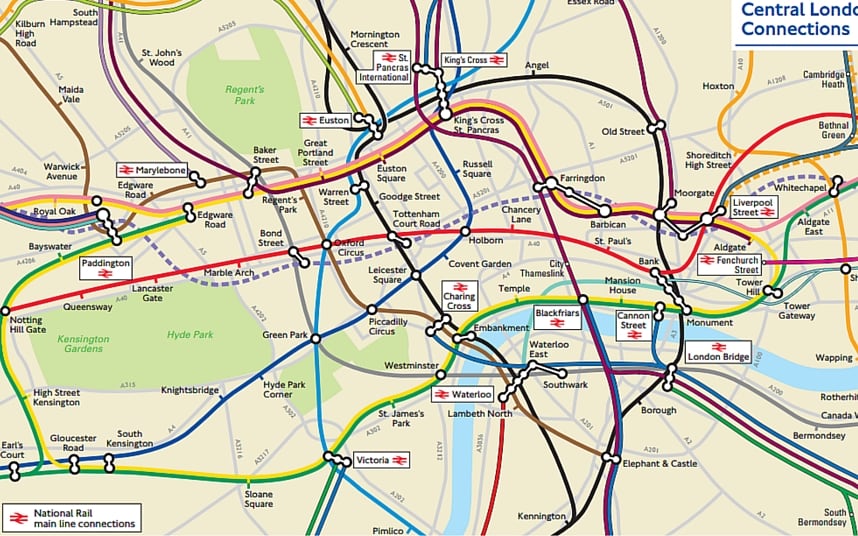
But before explaining this, I’d like to go over the scale of the underlying problem of prioritizing transfers. For a start, look at the Underground in Central London:

Crossrail is the dashed gray line. Between Paddington and Liverpool Street, it intersects seven north-south lines, including five in rapid succession on the West End; stopping at all of Bond Street, Oxford Circus, Tottenham Court Road, and Holborn would slow down too much what’s intended to be an express relief line to the Central line.

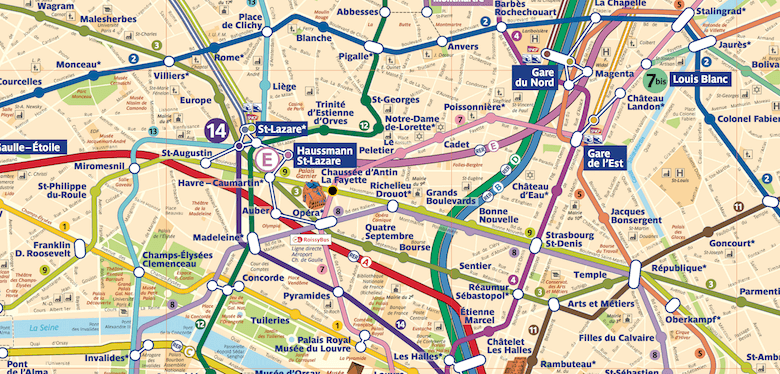
Stopping between two stations and having transfers to both is possible – look at Farringdon-Barbican and at Moorgate-Liverpool Street – but results in very long transfer times. The RER has opted for this solution at Auber, which is located between the Opera and Saint-Lazare, with a transfer stretching over three successive stations on Line 3, leading to legendarily labyrinthine transfers between the RER and the Metro:

Observe that in contrast with the RER A’s convoluted transfer at Auber, the RER B simply expresses between Chatelet-Les Halles and Gare du Nord, missing the connection to the east-west Lines 3, 8, and 9 and the north-south Line 7, and only connecting to the circumferential Line 2 via a long underground passageway. The reason for this is that a transfer station at Bonne Nouvelle or Sentier would be very expensive to construct; the RER’s stations were all extremely costly, and the RER A’s record of $750 million per km for the Nation-Auber segment remains unbroken outside the Anglosphere. On Crossrail (the recordholder in cost per km outside the US, soon to be overtaken by Crossrail 2), it’s the stations that drive up costs as well, and the same problem is even more acute in New York.

The tension is then between the network effects of including more transfer points, and the costs and slowdowns induced by stopping more often. The first point in my claim at the beginning of this post follows immediately: it’s more valuable to stop at transfer points to busier lines. The RER A misses Line 5 entirely, as does the express Line 14, because Line 5 is so weak that it’s not worth it to detour from Gare de Lyon through Bastille to connect to it; the oldest plans for the RER A had a stop at Bastille and not at Gare de Lyon, but under SNCF’s influence the system was redesigned to connect to the train stations better and thus Bastille was replaced.

Whereas the RER A in theory connects to every north-south one except the weakest (although the second strongest after Line 4, Line 13, has an even longer connection than at Chatelet), Crossrail does the opposite. The busiest station in London excluding mainline stations is Oxford Circus, thanks to the three-way transfer of the Bakerloo, Victoria, and Central lines; the Victoria line is the busiest in the system per km (although the longer Northern and Central lines have more riders), and it’s certainly the busiest north-south trunk line. However, plans to have a transfer to both Bond Street and Oxford Circus were rejected in favor of a connection to Bond Street alone. The reason is that London’s low-capacity passageways get congested, and TfL’s hamfisted solution is to omit critical transfers, a decision also made at the Battersea extension of the Northern line, which will miss a connection to the Victoria line at Vauxhall.

This brings me to the second transfer priority: it’s the most important to connect to orthogonal lines. The reason is that parallel lines, especially closely parallel lines, are less likely to generate transfers. New York’s four-track subway lines have very high volumes of local-express transfers, because those are easy cross-platform interchanges; as soon as any walking between platforms is required (for example, on the Lexington Avenue Line at 59th and 86th Streets), transfer volumes fall dramatically. In Paris, transfers between Line 1 and the RER A happen, but usually for longer-distance travel; I find it faster to take Line 1 from Nation to Chatelet than to take the RER A, even without any transfer, purely because it’s easier to get between the street and the Metro platforms at both ends.

This issue was never really in contention when Paris built the original RER system. The one place where the RER prioritized a transfer to a same-direction Metro line over an orthogonal one, Gare du Nord, is such an important destination for commuter and intercity trains that it’s obviously justified to prioritize it over an easier connection to Line 2. However, more recently, the RER E has seen this issue surface with the location of the infill Rosa Parks station. The RER E could have sited a station at the intersection with Line 5, but Line 5 goes northeast and serves much the same area as the RER E, so the network effects from an interchange would be weak. Instead, the station is sited to interchange with the circumferential T3 tramway, which opens up a connection toward Nation and eventually toward Porte d’Asnieres.

In London, the same question is critical to the central route of Crossrail 2. The current plan has three Central London stops: Victoria, Tottenham Court Road (with a transfer to Crossrail), and Euston-St. Pancras. But Victoria itself is not much of a destination, and of the two lines served, the District and the Victoria, the Victoria line is parallel to Crossrail 2 rather than orthogonal to it. The purpose of Crossrail 2 is to add north-south capacity through the West End to decongest the Victoria line and reduce the shuffle at Victoria station between mainline trains and the Underground; to this end, there’s no need to stop at Victoria station itself.

To this effect, Martha Dosztal proposes moving Crossrail 2 to Westminster or possibly Charing Cross. Instead of spending $2 billion on a station at Victoria, London would need to spend probably a comparable amount on a station that interchanges with lines that go northwest-southeast like Jubilee or Bakerloo rather than on the parallel Victoria line; moreover, Westminster and Charing Cross both have connections to the District line, so Crossrail 2 would still connect to all three east-west Underground lines.

Finally, the application to New York is the most delicate. New York’s scores of missed connections come from deliberate indifference on the IND’s part to transfers with the older lines rather than any systematic attempt at prioritizing important interchanges; the older IRT and BMT systems have between them just two missed connections (3/L in Brooklyn, 4-5/R-W in Lower Manhattan). But including better connections in the event the city builds more rail lines remains critical. Second Avenue Subway gets this right by having a cross-platform transfer to the east-west F; there’s no transfer to the north-south Lexington Line, but this is less important given Second Avenue’s role as a Lexington relief line.

Regional rail transfers are especially circumscribed in New York given the system’s nature as a few short tunnels: new tunnels across the Hudson, and ideally a connection between Penn Station and Grand Central. This is why there is little room for improving connectivity between the subway and what I call Lines 1-3 of New York regional rail. However, the priorities I’m advocating in this post suggest two important things about Penn Station: first, it’s important to reopen passageways to Sixth Avenue to allow connections to the NQRW and BDFM trains; and second, it’s not important to have a connection to the 7 at Hudson Yards, as IRUM proposes.

On more speculative lines involving longer tunnels, the same priorities point to my proposed stopping pattern in and around Lower Manhattan. What I call Line 4, a north-south line from Grand Central to Staten Island stopping at Union Square and Fulton Street would intersect the east-west subways: the 7 at Grand Central, the L at Union Square, and PATH and most Brooklyn-bound trains at Fulton Street. The only missed subways – the F/M at Houston Street and the N/Q at Canal – go mostly north-south (except the M, which has a same-platform transfer with the J/Z, connecting at Fulton). Likewise, what I call Line 5, connecting from Pavonia to Atlantic Terminal, would connect to most north-south subways at Fulton Street.

Ideally, it’s better to make every interchange, and subway builders around the world should aim for very long-term planning in order to prevent missed connections in the future. However, when the inevitable changes happen and missed connections are unavoidable, there are emergent rules for which are more important: busier lines are more important than less busy lines, and less obviously, lines that are orthogonal to the new line are more important than ones that are parallel. These priorities make it possible to build express lines that maximize regional connectivity with minimal loss of travel time due to making local stops.

Zoning and Commercialization

YIMBY is a movement that calls for liberalizing land use in order to produce more housing. However, its take on non-residential development is more complicated. I’d always assumed that San Francisco YIMBY was not calling for more commercial development because the Bay Area already builds a lot of office space because of California’s tax incentives, which let municipalities raise taxes on sales but not residential property; however, as a check on this hypothesis I asked YIMBYs in New York, but they too said that office upzoning wasn’t really a priority and only cited mixed projects to me. This approach is usually harmless, but in a few places it creates serious long-term problems, and one of them is the center of SF YIMBY, the South of Market (“SoMa”) area, and the reason is commercialization of near-CBD neighborhoods.

A few months ago I wrote about job sprawl in the US vs. in Europe. In Europe, hostility to high-rise office buildings in most historic city centers has caused jobs to spread to neighborhoods near the CBD, often in the direction of the favored quarter; in the US, CBDs have office towers, but everything right outside them is usually strictly zoned, so jobs sprawl to suburban office parks. Both situations have a number of exceptions (e.g. Kista and La Defense are both examples of high-rise edge cities independent of the CBDs, while Kendall Square and Back Bay are contiguous extensions of the Boston CBD), but for the most part they apply in their respective areas.

In the same way that on a wider scale building more housing in New York and San Francisco would reduce the demand for housing in the places to which these cities’ working and lower middle classes have been pushed out, building more office space in city centers would reduce the demand for suburban office parks. Permitting jobs to move back from suburban edge and edgeless cities to city centers is a good thing, both for urbanism and for transit: for urbanism, the CBD is accessible from all directions (which is why it’s so valuable to begin with), and for transit, congested CBDs tend to maintain decent transit mode shares even in otherwise completely auto-dominated cities.

The political problem is that this requires replacing residential development with commercial development. It’s questionable but possible in European zoning regimes. In the US it’s harder, for several reasons:

  • Near-CBD neighborhoods are as far as I can tell never middle or lower middle class. They’re either very poor (though by now they’ve all been urban-renewed) or rich. The greater extent of local empowerment in the US makes it harder to permit office development in rich areas over NIMBY objections.
  • American residential zoning is stricter than at least German residential zoning, and as far as I can tell is also stricter than French residential zoning, in that it permits no commercial uses at all, except ground-floor retail on main streets. In particular, doctors, lawyers, and accountants’ offices must go in designated commercial zones in the US.
  • American cities are more likely to have low-density neighborhoods in desirable near-downtown areas (for example, Georgetown) and defend their character fiercely through single-family zoning.

While all three factors seem important, the biggest examples of American near-CBD NIMBYism trigger only the first factor. In New York, the main example right now is the Meatpacking District, where there is extensive commercial demand (Google is located there and so do some other tech firms), which already has fairly high residential density, but the residents are rich homeowners who have successfully fought off attempts to build more office space. Historically, Midtown arose this way – rich areas around Fifth Avenue commercialized until the city’s 1916 zoning code put a stop to the practice.

And this brings me back to this post’s motivating example – SoMa. Located right next to the Financial District, with equally good access as the Financial District to the BART and Muni subway spine on Market Street, and better access to Caltrain’s 4th and King terminal, SoMa is a prime target for commercialization. Unfortunately, SF YIMBY opposes this process, saying the city’s zoning plan should add housing there and not office space. The argument is that permitting mostly office space in SoMa would create more demand for housing elsewhere in the Bay Area, exporting San Francisco’s high rents to Oakland and other East Bay cities. Unwittingly, SF YIMBY has turned into a NIMBY group when it comes to the highest and best use in the neighborhood in which it is the strongest.

To SF YIMBY’s credit, it recognizes the similarity between today’s tech workers (who form the vanguard of YIMBY) and last generation’s (who bought houses when they were cheaper than today and form one of several vanguards of area NIMBYism) and is pursuing preemption laws that reduce its own ability to object to growth. But, as preemption is not yet the law, SF YIMBY is opposed to commercialization in its own back yard.

The more specific argument SF YIMBY uses is about jobs-to-bedrooms ratio. Per YIMBY, zoning should have a maximum jobs-to-bedrooms ratio within a neighborhood or city, to prevent creating too much housing demand in other Bay Area cities. Right now, the Proposition 13 regime is such that municipalities derive tax revenues from commercial development but not so much residential development, and so they favor office space. But in reality, the only jobs-to-employed-residents ratio that’s sustainable this way is 1, a ratio that’s far too low for a city that has suburbs, let alone a central neighborhood such as SoMa. The consensus SF YIMBY proposes – an even balance between residential and commercial development everywhere, achieved through preference for housing in areas that are net recipients of inbound commuters – is thus untenable in a major metro area.

The proposed SF YIMBY consensus also does nothing to unseat the current consensus in favor of sprawl. Contrary to the narrative of selfish suburbs that add office space but no housing, the Silicon Valley suburbs are fiercely NIMBY toward high-density office development. Google could never hope to build a supertall skyscraper on top of Mountain View’s train station; it can’t even get permission to build a bridge to let the Googleplex expand to a nearby office park.

The selfish suburbs’ preference is not just office but also sprawl, and blocking commercial development in San Francisco increases sprawl in two distinct ways. First, the tech companies that would like to expand in SoMa – Uber, Slack, Airbnb, and so on – would, if not permitted to build more office space, open more back offices in sprawling areas, in or outside the Bay Area. And second, office development in the suburbs is only accessible to people from one wedge of the metro area, which encourages people to move to exurbs on the outer side, for example Gilroy for development in San Jose.

To counteract the tendency of hyperlocal planning to produce sprawl and replace the single-family housing consensus, the consensus YIMBY should seek is not about managing office-to-residential space ratios, but about letting places densify in whatever ways the market deems to have the highest and best use. In a high-demand place like San Francisco or New York, this means a consensus in favor of a bigger, faster-growing city, using its high productivity to add more people, offices, and apartments, rather than to increase the property values of the incumbents. Plan for long-term growth and long-term changes in zoning rules and don’t play the demand suppression game that NIMBYs love.

Little Things That Matter: Circulation at Transfer Stations

I’ve written before about some problems of metro network design in large cities. In brief, it’s important to maximize network effects in a multi-line system, which means offering plenty of transfers between lines. The perfect network should have every pair of lines intersecting in the center with a transfer, with possible additional intersections outside the center, again with transfers. In practice, it never works quite this way. There are always compromises, based on particular historical and geographical details of city layout. But probably the single biggest contributor to the issue is transfer capacity. This issue also has independent interest, but the two worst examples I know of involve the central transfer points of London and Paris, where many lines converge.

For a start, it’s worth asking why even have multiple stations. Why not just build a perfect star-shaped system? Two-line subway networks usually just cross once in city center. Three-line networks can intersect at one point (as in Stockholm and the first three lines of Moscow), but more commonly they intersect in a triangle of three city center stations. Central transfer points go way beyond three lines, though: Otemachi has five subway lines; Tokyo Station has a subway line and six independent JR East commuter lines; Chatelet-Les Halles has five Metro lines and two and a half RER lines; Bank and Monument together have four Underground lines and the Docklands Light Railway; Times Square has five subway lines, three of which are four-track. Why not just add more lines to the same central station? There are three distinct answers.

Coverage

Transit networks aren’t just about connecting large neighborhoods (“Upper West Side”) to a nebulously defined city center. They’re about specific connections. City centers are larger than a single subway stop, and much larger than a single subway stop in any city that has any business building four or more subway lines. In Stockholm, where three lines is about right, the CBD extends about two stops heading north and east of T-Centralen. New York, Paris, Tokyo, and London all have CBDs several square kilometers in area, so it makes sense to route lines in such a way that it’s easy to reach many points within the CBD from all directions.

Concretely, take Times Square and Grand Central. It’s useful to serve both of them on multiple subway lines, but a north-south line can only serve one. Thus, the 4/5/6 serve Grand Central, and the A/C/E, 1/2/3, and N/Q/R/W serve Times Square. The same process repeats itself at a number of nodes within Midtown, and within CBDs of other large cities.

Construction difficulties

Independently of the value of having extensive service in multiple directions from multiple points in the CBD, there is the cost of bringing lines together. In large cities, the biggest source of missed connections to begin with is that the street available for line 6 may happen to pass right between two widely-spaced stops on line 1, which never had a stop at this street because line 6 was not in the planning stages yet.

For the same reason, urban street networks make it difficult to serve one point from more than a few directions. Even lines bored deep under the surface, without regard for the street network, would find it difficult to go on level -9, beneath eight older lines. The stations with the largest number of independent lines all have tricks to make this work. Times Square has three north-south subways that don’t physically intersect (the 1/2/3 is always to the west of the N/Q/R/W and the A/C/E well to the west of both), a stub-ending east-west subway (the shuttle), and one deep-bored east-west subway (the 7). At Tokyo Station four of the six commuter lines are elevated at the same level. At Otemachi the lines form a square, with one side consisting of two lines that were built together at the same time. Chatelet-Les Halles has platforms that do not intersect, and the most difficult retrofit, the addition of the RER, was a massive excavation project that cost billions of euros.

The same construction difficulties are also relevant to small transfer stations. In Paris, transfer stations try to avoid superimposing one line’s platforms on top of the other, just because it’s hard to build. As a result, transfers often involve long walks; transfers at Chatelet are particularly labyrinthine.

Transfer capacity

The biggest problem is not coverage, and only partly related to construction difficulties. At the busiest stations, pedestrian circulation between platforms can be a challenge. London Reconnections has a fourpart series about Bank, where three deep-level Underground lines meet, all having built in the late 1890s, when expected ridership was far lower than it is today. Circulation is so obstructed that at rush hour TfL occasionally has to close the station for safety reasons, or else passengers would fall onto the tracks. Retrofitting the station with additional connections between lines as well as from the platforms to the street has been a daunting task, since the most logical places for escalators to one line would often pass through the platforms of another.

At Chatelet-Les Halles, the same problem occurs, if not so acutely that trains need to skip the station at rush hour. The passageways between the Metro platforms and between the Metro and the RER are long and narrow, and barely adequate to handle the large volume of passengers.

The simplest way to prevent this problem from occurring at a particular station is to make sure to design enough room for the transfer. The simplest way to do that, in turn, is to ensure transfers are cross-platform. The RER has such cross-platform transfers at the station, pairing westbound RER A trains with northbound RER B trains and eastbound RER A trains with southbound RER B trains. But even the wrong-way RER A-B transfers and the transfers involving the RER D are fine: the station’s extreme cost paid for a full-length, full-width mezzanine. The London Underground, too, retrofitted these onto some older lines when it built the Victoria line, which has cross-platform transfers at such key stations as Oxford Circus (the busiest in London not counting mainline stations – Bank is only the second busiest) and Euston.

However, cross-platform transfers connect two lines. I know of one place where they connect three: Jamaica Station, where one track in each direction has platforms on both sides, and passengers on the trains on the opposite sides of these platforms are sometimes told to walk through the train to transfer. This is a unique feature of regional rail, with its timed connections; subways with a train every 2-3 minutes can’t realistically time the connections, and without timing the connections, passengers are better off walking up and down to the other platform than waiting for a train to come in for a purely horizontal transfer.

The need for coordinated planning

The ultimate problem with using more cross-platform transfers if that they require a great deal of foresight. Retrofitting them is not always possible, and costs money in modification of existing stations. Hong Kong, Singapore, and Taipei all use these transfers extensively, but only on lines that were planned together, such as the first two lines in Singapore; Singapore’s newer lines have long (though spacious) transfer corridors, and Hong Kong’s lines inherited from the original MTR and from mainline rail have poor transfers.

With relatively limited opportunities to have high-capacity, high-quality transfers, it’s no wonder that most cities that build rapid transit try to avoid four- and five-way transfers when possible. Complex transfers like this can arise by accident, over several layers of planning – in the case of Paris, Line 11 was planned and built a generation later than Lines 1, 4, and 7; the RER was built a generation later than Line 1; and Line 14 was built a generation later than the RER, and indeed was designed as a relief line to the RER A.

Ultimately, the best way to prevent a situation like Chatelet or Bank from occurring is to know in advance where every line will go. However, this is necessarily a hard task. In the 1890s, London was a city of 6 million, with a large number of poor people living in overcrowded condition in East and South London; a planner could guess how the city would grow and suburbanize in the 20th century but would not be able to predict this with any certainty. Paris, the capital of a then-poorer and far less industrialized country, has grown even more tremendously – in 1901 Ile-de-France had 4.7 million people, not all living in the built-up area of the capital.

In very large third-world cities, the task of predicting future growth is somewhat easier, but only because they’re already very large and have informal transit pointing the way to the major corridors. I can draw a semi-serious Lagos metro proposal based on the city’s urban layout today and expect much of its future growth to come from increasing building heights so that the same density can be accommodated with less overcrowding, but I can’t meaningfully say which future areas will become hotspots that must be served from all directions or how far the suburban sprawl will go.

Why Free Trade in Rolling Stock is Good

Classical economics asserts that if two countries freely trade, then both gain relative to a baseline in which they don’t trade. The classical theory of comparative advantage hinges on reciprocal free trade. But more recently, economists have begun to push for entirely domestic support for free trade, arguing that reducing trade barriers is good even without reciprocation. The arguments involve corruption and misallocation of capital coming from protectionism. Whatever criticism there may be of this neoliberal conception of trade, rolling stock appears to be an example in which this conception is right.

I have previously criticized informal French protectionism in high-prestige procurement for blowing up Parisian rolling stock costs by a factor of almost 2. In Paris, my example of what could be done with the money Ile-de-France Mobilités is wasting on rolling stock was infrastructure construction, justified by the city’s very low construction costs relative to ridership (if not relative to route-length). But there’s an even better set of examples of high costs in the United States, justified on labor grounds and yet involving wastes of money disproportionate to the number of jobs created.

Last month, The American Prospect published an article about a union push to have more US rolling stock made in America, by unionized workers. The TAP article talks about a light rail vehicle order in Los Angeles for $890 million, for what the article says is 175 cars and what manufacturer Kinki Sharyo and other industry sources say is 235 cars, built at a dedicated factory in the Los Angeles exurbs. The purpose of the article is to advocate for more protectionism for the sake of American union members, so it details the wages the workers are making (about $20 an hour, up from $11 for unskilled jobs elsewhere) but does not delve into comparative costs. It’s worth asking if the costs are competitive, and the answer is that they are not.

The cost of LACMTA’s Kinki Sharyo order is $3.8 million per car; these cars are 27 meters long, so this translates to $140,000 per meter of train length. In contrast, the average cost in Europe appears to be just under $100,000 per meter, across a variety of cities and models:

The shortest trains on this list (the Citadis Compact orders, at 22-24 meters) are in the middle of the pack, so it’s unlikely there’s any nonlinearity in cost; moreover, the Compact is slightly shorter than the Kinki Sharyo trains, so no extrapolation is required, only interpolation.

The LACMTA order follows another premium-priced light rail order in the same state: as I wrote in the Bay City Beacon last year, Muni Metro’s Siemens LRV order cost about $4 million per 23-meter car, about $170,000 per meter of train length. The trains are being built at a new plant in Sacramento.

The United States has federal Buy America laws, requiring federally-funded contracts to buy domestic products provided they cost no more than 25% more than equivalent imports. However, there is no in-state purchase requirement. Owing to large New York City Subway orders, some vendors have long-established plants near New York (Kawasaki and Alstom are in-state, Bombardier is in Vermont). However, under informal pressure from activists within California to provide good local jobs, LACMTA asked bidders to open local factories. Moreover, Siemens most likely placed its plant in Sacramento rather than in lower-cost states in order to curry favor with state-funded orders.

We even see the same problem in Massachusetts, where CRRC opened a plant in Springfield for an MBTA Red and Orange Line car order. The order itself does not come at a premium – according to Metro Report the base order is about $100,000 per meter of train length and the option is $115,000, and the range of per-meter costs for subway trains is the same as that for LRVs – but it’s possibly a loss leader to help establish CRRC as a player in the American market. Even before Trump’s election, Congress investigated the order, which beat the competitors by a large margin; the competing bids were about $135,000 per meter for the base order. It says a lot about Massachusetts’ broken procurement that it takes a loss leader just to get costs down to their international levels. Nonetheless, the US premium does appear to be smaller for large subway orders than for small and medium-size LRV orders, since the extra costs of siting and setting up a factory are spread across more units.

The explicit goal of local content requirements is to create jobs. This is usually justified in terms of inequality and bleak prospects for unskilled workers. However, there is no cost-benefit calculation involved in this. According to TAP, the LACMTA order is creating 250 jobs manufacturing the trains; it doesn’t say how long they will last, but the duration of the contract is about 6 years. But the premium, about $300 million, works out to $1.2 million per job, a large multiple of total compensation to the workers. The Springfield plant has 200 jobs paying $50,000-60,000 per year, lasting 7 years across more than just the Boston contract; pro-rating to the Boston contract’s share of orders from the plant, the jobs will last around 5 years. Adding back the premium charged by the competing vendors raises the cost to $1 million per job, again a multiple of total working-class compensation.

There are two reasons why labor protectionism costs so much compared with its direct impact on working-class hiring. The first is leakage: much of the premium goes to management, including factory design and construction, or is just wasted on inefficiency (CRRC is opening a second American plant, in Chicago, instead of building everything at one plant). Some of the money goes to foreign consultants with the vendor and some stays domestic, but the domestic leakage goes to sitework and not to direct hiring.

The second reason is corruption and degradation of institutions. When the goal of public procurement is not just to buy the best product in terms of cost and quality, lobbyists make demands, like local hiring, that corrupt the process. A city that signals that the only things that matter are cost and quality will attract vendors who make the best bids in terms of cost and quality; a city that signals that the process depends on local political needs will attract vendors who make bids in order to satisfy local political actors, who as a rule don’t give a damn about good transit. Thus American agencies buy trains at a premium well beyond Buy America’s 25% limit, just because they think of cost and quality as just two of several political priorities and not as the sole legitimate bases of choosing a bidder.

The United States leads the world in higher education costs. The unsubsidized cost of a college degree at a good public university is about $100,000; at CUNY, which provides a good quality of degrees even if it’s so underfunded that classrooms aren’t supplied with chalk, it’s about $75,000. Stipends at the level of a good graduate program add another $30,000 or so per year. For around $200,000 per person, California could send low-income workers to college and pay for their living expenses for the duration of the degree, whereupon they will be able to get unsubsidized jobs paying much more than $20 per hour. For workers who can’t go to college, trade school is another option, offering decently-paying jobs for much lower cost since they take much less time. There is no need to lade the transit capital budget with what should be state or federal retraining grants; given the massive difference in cost, even the loss of matching funds (i.e. other people’s money) can leave the state or the city better off.

The problem is that there is no political incentive to think in such terms. Part of it is the corruption of institutions, as I mentioned already: labor groups see an opportunity to create jobs from a budget that from a local perspective is other people’s money. Another part is political prestige: romantics like old jobs (farmer, builder, truck driver, coal miner, baker, factory worker), which have had enough time to percolate into the national psyche, and since these jobs are old, they’re likely to be at the low end of the value-added ladder.

Absent very strong rules forbidding protectionism in procurement, this corruption will continue: evidently, Paris insists on buying expensive bespoke trains and somehow manages to get them manufactured within France, even though EU rules against interstate dumping are much stronger than US rules. Rules at the highest level are required to discourage such behavior (although Paris might still waste money on bespoke trains, just ones that can be made in Poland). Congress can and should stop funding any local or state agency that takes in-state content into account in procurement; the US is one democratic country, not fifty mercantile fiefdoms, and should use its status as a superstate with a large internal market to universalize good governance.

Construction Costs: Electrification

Continuing from last week’s post about signaling costs, here is what I’ve found about electrification costs.

Like signaling, electrification usually doesn’t make the industry press, and therefore there are fewer examples than I’d like. Moreover, the examples with concrete costs are all in countries where infrastructure costs are high: the US, Canada, the UK, Israel, New Zealand. However, a check using general reported French costs (as opposed to a specific project) suggests there is no premium in Israel and New Zealand over France, even though both countries’ urban rail tunneling projects are more expensive than Parisian Metro and RER extensions.

In the UK, the recent electrification project has stalled due to extreme cost overruns. Finding exact cost figures by segment is difficult in most of the country, but there are specific figures in the Great Western. Financial Times reports the cost of the Great Western project at £2.8 billion, covering 258 km of intercity mainline (mostly double-track, some four-track) and what I believe to be 141 km of commuter rail lines in South Wales, working from Wikipedia’s graphic and subtracting the canceled electrification to Swansea. In PPP dollars it’s around $10 million per km, but the cost may include items I exclude elsewhere in this post, such as rolling stock. For reference, in the late 2000s the project was estimated at £640 million, but costs then tripled, as the plan to automate wire installation turned out not to work. Taking the headline cost as that of the last link, £1.74 billion, the cost is $6.1 million per km, but there have been further overruns since (i.e. the Swansea cancellation).

In the US, there are three projects that I have numbers for. The most expensive of the three is Caltrain electrification, an 80 km project whose headline cost is $1.9 billion. But this includes rolling stock and signaling, and in particular, the CBOSS signaling system has wasted hundreds of millions of dollars. Electrification infrastructure alone is $697 million, or $8.5 million per km. The explanations I’ve read for this high figure include indifference to best practices (e.g. electrification masts are spaced 50 meters apart where 80 meters is more common) and generally poor contracting in the Bay Area.

The other two US projects are more remote, in two different ways. One is California High-Speed Rail: with the latest cost overrun, the projected electrification cost is $3.7 billion (table 4, PDF-p. 14). The length of route to be electrified is unclear: Phase 1, Los Angeles to San Francisco with a short branch up to Merced, is a little more than 700 km, but 80 km of that route is Caltrain, to which the high-speed rail fund is only contributing a partial amount. If the denominator is 700 km then the cost is $5.3 million per km.

The other remote US project is Amtrak’s electrification of the New Haven-Boston segment of the Northeast Corridor in the late 1990s. Back then, the 250-km double-track route was electrified for $600 million, which is $2.4 million per km, or about $3.5 million per km adjusted for inflation.

In Canada, Toronto is in the process of electrifying most of its regional rail network. The current project includes 262 route-km and has a headline cost of $13.5 billion, but according to rail consultant Michael Schabas, this includes new track, extensive junction modification, unnecessary noise walls (totaling $1 billion), and nearly 100% in contingency just because on the original budget the benefit-cost ratio seemed too good to be true. In a 2013 study, the infrastructure cost of full electrification was estimated at $2.37 billion for 450 route-km in 2010 Canadian dollars. In today’s American dollars it’s about $4.5 million per km.

In France, a report that I can no longer find stated that a kilometer of electrification cost a million euros, in the context of the electrification of a single-track legacy branch to Sables d’Olonne, used by some TGV services. While trying to find this report, I saw two different articles claiming the cost of electrification in France to be a million euros per double-track kilometer. The latter article is from 2006, so the cost in today’s money is a little higher, perhaps as high as $1.5 million per km; the article specifically says the cost includes bridge modification to permit sufficient clearances for catenary.

In Israel, the majority of the national network is currently being electrified, and I’ve argued elsewhere for a completist approach owing to the country’s small size, high density, and lack of rail connections with its neighbors. The project has been delayed due to litigation and possibly poor contractor selection, but a recent article on the subject mentions no cost overrun from the original budget of 3 billion shekels, about $750 million, for 600 km of double-track. This is $1.25 million per km and includes not just wire and substations but also 23 years’ worth of maintenance. This may be similar to the Danish ETCS project, which has been severely delayed but is actually coming in slightly under budget.

In New Zealand, the one electrification project recently undertaken, that of the Auckland regional rail network, cost $80 million in infrastructure. This is New Zealand dollars, so in US terms this is closer to $55 million. The total length of the network is about 80 route-km and 200 track-km, making the cost about $700,000 per km. But the project includes much more than wire: the maintenance facility, included in the Israeli figure, cost another NZ $100 million, and it is unclear whether bridge modifications were in the infrastructure contract or tendered separately.

The big takeaway from this dataset, taking French costs as the average (which they are when it comes to infrastructure), is that Israel and New Zealand, both small countries that use extensive foreign expertise, do not pay a premium, unlike the US, UK, and Canada. In the UK, there is a straightforward explanation: Network Rail attempted to automate the process to cut costs, and the automation failed, creating problems that blew up the budget. Premature automation is a general problem in industry: analysts have blamed it for Tesla’s production problems.

In the US and Canada, the construction cost problem is generally severe. However, it’s important to note that at NZ$2.8-3.4 billion for 3.4 km of tunnel, Auckland’s tunneling cost, around US$600 million per km, isn’t much lower than Toronto’s and is actually slightly higher than the Bay Area’s. My explanation for high costs in Israel, India, Bangladesh, Australia, Canada, New Zealand, Singapore, and Hong Kong used to be their shared English common law heritage, but this is contradicted by the lack of any British premium over French costs in the middle of the 20th century. An alternative explanation, also covering some high-cost civil law third-world countries like Indonesia and Egypt, is that these countries all prefer outside consultants to developing public-sector expertise, which in the richer countries is ideologically associated with big government and in the poorer ones doesn’t exist due to problems with corruption. (China and Latin America are corrupt as well, but their heritages of inward-looking development did create local expertise; after the Sino-Soviet split, China had to figure out how to build subways on its own.)

But Israel Railways clearly has no domestic expertise in electrification. The political system is so unused to this technology that earlier this decade I saw activists on the center-left express NIMBY opposition to catenary, citing bogus concerns over radiation, a line of attack I have never seen in California, let alone the Northeastern US. Nor is Israel Railways good at contracting: the constant delays, attributed to poor contractor choice, testify to that. The political hierarchy supports rail electrification as a form of modernization, but Transport Minister Israel Katz is generally hostile to public transit and runs for office with a poster of his face against a background of a freeway interchange.

What’s more likely in my view is that Israel and New Zealand, with no and very little preexisting electrification respectively, invited experts to design a system from scratch based on best industry practices. I’m unfamiliar with the culture of New Zealand, but Israel has extensive cultural cringe with respect to what Israelis call מדינה מתוקנת (“medina metukenet”), an unbroken country. The unbroken country is a pan-first-world mishmash of American, European, and sometimes even East Asian practices. Since the weakness of American rail is well-known to Israelis, Israel has just imported European technology, which in this case appears easy to install, without the more particular sensitivities of urban tunneling (the concrete side of the electronics before concrete maxim). In contrast, the US is solipsistic, insisting on using domestic ideas (designed by consultants, not civil servants). Canada, as far as I can tell, is as solipsistic as the US: its world extends to Canada and the US; Schabas himself had to introduce British ideas of frequent regional rail service to a bureaucracy that assumed regional rail must be run according to North American peak-only practices.

All of this is speculation based on a small number of cases, so caveat emptor. But it’s fairly consistent with infrastructure construction costs, so long as one remembers that the scope for local variation is smaller in electrification and systems than in civil infrastructure (for one, the scope for overbuilding is much more limited). It suggests that North America could reduce its electrification costs dramatically by expanding its worldview to incorporate the same European (or Asian) companies that build its trains and use European (or Asian) standards.

Construction Costs: Signaling

I launched a Patreon poll about construction cost posts, offering three options: signaling and electrification, rolling stock, and historical costs. Signaling and electrification won with 29 votes to historical costs’ 20 and rolling stock’s 6. This post covers signaling, and a subsequent post will cover electrification.

I was hoping to have a good database of the cost of installing train protection systems. Instead, I only have a few observations. Most metro lines in the world have searchable construction costs given a few minutes on Google, and a fair number of rolling stock orders are reported alongside their costs on Railway Gazette and other trade publications. In contrast, recent numbers for signaling are hard to get.

The gold standard for mainline rail signaling is European Train Control System, or ETCS; together with a specified GSM communications frequency it forms the European Rail Traffic Management System, or ERTMS. It’s a system designed to replace incompatible national standards that are often nearing the end of their lives (e.g. Germany expects that every person qualified to maintain its legacy LZB system will retire by 2026). It’s of especial interest to high-speed lines, since they are new and must be signaled from scratch based on the highest available standard, and to freight lines, since freight rail competes best over long distances, crossing national borders within Europe. Incompatible standards between countries are one reason why Europe’s freight rail mode share is weaker than that of the US, China, or Russia (which is Eurasian rather than European when it comes to freight rail).

As with every complex IT project, installation has fallen behind expectations. The case of Denmark is instructive. In 2008, Denmark announced that it would install ETCS Level 2 on its entire 2,667-km network by 2020, at the cost of €3.2 billion, or about $1.5 million per route-km. This was because, unlike both of its neighbors, Denmark has a weak legacy rail network outside of the Copenhagen S-tog, with little electrification and less advanced preexisting signaling than LZB. Unfortunately, the project has been plagued with delays, and the most recent timetable calls for completion by 2030. The state has had to additionally subsidize equipping locomotives with ETCS, but the cost is so far low, around $100,000 per locomotive or a little more.

That said, costs in Denmark seem steady, if anything slightly lower than budgeted, thanks to a cheap bid in 2011-2. The reason given for the delay is that Banedanmark changed its priorities and is now focusing on electrification. But contracts for equipping the tracks for ETCS are being let, and the cost per kilometer is about €400,000, or $500,000. The higher cost quoted above, $1.5 million per km, includes some fixed development costs and rolling stock costs.

Outside Denmark, ETCS Level 2 installation continues, but not at a nationwide scale, even in small countries. In 2010, SNCB rejected the idea of near-term nationwide installation, saying that the cost would be prohibitive: €4.68 billion for a network of 3,607 km, about $1.6 million per route-km. This cost would have covered not just signaling the tracks but also modifying interlockings; it’s not purely electronics but also concrete.

The Netherlands is planning extensive installation as well. As per Annex V of an EU audit from last year (PDF-pp. 58-59), the projected cost is around $2 million per route-km; the same document also endorses Denmark’s original budget, minus a small reduction as detailed above due to unexpectedly favorable bids. Locomotive costs are said to be not about $100,000 but €300,000 for new trainsets or €500,000 for retrofitting older trainsets.

A cheaper version, ETCS Level 1, is also available. I do not know its cost. Switzerland is about to complete the process of a nationwide installation. It permits a trainset equipped with just ETCS equipment and no other signaling to use the tracks, improving interoperability. However, it is an overlay on preexisting systems, so it is only a good fit in places with good preexisting signaling. This includes Switzerland, Germany, and France, but not Denmark or other countries with weak legacy rail networks, including the US. The Northeast Corridor’s ACSES system is similar to ETCS Level 1, but it’s an overlay on top of a cab signaling system installed by the Pennsylvania Railroad in the 1930s.

Comparing this with American costs is difficult. American positive train control, or PTC, uses lower-capacity overlay signaling, nothing like ETCS Level 2. One article claims that the cost per track-km (not route-km) on US commuter rail is about $260,000. On the MBTA, the projected cost is $517 million for 641 km, or $800,000 per route-km; on the LIRR it’s $1 billion for 513 route-km, or $1.9 million per route-km. Observe that the LIRR is spending about as much on a legacy tweak as Denmark and the Netherlands are on a high-capacity system built from scratch.

Consumption Theory and Gentrification

I recently saw an article about location decisions by education in the Netherlands. The article discusses the impact of rail investment on different social classes, and claims that,

A recent study by Teulings et al. (2018) uses microdata to quantify the differences in the willingness to pay for particular locations between the high and low educated (omitting the medium education level) (Figure 2). It shows willingness to pay for the job availability (based on the locally available transport infrastructure to commute to these jobs) and urban amenities such as parks and historic scenery at the location. The highly educated (right panel) are very sensitive to the quality of a location.

The claim is that educated people prefer central cities, in this case Amsterdam, because of their consumption amenities. This is the consumption theory of gentrification, which holds that the process of gentrification is caused by a middle-class taste for urban amenities. However, this theory appears incorrect, on several levels. The references cited in the paper for location decisions do not really bear out consumption theory. Moreover, the history of gentrification strongly suggests that, if consumption amenities are at all involved, then they have been stable for at least a hundred years.

Instead of consumption theory, the best explanation is that location decisions are about jobs. Certain cities have higher production amenities, especially for the middle class, leading the middle class to preferentially move to them to obtain higher-income jobs. The choice of neighborhood is then driven by access to skilled jobs, usually in the CBD but sometimes also in new job clusters. If there’s gentrification, the cause is insufficient housing in closer-in areas, leading to spillover to adjacent neighborhoods.

The references

The internal reference cited for it in the paper, the work of Coen Teulings, Ioulia Ossokina, and Henri de Groot, breaks down willingness to pay higher rents in expensive cities (i.e. Amsterdam) based on job access and several consumption amenities. The paper’s headline numbers superficially bear out consumption theory: table 7 on page 23 says that job availability is only responsible for 38% of low-education people’s variance in willingness to live in expensive cities and 28% of high-education people’s variance; the rest comes from amenities. However, a closer reading suggests that this is not really about consumption amenities.

First, that 28% of middle-class location choice comes from job access does not mean 72% comes from amenities. Observed consumption amenities are only 18% (and only 14% for low-education workers); the rest is unobserved amenities (30%), which are a residual rather than any identified amenities, and covariances between jobs and amenities.

Moreover, the consumption amenities listed are proximity to restaurants, monuments, parks, and a university. Is a university really a consumption amenity for the middle class? This is unlikely. Graduates don’t really have the same consumption basket as students. Instead, what’s more likely is that universities provide skilled employment for a particular set of high-education workers (namely, academics and other researchers), who are willing to pay extra to be near work; academic job markets are so specialized that access to non-academic high-education work isn’t as important. Of course, universities also have extensive working-class employment, but a university janitor can get a similar job at a non-academic environment, and therefore has no reason to locate specifically near a university rather than another source of work, such as a hospital or office building.

Finally, there is a second reference in the article, reinforcing its claims about location decisions with American data. This is a paper by David Albouy, Gabriel Ehrlich, and Yingyi Liu. Albouy, Ehrlich, and Liu’s text does not endorse consumption theory – on the contrary, their discussion blames “policies and regulations that raise rents by creating artificial shortages in housing supply” (pp. 28-29). On the question of consumption theory, the results of the study are inconclusive. They do not look directly at amenities that critics of gentrification typically implicate in causing the middle class to displace the poor; the amenities they consider include mild climate, clean air, and a sea view.

The history of gentrification

The word “gentrification” was coined in 1964 to describe the process in Islington. However, Stephen Smith has argued from looking at historical rents that the process goes much further back. He finds evidence of gentrification in Greenwich Village in the 1910s and 20s. Already then, the middle class was beginning to move into the Village, previously a working-class district. Jane Jacobs moved in in 1935. She was income-poor, as were many other people in the Depression, but on any marker of class, she was solidly comfortable: her father was a doctor, she herself was a high school graduate and had some college education at a time when most Americans had never gone to high school, and her job was in journalism, at the time a middle-class career path.

In the 1950s and 60s, this process continued in full swing, in the Village and other inner neighborhoods of New York, such as the Upper West Side, which unlike the Upper East Side was originally rowdy (West Side Story is set there). Developers were building taller buildings, to Jacobs’ consternation, to house the growing middle-class demand.

I focus on early gentrification in New York and not London, because in this era, the American middle class was fleeing cities. In the 1950s New York was poorer than its suburbs. The wealthiest strata of the city had decamped to Westchester and Fairfield Counties starting in the 1910s and 20s (in 1930 Westchester had 520,000 people, more than half of today’s level, and more than Long Island). Then in the 1950s and 60s this process spread to the entire white middle class, causing a population surge on Long Island, in New Jersey, and in the parts of Westchester and Fairfield that the rich hadn’t already settled in. Moreover, companies were moving out of city centers, often to be closer to the CEO’s home, including General Electric (which moved to the town of Fairfield in 1974) and IBM (which moved to Armonk in 1964). Middle-class taste at the time was firmly suburban.

A better explanation for the early history of gentrification in New York concerns the subway. Before the subway opened, the working class had to live right next to the Lower Manhattan CBD and commute on foot. The els did provide some options for living farther uptown, but they were slow and noisy (they were only electrified around the time the subway opened) and until the early 20th century the working class could not afford the 5-cent fare. This led to extreme levels of overcrowding just outside the CBD, most infamously on the Lower East Side. In 1900, most of Manhattan was open to the middle class but only the Lower East and West Sides were open to the working class. By 1920, the fast subway and the 5-cent fare (held down despite post-WW1 inflation) made all of Manhattan open to everyone, making it easier for the middle class to outbid the poor for housing in the Village.

Production theory

The paper cited at the beginning of this post does not profess consumption theory; it claims that both production and consumption amenities explain gentrification. However, the actual work within the paper leans heavily toward production. It looks at the effect of opening a new rail line from the suburbs to Amsterdam, and finds that this leads to middle-class displacement of lower-education residents, who have less use for the train service. This is also consistent with what working-class residents of some Parisian banlieues think: a newspaper article I can no longer find cites people within Seine-Saint-Denis complaining that all Grand Paris Express will do is raise their rents.

In addition to being more consistent with Dutch and American evidence and American history, production theory benefits from not relying on special local explanations for a global trend. A process that began at similar development levels in the US and Western Europe is unlikely to be about American race relations. Even Tokyo is seeing gentrification in the sense that industrial waterfront areas are redeveloped, if not in the sense of mass displacement seen in New York, London, and other cities with stricter zoning.

There is no burning middle-class desire to live near poor people – quite the opposite, in fact. When the middle class does begin gentrifying a neighborhood, it’s because it offers convenient access to jobs. The same is true on the level of an entire city: San Francisco did not magically become a nicer place to live in when the current tech boom began – if anything, rising rents have led to a homelessness problem, which makes professional workers uncomfortable. A city that wishes to forestall gentrification will make it easy to build housing in the areas with the best job access, in order to encourage people to have short commutes rather than seeking increasingly marginal neighborhoods to move to.

Why is Second Avenue Subway Phase 2 So Expensive?

I am only loosely following the news about the second phase of Second Avenue Subway. The project, running from 96th Street to 125th, with a short segment under 125th to Lexington, passing under the 4, 5, and 6 trains, is supposed to be cheap. In the 1970s, work began on Second Avenue Subway before the city went bankrupt, and there are extant tunnel segments built cut-and-cover in East Harlem between the station sites. The stations need to be dug, but the plan dating back to 2003 was to build them cut-and-cover as well, with local disruption for only a few blocks around 106th, 116th, and 125th Streets. Only one part would be difficult: going deep under 125th, under the preexisting subway. And yet, costs are very high, and the design seems to be taking a wrong turn.

In the early 2000s, the cost projections were $3.7 billion for phase 1 (actual cost: $5 billion, but much of the difference is inflation), and $3.3 billion for phase 2 (projected cost: at least $6 billion). Since then, there have been changes. For about a year I heard rumors that the preliminary engineering had been done wrong, and it was impossible to use the preexisting tunnel segments. Then I heard that no, it’s actually possible to use the existing tunnels. But a few days ago I heard that even though it’s possible, the MTA is now planning to demolish the existing tunnels and build the entire project deep underground using tunnel-boring machines.

With the information generally given out at community meetings, it’s hard to know what’s exactly going on. However, the fact that the MTA is talking about this suggests extreme disinterest in cost control. Cut-and-cover construction is cheaper than TBMs, per a 1994 paper by Godard, Barrié, Zhang, et al, looking at French urban rail costs since the 1970s. The tradeoff is that it forces rail lines to go underneath streets, which is disruptive to pedestrians and merchants, or demolish private property. Fortunately, Second Avenue is a wide, straight throughfare, and requires no such demolitions, while the disruption would be localized to areas that are scheduled to get subway stops as part of the project. Metro extensions here and in a number of other European cities are constructing stations cut-and-cover and the tunnels between them with TBMs; Metro Line 12’s online documents state that station construction involves just 18 months of digging.

It’s possible that the need to turn to 125th Street is messing up the plan to do everything cut-and-cover. While the turn itself can be done with minimal demolitions (the inside of the curve has a few small buildings, and there’s also an alignment slightly farther east that goes under vacant land while maintaining a 90-meter curve radius), going underneath the Lexington Avenue Line requires diving deep, and then there is no advantage to cut-and-cover. Building cut-and-cover under existing lines is difficult, and in that case, TBMs are warranted.

If the problem is 125th Street, then I would propose extending phase 2 and then breaking it apart into two subphases. Phase 2.0 would be cut-and-cover and open stations at 106th, 116th, and possibly 125th and 2nd temporarily. Phase 2.5 would involve driving TBMs under 125th Street all the way to Broadway; this could be done with a large-diameter TBM, with the platforms contained within the bore and vertical access dug so as to avoid the intersecting north-south subways. 125th Street has 30,000 crosstown bus boardings according to the MTA, which would make it the busiest bus corridor in the city per km: 10,000 per km, compared with 8,000 on the busiest single route, the M86. It is a priority for subway expansion, and if it’s for some reason not possible to easily build from 96th and 2nd to 125th and Lex in one go then the entire project should be extended to 125th and Broadway, at somewhat higher cost and far higher benefits.

The reason phase 1 was so expensive is that the stations were mined from small digs, rather than built cut-and-cover as is more usual. The idea was to limit street disruption; instead there was street disruption lasting 5 years rather than 1.5, just at small bore sites at 72nd and 86th rather than throughout the station boxes’ footprints. The TBM drive and systems cost together $260 million per kilometer, compared with $125 million on Paris’s Metro Line 1 extension, but the stations cost $750 million each, compared with $110 million.

It’s crucial that the MTA not repeat this mistake in phase 2, and it’s crucial that area transit activists hold the MTA’s feet to the fire and demand sharp cost control. Even taking the existing premiums as a given, cut-and-cover stations should not cost more than $200 million each, which means phase 2 as planned should cost $600 million for stations, about $330 million for systems, and another $350 million for overheads. At $1.3 billion this still represents high cost per kilometer, about $500 million, but it’s based on actual New York cost items, which means it’s plausible today. There is no excuse for $6 billion.