Construction Costs: Metro Stations

It is relatively easy to come up with a database of urban rail lines and their construction costs per kilometer. Construction costs are public numbers, reported in the mass media to inform citizens and taxpayers of the costs of public projects. However, the next step in understanding what makes American construction costs (and to a lesser extent common law construction costs) so high is breaking down the numbers. The New York Times published an excellent investigative piece by Brian Rosenthal looking at why Second Avenue Subway specifically is so expensive, looking at redundant labor and difficulties with contractors. But the labor examples given, while suggestive, concern several hundred workers, not enough for a multibillion dollar cost difference. More granularity is needed.

After giving examples of high US construction costs outside New York, I was asked on social media whether I have a breakdown of costs by item. This motivated me to look at station construction costs. I have long suspected that Second Avenue Subway splurged on stations, in two ways: first, the stations have full-length mezzanines, increasing the required amount of excavation; and second, the stations were mostly excavated from inside the tunnel, with only a narrow vertical access shaft, whereas most subway lines not crossing under older lines have cut-and-cover stations. The data I’m going to present seems to bear this out.

However, it is critical to note that this data is much sparser than even my original post about construction costs. I only have data for three cities: New York, London, and Paris.

In New York, Second Avenue Subway consisted of three new stations: 96th Street, 86th Street, and 72nd Street. Their costs, per MTA newsletters: 72nd Street cost $740 million, 86th Street cost $531 million, 96th Street cost $347 million for the finishes alone (which were 40% of the costs of 72nd and 86th). MTA Capital Construction also provides final numbers, all somewhat higher: 72nd Street cost $793 million, 86th Street cost $644 million, 96th Street cost $812 million. The 96th Street cost includes the launch box for the tunnel-boring machine, but the other stations are just station construction. The actual tunneling from 96th to 63rd Street, a little less than 3 km, cost $415 million, and systems cost another $332 million. Not counting design, engineering, and management costs, stations were about 75% of the cost of this project.

In Paris, Metro stations are almost a full order of magnitude cheaper. PDF-p. 10 of a report about Grand Paris Express gives three examples, all from the Metro rather than GPX or the RER, and says that costs range from €80 million to €120 million per station. Moreover, the total amount of excavation, 120,000 m^3, is comparable to that involved in the construction of 72nd Street, around 130,000 m^3, and not much less than that of 86th Street, around 160,000 m^3 (both New York figures are from an article published in the Gothamist).

A factsheet about the extension of Metro Line 1 to the east breaks down construction costs as 40% tunneling, 30% stations, 15% systems, and 15% overheads. With three stations and a total cost of €910 million over 5 km, this is within the range given by the report for GPX. The tunneling itself is according to this breakdown €364 million. An extension of Line 12 to the north points toward similar numbers: it has two stations and costs €175 million, with all tunneling having already been built in a previous extension. Piecing everything together, we get the following New York premiums over Paris:

Tunneling: about $150 million per km vs. $90 million, a factor of 1.7
Stations: about $750 million per station vs. $110 million, a factor of 6.5
Systems: about $110 million per km vs. $35 million, a factor of 3.2
Overheads and design: 27% of total cost vs. 15%, which works out to a factor of about 11 per km or a factor of 7 per station

Rosenthal’s article documents immense featherbedding in staffing the TBMs in New York, explaining much more than a factor of 1.7 cost difference. This is not by itself surprising: Parisian construction costs are far from Europe’s lowest, and there is considerable featherbedding in operations (for example, train driver productivity is even lower than in New York). It suggests that Paris, too, could reduce headcounts to make tunnel construction cheaper, to counteract the rising construction costs of Grand Paris Express.

But the situation with the stations is not just featherbedding: the construction technique New York chose is more expensive. The intent was to reduce street disruption by avoiding surface construction. Having lived on East 72nd Street for a year during construction, I can give an eyewitness account of what reducing disruption meant: there was a giant shaft covering about half the width of Second Avenue, reducing sidewalk width to 7 feet, between 72nd and 73rd Streets. This lasted for years after I’d moved away, since this method is so expensive and time-consuming. Under cut-and-cover, this disruption would cover several blocks, over the entire length of the station, but it would be finished quickly: the extension of Line 12 is currently in the station digging phase, estimated to take 18 months.

London provides a useful sanity check. Crossrail stations are not cut-and-cover, since the line goes underneath the entirety of the Underground network in Central London. Canary Wharf is built underwater, with 200,000 m^3 of excavation and 100,000 m^3 of water pumped; it’s technically cut from the top, but is nothing like terrestrial cut-and-cover techniques. The cost is £500 million. It’s a more complex project than the comparably expensive stations of Second Avenue Subway, but helps showcase what it takes to build stations in areas where cut-and-cover is not possible.

Another useful sanity check comes from comparing subway lines that could use cut-and-cover stations and subway lines that could not. Crossrail is one example of the latter. The RER A’s central segment, from Nation to Auber, is another: Gare de Lyon and Chatelet-Les Halles were built cut-and-cover, but in the case of Les Halles this meant demolishing the old Les Halles food market, excavating a massive station, and moving the Metro Line 4 tunnel to be closer to the newly-built station. The total excavated volume for Les Halles was about 560,000 m^3, and photos show the massive disruption, contributing to the line’s cost of about $750 million per km in today’s money, three times what Paris spends on Metro extensions. In London, all costs are higher than in Paris, but without such difficult construction, the extension of the Underground to Battersea is much cheaper than Crossrail, around $550 million per km after cost overruns and mid-project redesigns.

The good news is that future subway extensions in the United States can be built for maybe $500-600 million per km rather than $1.5-2 billion if stations are dug cut-and-cover. This is especially useful for Second Avenue Subway’s phase 2, where the segments between the station boxes already exist thanks to the aborted attempt to build the line in the 1970s, and thus cut-and-cover stations could simply connect to already-dug tunnels. It could also work for phases 3 and 4, which cross over rather than under the east-west lines connecting Manhattan with Queens and Brooklyn. The same technique could be used to build outer extensions under Utica and Nostrand in Brooklyn. Among the top priorities for New York, only a crosstown subway under 125th Street, crossing under the north-south line, would need the more expensive station construction technique; for this line, a large-diameter TBM would be ideal, since there would be plenty of space for vertical circulation away from the crossing subway lines.

There would still be a large construction cost premium. Changing the construction method is not enough to give New York what most non-English-speaking first-world cities have: getting down to $200 million per kilometer would require changes to procurement and labor arrangements, to encourage competition between the contractors and more efficient use of workers. Evidently, overheads are a larger share of Second Avenue Subway cost than of Parisian costs. But saving money on stations could easily halve construction costs, and aspirationally reduce them by a factor of three or four.

Base Train Service is Cheap, Peak Train Service is Expensive

A few days ago, I calculated regional rail operating costs from first principles, as opposed to looking at actual operating costs around the world. Subway operating costs in the developed world bottom at $4-5/car-km (and Singapore, near the bottom end, has long cars), and I wanted to see what the minimum achievable was. I tweetstormed about it two days ago and was asked to turn it into a full blog post. It turns out there is a vast difference between the operating cost of base service and the operating cost of the peak. The cost of rolling stock acquisition and maintenance may differ by a factor of five, or even more for especially peaky operations. The reason is that there are about 5,800 hours of daytime and evening operation per year but only about 1,000 hours of peak operation. Acquisition and maintenance costs seem to be based exclusively on time and not distance traveled, so this is about a factor of five difference in cost per hour (or kilometer) of operation: $5/car-km for the peak, or $1/car-km for the base.

The cost of acquisition of trains is pretty easy to calculate, since a large number of orders are reported in trade magazines like Railway Gazette and Rail Journal. The cost of a single-level trainset should be taken to be $2.5 million per 25-meter-long car, a length typical of American and Nordic trains, though on the high side for the rest of Europe. This is based on German orders of high-performance EMUs from 2014, 2016, and 2017, rated per meter of car length. In the US, the cost of single-level EMUs is similar, but the trains are heavier and lower-performance: the LIRR and Metro-North M9 is $2.7 million per car, and SEPTA’s defective Silverliner V cost $2.3 million per car. Bilevels cost more, and, as I complained at the beginning of this month, Paris has some comically expensive bilevels, approaching $6 million per 25 meters of car length on the RER D and E. American one-off orders are expensive as well: Caltrain’s KISS order is $5.7 million per car for the base order and $4 million per car for the option; in countries that import trains from the usual factories rather than making manufacturers open new domestic plants, the KISS is cheaper, down to about $3.2 million per car in Sweden.

I consolidated this list of costs to one tweet: $2.5 million per 25-meter car if you’re good at procurement, $5 million if you’re bad. The rest of the analysis assumes agencies are good at procurement, so a car is $2.5 million. This is a capital cost, but it’s still a marginal cost of operations, since higher frequency requires more trains at the end of the day; it’s not like investments in physical plant, which may or may not be necessary depending on the precise infrastructure situation.

Depreciation on $2.5 million over 40 years, and 4% interest, add up to $162,500 per year. Here I’m making an assumption that the lifespan of a train is the same no matter how long it runs. This seems justified: peaky American trains, traveling less than 100,000 km per year, don’t last longer than their less peaky counterparts in Europe. London aims at reducing its peak-to-base ratio to not much more than 1; judging by annual train-km and the number of trainsets, Underground trains travel 127,000 km a year, whereas the same analysis on the New York City Subway (using NTD data) yields 86,000 km. But in both cities, trains typically last about 40 years.

In Japan, the situation is different – trains only last 20 years. This is not because they run all that much (the peak-to-base ratio on the Tokyo rail network is about 2, and the average speed is 30 km/h except on a few express lines), but because the trains are designed to be lighter, cheaper, and lower-maintenance, at the cost of lasting only half as long. I’m not including Japanese costs in this analysis, because I can’t find any numbers for procurement costs, let alone maintenance costs, except for Shinkansen – and high-speed trains cost a multiple of regional trains (in Europe, about $5 million per 25-meter car).

Now, if acquisition ends up costing about $160,000 per year for a car, maintenance adds another $70,000-100,000. This is harder to ascertain, but there are occasional maintenance contracts, or purchase + maintenance contracts. An Alstom Coradia Nordic maintenance contract works out to about $70,000 per 25 meters of train length annually. Another Alstom contract, for British trains manufactured by CAF for $3.3 million per 25 meters of train length, is $550,000 per 25 meters of train length over 6 years; half of the trains are EMUs, the other half are unpowered cars (the diesel locomotive’s maintenance is not included in the contract). Two more contracts covering purchase plus maintenance, one by Bombardier and one by Stadler, are consistent with annual maintenance costs in the $70,000-100,000 range.

That the maintenance cost is priced per year, independently of distance driven, suggests that distance driven plays a limited role. The Bombardier contract involves a consortium with specified service, but the other contracts separate maintenance from operations, and were maintenance cost based largely on distance, operators could easily run more service and offload the cost to the vendors. This is not necessarily true everywhere, and Adam Rahbee (profiled in CityLab) told me that New York City Subway maintenance costs scale with distance driven, so running trains more often off-peak wouldn’t improve per-km operating expenses. But it does seem to hold at least in European regional rail maintenance contracts.

The upshot is that adding maintenance and depreciation and interest on rolling stock acquisition works out to about $250,000 per 25 meters of train length. So it’s now left to compute costs per car-km.

Base service for 16 hours a day works out to 5,800 hours a year. But rolling stock availability is less than 100% because of routine maintenance needs. In its proposals for high-speed rail in the US, SNCF said that it cycles TGVs for maintenance on weekdays in order to be able to run maximum service during the weekend travel peak: for example, in its Midwest proposal, it says on PDF-p. 60 that off-peak availability is 80% and peak availability is 98%. The 80% off-peak availability figure assumes one fifth of the trains are undergoing maintenance each weekday; but for service provided without a peak, it’s possible to also do maintenance on weekends, raising availability to 6/7, or about 86%, giving about 5,000 hours a year. If commuter trains average 50 km/h, the cost is $250,000/(5,000*50) = $1/car-km.

Peak service only allows a fraction of this usage level. Rolling stock availability can approach 100% if maintenance is kept to the off-peak period, but this only squeezes an extra 1/6 improvement in vehicle-km per year, nowhere near enough to offset the fact that the peak is short. When I write commuter rail schedules for the US I assume a 6-hour peak, entering the CBD between 7 and 10 in the morning and leaving between 5 and 8; however, actual peaks are much shorter, especially in the morning. The RER A has about 2.5 peak hours per day. One MBTA commuter train, the Heart-to-Hub nonstop service between Worcester and Boston, only runs for an hour a day in each direction. Metro-North’s New Haven Line schedules suggest a short peak period for each train as well. A 4-hour peak corresponds to 1,000 hours a year, assuming 250 weekdays excluding holidays.

Of note, it doesn’t matter too much whether the peak is unidirectional (inbound in the morning, outbound in the afternoon) or bidirectional, except when the train’s one-way travel time is much shorter than the peak window. A bidirectional 6-hour peak, with 3 hours in each direction, only allows trains to run the full 6 peak hours if the one-way trip time is 3 hours or if there’s enough reverse-peak service to allow the train to do multiple runs. On Heart-to-Hub this doesn’t matter because it consists of exactly one roundtrip, but on Metro-North, it does matter: the peak lasts about 2 hours in each direction, but there’s almost no supplemental reverse-peak service, and the one-way trip time ranges from 30 minutes to just over 2 hours, with an average of a little more than an hour, so each train can only run about 2.5 hours of peak service on average. The assumption of 4 hours of peak service per weekday is generous for an American operation.

With 1,000 annual hours of peak service and 50 km/h average speed, $250,000 in maintenance costs translates to $5 per car-km. Heart-to-Hub averages about 70 km/h, but only gets about 500 annual hours, boosting costs to $7/car-km.

In practice, all-peak and all-base rail operations only exist as edge cases: the only urban rail service without a peak that I know of is the Helsinki Metro, which runs every 5 minutes all day, whereas peak-only rail operations, such as Vancouver’s West Coast Express, tend to have so little ridership that they’re irrelevant to any discussion of modern regional rail. Switzerland tries to run the same frequency all day based on its clockface schedule plans, but peak trains are longer, so from the perspective of train maintenance there is often a hefty peak-to-base ratio there.

A mixed operation can be analyzed as a weighted average of peak and base costs. A good rule of thumb is that the overall cost can never be higher than the cost of the base times the peak-to-base ratio, because ultimately introducing extra peak service multiplies costs by the peak-to-base ratio while also increasing train-km (and of course increasing capacity when it is most constrained, significantly increasing ridership and revenue).

A peak-to-base ratio of 2, which seems typical of operations in Tokyo and is a little bit on the high side on the RER (in both Tokyo and Paris train lengths are the same throughout the day), means 5/6 of train-km are the base and 1/6 are supplemental service over the 4-hour peak, combining to a weighted average of $1.67/car-km. But the peak-to-base ratio on the New Haven Line is 5, which means the base contributes 5/9 of train-km and not 5/6, yielding only 90,000 annual km per car (in fact, the NTD suggests the actual figure is about 97,000, not including locomotives). Were maintenance costs on Metro-North similar to those of routine European operations, this would be about $2.70/car-km.

It’s important to note that rolling stock is just one of several costs of rail operations. Evidently, Metro-North costs $10/car-km to operate, and while its rolling stock maintenance appear higher than the European norm, procurement costs aren’t, and high maintenance costs can push it from $2.70/car-km to maybe $4/car-km. There’s a lot of extra expense on top of that. Among the other costs, infrastructure maintenance, including stations, has the same implication as rolling stock: the costs are insensitive to train-km, and they’re also relatively insensitive to the total amount of peak service provided. Crew costs in contrast mostly scale with train operating hours – a higher peak-to-base ratio does make it harder to schedule crew for optimal efficiency, but the difference is not so stark. And energy costs scale linearly with the number of train runs in service. So it’s not really true that the peak is five times as expensive to run as the base; I would guess the figure is about three times as expensive, from some data on other costs that isn’t strong enough for me to commit it to a blog post.

That said, rolling stock really does cost five times as much at the peak than off-peak. This implies that places that can’t control their rolling stock costs should aim at reducing the peak-to-base ratio whenever possible, including the RER (because of high procurement costs, especially on the RER A) and American rail operations (because of high maintenance costs on the LIRR and Metro-North, and high procurement cost of anything that requires setting up a new factory because of Buy America regulations).

The RER is not the LIRR or Metro-North. The total operating costs of the Metro and the RATP portions of the RER are together about $6 per car-km (this is one of the systems labeled “EU” in London’s benchmarking report), and unless the Metro is unusually cheap to operate, which would be surprising, the costs of both systems have to be about the same. Depreciation and interest on RER A rolling stock procurement costs alone is about $350,000 per 22.5-meter car, which works out to about $1.50/car-km base and $7.50 peak. Today’s peak-to-base ratio of 2 means that this capital cost adds about $2.50/car-km, or about 40% of operating and maintenance costs; this could be cut back to $1.50 if RATP ran off-peak and reverse-peak service at the same frequency as the peak. Boosting off-peak frequency to where the peak is today, about 25 trains per hour, would still have pretty full trains within the city and its innermost suburbs, if not near the ends. And it would cut unit capital costs by about 1/6 of present-day operating costs, while also allowing a supplementary cut in direct unit operating costs (namely, maintenance) of about 3%. In reality, Francilien tax money goes to pay for both capital and operating costs, so combined this cuts ongoing unit costs (i.e. excluding new tunnels) by about 17%, by running more service for not much more than today’s costs.

In an environment in which costs are dominated by capital acquisition, it makes sense to operate expensive machinery for as many hours as possible. This means running maximum service whenever possible, subject to spare ratios and maintenance needs. Even if the off-peak trains are mostly empty, the marginal cost of rolling stock for such service is free, and the other costs are still on the low side; adding more runs throughout the day has low enough operating costs ($1/car-km for rolling stock procurement and maintenance, again) that trains don’t need to be full or even close to full to socially and economically justify extra service.

Grand Paris Express Cost Overruns: Organization Before Electronics Before Concrete

Paris is building a suburban Metro expansion, consisting of 200 km of which 160 are underground, carrying automated trains. This program, dubbed Grand Paris Express, is intended to provide circumferential service in the inner suburbs (on future Metro Lines 15, 16, and 18) and some additional radial service from the suburbs into Central Paris (on future Line 17 and extensions of Lines 11 and 14). The estimated cost was about €25 billion in 2012 prices – about average for a European subway. But now a bombshell has dropped: the cost estimate should be revised upward by 40%, to 35 billion for the 200 km GPX scheme and €38 billion for GPX plus related projects (such as GPX contribution to the RER E extension). You can read it in English-language media on Metro Report, but more detail is available in French-language media, such as Le Monde, and in the original report by the Cour des Comptes, the administrative court charged with auditing government finances. The goal of this post is to suggest how Ile-de-France should react to the cost overruns, using best industry practices from neighboring countries.

First, it’s worthwhile to look at the problems the Cour des Comptes report identifies. It includes a moderate amount of scope creep, on page 40, which helped raise the budget by €3.5 billion between 2013 and 2017:

  • €592 million for separate maintenance facilities at Aulnay for M15 and the other lines (M14, M16, M17).
  • €198 million for interoperability between two segments of M15 in the south and east; the original plan made M15 not a perfect circle but a pinch, without through-service between south and east, and building connections to permit through-running at the southeast costs extra.
  • €167 million for a second railyard for storing trains on M15 East.

On page 47, there is a breakdown of the larger cost overrun accumulated in 2017, by segment. The bulk of the overrun comes from new risk assessments: whereas the budget in early 2017 was €22.4 billion plus €2.8 billion for contingency, the new cost estimate is €27.7 billion plus €7 billion for contingency. This is a combination of geological risk and management risk: the report criticizes the project for lacking enough management to oversee such a large endeavor, and recommends target costs for each segment as well as better cost control to reduce risk.

Reducing the scope of GPX to limit its cost is thankfully easy. For a while now I have puzzled over the inclusion of M18 and M17 (which the report calls M17 North, since M17 South is shared with M16 and M14 in an awkward branch). Whereas M15 is a circular line just outside city limits, serving La Defense and many other major inner-suburban nodes, and M16 is another (semi-)circular alignment to the northeast of M15, M18 is a southwestern circumferential far from any major nodes, connecting Versailles, Massy-Palaiseau, and Orly on a circuitous alignment. Between the major nodes there is very little, and much of what it does connect to is already parallel to the RER B and to one branch of the RER C, which is being replaced with an orbital tram. The suburbs served are high-income and have high car ownership, and transit dependence is unlikely, making M18 an especially weak line.

M17 North is weak as well. It is a weird line, an underground radial connecting to Charles-de-Gaulle, already served by the RER B and by the under-construction CDG Express money waste. The route is supposed to be faster than the RER B, but it is no more direct, and makes more stops – the RER B runs a nonstop train between Gare du Nord and the airport every 15 minutes off-peak. It serves hotels near Saint-Lazare better using the connection to M14, but the RER B serves these hotels, as well as the hotels near Etoile, using a wrong-way transfer at Chatelet-Les Halles with the RER A.

The Cour des Comptes report itself does not recommend pruning these two lines, but its cost-benefit calculations per line on page 29 suggest that they should be deleted. On page 30 it says outright that the cost-benefit calculation for M18 is unfavorable. But on page 29 we see that the benefit-cost ratio of M18, not counting contingency costs, is barely higher than 1, and that of M17 North is a risky 1.3. In contrast, M15 South, the section already under construction, has a benefit-cost ratio of 1.7. M15 West has a ratio of 2.3, M15 East 1.5, M14 South 2.1, and M16 about 2. The M11 eastern extension is not included on the list.

Blog supporter Diego Beghin brought up on social media that M17 and M18 are already most at risk, and local elected officials are seeking assurances from the state that these lines will not be canceled. However, given their low potential ridership, the state should cancel them over local objections. Their combined cost is €4.9 billion, or €6.3 billion with contingency, about the same as the total cost overrun since early 2017.

Instead of pouring concrete on tunnels through lightly-developed high-income southwestern suburbs and on a third express route to the airport, the region should learn from what Germany and Switzerland have had to do. Germany has higher construction costs than France, which has forced it to prioritize projects better. Swiss construction costs seem average or below average, but the entire country has only two-thirds the population of Ile-de-France, and the public’s willingness to subsidize transit as a social service is much smaller than that of the French public. Hence the Swiss slogan, electronics before concrete (and its German extension, organization before electronics before concrete).

The M18 route already has a mainline rail route paralleling it – one of the branches of the RER C. This is an awkward branch, allowing trains from Versailles to enter the core trunk from either east or west, and ridership is so low that SNCF is downgrading it to an orbital tram-train. Thus, there is no need for a new Versailles-Massy connection. Two more destinations of note, Orsay and Orly, are also not necessary. Orsay is notable for its university, but there is already a connection from the university to Massy-Palaiseau and the city via the RER B with a little bit of walking to the station, and the connection to Versailles isn’t important enough to justify building a new line. Orly is a major airport, with about 90,000 travelers per day, but most of the traffic demand there is to the city (which it will connect to via the M14 South extension), and not to Versailles. While many tourists visit Versailles, this is just one stop on their journey, and their hotels are in the city or perhaps near Eurodisney in Marne-la-Vallee.

The M17 route is a more complex situation. The only new stops are Le Mesnil-Amelot, beyond the airport, with little development; Le Bourget-Aeroport, on the wrong side of a freeway; and Triangle de Gonesse, which is farmland. All three are development sites rather than places with existing demand, and development can be built anywhere in the region. However, the new airport-city connection is interesting, as relief for the RER B.

That said, there are better ways to relieve the RER B. The RER B has trains running nonstop between the airport and the city, but only off-peak. At the peak, trains run local every six minutes, with another branch (to Mitry-Claye) also getting a train every six minutes. The trains are very crowded, with obstructed corridors and not enough standing space in the vestibules, and with 20 trains per hour on the RER B and another 12 on the RER D, delays are common. Fixing this requires some improvement in organization, and some in concrete.

The concrete (and electronics) improvement is easier to explain: the shared RER B and D tunnel is a bottleneck and should be quadrupled. With four tracks rather than two, there would be space for more RER B as well as RER D trains; 24 trains per hour on each would be easy to run, and 30 would be possible with moving-block signaling of the same kind used on the RER A. This would provide more capacity not just to the northeast, around Aulnay-sous-Bois, but also north and northwest, since the RER D could take over more branches currently used by Transilien H.

The cost of quadrupling the tunnel is hard to estimate. Local rail advocate group ADUTEC explains the problem. In 2003 a proposal was estimated to cost €700 million, but construction would disrupt service, and in 2013 a study proposed new stations platforms at Les Halles for the RER D, raising the project’s cost to €2-4 billion. ADUTEC instead proposes building one track at a time to avoid disruption without building new platforms, saying this option should be studied more seriously; the cost estimate has to be higher than €700 million (if only because of inflation), but should still not be multiple billions.

But this project, while solving the capacity problems on the RER to the north and south in the medium term, doesn’t help connect passengers to the airport. On the contrary: more RER B traffic would make it harder to fit express trains between the local trains. Already there is little speed difference between local and express trains, about four minutes with nine skipped stations. This isn’t because the trains accelerate so quickly (they don’t) or because the maximum line speed is so low (the maximum speed on the line is 110-120 km/h). Rather, it’s because otherwise the express trains would catch up with local trains, on the airport branch or on the Mitry branch.

Fortunately, the route between the approach to Gare du Nord and Aulnay-sous-Bois, where the two RER B branches diverge, has four tracks. Right now, two are used by the RER, and two by other trains, including Transilien K but also the odd intercity train. The organizational fix is then clear: the four tracks should be reassigned so that all local trains get two tracks and all express trains (including intercities and Transilien but also airport express trains) get the other two. There is very little intercity traffic on the route, which carries no TGVs, and Transilien K has only a handful of peak trains and can be folded into the RER B.

With four tracks between Gare du Nord and Aulnay, express trains could go at full speed, saving about a minute for each skipped stop. But they shouldn’t go nonstop to the airport. They should serve Aulnay, giving it fast trains to the center. Passenger boardings by time of day are available for the SNCF-owned portion of the RER and Transilien here; Aulnay is the busiest station on the RER B north of Gare du Nord, with about 20% more weekday boardings than the second busiest (Stade de France) and 25% more morning peak boardings than the second busiest (La Courneuve). If express trains stop there, then it will free more space on local trains for the stations closer in, which would permit a service plan with half local trains and half express trains, each coming every 4-5 minutes. Today the inner stations get a local train every 3 minutes, so this is a service cut, but letting express trains handle demand from Aulnay out, on the airport branch as well as the Mitry and Transilien K branch, would mean passengers wouldn’t clog the local trains as much.

Potentially this could also reduce the demand for M16, whose northern segment, currently planned to be interlined with M14 and M17, is radial rather than circumferential. The entire M16 has a high benefit-cost ratio, but this could change in the presence of more RER B and D capacity. It may even be prudent to consider canceling M15 East and rerouting the remainder of M16 to complete the circle, a Line 15 consisting of the segments planned as M15 South, M15 West, and M16.

The study shows there is demand for two circumferentials in the east and northeast (M15 East and M16), but if RER B improvements rob M16 of its usefulness as a radial then this may change. If RER B improvements reduce the benefit-cost ratio of M16 below 1.5, then it should be canceled as well; with a budget of €4.4 billion plus another €1.2 billion in contingency, M16 could fund radial improvements that are more useful elsewhere. M15 East is a more coherent circumferential, with connections to Metro lines, whereas M16 is too far out.

But despite lack of coherence, M16 serves key destinations on the RER B. By default, the plan for GPX should be canceling M17 North and M18, and instead quadrupling the RER B and D tunnel and running more north-south RER service. Further cost overruns should be limited by the mechanisms the Cour des Comptes proposes, including tighter oversight of the project; without M17, there also may be room for removing ancillary scope, such as the Aulnay railyard.

Transit and Scale Variance Part 2: Soviet Triangles

Continuing with my series on scale-variance (see part 1), I want to talk about a feature of transit networks that only exists at a specific scale: the Soviet triangle. This is a way of building subway networks consisting of three lines, meeting in a triangle:

The features of the Soviet triangle are that there are three lines, all running roughly straight through city center, meeting at three distinct points forming a little downtown triangle, with no further meets between lines. This layout allows for interchanges between any pair of lines, without clogging one central transfer point, unlike on systems with three lines meeting at one central station (such as the Stockholm Metro).

The name Soviet comes from the fact that this form of network is common in Soviet and Soviet-influenced metro systems. Ironically, it is absent from the prototype of Soviet metro design, the Moscow Metro: the first three lines of the Moscow Metro all meet at one point (in addition to a transfer point one station away on Lines 1 and 3). But the first three lines of the Saint Petersburg Metro meet in a triangle, as do the first three lines of the Kiev Metro. The Prague Metro is a perfect Soviet triangle; Lines 2-4 in Budapest, designed in the communist era (Line 1 opened in 1896), meet in a triangle. The first three lines of the Shanghai Metro have the typology of a triangle, but the Line 2/3 interchange is well to the west of the center, and then Line 4 opened as a circle line sharing half its route with Line 3.

Examples outside the former communist bloc are rarer, but include the first three lines in Mexico City, and Lines 1-3 in Tehran (which were not the first three to open – Line 4 opened before Line 3). In many places subway lines meet an even number of times, rather than forming perfect diameters; this is especially bad in Spain and Japan, where subway lines have a tendency to miss connections, or to meet an even number of times, going for example northwest-center-southwest and northeast-center-southeast rather than simply crossing as northwest-southeast and northeast-southwest.

But this post is not purely about the Soviet triangle. It’s about how it fits into a specific scale of transit. Pure examples have to be big enough to have three subway lines, but they can’t be big enough to have many more. Moscow and Saint Petersburg have more radial lines (and Moscow’s Line 5 is a circle), but they have many missed connections, due to poor decisions about stop spacing. Mexico City is the largest subway network in the world in which every two intersecting lines have a transfer station, but most of its lines are not radial, instead connecting chords around city center.

Larger metro networks without missed connections are possible, but only with many three- and four-way transfers that create crowding in corridors between platforms; in Moscow, this crowding at the connection between the first three lines led to the construction of the Line 5 circle. In many cases, it’s also just difficult to find a good high-demand corridor that intersects older subway lines coherently and is easy to construct under so much older infrastructure.

The result is that the Soviet triangle is difficult to scale up from the size class of Prague or Budapest (not coincidentally, two of the world’s top cities in rail ridership per capita). It just gets too cumbersome for the largest cities; Paris has a mixture of radial and grid lines, and the Metro still undersupplies circumferential transportation to the point that a circumferential tramway that averages 18 km/h has the same ridership per km as the New York City Subway.

It’s also difficult to scale down, by adapting it to bus networks. I don’t know of any bus networks that look like this: a handful of radial lines meeting in the core, almost never at the same station, possibly with a circular line providing crosstown service. It doesn’t work like this, because a small-city bus network isn’t the same as a medium-size city subway network except polluting and on the surface. It’s scaled for minimal ridership, a last-resort mode of transportation for the poorest few percent of workers. The frequency is a fraction of the minimum required to get even semi-reasonable ridership.

Instead, such networks work better when they meet at one city center station, often with timed transfers every half hour or hour. A crosstown line in this situation is useless – it cannot be timed to meet more than one radial, and untimed transfers on buses that come every half hour might as well not even exist. A source who works in planning in Springfield, Massachusetts, a metro area of 600,000, explained to me how the Pioneer Valley Transit Authority (PVTA) bus system works, and nearly all routes are radial around Downtown Springfield or else connect to the universities in the area. There are two circumferential routes within Springfield, both with horrifically little ridership. Providence, too, has little to no circumferential bus service – almost every RIPTA bus goes through Kennedy Plaza, except some outlying routes that stay within a particular suburb or secondary city.

The principle here is that the value of an untimed transfer depends on the frequency of service and to some extent on the quality of station facilities (e.g. shelter). Trains in Prague come every 2-3 minutes at rush hour and every 4-10 minutes off-peak. When the frequency is as low as every 15 minutes, transferring is already questionable; at the typical frequency of buses in a city with a bus-based transportation network, passengers are extremely unlikely to do it.

This raises the question, what about denser bus networks? A city with enough budget for 16 buses running at once is probably going to run 8 radii (four diameters) every half hour, with a city-center timed transfer, and service coverage extending about 24 minutes out of the center in each direction. But what happens if there’s enough budget for 60 buses? What if there’s enough budget for 200 (about comparable to RIPTA)?

Buses are flexible. The cost of inaugurating a new route is low, and this means that there are compelling reasons to add more routes rather than just beef up frequency on every route. It becomes useful to run buses on a grid or mesh once frequency rises to the point that a downtown timed transfer is less valuable. (In theory the value of a timed transfer is scale-invariant, but in practice, on surface buses without much traffic priority, schedules are only accurate to within a few minutes, and holding buses if one of their connections is late slows passengers down more than not bothering with timing the transfers.)

I know of one small city that still has radial buses and a circular line: Växjö. The frequency on the main routes is a bus every 10-15 minutes. But even there, the circular line (bus lines 2 and 6) is a Yamanote-style circle and not a proper circumferential; all of the buses meet in the center of the city. And this is in a geography with a hard limit to the built-up area, about 5-6 km from the center, which reduces the need to run many routes in many different directions over longer distances (the ends of the routes are 15-20 minutes from the center).

There’s also a separate issue, different from scale but intimately bundled with it: mode share. A city with three metro lines is capable of having high transit mode share, and this means that development will follow the lines if it is given the opportunity to. As the three lines intersect in the center, the place for commercial development is then the center. In the communist states that perfected the Soviet triangle, buildings were built where the state wanted them to be built, but the state hardly tried to centralize development. In Stockholm, where the subway would be a triangle but for the three lines meeting at one station, the lack of downtown skyscrapers has led to the creation of Kista, but despite Kista the region remains monocentric.

There is no chance of this happening in a bus city, let alone a bus city with just a handful of radial lines. In a first-world city where public transit consists of buses, the actual main form of transportation is the car. In Stockholm, academics are carless and shop at urban supermarkets; in Växjö, they own cars and shop at big box stores. And that’s Sweden. In the US, the extent of suburbanization and auto-centricity is legendary. Providence has some inner neighborhoods built at pedestrian scale, but even there, car ownership is high, and retail that isn’t interfacing with students (for example, supermarkets) tends to be strip mall-style.

With development happening at automobile scale in smaller cities with smaller transit networks, the center is likely to be weaker. Providence has more downtown skyscrapers than Stockholm, but it is still more polycentric, with much more suburban job sprawl. Stockholm’s development limits in the center lead to a smearing of commercial development to the surrounding neighborhoods (Spotify is headquartered two stops on the Green Line north of T-Centralen, just south of Odengatan). In Providence, there are no relevant development limits; the tallest building in the city is empty, and commercial development moves not to College Hill, but to Warwick.

With a weaker center, buses can’t just serve city center, unless the operating budget is so small there is no money for anything else. This is what forces a bus network that has money for enough buses to run something that looks like a transit network but not enough to add rail to have a complex everywhere-to-everywhere meshes – grids if possible, kludges using available arterial streets otherwise.

This is why bus and rail networks look so profoundly different. Bus grids are common; subway grids don’t exist, except if you squint your eyes in Beijing and Mexico City (and even there, it’s much easier to tell where the CBD is than by looking at the bus map of Chicago or Toronto). But by the same token, the Soviet triangle and near-triangle networks, with a number of important examples among subway network, does not exist on bus networks. The triangle works for cities of a particular size and transit usage intensity, and only in rapid transit, not in surface transit.

High-Speed Rail from New Rochelle to Greens Farms: Impacts, Opportunities, and Analysis

I was asked by Greg Stroud of SECoast to look at HSR between New Rochelle and Greens Farms. On this segment (and, separately, between Greens Farms and Milford), 300+ km/h HSR is not possible, but speedups and bypasses in the 200-250 area are. The NEC Future plan left the entire segment from New York to New Haven as a question mark, and an inside source told me it was for fear of stoking NIMBYism. Nonetheless, SECoast found a preliminary alignment sketched by NEC Future and sent it to me, which I uploaded here in Google Earth format – the file is too big to display on Google Maps, but you can save and view it on your own computer. Here’s my analysis of it, first published on SECoast, changed only on the copy edit level and on English vs. metric units.

The tl;dr version is that speeding up intercity trains (and to some extent regional trains too) on the New Haven Line is possible, and requires significant but not unconscionable takings. The target trip time between New York and New Haven is at the lower end of the international HSR range, but it’s still not much more than a third of today’s trip time, which is weighed down by Amtrak/Metro-North agency turf battles, low-quality trains, and sharp curves.

The New Haven Line was built in the 1840s in hilly terrain. Like most early American railroads, it was built to low standards, with tight curves and compromised designs. Many of these lines were later replaced with costlier but faster alignments (for example, the Northeast Corridor in New Jersey and Pennsylvania), but in New England this was not done. With today’s technology, the terrain is no problem: high-speed trains can climb 3.5-4% grades, which were unthinkable in the steam era. But in the 170 years since the line opened, many urban and suburban communities have grown along the railroad right of way, and new construction and faster alignments will necessarily require significant adverse impacts to communities built along the Northeast Corridor.

This analysis will explain some of the impacts and opportunities expanding and modernizing high-speed rail infrastructure on or near the New Haven Line—and whether such an investment is worthwhile in the first place. There are competing needs: low cost, high speed, limited environmental impact, good local service on Metro-North. High-speed rail can satisfy each of them, but not everywhere and not at the same time.

The Northeast Corridor Future (NEC Future) preferred alternative, a new plan by the Federal Railroad Administration to modernize and expand rail infrastructure between Washington and Boston, proposes a long bypass segment parallel to the New Haven Line, between Rye and Greens Farms. The entire segment is called the New Rochelle-Greens Farms bypass; other segments are beyond the scope of this document.

Structure and Assumptions

The structure of this write-up is as follows: first, technical explanations of the issues with curves, with scheduling commuter trains and high-speed trains on the same track, and with high-speed commuting. Then, a segment-by-segment description of the options:

  • New Rochelle-Rye, the leadup to the bypass, where scheduling trains is the most difficult.
  • Rye-Cos Cob, the first bypass.
  • The Cos Cob Bridge, a decrepit bridge for which the replacement is worth discussing on its own.
  • Cos Cob-Stamford, where the preferred alternative is a bypass, but a lower-impact option on legacy track is as fast and should be studied.
  • Stamford-Darien, where another bypass is unavoidable, with significant residential takings, almost 100 houses in one possibility not studied in the preferred alternative.
  • Norwalk-Greens Farms, a continuation of the Darien bypass in an easier environment.

The impacts in question are predominantly noise, and the effect of takings. The main reference for noise emissions is a document used for California High-Speed Rail planning, using calibrated noise levels provided by federal regulators. At 260 km/h, higher than trains could attain in most of the segment in question, trains from the mid-1990s 45 meters away would be comparable to a noisy urban residential street; more recent trains, on tracks with noise barriers, would be comparable to a quiet urban street. Within a 50-meter (technically 150 feet) zone, adverse impact would require some mitigation fees.

At higher speed than 260 km/h, the federal regime for measuring train noise changes: the dominant factor in noise emissions is now air resistance around the train rather than rolling friction at the wheels. This means two things: first, at higher speed, noise emissions climb much faster than before, and second, noise barriers are less effective, since the noise is generated at the nose and pantograph rather than the wheels. At only one place within the segment are speeds higher than about 260 km/h geometrically feasible, in Norwalk and Westport, and there, noise would need to be mitigated with tall trees and more modern, aerodynamic trains, rather than with low concrete barriers.

This analysis excludes impact produced by some legacy trains, such as the loud horns at grade crossings; these may well go away in a future regulatory reform, as the loud horns serve little purpose, and the other onerous federal regulations on train operations are being reformed. But in any case, the mainline and any high-speed bypass would be built to high standards, without level crossings. Thus noise impact is entirely a matter of loud trains passing by at high speed.

Apart from noise and takings, there are some visual impacts coming from high bridges and viaducts. For the most part, these are in areas where the view the aerials block is the traffic on I-95. Perhaps the biggest exception is the Mianus River, where raising the Cos Cob Bridge has substantial positive impact on commuter train operations and not just intercity trains.

Curves

The formula for the maximum speed on a curve is as follows:

\mbox{Speed}^2 = (\mbox{Curve radius}) \times (\mbox{Lateral acceleration})

If all units are metric, and speed is in meters per second, this formula requires no unit conversion. But as is common in metric countries, I will cite speed in kilometers per hour rather than meters per second; 1 m/s equals 3.6 km/h.

Lateral acceleration is the most important quantity to focus on. It measures centrifugal force, and has a maximum value for safety and passenger comfort. But railroads decompose it into two separate numbers, to be added up: superelevation (or cant), and cant deficiency (or unbalanced superelevation, or underbalance).

Superelevation means banking the tracks on a curve. There is an exact speed at which trains can run where the centrifugal force exactly cancels out the banking, but in practice trains tend to run faster, producing additional centrifugal force; this additional force is called cant deficiency, and is measured as the additional hypothetical cant required to exactly balance.

If a train sits still on superelevated track, or goes too slowly, then passengers will feel a downward force, toward the inside of the curve; this is called cant excess. On tracks with heavy freight traffic, superelevation is low, because slow freight trains would otherwise be at dangerous cant excess. But the New Haven Line has little freight traffic, all of which can be accommodated on local tracks in the off-hours, and thus superelevation can be quite high. Today’s value is 5” (around 130 mm), and sometimes even less, but the maximum regulatory value in the United States is 7” (around 180 mm), and in Japan the high-speed lines can do 200 mm, allowing tighter curves in constrained areas.

Cant deficiency in the United States has traditionally been very low, at most 3” (75 mm). But modern trains can routinely do 150 mm, and Metro-North should plan on that as well, to increase speed. The Acela has a tilting mechanism, allowing 7”; the next-generation Acelas are capable of 9” cant deficiency (230 mm) at 320 km/h; this document will assume the sum total of cant and cant deficiency is 375 mm (the new Acela trainsets could do 200 mm cant deficiency with 175 mm cant, or Japanese trainsets could do 175 mm cant deficiency with 200 mm cant). This change alone, up from about 200 mm today, enough to raise the maximum speed on every curve by 37%. At these higher values of superelevation and cant deficiency, a curve of radius 800 meters can support 160 km/h.

Scheduling and Speed

The introduction of high-speed rail between New York and New Haven requires making some changes to timetabling on the New Haven Line. In fact, on large stretches of track on this line, especially in New York State, the speed limit comes not from curves or the physical state of the track, but from Metro-North’s deliberately slowing Amtrak down to the speed of an express Metro-North train, to simplify scheduling and dispatching. This includes both the top speed (90 mph/145 km/h in New York State, 75 mph/120 km/h in Connecticut) and the maximum speed on curves (Metro-North forbids the Acela to run at more than 3”/75 mm cant deficiency on its territory).

The heart of the problem is that the corridor needs to run trains of three different speed classes: local commuter trains, express commuter trains, and intercity trains. Ideally, this would involve six tracks, two per speed class, much like the four-track mainlines with two speed classes on the subway in New York (local and express trains). However, there are only four tracks. This means that there are four options:

  1. Run only two speed classes, slowing down intercity trains to the speed of express commuter trains.
  2. Run only two speed classes, making all commuter trains local.
  3. Expand the corridor to six tracks.
  4. Schedule trains of three different speed classes on just four tracks, with timed overtakes allowing faster trains to get ahead of slower trains at prescribed locations.

The current regime on the line is option #1. Option #2 would slow down commuters from Stamford and points east too much; the New Haven Line is too long and too busy for all-local commuter trains. Option #3 is the preferred alternative; the problem there is the cost of adding tracks in constrained locations, which includes widening viaducts and rebuilding platforms.

Option #4 has not been investigated very thoroughly in official documents. The reason is that timed overtakes require trains to be at a specific point at a specific time. Amtrak’s current reliability is too poor for this. However, future high-speed rail is likely to be far more punctual, with more reliable equipment and infrastructure. Investing in this option would require making some targeted investments toward reliability, such as more regular track and train maintenance, and high platforms at all stations in order to reduce the variability of passenger boarding time.

Moreover, at some locations, there are tight curves on the legacy New Haven Line that are hard or impossible to straighten in any alignment without long tunnels. South of Stamford, this includes Rye-Greenwich.

This means that, with new infrastructure for high-speed rail, the bypass segments could let high-speed trains overtake express commuter trains. The Rye-Greenwich segment is especially notable. High-speed rail is likely to include a bypass of Greenwich station. Thus, express commuter trains could stop at Greenwich, whereas today they run nonstop between Stamford and Manhattan, in order to give intercity trains more time to overtake them. A southbound high-speed trains would be just behind an express Metro-North train at Stamford, but using the much greater speed on the bypass, it would emerge just ahead of it at Rye. This segment could be built separately from the rest of the segment, from Stamford to Greens Farms and beyond, because of its positive impact on train scheduling.

It is critical to plan infrastructure and timetable together. With a decision to make express trains stop at Greenwich, infrastructure design could be simpler: there wouldn’t be a need to add capacity by adding tracks to segments that are not bypassed.

High-Speed Commuting

A junior consultant working on NEC Future who spoke to me on condition of anonymity said that there was pressure not to discuss fares, and at any rate the ridership model was insensitive to fare.

However, this merits additional study, because of the interaction with commuter rail. If the pricing on high-speed rail is premium, as on Amtrak today, then it is unlikely there will be substantial high-speed commuting to New York from Stamford and New Haven. But if there are tickets with low or no premium over commuter rail, with unreserved seating, then many people would choose to ride the trains from Stamford to New York, which would be a trip of about 20 minutes, even if they would have to stand.

High-speed trains are typically longer than commuter trains: 16 cars on the busier lines in Japan, China, and France, rather than 8-12. This is because they serve so few stops that it is easier to lengthen every platform. This means that the trains have more capacity, and replacing a scheduled commuter train with a high-speed train would not compromise commuter rail capacity.

The drawback is that commuters are unlikely to ride the trains outside rush hour, which only lasts about 2 or 3 hours a day in each direction. In contrast, intercity passengers are relatively dispersed throughout the day. Capital investment, including infrastructure and train procurement, is based on the peak; reducing the ratio of peak to base travel reduces costs. The unreserved seat rule, in which there is a small premium over commuter rail for unreserved seats (as in Germany and Japan) and a larger one for reserved seats, is one potential compromise between these two needs (flat peak, and high-speed commuter service).

New Rochelle-Rye

The track between New Rochelle and Rye is for the most part straight. Trains go 145 km/h, and this is because Metro-North slows down intercity trains for easier dispatching. The right-of-way geometry is good for 180 km/h with tilting trains and high superelevation; minor curve modifications are possible, but save little time. The big item in this segment concerns the southern end: New Rochelle.

At New Rochelle, the mainline branches in two: toward Grand Central on the New Haven Line, and toward Penn Station on the Hell Gate Line, used by Amtrak and future Penn Station Access trains. This branching is called Shell Interlocking, a complex of track switches, all at grade, with conflicts between trains in opposite directions. All trains must slow down to 30 mph (less than 50 km/h), making this the worst speed restriction on the Northeast Corridor outside the immediate areas around major stations such as Penn Station and Philadelphia 30th Street Station, where all trains stop.

The proposed (and only feasible) solution to this problem involves grade-separating the rails using flyovers, a project discussed by the FRA at least going back to 1978 (PDF-p. 95). This may involve some visual impact, or not—there is room for trenching the grade-separation rather than building viaducts. It is unclear how much that would cost, but a flyover at Harold Interlocking in Queens for East Side Access, which the FRA discussed in the same report, cost $300 million dollars earlier this decade. Harold is more complex than Shell, since it has branches on both sides and is in a more constrained location; it is likely that Shell would cost less than Harold’s $300 million. Here is a photo of the preferred alignment:
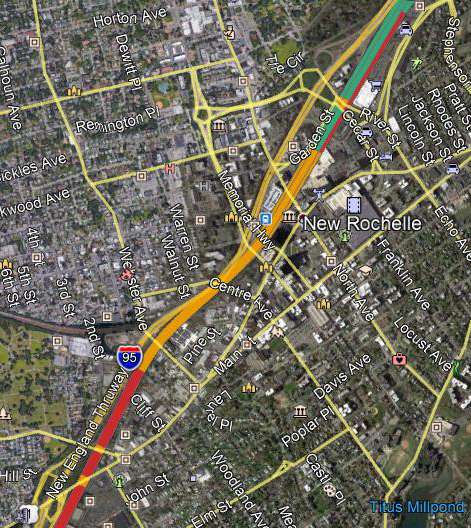
The color coding is, orange is viaducts (including grade separations), red is embankments, and teal is at-grade. This is the Northeast Corridor, continuing south on the Hell Gate Line to Penn Station, and not the Metro-North New Haven Line, continuing west (seen in natural color in the photo) to Grand Central.

A Shell fix could also straighten the approach from the south along the Hell Gate Line, which is curvy. The curve is a tight S, with individual curves not too tight, but the transition between them constraining speed. The preferred alignment proposes a fix with a kilometer of curve radius, good for 180 km/h, with impact to some industrial sites but almost no houses and no larger residential buildings. It is possible to have tighter curves, at slightly less cost and impact, or wider ones. Slicing a row of houses in New Rochelle, east of the southern side of the S, could permit cutting off the S-curve entirely, allowing 240 km/h; the cost and impact of this slice relative to the travel time benefit should be studied more carefully and compared with the cost per second saved from construction in Connecticut.

The main impact of high-speed rail here on ordinary commuters is the effect on scheduling. With four tracks, three train speed classes, and heavy commuter rail traffic, timetabling would need to be more precise, which in turn would require trains to be more punctual. In the context of a corridor-wide high-speed rail program, this is not so difficult, but it would still constrain the schedule.

Without additional tracks, except on the bypasses, there is capacity for 18 peak Metro-North trains per hour into New York (including Penn Station Access) and 6 high-speed trains. Today’s New Haven Line peak traffic is 20 trains per hour (8 south of Stamford, 12 north of which 10 run nonstop from Stamford to Manhattan), so this capacity pattern argues in favor of pricing trains to allow commuters to use the high-speed trains between Stamford and New York.

Rye-Greenwich
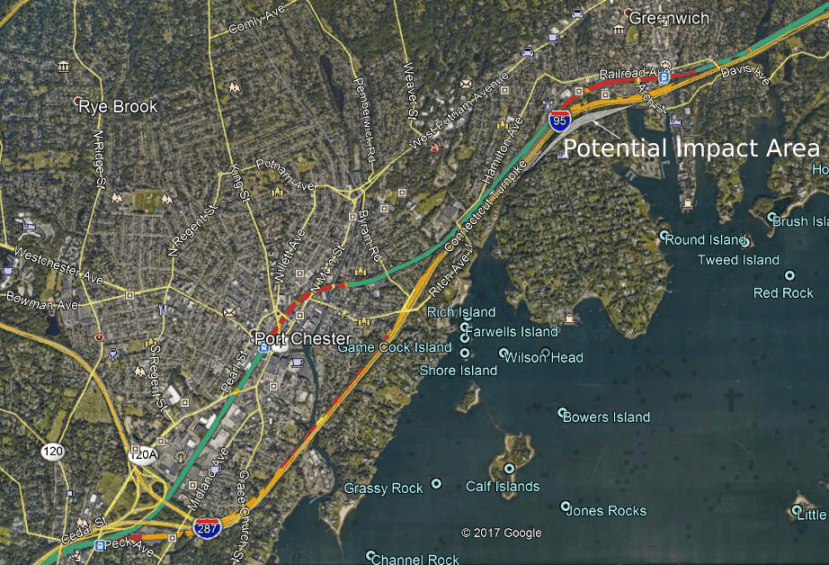
Rye is the first place, going from the south, where I-95 is straighter than the Northeast Corridor. This does not mean it is straight: it merely means that the curves on I-95 in that area are less sharp than those at Rye, Port Chester, and Greenwich. Each of these three stations sits at a sharp S-curve today; the speed zone today is 75 mph (120 km/h), with track geometry that could allow much more if Metro-North accepted a mix of trains of different speed, but Rye and Greenwich restrict trains to 60 mph/95 km/h, and Port Chester to 45 mph/70 km/h at the state line. The segment between the state line and Stamford in particular is one of the slowest in the corridor.

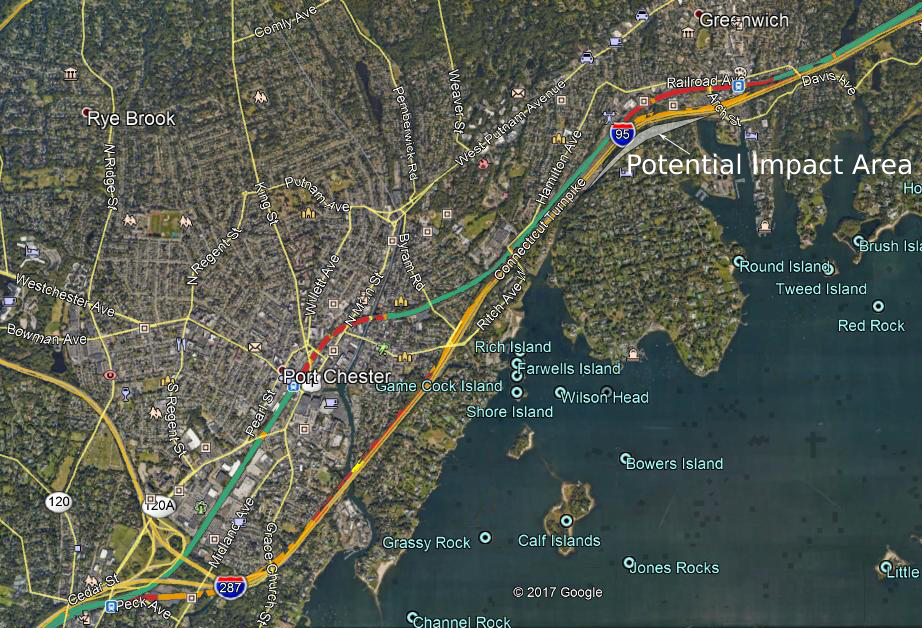
As a result, the NEC Future plan would bypass the legacy line there alongside the Interstate. Currently, the worst curve in the bypassed segment, at Port Chester, has radius about 650 meters, with maximum speed much less than today’s trains could do on such a curve because of the sharp S. At medium and high speed, it takes a few seconds of train travel time to reverse a curve, or else the train must go more slowly, to let the systems as well as passengers’ muscles adjust to the change in the direction of centrifugal force. At Rye, the new alignment has 1,200-meter curves, with gentle enough S to allow trains to fully reverse, without additional slowdowns; today’s tracks and trains could take it at 140 km/h, but a tilting train on tracks designed for higher-speed travel could go up to 195.

Within New York State, the bypass would require taking a large cosmetics store, and some houses adjacent to I-95 on the west; a few townhouses in Rye may require noise walls, as they would be right next to the right-of-way where trains would go about 200-210 km/h, but at this speed the noise levels with barriers are no higher than those of the freeway, so the houses would remain inhabitable.

In Connecticut, the situation is more delicate. When the tracks and I-95 are twinned, there is nothing in between, and thus the bypass is effectively just two extra tracks. To the south, just beyond the state line, the situation is similar to that of Rye: a few near-freeway houses would be acquired, but nothing else would, and overall noise levels would not be a problem.

But to the north, around Greenwich station, the proposed alignment follows the I-95 right-of-way, with no residential takings, and one possible commercial taking at Greenwich Plaza. This alignment comes at the cost of a sharp curve: 600 meters, comparable to the existing Greenwich curve. This would provide improvements in capacity, as intercity trains could overtake express commuter trains (which would also stop at Greenwich), but not much in speed.

Increasing speed requires a gentler curve than on I-95; eliminating the S-curve entirely would raise the radius to about 1,600 meters, permitting 225 km/h. This has some impact, as the inside of the curve would be too close to the houses just south of I-95, requiring taking about seven houses.

However, the biggest drawback of this gentler curve is cost: it would have to be on a viaduct crossing I-95 twice, raising the cost of the project. It is hard to say by exactly how much: either option, the preferred one or the 225 km/h option, would involve an aerial, costing about $100 million according to FRA cost items, so the difference is likely to be smaller than this. It is a political decision whether saving 30 seconds for express trains is worth what is likely to be in the low tens of millions of dollars.

Cos Cob Bridge

The Cos Cob Bridge restricts the trains, in multiple ways. As a movable bridge, it is unpowered: trains on it do not get electric power, but must instead coast; regular Metro-North riders are familiar with the sight of train lights, air conditioning, and electric sockets briefly going out when the train is on the bridge. It is also old enough that the structure itself requires trains to go more slowly, 80 km/h in an otherwise 110 km/h zone.

Because of the bridge’s age and condition, it is a high priority for replacement. One cost estimate says that replacing the bridge would cost $800 million. The Regional Plan Association estimates the cost of replacing both this bridge and the Devon Bridge, at the boundary between Fairfield and New Haven Counties, at $1.8 billion. The new span would be a higher bridge, fully powered, without any speed limit except associated with curves; Cos Cob station has to be rebuilt as well, as it is directly on the approaches, and it may be possible to save money there (Metro-North station construction costs are very high—West Haven was $105 million, whereas Boston has built infill stations for costs in the teens).

In any high-speed rail program, the curves could be eased as well. There are two short, sharp curves next to the bridge, one just west to the Cos Cob station and the other between the bridge and Riverside. The replaced bridge would need long approaches for the deck to clear the Mianus River with enough room for boats to navigate, and it should not cost any more in engineering and construction to replace the two short curves with one long, much wider curve. There is scant information about the proposed clearance below and the grades leading up to the bridge, but both high-speed trains and the high-powered electric commuter trains used by Metro-North can climb steep grades, up to 3.5-4%, limiting the length of the approaches to about 400 meters on each side. This is the alternative depicted as the potential alternative below; the Cos Cob Bridge is the legacy bridge, and the preferred alignment is a different bypass (see below for the Riverside-Stamford segment):
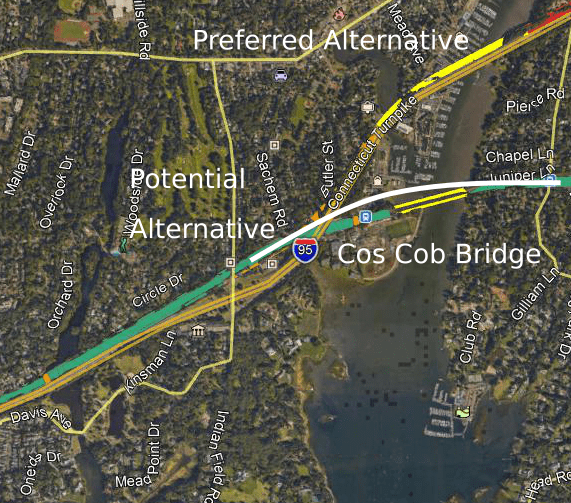
The color coding is the same as before, but yellow means major bridge. White is my own drawing of an alternative.

The radius of the curve would be 1,700 meters. A tilting train could go at 235 km/h. Commuter rail would benefit from increased speed as well: express trains could run at their maximum speed, currently 160 km/h, continuing almost all the way east to Stamford. The cost of this in terms of impact is the townhouses just north of the Cos Cob station: the viaduct would move slightly north, and encroach on some, possibly all, of the ten buildings. Otherwise, the area immediately to the north of the station is a parking lot.

The longer, wider curve alternative can be widened even further. In that case, there would be more impact on the approaches, but less near the bridge itself, which would be much closer in location to the current bridge and station. This option may prove useful if one alignment for the wider curve turns out to be infeasible due to either unacceptable impact to historic buildings or engineering difficulties. The curve radius of this alternative rises to about 3,000 meters, at which point the speed limit is imposed entirely by neighboring curves in Greenwich and Stamford; trains could go 310 km/h on a 3,000-meter curve, but they wouldn’t have room to accelerate to that speed from Greenwich’s 225 km/h.

Riverside-Stamford

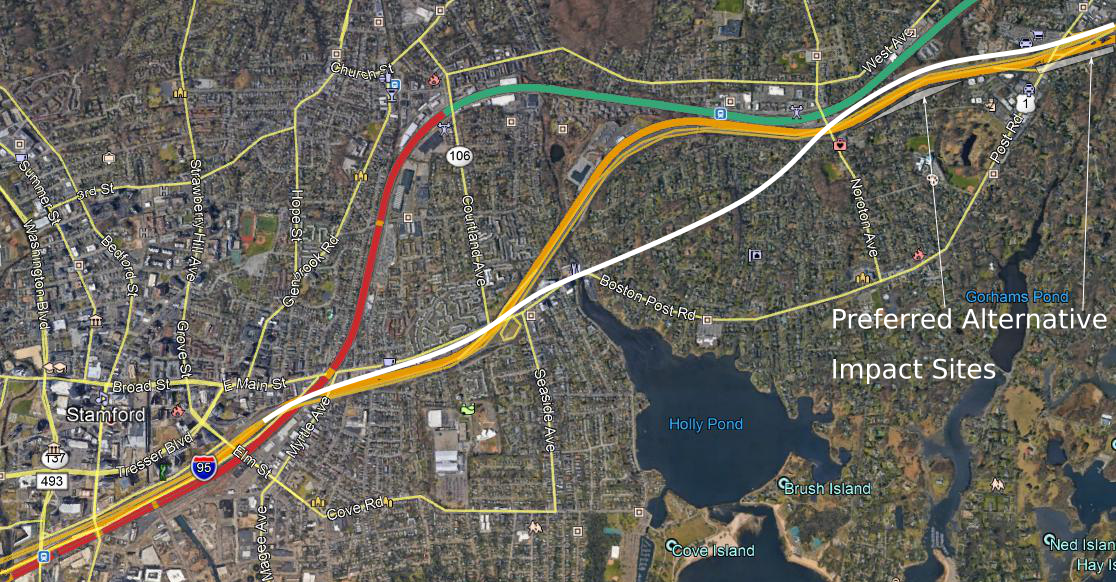
Between the Mianus River and Stamford, there are two possible alignments. The first is the legacy alignment; the second is a bypass alongside I-95, which would involve a new crossing of the Mianus River as well. The NEC Future alignment appears to prefer the I-95 option:
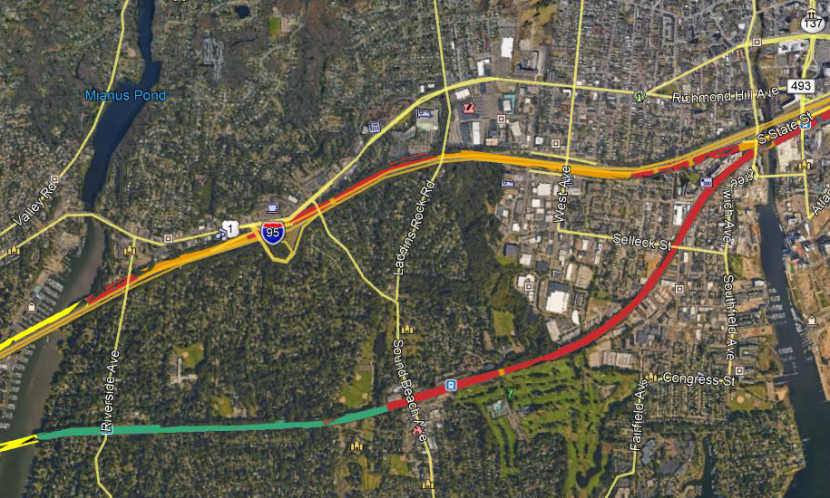
The main benefit of the I-95 option is that it offers additional bypass tracks for the New Haven Line. Under this option, there is no need for intercity trains and express commuter trains to share tracks anywhere between Rye and Westport.

However, the legacy alignment has multiple other benefits. First, it has practically no additional impact. Faster trains would emit slightly more noise, but high-speed trains designed for 360 km/h are fairly quiet at 210. In contrast, the I-95 alignment requires a bridge over the Greenwich Water Club, some residential takings in Cos Cob, and possibly a few commercial takings in Riverside.

Second, it is cheaper. There would need to be some track reconstruction, but no new right-of-way formation, and, most importantly, no new crossing of the Mianus River. The Cos Cob Bridge is in such poor shape that a replacement is most likely necessary even if intercity trains bypass it. The extra cost of the additional aerials, berms, and grade separations in Riverside is perhaps $150-200 million, and that of the second Mianus River crossing would run into many hundreds of millions. This also means somewhat more visual impact, because there would be two bridges over the river rather than just one, and because in parts of Riverside the aerials would be at a higher level than the freeway, which is sunken under the three westernmost overpasses

In either case, one additional investment in Stamford is likely necessary, benefiting both intercity and commuter rail travelers: grade-separating the junction between the New Canaan Branch and the mainline. Without at-grade conflicts between opposing trains on the mainline and the New Canaan Branch, scheduling would be simpler, and trains to and from New Canaan would not need to use the slow interlocking at Stamford station.

The existing route into Stamford already has the potential to be fast. The curves between the Mianus and Stamford station are gentle, and even the S-curve on the approach to Stamford looks like a kilometer in radius, good enough for 180 km/h on a tilting train with proper superelevation.

Stamford-Darien

Between New York and Stamford, the required infrastructure investments for high-speed rail are tame. Everything together except the Mianus crossing should be doable, based on FRA cost items, on a low 9-figure budget.

East of Stamford, the situation is completely different. There are sharp curves periodically, and several in Darien and Norwalk are too tight for high-speed trains. What’s more, I-95 is only available as a straight alternative right-of-way in Norwalk. In Darien, and in Stamford east of the station, there is no easy solution. Everything requires balancing cost, speed, and construction impact.

The one saving grace is that there is much less commuter rail traffic here than between New York and Stamford. With bypasses from Stamford until past Norwalk, only a small number of peak express Metro-North trains east of Greens Farms would ever need to share tracks with intercity trains. Thus the scheduling is at least no longer a problem.

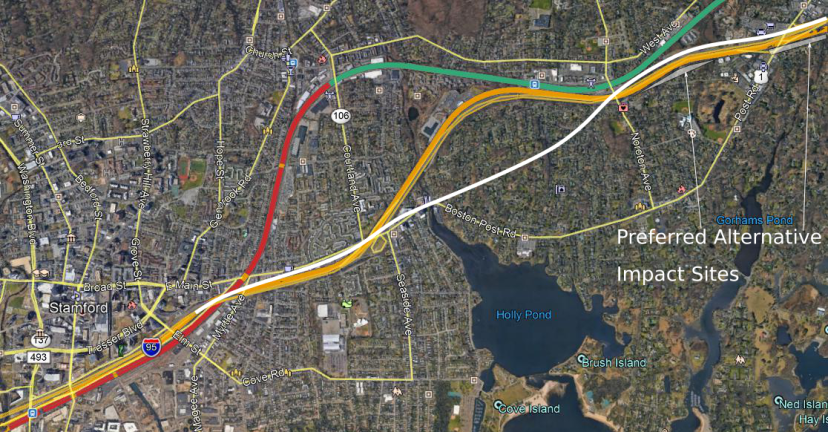
The official plan from NEC Future is to hew to I-95, with all of its curves, and compromise on speed. The curve radius appears to be about 700-750 meters through Stamford and most of Darien, good for about 95 mph over a stretch of 5.5 miles. This is a compromise meant to limit the extent of takings, at the cost of imposing one of the lowest speed limits outside major cities. While the official plan is feasible to construct, the sharp curves suggest that if Amtrak builds high-speed rail in this region, it will attempt a speedup, even at relatively high cost.

There is a possible speedup, involving a minimum curve radius of about 1,700-2,000 meters, good for 235-255 km/h. This would save 70-90 seconds, at similar construction cost to the preferred alignment. The drawback is that it would massively impact Darien, especially Noroton. It would involve carving a new route through Noroton for about a mile. In Stamford, it would require taking an office building or two, depending on precise alignment; in Noroton, the takings would amount to between 55 and 80 houses. The faster option, with 2,000-meter curves, does not necessarily require taking more houses in Noroton: the most difficult curves are farther east. In the picture, this speedup is in white, the preferred alternative is in orange, and the legacy line in teal:
Fortunately, east of Norton Avenue, there is not much commercial and almost no residential development immediately to the north of I-95, making things easier:
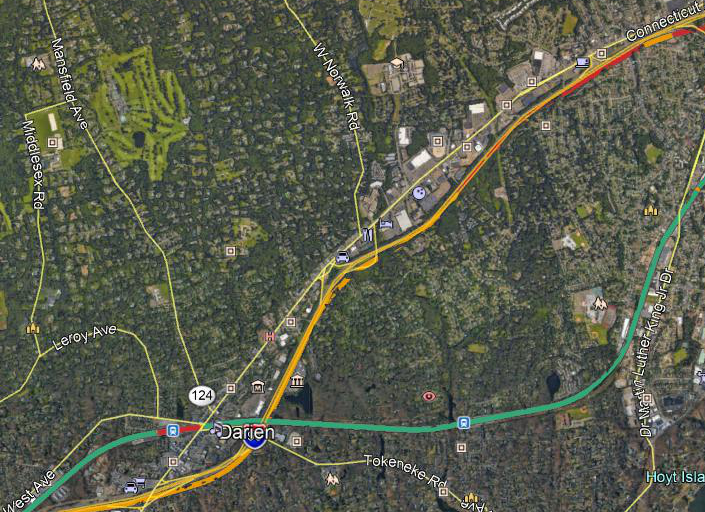
The preferred alignment stays to the south of the Turnpike. This is the residential side; even with tight curves, some residential takings are unavoidable, about 20 houses. Going north of I-95 instead requires a few commercial takings, including some auto shops, and one or two small office buildings east of Old Kings Highway, depending on curve radius. Construction costs here are slightly higher, because easing one curve would require elevated construction above I-95, as in one of the Greenwich options above, but this is probably a matter of a few tens of millions of dollars.

The main impact, beyond land acquisition cost, is splitting Noroton in half, at least for pedestrians and cyclists (drivers could drive in underpasses just as they do under highways). Conversely, the area would be close enough to Stamford, with its fast trains to New York, that it may become more desirable. This is especially true for takings within Stamford. However, Darien might benefit as well, near Noroton Heights and Darien stations, where people could take a train to Stamford and change to a high-speed train to New York or other cities.

As in Greenwich, it is a political decision how much a minute of travel time is worth. Darien houses are expensive; at the median price in Noroton, 60-80 houses would be $70-90 million, plus some extra for the office buildings. Against this extra cost, plus possible negative impact on the rest of Noroton, are positive impacts coming from access, and a speedup of 70-90 seconds for all travelers from New York or Stamford to points north.

Norwalk-Greens Farms

In Norwalk, I-95 provides a straight right-of-way for trains. This is the high-speed rail racetrack: for about ten kilometers, until Greens Farms, it may be possible for trains to run at 270-290 km/h.

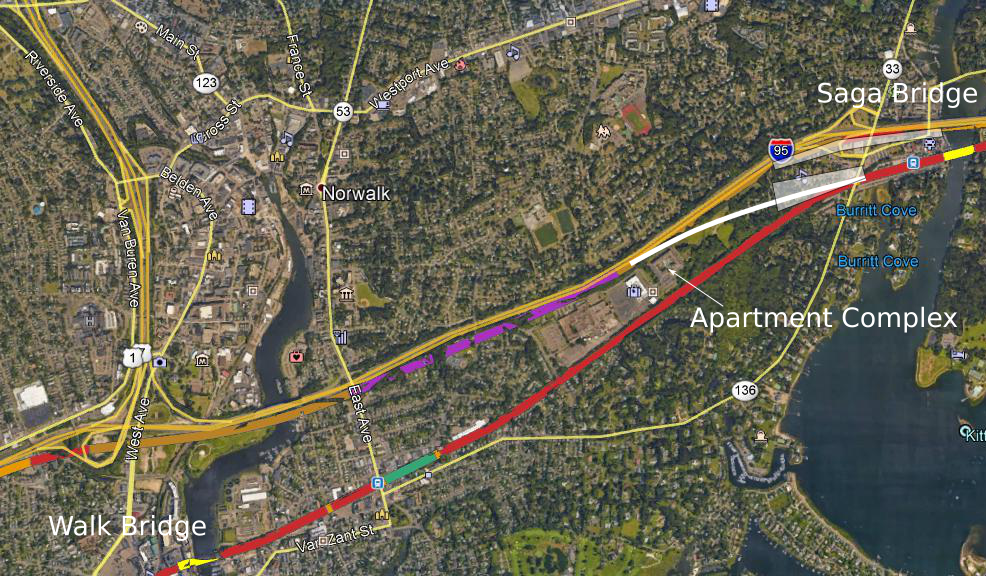
Here is a photo of Norwalk, with the Walk and Saga Bridges in yellow, a tunnel in the preferred alternative in purple, a possible different alignment in white, and impact zones highlighted:
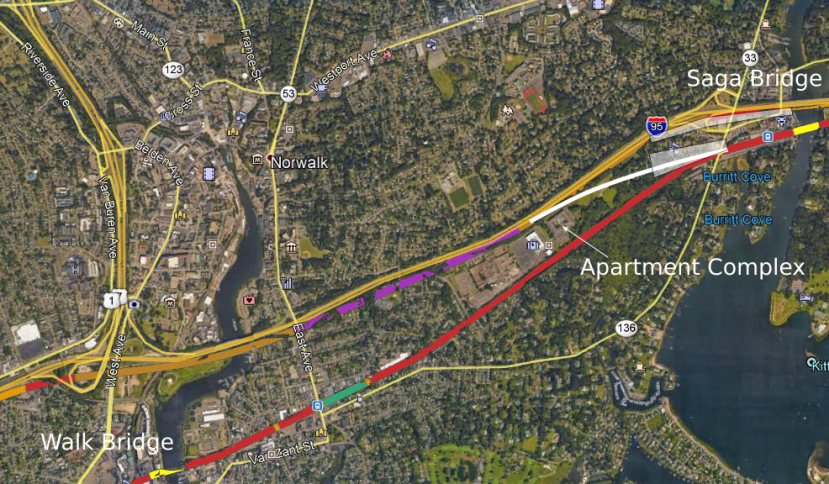
Three question marks remain about the preferred alignment.

The first question is, which side of the Turnpike to use? The preferred alignment stays on the south side. This limits impact on the north side, which includes some retail where the Turnpike and U.S. 1 are closely parallel, near the Darien/Norwalk boundary; a north side option would have to take it. But the preferred alignment instead slices Oyster Shell Park. A third option is possible, transitioning from the north to the south side just east of the Norwalk River, preparing to rejoin the New Haven Line, which is to the south of I-95 here.

The second question is, why is the transition back to the New Haven Line so complex? The preferred alignment includes a tunnel in an area without any more impacted residences than nearby segments, including in Greenwich and Darien. It also includes a new Saga Bridge, bypassing Westport, with a new viaduct in Downtown Westport, taking some retail and about six houses. An alternative would be to leverage the upcoming Saga Bridge reconstruction, which the RPA plan mentions is relatively easy ($500 million for Saga plus Walk, on the Norwalk River, bypassed by any high-speed alignment), and transition to the legacy alignment somewhat to the west of Westport.

A complicating factor for transitioning west of Westport is that the optimal route, while empty eight years ago, has since gotten a new apartment complex with a few hundred units, marked on the map. Alternatives all involve impact to other places; the options are transitioning north of the complex, taking about twenty units in Westport south of the Turnpike and twenty in Norwalk just north of it.

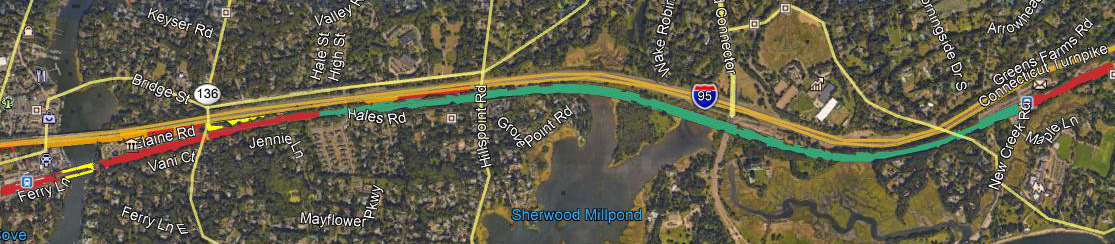
The third question, related to the second, is, why is Greens Farms so complicated? See photo below:
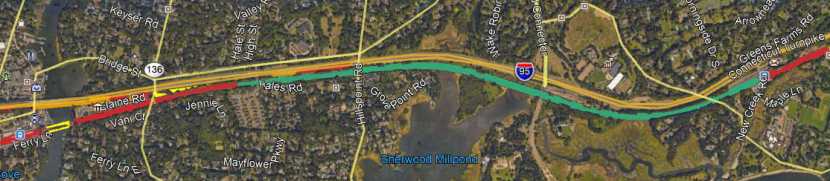
The area has a prominent S-curve, and some compromises on curve radius are needed. But the preferred alternative doesn’t seem to straighten it. Instead, it builds an interlocking there, with the bypass from Darien and points west. While that particular area has little impact (the preferred alignment transitions in the no man’s land between the New Haven Line and the Turnpike), the area is constrained and the interlocking would be expensive.

No matter what happens, the racetrack ends at Greens Farms. The existing curve seems to have a radius of about a kilometer or slightly more, good for about 190 km/h, and the best that can be done if it is straightened is 1,300-1,400 meters, good for about 200 km/h.

These questions may well have good answers. Unlike in Darien, where all options are bad, in Norwalk and Westport all options are at least understandable. But it’s useful to ask why go south of the Turnpike rather than north, and unless there is a clear-cut answer, both options should be studied in parallel.

Transit and Scale Variance Part 1: Bus Networks

I intend to begin a series of posts, about the concept of scale-variance in public transit. What I mean by scale-variance is that things work dramatically differently depending on the size of the network. This can include any of the following issues, roughly in increasing order of complexity:

  • Economies and diseconomies of scale: cars display diseconomies of scale (it’s easier to build freeway lanes numbers 1-6 than lanes 14-20), transit displays the opposite (there’s a reason why the world’s largest city also has the highest per capita rail ridership).
  • Barriers to entry: a modern first-world transit network, or an intercity rail network, requires vast capital investment, beyond the ability of any startup, which is why startup culture denigrates fixed-route transit and tries to find alternatives that work better at small scale, and then fails to scale them up.
  • Network design: the optimal subway network of 500 km looks different from the optimal network of 70 km, and its first 70 km may still look different from the optimal 70 km network. Bus networks look different from both, due to differences in vehicle size, flexibility, and right-of-way quality (surface running vs. grade separations).
  • Rider demographics: the social class of riders who will ride half-hourly buses is different from the class who will ride the subway, and the network design should account for that, e.g. by designing systems that the middle class will never ride to destinations that are useful to the working class. But then marginal rider demographics are profoundly different – sometimes the marginal rider on a low-usage bus network is a peak suburban commuter, leading to design changes that may not work in higher-volume settings.

For a contrasting example of scale-invariance, consider timed transfers: they underlie the Swiss intercity rail network, but also some small-town American bus systems and mid-size night bus networks such as Vancouver’s. I wrote about it in the context of TransitMatters’ NightBus proposal for Boston, giving a lot of parallels between buses and trains that work at many scales.

However, night buses themselves are an edge case, and usually, bus network design is different at different scales. In this post I’d like to go over some cases of changes that work at one scale but not at other scales.

Brampton

The trigger for this post was a brief Twitter flamewar I had earlier today, about Brampton. TVO just published an article praising Brampton Transit for its rapid growth in bus ridership, up from 9 million in 2005 to 27 million in 2017. Brampton is a rapidly growing suburb of 600,000 people, but transit ridership has grown much faster than population. The bone of contention is that current ridership is only 45 annual bus trips per capita, which is weak by the standard of even partly transit-oriented places (Los Angeles County’s total annual bus and rail ridership is about 40 per capita), but is pretty good by the standard of auto-oriented sprawl. The question is, is Brampton’s transit success replicable elsewhere? I’d argue that no.

First, Brampton’s transit ridership growth is less impressive than it looks, given changing demographics. Fast growth masks the extent of white flight in the city: it had 433,000 visible minorities in 2016, up from 246,000 in 2006 and 130,000 in 2001, and only 153,000 whites, down from 185,000 in 2006 and 194,000 in 2001. The TVO article points to racial divisions about transit, in which the white establishment killed a light rail line over concerns about traffic, whereas the black and South Asian population (collectively a majority of the city’s population) was supportive. Ridership per nonwhite resident is still up, but not by such an impressive amount. Brampton’s population density, 2,200 per square kilometer, is high for a North American suburb, and a change in demographics could trigger ridership growth – this density really is okay for both transit and driving, whereas very high density (e.g. New York) favors transit and very low density (e.g. most of the US Sunbelt) favors driving regardless of demographics.

But even with demographic changes, Brampton has clearly gotten something right. I compare ridership today to ridership in 2005 because that’s when various bus improvements began. These improvements include the following:

  • A bus grid, with straighter routes.
  • More service to the airport.
  • Free transfers within a two-hour window.
  • New limited-stop buses on the major trunks, branded as Züm.

The bus grid is not especially frequent. The Züm routes have variants and short-turns, with routes every 10-12 minutes on some trunks and every 20-25 on branches and the lower-use trunk lines.

This isn’t the stuff high ridership is made of. Most importantly, this is unlikely to be the stuff higher ridership in Brampton could be made of. The Toronto region is electrifying commuter rail in preparation for frequent all-day service, called the RER. One of Brampton’s stations, Bramalea, will get 15-minute rail frequency all day; but Brampton Station itself, at the intersection of the two main Züm routes, will still only have hourly midday service. With fast service to Toronto, the most important thing to do with Brampton buses is to feed the RER (and get the RER to serve Downtown Brampton frequently), with timed transfers in Downtown Brampton if possible.

The express buses are specifically more useful for low-transit cities than for high-transit ones. In low-transit cities, the travel market for transit consists of poor people, and commuters who want to avoid peak traffic. Poor people benefit from long transfer windows and from a grid network, whereas commuters only ride at rush hour and only to the most congested areas; in Brampton, where city center doesn’t amount to much, this underlies the express bus to the airport, and the trains that run to Downtown Toronto today.

The marginal rider in Brampton today is either a working-class immigrant who can’t afford Toronto, or a car-owning commuter who drives everywhere except the most congested destinations, such as Downtown Toronto at rush hour, or the airport. Brampton has catered to these riders, underlying fast bus ridership growth. But they’re not enough to lead to transit revival.

Bus grids

The value of a bus grid in which passengers are expected to transfer to get to many destinations rises with the frequency of the trunk lines. In Vancouver and Toronto, the main grid buses come every 5-10 minutes off-peak, depending on the route, and connect to subway lines. Waiting time is limited compared with the 15-minute grids common in American Sunbelt cities with bus network redesigns, such as San Jose and Houston.

The difference between waiting 15 minutes and waiting 7.5 minutes may seem like a matter of degree and not of kind, but compared with bus trip length, it is substantial. Buses are generally a mode of transportation for short trips, because they are slow, and people don’t like spending all day traveling. The average unlinked bus trip in Houston is 24 minutes according to the National Transit Database. In San Jose, it’s 27 minutes. Breaking one-seat rides into two-seat rides, with the bus schedules inconsistent (“show up and go”) and the connections not timed, means that on many trips the maximum wait time can be larger than the in-vehicle travel time.

The other issue coming from scale is that frequent bus network don’t work in sufficiently large cities. Los Angeles can run frequent bus lines on key corridors like Vermont and Western and even them them dedicated lanes, but ultimately it’s 37 km from San Pedro to Wilshire and an hourly bus on the freeway will beat any frequency of bus on an arterial. There’s a maximum size limit when the bus runs at 20 km/h in low-density cities (maybe 30 in some exceptional cases, like low-density areas of Vancouver with not much traffic and signal priority), and cars travel at 80 km/h on the freeway.

This has strong implications to the optimal design of bus networks even in gridded cities. In environments without grids, like Boston, I think people understand that buses work mostly as rail feeders (it helps that Boston’s public transit is exceptionally rail-centric by the standards of other US cities with similar transit use levels, like Chicago or San Francisco). But in sufficiently large cities, buses have to work the same way even with grids, because travel times on surface arterials are just too long. The sort of grid plan that’s used for buses in Chicago and Toronto is less useful in the much larger Los Angeles Basin.

Don’t Run Bilevels

For years, the RER A’s pride was that it was running 30 trains per hour through its central segment in the peak direction (and 24 in the reverse-peak direction). With two branches to the east and three to the west, it would run westbound trains every 2 minutes between 8 and 9 in the morning on the seven-station shared trunk line. Moreover, those trains are massive, unlike the trains that run on the Metro: 224 meters long, and bilevel. To allow fast boarding and alighting at the central stations, those trains were uniquely made with three very wide doors per side, and two bilevel segments per car; usually there are two doors near the ends of the car and a long bilevel segment in between. But now the RER A can no longer run this schedule, and recently announced a cut to 24 peak trains per hour. The failure of the RER A’s bilevel rolling stock, called the MI 2N or MI 09, should make it clear to every transit agency mulling high-throughput urban rail, including RER A-style regional rail, that all trains should be single-level.

On most of the high-traffic regional rail lines of the world, the trains are single-level and not bilevel. The reasoning is that the most important thing is fast egress in the CBD at rush hour. For the same reason, the highest-traffic regional rail lines tend to have multiple CBD stops, to spread the load among several stations. The Chuo Rapid Line squeezes 14 trains in the peak half-hour into Tokyo Station, its only proper CBD station, discharging single-deck trains with four pairs of doors per 20-meter-long car onto a wide island platform with excellent vertical circulation. Bilevels are almost unheard of in Japan, except on Green Cars, first-class cars that are designed to give everyone a seat at a higher price point; on these cars, there aren’t so many passengers, so they can disembark onto the platform with just two doors, one per end of the car.

Outside Japan (and Korea, where the distinction between the subway and regional rail is even fuzzier), the busiest regional rail system is the RER. The RER A runs bilevels, but the most crowded line while the RER A was running 30 tph was the RER B, which runs 20 tph, through a tunnel shared with the RER D, which runs 12 bilevel tph. Outside Paris, the busiest European regional rail systems are in London (where bilevels are impossible because of restricted clearances), and in Berlin, Madrid, and Munich, all of which run single-level trains. Berlin and Munich moreover have three door pairs per 17-to-18-meter car. Munich squeezes 30 tph through its central tunnel, with seven distinct branches. Other than the RER A, it’s the less busy regional services that use bilevels: the RER C, D, and E; the commuter trains in Stockholm; the Zurich S-Bahn and other Swiss trains; Dutch regional trains; and many low-performance French provincial TERs, such as the quarter-hourly trains in the Riviera.

Uniquely among bilevels, the RER A’s MI 2N (and later MI 09) was designed as a compromise between in-vehicle capacity and fast egress. There are three triple-width door pairs per car, allowing three people to enter or exit at once: one to the lower level, one to the upper level, one to the intermediate vestibule. The total number of door pairs per unit of train length is almost as high as on the RER B (30 in 224 meters vs. 32 in 208), and the total width of these doors is much more than on the RER B, whose doors are only double-wide.

Unfortunately, even with the extra doors, the MI 09 has ultimately not offered comparable egress times to single-level trains. Present-day peak dwell times on both the RER A and B are about 50-60 seconds at Les Halles; here, the RER B, with its prominent Gare du Nord-to-Les Halles peak in the morning, is in a more difficult urban geography than the RER A, with four stations that could plausibly lay claim to the CBD (Les Halles, Auber, Etoile, La Defense). The RER B has long had problems with maintaining the schedules, due to the 32 tph segment shared with the RER D, using traditional fixed-block signaling; the RER A in contrast has a moving-block system called SACEM. But now the RER A has problems with schedule reliability too, hence the cut in peak frequency.

The problem is that it’s not just the number of doors that determines how fast people can get in and out. It’s also how quickly passengers can get from the rest of the train’s interior to the doors. Metro systems optimize for this by having longitudinal seats, with their backs to the sides of the train, creating a large, relatively unobstructed interior compartment for people to move in; Japanese regional trains do the same. European regional trains still have transverse seating, facing forward and backward, and sometimes the corridors are so narrow that queues form on the way to the vestibules, where the doors are. The RER A actually has less obstructed corridors than the RER B. The problem is that it’s still a bilevel.

Bilevel design inherently constrains capacity on the way to the door, because the stairs from the two decks to the intermediate level, where the door is, are choke points. They are by definition only half a train wide. They are also slow, especially on the way down, for safety reasons. When the train is very crowded, people can’t just push on the way up or down the way they can on a flat train floor. If passengers get off their seats in the upper and lower levels well in advance and make their way to the intermediate-level vestibules then they can alight more quickly, but on a train as crowded as the RER A, the vestibule is already full, and people resort to sitting on the stairs at rush hour, obstructing passageways even further.

As a result, RATP is now talking about extending peak dwells at the central stations to 105 seconds, to stabilize the schedules. Relative to 60-second dwells, this is 45 seconds of padding per station; with about 3 minutes between successive stations in the central segment, this is around 25% pad (on top of the already-existing pad!), a level worthy of American commuter trains rather than of Europe’s busiest commuter rail line.

What’s more, this unique design cost the region a lot of money: Wikipedia says the MI 09’s base order was €3.06 million per 22.5-meter car, and the option went up to €4.81 million per car. In contrast, German operators have purchased the high-performance single-level Coradia Continental and Talent 2 for €1.25-1.5 million euros per 18-meter car (see orders in 2014, 2016, and 2017); these trains have a top speed of 160 km/h and the power-to-weight ratio of a high-speed train, necessary for fast acceleration on regional lines with many stops. Even vanilla bilevel trains, with two end-car door pairs, are often more expensive: at the low end the Regio 2N is €7.06 million per 94-meter trainset, at the higher end the high-performance KISS is around €3 million per 25-meter car (about 2.7 in Sweden, 3-3.5 in Azerbaijan), and the Siemens Desiro Double Deck produced for the Zurich S-Bahn in 2003 was around €3 million per 25-meter car as well.

High-traffic regional railroads that wish to improve capacity can buy bilevel trains if they’d like, but need to understand the real tradeoffs. Average bilevel trains, with a serious decrease in capacity coming from having long upper- and lower-level corridors far from the doors, can cost 50-100% more than single-level trains. They offer much more capacity within each train (the KISS offers about 30% more seats per meter of train length, with a small first-class section, than the FLIRT), but the reduction in capacity measured in trains per hour cancels most of the benefits, except in cases where peak dwells don’t matter as much, as in Zurich with its two platform tracks per approach track. In terms of capacity per unit cost, they remain deficient.

The MI 09 was supposed to offer slightly less seated capacity per unit of train length and equivalent egress capacity to single-level trains, but in practice it offers much less egress capacity, at much higher cost, around 2.5-3 times as high as single-level trains. If RATP had bought single-level trains instead of the MI 09, optimized for fast egress via less obstructed passageways, it would have had about €2.5 billion more. Since the cost of extending the RER E from Saint-Lazare to La Defense and beyond is about that high, the region would have had money to obtain far more capacity for east-west regional travel already.

The American or Canadian reader may think that this analysis is less relevant to the United States and Canada, where the entire commuter rail ridership in all cities combined is about the same as that of just the RER A and B. Moreover, with higher US construction costs, the idea of saving money on trains and then diverting it to tunnels is less applicable than in Paris. However, two important American factors make the need to stop running bilevels even more pertinent than in Europe: CBD layout, and station construction costs.

North American CBDs are higher-rise than European ones – even monocentric cities like Stockholm have few city center skyscrapers. The job density in Paris’s job-densest arrondissement (the 2nd) is about 50,000/km^2, and it’s higher in its western end but still only about comparable to Philadelphia’s job density around Suburban Station. Philadelphia has three central stations in the SEPTA commuter rail tunnel, but only Suburban is really in the middle of peak job density; Market East is just outside the highest-intensity zone, and 30th Street Station is well outside it. In Boston, only two proper CBD stations are feasible in the North-South Rail Link, South Station and Aquarium. In New York, Penn Station isn’t even in the CBD (forcing everyone to get off and connect to the subway), and only 1-2 Midtown stations are feasible in regional rail proposals, Penn and Grand Central. Some of these stations, especially Penn and Grand Central, benefit from multiple platform tracks per approach track in any plan, but in Boston this is not feasible.

The other issue is station construction costs. High construction costs in the US mean that spending more money on trains to avoid spending money on infrastructure is more economic, but conversely they also make it harder to build anything as station-rich as the RER A, the Munich S-Bahn tunnel, or Crossrail. They also make stations with multiple platform tracks harder to excavate; this is impossible to do in a large-diameter TBM. This makes getting egress capacity right even more important than in Europe.

New York and Philadelphia meandered into the correct rolling stock, because of clearance restrictions in New York and the lack of a domestic manufacturing base for bilevel EMUs. Unfortunately, they still try to get it wrong: New Jersey Transit is buying bilevel EMUs (the first FRA-compliant ones). Railroads that aren’t electrified instead got used to bilevel unpowered coaches, and get bilevel EMUs: Caltrain is getting premium-price KISSes (about the only place where this is justifiable, since there are sharp capacity limits on the line, coming from mixing local and express trains on two tracks), and the Toronto RER (with only one CBD station at Union Station) is also planning to buy bilevel EMUs once electrification is complete.

Paris’s MI 09 mistake is not deadly. The RER E extension to the west will open in a few years and relieve the RER A either way. Being large and rich can paper over a lot of problems. North American cities are much poorer than Paris when wages are deflated to tunnel construction costs, and this means that one mistake in choice of alignment or rolling stock can have long-lasting consequences for service quality. Learning from the most forward-thinking and successful public transit operators means not just imitating their successes but identifying and avoiding their failures.

Quick Note: U-Shaped Lines

Most subway lines are more or less straight, in the sense of going north-south, east-west, or something in between. However, some deviate from this ideal: for example, circular lines. Circular lines play their own special role in the subway network, and the rest of this post will concern itself only with radial lines. Among the radials, lines are even more common, but some lines are kinked, shaped like an L or a U. Here’s a diagram of a subway system with a prominently U-shaped line:

Alert readers will note the similarity between this diagram and my post from two days ago about the Washington Metro; the reason I’m writing this is that Alex Block proposed what is in effect the above diagram, with the Yellow Line going toward Union Station and then east along H Street.

This is a bad idea, for two reasons. The first is that people travel in lines, not in Us. Passengers going from the west end to the east end will almost certainly just take the blue line, whereas passengers going from the northwest to the northeast will probably drive rather than taking the red line. What the U-shaped layout does it put a one-seat ride on an origin-and-destination pair on which the subway is unlikely to be competitive no matter what, while the pairs on which the subway is more useful, such as northeast to southwest, require a transfer.

The second reason is that if there are U- and L-shaped lines, it’s easy to miss transfers if subsequent lines are built:

The purple line has no connection to the yellow line in this situation. Were the yellow and red line switched at their meeting point, this would not happen: the purple line would intersect each other subway line exactly once. But with a U-shaped red line and a yellow line that’s not especially straight, passengers between the purple and yellow lines have a three-seat ride. Since those lines are parallel, origin-and-destination pairs between the west end of the purple line and east end of the yellow line or vice versa require traveling straight through the CBD, a situation in which the subway is likely to be useful, if service quality is high. This would be perfect for a one-seat or two-seat ride, but unfortunately, the network makes this a three-seat ride.

The depicted purple line is not contrived. Washington-based readers should imagine the depicted purple line as combining the Columbia Pike with some northeast-pointing route under Rhode Island Avenue, maybe with an additional detour through Georgetown not shown on the diagram. This is if anything worse than what I’m showing, because the purple/red/blue transfer point is then Farragut, the most crowded station in the city, with already long walks between the two existing lines (there isn’t even an in-system transfer between them.). Thus the only direct connection between the western end of the purple line (i.e. Columbia Pike) and what would be the eastern end of the yellow line (i.e. H Street going east to Largo) requires transferring at the most crowded point, whereas usually planners should aim to encourage transfers away from the single busiest station.

When I created my Patreon page, I drew an image of a subway network with six radial lines and one circle as my avatar. You don’t need to be a contributor to see the picture: of note, each of the two radials intersects exactly once, and no two lines are tangent. If the twelve ends of six lines are thought of as the twelve hours on a clock, then the connections are 12-6, 1-7, 2-8, 3-9, 4-10, and 5-11. As far as possible, this is what subway networks should aspire to; everything else is a compromise. Whenever there is an opportunity to build a straight line instead of a U- or L-shaped lines, planners should take it, and the same applies to opportunities to convert U- or L-shaped lines to straight ones by switching lines at intersection points.

What Washington Metro Should Build

I’ve been thinking intermittently about how to relieve the capacity crunch on the Washington Metro. The worst peak crowding is on the Orange Line heading eastbound from Arlington to Downtown Washington, and this led to proposals to build a parallel tunnel for the Blue Line. Already a year ago, I had an alternative proposal, borrowing liberally from the ideas of alert reader Devin Bunten, who proposed a separate Yellow Line tunnel instead. Matt Yglesias’s last post about it, using my ideas, made this a bigger topic of discussion, and I’d like to explain my reasoning here.

Here is the map of what I think Metro needs to do:

Existing stations have gray fill, new ones have white fill. The Yellow Line gets its own route to Union Station, either parallel to the Orange Line and then north via the Capitol (which is easier to build) or parallel to the Green Line (which passes closer to the CBD), and then takes over the route to Glenmont. The rump Red Line then gets a tunnel under H Street, hosting the busiest bus in the city, and then takes over the current Blue Line to Largo, with an infill station in Mayfair for a transfer to the Orange Line and another at Minnesota Avenue for bus connections.

The Blue Line no longer presents a reverse-branch. It is reduced to a shuttle between the Pentagon and Rosslyn. Matt mistakenly claims that reducing the Blue Line to a shuttle is cost-free; in fact, it would need dedicated tracks at Rosslyn (if only a single track, based on projected frequency), an expensive retrofit that has also been discussed as part of the separate Blue Line tunnel project. At the Pentagon, initially shared tracks would be okay, since the Yellow Line is still a branch combined with the Green Line today; but the separate Yellow Line tracks would then force dedicated turnback tracks for the Blue Line at the Pentagon as well. Frequency should be high all day, and at times of low frequency (worse than about a train every 6 minutes), the lines in Virginia should be scheduled to permit fast transfers between both the Yellow and Orange Lines and the Blue Line.

The reverse branch today limits train frequency at the peak, because delays on one line propagate to the others. Peak capacity on Metro today is 26 trains per hour. I don’t know of anywhere with reverse-branching and much higher capacity: the London Underground lines that reverse-branch, such as the Northern line, have similar peak traffic, whereas ones that only conventionally branch (Central) or don’t branch at all (Victoria) are capable of 35-36 peak trains per hour. This means that my (and Devin’s, and Matt’s) proposed system allows more capacity even in the tunnel from Rosslyn to Foggy Bottom, which gets no additional connections the way 14th Street Bridge gets to feed a new Yellow Line trunk.

The big drawback of the plan is that the job center of Washington is Farragut, well to the west of the Yellow and Green Lines. WMATA makes origin-and-destination data publicly available, broken down by period. In the morning peak, the top destination station for each of the shared Blue and Yellow Line stations in Virginia is either the Pentagon or Farragut; L’Enfant Plaza is also high, and some stations have strong links to Gallery Place-Chinatown. Metro Center is actually faster to reach by Yellow + Red Line than by taking the Blue Line the long way, but Farragut is not, especially when one factors in transfer time at Gallery Place. The saving grace is that eliminating reverse-branching, turning Metro into four core lines of which no two share tracks, allows running trains more frequently and reliably, so travel time including wait time may not increase much, if at all.

This is why I am proposing the second alternative for the route between L’Enfant Plaza and Union Station. Devin proposed roughly following the legacy rail line. In the 1970s, it would have been better for the region to electrify commuter rail and add infill stops and just run trains on the route, and today a parallel route is appealing; Matt even proposed using the actual rail tunnel, but, even handwaving FRA regulations, that would introduce schedule dependency with intercity trains, making both kinds of trains less reliable. This route, the southeastern option among the two depicted in dashed lines, is easier to build, in that there are multiple possible streets to dig under, including C and E Streets, and giant parking lots and parks where the tracks would turn north toward the Capitol and Union Station. It also offers members of Congress and their staffers a train right to the officeUnfortunately, it forces Farragut-bound riders to transfer to the Orange Line at L’Enfant Plaza, slowing them down even further.

The second alternative means the Yellow Line stays roughly where it is. Four-tracking the shared Yellow and Green Line trunk under 7th Street is possible, but likely expensive. Tunneling under 8th Street is cheaper, but still requires passing under the Smithsonian Art Museum and tunneling under private property (namely, a church) to turn toward H Street. Tunneling under 6th Street instead is much easier, but this is farther from 7th Street than 8th Street is, and is also on the wrong side for walking to Metro Center and points west; the turn to H Street also requires tunneling under a bigger building. By default, the best route within this alternative is most likely 8th Street, then.

A variant on this second alternative would keep the Red Line as is, and connect the Yellow Line to the subway under H Street and to Largo. This is easier to construct than what I depict on my map: the Yellow Line would just go under H Street, with a Union Station stop under the track and new access points from the tracks to a concourse at H Street. This would avoid constructing the turns from the Red Line to H Street next to active track. Unfortunately, the resulting service map would look like a mess, with a U-shaped Red Line and an L-shaped Yellow Line. People travel north-south and east-west, not north-north or south-east.

Under either alternative, H Street would provide subway service to most of the remaining rapid transit-deprived parts of the District west of the Anacostia River. Some remaining areas near the Penn and Camden Lines could benefit from infill on commuter rail, and do not need Metro service. The big gaps in coverage in the District would be east of the river, and Georgetown.

Georgetown is the main impetus for the Blue Line separation idea; unfortunately, there’s no real service need to the east, along K Street, so the separate Blue Line tunnel would be redundant. In the 1970s it would have been prudent to build a Georgetown station between Foggy Bottom and Rosslyn, but this wasn’t done, and fixing it now is too much money for too little extra ridership; Bostonian readers may notice that a similar situation arises at the Seaport and BCEC, which should be on the Red Line if it were built from scratch today, but are unserved since the Red Line did not go there in the 1900s and 10s, and attempting to fix it by giving them their own subway line is a waste of money.

East of the river, the Minnesota Avenue corridor would make a nice circumferential rapid bus. But there are no strong radial routes to be built through it; the strongest bus corridor, Pennsylvania Avenue, serves a small node at the intersection with Minnesota and thereafter peters out into low-frequency branches.

This means that if the Yellow Line separation I’m proposing is built, all parts of the District that could reasonably be served by Metro will be. If this happens, Metro will have trunk lines with frequent service, two not branching at all and two having two branches on one side each; with passengers from Alexandria riding the Yellow Line, the Orange crush will end. The main issue for Metro will then be encouraging TOD to promote more ridership, and upgrading systems incrementally to allow each trunk line to carry more trains, going from 26 peak trains per hour to 30 and thence 36. Washington could have a solid rapid transit skeleton, which it doesn’t today, and then work on shaping its systems and urban layout to maximize its use.

RPA Fourth Regional Plan: LaGuardia Airport and the Astoria Line

This is the second post based on a Patreon poll about the RPA Fourth Regional Plan. See the first post, about Third Avenue, here.

The most worrisome part of the RPA Fourth Regional Plan is the LaGuardia Airport connector. The regional rail system the RPA is proposing includes some truly massive wastes of money, but what the RPA is proposing around LaGuardia showcases the worst aspects of the plan. On Curbed I explained that the plan has an unfortunate tendency to throw in every single politically-supported proposal. I’d like to expand on what I said in the article about the airport connector:

The most egregious example is another transit project favored by a political heavyweight: the LaGuardia AirTrain, championed by Governor Andrew Cuomo. Though he touts it as a one-seat ride from Midtown to LaGuardia, the vast majority of airport travelers going to Manhattan would have to go east to Willets Point (a potential redevelopment site) before they could go west. Even airport employees would have to backtrack to get to their homes in Jackson Heights and surrounding neighborhoods. As a result, it wouldn’t save airport riders any time over the existing buses.

Once again, it’s proven unpopular with transit experts and advocates: [Ben] Kabak mocked the idea as vaporware, and Yonah Freemark showed how circuitous this link would be. When Cuomo first proposed this idea, Politico cited a number of additional people who study public transportation in the region with negative reactions. Despite its unpopularity—and the lack of an official cost for the proposal—the AirTrain LaGuardia is included in the RPA’s latest plan.

But there is an alternative to Cuomo’s plan: an extension of the N/W train, proposed in the 1990s, which would provide a direct route along with additional stops within Astoria, where there is demand for subway service. Community opposition killed the original proposal, but a lot can change in 15 years; Astoria’s current residents may well be more amenable to an airport connector that would put them mere minutes from LaGuardia. Cuomo never even tried, deliberately shying away from this populated area.

And the Fourth Plan does include a number of subway extensions, some of which have long been on official and unofficial wishlists. Those include extensions under Utica and Nostrand avenues (planned together with Second Avenue Subway, going back to the 1950s), which also go under two of the top bus routes in the city, per [Jarrett] Walker’s maxim [that the best argument for an urban rail line is an overcrowded bus line, as on Utica and Nostrand].

There is also an extension of the N/W trains in Astoria—though not toward LaGuardia, but west, toward the waterfront, where it would provide a circuitous route to Manhattan. In effect, the RPA is proposing to stoke the community opposition Cuomo was afraid of, but still build the easy—and unsupported—airport connector Cuomo favors.

My views of extending the Astoria Line toward LaGuardia have evolved in the last few years, in a more positive direction. In my first crayon, which I drew in 2010, I didn’t even have that extension; I believed that the Astoria Line should be extended on Astoria Boulevard and miss the airport entirely, because Astoria Boulevard was the more important corridor. My spite map from 2010, give or take a year, connects LGA to the subway via a shuttle under Junction, and has a subway branch under Northern, a subway extension that I’ve been revising my views of negatively.

The issue, to me, is one of branching and capacity. The Astoria Line is a trunk line on the subway, feeding an entire tunnel to Manhattan, under 60th Street; the Queens Boulevard Line also feeds the same tunnel via the R train, but this is inefficient, since there are four trunk lines (Astoria, Flushing, and Queens Boulevard times two since it has four tracks), four tunnels (63rd, 60th, 53rd, Steinway/42nd), and no way to get from the Astoria Line to the other tunnels. This was one of my impetuses for writing about the problems associated with reverse-branching. Among the four trunks in Queens, the Astoria Line is the shortest and lowest-ridership, so it should be extended deeper into Queens if it is possible to do so.

The RPA is proposing to extend the Astoria Line, to its credit. But its extension goes west, to the waterfront. This isn’t really a compelling destination. Development isn’t any more intense than farther east, and for obvious reasons it isn’t possible to extend this line further; the RPA’s proposal would only add one stop to the subway. In contrast, an eastern extension toward LGA could potentially rebuild the line to turn east on Ditmars (with some takings on the interior of the curve at Ditmars and 31st), with stops at Steinway and Hazen before serving the airport. The intensity of development at Steinway is similar to that at 31st and Ditmars or at 21st, and Hazen also has some housing, albeit at lower density. Then, there is the airport, which would be about 8 minutes from Astoria, and 26 minutes from 57th and 7th in Manhattan. This is a different route from that proposed in the Giuliani administration, involving going north above 31st and then east farther out, running nonstop to the airport (or perhaps serving a station or two) through less residential areas, but I believe it is the best one despite the added impact of running elevated on Ditmars.

LGA is not a huge ridership generator; total O&D ridership according to the Consumer Airfare Report is around 55,000 per day, and 33% mode share is aspirational even with fast direct service to Manhattan hotels and an easy connection to the Upper East Side. But it still provides ridership comparable to that of Astoria Boulevard or Ditmars on the line today, and Steinway and Hazen are likely to add more demand. If the MTA closes the 11th Street Connection, taking the R from 60th Street Tunnel to the Queens Boulevard Line, in order to reduce the extent of reverse-branching, then the Astoria Line will run under capacity and need this additional demand. The total number of boardings at all stations, including Queensboro Plaza, is 80,000 per weekday today, plus some transfer volumes from the 7, which empties at Queensboro Plaza as 60th Street Tunnel provides a faster route to most Manhattan destinations than the Steinway Tunnel. An LGA extension should add maybe 40,000 or 50,000 weekday riders, without much of a peak since airport travel isn’t peaky, and make it easier to isolate the Astoria Line from the other Queens lines. This is not possible with a short extension to the waterfront as the RPA proposes.

I’ve seen someone suggest somewhere I don’t remember, perhaps on Twitter, that the reason the RPA plan involves an extension of the Astoria line to the west is to insidiously get the correct extension to LGA passed. If the RPA can propose an el in Astoria and not be killed by NIMBYs, then it will prove to Cuomo that NIMBYism is not a problem and thus he can send the subway to the airport directly, without the circuitous air train project that even less acerbic transit writers like Ben and Yonah hate.

I disagree with this line, on two different grounds. The first is that the RPA has two other reasons to support a western extension of the Astoria Line: it connects to the waterfront (which, following de Blasio and his support for the waterfront tramway, the RPA wants to develop further), and it got a station on Triboro in the Third Regional Plan, in the 1990s. I can no longer find the map with the stations on Mike Frumin’s blog, but the plan was to have a station every 800 meters, with a station to the west of Ditmar/31st still in Queens, around 21st Street; only in the more recent plan did the RPA redesign the idea as Crossboro, with much wider stop spacing.

The second grounds for disagreement is that the RPA presented a long-term vision. If Cuomo’s flawed LGA connector is there, then it will embolden him to find money to build this connection, even though it’s slower than taking a bus to the subway today. It will not embolden anyone to look for funding for the extension of the Astoria Line to the west, since there is no force clamoring for such extension – not the neighborhood, and not even the RPA, which includes this line on a long list of proposals.

As I said on Curbed, the RPA has been around for 90 years. Cuomo is just a governor, not even the leader of a real political movement (unlike Bernie Sanders, who seems to be interested in his leftist agenda more than in himself). There is no reason for an organization so venerable to tether itself to a politician who isn’t likely to be around for more than a few more years. On the contrary, it can provide cover for Cuomo to change his plan, if it does some legwork to prove that people in Astoria actually are interested in subway expansion to the east.