My Patreon is Live

Here is my Patreon page. Donations get processed on the 1st of every month; if you contribute today, my understanding is that it will still only get processed in August. I’m still working on the Lagos post solicited via Twitter, but should be done in a week, depending on how much time I have. (The subway meltdown in New York and Cuomo’s laconic response thereto mean that I’m on deadlines at a bunch of outlets that want my opinions.) When I’m done I’ll start doing internal Patreon polls about the next post’s topic.

My posts are going to remain public. Instead, the rewards are as follows:

$2/month (“diesel bus”): you get to vote in the polls about my topics. Not all posts will be polled, but at least one per month, ideally 2-3, will be.

$5/month (“trolleybus”): you get dedicated content, in the form of various examples or caveats that are cut from my published pieces due to length. Things that I cut because I couldn’t find good enough evidence for them don’t count; only things that I’d be comfortable saying in public, but didn’t because of length or flow, do.

$10/month (“tramway”): you get listed as a supporter on a sidebar of this blog.

$25/month (“rapid transit”): you get to tell me what to write about, bypassing the polls, a couple times a year – at least twice, possibly more depending on schedule and on how many people ask for the same thing. (If two people keep asking for the same thing, they really get a minimum of two posts each, so four total.)

My current target is a total of $200/month, based on what people said on Twitter. If I get a lot more than that, I can start committing to more than one post a week.

Modeling Jitney-Bus Competition

I just published a piece at the Bay City Beacon about Lyft Shuttle, the company’s foray into fixed-route buses. In the piece, I mentioned briefly that adding a competing operator can reduce the average quality of service. The piece, nominally 500 words, really 700, was far too short for me to expound on the model, even though people on social media had asked me about it before. So here it is.

The first assumption is that the routes are identical. This is largely true for some of the more northern Lyft Shuttle routes, duplicating Muni’s 2 and 41 buses (the 41 duplicator skips some inner stops, though).

The second assumption is that the bus has a fixed schedule, but the jitney can schedule itself in response to the bus. This is true of the case studies I know of (and, to make it very clear, “case study” means “I’ve read an article” or “I’ve heard it discussed on social media”): Israel’s Sherut vans, and Hudson County’s private jitneys. Both use dynamic schedules, which in plain English means drivers radioing each other (in Israel) or employing lookouts (in New Jersey); the bus companies have fixed schedules that are slower to change.

The third assumption is that marginal riders take whichever route they see first. This is the case with regular jitneys. Not all riders are marginal: there might be an explicit ethnic dimension, e.g. dollar vans in New York are more popular with unassimilated immigrants, because they provide amenities like use of their own language rather than English. Lyft Shuttle is booked via app, so the situation there is murkier; however, most likely the use case will involve passengers buying a ticket a few minutes in advance, possibly checking against a bus app to see which will come first. Some people will stick with one system over the other (tech boosters seem to hate public services, people without other reasons to download the Lyft app will probably stick to the bus), but some will be flexible.

Let us work this out first assuming perfect scheduling and then introducing schedule irregularities due to bunching.

Now, let’s assume the public bus arrives every 6 minutes. If the transit agency wishes to double service, it will schedule additional service at the midpoint between each pair of successive trips, providing 3-minute frequency. But if additional service comes from a private operator, the incentive is to schedule to compete and not to cooperate. Say the public bus arrives at my station at :00 on a 6-minute takt. The private operator can schedule itself to arrive at :03 on a 6-minute takt and get half of my station’s traffic, or it can schedule itself at :05 and get 5/6 of its traffic. Let’s set the fudge factor at 1 minute for now: if the separation is smaller, for example if the jitney comes at :05:30 and the public bus at :06, then I see both at the same time and am indifferent as to which to ride.

By itself, this still means adding service. However, it’s likely that there is going to be some service diversion – that some public bus riders will switch to the private service (e.g. because it usually comes first). If one quarter of the bus riders switch, then the schedule is cut to a bus every 8 minutes. The jitney still aims to arrive 1 minute before the bus for maximum revenue, perhaps getting bigger vehicles if it needs the capacity, as the New Jersey jitneys did. So now my bus comes at :00, :08, etc., and the jitney comes at :07, :15, etc. Average wait time is 3.125 minutes, whereas before it was 3 minutes.

The formula in general if both vehicles come every x minutes and are separated by 1 minute is \frac{(x-1)^2 + 1}{2x} and this equals 3 at x = 4 \pm \sqrt{14} \approx 7.74, corresponding to about 23.5% reduction in transit use; any higher reduction makes average wait times worse. If the original headway was y, then we have x = 1 + y/2 \pm \sqrt{(1 + y/2)^2 - 2}, or just under 2 extra minutes; the fixed separation, 1 minute, means this calculation is not scale-invariant.

Now, let’s introduce schedule irregularity into this system. As a toy model, let’s look at what happens if the bus can be up to 1 minute behind or ahead. If the route only has public buses, and one bus is off by 1 minute, then instead of two 6-minute gaps there’s a 5-minute gap and a 7-minute gap, for an average wait of 3:05. If the route has public buses and jitneys, scheduled 1 minute apart as above, then a 1-minute error is good for passengers if it evens out the schedules (it converts a 3.125-minute wait to a 2.5-minute wait), but bad for passengers if it makes the bus and the jitney arrive at exactly the same time (the wait rises to 4 minutes).

But really, bus schedules are an unstable equilibrium. (So are train schedules, but the instability is too slow to cause bunching). If a bus is a minute behind, then at the next bus stop it will have an above-average crowd size, since people had more time to show up and wait. Boarding time is a significant fraction of bus travel time, so the bus will go behind even further, until the bus behind it will catch up, at which point the two buses will leapfrog each other. It’s possible to reduce this effect by cutting boarding time, via low-floor buses and off-board fare collection with all-door boarding; Muni has implemented both, but this is still not enough to remove the instability. In practice, this imposes a minimum headway of about 3 minutes – below it, buses bunch so much that adding service doesn’t add any capacity. In theory it’s possible to go lower, but when ridership is high enough to justify 3-minute headways, it’s high enough for dwell times to make lower headways infeasible.

Jitneys do not have a 3-minute minimum headway; they’re more flexible about running express if they’re already full. This, in turn, means that schedules on jitney routes are more irregular than on buses, making wait times less predictable, and ultimately longer (since, at equal service, less even intervals translate to longer average waits). But more to the point, jitneys still aim to schedule themselves to come just before the bus does. This means that jitney arrival irregularity largely tracks bus arrival irregularity. So with this in mind, if the city bus gets delayed by a minute again, and the jitney adjusts, then we have the following service gaps, in minutes: 8, 1, 6, 1. Average wait time is now 3.1875 minutes.

So the question is, what effect does demand diversion from buses to jitneys have on bus irregularity? The answer is, not much. This depends on additional assumptions on dwell times and the initial delay. Delays compound exponentially, but the exponent (“Lyapunov exponent” in dynamics) is low; on a 6-minute bus route, a 1-minute delay means that future dwell times go up by 1/6, and at 2.5 seconds of variable dwell time per boarding or alighting (Muni average with all-door boarding, see PDF-p. 16 here) it takes 60*6/2.5 = 144 boardings and alightings to delay the schedule by another minute. Muni averages 127 boardings and alightings per hour, so it takes more than an hour for the 1 minute of delay to compound by another minute (strictly speaking, by \sqrt[6]{e} \approx 1.18 minutes). The busiest bus in North America, Vancouver’s 99, averages 320, so the compounding takes just 27 minutes (almost a full one-way trip); Vancouver buses with comparable ridership to the routes Lyft is duplicating average maybe half that.

The point of this exercise is that on the timescales relevant to a bus route, schedule irregularity is approximately linear. So demand diversion from buses to jitneys has a linear effect on schedule irregularity: 25% diversion means that instead of a 1-minute delay there’s only a 45-second delay. A 1-minute delay with 6-minute buses is still better than no delay with 8-minute buses an jitney spaced a minute apart, so the jitneys still remove value. At higher delays, this is no longer true (average wait time is quadratic in the delay); the point of equality is about 1.61 minutes of bus delay due to schedule instability (other delays, like traffic, affect all routes equally regardless of frequency). So jitneys can add value on long, busy routes (don’t forget – the lower the headway, the more significant the assumed 1-minute separation is). But the routes the Lyft Shuttle jitney runs are less busy, and more importantly are short, with less opportunity for delay compounding; delays do not compound past the terminus with decent dispatching.

The upshot is that jitneys do not universally remove value from transportation networks. But on short 6-minute routes, they do even under mild assumptions on ridership diversion. There’s more service in operation, but from the riders’ perspective, wait times have increased and regularity has degraded. The logic of competing private companies is not always the logic of better service for passengers. Sometimes, having a government monopoly inherently improves efficiency.

Quick Note: What a Few Pictures Tell Us About BRT

The Boston BRT initiative is pushing hard for what it calls gold standard BRT in Boston, with the support of ITDP. Backed by a Barr Foundation grant, it launched a competition for pilot routes. Two years ago to the day, Ari Ofsevit already wrote a takedown of the idea of gold standard BRT in Boston, comparing the street width in Boston to the street widths in Bogota and Mexico City. In brief, most of Bogota’s BRT network runs on streets wider than 40 meters, and the rest is still 30-something; in Boston nothing is that wide except streets that have light rail in their medians like Commonwealth Avenue and Beacon Street, and the key corridors have segments going below 20.

In response to this problem, here is the photo Boston BRT is using to illustrate the technology:

BRT in not-Boston

I am not sure where this photo was taken. Judging by the 60 speed limit sign, it can’t be in the US. What we see in the photo is 4 travel lanes in each direction (2 car, 2 bus), a generous median for the station, generous medians on both sides of the main road, and service lanes. Paris’s 80-meter-wide Cours de Vincennes has in each direction a service lane, two parking lanes, one bus lane, and three car lanes, but no median between the two main carriageways. The depicted street has to be wider, which means it’s wider in meters than most Boston arterials are in feet. It’s very wide by the standards of Mexico City, Curitiba, and Bogota.

BRT station in not-Boston

The BRT Report for Boston depicts another picture in that flavor on PDF-p. 14. It is also painfully misleading about existing BRT lines: its blurb about Mexico City omits the fact that the city has a large, expanding subway network with almost as much ridership as New York’s, and alongside Mexico; its blurb about Cleveland’s HealthLine BRT omits all the internal problems of the line, which make Cleveland urbanists denigrate it as a poor transportation solution.

BRT is a useful tool in cities’ kit for solving transportation problems. But proponents have to be honest about the tradeoffs involves: it is cheaper than a subway but also slower, less comfortable, and more expensive to operate; and it requires difficult choices about how to allocate street space. There are many examples of BRT on streets going down to about 30 meters, and Boston BRT could have also chosen to depict even narrower streets, to be relevant to Boston. Instead, it’s engaging in subterfuge: the report is claiming that BRT is faster than light rail and implying it’s the primary transit mode in Mexico City, and by the same token, the pictures all show wide enough streets for anything.

Core Connectors and In-Between Neighborhoods, Redux

Five years ago, I wrote about how American cities’ transit priorities cause them to underrate the neighborhoods with the best potential, which typically are also the poorer ones. Those are the in-between neighborhoods: beyond the gentrified core of the city, which is often within walking distance of the CBD in a small region, but not so far that they’re really suburbs. Instead of serving these neighborhoods, cities that want to look like they’re redeveloping build core connectors, i.e. short-range transit services within the gentrified (or gentrifying) center. I was specifically complaining about two plans, one in Providence and one in New Haven. The Providence plan involved a mixed-traffic streetcar, which has since been downgraded to a frequent bus. It’s this project that I wish to talk about in this post.

First, some background: in the 2000s and early 2010s, Rhode Island realigned I-195. This project, called Iway, rebuilt a segment of the freeway to higher standards, but also moved it so as to no longer cut off the Jewelry District from the CBD (called Downcity). Iway turned the Jewelry District from a post-industrial neighborhood to the next (possibly the only) frontier of gentrification in the city, and state elites needed to decide what to do with all this land. This led to plans to build what was in vogue in the late 2000s and early 2010s: a mixed-traffic streetcar, which would connect the Rhode Island Hospital and Jewelry District with Downcity and continue either north to the train station, or east to College Hill via the East Side Tunnel, a short bus-only tunnel cutting off a steep hill between Downcity and the Brown campus. This was from the start bad transit, and we in the Greater City community were skeptical. The plan was eventually scuttled, and the website’s registration lapsed without any redirect to the new plan, which is BRT.

The new BRT route is going between the train station and the Jewelry District. It’s planned to be very frequent, with a bus every 4-5 minutes, appropriate for the short length of the route, about 2 km between the hospital and the train station. The plan is to build open rather than closed BRT, with several branches interlining on the route. Overall, it looks like RIPTA is doing BRT right. And yet, it’s a terrible project.

The top bus corridor in Rhode Island is the R route (for Rapid), formed from the former 99 and 11 buses, which were by far the top two in ridership. It runs every 10 minutes, between Pawtucket and South Providence, serving some of the poorest parts of an already poor urban area. It has some BRT treatments, including hard-fought signal priority (Governor Carcieri vetoed it six times, and it took until the more progressive Lincoln Chafee replaced him for signal priority to go ahead). But buses run in mixed traffic, and fare collection is on-board. If any route deserves better frequency, it’s this one.

Moreover, the attempt to shoehorn multiple routes through the BRT path is compromising those routes. The R route is already detouring through the train station, which the old 99 route did not serve, and which forces a few minutes’ detour. Another bus, route 1, does not currently serve the train station, but will be rerouted once the BRT path opens; route 1 goes through the East Side tunnel, and making it detour to the train station would give it an especially circuitous path between the East Side and Downcity (the 1 already detours to enter the hospital, which is set back from the street). This, in turn, compromises the usefulness of the tunnel, which is that it interlines several routes between Downcity and Brown, which then go in different direction east of Brown.

There are potentially strong east-west corridors that could receive the R treatment. In the east, off-board fare collection on the buses using the tunnel would considerably speed up service. In the west, there are a few potentially strong routes: Broadway (carrying the 27 and 28 to Olneyville), Atwells in Federal Hill (carrying the 92 fake trolley, which runs through to the East Side and used to use the tunnel), and Westminster/Cranston (carrying the 17, 19, and 31). The highly-branched nature of the routes east of the tunnel makes through-service dicey, and this in turn is a matter of a broken bus network in East Providence. But overall, demand roughly matches that of the strongest corridor on the west, which is either Broadway or Westminster/Cranston, depending on how much branching one tolerates. This would create a second rapid bus trunk between College Hill and Olneyville. So why is the city investing in another route?

It’s not the train station. The train station itself is not a compelling transit destination. It’s too close to Downcity; even with a 5-minute bus frequency, it’s faster to walk from the central bus transfer point at Kennedy Plaza (or to the nearest point on the old 99 route on North Main or Canal) than to transfer to the right bus. It should be served by the routes for which it’s on the way, for example the northwest-bound 50, 56, and 57 routes. It’s unlikely anyone will transfer to a bus to the train station. Nor is it likely anyone will take the 1 from College Hill to the train station: walking downhill takes 15 minutes, and people going to a train station need more reliability than a mixed-traffic bus can provide. Walking uphill is more difficult, and there is less need for reliability, but even then, it seems that most people walk. This means the only real use of the train station connection is for people from the Jewelry District.

This brings me to the Jewelry District itself. The city wants to redevelop it, but it is not yet much of a destination. Nor is Providence itching for new development sites: residential rents are affordable on the East Side, and Downcity commercial property values are so low that the city’s tallest building is empty and was said at appraisal to have no value. So why the rush to give the Jewelry District better public transit than existing neighborhoods that direly need it, like South Providence, Olneyville, and Pawtucket?

The answer is contained in the title of this post. South Providence and Olneyville are in-between neighborhoods. Pawtucket is far enough away that it is getting a $40 million infill station on the Providence Line, but the state is not going to fund frequent service or integrated fares between the line and RIPTA buses. As far as Pawtucket’s predominantly poor and working-class residents are concerned, the train might as well not be there; nor will any gentrifiers move to Pawtucket for service to Boston (they get about the same travel time out of Providence and far better amenities). The focus for the city and the state is on redevelopment, and one can almost see the dollar signs in the eyes of the power brokers who passed this deal.

This neglect of the working class and of Providence’s nonwhite neighborhoods (South Providence is black, Olneyville is Hispanic) is not deliberate. But there is clear disparate impact: the Jewelry District gets BRT, South Providence and Olneyville can drop dead. Like everywhere else in the US, the power structure in Providence discourages investment in the in-between neighborhoods, even comfortable ones like the East Side. The in-between neighborhoods are intact enough that building something there is about providing transportation services, rather than about development and renaissance and the creative capital and other buzzwords. And providing services is too boring, too political, too underappreciated. Better to build something shiny and say “I did that,” even if it’s useless. What the elites consider shiny changes every few years – it was streetcars last decade and is frequent buses today – but the principle is the same: instead of investing for the benefit of residents of Providence and its inner suburbs, the state invests for the benefit of ribbon-cutters.

Rapid Transit in the Third World

Last month, I committed to producing a subway fantasy map for Lagos via a Twitter poll. I’m working on this, but before I go into Lagos itself, I want to talk about the third world in general. Good transportation in poor countries is of independent interest, but it also has some applications to thinking about solutions for rich countries, such as the countries my readers live in. The reason is that every principle of good transportation planning has edge cases, exceptions, and assumptions, and it is critical to evaluate these in the largest variety of situations. Understanding transportation in the United States can yield insights about Europe and vice versa; likewise, understanding the first world can yield insights about the third and vice versa.

The epistemological principle I use is that if I believe that a high concentration of factor A makes solution B work better, then a low concentration of factor A should make solution B work worse. I used that in a post about high-speed rail in Sweden, arguing against it due to the absence of factors that make it work better, namely, linear population distribution. Many good design principles formulated in rich countries depend on those countries’ high incomes, and are less relevant to countries that are only about as wealthy as the US and northwestern Europe were in 1900.

Everything is terrible

On nearly every indicator of technology or living standards, every poor country is worse than every rich country. There are some exceptions involving middle-income countries (for example, Russia and China have very good rail freight), but not in low-income countries. I wrote a piece in YIMBY recently describing the state of New York and Vienna in the early 20th century, which had very high crowding levels; much of the same story can describe many third-world cities today, especially in India, where tight zoning limits housing supply to the point of overcrowding. In Mumbai, the average residential floor space per person is 9 square meters, compared with 55 in Manhattan.

Pollution levels are very high as well, because of the combination of high population density and heavy industry (especially in North India), as well as the proliferation of cars. The amount of pollution caused by 50 or 100 cars per 1,000 people in a dense city where the cars don’t have catalytic converters can be many times worse than that caused by the 200 mostly diesel-powered cars per 1,000 people of Paris, or the 250 cars per 1,000 people of New York. The low motorization levels of lower-middle-income cities like Cairo, Lagos, or Mumbai aren’t a barrier to traffic, either: those cities routinely have traffic jams, just as the United States started having jams in the 1920s. These cities have centralized employment in the CBD, not a lot of road capacity coming in, and a culture in which the middle class drives (or is driven by chauffeurs).

This creates an urgency for improving public transportation in low-income countries that does not exist in the developed world. Third-world countries that build subways spend a much higher share of their GDPs on them than Europe and Japan do, and some, such as India and Bangladesh, spend more than the United States. If Paris hadn’t built the RER, Franciliens would drive or take the slower Metro; if Shanghai hadn’t built the Metro, Shanghainese would still be living in tiny apartments and riding buses in crawling traffic; if Lagos doesn’t build a metro, Lagosians will keep facing multi-hour commutes. The same situation also creates an urgency for improving other areas the government can invest in; good government, capable of making these investments at reasonable cost, without too much corruption, is crucial for economic and social development.

Concrete before electronics

The cost of advanced signaling systems, such as driverless technology, is approximately the same everywhere in the world, in exchange rate terms. The cost of civil infrastructure construction is approximately the same in PPP terms, and if anything may be a little lower in poor countries. The cost of labor that advanced technology avoids is proportional to wages. This means that the electronics-before-concrete principle is less valid in poorer countries, and is sometimes not valid at all. There are practically no driverless metros in developing countries; the only examples I can find of lines in operation include two lines in Sao Paulo and one in Manila, with a small handful more under construction. Brazil is middle-income, and the Philippines are lower-middle-income rather than poor.

This principle also extends to countries with existing rail lines that they could expand. Investments in concrete – additional tracks, grade separation, relief lines – are more valuable than in developed countries, while investments in electronics are less valuable. A city with a desperate transportation situation can expect that every rapid transit line it builds will fill quickly. Tunnels are in a way more future-proof than precise schedules and resignaling.

Regulate cars, not buses

A recurrent feature of transportation in poor cities without rapid transit or BRT is the minibus. It goes by various names; the most famous to the first-world reader is probably the Nairobi matatu, but it also exists in Lagos as the danfo, in the Philippines as the jeepney, and in Jakarta as the angkot. These vehicles are not popular with the segment of the population that the government listens to: they are typically noisy and dirty and the drivers are aggressive. The governor of Lagos State recently announced a plan to ban the danfos, saying they don’t meet the international standards of a great city and should be replaced with air-conditioned buses. This is while the city is still working on its first metro line.

In Delhi, attempts to give buses road priority met an intense backlash from high-income drivers. There was a failed lawsuit openly stating that car drivers’ time was more important. Eventually Delhi scrapped the system entirely.

In contrast, the most successful public transit in cities that were recently poor or low-income, such as Singapore or Seoul, is in an environment where state policy restrained cars and not buses. Singapore has had congestion pricing since in the 1970s, the first city in the world to implement this scheme, and levies high taxes on cars, as does Hong Kong. Seoul restrained domestic consumption, including of cars, in its period of early industrialization from the 1960s to the 1980s.

Nigeria has 60 cars per 1,000 people. Lagos has maybe 150. To a large majority of the city’s population, cars are traffic, not transportation. Numbers in other third-world megacities vary but are not too different: Cairo has about 200 as of 2011, Delhi about 170, Jakarta about 300. (Some car and population numbers are a few years out of date; caveat emptor.) Traffic restraint is the correct policy given massive traffic jams and growing pollution levels, and the sooner the city starts, the better it will look in a generation.

Plan for growth

Developing-world cities are going to be much larger and richer in 30 years than they are today. National population growth rates range from moderate in India and Bangladesh to explosive in Nigeria, Kenya, and Tanzania. Moreover, all of these countries have low urbanization rates today and fast migration from the villages to the cities, setting up fast urban population growth even where national population growth isn’t so high. Economic growth projections are dicier, but at least one estimate through 2024 is quite optimistic about India and East Africa.

The high-density context of most cities in question rules out any auto-based development pattern. The population density of the eastern half of the Indo-Gangetic Plain, from Delhi downriver to Bangladesh, is about 1,000 people per km^2, comprising nearly 600 million people. Nowhere in the developed world is this density seen outside city regions. Lombardy has 400 people per km^2, and is as hemmed by mountains as North India, producing large-scale thermal inversions; with high levels of car traffic and heavy industry, it is one of the most polluted regions of Europe. Southern Nigeria is not so dense, but with fast population growth, it eventually will be. Egypt’s population density along the Nile is well into the four figures.

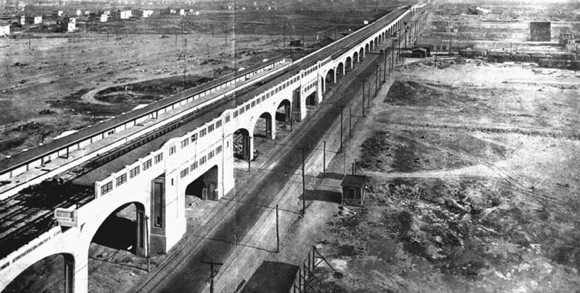
This also has implications for how rapid transit should be built. A metro line that passes through lightly-populated areas will soon sprout dense development around it, just as the early lines did in late-19th century London and early-20th century New York. Most New York railfans are familiar with the photo of farmland next to the 7 train in the 1910s; between 1900 and 1930, New York’s population doubled, while Queens’ population grew by a factor of 7. Such growth rates are realistic for some developing-world cities. For the same reason, it is worthwhile investing in grade-separated rights-of-way now, when they are cheap.

Another implication concerns capacity. Even Nairobi, which is not a megacity, can expect to become one soon, and requires many different rapid transit lines entering its center. Some of these can be accommodated on existing roads, as els or relatively easy subways under wide streets, but not all can. When the roads are wide enough, cities should consider four-track structures, since the relative construction cost of four-tracking is low for an el or a cut-and-cover subway.

Four-tracking has one additional benefit: local and express service, which is of critical importance in the very largest cities. In forums like Skyscraper City, Tokyo railfans often express concerns over China’s subways, which have no express tracks and little to no commuter rail, since they offer no path through the center faster than about 35 km/h (Tokyo’s express commuter lines, like Tokaido and Yokosuka, approach 60 km/h).

The final implication is that it’s fine to build a central business district from scratch. Shanghai is doing this in Lujiazui, but that is the wrong location, on the wrong side of a riverbend, with only one Metro line serving it, the overcrowded east-west Line 2; a north-south rail line would have to cross the river twice. A better location would have been People’s Square, served by Lines 1, 2, and 8. This is of especial relevance to cities whose traditional center is in a difficult location, especially Lagos but also Dar es Salaam.

BRT is not rapid transit

The failure of Delhi’s BRT line is in some sense atypical. The line was compromised from the start, and global pro-BRT thinktank ITDP expressed criticism from the start. However, other BRT projects draw cause for concern as well. Dar es Salaam’s BRT is instructive: the first phase cost about $8.5 million per km in exchange rate terms, or about $27 million per km in PPP terms, comparable to an average European light rail line or to an American BRT boondoggle. A hefty chunk of this cost comes from importing Chinese-made buses, which are priced in exchange-rate terms and not in PPP terms.

All else being equal, higher incomes strengthen the case for rail vs. BRT and lower incomes weaken it, since one of the major advantages of rail is fewer drivers per unit of passenger capacity. However, there is a countervailing force: the bulk of the cost of rail construction is local construction, priced in PPP terms, and not imported capital, priced in exchange rate terms. Trains still cost more than buses per unit capacity, but the bulk of the cost premium of rail over BRT is not the vehicles, and a weak currency reduces this premium.

And for all of the global marketing, by ITDP and by Jaime Lerner, the Curitiba mayor who invented modern BRT, BRT is not rapid transit. It is surface transit, which can achieve comparable speed to a tramway, but in a dense city with heavy traffic, this is not high speed. The busiest Parisian tramways, T1 and T3, average about 18 km/h. Modern rapid transit starts at 30 km/h and goes up as construction standards improve and stop spacing widens. BRT is still a useful solution for smaller cities, but in the larger ones, which need more speed, grade-separated rapid transit is irreplaceable.

Don’t neglect mainline rail

How are people going to travel between Jakarta and Surabaya, or between Lagos and Kano, or between Nairobi and Mombasa? They’re not going to fly; the capacity of air traffic is not high. They’re not going to take a vactrain. The only real solution is a high-speed rail network; Indonesia is already building HSR from Jakarta to Bandung, using Chinese technology, with plans for a further extension to Surabaya.

The most difficult part of building a new intercity rail network from scratch is serving the big cities. This is the big advantage of conventional rail over maglev or vactrains: it can run on legacy tracks for the last few kilometers. (In poorer countries, which import technology from richer ones, another advantage is that conventional rail isn’t vendor-locked.) Between this and the need to also accommodate medium-speed intercity rail to smaller cities, it’s important that developing-world cities ensure they have adequate right-of-way for any future system. Trunks should have a minimum of four tracks, with intensive commuter rail service on the local tracks, in a similar manner to Mumbai.

It is also important to build the metro to be mainline-compatible, in electrification and track gauge. It is wrong for India (and Pakistan) to build a single kilometer of standard-gauge metro; everything should be broad-gauge. Russia, where everything is on Russian gauge, does this better. African mainline rail networks are usually narrow-gauge and weak, and in some places (such as East Africa) are being rebuilt standard-gauge. Southeast Asia runs the gamut, with reasonable service in Jakarta, which is running frequent electric commuter rail using second-hand Japanese trains; this suggests future metro lines in Jakarta should be built narrow- rather than standard-gauge, to allow Tokyo-style through-service to commuter rail.

Conclusion

The biggest developing-world cities have problems with air pollution, traffic, overcrowding, and long commutes – precisely the problems that rapid transit is good at solving. They have equally great problems with infrastructure for electricity, running water, and sewage, and with access to health care, education, and such basic consumer goods as refrigerators. And they have limited tax capacity to pay for it all.

This makes building good transit – cost-effective, future-proof, and convenient enough to get high ridership – all the more critical. The smallest cities today may be able to get away with looking like smog-ridden midcentury Los Angeles, but even medium-size ones need to plan on models starting from New York or London or Tokyo, and the biggest ones, especially Lagos, should plan on looking like something that doesn’t really exist today.

To that effect, third-world governments need to absorb massive amounts of knowledge of good practices developed in Western Europe and high-income East Asia (and to a lesser extent Russia and China). But they cannot implement them blindly, but have to learn how to adapt them to local conditions: chiefly low incomes, but also weak currencies, import-dependence in technology, high expected future growth, and (in many cases) high expected population density. Nothing prevents a poor country from doing transit well: China, still a middle-income country, has more high-speed rail ridership than the rest of the world combined, and subway ridership per capita in Beijing, Shanghai, and Guangzhou is healthy. But India, Pakistan, Nigeria, and other poor countries with big cities have their work cut out for them if they want to solve their transportation problems.

I Almost Worked for Hyperloop One

I’d been making cryptic remarks about a possible job offer for a month, and a week ago I tweeted when I heard the final no. I didn’t want to say where I was interviewing until after I heard back, either way; now that I have, I’d like to talk more about the process, and what I think it means for transportation criticism in general.

History

A few weeks after I posted that I’m transitioning to working in transit or transit writing full-time, a recruiter reached out to me. I wouldn’t have applied myself, not out of ideological opposition to working on Hyperloop, but because until that point, I imagined they wouldn’t have wanted me working there anyway. But once the recruiter emailed me, I started the interview process. It went well. The company was familiar with my criticism of the initial concept and of startups’ own attempts to build it (the last link is Hyperloop One, the one before it is a different company). We talked about the technology, about which models I’d use to evaluate it, about various ways the system could be made more convenient.

People who are familiar with the interview process in the tech industry know that it is long and laborious. There are multiple rounds of interviews, with multiple people involved. Programming jobs involve something called whiteboarding, in which the interviewer will ask the interviewee to solve a coding problem on a whiteboard. I’m not a programmer, unless one counts QBASIC as programming, so I didn’t do any whiteboarding, but the same concept of interview meant there were a lot of hard on-the-spot technical questions. (In contrast, when I interviewed at Frontier, there were hard on-the-spot questions about political and social trends.)

Where I got stuck was American immigration policy. In the US, unlike in normal countries like Canada or Singapore or France, the skilled work visa process is based on a hard cap on the number of visas (called H-1B), rather than on a minimum salary requirement or a labor market analysis to make sure there are more jobs than qualified citizens, both of which criteria are easy to meet in tech. The H-1B cap is too tight – it’s oversubscribed by a factor of about 2; earlier this decade there was political consensus in the US elite that it needed to be lifted, but partisan politicking prevented this from happening. By mid-decade, even before Trump, the consensus frayed, thanks in no small part to anti-immigration reform conservatives, especially Reihan Salam (and, within the urbanist sphere, Aaron Renn). Academia and nonprofit research organizations, such as Frontier (or TransitCenter, or RPA), are exempt from the cap. Tech firms aren’t. This imposes a queue for getting a visa; HR at Hyperloop One said it would be a year, I think it would’ve been a year and a half. It took about a month to figure out whether Hyperloop One could work with me as a remote outside contractor, and when they realized they couldn’t, they had to tell me they couldn’t hire me.

My impressions of Hyperloop’s current status

Elon Musk’s original writeup was a scribble. Very little about it was salvageable. Hyperloop One is more serious. I believe that the most quotable criticism I made of the project in 2013 – the “barf ride” line – is being solved. As I said in 2013, I believe it is not too hard to solve the basic problem of curve radii; the problem is that it makes the civil engineering more expensive, by requiring more tunnels and more viaducts.

We didn’t discuss construction costs at the interview. I think of this as a point in the company’s favor, actually; they’d know that my understanding of construction costs is at too high a level, useful for policymakers but not for actual consultants or contractors. A few months ago, before this process started, I read somewhere that the company says Hyperloop would be 2/3 as expensive as conventional high-speed rail per km, up from Musk’s laughable 1/10 estimate. I’m skeptical about 2/3, but I’m willing to say “I’ll believe it when I see it” and not “yeah, right.”

The capacity constraints coming from the narrow tube diameter are also a problem that I think the company is capable of solving; the cost of a wider tube is higher, but in far less than linear proportion to the extra capacity provided.

There remain two big classes of hitches, one technical and one economic. The technical hitches involve materials engineering that I don’t understand as well, regarding sway inside the tube, ground subsidence, and construction tolerances. I am channeling other critics here; some of them are experts in the field and I am inclined to trust them. I’ve always taken these issues as a black box for conventional HSR and even 500-600 km/h service (maglev or conventional – the TGV reached 574 km/h in an experiment with a special train with a higher power-to-weight ratio), but at higher speeds, they become more serious.

My default assumption is that it’s still solvable at 1000+ km/h, but requires more delicate engineering, which may drive up construction costs even further. Even in my initial writeup I was implicitly arguing the required delicate engineering was such that it was inappropriate to generalize from the costs of oil pipelines, rather than from those of maglev. But it’s possible that the required materials and safety engineering will lead to much higher construction costs, and it’s possible that more basic research is required before it’s viable.

The economic hitch is, what is Hyperloop for? The technology suffers from tension between two opposing forces. The first force is speed: as a very fast technology, Hyperloop is the most useful for long-distance travel. At the distance of Musk’s original Los Angeles-San Francisco idea, security theater and design compromises about station locations (Sylmar and the East Bay, originally) would eat up the entire travel time advantage over conventional HSR. At longer distance, such as New York-Chicago, Hyperloop would still win on time, just as planes beat HSR on time on corridors in the 1,000 km range today. The second force is that Hyperloop still requires linear infrastructure, so it becomes less cost-effective versus planes as the distance increases.

Hyperloop One is a consulting firm. I was asked at the interview about the technology’s applicability in multiple geographies, and gave my opinions (“this place is a good candidate, that place isn’t”). So the company can’t just up and decide on an initial segment, which should probably be a connection from New York (probably in Jersey City or Hoboken) to either South Florida or Chicago. Complicating things, such an initial segment would require many tens of billions of dollars of capital investment, which is not easy for a startup to do. There’s a real problem with using the tech startup model to develop capital-intensive infrastructure, and it’s possible such vactrain technology will always fall between the conventional HSR and airplane chairs. I for one will keep putting vactrains in my 22nd-century science fiction, but not in my near-future science fiction.

On sycophancy

One of the lines I wrote in my initial post is that tech megalomaniacs believe that “people who question [the entrepreneur] and laugh at his outlandish ideas will invariably fail and end up working for him.” I recognize the irony in my almost-working for Hyperloop One.

And yet, I think it offers a valuable lesson about what I variously call sycophancy, or a courtier mentality. I mentioned this about the tech press in the first post; the national political press is less sycophantic (since it can be loyal to an opposition party or political faction, and can draw on the opposition for criticism of current leadership). But local political actors in areas without real political opposition can act like royal courtiers at times, unreasonably praising the leader and begging for scraps. I’ve criticized the RPA for this, for example here: Governor Andrew Cuomo proposed a new airport connector with negative transportation value, and while the area’s transit bloggers all said no, the RPA studied the idea seriously.

The connection with Hyperloop is that I hit the concept pretty hard, and still would’ve been hired but for the US’s broken immigration policy. I don’t know if it’s generalizable to tech. I know it is true in math academia, where if I make a serious criticism of someone’s research program, it’s quite likely we will then write a paper together. For example, my advisor formulated a conjecture he called Dynamical Manin-Mumford; two professors, Rochester’s Tom Tucker and UBC’s Dragos Ghioca, later my own postdoc advisor, found a counterexample, and wrote it up together with my advisor. Nowadays the different researchers in the field are trying to prove different weaker versions of the conjecture that might still be true.

This collaborative aspect is certainly true of transit blogging. I spend a lot of time talking about transit with my biggest critic, who argues my argument about construction costs is spurious and the US is only expensive due to inexperience; I also talk a lot to people who are more nitpickers than critics, like Threestationsquare. I’ve seen the same sentiment at a thinktank whose founder I criticized years ago, and my understanding is that the RPA too is familiar with my writings. But I don’t know if it’s true of government hiring as much – if the MTA, let alone anyone working for Cuomo, is interested in hiring a critic; but then again, MTA hiring has severe problems.

Still, I’d draw a lesson and tell people who write about transportation to be less afraid of being critical. It’s a natural fear; I have it too, when I have criticism for a blogger or Twitter user who I know or consider part of my in-group. But the only result of suppressing criticism is that people who have bad ideas keep promulgating them and either never realize they’re wrong (if they’re honest) or keep acquiring suckers (if they’re dishonest). People who are interested in better transportation recognize this and seek out the critic. Megalomaniacs who are interested in selling themselves suppress and ignore the critic. We know which side Hyperloop One is on; but where is New York’s political system?

The future of my work

I can’t legally work in the US, unless it’s for a cap-exempt institution, which means either a university (that ship sailed five months ago) or a thinktank. Canada is looking unlikely – a consultancy I applied for ended up hiring someone else they felt was more qualified, and Metrolinx isn’t going to hire me. My French is conversational, but not good enough to apply for Keolis’s planning positions here, of which they have plenty, including some I’m otherwise qualified for.

This means I’m going to do transportation writing full-time for the foreseeable future. My plan is to invest in this blog more to make it look nicer (two pieces I’ve recently sent out have decent graphics), and (almost certainly) start a Patreon account in which people who pitch in a few dollars a month can influence what I write about. My intention is to commit to a post every week, not counting personal stuff like this post. I don’t expect this to net me a lot of money, but together with freelancing income, it should be enough to live on in a developed country with universal health care.

New York’s MTA Genius Challenge

I don’t like the word “genius.” When people use it unironically, what I hear is “we haven’t met many smart people, so the first one we meet looks like a genius to us.” Math academia is very good about excising the word from anyone’s vocabulary. It drills you on the idea that you’re not Manjul Bhargava or anyone of that caliber, and if you are, you’re judged by what you’ve proved, not how theoretically smart you are. The tech industry uses the term more often, alongside related terms: rock star, 10x engineer, ninja. Most of it serves to convince coders that they’re masters of the universe, that all of them are above average and half of them are in the top 10% of coders.

New York State just issued a call for proposals for a $1 million grant, dubbed the MTA Genius Transit Challenge. I sent in a request for more information, and haven’t gotten a response yet; when I do, I will probably apply, if the specs and timeframe are within what I can give, but I doubt I will get it. My suspicion is that the state is looking for a tech company to privatize something to. Governor Andrew Cuomo wants someone to tackle one of the following three problems:

  1. Rail signaling, in context of how to maximize the subway’s capacity in trains per hour.
  2. Rolling stock maintenance schedules: the state isn’t saying what the ultimate issue is, but presumably it is reliability.
  3. Cell service and wi-fi underground.

I doubt that the tech industry is capable of doing much on the first two issues, while the third one is a solved problem (as in cities like Singapore and Boston) that just requires installing wires. The first two issues have a lot of potential improvements, but they come from the transportation field, including service planning.

Unfortunately, the panel judging the grant is tilted toward people in the tech industry. Only one has background in rail transportation: Sarah Feinberg, former administrator of the FRA, whose background prior to working at the US Department of Transportation is in politics and tech. Two more are academic administrators, neither with background in transportation: SUNY Chancellor-elect Kristina Johnson, an engineer with background in energy and 3D graphics, and Daniel Huttenlocher, dean and vice provost of Cornell Tech, whose background is in IT. The other five are in the tech industry; one is a professor who studies networks, with some applications to car transportation (congestion pricing) but not to rail. Missing from the panel are people who worked on ETCS, people who have developed driverless train technology, and professionals within the major rolling stock vendors.

The biggest tech fixes in New York area outside the three areas identified by Cuomo. One, train arrival boards, is already in development, with planned opening next year.

But an even bigger fix is speed: the subways in New York have permanent slow orders at some places, not because of deferred maintenance but because of past accidents. There is a railroading tradition, in the US but sometimes also elsewhere, of using slow orders to mask underlying safety issues, even when the accident in question had very little to do with speed. The subways in New York today are getting even slower, for a combination of legitimate reasons (temporary signal upgrades) and illegitimate ones (inexperienced crews assigned at the busiest times).

However, the solutions to these problems often combine many different viewpoints. Speeding up the subway involves ending the slow orders (which involves signaling, but isn’t exactly tech), improving scheduling to reduce delays at merges (which involves service planning), reallocating crews (which involves labor relations), and coming up with ways to reinstall signals with less impact to operations (which is itself a combination of signaling tech and service planning).

American tech industry titans like to think of themselves as omnicompetent; Elon Musk’s bad ideas about transportation, from Hyperloop to elevator-accessed tunnels for cars, stem from his apparent belief that he can understand everything better than anyone else. This is not how good interdisciplinary work happens; the best examples in science involve people who are specialized to the two fields they’re combining, or people in one field collaborating with people in another field. A governor that understood this would empanel people with a wider variety of fields of expertise within the transportation industry: service planning, civil engineering, signal engineering, local labor relations and regulations, rolling stock maintenance. There would be one tech person on the panel (among the existing panelists, the professor studying networks, Balaji Prabhakhar, seems the most relevant in background), rather than one non-tech person.

This sort of self-importance especially appeals to Cuomo. Cuomo is not managing the state of New York; he is running for president of the United States, which requires him to be able to say “I did that” about something. Solving big problems requires big money; reducing costs requires local tradeoffs, such as reducing construction costs by using more disruptive cut-and-cover techniques. That’s how you run a good government, but that’s not how you run a cautious political campaign for higher office, in which the other side will pounce on every negative consequence. As a result, Cuomo is hoping to solve problems using tech innovation without spending much money; but the parameters of his plan seem to guarantee that the panel can only solve small problems, without touching on the most fundamental concerns for people riding the subway.

What Elites Do Instead of Providing Services, Redux

Three years ago, I wrote about how American urban elites propose public monuments in lieu of providing public services. My topical example was an article by Larry Summers, whose proposal to reduce inequality was to invest in nicer-looking airports – per Summers, the rich have private jets, the poor fly commercial. The post overall focused on government projects. But in the last few days I’ve seen two examples in the same direction, involving thinktanks and the private sector, and no government projects at all. One is from a panel headlined by J. D. Vance, which Pete Saunders and Aaron Renn both sat on; I can’t find a link to the video anymore, but here is a recap (update: here is the video). The other is from a Brookings report about Philadelphia. In both cases, the elite speaker (Vance, or Brookings) looks at a region that’s not as wealthy as it would like to be, and proposes everything except better services.

Vance’s panel was held in Cleveland and discussed how Rust Belt towns could grow again. Vance, famous for talking about deep poverty in white Appalachia and for not proposing any political liberal or socialist solution to it, gave his usual spiel: Cleveland needs innovation, entrepreneurs, and venture capital. One of the panelists proposed dropping the name Rust Belt and replacing it with Heartland. It reminded me of how Providence subsidizes smartphone app developers in vain hopes that they’ll make it big and stay in town rather than decamping to Cambridge. Providence, too, went through rebranding attempts: first Renaissance City, and then, when I lived there, Creative Capital.

There is a cottage industry of right-wing pundits who talk about poverty and propose everything except center-left and left-wing (not the same thing!) solutions. Vance is clearly there, but the panel still didn’t discuss the usual center-right and neoliberal (not the same thing, again) solutions. Development economists on the right have a long list of proposals for fighting poverty, mainly in the third world, but with some applications to developed countries as well: give squatters legal title to the lands they’ve developed, make it easier to start a business, reduce occupational licensing requirements, improve capital markets, levy broad-based taxes, avoid industrial policy picking winners and losers. This is not what the panel said. The panel didn’t really say anything concrete, except that more ambition is needed.

The Brookings report about Philadelphia is similar in concept, even if the political and economic context is different. Brookings is center-left (though moderate enough to attract conservative experts like Ed Glaeser), and Philadelphia is not poor, just less rich than New York and Washington. But the list of recommendations, on PDF-pp. 39-40, is an exercise of how not to say anything. Most of the recommendations are nebulous: “appoint an executive director.” The one specific actionable item is to bring in star faculty to the universities; Penn in fact does that periodically, and the results are not always good, with several examples of tenured hires who weren’t as productive as hoped for.

These plans are reminiscent of alchemy. Medieval alchemical texts were never clear about what to do exactly; they couldn’t be, because then readers would try to replicate the results and see the recipe doesn’t work. So they can’t give an exact recipe for how to grow, because that wouldn’t work. Instead, they propose ten nebulous items. A city that succeeds will get praised for how it implemented six of them; a city that fails will get criticized for how it only implemented six and did so in the wrong way.

Nor can these plans offer services. They cannot talk about investing more in education and in hospitals, in improving social services, etc. That’s political. If they do talk about education, they talk about it in the same terms as a self-important tech entrepreneur or venture capitalist: attracting excellence, enterprise universities, global talent, anything to avoid talking about school segregation or funding disparities.

Cleveland urbanist Alex Baca complains that the Vance panel was overfocused on private-sector solutions and not on public-sector investments. But I don’t think that’s really the problem. Elite institutions and pundits who, to look like they’re above the political fray, propose non-solutions and irrelevant brand-building exercises, come up with both private and public programs. The biggest enduring fad, charter schools, is funded by the public, just not run by it. Brookings and Vance are proposing private programs, and New York and Providence both wasted money on public enterprise programs, but the principle is the same: branding is cool, social services are dirty.

The political problem is that the consultants need to justify their own existence. This requires them to exclude every solution that has a political address. Vance himself hints at his own conservative values (he thinks declining religiosity is a sign of decline), but he makes sure to propose things that everyone can relate to and that peg him as J. D. Vance, independent thinker, and not J. D. Vance, a cog in the religious right’s machine. This does not mean that his proposals are a veneer for the religious right. On the contrary: I think they’re a deliberate attempt to be independent of political partisanship. But the same principle also excludes every social program that orthodox progressives support. A consultant who proposed raising income or sales or property taxes, rather than an opaque TIF deal, would be treated as belonging to the city’s progressive Democrat faction; the same is true of a consultant who proposed raising teacher pay rather than bringing in outside school administrators.

This is not purely self-serving, since urban politics is corrupt, especially in poorer cities. Being treated as an outsider above the fray has legitimate value: a consultant who proposes ideas that are viewed as fresh will get more locals to listen purely for the mystique of outside opinion, regardless of whether those ideas are good. But the self-serving aspect of this kind of self-marketing ensures that there is no quality control, and the consultants who succeed the most at this are the ones who devote the least amount of effort to ensuring their proposals actually work.

I think the ultimate cause of this is the need to be seen to be doing something. If a peripheral city asked me what it could do to be as rich as San Francisco, I’d tell it, nothing. It can tax itself to make its poverty less desperate, it can improve the business climate somewhat, it can have better public transit based on best global industry practices, but it’s not going to be San Francisco, Munich, New York, or Paris. Forget about it. Elite consultants instead overpromise: they tell those cities what they want to hear. And they make sure to pick solutions that a) they will not be held accountable for when they invariably fail, and b) are complicated enough so as to justify those consultants’ own existence. Local urban elites benefit from looking leader-like and implementing a new program; consultants benefit by getting both money and kudos. Everyone wins, except the people who are governed by this arrangement.

The Yamanote Line: a Ring or a Radial?

Note: I am going to take some suggestions for post topics in the future. This post comes from a Twitter poll I ran the day before yesterday.

The Yamanote Line in Tokyo is a ring. Trains go around the ring as on any other circular rail line. However, the line is not truly circumferential, since it serves as a north-south trunk through Central Tokyo. In that way, it contrasts with fully circumferential rings, such as the Moscow Circle Line, Seoul Metro Line 2 (see update below), and the under-construction Paris Metro Line 15. It’s really a hybrid of radial and circumferential transit, despite the on-paper circular layout. In previous posts I’ve attacked one kind of mixed line and given criteria for when another kind of mixed line can work. In this post, I’m going to discuss the kind of mixed line Yamanote is: why it works, and in what circumstances other cities can replicate it.

Consider the following diagram:

The red and blue lines are radial. The other three are hybrids. The yellow line is radial, mostly, but skirts city center and acts as a circumferential to its west; this kind of hybrid is nearly always a bad idea. The pink line is radial, but at the eastern end bends to act as a circumferential at the eastern end; this kind of hybrid is uncommon but can work in special cases, for example if Second Avenue Subway in New York is extended west under 125th Street. The green line is a Yamanote-style ring, offering radial service through city center but also circumferential service to the south and west.

On this map, the green line ensures there is circumferential service connecting what are hopefully the major nodes just west and south of city center. It doesn’t do anything for areas north and east of it. This means that this line works better if there is inherently more demand to the west and south than to the east and north. In Tokyo, this is indeed the case: the Yamanote ring offers north-south circumferential service west of Central Tokyo, through what are now the high-density secondary business districts of Ikebukuro, Shinjuku, and Shibuya. East of Central Tokyo, the only really compelling destinations, judging by subway ridership, are Oshiage and Asakusa, and neither is as big as Ikebukuro, Shinjuku, or Shibuya. Toyosu has high subway ridership, but is close enough to the water that it’s hard to build a circumferential through it.

Such a mixed line also becomes more useful if the radial component is better. The radial line can’t extend very far out, since the line needs to form a ring, so it should connect to very high-density neighborhoods just a few stops outside city center, or else provide additional service on an overloaded radial trunk. The Yamanote Line benefits from looking less like a perfect circle and more like upside-down egg, with two elongated north-south legs and two short (one very short) east-west legs; it extends its radial segment slightly farther out than it would otherwise be. In Tokyo, of course, all rail lines serving the center are beyond capacity, so the Yamanote Line’s extra two tracks certainly help; in fact, the two radial lines going north and south of Tokyo Station on parallel tracks, the Tohoku and Tokaido Lines, are two of the three most overcrowded in the city. (The third is the Chuo Line.) There’s even a dedicated local line, Keihin-Tohoku, covering the inner segments of both lines, making the same stops as Yamanote where they are parallel, in addition to the more express, longer-distance Tokaido and Tohoku Main Line trains.

Finally, there should not be radials that miss the mixed line; this is always a danger with subway lines that are neither pure radials nor pure circumferentials. Yamanote avoids this problem because it’s so close to the water at Shimbashi that the north-south subway lines all curve to the west as they go south, intersecting the ring. It’s actually the east-west lines that cross the Yamanote Line without transfers, like Tozai and Hanzomon; the north-south lines intersect the line with transfers.

The obvious caveat here is that while the Yamanote Line functions very well today, historically it did not originate as a circumferential in an area that needed extra service. It was built as a bypass around Central Tokyo, connecting the Tokaido and Tohoku Line at a time when Tokaido still terminated at Shimbashi and Tohoku at Ueno. Tokyo Station only opened 30 years later, and the ring was only completed another 10 years after that. Shinjuku only grew in the first place as the junction between the Yamanote and Chuo Lines, and Ikebukuro and Shibuya grew as the terminals of interwar private suburban railways. When the line opened, in 1885, Tokyo had 1.1 million people; today, the city proper has 9.5 million and the metro area has 38 million. The early rail lines shaped the city as much as it shaped them.

Nonetheless, with the economic geography of Tokyo today, the Yamanote Line works. Even though the history is different, it’s a useful tool for mature cities seeking to build up their rail networks. Provided the principles that make for the Yamanote Line’s success apply – stronger demand for circumferential service on one side of city center than on the others, demand for supplemental inner radial service, and good connections to other lines – this layout can succeed elsewhere.

Waterfront cities should take especial note, since they naturally have one side that potentially has high travel demand and one side that has fish. In those cities, there may be value in running the radial closest to the shoreline in a ring with an inland line.

This does not mean that every waterfront city should consider such a line. On the contrary: non-examples outnumber examples.

In Toronto, using two mainline tracks and connecting them to a ring to provide subway relief could have worked, but there are no good north-south corridors for such a ring (especially on the west), and the only good east-west corridor is Eglinton, which is being built incompatible with mainline rail (and has too much independent value to be closed down and replaced with a mainline link).

In Chicago, the grid makes it hard to branch lines properly: for example, a ring leaving the Red Line heading west at Belmont would necessary have to branch before Belmont Station, cutting frequency to the busiest station in the area. Plans for a circle line from last decade also faced limited demand along individual segments, such as the north-south segment of the Pink Line parallel to Ashland; ultimately, the planned line had too small a radius, with a circumference of 16 km, compared with 34.5 for Yamanote.

In Tel Aviv, there just isn’t any compelling north-south corridor outside the center. There are some strong destinations just east of Ayalon, like the Diamond Exchange and HaTikva, but those are already served by mainline rail. Beyond that, the next batch of strong destinations, just past Highway 4, is so far from Central Tel Aviv that the line would really be two radials connected by a short circumferential, more the London Circle Line when it was a full circle than the Yamanote Line, which is just one radial.

So where would a Yamanote-style circle be useful outside Tokyo? There are semi-plausible examples in New York and Boston.

In New York, it’s at the very least plausible to cut the G off the South Brooklyn Line, and have it enter Manhattan via the Rutgers Street Tunnel, as a branch of the F, replacing the current M train. There is no track connection enabling such service, but it could be constructed just west of Hoyt-Schermerhorn; consult Vanshnookraggen’s new track map. This new G still shouldn’t form a perfect circle (there’s far too much radial demand along the Queens Boulevard Line), but there are plausible arguments why it should, with a short tunnel just west of Court Square: namely, it would provide a faster way into Midtown from Williamsburg and Greenpoint than the overcrowded L.

In Boston, there is a circumferential alignment, from Harvard to JFK-UMass via Brookline, that can get a subway, in what was called the Urban Ring project before it was downgraded to buses. Two of the busiest buses in the region, the 1 and 66, go along or near the route. An extension from Harvard east into Sullivan and Charlestown is pretty straightforward, too. Beyond Charlestown, there are three options, all with costs and benefits: keep the line a semicricle, complete the circle via East Boston and the airport, and complete the circle via the North End and Aquarium. The second option is a pure circumferential, in which South Boston, lying between East Boston and JFK-UMass, would get better service north and south than west to Downtown. The third option cuts off East Boston, the lowest-ridership of the radial legs of the subway, and offers a way into the center from South Boston and Charlestown.

Of note, neither New York nor Boston is a clear example of good use of the Yamanote-style ring. This style of mixed line is rare, depending on the existence of unusually strong circumferential demand on just one side (west in Boston, east in New York), and on the water making it hard to build regular circles. It’s an edge case; but good transit planning revolves around understanding when a city’s circumstances produce an edge case, in which the simplest principles of transit planning (“every subway line should be radial or circumferential”) do not apply.

Update 5/16: commenter Threestationsquare reminds me that Seoul Metro Line 2 is the same kind of ring as Yamanote. The north leg passes through City Hall, near the northern end of the Seoul CBD, providing radial east-west service. The south leg serves a busy secondary commercial core in Gangnam, Tehran Avenue; Gangnam Station itself is the busiest in Seoul, and has sprouted a large secondary CBD.

Cities Should not Encourage Home Ownership

There’s a discussion on Twitter about home ownership. In the US, there are periodic calls to abolish the mortgage interest deduction on various grounds: it discriminates against low-income renters, it benefits people in higher tax brackets (i.e. the rich), it is a subsidy to the suburbs. Matt Bruenig, one of the strongest voices on the American socialist left writing about policy, makes an anti-racist argument: per a 2015 report from Demos (p. 12), home ownership contributes to a racial wealth gap, since whites enjoy higher returns than blacks and Hispanics.

In this post, I’m going to make a more general point: home ownership is a questionable individual choice, and a bad regional choice. Governments, from the urban to the national level, should not encourage it in any way.

Home ownership as wealth

Real estate, like any other asset, is a source of wealth. People buy it as an investment, which they can borrow against (“second mortgage”), bequeath to their children, or sell in retirement. In this, it’s no different from any other asset. The more down-to-earth use is as a source of savings: retirees who own a house or apartment debt-free, having finished paying off their mortgage, are not at risk of eviction if their pensions are limited. Near-retirees who lose their jobs are in a similar situation – they have lower immediate expenses than if they rented.

The problem is that this form of saving works in reverse for everyone who is of working age. A 40-year-old who loses their job might want to live off of savings while looking for a job of equivalent skill level and pay. If their savings are largely in their house, this is difficult, for two reasons:

  1. The house is less liquid than stocks – it’s hard to sell a quarter of it.
  2. The house is likelier to lose value when the owner needs it the most.

The second point is true to some extent of all pro-cyclical assets (e.g. stocks), but especially of real estate. Workers are more likely to be laid off in recessions, when pro-cyclical assets lose value. Counter-cyclical ones, like sovereign bonds, rise in value, but have lower returns in the long run, creating the familiar risk/returns tradeoff. Housing in that sense is no different from stocks.

However, in one sense, housing is different: it is especially sensitive to the state of the local economy. The American economy today is stronger than it was thirty years ago, but the Detroit economy is not, and people who bought houses in Detroit have had their home values wiped. In this way, home ownership makes people less capable of moving to places with better jobs.

Home ownership and NIMBYism

One of the points made by William Fischel in his writings about zoning and NIMBYism is that the impetus for this behavior comes from homeowners trying to safeguard the value of their investment. Per Fischel, since most homeowners’ entire savings are locked up in one risky asset, they are risk-averse when it comes to any neighborhood change, leading to NIMBYism. Renters are more flexible. So are the richest people, who have a broad array of investments (and often multiple apartments and houses): upper-crust NIMBYism is often the domain of the upper middle class rather than of the top 1%.

It is the general interest of society to have less NIMBYism and looser zoning. This is true even at the level of the individual city. It’s in the interest of San Francisco to be able to build more housing and more office space, even to replace single-family houses in outer areas near Muni Metro with mid-rise apartment buildings. And the higher the level of government, the more upzoning makes sense.

Condos and governance

As Ed Glaeser mentions in a 2011 paper, more than 85% of single-family houses in the US are owned, and more than 85% of apartments in buildings with 3 or more units are rented. Glaeser explains how this turns home ownership incentives into incentives for single-family housing. But it also affects how new multifamily housing looks.

Traditional mid-rise buildings are owned by a single landlord, who rents them to individual tenants. Newer buildings are either rentals or condos. Condos have more complex governing boards, and in extreme cases end up having the same social dynamics of suburbs: people who enjoy telling others what to do make rules about behavior.

Policy solutions

The American practice of making mortgage interest tax-deductible is not common across the developed world. But there are more widespread policies that still treat homeowner wealth preferentially to other kinds of investments. There are no capital gains taxes on real estate appreciation, subject to constraints to make sure individual homeowners are not taxed but large-scale commercial developers are. Most countries also fail to tax imputed rents. Switzerland does tax imputed rents, but is unusual in doing so: Swiss homeowners owe taxes on the rents they’d be getting if they rented out their properties at fair market value.

There doesn’t need to be double taxation. In other words, housing should be taxed as personal consumption (so mortgage interest is not deductible, but there are no imputed rents) or as business expenses (so interest is deductible, but there are imputed rents). But it should be single-taxed, because it is not a state interest to depopulate the cities to create a class of suburban NIMBYs, who affect petty aristocratic manners when times are good but turn into a precariat when times are bad.