When Through-Running Is Inappropriate
I support through-running of regional trains: as far as possible, trains should not terminate in major city centers, but instead run through to urban neighborhoods and suburbs on the other side of the CBD. My first blog posts made this point about New York, and over the years I’ve written about this in the contexts of New York, Boston, Washington, Chicago, and Tel Aviv. However, in secondary cities, through-running is not always appropriate policy. If a city is near the edge and not at the center of its metro area, then quite often it’s preferable to run a separate service, which may overlap the primary city’s regional rail system. In some cases, through-running is actively harmful; unfortunately, this is currently done in San Jose and Providence.
Theory
Consider the following example city:
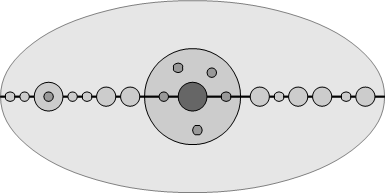
The metro area lies on an east-west rail line, and consists of a central city several suburbs; higher-density areas are denoted by darker shades, with the primary CBD in the darkest shade. The city proper also has five secondary CBDs, two of which are on the rail line. On the west, one suburb, really a secondary city, is larger than the rest, and has its own CBD, as job-dense as one of the primary city’s secondary CBDs. With rough symmetry of suburban demand west and east, there is no good reason why trains should not through the primary CBD, and good reasons why they should:
- People in the eastern suburbs may work in the secondary CBD just west of the primary one, and people in the western suburbs may work in the secondary CBD just east of the primary one.
- The primary CBD may not have room to park trains at rush hour without a costly railyard expansion.
- People within the central city may use the line as a rapid transit trunk, to get to either the primary CBD or the two secondary CBDs on the line, as well as to residential neighborhoods not depicted in the diagram.
This is relatively uncontroversial – urban transit is designed along the same guidelines. Also uncontroversial is the question of how far east the commuter line should run: the diagram shows a string of medium-size suburbs, so the line should run as far as the easternmost one, potentially with short-turn runs if the trains at the end are too empty.
The real controversy is how far west to run the service. On the one hand, the secondary city provides a natural outer anchor, with some reverse-peak ridership potential, so there’s an argument for terminating service there. I have criticized the Human Transit model of anchoring as a matter of urban planning, but as a matter of transit planning with fixed urban layout, it is sound; see explanations here and here. On the other hand, there are two smaller suburbs farther west, where people might want to commute to either the primary city or the secondary one, so perhaps service should run farther, with many trains short-turning at the secondary city to avoid running too many empty trains at the western end.
Which of the two options is better – terminating services at the secondary city or continuing onward – depends on the frequency the trunk rail line can support. The reason is that continuing onward requires a very large drop in capacity to avoid empty trains. In the depicted diagram, in relative units, 10% of the western suburbs’ built-up residential area is west of the secondary city; maybe another 10% is the western areas of the secondary city, which could host a station in addition to that at the city’s center. This means that nearly all trains should short-turn; only perhaps one in three or four should continue. If the demand is so intense that a quarter of the base frequency is enough, then trains should continue. But most likely, it isn’t. An individual commuter line with a train every 10 minutes off-peak would be stepped down to every half an hour at the western end, which is borderline; a train every 10 minutes off-peak almost never happens outside Paris, Tokyo, and other enormous systems, except when multiple branches interline to a single trunk.
The alternative is to terminate commuter trains at the secondary city, but then run supplemental service, centered at the secondary city. This supplemental service is not supposed to serve demand into the primary city, handling supercommuters from the western end via a timed transfer (with possible peak through-service), so it can run shorter trains at higher frequency. Sometimes, the secondary city’s CBD must be judged too auto-oriented to be served with commuter rail, and then the correct service pattern is no trains at all west of the secondary city.
Examples
In both Providence and San Jose, a situation akin to the above diagram occurs, except without any through-service beyond the primary CBD (respectively, Boston and San Francisco). Of course, San Jose has more residents than San Francisco, 1.03 million compared with 870,000, but it has only 360,000 jobs to San Francisco’s 610,000. Moreover, San Jose’s employment is more dispersed; according to OnTheMap, its CBD’s job density is about comparable to that of Providence’s CBD. Evidently, Caltrain ridership is 13,600 per weekday at San Francisco and 4,200 at San Jose Diridon (PDF-p. 6 here), with both stations located somewhat away from their respective cities’ CBDs. A proper comparison of Providence to Boston is harder to make, since South Station has multiple line and not just the Providence Line, but Providence’s secondary role within New England is well-understood.
In both cities, service runs beyond the secondary city, at reduced frequency. Between San Francisco and San Jose, Caltrain runs 5 trains per hour at the peak, and a train every hour off-peak; but Caltrain also runs three trains per day in each direction south to Gilroy, 47 km to the south (San Francisco-San Jose is 77 km). Between Boston and Providence, a distance of 70 km, the MBTA runs 3-4 trains per hour at the peak and a train every 1.5-2 hours off-peak, but one train per hour at the peak and one train every four hours off-peak continues another 31 km south to Wickford Junction.
Both tails, to Gilroy and to Wickford Junction, are significant drags on the ability of their respective cores to modernize. Ridership is very low: Tamien, just south of San Jose Diridon, has 1,100 weekday riders, but the sum total of all the stations to its south is 559; the two stations south of Providence have between them 454 weekday riders, compared with about 2,300 at Providence and 20,000 on the Providence Line overall (see PDF-pp. 74 and 77 of the 2014 MBTA Bluebook). In both cases, low ridership is a cause of poor service rather than a consequence: Clem Tillier tallied the population and job densities near each Caltrain station and found that, except in the southern neighborhoods of San Jose, there is no real ridership potential on the Gilroy extension; a similar analysis of the Providence Line’s tail has not been carried out, but one of its two stations is in a low-density suburb without many Boston-bound commuters, while Wickford Junction is surrounded by undeveloped land. Caltrain is currently planning to electrify south to Tamien, but there is no justification for continuing electrification further, which means that maintaining Gilroy service would require mixing diesel locomotive-hauled trains with lightweight EMUs; moreover, south of Tamien, the tracks are owned by Union Pacific rather than by Caltrain, and UP has little interest in allowing modern passenger trains on its tracks. In Rhode Island, an additional complication is that the line from Providence down to Wickford Junction is prime high-speed rail territory, and commuter rail ridership is frankly too low to justify complex scheduling with multiple overtakes, unlike the situation farther north in Massachusetts.
In the Bay Area, there is little that can be done, due to the low potential ridership south of Tamien, San Jose’s suburban layout and the distance of Diridon from the CBD, and UP ownership of the tracks. Perhaps a few diesel trains could run to San Jose Diridon with timed transfers to the electrified line from Tamien to San Francisco, but quite likely service could just be canceled. In Rhode Island, Wickford Junction should probably be closed due to low ridership, but Peter Brassard proposed an alternative, a Providence-focused line running short trains at medium frequency (perhaps once every 15 minutes), with very short interstations in order to serve Providence neighborhoods and not just the CBD. Such a line, running at the same average speed as a freight train due to the frequent stops, would interfere heavily with intercity trains, which means that four-tracking the line is a necessary precondition, as discussed here, but this may be worth it given potential local ridership. The most constrained part of the right-of-way is alongside the Route 10 expressway, which requires considerable repairs and is currently being overhauled at high cost.


 Pedestrian Observations
