Category: New York
Local and Intercity Rail are Complements
An argument in my comments section is reminding me of a discussion by American transit advocates 15 years ago, I think by The Overhead Wire, about the tension between funding local transit and high-speed rail. I forget who it was – probably Jeff Wood himself – pointing out that the argument in 2008-9 about whether the priority was local transit or intercity rail didn’t make much sense. There are separate questions of how to allocate funding for intercity transportation and how to do the same for local transportation, and in both cases the same group of activists can push for a more favorable rail : car funding ratio. Jeff was talking about this in the sense of political activism; the purpose of this post is to explain the same concept from the point of view of public transportation connectivity and network effects. This is not an obvious observation, judging by how many people argue to the contrary – years ago I had a debate with Noah Smith about this, in which he said the US shouldn’t build high-speed rail like the Shinkansen before building urban rail systems like those of Japanese cities (see my side here and here).
I’ve written about related issues before, namely, in 2022 when I recommended that countries invest against type. For example, France with its TGV-centric investment strategy should invest in connecting regional lines, whereas Germany with its hourly regional train connections should invest in completing its high-speed rail network. It’s also worthwhile to reread what I wrote about Metcalfe’s law for high-speed rail in 2020, here and here. Metcalfe’s law is an abstract rule about how the value of a network with n nodes is proportional to 

The combined point is that whenever two forms of local, regional, or intercity public transportation connect, investments in one strengthen the case for investments in the other.
In some edge cases, those investments can even be the same thing. I’ve been arguing for maybe 12 years that MBTA electrification complements Northeast Corridor high-speed rail investment, because running fast electric multiple units (EMUs) on the Providence Line and its branches instead of slow diesel locomotive-hauled trains means intercity trains wouldn’t get stuck behind commuter trains. Similarly, I blogged five years ago, and have been doing much more serious analysis recently with Devin Wilkins, that coordinating commuter rail and intercity rail schedules on the New Haven Line would produce very large speed gains, on the order of 40-45 minutes, for both intercity and commuter trains.
But those are edge cases, borne of exceptionally poor management and operations by Amtrak and the commuter railroads in the Northeast. Usually, investments clearly are mostly about one thing and not another – building a subway line is not an intercity rail project, and building greenfield high-speed rail is not a local or regional rail project.
And yet, they remain complements. The time savings that better operations and maintenance can produce on the New Haven Line are also present on other commuter lines in New York, for example on the LIRR (see also here, here, and here); they don’t speed up intercity trains, but do mean that people originating in the suburbs have much faster effective trips to where they’d take intercity rail. The same is true for physical investments in concrete: the North-South Rail Link in Boston and a Penn Station-Grand Central connection in New York both make it easier for passengers to connect to intercity trains, in addition to benefits for local and regional travel, and conversely, fast intercity trains strengthen the case for these two projects since they’d connect passengers to better intercity service.
Concretely, let’s take two New York-area commuter lines, of which one will definitely never have to interface with intercity rail and one probably will not either. The definitely line is the Morristown Line: right now it enters New York via the same North River Tunnels as all other trains from points west, intercity or regional, but the plan for the Gateway Tunnel is to segregate service so that the Morris and Essex Lines use the new tunnel and the Northeast Corridor intercity and commuter trains use the old tunnel, and so in the future they are not planned to interact. The probably line is the LIRR Main Line, which currently doesn’t interface with intercity trains as I explain in my post about the LIRR and Northeast Corridor, and which should keep not interfacing, but there are Amtrak plans to send a few daily intercities onto it.
Currently, the trip time from Morristown to New York is around 1:09 off-peak, with some peak-only express trains doing it in 1:01. With better operations and maintenance, it should take 0:47. The upshot is that passengers traveling from Morristown to Boston today have to do the trip in 1:09 plus 3:42-3:49 (Acela) or 4:15-4:35 (Regional). The commuter rail improvements, which other than Gateway and about one unfunded tie-in do not involve significant investment in concrete, turn the 4:51 plus transfer time trip to 4:29 plus transfer time – say 5 hours with the transfer, since the intercities run hourly and the transfers are untimed and, given the number of different branches coming in from New Jersey, cannot be timed. High-speed rail, say doing New York-Boston in 2 hours flat (which involves an I-95 bypass from New Haven to Kingston but no other significant deviations from the right-of-way), would make it 2:47 with a transfer time capped at 10 minutes, so maximum 2:57. In effect, these two investments combine to give people from Morristown an effective 41% reduction in trip time to Boston, which increases trip generation by a factor of 2.87. Of course, far more people from Morristown are interested in traveling to New York than to Boston, but the point is that in the presence of cheap interventions to rationalize and speed up commuter rail, intercity rail looks better.
The same is true from the other direction, from the LIRR Main Line. The two busiest suburban stations in the United States are on 2000s and 10s numbers Ronkonkoma and Hicksville, each with about 10,000 weekday boardings. Ronkonkoma-Penn Station is 1:18 and Hicksville-Penn Station is 0:42 off-peak; a few peak express trains per day do the trip a few minutes faster from Ronkonkoma by skipping Hicksville, but the fastest looks like 1:15. If the schedule is rationalized, Ronkonkoma is about 0:57 from New York and Hicksville 0:31, on trains making more stops than today. I don’t have to-the-minute New York-Washington schedules with high-speed rail yet, but I suspect 1:50 plus or minus 10 minutes is about right, down from 2:53-3:01 on the Acela and 3:17-3:38 on the Regional. So the current timetable for Ronkonkoma-Washington is, with a half-hour transfer time, around 4:45 today and 2:57 in the future, which is a 38% reduction in time and a factor of 2.59 increase in the propensity to travel. From Hicksville, the corresponding reduction is from 4:09 to 2:31, a 39% reduction and a factor of 2.72 increase in trip generation. Again, Long Islanders are far more interested in traveling to Manhattan than to Washington, but a factor of 2.59-2.72 increase in trip generation is nothing to scoff at.
The issue here is that once the cheap upgrades are done, the expensive ones start making more sense – and this is true for both intercity and regional trains. The New York-Boston timetable assumes an I-95 bypass between New Haven and Kingston, saving trains around 24 minutes, at a cost of maybe $5 billion; those 24 minutes matter more when they cut the trip time from 2:24 to 2:00 than when the current trip time is about 3:45 and the capacity on the line is so limited any increase in underlying demand has to go to higher fares, not more throughput. For suburban travelers, the gains are smaller, but still, going from 5:00 to 4:36 matters less than going from 3:21 to 2:57.
Conversely, the expensive upgrades for regional trains – by which I mean multi-billion dollars tunnels, not $300 million junction grade separations like Hunter or the few tens of millions of dollars on upgrading the junction and railyard at Summit – work better in a better-operated system. Electronics before concrete, not instead of concrete – in fact, good operations (i.e. good electronics) create more demand for megaprojects.
At no point are these really in competition, not just because flashy commuter rail projects complement intercity rail through mutual feeding, but also because the benefits for non-connecting passengers are so different that different funding mechanisms make sense. The North-South Rail Link has some benefits to intercity travel, as part of the same program with high-speed rail on the Northeast Corridor, and as such, it could be studied as part of the same program, if there is enough money in the budget for it, which there is not. Conversely, it has very strong local benefits, ideal for a funding partnership between the federal government and Massachusetts; similarly, New York commuter rail improvements are ideal for a funding partnership between the federal government, New York State, New Jersey, and very occasionally Connecticut.
In contrast, intercity rail benefits people who are far away from where construction is done: extensive bypasses built in Connecticut would create a small number of jobs in Connecticut temporarily, but the bigger benefits would accrue not just to residents of the state (through better New Haven-Boston and perhaps New Haven-New York trip times) but mostly to residents of neighboring states traveling through Connecticut. This is why there’s generally more national coordination of intercity rail planning than of regional rail planning: the German federal government, too, partly funds S-Bahn projects in major German cities, but isn’t involved in planning S21 S15 or the second S-Bahn trunk in Munich, whereas it is very involved in decisions on building high-speed rail lines. The situation in France is similar – the state is involved in decisions on LGVs and on Parisian transit but not on provincial transit, though it helps fund the latter; despite the similarity in the broad outlines of the funding structure, the outcomes are different, which should mean that the differences between France and Germany do not boil down to funding mechanisms or to inherent competition between intercity rail funds and regional rail funds.
Subway-Intercity Rail Connections
Something Onux said in comments on yesterday’s post, about connecting Brooklyn to intercity rail, got me thinking more about how metro lines and intercity rail can connect better. This matters for mature cities that build little infrastructure like New York or Berlin, but also for developing-world cities with large construction programs ahead of them. For the most part, a better subway system is automatically one that can also serve the train station better – the train station is usually an important destination for urban travel and therefore, usually the same things that make for a stronger subway system also make for better subway-intercity rail connections.
Subways and commuter trains
Like gender, transit mode is a spectrum. There are extensive systems that are clearly metro and ones that are clearly commuter rail, but also things in between, like the RER A, and by this schema, the Tokyo and Seoul subways are fairly modequeer.
The scope of this post is generally pure subway systems – even the most metro-like commuter lines, like the RER A and the Berlin S-Bahn, use mainline rail rights-of-way and usually naturally come to connect with intercity train stations. Of note, RER A planning, as soon as SNCF got involved, was modified to ensure the line would connect with Gare de Lyon and Gare Saint-Lazare; previous RATP-only plans had the line serving Bastille and not Gare de Lyon, and Concorde and not Auber. So here, the first rule is that metro (and metro-like commuter rail) plans should, when possible, be modified to have the lines serve mainline train stations.
Which train stations?
A city designing a subway system should ensure to serve the train station. This involves nontrivial questions about which train stations exactly.
On the one hand, opening more train stations allows for more opportunities for metro connections. In Boston, all intercity trains serve South Station and Back Bay, with connections to the Red and Orange Lines respectively. In Berlin, north-south intercity trains call not just at Hauptbahnhof, which connects to the Stadtbahn and (since 2020) U5, but also Gesundbrunnen and Südkreuz, which connect to the northern and southern legs of the Ringbahn and to the North-South Tunnel; Gesunbrunnen also has a U8 connection. In contrast, trains into Paris only call at the main terminal, and intercity trains in New York only stop at Penn Station.
On the other hand, extra stations like Back Bay and delay trains. The questions that need to be answered when deciding whether to add stations on an intercity line are,
- How constructible is the new station? In New York, this question rules out additional stops; some of the through-running plans involve a Penn Station-Grand Central connection to be used by intercity trains, but there are other reasons to keep it commuter rail-only (for example, it would make track-sharing on the Harlem Line even harder).
- How fast is the line around the new station? More stations are acceptable in already slow zones (reducing the stop penalty), on lines where most trips take a long time (reducing the impact of a given stop penalty). Back Bay and Südkreuz are in slow areas; Gesundbrunnen is north of Hauptbahnhof where nearly passengers are going south of Berlin, so it’s free from the perspective of passengers’ time.
- How valuable are the connections? This depends on factors like the ease of internal subway transfers, but mostly on which subway lines the line can connect to. Parisian train terminals should in theory get subsidiary stations because internal Métro transfers are so annoying, but there’s not much to connect to – just the M2/M6 ring, generally with no stations over the tracks.
Subway operations
In general, most things that improve subway operations in general also improve connectivity to the train station. For example, in New York, speeding up the trains would be noticeable enough to induce more ridership for all trips, including access to Penn Station; this could be done through reducing flagging restrictions (which we briefly mention at ETA), among other things. The same is true of reliability, frequency, and other common demands of transit advocates.
Also in New York, deinterlining would generally be an unalloyed good for Penn Station-bound passengers. The reason is that the north-south trunk lines in Manhattan, other than the 4/5/6, either serve Penn Station or get to Herald Square one long block away. The most critical place to deinterline is at DeKalb Avenue in Brooklyn, where the B/D/N/Q switch from a pattern in which the B and D share one track pair and the N and Q share another to one in which the B and Q share a pair and the D and N share a pair; the current situation is so delicate that trains are delayed two minutes just at this junction. The B/D and N/Q trunk lines in Manhattan are generally very close to each other, so that the drawback of deinterlining is reduced, but when it comes to serving Penn Station, the drawback is entirely eliminated, since both lines serve Herald Square.
If anything, it’s faster to list areas where subway service quality and subway service quality to the train station specifically are not the same than to list areas where they are:
- The train station is in city center, and so circumferential transit, generally important, doesn’t generally connect to the station; exceptions like the Ringbahn exist but are uncommon.
- If too many lines connect to the one station, then the station may become overloaded. Three lines are probably fine – Stockholm has all three T-bana lines serving T-Centralen, adjacent to the mainline Stockholm Central Station, and there is considerable but not dangerous crowding. But beyond that, metro networks need to start spreading out.
- Some American Sunbelt cities if anything have a subway connection to the train station, for example Los Angeles, without having good service in general. In Los Angeles, the one heavy rail trunk connects to Union Station and so does one branch of the Regional Connector; the city’s problems with subway-intercity rail connections are that it doesn’t really have a subway and that it doesn’t really have intercity rail either.
Intercity Trains and Long Island
Amtrak wants to extend three daily Northeast Corridor trains to Long Island. It’s a bad idea – for one, if the timetable can accommodate three daily trains, it can accommodate an hourly train – but beyond the frequency point, this is for fairly deep reasons, and it took me years of studying timetabling on the corridor to understand why. In short, the timetabling introduces too many points of failure, and meanwhile, the alternative of sending all trains that arrive in New York from Philadelphia and Washington onward to New Haven is appealing. To be clear, there are benefits to the Long Island routing, they’re just smaller than the operational costs; there’s a reason this post is notably not tagged “incompetence.”
How to connect the Northeast Corridor with Long Island

The Northeast Corridor has asymmetric demand on its two halves. North of New York, it connects the city with Boston. But south of New York, it connects to both Philadelphia and Washington. As a result, the line can always expect to have more traffic south of New York than north of it; today, this difference is magnified by the lower average speed of the northern half, due to the slowness of the line in Connecticut. Today, many trains terminate in New York and don’t run farther north; in the last 20 years, Amtrak has also gone back and forth on whether some trains should divert north at New Haven and run to Springfield or whether such service should only be provided with shuttle trains with a timed connection. Extending service to Long Island is one way to resolve the asymmetry of demand.
Such an extension would stop at the major stattions on the LIRR Main Line. The most important is Jamaica, with a connection to JFK; then, in the suburbs, it would be interesting to stop at least at Mineola and Hicksville and probably also go as far as Ronkonkoma, the end of the line depicted on the map. Amtrak’s proposed service makes exactly these stops plus one, Deer Park between Hicksville and Ronkonkoma.
The entire Main Line is electrified, but with third rail, not catenary. The trains for it therefore would need to be dual-voltage. This requires a dedicated fleet, but it’s not too hard to procure – it’s easier to go from AC to DC than in the opposite direction, and Amtrak and the LIRR already have dual-mode diesel locomotives with third rail shoes, so they could ask for shoes on catenary electric locomotives (or on EMUs).
The main benefit of doing this, as opposed to short-turning surplus Northeast Corridor trains in New York, is that it provides direct service to Long Island. In theory, this provides access to the 2.9 million people living on Long Island. In practice, the shed is somewhat smaller, because people living near LIRR branches that are not the Main Line would be connecting by train anyway and then the difference between connecting at Jamaica and connecting at Penn Station is not material; that said, Ronkonkoma has a large parking lot accessible from all of Suffolk County, and between it and significant parts of Nassau County near the Main Line, this is still 2 million people. There aren’t many destinations on Long Island, which has atypically little job sprawl for an American suburb, but 2 million originating passengers plus people boarding at Jamaica plus people going to Jamaica for JFK is a significant benefit. (How significant I can’t tell you – the tools I have for ridership estimation aren’t granular enough to detect the LIRR-Amtrak transfer penalty at Penn Station.)
My early Northeast Corridor ideas did include such service, for the above reasons. However, there are two serious drawbacks, detailed below.
Timetabling considerations
Under current plans, there is little interaction between the LIRR and the Northeast Corridor. There are two separate routes into Penn Station from the east, one via 32nd Street (“southern tunnels”) and one via 33rd (“northern tunnels”), each a two-track line with one track in each direction. The North River Tunnels, connecting Penn Station with New Jersey and the rest of the United States, face the southern tunnels; the Gateway tunnels under construction to double trans-Hudson capacity are not planned to pair with the northern tunnels, but rather to connect to stub-end tracks facing 31st Street. For this reason, Amtrak always or almost always enters Penn Station from the east using the southern tunnels; the northern tunnels do have some station tracks that connect to them and still allow through-service to the west, but the moves through the station interlocking are more complex and more constrained.
As seen on the map, east of Penn Station, the Northeast Corridor is to the north of the LIRR. Thus, Amtrak has to transition from being south of the LIRR to being north of it. This used to be done at-grade, with conflict with same-direction trains (but not opposite-direction ones); it has since been grade-separated, at excessive cost. With much LIRR service diverted to Grand Central via the East Side Access tunnel, current traffic can be divided so that LIRR Main Line service exclusively uses the northern tunnels and Northeast Corridor (Amtrak or commuter rail under the soon to open Penn Station Access project) service exclusively uses the southern tunnels; the one LIRR branch not going through Jamaica, the Port Washington Branch, can use the southern tunnels as if it is a Penn Station Access branch. This is not too far from how current service is organized anyway, with the LIRR preferring the northern (high-numbered) tracks at Penn Station, Amtrak the middle ones, and New Jersey Transit the southern ones with the stub end:

The status quo, including any modification thereto that keeps the LIRR (except the Port Washington Branch) separate from the Northeast Corridor, means that all timetabling complexity on the LIRR is localized to the LIRR. LIRR timetabling has to deal with all of the following issues today:
- There are many different branches, all of which want to go to Manhattan rather than to Brooklyn, and to a large extent they also want to go on the express tracks between Jamaica and Manhattan rather than the local tracks.
- There are two Manhattan terminals and no place to transfer between trains to different ones except Jamaica; an infill station at Sunnyside Yards, permitting trains from the LIRR going to Grand Central to exchange passengers with Penn Station Access trains, would be helpful, but does not currently exist.
- The outer Port Jefferson Branch is unelectrified and single-track and yet has fairly high ridership, so that isolating it with shuttle trains is infeasible except in the extreme short run pending electrification.
- All junctions east of Jamaica are flat.
- The Main Line has three tracks east of Floral Park, the third recently opened at very high cost, purely for peak-direction express trains, but cannot easily schedule express trains in both directions.
There are solutions to all of these problems, involving timetable simplification, reduction of express patterns with time saved through much reduced schedule padding, and targeted infrastructure interventions such as electrifying and double-tracking the entire Port Jefferson Branch.
However, Amtrak service throws multiple wrenches in this system. First, it requires a vigorous all-day express service between New York and Hicksville if not Ronkonkoma. Between Floral Park and Hicksville, there are three tracks. Right now the local demand is weak, but this is only because there is little local service, and instead the schedule encourages passengers to drive to Hicksville or Mineola and park there. Any stable timetable has to provide much stronger local service, and this means express trains have to awkwardly use the middle track as a single track. This isn’t impossible – it’s about 15 km of fast tracks with only one intermediate station, Mineola – but it’s constraining. Then the constraint propagates east of Hicksville, where there are only two tracks, and so those express trains have to share tracks with the locals and be timetabled not to conflict.
And second, all these additional conflict points would be transmitted to the entire Northeast Corridor. A delay in Deer Park would propagate to Philadelphia and Washington. Even without delays, the timetabling of the trains in New Jersey would be affected by constraints on Long Island; then the New Jersey timetabling constraints would be transmitted east to Connecticut and Massachusetts. All of this is doable, but at the price of worse schedule padding. I suspect that this is why the proposed Amtrak trip time for New York-Ronkonkoma is 1:25, where off-peak LIRR trains do it in 1:18 making all eight local stops between Ronkonkoma and Hicksville, Mineola, Jamaica, and Woodside. With low padding, which can only be done with more separated out timetables, they could do it in 1:08, making four more net stops.
Trains to New Haven
The other reason I’ve come to believe Northeast Corridor trains shouldn’t go to Jamaica and Long Island is that more trains need to go to Stamford and New Haven. This is for a number of different reasons.
The impact of higher average speed
The higher the average speed of the train, the more significant Boston-Philadelphia and Boston-Washington ridership is. This, in turn, reduces the difference in ridership north and south of New York somewhat, to the point that closer to one train in three doesn’t need to go to Boston than one train in two.
Springfield
Hartford and Springfield can expect significant ridership to New York if there is better service. Right now the line is unelectrified and runs haphazard schedules, but it could be electrified and trains could run through; moreover, any improvement to the New York-Boston line automatically also means New York-Springfield trains get faster, producing more ridership.
New Haven-New York trips
If we break my gravity model of ridership not into larger combined statistical areas but into smaller metropolitan statistical areas, separating out New Haven and Stamford from New York, then we see significant trips between Connecticut and New York. The model, which is purely intercity, at this point projects only 15% less traffic density in the Stamford-New York section than in the New York-Trenton section, counting the impact of Springfield and higher average speed as well.
Commutes from north of New York
There is some reason to believe that there will be much more ridership into New York from the nearby points – New Haven, Stamford, Newark, Trenton (if it has a stop), and Philadelphia – than the model predicts. The model doesn’t take commute trips into account; thus, it projects about 7.78 million annual trips between New York and either Stamford or New Haven, where in fact the New Haven Line was getting 125,000 weekday passengers and 39 million annual passengers in the 2010s, mostly from Connecticut and not Westchester County suburbs. Commute trips, in turn, accrete fairly symmetrically around the main city, reducing the difference in ridership between New York-Philadelphia and New York-New Haven, even though Philadelphia is the much larger city.
Combining everything
With largely symmetric ridership around New York in the core, it’s best to schedule the Northeast Corridor with the same number of trains immediately north and immediately south of it. At New Haven, trains should branch. The gravity model projects a 3:1 ratio between the ridership to Boston and to Springfield. Thus, if there are eight trains per hour between New Haven and Washington, then six should go to Boston and two to Springfield; this is not even that aggressive of an assumption, it’s just hard to timetable without additional bypasses. If there are six trains per hour south of New Haven, which is more delicate to timetable but can be done with much less concrete, then two should still go to Springfield, and they’ll be less full but over this short a section it’s probably worth it, given how important frequency is (hourly vs. half-hourly) for trips that are on the order of an hour and a half to New York.
How Residential is a Residential Neighborhood?
Last post, I brought up the point that the neighborhoods along the Interborough Express corridor in New York are residential. An alert commenter, Teban54transit, pointed out that this should weaken the line, since subway lines should connect residential neighborhoods with destinations and not just with other residential neighborhoods. To explain why this is not a major problem in this case, I’d like to go over what exactly is a residential neighborhood and what exactly is a destination. In short, a predominantly residential neighborhood may still have other functional uses, turning it into a destination. It’s imperfect in the case of IBX, but the relative ease of using the right-of-way makes the line still viable.
Residential-but-mixed neighborhoods
Residential neighborhoods always have nonresidential uses, serving the local population: supermarkets, schools, doctors’ offices, restaurants, pharmacies, clothing stores. These induce very few trips from out of the neighborhood, normally. But things are not always normal, and some residential areas end up getting a cluster of destinations.
In New York, the most common way such a cluster can form is as an ethnic center, including Harlem and several Chinatowns. People in and around New York travel to Harlem for specifically black cultural events, for example the shows at the Apollo Theater; they travel to Chinatown and Flushing for Chinese restaurants and supermarkets. Usually the people who so travel are members of the same ethnic community who live elsewhere; this way, in Washington Metro origin-and-destination travel data, one can see a few hundred extra trips a day between black neighborhoods east of the Anacostia River and Columbia Heights, whereas no noticeable bump is seen in work trips between those two areas on OnTheMap.
On the IBX route, this is Jackson Heights. It’s on net a bedroom community, whereas Flushing has within 1 km of Main and Roosevelt 43,000 jobs and 29,000 employed residents, but such ethnic cultural centers over time grow into destinations. People travel to the neighborhood for Indian restaurants, groceries, and cultural events, and it’s likely that over time the area will also get more professional services that cater to the community, creating more non-work and work destinations. The growth of Flushing as a job center is recent and has to be understood as part of this process: in 2007, on the eve of the Global Financial Crisis, there were only 17,000 jobs within 1 km of Main and Roosevelt. Jackson Heights, too, has seen growth in jobs from 2007 to 2019, though much less, by 27%, or 50% excluding Elmhurst Hospital, which over this period saw a small decrease in jobs.
Not only ethnic neighborhoods have this pattern. A neighborhood can grow to become mixed out of proximity to a business district, for example the Village, or out of a particular destination, for example anything near a university. On IBX, there’s nothing like the Village or Long Island City, but Brooklyn College is a destination in and of itself.
Building neighborhood-scale destinations
New public transit lines can help build neighborhoods into destinations. At the centers of cities, central business districts and rapid transit systems tend to co-evolve with each other: a high degree of centralization creates demand for more lines as the only way to truly serve all of those jobs, while a larger rapid transit system in turn can encourage the growth of city center as the place best served by the network. The same is true for secondary centers and junctions of other lines.
This, to be clear, is not a guarantee. Broadway Junction is very easily accessible by public transportation from a large fraction of New York. It’s also more or less the poorest area of the city, where working-class Bangladeshi immigrants living several to a room to save money on rent are considered a sign of gentrification and growth in rent. Adding IBX there is unlikely to change this situation.
But in Jackson Heights and around Brooklyn College, a change is more likely. Jackson Heights already has large numbers of residents using the radial subway lines to get to Manhattan for work, and a growing number of nonresidents who use its specialized businesses and cultural events. The latter group is the greatest beneficiary from circumferential transit, if it connects to the radial lines well; strong radial transit is a prerequisite, but in Jackson Heights, there already is such transit. Brooklyn College is already a destination, in a neighborhood that’s much better off than East New York and already draws widely because of the university trips; I expect that rapid transit service in three directions, up from the one direction available today (toward Manhattan), would encourage the growth of university-facing amenities, which generate their own trips.
Where to build circumferential rail
The best alignment for circumferential rail remains one that connects strong secondary destinations. However, that is strictly in theory, because usually such destinations don’t form a neat circle around city center, especially not in a city so divided by water like New York. If we were to draw the strongest secondary destinations in the city outside the Manhattan core excluding Downtown Brooklyn and Long Island City on the G, we’d get Morningside Heights for Columbia (centered on 116th), maybe 125th Street, the Bronx Hub, LaGuardia, Flushing, Jamaica, and Kings County Hospital/SUNY Downstate. These barely even form a coherent line if dug entirely underground by tunnel boring machine, diagonally under private blocks. And this is without taking into account destinations in New Jersey on the waterfront, which don’t form any neat circle with those city destinations (for example, Fort Lee is well to the north of Morningside Heights and Harlem).
In practice, then, circumferential lines have to go where it is possible, making compromises along the way. This is why it’s so important to connect to every radial, with as short a walk as practical: they never connect the strongest destinations and therefore have to live off of transfers. The G, which does connect the two largest job centers in the region outside Manhattan, fails because of the poor transfers. IBX works as a compromise alignment, connecting to interesting secondary destinations, with transfers to the most important ones, like Flushing and Jamaica. It is fortunate that the route is not purely residential: the neighborhoods are all on net bedroom communities, but some have the potential to grow to be more than that through both processes that are already happening and ones that good rapid transit can unlock.
Land Use Around the Interborough Express
Eric and Elif are working on a project to analyze land use around the corridor of the planned Interborough Express line in New York. The current land use is mostly residential, and a fascinating mix of densities. This leads to work on pedestrian, car, and transit connectedness, and on modal split. As might be expected, car ownership is fairly high along the corridor, especially near the stations that are not at all served by the subway today, as opposed to ones that are only served by radial lines. Elif gave a seminar talk about the subject together with João Paulouro Neves, and I’d like to share some highlights.
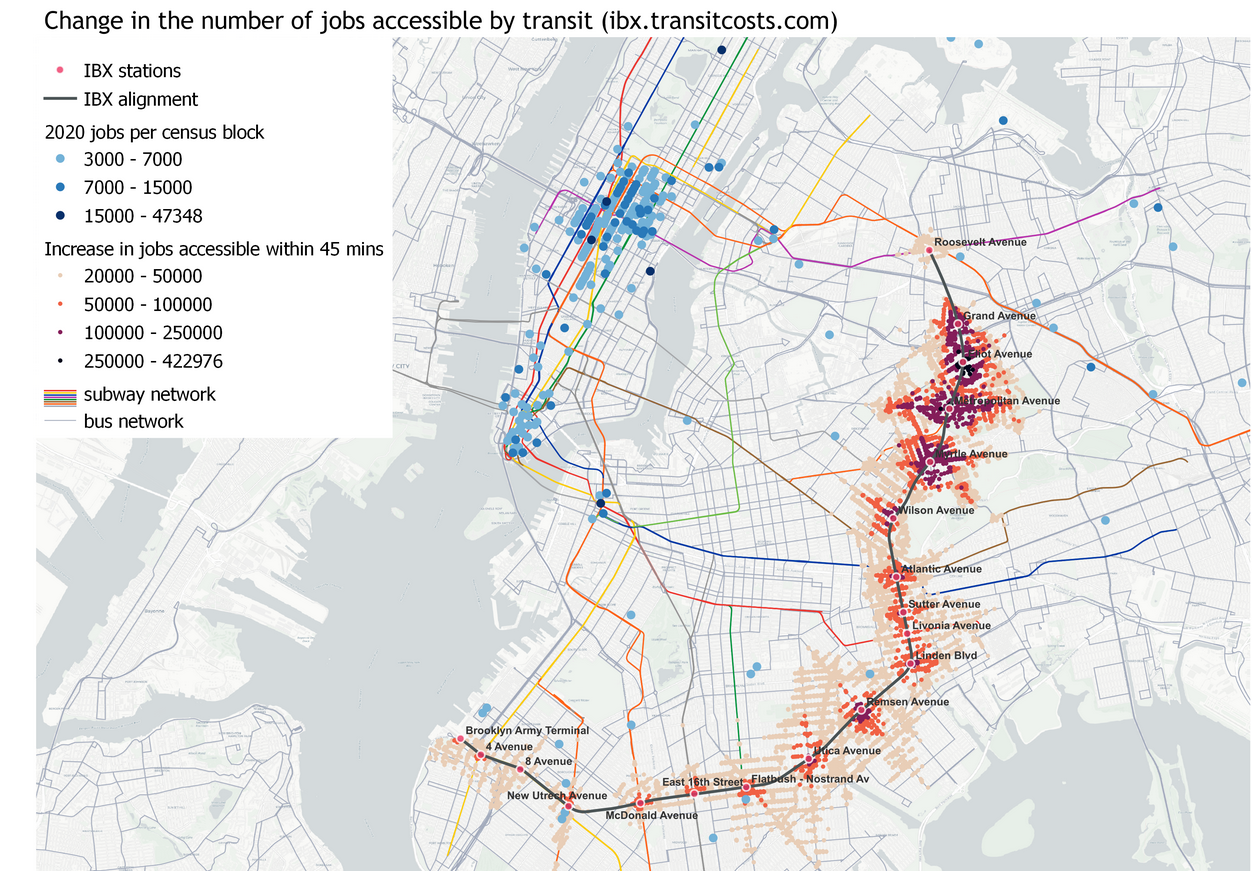
The increase in transit accessibility in the above map is not too surprising, I don’t think. Stations at both ends of the line gain relatively little; the stations that gain the most are ones without subway service today, but Metropolitan Avenue, currently only on the M, gains dramatically from the short trip to Roosevelt with its better accessibility to Midtown.
More interesting than this, at least to me, is the role of the line as a way to gradually push out the boundary between the transit- and auto-oriented sections of the city. For this, we should look at a density map together with a modal split map.

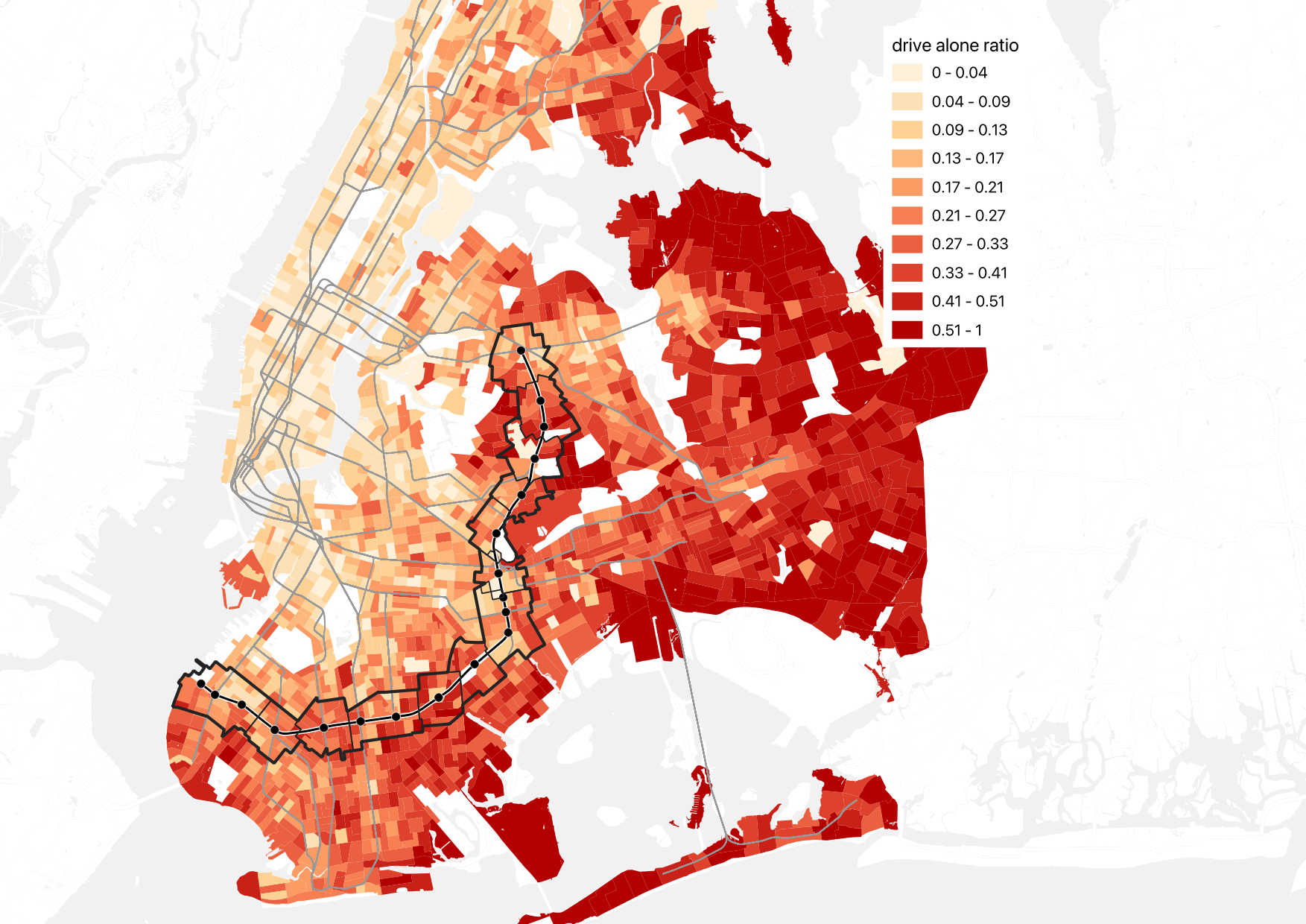
At the seminar talk, Elif described IBX as roughly delineating the boundary between the auto- and transit-oriented parts of the city, at least in Brooklyn. (In Queens, the model is much spikier, with ribbons of density and transit ridership along subway lines.) This isn’t quite visible in population density, but is glaring on the second map, of modal split.
Now, to be clear, it’s not that the IBX route itself is a boundary. The route is not a formidable barrier to pedestrian circulation: there are two freight trains per day in each direction, I believe, which means that people can cross the trench without worrying about noise the way they do when crossing a freeway. Rather, it’s a transitional zone, with more line density to the north and less to the south.
The upshot is that IBX is likely to push this transitional zone farther out. There is exceptionally poor crosstown access today – the street network is slow, and while some of the crosstown Brooklyn buses are very busy, they are also painfully slow, with the B35 on Church Avenue, perennially a top 10 route in citywide ridership, winning the borough-wide Pokey Award for its slowness. So we’re seeing strong latent demand for crosstown access in Brooklyn with how much ridership these buses have, and yet IBX is likely to greatly surpass them, because of the grade-separated right-of-way. With such a line in place, it’s likely that people living close to the line will learn to conceive of the subway system plus the IBX route as capable of connecting them in multiple directions: the subway would go toward and away from Manhattan, and IBX orthogonally, providing enough transit accessibility to incentivize people to rely on modes of travel other than the car.
This is especially important since the city’s street network looks differently by mode. Here is pedestrian integration by street:

And here is auto integration:

The auto integration map is not strongly centered the way the pedestrian map is. Quite a lot of the IBX route is in the highest-integration zone, that is with the best access for cars, but the there isn’t really a single continuous patch of high integration the way Midtown Manhattan is the center of the pedestrian map. East Williamsburg has high car integration and is not at all an auto-oriented area; I suspect it has such high integration because of the proximity to the Williamsburg and Kosciuszko Bridges but also to Grand Street and Metropolitan Avenue toward Queens, and while the freeways are zones of pedestrian hostility, Grand and Metropolitan are not.
What this means is that the red color of so many streets along the IBX should not by itself mean the area will remain auto-oriented. More likely, the presence of the line will encourage people to move to the area if they intend to commute by train, and I suspect this will happen even at stations that already have service to Manhattan and even among people who work in Manhattan. The mechanism here is that a subway commuter chooses where to live based on commuter convenience but also access to other amenities, and being able to take the train (for example) from Eastern Brooklyn to Jackson Heights matters. It’s a secondary effect, but it’s not zero. And then for people commuting to Brooklyn College or intending to live at one of the new stops (or at Metropolitan, which has Midtown access today but not great access), it’s a much larger effect.
The snag is that transit-oriented development is required. To some extent, the secondary effect of people intending to commute by train coming to the neighborhood to commute from it can generate ridership by itself; in the United States, all ridership estimates assume no change in zoning, due to federal requirements (the Federal Transit Administration has been burned before by cities promising upzoning to get funding for lines and then not delivering). But then transit-oriented development can make it much more, and much of the goal of the project is to recommend best practices in that direction: how to increase density, improve pedestrian accessibility to ensure the areas of effect become more rather than less walkable, encourage mixed uses, and so on.
Is There Room for Optimism About New York Construction Costs?
This year, there have been some positive signs about things changing in New York on subway construction – and yet, I’m uncertain about them. There are some signs that construction costs for Second Avenue Subway Phase 2 are coming under control. The New York Post broke in January that the MTA is eying smaller station designs, to reduce costs, to the tun of $300 million; an article released a few hours ago adds that there may be another $600 million in potential savings. So, in theory, costs are going down, and they’re going down as the MTA implements something we’ve been screaming about at the Transit Costs Project, so we should be happy.
And yet, I’m uncertain – not negative, but still somewhat pessimistic about whether this portends an era in which New York can finally build more subways. The main reason isn’t even some mistrust in the MTA at this point – the reduction in station footprints is a genuinely good thing, and to the extent it’s incomplete, it’s because it’s a longstanding project with older designs. Rather, it’s a combination of what this means for future projects, and how it interacts with federal funding. In brief, federal funding is at the level of the project rather than agency, and this makes it hard for cost savings to be plugged into the most straightforward benefit – namely, being able to build more on the same budget.
How is the money being saved?
The New York Post is relying on an MTA presentation from January that defends the cost structure but talks about how to reduce station costs through reducing back-of-house space. Phase 1 of Second Avenue Subway built two deep-mined intermediate stations, at 72nd and 86th Streets; the platforms are 610′ (187 meters) long, and there are no serious prospects of ever running longer trains since the line is an extension of older lines, but the station caverns are, respectively, 398 and 295 meters long, where the norm in the European comparison cases we’ve seen is that the station dig is 3-15% longer than the platforms, not twice as long.
Both stations have extensive back-of-house space, which New York City Transit demanded so that each department using the station would have its own space; 72nd also has a crossover inherited from older designs that would have permitted some trains from the south to terminate there on a third station track, which was later removed from scope to reduce costs. (The terminal station, the cut-and-cover 96th Street, is a 485 meter long dig, but that’s an artifact of block-level geology: the northern end had to go as far as 99th in order to connect with an older tunnel built in the 1970s, whereas the southern end had to go as far as 92nd because the underground geology changes abruptly there and it was easier to start boring at 92nd than at 96th.)
The plan for Phase 2 initially included much longer digs than the platform, for the same reason. However, it has since changed, and now the digs are substantially reduced. The MTA’s presentation looks like the overage at 125th Street is reduced from somewhat more than 100% in the 2004 plan to about 40-50% in the 2023 plan, and the overage at 106th and 116th is somewhat less than that, maybe 30-40%. While the 125th Street station dig is still as deep as in prior plans, the deep-mined station will also extend less far up, reducing the extent of space required to be outfit with systems.
The MTA could shrink the stations’ footprint further and save more money, but it’s fairly late in the design, and thus the opportunity to take full benefit of this improvement is for future projects. If this establishes precedent for future station construction, then it’s an unmixed blessing.
Money is saved. So what?
The broader issue is that the savings from shrinking the stations’ footprint – totaling potentially $1 billion out of a budget of $7 billion – don’t have much to go. The rub is that the project already has a Full Funding Grant Agreement. If the MTA manages to do it for less, then the most obvious, and most pessimistic, answer to where the money goes is “preventing future overruns.” The savings, in the worst case, then transfer waste from one basket, namely oversize stations, to other baskets, which could be future conflict with contractors, last-minute design changes, or betterments to the neighborhood.
That said, there are plans to spend it on something useful. But the problem is that this is limited by the scope of the project itself. Second Avenue Subway in its current iteration dates to the 1990s, and is reusing some infrastructure from the 1970s. The intention in the 1990s was to do the entire thing, or at least Phases 1 and 2, together, and the project was only chopped into four phases due to high costs. There was design work done 20 years ago or more, and the environmental impact statement is roughly that old.
I suspect the reason the cost saving from shrinking the stations is $1 billion and not much more – we estimated that Phase 1’s cost would have been halved if the stations had been only as long as the platforms – is that the designs are already spoken for, with 20 years of optimization involved. Thus the change is reducing the hard costs of construction, but not the soft costs. It will not surprise me if a postmortem will reveal an elevated ratio of soft to hard costs, purely because the cost savings are happening at such a late stage; in this case, and only in this case, it is important to forgive a high ratio of soft to hard costs, since it portends that future designs will be cheaper, and future cost savings larger. Normally, a high soft-to-hard cost ratio suggests red tape and waste involving consultants, but in this one case, it would suggest something else; I highlight this so that watchdogs for government waste, including the New York Post, realize what is going on and avoid hitting the project if it turns out to indeed have a high soft-to-hard cost ratio as I expect.
Current plans include potentially continuing the tunnel boring under 125th Street. Governor Hochul expressed some interest in a subway extension under 125th Street, extending Phase 2 from 125th/Lexington to the Hudson, with stops at the intersections with the subway lines, at Lenox (2/3), St. Nicholas (A/B/C/D), and Broadway (1 and also potential commuter rail). Such an extension was long on the wishlist of New York-area railfans, and an operations planner mentioned it to me as a future desire more than 10 years ago, unprompted. But there is no way to just reallocate $1 billion to this line; that’s not how federal funding works. At best, it will be possible to continue boring the tunnel all the way to the west, and leave the systems and stations to a future project.
My pessimism is that the cost figure given for the 125th Street extension is $7.6 billion, around $3.3 billion per kilometer. Even taking into account future inflation, it’s costlier than Second Avenue Subway Phases 1 and 2. Now, this is an early number, one that hasn’t really made it into any plans. I hope that the current cost savings are then plugged into the 125th Street extension plan, and that this project is pursued seriously at a much lower cost figure; since all stations would have to be complex digs underneath older north-south subway lines, the benefits of shrinking station footprint are especially large. But I worry that this will not happen; I’ve had hopes dashed before – for example, FRA reform did not lead American commuter rail agencies to start buying alt-compliant vehicles. We’ll see what happens if there’s more detailed work on the 125th Street extension proposal.
Funding projects vs. funding agencies
The current way federal funding works for public transportation in the United States is that the government funds specific capital projects. The MTA can ask for funding for big-ticket items like Second Avenue Subway Phase 1, Phase 2, a future 125th Street subway, the Interborough Express, or any similar such line. It can also ask for a rolling program of improvements, for example installing elevators at stations to make them accessible in line with the Americans with Disabilities Act. But the federal government does not make it easy to move money between such projects.
Phase 2 is just one project, but imagine that there are three subway lines funded concurrently: Phase 2, a subway extension under Nostrand, and a subway extension under Utica. If the MTA finds 25% cost savings, it can’t easily flex the money to a fourth line, say under 125th. It would need to start the planning process early, which is so cumbersome and expensive that it wouldn’t do so for a project it wasn’t certain it wanted to do; there is no shelf of subway extensions that are approved and are just waiting for money.
This makes the incentives for cost savings uncertain: cost savings could be used to establish the agency’s bona fides with a distrustful public, or to establish a warchest guarding against future cost overruns, or to trial new ways of working that could lead to bigger cost savings in the future, but the most straightforward benefit of cost savings – building more infrastructure on the same budget – is not generally available. For Phase 2, the best that can happen is, again, continuing boring the tunnel to the western end of 125th Street, which could be connected with the current project because the geology under the street is the same from Second Avenue to Broadway so might as well future-proof it.
And unfortunately, in the United States, the current examples of funding agencies rather than projects have been lacking. The programs in Los Angeles and Seattle, funded by sales taxes, in effect fund the agencies. There are long lists of projects in both metro areas that are funded from them, but they come from the same pool of money in each region. The situation in Los Angeles is that there’s a decided priority list, with money allocated through the end of the 2050s; if Los Angeles figures out how to cut costs significantly, all of the opening dates will be moved closer and additional lines could be planned and built with the money (the planning and environmental review process takes years, not decades, so by 2050 they will have reviews for the additional subways they could build).
And yet, the same process that’s produced lush agency-level funding in both regions has also led to bad prioritization. New York may have the world’s highest construction costs, but at least what it’s building is what it should be building: Second Avenue Subway Phase 2 is indeed the highest priority right now, and among the next priorities, the Interborough Express and 125th Street are solid choices, according to most area rail advocates two of the top five, and potentially even the top two (the other three are Nostrand, Utica, and an elevated extension of the Astoria Line to LaGuardia). In contrast, Los Angeles is prioritizing the wrong projects. The same ballot proposition process there that produces agency-level funding also requires the agency to bribe local actors who care little for public transportation or for ideological politics with lines to their own subregions of the county, not because they or their constituents will ride the trains, but because they will be able to tell their constituents “I managed to force the county to give us infrastructure money.” This way, each region of the county gets a light rail extension, no matter how lightly-ridden, while the core of the system receives little investment: while the busiest bus corridor in Los Angeles, Wilshire, is getting a subway in the D (Purple) Line Extension, the next two busiest, Vermont and Western, are not getting any rail through the 2050s, despite calls from advocates to built a line on Vermont to turn the B (Red) Line into a north-south line rather than a branch with the Purple Line.
Incentives for the future
The MTA is clearly capable of saving money. The question is now how to incentivize doing more of it. First of all, I urge New York-area advocates to pursue the 125th Street extension, and demand that the cost savings identified for Phase 2 apply to it too. The savings may even potentially be relevant to the Interborough Express, though with at-grade and above-ground stations, the impact is greatly reduced. The Phase 2 savings are reactive; applying them to future lines is proactive.
Second, I urge both the MTA and advocates to look for cost savings in areas where it is easier to flex money – namely, ADA accessibility. Being able to make a station accessible not for the current budget of about $70 million per station with contingency but the $25 million of Boston or $10 million of Madrid would enable New York to have an all-accessible subway system not in the 2050s but in the early 2030s.
Finally, at the federal level, it is useful to figure out how to fund agencies with a positive track record and not just specific projects. Potentially, agencies could be encouraged to submit wishlists of future projects that may be cleared in case money becomes available on short notice; this is useful not just in the case of cost savings, but also in the case of an unexpected infrastructure stimulus – neither the scope of the 2009 stimulus in the early Obama era nor that of 2021 under Biden had been telegraphed until shortly before, and so agencies have not always been able to take maximum advantage of the additional funds.
Serving Metro-North Fordham Station
In the Bronx, the Metro-North Harlem Line runs north-south, west of the 2/5 subway lines on White Plains Road and east of the 4 on Jerome Avenue and the B/D on Grand Concourse. It makes multiple stops, all served rather infrequently, currently about every half hour, with some hourly midday gaps, at premium fare. The north-south bus lines most directly parallel to the line, the Bx15 and Bx41, ranked #20 and #24 respectively in ridership on the New York City Transit system in 2019, though both have lost considerable ground since the pandemic. Overall, there is serious if not extremely high demand for service at those stations. There is already a fair amount of reverse-peak ridership: while those half-hourly frequencies can’t compete with the subway for service to Manhattan, they are the only non-car option for reverse-peak service to White Plains, and Fordham gets additional frequencies as well as some trains to Stamford. A city report from 2011 says that Fordham has 51 inbound passengers and 3,055 outbound ones boarding per weekday on Metro-North. Figuring out how to improve service in the Bronx requires a paradigm shift in how commuter rail is conceived in North America. Fordham’s reverse-peak service is a genuinely hard scheduling question, which we’re having to wrestle with as we’re proposing a (much) faster and smoother set of timetables for Northeast Corridor trains. Together, they make for a nontrivial exercise in tradeoffs on a busy commuter line, in which all options leave something to be desired.
Harlem Line local service
The bulk of demand from Fordham is local service, mostly toward Manhattan. The area is a bedroom community: within 1 km of the station at Park and Fordham there are 35,338 employed residents and only 22,515 jobs as of 2019; the largest destination is Manhattan (12,734 commuters), followed by the Bronx (7,744), then the rest of the city (8,069 across three boroughs), and only then Westchester (2,207), Long Island (1,660), and Connecticut (220). But to an extent, the station’s shed is larger for reverse-commute service, because people can connect from the Bx12 bus, which ranked second in the city behind the M15 in both 2019 and 2022; in contrast, Manhattan-bound commuters are taking the subway if they live well east or west of the station along Fordham. Nonetheless, the dominance of commutes to city destinations means that the most important service is to the rest of the city.
Indeed, the nearest subway stations have high subway ridership. The city report linked in the lede cites ridership of 11,521 on the B/D and another 12,560 on the 4 every weekday, as of 2012; both stations saw declines by 2019. The West Bronx’s hilly terrain makes these stations imperfect substitutes for each other and for the Metro-North station, despite the overlap in the walk sheds – along Fordham, Park is 600 meters from the Concourse and 950 from Jerome. Nonetheless, “roughly the same as either of the Fordham stations on the subway” should be a first-order estimate for the ridership potential; better Metro-North service would provide a much faster option to East Harlem and Grand Central, but conversely require an awkward transfer to get to points south, which predominate among destinations of workers from the area, who tilt working-class and therefore peak in Midtown South and not in the 50s:
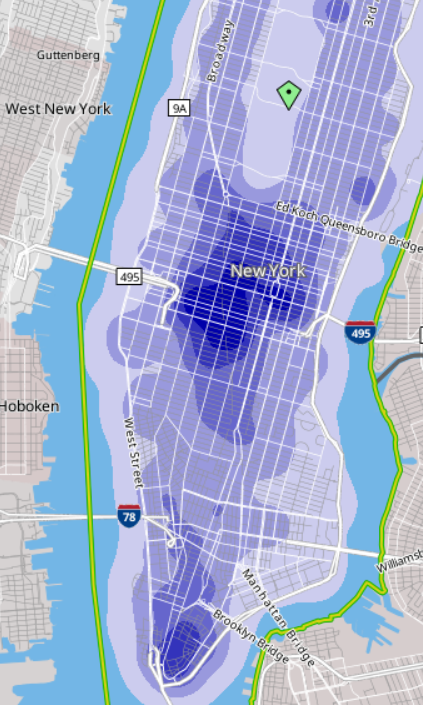
Adding up all the Bronx stations on the line – Wakefield, Woodlawn, Williams Bridge, Botanical Garden, Fordham, Tremont, Melrose – we get 170,049 employed residents (as always, as of 2019), of whom 62,837 work in Manhattan. The line is overall in a subway desert, close to the 4 and B/D but along hills, and not so close to the 2/5 to the east; several tens of thousands of boardings are plausible if service is improved. For comparison, the combination of Westchester, Putnam, and Dutchess Counties has 115,185 Manhattan-bound commuters, split across the Harlem Line, the Hudson Line, and the inner New Haven Line. The Bronx is thus likely to take a majority of Manhattan-bound ridership on the Harlem Line, though not an overwhelming one.
To serve all this latent demand, it is obligatory to run more local service. A minimum service frequency of a train every 10 minutes is required. The current outbound schedule is 20 minutes from Grand Central to Fordham, and about four of those are a slowdown in the Grand Central throat that can be waived (the current speed limit is 10 miles per hour for the last mile; the infrastructure can largely fit trains running three times that fast almost all the way to the bumpers). Lower frequency than this would not really make use of the line’s speed.
Moreover, using the track chart as of 2015 and current (derated) M7 technical performance, the technical trip time is 18 minutes, over which 20 minutes is not too onerously padded; but removing the derating and the four gratuitous minutes crawling into and out of Grand Central, this is about 14 minutes, with some pad. The speed zones can be further increased by using modern values of cant and cant deficiency on curves, but the difference isn’t very large, only 40 seconds, since this is a section with frequent stops. It’s fast, and to reinforce this, even higher frequency may be warranted, a train every 7.5 or 6 or even 5 minutes.
There is room on the tracks for all of this. The issue is that this requires dedicating the local tracks on the Harlem Line in the Bronx to local service, instead of having trains pass the platforms without stopping. This, in turn, requires slowing down some trains from Westchester to make more local stops. Current peak traffic on the Harlem Line is 15 trains per hour, of which 14 run past Mount Vernon West, the current northern limit of the four-track section, and 13 don’t stop in the Bronx at all. The line has three tracks through past Crestwood, and the stations are set up with room for a fourth track, but a full 10 trains per hour, including one that stops in the Bronx, run past Crestwood. In theory it’s possible to run 12 trains per hour to Mount Vernon West making all stops, and 12 trains past it skipping Bronx stops; this slows down the express trains from White Plains, which currently skip seven stops south of White Plains to Mount Vernon West inclusive, but higher speeds in the Bronx, speeding up the Grand Central throat, higher frequency, and lower schedule padding would together lead to improvements in trip times. However, this introduces a new set of problems, for which we need to consider the New Haven Line too.
Harlem Line express service and the New Haven Line
Currently, the New Haven Line runs 20 trains per hour into Grand Central at the peak. This number will go down after Penn Station Access opens in 2027, but not massively; a split of 6-8 trains per hour into Penn Station and 16-18 into Grand Central, with the new service mildly increasing total throughput, is reasonable.
Today, New Haven Line locals stop at Fordham, and nowhere else in the Bronx. This is inherited from the trackage rights agreement between the New York Central and the New York, New Haven and Hartford Railroad, allowing the latter to make only one stop in the Bronx on the former’s territory; it used to be Woodlawn, the branch point, but has been moved to Fordham, which has busier reverse-peak traffic. The two railroads merged in 1969, and all service is currently run by Metro-North, but the practice persists. This is not necessarily stupid: the New Haven locals are long – Stamford is 53 km from Grand Central, 50% farther than White Plains – and a system in which the New Haven trains are more express than the Harlem trains is not by itself stupid, depending on other system constraints. Unfortunately, this setup introduces all manners of constraints into the system:
- Fordham is a local-only station, and thus New Haven locals have to use the local tracks, using awkwardly-placed switches to get between the express and the local tracks. In fact, all stations up to and including Woodlawn are local-only; the first station with platforms on the express tracks is Wakefield, just north of the split between the two lines.
- If there are 12 Harlem Line trains per hour expressing through the Bronx, then the New Haven Line is limited to about 12 trains per hour as well unless the local trains make all the Bronx local stops.
- The Hudson Line has a flat junction with the Harlem Line at Mott Haven Junction, which means that any regular schedule has to have gaps to let Hudson Line trains pass; current peak Hudson Line traffic is 11 trains per hour, but it was 14 before corona.
This leads to a number of different options, each problematic in its own way.
Maximum separation
In this schedule, all Harlem Line trains run local, and all New Haven Line trains run express in the Bronx. This is the easiest to timetable – the junction between the two lines, unlike Mott Haven, is grade-separated. This also requires splitting the Hudson Line between local and express tracks, so delays will still propagate in any situation unless the Hudson Line is moved to the Empire Connection (6-8 trains per hour can stay on the current route); but in a future with Penn Station Access West, building such service, it does allow for neat separation of the routes, and I usually crayon it this way in very high-investment scenarios with multiple through-running tunnels.
But in the near future, it is a massive slowdown for Harlem Line riders who currently have express service from White Plains to Manhattan. The current peak timetable has a 15-minute difference between local and express trains on this section; this figure is padded but not massively so, and conversely, higher speeds on curves increase the express train speed premium.
It also severs the connection between the Bronx and the New Haven Line, unless passengers take east-west buses to the Penn Station Access stations. It is possible to add infill at Wakefield on the New Haven Line: this is north of the junction with the Harlem Line, but barely, so the separation between the lines is short, and a transfer station is feasible. But it wouldn’t be a cross-platform transfer, and so Fordham-Stamford service would still be degraded.
Locals run local
The New Haven Line locals can make local stops in the Bronx. It’s a slowdown of a few minutes for those trains – the current outbound timetable is 18 minutes from Grand Central to Fordham, two minutes faster than on Harlem Line locals while skipping Melrose and Tremont. Overall, it’s a slowdown of around six minutes; the current speed zones are 60 and 75 mph, and while raising the speed limits increases the extent of the slowdown (most of the track geometry is good for 160 km/h), getting new trainsets with better acceleration performance decreases it, and overall it’s likely a wash.
From there, the service pattern follows. New Haven Line locals to Grand Central have little reason to run more frequently than every 10 minutes at peak – the local stations are 30-60 minutes out of Grand Central today, and this is massively padded, but with the timetables Devin produced, fixing the Grand Central throat, New Rochelle would still be 20 minutes out on a local train (stopping at Fordham only as is the case today) and Stamford would be 45 minutes out. What’s more, there will be some local trains to Penn Station starting in three years, boosting the effective frequency to a train every five minutes, with a choice of Manhattan station if express trains can be made to stop at New Rochelle with a timed connection.
Now, if there are six local trains per hour in the Bronx going to Stamford, then the Harlem Line locals only take six trains per hour of their own, and then 12 trains should run express from Wakefield to Harlem. What they do to the north depends. The simplest option is to have all of them make all stops, which costs White Plains 7-8 minutes relative to the express stopping pattern. But if the line can be four-tracked to Crestwood, then half the trains can run local to White Plains and half can run nonstop between Wakefield or Mount Vernon West and White Plains. Two local stations, Scarsdale and Hartsdale, are in two-track territory, but timetabling a local to follow an express when both run every 10 minutes and there are only two local stops’ worth of speed difference is not hard.
The New Haven Line, meanwhile, gets 12 express trains per hour. Those match 12 express Harlem Line trains per hour, and then there’s no more room on the express tracks; Hudson Line trains have to use the local tracks and somehow find slots for the northbound trains to cross both express tracks at-grade.
Status quo
The status quo balances Bronx-Stamford connectivity with speed. Bear in mind, the New Haven Line today has truly massive timetable padding, to the point that making trains make all six stops in the Bronx and not just Fordham would still leave New Rochelle locals faster than they are today if the other speedup treatments were put into place. But the status quo would allow New Rochelle, Larchmont, Rye, and Greenwich to take maximum advantage of the speedup, which is good. The problem with it is that it forces New Haven Line locals to take slots from both the express tracks and the local tracks in the Bronx.
In this situation, the New Haven Line still runs six locals and 12 express trains to Grand Central per hour. The Harlem Line is reduced to six express trains through the Bronx and has to run 12 trains local. Transfers at Wakefield allow people in suburbs south of White Plains to get on a faster train, but this in effect reduces the effective peak-of-peak throughput from the suburbs to Manhattan to just six trains per hour.
Express Fordham station
Rebuilding Fordham as an express station means there’s no longer any need to figure out which trains stop there and which don’t: all would. Then the New Haven Line would run express and the Harlem would either run local or run a mix.
The problem is that Fordham is in a constrained location, where such a rebuild is hard:
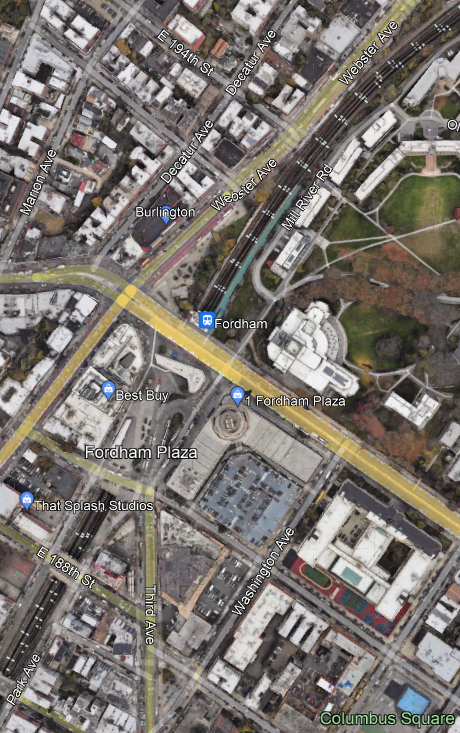
The line is below-grade, with a tunnel from Fordham Road to 189th Street. The platforms are short and narrow, and partly overlap the tunnel. Any conversion has to involve two island platforms north of the tunnel, where there is room but only if the right-of-way is expanded a little, at the expense of some parkland, and possibly a lane of Webster Avenue. The cost would not be pretty, independently of the inability of the MTA to build anything on a reasonable budget.
That said, the timetables on the Northeast Corridor require some infrastructure intervention to smooth things, like grade-separating some junctions for hundreds of millions of dollars each. New Rochelle, which has only a local platform southbound, should almost certainly be rebuilt as a full express stop. So rebuilding Fordham is not out of the question, even if the cost is high (which it is).
In this situation, all New Haven Line trains should use the express tracks. Thus, as in the status quo alternative, the Harlem Line gets six express trains, the other trains having to run local. Potentially, there may be a schedule in which the New Haven Line runs 16 trains to Grand Central and eight to Penn Station, and then the Harlem Line can get eight local and eight express trains; but then the local trains have to be carrying the load well into Westchester, and four-tracking the line to Crestwood is likely obligatory.
The New Haven Line and intercity trains
The above analysis elides one important factor: intercity trains. The current practice in the United States is a three-way separation of urban rail, suburban commuter rail, and intercity rail, with fares designed to discourage riders from taking trains that are not in their sector. However, in much the same way the best industry practice is to charge mode-neutral fares within cities, it is also valuable to charge mode-neutral fares between them. In other words, it’s useful to look at the impact of permitting people with valid commuter rail tickets to take intercity trains, without seat reservations.
To be clear, this means that at rush hour, there are going to be standees on busy commuter routes including Stamford-New York and Trenton-New York. But it’s not necessarily bad. The intercity trip time in our timetables between Stamford and New York is around 29 minutes without high-speed bypasses; the standing time would be less than some subway riders endure today – in the morning rush hour the E train departs Jamaica Center full and takes 34 minutes to get to its first Manhattan stop. And then there’s the issue of capacity: commuter trains on the New Haven Line are eight cars long, intercity trains can be straightforwardly expanded to 16 cars by lengthening the platforms at a very small number of stations.
And if the intercity trains mop up some of the express commuter rail traffic, then the required service on the New Haven Line at rush hour greatly decreases. An intercity train, twice as long as a commuter train (albeit with somewhat fewer seats and less standing space per car), could plausibly displace so much commuter traffic that the peak traffic on the line could be reduced, say to 18 trains per hour from today’s 20. Moreover, the reduction would be disproportionately at longer distance: passengers west of Stamford would not have any replacement intercity train unless they backtracked, but passengers east of Stamford would likely switch. This way, the required New Haven Line traffic shrinks to 12 local trains per hour and six express trains; half the locals run to Penn Station and half to Grand Central, and all express trains run to Grand Central.
In that situation, we can rerun the scenarios for what to do about Fordham; the situation generally improves, since less commuter traffic is required. The maximum separation scenario finally permits actual separation – the Hudson Line would run on the express tracks into Grand Central and have to cross the southbound Harlem Line locals at Mott Haven Junction, with predictable gaps between trains. The locals-run-local scenario gives Harlem Line express trains more wiggle room to slot between New Haven Line express trains. The status quo option lets the Harlem Line run six local trains and 12 express trains, though that likely underserves the Bronx. Converting Fordham to an express stop straightforwardly works with zero, six, or 12 express Harlem Line trains per hour.
Or maybe not. It’s fine to assume that letting passengers get on a train that does Stamford-Penn Station in 29 minutes and New Haven-Penn Station in 57 for the price of a commuter pass is going to remove passengers from the express commuter trains and put them onto longer intercity trains. But by the same token, the massive speed improvements to the other stops could lead to an increase in peak demand. The current trip time to Stamford is 1:12 on a local train; cutting that to 45 minutes means so much faster trips to the suburbs in between that ridership could increase to the point of requiring even more service. I’m not convinced on this – the modal split for peak commutes to Manhattan is already very high (Metro-North claimed 80% in the 2000s), and these suburbs are incredibly NIMBY. But it’s worth considering. At the very least, more local service is easier to add to the timetable than more express service – locals to Grand Central don’t share tracks with intercities at all, and even locals to Penn Station only do on a controllable low-speed section in Queens.
Costs Per Rider and Willingness to Build
At the Transit Costs Project, we study the costs of urban rail lines per kilometer. This, with our usual controls, is a rough indicator of how efficient a city’s infrastructure construction program is. However, cost-effectiveness is different from efficiency, and is better measured not by just the cost but also the benefits, which are measured by ridership. Thus, cost-effectiveness is best measured by the cost of each project per rider. So what does it mean to compare different cities by their costs per rider, rather than per kilometer?
The answer is, “not much,” at least not as far as efficiency or good decisionmaking. In fact, while some projects persistently have costs per rider that are too high to be cost-effective (for example, it’s endemic to airport extensions), some cities have costs per rider that are too low, such as Berlin. The issue here is that if municipal or state decisionmaking is healthy, it will build cost-effective lines; if a line under discussion has a very high benefit-cost ratio, or equivalently a very low cost per rider, it means it should have been built long ago, and it speaks poorly to the local decisionmaking that it hasn’t been built already, as is unfortunately the case in Berlin.
Cost per rider and cost-effectiveness
As always, let’s start with Second Avenue Subway Phase 1, the project that launched my interest in construction costs and the Transit Costs Project writ large. The projected daily ridership is 202,000; the line came close to it in 2019, reaching about 163,000 (see data here; I’m taking boardings for the three new stations, adding the growth in ridership at Lexington/63rd, and multiplying by two to account for disembarkings), and would have likely reached projection by now but for the pandemic. The cost, in 2023 dollars, was $6.23 billion, or about $31,000 per projected weekday trip.
For another anchoring number, let’s use the Stockholm Metro’s entire construction from the 1940s to the 1970s. This is useful because in addition to costs per rider, there is a published ex post benefit-cost ratio, thanks to the work of Maria Börjesson. The cost of that system, in 2023 PPP dollars, was $3.7 billion, with a ridership of 1,265,900 per workday in 2019, or $2,900/rider, while the benefit-cost ratio is 6 without taking agglomeration into account, or 8.5 with. This does not mean that the value of a rider is only about $24,900; this was the value in the economic situation of postwar Sweden, a country that was substantially poorer than the Sweden of today. In 2023 PPP terms, Sweden’s GDP per capita in 1965, about midway through the opening of the original system, was about $19,400; today, Sweden is 3.5 times richer, and the US is 17% richer than Sweden.
The benefits of urban travel are largely proportional to GDP per capita. The economic benefits of agglomeration are proportional to the value of the economy writ large, and so are the benefits of reduced travel time, which in benefit-cost analyses are usually taken to be proportional to the average hourly wage. Conversely, the ability of a government to spend money on desired outcomes is proportional to its tax base, i.e. the size of its economy. All of this is approximate, but all we’re doing is first-order approximate analysis anyway, and so correcting for GDP per capita is valuable.
As it is, the difference between American and Swedish GDP per capita boils down entirely to working hours. Swedes work shorter hours than Americans, as they, like nearly everyone else in Europe, get much longer vacation time; as of 2022, Sweden’s GDP per hour worked was, by a rounding error, slightly higher than the US’s. However, at the same time, the daily ridership numbers for Sweden are specifically drawn from winter workday ridership, to avoid reporting figures from when ridership is lower during the summer vacation season, and the same is true for daily ridership counts in France. If we give Sweden and France credit by looking at ridership when people aren’t on vacation, we must compare the cost per rider with GDP per capita and not GDP per hour.
The upshot is that countries should be building metros up to a maximum capital cost per rider that’s about as large as their GDP per capita. The $24,900 computation for 1960s’ Sweden is ex post, and usually the ex ante benefit-cost ratio must be at least 1.2 or 1.3 for the project to go ahead due to risk. For light rail the allowable cost should be lower, and for bus projects it should be lower still, due to the higher lifetime operating costs; but for metros and metro-like urban rail projects (such as largely grade-separated light rail, or commuter rail tunnels like Citybanan), this analysis should hold. Second Avenue Subway Phase 1, which opened in a United States with a GDP of $73,300/capita in 2023 prices, is thus very cost-effective; Phase 2, budgeted at something like $70,000/rider in today’s prices, is marginal but makes it (in 2022, US GDP per capita in 2023 prices was $80,300).
Some more costs per rider
Our database of construction costs per km is largely complete, but we don’t have much ridership data. Worse, the costs per rider we do have have some biases. We have better information for the US and Canada than elsewhere, and for Europe than the rest of the non-North American world. Costs are also likeliest to be reported for megaprojects with notable delays or cost overruns and thus an incomplete database will be biased upward; large, international cities have better reporting in English than the rest and this introduces another upward bias in incomplete data (these are typically wealthy and therefore capable of affording a high cost per rider).
With that in mind, here are some (again, incomplete) examples:
- Crossrail cost $24 billion in 2023 PPP terms; ridership in late 2023 was 4.3 million a week, which is usually about 700,000/weekday, said to be above projections, with long-term projections rising to a million/weekday; on current ridership it’s $34,000/rider, and on future projections it’s $24,000.
- Paris Métro Line 14’s original section, opened by 2007, cost $2.44 billion in 2023 PPP terms; ridership in 2019, before more recent extensions and before corona, was 92 million, so around 320,000 per workday, which is $7,600/rider.
- Grand Paris Express was projected in 2021 to cost (in 2023 PPP dollars) around $65 billion, with a ridership projection of 2 million/day from 2022, and 2.3-2.4 million/day from 2012, for around $32,000/rider, or $28,000 if the older ridership projection is used.
- Milan Metro Line 5 cost $2.2 billion in 2023 PPP terms to date, and was said to carry 180,000 daily passengers in 2019, for $12,000/rider.
- Milan Metro Line 4 cost $2.63 billion, and was expected to carry 235,000 riders per day when complete, which would be $11,000/rider; it will be completed this year, but ridership so far is for only the half of the line that has opened so far ans is also still somewhat suffering from corona.
- The U-Bahn extensions in Berlin that are currently in development hell include U8 to Märkisches Viertel projected at 13,160€/rider (around $21,000 in 2023 PPP terms), a U6 extension to the former Tegel Airport projected at 27,200€/rider (around $43,000), and a U7 extension to the current BER airport projected at 23,000€/rider (around $36,000), among others brought up by the new coalition.
Willingness to build and Berlin’s problem
The above numbers should not be taken to mean that Italy and Germany are more cost-effective about metro construction. To the contrary, they indicate that they are leaving value on the table by not building.
Germany has a GDP per capita of $66,000 in PPP terms. The benefit-cost ratios of the U-Bahn extensions in Berlin that are being discussed but not actually brought forward and built are very high, and the U8 extension to Märkisches Viertel is scratching a ratio of 4. It is irresponsible that there isn’t a massive construction plan not just under discussion but in design and soon physical construction. This must include not just those lines but also others to be added until the benefit-cost ratio of the marginal line falls to slightly more than the minimum that deserves funding.
Italy has the same problem. No matter how pessimistic one’s view of the future of the economy of Italy is, the metro lines it is currently building, at least in Milan, are so cost-effective that there have to be more of them. In the 2010s, Italy was in a budget crunch and ended up using public-private partnerships to keep debt off-books, at very high implied interest rate based on the rate of payment to the concessionaire, about 8%. Today, fundamentally, even a stagnant economy with a GDP per capita of $55,000, which may finally overtake its 2007 peak this year, should be building more if the current extensive margin of Milan Metro construction is not even in the teens of thousands of dollars. Perhaps the benefit-cost ratios for Sweden rely not just on Sweden’s GDP per capita of the 1960s but on that of today, after 60 years of growth; but then even absent any of this growth, 55/3.5 > 12.
Paris showcases a healthier situation: the success of M14 endeared the region to driverless metros with longer interstations than the older metro lines but shorter ones than the RER, and with further growth in the region, the state decided to build the 200 km Grand Paris Express to improve circumferential rail service and add more fast radial connections from the suburbs to the city not along the RER. France’s GDP per capita is around $58,000 in PPP dollars; some elements of GPE may be marginal, but the project writ large has a solid benefit-cost-ratio starting with a 2.
Spain is like France in that when it can build, as it could before the Great Recession and as it can now after having recovered, it does. This is the right way to do it: low costs per km should translate to massive subway expansion. If you’re Madrid, you can build lines that would be completely ridiculous anywhere else in terms of land use, like MetroSur, because it’s cheap.
A Paris or Berlin cannot be so profligate as Madrid. Building a line like MetroSur here, which in the Spanish context looks silly but does pass cost-effectiveness muster, would be an economic albatross. But medium-cost cities can still cover most of the built-up area with subway and commuter rail lines; Paris is doing so but Berlin is not.
The problem for Berlin is not quite austerity, which afflicted Southern Europe last decade, producing negative economic growth. In the last coalition, it was the two most left-wing parties, the Greens and Die Linke, which opposed U-Bahn construction. In their view, trams are preferable; they complain about the high construction costs of subways, but don’t meaningfully engage with why they’re still necessary for fast urban transport beyond the range of the handful of inner neighborhoods where people vote for the Greens.
That said, in the current coalition, there’s no real political left. SPD is in it, but under an atypically conservative leader in Franziska Giffey, and the more left-wing faction in the party, including the youth league Jusos, is sidelined. Both parties in the coalition, CDU and SPD, are committed to building those U-Bahn extensions. But then nothing is happening; Giffey is not competent enough to do it, and CDU is too wrapped up in anti-environmental populism to do something that pisses off some environmentalists but makes others happy.
This way, the low costs per rider projected for Berlin U-Bahn expansion are not a testimony to cost-effectiveness. They’re a testimony to political unwillingness to build, for largely petty reasons. It is wasteful to build a subway line with a very high projected cost per rider relative to the country’s wealth, but it is equally wasteful not to build one with a low projected cost per rider, and the latter is what is happening in Berlin, unfortunately.
The Need for Ample Zoning Capacity
An article by Vishaan Chakrabarti in last month’s New York Times about how to make room for a million more people in New York reminded me of something that YIMBY blogs a decade ago were talking about, regarding zoning capacity. Chakrabarti has an outline of where it’s possible to add housing under the constraints that it must be within walking distance of the subway, commuter rail, or Staten Island Railway, and that it must be of similar height to the preexisting character of the neighborhood. With these constraints, it’s possible to find empty lots, parking lots, disused industrial sites, and (in near-Midtown Manhattan) office buildings for conversion, allowing adding about half a million dwellings in the city. It’s a good exercise – and it’s a great explanation for why those constraints, together, make it impossible to add a meaningful quantity of housing. Transit-oriented development successes go far beyond these constraints and build to much higher density than is typical in their local areas, which can be mid-rise (in Europe) or high-rise (in Canada and Asia).
The issue with the proposal is that in practice, not all developable sites get developed. The reasons for this can include any of the following:
- The parcel owner can’t secure capital because of market conditions or because of the owner’s particular situation.
- The parcel is underdeveloped but not empty, and the owner chooses not to redevelop, for a personal or other reason.
- The area is not in demand, as is likely the case near the Staten Island Railway or commuter rail stations in Eastern Queens, or in much of the Bronx.
- The area is so auto-oriented, even if it is technically near a station, that prospective buyers (and banks) demand parking, reducing density.
New York has, on 2020 census numbers, 8.8 million people; 1 million additional New Yorkers is 11% more people. Cities that permit a lot of housing have an envelope for much more than 11% extra population. In New York’s history, it was computed in 1956 that under the then-current 1916 zoning code, the city’s zoned capacity was 55 million people, but under the proposed code that would be enacted in 1961, the zoned capacity would fall to 12 million. In Los Angeles, The Homeowner Revolution makes the point (on PDF-page 19) that in 1960, zoned capacity was 10 million in the city proper, four times the city’s population, but by 1990 it fell to 3.9 million, 11% more than the city’s population.

Technically, the same extra zoned capacity that Chakrabarti finds for New York has existed in Los Angeles for a generation. In practice, for all the above reasons why development never reaches 100% of capacity even in expensive areas, Los Angeles builds very little housing, and rents are very high, perhaps comparable to those of New York even as wages are much lower.
What this means is that the way forward for any transit-oriented development plan has to get out of the mentality that the buildings need to be of similar size to the existing character of the neighborhood. This constraint is too strict, and not at all observed in any successful example that I know of.
To Americans, the most accessible example of transit-oriented development success is Vancouver; some sections of the Washington suburbs (especially Arlington) qualify as well, but the extent there is much less than in Canada, and consequently ridership on Washington Metro has lagged that of its Canadian counterparts. In Vancouver, the rule that Chakrabarti imposes that the preexisting parcels must be empty or nonresidential is largely observed – as far as I can tell, the city has not upzoned low-density residential areas near SkyTrain, and even in Burnaby, the bulk of redevelopment has been in nonresidential areas.
The redevelopment in Vancouver proper looks like this:

And here is Metrotown, Burnaby:

The surface parking may look obnoxious to urbanists, but the area has more jobs, retail, and housing than the parking lots can admit, and the modal split is very high.
European transit-oriented development is squatter – the buildings are generally less tall, and they’re spread over a larger contiguous area, so that beyond the resolution of a few blocks the density is high as well. But it, too, often grows well beyond tradition. For example, here is Bercy, a redevelopment of the steam-era railyards at Gare de Lyon, no longer necessary with modern rail technology:
In the future, a New York that wants to make more room will need to do what Vancouver and Paris did. There is no other way.
Janno Lieber Lies to New York About Costs and Regulations
After being criticized about the excessive size of subway stations designed on his watch, MTA head Janno Lieber fired back defending the agency’s costs. In a conversation with the Manhattan Institute, he said about us, “They’re not wrong that the stations are where the MTA stations add cost. But they are wrong about how they compare us – the cost per mile is misleading” (see discussion on social media here). Then he blamed labor and the fire code. Blaming labor is a small but real part of the story; this is common among the white-collar managers Eric and I have talked to, and deserves a separate explanation for why this concern is overblown. But the issue of the fire code is fraud, all the way.
I’ve previously seen some journalists and advocates who write about American construction costs talk about fire safety, which is mentioned occasionally as a reason designs cannot be changed. It’s not at all what’s going on, for two separate reasons, each of which, alone, should be grounds to dismiss Lieber and ensure he never works for the state again.
The first reason is that the fire safety regulation in the United States for train stations, NFPA 130, has been exported to a number of other countries, none of which has American costs or the specific American tradition of overbuilding stations. China uses NFPA 130. So does Turkey. Spain uses a modification. We can look at their designs and see that they do not build oversize stations. I’ve seen an environmental impact analysis in Shanghai, with the help of a Chinese student studying this issue who explained the main planning concerns there. I could write an entire blog post about China (not a 10,000-word case report, of course), but suffice is to say, if the train is projected to be 160 m long, the station dig will be that plus a few meters – and Chinese stations have mezzanines as I understand it. Spanish and Turkish stations have little overage as well; building a dig twice as long as the station’s platforms to house back-of-the-house spaces is unique to most (not all) of the Anglosphere, as design consultants copy bad ideas from one another.
Even the claim that NFPA 130 requires full-length mezzanines is suspect. It requires stations to be built so that passengers can evacuate in four minutes in emergency conditions, rising to six minutes counting stragglers (technically, the throughput needs to be enough to evacuate in four minutes, but with latency it can go up to six). The four minute requirement can be satisfied on the lettered lines of the subway in New York with no mezzanines and just an access point at each end of the platform, but it’s close and there’s a case for another access point in the middle; no full-length mezzanine is required either way. If the stations are any shorter, as on the numbered lines or in other North American cities, two escalators and a wide staircase at the end of each platform are more than enough, and yet the extensive overage is common in those smaller systems too (for example, in Vancouver, the Broadway extension is planned with 128 m long digs for 75 m trains, per p. 9 here).
“Fire safety” is used as an excuse by people with neither engineering background nor respect for anything quantitative or technical. Lieber is such a person: his background is in law and he seems incurious about technical issues (and this is also true of his successor at MTA Capital Construction, public policy grad Jamie Torres-Springer).
Perhaps due to this lazy incuriosity, Lieber didn’t notice that the MTA has extensive influence on the text of NFPA 130, bringing us to the second reason his claim is fraudulent. NFPA 130 is not to blame – again, it’s the same code as in a number of low- and medium-cost countries – but Nilo Cobau explains that the NFPA process is such that big agencies have considerable input, since there aren’t many places in the US that build subways. Nolan Hicks pointed out in the same thread, all linked in the lede paragraph, that the MTA has a voting member and two alternates on the board that determines NFPA 130 and hasn’t requested changes – and that Montreal, subject to the same codes, built a station with little overage (he says 160 m digs for 150 m platforms).
The handwaving of a fire code that isn’t even different from that of cheaper places is there for one purpose only: to deflect blame. It was a struggle to get Lieber and other New York leaders to even admit they have high costs, so now they try to make it the fault of anyone but themselves: fire safety regulations, organized labor, what have you.
Labor is a real issue, unlike fire safety, but it’s overblown by managers who look down on line workers and have generally never been line workers. Lieber graduated law school, was hired by USDOT at either junior-appointed or mid-level civil servant role, I can’t tell which, and then did managerial jobs; his successor as head of MTA Construction and Development, Jamie Torres-Springer, graduated public policy. These aren’t people who worked themselves up from doing engineering, architecture, planning, or ethnographic work; add the general hostility American white-collar workers have toward blue-collar workers, and soon people in that milieu come to believe that just because their top 5%er wages are much higher than they could earn anywhere else in the world, the sandhogs also earn much more than they could anywhere else in the world, when in truth New York sandhog and Stockholm miner wages and benefits are very close.
Occasionally the point that it’s not wages but labor productivity seeps in. There, at last, we see a real problem with labor. Eric and I found that about a third of the sandhogs on Second Avenue Subway didn’t really need to be there. Further cuts could be achieved through the use of more labor-efficient techniques, which the MTA is uninterested in implementing. The rest of the American labor premium comes from excessive staffing of white-collar supervisors, including representatives from each utility, which insists that the MTA pay for the privilege of having such representatives tell them what they can and cannot do in lieu of mapping the utilities and sending over the blueprints. All included, labor was around 50% of the cost of Second Avenue Subway, where the norm in Italy, Turkey, and Sweden is around 25% (note how higher-wage Sweden is the same as lower-wage Italy and much lower-wage Turkey); excessive labor costs contributed a factor of 1.5 premium to the project, but the other factor of 6 came from excessive station size, deep mining of stations (which thankfully will not happen at 106th and 116th Street; it will at 125th but that’s unavoidable), lack of system standardization, and a litany of project delivery problems that are generally getting worse with every iteration. Lieber personally takes credit for some of the privatization of planning to design-build consultancies, though to be fair to him, the project delivery problems predate him, he just made things slightly worse.
A New York that wants to build will not have incompetent political appointees in charge. It will instead hire professionals with a track record of success; as no such people exist within the American infrastructure construction milieu, it should use its own size and prestige to find someone from a low-cost city to hire, who will speak English with an accent and know more engineering than American legal hermeneutics. And it will not reward people who defraud the public about the state of regulations just because they’re too lazy to know better.
 Pedestrian Observations
