Category: Good Transit
Radial Metro Design on Rivers
The most common and most useful design paradigm for an urban metro system is radial. Subway lines should be running across the city, passing through city center with transfers to other radial lines; larger cities can also support a circumferential line, or for the largest megacities (like Moscow) two, and unless there are multiple circumferentials, every pair of lines should intersect with a transfer. For example, here is Prague:

There are three lines, meeting in a Soviet triangle, running from one side of city center to the other. Together with an intact tramway network, this boosts Prague’s annual urban rail ridership to around 830 million a year, which is 310/capita, a figure that isn’t far lower than Tokyo’s and is higher than anywhere else I can think of.
But in some cities – but not Prague – there’s a kink in the radial design. For example, here’s Kyiv, with planned expansion:

The three existing lines form a perfect Soviet triangle. Line 4, Podilsko-Vyhurivska, is under construction and radial as well. And then there is the under-construction eastern extension of Line 3, Syretsko-Pecherska, looping back to meet Line 1 at Darnytsia. This is not standard radial design. But it’s fully understandable given the situation of Kyiv.
Kyiv has a division into left-bank and right-bank Kyiv. The Dnipro is, with islets included, 1-2 km wide, one of the widest rivers of Europe. There are few bridges. The main of the city is on the right bank, but left-bank Kyiv has its own independent center around Darnytsia, encouraged by the city’s development plan precisely because the river is such an obstacle.
The river division is not universal. Prague doesn’t quite have it – the Vltava is 160-200 m wide and there are many bridge crossings, so even though city center grew along the right bank, much of the near-center is on the left bank. The city is also hilly enough that there’s no coherent left- vs. right-bank identity, and the streetcar system is sufficient to connect left-bank neighborhoods with each other without passing through city center.
Conversely, London does have this division. Bank terms are not used there – one says North and South London – but the situation is the same, even though the Thames at 250 meters is not much wider than the Vltava, and has many crossings as well. Nonetheless, a South London identity exists, defined by paucity of river crossings to East London (but not to Central or West London), and by its own centers at Waterloo and London Bridge.
As a result, the radial Underground network forms a coherent sub-network in South London. Just as the Kyiv Metro is planned to feature a loop back on Line 3 in left-bank Kyiv starting 2023, London built the Victoria line to swerve east to cross each trunk of the Northern line twice, once in North London and once in South London, and the crossing with the main line at Stockwell is even cross-platform. Unfortunately, the South London crossing with the Battersea extension is without a transfer, a deliberate design decision made to reduce ridership and perhaps reduce crowding on the Vic.
Finally, New York should think explicitly in terms of right- and wrong-side parts of the city, the right side referring to city center, that is Manhattan. New York’s subway network is not radial, but the same principles apply just the same. There is a strong wrong-side identity for Brooklyn, and historically Downtown Brooklyn was a very large business center; today it remains near-tied with Long Island City for largest job center in the region outside Manhattan. Early-20th century designers did not think in such comparative terms but they understood that it was valuable to connect Brooklyn homes with Brooklyn jobs, and thus most subway lines in Brooklyn converge on Downtown Brooklyn, and only the J/M/Z and the L go directly from Williamsburg to Manhattan.
By a fluke, all four subway lines in Queens connect to Manhattan via Long Island City, the nearest neighborhood to Midtown. Thus, a business center emerged there, growing to rival Downtown Brooklyn; just as the city’s geography can create a subway network, the subway network can create the city’s geography.
Notes on Accessibility and Chronic Pain
I’m surrounded by people who have various chronic pain disorders. I’m not sure why this is; people with disabilities tend to be marginalized and made invisible, and this is especially true for disabilities other than what’s become the universal symbol for the community, the wheelchair. I speculate that queer communities make chronic pain more visible because they normalize talking about one’s body, and this way people casually tell me about their Ehlers-Danlos Syndrome (EDS), their chronic fatigue, their sciatica, their epilepsy, their motion sickness, their sensory issues, their car crash injuries. Not all of the people I’ve spoken to about this in the last five years are queer, but a hefty proportion are, likely a majority, and the rest tend to be public transit advocates who are sensitive to this issue. This makes it not a perfect ethnography, but I do think the combination of talking to experts and members of the lay public is good at showing some of what transit planners have unfortunately so far overlooked.
The issue of chronic pain
Public accommodations for disabled people look at a few classes of disabilities. Wheelchair users are the best-known and form the universal symbol for the group, to the point that the name of the program in Britain is “step-free access”; it makes sense since elevator installation on subways is the most expensive retrofit required, but is not the only issue. Two additional important classes are blind and deaf people; for their benefits, systems install tactile pavements on platforms and arrange things so that station announcements are both visible from the train and clearly audible.
However, chronic pain syndromes are not on the list of disabilities to be so covered by design standards. The assumption is that invisible disabilities do not really exist; one person suffering from both EDS and complications from a debilitating car crash told me that they considered walking around with a cane, not because they needed it, but because otherwise people would assume they were able-bodied and freely run into them and not accommodate their need for a seat at public facilities.
Compounding this issue is the matter of spoons. Spoons are, in the disability community, an analog of hit points or mana pool in RPGs, an abstracted level of energy that is drained by routine activities, such as household chores, work, having a difficult conversation with a romantic partner, or dealing with medical care. In addition to having a more limited pool of spoons, people with disabilities also have to deal with a medical care system that is often adversarial and hostile; doctors flat out disbelieve patients’ pain, especially when they are women or racial minorities, which issue has been publicized more broadly with post-viral fatigue for long covid. The upshot of spoons is that people with disabilities can expend a spoon and act in ways that do not appear different from the behavior of able-bodied people, such as boarding a bus with poor ride quality, but they can’t do so consistently, and accessibility standards should acknowledge this and figure out how to minimize spoon consumption.
The issue of long covid makes accommodations for people with chronic pain an especially pertinent issue. Corona is not the first infection to lead to long-term ill effects, but because it is so much more virulent than the flu and the cold, it affects many more people, including many middle-class people who are used to getting what they need from the medical system to obtain a diagnosis. A hefty fraction of the population has been made permanently disabled, outside corona fortresses like Taiwan, and this means that going forward, access for this class of people will be a serious public issue.
Disability and harassment
People with disabilities do not expect the general public or any authority to be sympathetic to them or their needs. Twitter is full of threads giving people advice about how to deal with hostile doctors, and both in public and in private, people who require regular medical care think little of the medical establishment; I suspect one of the connections with queerness is that trans people tend to have a similar negative experience.
This lack of sympathy includes outright harassment. It’s lesser-known than sexual harassment, but it follows a similar pattern: one asshole makes derisive or threatening remarks, and the general public stands by. In some cases, the public may want to be helpful but not know how and thereby make things worse: one of my interviewees spoke of a friend who has seizures and is afraid to take public transport because if they have an episode on a bus then people might try to help them in the wrong way such as sticking a spoon in their mouth, which could lead to broken teeth.
The people I’ve interviewed who mentioned harassment or public hostility to me, including women and men, did not propose the same mechanisms as women who are afraid of sexual harassment. Women who worry about sexual harassment tend to complain about a general fear of crime, mentioning problems like poor lighting, obstructed sight lines, and loitering, and positives like nearby retail and safety in numbers. I have not heard the same from the disabled people I’ve spoken to. To the extent there’s a specific ask, it’s better public awareness and training, in common with people with other disabilities (wheelchair users object to strangers touching their wheelchairs without permission).
Trains, buses, and automobiles
Most of my interviewees have said that they prefer trains to buses, often strongly. Trains have better ride quality; buses are rickety and make them feel more fatigued, motion sick, or in outright pain. Some did not mention mode choice either way; I don’t recall any who explicitly said they are indifferent between bus and rail transit. The better ride quality of trains must be viewed as a key factor behind the rail bias, the observation that at equal speed and other amenities, trains get around 40% more ridership than buses.
Other opinions are variable. Some have said that even trains induce fatigue, and as a result, they drive everywhere; others have explicitly said the otherwise and prefer trains to cars on ride quality and motion sickness grounds. Bikes are less clear – the German chronic pain podcaster I talked to said that she has difficulty riding bikes but public transit is fine, and the Americans I’ve talked to did not say much about bikes, but then American cities are in general not nearly as bike-friendly as Berlin.
The magnitude of the bus effect varies by person, type of bus, and system. Reasons people have cited for avoiding buses include sudden acceleration and deceleration cycles, uncomfortable seats, insufficient straps to hold on, brake squeal, old buses in general, the noise and rattling of the diesel engine, and the experience of waiting at a bus stop on the street with nowhere to sit. Trolleybuses, lacking a diesel engine, are better according to some but not all people I have spoken to. One person emphasized that driving on the same arterial road used by a bus was much better than riding the bus, singling out Denver for its poor ride quality in comparison with the better buses of Sydney.
Trains vary in quality too. One interviewee complained that the ride quality on the Washington Metro deteriorated after the system switched from automatic (albeit not driverless) operation with smooth acceleration and braking to manual driving, leading to motion sickness.
One thing I did not hear commonly despite asking multiple times was complaints about walking. To the contrary, one source, familiar with modern transit planning conventions, explicitly said they’re fine with walking longer to consolidated stops, and another would walk longer distances to the subway to avoid the bus. But one planner, Allan Rosen who has proposed many bus reforms in New York, has argued in public that his sciatica makes walking longer to the bus stop more difficult.
The need for seats
It’s understood that in public accommodations, the disabled, elderly, and pregnant should have first priority for seats. Signs and PSAs remind passengers on trains and buses to get up if they see such a person, designating priority seats near the doors; there are also strong social norms about getting up for elderly people (my mother taught me this when I started riding the bus alone, at age 10).
This is compounded for people with invisible disabilities. Passengers will not spontaneously get up for someone who is in physical pain. When I would get sick enough that my legs hurt, I had no expectation of being able to get people to give me a seat, and had to seize what I could on Vancouver buses. This is one of the reasons as mentioned above one of my sources considered walking with a cane, which they otherwise did not need.
The implication is that seats must be available. Every bus stop must have a bench and shelter on a system that expects people who are not desperately poor to ride public transport. Train stations and other public facilities must have ample seating space for the general public as well; the hostile architecture trend of eliminating seating in order to repel homeless people must cease.
On vehicles, the seating-standing space tradeoff is murkier. Trains that cram many seats into the same space at the expense of standing space end up cramped. Moreover, for the people I’ve interviewed, a short period of standing typical of urban rail trips, of perhaps 10 minutes or even 20, is tolerable, even at the expense of some spoon expenditure.
Motion sickness
There is ample literature studying motion sickness on various forms of transport, public and private. Examples include Dobie et al cited in Persson, and Cohen et al, regarding trains; Griffin-Turner 1 and 2 regarding buses; and Li-Reda-Butz and Ittner-Mühlbacher-Weisswange regarding car drivers and passengers with further implications to buses.
One of my sources also told me of getting vertigo on the long escalators of the deepest stations of the Washington Metro, those on the Red Line as it transitions from running under hilly terrain to ducking under Rock Creek.
In general, motion sickness levels show great heterogeneity. Backward-facing seats, which the literature implies are less comfortable and which get a 5% discount on Korean high-speed trains, are no trouble for those sources who I asked directly, and yet they are unusually bad for me, an otherwise able-bodied person. Much depends on exact characteristics of acceleration, smoothness of ride, and road quality.
Sensory issues
A pair of people who I interviewed together told me about sensory issues. Those are even worse-known than physical chronic pain, and have implications for system design that are at odds with current norms. The issue is that of lighting quality: lighting that is too harsh or unnatural can induce migraines and repel passengers. The Denver system, already bad for its physical ride quality, also has such harsh white light at stations and on vehicles.
Sensory issues are especially delicate, as the worst cases can induce seizures, and people who get seizures are an important constituency for public transportation as many cannot drive for fear they might be incapacitated while on the road and cause an accident.
The language of universal design
The trend within accessibility advocacy is toward universal design and fostering independence. To that end, wheelchair users are promulgating norms in which it is prohibited to touch a stranger’s wheelchair without consent. Gap standards incorporate this norm by mandating such narrow gaps between train or bus and platform that a wheelchair user can safely traverse it without requiring someone else to push them. For the same reason, there is some agitation by wheelchair users in the United States against local regulations that require drivers to strap them in when they board a bus, such as those of New York City Transit, robbing them of their independent mobility.
Likewise, the trend is toward universal design, rather than special accommodations. Nobody wants to be judged for demanding special treatment or delaying other passengers; my sources, all either middle-class or aspiring to that status, have never once mentioned paratransit as an option. In this mentality, elevators are a lifeline for people in wheelchairs but are also useful for able-bodied people with strollers or heavy luggage, tactile pavements help prevent accidents, and clear audiovisual announcements help able-bodied passengers who are not alert during the trip and are especially helpful for people who don’t speak the language. And far from an obscure radicalism, the practice of universal design was first explained to me by Laura Brelsford, assistant general manager of accessibility at the MBTA.
Accommodating people with EDS, motion sickness, sciatica, or especially in the coming generation long covid is likewise a matter of universal design. Better ride quality on buses and trains means that I have a better user experience and (through precise computer control) faster trips while people who are more sensitive to motion sickness can ride at all without vomiting. Railstituting buses with trams where appropriate likewise has wide-reaching benefits, accruing again the most to people with chronic fatigue, and the same is true of the intermediate option of using trolleybuses or IMC. Bus shelter has very high impact relative to its cost, and this again especially benefits people who can’t stand for 10 minutes waiting for a bus.
All of these design issues are difficult to quantify. This makes them invisible to the manager who asks for metrics and data for everything as an excuse for inaction, as invisible as the chronic pain sufferers who they most benefit. But they are real, and from a broad enough view, their impact on the use and health of a public transport network is large.
How Tramway Networks Look
I’ve been thinking about trams today. The origin of this post is that yesterday’s post about modal versus other questions concerning public transport led to a conversation about how in some places, namely Vancouver, the light rail versus subway debate is big. And that got me thinking about how cities that do not have subways arrange their streetcar networks. These cities exist, mostly in Central and Eastern Europe, and often have very strong public transport – this is for example the Zurich model, based on a combination of streetcars and an S-Bahn system. Some such cities don’t even have an S-Bahn system. How do they arrange their tramway networks?
The top tram cities
I asked on Twitter what the busiest tramway network is in cities without a subway. Across all cities, including ones that have both streetcars and metro tunnels, the answer was Saint Petersburg at the beginning of the 21st century, and today is either still Saint Petersburg, where ridership has been in decline recently, or Budapest; Prague is the third. All have around 400 million annual riders, or somewhat less.
Among cities without subways, it’s harder to tell, because the information isn’t always out there; streetcars are not as well-studied as subways, a pattern of which I am guilty of contributing to with the focus of the Transit Costs Project (for now). Zurich, Brno, Zagreb, and Melbourne all have around 200 million annual passengers each, and Bratislava, Kraków, Łódź, an Belgrade are all plausible contenders except that I have not been able to find ridership figures for them.
Additional cities with strong ridership but not 200 million a year include the Upper Silesia complex with about 100 million, which is weak for its size with high car modal split for a Polish city, and smaller cities like Leipzig, Dresden, Linz, Basel, Geneva, Košice, Gothenburg and Lviv.
The pattern of tram cities
All of the high-ridership tram cities I’ve been able to find have historically maintained their systems. Cities that closed their streetcars in the postwar era and have since reopened them as modern light rail systems sometimes have very strong ridership, like Paris, but that’s in conjunction with a metro system; the Ile-de-France tram network is strikingly circumferential and barely penetrates city limits, where the Métro predominates. In the United States, the busiest modern light rail system is Los Angeles and the busiest without a subway is Portland, with 40 million annual trips, in a metro area of comparable size to Upper Silesia, which is much more auto-oriented than monocentric Polish city regions like those of Warsaw and Kraków.
Moreover, nearly all examples I know are in Central and Eastern Europe. Elsewhere, trams were shut down in the postwar era, or replaced with subway-surface Stadtbahn systems as in San Francisco and most West German cities. This is going to color the analysis, because just as there are American, Soviet, British, French, and German traditions of how to build rapid transit, there are national and areal traditions of how to build tramways, and with the exceptions of Melbourne and Gothenburg, all of the top systems in metro-free cities are in one or two macro-regions (Warsaw Pact and German), which means that shared features may be either the key to success or just a regional cultural feature.
The shape of strong tramway networks
I encourage readers to go to Alexander Rapp’s website with maps of rapid transit and tram networks around the world, and toggle the maps so that the top streetcar networks are visible.
For example, here is Zagreb:

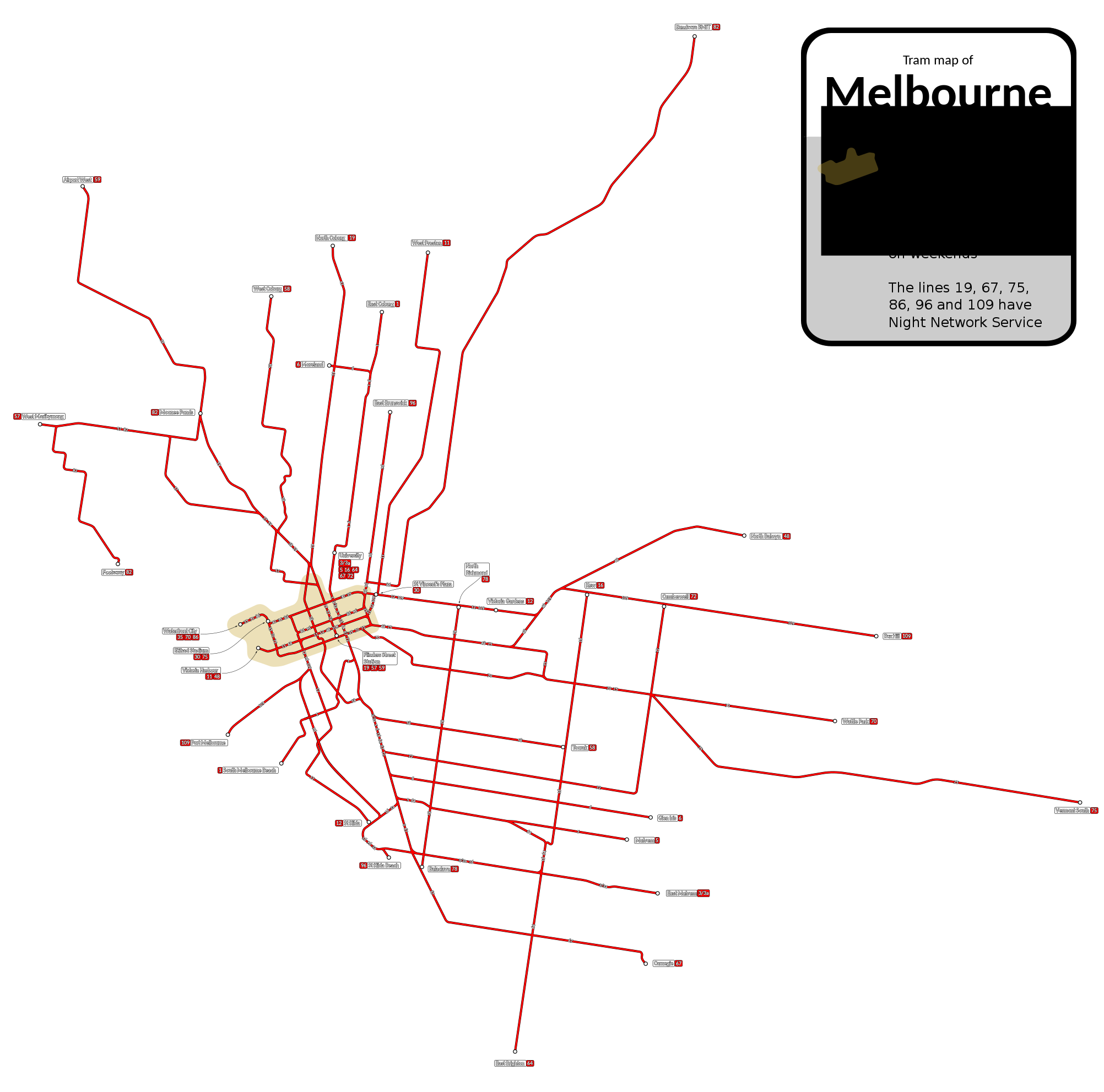
Here is Melbourne, which doesn’t yet have a metro but is building one at very high costs:
Here is Brno, which has around 200 million annual passengers in a metro area of 700,000:

The striking features of these networks and others without as good maps on Wikipedia (Gothenburg, Zurich), to me, are,
- The network design is radial – crosstown routes are rare and sporadic.
- The lines form something like a mesh in a small city center, perhaps the size of the historic premodern core, in which one can walk from one end to another; Melbourne, which does not have the history of a walled European city, shows convergent evolution with the same pattern.
- Owing to the long history of such systems, the ones I’ve used (Prague, Zurich, Basel, Leipzig, East Berlin) have basic stations with shelter and in Zurich’s case ticketing machines but no other facilities.
- There is extensive interlining and branching in all directions.
Moreover, as I should blog about soon in the future, Melbourne exhibits the same pattern even with a weak city center: the centralmost 100 km^2 of the city, which in Canada or Europe or the most centralized American cities should have 30-40% of metropolitan employment, only have 15%.
The New Triboro/Interboro Plan
Governor Kathy Hochul announced a policy package for New York, and, in between freeway widening projects, there is an item about the Triboro subway line, renamed Interboro and shortened to exclude the Bronx. The item is brief and leaves some important questions unanswered, and this is good – technical analysis should not be encumbered by prior political commitments made ex cathedra. Good transit advocates should support the program as it currently stands and push for swift design work to nail down the details of the project and ensure the decisions are sound.
What is Triboro?
The Bronx Times has a good overview, with maps. The original idea, from the RPA’s Third Regional Plan in the 1990s, was to use various disused or barely-used freight lines, such as the Bay Ridge Branch, to cobble together an orbital subway from Bay Ridge via East New York and Jackson Heights to Yankee Stadium. Only about a kilometer of greenfield tunnel would be needed, at the northern end.
In the Fourth Plan from the 2010s, this changed. The Fourth Plan Triboro was like PennDesign’s Crossboro idea, differing from the Third Plan Triboro in three ways: first, the stop spacing would be wider; second, the technology used would be commuter rail for mainline compatibility and not subway; and third, the Bronx routing would not follow disused tunnels (by then sealed) to Yankee Stadium but go along the Northeast Corridor to Coop City. Years ago, I’ve said that the Fourth Plan Triboro is worse than the Third Plan.
Unlike the RPA Triboro plans, Hochul’s Interboro plan only connects Brooklyn and Queens, running from Jackson Heights to the south. I do not know why, but believe this has to do with right-of-way constraints further north. The Queens-Bronx connection is on Hell Gate Bridge, which has three tracks and room for a fourth (which historically existed), of which Amtrak uses two and CSX uses one; having the service run to the Bronx is valuable but requires figuring out what to do about CSX and track-sharing. The Third Plan version ignored this, which is harder now, in part because freight traffic has increased from effectively zero in the 1990s to light today.
Stop spacing
The stop spacing in the governor’s plan appears to be more express, as in the Fourth Regional Plan, where the service is to run mostly nonstop between subway connections. In contrast, the Third Regional Plan called for regular stop spacing of 800 meters, in line with subway guidelines for new lines, including Second Avenue Subway.
I’m of two minds on this. We can look at formulas derived here in previous years for optimal stop spacing; the formulas are most commonly applied to buses (see here and follow first paragraph links), which can change their stop pattern more readily, but can equally be used for a subway.
The line’s circumferential characteristic gives it two special features, which argue in opposite directions on the issue of stop spacing. On the one hand, trips are likely to be short, because many people are going to use the line as a way of connecting between two subway spokes and those are for the most part placed relatively close to one another; farther-away connections such as end-to-end can be done on a radial line. But on the other hand, trips are not isotropic, because most riders are going to connect to a line, and the stronger the distinguished nodes are on a line, the longer the optimal interstation is.
On this, further research is required and multiple options should be studied. My suspicion is that on balance the longer stop spacing will prove correct, but it’s plausible that the shorter one is better. A hybrid may well be good too, especially in conjunction with a bus redesign ensuring the stops on the new rail link are aligned with bus trunks.
The issue of frequency
The line’s short-hop characteristic has an unambiguous implication about service: it must be very frequent. The average trip length along the line is likely to be short enough, on the order of 15 minutes, that even 10-minute waits are a drag on ridership. Nor is it possible to set up some system of timed transfers to 10-minute subway lines, first of all because the subway does not run on a clockface timetable, and second because the only transfers that could be cross-platform are to the L train.
This means that all-day frequency must be very high, on the order of a train every 5 minutes. This complicates any track-sharing arrangement, because the upper limit of frequency on shared track with trains that run any other pattern is a bit worse than this. The North London Line runs every 10 minutes and shares track with freight, and I believe there are some short shared segments in Switzerland up to a train every 7.5 minutes.
The upshot is that freight can’t run during normal operations. This is mostly fine, there are only 2-4 freight trains a day on the Bay Ridge Branch, where there are segments of the right-of-way that are only wide enough for two tracks, not four. This means if freight is to be retained, it has to run during light periods, such as 5 in the morning or 11 at night, when it’s more acceptable to run passenger trains every 10 minutes and not 5.
Institutional Issues: Who is Entrusted to Learn?
I know I’ve been on hiatus in the last few weeks; here is the continuation of my series on institutional factors in public transportation. I have harped for more than 10 years about the need to learn best practices from abroad, and today I’d like to discuss the issue of who gets to learn. Normally it should be a best practices office or various planners who are seconded to peer agencies or participate in exchange programs, but the United States does things differently, leading to inferior outcomes.
The American pattern is that senior officials revel in junket trips while ordinary civil servants are never sent abroad. Any connections they make are sporadic: if they go to Europe on vacation at their own expense then they are allowed to attend professional conferences. This is the exact opposite of how good learning happens. A few days of a junket trip teach nothing, while long-lasting connections at the junior and middle levels of the bureaucracy facilitate learning.
This is connected with the issue of downward trust. When I confront Americans with the above pattern and explain why it is problematic, the response I get is always the same: senior officials do not trust junior ones. This is often further elaborated in terms of low- versus high-trust societies, but it is not quite that. It’s not about whether people trust their leaders, but whether the leaders, that is the layer of political appointees and senior managers, trust the people who they have parachuted to oversee. If they see themselves as mentors and guides and their charges as competent people to be coordinated, the institutional results will be superior to if they see themselves as guards and scourges and their charges as competitors.
Some examples
New York City Mayor-Elect Eric Adams, for example, spent much of the second half of this year flying over to Europe to experience urbanism outside the United States. He is not the only elected official to have done so. Mike Bloomberg reveled in his personal connections with Ken Livingstone in the 2000s, leading to his attempt to import London’s congestion pricing system into New York.
Below the mayoral level, senior officials engage in the same behavior. They fly to the Netherlands, France, Denmark, or any other country they seek to learn from for a few days, experience the system as a tourist, and come back with little more knowledge than when they left but a lot more self-assurance in their knowledge.
This is called the junket trip, because to the general public, it’s viewed as just a taxpayer-funded vacation. It isn’t quite that, because at least the ones who I’ve spoken to who engage in such behavior genuinely believe that they learn good practices out of it. But realistically, it has the same effects as a vacation. Spending a week in a city where you are an important person meeting with other important people who are trying to impress you will not teach you much.
My pedestrian observations
I would travel regularly before corona. Some of my early blog posts are literally called Pedestrian Observations from [City], describing my first impressions of a place; the name of this blog comes from a photo album I took in 2011 a few months before I started blogging, called Pedestrian Observations from Worcester.
Those observations were always a mixed bag, which I was always aware of. Overall, I think they’ve held up reasonably well – my pedestrian observations from Providence were mostly in accordance with how I would experience the city later after I moved there. But there were always big gaps; in my Providence post, note that in my first visit to the East Side I named Wickenden and South Main as the major commercial streets, missing the actual main drag, Thayer, which I only discovered during my next visit.
The same is true of transit observations. Shortly before corona, I spent a week in Taipei. I took the MRT everywhere, and was impressed with its cleanliness and frequency, but there isn’t too much more I could say about the system from personal experience. I could only tell you how it deep-cleaned the system in early 2020, when people thought corona was spread by fomites rather than aerosols, from a report sent to me by long-term resident Alex Garcia of Taipei Urbanism. I knew construction costs were high because I looked them up, but that’s not the same as personal experience, and I only have a vague understanding of why, coming from both Alex and papers I would later read on the subject.
In Berlin, at a queer meetup in 2019 on a Friday night, months into living here, I was expressing worry around midnight that I might miss the last train. One of the people there chided me. I was working in the transit industry, broadly speaking – how could I not know that trains here run overnight on weekends? I knew, but had forgotten, and I needed that person to remind me.
Secondment and exchange
The short junket trip reveals nothing. But this does not mean learning from abroad is impossible – quite to the contrary. The path forward is to take these trips but go for months rather than days. There are journalists who do this: Alec MacGillis, a Baltimore-based journalist, spent months in Germany to study how the country is dealing with economic and environmental issues, and when I met him toward the end of his stay, he could tell me things I did not know about the coal industry in Germany.
Within Europe and East Asia, there are exchange programs. DB sends its planners abroad on exchange missions for a few weeks to a few months at a time, not just within Western Europe but also to Japan and Russia – even in those countries enough people speak English that it’s possible to do this. The people who take these trips are ordinary middle-class civil servants and not a class of overlords; the locals who they interact with are their peers and will correct them on errors, just as my queer meetup friend corrected me when I forgot that Berlin trains run overnight on weekends.
This program must also include routine connections at conferences. These are short trips, but a planner who goes on one makes connections with planners abroad and hears about advances in the field, from a peer who will have a discussion as an equal about their own experience and expertise. Over many trips the attendees can then figure out patterns to travel, notice changes, and come up with their own suggestions. This is no different from the academic process, in which research groups across multiple continents would regularly meet to discuss their work, and form connections to produce joint papers.
This way, it’s possible to learn details. This includes consumer-level details, similar to how I learn a city by taking public transit there many times and finding out hidden gems like Berlin’s timed transfer stations at Mehringdamm and Wuhletal. But this also includes the back end of how planning is done, what assumptions everyone makes that may differ from one’s home country’s, and so on.
The United States has done this before, by accident. Veteran and planner R. W. Rynerson has long pointed out that first-generation light rail in North America, covering such systems as Edmonton, Calgary, San Diego, and Portland, was planned by veterans who’d served in Germany during the Cold War and were familiar with ongoing trends here. Army tours of duty abroad last years, and soldiers are often happy to extend them to offer their families stability.
This way, American light rail bears striking similarities to the German Stadtbahn concept. It exhibits convergent evolution with tram-trains, modified to avoid track-sharing with mainline rail. The vehicles used were developed for German Stadtbahn systems, and the concept of having a streetcar system that runs faster than a traditional streetcar came out of this history as well. However, the generation of vets has retired, and today American planners no longer keep up with European advances in the field. Civilian connections through conferences, secondments, and exchange programs do not really exist, and the militarization levels of the 1960s and 70s are a thing of the past.
Downward trust
When I confront Americans with the distinction between valuable but uncommon long-term, routine international links for ordinary engineers and planners and worthless but all too common executive junket trips, the excuses for the pattern all fall into the same family: executives just do not trust their workers. Senior management in this industry in the United States views the people they oversee as little devils to be constantly disciplined, and never supported.
Based on this pattern, the peons do not get professional development – only the executives do. If tabloid media criticizes European conferences as vacation trips then it is used as an excuse to prohibit civil servants from going, but somehow the executives still go on junket trips, figuring that someone at Eric Adams’ level can just ride out the media criticism.
Likewise, the civil servants do not get to develop any knowledge that the executives don’t have. If they come with prior knowledge – say, Hispanic immigrants who work in New York and keep abreast of developments in their country of origin – then they must be broken down. They are peons, not advisors, and the layer of political appointees parachuting to oversee them are scourges and not mentors.
I focus on mentorship because good advisors understand that their advisees’ success reflects positively on them. In academia, professors who successfully place their students at tenure-track research positions are recognized as such behind the scenes and the rumor mill will inform new students that they should seek them out as advisors; there is a separate whisper network for women to discuss which advisors are abusive to them.
And this mentorship requires a minimum level of downward trust. Academia, for all of its toxicity and drama, has it, but somehow the American public-sector planning field does not. This is especially bad considering that the American public sector has set up its benefits system to ensure that people stay at the same workplace for life, which environment is perfect for investing in the junior employees. And yet, senior management does not deem $60,000/year planners with lush pensions important enough to pay $1,500 to send them to a conference abroad.
A high-trust environment is not one where the broad public trusts the elite. Germany has a culture of incessant complaints about everything; every middle-class German is certain they can do better than the state in many fields, and regrettably, many are correct. No: a high-trust environment is one where the elite trusts both the broad public and its own subordinates. This is what European public transit agencies have to varying extents, the ones that are more trusting of the riders generally having better outcomes than the ones that are less trusting, and what American ones lack.
Institutional Issues: Coordination
In this installment of institutional issues, I’m going to talk about coordination, following up from procurement, professional oversight, transparency, proactive regulations, and dealing with change.
The state is to a large extent a coordinating body. Even the more extractive aspects of it, like historically the military, succeeded or failed not by who was the most brutal (they all were brutal) but by who was most efficient at organizing large groups of people.
Coordination in public transit is especially important, because it’s a system with many moving parts: infrastructure, equipment, timetable, development. These do not accrete spontaneously, not in any society that has also invented cars; transit-oriented development in the 21st century looks different from historic development before mass motorization. Organizational capacity makes the difference between a state that grows around mass transit, like Japan or South Korea or Switzerland or Sweden or increasingly France, and one that grows around cars even when the goal is nominally transit first, as is common in the United States but also most of Southeast Asia.
So in general, better coordination means overall better public transit. But it specifically means better investment – more targeted at the right places. And this is especially visible in mainline rail, which is less self-contained than urban metro lines. The right way to plan is to get different bodies to cooperate, such as different railroads and government agencies. And then there is the wrong, American way.
Coordination versus wishlists
In theory, the United States has mechanisms to get different agencies to talk to one another. The Northeast Corridor planning process understands that the corridor has many users and owners: Amtrak, MBTA, Connecticut DOT, MTA, New Jersey Transit, SEPTA, MARC. To ensure they collaborate, there are layers set on top of them, like the NEC Commission.
And yet, the NEC Commission’s plans are not worth the paper they are written on, and the people involved should not work in this field or in government again. The problem is that their idea of coordination is to ask each of the above agencies what its wishlist is, collate the responses, and staple them together.
The wishlist staple job is the opposite of coordination. Coordination means sitting down with intercity and regional rail operators, figuring out their service needs, and writing down a timetable with associated infrastructure plan that maximizes service at minimum cost. Even the accidental moves toward coordination that do exist, like the MBTA plan to complete electrification of the Providence Line and run modern EMUs rather than diesels under catenary, do not figure into the plan: Amtrak still wants a third track on the Providence Line, which such electrification obviates even if Amtrak cuts its Boston-Providence trip time in half. The third track was said to cost $400 million years ago; I do not know if it is still its budget or whether costs are higher now. One such unnecessary project at a time is what it takes to turn what should be a $15 billion project into three-figure billions.
This wishlist mentality is present whenever bad planners (e.g. all Americans) try to do something that involves more than one agency. It’s assumed that different parts of the government must constantly be at one another’s throats. Unless one agency dominates, the only solutions in this mentality are either to do a staple job, or subordinate all agencies to one new hierarchy, typically run by people who have never run transit service and do not respect those who have.
How to plan mainline rail better
Three of the legs of coordinated planning – infrastructure, rolling stock, timetable – are coordinated in an excellent way in Switzerland. (Switzerland is unfortunately too NIMBY for modern TOD.) This does not mean slavishly copying every single Swiss decision, but it does mean that it behooves planners to learn how Swiss rail planners got Europe’s best rail network on a limited (though not quite austerity) budget.
The way it should work is that everything begins from the timetable. Trains must run on the same fixed interval – typically hourly, but denser services should be planned around shorter intervals like 30 minutes or smaller divisors of the hour. This provides the base level of coordination: connections between trains at major stations are to be done at times that are compatible with this interval.
If the trip time between major stations (“Knoten”) is just a bit too long for timed connections at both ends, it means that the trains should be sped up. This is the run trains as fast as necessary maxim, beloved by many high-speed rail opponents who bring up that maxim far more often than they bring up how much rail tunneling Switzerland has built.
Everything must come based on this plan. The choice of rolling stock must be compatible. Switzerland chose bilevel EMUs, because its use case is urban stations with a surplus of platform tracks but limited platform length; the bilevel trades off higher on-train capacity per unit of train length for lower egress capacity, and in a country where the main train station has 26 tracks, the bilevel is the correct choice. Maybe in another environment it is and maybe it isn’t; in New York it is not.
The slate of infrastructure projects must likewise be based on total integration of operations and capital planning. This means being able to trace delays to their source, using data to figure out what the most problematic areas are, and fixing them. Swiss trains are not inherently punctual; delays in the 5 minute range are routine. What sets them apart is that the infrastructure has been designed, at minimum cost, to ensure that delays don’t propagate, whereas in Germany, cascading delays are more common, and the less said about the United States, the better.
Swiss integration, to be clear, operates in an environment that is highly federal, has a smattering of private railroads interoperating with SBB, is stingy about public spending, and has in most cases Western Europe’s most privatized economy. And yet there is no separation of infrastructure and operations, in contrast with the trend in Britain and the EU.
Coordination and saying no
A planning agency that has to work with operators to ensure they all collaborate has to mediate conflict in many cases. This is the origin of the wishlist mentality: by planning overly expensive systems with maximum separation between operators, conflict is avoided, at the minor cost of an order of magnitude increase in the budget.
A better way to mediate is to either propose compromises, or outright saying no. Investment that is not part of the coordinated plan is extra and infrastructure plans should not burden the taxpayers with it. If different bodies conflict, sometimes one is right and the other is wrong, and the infrastructure planners should say so; sometimes who is right and who is wrong is consistent, sometimes it isn’t. Moreover, if bodies refuse to coordinate, it’s important to be able to say no to overall plans.
All of this interfaces with previous posts on this subject. In particular, the infrastructure investment program, whether it’s a regional Verkehrsverbund or an intercity system like the NEC Commission, should consist of subject matter experts. Senior politicians should understand that those experts are paid to maximize the efficiency of an enormous infrastructure program and therefore defend their expertise against attacks.
Institutional Issues: Dealing with Technological and Social Change
I’ve covered issues of procurement, professional oversight, transparency, and proactive regulations so far. Today I’m going to cover a related institutional issue, regarding sensitivity to change. It’s imperative for the state to solve the problems of tomorrow using the tools that it expects to have, rather than wallowing in the world of yesterday. To do this, the civil service and the political system both have to be sensitive to ongoing social, economic, and technological changes and change their focus accordingly.
Most of this is not directly relevant to construction costs, except when changes favor or disfavor certain engineering methods. Rather, sensitivity to change is useful for making better projects, running public transit on the alignments where demand is or will soon be high using tools that make it work optimally for the travel of today and tomorrow. Sometimes, it’s the same as what would have worked for the world of the middle of the 20th century; other times, it’s not, and then it’s important not to get too attached to nostalgia.
Yesterday’s problems
Bad institutions often produce governments that, through slowness and stasis, focus on solving yesterday’s problems. Good institutions do the opposite. This problem is muted on issues that do not change much from decade to decade, like the political debate over overall government spending levels on socioeconomic programs. But wherever technology or some important social aspect changes quickly, this problem can grow to the point that outdated governance looks ridiculous.
Climate change is a good example, because the relative magnitudes of its various components have shifted in the last 20 years. Across the developed world, transportation emissions are rising while electricity generation emissions are falling. In electricity generation, the costs of renewable energy have cratered to the point of being competitive from scratch with just the operating costs of fossil and nuclear power. Within renewable energy, the revolution has been in wind (more onshore than offshore) and utility-scale solar, not the rooftop panels beloved by the greens of last generation; compare Northern Europe’s wind installation rates with what seemed obvious just 10 years ago.
I bring this up because in the United States today, the left’s greatest effort is spent on the Build Back Better Act, which they portray as making the difference between climate catastrophe and a green future, and which focuses on the largely solved problem of electricity. Transportation, which overtook electricity as the United States’ largest source of emissions in the late 2010s, is shrugged off in the BBB, because the political system of 2021 relitigates the battles of 2009.
This slowness cascades to smaller technical issues and to the civil service. A slow civil service may mandate equity analyses that assume that the needs of discriminated-against groups are geographic – more transit service to black or working-class neighborhoods – because they were generations ago. Today, the situation is different, and the needs are non-geographic, but not all civil service systems are good at recognizing this.
The issue of TOD
Even when the problem is static, for example how to improve public transit, the solutions may change based on social and technological changes.
The most important today is the need to integrate transportation planning with land use planning better. Historically, this wasn’t done much – Metro-land is an important counterexample, but in general, before mass motorization, developers built apartments wherever the trains went and there was no need for public supervision. The situation changed in the middle of the 20th century with mass competition with the automobile, and thence the biggest successes involved some kind of transit-oriented development (TOD), built by the state like the Swedish Million Program projects in Stockholm County or by private developer-railroads like those of Japan. Today, the default system is TOD built by private developers on land released for high-density redevelopment near publicly-built subways.
Some of the details of TOD are themselves subject to technological and social change:
- Deindustrialization means that city centers are nice, and waterfronts are desirable residential areas. There is little difference between working- and middle-class destinations, except that city center jobs are somewhat disproportionately middle-class.
- Secondary centers have slowly been erased; in New York, examples of declining job centers include Newark, Downtown Brooklyn, and Jamaica.
- Conversely, there is job spillover from city center to near-center areas, which means that it’s important to allow for commercialization of near-center residential neighborhoods; Europe does this better than the United States, which is why at scale larger than a few blocks, European cities are more centralized than American ones, despite the prominent lack of supertall office towers. Positive New York examples include Long Island City and the Jersey City waterfront, both among the most pro-development parts of the region.
- Residential TOD tends to be spiky: very tall buildings near subway stations, shorter ones farther away. Historic construction was more uniformly mid-rise. I encourage the reader to go on some Google Earth or Streetview tourism of a late-20th century city like Tokyo or Taipei and compare its central residential areas with those of an early-20th century one like Paris or Berlin.
The ideal civil service on this issue is an amalgamation of things seen in democratic East Asia, much of Western and Central Europe, and even Canada. Paris and Stockholm are both pretty good about integrating development with public transit, but only in the suburbs, where they build tens of thousands of housing units near subway stations. In their central areas, they are too nostalgic to redevelop buildings or build high-rises even on undeveloped land. Tokyo, Seoul, and Taipei are better and more forward-looking.
Public transit for the future
Besides the issue of TOD, there are details of how public transportation is built and operated that change with the times. The changes are necessarily subtle – this is mature technology, and VC-funded businesspeople who think they’re going to disrupt the industry invariably fail. This makes the technology ideal for treatment by a civil service that evolves toward the future – but it has to evolve. The following failures are regrettably common:
- Overfocus on lines that were promised long ago. Some of those lines remain useful today, and some are underrated (like Berlin’s U8 extension to Märkisches Viertel, constantly put behind higher cost-per-rider extensions in the city’s priorities). But some exist out of pure inertia, like Second Avenue Subway phases 3-4, which violates two principles of good network design.
- Proposals that are pure nostalgia, like Amtrak-style intercity trains running 1-3 times per day at average speeds that would shame most of Eastern Europe. Such proposals try to fit to the urban geography of the world of yesterday. In Germany, the coalition’s opposition to investment in high-speed rail misses how in the 21st century, German urban geography is majority-big city, where a high-speed rail network would go.
- Indifference to recent news relevant to the technology. Much of the BART to San Jose cost blowout can still be avoided if the agency throws away the large-diameter single-bore solution, proposed years ago by people who had heard of its implementation in Barcelona on L9 but perhaps not of L9’s cost overruns, making it by far Spain’s most expensive subway. In Germany, the design of intercity rail around the capabilities of the trains of 25 years ago falls in this category as well; technology moves on and the ongoing investments here work much better if new trains are acquired based on the technology of the 2020s.
- Delay in implementation of easy technological fixes that have been demonstrated elsewhere. In a world with automatic train-mounted gap fillers, there is no excuse anywhere for gaps between trains and platforms that do not permit a wheelchair user to board the train unaided.
- Slow reaction time to academic research on best practices, which can cover issues from timetabling to construction methods to pricing to bus shelter.
Probably the most fundamental issue of sensitivity to social change is that of bus versus rail modal choice. Buses are labor-intensive and therefore lose value as the economy grows; the high-frequency grid of 1960s Toronto could not work at modern wages, hence the need to shift public transit from bus to rail as soon as possible. This in turn intersects with TOD, because TOD for short-stop surface transit looks uniformly mid-rise rather than spiky. The state needs to recognize this and think about bus-to-rail modal shift as a long-term goal based on the wages of the 21st century.
The swift state
In my Niskanen piece from earlier this year, I used the expression building back, quickly, and made references to acting swiftly and the swift state. I brought up the issue of speeding up the planning lead time, such as the environmental reviews, as a necessary component for improving infrastructure. This is one component of the swift state, alongside others:
- Fast reaction to new trends, in technology, where people travel, etc. Even in deeply NIMBY areas like most of the United States, change in urban geography is rapid: job centers shift, new cities that are less NIMBY grow (Nashville’s growth rates should matter to high-speed rail planning), and connections change over time.
- Fast rulemaking to solve problems as they emerge. This means that there should be fewer layers of review; a civil servant should be empowered to make small decisions, and even the largest decisions should be delegated to a small expert team, intersecting with my previous posts about civil service empowerment.
- Fast response time to civil complaints. It’s fine to ignore a nag who thinks their property values deserve state protection, but if people complain about noise, delays, slow service, poor UI, crime, or sexism or racism, take them seriously. Look for solutions immediately instead of expecting them to engage in complex nonprofit proof-of-work schemes to show that they are serious. The state works for the people, and not the other way around.
- Constant amendment of priorities based on changes in the rest of society. A state that wishes to fight climate change must be sensitive to what the most pressing sources of emissions are and deal with them. If you’re in a mature urban or national economy, and you’re not frustrating nostalgics who show you plans from the 1950s, you’re probably doing something wrong.
In all cases, it is critical to build using the methods of the world of today, aiming to serve the needs of the world of tomorrow. Those needs are fairly predictable, because public transit is not biotech and changes therein are nowhere near as revolutionary as mRNA and viral vector vaccines. But they are not the same as the needs of 60 years ago, and good institutions recognize this and base their budgetary and regulatory focus on what is relevant now and not what was relevant when color TVs were new.
Institutional Issues: Proactive and Reactive Regulations
So far, in this series on institutional factors behind differences in the quality and cost of public transportation infrastructure, I’ve gone over procurement, public-sector oversight, and transparency. These three posts can be read together as a series: procurement is the keystone, and to get it right it is critical to have high-quality in-house supervision of the work, and to get that right in turn it’s important to cultivate transparency.
Today I’m going to turn the camera 90 degrees and talk about another relevant issue: that of proactive versus reactive state regulation and supervision. This is related to the issue of oversight, in that proactive regulation requires deeper in-house expertise and detachment from politics, so that the state can effectively make changes as necessary based on changes in travel and social patterns and advances in knowledge by scientists and practitioners.
Nudging and doing
One of the distinctions I’ve noticed regarding different regulatory traditions is whether the regulators do things or merely nudge. This is related to the issue of oversight, in that strong engineering bureaucracies that do design and planning in-house also come up with their own sets of clear rules.
The Italian civil service does rather than nudges: there are clear proactive rules by the Ministry of Culture about the protection of historical monuments, limiting the permitted building settlement in sensitive areas to 3 mm. Such proactive clear rules lead to a more predictable legal situation since it’s easy to measure what is and what is not legal, reducing risk. Long-term standards that impose real costs on business also soon sprout innovation for how to follow them while minimizing costs, as is the case for Japanese and Chinese zoning standards for light; ad hoc rules instead impose new costs every time, since the investment in trying to adapt to them would be spread across just one project rather than many.
The American regulatory apparatus has a mixture of doing and nudging. Environmental protection is almost entirely adversarial: the National Environmental Protection Act requires agencies to prepare environmental impact statements (EISes) before every project, but those are not judged by regulators but instead subject to lawsuit, and soon the nudge turns into red tape with hundreds of pages in an EIS aiming to anticipate every possible legal objection. Labor law is largely adversarial, but some states have passed triple damages statutes, in which the penalty for violation is specified at three times the missed wage and therefore workers do not have to litigate against much better-resourced employers.
The disability rights regime in the United States is a mix but include a significant amount of doing. There are clear standards for elevator accessibility, longest path of travel for people in wheelchairs, and maximum permitted gaps between the platform and the train; more recently, the FRA has wanted to mandate automatic gap fillers on mainline rail in order to permit passengers in wheelchairs to board unaided even across small gaps.
This is related to the issue of adversarial legalism, but is not exactly the same. There is plenty of adversarial legalism in the American disability rights regime, in which agencies refuse to follow the law and dare advocates to sue them.
Moreover, federal regulations in the United States remain a matter of nudging more than doing whenever there is any interaction with state and local authorities; instead of coordinating different authorities from a position of being able to engage in planning things itself, a federal agency will often try to nudge through offering incentives.
Two examples of equity
There’s a sense in much of the planning world in both the United States and Europe that it is necessary to proactively plan cities and transportation for the benefit of disadvantaged groups, or else even well-meaning planners would make unquestioned assumptions that harm such groups. It’s worthwhile examining the differences between the approaches to such planning, because one is proactive and the other reactive.
Before going on, I would like to point out a huge difference that is not about proactive planning: in the United States, the Title VI process for egalitarian planning (currently in revision, for which I’m very likely to submit comments make this and other points) centers racial equity, as a legacy of the civil rights movement that it came out of. In Europe, planners persistently ignore the problem of racism, and people of color are severely underrepresented in the civil services that I’ve seen, which issue is so glaring it makes Americans discount any European experience. However, European planners do look at class equity (for example, in Paris) and gender equity (for example, in Sweden), and there, they aim for proactive changes to reduce barriers to access.
The Swedish system is accessible to the English speaker, because feminist writers in English have occasionally looked to the Nordic world for inspiration, and outlets like Streetsblog have examined gender-based planning in Sweden. In 2015, Stockholm examined travel patterns by gender and found that women walk and take public transportation more and drive less than men, and as a result, it changed its snowplowing patterns to prioritize sidewalks over roads.
I was similarly told that when Swedish cities do surface construction, such as the cut-and-cover stations of Västlänken in Gothenburg or the cut-and-cover entry halls into the deep mined stations of the Stockholm T-bana extensions, by regulation the contractors must preserve sufficient sidewalk space on the street for pedestrians. If they need to open up most of the street, they can take car traffic lanes. The reasoning isn’t corrective discrimination, but rather that past planners, who prioritized keeping roads open over sidewalks, had erred because of conscious or unconscious discounting of the experience of women. The change in snowplowing practices led to a fall in injuries, since three times as many people in Sweden were injured walking in icy conditions as driving.
The Swedish system is proactive: the municipality or the state comes up with actionable, concrete changes based on its understanding of travel pattern. Researchers working for the city, perhaps in partnership with activists, notice a discriminatory practice, and come up with an alternative.
Now consider the American system. Title VI does not offer a clear set of practices for anti-racist transportation planning. It instead requires agencies to engage in review of their practices whenever they propose a change, leading first to status quo bias and second to arbitrary enforcement of rules. Much of the enforcement is not done top-down by regulators who are apolitical subject matter experts, but bottom-up from lawsuit or the threat thereof with supervision by judges trained in law but not in the specifics of transportation.
Status quo and reactivity
The worst aspect of reactive planning is that it leads to status quo bias. American regulations for civil rights and environmental protection require review of changes, but not of the status quo. The process can stop an agency from implementing a change or delay implementation until mitigations are done, but it cannot compel an agency to take an action it does not wish to take.
To nuance this somewhat, a judge can put an agency under a consent decree. But that already assumes an adversarial relationship between the state and itself. The process can imposing fines and constraints on an agency that does not want to do something, such as following ADA law and installing elevators at every subway station (something Berlin, an older system than New York, is about to complete systemwide). But it cannot literally build elevators there itself. It’s akin to the Jewish concept of a get, in which a rabbinical court can impose arbitrary fines on a husband who refuses to grant his wife a divorce, where what is needed is to permit women to initiate divorce without their husband’s permission.
A more proactive and less reactive regulatory culture can break out of the status quo trap. The first thing it must do is create a system that does not privilege the status quo: if a change is subject to review on such grounds as accessibility, racial equality, and environmental protection, then current practice must be as well. If it turns out that current practice falls short or is discriminatory, as Sweden’s snowplowing priorities were a decade ago, the agency must change its ways based on clear, concrete standards.
More proactive regulations are more obtrusive and visible, but they reduce costs and improve service quality. They are more sensitive to the current economic and social conditions and to the state of present-day knowledge than to the conditions and knowledge of a generation ago. They are more legible to the public and to contractors, who can then come up with ways to follow them without gambling on favorable judicial or political rulings. And they are less likely to surprise agencies deep into the process with a sudden imposition.
A state that acts as a helping hand rather than a grabbing hand helps more by governing more. Making it easier to ditch a status quo that worked for the world of yesterday but doesn’t for that of today or tomorrow, or one that never worked but was falsely believed to work, allows it to govern more efficiently. It’s necessary then to ensure that the highest-level civil servants who regulate transportation be empowered to make concrete decisions and coordinate lower-level agencies rather than just nudging in the right direction.
Institutional Issues: Transparency
Continuing with my series on institutional factors relevant to construction costs, I’d like to turn to a culture of transparency, or lack thereof. It’s unfortunate that the exact breakdown of costs by items and factors that we’ve seen in Italy and Turkey and are seeing in Sweden does not exist in the English-speaking world. It’s further unfortunate that there is an adversarial relationship in the Anglosphere between the civil service and academic researchers like us or the broad public.
It’s a delicate subject, because the cultures of opacity we’ve encountered, the American and the British, certainly correlate with high costs, but we cannot be perfectly certain that they cause them. The peripheral Anglosphere learns many things from the US and UK, so it could just be part of the general correlation between Anglosphere membership and high costs.
That said, we do have reasons to believe this matters. The opacity we’ve encountered in the US and UK is so severe that it ensures there is no proper oversight. A system that punishes junior workers for reporting problems will just not know they exist. It’s best viewed as the Xi Jinping school of governance: demand that people follow the line and not air out problems, until subordinates lie to you just as much as you lie to the public, and local party officials arrest doctors who report to the public about corona while Taiwan is already warning the world about it.
The organization of information
Many episodes of Yes, Minister prominently feature the red boxes of papers for the minister to review. The civil service prepares documents every night for review, and the minister, who thinks he is a reformer, demands to know everything – so the permanent secretary’s office gives him interminable work to look at, down to and including stationery requisition. Needless to say, the minister does not come out of this experience informed about the department’s workings.
One of the obstacles we’ve encountered to a clean itemized comparison of construction costs is that in the US (and apparently also the UK), the information either does not exist or is not made public. We know how much Second Avenue Subway cost; we know how much individual stations cost and even how the stations break down between the civil work and the finishes, but each of these is still $200-500 million in unitemized costs, given as a lump sum contract. There are independent itemized estimates used as a benchmark, but they’re confidential, since the MTA uses them to rate contractor bids.
Any further breakdown we’ve seen is at the level of the minister’s red boxes, stating individual salaries and contracts for concrete and widgets; it’s not even complete information, since most of the work is subcontracted, and what’s subcontracted is opaque even to the independent cost estimators. To the extent we have estimates at a level that’s at all useful, that is high single-digit millions to low tens of millions, they’re cobbled together from many different examples, to the great frustration of people who were hoping for a perfect recipe for them to solve the cost problem.
I must stress that this is in a relatively cooperative environment. I don’t think Janno Lieber is sitting on a detailed breakdown of contracts to tranches of about $30 million and is just making sure we don’t know it. I doubt that this information exists in an organized fashion at all – it lives in the lore of numerous private-sector middle managers each of whom knows a few items.
An example from Italy
Italy has a well-known problem with tax evasion. Pellegrino-Zingales consider tax evasion among small businesses to be one of the root causes behind Italy’s economy stagnation in the last generation, arguing that it encourages firms to hire and promote by loyalty and nepotism (alongside patronage-based credit networks) rather than by merit, and that this has been an especial drag in the age of IT.
More recently, D’Agostino-de Benedetto-Sobbrio consider this question from the other end: what makes people choose to evade taxes? They look at the impact of government spending, proposing two opposed theories: the government as a grabbing hand, which taxpayers perceive as out to get them, and the government as a helping hand, whose spending helps ordinary taxpayers. The grabbing hand model predicts that bigger government leads to more tax evasion, the helping hand model predicts the opposite. While Chinese tax evasion follows the grabbing hand model, Italian tax evasion follows the helping hand model: Italian government spending induces the taxpayers to perceive the Italian state as on their side, reducing tax cheating.
All of this should be treated as background to the fact that, in Italy, the public data on construction costs and their breakdown is of very high quality. Marco Chitti has obtained breakdowns at the level that is useful for us for the upcoming Italian case study, and having read a draft of his report, I can speak with relative confidence (less than he can, of course) about wages, staffing levels, techniques, relative costs, and what the problem sections are.
Transparency and openness
That Sweden has very high-quality public data is probably not surprising to readers who know even a little bit about Nordic institutions. Here, for example, is the published breakdown of one set of contracts for Nya Tunnelbanan. Nordic transparency is a general feature, seeping to so many places, to the point that academic hiring committees in Sweden produce public-facing spreadsheets of all applicants and brief comments on them, and if the comments are positive, along the lines of “almost makes our shortlist but we have too many good candidates this year,” then applicants use that in their next application.
But when it comes to infrastructure megaprojects, we’ve found high transparency wherever we’ve looked in Continental Europe. Italy has the same information quality – because the Italian state works for the people of Italy rather than lording over them in secret.
This transparency extends to analysis of problems. The cost overruns on Grand Paris Express have led to a report by the Cour des Comptes about what happened, with detailed analysis and cost breakdowns (albeit not at granular enough level for our case studies). The report is earnest because the French state, elitist as it is, still works for the public, and acknowledges errors. Likewise, academic work in Italy on cost problems, such as Paolo Beria’s paper on the high costs of Italian high-speed rail, is in wide circulation. In Sweden, there is not only academic student work about the cost overruns of Nya Tunnelbanan but also a brief report a civil servant involved in the project sent us explaining the issue of mid-project changes in regulations.
Then there are the UK and US, where the situation is different. The UK, and countries it influences like Australia, barely even informs the public of the expected cost of a project until it is time to approve it; David Levinson told me that in Australia all communication about costs comes from leaks and trial balloons, unlike in the more open US. Even learning the highest-level breakdown of Crossrail costs required using a freedom of information request, and project-level questions about the cost of individual stations are often redacted (Crossrail 2 made available information about relative costs of stations, not a specific number per station). Reports about critical technological change like driverless trains, increasingly adopted in Paris, are not available to the public in London except through leaks. American governance is somewhat more transparent in the early stages, but key information about choices is hidden in confidential documents; the freedom of information process takes forever and officials freely redact documents or reject handing them over. The American and British freedom of information process screams, the government doesn’t work for you – its relationship with you is adversarial.
Transparency and language
In the last year or so, observing ever more central circles of political activism in the United States, I’ve realized something important: federal policymakers, and state policymakers who interface with them, speak an inscrutable language of bureaucrats who nudge but do not do. This is best illustrated with examples:
- The Bipartisan Infrastructure Framework has a line item about federal funding for previously funded but canceled projects, inserted by Maryland’s senators in order to fund the Baltimore Red Line, which Governor Hogan canceled for racist reasons in 2017. Instead of openly including it as an earmark, or else letting the federal process play it out, the language uses a circumlocution.
- At a meeting with activists, another advocate asked Beth Osborne of Transportation for America (T4America) about bus shelter. Instead of dealing with the direct issue, she gave a soporific answer about the need for federal standards, which may be Washingtonian for what in English would be rendered as “yes, I’ll do what I can to make sure the feds fund bus shelters,” or it may be Washingtonian for endless process and yet another round of red tape; not speaking the language, I could not and still cannot tell.
The contrast is with the concrete, plain language I see elsewhere from civil servants, to the point that it’s easier for me to go through the Cour des Comptes report, in a language I speak imperfectly, than to try to translate from Washingtonian to English. All of this matters – the use of a form of language designed to speak only to Beltway insiders is itself a form of opacity and American civil servants need to train themselves to on the one hand be more technical when necessary but on the other hand be very clear about what they’re doing.
Transparency as a goal
The path forward must involve treating transparency not as an imposition to be fulfilled through checklists, which produce red boxes, but as a positive goal. It involves ensuring agencies are helpful to regulators, academics, and the broad public, rather than hiding decisions behind walls, often because the reasoning behind such decisions is weak. An academic is expected to make data available to peers and the public, and so must agencies and regulators.
Trust in the civil servants is crucial for public infrastructure to succeed. Results can speak for themselves even in a low-trust system – streets really do come before trust – but the US and UK have poor results. The adversarial relationship with the public produces bad outcomes, and people whose expertise is in stonewalling and making excuses must be replaced with people whose expertise is in building things and accurately reporting on what they’re doing so that others can replicate their success.
Institutional Issues: Professional Oversight
Continuing my series on institutional issues concerning infrastructure costs and quality, after the issue of procurement, I’d like to discuss the issue of the quality of public-sector oversight. It is critical to have extensive in-house expertise inside an apolitical civil service empowered to make technical decisions. The role of the political layer is to set up broad rules, not to micromanage. Conversely, while the top people should avoid micromanagement, they should be expert enough to be capable of making specific decisions.
Civil service and oversight
The importance of civil service to oversight is that it’s the professional layer that has to supervise planners, engineers, architects, and construction teams. There are too many small decisions for a single elected political layer, say a minister and a policy team the minister directly appoints and supervises.
In my procurement post, I was basing my recommendations on common threads I’d seen or read about in low- and medium-cost European countries, and to some extent practice in South Korea, a low-cost country on a par with Southern Europe. All of these make use of professional civil servants to make any of the following decisions:
- In-house planning. The macro-level decisions on funding levels are political (and never devolved to the agency through dedicated slush funds, unlike for US highways), but the decisions at the level just below, such as what programs to ask the politicians to fund, are made by professional agencies. High-speed rail was invented this way in Japan and then reinvented in France, while upgraded legacy rail was so invented in Germany and perfected in Switzerland.
- Design and engineering. Those can be done in-house or outsourced to consultants, or more likely some mixture of the two, but even if the design is contracted out, it’s the agency that owns the product and is responsible for it.
- Contractor selection. It is irresponsible to award a megaproject design contract based on the lowest bid. A technical score is used nearly universally in the low- and medium-cost examples we have looked at, and this means someone needs to come up with sound criteria for scoring and then evaluate each proposal. This has to be done more intelligently than just by rubric. A British source told us of a problem with British technical scoring: every large project is parceled out between different consultants, and thus all consultants can claim experience on the same project, making it impossible at that level to tell which companies do better work than others, even as industry insiders know who does bad work. The same source, when I asked about French comparisons, said that France has extensive in-house expertise and therefore doesn’t hire their consultancy.
- Contract supervision. Change orders are inevitable, especially for underground projects. Not coincidentally, in Eno’s database the American premium for subways is higher than for at-grade light rail, which is technically more predictable. It’s on the client agency to decide whether to accept or reject changes coming from unpredictable factors, and this requires extensive knowledge of the field.
In my procurement post, I spoke of flexibility. No client can have flexibility without oversight – flexibility without oversight is an anything-goes game in which the contractor abuses the client, the client abuses the contractor, or, most likely, both. And this oversight is necessarily detailed enough that it requires civil service.
An example from Sweden
I spoke to an experienced Swedish project manager earlier this year. The project manager talked to me about the major issues with the construction of Citybanan, the regional rail tunnel Stockholm opened 4 years ago, shortly after I left the country. This included issues of construction techniques (but for further engineering question my source referred me to an engineer) but also competition policy, negotiation, change orders, etc.
At one point in the interview, I asked about something a previous Swedish source told me about, called functional procurement. In functional procurement, the agency maximizes flexibility by specifying only the function of the project, such as the required capacity and schedule, and letting the contractors make suggestions as to how to fulfill it; this is similar to the military concept of mission command, stressing flexibility and training intermediate officers in how to use it in a hierarchical organization.
The project manager said of this growing trend in Swedish procurement: “I can’t say it makes it easier.” The manager then explained the constraints involved – railways have technical specs that make a functional contract not too different from a conventional one, where the design is already figured out and the contractors have to build to it with only minor modifications.
Let’s unpack what happened in that interview. A Swedish manager who does not know me, who I have never met, first of all talked to me in technically adept language, and second of all was willing to go on the record criticizing a trend in infrastructure construction procurement, a trend that the person who put us in contact had mentioned to me as a positive.
I have never heard this kind of internal criticism from American sources, unless they knew me well enough and were trying to get me to publish their internal problems in the media. And quite often, the criticism I would hear from the US was much more pungent, complaining about politics or a bad manager. “We have been trying this trend but I don’t think it’s working,” in exactly the tone you can imagine emerge from the style of quotation, is not a line I recall hearing from an American. The civil servants who criticize something are far more frantic, far more afraid. Sweden will trust its civil servants to literal death. The US (and UK) will not trust them to do anything but follow orders.
Is Sweden unique?
No. Strong traditions of professional civil service exist everywhere we’ve looked outside the US. Even the UK has a semblance of it; the problem there is that the topmost layer of civil servants – the Sir Humphreys – consists of lifelong generalist elites rather than domain experts.
In Italy, the situation is especially lopsided. The political layer of the government is weak because party control changes so often and ministers do not last, and there are so few political appointments that even with political instability, the civil service lasts across those changes. If anything, the instability makes the professional layer stronger.
Apolitical experts
It’s critical to ensure the civil service is not political. This doesn’t just mean that it should not be partisan. There are enough dominant-party jurisdictions in which it’s understood that the civil service exists to implement a predictable political agenda, which can be left-wing (Berlin, New York, California) or right-wing (Bavaria, Texas). Those jurisdictions all have problems coming from the lack of meaningful political competition, but those problems come from politicians, not civil servants. No: political noninterference goes much deeper, and means sidelining issues of petty personal priorities.
The ideal civil service has as few political appointees as possible. Those are neither elected nor meritorious. By their nature, they lack the legitimacy of both the politicians above them and the deep layer of domain experts below them. If they’re selected from among people with industry and operating experience then this is fine – technically senior generals are political appointments in both the US and Israel subject to the usual military norms, and Andy Byford was an external hire for New York City Transit with experience in the industry but not the agency. But letting generalist managers selected for political loyalty parachute in charge of agencies is a recipe for disaster.
The word for people who are always to be managed by people who are not from within their own social group is servants. Such people, knowing that their manager will always be someone who has other priorities that are not always transparent to them, will learn to lower their heads rather than proactively looking for ways to improve their institution.
A scientist working at a federal institution explained it to me this way: “There’s absolutely ways to speed things up, but they need cover from the political appointees at the top. A career officer understands their role to be following an existing plan, laid down in writing by either congress or by a planning process involving the top (i.e. political appointee) officers of the agency.”
This was meant to explain the sluggish FDA corona vaccine approval process, but can equally apply to infrastructure and operations of public transportation. Any variation from a plan written long ago by people who were often not even at the frontier of knowledge then requires political approval.
Trusting the civil service
A low-trust society isn’t one in which common people don’t trust the elites. It’s one in which the elites don’t trust the common people. In the context of civil service, it’s crucial to set up a system in which the top people affirm rather than scourge those below them.
Byford did it well, setting up a system encouraging employees to complain and suggest improvements, much to the surprise of managers at other MTA agencies who preferred scourging their subordinates. At the topmost level, it means the political layer needs to affirm the authority and expertise of the civil servants; in conflict between a petty actor such as a community advocate and the junior members of the state, the state must support its own, while internally ensuring that the proposal has technical merit. (Political merit is judged by elections, not by who screams the most loudly at midday community meetings.)
Civil servants who see that their superiors are hired and promoted from within the ranks or among peers, and judged for their ability to work with those below them and not just those above them (in the tech industry, a managerial hire spends some interview time with the team they are to supervise), will soon learn that they can show initiative. The ones with bad intuition will fail, whereas the ones whose initiative is more successful will be able to rise and transmit their ideas to the group. It goes without saying that this also requires staffing up to normal levels and paying competitive wages. This way, the state can ensure it can oversee its own projects competently; there is no alternative.
 Pedestrian Observations