Category: High-Speed Rail
More Sanity Checks on My High-Speed Rail Model
Writing my Eastern Europe high-speed rail post meant I needed to go back to my ridership projection model for high-speed trains. This model aims to analyze large networks like the entire Shinkansen or TGV and project traffic for extensions of these systems, for upgrade of partially-built networks like that of Germany, and for entirely new systems like any proposal for the United States. To compensate for the relative paucity of training data, the model has as few variables as possible – just four:

The populations of metro areas A and B are in millions, distance is in kilometers, and ridership is in millions for year. The four constants – 75,000, 0.8, 500, and 2 – are roughly motivated by Shinkansen data, with some European sanity-checks; the 0.8 exponent is also motivated by some practical attempts to subdivide metropolitan areas into pieces, some on the line and some off it. But is this right?
And as it turns out, the model nails trips from Tokyo to most metropolitan areas in Honshu. Defining Tokyo as the prefecture plus Kanagawa, Chiba, and Saitama Prefectures (#15-18 in the spreadsheet), the spreadsheet says there are 2,742,200 annual JR trips between there and Aomori Prefecture (#6); the spreadsheet predicts 2.59 million trips between Tokyo and the prefecture’s two cities, Aomori and Hachinohe.
Two years ago already, I made a spreadsheet with the model’s predictions for ridership between each pair of metro areas on the Shinkansen network. This can be compared with actual numbers of prefecture-to-prefecture trips by mode (except cars). For most long-distance trips, the numbers in the second sheet matter, comprising all Japan Railways trips; for interregional ones for which slow lines maybe an alternative, it is perhaps better to use the fourth sheet, which excludes season passes used by regular commuters. The numbers in the spreadsheet are directional, so cells should be added to the ones diagonally across.
The problem is that the model severely overpredicts inter-island trips. Tokyo-Fukuoka is 4.61 million per the model; the actual count per the spreadsheet (Fukuoka is #44) is 1,203,600. Tokyo-Hakodate (#4) is likewise 954,000 in the model and 378,200 in reality. Osaka-Fukuoka fares better but still notably underperforms: the model says 10.2 million, whereas the spreadsheet, defining Osaka as Osaka, Kyoto, and Hyogo Prefectures (#30-32), gives 7,162,900, even though the distance is similar to that of Tokyo-Osaka.
Another category that the model overpredicts is trips through Tokyo. Those are less convenient by Shinkansen as they require a transfer, and the transfers are not timed, though the frequency on the Tokaido Shinkansen is such that untimed transfers are not the end of the world. The model predicts Osaka-Sendai at 2.21 million and Nagoya-Sendai at 1.97 million; the spreadsheet says metro Osaka-Miyagi Prefecture (#8) is 194,500 trips, and from metro Nagoya (Aichi Prefecture, #27) it’s 234,300. It’s not even quite a matter of distance: Osaka-Sendai is 840 km, about the same as Tokyo-Hiroshima, which the model gets correctly. It’s just a through-Tokyo effect, like the inter-island effect.
Fortunately both categories can be corrected by taking plane trips into account, listed on the last sheet. Tokyo-Fukuoka by both air and rail is not 1,203,600 trips but 12,313,300; this is a five-hour trip, at which point in Europe the modal split is fairly even, for example on Paris-Nice (p. 3) or more generally in France (source, p. 33). If we include air trips, Osaka-Fukuoka is 8,199,900, Tokyo-Hakodate is 1,482,200, Osaka-Sendai is 1,624,000, Nagoya-Sendai is 445,100. If we take the combined air-rail market and apply more common European modal splits, there is no inter-island penalty, just a bit of a penalty for Osaka-Sendai and a big penalty for Nagoya-Sendai.
Finally, the model chokes on short-distance ridership, generally underpredicting it. It’s hard to exactly count between two relatively close provincial cities, since very short regional trips are included and not just intercity ones. But even excluding season passes, Miyagi-Aomori is 1,140,400 trips a year, where my model says 446,000.
The dicier situation is that of Tokyo-Shizuoka (#26). My model predicts 14.1 million annual trips between Tokyo and the combination of Shizuoka and Hamamatsu, the two largest cities between Tokyo and Nagoya. The spreadsheet gives the number at 37,264,700, or 26,458,300 excluding passes. Even that likely includes some legacy rail trips: there are 9,382,000 non-pass trips between Shizuoka and Kanagawa Prefectures and 15,646,300 between Shizuoka and Tokyo itself, where from Nagoya and Osaka the ratio is more like 1:4; Shin-Yokohama is located in a less central place than Yokohama Station, and I suspect most of the 9.4 million figure rides the Tokaido Main Line.
To complicate things further, while my model underpredicts trips of around 150-200 km, it doesn’t do so to Tokyo-Sendai (10.5 million predicted, 10,924,000 actual), Tokyo-Nagoya (32.4 million predicted, 28,391,100 actual), or Tokyo-Niigata (11.1 million counting Nagaoka and Sanjo, 10,436,600 actual), and it actually overpredicts Nagoya-Osaka (19.2 million; the actual is 13,026,800). Thus, I am still reluctant to change the 500 km minimum in the denominator below which distance is deemed to no longer matter, even if I include a fudge factor for Nagoya’s repeated underperformance.
The one snag that may be worth addressing is the scale issue inherent in the 0.8 exponent. The exponent seems broadly correct from Japanese data. Moreover, when I break metro areas like New York into smaller constituents and compute their individual trip times to other places to apply the formula to each, the exponent seems correct: large metropolitan areas are so big that many of those smaller pieces are far from the train (for example, Long Island) and have additional trip time to consider, reducing overall ridership.
However, the 0.8 exponent also means that as the area of study grows, the model expects per capita trips to rise. Doubling the population of every metro area increases overall ridership by a factor of about three, which may be correct at small scale (it probably means those regions get stronger connecting lines and better train frequency), but should fail at large scale. Evidently, Taiwan overperforms the model by a factor of about three. Just shrinking the exponent to 0.5 wouldn’t work – it would lead to massive underprediction of Tokyo-Osaka ridership and overprediction of Tokyo-Sendai, Tokyo-Hiroshima, and Nagoya-anywhere. There may need to be a fudge factor for systemwide population.
Best I can say is that you should trust the model in the range of system sizes between Spain and Japan, so around 45 to 120 million. It may be possible to go above 120 million in geographically larger regions, like the Eastern United States (around 190 million) or even the entirety of the EU from Warsaw westward (around 370 million), if the large geographic extent means that in practice the network has its own diseconomies of scale from the long end-to-end distance. In other words, the pure 0.8 exponent is obviously false if we double the population of each metro area – but if we instead double the size of the area of study by including more cities in it, then the average distance grows and then the exponent of 2 in the denominator countermands the effect.
Eastern European High-Speed Rail
Last night, I poked around my ridership model for intercity rail in the context of what could be done in Eastern Europe. This is the same model I’ve used for the United States for three years, but here I am more confident in its predictions, at least at overall level if not at the level of specific city pairs.
The model is, to be clear, primitive. I project that the ridership between two metropolitan area pairs A and B, with populations in millions and distance d in kilometers, is

The gravity model is trained on some Shinkansen, TGV, and AVE city pairs; it is not perfect even in Japan, overrating inter-island and through-Tokyo ridership, and underrates Taiwanese ridership. But in the range of distances typical of the workhorse TGV and Shinkansen connections it does fit; the 0.8 exponent represents diseconomies of scale, as larger metropolitan areas have a longer distance between the average home or destination and the train station, and empirically the exponent holds up when I break big metro areas into pieces with different distances to other areas.
With that in mind, here’s the network to be tested:
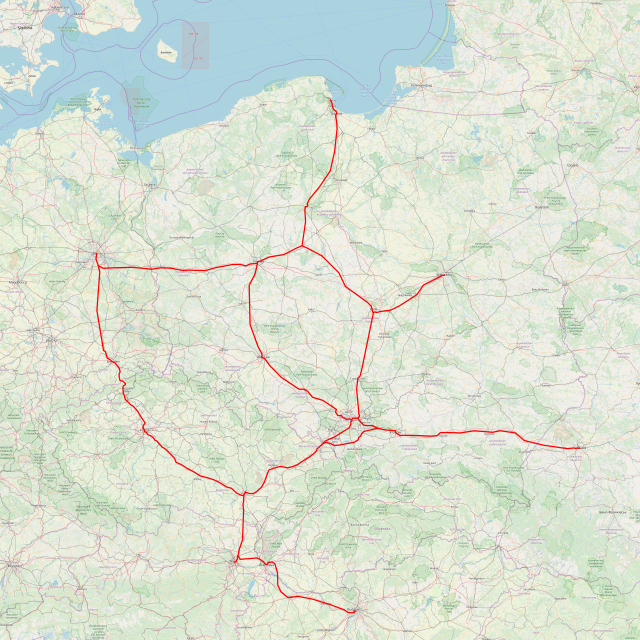
A full-resolution image, with most cities labeled via the OpenStreetMap layer, can be found here.
In short, the point of the network is to connect the main and secondary cities of the four Visegrád Group countries, which are the densest in Eastern Europe and the closest to preexisting Western European networks. Berlin-Dresden becomes a full high-speed line, with an onward connection to Prague, Brno, Olomouc, and Ostrava, which conveniently lie on a single line. From Brno, trains go south to Vienna or Bratislava and thence Budapest. From Ostrava, trains either go into Katowice or via an upgrade of an existing bypass line to Kraków; Kraków gets a connection to Lviv via the collinear cities of Tarnów, Dębica, and Rzeszów. Poland gets a series of Y-shaped lines connecting Berlin, Warsaw, and Katowice via Łódź, while the Berlin-Łódź section itself is two legs of a Y with Gdańsk and the Tricity area. A faster alternate route from Poznań to Katowice via Wrocław and Opole rounds up the network.
The spreadsheet with metro populations, approximate distances, and ridership projections can be found here. Metro area populations are taken from a variety of sources, such as Eurostat; I don’t have a good feel for Polish numbers, so I sanity-checked them with Wikipedia’s multi-source list. The network as proposed is 2,770 km in the spreadsheet not counting Berlin-Dresden, but could be a few tens of km off. This is similar in size to the French LGV network, in a region of similar overall population, and the model says there would be 103 million trips generating 48 billion passenger-km, neither figure counting internal German travel; the domestic TGVs had 51.6 billion passenger-km in 2019 (source, p. 46).
Domestic networks
The network provides a fairly complete coverage of Czechia, and a reasonable one of Poland. Slovakia is too small for such a network, and Hungary’s secondary cities are small and never collinear with Budapest, and therefore these two countries only get international service.
Czechia here benefits from a linear population distribution, and the biggest miss, Plzeň, is collinear with the rest of Czechia as well and could potentially get a heavily-tunneled onward route to Bavaria with a connection to Munich, Nuremberg, or both. Czechia also benefits from atypically strong connecting urban rail – Prague may have Europe’s highest rail ridership per capita depending on metro area definitions, and Brno, with a metro area that on the widest reasonable definition has about a million people, had 195 million tram trips in 2019 (source, PDF-p. 36).
The main challenge for Czech high-speed rail construction is that costs would be high. Prague Metro construction costs have exploded in the last decade, for which I have only an inkling of an explanation; more to the point, the hilly topography north of Prague and the difficulty of finding fast approaches would force extensive tunneling. In fact, current plans assume even more tunneling: the Dresden-Prague planning is for a long base tunnel for the dual use of passenger and freight rail, instead of a steep-grade passenger-only route with little tunneling so that the classical line can be given over to freight trains and tourist passenger trains up Saxon Switzerland.
In Poland, the urban geography is more spread out. There is little collinearity, and the positions of the main cities are such that any network of lines would involve significant detours. Łódź is so far south that it forces Warsaw-Gdańsk to detour (as on this map) or go directly with little useful service from Gdańsk to Germany and western Poland (as on a map I made in 2020). Wrocław is at an awkward spot unless there’s a line directly to Dresden. Eastern Polish cities are never at sufficient scale to justify lines by themselves, orphaning Białystok and, unless there’s a Warsaw-Lviv line, Lublin. Warsaw itself is remarkably undersize: in a country almost as large as Spain, it is less than half the metro area population of Madrid. Thankfully, construction is straightforward, and there are enough cities at sufficient density, generally with decent tram connections (and a metro in Warsaw), that it can work.
International trips and Metcalfe’s law
While the internal networks in Czechia and Poland can expect reasonable traffic density, there is no hope of building them by themselves. Too much traffic relies on international connections. The busiest station on the network as depicted above would be Berlin, as it is by far the largest city. Progress in this direction requires international cooperation to build physical high-speed lines, and not just Alpine base tunnels, which are not appropriate for the Germany-Czechia case.
Metcalfe’s law rears its head again, in that every end of the network contributes a greater share of passenger-km to the system than its share of the length. For example, the most peripheral node, Gdańsk and Bydgoszcz, requires 230 km from the pivot of the Y with Poznań and Łódź, or 8.3% – but Gdańsk and Bydgoszcz contribute 11.8 million passengers (11.5% of total) and 6.4 billion passenger-km (13.3% of total). The only place where this is not true is Wrocław and Opole, since there is an alternate route from Berlin to Katowice that’s only somewhat longer; even there, this route adds 350 km (12.6%) and contributes around 5,000 p-km (10.4%) taking into account reduced ridership from longer Berlin-Katowice trips, hardly a laggard.
In practice, the only way to build such a network incrementally is to start from the strongest link, such as Paris-Lyon in France. But no such link exists in Eastern Europe, where the four largest metro regions combined – Warsaw, Kyiv, Budapest, Prague – are about the same size as Ile-de-France. Instead, the network should accrete from already existing lines in Germany and Austria. The spreadsheet omits ridership coming from onward connections to West German cities like Hamburg or Hanover, both fairly close to Berlin by rail, a list that grows every time Germany opens another high-speed line. Thus, a Czech network integrated with Germany and Austria could succeed on its own, leading up to Poland.
But this can’t work in a haphazard way. Czechia generally knows what it needs, but more international cooperation with a stronger EU role is required to make sure everything falls into place – to make sure cross-border rail infrastructure is seamless enough people actually take the train. This just isn’t the kind of network that can accrete bottom-up.
Quick Note: High Speed 2 and Euston
There was reporting in the Sun, since officially denied, that Britain is planning to cut Euston from its high-speed rail project and run trains only as far a Old Oak Common, a future development site west of Central London. I assume given the source and lack of any other confirmation that the plans are to run to Euston as planned. But what if the story is not completely fake news, and there are plans to cut on construction at Euston? I can see a cut being positive value engineering, using space at the station more efficiently.
What’s the issue with High Speed 2?
High Speed 2 is an extremely expensive line. Among proper intercity high-speed rail lines (as opposed to suburban lines running at medium speed), it is the most expensive in our database per kilometer. The projected cost as of 2019-20 is about the same as that of all lines built to date in Germany and France combined; Germany has about 1,000 km of newly-built high-speed lines and France 2,500, whereas HS2 is planned to be 530 km.
The high costs are related to some massive scope creep, including tunnels in relatively flat terrain through the Chilterns, dug essentially because the area has rich NIMBYs and the British state decided not to fight them. Those are already in advanced enough construction that I don’t think descoping them and building the line at-grade with compulsory purchase of land is viable. However, some of the scope is new stations, which British defenders of the system insist are necessary. Birmingham is to get an entirely new station at Curzon Street, and London Euston is to get a substantial increase in size, with additional tracks and approaches. This is said to be necessary for capacity reasons.
Are new stations necessary for capacity?
No. Euston today has 16 platform tracks; it had 18 before HS2 construction started. The S-Bahn-quality Watford DC line can use two; the remaining slow services at the station amount to around 10-12 trains per hour, which S-Bahn-quality terminals like Saint-Lazare on the RER E and Catalunya on the Barcelona Rodalies network can comfortably turn on four tracks; those two comparisons turn 16 and 24 trains per hour on four tracks, respectively. The services out of Euston branch more than the RER and Rodalies, but this is mostly a mix of stopping patterns, largely on the same legacy line.
Then there’s HS2 itself. The line is expected to get very high ridership, justifiably: all cities along the line are larger than their comparison cases on the LGV Sud-Est, often substantially, and the projection is that very high capacity is required, on the order of 16 trains per hour. This stretches high-speed rail to its limit: the Shinkansen, which mixes local and express trains on double track, peaks around 14-15 trains per hour, and the complexly branched TGV around 12. HS2 expects to do better perhaps through better signals but also through having a simpler stopping pattern on its most congested section, between London and the bifurcation at Birmingham Interchange, on which trains are to run nonstop.
However, 16 trains per hour can still turn on about six platform tracks. This is not easy: the Tohoku Shinkansen turns 14 on four tracks, but this is a limit case, famous not just in rail media but also in business media as successful optimization of infrastructure. Nonetheless, given how constrained the site is, it’s useful to learn from the best and not the average. If it’s possible to descope the plans to add new tracks to Euston, this should be done; present plans for Euston cost billions.
Is this happening?
Maybe. Britain is aware of the situation at Tokyo Station, although it seems more interested in looking for reasons not to learn than in learning. Perhaps very high costs are leading to a reevaluation, in which Euston can be made smaller than in current plans and trains can turn more efficiently.
But again, the ultimate source on this said nothing of this sort, and is unreliable. So who knows?
Paris-Berlin Trains, But no Infrastructure
Yesterday, Bloomberg reported that Macron and Scholz announced new train service between Paris and Berlin to debut next year, as intercity rail demand in Europe is steadily rising and people want to travel not just within countries but also between them. Currently, there is no direct rail service, and passengers who wish to travel on this city pair have to change trains in Frankfurt or Cologne. There’s just one problem: the train will not have any supportive infrastructure and therefore take the same eight hours that trains take today with a transfer.
This is especially frustrating, since Germany is already investing in improving its intercity rail. Unfortunately, the investments are halting and partial – right now the longest city pair connected entirely by high-speed rail is Cologne-Frankfurt, a distance of 180 km, and ongoing plans are going to close some low-speed gaps elsewhere in the system but still not create any long-range continuous high-speed rail corridor connecting major cities. With ongoing plans, Cologne-Stuttgart is going to be entirely fast, but not that fast – Frankfurt-Mannheim is supposed to be sped up to 29 minutes over about 75 km.
Berlin-Paris is a good axis for such investment. This includes the following sections:
- Berlin-Halle is currently medium-speed, trains taking 1:08-1:16 to do 162 km, but the flat, low-density terrain is easy for high-speed rail, which could speed this up to 40-45 minutes at fairly low cost since no tunnels and little bridging would be required.
- Halle-Erfurt is already fast, thanks to investments in the Berlin-Munich axis.
- Erfurt-Frankfurt is currently slow, but there are plans to build high-speed rail from Erfurt to Fulda and thence Hanau. The trip times leave a lot to be desired, but newer 300 km/h trains like the Velaro Novo, and perhaps a commitment to push the line not just to Hanau but closer to Frankfurt itself, could do this section in an hour.
- Frankfurt-Saarbrücken is very slow. Saarbrücken is at the western margin of Germany and is not significant enough by itself to merit any high-speed rail investment. Between it and Frankfurt, the terrain is rolling and some tunneling is needed, and the only significant intermediate stops are Mainz (close enough to Frankfurt it’s a mere stop of opportunity) and Kaiserslautern. Nonetheless, fast trains could get from Frankfurt to the border in 45 minutes, whereas today they take two hours.
Unfortunately, they’re not talking about any pan-European infrastructure here. Building things is too difficult, so instead the plan is to run night trains – this despite the fact that Frankfurt-Saarbrücken with a connection to the LGV Est would make a great joint project.
Midwestern Urban Geography and High-Speed Rail
I’ve been uploading videos about high-speed rail lately, of which the most recent, from a week ago, is a return to my attempt at producing a high-speed rail map proposal for the eastern half of the United States. I streamed and then blogged a map here with followup here, but having looked at the model more, I’d like to do a refinement – both to introduce a slightly bigger map and explain why it is so, and talk about the issue of connecting low-speed lines. Along the way, I feel like I must talk about an issue mentioned in comments occasionally about the politics of only connecting major metropolitan areas, especially since this map still has fewer lines than various state wishlists stapled by Amtrak; this is especially important because one of the motivations for this post is a criticism of current plans by Matt Yglesias.
The map
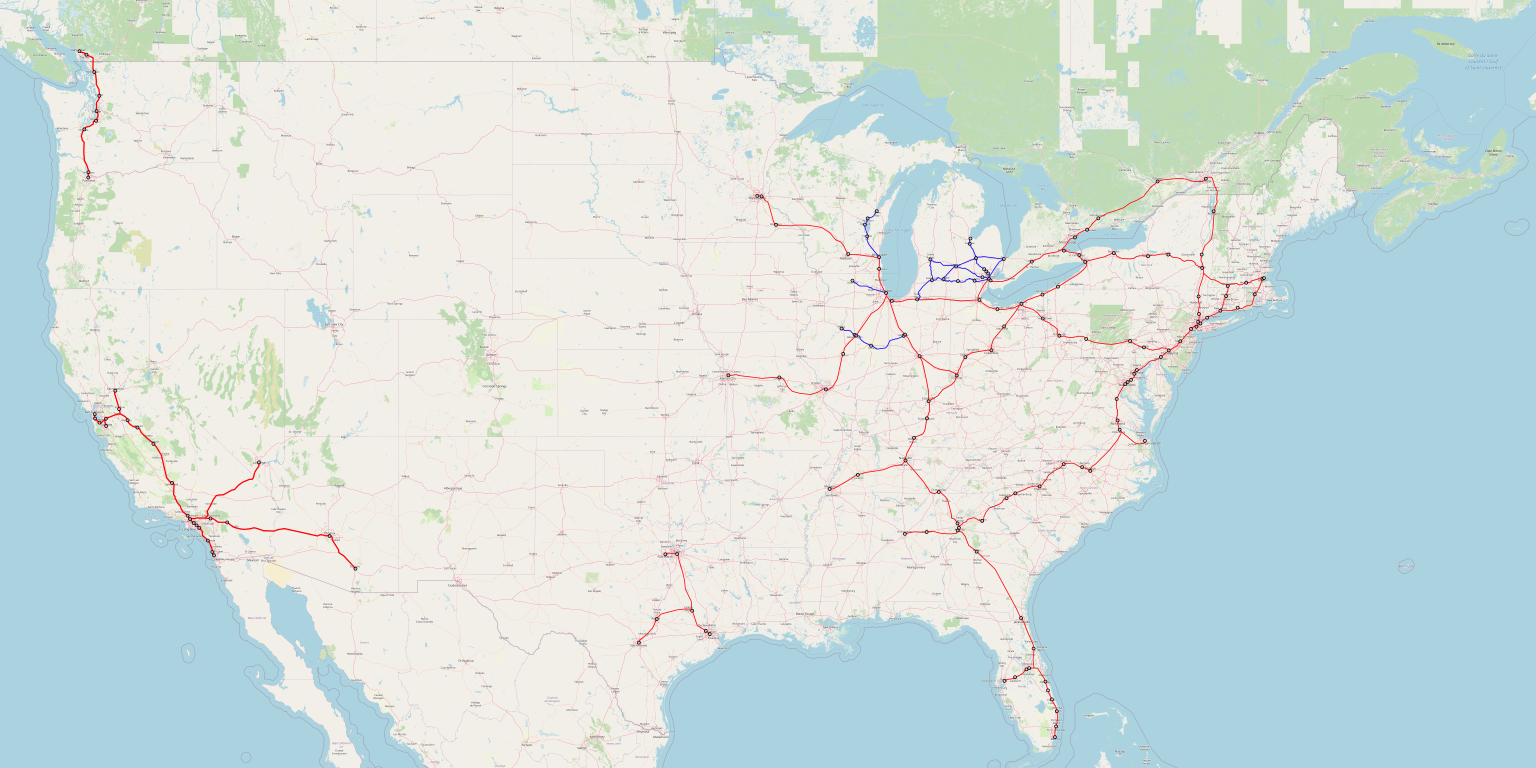
A full-size (6 MB) version of the map can be found here. This is not intended as a comprehensive map of all desirable low-speed connections – I made no effort to include the Northeastern ones, which I wrote about in the context of New England and Upstate New York, and which Ben She has done good work on in the context of eastern Pennsylvania and the mid-Atlantic. Rather, I want to focus on the Midwest.
But first, to explain a little more about why this map includes more red (high-speed) lines than previously, the reason has to do with my spreadsheet for computing ridership density based on Metcalfe’s law. The original posts computed everything by hand, which meant that some low-ridership city pairs I just rounded to zero; the spreadsheet does include them, making every line look much stronger. This, in particular, makes St. Louis-Kansas City and Atlanta-Birmingham, omitted last year, and Nashville-Memphis, suggested last year as a maybe, solid propositions.
A note of caution is still advised. Those weak city pairs that aggregate to sufficient ridership for significant return on investment are often at long distance, such as Kansas City-New York. The ridership model is trained on Shinkansen data out of Tokyo and sanity-checked with some French, German, and Spanish data, but the same model overpredicts Shinkansen ridership on inter-island trips for which planes are a convenient alternative, like Tokyo-Fukuoka or Tokyo-Hakodate. This makes me reluctant to add a Kansas City-Dallas connection, which the spreadsheet thinks generates a bit more than $1 million in annual operating profit per km of new construction: the extra ridership out of Kansas City-Dallas includes some very long-distance trips like Dallas-Detroit, for which the model is likely an overprediction.
The truth is likely between the spreadsheet and the handmade version of the model; while the Shinkansen is not competitive with planes when trains take five hours, European high-speed trains are, for example Paris-Nice. This leads to the inclusion of the new sections, but the exclusion of Kansas City-Dallas. Note also that I did look at Birmingham-New Orleans and Memphis-Little Rock, and both were weak even in the spreadsheet (though I did not attempt Birmingham-New Orleans-Houston) – the Deep South is too low-density and rural to support as expansive a system.
But the topic of this post is not the South, but the Midwest.
Midwestern urban geography
The United States is usually a country of fewer, bigger metropolitan areas, like rich Asia and unlike Europe; unlike both Europe and Asia, American cities are very decentralized, and the exceptions are in the Northeast and West, not the Midwest. In particular, naive comparisons of Midwestern to French high-speed rail corridors are unwarranted: while Chicago is of the same approximate size as Paris, and secondary Midwestern metropolitan areas like Detroit and St. Louis are substantially larger than French ones like Lyon and Marseille, Lyon and Marseille are ringed by many small metropolitan areas with their own TGV service, whereas at the same radius, St. Louis has only its suburbs.
However, this phenomenon of fewer, bigger metro areas has exceptions. Michigan, in particular, has a slightly more European geography. Using the smaller numbers produced by the metropolitan statistical area (MSA) calculation rather than the broader combined statistical area (CSA), Metro Detroit has 43% of Michigan’s population as of the 2020 census. The median Michigander lives in the Grand Rapids MSA, with 1.1 million people, fewer than the US-wide median of 1.6-1.7 million. Michigan is a fairly urban state, and below Grand Rapids is a succession of six-figure metropolitan areas: Ann Arbor, Lansing, Flint, Kalamazoo, Battle Creek, Saginaw.
Ohio is similar to Michigan. Its three main metro areas, excluding Cincinnati’s out-of-state suburbs, have just a hair less than half the state’s population; the median Buckeye therefore lives in Dayton, MSA population 800,000. Moreover, the southern half of Michigan has fairly high population density, as does Ohio – nothing as dense as the Northeast or Germany, but they’re comparable to France.
This geography lends itself to an expansive intercity rail network: the cities are relatively close to one another, and there are many of them meriting a connection. In Ohio, this happens to take the form of an entirely high-speed network, since Cleveland, Columbus, Dayton, and Cincinnati all lie on one line, and then the most natural east-west route between the Northeast and the Midwest passes through Cleveland and Toledo. Ohio, in this case, is a state with fairly good geography for low-speed intercity rail that just happens to also have good geography for high-speed rail due to its location. Michigan, in contrast, is not on the way between much, and thus should get a low-speed rail network, including both connections to Chicago (such as to Grand Rapids) and an intra-state network.
Wisconsin has many, smaller cities as well: the median resident is in an MSA of around 200,000 people, currently Racine. Fortunately, many of those cities lie on just one line between Chicago and Minneapolis, plus a low-speed branch up to Green Bay. Unfortunately, coverage is lacking by the standards of Ohio, Michigan, or much more big city-dominated Illinois and Minnesota.
Getting low-speed rail right
I am happy to report that in Michigan and Ohio at least, good projects for low-speed rail are pursued. When I streamed my video, I was told in Twitch chat that Michigan is looking into funding a Detroit-Lansing-Grand Rapids intercity train. Ohio likewise has long had ideas for a statewide network, beginning with the Cleveland-Cincinnati spine.
It is unfortunate that these projects are not planned well. In a future post, I should write more about the concept of the wrong project versus the right project done poorly; I obliquely pointed this out when writing about leakage in the context of urban transit, where some American cities have poor project prioritization (such as Los Angeles) whereas others choose more or less the right projects but execute them poorly (such as New York and San Francisco). In this schema, the current plans for low-speed rail are often the right project, done wrong.
What I mean by this is that there’s a set of best industry practices for getting low-speed (that is, legacy) rail right, emanating out of Germany and surrounding countries, especially Switzerland. These include,
- Integration of timetable planning and infrastructure, to minimize construction costs – if higher costs are acceptable, just build high-speed rail.
- A clockface all-day schedule with a minimum of one train every two hours, and ideally a train every hour if the distances are shorter or the cities are bigger.
- Timed connections at major nodes to both other intercity trains within the same network and regional mass transit (such as regional trains or connecting buses).
- Reliability-centric planning, in which sources of delays are to be proactively eliminated – on a system this tightly coordinated, delays on one line propagate across the entire system.
- An average speed of around 100-130 km/h – the higher numbers are more appropriate in flat terrain.
Marco Chitti has an excellent post that I must revisit in the future giving more detailed guidelines, mostly at regional level but also with an eye toward national intercity rail planning.
The upshot is that trying to incrementally build up ridership for a few trains per day does not work. The US has a few trains per day on a few corridors now, such as Chicago-Detroit, and daily trains on most others, and this hasn’t built up ridership. The low-speed, low-frequency intercity trains Europe had before the introduction of the TGV in France and the high-frequency, tightly-linked InterCity network in Germany were rapidly losing market share to cars and planes. To build such a network now would be like to build infrastructures wired telephones in a developing country rather than just skipping straight to cellphones as developing countries have.
Politics and Matt Yglesias’s post
Matt likes pointing out that current transportation plans in the United States are deficient, and to link to my posts as a better alternative. There was a lot of dunking on Matt’s post about this (as there is on anything that Matt writes) by left-identified people who, in effect, think daily or twice-daily trains between small cities are a great investment. This dunking usually takes the form of “how dare Matt, a lifelong East Coaster, tell people in [insert Midwestern town] that they don’t deserve trains?”. In a less abrasive form, some people in comments here, like Pharisee, have made the point that these expansive maps proposing daily trains to many places have good geographic coverage whereas what I propose does not. Let me explain why this line of thinking is wrong.
The issue is that the United States is, again, a country that for the most part has fewer, larger metropolitan areas than Europe. The map I made above hits MSAs with a large majority of the country’s population. Of the top 50 as of the 2020 census, the only misses are Denver, Oklahoma City, Salt Lake City, and New Orleans. Denver and Salt Lake City are far from everything else, and the other two are in theory on routes from Texas to the rest of the country but there’s too little population on the way for a connection in the geography of 2022.
Moreover, within the Midwest, coverage is ample. The Midwest is a highly (sub-)urbanized region, much of which has fairly high population density, and the biggest exception to the high density, Minnesota, has a large enough city to justify a line to Chicago by itself (and Milwaukee is on the way, too). The areas that are usually most moralized as Real America – Michigan, Ohio, Pennsylvania – are on the way. This shouldn’t be too surprising: the Real America moralization centers areas with a past industrial history, evoking feelings of nostalgia for midcentury American industrial dominance, and those areas remain major cities today, just relatively poorer than they were in the 1960s. This way, in the Midwest, every state has a large majority of its population in an MSA with a high- or low-speed train station on my map, except Iowa, which is unusually rural.
This is not even out of any consciously political desire to serve these areas. I draw maps out of a ridership model. It just so happens that metropolitan areas of 4 million people situated in dense geographies scream “build high-speed trains to me,” and those include Detroit.
The problem – the reason Matt is so negative on current plans – is that current plans are bad. They are low- and not high-speed rail, which by itself is not horrible, but they’re also bad low-speed rail. Daily trains are just not good. But this does not mean the Midwest can’t or shouldn’t get a good intercity rail network: it should, combining high- and low-speed trains as appropriate.
Philadelphia and High-Speed Rail Bypasses (Hoisted from Social Media)
I’d like to discuss a bypass of Philadelphia, as a followup from my previous post, about high-speed rail and passenger traffic density. To be clear, this is not a bypass on Northeast Corridor trains: every train between New York and Washington must continue to stop in Philadelphia at 30th Street Station or, if an in my opinion unadvised Center City tunnel is built, within the tunnel in Center City. Rather, this is about trains between New York and points west of Philadelphia, including Harrisburg, Pittsburgh, and the entire Midwest. Whether the bypass makes sense depends on traffic, and so it’s an example of a good investment for later, but only after more of the network is built. This has analogs in Germany as well, with a number of important cities whose train stations are terminals (Frankfurt, Leipzig) or de facto terminals (Cologne, where nearly all traffic goes east, not west).
Philadelphia and Zoo Junction
Philadelphia historically has three mainlines on the Pennsylvania Railroad, going to north to New York, south to Washington, and west to Harrisburg and Pittsburgh. The first two together form the southern half of the Northeast Corridor; the third is locally called the Main Line, as it was the PRR’s first line.

Trains can run through from New York to Washington or from Harrisburg to Washington. The triangle junction northwest of the station, Zoo Junction, permits trains from New York to run through to Harrisburg and points west, but they then have to skip Philadelphia. Historically, the fastest PRR trains did this, serving the city at North Philadelphia with a connection to the subway, but this was in the context of overnight trains of many classes. Today’s Keystone trains between New York and Harrisburg do no such thing: they go from New York to Philadelphia, reverse direction, and then go onward to Harrisburg. This is a good practice in the current situation – the Keystones run less than hourly, and skipping Philadelphia would split frequencies between New York and Philadelphia to the point of making the service much less useful.
When should trains skip Philadelphia?
The advantage of skipping Philadelphia are that trains from New York to Harrisburg (and points west) do not have to reverse direction and are therefore faster. On the margin, it’s also beneficial for passengers to face forward the entire trip (as is typical on American and Japanese intercity trains, but not European ones). The disadvantage is that it means trains from Harrisburg can serve New York or Philadelphia but not both, cutting frequency to each East Coast destination. The effect on reliability and capacity is unclear – at very high throughput, having more complex track sharing arrangements reduces reliability, but then having more express trains that do not make the same stop on the same line past New York and Newark does allow trains to be scheduled closer to each other.
The relative sizes of New York, Philadelphia, and Washington are such that traffic from Harrisburg is split fairly evenly between New York on the other hand and Philadelphia and Washington on the other hand. So this really means halving frequency to each of New York and Philadelphia; Washington gets more service with split service, since if trains keep reversing direction, there shouldn’t be direct Washington-Harrisburg trains and instead passengers should transfer at 30th Street.
The impact of frequency is really about the headway relative to the trip time. Half-hourly frequencies are unconscionable for urban rail and very convenient for long-distance intercity rail. The headway should be much less than the one-way trip time, ideally less than half the time: for reference, the average unlinked New York City Subway trip was 13 minutes in 2019, and those 10- and 12-minute off-peak frequencies were a chore – six-minute frequencies are better for this.
The current trip time is around 1:20 New York-Philadelphia and 1:50 Philadelphia-Harrisburg, and there are 14 roundtrips to Harrisburg a day, for slightly worse than hourly service. It takes 10 minutes to reverse direction at 30th Street, plus around five minutes of low-speed running in the station throat. Cutting frequency in half to a train every two hours would effectively add an hour to what is a less than a two-hour trip to Philadelphia, even net of the shorter trip time, making it less viable. It would eat into ridership to New York as well as the headway rose well above half the end-to-end trip, and much more than that for intermediate trips to points such as Trenton and Newark. Thus, the current practice of reversing direction is good and should continue, as is common at German terminals.
What about high-speed rail?
The presence of a high-speed rail network has two opposed effects on the question of Philadelphia. On the one hand, shorter end-to-end trip times make high frequencies even more important, making the case for skipping Philadelphia even weaker. In practice, high speeds also entail speeding up trains through station throats and improving operations to the point that trains can change directions much faster (in Germany it’s about four minutes), which weakens the case for skipping Philadelphia as well if the impact is reduced from 15 minutes to perhaps seven. On the other hand, heavier traffic means that the base frequency becomes much higher, so that cutting it in half is less onerous and the case for skipping Philadelphia strengthens. Already, a handful of express trains in Germany skip Leipzig on their way between Berlin and Munich, and as intercity traffic grows, it is expected that more trains will so split, with an hourly train skipping Leipzig and another serving it.
With high-speed rail, New York-Philadelphia trip times fall to about 45 minutes in the example route I drew for a post from 2020. I have not done such detailed work outside the Northeast Corridor, and am going to assume a uniform average speed of 240 km/h in the Northeast (which is common in France and Spain) and 270 km/h in the flatter Midwest (which is about the fastest in Europe and is common in China). This means trip times out of New York, including the reversal at 30th Street, are approximately as follows:
Philadelphia: 0:45
Harrisburg: 1:30
Pittsburgh: 2:40
Cleveland: 3:15
Toledo: 3:55
Detroit: 4:20
Chicago: 5:20
Out of both New York and Philadelphia, my gravity model predicts that the strongest connection among these cities is by Pittsburgh, then Cleveland, then Chicago, then Detroit, then Harrisburg. So it’s best to balance the frequency around the trip time to Pittsburgh or perhaps Cleveland. In this case, even hourly trains are not too bad, and half-hourly trains are practically show-up-and-go frequency. The model also predicts that if trains only run on the Northeast Corridor and as far as Pittsburgh then traffic fills about two hourly trains; in that case, without the weight of longer trips, the frequency impact of skipping Philadelphia and having one hourly train run to New York and Boston and another to Philadelphia and Washington is likely higher than the benefit of reducing trip times on New York-Harrisburg by about seven minutes.
In contrast, the more of the network is built out, the higher the base frequency is. With the Northeast Corridor, the spine going beyond Pittsburgh to Detroit and Chicago, a line through Upstate New York (carrying Boston-Cleveland traffic), and perhaps a line through the South from Washington to the Piedmont and beyond, traffic rises to fill about six trains per hour per the model. Skipping Philadelphia on New York-Pittsburgh trains cuts frequency from every 10 minutes to every 20 minutes, which is largely imperceptible, and adds direct service from Pittsburgh and the Midwest to Washington.
Building a longer bypass
So far, we’ve discussed using Zoo Junction. But if there’s sufficient traffic that skipping Philadelphia shouldn’t be an onerous imposition, it’s possible to speed up New York-Harrisburg trains further. There’s a freight bypass from Trenton to Paoli, roughly following I-276; a bypass using partly that right-of-way and, where it curves, that of the freeway, would require about 70 km of high-speed rail construction, for maybe $2 billion. This would cut about 15 km from the trip via 30th Street or 10 km via the Zoo Junction bypass, but the tracks in the city are slow even with extensive work. I believe this should cut another seven or eight minutes from the trip time, for a total of 15 minutes relative to stopping in Philadelphia.
I’m not going to model the benefits of this bypass. The model can spit out an answer, which is around $120 million a year in additional revenue from faster trips relative to not skipping Philadelphia, without netting out the impact of frequency, or around $60 million relative to skipping via Zoo, for a 3% financial ROI; the ROI grows if one includes more lines in the network, but by very little (the Cleveland-Cincinnati corridor adds maybe 0.5% ROI). But this figure has a large error bar and I’m not comfortable using a gravity model for second-order decisions like this.
High-Speed Rail Doesn’t Depend on Megaregions
On my Discord channel, I was reminded of the late-2000s work by some institutional American urbanists about the concept of megaregions. Wikipedia has a good summary of the late-2000s discourse on the subject. In short, there are linear ties across the East Coast from Boston to Washington (“BosWash”), with more or less continuous suburban development in between, and some urbanists tried to generalize this concept to other agglomerations of metropolitan areas, not usually successfully. The American work on this carved most of the country’s population into 10 or 11 megaregions, sometimes annexing portions of Canada, as in the Regional Plan Association’s America 2050 program:
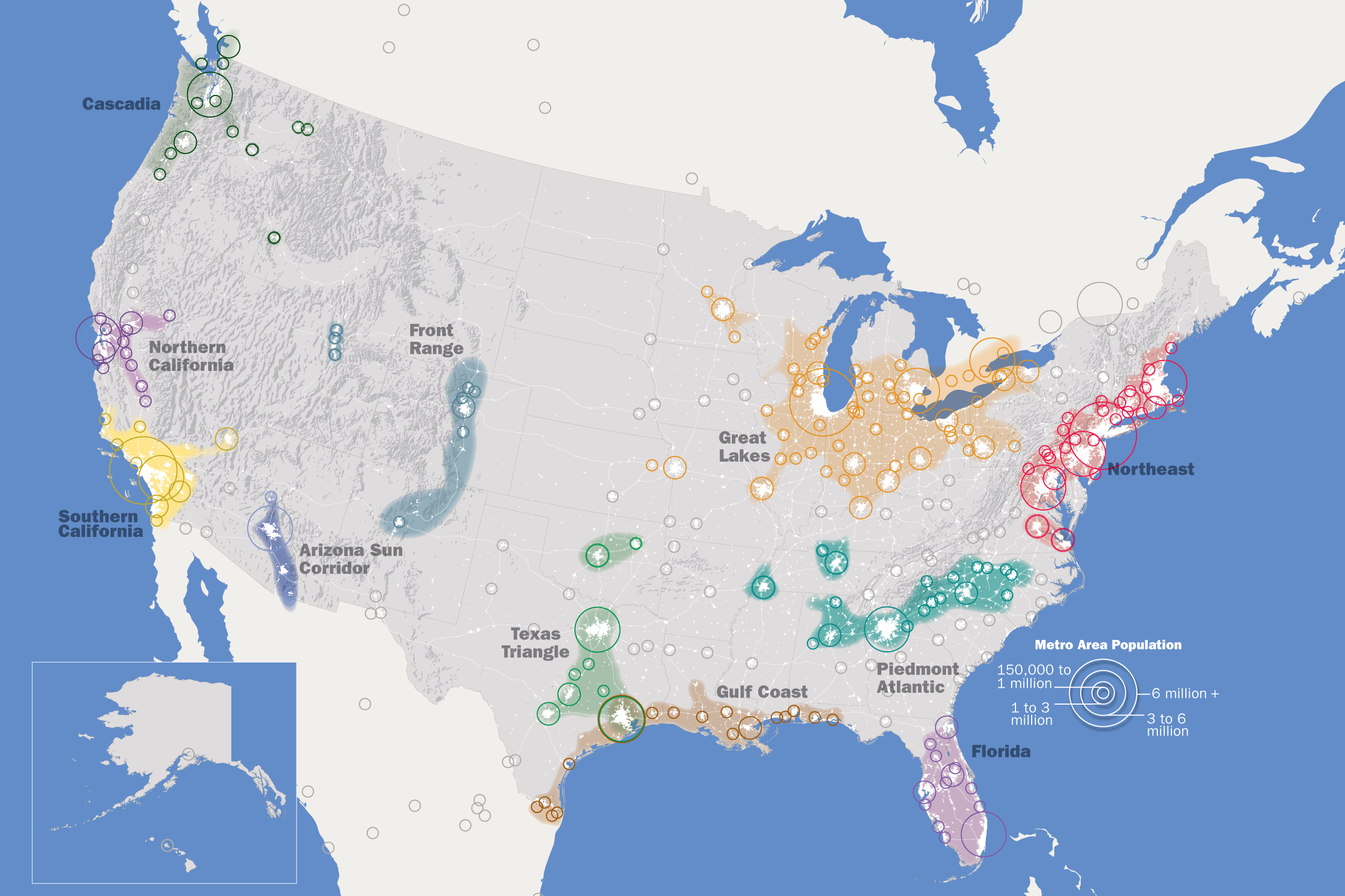
There is a lot to critique about this map. Canada has a strong self-conception as a distinct entity from the United States; while there’s a case for lumping Vancouver with Seattle and Portland as the Pacific Northwest, lumping Toronto with the Midwest is irresponsible. The Hampton Roads region is not meaningfully a periphery of the Northeast, but is rather Southern (for example, it is heavily militarized, and the South has consistently higher enlistment rates than the Northeast). The Rio Grande Valley is not especially connected with New Orleans.
But the core of the program is to propose this as the basis of high-speed rail investment, and that’s where it fails the most visibly. When one of my Discord channel participants posted the map in the channel about high-speed rail, I started talking about my gravity model, and pointed out some patterns that emerge.
For this, consult a table of ridership between any pair of American or Canadian cities in the main connected component of my proposed map:

The table omits Texas, California, and the Pacific Northwest. But it includes lines that I initially considered and rejected, going to Kansas City and Birmingham; the reason is that when I calculated it by hand I omitted very weak long-range connections such as between Boston and the Midwest, whereas the table can automatically calculate them and add them in, producing an estimate of 5 million annual riders between Boston and the entire Midwest region. These extra connections make weak lines like those to Birmingham and Kansas City appear stronger, so those lines are included; it’s plausible they could even justify a connection to Texas via both New Orleans and and Tulsa, but those are not included (and would at any case not impact the analysis below).
The following table includes some connections between two adjacent cities in the table, with their total projected passenger counts. Those are very high numbers, higher than you’d expect; this is because they lump in a great many city pairs – for example, New York-Philadelphia includes all connections from New York, Boston, and Albany to Philadelphia and points south and west, and those sum to a much higher number than just the internal trips on the Northeast Corridor, let alone just trips originating in New York and ending in Philadelphia or the reverse. Also, as a note of caution, there may be small inaccuracies if I mistakenly tabulated very weak markets like Chicago-Charlotte as going via the wrong path; they do not change the main conclusion.
| City pair | Ridership |
| Boston-New York | 39,299,133 |
| Boston-Springfield | 25,482,364 |
| New York-Philadelphia/Harrisburg | 139,860,707 |
| Philadelphia-Washington | 110,010,205 |
| Washington-Richmond | 64,145,050 |
| Richmond-Raleigh | 50,425,578 |
| Raleigh-Greensboro | 42,654,519 |
| New York-Albany | 57,773,629 |
| Philadelphia-Harrisburg | 65,639,871 |
| Harrisburg-Pittsburgh | 61,110,782 |
| Pittsburgh-Cleveland | 62,352,156 |
| Cleveland-Toledo | 56,482,182 |
| Cleveland-Columbus | 46,046,790 |
| Buffalo-Cleveland | 41,584,062 |
Some observations jump from this (partial) table:
- New York-Boston is much weaker than a lot of segments that are by themselves far weaker than the Northeast Corridor. The reason for this is that a full 31.1 million annual riders on New York-Boston are internal to the Northeast Corridor, whereas the other city pairs require large swaths of the network to be built to have such high traffic.
- From Philadelphia to points west, traffic density is fairly consistent. There’s no separation between a Northeastern and Midwestern megaregion evident in the data: Cleveland has about the same traffic density going east and west, as does Pittsburgh. Rather, it’s the connections between the East Coast and the Midwest, chiefly Philadelphia-Pittsburgh-Cleveland but also the Empire corridor between Albany and Cleveland, that create high ridership.
- Washington-Atlanta is a tail gradually weakening with distance from the Northeast Corridor, rather than an independent corridor.
Outside the US, the same observation about the irrelevance of megaregions to high-speed rail is true. The European attempt to describe a megaregion, the so-called Blue Banana, was constructed explicitly to exclude France – but the highest-traffic density intercity rail link in Europe is between Paris and the bifurcation splitting toward Lyon and Dijon. Frankfurt-Mannheim is a close second, but French intercity trains average around 220 km/h and German ones around 130 km/h depending on the line, and the actually existing high-speed rail network gets higher peak traffic density than the medium-speed one.
Ultimately, high-speed rail as a mode of transportation is a means of connecting metropolitan areas. Whether they fall into megaregions or not is immaterial – some strong links connect distinct regions, like Northeast-Midwest, with higher demand for traffic than some of the internal connections.
When Different Capital Investments Compete and When They Don’t
Advocates for mass transit often have to confront the issue of competing priorities for investment. These include some long-term tensions: maintenance versus expansion, bus versus rail, tram versus subway and commuter rail, high-speed rail versus upgraded legacy rail, electronics versus concrete. In some cases, they genuinely compete in the sense that building one side of the debate makes the other side weaker. But in others, they don’t, and instead they reinforce each other: once one investment is done, the one that is said to compete with it becomes stronger through network effects.
Urban rail capacity
Capacity is an example of when priorities genuinely compete. If your trains are at capacity, then different ways to relieve crowding are in competition: once the worst crowding is relieved, capacity is no longer a pressing concern.
This competition can include different relief lines. Big cities often have different lines that can be used to provide service to a particular area, and smaller ones that have to build a new line can have different plausible alignments for it. If one line is built or extended, the case for parallel ones weakens; only the strongest travel markets can justify multiple parallel lines.
But it can also include the conflict between building relief lines and providing extra capacity by other means, such as better signaling. The combination of conventional fixed block signaling and conventional operations is capable of moving maybe 24 trains per hour at the peak, and some systems struggle even with less – Berlin moves 18 trains per hour on the Stadtbahn, and has to turn additional peak trains at Ostbahnhof and make passengers going toward city center transfer. Even more modern signals struggle in combination with too complex branching, as in New York and some London lines, capping throughput at the same 24 trains per hour. In contrast, top-of-line driverless train signaling on captive metro lines can squeeze 42 trains per hour in Paris; with drivers, the highest I know of is 39 in Moscow, 38 on M13 in Paris, and 36 in London. Put another way, near-best-practice signaling and operations are equivalent in capacity gain to building half a line for every existing line.
Reach and convenience
In contrast with questions of capacity, questions of system convenience, accessibility, reliability, and reach show complementarity rather than competition. A rail network that is faster, more reliable, more comfortable to ride, and easier to access will attract more riders – and this generates demand for extensions, because potential passengers would be likelier to ride in such case.
In that sense, systematic improvements in signaling, network design, and accessibility do not compete with physical system expansion in the long run. A subway system with an elevator at every station, platform edge doors, and modern (ideally driverless) signaling enabling reliable operations and high average speeds is one that people want to ride. The biggest drawback of such a system is that it doesn’t go everywhere, and therefore, expansion is valuable. Expansion is even more valuable if it’s done in multiple directions – just as two parallel lines compete, lines that cross (such as a radial and a circumferential) reinforce each other through network effects.
This is equally true of buses. Interventions like bus shelter interact negatively with higher frequency (if there’s bus shelter, then the impact of wait times on ridership is reduced), but interact positively with everything else by encouraging more people to ride the bus.
The interaction between bus and rail investments is positive as well, not negative. Buses and trains don’t really compete anywhere with even quarter-decent urban rail. Instead, in such cities, buses feed trains. Bus shelter means passengers are likelier to want to ride the bus to connect the train, and this increases the effective radius of a train station, making the case for rail extensions stronger. The same is true of other operating treatments for buses, such as bus lanes and all-door boarding – bus lanes can’t make the bus fast enough to replace the subway, but do make it fast enough to extend the subway’s range.
Mainline rail investments
The biggest question in mainline rail is whether to build high-speed lines connecting the largest cities on the French or Japanese model, or to invest in more medium-speed lines to smaller cities on the German or especially Swiss model. German rail advocates assert the superiority of Germany to France as a reason why high-speed rail would detract from investments in everywhere-to-everywhere rail transport.
But in fact, those two kinds of investment complement each other. The TGV network connects most secondary cities to Paris, and this makes regional rail investments feeding those train stations stronger – passengers have more places to get to, through network effects. Conversely, if there is a regional rail network connecting smaller cities to bigger ones, then speeding up the core links gives people in those smaller cities more places to get to within two, three, four, five hours.
This is also seen when it comes to reliability. When trains of different speed classes can use different sets of track, it’s less likely that fast trains will get stuck behind slow ones, improving reliability; already Germany has to pad the intercity lines 20-25% (France: 10-14%; Switzerland: 7%). A system of passenger-dedicated lines connecting the largest cities is not in conflict with investments in systemwide reliability, but rather reinforces such reliability by removing some of the worst timetable conflicts on a typical intercity rail system in which single-speed class trains never run so often as to saturate a line.
Recommendation: invest against type
The implication of complementarity between some investment types is that a system that has prioritized one kind of investment should give complements a serious look.
For example, Berlin has barely expanded the U-Bahn in the last 30 years, but has built orbital tramways, optimized timed connections (for example, at Wittenbergplatz), and installed elevators at nearly all stations. All of these investments are good and also make the case for U-Bahn expansion stronger to places like Märkisches Viertel and Tegel.
In intercity rail, Germany has invested in medium-speed and regional rail everywhere but built little high-speed rail, while France has done the opposite. Those two countries should swap planners, figuratively and perhaps even literally. Germany should complete its network of 300 km/h lines to enable all-high-speed trips between the major cities, while France should set up frequent clockface timetables on regional trains anchored by timed connections to the TGV.
Deutsche Bahn’s Meltdown and High-Speed Rail
A seven-hour rail trip from Munich to Berlin – four and a half on the timetable plus two and a half of sitting at and just outside Nuremberg – has forced me to think a lot more about the ongoing collapse of the German intercity rail network. Ridership has fully recovered to pre-corona levels – in May it was 5% above 2019 levels, and that was just before the nine-euro monthly ticket was introduced, encouraging people to shift their trips to June, July, and August to take advantage of what is, among other things, free transit outside one’s city of residence. But at the same time, punctuality has steadily eroded this year:
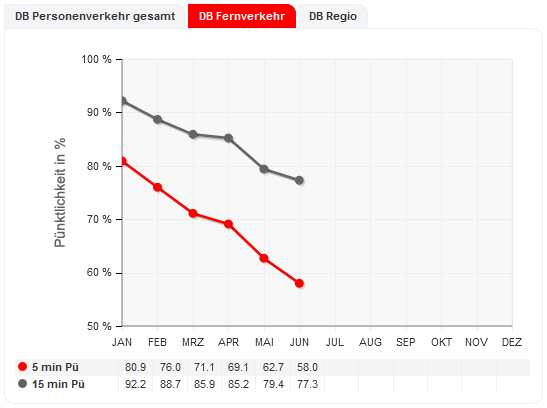
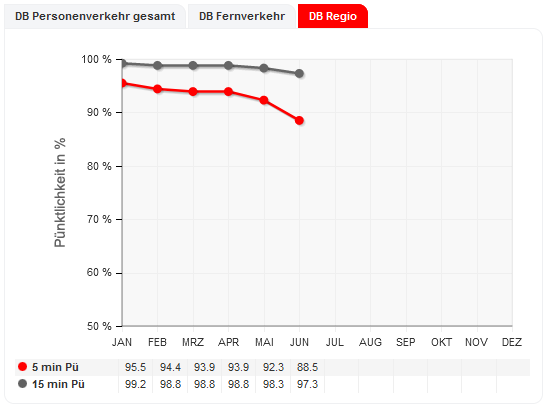
It’s notable that the June introduction of the 9€ ticket is invisible in the graphic for intercity rail; it did coincide with deterioration in regional rail punctuality, but the worst problems are for the intercity trains. My own train was delayed by a mechanical failure, and then after an hour of failed attempts to restart it we were put on a replacement train, which spent around an hour sitting just outside Nuremberg, and even though it skipped Leipzig (saving 40 minutes in the process), it arrived at Berlin an hour and a half behind its schedule and two and a half behind ours.
Sometimes, those delays cascade. It’s not that high ridership by itself produces delays. The ICEs are fairly good at access and egress, and even a full train unloads quickly. Rather, it’s that if a train is canceled, then the passengers can’t get on the next one because it’s full beyond standing capacity; standing tickets are permitted in Germany, but there are sensors to ensure the train’s mass does not exceed a maximum level, which can be reached on unusually crowded trains, and so a train’s ability to absorb passengers on canceled trains as standees is limited.
But it’s not the short-term delays that I’m most worried about. One bad summer does not destroy a rail network; riders can understand a few bad months provided the problem is relieved. The problem is that there isn’t enough investment, and what investment there is is severely mistargeted.
Within German discourse, it’s common to assert superiority to France and Southern Europe in every possible way. France is currently undergoing an energy crisis, because the heat wave is such that river water cannot safely cool down its nuclear power plants; German politicians have oscillated between using this to argue that nuclear power is unreliable and the three remaining German plants should be shut down and using this to argue that Germany should keep its plants open as a gesture of magnanimity to bail out France.
Rail transport features a similar set of problems. France has a connected network of high-speed lines, nearly all of which are used to get between Paris and secondary cities. Germany does not – it has high-speed lines but the longest connection between major cities allowing more than 200 km/h throughout is Cologne-Frankfurt, a distance of 180 km.
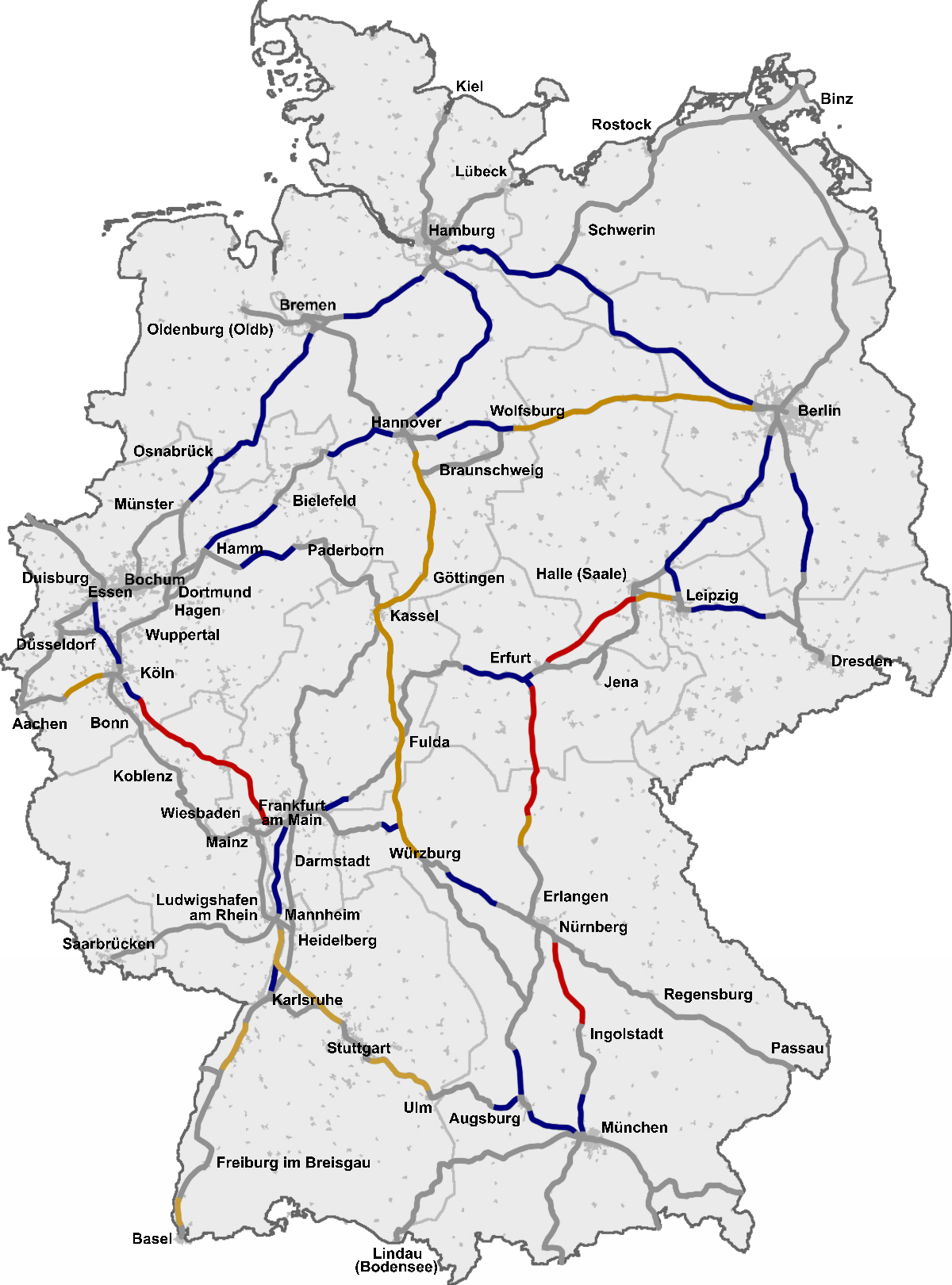
The natural response of most German rail advocates is to sneer at the idea of high-speed rail; France has genuine problems with punctuality, neglect of legacy rail lines, and poor interconnections between lines (it has nothing like the hourly or two-hour clockface timetables of German intercity rail), and those are all held as reasons why Germany has little to learn from France. Instead, those advocates argue, Germany should be investing in network-wide punctuality, because reliability matters more than speed.
The problem is that the sneering at France is completely unjustified. A French government investigation into punctuality in 2019-20 found that yes, French intercity trains suffered from extensive delays – but in 2019 intercity trains were on-time at the terminus 77.4% of the time, compared with 73.8% in Germany. Germany did better in 2020 when nobody was riding, but went back to 75% in 2021 as ridership began to recover. High-speed trains were the most punctual in Spain and the Netherlands, where they do not run on classical lines for significant stretches, unlike in France, Germany, or Italy.
Moreover, German trains are extremely padded. Der Spiegel has long been a critic of poor planning in German railways, and in 2019 it published a comparison of the TGV and ICE. The selected ICE connections were padded more than 20%; only Berlin-Munich was less, at 18%. The TGV comparisons were padded 11-14%; these are all lines running almost exclusively on LGVs, like Paris-Bordeaux, rather than the tardier lines running for significant distances on slow lines, like Paris-Nice. And even 11-14% is high; Swiss planning is 7% on congested urban approaches, with reliability as the center of the country’s design approach, while JR East suggested 4% for Shinkansen-style entirely dedicated track in its peer review of California High-Speed Rail.
Thus, completing a German high-speed rail network is not an opposed goal to reliability. Quite to the contrary, creating a separate network running only or almost only ICEs to connect Berlin, Hamburg, Hanover, Bremen, the main cities of the Rhine-Ruhr, Frankfurt, Munich, and Stuttgart means that there is less opportunity for delays to propagate. A delayed regional train would not slow down an intercity train, permitting not just running at high punctuality but also doing so while shrinking the pad from 25% to 7%, which offers free speed.
Cutting the pad to 7% interacts especially well with some of the individual lines Germany is planning. Hanover-Bielefeld, a distance of 100 km, can be so done in 27-28 minutes; this can be obtained from looking at the real performance specs of the Velaro Novo, but also from a Japanese sanity check, as the Nagoya-Kyoto distance is not much larger and taking the difference into account is easy. But the current plan is to do this in 31 minutes, just more than half an hour rather than just less, complicating the plan for regular timed connections on the half-hour.
German rail traffic is not collapsing – quite to the contrary. DB still expects to double intercity ridership by the mid-2030s. This requires investments in capacity, connectivity, speed, and reliability – and completing the high-speed network, far from prioritizing speed at the expense of the other needs, fulfills all needs at once. Half-hourly trains could ply every connection, averaging more than 200 km/h between major cities, and without cascading delays they would leave the ongoing summer of hell in the past. But this requires committing to building those lines rather than looking for excuses for why Germany should not have what France has.
Quick Note: Why Not Fly?
I was asked a deceptively simple question on Twitter: why would people bother with taking a train when flying is available? In my (admittedly primitive) modeling for high-speed rail ridership in the US, I’m including some nontrivial ridership and revenue coming from cities at a distance that people do fly, like Boston-Washington, New York-Cleveland, and so on. What gives?
The simplest answer is that evidently people do take trains at such distances. Statista has some examples, all with more rail than air travel; an Air2Rail paper by Arie Bleijenberg has some numbers within Europe in Annex B. The main factor is rail travel time, with a malus for markets with poor rail connectivity (such as anything crossing the Channel). When trains take four hours, as on Paris-Toulon, they have a small majority of the travel market (source, p. 14 – look at the 2009 numbers, the 2023 numbers being a speculation); Paris-Nice manages to have respectable modal split even at 5.5 hours.
But that answer is frustrating. Why do people take trains for 4-5 hours when it’s possible to fly in an hour?
The first answer is door-to-door travel time. This includes all of the following features:
- Airports are far from city centers whereas train stations are almost universally within them; even taking into account that most people don’t live in city center, they tend to have easier access to the train station than to the airport, and then destinations are massively centralized in the city.
- Trains have no security theater to delay passengers, and passengers can get from the station entrance to the platform in 10 minutes if the station is exceptionally labyrinthine and they’re unfamiliar with its layout and two minutes if it’s not or they are.
- Passengers with luggage can take it on the train and don’t have to be further delayed for baggage claim.
All of these features work to make trains more pleasant than planes even when the door-to-door trip times are equal. The sequential queuing for security and then boarding on a plane is a hassle in addition to extra time; of note, in the Air2Rail link, the most glaring underperformance in high-speed rail modal split relative to trip times is for routes crossing the Channel, because they have such queuing courtesy of British paranoia about terrorism in the Chunnel and also charge higher fares.
The advantages of planes over trains are elsewhere. First, planes are faster airport-to-airport than trains are station-to-station, and as a result, a longer distances they are much faster door-to-door and therefore dominant. And second, trains travel in lines whereas planes travel point-to-point; it’s not hard to come up with city pairs that have no reason to have an even semi-direct high-speed railway between them even though they are at rail-appropriate range, for example Nice-Geneva (290 km) or Cincinnati-Charlotte (540 km).
But once the lines exist, they should get substantial passenger traffic – and the modal split with air is very well-documented in the literature and the overall traffic is still fairly well-modeled as well.
 Pedestrian Observations