Category: Transportation
We Ran a Conference About Rail Modernization
The Modernizing Rail (Un)Conference happened last Sunday. We’re still gathering all the materials, but here are video uploads, including the keynote by Michael Schabas.
We will also have slides as given by presenters who used them. But for now, here are the slides used by the keynote. You may notice that the recording does not begin on the first slide; we missed Schabas’s introduction and some remarks on his background, detailing his 40 years of experience designing public transit systems in a number of countries, mainly Britain and Canada but also elsewhere in the developed world.
My session on construction costs was slide-free (and was not recorded), since I mostly just showed people around our under-construction cost dataset and answered a lot of questions. Some of those questions were annoying, by which I mean they questioned my thinking or brought up a point I haven’t considered before. I am not talking too much about it partly because I was mostly (mostly) repeating things I’ve said here, and the full database should be out later this summer, with all the mistakes I’ve made in currency conversion rates and in not updating for cost overruns fixed.
After my breakout, I was uncertain between which of two sessions to attend – one on HSR-legacy rail compatibility by María Álvarez, and one on equity issues in rail planning, by Grecia White and Ben She. I ended up going to the latter, which featured interesting discussions of inclusion of low-income people and minorities, both as riders (that is, serving people who are not middle-class whites better on regional rail) and as workers (that is, diversifying planning and engineering departments).
It went well in that there was no monopolization of discussion by people who have more a comment than a question, or any open racism or sexism; but it was somewhat frustrating in that while there was a lot of productive discussion of racial equality in rail planning, there was very little of gender equality even though we did intend to talk about both; Grecia was specifically interested in discussing these, for example women’s perceptions of public safety. This is in line with conference demographics – the organizing team and the breakout presenters were each one-third people of color, in line with US demographics; but the organizing team had 2/18 active women and the presenters 3/15. TransitMatters is similar in that regard – racial diversity is comparable to that of the Boston region, and the proportion of regulars who are queer is enormous, but there are very few women.
Finally, I hosted a session on how to set up a transport association, a.k.a. Verkehrsverbund. Christof Spieler did the most talking, and German attendees explained a lot about the difference between a transport association and agency amalgamation. But for the most part that session felt like an ersatz conclusion to the entire conference; it technically lasted an hour, but once the hour had lapsed, people from other sessions came to the room and the conversation continued naturally, talking a bit about different transit planning issues in Germany and a bit about applicability to rail reform in the Northeastern US.
More on the Deutschlandtakt
The Deutschlandtakt plans are out now. They cover investment through 2040, but even beforehand, there’s a plan for something like a national integrated timetable by 2030, with trains connecting the major cities every 30 minutes rather than hourly. But there are still oddities that are worth discussing, especially in the context of what Germans think trains are capable of and what is achieved elsewhere.
The key is the new investment plans. The longer-term plans aren’t too different from what I’ve called for. But somehow the speeds are lower. Specifically, Hamburg-Hanover is planned to be a combination of legacy rail (“ABS”) and newly-built high-speed rail (“NBS”), dubbed the Alpha-E project, with trains connecting the two cities in 63 minutes.
The point of an integrated takt timetable is that trains should connect major nodes (“knots”) in just less than an integer number of half-hours for hourly service, or quarter-hours for half-hourly service. Trains connect Zurich and Basel in 53 minutes and each of these two cities with Bern in 56 minutes, so that passengers can change trains on the hour and have short connections to onward destinations like Biel, St. Gallen, and Lausanne. To that effect, Switzerland spent a lot of money on tunnels toward Bern, to cut the trip time from somewhat more than an hour to just less than an hour. So the benefits of cutting trip times from 63 minutes to just less than an hour are considerable.
What’s more, it is not hard to do Hamburg-Hanover in less than an hour. Right now the railway is 181 km long, but the planned Alpha-E route is shorter – an alignment via the A 7 Autobahn would be around 145 km long. The Tokaido Shinkansen’s Hikari and Nozomi trains run nonstop between Nagoya and Kyoto, a distance of 134 km, in 34 minutes. Kodama trains make two additional stops, with long dwell times as there are timed overtakes there, and take 51 minutes. Shinkansen trains have better performance characteristics than ICE trains, but the difference in the 270-300 km/h range is around 25 seconds per stop, and the Tokaido Shinkansen is limited to 270 km/h whereas an Alpha-E NBS would do 300. So doing Hamburg-Hanover in less than 40 minutes is eminently possible.
Of course, major cities have slow approaches sometime… but Hamburg is not a bigger city than Kyoto or Nagoya. It’s about comparable in size to Kyoto, both city proper and metro area, and much smaller than Nagoya. Hanover is a lot smaller, comparable to cities served by Hikari but not Nozomi, like Shizuoka and Hamamatsu. Hamburg-Hanover has 12 km between Hamburg and Harburg where trains would be restricted to 140 km/h, and around 6 in Hanover where trains would be restricted to 130 km/h; in between they’d go full speed, which at the performance characteristics of the next-generation Velaro would be a little more than 35 minutes without schedule padding and maybe 38 minutes with. This fits well into a 45-minute slot in the takt, permitting both Hanover and Hamburg to act as knots.
Moreover, if for some reason a full NBS is not desirable – for example, if NIMBY lawsuits keep delaying the project – then it’s possible to built a partial NBS to fit into an hourly time slot, trains taking around 53 minutes. The cost per minute saved in this context is fairly consistent, as this is a flat area and the legacy line is of similar quality throughout the route; if for some reason the cost per minute saved is too high, e.g. if nuisance lawsuits raise construction costs above what they should be on such a route, which is around 15-20 million euros per kilometer, then going down only to 53 minutes is fine as it makes the hourly takt work well.
And yet, it’s not done. The biggest cities are not planned to have regular half-hourly knots, because there’s too much traffic there. But Hanover is in fact a perfect place for a knot, with trains going east to Berlin, west to the Rhine-Ruhr, north to Hamburg, and south to Frankfurt and the cities of Bavaria. Hamburg is at the northern margin of the country, with trains going mostly south to Hanover, but having some timed connection with trains continuing north to Kiel and eventually Copenhagen is not a bad idea.
For some reason, German rail activists, including presumably the ones who pushed the Deutschlandtakt from the bottom up while the ministry of transport was run by pro-car conservatives, are just too conservative about the capabilities of trains. I’ve seen one of the D-Takt groups, I forget which one, criticize plans to build an NBS between Hanover and Bielefeld, a segment on which the existing line is fairly slow, on the grounds that it could never fit into a knot system. It is not possible to do the roughly 100 km between Hanover and Bielefeld (actually closer to 95 km) in less than half an hour to fit a knot, they say – average speeds higher than 200 km/h are only found on very long nonstop stretches of high-speed rail, as in France, they insist. Shinkansen trains achieve such speeds over such segments every day, and even with the slightly lower performance characteristics of the next-generation Velaro, Hanover-Bielefeld in 24 technical minutes and 26 minutes with 7% pad (and the Shinkansen only has 4% pad) is feasible.
I genuinely don’t know why there is such conservatism among German rail planners and advocates. It could be that Europeans don’t like learning from Asia, just as Americans don’t like learning from Europe. There are examples of faster trains than in Germany within Europe, but maybe German advocates discount French and Spanish examples because of genuine problems with French and Spanish rail operations, leading them to also make excuses like “the trains run nonstop for 500 km and that’s why they’re fast” to avoid adopting the things where France and Spain are genuinely superior to Germany.
Nothing about the integrated timed transfer schedule idea impedes high speeds. On the contrary, in some cases, like Hanover-Hamburg but also the planned Frankfurt-Stuttgart line (already in place south of Mannheim), high speeds are necessary to make the desired knots. Moreover, where distances between cities are long compared with desired frequency, as on Berlin-Hanover, it’s possible to build 300 km/h lines and cut entire half hours or even full hours from trip times. Germany could innovate in this and build such a network for an amount of money well within the limits of the corona recovery package, which includes €50 billion for climate mitigation.
But either way, Germany is about to make mistakes of underinvestment because it’s not quite willing to see where the frontier of rail transport technology is. This is not the American amateur hour, it’s not the sort of situation where I can spend a few hours with maps and come up with better timetables myself, but even so, the plans here are far too timid for Germany’s medium- and long-term transportation needs.
The D-Takt is a step forward, don’t get me wrong. None of the investments I’m seeing is bad. But it’s a small, hesitant step forward rather than a firm, bold walk toward direction of intercity rail modernization. A country that expects intercity rail ridership to double, putting Germany’s per capita intercity rail ridership in the vicinity of Japan’s, should have something similar to the Shinkansen network, with a connected network of NBS links between the major cities averaging 200-250 km/h and not 120-160 km/h.
The French Way of Building Rapid Transit
It’s been a while since I last wrote this series, where I covered the American, Soviet, and British traditions of building urban rail. I’d like to return by focusing attention on the French tradition, which has been influential not just within France itself but also to some extent former French colonies, especially Quebec.
An issue I hope to return to soon is the extent to which France has not truly decolonized; former French colonies in Africa, especially the Maghreb, rely on French technical expertise for construction, and often outsource their monetary policy (as with the CFA franc, but Morocco too has a peg to a dollar and euro mix). This matters, because this means the French way of building urban transit is influential in former French colonies in Africa, whereas the British tradition’s impact on India, Nigeria, and so on is limited.
The history of Paris
Like Britain, the USSR, and the US, France has a dominant financial center that its smaller cities aim to imitate. This imitation has been much more extensive than in the US and UK – to the extent that secondary French cities diverge in design principles from the capital, they do things that were fashionable in Paris at the time they built out their rail networks rather than things that were fashionable in Paris when Paris built the Métro. Thus, it is especially valuable to look at the history of urban rail in Paris.
The Paris Métro opened in 1900, as the world’s fifth metro system. Already then, it had a critical feature that the previous four (London, Budapest, Chicago, Glasgow) lacked: it was a centrally planned multi-line system. The city planned a coordinated system of what would become Lines 1-6, in the shape of a # in a circle: Lines 1 and 3 would run east-west, Lines 4 and 5 would run north-south, and Line 2, eventually split into Lines 2 and 6, would run the trace of the wall that delineated the city’s pre-1860 boundary.
The Métro was a municipal effort run by the municipal CMP, designed around the city’s needs, which included not just good transportation but also separation from the working-class suburbs. Whereas the London Underground was mostly technologically compatible with the mainline system, the Métro was deliberately designed not to be, to protect the urban middle class from transport integration with the suburban poor. This led to the following features:
- The trains are extremely narrow, 2.4-2.44 meters wide, compared with about 2.9 m on the mainline; the deep Tube trains in London, held to have the narrowest loading gauge on a standard-gauge railway, are 2.68 m wide.
- The interstation distance is very short, 562 meters on average. Paris is compact and dense and the short interstations are only a real problem in the suburbs.
- The trains run on the right, like French road traffic, whereas French trains run on the left.
- No legacy lines were incorporated into the system, unlike in New York and London, and thus the shape of the network looks much more like how one would design a metro network from scratch and less like how old West London branches or Brooklyn excursion lines looked.
Like New York and Berlin and unlike London, Paris built the Métro cut-and-cover. The lines built before the 1990s all closely follow streets except when they cross the river – and in the 1900s the Line 4 river crossing was the hardest part of the system to build, opening in 1908 whereas the rest of the network had opened by 1906. This was done entirely by hand, forcing the lines to curve where the streets did, which led to two notable warts. First, while most of the system had a design standard of 60 meter curve radii, Line 1 goes down to 40 at Bastille. And second, Line 5, which crosses the Seine on a bridge, cannot serve Gare de Lyon; the engineers could not get it to curve that way while still running through to Gare d’Austerlitz and the Left Bank, so instead the transfer point between Lines 1 and 5 is Bastille, and more recently the RER A and Line 14 both cross Line 5 without a transfer as they run express from Gare de Lyon to Châtelet.
That said, the missed connection between Lines 5 and 14 is the only one in the system, though two more are under construction on Line 14 extensions. Only one among the major metro systems of the world runs entirely without missed connections, the Mexico City Metro, which has unusually low line density in the core and unusually many tangential lines.
The suburbs and the RER
The Métro’s deliberate exclusion of the suburbs made sense from the point of view of a middle-class Parisian in 1900 who was mortally afraid of the working class. But by the 1930s, it was leading to serious design constraints. Further Métro extensions both densified the network and extended it outward, and in the 1930s, lines began to extend past city limits, to such suburbs as Lilas, Issy, Neuilly, and Montreuil. The short interstations made longer extensions infeasible, and some solution involving regional rail was needed.
In 1938, CMP bought and electrified the Ligne de Sceaux, which alone among the Paris commuter lines had reached close to city center, terminating at Jardin du Luxembourg rather than at the farther away rail stations, which are located at or just inside the M2/M6 ring. Then after the war, as suburbanization intensified and commuter traffic at Gare Saint-Lazare grew increasingly congested, CMP’s successor RATP collaborated with SNCF on connecting regional rail branches to form an express system, that is the RER; the Ligne de Sceaux became the southern half of the RER B, while a similar branch going east paired with one of the Saint-Lazare lines to form the RER A. Through-service opened in 1977, roughly at the same time as the German S-Bahn through-tunnels, but the system grew much larger as Paris was and remains far larger than any German city.
But it is not exactly correct to view the RER as identical to a German S-Bahn, or to one of the RER’s inspirations, the Tokyo through-running system. A number of features characterize it, some shared with other urban regional rail systems, some not:
- There are multiple trunk lines through the city, which form something like a coherent network among themselves, and do not share rolling stock. The biggest warts are that the RER B and D share tracks (but no platforms) on one interstation, and that the RER C mostly stays on the Left Bank, legacy of when planning in Paris conceived of the area around Saint-Michel as a central area to be served, where in reality it is decidedly secondary to the CBD stretching from Les Halles to Champs-Elysées.
- It runs largely, though not entirely, on separate tracks from non-RER lines.
- It is locally viewed as deficient to Métro service – researchers who use the RER B to get to IHES think of it as lower-quality, lower-class service than the Métro in the city and its immediate suburbs. I suspect that this is why Grand Paris Express is designed around Métro standards rather than as intensification of RER service, while RER expansion has fallen to the wayside.
- RER-Métro integration is imperfect: the fares are integrated but there are still barriers between RER and Métro platforms, and there are many missed RER-Métro connections, whereas in Berlin the S-Bahn and U-Bahn have only one missed connection between them.
- The interstation is around 2-3 km, but it’s actually slightly longer on the new urban tunnels build for the RER A, B, D, and E than on the legacy lines in the inner suburbs; this feature also exists in a much more extreme form in the United States, but in Berlin and Tokyo it is completely absent.
Exporting Parisian ideas
Parisian metro planning influenced Montreal, Mexico City, and the smaller French cities, in chronological order. We see any of the following features in those cities:
- Rubber-tired metros. This technology was in vogue in postwar Paris, which converted Lines 1, 4, and 11 to it figuring this was just better than steel wheels, and also Line 6, figuring that an elevated line would benefit from a quieter propulsion system.
- Non-radial network design. London and the systems inspired by it, including all Eastern bloc systems, have radial design, with nearly all lines entering a relatively small city center. Paris expanded its #-in-a-circle system to a combination of a radial network and a grid, with a large number of pairs of parallel lines. Mexico City, the largest system inspired by Paris, is rich in tangential lines but has only three lines serving city center, which are by far the three busiest.
- Short interstations, though this is truer domestically than in Montreal and Mexico City.
- Driverless operations. This technology became popular in the 1980s, starting with the Lille Metro, and France has used it on new lines in Paris (M14) and elsewhere (Lyon Line D, both lines in Toulouse), also innovating in converting manual lines to automatic on Paris M1 and now M4. While the Parisian lines are full-size metro lines, the other ones are light metro running shorter vehicles, often with extensive elevated service.
- Separation between regional rail and metro service. Montreal is sufficiently North American to have given up on regional rail entirely, but Lyon and Marseille are investing in better regional rail, run separately from the local urban transit system but with some degree of integration.
- Light rail. France’s modern light rail systems do not originate in Paris – Nantes opened its system in 1985, suburban Paris only in 1992 – but Paris has a notable feature that isn’t common elsewhere in Western Europe: it is a mixed system with some Métro lines and some tram lines filling in the gaps. This mixed system is also present in Lyon, Marseille, and Toulouse, whereas Bordeaux, Strasbourg, and Nice have entirely tram-centric systems. But in no case is there any subway-surface running as in the United States or Germany: lines are either clearly trams or clearly metros, rather than mixtures, and it is the system that is mixed, not the individual line.
Has France decolonized?
Like Britain, France did not take its geopolitical disempowerment at the end of World War Two easily. Both countries have maintained superpower pretensions, decolonizing but trying to treat their former colonies as their spheres of influence as much as possible. In Britain, this relationship broke down – the ex-colonies were being too loud in the Commonwealth, leading the country to seek to join the EU instead. In France, this relationship remains in Africa, and notable not in Southeast Asia, where Vietnam is buildings its urban rail networks with Chinese and Japanese financing.
But France is not just providing financing to infrastructure projects in its former (or current?) African colonies. It has a permanent presence. In researching Arab rail infrastructure, Anan Maalouf has noted that Alstom has had a subsidiary operating in Algeria since 2002, which does not exist elsewhere in the Arab world. This way, French firms maintain close knowledge of the situation in the Maghreb, where incomes and productivity levels are much lower than in France, so that different methods are optimal from those common in rich countries.
Nonetheless, what they build remains noticeably French. For example, the Sfax tramway does not look too different from what Bordeaux or Nice has. The Tunis Métro looks rather like a French tramway system too, despite the name; of note, even though the Tunis Métro branches, and has some underground segments, those segments are not on line trunks and thus the system does not form a subway-surface or Stadtbahn network.
I haven’t gone too much into intercity rail, but it is worth mentioning that Morocco has a high-speed rail system, built with French technical assistance and running TGV equipment.
Does this work?
Yes and no.
The Paris system works. It is not perfect, and in particular the integration between the Métro and the RER could be better; at least one tram line should be a full metro line (a completed T3 ring), and suburban extensions should generally use the RER, with more investment in RER capacity within the city as well. That said, public transport usage is higher in Paris than in its closest comparison, that is London; Paris’s system is also superior in both overall usage and future prospects to that of another megacity in Europe, Moscow. Only Istanbul could potentially do better in the future, in the context of extremely low construction costs.
That said, Paris is a giant that casts a long shadow, which doesn’t always work well for secondary cities. Lyon, Marseille, Toulouse, and the other secondary French cities aren’t too different in modal split from similar-size British cities, and are behind Vancouver, a North American city with extensive postwar growth. German cities in the Lyon size class do a lot better. See for example data here and here.
The weird features of France, like the love for rubber tires, are not that relevant overall, but do point out that France is relatively insular, and mostly adopts domestic ideas developed in Paris rather than ideas from elsewhere in Europe, let alone Asia. (Yes, I know about Japanese influence on the initial RER; however, there have been 50 years of divergence since, same as with German tram-trains and American light rail.) This has been especially problematic with regional rail. France does not have frequent takts anywhere – even Paris only has takt timetables off-peak, running a separate schedule at rush hour, whereas the German takt plan is repeated throughout the day and the peak can only have supplemental service.
The issue is that Paris does not need to think in terms of repeating schedules, because it is so big that the RER trunks run every 5 minutes off-peak. It thinks of the RER as mostly separate trunk lines with dedicated fleets, because the primary problem is train capacity through city center. In Lyon, let alone smaller cities, this is not the main issue. There do exist a handful of individual lines running an off-peak takt elsewhere in France, but integration with urban rail remains imperfect and a comparison with Vienna, Copenhagen, Zurich, Stuttgart, and Hamburg would not be favorable. It matters that, like Britain, France has such a dominant capital that it doesn’t know how to scale down to provide rail service in a metropolitan area where if the transfers aren’t perfectly timed, people won’t ride.
Modernizing Rail Unconference
On Sunday the 12th of July, a few of us public transit activists are going to hold a conference online called Modernizing Rail, focusing on better service and integration in the Northeastern United States. Our keynote speaker will be Vukan Vuchic, the Serbian-American UPenn transportation professor who imported German rail modernization schemas from the 1970s, including the concept of regional rail; he will speak about the history of this in the context of SEPTA, which built much of the S-Bahn infrastructure (e.g. S-Bahn through-running tunnel) but has not done many other important things such as fare integration and coordinated planning with urban transit.
Update 2020-07-04: due to a family health emergency, Vuchic cannot make it. Therefore we will have an alternate keynote address by Michael Schabas, entitled Using Business Case Analysis to Design Better Railways.
Schabas has been finding ways to make railways deliver more and cost less for 40 years, shaping urban, intercity, and high speed rail projects in Canada, England, and the USA, and operating passenger and freight railways in England and Australia. He is the author of The Railway Metropolis – how planners, politicians and developers shaped Modern London. Since 2014 he has been advising Toronto’s Metrolinx on the $20 billion upgrading and electrification of the GO Rail system, and the $28.5 billion expansion of Toronto’s subway system. Michael is a Partner in FCP, a rail strategy boutique based in the UK advising clients on rail developments and projects around the world
The keynote will be between 11 am and noon Eastern time.
After the keynote, we will hold unconference-style sessions. For people who have not seen this style before, this means that we solicit ideas from the entire body of attendees for breakout sessions, and then by consensus, depending on the number of attendees and what they are interested in, split into rooms for further discussion of the selected topics. There will be three slots for breakouts: 1-2, 2:15-3:15, 3:30-4:30 pm, all Eastern time; the number of breakouts will depend greatly on the number of attendees, which at this point we are uncertain about. The breakouts may include pure discussions or presentations, and we also solicit expressions of interest in presenting if there’s an issue you have particular interest and expertise in.
There will be more information available on social media, but to register, please complete this form. You can create an account on Journey for this if you’d like, in which case you can save your progress and come back later, but this is not a long form and you can complete it in one go without registration.
The conference will be held on Zoom, with link emailed shortly before the event takes place.
Update 2020-07-11: here is the timetable. Email us at modernizing.rail@gmail.com for the Zoom password if you’ve registered.
Construction Costs, Inflation, and Developing Countries
As our construction cost project moves forward, we are expanding our database to be as complete as possible. My original dataset is mostly in developed countries, but does have decent coverage in developing ones other than China. However, decent and good are two very different things, and expanding coverage showcases some problems. These are all resolvable, but they require some delicate care.
When I wrote about Yinan Yao’s work on construction costs in China, I mentioned we would expand to more parts of the world. We have a mostly complete table for the Arab world, thanks to the work of Anan Maalouf, and a growing table with exceptional detail thanks to the work of Elif Ensari. I’m going to give each a complete post fairly soon, later this month or in July, since they both have insights that have seriously challenged the way we have to think about costs. But for now, I want to focus on one cross-national issue: inflation, and generally currency conversion rates.
The best example of this is actually not in either the Arab world or Turkey, but in Iran. I have three Iranian projects in my dataset: the extension of Line 3, and Lines 6 and 7. They are fully underground and cluster around PPP$200 million per kilometer, which is slightly lower than the global median and roughly in line with the global median excluding the English-speaking world. The problem is figuring out what conversion rate to use. Line 3 cost 20 trillion rial and was built between 2012 and 2014. But what year should we deflate costs to? Iran had 30% annual inflation in that period, and after a brief lull of 10% inflation went up to 40% last year. A one-year error in the PPP conversion rate can lead to sizable errors in the final costs.
Moreover, high inflation leads to nominal cost overruns if it is higher than expected or if the project takes longer than expected. These nominal overruns can lead to real problems if there are contract disputes or a budget crisis, and usually if your inflation rate is 30% then your budget is in perpetual crisis mode. Check the source above for the costs of Lines 6 and 7: it mentions nominal overruns, disputes, and schedule slips.
The OECD has PPP conversion rates for different countries by year, going back to 2000. If the numbers increase over time, it indicates the country in question has more inflation than the United States; if they decrease, it indicates the opposite. For example, in Japan, the real value of the yen has strengthened from 154.718 to the dollar in 2000 to 101.474 in 2019, in line with Japan’s lack of inflation – in fact, it’s had slight net deflation. The eurozone has had positive inflation but less so than the United States, so the real value of the euro has increased from $1.159 to $1.416. These relative changes are significant in looking at the long-term evolution of costs, but they’re gradual, so over a 5-year construction period, they’re not too important.
In contrast, on the same table, we can look at Turkey. Between 2000 and 2019, the lira’s real value weakened from 0.282 to the dollar to 1.841. This is about 10% annual inflation above the US rate, so maybe 12% a year; moreover, this is an average of relatively moderate inflation in 2005-2015 and high inflation before and after. Getting the exact conversion correct is important, and evidently the data table I uploaded in November got one Turkish project wrong, making the spread in costs between different lines look larger than it really was.
But this is about more than just picking the correct year. The standard way to compare projects’ real costs is to deflate to the midpoint of construction. It’s an approximation that works when inflation rates are low – and for the purpose of this discussion, 5% over the course of a 6-year subway timeline is low; I am not making a macroeconomic claim about long-term price stability, but an econometric claim about measurement errors. However, when inflation is high, especially at the Iranian rates rather than the Turkish ones, we have to be more precise.
More precise here means having some idea when most of the money was spent. Was it spent evenly over the construction timeline? If so, then the midpoint is not a bad approximation at 10-15% inflation, and even at 20-30% inflation it is not terrible if the construction timeline is short, which it was for the Line 3 extension in Tehran. However, the money is not always spent at a uniform rate. Maybe there is a long preliminary engineering process followed by a quick construction period toward the end, or maybe most of the construction is done early and then thee timeline drags for the final elements like systems or testing or one particularly hard segment.
This introduces a new element – keeping track of how much money was spent in each year – that I didn’t do much before when I was only looking at first-world countries. About the only first-world projects for which I care much about the timeline are ones that have become legendary for how long they took, like Rome Metro Line C and Barcelona Metro Lines 9 and 10.
The broader point here is that it is often difficult to adapt knowledge from one context to another. The context in which I began looking at construction costs was that of New York during the construction of Second Avenue Subway, so I was focusing on fully underground lines in the centers of large first-world cities. I’ve since adapted it to a more global context, and in some cases it’s worked fine (e.g. smaller cities), but it’s critical to keep track of when new complications arise.
I wrote this thread a few days ago about third-world construction costs, and there I pointed out that it’s critical to analyze third-world issues in terms of what is relevant to the third world. Global consultancies (and here I’m including Japanese and European governmental organizations focusing on international development, and not just private consultancies) don’t often do this right – their money comes from the first world, so they think about how to be efficient in the first world. This is also relevant to us – our money comes from the US. But it’s critical to take developing-country factors into account nonetheless.
Transportation Renaissance
Ada Palmer posts rarely, but when she does, it’s always worth reading. She alternates between writing about her science fiction and writing about academic history; her most recent post is the latter, covering the historiography of the Renaissance. She notes that the idea of a three-age system, in which great Ancient knowledge was lost in the Middle Ages and rediscovered in the Renaissance, was first promoted in the Renaissance itself, even if the word renaissance was only used starting in the 19th century, and traces why this idea was accepted then and why it’s remained popular since. In short: it provided political legitimacy to the coterie of thugs (“aristocracy”) who launched coups and counter-coups in the Italian states, who could hire historians to portray them as harbingers of a new era of revival of ancient glory.
This is a paragraph-long summary of a 13,000-word post that summarizes an in-progress book, so I’m glossing over a lot of detail and I recommend that people read the post if they want to talk about Renaissance historiography. I bring this up because this is relevant to transportation, and to some extent urbanism in general, in a number of ways.
The three-age schema
Ada notes that medieval Europeans divided the world into two ages: before and after Jesus. The Renaissance began a trend of a three-age system: Antiquity, a medieval dark age, and the Renaissance or modernity. She further traces the intellectual history of this not just in the Italian Renaissance but also in more recent times, going over the use of the language of renaissance in Johan Burkhardt’s work to argue for a new modernity replacing medieval superstition.
Stepping away from professional historians, I do not know to what extent the average educated Westerner thinks in terms of three ages. The answer is clearly “a great deal,” but I do not know to what extent it is universal. I was taught this schema uncritically in primary and middle school, but what I see in the online discourse is less consistent – for example, Paul Krugman’s writings on Malthusianism back a two-age model, before and after the beginning of the Industrial Revolution. But even with the caveat that economic historians don’t view things this way, the Nike swoosh model of Roman greatness, medieval decline, and modern resurgence still exercises enormous cultural influence.
The relevance of this is that people who propose a change to something often default to the three-age model, transplanted into a specific context. The emergent view of most American and European advocates for rail transport is that rail had a golden age from its invention until the middle of the 20th century, declined subsequently, and is supposed to enter a renaissance now. This is usually connected with urbanism, with a model of the growth of traditional cities, decline through suburban sprawl, and renaissance; variants depend on politics, but Strong Towns, myriads of consultants telling cities how to attract talent, most YIMBYs, and most of the left agree on this picture.
Revival of ancient learning
Renaissance Italy had a MIGA obsession. In an era of the Avignon Papacy and intensifying warfare between different factions and city-states, the appeal of Roman unity and peace is not hard to understand; it’s not as if 14th- and 15th-century Italians had better models. Here’s Ada again:
The solution Petrarch proposed to what he saw as the fallen state of “my Italy” was to reconstruct the education of the ancient Romans. If the next generation of Florentine and, more broadly, Italian leaders grew up reading Cicero and Caesar, the Roman blood within them might become noble again, and they too might be more loyal to the people than to their families, love Truth more than power, and in short love their cities as the Romans loved Rome. Such men would, he hoped, be brave and loyal in strengthening and defending their homelands. Rome started as one city, and did not make itself master of the world without citizens willing to die for it.
“Petrarch says we can become as great as the ancients by studying their ways! Let’s do it!” Petrarch’s call went out and, with amazing speed, Italy listened. Desperate, war-torn city states like Florence who hungered for stability poured money into assembling the libraries which might make the next generation more reliable. Wealthy families who wanted their sons to be princely and charismatic like Caesar had them read what Caesar read. Italy’s numerous tyrants and newly-risen, not-at-all-legitimate dukes and counts filled their courts and houses and public self-presentation with Roman objects and images, to equate themselves with the authority, stability, competence and legitimacy of the Emperors. No one took this plan more to heart than Petrarch’s beloved Florentine republic, and, within it, the Medici, who crammed their palaces with classical and neoclassical art, and with the education of Lorenzo succeeded in producing a classically-educated scion who was more princely than princes.
This provided the template for every Western narrative of decline that I’m familiar with, and a good number of non-Western ones: we were great, we’ve gone into decline, we will reverse the decline by restoring our ancient values. It’s unavoidable in every narrative of American decline; it’s there in the Brexit conception of British nationalism; it’s there in cross-national narratives of the decline of the left since the 1970s. In non-Western countries, it was there in a lot of early colonial rebellions (the Indian Rebellion of 1857 tried to restore the Mughal Empire). Even Japan went through a restorationist phase in the wake of its forced opening, though it famously went in a very different direction once the Meiji restoration happened.
This schema is used at a subnational level extensively. Regions that view themselves as declining, like the American Rust Belt, Northern England, or East Germany, cling fiercely to distinctive local institutions. This includes extensive study of local history and local affairs. It’s unavoidable in, say, Belt Publishing. Sometimes, this history is studied critically; in the broad public, it usually isn’t. The number of times I’ve heard New Yorkers contrast how the First Subway was built in four years (and not, say, 40) with how long subways take today is beyond mortals’ ability to count.
With rail transport specifically, advocacy is usually bundled into railfan interests. This, as per the usual paradigm, dovetails into very deep, usually uncritical, study of the history of the technology back when it was supposedly great. Go on Railroad.net and you will see people talk about the minutiae of historical steam and diesel engines and also brush off every piece of knowledge that was not generated in American mainline railroading. Interest in rail technology as a solution for the future gets bundled into romanticism for steam locomotives and for the particulars of how private railroads chose to operate service in the early 20th century.
The Renaissance Man as the innovator
Finally, Ada’s insight about why the idea of the Renaissance was accepted so quickly matters when looking at modern technology. Here, the three-age model is less relevant. The same emphasis on the innovator bringing the company/city/nation/world into a golden age is produced by other models. The accelerating growth model of the technological singularity produces the same effect even without the need to learn history, and is therefore widely popular among rationalists.
In transportation, the best recent example of this is the idea of the Hyperloop. What it is, underlyingly, is a new technology for running rail service, like maglev but capable of running at higher speed. All aspects of rail service planning with the exception of propulsion remain mostly the same (mostly, because the higher speeds do have special implications, though I don’t think they’re any different from what one can extrapolate from existing high-speed rail). This means that what it takes to build Hyperloop is similar to what it takes to build ordinary rail plus more money. I think Hyperloop One and Virgin understand that, but Elon Musk does not.
The importance of history as legitimacy cannot be discounted here. Court historians were hired to write hagiographies, just as artists were hired to paint and sculpt the likenesses of the biggest thugs (“royalty”). This does not usually apply to modern academic history – historians have political biases but there are layers insulating high-prestige academic historians from donors. But it does apply to a lot of popular writing, especially business journalism. I forget where I’ve read – I think it was in the context of New York real estate – that 2010s journalism is alive and well in trade media, but writing critical investigative pieces about powerful players is not always expected or rewarded in publications that make money as internal trade papers.
The upshot is that analyzing history, whether general or specific, as an abrupt positive change serves to empower people who can claim that they are the new world, and that any and all criticism is just the old way of thinking. It’s a form of epistemic narrowing that blocks off knowledge those people don’t have or can’t easily control.
The Problem of Infrastructure Profits
I’m sometimes asked about the private sector’s role in infrastructure. I’ll cover this more broadly in the future, but for now, let me pour some cold water on the idea that a private actor could build an urban rail system for profit. This is a political and not technical problem: it is possible to build a few (but not many) urban rail lines that, at good but not unheard of construction and operating costs, would generate decent financial returns. However, such lines are extremely vulnerable to confiscation of profits by government at all levels, especially the local level. Moreover, it is not possible for a local government to give any credible guarantee of security of property for a private rail line.
Lines and extensions
There is a great many rail lines in the world where new construction can be profitable. For example, Tokyo subway lines turn a profit, and the government is not building more because it demands a minimum of 3% rate of financial return – and Tokyo has high construction costs. Seoul has low costs, and it’s plausible that if Tokyo could build subways at the cost of Seoul, it would go over the 3% threshold. London is roughly breaking even on the Underground, and I think Berlin is on the U-Bahn, so some of the stronger extensions might be profitable too.
However, in such cases, the profitable additions are mostly extensions of existing lines. These can be profitable, but not to a private operator, only to the agency that controls the existing line. Even new lines often come as part of a broader system designed around transfers; for example, a short line under consideration in Tokyo is designed to connect existing rail lines in Central Tokyo with the growing waterfront area. Usually, these lines work best with free transfers, so an independent operator can’t easily build them – it’s possible Tokyo will build the line as an independent one with extra fares for transfers rather than as a Toei subway, but if so this will be unusual by global standards.
That said, there do exist places where an independent actor could build an entirely new line and not have to worry too much about connections. The example I keep going back to is Geary Boulevard in San Francisco, where a line could connect Downtown San Francisco, say around Transbay Terminal (or even Union Square to save money and avoid tunneling under Market Street), with the Outer Richmond. The bus along this route has 57,000 riders per weekday, and the total including closely parallel routes is 110,000. Bus connections are useful, but a subway on Geary could succeed without them. The same is true of connections to the BART and Muni subways at Market Street – free transfers would be really useful, but the San Francisco central business district is strong enough that a private investor might well take the hit on ridership to avoid being too entangled with public governance.
A few more plausible independent lines include the Downtown Relief Line planned for Toronto, an east-west line between Queens and New Jersey via Midtown Manhattan, and and maybe even the dormant U10 for Berlin; U10 is unlikely to work at all without fare integration, but fortunately the Verkehrsverbund Berlin-Brandenburg provides a local mechanism for revenue sharing without getting too entangled in public governance, though even then I don’t think the returns would be high enough to interest a private investor.
Some technically plausible returns
Let’s focus on Geary in San Francisco. Total ridership on or parallel to the route is 110,000 per weekday, but that’s on slow buses. A rapid transit line would get much more than that – 250,000 is plausible on a very frequent driverless train averaging 35 km/h end-to-end. High frequency would also encourage off-peak ridership, but let’s keep the annual-to-weekday ridership ratio at 300, typical of New York, and not the higher figures seen in London, since passengers would have to pay a separate fare to connect to non-CBD destinations. So this is 75 million riders a year.
What’s the plausible average fare? The Richmond is a middle-class neighborhood, but even there, fares significantly above the current Muni rate are likely to discourage ridership. Muni currently charges $2.50 one-way or $81 for a monthly ($98 with BART, but we’re assuming no free transfers). Assuming New York behavior again, a pass holder averages 46 trips a month; averaging with occasional riders, let’s say this is $2/trip, or $150 million a year.
Against this, what’s the operating cost? If 75 million trips a year average 5 km (half the route length), and there are 30 passengers per car (the New York subway average, and 20% more than the commuter-oriented BART average), this is 12.5 million car-km per year. This is equivalent to 19 5-car trains per hour in each direction 18 hours a day every day. The non-New York first-world range of operating costs is $4-7.5 per car-km as of 2014, but none of the systems studied in the report is all or even mostly driverless, and entirely driverless operations as in Vancouver would reduce costs to the low end of this range. So make it around $50 million a year in operating costs, plus maybe $8 million in depreciation on rolling stock – and let’s even bump it up a bit to $70 million because the maintenance workers are local, even if everything else can be offshored, and San Francisco wages are high. So, $80 million in operating profits per year.
Finally, the construction costs. This is a 10 km line, so at the global median of construction costs this is $2.5 billion. But Scandinavia, Southern Europe, and Korea are all capable of substantially below-median construction – and Nordic working-class wages aren’t necessarily lower than Californian ones. $1.5 billion is plausible, and even $1 billion is ambitious but not outside the realm of possibility if the line only runs to Union Square, not Transbay Terminal.
Profiting $80 million a year on $1.5 billion in investment is thus plausible, giving somewhat better returns than 5%. There’s risk inherent in the figure – costs may escalate, ridership may disappoint, operating costs may be higher than expected. All three happened almost from the dawn of rail technology – they all were rampant in the Railway Mania. The good news is that there is also some upside – office growth in the center of San Francisco could generate more demand, and mass upzoning in the Richmond could happen and was recently a near-miss in the state legislature.
Nonetheless, 5% returns at this level of risk, given decent confidence in one’s cost control, are still reasonable. However…
The government will confiscate profits
Unfortunately for any prospective private investor, the city and state governments have a large toolkit with which to confiscate all profits:
- Impact fees – such a subway would have positive impact on the neighborhood, but the city can still find grounds to levy fees.
- Nuisance suits – groups can invent grounds to sue on and demand bribes (“community benefits”) in exchange for dropping the suit.
- Construction regulations demanding more expensive methods that are (or seem) less disruptive, e.g. a ban on the use of cut-and-cover even for stations.
- Requirements that all workers be unionized and that nothing be outsourced, even things that can be done remotely like the control center.
- Rules calling all new housing construction along the line a benefit to the company, for which the company has to pay a fee.
- Unfunded mandates for fare discounts for seniors, children, the poor, and other groups; the city can pay these discounts out of its own budget, but why not claw into the profits of a private rail operator?
- Hearings at the inevitable objections (someone is always unhappy) in which legislators demand personal favors (“community benefits,” again) in exchange for a yes vote.
The operating requirements, like the unfunded discount mandate, can always be imposed in the future in case the operator profits more than expected. This means that there is not much upside – if profits are higher, there will be more confiscation. The effective profit rate net of the cost of compliance with regulations approaches zero. It may well be negative – the city has every interest in driving a private operator that just spent $1.5 billion of its own money on a subway into liquidation, buy out the infrastructure, and operate service itself.
This in fact happened in New York in the 1920s and 30s. Starting under Mayor John Hylan, the city used regulatory denials to deliberately drive the private streetcar companies out of business. Simultaneously, through the construction of the IND to compete with the private IRT and BMT subways and through denial of a fare hike from 5 cents a ride to 10 cents even after post-WW1 inflation halved the value of the dollar, the city did the same to the private subway operators; the IRT went bankrupt in the Depression, and in 1940 the city bought it and the BMT out.
Obedience, emigration, or the graveyard
The state, or any actor more powerful than you, always offers you this choice. The meaning of obedience is flexible (the political opposition in a democracy is still obedient), and the meaning of the graveyard is usually not literal (“you’ll never work in this town again,” not “you will be killed”). But the choice is still this.
The main way of avoiding the graveyard, emigration, is not available here. Subways are physically fixed infrastructure. If a local government doesn’t like you, you can’t take your capital and move somewhere else. For this reason, owners of tangible property, like small business owners, have had anti-socialist politics going back to the emergence of socialism as a real political force around the Paris Commune, whereas skilled workers didn’t mind socialism as much.
Modifying the meaning of obedience is possible in a place with stronger norms of rule of law. In a capitalist country, earning a profit and paying the normal corporate tax rather than 100% is obedience – the risk is not federal confiscation but state or local confiscation, where the United States never established such norms, relying on the threat of capital flight to lower-tax, lower-regulation states to discipline governments.
I brought up the example of Berlin because I think that here the threat of local confiscation is smaller (but not zero – witness the rent control bill), but even then it’s unlikely to be a 250,000 riders/10 km line – it’s probably a breakeven line or slightly better, ideal for public but not private construction. For the most part, the subway lines that can be profitably built in the EU have already been built; there aren’t huge cities here with unique construction cost problems, except London, where I don’t think there’s an even semi-decent case for any rail line that’s not an extension of existing lines (counting Crossrail as an inward extension of suburban lines).
However, within the US and probably also Canada, even a well-capitalized corporation can’t really modify the meaning of obedience to include profitably constructing urban infrastructure. It can only emigrate, which in this case means knowing not to allocate capital to fixed infrastructure in the first place. Even if apparent returns beat the market, which I don’t think they do, the real returns will be zero so long as state and local governments remain as they are.
Managerialism and Civil Service
I have a pretty concrete institutional theory for why the United States, and to some extent the rest of the Anglosphere, lags in infrastructure. It mostly fits the available evidence, but “mostly” and “available” are the operative words, and I don’t want to expound on it too much before doing more interviews to contrast American infrastructure planning with Continental European and democratic Asian examples, to see if there’s basis to what I’m saying.
But one piece of the theory is worth talking about early: the concept of managerialism. The relevance to infrastructure is roughly the following set of propositions that constitute this theory as applied to public policy:
- Big outfits should be run by professional managers, who should be trained primarily in management and not in a specific industry; it is acceptable and even desirable for a CEO to bounce between different industries. A successful founder or manager in one field should be presumed capable of quickly acquiring expertise in another field if they move to a new industry.
- Domain knowledge is suspect, because the people who hold it are self-interested – in public policy this relates to public choice theory. At best, domain knowledge means you get to work for a manager.
- Managers should set up the right incentives to force underlings with domain knowledge to innovate, and do not need to acquire detailed domain knowledge themselves. For example, they should set up objective metrics to evaluate employees by rather than have close enough relationships with the employees to know intuitively who to promote.
- The recruitment pipeline for the managers should combine a set of institutions producing a single elite (Oxbridge, Ivy League) with a proof-of-pudding system measuring success by earned wealth.
The upshot is that if you don’t trust any of your workers (public choice theory, again) and do trust the managerial elite to be able to run all industries equally, then you can just do whatever you want and blame the inevitable failure on the workers being too stupid or incompetent.
Note that even though this is often an anti-government theory of how to run public-sector agencies, it is as written politically neutral, and even used by leaders on the left. Politicians of all stripes appoint people with the wrong skillset to run public agencies, preferring political appointees (who in both the US and UK come from the same institutions as the private-sector managerial elite) to career professionals. Career professionals may be too politically independent and have long-term plans that are not compatible with self-aggrandizing schemes to build visible infrastructure that a politician can claim full credit for.
Note also that even though the full set of propositions I associate with managerialism comes from the English-speaking world, segments of it can be found elsewhere. France, for example, has a Grande Ecole-educated elite that views itself as omnicompetent. It differs from the Anglo-American model somewhat in that the institution that produces engineering executives (Polytéchnique) are not the same as the one that produces politicians (ENA), and a a lot in that bouncing between industries is narrower, so that SNCF is run by airline executives without experience in railways rather than by industrialists and financiers without experience in transportation.
I make no claim about whether managerialism works in other spheres, like general business. That said, in the fastest-growing high-end segment of the American economy, tech, the business culture is very different: everyone, including management, is expected to know how to code; managers are recruited from among experienced programmers; the culture regards external managers much less than it does coder-founders like Larry Page, Sergey Brin, or Mark Zuckerberg, to the point that most people in tech and tech media regard Microsoft’s stagnation in the 2000s as the fault of the transition from founder Bill Gates to the more managerial Steve Ballmer.
But in the public sector, at least in infrastructure, managerialism has not succeeded. Any of the following reasons may be relevant to the failure of turnaround experts, political appointees, private-sector CEOs, and other non-industry professionals to improve American public transportation.
- American business culture assumes that the same methods work regardless of scale. Public transit is scale-dependent, which fries a lot of common private-sector assumptions. Most importantly, starting small is not always possible, especially in trains. Managers who are used to starting small end up deemphasizing the most productive parts of public transportation, like rail operations, in favor of things that can be done incrementally, like bus lanes.
- American culture is generally closed to foreign knowledge. It is also pragmatic and anti-theoretical, viewing foreign knowledge as a kind of theory that must be tested at very small scale before being applied widely; one American big-city transit manager denigrated international cost comparisons as “Paris or something.” The difference between managers and industry professionals is that some of the latter understand that public transportation works better in Europe and East Asia and try to learn, whereas managers see nothing to learn in countries with living standards that are (on average) comparable to the US’s or (for senior managers) much lower.
- Public transportation has a lot of moving parts that have to be planned together – timetable, infrastructure, equipment, and more broadly also development. Even within operations, there are different departments that affect one another closely, like dispatching and actual operations. This makes typical responses to bad news, like a hiring freeze, atrocious, because an overstaffed agency may have one understaffed department creating too much work for everyone else; only an experienced transportation professional would know to fix the problem department by hiring more people even in a bad economy in order to increase productivity elsewhere.
- Infrastructure has very long time horizons. Agency heads have to think on the scale of decades, not quarterly earnings calls with the shareholders.
- Competition is destructive. The real competition is cars, and not other modes of public transportation. Competitive private businesses generally understand coordination (“synergy” was a much-mocked buzzword in the 1990s and 2000s), but less deeply than researchers with familiarity with the situation of multimodal public transportation.
What this means is that the penchant of so many American politicians to hire outsiders to the field is not part of the solution to the problem of failing transit agencies, but rather part of the problem. Success comes from hiring people who are experienced in the field, and if the agency bureaucracy seems too inflexible, then hiring from other countries. There’s a reason Andy Byford, a career transportation planner with experience in London and Toronto, was such a hit success in New York – and there’s a reason this success involved developing much greater levels of mutual trust between management and the workers. In contrast, a string of people whose background is in a culture that treats everything as an American business to be turned around with tough management does not produce good results – rather, such leaders create problems that justify their own continued existence, blaming their own failures on the people below them.
The RER Paris Needs
Since the 1960s, Paris has gradually built itself to have a 5-line regional rail network connecting the city and its suburbs, with more than a billion riders a year. Unfortunately, investment has been slow in the last 20 years; the fifth line, the RER E, is being extended to the west, but other problems are not being fixed through more investment. Some regional rail lines remain disconnected from the system, including one of the city’s six intercity rail terminals, Gare Montparnasse. While east-west capacity is being augmented through the RER E extension, north-south traffic is jammed and yet is not slated to receive any relief, despite past studies.
Taking everything together, this is what Paris needs to do to complete the conversion of all commuter rail in Ile-de-France to RER standards:
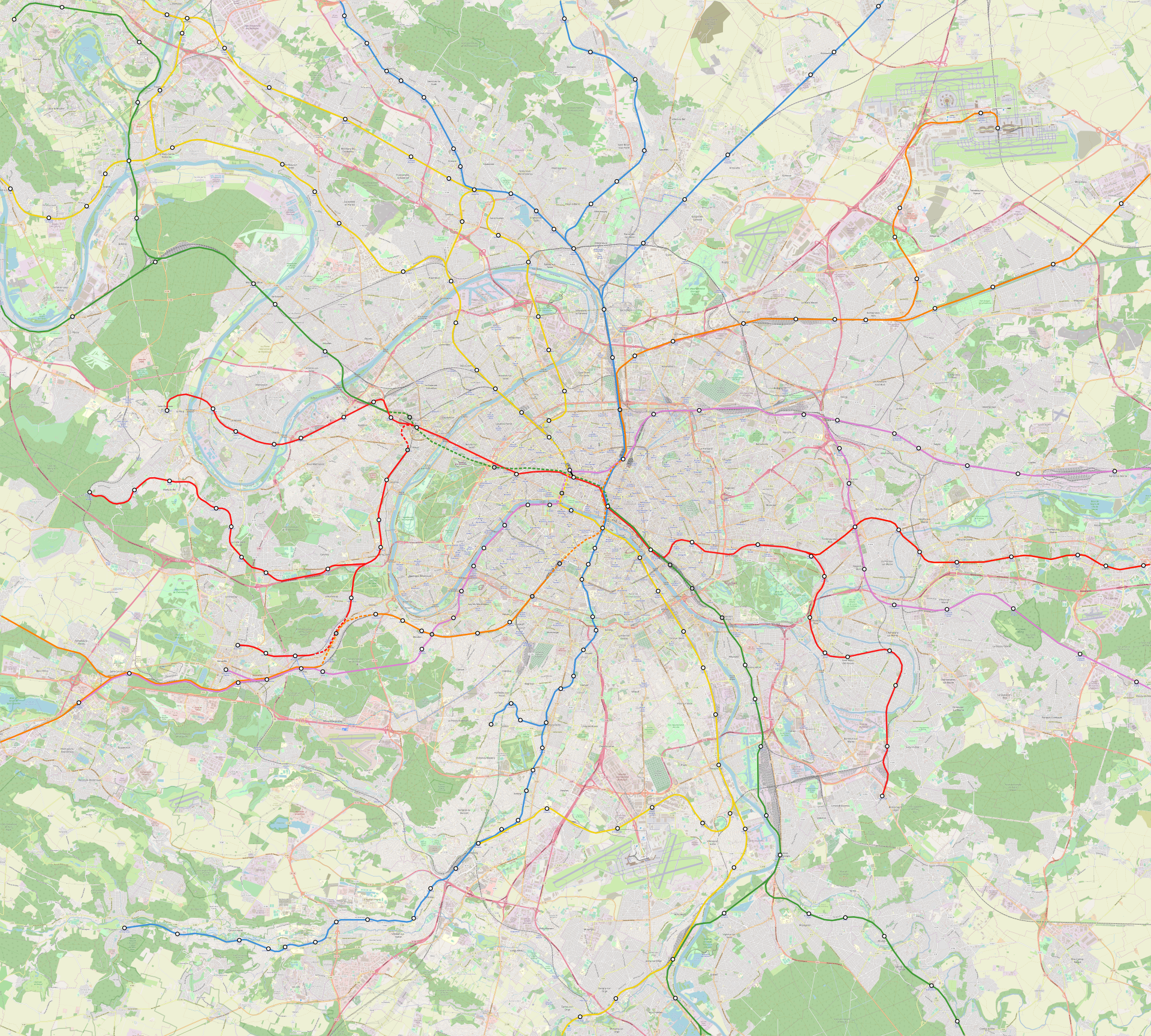
Full-size image can be seen here; warning: 71 MB.
Dashed lines are new tunnels to be built. Most of the dashed green line is the under-construction RER E extension from Saint-Lazare to La Défense and points west. The remainder, between Les Halles and Auber/Saint-Lazare, is a new tunnel that should be built, giving away the extension to the RER D instead. With a full line extended, the RER D could take over the entire SNCF-run part of the RER A while also continuing west to Mantes-la-Jolie as is planned for the RER E extension, so the RER A can gain the Transilien L branches to the southwest with a short curve from La Défense to Puteaux.
In addition, what is now the shared RER B and D tunnel between Gare du Nord and Les Halles should be four-tracked; the stations at both ends thankfully already have separate platform tracks for the RER B and D, and in 2003 a somewhat disruptive plan to four-track the tunnel was estimated to cost €700 million. Since the RER D tracks are to continue west, the new dual track tunnel should continue south across the river and connect to Montparnasse, creating the RER F; the RER F should take over the current northern branches of the RER B to form a southwest-northeast line, while the current southern branches of the RER B should be connected to what are now the northern branch of the RER D and the branches of Transilien H.
The RER C and E should be broken and recombined using a short four-track tunnel across the river, creating northeast-southwest and northwest-southeast trunk lines. Today, the RER C misses the Paris CBD and has an awkward connection to the RER A; with this recombination, the connections would still require a lot of walking at transfer stations but they’d exist and passengers would get solid two-seat rides.
Finally, a handful of outer-urban and suburban fixes would be useful: a few infill stations, depicted with gray filling; using all four tracks on the RER F trunk line to Aulnay (currently the RER B) to make it easier to run express trains to Charles-de-Gaulle; building a short suburban tunnel through Chaville to connect the RER F and A branch; continuing T3 to form a full circle using the Petite Ceinture in lieu of the awkward RER C branch today; constructing an infill station at the RER E/F junction in Meudon.
Excluding the ongoing RER E extension, the total length of new tunnel in city center is 8 km of two-track tunnel and about 1.5 km of four-track tunnel. This would set non-Anglosphere world records in construction costs per kilometer, just as the RER A did; costs in the €400-500 million per km can be expected given the complexity of tunneling under so many older Métro lines, so the system would cost around €5 billion, perhaps reaching €6-7 billion with the extra suburban tunnels and infill stations.
The map doesn’t go to the edge of Ile-de-France, or else it would be even bigger, but the plan should be to connect every Transilien line to this system, even ones in faraway exurbs. Frequency to the exurbs need not be very high – today they get hourly service off-peak, and half-hourly service in the future should be plenty to small towns on the edge of Ile-de-France; of course, closer-in suburbs as well as major secondary centers like Meaux and Evry should get much higher frequency, and the trunks should get a train every 3-4 minutes even off-peak.
The point of this exercise is that Paris has already done the hardest parts. The RER A and B exist, and Châtelet-Les Halles was dug at enormous expense in the 1970s. Even at the high per-km costs of connections underneath the center of Paris, the tunnels Paris needs to build in the next 10-15 years are low-hanging fruits for completing the project of connecting the entire region through a unified RER network.
Who is Being Empowered?
Practically any change has some beneficiaries (why else would it happen?), but a separate question, often with a separate answer is, who does it empower? For examples, expansion of education benefits students but empowers teachers and school administrators, and expansion of health care benefits patients but empowers medical care providers, especially ones below the prestige level of doctors. In both cases, the groups that were empowered back expansion, and at least in the case of teachers, the other side assumes that there are no beneficiaries, hence for example Humphrey’s comment in Yes, Minister that comprehensive education was adopted only because of the teachers’ unions.
The relevance of this distinction is that improvements in public transport mostly have the same set of beneficiaries – current and potential transit riders – but empower different groups of people depending on what the proposed improvement is. This matters, because it’s easier for change to happen if it empowers people who are already important. This is not restricted to politics – a change in how a business is run is easier to accept if it empowers senior management than if it empowers grunt workers, even if the ultimate beneficiary, that is the shareholders, is the same. The upshot is that there are changes in how to run public transportation that empower the already-powerful, and those changes are not necessarily best for the riders.
Politicians and civil servants
Politicians, especially high-level ones, are more powerful than civil servants. It is therefore easier to pass changes that empower them than ones that empower the civil service.
I think the Anglosphere’s fascination with design-build comes from this, at least partially. Traditional design-bid-build procurement means that an in-house team reviews bids and selects separate contractors for design and construction. In contrast, design-build removes power from the civil service. The consultants who get to draw design specs get empowered, but I don’t think this is why governments adopt design-build. Rather, design-build means that high-level politicians get to make big decisions, first since they often have casual ties to the consultants through a revolving door, and second since each bid is bigger (one firm might do everything) and therefore it is evaluated at a higher level.
Consulting in business is a good analogy, since there are some analogies between how the state is run and how big businesses are. The relevant one is the tyranny of the org chart; see some examples here and here by Aaron Renn, and here and here by other consultants. Senior management in the private sector has serious problems with listening to people who the org chart asserts are subordinates, from middle management all the way down. Management consultants often succeed by talking to lower-level workers, getting good ideas from them, and then packaging them to senior management in glossy presentations that look like they came from the consultants, who have nebulous job titles so as to convince senior management that the consultants are their peers. In effect, consultants are a workaround to the fact that senior management is unlikely to adopt ideas that empower subordinates.
The greatest irony here is that the sort of political operatives who are most educated in public choice theory are the ones who most consistently act according to its precepts. They dislike public-sector unions, so they institute public-sector hiring freezes and instead outsource work to consultants. In effect, they empower themselves, as senior political operatives who get to make more important decisions when the decisions are about higher-level things (that is, who gets the work among design-build bidders).
National vs. international comparisons
The issue of outside comparisons depends heavily on what the agency is to be compared to. The difference is that in the United States, managers are well-traveled domestically but not internationally, so domestic comparisons empower them and international ones do the opposite. In Europe, managers are more internationally traveled but largely within Europe, so comparisons to Asia are as problematic for them as comparisons to non-English-speaking European countries are to American managers.
What this means is, a study delivered to Boston or Los Angeles or Chicago that does a domestic comparison will bring up things that top managers and politicians are at least somewhat familiar with. A manager in Boston may have happened to work only in New England, but this is not common, and the manager’s social circle will include people with experience from other parts of the United States. This manager can read a report employing domestic comparison and will have heard about some of the success cases in the report, and if anything is unclear, the manager can call up friends and former coworkers and get clarifications. The manager is thus empowered to implement the report’s recommendations.
An international comparison has the opposite effect. The American manager might be facing a report that brings up case studies from European and East Asian countries, where few Americans have ever lived. The report might mention things that all American transit managers have convinced themselves are impossible, because those managers only ever talk to other Americans. It devalues most of the expertise of the American insider. If anyone within the agency is empowered, it is often a junior planner who has delved into foreign cases out of interest, or perhaps an immigrant whose knowledge is foreign and not just American. It completely upends the hierarchy: the senior manager has no way to contribute to the process and is at the mercy of outsiders and subordinates.
The trick that management consultants use to persuade senior managers to accept recommendations that came from below is not useful here. The report cannot hide its foreign provenance; it screams right there, “your experience as a senior American manager is not as valuable as you think it is.”
Is there a way out?
I believe that there is. I don’t know this for a fact, but I have some circumstantial evidence pointing in a more optimistic direction.
First, not only is the idea of the tyranny of the org chart well-known to consultants, but also a brief Googling revealed a number of different consultants openly pitch their skills to management in how to avoid the problem. That people who get paid to give outside expert advice to corporate leaders believe they can tell to those leaders’ faces, “you need to listen to your subordinates better and here’s how you can do it” suggests that it is possible to get at least some managers to listen.
Second, on an abstract level, managing others is a valuable skill on top of the deep experience managers must possess in the industry they lead, and moreover, general management skills are highly valued in American business culture in the private as well as public sector. This means that even though the use of foreign advice devalues senior managers’ industry-internal skills, and maybe even some precepts that they’ve learned in other industries if they’ve jumped around from industry to industry, it still does not devalue general management skills, not should it.
Third, beneficiaries matter, rather than just the people whose skills are valued more under the changes required to improve American public transportation. This means that a politician who is seen as successfully improving infrastructure will get accolades from the public, because there’s general political consensus that infrastructure is good, and specific political consensus in the parts of the United States with the most public transit ridership that public transportation infrastructure is good. Political advisors may be sidelined by change that relies on knowledge they don’t have, but elected politicians who are seen building infrastructure cheaply become more popular.
And fourth, the situation in the United States in general and New York is particular is so bad that change is possible even while respecting at least some degree of turf. Gradual replacement is possible, if New York implements one change that reduces costs by a factor of 2 while leaving other causes of high costs unchanged, and then the people who successfully shepherded the change implement more such changes. Future changes can devalue the skills of managers who only know how to build and run bad transit and not good transit, but a manager who was responsible to a large cost reduction will get enough internal and public clout that empowering this manager further through further-reaching reforms will be easier for the hierarchy to swallow.