Category: Regional Rail
Can Intercity Trains into Boston Enter from Springfield?
From time to time, I see plans for intercity rail service into Boston going via Springfield. These include in-state rail plans to run trains between the two cities, but also grander plans to have train go between Boston and New Haven via Springfield, branded as the Inland Route, as an alternative to the present-day Northeast Corridor. In-state service is fine, and timed connections to New Haven are also fine for the benefit of interregional travel like Worcester-Hartford, but as an intercity connection, the Inland Route is a terrible choice, and no accommodation should be made for it in any plans. This post goes over why.
What is the Inland Route?
Via Wikipedia, here’s a map of the Northeast Corridor and connecting passenger rail lines:

Red denotes Amtrak ownership, and thus some non-Northeast Corridor sections owned by Amtrak are included, whereas the New Rochelle-New Haven section, while part of the corridor, is not in red because it is owned by state commuter rail authorities. Blue denotes commuter rail lines that use the corridor.
The Inland Route is the rail route in red and black from New Haven to Boston via Springfield. Historically, it was the first all-rail route between New York and Boston: the current route, called the Shore Line, was difficult to build with the technology of the 1840s because it required many river crossings, and only in 1889 was the last river bridged, the Thames just east of New London. However, as soon as the all-rail Shore Line route opened, mainline traffic shifted to it. Further investment in the Shore Line relegated the Inland Route to a secondary role, and today, the only passenger rail at all between Boston and Springfield comprises a daily night train to Chicago, the Lake Shore Limited. More recently, there has been investment in New Haven-Springfield trains, dubbed the Hartford Line, which runs every 1-2 hours with a few additional peak trips.
What rail service should run to Springfield?
Springfield is a secondary urban center, acting as the most significant city in the Pioneer Valley region, which has 700,000 people. It’s close to Hartford, with a metro population of 1.3 million, enough that the metro areas are in the process of merging; this is enough population that some rail service to both New York and Boston is merited.
In both cases, it’s important to follow best practices, which the current Hartford Line does not. I enumerated them for urban commuter rail yesterday, and in the case of intercity or interregional rail, the points about electrification and frequency remain apt. The frequency section on commuter rail talks about suburbs within 30 km of the city, and Springfield is much farther away, so the minimum viable frequency is lower than for suburban rail – hourly service is fine, and half-hourly service is at the limit beyond which further increases in frequency no longer generate much convenience benefit for passengers.
It’s also crucial to timetable the trains right. Not only should they be running on a clockface hourly (ideally half-hourly) schedule, but also everything should be timed to connect. This includes all of the following services:
- Intercity trains to Hartford, New Haven, and New York
- Intercity trains to Boston
- Regional trains upriver to smaller Pioneer Valley cities like Northampton and Greenfield (those must be at least half-hourly as they cover a shorter distance)
- Springfield buses serving Union Station, which acts as a combined bus-rail hub (PVTA service is infrequent, so the transfers can and should be timed)
The timed connections override all other considerations: if the demand to Boston and New York is asymmetric, and it almost certainly is, then the trains to New York should be longer than those to Boston. Through-running here is useful but not essential – there are at least three directions with viable service (New York, Boston, Greenfield) so some people have to transfer anyway, and the frequency is such that transfers have to be timed anyway.
What are the Inland Route plans?
There are perennial plans to add a few intercity trains on the New Haven-Springfield-Boston route. Some such trains ran in my lifetime – Amtrak only canceled the last ones in the 2000s, as improvements in the Shore Line for the Acela, including electrification of the New Haven-Boston section, made the Inland Route too slow to be viable.
Nonetheless, plans for restoration remain. These to some extent extend the plans for in-state Boston-Springfield rail, locally called East-West Rail: if trains run from Boston to Springfield and from Springfield to New Haven, then they might as well through-run. But some plans go further and posit that this should be a competitive end-to-end service, charging lower fares than the faster Northeast Corridor. Those plans, sitting on a shelf somewhere, are enough that Massachusetts is taking them into account when designing South Station.
Of note, no modernization is included in these plans. The trains are to be towed by diesel locomotives, and run on the existing line. Both the Inland Route and East-West plans assume frequency is measured in trains per day, designed by people who look backward to a mythologized golden age of American rail and not forward to foreign timetabling practices that have only been figured out in the last 50 years.
Is the Inland Route viable as an intercity route into Boston?
No. This is not even a slag on the existing plans; I’m happy assuming best practices in other cases, hence my talk of timed half-hourly connections between trains and buses above. The point is that even with best practices, there is no way to competitively run a New Haven-Springfield-Boston route.
The graphic above is suggestive of the first problem: the route is curvy. The Shore Line is very curvy as well, but less so; it has a bad reputation because its curves slow trains that in theory can run at 240 km/h down to about 150-180 km/h, but the Boston-Springfield Line has tighter curves over a longer stretch, they’re just less relevant now because the trains on the line don’t run fast anyway. In contrast, the existing Northeast Corridor route is fast in Massachusetts and Rhode Island.
The Inland Route is also curvy on the Boston-Worcester stretch, where consideration for slow trains is a must. The main way to squeeze extra speed out of a curvy line is to cant it, but this is less viable if there is a mix of fast and slow trains, since slow trains would be overcanted. This, in fact, is the reason Amtrak trains outside the Northeast are slower than they were in the middle of the 20th century – long-distance passenger trains have less priority for infrastructure design than slow freight trains, and so cant is limited, especially when there are hills. Normally, it’s not a problem if the slower trains are commuter trains, which run fast enough that they can just take the curve, but some curves are adjacent to passenger train stations, where passengers would definitely notice the train sitting still on canted track, leaning to the inside of the curve.
Then, there is the issue of how one gets into Boston. The Providence Line is straight and fast and can be upgraded to provide extra capacity so that fast intercity trains can overtake slow ones if need be. The Worcester Line has a two-track narrows in Newton, hemmed by I-90 with no possibility of expansion, with three stations on this stretch and a good location for a fourth one at Newton Corner. Overtakes are possible elsewhere (one is being designed just to the west, in Wellesley – see my sample timetable here), but they still constrain capacity. It’s comparably difficult from the point of view of infrastructure design to run a 360 km/h intercity train every 15 minutes via Providence and to run a 160 km/h intercity train every 30 minutes via Springfield and Worcester. Both options require small overtake facilities; higher frequency requires much more in both cases.
The Worcester Line is difficult enough that Boston-Springfield trains should be viewed as Boston-Worcester trains that go farther west. If there’s room in the timetable to include more express trains then these can be the trains to Springfield, but if there’s any difficulty, or if the plan doesn’t have more than a train every half hour to Worcester, then trains to Springfield should be making the same stops as Boston-Worcester trains.
Incentives for passengers
The worst argument I’ve seen for Inland Route service is that it could offer a lower-priced alternative to the Northeast Corridor. This, frankly, is nuts.
The operating costs of slower trains are higher than those of faster trains; this is especially true if, as in current plans, the slow trains are not even electrified. Crew, train maintenance, and train acquisition costs all scale with trip time rather than trip distance. Energy costs are dominated by acceleration and deceleration cycles rather than by cruise speed at all speeds up to about 300 km/h. High-speed trains sometimes still manage lower energy consumption per seat-km than slow trains, since slow trains have many acceleration cycles as track speeds change between segments whereas high-speed lines are built for consistent cruise speed.
The only reason to charge less for the trains that are more expensive to operate is to break the market into slow trains for poor people and fast trains for rich people. But this doesn’t generate any value for the customer – it just grabs profits through price discrimination that are then wasted on the higher operating costs of the inferior service. It’s the intercity equivalent of charging more for trains than for buses within a city, which practice is both common in the United States and a big negative to public transit ridership.
If, in contrast, the goal is to provide passengers with good service, then intercity trains to Boston must go via Providence, not Springfield. It’s wise to keep investing in the Shore Line (including bypasses where necessary) to keep providing faster and more convenient service. Creating a class system doesn’t make for good transit at any scale.
Through-Running and American Rail Activism
A bunch of us at the Effective Transit Alliance (mostly not me) are working on a long document about commuter rail through-running. I’m excited about it; the quality of the technical detail (again, mostly not by me) is far better than when I drew some lines on Google Maps in 2009-10. But it gets me thinking – how come through-running is the ask among American technical advocates for good passenger rail? How does it compare with other features of commuter rail modernization?
Note on terminology
In American activist spaces, good commuter rail is universally referred to as regional rail and the term commuter rail denotes peak-focused operations for suburban white flighters who work in city center and only take the train at rush hour. If that’s what you’re used to, mentally search-and-replace everything I say below appropriately. I have grown to avoid this terminology in the last few years, because in France and Germany, there is usually a distinction between commuter rail and longer-range regional rail, and the high standards that advocates demand are those of the former, not the latter. Thus, for me, a mainline rail serving a metropolitan area based on best practices is called commuter and not regional rail; there’s no term for the traditional American system, since there’s no circumstance in which it is appropriate.
The features of good commuter rail
The highest-productivity commuter rail systems I’m aware of – the Kanto area rail network, the Paris RER, S-Bahns in the major German-speaking cities, and so on – share certain features, which can be generalized as best practices. When other systems that lack these features adopt them, they generally see a sharp increase in ridership.
All of the features below fall under the rubric of planning commuter rail as a longer-range subway, rather than as something else, like a rural branch line or a peak-only American operation. The main alternative for providing suburban rapid transit service is the suburban metro, typical of Chinese cities, but the suburban metro and commuter rail models can coexist, as in Stockholm, and in either case, the point is to treat the suburbs as a lower-density, longer-distance part of the metropolitan area, rather than as something qualitatively different from the city. To effect this type of planning, all or nearly all of the following features are required, with the names typically given by advocates:
- Electrification/EMUs: the line must run modern equipment, comprising electric multiple units (self-propelled, with no separate locomotive) for their superior performance and reliability
- Level boarding/standing space: interior train design must facilitate fast boarding and alighting, including many wide doors with step-free boarding (which also provides wheelchair accessibility) and ample standing space within the car rather than just seated space, for example as in Berlin’s new Class 484
- Frequency: the headway between trains set at a small fraction of the typical trip time – neighborhoods 10 km from city center warrant a train every 5-10 minutes, suburbs 20-30 km out a train every 10-20 minutes, suburbs farther out still warrant a train every 20-30 minutes
- Schedule integration: train timetables must be planned in coordination with connecting suburban buses (or streetcars if available) to minimize connection time – the buses should be timed to arrive at each major suburban station just before the train departs, and depart just after it arrives
- Pedestrian-friendliness: train stations designed around connections with buses, streetcars if present, bikes, and pedestrian activity – park-and-rides are acceptable but should be used sparingly, and at stations in the suburbs, the nearby pedestrian experience must come first, in order to make the station area attractive to non-drivers
- Fare integration/Verkehrsverbund: the system may charge higher fares for longer trips, but the transfers to urban and suburban mass transit must be free even if different companies or agencies run the commuter trains and the city’s internal bus and rail system
- Infill: stations should be spaced regularly every 1-3 km within the built-up area, including not just the suburbs but also the city; slightly longer stop spacing may be acceptable if the line acts as an express bypass of a nearby subway line, but not the long stretches of express running American commuter trains do in their central cities
- Through-running: most trains that enter city center go through it, making multiple central stops, and then emerge on the other side to serve suburbs in that direction
Is through-running special?
Among the above features, through-running has a tendency to capture the imagination, because it lends itself to maps of how the lines fit together in the region; I’ve done more than my share of this, in the 2009 post linked in the intro, in 2014, in 2017, and in 2019. This is a useful feature, and in nearly every city with mainline rail, it’s essential to long-term modernization; the exceptions are cities where the geography puts the entirety of suburbia in one direction of city center, and even there, Sydney has through-running (all lines go west of city center) and Helsinki is building a tunnel for it (all lines go north).
The one special thing about through-running is that usually it is the most expensive item to implement, because it requires building new tunnels. In Philadelphia, this was the Center City Commuter Connection, opened in 1984. In Boston, it’s the much-advocated for North-South Rail Link. In Paris, Munich, Tokyo, Berlin, Copenhagen, London, Milan, Madrid, Sydney, Zurich, and other cities that I’m forgetting, this involved building expensive city center tunnels, usually more than one, to turn disparate lines into parts of a coherent metropolitan system. New York is fairly unique in already having the infrastructure for some through-running, and even there, several new tunnels are necessary for systemwide integration.
But there are so many other things that need to be done. In much of the United States, transit advocacy has recently focused on the issue of frequency, brought into the mainstream of advocacy by Jarrett Walker. Doing one without the other leads to awkward situations: after opening the tunnel, Philadelphia branded the lines R1 through R8 modeled on German S-Bahns while still running them hourly off-peak, even within the city, and charging premium fares even right next to overcrowded city buses.
This is something advocates generally understand. There’s a reason the TransitMatters Regional Rail program for commuter rail modernization puts the North-South Rail Link on the back burner and instead focuses on all the other elements. But there’s still something about through-running that lends itself to far more open argumentation than talking about off-peak frequency. Evidently, the Regional Plan Association and other organizations keep posting through-running maps rather than frequency maps or sample timetables.
Through-running as revolution
I suspect one reason for the special place of through-running, besides the attractiveness of drawing lines on a map, is that it most blatantly communicates that this is no longer the old failed system. There are good ways of running commuter rail, and bad ways, and all present-day American commuter rail practices are bad ways.
It’s possible to make asks about modernization that don’t touch through-running, such as integrating the fares; in Germany, the Verkehrsverbund concept goes back to the 1960s and is contemporary with the postwar S-Bahn tunnels, but Berlin and Hamburg had had through-running for decades before. But because these asks look small, it’s easy to compromise them down to nothing. This has happened in Boston, where there’s no fare integration on the horizon, but a handful of commuter rail stations have their fares reduced to be the same as on the subway, still with no free transfers.
Through-running is hard to compromise this way. As soon as the lines exist, they’re out there, requiring open coordination between different railroads, each of which thinks the other is incompetent and is correct. It’s hard to sell it as nothing, and thus it has to be done as a true leap generations forward, catching up with where the best places have been for 50+ years.
Quick Note: New Jersey Highway Widening Alternatives
The Effective Transit Alliance just put out a proposal for how New Jersey can better spend the $10 billion that it is currently planning on spending on highway widening.
The highway widening in question is a simple project, and yet it costs $10.7 billion for around 13 km. I’m unaware of European road tunnels that are this expensive, and yet the widening is entirely above-ground. It’s not even good as a road project – it doesn’t resolve the real bottleneck across the Hudson, which requires rail anyway. It turns out that even at costs that New Jersey Transit thinks it can deliver, there’s a lot that can be done for $10.7 billion:
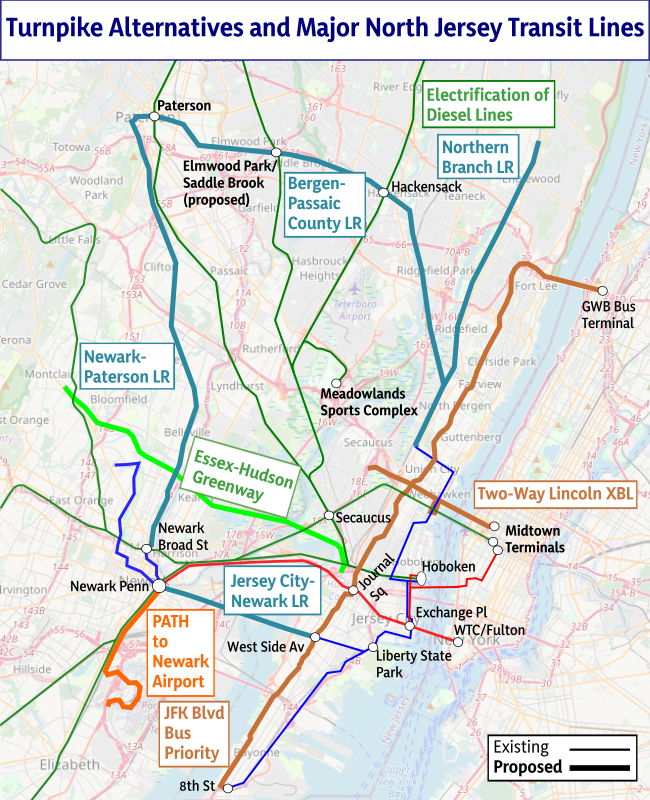
I contributed to this project, but not much, just some sanity checks on costs; other ETA members who I will credit on request did the heavy pulling of coming up with a good project list and prioritizing them even at New Jersey costs, which are a large multiple of normal costs for rail as well as for highways. I encourage everyone to read and share the full report, linked above; we worked on it in conjunction with some other New Jersey environmental organizations, which supplied some priorities for things we are less familiar with than public transit technicalities like bike lane priorities.
The RENFE Scandal and Responsibility
I’ve been repeatedly asked about a RENFE scandal about its rolling stock purchase. The company ordered trains too big for its rolling stock, and this has been amplified to a scandal that is said to be “incompetence beyond imagination” leading to several high-level resignations, including that of the ministry of transport’s chief civil servant, former ADIF head Isabel Pardo de Vera Posada. In reality, this is a real scandal but not a monumental one, and Pardo de Vera is not at fault; what it does show is both a culture of responsibility and a degree of political deflection.
What is the scandal?
RENFE, the state-owned Spanish rail operating firm, ordered regional trains for service in Asturias and Cantabria on a meter-gauge mountain railway with many narrow tunnels of nonstandard sizes. RENFE did not properly spec out the loading gauge, which vendor CAF noticed in 2021, shortly after the order was tendered but before manufacturing began; thereafter, both tried fixing the error, which has not led to any increase in cost, but has led to a delay in the entry of the under-construction equipment into service from 2024 to 2026.
The head of the regional government of Cantabria, Miguel Ángel Revilla Roiz, demanded that heads roll over the spectacular botch and delay. The context is that regional rail service outside Madrid and Barcelona has been steadily deteriorating, and people outside those two regions have long complained about the domination of the economy and society by those two cities and the depopulation of rural areas. Frequency is low and lines are threatened with closure due to the consequent poor ridership, and there is deep mistrust of the central government (a mistrust that is also common enough in Barcelona, where it is steered toward Catalan nationalism).
The other piece of context is the election at the end of this year. Nearly all polls have the right solidly defeating the incumbent PSOE; Revilla is a PSOE ally and so Asturias head Adrián Barbón Rodríguez is a PSOE member, and both are trying to save their political support by distinguishing themselves from the central government, which is unpopular due to the impact of corona on the Spanish economy.
What is Pardo de Vera’s role?
She was at ADIF when the contract came down; ADIF manages infrastructure, not operations. She was viewed as a consummate technocrat, and I became aware of her work through Roger Senserrich’s interview with her; as such, she was elevated to the position of secretary of state for transport, the chief civil servant in the ministry. Once the ministry became aware of the scandal in 2021, she tried to fix the contract, leading to the current result of a two-year delay; she is now under fire for not having been transparent with the public about it, as the story only became public after a local newspaper broke it.
This needs to be viewed not as incompetence on her part. The scandal is real, but moderate in scope; delays of this magnitude are unfortunately common, and Berlin is having one on the U-Bahn due to vendor lawsuits. Rather, the success of Spain in infrastructure procurement (if not in rail operations, where it unfortunately lags) has created high expectations. In the United States, where standards are the worst, a similar mistake by the MBTA in the ongoing process of procuring electric trains – the RFI did not properly specify the catenary height – is leading to actual increases in costs and it’s not even viewed as a minor problem as in Berlin but as just how expensive electrification is.
I urge Northern European and American agencies to reach out to Pardo de Vera. In Spain she may be perceived as scandalized, but she has real expertise in infrastructure construction, engineering, and procurement. Often boards, steering committees, and review panels comprise retired agency heads who left for a reason; she left for a reason that is not her fault.
Quick Note: Catalunya Station
Barcelona’s commuter rail network has a few distinct components. In addition to the main through-running sections, there are some captive lines terminating at one of two stations, Espanya and Catalunya. Catalunya is especially notable for its very high throughput: the system feeding it, the Barcelona-Vallès Line, has two running tracks, fanning out onto five station tracks, of which only three are used in regular service. Despite the austere infrastructure, the station turns 32 trains per hour on these tracks. I believe this is the highest turnback rate on a commuter rail network. The Chuo Line in Tokyo turns 28 trains per hour on two rather than three tracks but it’s with the same two running tracks as the Catalunya system, and with considerably less branching.
I bring this up because I was under the impression Catalunya turned 24 rather than 32 trains per hour when writing about how Euston could make do with fewer tracks than planned for High Speed 2. But several people since have corrected me, including Shaul Picker (who looked at the timetables) and planning engineer Joan Bergas Massó (who, I believe, wrote them).
The current situation is that the Vallès Line includes both proper commuter lines and metro, sharing tracks. The commuter part of the system comprises two branches, Terrassa carrying S1 and short-turning trains on S7 and Sabadell carrying S2 and short-turning trains on S6; some trains skip stops, but it’s not a consistent pattern in which S1 and S2 run express and S6 and S7 run local. A branch entirely within the city is signed as a metro line, designated L7. Currently, all L7 trains use track 4, turning 8 trains per hour, while the other lines use tracks 1 and 2, turning 24 trains per hour in total.
I stress that while this is a commuter line – it goes into suburbia and descends from a historic steam train rather than a greenfield metro – it is not connected with the mainline network. So it’s easier to turn trains there than on an intricately branched system; the Chuo Line is not as hermetically sealed but is similar in having little other traffic on it than the rapid trains from Tokyo to its in-prefecture western suburbs. Nonetheless, there are multiple branches and stopping patterns; this is not a metro system where all trains are indistinguishable and passengers only care about the interval between trains rather than about the overall schedule.
Free Public Transport, Fare Integration, and Capacity
There’s an ongoing debate about free public transport that I’m going to get into later, but, for now, I want to zoom in on one aspect of the 9€ ticket, and how it impacted public transport capacity in Germany. A commenter on the Neoliberal Reddit group claimed that during the three months of nearly free public transport fares, there was a capacity crunch due to overuse. But in fact, the impact was not actually significant on urban rail, only on regional trains, in a way that underscores the importance of fare integration more than anything.
What was the 9€ ticket?
Last year, in the wake of the Russian invasion of Ukraine, fuel prices shot up everywhere. This created populist pressure to alleviate the price of fuel through temporary tax cuts, which further exacerbated last year’s high inflation. The center-right element within the German coalition, FDP, moved away from its traditional position as deficit scold and demanded a cut in the fuel tax; as a compromise, the Greens agreed to it on condition that during the three months of reduced fuel tax, June through August, public transport fares would be cut as well. Thus the 9€ monthly was born.
The 9€ ticket applied throughout Germany. The key feature wasn’t just the deep discount but also the fact that on one ticket, people could travel all over Germany; normally, my Berlin monthly doesn’t let me ride the local trains in Leipzig or Munich. This stimulated massive domestic tourism, since people could travel between cities on slow regional trains for free and then also travel around their destination city for free as well.
What now?
The 9€ ticket clearly raised public transport ridership in the three months it was in effect. This led to demands to make it permanent, running up against the problem that money is scarce and in Germany ticket fares generate a significant proportion of public transport revenue, 7.363 billion € out of 14.248 billion € in expenses (source, p. 36).
One partial move in that direction is a 29€ monthly valid only within Berlin, not in the suburbs (zone C of the S-Bahn) or outside the system; unlike the 9€ ticket, which was well-advertised all over national and local media and was available at every ticketing machine, the 29€ monthly is only available via annual subscription, which requires a permanent address in the city, and the regular machines only sell the usual 86€ monthly and don’t even let you know that a cheaper option exists. The subscription is also not available on a rolling basis – one must do it before the start of the month, which is not advertised, and Ant6n‘s family was caught unaware one month.
Negotiations for a nationwide 49€ ticket are underway, proceeding at the pace of a German train, or perhaps that of German arms deliveries to Ukraine. This was supposed to start at the beginning of 2023, then in April, and now it’s expected to debut in May. I’m assuming it will eventually happen – German trains get you there eventually, if hours late occasionally.
What’s the impact on capacity?
The U- and S-Bahn systems didn’t at all get overcrowded. They got a bit more crowded than usual, but nothing especially bad, since the sort of trips induced by zero marginal cost are off-peak. Rush hour commuters are not usually price-sensitive: whenever one’s alternative to the train is a car, the difference between a 9€ monthly and an 86€ one is a fraction of the difference between either ticket and the cost of owning and using a car, and at rush hour, cars are limited by congestion as well. Off-peak ridership did visibly grow, but not to levels that congest the system.
But then the hourly regional trains got completely overcrowded. If you wanted to ride the free trains from Berlin to Leipzig, you’d be standing for the last third of the trip. This is because the regional rail system (as opposed to S-Bahn) is designed as a low-capacity coverage-type system for connecting to small towns like Cottbus or Dessau.
The broader issue is that there is always a sharp ridership gradient between large cities and everywhere else, even per capita. In some places the gradient is sharper than elsewhere; the difference between New York and the rest of the United States is massive. But even in Germany, with a smaller gradient than one might be used to from France or the UK or Japan, public transport ridership is disproportionately dense urban or perhaps suburban, on trams and U- and S-Bahns.
The regional trains are another world. Really, European and Japanese trains can be thought of as three worlds: very high-use urban and suburban rail networks, high-use intercity rail connecting the main cities usually at high speed, and low-usage, highly-subsidized regional trains outside the major metropolitan regions. Germany has relatively good trains in the last category, if worse than in Switzerland, Austria, or the Netherlands: they run hourly with timed connections, so that people can connect between them to many destinations, they just usually don’t because cities the size of Dessau don’t generate a lot of ridership. The 9€ ticket gave people a free intercity trip if they chained trips on these regional trains, at the cost of getting to Leipzig in a little less than three hours rather than 1:15 on the ICE; the regional trains were not expanded to meet this surge traffic, which is usually handled on longer intercity trainsets, creating standing-room only conditions on trains where this should not happen off-peak or perhaps ever.
The issue of fare integration
The overcrowding seen on the regional trains last summer is really an issue of fare integration, which I hope is resolved as the 49€ gives people free trips on such trains permanently. A cornerstone of good public transport planning is that the fare between two points should be the same no matter what vehicle one uses, with exceptions only for first-class cars if available. Ein Ticket für alles, exclaims the system in Zurich, to great success. Anything else slices the market into lower-frequency segments, providing worse service than under total fare integration. Germany understands this – the Verkehrsverbund was invented in Hamburg in 1965, and subsequently this idea was adopted elsewhere until the country has been divided into metropolitan zones with internal fare integration.
The regional trains that cross Verkehrsverbund zones have their own fares, and normally that’s okay. Intercity trains were never part of this system, and that’s okay too – they’re not about one’s usual trip, and so an intercity ticket doesn’t include free transfers to local public transport unless one pays extra for that amenity. The fares between intercity trains and chains of regional trains were not supposed to be integrated, and normally that’s fine too, because any fare savings from chaining trips on slower trains are swamped both by the headache of buying so many tickets and by the difference in trip time and reliability.
The 9€ ticket broke that system, and the 49€ ticket will have the same effect: for three months, trips on slower trains were free, leading to overcrowding on a low-capacity network that normally isn’t that important to the country’s overall public transport system.
Worse, the operating costs of slow trains are higher than those of fast trains: they are smaller and so have a higher ratio of crew to passengers than ICEs, and their slowness means that crew and maintenance costs per kilometer are higher than those of fast trains. Even energy costs are higher on slow trains, because high-speed lines run at 300 km/h over long stretches, whereas regional lines make many stops (which had very little usage compared with the train’s volume of passengers last summer) and have slow zones rather than cruising at 130 or 160 km/h over long stretches. So the system gave people a price incentive to use the higher-cost trains and not the lower-cost ones.
This is the most important thing to resolve about any future fare reductions. Some mechanism is needed to ensure that the most advantageous way to travel between two cities is the one that DB can provide the most efficiently, which is IC/ICE and not RegionalBahn.
Edge Cities With and Without Historic Cores
An edge city is a dense, auto-oriented job center arising from nearby suburban areas, usually without top-down planning. The office parks of Silicon Valley are one such example: the area had a surplus of land and gradually became the core of the American tech industry. In American urbanism, Tysons in Virginia is a common archetype: the area was a minor crossroads until the Capital Beltway made it unusually accessible by car, providing extensive auto-oriented density with little historic core.
But there’s a peculiarity, I think mainly in the suburbs of New York. Unlike archetypal edge cities like Silicon Valley, Tysons, Century City in Los Angeles, or Route 128 north of Boston, some of the edge cities of New York are based on historic cores. Those include White Plains and Stamford, which have had booms in high-end jobs in the last 50 years due to job sprawl, but also Mineola, Tarrytown, and even New Brunswick and Morristown.
The upshot is that it’s much easier to connect these edge cities to public transportation than is typical. In Boston, I’ve spent a lot of time trying to figure out good last mile connections from commuter rail stations. Getting buses to connect outlying residential areas and shopping centers to town center stations is not too hard, but then Route 128 is completely unviable without some major redesign of its road network: the office parks front the freeway in a way that makes it impossible to run buses except dedicated shuttles from one office park to the station, which could never be frequent enough for all-day service. Tysons is investing enormous effort in sprawl repair, which only works because the Washington Metro could be extended there with multiple stations. Far and away, these edge cities are the most difficult case for transit revival for major employment centers.
And in New York, because so much edge city activity is close to historic cores, this is far easier. Stamford and White Plains already have nontrivial if very small transit usage among their workers, usually reverse-commuters who live in New York and take Metro-North. Mineola could too if the LIRR ran reverse-peak service, but it’s about to start doing so. Tarrytown and Sleepy Hollow could be transit-accessible. The New Jersey edge cities are harder – Edison and Woodbridge have lower job density than Downtown Stamford and Downtown White Plains – but there are some office parks that could be made walkable from the train stations.
I don’t know what the history of this peculiar feature is. White Plains and Mineola are both county seats and accreted jobs based on their status as early urban centers in regions that boomed with suburban sprawl in the middle of the 20th century. Tarrytown happened to be the landfall of the Tappan Zee Bridge. Perhaps this is what let them develop into edge cities even while having a much older urban history than Tysons (a decidedly non-urban crossroads until the Beltway was built), Route 128, or Silicon Valley (where San Jose was a latecomer to the tech industry).
What’s true is that all of these edge cities, while fairly close to train stations, are auto-oriented. They’re transit-adjacent but not transit-oriented, in the following ways:
- The high-rise office buildings are within walking distance to the train station, but not with a neat density gradient in which the highest development intensity is nearest the station.
- The land use at the stations is parking garages for the use of commuters who drive to the station and use the train as a shuttle from a parking lot to Manhattan, rather than as public transportation the way subway riders do.
- The streets are fairly hostile to pedestrians, featuring fast car traffic and difficult crossing, without any of the walkability features that city centers have developed in the last 50 years.
The street changes required are fairly subtle. Let us compare White Plains with Metrotown, both image grabs taken from the same altitude:
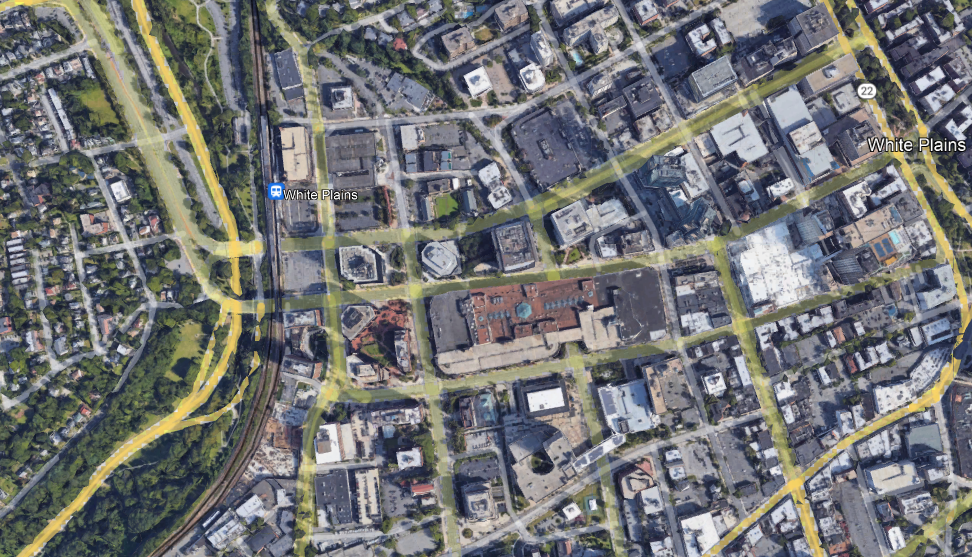

These are both edge cities featuring a train station, big buildings, and wide roads. But in Metrotown, the big buildings are next to the train station, and the flat-looking building to its north is the third-largest shopping mall in Canada. The parking goes behind the buildings, with some lots adjoining Kingsway, which has a frequent trolleybus (line 19) but is secondary as a transportation artery to SkyTrain. Farther away, the residential density remains high, with many high-rises in the typical thin-and-tall style of Vancouver. In contrast, in White Plains, one side of the station is a freeway with low-density residential development behind it, and the other is parking garages with office buildings behind them instead of the reverse.
The work required to fix this situation is not extensive. Parking must be removed and replaced with tall buildings, which can be commercial or residential depending on demand. This can be done as part of a transit-first strategy at the municipal level, but can also be compelled top-down if the city objects, since the MTA (and other Northeastern state agencies) has preemption power over local zoning on land it owns, including parking lots and garages.
On the transit side, the usual reforms for improvements in suburban trains and buses would automatically make this viable: high local frequency, integrated bus-rail timetables (to replace the lost parking), integrated fares, etc. The primary target for such reforms is completely different – it’s urban and inner-suburban rail riders – but the beauty of the S-Bahn or RER concept is that it scales well for extending the same high quality of service to the suburbs.
TransitCenter’s Commuter Rail Proposal
Last week, TransitCenter released a proposal for how to use commuter rail more effectively within New York. The centerpiece of the proposal is to modify service so that the LIRR and Metro-North can run more frequently to stations within the city, where today they serve the suburbs almost exclusively; at the few places near the outer end of the city where they run near the subway, they have far less ridership, often by a full order of magnitude, which pattern repeats itself around North America. There is much to like about what the proposal centers; unfortunately, it falls short by proposing half-hourly frequencies, which, while better than current off-peak service, are far short of what is needed within the city.
Commuter rail and urban ridership
TransitCenter’s proposal centers urban riders. This is a welcome addition to city discourse on commuter rail improvement. The highest-ridership, highest-traffic form of mainline rail is the fundamentally urban S-Bahn or RER concept. Truly regional trains, connecting distinct centers, coexist with them but always get a fraction of the traffic, because public transit ridership is driven by riders in dense urban and inner-suburban neighborhoods.
A lot of transit and environmental activists are uncomfortable with the idea of urban service. I can’t tell why, but too many proposals by people who should know better keep centering the suburbs. But in reality, any improvement in commuter rail service that does not explicitly forgo good practices in order to discourage urban ridership creates new urban ridership more than anything else. There just aren’t enough people in the suburbs who work in the city (even in the entire city, not just city center) for it to be any other way.
TransitCenter gets it. The proposal doesn’t even talk about inner-suburban anchors of local lines just outside the city, like Yonkers, New Rochelle, and Hempstead (and a future update of this program perhaps should). No: it focuses on the people near LIRR and Metro-North stations within the city, highlighting how they face the choice between paying extra for infrequent but fast trains to Midtown and riding very slow buses to the edge of the subway system. As these neighborhoods are for the most part on the spectrum from poor to lower middle-class, nearly everyone chooses the slow option, and ridership at the city stations is weak, except in higher-income Northeast Queens near the Port Washington Branch (see 2012-4 data here, PDF-pp. 183-207), and even there, Flushing has very little ridership since the subway is available as an alternative.
To that effect, TransitCenter proposes gradually integrating the fares between commuter rail and urban transit. This includes fare equalization and free transfers: if a bus-subway-bus trip between the Bronx and Southern Brooklyn is covered by the $127 monthly pass then so should a shorter bus-commuter rail trip between Eastern Queens or the North Bronx and Manhattan.
Interestingly, the report also shows that regionwide, poorer people have better job access by transit than richer people, even when a fare budget is imposed that excludes commuter rail. The reason is that in New York, suburbanization is a largely middle-class phenomenon, and in the suburbs, the only jobs accessible by mass transit within an hour are in Midtown Manhattan, whereas city residents have access to a greater variety of jobs by the bus and subway system. But this does not mean that the present system is equitable – rich suburbanites have cars and can use them to get to edge city jobs such as those of White Plains and Stamford, and can access the entire transit network without the fare budget whereas poorer people do have a fare budget.
The issue of frequency
Unfortunately, TransitCenter’s proposal on frequency leaves a lot to be desired. Perhaps it’s out of incrementalism, of the same kind that shows up in its intermediate steps toward fare integration. The report suggests to increase frequency to the urban stations to a train every half an hour, which it phrases in the traditional commuter rail way of trains per day: 12 roundtrips in a six-hour midday period.
And this is where the otherwise great study loses me. Forest Hills, Kew Gardens, and Flushing are all right next to subway stations. The LIRR charges higher fares there, but these are fairly middle-class areas – richer than Rosedale in Southeast Queens on the Far Rockaway Branch, which still gets more ridership than all three. No: the problem in these inner areas is frequency, and a train every half hour just doesn’t cut it when the subway is right there and comes every 2-3 minutes at rush hour and every 4-6 off-peak.
In this case, incremental increases from hourly to half-hourly frequency don’t cut it. The in-vehicle trip is so short that a train every half hour might as well not exist, just as nobody runs subway trains every half hour (even late at night, New York runs the subway every 20 minutes). At outer-urban locations like Bayside, Wakefield, and Rosedale, the absolute worst that should be considered is a train every 15 minutes, and even that is suspect and 10 minutes is more secure. Next to the subway, the absolute minimum is a train every 10 minutes.
All three mainlines currently radiating out of Manhattan in regular service – the Harlem Line, the LIRR Main Line, and the Port Washington Branch – closely parallel very busy subway trunk lines. One of the purposes of commuter rail modernization in New York must be decongestion of the subway, moving passengers from overcrowded 4, 5, 7, E, and F trains to underfull commuter trains. The LIRR and Metro-North are considered at capacity when passengers start having to use the middle seats, corresponding to 80% of seated capacity; the subway is considered at capacity when there are so many standees they don’t meet the standard of 3 square feet per person (3.59 people/m^2).
To do this, it’s necessary to not just compete with buses, but also directly compete with the subway. This is fine: Metro-North and the LIRR can act as additional express capacity, filling trains every 5 minutes using a combination of urban ridership and additional ridership at inner suburbs. TransitCenter has an excellent proposal for how to improve service quality at the urban stations but then inexplicably doesn’t go all the way and proposes a frequency that’s too low.
I Gave a Talk About Through-Running
The ReThink NYC online panel earlier today was strange in a lot of ways: in delivery, in tone, in emphasis. Perhaps the full slide deck will be uploaded and I will be able to more easily point this out. For now, look at my slides; they’re a very condensed version of this post, criticizing the Empire State Development report saying that through-running at Penn Station is impossible.
The technical issue is that as you can see, my slides are a Beamer PDF. The version that I delivered was line-by-line, as is the norm for math presentations; you can click through to see what it means and why every presentation I upload on this blog is modified to be slide-by-slide and therefore has “2” in the file name. Everyone else was on PowerPoint or Google Slides, with centralized control; I took control for my portion, which was not designed around having an assistant who I tell “next slide please” periodically, and the system wasn’t as responsive to my clicks as I’d hoped.
The tone issue is that somehow I was the least offensive person on the panel. Moderator Sam Turvey was complaining that the MTA called the panel a private event as a reason not to send anyone to attend; I just stuck to some technical critiques, even with my background of calling for people to be fired here and on Twitter. I’m not sure how that came to be. But I somehow was the most polite person to the decision makers, I think, and that’s always jarring, when within the Transit Costs Project team I’m the least polite and least charitable (why should I be charitable to $2 billion/km subway builders?).
And then there’s the emphasis issue. I was trying to give a 10-minute technical primer about the value of through-running and suggest one way of doing so (in practice, more like 15 minutes – everyone ran over). There are some differences between my concept and ReThink’s that I think are worth going over:
- On the level of crayon, I think through-running at Penn Station should connect to Grand Central (similar to the old Alternative G from the early 2000s). ReThink prefers pure East River through-running, I can’t tell whether via the existing tunnels or via a new two-track tunnel (called Alternative S in the 2000s, S standing for Sunnyside), which you can see one version of on Tri-State’s generally excellent report on the subject.
- My conception of commuter rail is a predominantly urban service, using infrastructure that can then also be used for secondarily important suburban service. I wrote the linked blog post after seeing some discussion on Twitter, without realizing what ReThink was planning; next day, they told me about their conception of commuter rail as a system for decentralizing employment to suburban centers.
- I think much more about non-crayon issues like junctions, high platforms, electrification of tails than do other advocacy organizations. That’s what I mean by electronics before concrete: fix the surface issues before or during construction of tunneled megaprojects.
- I’m pretty rigidly against expansion of the footprint of Penn Station. It’s unnecessary (see for example this post), and so expensive it should only be done if absolutely critical; it’s fine to make compromises on platform amenities to avoid such expense. ReThink is against the full demolition of the block south of Penn Station but is open to moderate expansion of the footprint, as is Tri-State.
- I’m openly YIMBY. I think Penn Station is the best place in the United States to put new commercial skyscrapers – the area is very well-served by mass transit, and the commuter trains are underfull by the crowding standards used to determine subway service. I see fully recovered rail ridership where I live and where I last lived and slower but noticeable corona recovery in New York. ReThink… all I’ll say is that they’re not YIMBY.
And none of this was really discussed. I can’t tell if it’s because everyone ran over, or because audience questions had a different focus, or because some of the other panelists were more critical of the plans to redevelop the area around Penn Station than of the technical merits of different paradigms of rail service. In a way, that kind of advocacy space is the wrong space to decide technical matters like Grand Central vs. no Grand Central through-running, but it might be useful to introduce the options and go over some pros and cons.
S-Bahn Frequency and Job Centralization
Commuter rail systems with high bidirectional frequency succeed in monocentric cities. This can look weird from the perspective of rail advocacy: American rail advocates who call for better off- and reverse-peak frequency argue that it is necessary for reverse-commuters. The present-day American commuter rail model, which centers suburban commuters who work in city center between 9 am and 5 pm, doesn’t work for other workers and for non-work trips, and so advocates for modernization bring up these other trips. And yet, the best examples of modern commuter rail networks with high frequency are in cities with much job centralization within the inner areas and relatively little suburbanization of jobs. What gives?
The ultimate issue here is that S-Bahn-style operations are not exactly about the suburbs or about reverse-commutes. They’re about the following kinds of trips, in roughly descending order of importance:
- Urban commuter trips to city center
- Commuter trips to a near-center destination, which may not be right at the one train station of traditional operations
- Urban non-work trips, of the same kind as subway ridership
- Middle-class suburban commutes to city center at traditional midcentury work hours, the only market the American commuter rail model serves today
- Working-class reverse-commutes, not to any visible office site (which would tilt middle-class) but to diffuse retail, care, and service work
- Suburban work and non-work trips to city center that are not at traditional midcentury hours
- Middle-class reverse-commutes and cross-city commutes
The best example of a frequent S-Bahn in a monocentric city is Munich. The suburbs of Munich have a strong anti-city political identity, rooted in the pattern in which the suburbs vote CSU and the city votes SPD and Green and, increasingly, in white flight from the diverse city. But the jobs are in the city, so the suburbanites ride the commuter trains there, just as their counterparts in American cities like New York do. The difference is that the same trains are also useful for urban trips.
I don’t know the ridership by segment in Munich, but I do know it in Berlin, as of 2016 (source, p. 6):

Between Ostkreuz and Hauptbahnhof, just west of the meeting point with the North-South Tunnel, the east-west Stadtbahn has 160,000 daily riders. The proper suburbs are mostly less than 10,000 each, and even the more suburban neighborhoods of the city, like Wannsee, don’t contribute much. Overall, the majority of S-Bahn traffic is urban, consisting of trips taken either within the Ring or in the more urban outside-the-Ring areas, like Pankow, Steglitz, and especially Lichtenberg.
The high-frequency model of the S-Bahn works not because there is a mass of people who work in these outer areas. I don’t know the proportion of jobs in the Berlin region that are within the Ring, but I doubt it’s low. For reference, about 35% of Ile-de-France jobs are in a 100 km^2 blob (about the same area enclosed by the Ring) consisting of Paris, La Défense, and the suburbs in between. New York likewise has about 35% of metro area jobs in a 100 km^2 blob chosen to include Manhattan and the major non-Manhattan job centers like Downtown Brooklyn, Long Island City, and the Jersey City waterfront. I imagine Berlin should be the same or even somewhat higher (this proportion is inversely correlated with city population all else being equal) – Berlin is polycentric but all of its centers are on or within the Ring.
Rather, the reason the high-frequency model works is that there is a lot more ridership in urban areas than in low-density suburbs generating strictly unidirectional trips. The main users of the S-Bahn are city residents, or maybe residents of dense inner suburbs in regions with unusually tightly drawn city limits like Paris. If the highest demand is by people whose trip is 20 minutes and not 90 minutes, then the trains must run very frequently, or else they won’t ride. And if the highest demand is by people who are traveling all over the urban core, even if they travel to the central business district more than to other inner neighborhoods, then the trains must have good connections to the subway and buses and many urban stops.
In this schema, the suburbs still get good service because the S-Bahn model, unlike the traditional metro model (but like the newer but more expensive suburban metro), is designed to be fast enough that suburb-to-city trips are still viable. This way, middle-class suburbanites benefit from service whose core constituency is urban, and can enjoy relatively fast, frequent trips to the city and other suburbs all day.
I emphasize middle-class because lower-income jobs are noticeably less centralized. I don’t have any European data on this, but I do have American data. In New York, as of 2015, 57% of $40,000-a-year-and-up workers worked in Manhattan south of 60th Street, but only 37% of under-$40,000-a-year workers did. Moreover, income is probably a better way of conceptualizing this than the sociological concept of class – the better-off blue-collar workers tend to be centralized at industrial sites or they’re owner-operators with their own vans and tools and in either case they have very low mass transit ridership. The sort of non-middle-class workers who high-frequency suburban transit appeals to are more often pink-collar workers cleaning the houses of the middle class, or sometimes blue-collar workers with unpredictable work assignments, who might need cross-city transit.
In contrast, the sort of middle-class ridership that is sociologically the same as the remnants of the midcentury 9-to-5 suburban commuters but reverse-commutes to the suburbs is small. American commuter rail does take it into account: Metro-North has some reverse-peak trains for city-to-White Plains and city-to-Stamford commuters, and Caltrain runs symmetric peak service for the benefit of city-to-Silicon Valley commuters. And yet, even on Caltrain ridership is much more traditional- than reverse-peak; on Metro-North, the traditional peak remains dominant. There just isn’t enough transit-serviceable ridership in a place like Stamford the way it looks today.
So the upshot of commuter rail modernization is that it completely decenters the suburban middle class with its midcentury aspirations of living apart from the city. It does serve this class, because the S-Bahn model is good at serving many kinds of trips at once. But the primary users are urban and inner-suburban. I would even venture and presume that if, on the LIRR, the only options were business-as-usual and ceasing all service to Long Island while providing modern S-Bahn service within city limits, Long Island should be cut off and ridership would increase while operating expenses would plummet. The S-Bahn model does not force such a choice – it can serve the suburbs too, on local trains making some additional city stops at frequencies and fares that are relevant to city residents – but the primacy of city ridership means that the system must be planned from the inside out and not from the outside in.