Category: Urban Transit
Schedule Planners as a Resource
The Effective Transit Alliance published its statement on Riders Alliance’s Six-Minute Service campaign, which proposes to run every subway line in New York and the top 100 bus routes every (at worst) six minutes every day from morning to evening. We’re positive on it, even more than Riders Alliance is. We go over how frequency benefits riders, as I wrote here and here, but also over how it makes planning easier. It is the latter benefit I want to go over right now: schedule planning staff is a resource, just as drivers and outside capital are, and it’s important for transit agencies to institute systems that conserve this resource and avoid creating unnecessary work for planners.
The current situation in New York
Uday Schultz writes about how schedule planning is done in New York. There’s an operations planning department, with 350 budgeted positions as of 2021 of which 284 are filled, down from 400 and 377 respectively in 2016. The department is responsible for all aspects of schedule planning: base schedules but also schedules for every service change (“General Order” or GO in short).
Each numbered or lettered route is timetabled on it own. The frequency is set by a guideline coming from peak crowding: at any off-peak period, at the most crowded point of a route, passenger crowding is supposed to be 25% higher than the seated capacity of the train; at rush hour, higher standee crowding levels are tolerated, and in practice vary widely by route. This way, two subway routes that share tracks for a long stretch will typically have different frequencies, and in practice, as perceived by passengers, off-peak crowding levels vary and are usually worse than the 25% standee factor.
Moreover, because planning is done by route, two trains that share tracks will have separate schedule plans, with little regard for integration. Occasionally, as Uday points out, this leads to literally impossible schedules. More commonly, this leads to irregular gaps: for example, the E and F trains run at the same frequency, every 4 minutes peak and every 12 minutes on weekends, but on weekends they are offset by just 2 minutes from each other, so on the long stretch of the Queens Boulevard Line where they share the express tracks, passengers have a 2-minute wait followed by a 10-minute wait.
Why?
The current situation creates more work for schedule planners, in all of the following ways:
- Each route is run on its own set of frequencies.
- Routes that share tracks can have different frequencies, requiring special attention to ensure that trains do not conflict.
- Each period of day (morning peak, midday, afternoon peak, evening) is planned separately, with transitions between peak and off-peak; there are separate schedules for the weekend.
- There are extensive GOs, each requiring not just its own bespoke timetable but also a plan for ramping down service before the start of the GO and ramping it up after it ends.
This way, a department of 284 operations planners is understaffed and cuts corners, leading to irregular and often excessively long gaps between trains. In effect, managerial rules for how to plan trains have created makework for the planners, so that an objectively enormous department still has too much work to do and cannot write coherent schedules.
Creating less work for planners
Operations planners, like any other group of employees, are a resource. It’s possible to get more of this resource by spending more money, but office staff is not cheap and American public-sector hiring has problems with uncompetitive salaries. Moreover, the makework effect doesn’t dissipate if more people are hire – it’s always possible to create more work for more planners, for example by micromanaging frequency at ever more granular levels.
To conserve this resource, multiple strategies should be used:
Regular frequencies
If all trains run on the same frequency all day, there’s less work to do, freeing up staff resources toward making sure that the timetables work without any conflict. If a distinction between peak and base is required, as on the absolute busiest routes like the E and F, then the base should be the same during all off-peak periods, so that only two schedules (peak and off-peak) are required with a ramp-up and ramp-down at the transition. This is what the six-minute service program does, but it could equally be done with a more austere and worse-for-passengers schedule, such as running trains every eight minutes off-peak.
Deinterlining
Reducing the extent of reverse-branching would enable planning more parts of the system separately from one another without so much conflict. Note that deinterlining for the purposes of good passenger service has somewhat different priorities from deinterlining for the purposes of coherent planning. I wrote about the former here and here. For the latter, it’s most important to reduce the number of connected components in the track-sharing graph, which means breaking apart the system inherited from the BMT from that inherited from the IND.
The two goals share a priority in fixing DeKalb Avenue, so that in both Manhattan and Brooklyn, the B and D share tracks as do the N and Q (today, in Brooklyn, the B shares track with the Q whereas the D shares track with the N): DeKalb Junction is a timetabling mess and trains have to wait two minutes there for a slot. Conversely, the main benefit of reverse-branching, one-seat rides to more places, is reduced since the two Manhattan trunks so fed, on Sixth Avenue and Broadway, are close to each other.
However, to enable more convenient planning, the next goal for deinterlining must be to stop using 11th Street Connection in regular service, which today transitions the R from the BMT Broadway Line and 60th Street Tunnel to the IND Queens Boulevard local tracks. Instead, the R should go where Broadway local trains go, that is Astoria, while the Broadway express N should go to Second Avenue Subway to increase service there. The vacated local service on Queens Boulevard should go to IND trunks in Manhattan, to Eighth or Sixth Avenue depending on what’s available based on changes to the rest of the system; currently, Eighth Avenue is where there is space. Optionally, no new route should be added, and instead local service on Queens Boulevard could run as a single service (currently the M) every 4 minutes all day, to match peak E and F frequencies.
GO reform
New York uses too many GOs, messing up weekend service. This is ostensibly for maintenance and worker safety, but maintenance work gets done elsewhere with fewer changes (as in Paris or Berlin) or almost none (as in Tokyo) – and Berlin and Tokyo barely have nighttime windows for maintenance, Tokyo’s nighttime outages lasting at most 3-4 hours and Berlin’s available only five nights a week. The system should push back against ever more creative service disruptions for work and demand higher maintenance productivity.
The Official Brooklyn Bus Redesign is Out
The MTA just released a draft of the Brooklyn bus redesign it and its consultant had been working on. It is not good. I’m not completely sure why this is – the Queens redesign was a good deal better, and our take on it at the Effective Transit Alliance was decidedly positive. But in the case of Brooklyn, the things that worked in Queens are absent. Overall, the theme of this is stasis – the changes to the network are minor, and the frequencies are to remain insufficiently low for good service. The only good thing about this is stop consolidation, which does not require spending any money on consultants and is a straightforward fix.
This is especially frustrating to me because my first project for Marron, before the Transit Costs Project, was a redesign proposal. The proposal can be read here, with discussion in blog posts here, here, and here. The official reaction we got was chilly, but the redesign doesn’t look anything like a more politic version, just one produced at much higher consultant cost while doing very little.
The four-color scheme
The Brooklyn project retains the Queens redesign’s four-color scheme of buses, to be divided into local (green), limited (red), Select Bus Service (blue), and rush (purple). The local buses are supposed to stop every 300-400 meters, which is not the best (the optimum for Brooklyn is about 400-500) but is a good deal better than the current spacing of about 200-250. The other three kinds of buses are more express, some running on the same routes as local buses as express overlays and some running on streets without local service.
In Queens, this four-way distinction emerges from the pattern in which in neighborhoods beyond the subway’s reach, bus usage is extremely peaky toward the subway. The purpose of the rush route is to get people to the subway terminal, such as Flushing or Jamaica, with not just longer stop spacing but also long nonstop sections close to the terminal where local service exists as an overlay, imitating the local and express patterns of peaky commuter rail operations in New York. I still think it’s not a good idea and buses should run at a more uniform interstation at higher frequency. But over the long stretches of Eastern Queens, the decision is fairly close and while rush routes are not optimal, they’re not much worse than the optimum. In contrast, Brooklyn is nothing like Queens: people travel shorter distances, and long routes are often used as circumferential subway connectors with ample turnover.
Ironically, this is something the MTA and its consultants understood: the Brooklyn map is largely green, whereas that in Queens has a more even mix of all four colors. Nonetheless, some rush routes are retained and so are some limited-only routes, in a way that subtracts value: if nearly all buses in Brooklyn offer me something, I should expect it on the other buses as well, whereas the rush-only B26 on Halsey Street is different in a way that isn’t clear.
In general, the notable feature of our redesign, unlike the more common American ones, is that there is no distinction among the different routes. Some are more frequent than others, but all have very high base frequency. This is because Brooklyn has unusually isotropic travel: density decreases from the East River south- and eastward, but the subway network also thins out and these effects mostly cancel out, especially with the high density of some housing projects in Coney Island; the busiest buses include some running only within Southern Brooklyn, like the B6 and B82 circumferentials.
In contrast, small-city redesigns tend to occur in a context with a strong core network and a weak peripheral network (“coverage routes,” which exist to reassure loud communities with no transit ridership that they can get buses too), and the redesign process tends to center this distinction and invest in the stronger core network. Queens has elements that look like this, if you squint your eyes sufficiently. Brooklyn has none: the isotropic density of most of the borough ensures that splitting buses into separate classes is counterproductive.
Frequency
The frequency in the proposed system is, frankly, bad. The MTA seems to believe that the appropriate frequency for urban mass transit is a train or bus every 10 minutes. This is acceptable in the suburban neighborhoods of Berlin or the outermost parts of New York, like the Rockaways and the eastern margin of Queens. In denser areas, including all of Brooklyn, it is not acceptable. People travel short distances: citywide, the average trip distance before corona was 3.4 km, which works out to 18 minutes at average New York bus speed (source: NTD 2019). In Brooklyn, the dense mesh of buses going between subway lines rather than to them makes the average even slightly lower. This means that very high frequency is a high priority.
So bad is the MTA’s thinking about frequency that core routes in the borough are split into local and limited variants, each running every 10 minutes off-peak, including some of the busiest corridors in the borough, like the outer circumferential B6 and B82 and the more inner-circumferential B35 on Church (split in the plan into a local B35 and an SBS B55). This is not changed from the current design, even though it’s easy to do so in the context of general consolidation of stops.
To make this even worse, there does not appear to be any increase in service-km, judging by the plan’s lack of net increase in frequency. This is bad planning: bus operating costs come from time (driver’s wage, mainly) and not distance, and the speedup provided by the stop consolidation should fuel an increase in frequency.
The Battery Tunnel
The most annoying aspect, at least to me, is the lack of a bus in the Brooklyn-Battery Tunnel, connecting Manhattan with Red Hook. Red Hook is isolated from the subway and from the rest of Brooklyn thanks to the freeway, and has bus connections only internally to Brooklyn where in fact a short bus route through the tunnel would beat bus-subway connections to Lower Manhattan.
We got the idea for the inclusion of such a bus service from planners that we spoke to when we wrote our own redesign. The service is cheap to provide because of the short length of the route, and would complement the rest of the network. It was also popular in the neighborhood meetings that tee consultants ran, we are told. And yet, it was deleted on a whim.
Berlin Greens Know the Price of Everything and Value of Nothing
While trying to hunt down some numbers on the costs of the three new U5 stations, I found media discourse in Berlin about the U-Bahn expansion plan that was, in effect, greenwashing austerity. This is related to the general hostility of German urbanists and much of the Green Party (including the Berlin branch) to infrastructure at any scale larger than that of a bike lane. But the specific mechanism they use – trying to estimate the carbon budget – is a generally interesting case of knowing the costs more certainly than the benefits, which leads to austerity. The underlying issue is that mode shift is hard to estimate accurately at the level of the single piece of infrastructure, and therefore benefit-cost analyses that downplay ridership as a benefit and only look at mode shift lead to underbuilding of public transport infrastructure.
The current program in Berlin
In the last generation, Berlin has barely expanded its rapid transit network. The priority in the 1990s was to restore sections that had been cut by the Berlin Wall, such as the Ringbahn, which was finally restored with circular service in 2006. U-Bahn expansion, not including restoration of pre-Wall services, included two extensions of U8, one north to Wittenau that had begun in the 1980s and a one-stop southward extension of U8 to Hermannstrasse, which project had begun in the 1920s but been halted during the Depression. Since then, the only fully new extension have been a one-stop extension of U2 to Pankow, and the six-stop extension of U5 west from Alexanderplatz to Hauptbahnhof.
However, plans for much more expansive construction continue. Berlin was one of the world’s largest and richest cities before the war, and had big plans for further growth, which were not realized due to the war and division; in that sense, I believe it is globally only second to New York in the size of its historic unrealized expansion program. The city will never regain its relative wealth or size, not in a world of multiple hypercities, but it is growing, and as a result, it’s dusting off some of these plans.
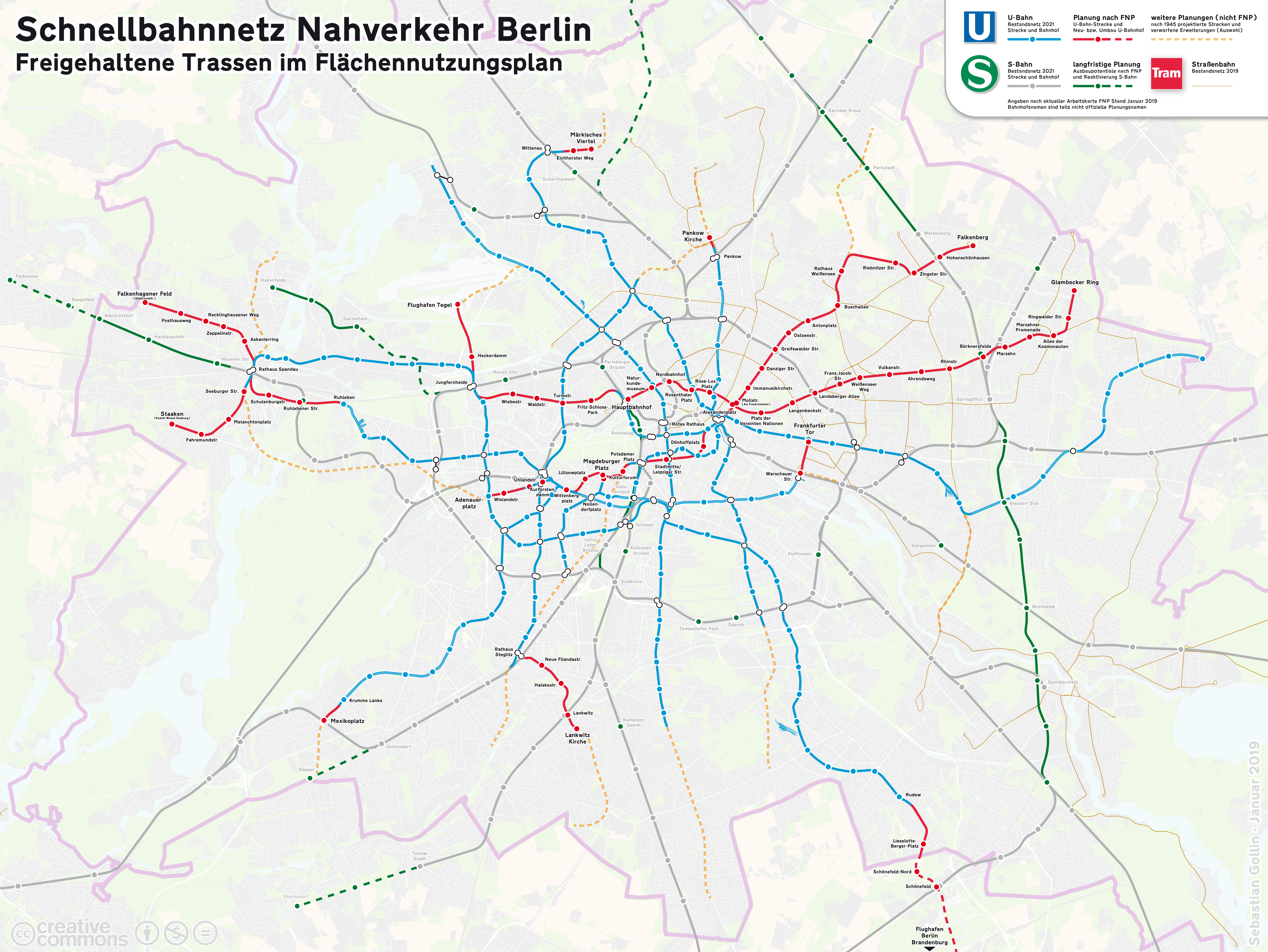
Most of the lines depicted in red on the map are not at all on the city’s list of projects to be built by the 2030s. Unfortunately, the most important line measured by projected cost per rider, the two-stop extension of U8 north (due east) to Märkisches Viertel, is constantly deprioritized. The likeliest lines to be built per current politicking are the extensions of U7 in both directions, southeast ti the airport (beyond the edge of the map) and west from Spandau to Staaken, and the one-stop extension of U3 southwest to Mexikoplatz to connect with the S-Bahn. An extension to the former grounds of Tegel is also considered, most likely a U6 branch depicted as a lower-priority dashed yellow line on the map rather than the U5 extension the map depicts in red.
The carbon critique
Two days after the U5 extension opened two years ago, a report dropped that accused the proposed program of climate catastrophe. The argument: the embedded concrete emissions of subway construction are high, and the payback time on those from mode shift is more than 100 years.
The numbers in the study are, as follows: each kilometer of construction emits 98,800 tons of CO2, which is 0.5% of city emissions (that is, 5.38 t/person, cf. the German average of about 9.15 in 2021). It’s expected that through mode shift, each subway kilometer saves 714 t-CO2 in annual emissions through mode shift, which is assumed to be 20% of ridership, for a payback time of 139 years.
And this argument is, frankly, garbage. The scale of the difference in emissions between cities with and without extensive subway systems is too large for this to be possibly true. The U-Bahn is 155 km long; if the 714 t/km number holds, then in a no U-Bahn counterfactual, Berlin’s annual greenhouse gas emissions grow by 0.56%, which is just ridiculous. We know what cities with no or minimal rapid transit systems look like, and they’re not 0.56% worse than comparanda with extensive rapid transit – compare any American city to New York, for one. Or look again at the comparison of Berlin to the German average: Berlin has 327 cars per 1,000 people, whereas Germany-wide it’s 580 and that’s with extensive rapid transit systems in most major cities bringing down the average from the subway-free counterfactual of the US or even Poland.
The actual long-term effect of additional public transport ridership on mode shift and demotorization has to be much more than 20%, then. It may well be more than 100%: the population density that the transit city supports also increases the walking commute modal split as some people move near work, and even drivers drive shorter distances due to the higher density. This, again, is not hard to see at the level of sanity checks: Europeans drive considerably less than Americans not just per capita but also per car, and in the United States, people in New York State drive somewhat shorter distance per car than Americans elsewhere (I can’t find city data).
The measurement problem
It’s easy to measure the embedded concrete of infrastructure construction: there are standardized itemized numbers for each element and those can be added up. It’s much harder to measure the carbon savings from the existence of a better urban rail system. Ridership can be estimated fairly accurately, but long-term mode shift can’t. This is where rules of thumb like 20% can look truthy, even if they fail any sanity check.
But it’s not correct to take any difficult to estimate number and set it to zero. In fact, there are visible mode shift effects from a large mass transit system. The difficulty is with attributing specific shifts to specific capital investments. Much of the effect of mode shift comes from the ability of an urban rail system to contribute to the rise of a strong city center, which can be high-rise (as in New York), mid-rise (as in Munich or Paris), or a mix (as in Berlin). Once the city center anchored by the system exists, jobs are less likely to suburbanize to auto-oriented office parks, and people are likelier to work in city center and take the train. Social events will likewise tend to pick central locations to be convenient for everyone, and denser neighborhoods make it easier to walk or bike to such events, and this way, car-free travel is possible even for non-work trips.
This, again, can be readily verified by looking at car ownership rates, modal splits (for example, here is Berlin’s), transit-oriented development, and so on, but it’s difficult to causally attribute it to a specific piece of infrastructure. Nonetheless, ignoring this effect is irresponsible: it means the carbon benefit-cost analysis, and perhaps the economic case as well, knows the cost of everything and the value of little, which makes investment look worse than it is.
I suspect that this is what’s behind the low willingness to invest in urban rail here. The benefit-cost analyses can leave too much value on the table, contributing to public transport austerity. When writing the Sweden report, I was stricken by how the benefit-cost analyses for both Citybanan and Nya Tunnelbanan were negative, when the ridership projections were good relative to costs. Actual ridership growth on the Stockholm commuter trains from before the opening of Citybanan to 2019 was enough to bring cot per new daily trip down to about $29,000 in 2021 PPP dollars, and Nya Tunnelbanan’s daily ridership projection of 170,000 means around $23,000/rider. The original construction of the T-bana cost $2,700/rider in 2021 dollars, in a Sweden that was only about 40% as rich as it is today, and has a retrospective benefit-cost ratio of between 6 and 8.5, depending on whether broader agglomeration benefit are included – and these benefits are economic (for example, time savings, or economic productivity from agglomeration) scale linearly with income.
At least Sweden did agree to build both lines, recognizing the benefit-cost analysis missed some benefits. Berlin instead remains in austerity mode. The lines under discussion right now are projected between 13,160€ and 27,200€ per weekday trip (and Märkisches Viertel is, again, the cheapest). The higher end, represented by the U6 branch to Tegel, is close to the frontier of what a country as rich as Germany should build; M18 in Paris is projected to be more than this, but area public transport advocates dislike it and treat it as a giveaway to rich suburbs. And yet, the U6 branch looks unlikely to be built right now. When the cost per rider of what is left is this low, what this means is that the city needs to build more infrastructure, or else it’s leaving value on the table.
Quick Note on My New York Trip
I am back in Europe now (in London until Tuesday), but I was in New York for nearly three weeks, and it was interesting reconciling what I was seeing with what everyone else is saying about the city. It and my March 2022 trip were both enlightening in a way because I’d last been in the US at the end of 2019, so many New Yorkisms that I was used to in the 2000s and 2010s suddenly jarred me as foreign to what I had grown used to in Europe.
As one might expect based on the subject of this blog, I took the subway a lot. I took it so much that I was using weekly passes, and the last week I had a weekly pass for just three days and still I took 13 trips on those days, justifying its cost (which is like that of 12 single trips). I saw things, and notably didn’t see others.
What I did see: abject unreliability. I snapped a photo whenever the train arrival board was showing something weird, like low frequency or bunching; if you’re reading this post as it’s being posted and not going on a deep archive run, then go to my Twitter media and look at the last few weeks of pictures. Out of 19 days, something was going wrong 10 times, usually on the train I used to get between my Queensbridge hotel and Marron, the F train – and that’s without counting a few trips when the train frequency looked good but then I was delayed 10-20 minutes due to incidents. Something would always come up: signal failure, medical emergency, mechanical failure, cascading delays. Uday Schultz, a railfan who scares me with the depth of his knowledge of operations, maintenance, and rail history, points out how one such delay compounded due to bad interlining.
This is not normal. Berlin has delays but nowhere nearly this often – not on the U-Bahn but also not on the S-Bahn, whose interlining complexity is comparable to that of the New York City Subway. Low-frequency sections due to single-tracking for maintenance exist in Berlin, but it’s rare, and trains do not run worse than every 10 minutes except on the suburban periphery of the city. Over a similar period of time in Berlin I might see an incident bad enough to complain to BVG about it on Twitter maybe once or twice, not 10 times.
What I didn’t see: significant crime. I point out that I was staying near Queensbridge because the area is negatively stereotyped by suburbanites and city residents with I-hate-(the-rest-of-)the-city identity politics. Nothing there looked scary, at any time of day. There’s a large housing project there, which I mostly associate with people playing the Halloween theme song on 10/31 for what I imagine was a showing of the film and with some people wearing delightfully scary costumes. The worst I saw was someone selling swipes illegally when there was an unusually long line for the ticketing machines; there were cops on the platform who must have passed this person by and apparently done nothing.
I point this out because the city is convinced that the subway is dangerous. There are annoying announcements all the time: “this is an important message from the New York City Police Department…” It makes for some awful user experience – there’s no possibility of quiet on the train, for which those announcements contribute more than anything, since the panhandlers are much less common and the background noise is easier to tune out. People who speak limited English or can’t make out the phonemes garbled over bad announcer systems learn to tune everything out, including the occasional useful announcement of service changes.
And the police loves how annoying it is, which it justifies by appealing to safety theater. When Sarah Meyer tried reducing the annoyance levels, she ran into some real and some made-up technical problems, and one political problem in that nobody in management cares about UX. The police said they need those announcements, annoying and counterproductive as they are (telling tourists to watch their belongings gets them to grasp their wallets in fear, alerting every thief to the location of the wallet on their person); nobody at the agency thought to push back. In the last few days, a new disturbance has been added: the conductors announce at nearly every stop that cops are on the platform should people need assistance. This is in a safe city. Just stop this.
Quick Note on Transit Expansion and Development
I’ve been thinking a lot about where subway extensions can go in New York. One of the appendices we’re likely to include down the line in the Transit Costs Project is a proposal for what New York could do if its construction costs were more reasonable, and this means having to think about plausible extensions. Leaving aside regional rail and systematic investments for now, this may roughly be it:
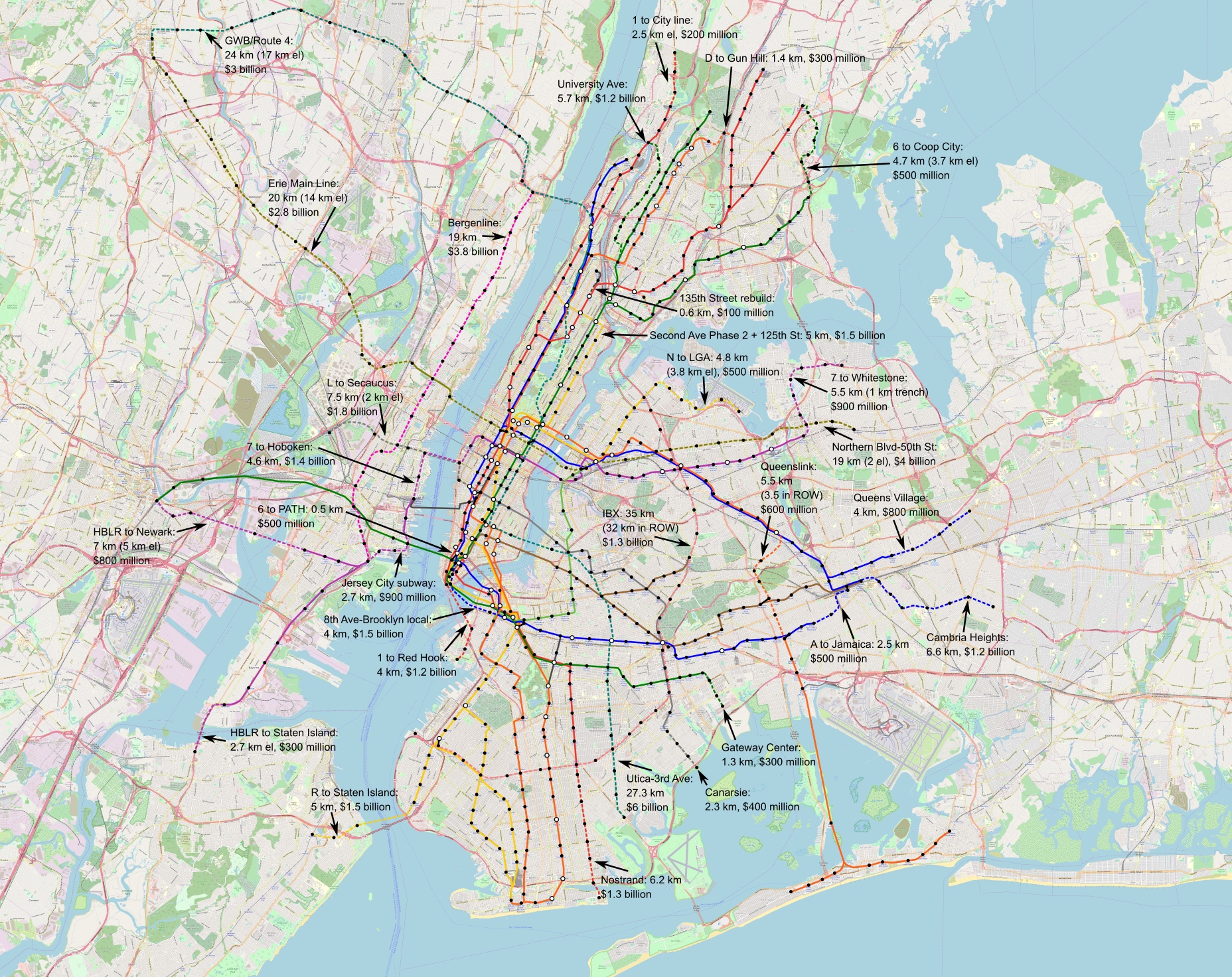
The full-size image (warning: 52 MB) can be found here.
The costs depicted are about twice as high as what I wrote in 2019 with Nordic costs as the baseline, because nominal Nordic costs have doubled since then, partly due to updating price levels from the early 2010s to the early 2020s, but mostly because of the real cost explosion in the Nordic countries. These costs are about $200 million/km in outlying areas, $300 million/km in Manhattan or across water, somewhat less than $100 million/km above ground or in an open trench, and higher than $300 million/km when reconstruction of existing tunnel complexes is proposed; everything is rounded to the nearest $100 million, which creates some rounding artifacts for short extensions that cancel one another out.
But the precise map is not what I think is the most interesting. The point is to build to the frontier of the cost per rider that is acceptable in American cities today, so by definition the marginal line for inclusion on the map, such as the D extension to Gun Hill Road to meet with the 2 train, is also socioeconomically marginal. What I think is more interesting is how important transit-oriented development is for the prospects of lines beyond the most obvious ones (Second Avenue Subway Phase 2, 125th Street, Utica, Nostrand, IBX, and maybe also the 7 to College Point).
The current land use in New York is largely frozen from the middle of the 20th century; the 1961 zoning law was the watershed. Since then, change has been slow, in contrast with rapid redevelopment in places that have chosen a pro-growth path. If the pace of change stays slow, then fewer lines are viable; if the city instead chooses not to keep anti-developmental neighborhood interests in the loop, then more are.
This, in turn, feeds into growth plans. Nordic and Italian planning bundles the question of where the regional housing growth goes with where the subway goes. (Our other positive case study, Turkey, works differently; the answer to both questions is “everywhere.”) This means that subway service goes to areas where substantial quantities of transit-oriented development will be permitted and built, often in negotiations with NIMBY municipalities that would rather just get the infrastructure without the housing; in Stockholm the scale involved is tens of thousands of units per tranche of Nya Tunnelbanan.
In the case of New York, this affects the shape of the map above more than anything. The 6 extension to Coop City is likely good either way, but the other radial extensions in the Bronx are more questionable and depend on where new housing in the borough will be built. The same is true in Queens: more housing in Northeast Queens may argue even in favor of further lines not depicted on the map, for example extending the 7 even further.
One- and Two-Seat Rides
All large urban rail networks rely on transfers – there are too many lines for direct service between any pair of stations. However, transfers are still usually undesirable; there is a transfer penalty, which can be mitigated but not eliminated. This forces the planners who design urban and suburban rail systems to optimize: too many transfers and the trips are too inconvenient, too few and the compromises required to avoid transfers are also too inconvenient. How do they do it? And why?
Of note, the strategies detailed below are valid for both urban rail and suburban commuter rail systems. Multi-line commuter rail networks like the RER and the Berlin S-Bahn tend to resemble urban rail in their core and work in conjunction with the rest of the urban rail network, and therefore strategies for reducing the onerousness of transferring work in much the same way for both kinds of systems. Suburban strategies such as timing half-hourly trains to meet connecting buses are distinct and outside the scope of this post.
Transfer penalties
Passengers universally prefer to avoid transfers between vehicles, keeping everything else constant. The transportation studies literature has enough studies on this pattern that it has a name: transfer penalty. The transfer penalty consists of three elements:
- Walking time between platforms or bus curbs
- Waiting time for the connecting train or bus
- An independent inconvenience factor in addition to the extra time
One meta-study of this topic is by Iseki-Taylor-Miller of the Institute for Transportation Studies. There’s a bewildering array of different assumptions and even in the same city the estimates may differ. The usual way this is planned in elasticity estimates is to bundle the inconvenience factor into walking and waiting times; passengers perceive these to be more onerous than in-vehicle time, by a factor that depends on the study. Iseki-Taylor-Miller quote a factor as low as 1.4-1.7 and Lago-Mayworm-McEnroe’s classic paper, sourced to a Swedish study, go up to 3; Teulings-Ossokina-de Groot suggest it is 2, which is the figure I usually use, because of the convenience of assuming worst-case scenario for waiting time (on average, the wait is half the headway).
The penalty differs based on the quality of station facilities, and Fan-Guthrie-Levinson investigate this for bus shelter. However, urban rail estimates including those in the above meta-studies are less dependent on station facilities, which are good in all cases.
Mitigating the transfer penalty
Reducing the transfer penalty for riders can be done in three ways, if one believes the model with a constant penalty factor (say 2):
- Reducing the number of transfers
- Reducing walking time between platforms
- Reducing waiting time for trains
All three are useful strategies for good urban rail network planning, and yet all three are useful only up to a point, beyond which they create more problems than they solve.
Reducing transfers
The most coherent network planning principle for reducing passengers’ need to transfer is to build radial rail networks. Such networks ideally ensure each pair of lines intersects once in or near city center, with a transfer, and thus there is at most one transfer between any pair of stations. A circumferential line may be added, creating some situations in which a three-legged trip is superior in case it saves a lot of time compared with the two-legged option; in Moscow, the explicit purpose of the Circle Line is to take pressure off the congested passageway of the central transfer connecting the first three lines.
In general, the most coherent radial networks are those inherited from the Soviet tradition of metro building; the London Underground, which influenced this tradition in the 1920s, is fairly radial itself, but has some seams. It’s important in all cases to plan forward and ensure that every pair of lines that meets has a transfer. New York has tens of missed connections on the subway, and Tokyo has many as well, some due to haphazard planning, some due to an explicit desire to build the newer lines as express relief lines to the oversubscribed older lines.
On a regional rail network, the planning is more constrained by the need to build short tunnels connecting existing lines. In that case, it’s best to produce something as close to a coherent radial network with transfers at all junctions as possible. Through-running is valuable here, even if most pairs of origins and destinations on a branched commuter line trunk still require a transfer, for two reasons. First, if there is through-running, then passengers can transfer at multiple points along the line, and not just at the congested city center terminus. And second, while through-running doesn’t always cut the transfer for suburb-to-suburb trips, it does reliably cut the transfer for neighborhood-to-suburb trips involving a connection to the metro: a diameter can be guaranteed to connect with all radial metro lines, whereas a radius (terminating at city center) will necessarily miss some of them, forcing an extra transfer on many riders.
Reducing walking time
The ideal transfer is cross-platform, without any walking time save that necessary to cross a platform no more than 10-15 meters wide. Some metro building traditions aim for this from the outset: London has spent considerable effort on ensuring the key Victoria line transfers are cross-platform and this has influenced Singapore and Hong Kong, and Berlin has accreted several such transfers, including between the U- and S-Bahn at Wuhletal.
However, this is not always viable. The place where transfers are most valuable – city center – is also where construction is the most constrained. If two lines running under wide streets cross, it’s usually too costly to tilt them in such a way that the platforms are parallel and a cross-platform transfer is possible. But even in that case, it’s best to make the passageways between the platforms as short as possible. A cruciform configuration with stairs and an elevator in the middle is the optimum; the labyrinthine passageways of Parisian Métro stations are to be avoided.
Reducing waiting time
The simplest way to reduce waiting time is to run frequently. Passengers’ willingness to make untimed transfers is the highest when frequency is the highest, because the 2-minute wait found on such systems barely lengthens one’s trip even in the worst case, when one has frustratingly just missed the train.
Radial metro networks based on two- rather than one-seat rides pair well with high frequency. Blog supporter and frequent commenter Threestationsquare went viral last month when he visited Kyiv, a Soviet-style three-line radial system, and noted that due to wartime cuts the trains only run every 6-7 minutes off-peak; Americans amplified this and laughed at the idea that base frequency could be so high that a train every 7 minutes takes the appellation “only.”
When frequency is lower, for example on a branch or at night, cross-platform transfers can be timed, as is the case in Berlin. But these are usually accidental transfers, since the core city center transfers are on frequent trunks, and thus the system is only valuable at night. Moreover, timed transfers almost never work outside cross-platform transfers, which as noted above are not always possible; the only example I’m aware of is in Vienna, where a four-way transfer with stacked parallel platforms is timed.
This is naturally harder on a branched commuter rail system. In that case, it’s possible to set up the timetable to make the likeliest origin-destination pairs have short transfer windows, or even one-seat rides. However, in general transfers may require a wait as long as the system’s base clockface intervals, which is unlikely to be better than 20 minutes except on the busiest trunks in the largest cities; even Paris mixes 10-, 15-, and occasionally 20- and 30-minute intervals on RER branches.
Subway Expansion to Kingsborough Community College
One of the perennial wishlist items for New York subway expansion is Nostrand Avenue. The 2 and 5 trains run under the avenue between Eastern Parkway and Brooklyn College, a distance of 4 km; from the start, the line was intended to be extended farther south, and in both the 1950s and 1970, there were plans for such extension as well as one shortly to the east under Utica, to be built right after Second Avenue Subway. The case for Nostrand and Utica remains strong – these two streets host Brooklyn’s two busiest buses (the B44 and B46 respectively), and another top route, the B41 on Flatbush, is closely parallel. The purpose of this post is to ask what the southern end of Nostrand should be, and whether a longer extension going to Kingsborough Community College is a good idea.
Nostrand: current plans
All plans I am aware of for extending the subway under Nostrand have it following the street to Sheepshead Bay. For example, my proposal from 2019 would terminate it right at the water, at Emmons Avenue, where the B44’s southern end is. This reflects official proposals over the last few generations: a Nostrand subway is to run just under Nostrand.
Kingsborough Community College
Right across geographic Sheepshead Bay from the neighborhood named after the bay, the eastern end of geographic Coney Island comprises the neighborhood of Manhattan Beach. It is not a dense area, and for the use of residents, there are buses to the Brighton Beach subway station. However, at the easternmost end of Manhattan Beach, Kingsborough Community College (KBCC) is a huge destination.
How huge? The bus serving it, the B1, is one of the busiest in Brooklyn, with some rush hour runs just operating back and forth as short-hop shuttles between Brighton Beach and KBCC, a distance of 2 km. Frequency at rush hour reached a bus every 3-4 minutes before corona.
This is not easily legible to commuter-oriented planning tools like OnTheMap. That area has only 1,000 jobs; KBCC itself doesn’t generate many jobs, nor does it anchor other industries around it that aim to employ graduates. Those planning tools can capture other universities if they’re more residential and higher-end – those have a higher ratio of faculty to students, have ample research labs, and anchor employers who look to locate near residential students. In contrast, a commuter college is largely invisible to them. In reality, there are 18,000 students, all of whom commute from elsewhere.
How much ridership does this generate?
KBCC has 18,000 students, and the overall area has 1,000 workers. If the modal split were 100%, this should generate 38,000 trips per weekday; commuter colleges don’t generate as many non-commute trips as do residential colleges. In reality, the modal split is not 100%, but it should be high given the low car ownership rates in the city, especially low for college students.
The bigger question is what proportion of the travel market would ride a Nostrand subway in preference to a rail-bus connection at Brighton Beach. This in turn depends on the state of the rest of the system. If the Interborough Express or some variant of it is already built, then from all points on or north of the IBX route, an all-rail route is superior to a rail-bus connection. If it isn’t, then it’s dicier, and from much of Southern Brooklyn from the Brighton Line to the west, the B1 is likely faster.
IBX should be built ahead of such a connection based on current plans, so the assumption should be the more optimistic one – and, of course, if there is long-term planning for subway extensions, then this should figure as an argument in favor of IBX. KBCC is hardly the only place that, despite being far from IBX, IBX can help riders access. In that scenario, 30,000 trips a day are not unrealistic, and 20,000 should be conservative.
How much should this cost?
I do not know. In an unusual inversion, I’m more confident of the benefits than the costs. The travel market is fairly circumscribed. In contrast, the costs have a question mark, because of the premium coming from underwater construction.
With no premium at all, New York should be able to reduce its construction costs for subways to $200 million per km on average, and less on easy sections, that is, on outer extensions of the system in the Outer Boroughs. But Nostrand has a high water table, and the underwater segment across Sheepshead Bay is not easy; figure $250-300 million per km, with a wide error margin.
This is not an onerous cost. It’s about 600-700 meters longer than the usual plan for Nostrand to Emmons, and presumably the whole route would be built at once with a tunnel boring machine, so the fixed costs are already paid. So $200 million is probably a reasonable cost.
IBX Cannot be a Tram
Clay Guse of the NY Daily News reports that in New York, the plans for the Interborough Express connector between Brooklyn and Queens are starting to lean in the direction of light rail. To be very clear, light rail in this context just means running light rail vehicles on infrastructure that is entirely grade-separated, either in the Bay Ridge Branch right-of-way (which has a handful of freight trains and is mostly wide enough for light rail and freight on separate tracks) or on viaducts (over the sections of the branch that are too narrow). I do not think there is any plan to downgrade IBX to a tramway. However, on Twitter I was asked about this anyway: why not make it a tramway, for more on-street flexibility?
What is a tram? Or a streetcar? Or light rail?
A tram or streetcar is a rail vehicle that runs predominantly on-street. The quality of the right-of-way may vary, from full mixed traffic as was traditional, to dedicated lanes that may be shared with buses and emergency traffic, to a grassy median that is no longer usable by road vehicles. But the distinguishing feature of the streetcar is that it runs on a street.
The doesn’t mean the streetcar has to run on-street the entire way. Street running is slow, even with dedicated lanes. Paris’s T3, an orbital tram in the grassy median of the Boulevards des Maréchaux on the outer margin of the city, averages 18 km/h. Berlin’s streetcars average 19 km/h; a handful of central sections are mixed-traffic but most have dedicated lanes, and in outer parts of the city there’s just less traffic and lines are generally faster.
There are two main ways to speed up the streetcar: make it faster in city center via tunneling (called subway-surface, Stadtbahn, or premetro), or make it faster outside city center by finding grade-separated rights-of-way (called tram-trains). Confusing, both subway-surface and tram-train systems are called light rail in the US, and Germany’s most celebrated tram-train, that of Karlsruhe, is also called Stadtbahn. Because these systems have evolved from all-surface streetcars, the separation between them and streetcars is not always perfect, which is why the American distinction between light rail (either subway-surface or tram-train) and streetcar (all on-street) is sometimes muddied in popular reporting.
Can IBX function as a tram variant?
No.
The problem with running an orbital tram parallel to the right-of-way is that there is no good street for it to run on. On the map below, the thick black line denotes the right-of-way that IBX is to use:
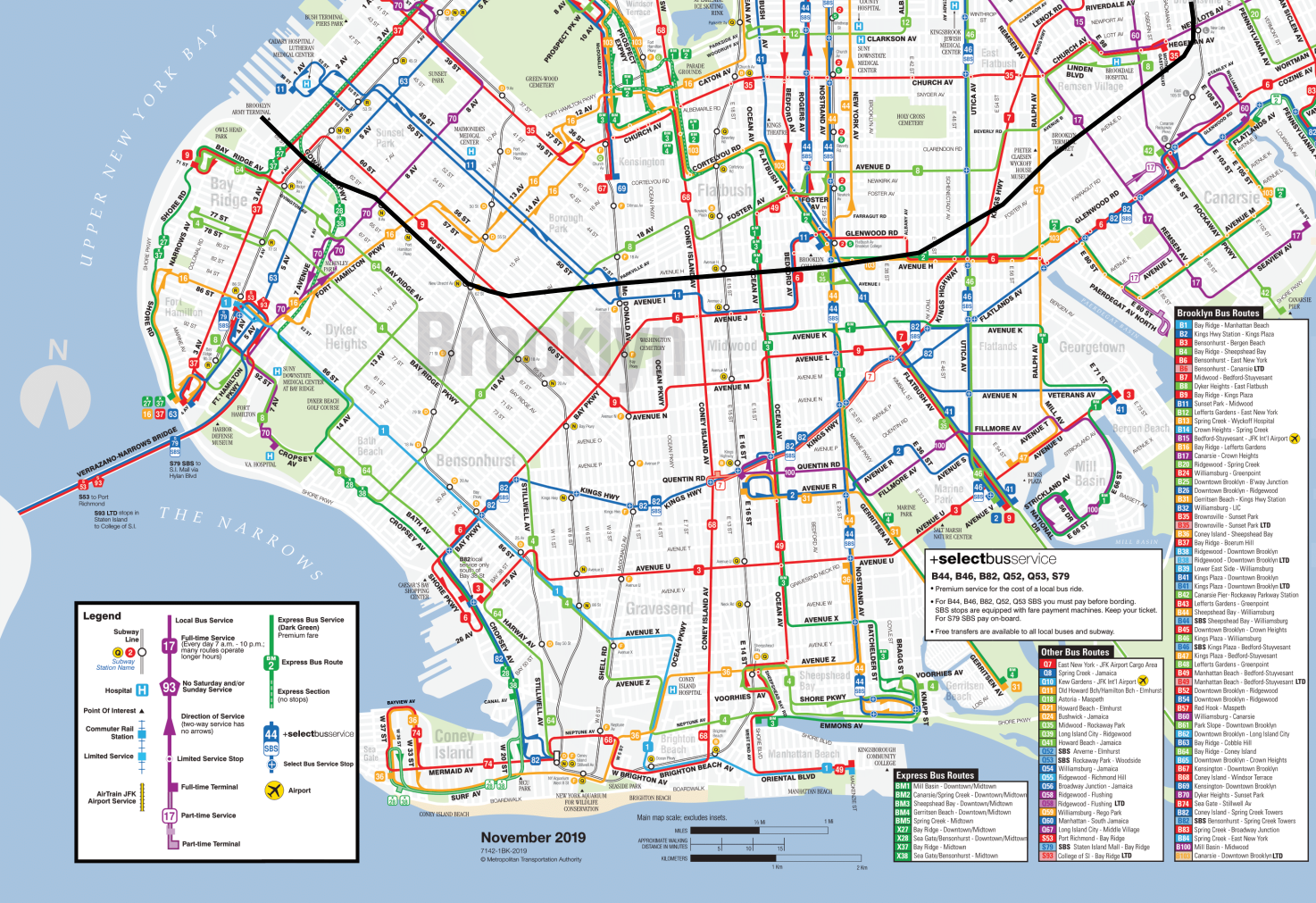
There are no on-street alternatives to the right-of-way. Brooklyn has three major orbital buses: the B35 on Church, and the B6 and B82. Church is not wide – dedicated lanes there would be contentious and still produce inferior speeds to those of T3, let alone streetcars in less dense cities; it’s a great corridor for dedicated bus lanes, but not for a tram. The B6 and B82 shift between different streets, as do other crosstown routes, like the B1, B3, B8, B9, and B11. Even Kings Highway is only 24 meters wide.
This, in turn, is why IBX is such a great idea: it provides service that the surface bus networks can’t provide, because the quality of rights-of-way is poor unless one uses the Bay Ridge Branch. When the street network is poor, surface transit ridership is suppressed relative to travel demand, which means that a rapid transit service like IBX will overperform any model trained on existing travel volumes.
This is also why no variant with any street running is viable. Not only is there no good street for a streetcar, but also there is no section of a street that is good for a streetcar. The narrow sections of the Bay Ridge Branch right-of-way, mainly the segment between the F and Q trains, don’t parallel any convenient street.
Moreover, subway-surface alignments work by branching the grade-separated core into many surface branches, but there is no good tie-in. Circumferential lines sometimes do branch, but the best use case is when there are major destinations just off the route. This is not the case for IBX: Brooklyn College is on-route. The most significant destination in Brooklyn off the route is Kings County Hospital/SUNY Downstate, which is unusually poorly-served by the street network even by Brooklyn standards, and is therefore only on one bus route, the B12, rather than at the intersection of multiple buses as it ideally should be. There is no viable surface deviation off of the IBX right-of-way that serves it.
So why light rail?
The modal alternatives analysis seems biased in favor of light rail. This, to be clear, is not light rail as a service or infrastructure technology – the plan is to use viaducts wherever the Bay Ridge Branch right-of-way is too narrow for IBX and freight tracks side by side. Rather, the plan is to use light rail vehicles on a service that is entirely rapid transit.
This has precedent in the United States. In the same manner that historic streetcars evolved into subway-surface lines in Boston, Philadelphia, and San Francisco, and into the tram-trains that are called light rail elsewhere (with inspiration from Germany, brought in by American troops serving there in the Cold War), some light rail lines evolve into fully grade-separated rapid transit. It’s uncommon, because usually the parts that are left on the surface are the most difficult to construct, but it does exist. The Green Line in Los Angeles runs LRVs on a fully grade-separated right-of-way, mostly in the median of the 105, and the Gold Line’s initial section to and beyond Pasadena has just 1.5 km of street running, on Marmion Way. In Calgary and Dallas there are plans to bury light rail lines, which could result in fully grade-separated lines that still run LRVs and are locally conceived of as light rail.
But in New York, this is not a wise course of action. Running rapid transit with LRVs is great for a city that has LRVs but not subway trains, like the Los Angeles of the early 1990s. A city with both may potentially still elect to use LRVs if it expects some surface extensions. But New York has large-scale operations and maintenance for subway rolling stock, and none for LRVs. The only light rail in the region is in Jersey City and Newark, which do not share management or maintenance facilities with the city, and couldn’t do the latter even if they wanted to since they’re on the wrong side of the Hudson.
If intermediate-capacity transit is desired, New York could build shorter platforms, only long enough for 4- or 5-car trains. If even less capacity is desired, it could go down to 2-car platforms; the rolling stock would need to be somewhat captive to the line, since the rest of the system runs permanently coupled 4- and 5-car trains, but that’s completely normal for a large subway system, and heavy maintenance facilities can still be shared. I’m wary of reductions in capacity just for the sake of downsizing – this is an entirely above-ground project, so station costs are not as onerous as they are underground – but I can see a case for smaller trains.
I can’t find a good reason for this preference for light rail over subway equipment for what is, by infrastructure and service, rapid transit. I can find many bad ones, of which the most likely is a desire for something different from the subway with all the connotations it has.
But this does not mean that the IBX plan is a tram. It’s not; it’s rapid transit service, which could easily be a normal subway, running LRVs for bad reasons.
Deinterlining and Schedule Robustness
There’s an excellent Uday Schultz blog post (but I repeat myself) about subway scheduling in New York. He details some stunning incompetence, coming from the process used to schedule special service during maintenance (at this point, covering the entirety of the weekend period but also some of the weekday off-peak). Some of the schedules are physically impossible – trains are scheduled to overtake other trains on the same track, and at one point four trains are timetabled on the same track. Uday blames this on a combination of outdated software, low maintenance productivity, aggressive slowdowns near work zones, and an understaffed planning department.
Of these, the most important issue is maintenance productivity. Uday’s written about this issue in the past and it’s a big topic, of similar magnitude to the Transit Costs Project’s comparison of expansion costs. But for a fixed level of maintenance productivity, there are still going to be diversions, called general orders or GOs in New York, and operations planning needs to schedule for them. How can this be done better?
The issue of office productivity
Uday lists problems that are specific to scheduling, such as outdated software. But the software is being updated, it just happens to be near the end of the cycle for the current version.
More ominous is the shrinking size of ops planning: in 2016 it had a paper size of 400 with 377 positions actually filled, and by 2021 this fell to 350 paper positions and 284 actually filled ones. Hiring in the American public sector has always been a challenge, and all of the following problems have hit it hard:
- HR moves extraordinarily slowly, measured in months, sometimes years.
- Politicians and their appointees, under pressure to reduce the budget, do so stupidly, imposing blanket hiring freezes even if some departments are understaffed; those politicians universally lack the competence to know which positions are truly necessary and where three people do the job of one.
- The above two issues interact to produce soft hiring freezes: there’s no hiring freeze announced, but management drags the process in order to discourage people from applying.
- Pay is uncompetitive whenever unemployment is low – the compensation per employee is not too far from private-sector norms, but much of it is locked in pensions that vest after 25 years, which is not the time horizon most new hires think in.
- The combination of all the above encourages a time clock managerial culture in which people do not try to rock the boat (because then they will be noticed and may be fired – lifetime employment is an informal and not a formal promise) and advancement is slow, and this too deters junior applicants with ambition.
Scheduling productivity is low, but going from 377 to 284 people in ops planning has not come from productivity enhancements that made 93 workers redundant. To the contrary, as Uday explains, the workload has increased, because the maintenance slowdowns have hit a tipping point in which it’s no longer enough to schedule express trains on local train time; with further slowdowns, trains miss their slots at key merge points with other lines, and this creates cascading delays.
Deinterlining and schedule complexity
One of the benefits of deinterlining is that it reduces the workload for ops planning. There are others, all pertaining to the schedule, such as reliability and capacity, but in this context, what matters is that it’s easier to plan. If there’s a GO slowing down the F train, the current system has to consider how the F interacts with every other lettered route except the L, but a deinterlined system would only have to consider the F and trains on the same trunk.
This in turn has implications for how to do deinterlining. The most urgent deinterlining in New York is at DeKalb Avenue in Brooklyn, where to the north the B and D share two tracks (to Sixth Avenue) and the N and Q share two tracks (to Broadway), and to the south the B and Q share tracks (to Coney Island via Brighton) and the D and N share tracks (to Coney Island via Fourth Avenue Express). The junction is so slow that trains lose two minutes just waiting for the merge point to clear, and a camera has to be set up pointing at the trains to help dispatch. There are two ways of deinterlining this system: the Sixth Avenue trains can go via Brighton and Broadway trains via Fourth Avenue, or the other way around. There are pros and cons either way, but the issue of service changes implies that Broadway should be paired with Fourth Avenue, switching the Q and D while leaving the B and N as they are. The reason is that the Fourth Avenue local tracks carry the R, which then runs local along Broadway in Manhattan; if it’s expected that service changes put the express trains on local tracks often, then it’s best to set the system up in a way that local and express pairings are consistent, to ensure there’s no interlining even during service changes.
This should also include a more consistent clockface timetable for all lines. Present-day timetabling practice in New York is to fine-tune each numbered and lettered service’s frequency at all times of day based on crowding at the peak point. It creates awkward situations in which the 4 train may run every 4.5 minutes and the 5, with which it shares track most of the way, runs every 5.5, so that they cannot perfectly alternate and sometimes two 4s follow in succession. This setup has many drawbacks when it comes to reliability, and the resulting schedule is so irregular that it visibly does not produce the intended crowding. Until 2010 the guideline was that off-peak, every train should be occupied to seated capacity at the most crowded point and since 2010 it has been 125% of seated capacity; subway riders know how in practice it’s frequently worse than this even when it shouldn’t be, because the timetables aren’t regular enough. As far as is relevant for scheduling, though, it’s also easier to set up a working clockface schedule guaranteeing that trains do not conflict at merge points than to fine-tune many different services.
Deinterlining and delocalization of institutional knowledge
Uday talks about New York-specific institutional knowledge that is lost whenever departments are understaffed. There are so many unique aspects of the subway that it’s hard to rely on scheduling cultures that come from elsewhere or hire experienced schedulers from other cities.
There is a solution to this, which is to delocalize knowledge. If New York does something one way, and peers in the US and abroad do it another way, New York should figure out how to delocalize so that it can rely on rest-of-world knowledge more readily. Local uniqueness works when you’re at the top of the world, but the subway has high operating costs and poor planning and operations productivity and therefore its assumption should be that its unique features are in fact bugs.
Deinterlining happens to achieve this. If the subway lines are operated as separate systems, then it’s easier to use the scheduling tools that work for places with a high degree of separation between lines, like Boston or Paris or to a large extent London and Berlin. This also has implications for what capital work is to be done, always in the direction of streamlining the system to be more normal, so that it can cover declining employee numbers with more experienced hires from elsewhere.
The Nine-Euro Ticket
A three-month experiment has just ended: the 9€ monthly, valid on all local and regional public transport in Germany. The results are sufficiently inconclusive that nobody is certain whether they want it extended or not. September monthlies are reverting to normal fares, but some states (including Berlin and Brandenburg) are talking about restoring something like it starting October, and Finance and Transport Ministers Christian Lindner and Volker Wissing (both FDP) are discussing a higher-price version on the same principle of one monthly valid nationwide.
The intent of the nine-euro ticket
The 9€ ticket was a public subsidy designed to reduce the burden of high fuel prices – along with a large three-month cut in the fuel tax, which is replaced by a more permanent cut in the VAT on fuel from 19% to 7%. Germany has 2.9% unemployment as of July and 7.9% inflation as of August, with core inflation (excluding energy and food) at 3.4%, lower but still well above the long-term target. It does not need to stimulate demand.
Moreover, with Russia living off of energy exports, Germany does not need to be subsidizing energy consumption. It needs to suppress consumption, and a few places like Hanover are already restricting heating this winter to 19 degrees and no higher. The 9€ ticket has had multiple effects: higher use of rail, more domestic tourism, and mode shift – but because Germany does not need fiscal stimulus right now and does need to suppress fuel consumption, the policy needs to be evaluated purely on the basis of mode shift. Has it done so?
The impact of the nine-euro ticket on modal split
The excellent transport blog Zukunft Mobilität aggregated some studies in late July. Not all reported results of changes in behavior. One that did comes from Munich, where, during the June-early July period, car traffic fell 3%. This is not the effect of the 9€ ticket net of the reduction in fuel taxes – market prices for fuel rose through this period, so the reduction in fuel taxes was little felt by the consumer. This is just the effect of more-or-less free mass transit. Is it worth it?
Farebox recovery and some elasticities
In 2017 and 2018, public transport in Germany had a combined annual expenditure of about 14 billion €, of which a little more than half came from fare revenue (source, table 45 on p. 36). In the long run, maintaining the 9€ ticket would thus involve spending around 7 billion € in additional annual subsidy, rising over time as ridership grows due to induced demand and not just modal shift. The question is what the alternative is – that is, what else the federal government and the Länder can spent 7 billion € on when it comes to better public transport operations.
Well, one thing they can do is increase service. That requires us to figure out how much service growth can be had for a given increase in subsidy, and what it would do to the system. This in turn requires looking at service elasticity estimates. As a note of caution, the apparent increase in public transport ridership over the three months of more or less free service has been a lot less than what one would predict from past elasticity estimates, which suggests that at least fare elasticity is capped – demand is not actually infinite at zero fares. Service elasticities are uncertain for another reason: they mostly measure frequency, and frequency too has a capped impact – ridership is not infinite if service arrives every zero minutes. Best we can do is look at different elasticity estimates for different regimes of preexisting frequency; in the highest-frequency bucket (every 10 minutes or better), which category includes most urban rail in Germany, it is around 0.4 per the review of Totten-Levinson and their own work in Minneapolis. If it’s purely proportional, then doubling the subsidy means increasing service by 60% and ridership by 20%.
The situation is more complicated than a purely proportional story, though, and this can work in favor of expanding service. Just increasing service does not mean doubling Berlin U-Bahn frequency from every 5 to every 2.5 minutes; that would achieve very little. Instead, it would bump up midday service on the few German rail services with less midday than peak frequency, upgrade hourly regional lines to half-hourly (in which case the elasticity is not 0.4 but about 1), add minor capital work to improve speed and reliability, and add minor capital work to save long-term operating costs (for example, by replacing busy buses with streetcars and automating U-Bahns).
The other issue is that short- and long-term elasticities differ – and long-term elasticities are higher for both fares (more negative) and service (more positive). In general, ridership grows more from service increase than from fare cutting in the short and long run, but it grows more in the long run in both cases.
The issue of investment
The bigger reason to end the 9€ ticket experiment and instead improve service is the interaction with investment. Higher investment levels call for more service – there’s no point in building new S-Bahn tunnels if there’s no service through them. The same effect with fares is more muted. All urban public transport agencies project ridership growth, and population growth is largely urban and transit-oriented suburban.
An extra 7 billion € a year in investment would go a long way, even if divided out with direct operating costs for service increase. It’s around 250 km of tramway, or 50 km of U-Bahn – and at least the Berlin U-Bahn (I think also the others) operationally breaks even so once built it’s free money. In Berlin a pro-rated share – 300 million €/year – would be a noticeable addition to the city’s 2035 rail plan. Investment also has the habit to stick in the long term once built, which is especially good if the point is not to suppress short-term car traffic or to provide short-term fiscal stimulus to a 3% unemployment economy but to engage in long-term economic investment.
 Pedestrian Observations