Category: Urban Transit
Assume Normal Costs: An Update
The maps below detail what New York could build if its construction costs were normal, rather than the highest in the world for reasons that the city and state could choose to change. I’ve been working on this for a while – we considered including these maps in our final report before removing them from scope to save time.
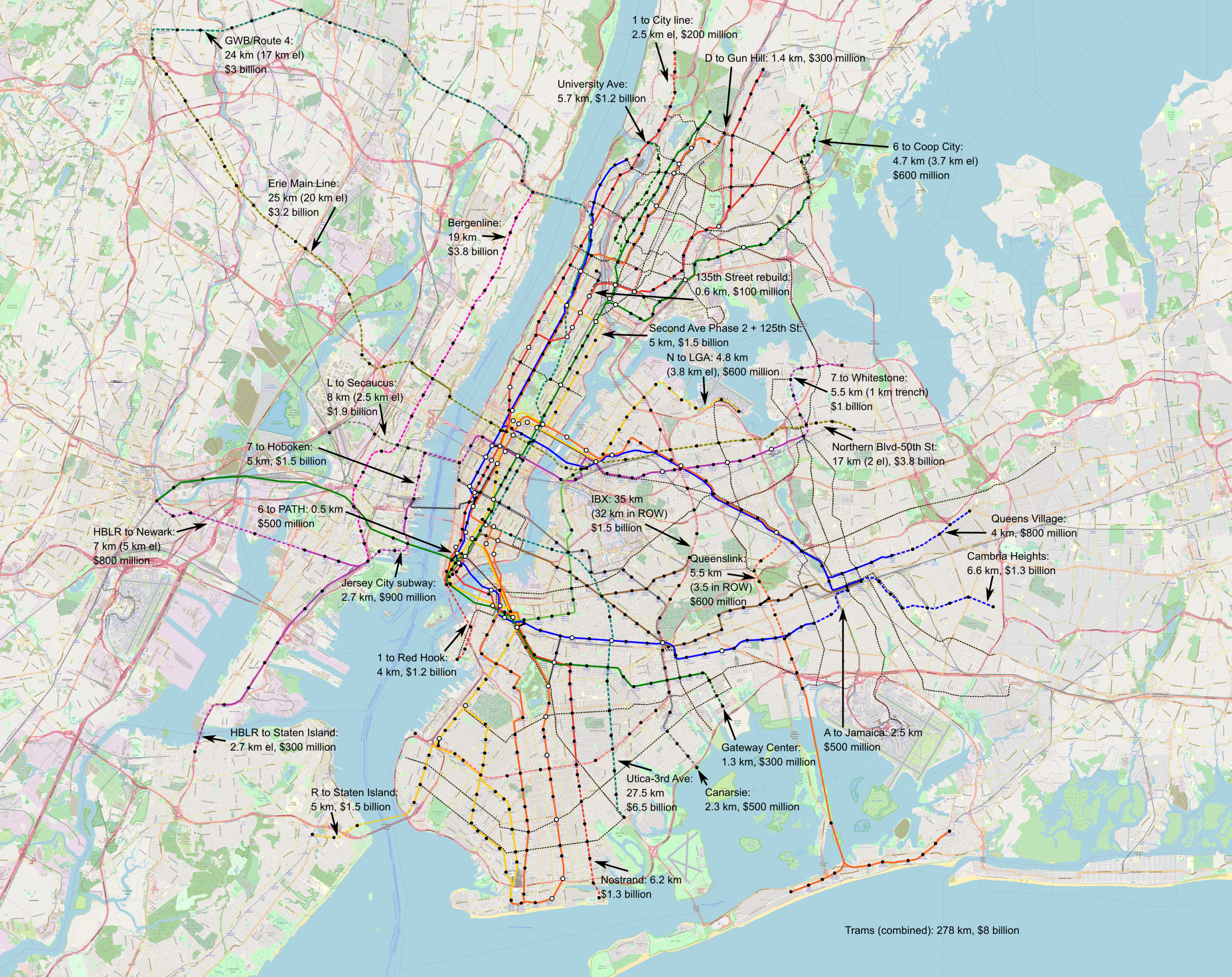
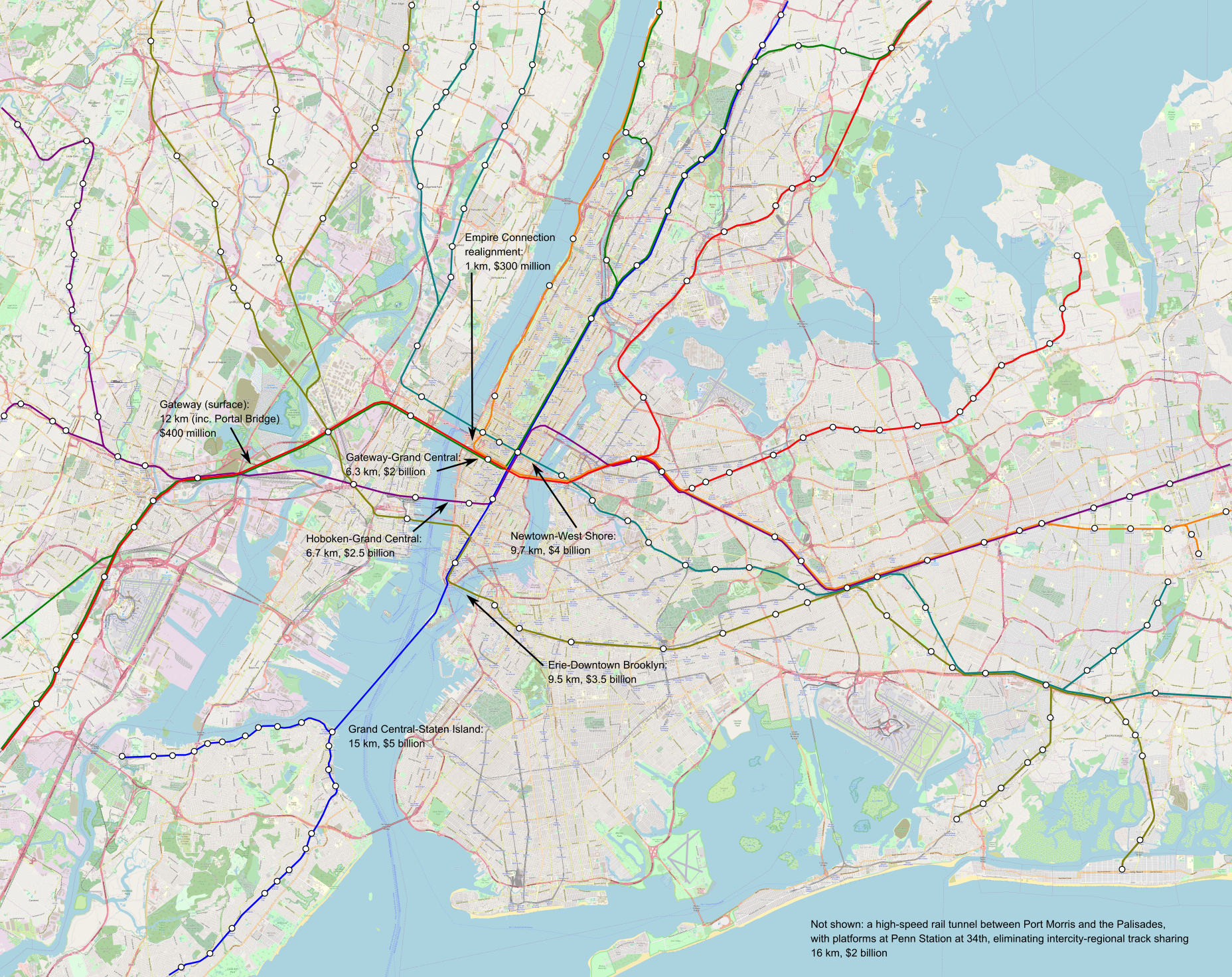
Higher-resolution images can be found here and here; they’re 53 MB each.
Didn’t you do this before?
Yes. I wrote a post to a similar effect four years ago. The maps here are updated to include slightly different lines – I think the new one reflects city transportation needs better – and to add light rail and not just subway and commuter rail tunnels. But more importantly, the new maps have much higher costs, reflecting a few years’ worth of inflation (this is 2022 dollars) and some large real cost increases in Scandinavia.
What’s included in the maps?
The maps include the following items:
- 278 km of new streetcars, which are envisioned to be in dedicated lanes; on the Brooklyn and Queensborough Bridges, they’d share the bridges’ grade separation from traffic into Manhattan, which in the case of the Brooklyn Bridge should be an elevated version of the branched subway-surface lines of Boston, Philadelphia, San Francisco, and most German cities. Those should cost $8 billion in total, based on Eno’s European numbers plus some recent urban German projects.
- 240 km of new subway lines, divided as 147.6 km in the city (97.1 km underground) and 92.4 km across the Hudson and in New Jersey (45.2 km underground). Of those 240 km, 147.5 km comprise four new trunk lines, including the already-planned IBX, and the rest are extensions of existing lines. Those should cost $25.2 billion for the city lines and $15.4 billion for the New Jersey lines.
- Rearrangement of existing lines to reduce branching (“deinterlining“) and improve capacity and schedule robustness; the PATH changes are especially radical, turning the system into extensions of the 6 and 7 trains plus a Hoboken-Herald Square shuttle.
- 48.2 km of commuter rail tunnels, creating seven independent trunk lines across the region, all running across between suburbs through the Manhattan core. In addition to some surface improvements between New York and Newark, those should cost $17.7 billion, but some additional costs, totaling low single-digit billions, need to be incurred for further improvements to junctions, station platforms, and electrification.
The different mode of transportation are intended to work together. They’re split across two maps to avoid cluttering the core too much, but the transfers should be free and the fares should be the same within each zone (thus, all trains within the city must charge MetroCard/OMNY fare, including commuter rail and the JFK AirTrain). The best way to connect between two stations may involve changing modes – this is why there are three light rail lines terminating at or near JFK not connecting to one another except via the AirTrain.
What else is included?
There must be concurrent improvements in the quality of service and stations that are not visible on a map:
- Wheelchair accessibility at every station is a must, and must be built immediately; a judge with courage, an interest in improving the region, and an eye for enforcing civil rights and accessibility laws should impose a deadline in the early to mid 2030s for full compliance. A reasonable budget, based on Berlin, Madrid, and Milan, is about $10-15 million per remaining station, a total of around $4 billion.
- Platform edge doors at every station are a good investment as well. They facilitate air conditioning underground; they create more space on the platform because they make it easier to stand closer to the platform edge when the station is crowded; they eliminate deaths and injuries from accidental falls, suicides, and criminal pushes. The only data point I have is from Paris, where pro-rated to New York’s length it should be $10 million per station and $5 billion citywide.
- Signaling must be upgraded to the most modern standards; the L and 7 trains are mostly there already, with communications-based train control (CBTC). Based on automation costs in Nuremberg and Paris, this should be about $6 billion systemwide. The greater precision of computers has sped up Paris Métro lines by almost 20% and increased capacity. Together with the deinterlining program, a single subway track pair, currently capped at 24 trains an hour in most cases, could run about 40 trains per hour.
- Improvements in operations and maintenance efficiency don’t cost money, just political capital, but permit service to be more reliable while cutting New York’s operating expense, which are 1.5-2.5 time a high as the norm for large first-world subway systems.
The frequency on the subway and streetcar lines depicted on the map must conform to the Six-Minute Service campaign demand of Riders Alliance and allies. This means that streetcars and subway branches run very six minute all day, every day, and subway trunk lines like the 6, 7, and L get twice as much frequency.
What alternatives are there?
Some decisions on the map are set in stone: an extension of Second Avenue Subway into Harlem and thence west along 125th Street must be a top priority, done better than the present-day project with it extravagant costs. However, others have alternatives, not depicted.
One notable place where this could easily be done another way is the assignment of local and express trains feeding Eighth and Sixth Avenues. As depicted, in Queens, F trains run local to Sixth Avenue and E trains run express to Eighth; then, to keep the local and express patterns consistent, Washington Heights trains run local and Grand Concourse trains run express. But this could be flipped entirely, with the advantage of eliminating the awkward Jamaica-to-Manhattan-to-Jamaica service and replacing it with straighter lines. Or, service patterns could change, so that the E runs express in Queen and local in Manhattan as it does today.
Another is the commuter rail tunnel system in Lower Manhattan. There are many options for how to connect New Jersey, Lower Manhattan, and Brooklyn; I believe what I drew, via the Erie Railroad’s historic alignment to Pavonia/Newport, is the best option, but there are alternatives and all must be studied seriously. The location of the Lower Manhattan transfer station likewise requires a delicate engineering study, and the answer may be that additional stops are prudent, for example two stops at City Hall and South Ferry rather than the single depicted station at Fulton Street.
What are those costs?
I encourage people to read our costs report to look at what goes into the numbers. But, in brief, we’ve identified a recipe to cut New York subway construction costs by a factor of 9-10. On current numbers, this means New York can cut its subway construction costs to $200-250 million per kilometer – a bit less in the easiest places like Eastern Queens, somewhat more in Manhattan or across water. Commuter rail tunnel costs are higher, first because they tend to be built only in the most difficult areas – in easier ones, commuter rail uses legacy lines – and second because they involve bigger stations in more constrained areas. Those, too, follow what we’ve found in comparison cases in Southern Europe, the Nordic countries, Turkey, France, and Germany.
In total, the costs so projected on the map, $66.3 billion in total, are only slightly higher than the total cost of Grand Paris Express, which is $60 billion in 2022 dollars. But Paris is also building other Métro, RER, and tramway extensions at the same time; this means that even the program I’m proposing, implemented over 15 years, would still leave New York spending less money than Paris.
Is this possible?
Yes. The governance changes we outline are all doable at the state level; federal officials can nudge things and city politician can assist and support. There’s little confidence that current leadership even wants to build, let alone knows what to do, but it’s all doable, and our report linked in the lede provides the blueprint.
Quick Note: Los Angeles Spends $50,000 Per Bus Shelter
I saw a few months ago that Los Angeles was planning to equip its entire bus network with shelter, and rejoiced that such an underrated amenity finally gets the attention it deserves. Unfortunately, the cost of the program is now $50,000 per bus shelter; to lower the cost, the city is experimenting with a substandard shelter providing no protection from the elements for $10,000. In Victoria, as pointed out by one commenter on Twitter, a full shelter is around $15,000 in 2018 Canadian dollars, comparable to 2023 American ones.
Ordinarily, it would be a dog-bites-man story: of course the costs are at a premium of a factor of three over Canada (let alone a place that builds cheaply), it’s an American transit infrastructure project. But this one is significant because bus shelter is small in scope – it’s not a megaproject, and this means that rules of megaprojects do not apply to it.
For example, installing shelter at thousands of stops, as Los Angeles is doing, allows for repetition of a standard design that vendors can figure out on their own. This means that the usual privatization of decisionmaking should not be a problem. (It’s been pointed out to me that design-build works well for municipal parking garages, since they’re so streamlined at this point.)
Moreover, bus shelter, even repeated so many times, is still small enough scope that a small in-house team could handle it. LACMTA has been talking to us about how to scale up their in-house team, and we couldn’t give them concrete numbers, but I believe what they have for design review is in the teens, which is probably not enough for a subway extension but should be for a bus shelter program measured in the tens of millions of dollars or (with the cost blowouts factored in) very low hundreds of millions. Elsewhere, for example in Boston, we’ve seen agencies build small things affordably – Boston’s premium over Berlin for building infill commuter rail stations is a factor of maybe 1.5 – and fail at building large things such as urban rail expansion, because their design review team is sized for small and not large things.
Finally, there’s a problem with politicization, in which when politicians insert themselves into a piece of infrastructure, hoping to make it their legacy, it will end up raising costs with at best no and at worst negative benefit to users. Small items like this ordinarily do not have this problem, as they fly under the radar of politicians as well as surplus-extracting community groups.
So why is this so expensive?
I don’t know the details of this failure – all I know is a handful of links to the current cost. I suspect, judging by the tone used in press coverage, that it’s politicization. Note that the piece linked in the lead paragraph centers the issue of gender equity; this isn’t stupid (as the other link points out, bus shelter has a disproportionately positive impact on women), but it does suggest someone thought about the political implications of this. The piece also quotes the designers as having developed the new substandard option “with input from female riders,” suggesting some waste on community consultation.
If I’m right on this, then this suggests a great peril for any city that looks at small and large projects, finds that the small ones are more cost-effective, and decides to prioritize them over large ones. In a city that builds subway expansion and also installs bus shelter beneath anyone’s notice, the bus shelter may be achievable at reasonable cost. But as soon as the shelter turns into a splashy program, beloved by incompetent managers who figure it’s within their span of control and by politicians (who are by definition incompetent on managerial issues), it will acquire the same problems of politicization usually associated with megaprojects. In this case, it’s waste coming from community consultation. In other cases, it might be demands for neighborhood signatures, or intransigence by abutting property owners or by utilities figuring there is surplus to extract, or any of the other causes of cost overruns.
And in particular, downgrading your city’s investment plan just because the flashiest items have cost blowouts wouldn’t end the cost blowouts. If you can’t build subways, work on making yourself capable of building subways; avoiding that mess and building other things instead of subways would run into the same problems and soon you’d be paying $50,000 for a single bus shelter.
Local Elected Representation is Bad
I am in awe of Marco Chitti’s depth of knowledge and quality of analysis on matters of public transportation; what he’s written about coordinated planning on his blog, not to mention his Italian construction costs case study, is an invaluable resource for anyone interested in improving public transportation at any scale. So it’s against this background that I feel compelled to point out, regrettably, that he’s wrong when he calls for local representation on public transit planning boards. Specifically, he promotes a model in which a transport association’s decisions flow from a board that represents the mayors of the municipalities in the region. And this is a model that exists (he gives the example of provincial France) and just plain does not work. EU-level observers see this every time we are reminded that the Council of Ministers exists.
To the contrary, any path forward on public transportation requires the steady disempowerment of local electeds, including mayors of small municipalities or neighborhood-level representation in a larger city. The EU-level observation that the Council of Ministers is the epitome of the democratic deficit is true at all lower levels as well, down to a single city.
Local representation does not work in France
Marco puts a parenthetical in his tweet: “or the region president for IDF-mobilités.” This makes the entire difference. In Ile-de-France, the transport association is governed at the level of the entire region, which has a single elected regional government with competitive partisan elections and high-profile campaigns; the current president of the region, Valérie Pécresse, was the national presidential candidate of Les Républicains last election. The dominant players within Ile-de-France Mobilités, RATP and SNCF, are both owned by the French state, and Prime Minister Elisabeth Borne was the politically-appointed head of RATP in the Hollande era, which was her stepping stone from a string of advisor positions to a ministry under Macron. This is not at all a situation with much localism.
Where there is localism in the Paris region, it promotes pettiness and NIMBYism. The increase in the rate of housing production in the region starting in the mid-2010s was promoted by the state and by the region, over the objections of suburban mayors, who were livid at the idea of more housing in their enclaves, especially social housing. The state never so coerced the city, where housing growth remains anemic, but Anne Hidalgo has likewise built social housing in rich arrondissements over the objections of their local mayors.
In fact, the model in which there is a single metropolitan government that is responsible at once for multiple services, is being implemented in Lyon. The traditional department it’s part of, Rhône, isn’t really coterminous with the metropolitan area, while some suburbs spill over to neighboring departments; for planning purposes, France set up the intergovernmental Urban Community of Lyon in 1969, comprising Lyon and its inner suburbs (equivalent not to Ile-de-France but to the combination of Paris and the Petite Couronne), but then in 2015 it replaced it with the Lyon Metropolis, with direct elections of a single government.
Elsewhere in France, inter-municipal relations remain more intergovernmental, and local mayors are in the loop on many decisions. But provincial France is hardly an example of success in transit governance. The modal splits in regions like Marseille, Nice, Lille, Bordeaux, Toulouse, and Strasbourg are all in the mid teens. They have little to recommend them as models over similar-size cities in the German-speaking and Nordic worlds.
This is something that’s recognized in France too – hence the formation of the Lyon Metropolis. France has excessive fractionalization of municipalities – it has around 35,000 communes, where Italy and Spain have 8,000 each and Germany has 11,000. It’s had little municipal consolidation since the Revolution; this way, Paris has fewer people than Berlin or Madrid, while possessing a metro area about the size of Berlin’s and Madrid’s combined. Local traditions make it hard to do further consolidation, often for petty reasons (Paris is wealthier than most of its suburbs and in the postwar era the poorer suburbs voted for communists); instead, where it cares that things should work, France sets up direct institutions with enough heft that people can vote for one government and expect that it should have the last say on big political questions.
Local representation does not work in the United States
The United States does not quite use the provincial French system of direct representation of mayors on transit boards. However, it has analogs, with extensive local empowerment. And those analogs do not work.
For example, in and around Springfield, Massachusetts, the Pioneer Valley Transit Authority (PVTA) is governed on the basis of representation of each municipality within the region. These are not the directly-elected mayors of those municipalities but it doesn’t matter – the problems do not stem from how they are elected but from which interests they answer to. The problem starts with the fact that nearly all PVTA ridership is in the urban core – Springfield itself and a small handful of working-class suburbs like Holyoke – but the representation structure gives snob suburbs veto power, which they use to block any consolidation plan focusing service on where people ride.
Worse, the suburbs of PVTA have a combination of two political attitudes that explodes any possibility of good governance. They are snobs and NIMBYs, opposing any attempt to make buses useful for poor urbanites trying to access service jobs in their jurisdictions. But they also have left-wing identity politics and want to be seen as progressive places where there are alternatives to the car. Therefore, they demand that PVTA serve every municipality in the region, but often just peripherally, so that they can say “we have buses”; those buses have practically no ridership, and serve to trigger Massachusetts’ accessibility requirement, in which paratransit must be provided on demand not just within 0.75 miles of a bus or urban rail stop as in the federal ADA but also within the entire town’s jurisdiction.
Marco says that the solution to bad politics is good politics. But the problem with PVTA and similar intergovernmental agencies is not that local representation is based on local appointment or recommendation rather than the direct mandate of the mayor. The mayor wouldn’t be any better than what is currently available, because at the end of the day, when a small enclave in a wider region gets to self-govern, the people it represents will be selected for pettiness (since the great majority of people who socialize outside the municipality are effectively disenfranchised) and snobbery (since the enclaves safeguard their insulation from poorer people). In some places, the worst NIMBYism may even be spearheaded by a county executive, if the county is itself an enclave, which Westchester County, New York is.
Transportation and Localism
In New York City, 92% of workers commute out of their community board. Representation at such level has a democratic deficit that exceeds that of the EU; the ministers who comprise the Council were after all elected in their respective countries, in democratic elections in which the important portfolios are doled out to acceptable parties and politicians. Fractional suburbs like those of France or the parts of the United States that have public transit are little different from city neighborhoods in this way. To continue with the example of PVTA, the two largest suburbs of Springfield by population are Chicopee and Westfield. Chicopee has 24,431 employed residents and 18,228 jobs, but only 4,131 of those live and work in the city, or 17%; Springfield has 17,656 employed residents, 14,863 jobs, and 3,820 people working and living in the city, or 22%. In effect, the mayors of both cities are elected in enclaves in which the most empowered people are not at all representative of the jurisdictions.
This situation is especially bad when it comes to transportation. There, the interests of those 17-22% of the Springfield suburbs who work locally, not to mention the 8% of New Yorkers who work in-community board, diverge the most from the general interest. People who live and work in an outlying local area do not really ride public transportation; people who commute to a city center do. This is not just a feature of transit cities – the transit modal split for people working in Downtown Los Angeles is not awful (I remember reading it was 50% in the 2000s-10s), they’re just swamped by people who work in places that don’t even rise to the category of a secondary center.
Even when the time comes to build a transit network that works for people who don’t work in city centers, it still is intended for the majority, which doesn’t work locally. PVTA and other non-Boston Massachusetts agencies (called RTAs) struggle with span of service – buses stop running anytime between 6 and 8 pm to shopping malls that close at 10. Regional representation could catch those riders, who would have a single point of contact to vote for; local representation cannot, because they are formally disenfranchised where they work and in practice disempowered where they live.
Americans – not Marco, but some of the people who responded to him on Twitter – are paranoid that regional representation in an auto-oriented area would lead to the defunding of transit.
But we can concretely compare what happens when auto-oriented suburbs have local representation (as in most of the US) and what happens when they’re incorporated into a larger whole and can then vote there (as in Ile-de-France, or Berlin, or Toronto). Kai Wegner became mayor of Berlin after an explicitly pro-car campaign; what this means in practice is a halt on some road diet projects, the latter pushed by Green voters who work close to where they live and care about bikes more than about public transit. The far more populist, far more pro-car Rob Ford became mayor of Toronto powered by resentment of David Miller’s Transit City concept, which had the same failings as the agenda of the Berlin Greens; Ford’s election caused far more damage in its politicization of transit, leading to repeated changes in the Eglinton rail plan just so that Ford could prove that he existed, than at the basic level of defunding transit or closing the streetcars (which Ford promised to do and then didn’t).
We can even see the interplay between local and regional in Ile-de-France. The pro-car suburban mayors tried to sue Paris to stop its road diets, alleging that they are discriminatory against them, and one might expect that those suburbs, if given a seat at the table, would favor pro-car policy. But in practice, the same voters who vote for these mayors at the local level also vote for Pécresse at the regional level, and Pécresse hasn’t compelled Paris to remotorize and is a lot YIMBYer than any of those suburban mayors. The issue is less that people in those places are pro-car and more that local representation consistently returns people who drive more than the average and who represent a minority that drives more than the average, and in the absence of such local representation, even someone like Rob Ford can’t do much damage through his transportation policy. (Doug Ford, in contrast, has done considerably more damage in micromanaging the megaprojects to the point that Toronto is careening past the $1 billion/km mark.)
The need for professionalism in democracy
Professional civil service arises in part from the fact that it’s not possible to have meaningful local representation in an urban area. A city the scale of Berlin can have a democratic election, since people generally live and work in the city, and not many commute in from or out to elsewhere. The same is true of the Commonwealth of Massachusetts, or even New York City, which has less than half the population of its metro area and yet this is enough that the populations of disempowered in- and out-commuters are limited. It’s true of Lyon Metropolis. It’s true of the combination of Paris and the Petite Couronne, which France occasionally considers amalgamating into a single Grand Paris and mostly doesn’t because the elected layer of Ile-de-France is so far sufficient and there is a lot of identity politics involved in the formal separation of the city from the suburbs.
And at this scale, it’s impossible for a single government to control everything. Berlin, New York, and so on have the populations of small countries. Such countries can elect a government, but the span of control of the elected ministers comprises an order of magnitude of 100 people across all ministries combined.
Thus, the need for a professional civil service. This is why the role of politicians in a healthy political environment is to macro- and not micromanage. They can make big yes-or-no decisions, and that’s it – decisions on alignments should be left to professionals, who are hired and promoted based on apolitical criteria. A Wegner or Ford can choose to fund roads more and transit less and halt or even reverse road diets, but the details have to come from experts, because the span of control of the Wegner cabinet is far too small for there to be any real democratic check on the sort of advisors who in the United States are politically appointed.
What’s more, even when they do make decisions, the tendency of politicians to do things just to prove that they exist is, always, bad for governance. In some cases, including what we’ve seen in Boston when we wrote the Green Line Extension report, megaprojects even act as siphons for bad ideas, while contemporary small projects beneath the notice of politicians are done more smoothly and efficiently. The danger is that the practices developed for the megaprojects then later poison the local infrastructure ecosystem, as when some of the decisions made for Grand Paris Express are now leading to overdesign for shorter Métro extensions.
The ideal role for elected leaders is to set overall funding levels and then just let the professionals work. If the professionals are failing, it’s fine to replace them with other professionals, chosen based on past successes in the same field (in the US, this has to mean foreigners), rather than chums who the politicians are comfortable with, like the repulsive political appointees I’ve seen in New York and Boston.
In the same way that most people writing about EU governance understand that Parliament has democratic legitimacy and the Council is the opposite, it’s critical to understand that localism subtracts from civilian democratic control of the state, through its elevation of petty voices. And if subdividing territory into local fiefs doesn’t work, the alternative is to subdivide it thematically and let subject-matter experts handle planning. Marco, and I think other people who are much more uncomfortable with top-down unitary civil services than he is (after all, Italy is governed by such civil service and builds infrastructure very well), errs in portraying this depoliticization as antithetical to democracy; it’s to the contrary the tool with which democracy governs anything bigger than an isolated village.
President Navalny Announces Metro Expansion to Accommodate Migrants From Viipuri and Královec
President Alexei Navalny (RB) has been beset by political instability since taking office three months ago, in the wake of the collapse of the Russian Armed Forces in face of a Ukrainian offensive with two divisions’ worth of Leopard 2s and 10 squadrons’ worth of F-16s. The loss of Královec in particular has generated a movement of nearly a million refugees, most of them headed to Moscow. Simultaneously, an estimated 400,000 Russians who left last year are returning, most of them, too, headed to Moscow or Saint Petersburg.
Navalny promises to react to this crisis through construction of housing and infrastructure, in the capital as well as in secondary cities. He says that the reduction in military spending and removal of sources of corruption will be enough to pay for this program, and says that while the loss of what he calls Vyborg and Kaliningrad is regrettable, at least no reparation payments were imposed. Analysts from the United States suggest that this early focus on material goods and growth is intended to increase popular support for the new regime and suggest continuity with the apolitical aspects of the prewar Russian state.
The focus on migrants from Viipuri and the larger Královec comes as interest groups speaking for those migrants are the most strident revanchists, calling for rearmament and saying that protesters and urban interests stabbed the Russian Armed Forces in the back. Russia Budushchego is rooted in Moscow and Saint Petersburg more than in the provinces, and Navalny is, according to analysts from Kazan and Chelyabinsk, trying to fold such migrants into big city society, hoping that they would integrate into what he views as the new Russia.
The proposed spending levels for the rail construction program bear out those analysts. The program includes 200 km of new rail in and around Moscow and another 90 in Saint Petersburg. All other cities combined are to get about 250 km, including restarting metro construction in Omsk, Krasnoyarsk, and Chelyabinsk; expanding the existing systems of Kazan, Nizhny Novgorod, Novosibirsk, Samara, and Yekaterinburg; and building new systems in Volgograd, Krasnodar, Ufa, Perm, Voronezh, and Rostov-on-Don.
Nonetheless, this program represents a quadrupling of the length of metro in Russia outside Moscow and Saint Petersburg; Navalny himself has personally visited Rostov-on-Don, the third largest destination for Russian refugees, mostly people expelled from Crimea and the Donbas for collaboration, and promised that democratic Russia would take care of all Russians, and repeated the line about quadrupling metro length outside the two main cities.
Navalny also pledged that housing construction would accelerate from a prewar average of 80 million square meters a year to 150 million. Here the new administration is open about focusing construction in Moscow and Saint Petersburg, where demand is the strongest and rents are the highest; in Moscow, the government promises that incentives to private builders would create high-quality, high-density housing on top of existing and planned metro stations.
Generational Investment and Politicized Delay
Investments that are pitched as once in a generation tend not to work very well. They’re delayed, they’re expensive in both absolute and relative terms, they’re compromised by competing demands that are rarely about good service. Looking at both the ongoing situation in the United States and Germany, I’m seeing parallels; one of my motivations for writing this post is New York-area problems, but the other is response by German tram advocates to my post about the Berlin U-Bahn expansion plan. In short: there’s nothing inherently easier about lower-intensity infrastructure like trams or legacy rail than about high-intensity alternatives like subways and high-speed rail.
There is an artifact of politicization there. At the end of the day, every generational investment is vulnerable to political micromanagement. If you build an U-Bahn, the streetcars will not be politicized; if you don’t and instead make the streetcars your urban rail centerpiece, they will be politicized instead. If your city has a problem with construction costs or with timelines, it’s likely political and therefore will attach to whatever mode you choose; downgrading to a lower-intensity mode will just make that mode as expensive as the higher-intensity mode used to be.
The issue of political micromanagement
There are countries that are capable of building infrastructure efficiently. All of them do so in a remarkable depoliticized manner, even extremely polarized Turkey, where AKP’s attempt to choke metro funding to Istanbul after the opposition won the election under Ekrem İmamoğlu failed and İmamoğlu got funding from the European Investment Bank. The engineers and planners choose the alignments and construction methods; the politicians say yes or no and have little or ideally no further input.
The upshot is that this is the most politically sustainable in an environment of regular ongoing construction. Setting up this system in a country that can’t build is hard and requires a lot of public breaking of implicit promises to political actors who think they matter but don’t. But if this preexists, then this is sustained through regular construction in which politicians show up twice, once for the groundbreaking and once for the opening, and never again. The civil service runs technical matters under the aegis of technical experts.
As soon as major politicians make more decisions than the most general ones, things go awry. This is for two reasons.
The first reason is that the politicians want to show that they are important and therefore like overruling or changing previous plans just because. Such changes are by themselves neutral: usually the changes are relative to a plan that was itself developed with political input (for example, changes in the alignment of Grand Paris Express in the early 2010s). However, they introduce delays, which raise costs, permit more cruft to accumulate, and lead to projects that solve yesterday’s problems.
The second reason is that petty actors are likelier to find audience with politicians, who don’t want to annoy them, than with civil servants. Those petty actors can include NIMBYs who demand more expensive methods to avoid real or perceived negative local impact, but also their opposite number, local groups that want a diversion of service to reach them or bigger construction to act as a signature piece. In the United States, there is a lot of preemptive surrender to such groups (“good neighbor policy”). Other groups just send input for its own sake. Others hog other people’s money (OPM), such as when the New York Parks Department and got $15 million to permit staging subway construction in a playground, or when an American municipal department insists on building more than the federal and state fire code requires. This happens regardless of the project, but politicians want to please and will not generally back the civil service against the petty actors, and if the politicians are involved, it’s also a signal that there’s plenty of OPM.
Of note, neither of these mechanisms depends on the technical details of the project. All that matters is that the project is perceived as big enough to merit political attention.
Also of note, local environmental organizations generally cause more environmental problems than they solve through their praxis of making it harder to govern. In Brussels, the construction of Métro Line 3 is delayed due to complaints by local NIMBYs, signal-boosted by Ecolo/Groen, that staging construction in a park hurts the neighborhood; this is then held up by the same green NIMBYs as evidence that subways take too long to build and decarbonization has to be done by 2030. The praxis of such organizations is deliberately adversarial and disruptive – whatever the city decides is its primary form of transport investment will be opposed.
Downgrades don’t solve the problem
There are German anti-subway NIMBYs who think that trams are literally as good as subways; one person on Reddit reacting to my post said that the Berlin average speeds I posted (streetcars 17.6 km/h, U-Bahn 30.5 km/h), sourced to BVG, are just an opinion. People like that are obviously risible. The more common anti-U-Bahn take recognizes that metro trains provide better service than trams, but questions whether it’s worth the higher cost. This is in places reasonable: cities don’t literally build a subway on every street, and there’s a growing system of using peripheral trams to feed metro trunks.
However, this analysis is only true at the relative level. If a city that builds subways also builds trams, the trams will look easier, precisely because they’re beneath the notice of politicians, who care about the highest-end projects. As soon as the city decides to forgo the subway and focus only on trams, the problem of political micromanagement instead attaches itself to the tram system.
This is also true of downgrades in quantity and not quality. A large metro expansion project, like Grand Paris Express or the Istanbul Metro investment program, is a flashy project that attracts political attention and sometimes includes weak lines, such as Métro Lines 17 and 18 in Paris. If there’s political controversy over the project, it will likely center the weakest lines, as these are the easiest to rally against, while often the critics will acknowledge that the strongest lines should still be built. The downgrade in quantity occurs when, in anticipation of future controversy over the program, it is decided to only build a small program comprising the strongest lines or even just a single line. The strongest line is genuinely strong, but if the problem comes from politicization, then this strong line will have many interests demanding tie-ins and OPM and often this line will then be more marginal just from the extra costs.
This is not hypothetical: this exact problem has happened in the United States in the last 45 years. Subway construction costs exploded in the 1970s: the Washington Metro’s per-km tunneling costs were in today’s money on the order of $300 million, continuing at this level through the 1990s (source; old costs are on PDF-p. 4 and 1990s costs are taken from segment 3 on PDF-p. 11). This was seen as too expensive for most cities, so they instead built light rail.
The early light rail program in the United States looked successful; its Canadian equivalent, of the same provenance, actually was successful. One of the planners involved, R. W. Rynerson, occasionally comments here, and points out that it was developed by American veterans who had been stationed in Germany and were intentionally adapting the German Stadtbahn concept to the North American context. The cities involved in this were all Western, because this system was ideal for cities that did not have preexisting urban rail and Western cities were newer; early examples include Edmonton, San Diego, Calgary, Portland, Denver, and Sacramento, with Los Angeles building a mix of light rail and subway and Seattle building a different mix.
This bought those cities maybe 15 years of reprieve. Subsequently, costs exploded. Once light rail was not just a simple way to plan future growth, under the aegis of trusted engineers, but rather a political program, the same politicization that made New York incapable of building beyond its Depression-era plan (that is, the IND) and Washington and San Francisco incapable of building beyond their Great Society-era plans (that is, the initial Metro and BART networks) now made those newer cities incapable of building. Portland opened the at-grade Orange Line of its light rail system in 2015 for $160 million/km in 2022 dollars. Minneapolis is taking forever to build its Southwest light rail line, with plenty of politicization of where and how to go. Boston built the Green Line Extension for $370 million/km in 2022 dollars, a higher real cost than that of tunnels in densely built-up parts of Washington in the 1990s – and it had severe politicization problems at all levels, even eclipsing the problem of insufficient project management capacity. Canada has had the same problem: Calgary’s light rail-centric investment was extraordinarily cheap in the late 20th century, but starting with the West LRT, costs have exploded so much that the city lost its ability to build and its modal split is stagnating around 16%.
Of note, American environmental and local-left organizations have not made light rail expansion easy. The first iteration of the Boston Green Line Expansion plan included $100 million, maybe $130 million in today’s money, for a short bike path, based on the demands of Somerville. In Los Angeles, left-NIMBYs oppose rail construction and have complained about transit-oriented gentrification. American left-NIMBYs have grown enamored of the idea of transit-oriented gentrification that they make demands of any city that builds light rail that it should pair it with spending on affordable housing and oppose any program that doesn’t include such additional funds, for example in Nashville in alliance with the anti-spending right. Any German readers who have any notions that such advocacy couldn’t happen here are invited to see the rhetoric that Green Party officials deploy against Tempelhofer Feld redevelopment.
If you can build, then build
The construction costs report we put out at the Transit Costs Project are pitched to an American audience, or very occasionally a Canadian or possibly British one, those countries sharing the American problem of poor project delivery and high soft costs. However, there are a lot of conclusions that can be drawn for the case of a medium-cost country that manifestly can build, like France or Germany. Such a country must look carefully at what goes on in the United States and to an extent the United Kingdom, as an example to avoid.
In particular, under no circumstances should cities downgrade, shrink, or slow down construction as a means of dealing with high project costs. The political problems are going to happen to the primary program no matter whether it is pitched as a metro- or tram-centric system.
Next to politics, the second most important thing to avoid is problems with project delivery. Here, I’m happy to report that Germany doesn’t seem to have such problems, except perhaps on the Munich S-Bahn, which has an even bigger political problem (namely, it’s a generational project for CSU politicians and was not properly overseen when CSU also controlled the federal transport ministry). Tellingly, other than the Munich S-Bahn, I’m not seeing substantial cost increases in actual (not projected) costs from the 1970s to the present in Germany. If an expansion program is larger than the city has recently had, it should staff up the civil service, hiring in-house to ensure the civil service retains lessons learned, and avoiding relying on private consultants or British-style Special Purpose Delivery Vehicles (SPDVs).
And if you can build, you should. Germany is a growing country with demand for further growth, especially in and next to its largest cities, such as Berlin. It should expand its U- and S-Bahn networks, using trams as a subsidiary feeder; that the trams look easier doesn’t make them so, not when they are turned into the centerpiece of the urban rail program – the same petty actors who induce delays to whatever the biggest project in town is do it no matter what the biggest project is.
Berlin’s U-Bahn Expansion Plan
An obscure change in German benefit-cost analysis regulations has led to expansive proposals for urban rail construction in Germany. In Berlin, where ongoing coalition negotiations between CDU and SPD are leading in a developmentalist cars-and-trains direction, this led BVG to propose a massive program for growing the U-Bahn from its current 155 km of route-length to 318. The BVG proposal is split fairly evenly between good lines and lines that duplicate the S-Bahn and have little transportation value, and yet I’ve not seen much discussion of the individual technical merit of the program. Instead, anti-developmental activists who think they’re being pro-environment, such as BUND, regurgitate their anti-U-Bahn conspiracy theories and go to the point of associating subway tunneling with the Nazis. (I, unlike native Europeans, associate the Nazis with the Holocaust instead.)
What is the BVG proposal?
A number of media outlets have produced maps of the proposal; here is Tagesspiegel’s, reproduced here because it shows S-Bahn and regional lines as thin but visible lines.

All nine lines of the U-Bahn are to be extended, most in both directions; U3 and U4, currently a branch of U1 and a low-ridership shuttle line respectively, are to be turned into full main lines via Mitte. In addition, a ring line called U0 is to be built, duplicating the Ringbahn on its western margin and taking over some lines currently planned as radial extensions to Tegel, and running as a circumferential at consistently larger radius than the Ring to the south, east, and north.
Background
The immediate news leading BVG to propose this plan is a combination of federal and city-level changes. The federal change is obscure and I only saw it discussed by one low-follower account on Twitter, Luke Horn. Luke points out that after years of red tape, the federal government finally released its updated benefit-cost analysis regulations. As those are used to score projects, city and state governments are required to follow exact rules on which benefits may be counted, and at what rate.
One of these benefits is modal shift. It’s notoriously hard to measure, to the point that anti-U-Bahn advocates argued based on one low-count measurement that U-Bahn construction generated more emissions than it saved through modal shift; their study has just been retracted for overestimating construction emissions, but the authors are unrepentant.
At any rate, on the 21st, the new federal rules were finally published. Greenhouse gas emissions avoided through modal shift are to be counted as a benefit at the rate of 670€ per metric ton of CO2 (see PDF-p. 243). This is a high number, but it’s only high when it comes to pushing carbon taxes through a political system dominated by old climate denialists; by scientific consensus it’s more reasonable – for example, it’s close to the Stern Report estimates for the 2020s. If Germany imposed a carbon tax at this rate, and not the current rate of 55€/t, the fuel price here would grow by around 1.50€/liter, roughly doubling the price and helping kill the growing market for SUVs and luxury cars. If that is the rate at which modal shift is modeled, then even with an undercount of how urban rail construction substitutes for cars, many otherwise marginal lines pencil out.
The city-level change is that Berlin just had a redo of the 2021 election, and while technically the all-left coalition maintained its majority, CDU got the most votes, which gave Mayor Franziska Giffey (SPD) the excuse she needed to break the coalition and go into a grand coalition negotiation with CDU. Giffey had had to resign from the federal cabinet in the late Merkel era when it turned out that she had plagiarized her thesis, leading the university to revoke her degree, but out of shamelessness she remained Berlin SPD’s mayoral candidate and won in 2021. The Greens thought little of having to serve under such a scandalized mayor, and out of personal pettiness, Giffey, politically well to the right of most SPD voters anyway, accused them of personally disrespecting her and went into negotiations with CDU.
The importance of this is that the Greens (and Die Linke) are a pro-tram, anti-U-Bahn, NIMBY party. When CDU and SPD said they’d finally develop the parade of Tempelhofer Feld with housing, an advisor to a Green Bundestag member accused them of wanting to develop the area out of personal spite, and not, say, out of wanting Berlin to have more housing. Under the all-left coalition, U-Bahn planning continued but at a slow pace, and by far the most important extension on a cost per rider basis, sending U8 north to Märkisches Viertel, was deprioritized; CDU’s campaign in the election was mostly about parking and opposition to road diets, but it also hit the Greens on their opposition to U-Bahn development.
The plan as it stands has a few sops to CDU. The U0 ring is the most significant: in a country where the median age is 45, under-18s can’t vote, and CDU is disproportionately an old people’s party, CDU’s median voter was an adult through the era of the Berlin S-Bahn Boycott, as both halves of the S-Bahn were run by the East during the Cold War. Where CSU supports the Munich S-Bahn as a vehicle for conservatives to move away from the left-wing city while still having access to city jobs, Berlin CDU is uniquely more negative toward the S-Bahn. Thus, the plan has a line that mostly duplicates the Ring. The U2 expansion to the west duplicates the S-Bahn as well, especially west of Spandau. Finally, the proposed western terminus of U1 is explicitly billed as a park-and-ride, which type of service Berlin CDU has long supported.
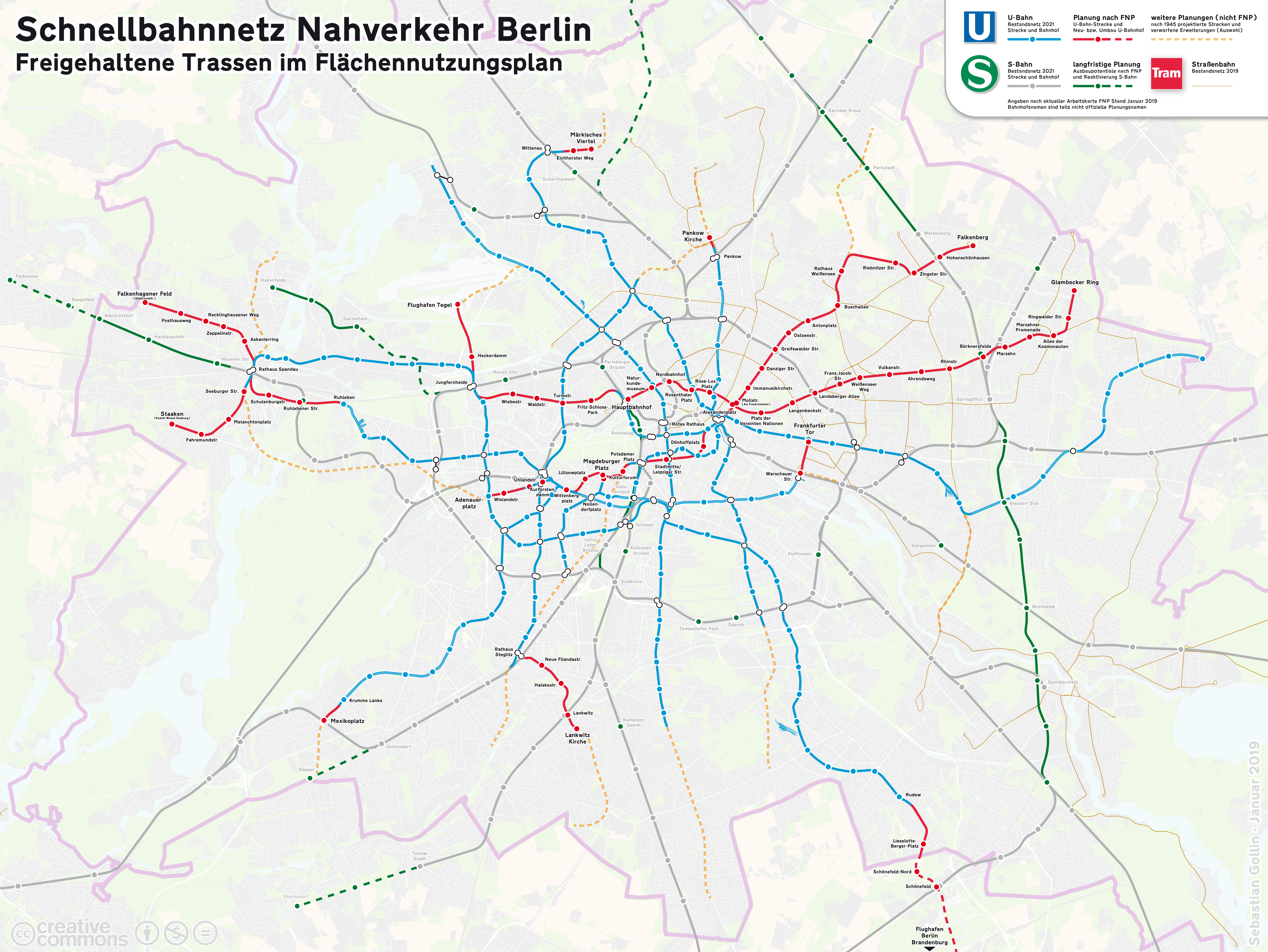
But other than the U0 ring, the plan is not too different from things that have long been planned. The longest segment other than U0 is the U3 extension to the northeast; this was part of the 200 km plan already in the 1950s, except originally the plan for this extension was not to hook into U3 as on post-Cold War plans but to run along an alignment closer to that of U9, whose southern terminus at Rathaus Steglitz was even built with room for this line, then numbered U10. A fair number of other sections on BVG’s map have a long history of languishing in unfavorable benefit-cost ratios. Other than U0, the plan is rather similar to what was studied in 2019:
However, this history has not prevented people from literally comparing BVG’s plan to the Nazis. The more prosaic reality is that the 1938 Welthauptstadt Germania U-Bahn expansion plan, other than its ring (built inside of the Ringbahn, the opposite of U0), made it to the 200 km plan and most of the lines it proposed were built, the largest change being that Cold War realities made West Berlin build U7 and U9 to serve the center of West Berlin at the Zoo rather than as additional lines serving Mitte.
The issue of costs
I have not seen an official cost estimate. BUND, which opposes the plan on the grounds that building tramways is better, says that it would cost 35 billion euros. Judging by recent construction costs of realized and proposed lines in Berlin, I think this estimate is broadly correct, if the project is run well.
The estimate is then about 210 million €/km, which looks realistic. The construction of the U5 extension from Alexanderplatz to Brandenburger Tor opened in 2020 at a cost of 280 million €/km in 2022 prices, but that was in the very center of the city, including a station at Museumsinsel mined directly beneath the Spree, for which BVG had to freeze the sandy soil. Conversely, the estimates of outer extensions that were already under planning before a week ago are lower: U7, the most advanced of these, is projected at 890 million € for about 8 km, or 110 million €/km, in an unusually easy (not really urbanized) tunneling environment.
The risk is that such a large project, done all at once, would strain the planning capacity of Berlin and Brandenburg. This exact risk happened in Paris: at 205 million €/km for 80% underground construction Grand Paris Express is more expensive per km than smaller Métro extensions built in the 2010s as it’s so large the region ran out of in-house planning capacity, and its response, setting up a British-style special purpose delivery vehicle (SPDV) along the lines of Crossrail, has resulted in British-style permanent loss of state capacity. Now, even the short Métro extensions, like the planned eastern M1 extension, cost more like GPE and not like similar projects from 10 years ago.
Notably, while France and the Nordic countries are seeing growing construction costs (France from a medium-low level and the Nordic countries from a very low one), Germany is not. I haven’t been able to find historic costs for Berlin with few exceptions. One of those exception, the last section of U9, cost 235 million € in 2022 prices for 1.5 or 1.6 km, or around 150 million €/km; this was built in 1968-74, in a relatively easy area, albeit with extra costs as noted above preparing for the U10 line. Another exception is the final section of U7 to Spandau, which cost around 800 million € for 4.9 km, or around 160 million €/km. Taken together with some numbers I posted here, it’s notable that in the 1970s, the construction costs per km in Italy, Germany, and the UK were all about the same but since then German costs have stayed the same or at worst inched up, Italian costs have fallen due to the anti-corruption laws passed in the wake of mani pulite, and British costs have quadrupled.
The most frustrating part of this discourse is that I’ve yet to see a single German rail advocate express any interest in the issue of costs. The critics of U-Bahn and other rail transport expansion plans who cite costs, of which BUND is a prime example, never talk about how to make metro construction in Germany cheaper; instead, they use it as an argument for why building underground railways is a waste of money, and urban rail must take the form of streetcars, which are held to be not only cheaper but also more moral from a green point of view as they annoy drivers. The same problem crops up in the discourse on high-speed rail, where Germany makes fairly easily fixable mistakes, generally falling under the rubric of over-accommodation of NIMBYs, and thus instead of figuring out how to build more lines, advocates write the idea off as impractical and instead talk about how to run trains on slow lines.
Can Berlin make do with streetcars?
No.
The problem with streetcars is that, no matter how much priority they get over other street traffic, they’re still slow. T3 in Paris, about the most modern urban tramway I’ve seen, running in a grassy reservation in the middle of the 40 meter wide Boulevards des Maréchaux, averages 18 km/h. The Berlin streetcars average 17.6 km/h; they don’t have 100% dedicated lanes at places, but for the most part, they too are run to very high standards, and only minor speedups can be seriously expected. Meanwhile, the U-Bahn averages 30.5 km/h, which is on the high side for the 780 m stop spacing, but is without driverless operations, which raised Paris’s average speed on M1 with its 692 m interstation from 24.4 to 30 km/h, at least in theory. The best Berlin can do with tramway modernization is probably around 20 km/h; the best it can do with the U-Bahn is probably 35 km/h, and with the S-Bahn maybe 45 km/h.
And Berlin is already large enough to need the speed. Leipzig is a good example of an Eastern city maintaining modal split with no U-Bahn, just streetcars and a recently-opened S-Bahn tunnel; in 2018, its modal split for work trips was 47% car, 20% public transport, 22% bike, 11% pedestrian (source, p. 13). But most of the walkable urban area of Leipzig is contained within a four kilometer radius of the main train station, a large majority of the city’s population is within six, and by eight one is already in the suburbs. Slow transportation like bikes and trams can work at that scale, to an extent.
In contrast with Leipzig’s smaller scale, I live four km from Berlin Hauptbahnhof and I’m still in Mitte, albeit at the neighborhood’s southeastern corner where Hbf is at the northwestern one. From the most central point, around Friedrichstrasse, both the Zoo and Warschauer Strasse are four km away, and both have high-rise office buildings. At eight km, one finally gets to Westkreuz and ICC-Messe, Steglitz, Lichtenberg, and the former airport grounds of Tegel; Gropiusstadt, a dense housing project built as transit-oriented development on top of U7, is 13 km from Friedrichstrasse by straight line.
The actual average speed, door-to-door, is always lower than the in-vehicle average speed. There’s access time, which is independent of mode, but then wait times are shorter on a high-intensity metro system than on a more diffuse streetcar network, and extra time resulting from the fact that rail lines don’t travel in a straight line from your home to your destination scales with in-vehicle travel time.
Leipzig’s modal split for work trips is 47% car, 20% public transport. Berlin’s is 28% car, 40% public transport. This is partly because Berlin is bigger, but mostly related to the city’s U-Bahn network; closer to Leipzig’s size class, one finds Prague, with a larger per capita urban rail ridership than Berlin or even Paris, with a system based on metro lines fed by streetcars and high-intensity development near the metro.
Berlin’s multiple centers make this worse. The same tram-not-subway NIMBYs who oppose U-Bahn development believe in building polycentric cities, which they moralize as more human-scale than strong city centers with tall buildings (apparently, Asia is inhuman). The problem is that when designing transportation in a polycentric city, we must always assume the worst-case scenario – that is, that an East Berliner would find work near the Zoo or even at ICC and a Spandauer would find it in Friedrichshain. The Spandauer who can only choose jobs and social destinations within streetcar distance for all intents and purposes doesn’t live in Berlin, lacking access to any citywide amenities or job opportunities; not for nothing, Spandauers don’t vote for NIMBYs, but for pro-development politicians like Raed Saleh.
Truly polycentric cities are not public transport-oriented. Upper Silesia is auto-oriented while Warsaw has one of Europe’s strongest surface rail networks. In Germany, the Rhine-Ruhr is an analog: its major cities have strong internal Stadtbahn networks, but most of the region’s population doesn’t live in Cologne or Essen or Dortmund or Dusseldorf, and the standard way to get between two randomly-selected towns there, as in Silesia, is by car.
The reason BUND and other NIMBYs don’t get this is a historical quirk of Germany. The Stadtbahn – by which I mean the subway-surface mode, not the Berlin S-Bahn line – was developed here in the 1960s and 70s, at a time of rapidly rising motorization. The goal of the systems as built in most West German cities was to decongest city center by putting the streetcars underground; then, the streetcar lines that fed into those systems were upgraded and modernized, while those that didn’t were usually closed. The urban New Left thus associates U-Bahn construction with a conspiracy to get trains out of cars’ way, and Green activists have reacted to the BVG plan by saying trams are the best specifically because they interfere with cars.
That belief is, naturally, hogwash. The subway-surface trolley, for one, was invented in turn-of-the-century Boston and Philadelphia, whose centers were so congested by streetcars, horsecars, and pedestrians that it was useful to bury some of the lines even without any cars. The metro tunnel was invented in mid-Victorian London for the same reason: the route from the train terminals on Euston Road to the City of London was so congested with horsecars there was demand for an underground route. Today, there’s less congestion than there was then, but only because the metro has been invented and the city has spread out, the latter trend raising the importance of high average speed, attainable only with full grade separation.
BUND and others say that the alternative to building 170 km of U-Bahn is building 1,700 km of streetcar. Setting aside that streetcars tend to be built in easier places and I suspect a more correct figure than 1,700 is 1,000 km, Berlin can’t really use 1,700 or 1,000 or even 500 km of tramway, because that would be too slow. Saturating every major street within the Ring with surface rail tracks would run into diminishing returns fast; the ridership isn’t there, getting it there requires high-density development that even SPD would find distasteful and not just the Greens, and streetcars with so many intersections with other streetcars would have low average speed. I can see 100-200 km of streetcar, organized in the Parisian fashion of orbital lines feeding the U- and S-Bahn; M13 on Seestrasse is a good example. But the core expansion must be U- and S-Bahn.
Okay, but is the BVG plan good?
Overall, it’s important for Berlin to expand its U- and S-Bahn networks, both by densifying them with new trunk lines and by expanding them outward. However, some of the lines on the BVG map are so out there that the plan is partly just crayon with an official imprint.
Core lines
The way I see it, the proposal includes 2.5 new trunk lines: U3 (again, formerly planned as U10), U4, and the western extension of U5.
Of those, U3 and U5 are unambiguously good. Not for nothing, they’ve been on the drawing board for generations, and many of their difficult crossings have already been built. Jungfernheide, where U5 would connect with U7, was built with such a connection in mind; the plan was and to an extent remains to extend U5 even further, sending it north to what used to be Tegel Airport and is now a planned redevelopment zone as the Urban Tech Republic, but the new BVG proposal gives away the Tegel connection to the U0 ring.
The U3 and U4 trunks in fact are planned along the routes of the two busiest tramways in the city, the M4 and combined M5/M6/M8 respectively (source, p. 7). The U3 plan thus satisfies all criteria of good subway construction – namely, it’s a direct radial line, in fact more direct than U2 (built around and not on Leipziger Strasse because the private streetcar operator objected to public U-Bahn development on its route), replacing a busy surface route. The U4 expansion mostly follows the same criterion; I am less certain about it because where M5 and M6 today serve Alexanderplatz, the proposed route goes along that of M8, which passes through the northern margin of city center, with some employment but also extensive near-center residential development near the Mitte/Gesundbrunnen boundary. I’m still positive on the idea, but I would rate it below the U3 and U5 extensions, and am also uncertain (though not negative) on the idea of connecting it from Hbf south to U4.
The U5 extension parallels no streetcar, but there’s high bus ridership along the route. The all-left coalition was planning to build a streetcar instead of an U-Bahn on this route. If it were just about connecting Jungfernheide to Hbf I’d be more understanding, but if the Urban Tech Republic project is built, then that corner of the region will need fast transportation in multiple directions, on the planning principle outlined above that in a polycentric city the public transport network must assume the worst-case scenario for where people live and work.
Outward extensions
All of Berlin’s nine U-Bahn lines are planned with at least one outward extension. These are a combination of very strong, understandable, questionable, and completely drunk.
The strongest of them all is, naturally, the U8 extension to Märkisches Viertel. In 2021, it was rated the lowest-cost-per-rider among the potential extensions in the city, at 13,160€/weekday trip; the U7 extension to the airport is projected to get 40,000 riders, making it around 22,000€/trip. It has long been to the city’s shame that it has not already completed this extension: Märkisches Viertel is dense, rather like Gropiusstadt on the opposite side of the city except with slightly less nice architecture, and needs a direct U-Bahn connection to the center.
Several other extensions are strong as well – generally ones that have been seriously planned recently. Those include U7 to the airport, the combination of the one-stop expansion of U2 to Pankow Kirche and the northeastern extension of U9 to intersect it and then terminate at the S-Bahn connection at Pankow-Heinersdorf, and U7 to the southwest to not just the depicted connection to U1 at Gatower Strasse but also along the route that the new plan gives to U1 to Heerstrasse.
The U3 expansion to the southwest is intriguing in a different way. It’s a low-cost, low-benefit extension, designed for network completeness: a one-stop extension to the S-Bahn at Mexikoplatz is being planned already, and the BVG plan acknowledges near-future S-Bahn plans adding a new southwestern branch and connect to it at Düppel.
Unfortunately, most of the other radial extensions go in the opposite direction from U3: where U3 acknowledges S-Bahn expansion and aims to connect with it, these other plans are closely parallel to S-Bahn lines that are not at capacity and are about to get even more capacity soon. Spandau, in particular, sees a train every 10 minutes; the Stadtbahn’s core segment has three trains in 10 minutes, with more demand from the east than from the west, so that a train every 10 minutes goes to Spandau, another goes to Potsdam, and a third just turns at Westkreuz since demand from the west is that weak. Creating more demand at Spandau would rebalance this system, whereas building additional U-Bahn service competing with current S-Bahn service (especially the U1 plan, which loses benefit west of the Ring) or with future expansion (such as U2 – compare with the expansion on the 2019 plan) would just waste money.
The southern extensions are a particularly bad case of not working with the S-Bahn but against it. The North-South Tunnel has 18 peak trains per hour, like the Stadtbahn; this compares with 30 on the trunk of the Munich S-Bahn. The ongoing S21 project should divert southeast, but as currently planned, it’s essentially a second North-South Tunnel, just via Hbf and not Friedrichstrasse, hence plans to beef up service to every five minutes to Wannsee and add branches, such as to Düppel. This massive increase in S-Bahn capacity is best served with more connections to the S-Bahn south of the Ring, such as east-west streetcars feeding the train; north-south U-Bahn lines, running more slowly than the S-Bahn, are of limited utility.
Finally, the extension of U1 to the northeast is a solution looking for a problem. U1’s terminus is frustratingly one S-Bahn stop away from the Ring, and perhaps the line could be extended east. But it points north, and is elevated, and past the U5 connection at Frankfurter Tor there’s no real need to serve the areas with another line to Friedrichshain.
The ring
The radial component of the BVG plan includes good and bad ideas. In contrast, the U0 ring is just a bad idea all around. The problem is that it doesn’t really hit any interesting node, except Tegel and Westkreuz, and maybe Steglitz and Pankow; Alt-Mariendorf, for example, is not especially developed. Berlin is polycentric within the Ring, but the importance of destinations outside it is usually low. This should be compared with Grand Paris Express’s M15 ring, passing through La Défense and the Stade de France.
Where circumferential service is more useful is as a feeder to S- and U-Bahn lines connecting people with the center. However, metro lines don’t make good feeders for other metro lines; this is a place where streetcars are genuinely better. The required capacity is low, since the constraints are on the radial connection to the center. The expected trip length is short and a transfer is required either way, which reduces the importance of speed – and at any rate, these outer circumferential routes are likely less congested, which further reduces the speed difference. The differences in cost permit streetcars to hit multiple stations on each line to connect with (though this means two parallel lines, not ten); this is not the same as fantasies about 1,700 km of streetcar in areas where people vote Green.
Is this a good plan?
Well, it’s about half good. Of the 163 km in BVG’s proposal, I think around 68 are good, and the rest, split between the U0 ring and the less useful outer extensions, should be shelved. That’s the crayon element – parts of the plan feel like just drawing extra extensions, by which I mean not just U0 but also the southern extensions.
However, substantial expansion of the U-Bahn is obligatory for Berlin to maintain healthy growth without being choked by cars. NIMBY fantasies about deurbanizing workplace geography would make the city more like Los Angeles than like their ideal of a 15-minute bikable small city center. Berlin needs to reject this; small is not beautiful or sustainable, and the city’s transport network needs to grow bigger and better with a lot more subway construction than is currently planned.
What’s more, the fact that construction costs in Germany are fundamentally the same in real terms as they were 40-50 years ago means that the country should accelerate its infrastructure construction program. Benefits for the most part scale with national GDP per capita – for example, the value of time for commuters, students, and other travelers so scale. Ignoring climate entirely, lines that were marginal in 1980 should be strong today; not ignoring climate, they are must-builds, as is high-density housing to fill all those trains and enable people to live in a desirable city with low car usage.
Bad Public Transit in the Third World
There’s sometimes a stereotype that in poor countries with low car ownership, alternatives to the car are flourishing. I saw a post on Mastodon making this premise, and pointed out already in comments that this is not really true. This is a more detailed version of what I said in 500 characters. In short, in most of the third world, non-car transportation is bad, and nearly all ridership (on jitneys and buses) is out of poverty, as is most walking. While car ownership is low, the elites who do own cars dominate local affairs, and therefore cities are car-dominated and not at all walkable, even as 90%+ of the population does not own a car.
What’s more, the developing countries that do manage to build good public transportation don’t stay developing for long. The same development model of Japan, the East Asian Tigers, and now China has built both rail-oriented cities and high economic growth, to the point that Japan and the Tigers are fully developed, and China is a solidly middle-income economy. The sort of places that stay poor, or get stuck in a middle-income trap, also tend to have stagnant urban rail networks, and so grow more auto-oriented over time.
The situation in Southeast Asia
With the exception of Singapore, nowhere in Southeast Asia is public transit good. What’s more, construction costs have been high for elevated lines and very high for underground ones, slowing down the construction of metro systems.
In Kuala Lumpur and Bangkok, motorization is high and public transit usage is weak. Paul Barter’s thesis details how both cities got this way, in comparison with the more transit-oriented model used in Tokyo, Seoul, Hong Kong, and Singapore. The thesis also predicts that the poorer megacities of Southeast Asia – Jakarta and Manila – will follow the auto-oriented path as they develop, which has indeed happened in the 13 years since it was written.
The situation in those cities is, to be fair, murky. Manila has a large urban rail under construction right now, with average to above average costs for elevated lines and high ones for subways. But the system it has today consists of four lines, two branded light rail, one branded MRT, and one commuter line. In 2019, the six-month ridership on the system was 162 million. A total of 324 million in a metro area the size of Manila is extraordinarily low: the administrative Metro Manila region has 13.5 million people, and the urban or metropolitan area according to both Citypopulation.de and Demographia is 24-26 million. On the strictest definition of Metro Manila, this is 24 trips per person per year; on the wider ones, it is about 13, similar to San Diego or Portland and only somewhat better than Atlanta.
Jakarta is in the same situation of flux. It recently opened a half-underground MRT line at fairly high cost, and is modernizing its commuter rail network along Japanese lines, using second-hand Japanese equipment. Commuter rail ridership was 1.2 million a day last year, or around 360 million a year, already higher than before corona; the MRT had 20 million riders last year, and an airport link had 1.5 million in 2018. This isn’t everything – there’s also a short light metro called LRT for which I can’t find numbers – but it wouldn’t be more than second-order. This is 400 million annual rail trips, in a region of 32 million people.
The future of these cities is larger versions of Bangkok. Thailand is sufficiently middle-income that we can see directly how its transport system evolves as it leaves poverty, and the results are not good. Bus ridership is high, but it’s rapidly falling as anyone who can afford a car gets one; a JICA report about MRT development puts the region’s modal split at 5% MRT, 36% bus, and the rest private (PDF-p. 69) – and the income of bus riders is significantly lower than that of drivers (PDF-p. 229), whereas MRT riders are closer to drivers.
Even wealthier than Bangkok, with the same auto-oriented system, is Kuala Lumpur. There, the modal split is about 8% bus, 7% train, and the rest private. This is worse than San Francisco and the major cities of Canada and Australia, let alone New York or any large European city. The national modal split in England, France, Germany, and Spain is about 16% – the first three countries’ figures predate corona, but in Spain they’re from 2021, with suppressed public transport ridership. Note that rail ridership per capita is healthier in Kuala Lumpur than in Jakarta or Manila – all rail lines combined are 760,000 riders per day, say 228 million per year, in a region of maybe 7 million people. This is better than a no-transit American city like San Diego, but worse than a bad-transit one like Chicago or Washington, where the modal split is about the same but there is no longer the kind of poverty that is common in Malaysia, let alone in Indonesia, and therefore if people ride the trains it’s because they get them to their city center jobs and not because they’re poor.
Even in Singapore, the best example out there of a transit-oriented rich city, it took until very recently for MRT coverage to be good enough that people willingly depend on it; it only reached NUS after I graduated. In the 1990s, the epitome of middle-class Singaporean materialism was described as owning the Five Cs, of which one was a car; traffic suppression, a Paul Barter describes, has centered fees on cars, much more car purchase than car use (despite the world-famous congestion pricing system), and thus to those wealthy enough to afford cars, they’re convenient in ways they are not in Paris, Berlin, or Stockholm.
The situation in Africa
African countries between the Sahara and the Kalahari are all very poor, with low car ownership. However, they are thoroughly car-dominated.
From the outside, it’s fascinating to see how the better-off countries in that region, like Nigeria, are already imitating Southeast Asia. Malaysia overregulated its jitneys out of existence because they were messy and this bothered elites, and because it wanted to create an internal market for its state-owned automakers. Nigeria is doing the same, on the former grounds; to the extent it hasn’t happened despite years of trying, it’s because the state is too weak to do more than harass the drivers and users of the system.
It’s notable that the Lagos discourse about the evils of the danfo – they are noisy, they are polluting, they drive like maniacs – there is little attention to how cars create all the same problems, except at larger scale per passenger served. The local notables drive (or are driven); the people who they scorn as unwashed, overly fecund, criminal masses ride the danfo. Thanks to aggressive domination by cars and inattention to the needs of the non-driving majority, Lagos’s car ownership is high for how poor it is – one source from 2017 says 5 million cars in the state, another from 2021 says 6.5 million vehicles between the state and Kano State. The denominator population in the latter source is 27 million officially, but unofficially likely more; 200 vehicles per 1,000 people is plausible for Lagos, which to be clear is not much less than New York or Paris, on an order of magnitude lower GDP per capita. Tokyo took until about 1970 to reach 100 vehicles per 1,000 people, at which point Japan had almost fully converged with American GDP per capita.
This is not specific to Lagos. A cousin who spent some time in Kampala told me of the hierarchy on the roads: pedestrians fear motorcycles, motorcycles fear cars, cars fear trucks. There is no pedestrian infrastructure to speak of; a rapid transit system is still a dream, to the point that a crayon proposal that spread on Twitter made local media. That the vast majority of Ugandans don’t own cars doesn’t matter; Kampala remains dominated by the few who do.
Transit and development
I don’t think it’s a coincidence that the sort of developing countries that build successful urban rail systems don’t stay poor for long. Part of it is that public transportation is good for economic development, but that’s not most of it – the United States manages to be rich without it except in a handful of cities. Rather, I suspect the reason has to do with state capacity.
More specifically, the reason cities with 100-200 cars per 1,000 people are thoroughly dominated by cars is that those 10-20% drivers (or people who are driven) are the elites. Their elite status can come from any source – passive business income, landlordism, active business income, skilled professional work – but usually it tilts toward the traditional, i.e. passive. These groups tend to be incredibly anti-developmental: they own small businesses, sometimes actively and sometimes passively, and resent being made redundant through economies of scale. India has problems with economic dwarfism and informality, and this is typical of poor countries; if anything, India is better than most at developing a handful of big businesses in high-value added industries.
The upshot is that the sort of people who drive, and especially the sort of drivers who are powerful enough to effect local changes to get incremental upgrades to roads at the expense of non-drivers, are usually anti-developmental classes. The East Asian developmental states (and Singapore and Hong Kong, which share many characteristics with them) clamped down on such classes hard, on either nationalist or socialist grounds; Japan, both Koreas, and both Chinas engaged in land reform, with characteristic violence in the two socialist states and without it but still with forcible purchase in the three capitalist states. The same sort of state that can eliminate landlordism can also, as a matter of capital formation, clamp down on consumption and encourage personal savings, producing atypically low levels of motorization well into middle-income status. Singapore, whose elite consumption centers vacations out of the country, has managed to do so even as a high-income country – and even more normal Tokyo and Seoul have much higher rail usage and lower car usage than their closest Western analog, New York.
India is in many ways anti-developmental, but it does manage to grow. Its anti-developmentalism is anti-urban and NIMBY, but it is capable of building infrastructure. Its metro program has problems with high construction costs (but Southeast Asia’s are generally worse) and lack of integration with other modes such as commuter rail, which the middle class denigrates as only befitting poor people; but the Delhi Metro had 5.5 million daily riders just before corona, slightly behind New York in a slightly larger metro area, perhaps a better comparison than Jakarta and Manila’s San Diego.
It’s the slower-growing developing countries that are not managing to even build the systems India has, let alone East Asia. They don’t have high car use, but only because they are poor, and in practice, they are thoroughly car-dominated, and everyone who doesn’t have a car wants one. A rich country really is not one where even the poor have cars but where even the rich use public transportation – and those countries aren’t rich and don’t grow at rates that will make them rich.
Schedule Planners as a Resource
The Effective Transit Alliance published its statement on Riders Alliance’s Six-Minute Service campaign, which proposes to run every subway line in New York and the top 100 bus routes every (at worst) six minutes every day from morning to evening. We’re positive on it, even more than Riders Alliance is. We go over how frequency benefits riders, as I wrote here and here, but also over how it makes planning easier. It is the latter benefit I want to go over right now: schedule planning staff is a resource, just as drivers and outside capital are, and it’s important for transit agencies to institute systems that conserve this resource and avoid creating unnecessary work for planners.
The current situation in New York
Uday Schultz writes about how schedule planning is done in New York. There’s an operations planning department, with 350 budgeted positions as of 2021 of which 284 are filled, down from 400 and 377 respectively in 2016. The department is responsible for all aspects of schedule planning: base schedules but also schedules for every service change (“General Order” or GO in short).
Each numbered or lettered route is timetabled on it own. The frequency is set by a guideline coming from peak crowding: at any off-peak period, at the most crowded point of a route, passenger crowding is supposed to be 25% higher than the seated capacity of the train; at rush hour, higher standee crowding levels are tolerated, and in practice vary widely by route. This way, two subway routes that share tracks for a long stretch will typically have different frequencies, and in practice, as perceived by passengers, off-peak crowding levels vary and are usually worse than the 25% standee factor.
Moreover, because planning is done by route, two trains that share tracks will have separate schedule plans, with little regard for integration. Occasionally, as Uday points out, this leads to literally impossible schedules. More commonly, this leads to irregular gaps: for example, the E and F trains run at the same frequency, every 4 minutes peak and every 12 minutes on weekends, but on weekends they are offset by just 2 minutes from each other, so on the long stretch of the Queens Boulevard Line where they share the express tracks, passengers have a 2-minute wait followed by a 10-minute wait.
Why?
The current situation creates more work for schedule planners, in all of the following ways:
- Each route is run on its own set of frequencies.
- Routes that share tracks can have different frequencies, requiring special attention to ensure that trains do not conflict.
- Each period of day (morning peak, midday, afternoon peak, evening) is planned separately, with transitions between peak and off-peak; there are separate schedules for the weekend.
- There are extensive GOs, each requiring not just its own bespoke timetable but also a plan for ramping down service before the start of the GO and ramping it up after it ends.
This way, a department of 284 operations planners is understaffed and cuts corners, leading to irregular and often excessively long gaps between trains. In effect, managerial rules for how to plan trains have created makework for the planners, so that an objectively enormous department still has too much work to do and cannot write coherent schedules.
Creating less work for planners
Operations planners, like any other group of employees, are a resource. It’s possible to get more of this resource by spending more money, but office staff is not cheap and American public-sector hiring has problems with uncompetitive salaries. Moreover, the makework effect doesn’t dissipate if more people are hire – it’s always possible to create more work for more planners, for example by micromanaging frequency at ever more granular levels.
To conserve this resource, multiple strategies should be used:
Regular frequencies
If all trains run on the same frequency all day, there’s less work to do, freeing up staff resources toward making sure that the timetables work without any conflict. If a distinction between peak and base is required, as on the absolute busiest routes like the E and F, then the base should be the same during all off-peak periods, so that only two schedules (peak and off-peak) are required with a ramp-up and ramp-down at the transition. This is what the six-minute service program does, but it could equally be done with a more austere and worse-for-passengers schedule, such as running trains every eight minutes off-peak.
Deinterlining
Reducing the extent of reverse-branching would enable planning more parts of the system separately from one another without so much conflict. Note that deinterlining for the purposes of good passenger service has somewhat different priorities from deinterlining for the purposes of coherent planning. I wrote about the former here and here. For the latter, it’s most important to reduce the number of connected components in the track-sharing graph, which means breaking apart the system inherited from the BMT from that inherited from the IND.
The two goals share a priority in fixing DeKalb Avenue, so that in both Manhattan and Brooklyn, the B and D share tracks as do the N and Q (today, in Brooklyn, the B shares track with the Q whereas the D shares track with the N): DeKalb Junction is a timetabling mess and trains have to wait two minutes there for a slot. Conversely, the main benefit of reverse-branching, one-seat rides to more places, is reduced since the two Manhattan trunks so fed, on Sixth Avenue and Broadway, are close to each other.
However, to enable more convenient planning, the next goal for deinterlining must be to stop using 11th Street Connection in regular service, which today transitions the R from the BMT Broadway Line and 60th Street Tunnel to the IND Queens Boulevard local tracks. Instead, the R should go where Broadway local trains go, that is Astoria, while the Broadway express N should go to Second Avenue Subway to increase service there. The vacated local service on Queens Boulevard should go to IND trunks in Manhattan, to Eighth or Sixth Avenue depending on what’s available based on changes to the rest of the system; currently, Eighth Avenue is where there is space. Optionally, no new route should be added, and instead local service on Queens Boulevard could run as a single service (currently the M) every 4 minutes all day, to match peak E and F frequencies.
GO reform
New York uses too many GOs, messing up weekend service. This is ostensibly for maintenance and worker safety, but maintenance work gets done elsewhere with fewer changes (as in Paris or Berlin) or almost none (as in Tokyo) – and Berlin and Tokyo barely have nighttime windows for maintenance, Tokyo’s nighttime outages lasting at most 3-4 hours and Berlin’s available only five nights a week. The system should push back against ever more creative service disruptions for work and demand higher maintenance productivity.
The Official Brooklyn Bus Redesign is Out
The MTA just released a draft of the Brooklyn bus redesign it and its consultant had been working on. It is not good. I’m not completely sure why this is – the Queens redesign was a good deal better, and our take on it at the Effective Transit Alliance was decidedly positive. But in the case of Brooklyn, the things that worked in Queens are absent. Overall, the theme of this is stasis – the changes to the network are minor, and the frequencies are to remain insufficiently low for good service. The only good thing about this is stop consolidation, which does not require spending any money on consultants and is a straightforward fix.
This is especially frustrating to me because my first project for Marron, before the Transit Costs Project, was a redesign proposal. The proposal can be read here, with discussion in blog posts here, here, and here. The official reaction we got was chilly, but the redesign doesn’t look anything like a more politic version, just one produced at much higher consultant cost while doing very little.
The four-color scheme
The Brooklyn project retains the Queens redesign’s four-color scheme of buses, to be divided into local (green), limited (red), Select Bus Service (blue), and rush (purple). The local buses are supposed to stop every 300-400 meters, which is not the best (the optimum for Brooklyn is about 400-500) but is a good deal better than the current spacing of about 200-250. The other three kinds of buses are more express, some running on the same routes as local buses as express overlays and some running on streets without local service.
In Queens, this four-way distinction emerges from the pattern in which in neighborhoods beyond the subway’s reach, bus usage is extremely peaky toward the subway. The purpose of the rush route is to get people to the subway terminal, such as Flushing or Jamaica, with not just longer stop spacing but also long nonstop sections close to the terminal where local service exists as an overlay, imitating the local and express patterns of peaky commuter rail operations in New York. I still think it’s not a good idea and buses should run at a more uniform interstation at higher frequency. But over the long stretches of Eastern Queens, the decision is fairly close and while rush routes are not optimal, they’re not much worse than the optimum. In contrast, Brooklyn is nothing like Queens: people travel shorter distances, and long routes are often used as circumferential subway connectors with ample turnover.
Ironically, this is something the MTA and its consultants understood: the Brooklyn map is largely green, whereas that in Queens has a more even mix of all four colors. Nonetheless, some rush routes are retained and so are some limited-only routes, in a way that subtracts value: if nearly all buses in Brooklyn offer me something, I should expect it on the other buses as well, whereas the rush-only B26 on Halsey Street is different in a way that isn’t clear.
In general, the notable feature of our redesign, unlike the more common American ones, is that there is no distinction among the different routes. Some are more frequent than others, but all have very high base frequency. This is because Brooklyn has unusually isotropic travel: density decreases from the East River south- and eastward, but the subway network also thins out and these effects mostly cancel out, especially with the high density of some housing projects in Coney Island; the busiest buses include some running only within Southern Brooklyn, like the B6 and B82 circumferentials.
In contrast, small-city redesigns tend to occur in a context with a strong core network and a weak peripheral network (“coverage routes,” which exist to reassure loud communities with no transit ridership that they can get buses too), and the redesign process tends to center this distinction and invest in the stronger core network. Queens has elements that look like this, if you squint your eyes sufficiently. Brooklyn has none: the isotropic density of most of the borough ensures that splitting buses into separate classes is counterproductive.
Frequency
The frequency in the proposed system is, frankly, bad. The MTA seems to believe that the appropriate frequency for urban mass transit is a train or bus every 10 minutes. This is acceptable in the suburban neighborhoods of Berlin or the outermost parts of New York, like the Rockaways and the eastern margin of Queens. In denser areas, including all of Brooklyn, it is not acceptable. People travel short distances: citywide, the average trip distance before corona was 3.4 km, which works out to 18 minutes at average New York bus speed (source: NTD 2019). In Brooklyn, the dense mesh of buses going between subway lines rather than to them makes the average even slightly lower. This means that very high frequency is a high priority.
So bad is the MTA’s thinking about frequency that core routes in the borough are split into local and limited variants, each running every 10 minutes off-peak, including some of the busiest corridors in the borough, like the outer circumferential B6 and B82 and the more inner-circumferential B35 on Church (split in the plan into a local B35 and an SBS B55). This is not changed from the current design, even though it’s easy to do so in the context of general consolidation of stops.
To make this even worse, there does not appear to be any increase in service-km, judging by the plan’s lack of net increase in frequency. This is bad planning: bus operating costs come from time (driver’s wage, mainly) and not distance, and the speedup provided by the stop consolidation should fuel an increase in frequency.
The Battery Tunnel
The most annoying aspect, at least to me, is the lack of a bus in the Brooklyn-Battery Tunnel, connecting Manhattan with Red Hook. Red Hook is isolated from the subway and from the rest of Brooklyn thanks to the freeway, and has bus connections only internally to Brooklyn where in fact a short bus route through the tunnel would beat bus-subway connections to Lower Manhattan.
We got the idea for the inclusion of such a bus service from planners that we spoke to when we wrote our own redesign. The service is cheap to provide because of the short length of the route, and would complement the rest of the network. It was also popular in the neighborhood meetings that tee consultants ran, we are told. And yet, it was deleted on a whim.
Berlin Greens Know the Price of Everything and Value of Nothing
While trying to hunt down some numbers on the costs of the three new U5 stations, I found media discourse in Berlin about the U-Bahn expansion plan that was, in effect, greenwashing austerity. This is related to the general hostility of German urbanists and much of the Green Party (including the Berlin branch) to infrastructure at any scale larger than that of a bike lane. But the specific mechanism they use – trying to estimate the carbon budget – is a generally interesting case of knowing the costs more certainly than the benefits, which leads to austerity. The underlying issue is that mode shift is hard to estimate accurately at the level of the single piece of infrastructure, and therefore benefit-cost analyses that downplay ridership as a benefit and only look at mode shift lead to underbuilding of public transport infrastructure.
The current program in Berlin
In the last generation, Berlin has barely expanded its rapid transit network. The priority in the 1990s was to restore sections that had been cut by the Berlin Wall, such as the Ringbahn, which was finally restored with circular service in 2006. U-Bahn expansion, not including restoration of pre-Wall services, included two extensions of U8, one north to Wittenau that had begun in the 1980s and a one-stop southward extension of U8 to Hermannstrasse, which project had begun in the 1920s but been halted during the Depression. Since then, the only fully new extension have been a one-stop extension of U2 to Pankow, and the six-stop extension of U5 west from Alexanderplatz to Hauptbahnhof.
However, plans for much more expansive construction continue. Berlin was one of the world’s largest and richest cities before the war, and had big plans for further growth, which were not realized due to the war and division; in that sense, I believe it is globally only second to New York in the size of its historic unrealized expansion program. The city will never regain its relative wealth or size, not in a world of multiple hypercities, but it is growing, and as a result, it’s dusting off some of these plans.
Most of the lines depicted in red on the map are not at all on the city’s list of projects to be built by the 2030s. Unfortunately, the most important line measured by projected cost per rider, the two-stop extension of U8 north (due east) to Märkisches Viertel, is constantly deprioritized. The likeliest lines to be built per current politicking are the extensions of U7 in both directions, southeast ti the airport (beyond the edge of the map) and west from Spandau to Staaken, and the one-stop extension of U3 southwest to Mexikoplatz to connect with the S-Bahn. An extension to the former grounds of Tegel is also considered, most likely a U6 branch depicted as a lower-priority dashed yellow line on the map rather than the U5 extension the map depicts in red.
The carbon critique
Two days after the U5 extension opened two years ago, a report dropped that accused the proposed program of climate catastrophe. The argument: the embedded concrete emissions of subway construction are high, and the payback time on those from mode shift is more than 100 years.
The numbers in the study are, as follows: each kilometer of construction emits 98,800 tons of CO2, which is 0.5% of city emissions (that is, 5.38 t/person, cf. the German average of about 9.15 in 2021). It’s expected that through mode shift, each subway kilometer saves 714 t-CO2 in annual emissions through mode shift, which is assumed to be 20% of ridership, for a payback time of 139 years.
And this argument is, frankly, garbage. The scale of the difference in emissions between cities with and without extensive subway systems is too large for this to be possibly true. The U-Bahn is 155 km long; if the 714 t/km number holds, then in a no U-Bahn counterfactual, Berlin’s annual greenhouse gas emissions grow by 0.56%, which is just ridiculous. We know what cities with no or minimal rapid transit systems look like, and they’re not 0.56% worse than comparanda with extensive rapid transit – compare any American city to New York, for one. Or look again at the comparison of Berlin to the German average: Berlin has 327 cars per 1,000 people, whereas Germany-wide it’s 580 and that’s with extensive rapid transit systems in most major cities bringing down the average from the subway-free counterfactual of the US or even Poland.
The actual long-term effect of additional public transport ridership on mode shift and demotorization has to be much more than 20%, then. It may well be more than 100%: the population density that the transit city supports also increases the walking commute modal split as some people move near work, and even drivers drive shorter distances due to the higher density. This, again, is not hard to see at the level of sanity checks: Europeans drive considerably less than Americans not just per capita but also per car, and in the United States, people in New York State drive somewhat shorter distance per car than Americans elsewhere (I can’t find city data).
The measurement problem
It’s easy to measure the embedded concrete of infrastructure construction: there are standardized itemized numbers for each element and those can be added up. It’s much harder to measure the carbon savings from the existence of a better urban rail system. Ridership can be estimated fairly accurately, but long-term mode shift can’t. This is where rules of thumb like 20% can look truthy, even if they fail any sanity check.
But it’s not correct to take any difficult to estimate number and set it to zero. In fact, there are visible mode shift effects from a large mass transit system. The difficulty is with attributing specific shifts to specific capital investments. Much of the effect of mode shift comes from the ability of an urban rail system to contribute to the rise of a strong city center, which can be high-rise (as in New York), mid-rise (as in Munich or Paris), or a mix (as in Berlin). Once the city center anchored by the system exists, jobs are less likely to suburbanize to auto-oriented office parks, and people are likelier to work in city center and take the train. Social events will likewise tend to pick central locations to be convenient for everyone, and denser neighborhoods make it easier to walk or bike to such events, and this way, car-free travel is possible even for non-work trips.
This, again, can be readily verified by looking at car ownership rates, modal splits (for example, here is Berlin’s), transit-oriented development, and so on, but it’s difficult to causally attribute it to a specific piece of infrastructure. Nonetheless, ignoring this effect is irresponsible: it means the carbon benefit-cost analysis, and perhaps the economic case as well, knows the cost of everything and the value of little, which makes investment look worse than it is.
I suspect that this is what’s behind the low willingness to invest in urban rail here. The benefit-cost analyses can leave too much value on the table, contributing to public transport austerity. When writing the Sweden report, I was stricken by how the benefit-cost analyses for both Citybanan and Nya Tunnelbanan were negative, when the ridership projections were good relative to costs. Actual ridership growth on the Stockholm commuter trains from before the opening of Citybanan to 2019 was enough to bring cot per new daily trip down to about $29,000 in 2021 PPP dollars, and Nya Tunnelbanan’s daily ridership projection of 170,000 means around $23,000/rider. The original construction of the T-bana cost $2,700/rider in 2021 dollars, in a Sweden that was only about 40% as rich as it is today, and has a retrospective benefit-cost ratio of between 6 and 8.5, depending on whether broader agglomeration benefit are included – and these benefits are economic (for example, time savings, or economic productivity from agglomeration) scale linearly with income.
At least Sweden did agree to build both lines, recognizing the benefit-cost analysis missed some benefits. Berlin instead remains in austerity mode. The lines under discussion right now are projected between 13,160€ and 27,200€ per weekday trip (and Märkisches Viertel is, again, the cheapest). The higher end, represented by the U6 branch to Tegel, is close to the frontier of what a country as rich as Germany should build; M18 in Paris is projected to be more than this, but area public transport advocates dislike it and treat it as a giveaway to rich suburbs. And yet, the U6 branch looks unlikely to be built right now. When the cost per rider of what is left is this low, what this means is that the city needs to build more infrastructure, or else it’s leaving value on the table.


