Noah Smith is skeptical about high-speed rail in the United States. He makes a bunch of different arguments against it, but I want to zoom in on the first, the issue of connecting transit, which Noah is far from the first person to bring up. It’s a genuine drawback of rail planning in the United States, but it’s very easy to overrate its importance. Connecting transit is useful, as is the related issue of city centralization, but its effect, serious as it is, is only on already marginal high-speed routes, like Atlanta-Memphis or Dallas-Kansas City. Los Angeles suffers from lacking connecting transit, but it’s also so big that nothing it connects to is marginal. Finally, high-speed rail and urban centralization are not in competition, but rather are complements, as in the history of the TGV.
Connections and centralization
Modal choice is about door-to-door trip times. This is why a large majority of people take a train that takes three hours over a plane that takes one: hardly anyone lives near the airport or has an airport as their ultimate destination. In practice, people are much likelier to be living near and traveling to a destination near a city center station.
The importance of connections then is that connecting urban transit extends the range of the train station. I didn’t live at Gare de Lyon or Gare de l’Est, but I could take the Métro there and it was a short trip, much shorter and more reliable than taking the RER to the airport, which made it easier for me to ride the TGV. With reliable connections, I showed up at Gare de l’Est four minutes before a train to Saarbrücken was due to depart, printed my ticket on-site, and walked leisurely to the platform, boarding still with two minutes to spare.
Regional rail has the same effect, at longer range. It’s not as convenient as urban rail, but it feeds the main intercity rail station and is timetabled, so if the system is punctual, passengers can time themselves to the main train station. In Switzerland the connections are even timed, enabling people who travel from smaller cities like St. Gallen to points west to transfer at Zurich Hauptbahnhof within a short window. However, this is completely absent from France: the regional trains are unreliable, and Paris has through-running on the RER but no single central station that can collect connections from secondary centers like Meaux or Versailles.
Finally, centralization is important because the reach of an urban transportation system is measured in units of time and not distance. Even racists who are afraid of taking the trains in Paris and rely exclusively on cars can take a cab from a train station to their ultimate destination and be there shortly. The average speed of the Métro is low, around 25 km/h, but Paris’s density and centralization mean that it’s enough to connect from the main TGV stations to where one lives or works.
But the US doesn’t have that, right?
What Noah gets wrong is that the US has connecting transit as in Paris in a number of big cities, and nearly every even semi-plausible high-speed line connects to at least one such city. Here’s Noah on New York:
The best thing about using the Shinkansen in Japan is that you can get to and from the high-speed rail station using a dense, convenient network of local trains. In America there is no such network. Thus, when I imagine taking the train from SF to L.A., I imagine taking a scooter or an Uber to and from the train station. In L.A., which is so spread out that I probably won’t stay in a small area, I imagine I’d rent a car. That’s a very different experience from using the Shinkansen in Japan. And in NYC, it would mean dealing with the nightmare that is Penn Station — a thoroughly stressful and inconvenient experience.
Let’s discuss New York now; Los Angeles deserves a separate section in this post. Noah lived on Long Island for years; he could connect to any intercity train by taking the LIRR to Penn Station and changing there. It’s this connection that he describes as a nightmare. But the question is, a nightmare compared to what? It’s clearly far less convenient than the timed Swiss connections, or even untimed connections between the Berlin S-Bahn and intercity trains. But the LIRR is a timetabled train, and while delays happen, they’re measured in minutes, not tens of minutes. Passengers can time themselves to arrive 10 minutes before the intercity train departs, even today.
All of this gets easier if a minimally competent agency is in charge and track numbers are scheduled in advance and printed on the ticket as they are here or in Japan. Penn Station is crowded, but it’s not a stampede crush and people who know their commuter train arrives on track 19 and the intercity train leaves on track 14, as written in the ticket, can make the connection in 3 minutes.
The secondary transit cities of the US are dicier. Their modal splits are all in the teens; San Francisco (excluding Silicon Valley) is the highest, with 17.5%. In that way, they’re comparable to Lyon, Marseille, Nice, Bordeaux, Toulouse, Strasbourg, and Lille. However, the way non-New York transit systems work in the US is, the system is usually semi-decent at ferrying people to and from city center, it’s just not strong for other destinations. In Boston, for example, people could transfer to the subway at South Station or Back Bay and cover a decent chunk of urban destinations. It’s nowhere nearly as good as the options for Paris or Berlin, but it’s not the same as not having any connecting transit.
Destination centralization
The connecting transit critique of high-speed rail in the American discourse goes back at least to the Obama era; Richard Mlynarik used it to argue against what he views as inflated California HSR ridership expectations, and everyone who commented on transit blogs in 2008-9 had to address the critique in one way or another. In 2012, I posted about the issue of destination centralization, that is, that destinations are more centralized than origins, especially at long distance. For example, at the time Manhattan had 22% of New York metro jobs, but 36% of jobs involving out-of-county commuting – and the longer the trip, the likelier one’s destination is to be in Manhattan.
The data I looked at was the distribution of five-star hotels, which are incredibly centralized. Depending on data sources, 50 out of 56 such hotels in metro New York were in Manhattan, or perhaps 36 in 37. In Boston, either all are in Downtown or Back Bay, or all but one are and the one is in Cambridge, a few Red Line stops from South Station. In Philadelphia, they’re in Center City.
In New York, there are clusters of lower-priced hotels outside Manhattan. The biggest such clusters are in strategic locations in Queens, Brooklyn, or North Jersey with maximally convenient access to Manhattan, where tourists and business travelers cluster. Some hotels serve suburban office parks, such as the various Central Jersey hotels I would go to gaming conventions at, but they’re smaller and lower-end.
In the Bay Area, Richard argued in favor of the primacy of San Francisco over San Jose by citing broader data on interregional travel. San Francisco, per his dataset, absolutely dominated. More recent data can be seen here, measuring tourism revenue rather than visitor numbers, but San Francisco with 900,000 people is about comparable to Santa Clara, Alameda, and San Mateo Counties combined with their 4.4 million people. There is also a comparison of international arrivals to San Jose and San Francisco – there are several times as many of the latter; I cannot find domestic arrival numbers for San Jose that might compare with San Francisco’s 26 million visitors in 2019.
The upshot is that high-speed rail does not need to connect two strongly-centered cities to be comparable in ridership to existing lines in Europe and East Asia. It only needs to connect one. People may need to drive to a park-and-ride or take a taxi to the train station, but if their destination is New York or any of the secondary transit cities of the US, it is likely to be fairly close to the train station, even if most employment isn’t.
The Los Angeles exception
Noah is on stronger grounds when he criticizes Los Angeles. Even Los Angeles has 1.5 subway lines connecting to Union Station, soon to be augmented with the Regional Connector, but the city is weakly-centered, and a car or taxi connection to one’s ultimate destination is likely. Moreover, the destinations within Los Angeles are not centered on Downtown; for example, high-end hotels are the most likely to be found on the Westside.
However, there are two saving graces for trains to Los Angeles. The first is that Los Angeles’s transit ridership is so low because the city’s job geography is so decentralized that the network is bad at connecting local origins with local destinations. If it is guaranteed that one of the two points connected is Union Station, the city’s network is still bad for its size, but becomes usable. The under-construction Westside subway will open later this decade, providing decent (if not good) connectivity from the train station to high-end destinations in that part of the region.
The second and more important saving grace is that Los Angeles is huge. The absence of connecting transit is a serious malus for intercity rail, but people can still take a taxi, and that may add half an hour to the trip and a cab fare, but we know what adding half an hour to a three-hour train trip does and it’s a 1.5th-order effect. A 1.5th-order effect can turn a line that is projected to get a marginal 2.5% return on investment into one with a below-cost-of-capital 1.5% return. It cannot do this to lines serving Los Angeles, none of which are economically marginal, thanks to Los Angeles’s size. On my map, the only line connecting to Los Angeles that a straight gravity model doesn’t love at first sight is Los Angeles-Las Vegas, and this is a connection we know overperforms the model because of the unique tourism draw of Las Vegas.
On the same map, the other connection that everyone (including myself until I ran the number) is skeptical of, Atlanta-Florida, has the same issue as Los Angeles-Las Vegas: it connects to a very strong tourism region, and the train station would serve the biggest tourist attractions. (This is also true in the case of Los Angeles, where Anaheim is still supposed to get a station within a short shuttle distance to Disneyland.) So my model thinks it’s only 2.5% ROI, but the strong tourism volume is such that I am confident the model remains correct even with the malus for weak job centralization in both Atlanta and the cities of Florida.
High-Speed Rail and Connecting Transit
Noah makes a broader point portraying intercity and regional public transport in opposition:
Building high-speed rail without having a usable network of local trains instinctively feels like putting the cart before the horse. If I had a choice between being able to train around San Francisco conveniently, or quickly get between SF and San Jose, I’d choose either of those over being able to take a Shinkansen-style train to L.A. or Seattle. The lack of local trains and fast commuter rail simply limits my travel options much more than the lack of high-speed rail. A local train network without HSR is great; HSR lines without local trains seem like something that’s at best slightly better than what we have now.
And yes, I realize that money earmarked for “high-speed rail” sometimes goes to create faster commuter rail, and that’s good. But that doesn’t answer the question of what these maps are for.
Noah is pooh-poohing the connection between intercity and regional transit as “the money sometimes goes to create faster commuter rail,” but he’s underestimating what this means, in two ways.
First, on the Northeast Corridor specifically, any improvement to intercity transit automatically improves commuter rail. The reason is that the most cost-effective speed treatments there are shared. By far the cheapest minutes saved on the corridor come from speeding up the station throats by installing more modern turnouts and removing speed limits that exist due to agency inertia rather than the state of the physical infrastructure. Trains can save two minutes between South Station and Back Bay alone on a high seven to low eight figures budget for rebuilding the interlocking. These improvements speed up commuter rail and intercity rail equally.
Moreover, in higher speed zones, it’s necessary to invest in organization before concrete and schedule trains with timed overtakes. But this too improves the quality of regional rail. Boston-Providence trains need to be electrified and run faster to get out of intercity trains’ way more easily; even with trains holding twice for an overtake, this speeds up Providence-Boston travel by 15 minutes even while adding station stops. New York-New Haven trains had better run faster on both short- and long-distance connections – and the difference between improving intercity rail this way and in a way that is indifferent to integration with regional rail is the difference between doing it for $15 billion and doing it for $150 billion.
And second, in cities that are not traditional transit cities, high-speed rail is a really good catalyst for expanding a central business district around the station. The best example for this is Lyon. Lyon built a dedicated central business district at Part-Dieu, the Metro, and the LGV Sud-Est simultaneously. This was not sequenced as local transit first, then high-speed rail. Rather, the selection of the site for a high-speed rail station, within the city but just outside its traditional center, was simultaneous with the construction of the new business district and of an urban rail system serving it.
This is particularly useful for cities that, by virtue of size (Dallas) or location (Cleveland) could be high-speed rail hubs but do not have strong city centers. In Cleveland, demand for housing in the city is extremely weak, to the point that houses sell for well below construction costs, and demand for city center office space is likewise weak; but a train that gets to Chicago in 2 hours and to New York in about 3:15 can make the area immediately around the station more desirable. In Dallas this is more complicated because it would be the system’s primary city, but a location with convenient rail access to Houston is likely to become more desirable for office space as well. This is not in competition with local transit – it complements it, by giving existing light rail lines and potential commuter rail lines a meatier city center to connect suburban areas with.
Public Transport and Scale
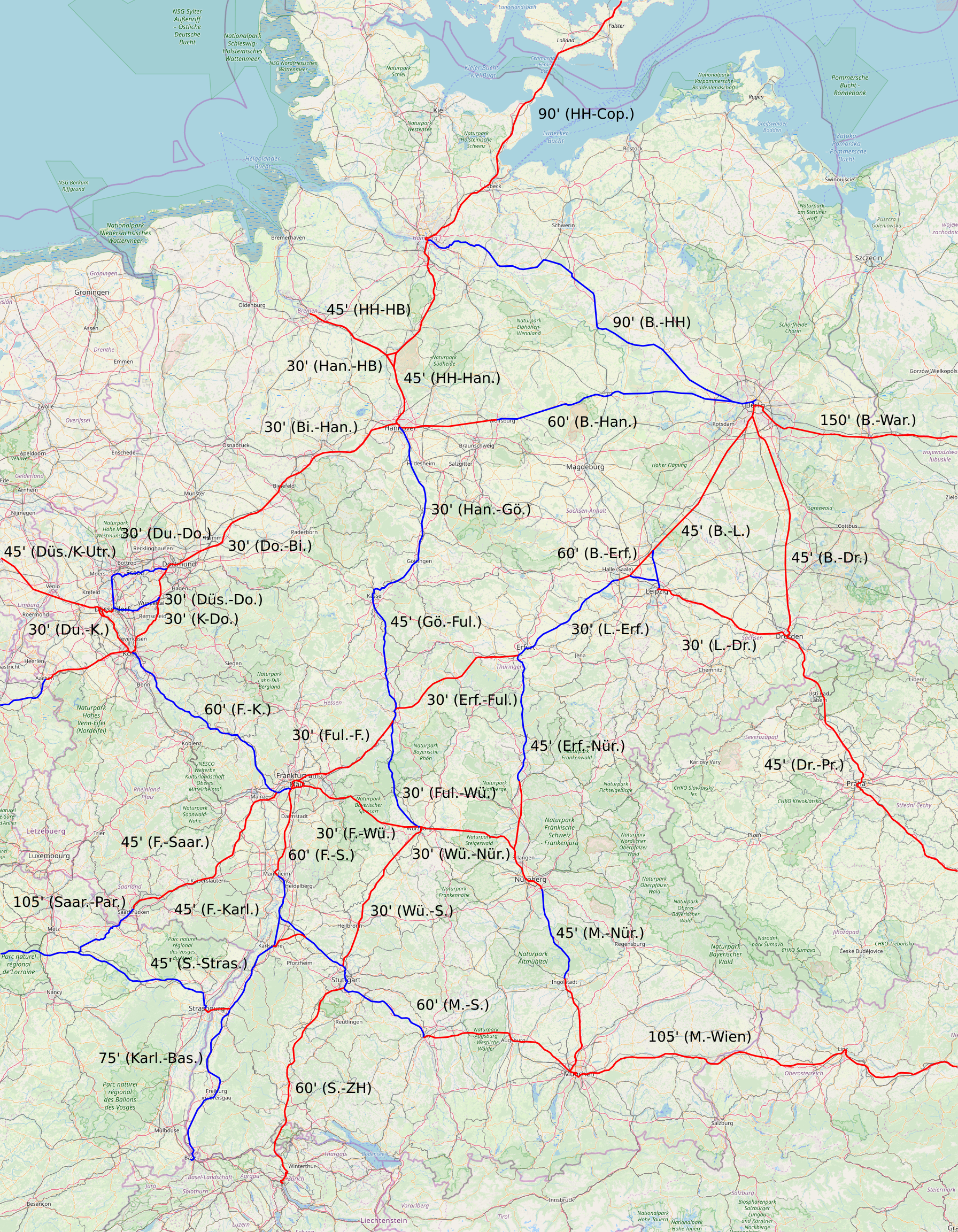
Noah asks what the proposal maps are for. The answer is, they are proposals for improvement in passenger rail. There is a real issue of scale and details, which is why those maps don’t depict literally every connection. For that, there are smaller-scale maps, in the same way there is the TransitMatters proposal for Regional Rail in the Boston area, or maps I’ve made for timed connections in New England and Upstate New York between intercity and regional trains. At lower-altitude zoom there’s also the issue of local connections to buses.
A roadmap like Google Maps or a national planning map, shown at such zoom that the entirety of a continental superstate like the United States is in the field of view, will only include the highest level of the transportation hierarchy. In the case of roads, that’s the Interstates, and the map may well omit spurs and loops. At lower altitude, more roads are visible, until eventually at city scale all streets are depicted.
The same is true of public transit – and high-speed rail is ideally planned as public transit at intercity scale. A continental-scale proposal will depict high-speed rail because it depicts all cities at once and therefore what matters at this level is how to get between regions. A state map or regional map such as for New England will depict all regional connections, and a local map will depict bus connections around each train station. At no point are these in competition for resources – good integrated planning means they all work together, so that improvements in regional rail also enable better bus connections, and improvements in intercity rail enable better regional connections.
Is all of this absolutely necessary? No. France manages to make certain connections work without it, and when I try to model this as a door-to-door trip, it’s a factor of 1.5-2 question, not an order of magnitude question. But a factor of 1.5 question is still serious, and it’s one that resolves itself with good public transit planning, rather than with not building high-speed rail at all.



 .
. , a more modest ratio than on mixed track.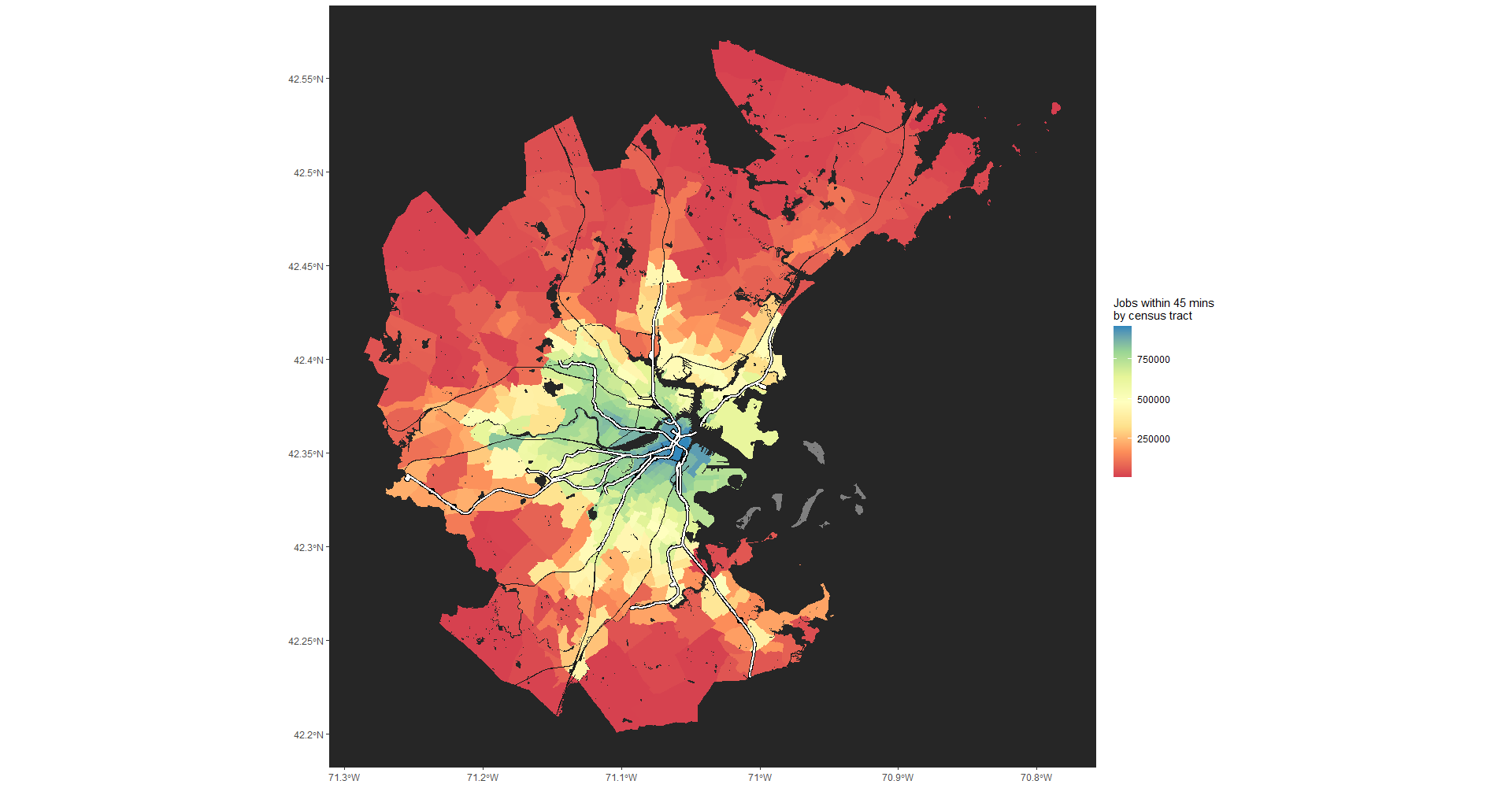



 Pedestrian Observations