Deutschlandtakt and Country Size

Does the absolute size of a country matter for public transport planning? Usually it does not – construction costs do not seem to be sensitive to absolute size, and the basics of rail planning do not either. That Europe’s most intensely used mainline rail networks are those of Switzerland and the Netherlands, two geographically small countries, is not really about the inherent benefits of small size, but about the fact that most countries in Europe are small, so we should expect the very best as well as the very worst to be small.

But now Germany is copying Swiss and Dutch ideas of nationally integrated rail planning, in a way that showcases where size does matter. For decades Switzerland has had a national clockface schedule in which all trains are coordinated for maximum convenience of interchange between trains at key stations. For example, at Zurich, trains regularly arrive just before :00 and :30 every hour and leave just after, so passengers can connect with minimum wait. Germany is planning to implement the same scheme by 2030 but on a much bigger scale, dubbed Deutschlandtakt. This plan is for the most part good, but has some serious problems that come from overlearning from small countries rather than from similar-size France.

In accordance with best industry practices, there is integration of infrastructure and timetable planning. I encourage readers to go to the Ministry of Transport (BMVI) and look at some line maps – there are links to line maps by region as well as a national map for intercity trains. The intercity train map is especially instructive when it comes to scale-variance: it features multihour trips that would be a lot shorter if Germany made a serious attempt to build high-speed rail like France.

Before I go on and give details, I want to make a caveat: Germany is not the United States. BMVI makes a lot of errors in planning and Deutsche Bahn is plagued by delays; these are still basically professional organizations, unlike the American amateur hour of federal and state transportation departments, Amtrak, and sundry officials who are not even aware Germany has regional trains. As in London and Paris, the decisions here are defensible, just often incorrect.

Run as fast as necessary

Switzerland has no high-speed rail. It plans rail infrastructure using the maxim, run trains as fast as necessary, not as fast as possible. Zurich, Basel, and Bern are around 100 km from one another by rail, so the federal government invested in speeding up the trains so as to serve each city pair in just less than an hour. At the time of this writing, Zurich-Bern is 56 minutes one-way and the other two pairs are 53 each. Trains run twice an hour, leaving each of these three cities a little after :00 and :30 and and arriving a little before, enabling passengers to connect to onward trains nationwide.

There is little benefit in speeding up Switzerland’s domestic trains further. If SBB increases the average speed to 140 km/h, comparable to the fastest legacy lines in Sweden and Britain, it will be able to reduce trip times to about 42 minutes. Direct passengers would benefit from faster trips, but interchange passengers would simply trade 10 minutes on a moving train for 10 minutes waiting for a connection. Moreover, drivers would trade 10 minutes working on a moving train for 10 minutes of turnaround, and the equipment itself would simply idle 10 minutes longer as well, and thus there would not be any savings in operating costs. A speedup can only fit into the national takt schedule if trains connect each city pair in just less than half an hour, but that would require average speeds near the high end of European high-speed rail, which are only achieved with hundreds of kilometers of nonstop 300 km/h running.

Instead of investing in high-speed rail like France, Switzerland incrementally invests in various interregional and intercity rail connections in order to improve the national takt. To oversimplify a complex situation, if a city pair is connected in 1:10, Switzerland will invest in reducing it to 55 minutes, in order to allow trains to fit into the hourly takt. This may involve high average speeds, depending on the length of the link. Bern is farther from Zurich and Basel than Zurich and Basel are from each other, so in 1996-2004, SBB built a 200 km/h line between Bern and Olten; it has more than 200 trains per day of various speed classes, so in 2007 it became the first railroad in the world to be equipped with ETCS Level 2 signaling.

With this systemwide thinking, Switzerland has built Europe’s strongest rail network by passenger traffic density, punctuality, and mode share. It is this approach that Germany seeks to imitate. Thus, the Deutschlandtakt sets up control cities served by trains on a clockface schedule every 30 minutes or every hour. For example, Erfurt is to have four trains per hour, two arriving just before :30 and leaving just after and two arriving just before :00 and leaving just after; passengers can transfer in all directions, going north toward Berlin via either Leipzig or Halle, south toward Munich, or west toward Frankfurt.

Flight-level zero airlines

Richard Mlynarik likes to mock the idea of high-speed rail as conceived in California as a flight-level zero airline. The mockery is about a bunch of features that imitate airlines even when they are inappropriate for trains. The TGV network has many flight-level zero airline features: tickets are sold using an opaque yield management system; trains mostly run nonstop between cities, so for example Paris-Marseille trains do not stop at Lyon and Paris-Lyon trains do not continue to Marseille; frequency is haphazard; transfers to regional trains are sporadic, and occasionally (as at Nice) TGVs are timed to just miss regional connections.

And yet, with all of these bad features, SNCF has higher long-distance ridership than DB, because at the end of the day the TGVs connect most major French cities to Paris at an average speed in the 200-250 km/h range, whereas the fastest German intercity trains average about 170 and most are in the 120-150 range. The ICE network in Germany is not conceived as complete lines between pairs of cities, but rather as a series of bypasses around bottlenecks or slow sections, some with a maximum speed of 250 and some with a maximum speed of 300. For example, between Berlin and Munich, only the segments between Ingolstadt and Nuremberg and between Halle and north of Bamberg are on new 300 km/h lines, and the rest are on upgraded legacy track.

Even though the maximum speed on some connections in Germany is the same as in France, there are long slow segments on urban approaches, even in cities with ample space for bypass tracks, like Berlin. The LGV Sud-Est diverges from the classical line 9 kilometers outside Paris and permits 270 km/h 20 kilometers out; on its way between Paris and Lyon, the TGV spends practically the entire way running at 270-300 km/h. No high-speed lines get this close to Berlin or Munich, even though in both cities, the built-up urban area gives way to farms within 15-20 kilometers of the train station.

The importance of absolute size

Switzerland and the Netherlands make do with very little high-speed rail. Large-scale speedups are of limited use in both countries, Switzerland because of the difficulty of getting Zurich-Basel trip times below half an hour and the Netherlands because all of its major cities are within regional rail distance of one another.

But Germany is much bigger. Today, ICE trains go between Berlin and Munich, a distance of about 600 kilometers, in just less than four hours. The Deutschlandtakt plan calls for a few minutes’ speedup to 3:49. At TGV speed, trains would run about an hour faster, which would fit well with timed transfers at both ends. Erfurt is somewhat to the north of the midpoint, but could still keep a timed transfer between trains to Munich, Frankfurt, and Berlin if everything were sped up.

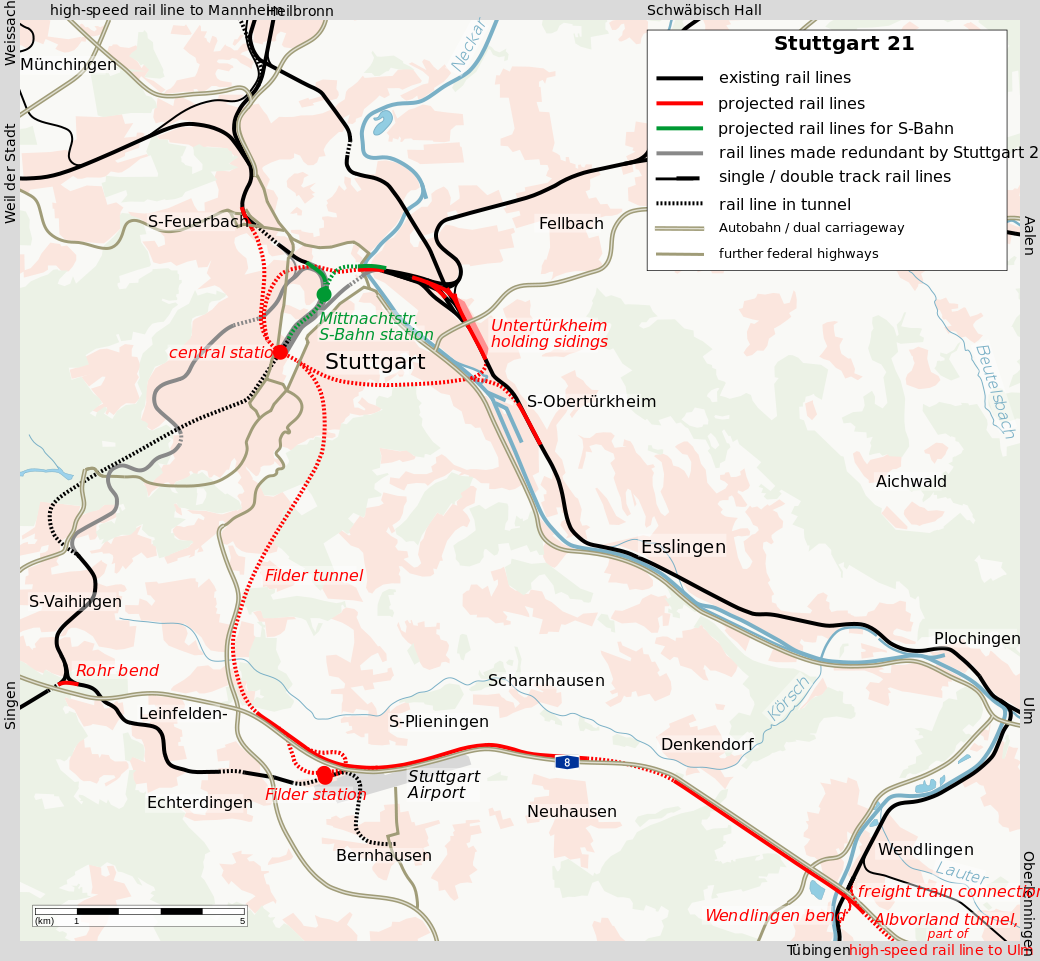
Elsewhere, DB is currently investing in improving the line between Stuttgart and Munich. Trains today run on curvy track, taking about 2:13 to do 250 km. There are plans to build 250 km/h high-speed rail for part of the way, targeting a trip time of 1:30; the Deutschlandtakt map is somewhat less ambitious, calling for 1:36, with much of the speedup coming from Stuttgart21 making the intercity approach to Stuttgart much easier. But with a straight line distance of 200 km, even passing via Ulm and Augsburg, trains could do this trip in less than an hour at TGV speeds, which would fit well into a national takt as well. No timed transfers are planned at Augsburg or Ulm. The Baden-Württemberg map even shows regional trains (in blue) at Ulm timed to just miss the intercity trains to Munich. Likewise, the Bavaria map shows regional trains at Augsburg timed to just miss the intercity trains to Stuttgart.

The same principle applies elsewhere in Germany. The Deutschlandtakt tightly fits trains between Munich and Frankfurt, doing the trip in 2:43 via Stuttgart or 2:46 via Nuremberg. But getting Munich-Stuttgart to just under an hour, together with Stuttgart21 and a planned bypass of the congested Frankfurt-Mannheim mainline, would get Munich-Frankfurt to around two hours flat. Via Nuremberg, a new line to Frankfurt could connect Munich and Frankfurt in about an hour and a half at TGV speed; even allowing for some loose scheduling and extra stops like Würzburg, it can be done in 1:46 instead of 2:46, which fits into the same integrated plan at the two ends.

The value of a tightly integrated schedule is at its highest on regional rail networks, on which trains run hourly or half-hourly and have one-way trip times of half an hour to two hours. On metro networks the value is much lower, partly because passengers can make untimed transfers if trains come every five minutes, and partly because when the trains come every five minutes and a one-way trip takes 40 minutes, there are so many trains circulating at once that the run-as-fast-as-necessary principle makes the difference between 17 and 18 trainsets rather than that between two and three. In a large country in which trains run hourly or half-hourly and take several hours to connect major cities, timed transfers remain valuable, but running as fast as necessary is less useful than in Switzerland.

The way forward for Germany

Germany needs to synthesize the two different rail paradigms of its neighbors – the integrated timetables of Switzerland and the Netherlands, and the high-speed rail network of France.

High investment levels in rail transport are of particular importance in Germany. For too long, planning in Germany has assumed the country would be demographically stagnant, even declining. There is less justification for investment in infrastructure in a country with the population growth rate of Italy or of last decade’s Germany than in one with the population growth rate of France, let alone one with that of Australia or Canada. However, the combination of refugee resettlement and a very strong economy attracting European and non-European work migration is changing this calculation. Even as the Ruhr and the former East Germany depopulate, we see strong population growth in the rich cities of the south and southwest as well as in Berlin.

The increased concentration of German population in the big cities also tilts the best planning in favor of the metropolitan-centric paradigm of France. Fast trains between Berlin, Frankfurt, and Munich gain value if these three cities grow in population whereas the smaller towns between them that the trains would bypass do not.

The Deutschlandtakt’s fundamental idea of a national integrated timed transfer schedule is good. However, a country the size and complexity of Germany needs to go beyond imitating what works in Switzerland and the Netherlands, and innovate in adapting best practices for its particular situation. People keep flying domestically since the trains take too long, or they take buses if the trains are too expensive and not much faster. Domestic flights are not a real factor in the Netherlands, and barely at all in Switzerland; in Germany they are, so trains must compete with them as well as with flexible but slow cars.

The fact that Germany already has a functional passenger rail network argues in favor of more aggressive investment in high-speed rail. The United States should probably do more than just copy Switzerland, but with nonexistent intercity rail outside the Northeast Corridor and planners who barely know that Switzerland has trains, it should imitate rather than innovating. Germany has professional planners who know exactly how Germany falls short of its neighbors, and will be leaving too many benefits on the table if it decides that an average speed of about 150 km/h is good enough.

Germany can and should demand more: BMVI should enact a program with a budget in the tens of billions of euros to develop high-speed rail averaging 200-250 km/h connecting all of its major cities, and redo the Deutschlandtakt plans in support of such a network. Wedding French success in high-speed rail and Swiss and Dutch success in systemwide rail integration requires some innovative planning, but Germany is capable of it and should lead in infrastructure construction.

What is Light Rail, Anyway?

I’ve been asked on Twitter about the differences between various kinds of urban rail transit. There is a lot of confusion about the term light rail in English, since it can be used for urban public transport typologies that have little to do with one another. The best way to think about urban rail (other than regional rail) is to use the following schema:

Slow in center Fast in center
Slow in outlying areas Tramway Subway-surface
Fast in outlying areas Tram-train Rapid transit


In American parlance, all four have been called light rail: subway-surface and tram-train lines are always called light rail, and officially so are tramways; then one full rapid transit line, the Green Line in Los Angeles, is called light rail as it runs light rail vehicles (LRVs) rather than subways. Nonetheless, in this post I will ignore what things are called and focus on their speed.

In this context, fast and slow refer to right-of-way quality. A tramway in a low-density city with little traffic and widely separated stops may well be faster than a rapid transit line with many stops, such as most Paris Metro lines, but relative to the local urban typology the tramway is still slow while the metro is fast.

The two hybrid forms – subway-surface and tram-train – differ in where they focus higher-speed service. On a subway-surface line, the city center segment is in a subway and then the line branches farther out, for examples the Boston Green Line, San Francisco Muni Metro, Philadelphia Subway-Surface Lines, and Frankfurt and Cologne U-Bahn networks. On a tram-train, the train is fast outside city center, where it runs in a dedicated surface right-of-way, but then in city center it runs in tramway mode on the street at lower speed; the Karlsruhe tram-train is one such example, as are virtually all postwar light rail systems in the United States and Canada.

Aberrations

The 2*2 typology simplifies the situation somewhat. There exist lines that don’t fully obey it, and instead change between metro and streetcar mode haphazardly. Some of the Cologne lines go back and forth. Buffalo has a single light rail line without branches, dubbed the Buffalo Metro Rail, running on the surface in the center and in a greenfield tunnel farther out toward Amherst and the university campus. Frankfurt’s U1/2/3/8 trunk is the opposite of Buffalo, running in a tunnel in the center and on the surface farther out even downstream of the branch point. The Los Angeles Blue Line is underground at Metro Center but then runs on the surface, transitions to a grade-separated right-of-way later, and finally drops back to streetcar mode in Downtown Long Beach.

The most fascinating case is that of the Boston Green Line D branch. It is technically rapid transit, since the trunk line is in a tunnel alongside the other branches whereas the branch itself is a former commuter rail line; it is called light rail because it runs LRVs, like the Los Angeles Green Line, and shared the trunk with the B, C, and E branches, all of which have surface segments. But conceptually, it presages most proper American light rail lines: it was built in the 1950s as suburban-oriented rapid transit, with park-and-rides and downtown-focused service, creating a paradigm that postwar metros like BART and the Washington Metro would sometimes follow and that light rail systems from the 1980s onward (San Diego, Portland, etc.) always would.

Nonetheless, such aberrations are uncommon enough that the 2*2 simplification works when explaining what cities should be building.

Right-of-way availability

Cities are more likely to build fast trains when there is preexisting right-of-way for them. The Karlsruhe Zweisystem is based on using the area’s extensive legacy mainline network, on which LRVs run in train mode, and then diverging toward city center in streetcar mode. Jarrett Walker has a good post about Karlsruhe specifically: there is no good right-of-way with which to drag the Stadtbahn into city center in train mode, and thus the alternative to a tram-train is an expensive tunnel; such a tunnel is under construction now, at the cost of about €1 billion, but as Karlsruhe is a small city, it comes a generation after the tram-train system was put into place.

North American light rail systems often use mainline rail corridors as well, but thanks to federal regulations as well as weak regional rail systems, they almost never use mainline tracks; the Blue Line in San Diego, the first tram-train in the United States, is one of very few exceptions, and even then it shares track with a very lightly-used freight line, rather than with a frequent S-Bahn as in Karlsruhe. It is more common for North American tram-trains to run in disused corridors, on new tracks parallel to the mainline, or even in highway medians.

Reusing legacy rail lines and running in freeway medians are not unique to tram-trains. Rapid transit does both outside city center; the first subway network in the world, the London Underground, makes extensive use of branches of former commuter lines, and even shares track with a still-active one on a portion of the Watford DC Line. New York, likewise, connected former excursion lines in Brooklyn to the subway, forming most of the Coney Island-bound system, and later did the same with the LIRR in the Rockaways, now carrying branches of the A train. It is usually easy to spot whether an urban rail line descends from a legacy branch line – if it does then it is very unlikely to follow a single street (none of the lines serving Coney Island does), whereas if it doesn’t then it is usually a subway or el on a major arterial (such as Fourth Avenue in Brooklyn).

The upshot is that cities are likelier to build tram-trains and rapid transit in preference to tramways and subway-surface lines if they have high-quality right-of-way. New York and London were unlikely to build subway-surface lines in the early 20th century either way, but the high density of their metro networks in Southern Brooklyn and West London respectively can be explained by the extent of preexisting legacy lines in these areas. Comparable areas that did not have such good connections, for example Queens, have much less rapid transit coverage.

While this issue in theory affects tram-trains and rapid transit equally, in practice it is especially relevant to tram-trains. Rapid transit is more expensive, so it is likely to be built in larger and denser cities, where it is more acceptable to just tunnel under difficult segments. Tram-trains are present in smaller cities – Calgary, Edmonton, Karlsruhe, and so on – as well as in American Sunbelt cities that are so auto-oriented that they have the public transport of European cities one third or even one tenth their size. In those cities, tunneling is harder to justify, so the train goes where it can go cheaply. Downtown transit malls like those of Portland and Calgary are the least bad solution for connecting fast lines from the suburbs to provide better city center coverage and connect to lines on the other side of the region.

Subway-surface branching

Subway-surface lines are fast in city center and slow outside of it. Moreover, in city center their right-of-way segregation (in a tunnel in all of the American cases) means there is more capacity than on the surface. This makes branching especially attractive. Indeed, in all three American cases – Boston, Philadelphia, San Francisco – the subway-surface line has four to five branches.

Outside the United States, subway-surface branching is more complicated. In Frankfurt, the U4/5 and U6/7 lines work as in the United States, but with only two branches per trunk rather than four or five; but the U1/2/3 line has a surface segment on the mainline. In Cologne, there is extensive reverse-branching (see map), and while most of the system runs in subway-surface mode, one line runs in tramway mode through city center but then drops to a tunnel in Deutz and splits into two surface branches farther east.

Tel Aviv is building a subway-surface line from scratch, without any branching. The Red Line is to run underground in Central Tel Aviv, Ramat Gan, and Bnei Brak, and on the surface farther east in Petah Tikva as well as at the other end in Jaffa and Bat Yam. At the Petah Tikva end, an underground connection to the depot is to enable half the trains to terminate and go out of service without running on the surface; at the Jaffa/Bat Yam end, a loop near the portal is to enable half the trains to terminate and reverse direction without running on the surface.

The American way works better than the incipient Israeli way. The main advantage of branching is that the greater expanse of land in outer-urban neighborhoods and suburbs means more lines are needed than in the center to guarantee the same coverage. Thus Downtown San Francisco has just one line under Market Street, serving not just Muni Metro but also BART on separate tracks, but in the rest of the city, BART and the five branches of Muni serve an arc of neighborhoods from the Mission to the Sunset. The lack of branching on the Tel Aviv Red Lines means that it will not be able to serve Petah Tikva well: the city is not very dense or very central and has no hope of getting the multiline crisscross pattern eventually planned for Central Tel Aviv.

One implication of the fact that subway-surface lines should branch is that they are more appropriate for cities with natural branching than for cities without. Boston in particular is an excellent place for such branching. Its street network does not form a grid, but instead has arterials that are oriented around the historic city center; the Green Line makes use of two such streets, Commonwealth Avenue hosting the B branch and Beacon Avenue hosting the C branch. A light rail line following Washington Street could likewise branch to Warren Street and Blue Hill Avenue and potentially even branch farther out on Talbot Avenue to Ashmont, effectively railstituting the area’s busiest buses.

In contrast, cities whose street networks don’t lend themselves well to branching should probably not build subway-surface lines. North American cities with gridded street networks have little reason to use this technology. If they are willing to build downtown tunnels and have the odd right-of-way running toward city center diagonally to the grid, they should go ahead and build full rapid transit, as Chicago did on the Blue Line of the L.

Speed and range

Tramways are the cheapest variety of urban rail and metro tunnels are the most expensive. The reason cities don’t just build tramways in lieu of any grade separation is that tramways are slow and therefore have limited range. Berlin’s tramways average around 16 km/h; they run partly in mixed traffic, but I don’t think they can cross 20 km/h even with dedicated lanes and signal priority.

What this means is that tramways are mainly a solution for city centers and near-center neighborhoods. The tramways in Berlin work okay within the Ring, especially in U-Bahn deserts like the segment of East Berlin between U2 and U5. But in suburban Paris, they’re too slow to provide the full trip and instead work as Metro and RER feeders, providing circumferential service whereas the faster modes provide radial rail transport.

Tramway-centric transit cities can work, but only in a constrained set of circumstances:

  • They must be fairly small, like Karlsruhe, Strasbourg, or Geneva.
  • They should have a network of sufficiently wide streets (minimum 20-25 meters including sidewalks, ideally 30-35) through city center as well as radiating out of it.
  • They should have a supplementary regional rail network for longer trips.

Tramway-and-regional-rail is a powerful combination. Zurich is based on it, having rejected a subway network in two separate referendums. However, once the city grows beyond the size class of Strasbourg, the regional rail component begins to dominate, as there are extensive suburbs that are just too far away from city center for streetcars.

Upgrading to rapid transit

It’s common for cities to replace light rail with rapid transit by building new tunnels and burying the tracks. Historically, Boston and San Francisco both built their subway-surface networks by incrementally putting segments in tunnel, which would later protect these lines from replacement by diesel buses. Stockholm and Brussels both incrementally upgraded streetcars to metro standards, calling the intermediate phase pre-metro. Karlsruhe is building a tunnel for its Stadtbahn.

However, in the modern era, not all such tunneling projects are equally useful. Subway-surface lines stay subway-surface indefinitely: they have so much surface branching that the cost of putting everything underground would be prohibitive. San Francisco activists have flirted with a plan to replace one Muni Metro surface line with rapid transit and then reduce the rest to tramways with forced transfers; this plan is both terrible and unlikely to happen. Tel Aviv might eventually come to its senses and bury the entire Red Line, but this is possible only because the current branch-free layout is already more suited for a subway than for a subway-surface system.

Tram-trains are easier to convert to rapid transit. All that’s needed is a short tunnel segment in city center. Thus, in addition to the Karlsruhe tunnel project, there are serious discussions of city center tunneling in a variety of North American cities, including Portland and Calgary (in the near term) as well San Diego (on the 2050 horizon).

Finally, tramways can be upgraded to full rapid transit more easily than to either of the two intermediate forms. A good tramway is rarely a good subway-surface system, because the subway-surface system ideally branches and the pure tramway ideally does not. Moreover, a good tramway is unlikely to go very far into the suburbs because of its low speed, whereas a tram-train’s ability to leverage high speed in train mode allows it to go deep into the suburbs of Karlsruhe, Calgary, or San Diego. The optimal place for a tramway – dense city neighborhoods following a single line – is also the optimal one for a metro line, making the upgrade more attractive than upgrading the tramway to a hybrid.

Massachusetts Sandbags Rail Electrification

In the last year, Massachusetts has been studying something called the Rail Vision, listing several alternatives for commuter rail modernization. This has been independent of the North-South Rail Link study, and one of the options that the Rail Vision considered was full electrification. Unfortunately, the report released yesterday severely sandbags electrification, positing absurdly high costs. The state may well understand how bad its report is – at least as of the time of this writing, it’s been scrubbed from the public Internet, forcing me to rely on screencaps.

In short: the alternative that recommends full system electrification was sandbagged so as to cost $23 billion. This is for electrification, systems, and new equipment; the NSRL tunnel is not included. All itemized costs cost a large multiple of their international cost. The Americans in my feed are even starting to make concessions to extremely expensive projects like the Caltrain electrification, since the proposed MBTA electrification is even costlier than that.

But the telltale sign is not the cost of the wires, but rolling stock. The report asserts that running electrified service requires 1,450 cars’ worth of electric multiple units (“EMUs”), to be procured at a cost of $10 billion. More reasonable figures are 800 and $2 billion respectively.

Why 1,450 cars?

The all-electric option assumes that every line in the system will get a train every 15 minutes, peak and off-peak. What counts as a line is not clear, since some of the MBTA’s commuter lines have branches – for example, the Providence and Stoughton Lines share a trunk for 24 km, up to Canton Junction. However, we can make reasonable assumptions about which branches are far enough out; overall rolling stock needs are not too sensitive to these assumptions, as most lines are more straightforward.

The MBTA is capable of turning trains in 10 minutes today. In making schedules, I’ve mostly stuck to this assumption rather than trying to go for 5-minute turnarounds, which happen in Germany all the time (and on some non-mainline American subways); occasionally trains steal 1-2 minutes’ worth of turnaround time, if there’s a longer turn at the other end. Thus, if the one-way trip time is up to 50 minutes, then 8 trainsets provide 15-minute service.

To me, high-frequency regional rail for Boston means the following peak frequencies:

Providence/Stoughton: a train every 15 minutes on each branch. Service south of Providence is spun off to a Rhode Island state service, making more stops and running shorter trains as demand is weaker than commuter volumes to Boston. With this assumption, the Providence Line requires 7-8 trainsets. The Stoughton Line, with the South Coast Rail expansion to New Bedford and Fall River, each served every half hour, requires around 9-10. Say 18 sets total.

Worcester: the big question is whether to exploit the fast acceleration of EMUs to run all-local service or mix local and express trains on tracks in Newton that will never be quadrupled unless cars are banned. The all-local option has trains doing Boston-Worcester in just under an hour, so 9-10 trainsets are required. The mixed option, with a train every 15 minutes in each pattern, and local trains only going as far as Framingham, requires 14 sets, 8 express and 6 local.

Franklin/Fairmount: a train every 15 minutes on the Franklin Line, entering city center via the Fairmount Line, would do the trip in around 50 minutes. It may be prudent to run another train every 15 minutes on the Fairmount Line to Readville, a roughly 17-minute trip by EMU (current scheduled time with diesel locomotives: 30 minutes). Overall this is around 12 trainsets.

Old Colony Lines: there are three lines, serving very low-density suburbs. The only destinations that are interesting for more than tidal commuter rail are Plymouth, Brockton, Bridgewater State, and maybe an extension to Cape Cod. Each branch should get a train every 30 minutes, interlining to a train every 10 from Quincy Center to the north. About 10-12 trainsets are needed (2 more if there’s an hourly train out to Cape Cod); this is inefficient because with three branches, it’s not possible to have all of them depart South Station at :05 and :35 and arrive :25 and :55, so even if there’s a train every 15 minutes per branch, the requirement doesn’t double.

Fitchburg Line: a local train to Wachusett every 15 minutes would require around 12 sets (75 minutes one-way). The number may change a little if there’s an overlay providing service every 7.5 minutes to Brandeis, or if trains beyond South Acton only run every half hour.

Lowell Line: an EMU to Lowell would take about 27 minutes, depending on the stop pattern; 5 trainsets provide 15-minute frequency.

Haverhill Line: an EMU to Haverhill running the current route (not via the Wildcat Branch) would take about 40 minutes, so 7 trainsets provide a train every 15 minutes.

Eastern Lines: like the Old Colony Lines, this system has very low-density outer branches, with only one semi-reasonable outer anchor in Newburyport. Trains should run to Beverly every 10 minutes, and then one third should turn, one third should go to Rockport, and one third should go to Newburyport. With the same inherent inefficiency in running this service on a symmetric schedule as the Old Colony, around 10-12 sets are needed.

This is about 90 sets total. At eight cars per set, and with a spare ratio of 11%, the actual requirement is 800 cars, and not 1,450. The difference with the state’s assumption is likely that I’m assuming trains can run at the acceleration rates of modern EMUs; perhaps the state thinks that EMUs are as slow and unreliable as diesel locomotives, so a larger fleet is necessary to provide the same service.

Rolling stock costs

Reducing the cost of infrastructure is complicated, because it depends on local factors. But reducing the cost of industrial equipment is easy, since there are international vendors that make modular products. Factories all over Europe, Japan, and South Korea make this kind of equipment, and the European factories barely require any modifications to produce for the American market under current federal regulations.

It is not hard to go to Railway Gazette and search for recent orders for EMUs; names of trainsets include Talent, FLIRT, Mireo (cost information here) and Coradia. The linked Coradia order is for €96,500 per meter of train length, the other three orders are for about €70,000. A US-length (that is, 25 meters) car would cost around $2.5 million at this rate. 800 cars times $2.5 million equals $2 billion, not the $10 billion the MBTA claims.

Railway Gazette also discusses a maintenance contract: “Vy has awarded Stadler a contract worth nearly SFr100m for the maintenance in 2020-24 of more than 100 five-car Flirt EMUs.” These trains are 105 meters long; scaled to US car length, this means the annual maintenance cost of an EMU car is around $50,000, or $40 million for the entire fleet necessary for electrified service.

The actual net cost is even lower, since the MBTA needs to replace its rolling stock very soon anyway. If the choice is between 800 EMUs and a larger diesel fleet, the EMUs are cheaper; in effect, the rolling stock cost of electrification is then negative.

Why are they like this?

I struggle to find a problem with Boston’s transportation network that would not be alleviated if Massachusetts’ secretary of transportation Stephanie Pollack and her coterie of hacks, apparatchiks, and political appointees were all simultaneously fired.

There is a chain of command in the executive branch of the Massachusetts state government. Governor Charlie Baker decides that he does not want to embark on any big project, such as NSRL or rail electrification, perhaps because he is too incompetent to manage it successfully. He then intimates that such a project is unaffordable. Secretary Pollack responds by looking for reasons why the project is indeed unaffordable. Under pressure to deliver the required results, the planners make up outrageously high figures: they include fleet replacement in the electrified alternative but not in the unelectrified one (“incremental cost”), and then they lie about the costs by a factor of five.

Good transit activists can pressure the state, but the state has no interest in building good transit. The do-nothing governor enjoys no-build options and multi-billion dollar tweaks – anything that isn’t transformative is good to him. The do-nothing state legislature enjoys this situation, since it is no more capable of managing such a project, and having a governor who says no to everything enables it to avoid taking responsibility.

New Report on Construction Costs Misses the Mark

In the last few years, ever more serious and powerful actors have begun investigating the fact of high American infrastructure construction costs. First it was Brian Rosenthal’s excellent New York Times exposé, and then it was the Regional Plan Association’s flop of a study. At the same time, I was aware that the congressional Government Accountability Office, or GAO, was investigating the same question, planning to talk to sources in the academic world as well as industry in order to make recommendations.

The GAO report is out now, and unfortunately it is a total miss, for essentially the same reason the RPA’s report was a miss: it did not go outside the American (and to some extent rest-of-Anglosphere) comfort zone. Its literature review is if anything weaker than the RPA’s. Its interviews with experts are telling: out of nine mentioned on PDF-p. 47, eight live in English-speaking countries. Even when more detailed information about non-English-speaking countries is readily available, even in English, the GAO report makes little use of it. It is a lazy study, and people who ideologically believe the American federal government does not work should feel confident citing this as an example.

Cost comparisons

Brian himself already notes one of the reasons the report is so weak: Congress mandated a comparative study, but the report made no international comparisons at all. Instead, the report offered this excuse (PDF-p. 27):

The complexity of rail transit construction projects and data limitations, among other things, limits the ability to compare the costs of these projects, according to the stakeholders we interviewed. As highlighted above, each project has a unique collection of specific factors that drive its costs. According to FTA officials, each proposed transit project has its own unique characteristics, physical operating environment, and challenges. Some stakeholders said that the wide disparity in the relative effect of different cost factors renders cost comparisons between projects difficult. For example, representatives of an international transit organization said that because of the large number of elements that can affect a project’s costs and the differences in what costs are included in different projects’ data, projects should be compared only at a very granular level and that aggregate cost comparisons, such as between the costs per mile or costs per kilometer of different projects, are likely flawed. Some stakeholders also said that project costs should not be compared without considering the projects’ contexts, such as their complexity. For example, one academic expert contended that project costs cannot be compared without considering the context of each project, and that analysis of projects should focus on leading practices and lessons learned instead.

There is a big problem with the above statement: disaggregated costs for many aspects of urban rail construction do exist. The Manhattan Institute’s Connor Harris has done a lot of legwork comparing tunnel boring machine staffing levels and wages in New York and in Germany, and found that New York pays much higher wages but also has much higher staffing levels, 25-26 workers compared with 12. I have done some work looking at station costs specifically, and at the cost of installing elevators for wheelchair accessibility.

There is a lot of detailed comparative research about the costs of high-speed rail; the report even references one such meta-study undertaken within Europe, but omits the study’s analysis of causes of cost differences and instead asserts that it shows that comparing different projects is hard. In the interim, California contracted Deutsche Bahn to do a post-mortem of its elevated high-speed rail costs, which found that California needlessly built larger structures than necessary, explaining its cost premium over Germany.

Instead of probing these disaggregated estimates, the GAO preferred to say that they are too hard and move on.

Sanity checks

Even without disaggregation, there are some good sanity checks one can make about construction costs. The most important is that big projects – major subway expansions, regional rail tunnels, high-speed rail – cost an appreciable amount of the government’s budget. The budget for the 200-kilometer Grand Paris Express project is €35 billion, plus another €3 billion in contributions for related suburban rail extensions such as that of the RER E. There may be future cost overruns, but they will be reported in the media, just as the current overrun has been; it is extremely difficult to hide cost overruns measured in tens of billions in a Paris-size city, and even in a China-size country it may not be easy.

Is it plausible that GPX is inherently easier to build than New York’s $1+ billion/km subway tunnels? Yes. It’s equally plausible that it is inherently harder. Second Avenue Subway runs under a wide, straight throughfare, a situation that simplifies construction. In Israel, the ministry of transportation has long mentioned the ease of tunneling under wide, straight boulevards in connection with plans to extend the second line of the Tel Aviv subway to North Tel Aviv under Ibn Gabirol, and admitted this even when it opposed the extension on land use grounds.

The most important sanity check is that in a world with several dozens of cities with a wide variety of wealth levels, land use patterns, geologies, and topographies, no city has managed to match or even come close to New York’s construction costs. New York is not special enough to be an edge case in all or even most relevant geographic variables – it is dense but no denser than Seoul or Paris, it is wealthy but no wealthier than London or Paris or Munich and barely wealthier than Stockholm, it has hard rock but less hard than Stockholm (and in Stockholm the gneiss is cited as a cost saver – bored tunnels do not require concrete lining), etc.

Moreover, the cities that have the highest construction costs outside New York are almost without exception in the same set of countries: the US, Canada, Britain, Singapore, Australia. What’s likelier – that there is some special geographic feature common to the entire Anglosphere (including Quebec) but absent from all other developed countries, or that there is a shared set of legal and political traditions that developed in the last 50 years that impede cost-effective construction? Instead of probing this pattern, the GAO preferred to wash its hands and refuse to compare projects across countries.

Internal comparisons

In lieu of making international comparisons, the GAO has engaged in extensive internal comparison. It cites aspects that have raised the costs of Second Avenue Subway above other American subway projects, such as overdesign for stations. Apparently, it’s completely legit to compare two different cities’ construction if they’re in the same country.

Over and over again, it references its own domestic standards. The GAO has 12 design standards, e.g. on PDF-pp. 51-52 and 56-60; the report mentions that existing cost estimation methodologies by the Federal Transit Administration, or FTA, meet 7 of them; thus, it exhorts transit agencies to meet the other 5 standards.

The only problem is that there is no evidence supplied that those design standards are really useful. After all, the United States has very high costs, so why should anyone trust its standards? Even domestically, the report makes no effort to bring up successful examples of low overall costs coming from following prescribed standards. Seattle recently opened a light rail tunnel built for around $400 million per kilometer, a cost that would get most European project managers fired but that is still the lowest for an American urban rail tunnel built in this century. But the report never brings up Seattle at all, never mind that New York would salivate over the prospect of tunneling at Seattle’s cost.

The real internal comparisons then are not between different cities in the United States. Rather, they’re between different stages of cost estimation for the same project. There is published literature on cost overruns, most famously by Bent Flyvbjerg and his research group. The report cites Flyvbjerg. Moreover, one of the nine academic experts it consulted is Don Pickrell, who published a seminal paper on American cost overruns and ridership shortfalls in 1990. Pickrell was influential enough that a 2009 review found that not only had cost and ridership projections improved greatly in the intervening two decades, but also there was an improvement in ridership estimate quality attributable to Pickrell’s paper.

The GAO report is not the best source on cost overruns, but it is not completely useless there. Unfortunately, it remains useless when it comes to discussing absolute costs, a different topic from relative increases. Flyvbjerg’s original paper found that the US did not have higher cost overruns than Europe; but absolute costs in the US are several times as high. Flyvbjerg’s paper found that urban rail has higher cost overruns than road projects; but when a rail tunnel and a road tunnel are built in the same city, the road tunnel is more expensive by a factor of 1.5-2.5, at least in the four-city pilot I reported in 2017, owing to the need to build bigger bores with ventilation to carry heavy car traffic.

Lazy analysis, lazy synthesis

Americans who think of themselves as reformers like to point out real problems to solve, but then propose solutions that they made up without any connection with their analysis. The RPA study is one such example: even though one of its sources (namely, former Madrid Metro CEO Manuel Melis Maynar’s writeup about low Spanish costs) explicitly calls for separation of design and construction, its recommendations include a greater reliance on design-build. The same design-build recommendation appeared in a 2008 report in Toronto comparing the costs of the Sheppard subway, opened in 2002, with those of subways in Madrid; construction costs in Toronto have since tripled, while those of Madrid have barely risen.

To the GAO report’s credit, it does not recommend design-build. It even mentions the biggest drawback of design-build: it shifts cost risk to the private contractor, who compensates by demanding more public money up front. Nonetheless, it does not follow through and does not make the correct recommendation on this subject – namely, that cities and states should cease using this approach. It buries a recommendation for in-house expertise alongside a fad for peer review of projects.

Instead of lazily proposing design-build, the GAO lazily proposes two barely relevant tweaks (PDF-p. 43):

  • The FTA administrator should ensure that FTA’s cost estimating information for project sponsors is consistent with all 12 steps found in GAO’s Cost Estimating and Assessment Guide and needed for developing reliable cost estimates.
  • The FTA Administrator should provide a central, easily accessible source with all of FTA’s cost estimating information to help project sponsors improve the reliability of their cost estimates.

In other words, the report makes no recommendation about how to reduce costs, only about how to tell the public in advance that costs will be unaffordably high.

Why are these reports so bad?

This is not the first time a serious group releases an incurious study of American construction costs. What gives?

I suspect the answer has to be a combination of the following problems:

  • Reform factions often have a lot of internal ideas about how to improve things based on what they already know. They will cite new information if they feel like they must do so to save face, but they will not let new evidence change their conclusions. A little knowledge can be dangerous.
  • Finding information from outside the US, especially outside the English-speaking world, puts Americans (and Canadians) at a disadvantage. They know few to no foreigners, have little experience with cities abroad except as tourists, and do not speak foreign languages. Even when machine translation is decently accurate, which it is in the engineering literature in European languages, they are intimidated by the idea of dealing with non-English material. The process of learning is humbling, and some people prefer to remain proud and ignorant.
  • Open-ended analysis does not always lend itself to easy explanations or easy solutions. Even when solutions do present themselves, they may not flatter the people in power. Ten years ago I did not think senior management at American transit organs should be fired; today I think mass layoffs of the top brass, especially the political appointees, are somewhere between very useful and essential.

All three problems interact. For example, senior management is even less likely to be multilingual than junior staffers, who may be second-generation immigrant heritage speakers of a foreign language; thus, anything relying on foreign material disempowers the high-ups in favor of up-and-comers. The quick-and-easy-and-wrong solutions reformists seize upon if they find a little bit of knowledge let outfits like the GAO feel more powerful without actually challenging any obstructive politician or interest group, and if those solutions fail, they can always keep churning reports about implementation.

Last year, I did not know whether the GAO was capable of providing a blueprint for improving American infrastructure at lower cost. I assumed good faith because I had no reason not to. With this report, it is clear to me as well as to other observers of American public transit that the GAO is not so capable. Instead of doing what was in the country’s best interest, the people who commissioned and wrote the report delivered the minimal product that would get them kudos from superiors who do not know any better. They could have learned, or made a serious effort to learn, but that might challenge their assumptions or those of the high political echelons, and thus they preferred to say nothing and propose to do nothing.

Little Things That Matter: Interchange Siting

I’ve written a lot about the importance of radial network design for urban metros, for examples here, here, here, here, and here. In short, an urban rail network should look something like the following diagram:

That is, every two radial routes should intersect exactly once, with a transfer. In this post I am going to zoom in on a specific feature of importance: the location of the intersection points. In most cities, the intersection points should be as close as possible to the center, first in order to serve the most intensely developed location by all lines, and second in order to avoid backtracking.

The situation in Berlin

Here is the map of the central parts of Berlin’s U- and S-Bahn network, with my apartment in green and three places I frequently go to in red:

(Larger image can be found here.)

The Ring is severed this month due to construction: trains do not run between Ostkreuz, at its intersection with the Stadtbahn, and Frankfurter Allee, one stop to the north at the intersection with U5. As a result, going to the locations of the two northern red dots requires detours, namely walking longer from Warschauer Strasse to the central dot, and making a complex trip via U7, U8, and U2 to the northern dot.

But even when the Ring is operational, the Ring-to-U2 trip to the northern dot in Prenzlauer Berg is circuitous, and as a result I have not made it as often as I’d have liked; the restaurants in Prenzlauer Berg are much better than in Neukölln, but I can’t go there as often now. The real problem is not just that the Ring is interrupted due to construction, but that the U7-U2 connection is at the wrong place for the city’s current geography: it is too far west.

As with all of my criticism of Berlin’s U-Bahn network layout, there is a method to the madness: most of the route of U7 was built during the Cold War, and if you assumed that Berlin would be divided forever, the alignment would make sense. Today, it does not: U7 comes very close to U2 in Kreuzberg but then turns southwest to connect with the North-South Tunnel, which at the time was part of the Western S-Bahn network, running nonstop in the center underneath Mitte, then part of the East.

On hindsight, a better radial design for U7 would have made it a northwest-southeast line through the center. West of the U6 connection at Mehringdamm it would have connected to the North-South Tunnel at Anhalter Bahnhof and to U2 at Mendelssohn Park, and then continued west toward the Zoo. That area between U1/U2 and Tiergarten Park is densely developed, with its northern part containing the Cold War-era Kulturforum, and in the Cold War the commercial center of West Berlin was the Zoo, well to the east of the route of U7.

Avoiding three-seat rides

If the interchange points between lines are all within city center, then the optimal route between any two points is at worst a two-seat ride. This is important: transfers are pretty onerous, so transit planners should minimize them when it is reasonably practical. Two-seat rides are unavoidable, but three-seat rides aren’t.

The two-seat ride rule should be followed to the spirit, not the letter. If there are two existing lines with a somewhat awkward transfer, and a third line is built that makes a three-seat ride better than connecting between those two lines, then the third line is not by itself a problem, and it should be built if its projected ridership is sufficient. The problem is that the transfer was at the wrong location, or maybe at the right location but with too long a walk between the platforms.

Berlin’s awkward U-Bahn network is such that people say that the travel time between any two points within the Ring is about 30 minutes, no matter what. When I tried pushing back, citing a few 20-minute trips, my interlocutors noted that with walking time to the station, the inevitable wait times, and transfers, my 20-minute trips were exceptional, and most were about 30 or slightly longer.

The value of an untimed transfer rises with frequency. Berlin runs the U-Bahn every 5 minutes during the daytime on weekdays and the S-Bahn mostly every 5 minutes (or slightly better) as well; wait times are shorter in a city like Paris, where much of the Metro runs every 3 minutes off-peak, and only drops to 5 or 6 minutes late in the evening, when Berlin runs trains every 10 minutes. However, Parisian train frequencies are only supportable in huge cities like Paris, London, and Tokyo, all of which have very complex transfers, as the cities are so intensely built that the only good locations for train platforms require long walks between lines.

New York of course has the worst of all worlds: a highly non-radial subway network with dozens of missed connections, disappointing off-peak frequencies, and long transfer corridors in Midtown. In New York, three-seat rides are ubiquitous, which may contribute to weak off-peak ridership. Who wants to take three separate subway lines, each coming every 10 minutes, to go 10 kilometers between some residential Brooklyn neighborhood and a social event in Queens?

Free Public Transportation

Note: this may turn into a long series of posts about public transportation fare systems and payments.

From time to time, people propose free public transport. Supporters have a variety of motivations, including an attempt to mirror cars (“do state roads charge tolls?”), ideological socialism, positive externalities, and the efficiencies of getting rid of fare collection.

In reality, making service free at the point of use means spending money on subsidies from other sources – money that could be spent on other things than zeroing out the fares. There are opportunity costs, and robust public transportation networks do not gain much efficiency from being free. If there is money to make service free, there is money to spend on service improvements, including more metro lines, higher frequency, and wheelchair accessibility where it isn’t already present.

Literature review

A tweetstorm from two days ago includes references to a number of studies on this issue:

Proof of payment

One argument for free transit is that it simplifies operations because no fare collection is needed. Front-door boarding and paying the drivers slow down bus boarding – each passenger takes 2.6-3 seconds to board (source, PDF-p. 20). Rapid transit systems also suffer from the complexity of fare collection infrastructure: batteries of faregates create chokepoints and require maintenance, and usually rapid transit agencies also have to hire station agents to watch the gates.

However, proof-of-payment fare enforcement, or POP, gets around most of these issues. If passengers do not need to pay at entry, everything becomes much simpler: they can board buses from any door, and get onto the train without crossing faregates. Berlin has all-door boarding and open, unstaffed U-Bahn stations. There are fare-vending machines, which are not free, but they are cheap. There are fare inspectors working on consignment – they get paid by catching non-paying riders.

Better uses for money

New York City Transit has $9.1 billion in operating and maintenance expenses as of 2016, and $4.3 billion in fare revenue (source). Ile-de-France Mobilités has a total of about €10 billion in annual operating and capital expenses, with about 10% of this being capital and the rest operating, and €2.8 billion in fare revenue. As of 2015, BVG had a total transport income of €1.344 billion (PDF-p. 7) and an additional subsidy of €620 million (PDF-p. 21).

In all of these cities, if there is money for fare elimination, there is money for further improvements in service. A disability rights advocacy group in Paris estimates the cost of making the Metro accessible at €4-6 billion, or 1.5-2 years’ worth of fares. Parisian construction costs for further Metro extensions are such that the budget for free fares could instead be spent on adding around 14 annual kilometers of new tunnels. In Berlin, a third S-Bahn trunk line running northwest-southeast would require about a year and a half’s worth of present-day fares to construct; adding service to guarantee 5-minute frequency on all trunk lines even on weekends and evenings would require a small increase in operating expenses.

New York’s construction costs are much higher than those of Paris and Berlin, and even its operating costs are elevated, but then it also charges higher fares. If there is $4.3 billion a year for free fares, there is much less $4.3 billion a year for boosting off-peak frequency on every named route (2, 4, A, etc.) to at worst 6 minutes, with 2- and 3-minute off-peak frequencies on interlined trunk lines. As with Paris, there is also a dire need for wheelchair accessibility; thanks to very high costs, full installation would not cost just 1.5-2 years’ worth of fare revenue, but more like 3 years’ worth.

Cities with and without public transport

The above discussion centers where the vast majority of public transportation takes place – that is, in cities with serious public transportation systems. The argument changes completely in smaller cities, which run the occasional bus but not at the required speed, coverage, or frequency for it to count as a real public transport network.

In Germany, there is no free transit, but the difference between big-city and small-city fare enforcement is telling: only relatively big cities have POP systems. Small-town Germany makes bus passengers pay the fare to the driver, and runs trains with conductors checking tickets. The reason is that roving inspectors only work on systems with enough frequency and coverage, or else they can’t efficiently ride the buses and trains and check tickets.

If POP is not possible, then the cost of collecting fares rises: buses are slowed down by every additional passenger, and trains require a second crew member. Such systems often have very low farebox recovery in the first place, and a very low-income rider profile, since everyone who can afford to drive drives rather than waits 25 minutes for the bus. In Los Angeles, total fare revenue on Metro (which includes most buses) is $350 million a year and total operating and maintenance expenses amount to $1.57 billion, and the average public transport commuter has about half the average income of the average solo driver. In that specific use case, making public transport free may be justified.

The one caveat is that if the plan is to convert a city from one without public transportation to speak of to one with a good system, for example in Los Angeles, then in the future, revenue will become more important. Even if free public transport is a good idea in the conditions of 2019, it may not be such a good idea in those of 2035, at least if grandiose transit city plans materialize (and I don’t think they will – the state of American local governance just isn’t good enough for cities to follow through).

Costs are Rising, US Highway Edition

There’s a preliminary paper circulating at Brookings, looking at American infrastructure construction costs. Authors Leah Brooks and Zachary Liscow have tabulated the real costs of the American Interstate program over time, from the 1950s to the 1990s, and find that they increased from $5.3 million per km ($8.5 million/mile) in 1958-63 to $21.3 million/km ($34.25 million/mile) in 1988-93.

Moreover, they have some controls for road difficulty, expressed in slope (though not, I believe, in tunnel quantity), urbanization, and river and wetland crossings, and those barely change the overall picture. They go over several different explanations for high American infrastructure costs, and find most of them either directly contradicted by their results or at best not affirmed by them.

I urge readers to read the entire paper. It is long, but very readable, and it is easy to skip the statistical model and go over the narrative, including favored and disfavored explanations, and then poke at the graphs and tables. I’m going to summarize some of their explanations, but add some important context from cross-national comparisons.

Why costs (probably) aren’t rising

The authors identify four hypotheses they rule out using their research, in pp. 19-23 (they say five but only list four):

Difficult segments postponed and built later – they have some controls for that, as mentioned above. The controls are imperfect, but the maps depicted on pp. 59-61 for the Interstate network’s buildout by decade don’t scream “the segments built after 1970 were harder than those built before.”

Time-invariant features – these include cross-national comparisons, since the United States has always been the United States. I will discuss this in a subsequent section, because two separate refinements of what I’ve seen from cross-national comparisons deal with this issue specifically.

Input prices – this is by far the longest explanation the authors deal with. Anecdotally, it’s the one I hear most often: “labor costs are rising.” What the authors show is that labor and materials costs did not rise much over the period in question. Construction worker wages actually peaked in real terms in 1973 and fell thereafter; materials costs jumped in the aftermath of the oil crisis, but came down later, and were back at pre-crisis levels by the 1990s (p. 48). Land costs did rise and have kept rising, but over the entire period, only 17.7% of total costs were preliminary engineering and land acquisition, and the rest were in construction.

Higher standards – the authors looked and did not find changes in standards leading to more extensive construction.

There are several more incorrect explanations that jump from the data. I was surprised to learn that throughout the 1970s and 80s, completion time remained mostly steady at 3-3.5 years of construction; thus, delays in construction cannot be the explanation, though delays in planning and engineering can be.

The authors themselves list additional explanations that have limited evidence but are not ruled out completely from their data, on pp. 32-35. Construction industry market concentration may be an explanation, but so far data is lacking. Government fragmentation, measured in total number of governments per capita, has no effect on the result (for example, California has high costs and not much municipal fragmentation); I’ll add that Europe’s most municipally fragmented country, France, has middle-of-the-road subway construction costs. State government quality, as measured by corruption convictions, has little explanatory power – and as with fragmentation, I’ll add that in Europe we do not see higher costs in states with well-known problems of clientelism and corruption, like Italy and Greece. Work rules requiring the addition of more workers may be relevant, but unionization and left-right politics are not explanatory variables (and this also holds for rail costs).

Economies of scale look irrelevant as well: there is negative correlation between costs and construction, but the causality could well go the other way. Finally, soft budget constraints are unlikely, as the federal government can punish states that mismanage projects and take more money; it’s possible that as the Interstate program ended states felt less constrained because there wouldn’t be money in the future either way (“end of repeated game”), but the fact that costs keep rising in subway construction suggests this is not relevant.

Favored explanations

Two explanations stand out to the authors. The first is that nearly the entire increase in construction costs over time can be attributed to a mix of higher real incomes and higher house prices. While the construction workers themselves did not see their wages rise in the late 1970s and 80s, a richer population may demand more highways, no matter the cost.

Higher real estate costs could have an impact disproportionate to the share of land acquisition in overall costs by forcing various mitigations that the paper does not control for, such as sound walls and tunnels, or by sending roads over higher-cost alignments.

The second explanation is what the authors call citizen voice. Regulatory changes in the 1960s and early 70s gave organized local groups greater ability to raise objections to planning and force changes, reducing community impact at the cost of higher monetary expenditures. The authors give an example from suburban Detroit, where a highway segment that disrupted a Jewish community center took 25 years to be built as a result of litigation.

The authors don’t say this explicitly, but the two explanations interact well together. The citizen voice is very locally NIMBY but is also pro-road outside a handful of rich urban neighborhoods. Higher incomes may have led to public acceptance of higher costs, but local empowerment through citizen voice is the mechanism through which people can express their preference for higher costs over construction inconvenience.

How time-invariant are national features, anyway?

The authors contrast two proposed explanations – higher incomes and property values, and stronger NIMBY empowerment – with what they call time-invariant features, which could not explain an increase in costs. But can’t they?

I spent years plugging the theory that common law correlates with high subway construction costs, and it does in the developed world, but upon looking at more data from developing countries as well as from before the last 25 years, I stopped believing in that theory. It started when I saw a datapoint for Indonesia, a civil-law country, but even then it took me a few more years to look systematically enough, not to mention to wait for more civil-law third-world countries to build subways, like Vietnam. By last year I was giving counterexamples, including Montreal, low rail electrification costs in some common law countries, and the lack of a London cost premium over Paris until the late 20th century.

In lieu of common law, what I use to explain high costs in the US relative to the rest of the world, and to some extent also in most first-world common law countries as well as third-world former colonies, is weak civil service. In the developed world, the theory behind this is called adversarial legalism, as analyzed by Robert Kagan. Adversarial legalism enforces the law through litigation, leading to a web of consent decrees. Some are naked power grabs: for example, in Los Angeles, a union sued a rolling stock vendor for environmental remediation and agreed to drop the lawsuit in exchange for a pledge that its factory be unionized, which may play a role in why the trains cost around 50% more than equivalent European products.

American litigiousness developed specifically in the 1970s – it’s exactly how what the authors of the paper call citizen voice is enforced. In contrast, on this side of the Channel, and to some extent even generally on this side of the Pond, laws are enforced by regulators, tripartite labor-business-government meetings, ombudsmen, or street protests. French riotousness is legendary, but its ability to systematically change infrastructure is limited, since rioting imposes a real cost on the activist, namely the risk of arrest and backlash; in contrast, it is impossible to retaliate against people who launch frivolous lawsuits.

I bring up the fact that I said most of this last year, and the rest at the beginning of this year, whereas I was not aware of the paper under discussion until it was released a few hours ago, to make it clear that I’m not overfitting. This is something that I’ve been talking about for around a year now, and a jump in American construction costs in the 1970s and 80s – something that also looks to be the case in subway construction – is fully compatible with this theory.

West Station is an Overbuilt Mess

Boston has been on a commuter rail infill binge lately; it has opened four stations on the Fairmount Line this decade, with general success, and is now eying the Worcester Line, where the MBTA has already opened a single in-city station called Boston Landing. The next station to be opened is called West Station, serving Allston, a middle-class urban neighborhood home to Boston University. Unfortunately, the West Station project has suffered from budget and schedule overruns: the current projection is $90 million, where past stations in the area have opened for about $15-25 million each, and construction will start next decade and only wrap up by 2040.

The cause of the extreme cost is poor design. The station as currently proposed is an overbuilt mess. It is development-oriented transit, sited next to an area that Harvard wishes to redevelop as a new campus, and the compromises made between good rail service, intermodal bus-rail connections, and encouraging development make the project fail at all of its objectives. The idea of an infill station in Allston is solid and the MBTA should keep working on the project, but it should do it right – that is, maximize passenger utility while also slashing the budget by a factor of about 4.

I encourage readers to look at a presentation about the status of the project from May, and at another presentation from June, which was sent to members of the media and neighborhood.

Intermodal integration done wrong

The West Station site is roughly in the center of the new development. Unfortunately, it is poorly-located relative to the street network. With its hierarchy of major and minor streets, Boston is not forgiving to wrong station siting: buses would have to meander to reach the site.

The busiest bus in the area, and among the busiest in the region, is the 66. See image below:

The Red and Green Lines of the subway are in their respective colors (and the Green Line’s branches are surface light rail), the Worcester Line is in purple with its existing stations marked alongside the proposed West Station site, and the 66 bus is in black. The dashed purple line is the disused Grand Junction Railroad – see below for more explanation.

North of the West Station site, the bus could still reach the platforms relatively easily, as the plan includes mapping new streets over the entire site. But to the south, the streets are narrow and practically unusable. All north-south through-traffic is funneled through Harvard Avenue – anything else would meander at speeds not much higher than that of walking.

What’s more, the zigzag in the image above comes from a detour to the center of Allston, called Union Square. The West Station site would move service farther away from Union Square, forcing it to either abandon its single busiest stop or have a more circuitous route. Serving both West Station and Union Square requires running two separate north-south bus routes sharing much of their southern legs, which is bad for frequency. Already the 66 runs every 10 minutes off-peak in one direction and every 14 in the other; this is worse than the minimum acceptable on such a key route, and any further reduction in frequency through route splitting is unacceptable.

Finally, the station design as shown in the presentations includes ample room for bus bays, so that buses can terminate at the station. Such a layout may be appropriate at the center of a small town with timed bus-rail transfers; in the middle of the city, it is pointless. The 66 crosses the rail tracks and has no use for terminal berths. Nor is there any need for terminating buses running parallel to the tracks – passengers could walk to another train station on the Worcester Line or on the Green Line.

The MBTA has never released any public plan for a bus redesign around West Station. It talks about intermodal transfers but refuses to give any details, and it’s likely these details don’t even exist yet. There are occasional excuses, such as intercity buses (why would they terminate there instead of continuing to South Station?), buses to Kendall Square (they don’t need bus bays either), and buses to Longwood (Longwood is south of the Worcester Line and would be better-served by a commuter rail-to-Green Line transfer near Fenway Park).

Track design for maximum conflict

The latest option for West Station is called the flip option. The diagrams below are from the June presentation, pp. 8-10, going west to east:

There are to be two bypass tracks (“WML Express”), located where the current mainline is. There are also to be three tracks with station access, both on the other side of the railyard. The tracks serving the platforms cross the bypass tracks in a flat junction, forcing dependency between the inbound and outbound schedule. The flat junction is not especially quick, either – it is a long ladder track, requiring inbound local trains to South Station to make two slow diverging moves in succession.

The MBTA is planning to spend tens of millions of dollars on station platforms in Newton turning the line into full double-track all the way from Boston to Worcester, freeing the schedule from such dependency, but at the same time it’s planning to add new conflicts.

While the diagrams label two tracks as freight tracks, there is little to no freight on that portion of the line. A freight rail spur in the area, serving Houghton Chemical, was just removed in preparation for the project. The line can and should be designed exclusively around the needs of regional passenger trains, for which the most important thing is continuous operation of double track, preferably with no flat junctions with oncoming traffic, and not any ancillary frills.

The Grand Junction tangential

The MBTA has grandiose plans to use the Grand Junction Railroad to allow trains from Allston and points west to avoid South Station entirely. The Grand Junction provides a bypass to the west of Downtown Boston, which currently sees no passenger service but is used for non-revenue moves between the South Station and North Station networks. There are periodic plans to reactive service so as to enable trains from the west to serve Cambridge and North Station instead. In the flip option, all local trains are required to go to the Grand Junction or switch back to the mainline using the ladder track.

Consult the following table, sourced to OnTheMap, for the number of jobs accessible within walking distance of the various station sites:

Station Walkshed boundaries Jobs
South Station Essex, Tremont, State, the harbor 119,191
Back Bay Hereford, Belvidere, Columbus, Arlington, Storrow 62,513
Kendall Binney, Third, Wadsworth, Memorial, Mass Ave, Windsor, Bristol 29,248
North Station Blossom, Cambridge, State, Prince, the river 33,232

Jobs accessible on the existing mainline outnumber ones accessible via the Grand Junction by a factor of about three. It is not technically sound to avoid city center on an urban rail line, much less a suburban one. Only if the line is a consistent circumferential line is there a good reason to go around the center.

A far-future subway duplicating the 66 route may succeed. The same may be true of a shuttle using the Grand Junction, but such shuttle may well need extensive new track – West Station is not necessarily the best south-of-Charles footprint (turning east toward BU to form a loop with a future North-South Rail Link is better). In contrast, the current plan for diversion of Newton trains toward a secondary job center and away from Downtown Boston has no chance of getting substantial ridership.

The railyard as an obstacle

For a project so focused on redevelopment, West Station does not do a good job encouraging construction in the area. It plans to keep the railyard in the middle, and even forces local and express trains to go on opposite sides of it. But the railyard is an obstacle not only to sound railway operations but also to redevelopment.

Building anything over rail tracks is complicated. New York supplies a few such examples: the link mentions the difficulties of Atlantic Yards, and to that I will add that the construction of the Hudson Yards towers cost around $12,000/m^2, compared with $3,000-6,000 for Manhattan supertall office towers on firma. Hudson Yards has managed to be financially successful, albeit with tax breaks, but it’s located right outside Midtown Manhattan. Allston’s location is not so favored. The cost penalty of building over railyards is likely to make air rights unviable.

There is still an extensive portion of the site that’s on firma. However, if the point is to maximize redevelopment potential, the city and the state must discard any plans for air rights. The railyard should go in order to increase the buildable area.

In lieu of parking at a railyard in a desirable near-center location, trains should circulate back and forth between Boston and Worcester. The MBTA keeps saddling itself with capital costs because it likes running trains one-way to Downtown Boston in the morning and then back to the suburbs in the afternoon, parking them near South Station midday. This is bad practice – trains are not just for suburban salarymen’s commutes. Urban infill stations in particular benefit from high all-day frequency and symmetric service. If the MBTA needs space for train parking, it should sell the railyard in Allston and charge Allston land prices, and instead buy space in Framingham and Worcester for Framingham and Worcester land prices.

West Station, done right

Thanks to delays and cost overruns, West Station is still in preliminary design. There is plenty of time to discard the flip option as well as the original plan in favor of a route that maximizes intermodal connections at minimum cost. A better West Station should have all of the following features:

  • A simple four-track design, either with two stopping tracks and two bypass tracks or four stopping tracks and two island platforms, depending on long-term plans for train timetables
  • High design speed, as high as the rest of the line for nonstop trains, as the tracks are straight and do not require any speed restriction
  • Retention of double-track rail service throughout construction, even at the cost of more disruption to the Massachusetts Turnpike
  • No at-grade conflicts in opposing directions: tracks should go slow-fast-fast-slow or fast-slow-slow-fast rather than slow-slow-fast-fast
  • No bus bays: crosstown buses (that is, the 66) should stop on the street crossing the station right above the tracks, with vertical circulation directly from the bus stop to the platform in order to minimize transferring time
  • Subject to site availability, platforms reaching Cambridge Street for a connection to the present-day 66 and a shorter walk to Union Square
  • Elimination of the railyard to make more room for development, and if the line needs more yard space, then the state should find cheaper land for it in Framingham and Worcester

There is no reason for such a project to cost more than past infill stations built in Boston, which have cost around $15-25 million, about the same range as Berlin. By removing unnecessary scope, the MBTA can make West Station not only cheaper and easier to build but also more useful for passengers. The idea of an infill commuter rail station in Allston is good and I commend the MBTA for it, but the current plan is overbuilt and interferes with good rail and bus operations and needs to be changed immediately, in advance of engineering and construction.

Climate Urgency

Every year that passes, climate change becomes a more urgent problem to solve: every year that emissions do not fall means that future emissions will have to fall even faster to avoid catastrophic global warming and ocean level rise. This aspect makes climate change different as an issue from air pollution, health care, education, etc., all of which can be solved tomorrow in approximately the same way as today.

Transportation is an increasingly important aspect of climate change. In the 1990s activists could focus on electricity generation, due to the prevalence of coal power in developed countries. Today, when coal has terminally declined in most of the developed world, and is controversial in China and India because of its severe air pollution emissions, the share of transportation in greenhouse gas emissions is higher, and still rising (see e.g. US data on PDF-p. 32 and UK data).

Fast decisionmaking

As the biggest challenge of urbanism and transportation shifts from local public health to global climate change, the need for mechanisms that enable rapid demotorization and reurbanization becomes more urgent. I wrote a lot about consensus urbanism in 2011, and a lot of what I said still works if the aim is long-term improvement of democratic decisionmaking through inclusion; in essence, the consensus process spends time on buying goodwill from various groups instead of money (through open or de facto bribes) or political capital (through controversial coercion). But if the goal is to prevent catastrophic climate change, then the value of time is high and will grow as the years go by and no action is taken, and thus the consensus process loses a lot of its appeal.

In lieu of slow attempts at consensus, there are two ways to implement policy fast: market pricing, and top-down coercion. In cultural theory terms, consensus is egalitarian, market pricing individualist, and coercion hierarchical; the fourth cultural bias, fatalism, is not really associated with any system, but rather with the government by exception that characterizes populism, and does not proceed in a particular direction.

The upshot is that governments should aim to spend money and political capital instead of time, and use governing mechanisms that facilitate rapid change. In areas where the market supports green decisions, for example urban real estate construction, it is necessary to remove restrictions on market activity. Where it cannot, for example any question of infrastructure, it is necessary to reduce delays, for example by removing the ability of individuals to sue over environmental reviews – decisions about environmental impact should be taken internally through a civil service.

Learn to say no

One of the biggest loci of opposition to the green transition is a culture war by an old guard that clings to a postwar vision of the good life that centers car ownership and either the suburbs (in the US and parts of Europe) or a small town that turned into a suburb (in the other parts of Europe). Waiting for the old guard to die off or otherwise slowing down the process of change to make it more palatable may work for other goals, such as reducing urban housing costs, curbing air pollution, and providing better mobility for people who already don’t drive. It does not work for climate change.

The upshot is that there are two valid strategies to deal with literally hundreds of millions of first-world citizens who stand to lose income, wealth, or social or cultural status from the green transition. The first is to buy them off, or at least buy off those who can be bought off without bankrupting the state. The second is to tell them no. No, we are not going to accommodate you: saving the planet is too important a goal, and turning your 20-minute car commute into a one-hour three-seat ride by a bus because you kept voting against trains is a price we are willing to pay, and even if you’re not willing to pay it, we don’t need you to vote for us.

This is easier in Europe than in the United States; Canada is somewhere in between. If NATO-Europe gets into a war with Russia tomorrow and bans personal car use the next day to conserve fuel for tanks, people will for the most part be able to adapt; the trains will get more crowded, but outside Paris and London, the main constraint on train capacity is rolling stock, which is cheap to make more of even in an environment of total mobilization. If the United States gets into a shooting war, it will not be able to do so – at most it may be able to organize car-sharing clubs as in World War Two, but even then, many weak-centered cities would cease to function.

Climate change is urgent but less urgent than a total war starting tomorrow, which gives some time for expansion of transit. There’s about a generation’s worth of time; in the same timeframe, Vancouver has turned itself from a postwar suburban hellscape into something resembling a transit city. However, two important caveats make a public works-only green transition impossible. First, there is political opposition to transit, especially cost-effective transit (for example, buses taking freeway lanes from cars rather than adding lanes to freeways). And second, without some combination of transit-oriented development and coercive taxes on fuel, public transport remains underutilized – a number of American cities have built ample urban rail but have far lower ridership than comparable European and Canadian examples. Rail expansion makes confrontational green politics more palatable; it does not remove the need for confrontation.

The one saving grace of this need for confrontational, risk-taking politics is that the status-anxious opposition is the same to everything: to urban redevelopment, to public transportation, to raising taxes on cars, and often even to a consensus-based process if this process empowers the wrong social classes or ethnic groups. Quite often this opposition is exceptionally loud and connected, but running against it, while risky, is not political suicide. California voted against expansion of rent control last year, congestion pricing proved popular in London and Stockholm after the initial controversy of implementation, carbon taxes in Sweden keep going up and emissions keep going down, the German Christian Democrats’ road warrior tendency is conservative rather than reactionary. The green movement should expect to lose battles; it should not expect to lose the war.

How France builds high-speed rail and how Spain builds subways

France and Spain have opposite approaches to cost containment. France spends time rather than money: informal political opposition in rural areas is hard to break – what the state will let the police do to suburban Arabs and blacks who protest brutality it won’t dare let it do to rural whites who protest trains despoiling their romantic Provence views – so the state painstakingly negotiates with the landowners. The resulting construction costs are reasonable: the 106 km LGV Est phase 2, with 4 km in tunnel, cost €2.01 billion euros in 2008 prices. However, the process takes a long time: in Provence, where placating the NIMBYs proved impossible, the resulting alignment is tunnel-heavy and expensive, and even though public debate goes back to 2005, the line will likely open well into the 2030s.

Spain takes the opposite approach. In the view of Manuel Melis Maynar, time is money, and the faster a project is completed, the cheaper it will be, as there will be less time for problems to accumulate. Madrid Metro awards contracts based on how fast construction can be completed as well as on the budget, and its internal planning process is designed around fast decisionmaking.

Spain builds infrastructure more cheaply than France, but that by itself is not enough to argue in favor of the Spanish approach. Spain does many things to curb costs that France does not, and the question of whether time and money are substitutes or complements occurs in many industries with different answers. In tech, there may well arise situations in which code can be written cheaply or quickly and ones in which delays add costs within the same project.

That the time or money question is delicate means that infrastructure builders need to cultivate enough expertise to be able to know when it’s one or the other and when it’s both or neither. However, that, by itself, has nothing to do with urgency; “work on building infrastructure more cheaply” is a good principle regardless of whether everything needs to be in place in 10 years or in 100.

What the urgency of climate change does mean is that there should be a bias against delays. In situations in which it is certain that time and money are substitutes, agencies should prefer to spend money, for example by buying off property owners and paying above market rates. In situations in which it is unclear, agencies should act as if time is money and aim to complete projects quickly even at the cost of budget overruns, rather than to complete them on a prescribed budget even at the cost of schedule slips.

That Spain has lower construction costs than France suggests that acting as if Spain is right and France is wrong is not likely to have too many drawbacks. It may require some internal cultural changes in how infrastructure builders think, and possibly regulatory changes streamlining environmental reviews, but it’s likely to either save money in the long run or only cost a little more.

Costs are Rising

This is a partial data dump from an in-progress database I’m compiling for subway construction costs around the world. The key point is that costs are rising: in cities with enough historical data points we can see a secular increase in construction costs. The difference between expensive cities like New York and London is that their costs have been high for a while, whereas cheap ones like Madrid and Seoul are seeing construction cost growth from a very low basis.

As a note of caution, while growth in costs seems universal, the rate of growth is not the same everywhere. Some cities, most notably Singapore and Toronto, have seen a cost explosion in the last 15-20 years; others, most notably Seoul, have seen only a moderate increase in costs.

I also urge readers to look at some 20th century historical costs here, as in this post I am going to focus on the very end of the 20th century and the 21st century.

Paris: the original Metro Line 14 cost €1.174 billion for 9.2 km (link), built between the 1990s and 2007; deflated to 2012 euros, the baseline year used for ongoing extensions, this is around €160 million per km. More recent projects in Paris cost around the same, including the Line 1 extension and Grand Paris Express – but those are mostly suburban extensions, whereas M14 had to go underneath central Paris.

Toronto: Jonathan English, who has been working with me on Canadian construction costs issues, notes that the Sheppard subway, opened in 2002, cost C$1 billion for 5.5 km, but ongoing projects are far more expensive. The one-stop 6.2 km Scarborough subway is projected to cost around C$3.5 billion not including extra items for interfacing with the existing rapid transit line along the same alignment, which is to be dismantled. Not only is the nominal cost 3 times higher – and the real cost is still around twice as high – but also the Scarborough subway has just one station to be constructed, which makes it a simpler project.

Montreal: Jonathan equally looks at the cost explosion in Montreal. The Laval extension was built in the 2000s and opened in 2007, costing C$742 million for 5.2 km and 3 stations, or C$143 million per km, crossing under the Rivière des Prairies. In contrast, an extension of the Blue Line planned for next decade is to cost C$3.9 billion for 5.8 km and 5 stations, or C$672 million per km – and even adjusting for inflation only reduces the cost differential to a factor of about 3.

(In case Canadian readers wonder why I’m not covering Vancouver, even though the escalations on the Broadway subway have pushed its per-km cost well beyond that of the Canada Line, the reason is that the Canada Line was built cut-and-cover whereas the Broadway subway will be bored.)

Singapore: Singapore’s cost overrun history in the 21st century has been unusually severe. Built mainly in the 2000s, the original Circle Line cost S$10 billion for 33.3 km, or S$300m/km, an overrun of 50% over the original budget. Subsequently, the Downtown MRT Line, built from 2008 to 2017, cost S$21 billion for 42 km, and the Thomson Line S$24 billion for 43 km. The Thomson Line has a complex interchange at Orchard, but also long segments in easy suburban areas – Upper Thomson Road, after which it is named, is very wide and borders modernist housing projects on one side and a forest on the other. Moreover, the last stage of the Circle Line, completing the circle, is to cost S$4.85 billion for 4 km and 3 stations – depending on PPP rates, it may be the first line outside New York to cross the US$1 billion/km line.

Seoul: South Korean costs are fairly stable. JRTR has data for the Seoul Metro going back to its start in the 1970s. After adjusting for inflation, costs were initially about $70 million per km, and rose gently to $80-90 million. The cost increases are continuing, albeit at a slow pace. As best as I can tell, the 2020s’ expansion program is budgeted at about $110 million per km in PPP terms.

Madrid: in the 1995-2003 period the city built tunnels for very low costs. The 1995-8 program cost $55 million per km, all underground, and the 1999-2003 program cost €3.147 billion for 74.7 km, 77% underground, around $52 million per km based on the era’s PPP conversion rate. In the conditions of 2010 this would be roughly $65-70 million per km – but the Line 2 extension, built 2008-11, cost €315 million for 4.6 km and 4 stations, and the Line 9 extension, built 2009-15, cost €191 million for 3 km and 2 stations, about $80-90 million per km.

Update: since people have asked for high-speed rail data, it confirms the same story. Ferropedia has costs in Spain, which have risen from €4.88 million per kilometer in 2001 terms for Madrid-Seville, which opened in 1992, to about €15-20 million per kilometer in 2006-7 terms for subsequent lines from the 2000s and 2010s. France displays the same history of escalation: built in the early 1980s, the LGV Sud-Est cost €5.5 million per km, much less than the late 1980s and early 1990s’ LGVs Nord and Atlantique (which cost €10 million), let alone this decade’s LGV Est (which cost €16 million for Phase 1 and €19 million for Phase 2); all of these lines are through comparable terrain, with very little to no tunneling.