I’ve sporadically discussed how some countries or regions have traditions of how to build rapid transit. For example, in a City Metric article last year I made an off-hand comment about how communist bloc metros, from Europe to North Korea, have widely-spaced stops just like Moscow, while French metros and French-influenced Montreal Metro have short stop spacing just like Paris. I intend to write some posts covering different traditions, starting from one I’ve barely discussed as such: the American one. There are commonalities to how different American cities that build subways choose to do so, usually with notable New York influences, and these in turn affect how American transit activists think about trains.
For the most part, the American tradition of rapid transit should be viewed as one more set of standards, with some aspects that are worth emulating and others that are not. Most of the problems I’ve harped on are a matter of implementation more than a matter of standards. That said, that something is the local tradition does not immediately mean it works, even if on the whole the tradition is not bad. Some of the traditions discussed below definitely increase construction costs or reduce system effectiveness.
The situation in New York
A large majority of American rapid transit ridership, about two thirds, is in New York. The city’s shadow is so long that the systems built in the postwar era, like the Washington Metro and BART, were designed with New York as a reference, whether consciously or not. Only the Boston subway and Chicago L are old enough to avoid its influence – but then their elevated system design still has strong parallels in New York, whether due to direct influence or a common zeitgeist at the end of the 19th century. Thus, the first stop on the train of thought of the American rapid transit tradition must be New York practice.
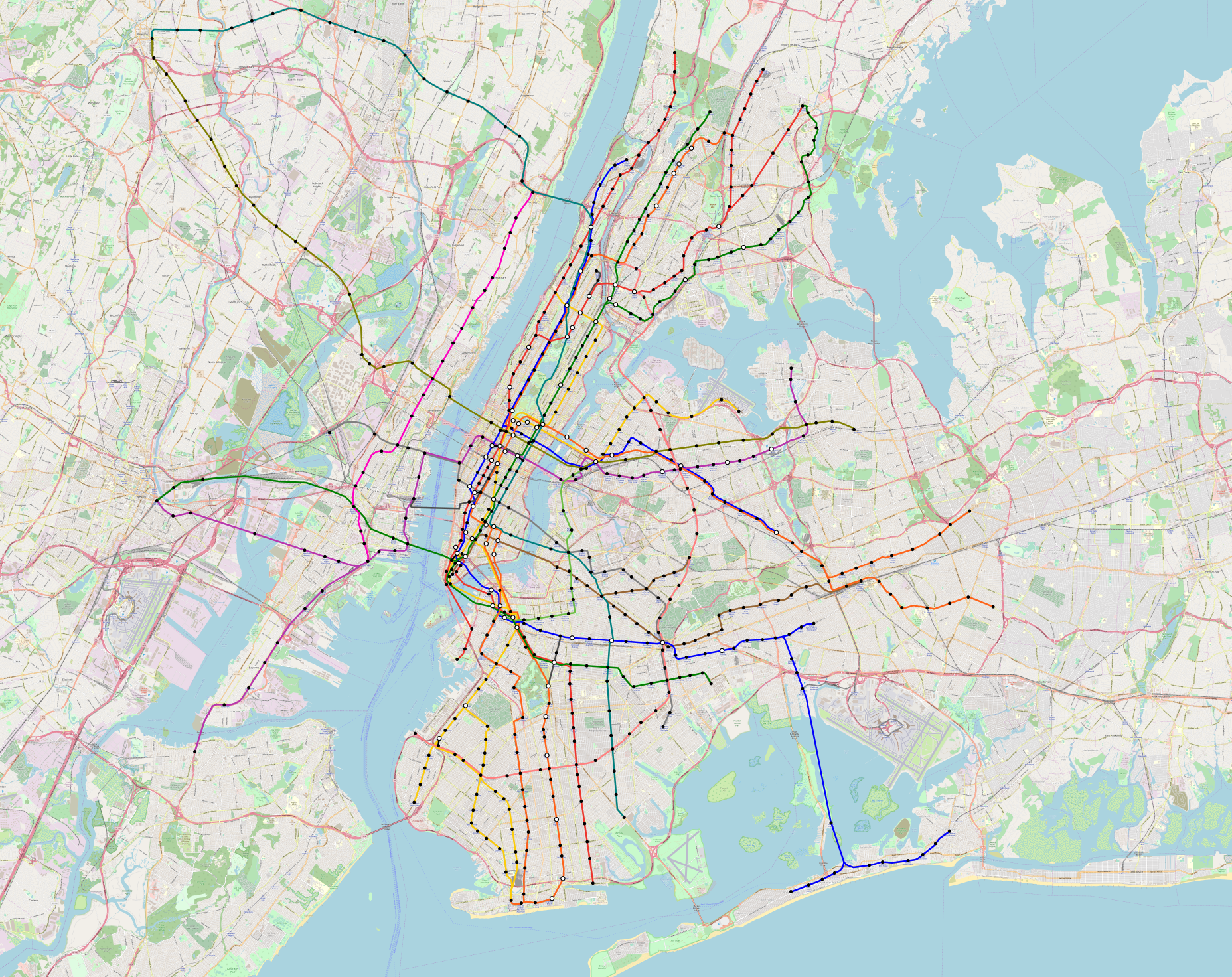
New York has nine subway main lines. Five are north-south through Manhattan and four-track, three are east-west and two-track, and one avoids Manhattan entirely. Nearly all construction was done cut-and-cover between 1900 and 1940, forcing lines to hew to the street network. As New York has wide, straight streets, a trait shared with practically all American cities, this was not a problem, unlike in London, where carving right-of-way for the Underground was so difficult that every line from the third onward was built deep-bore.
With four tracks on most of the Manhattan trunks, there is local and express service. This allows trains to go around obstacles more easily, increasing redundancy. It’s in this context that New York’s 24/7 service makes sense: there is no absolute need for nighttime maintenance windows in which no train runs. This approach works less well on the two-track lines, and the L, the only one that’s two-track the entire way, has occasional work orders with very low train frequency because of single-tracking.
Outside the core of the city as it was understood during construction, lines run elevated. The standard New York el is an all-steel structure, which reduces construction costs – the First Subway’s subway : el cost ratio was 4:1, whereas today the average is about 2.5:1 even though tunneling uses the more expensive boring technique – at the cost of creating a boombox so noisy that it’s impossible to have a conversation under the tracks while a train is passing. Moreover, splitting the difference between two and four tracks, the standard el has three tracks, which allows peak-direction express service (on the 2/5, 6, and 7) or more space for trains to get around obstacles (on the 1, 4, and N/W).
Because the els are so noisy, the city stopped building them in the 1920s. The lines built in the 1930s were all underground, with the exception of one viaduct over an industrial shipping channel.
Moreover, from the 1930s onward, stations got bigger, with full-length mezzanines (the older stations had no or short mezzanines). Track standards increased, leading to an impressive and expensive array of flying junctions, contrasting with the flat junctions that characterize some older construction like the Chicago L or some foreign examples like much of the London Underground.
Finally, while New York has nine separate subway colors, its number of named lines is far greater. The system comprises several tens of segments called lines, and each route combines different lines, with complex branching and recombination. The infrastructure was never built for discrete lines with transfers between them, but rather for everywhere-to-everywhere one-seat rides, and service choices today reinforce this, with several outer lines reverse-branching to an East Side and a West Side Manhattan trunk.
The desire for 24/7 service
I know of five urban rail networks with 24/7 service. One is the Copenhagen Metro, which is driverless and built with twin bores, making it easy for service to single-track at night for maintenance. The other four are American: the New York City Subway, PATH, PATCO, and the Chicago L. Moreover, the LIRR runs 24/7, which no other commuter rail system I know of does, even ones where an individual outlying station has comparable ridership to the entire LIRR.
The other systems have somewhat of a 24/7 envy. I’ve heard lay users and activists in Washington and the Bay Area complain that the Washington and BART shut down overnight; BART itself feels it has to justify itself to the users on this question. Right now, BART’s decision to temporarily add an hour to the nighttime shutdown window to speed up maintenance is controversial. People are complaining that service is being cut despite increases in funding. In Washington, the more professional activists understand why 24/7 service is unviable, but like BART feel like they have to explain themselves.
Local and express trains
New York is full of four-track mainlines, running both local and express trains. Chicago and Philadelphia have them as well on one line each. The other rapid transit networks in the US don’t, but like 24/7 service desire it. Washington has enough complaints about it that regular reader and Patreon supporter DW Rowlands had to write an article for Greater Greater Washington explaining why it would not be all that useful.
BART is the more interesting case. In any discussion of BART extensions, people bring up the fact that BART can’t skip stops – never mind that its stop spacing is extremely wide owing to its function as suburban rail. The average speed on BART is 57 km/h per the National Transit Database; the RER A, which is the express service here, averages around 50. At BART’s speed, the single longest express segment in New York not crossing water, the A/D between 125th and 59th Streets, would take 7 minutes; in fact it takes about 9. If anything, BART errs in having too few stations in Oakland and San Francisco.
On new-build systems, four tracks are understandable and desirable, provided the construction method is cut-and-cover, as it was in early-20th century America. The earliest subway lines built in New York had little cost premium over London and Paris even though the tunnels were twice as wide for twice as many tracks. However, cut-and-cover is no longer used in developed countries owing to its heavy impact on merchants and residents along the way; already during WW2, Chicago dug the tunnels for the Red and Blue Lines of the L using deep boring. A city that bores tunnels will find that four-track tunnels cost twice as much as two-track tunnels, so it might as well built two separate lines for better coverage.
The shadow of steel els
New York, Boston, Philadelphia, and Chicago all built all-steel els. While cheaper, these structures are so noisy that by the 1930s they became untenable even in far-out neighborhoods, like on the Queens Boulevard Line. New lines in New York were underground; existing els were removed, quickly in New York and more slowly in Boston.
The newer systems built in the US avoided els entirely. BART planned to build one in Berkeley, but community opposition led to a change to an underground alignment; unlike subsequent examples of NIMBYism, Berkeley was willing to pay the cost difference. When tunnels are infeasible due to cost, American rail networks prefer at-grade rights-of-way, especially freeway medians. Rail rights-of-way are popular where available, such as on the realigned Orange Line in Boston, but freeway medians are common where rail alignments don’t exist.
The next generation of American urban rail systems, unable to tunnel in city center, turned to light rail in order to keep things at-grade. Across the border, in Canada, Vancouver built els to cover gaps in the right-of-way that turned into the Expo Line, and then built concrete els on the Millennium Line and outer Canada Line to reinforce the system. These brutalist structures are imposing, but I’ve had conversations under the viaducts in Richmond, just as I have in Paris under the mixed concrete and steel structures or in Sunnyside next to New York’s one concrete el.
Reverse-branching
New York did not invent reverse-branching. London has had it since the 1860s, when most South London railways ran separate trains to the City (at Cannon Street, London Bridge, or Blackfriars) or the West End (at Victoria or Charing Cross), and multiple North London railways ran trains to their traditional terminals or to the North London Railway for service to Broad Street. Paris has had it since even earlier: the railways operating out of Gare Saint-Lazare and Gare Montparnasse merged in 1851 and treated the two stations as reverse-branches allowing cities farther west to access both the Right Bank and the Left Bank. In both cities, this situation makes it harder to run coherent regional rail – in London the railways are spending considerable resources on disentangling the lines to increase frequency to South London’s many branches, and in Paris the fact that Montparnasse and Saint-Lazare serve similar destinations frustrated plans to connect the two stations with an RER tunnel.
Where New York innovated is in copying this practice on rapid transit, starting with the Dual Contracts era. In Brooklyn, existing as well as new outlying lines could be routed to any number of new crossings to Manhattan; in the Bronx and Eastern Brooklyn, a desire to give branches service to both the West Side and East Side led to reverse-branching even on the numbered lines, which were built from scratch and did not involve older suburban railroads.
Reverse-branching spread across the United States. Boston had it until it removed the Atlantic Avenue El, and even today, railfans occasionally talk about reverse-branching the Red Line along Massachusetts Avenue to Back Bay and Roxbury. Chicago occasionally has it depending on the arrangement of trains on the North Side; today, the Purple and Brown Lines share tracks at rush hour but then go in opposite directions on the Loop. The Broad Street Line in Philadelphia reverse-branches to Chinatown. The Washington Metro has reverse-branches in Virginia, limiting train frequency due to asymmetry at the merge points. BART designed itself to force a three-way wye in Oakland pointing toward San Francisco, Berkeley and Downtown Oakland, and East Oakland on which every pair of destinations has a direct train, or else East Oakland residents would have to change trains to access their own city center – and current plans for a second trans-Bay tube add further reverse-branches instead of using the extra capacity as an opportunity to fix the Oakland junction.
Outside the United States, I know of four reverse-branches on rapid transit that is not historically regional rail: the Delhi Green Line, the Namboku and Mita Lines in Tokyo, the Yurakucho and Fukutoshin Lines also in Tokyo, and the Northern line’s two trunks in London. Of those, the last one is slowly being disentangled: its southern end will be two separate lines once the Battersea extension opens, and its northern end will, severing the line in two, once upgrades to pedestrian circulation are completed at the branch point. Historically Toronto had a three-way wye on the subway, like BART, but it caused so many problems it was discontinued in favor of running two separate lines.
Regional rail
The most prominent feature of American rail networks is not what they do, but what they lack. American (and Canadian, and Chinese) regional rail networks remain unmodernized, run for the exclusive benefit of upper middle-class suburban office workers at the primary CBD. Details differ between cities, but even when management is theoretically part of the same agency as the rapid transit network, as in Boston, New York, and Philadelphia, in practice the commuter railroads are autonomous. There is no hint of fare integration or schedule integration.
This fact influences network design more than anything else, even the low quality of steel els. Service to any destination beyond the dense urban core, which is small outside a handful of relatively dense cities, requires building new rail from scratch. This favors low-cost, low-capacity light rail, often in freeway medians. Smaller cities, unable to afford enough light rail to convince entire counties to tax themselves to build transit, downgrade service one step further and build bus rapid transit, typically treated as a weird hybrid of Latin American busways and European bus lanes.
Does any of this work?
In one word, no. The American tradition of rapid transit clearly doesn’t work – just look at the weak ridership even in old cities like Boston and Philadelphia, whose mode shares compare with medium-size urban regions in the French sunbelt like the Riviera or Toulouse.
Or, more precisely, it doesn’t work in early-21st century America. In the rare occasion an American city manages to round up funding to build a new subway line, I would recommend looking abroad for models of both construction methods and network design. For example, as BART keeps working on designing the second tube, I would strongly advise against new branches on the East Bay – instead, one of the two tubes (old and new) should permanently serve East Oakland, with a new Downtown Oakland transfer station, and the other should serve Berkeley and Concord.
Moreover, the United States owes it to itself to aggressively modernize its mainline passenger rail network. It’s too important to let Amtrak, the LIRR, Metro-North, Metra, and other dinosaurs do what they’ve always done. Toronto’s modernization of GO Transit, named the Toronto RER after the Western world’s premier regional rail network, had wide support among transit planners, but the engineers at GO itself were against it, and Metrolinx had to drag them into the 21st century.
Where the American tradition does work is in contexts that the United States has long left behind. Booming third-world cities direly need rapid transit, and while American construction costs are not to be emulated, the concept of opening up major throughfares, laying four tracks, and covering the system is sound. The mix of underground construction in city center and elevated construction farther out (using concrete structure, not louder steel ones) is sound as well, and is already seeing use in China and India. This is especially useful in cities that have little to no legacy regional rail, in which category India and China do not qualify, but most of the rest of the third world does.
Globalization makes for grand shuffles like this one. Experts in the United States should go to Nigeria, Bangladesh, Pakistan, Colombia, Kenya, Tanzania, Angola, and the Philippines and advise people in these countries’ major cities about how to emulate rapid transit designs from early-20th century America. But in their home country these same experts should instead step aside and let people with experience in the traditions of Japan, South Korea, and the various distinct countries of Western and Central Europe make decisions.


 Pedestrian Observations