Category: Germany
Small is not Resilient
I wrote about how the future is not retro, and Daniel Herriges Strong Towns just responded, saying that traditional development is timeless. I urge all readers to click the last link and read the article, which makes some good points about how cars hollowed out what both Daniel and I call the traditional prewar Midwestern town. There are really two big flaws in the piece. First, it makes some claims about inequality and segregation that are true in American cities but false in the example I give for spiky development, Vancouver. And second, it brings up the resilience of the traditional small town. It’s the second point that I wish to contest: small is not resilient, and moreover, as the economy and society evolve, the minimum size required for resilience rises.
Small cities in the 2010s
In the premodern era, a city of 50,000 was a bustling metropolis. In 1900, it was still a sizable city. In 2019, it is small. The difference is partly relative: a migrant to the big city had the option of moving to a few 200,000 cities in 1900 and one of about ten 1,000,000+ cities, whereas today the same migrant can move to many metro areas with millions of people. But part of it has to do with changes in the economy.
In Adam Smith’s day, big businesses were rare. If you had five employees, you were a big employer. Then came the factory system and firm size grew, but even then companies were small by the standards of today’s specialized economy. A city of 50,000 might well specialize in a single product, as was common in the American manufacturing belt (Krugman mentions this on pp. 11-12 here), but there would be many factories each with a few hundred employees.
But as the economy grows more complex, firm size grows, and so does the interdependence between different firms in the same supply chain. Moreover, the support functions within a city grow in complexity: schools, a hospital, logistics, retail, and so on. The proportion of the population employed in the core factory is lower, as the factory’s high productivity supports more non-manufacturing employees. The upshot is that it’s easy for a town of 50,000 to live off of a single firm and its supply chain. This is not resilient: if the firm fails, the town dies.
Occasionally, cities of that size can have more resilience. Perhaps they’re suburbs of a larger city, in which case they live off of commuting to a more diverse economic center. Perhaps they happen to live off of an industry that cannot die so easily, such as a state capital or a university. On social media one of my followers brought up farming as an example of an activity whose towns have held up in the Midwest better than manufacturing towns; farming is in fact extremely risky, but it has been subsidized since the 1930s, so it has some resilience thanks to subsidies from more internally resilient parts of the country.
Large cities and resilience
I read Ed Glaeser not so much for his observations about the housing market – he’s a lot of things but he’s not a housing economist – as for his economic history. He has a pair of excellent papers describing the economic histories of Boston and New York respectively. Boston, he argues, has reinvented itself three times in the last 200 years after declining, using its high education levels to move up the value chain. New York was never in decline except in the 1970s, and has resiled from its 1980 low as well.
These as well as other large cities have economic diversity that small cities could never hope to have. At the time Glaeser wrote his paper about New York, in 2005, the city seemed dominated by finance and related industries. And yet in the 2007-9 recession, which disproportionately hit finance, the metro area’s per capita income relative to the national average barely budged, falling from 135.3% to 133.8%; in 2017 it was up to 137.5%. The New York region is a center of finance, yes, but it’s also a center of media, academic research, biotech, and increasingly software.
New York is extremely large, and has large clusters in many industries, as do London, Paris, Tokyo, and other megacities. But even medium-size cities often have several clusters, if not so many. This is especially evident in Germany, where Munich, Hamburg, Stuttgart, and Frankfurt are not particularly large. Munich is the center of conglomerates in a variety of industries, including cars (BMW, far and away the largest employer, but also MAN), general industry (Siemens), chemicals (Linde), and finance (Allianz).
What’s true is that these large cities have much more knowledge work than menial work – yes, even Munich, much more a center of engineering than of menial production. But the future is not retro in the mix of jobs any more than it is in its urban layout. The nostalgics of the middle of the 20th century taxed productive industrial cities to subsidize farmers, treating industrial work as the domain of socialists, Jews, immigrants, and other weirdos; the nostalgics of the early 21st century propose to tax productive knowledge economies to subsidize menial workers, and in some specific cases, like American protection of its auto industry, this has been the case for decades.
Small cities as suburbs
In Germany, Switzerland, and the Netherlands, unlike in the United States or France, there is a vigorous tradition of historic small cities becoming suburbs of larger cities while retaining their identity. This doesn’t really involve any of Strong Towns’ bêtes noires about roads and streets – in fact pretty much all of these cities have extensive sprawl with big box retail and near-universal car ownership. Rather, they have tight links with larger urban cores via regional rail networks, and German zoning is less strict about commercialization of near-center residential areas than American zoning. There was also no history of white flight in these areas – the white flight in Germany is in the cores of very large cities, like Berlin, which can replace fleeing whites one to one with immigrants.
In this sense, various Rhineland cities like Worms and Speyer do better than Midwestern cities of the same size. But even though they maintain their historic identities, they are not truly economically independent. In that sense, a better American analogy would be various cities in New England and the mid-Atlantic that have fallen into the megalopolis’s orbit, such as Salem, Worcester, Providence, Worcester, New Brunswick, and Wilmington. Many of these are poor because of the legacy of suburbanization and white flight, but their built-up areas aren’t so poor.
However, the most important link between such small cities and larger urban core, the regional railway, heavily encourages spiky development. In Providence, developers readily build mid-rise housing right next to Providence Station. If the quality of regional rail to Boston improves, they will presumably be willing to build even more, potentially going taller, or slightly farther from the station. Elsewhere in the city, rents are not high enough to justify much new construction, and Downcity is so weak that the tallest building, the Superman Building, is empty. In effect, Providence’s future economic value is as part of the Boston region.
The relatively even development of past generations is of less use in such a city. The economy of a Providence or a Wilmington is not strong enough that everyone can work in the city and earn a good wage. If the most important destination is a distant core like Boston or Philadelphia, then people will seek locations right near the train station. Driving is not by itself useful – why drive an hour from Rhode Island when cheaper suburbs are available within half an hour? Connecting from local transit would be feasible if the interchange were as tightly timed and integrated as in Germany, but even then this system would be oriented around one dot – the train station – rather than a larger walkable downtown area.
A bigger city is a better city
Resilience in the sense of being able to withstand economic shocks requires a measure of economic diversity. This has always been easier in larger cities than in smaller ones. Moreover, over time there is size category creep: the size that would classify a city a hundred years ago as large barely qualifies it to be medium-size today, especially in a large continental superpower like the US. As global economic complexity increases, the size of businesses and their dedicated supply chains as well as local multipliers rises. The city size that was perfectly resilient in an economy with a GDP per capita of $15,000 is fragile in an economy with a GDP per capita of $60,000.
Usually, the absolute richest or more successful places may not be so big. There are hundreds of American metro areas, so a priori there is no reason for New York to be at the top, just as there is no reason for it to be at the bottom. Nonetheless, the fact that larger cities are consistently richer as well as at less risk of decline than smaller cities – New York is one of the richest metro areas, just not the single richest – should give people who think small is beautiful pause.
Whatever one’s aesthetic judgment about the beauty of the upper Mississippi versus that of the lower Hudson, the economic and social system of very large places weathers crises better, and produces more consistent prosperity. Economically and socially, a bigger city is a better city, and national development policy should reject nostalgia and make it possible for developers to build where there is demand – that is, in the richest, most populated metro areas, enabling these regions to grow further by infill as well as accretion. Just as 50,000 was fine in 1900 but isn’t today, a million is fine today but may not be in 2100, and it’s important to enable larger cities to form where people want to live and open businesses.
Cars-and-Trains Urbanism
For all of the rhetoric about banning cars and the inherent conflict between public transportation and private automobiles, the dominant political view of urbanism in large chunks of the world is the cars-and-trains approach. Under this approach, cities build extensive infrastructure for cars, such as parking, wide arterials, and some motorways, as well as for trains, which are as a rule always rapid transit, never streetcars. In the midcentury developed world this was the unanimous view of urban development, and this remains the preference of mainline center-right parties like CDU, the French Republicans, and the British and Canadian Tories; various 1960s urbanist movements with roots in the New Left arose in specific opposition to much of that mentality, which is why those movements are usually NIMBY in general.
In the post-consensus environment of political conflict in most issues, in this case between auto- and transit-oriented urbanism, it’s tempting to go back to the midcentury elite consensus as a compromise, and call for making cities friendly to both transit users and drivers. This is attractive especially to people who hope to defuse culture war issues, either because they identify as political moderates or because they identify as socialists and have some nostalgia for the Old Left. However, this kind of urbanism does not really work. While a destination can sometimes be friendly to both drivers and transit users, the city overall cannot be; the majority of the points of interest in a successful transit city are hostile to cars and vice versa.
Moreover, this cars-and-transit failure is not just historical. It keeps going on today. Middle-income countries waste vast sums of money on building two separate transportation networks that do not work well together. The United States, too, has adopted this mentality in the cities that are building new light rail lines, resulting in large urban rail systems whose ridership is a rounding error since most of the city isn’t oriented around public transportation.
What is cars-and-trains urbanism?
Postwar West Germany built a number of subway networks in its large cities, such as Munich, Frankfurt, Cologne, Dortmund, Essen, and Hanover. With the exception of Munich and Nuremberg, these are subway-surface systems, in which the trains are underground in city center but run in streetcar mode farther out. For the most part, these systems were built with the support of the driver lobby, which wanted the streetcars out of city center in order to be able to drive more easily, and once those systems opened, the cities dismantled the streetcars. Most of West Germany thus eliminated the streetcars that did not feed into the tunnels, just as the US eliminated nearly all of its streetcars except the ones that were part of a subway-surface system in Boston, Philadelphia, and San Francisco.
In the United States, such development only happened in San Francisco, where Muni buried the main streetcar trunk in conjunction with the construction of BART along the same alignment on Market Street. More commonly, cars-and-trains urbanism led to the development of park-and-rides in the suburbs. An early example is the Green Line D branch in Boston, designed for suburban commuters rather than urban residents using the line for all purposes and not just work. Subsequently, light rail lines have been built with park-and-rides, as have full rapid transit systems in the suburb of Atlanta, Washington, and San Francisco. In the same period, American mainline rail networks evolved to be car-oriented, replacing city center stations with park-and-rides for commuter as well as intercity rail uses.
American cars-and-trains development was not without conflict. The auto lobby opposed trains, believing buses were cheaper; top civil servants in what is now the Federal Highway Administration advocated for bus lanes to create more capacity at the peak into city centers such as Washington’s. However, the trains that were built in this era followed the same mentality of creating more peak capacity in areas where widening roads was too expensive because of high city center land prices.
In the US as well as in Europe, and nowadays in developing countries, construction of rapid transit in the biggest cities and high-speed rail between them is paired with large highway systems for everything else. When the Tories won the 2010 election, they proclaimed the end of Labour’s so-called war on motorists, but maintained their support for Crossrail in London and High Speed 2 from London to the major provincial cities. And in Toronto, even Rob and Doug Ford, for all their anti-walkability demagogy, support subways, just not at-grade streetcars that would take lanes away from cars.
How does cars-and-trains transportation fail?
In the United States, public transportation is divided into three groups. There is transit-oriented urbanism, which covers about half to two thirds of New York, and very small segments of Chicago, Boston, San Francisco, Washington, and Philadelphia. There are people riding public transportation out of poverty. And there is cars-and-trains behavior, common in the outer parts and suburbs of cities with urban rail networks. In the major American metropolitan areas with urban rail other than New York, people who commute by public transport actually outearn people who drive alone, because so much transit ridership consists of rich suburban commuters. Because of the weight of those commuters and because American metro areas with public transportation are richer than the rest of the country, the national gap in income between drivers and transit commuters is small and shrinking. And yet, fuel consumption as a proportion of overall consumption is constant around 3.5% in the bottom nine deciles.
In other words: the United States has spent a lot of money on attracting the rich to public transportation, and has succeeded in the sense that transit commuters earn about the same as car commuters, but the rich still drive so much that they consume as much fuel as the poor relative to their total spending. This is not because rich people inherently like driving – rich Manhattanites don’t drive much. This is because the postwar American transportation network does not provide adequate public transportation for non-commute trips. Off-peak frequencies are low, and service to destinations outside city centers is weak.
In Germany, the politics of cars-and-trains infrastructure is still around. A few months ago, when some Berlin Greens proposed congestion pricing, CDU came out in opposition, saying that without park-and-rides, how can people be expected to use the U- and S-Bahn? Walking or biking to the station is apparently not possible in outer Berlin, per CDU.
How does cars-and-trains urbanism fail?
The problem with cars-and-trains urbanism is not just about lack of frequency. The off-peak frequency on some of the American light and heavy rail systems serving park-and-rides is not terrible for regional rail – trains come every 10 or 12 or 15 minutes. But the development repels non-commuter uses of the system. The stations are surrounded by parking rather than high-density office or residential development. People who already own cars will drive them wherever it’s convenient: they’ll shop by car since retail has no reason to cluster in the central business district, and they’ll probably drive to jobs that do not have such agglomeration benefits as to have to be in city center.
That is not just an American problem. Western Europe, too, has built extensive infrastructure to extend auto-oriented postwar suburbia into older city centers, including motorways and parking garages. If the streets are narrow, then the sidewalks may be extremely narrow, down to maybe a meter in Florence. This encourages anyone who can afford to do so to drive rather than walk.
If there is no transit-oriented core to the city, then the result is a standard auto-oriented city. Examples include Los Angeles and Dallas, both of which have large urban rail networks with approximately no ridership. In the three-way division of American transit ridership – New York (and to a small extent a handful of other city cores), suburban commuters, very poor people – Los Angeles’s transit ridership is mostly very poor, averaging half the income of solo drivers. Public transit construction in this case has been a complete waste without policies that create a transit city, which must include both liberalization (namely, zoning liberalization near stations) and coercion (such as higher car and fuel taxes and removal of parking).
If there is a transit-oriented core, then the result cleaves the metro area in two. To people who live in the transit zone, the auto-oriented parts are inaccessible, and vice versa. A few places at the boundary can be crosshatched, but the city itself cannot be entirely crosshatched – the sea of single-family houses in the suburbs is not accessible except by car, and transit-oriented cities have no room for the amount of parking or road capacity required for auto-centric density.
Does rapid transit mean cars-and-trains?
No. In opposition to the postwar elite consensus and the center-right’s support of cars-and-trains urbanism, the New Left tends to be hostile to rapid transit, on the theory that it’s only good for cars and that tramways with dedicated lanes are as good as subways. This theory is hogwash – enough cities built metros before mass motorization in order to avoid streetcar and horsecar traffic jams – but it’s attractive to people who associate subways with the failings of CDU and its equivalents in other countries.
Paris provides a positive example of rejecting cars-and-trains urbanism while building rapid transit. Postwar France was thoroughly cars-and-trains in its mentality, but 21st-century Paris is the opposite. Mayor Anne Hidalgo has narrowed roadways and removed freeways in order to make the city pedestrian-friendlier. Ile-de-France is expanding its tramway network, but it’s at the same time investing enormous amounts of money in expanding the Metro and RER. I do not think there is any city outside China with more underground route-km built than Paris in 2000-30 – Indian metros are mostly above-ground. In my under-construction database, which largely omits China and Russia due to difficulties of finding information in English, Grand Paris Express is 10% of the total route-length.
Postwar Japan is another example of rapid transit without cars-and-trains typology. Unlike present-day Paris, which is ideologically leftist and green, Japanese development has been in an ideological environment similar to the center-right elite consensus, called dirigism in France. Nonetheless, Tokyo’s motorway network is not large relative to the city’s population, and suburban development has been quite dense and rail-oriented. The private rail operators have preferred to build high-density housing at their suburban stations to encourage more ridership, rather than park-and-rides.
It’s one or the other
Drivers are most comfortable on high-speed arterial streets with generous shoulders and setbacks, with parking right next to their destinations. This encourages dispersal – just try building parking for all the jobs of Midtown Manhattan or Central Tokyo on-site. Pedestrians would need to walk long distances along noisy, polluted streets and cross them at inconvenient signal times or places or risk being run over. Public transit users fare little better, as they turn into pedestrians at their destination – and what’s more, public transportation requires destinations to cluster at a certain density to fill a train at a usable frequency.
This situation works in reverse in a transit city. On a robust public transportation network, the most desirable locations are in the very center of the city, or at key interchanges. Usually the density at those nodes grows so high that drivers have to contend with heavy traffic. Widening roads is not possible at reasonable cost in dense centers of economic production; the very reason for cars-and-trains urbanism as opposed to just 100% cars is that it was never economic to build 20-lane highways in city centers.
On the street, too, conflict is inevitable. A lane can be shared, which means dominated by cars so long as a car with one person inside it gets the same priority as a bus or tram with 40; or it can be dedicated to buses and trams, which means cars have less space. And then there are pedestrians, who need adequate sidewalks even in historic city centers where the street width from building to building is 10 meters rather than the more modern 30.
Defusing conflict is attractive, but this is not possible. A city cannot be friendly to drivers and to non-drivers at the same time. The urban designs for the two groups are too different, and for the most part what most appeals to one repels the other. Trying to build two redundant transportation networks may be attractive to people who just like the idea of visible development with its construction jobs, but both will end up underused and overly costly. Good transit has to convert drivers into non-drivers – sometimes-drivers are too expensive to serve, because the urbanism for them is too peaky and expensive.
As a corollary of this, political structures that have to give something to drivers too have to be eliminated if public transportation is to succeed. For example, infrastructure funding formulas that give set amounts of money to the two modes, like the 80% cars, 20% transit split of American federal funding, are bad and should ideally be reduced to 0 if the formula itself cannot be changed; the investment in highways is making public transportation less useful, both through direct competition and through incentives for auto-oriented development. The same is true of schemes that are really fronts for highway widening, like some bus rapid transit in the US and India. Good transit activists have to oppose these, even if it means less money in overall spending, even if it means less money in spending specific for some public transit programs. The cost of highways is just too high to try to maintain a culture truce.
Circumferential Lines and Express Service
In a number of large cities with both radial and circumferential urban rail service, there is a curious observation: there is express service on the radial lines, but not the circumferential ones. These cities include New York, Paris, and Berlin, and to some extent London and Seoul. Understanding why this is the case is useful in general: it highlights guidelines for urban public transport design that have implications even outside the distinction between radial and circumferential service. In brief, circumferential lines are used for shorter trips than radial lines, and in large cities connect many different spokes so that an express trip would either skip important stations or not save much time.
The situation
Berlin has three S-Bahn trunk lines: the Ringbahn, the east-west Stadtbahn, and the North-South Tunnel. The first two have four tracks. The last is a two-track tunnel, but has recently been supplemented with a parallel four-track North-South Main Line tunnel, used by regional and intercity trains.
The Stadtbahn has a straightforward local-express arrangement: the S-Bahn uses the local tracks at very high frequency, whereas the express tracks host less frequent regional trains making about half as many stops as well as a few intercity trains only making two stops. The north-south system likewise features very frequent local trains on the S-Bahn, and a combination of somewhat less frequent regional trains making a few stops on the main line and many intercity trains making fewer stops. In contrast, the Ringbahn has no systemic express service: the S-Bahn includes trains running on the entire Ring frequently as well as trains running along segments of it stopping at every station on the way, but the only express services are regional trains that only serve small slivers on their way somewhere else and only come once or twice an hour.
This arrangement is mirrored in other cities. In Paris, the entire Metro network except Line 14 is very local, with the shortest interstations and lowest average speeds among major world metro systems. For faster service, there is Line 14 as well as the RER system, tying the suburbs together with the city. Those lines are exclusively radial. The busiest single RER line, the RER A, was from the start designed as an express line parallel to Line 1, the Metro’s busiest, and the second busiest, the RER B, is to a large extent an express version of the Metro’s second busiest line, Line 4. However, there is no RER version of the next busiest local lines, the ring formed by Lines 2 and 6. For non-Metro circumferential service, the region went down the speed/cost tradeoff and built tramways, which have been a total success and have high ridership even though they’re slow.
In New York, the subway was built with four-track main lines from the start to enable express service. Five four-track lines run north-south in Manhattan, providing local and express service. Outside the Manhattan core, they branch and recombine into a number of three- and four-track lines in Brooklyn, Queens, and the Bronx. Not every radial line in New York has express service, but most do. In contrast, the circumferential Crosstown Line, carrying the G train, is entirely local.
In Seoul, most lines have no express service. However, Lines 1, 3, and 4 interline with longer-range commuter rail services, and Lines 1 and 4 have express trains on the commuter rail segments. They are all radial; the circumferential Line 2 has no express trains.
Finally, in London, the Underground has few express segments (all radial), but in addition to the Underground the city has or will soon have express commuter lines, including Thameslink and Crossrail. There are no plans for express service parallel to the Overground.
Is Tokyo really an exception?
Tokyo has express trains on many lines. On the JR East network, there are lines with four or six tracks all the way to Central Tokyo, with local and express service. The private railroads usually have local and express services on their own lines, which feed into the local Tokyo subway. But not all express services go through the primary city center: the Ikebukuro-Shibuya corridor has the four-track JR Yamanote Line, with both local services (called the Yamanote Line too, running as a ring to Tokyo Station) and express services (called the Saikyo or Shonan-Shinjuku Line, continuing north and south of the city); Tokyo Metro’s Fukutoshin Line, serving the same corridor, has a timed passing segment for express trains as well.
However, in three ways, the area around Ikebukuro, Shinjuku, and Shibuya behaves as a secondary city center rather than a circumferential corridor. The job density around all three stations is very high, for one. They have extensive retail as well, as the private railroads that terminated there before they interlined with the subway developed the areas to encourage more people to use their trains. This situation is also true of some secondary clusters elsewhere in Tokyo, like Tobu’s Asakusa terminal, but Asakusa is in a historically working-class area, whereas the Yamanote area was historically and still is wealthier, making it easier for it to attract corporate jobs.
Second, from the perspective of the transportation network, they are central enough that railroads that have the option to serve them do so, even at the expense of service to Central Tokyo. When the Fukutoshin Line opened, Tokyu shifted one of its two mainlines, the Toyoko Line, to connect to it and serve this secondary center, where it previously interlined with the Hibiya Line to Central Tokyo; Tokyu serves Central Tokyo via its other line, the Den-en-Toshi Line, which connects to the Hanzomon Line of the subway. JR East, too, prioritizes serving Shinjuku from the northern and southern suburbs: the Shonan-Shinjuku Line is a reverse-branch of core commuter rail lines both north and south, as direct fast service from the suburbs to Shibuya, Shinjuku, and Ikebukuro is important enough to JR East that it will sacrifice some reliability and capacity to Tokyo Station for it.
Third, as we will discuss below, the Yamanote Line has a special feature missing from circumferential corridors in Berlin and Paris: it has distinguished stations. A foreigner looking at satellite photos of land use and at a map of the region’s rail network without the stations labeled would have an easy time deciding where an express train on the line should stop: Ikebukuro, Shinjuku, and Shibuya eclipse other stations along the line, like Yoyogi and Takadanobaba. Moreover, since these three centers were established to some extent before the subway was built, the subway lines were routed to serve them; there are 11 subway lines coming from the east as well as the east-west Chuo Line, and of these, all but the Tozai and Chiyoda Lines intersect it at one of the three main stations.
Interstations and trip length
The optimal stop spacing depends on how long passenger trips are on the line: keeping all else equal, it is proportional to the square root of the average unlinked trip. The best formula is somewhat more delicate: widening the stop spacing encourages people to take longer trips as they become faster with fewer intermediate stops and discourages people from taking shorter ones as they become slower with longer walk distances to the station. However, to a first-order approximation, the square root rule remains valid.
The relevance is that not all lines have the same average trip length. Longer lines have longer trips than short lines. Moreover, circular lines have shorter average trips than straight lines of the same length, because people have no reason to ride the entire way. The Ringbahn is a 37-kilometer line on which trains take an hour to complete the circuit. But nobody has a reason to ride more than half the circle – they can just as well ride the shorter way in the other direction. Nor do passengers really have a reason to ride over exactly half the circle, because they can often take the Stadtbahn, North-South Tunnel, or U-Bahn and be at their destinations faster.
Circumferential lines are frequently used to connect to radial lines if the radial-radial connection in city center is inconvenient – maybe it’s missing entirely, maybe it’s congested, maybe it involves too much walking between platforms, maybe happens to be on the far side of city center. In all such cases, people are more likely to use the circumferential line for shorter trips than for longer ones: the more acute the angle, the more direct and thus more valuable the circle is for travel.
The relevance of this discussion to express service is that there’s more demand for express service in situations with longer optimum stop spacing. For example, the optimum stop spacing for the subway in New York based on current travel patterns is the same as that proposed for Second Avenue Subway, to within measurement error of parameters like walking speed; on the other trunk lines, the local trains have denser stop spacing and the express trains have wider stop spacing. On a line with very short optimum spacing, there is not much of a case for express service at all.
Distinguished stops versus isotropy
The formula for optimal stop spacing depends on the isotropy of travel demand. If origins and destinations are distributed uniformly along the line, then the optimal stop spacing is minimized: passengers are equally likely to live and work right on top of a station, which eliminates walk time, as they are to live and work exactly in the middle between two stations, which maximizes walk time. If the densities of origins and destinations are spiky around distinguished nodes, then the optimal stop spacing widens, because planners can place stations at key locations to minimize the number of passengers who have to walk longer. If origins are assumed to be perfectly isotropic but destinations are assumed to be perfectly clustered at such distinguished locations as city center, the optimum stop spacing is larger than if both are perfectly isotropic by a factor of 
Circumferential lines in large cities do not have isotropic demand. However, they have a great many distinguished stops, one at every intersection with a radial rail service. Out of 27 Ringbahn stops, 21 have a connection to the U-Bahn, a tramway, or a radial S-Bahn line. Express service would be pointless – the money would be better spent increasing local frequency, as ridership on short-hop trips like the Ringbahn’s is especially sensitive to wait time.
On the M2/M6 ring in Paris, there are 49 stops, of which 21 have connections to other Metro lines or the RER, one more doesn’t but really should (Rome, with a missed connection to an M14 extension), and one may connect to a future extension of M10. Express service is not completely pointless parallel to M2/M6, but still not too valuable. Even farther out, where the Paris region is building the M15 ring of Grand Paris Express, there are 35 stops in 69 kilometers of the main ring, practically all connecting to a radial line or located at a dense suburban city center.
The situation in New York is dicier, because the G train does have a distinguished stop location between Long Island City and Downtown Brooklyn, namely the connection to the L train at Bedford Avenue. However, the average trip length remains very short – the G misses so many transfers at both ends that end-to-end riders mostly stay on the radials and go through Manhattan, so the main use case is taking it a few stops to the connection to the L or to the Long Island City end.
Conclusion
A large urban rail network should be predominantly radial, with circumferential lines in dense areas providing additional connectivity between inner neighborhoods and decongesting the central transfer points. However, that the radial and circumferential lines are depicted together on the same metro or regional rail map does not mean that people use them in the same way. City center lies ideally on all radials but not on the circumferentials, so the tidal wave of morning commuters going from far away to the center is relevant only to the radials.
This difference between radials and circumferentials is not just about service planning, but also about infrastructure planning. Passengers make longer trips on radial lines, and disproportionately travel to one of not many distinguished central locations; this encourages longer stop spacing, which may include express service in the largest cities. On circumferential lines, they make shorter trips to one of many different connection points; this encourages shorter stop spacing and no express service, but rather higher local frequency whenever possible.
Different countries build rapid transit in radically different ways, and yet big cities in a number of different countries have converged on the same pattern: express service on the strongest radial corridors, local-only service on circumferential ones no matter how busy they are. There is a reason. Transportation planners in poorer cities that are just starting to build their rapid transit networks as well in mature cities that are adding to their existing service should take heed and design infrastructure accordingly.
The Future is not Retro
One faction of urbanists that I’ve sometimes found myself clashing with is people who assume that a greener, less auto-centric future will look something like the traditional small towns of the past. Strong Towns is the best example I know of of this tendency, arguing against high-rise urban redevelopment and in favor of urbanism that looks like pre-freeway Midwestern main streets. But this retro attitude to the future happens everywhere, and recently I’ve had to argue about this with the generally pro-modern Cap’n Transit and his take about the future of vacations. Even the push for light rail in a number of cities has connections with nostalgia for old streetcars, to the point that some American cities build mixed-traffic streetcars, such as Portland.
The future was not retro in the 1950s
The best analogy for a zero-emissions future is ironically what it seeks to undo: the history of suburbanization. In retrospect, we can view midcentury suburbanization as a physical expansion of built-up areas at lower density, at automobile scale. But at the time, it was not always viewed this way. Socially, the suburbs were supposed to be a return to rural virtues. The American patrician reformers who advocated for them consciously wanted to get rid of ethnic urban neighborhoods and their alien cultures. The German Christian democratic push for regional road and rail connections has the same social origin, just without the ethnic dimension – cities were dens of iniquity and sin.
At the same time, the suburbs, that future of the middle of the 20th century, were completely different from the mythologized 19th century past, before cities like New York and Berlin had grown so big. Most obviously, they were linked to urban jobs; the social forces that pushed for them were aware of that in real time, and sought transportation links precisely in order to permit access to urban jobs in what they hoped would be rural living.
But a number of other key differences are visible – for one, those suburbs were near the big cities of the early 20th century, and not in areas with demographic decline. In the United States, the Great Plains and Appalachia kept depopulating and the Deep South except Atlanta kept demographically stagnating. The growth in that era of interregional convergence happened in suburbs around New York, Chicago, and other big then-industrial cities, and in parts of what would soon be called the Sunbelt, namely Southern California, Texas, and Florida. In Germany, this history is more complicated, as the stagnating region that traditionalists had hoped to repopulate was Prussia and Posen, which were given to Poland at the end of the war and ethnically cleansed of their German populations. However, we can still see postwar shifts within West Germany toward suburbs of big cities like Munich and Frankfurt, while the Ruhr stagnated.
The future of transit-oriented development is not retro
People who dislike the auto-oriented form of cities can easily romanticize how cities looked before mass motorization. They’d have uniform missing middle built form in most of the US and UK, or uniform mid-rise in New York and Continental Europe. American YIMBYs in particular easily slip into romanticizing missing middle density and asking to replace single-family housing with duplexes and triplexes rather than with anything more substantial.
If you want to see what 21st-century TOD looks like, go to the richer parts of East Asia, especially Tokyo, which builds much more housing than Hong Kong and Singapore. The density in Tokyo is anything but uniform. There are clusters of high-rise buildings next to train stations, and lower density further away, even small single-family houses fronting narrow streets far enough from train stations that it’s not economical to redevelop them. It offends nostalgic Westerners; the future often does.
In the context of a growing city like New York or London, what this means is that the suburbs can expect to look spiky. There’s no point in turning, say, everything within two kilometers of Cockfosters (or the Little Neck LIRR station) into mid-rise apartments or even rowhouses. What’s the point? There’s a lot more demand 100 meters from the station than two kilometers away, enough that people pay the construction cost premium for the 20th floor 100 meters from the stations in preference to the third floor two kilometers away. The same is true for Paris – there’s no solution for its growth needs other than high-rises near RER stations and key Metro stations in the city as well as the suburbs, like the existing social housing complexes but with less space between buildings. It may offend people who associate high-rises with either the poor or recent high-skill immigrants, but again, the future often offends traditionalists.
The future of transportation is not retro
In countries that do not rigidly prevent urban housing growth the way the US does, the trend toward reurbanization is clear. Germany’s big cities are growing while everything else is shrinking save some suburbs in the richest regions, such as around Munich. Rural France keeps depopulating.
In this context, the modes of transportation of the future are rapid transit and high-speed rail. Rapid transit is preferable to buses and surface trains in most cities, because it serves spiky development better – the stations are spaced farther apart, which is fine because population density is not isotropic and neither is job density, and larger cities need the longer range that comes with the higher average speed of the subway or regional train over that of the tramway.
High-speed rail is likewise preferable to an everywhere-to-everywhere low-speed rail network like that of Switzerland. In a country with very large metro areas spaced 500 km or so apart, like the US, France, or Germany, connecting those growing city centers is of crucial importance, while nearby cities of 100,000 are of diminishing importance. Moreover, very big cities can be connected by trains so frequent that untimed transfers are viable. Already under the Deutschlandtakt plan, there will be 2.5 trains between Berlin and Hanover every hour, and if average speeds between Berlin and the Rhine-Ruhr were increased to be in line with those of the TGVs, demand would fill 4-6 trains per hour, enough to facilitate untimed transfers from connecting lines going north and south of Hanover. The Northeast Corridor has even more latent demand, given the huge size of New York.
The future of travel is not retro
The transportation network both follows and shapes travel patterns. Rapid transit is symbiotic with spiky TOD, and high-speed rail is symbiotic with extensive intercity travel.
The implication is that the future of holidays, too, is not retro. Vacation trips between major cities will become easier if countries that are not France and Japan build a dense network of high-speed lines akin to what France has done over the last 40 years and what Japan has done over the last 60. Many of those cities have thriving tourism economies, and these can expect to expand if there are fast trains connecting them to other cities within 300-1,000 kilometers.
Sometimes, these high-speed lines could serve romanticized tourist destinations. Niagara Falls lies between New York and Toronto, and could see expansion of visits, including day trips from Toronto and Buffalo and overnight stays from New York. The Riviera will surely see more travel once the much-delayed LGV PACA puts Nice four hours away from Paris by train rather than five and a half. Even the Black Forest might see an expansion of travel if people connect from high-speed trains from the rest of Germany to regional trains at Freiburg, going from the Rhine Valley up to the mountains; but even then, I expect a future Germany’s domestic tourism to be increasingly urban, probably involving the Rhine waterfront as well as the historic cities along the river.
But for the most part, tourist destinations designed around driving, like most American national parks as well as state parks like the Catskills, will shrink in importance in a zero-carbon future. It does not matter if they used to have rail access, as Glacier National Park did; the tourism of the leisure class of the early 20th century is not the same as that of the middle class of the middle of the 21st. Grand Canyon and Yellowstone are not the only pretty places in the world or even in the United States; the Hudson Valley and the entire Pacific Coast are pretty too, and do not require either driving or taking a hypothetical train line that, on the list of the United States’ top transportation priorities, would not crack the top 100. This will offend people whose idea of environmentalism is based on the priorities of turn-of-the-century patrician conservationists, but environmental science has moved on and the nature of the biggest ecological crisis facing humanity has changed.
The non-retro future is pretty cool
The theme of the future is that, just as the Industrial Revolution involved urbanization and rural depopulation, urban development patterns this century involve growth in the big metro areas and decline elsewhere and in traditional small towns. This is fine. The status anxieties of Basil Fawlty types who either can’t or won’t adapt to a world that has little use for their prejudices are not a serious public concern.
Already, people lead full lives in big global cities like New York and London without any of the trappings of what passed for normality in the middle of the 20th century, like a detached house with a yard and no racial minorities or working-class people within sight. The rest will adapt to this reality, just as early 20th century urbanites adapted to the reality of suburbanization a generation later.
It’s not even an imposition. It’s opportunity. People can live in high-quality housing with access to extensive social as well as job networks, and travel to many different places with different languages, flora and fauna, vistas, architecture, food, and local retail. Even in the same language zone, Northern and Southern Germany look completely different from each other, as do Paris and Southern France, or New England and Washington. Then outside the cities there are enough places walking distance from a commuter rail line or on the way on a high-speed line between two cities that people can if they’d like go somewhere and spend time out of sight of other people. There’s so much to do in a regime of green prosperity; the world merely awaits the enactment of policies that encourage such a future in lieu of one dominated by small-minded local interests who define themselves by how much they can pollute.
Stuttgart 21’s Impending Capacity Problems and Timed Connections
The largest single transportation project in Germany today is a new underground main station for Stuttgart, dubbed Stuttgart 21. Built at a cost of €8.2 billion, it will soon replace Stuttgart’s surface terminal with a through-station, fed in four directions by separate tunnels. The project attracted considerable controversy at the beginning of this decade due to its cost overruns and surface disruption. It’s had a long-term effect on German politics as well: it catapulted the Green Party into its first ever premiership of a German state, and the Green minister-president of the state, Winfried Krestchmann, has remained very popular and played a role in mainstreaming the party and moving it in a more moderate direction.
But the interesting thing about Stuttgart 21 now is not the high cost, but a new problem: capacity. The new station will face capacity constraints worse than those of the surface station, particularly because Germany is transitioning toward timed connections (“Deutschlandtakt”) on the model of Switzerland. Since Stuttgart is closing the surface station and selling the land for redevelopment, a second underground station will need to be built just to add enough capacity. It’s a good example of how different models of train scheduling require radically different kinds of infrastructure, and how even when all the technical details are right, the big picture may still go wrong.
What is the Stuttgart 21 infrastructure?
The following diagram (via Wikipedia) shows what the project entails.
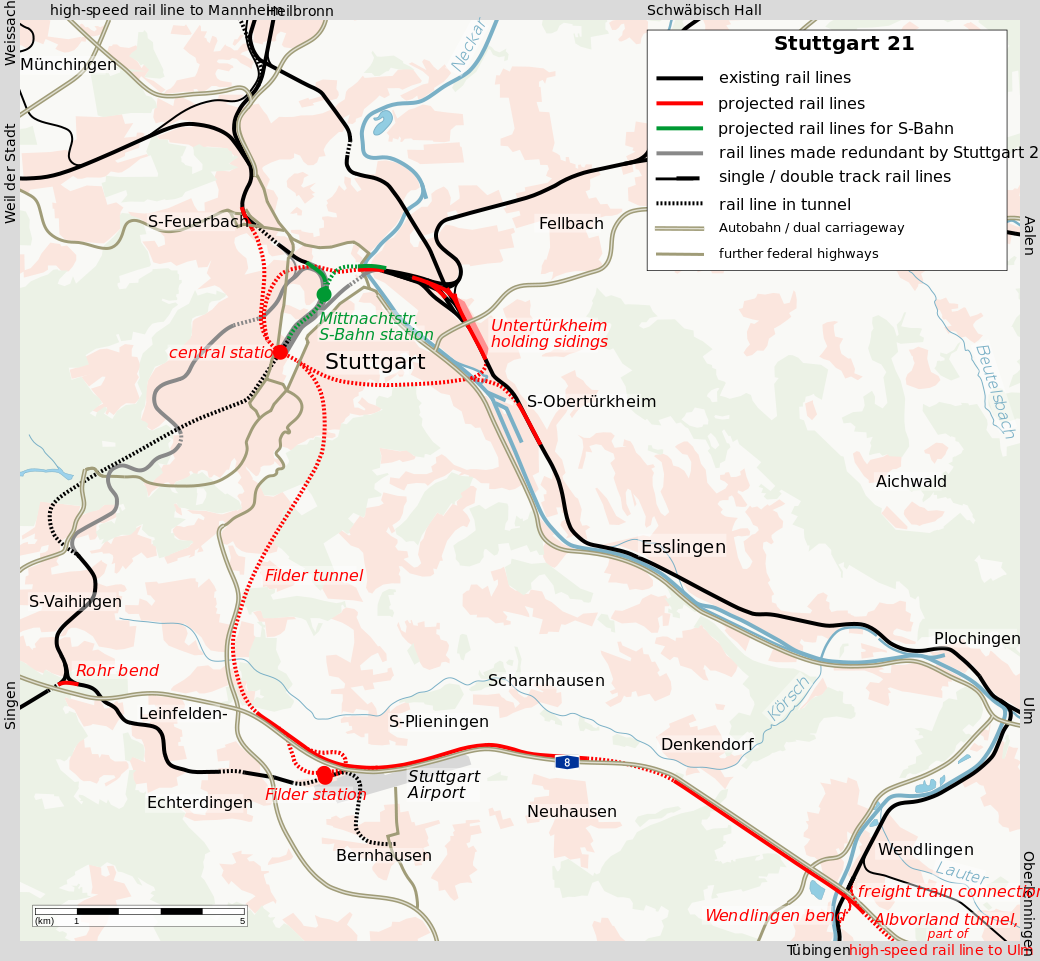
The existing tunnel, oriented in a northeast-southwest direction, is used exclusively by S-Bahn trains. Longer-distance regional trains (“RegionalBahn“) and intercity trains terminate on the surface, and if they continue onward, they must reverse direction.
The new tunnel infrastructure consists of four independent two-track tunnels, two coming in from the northwest and two from the southeast, with full through-service. In addition, an underground loop is to be constructed on the south in order to let trains from points south (Singen) enter Stuttgart via the Filder tunnel while serving the airport at Filder Station without reversing direction. The total double-track tunnel length is 30 kilometers.
Stuttgart 21’s station infrastructure will consist of eight tracks, four in each direction:

The two tracks facing each platform are generally paired with the same approach track, so that in case of service changes, passengers will not be inconvenienced by having to go to a different platform. The interlocking permits trains from each of the two eastern approaches to go to either of the western ones without conflict and vice versa, and the switches are constructed to modern standards, with none of the onerous speed restrictions of American station throats.
So what is the problem?
First of all, the four approach tunnels are not symmetric. The Feuerbach tunnel leads to Mannheim, Frankfurt, Würzburg, and points north, and the Filder tunnel leads to Ulm and points east, including Munich; both are planned to be heavily used by intercity trains. In contrast, the other two tunnels lead to nothing in particular. The Obertürkheim tunnel leads to the current line toward Ulm, but the under-construction high-speed line to Ulm feeds Filder instead, leaving Obertürkheim with just a handful of suburbs.
On the Deutschlandtakt diagram for Baden-Württemberg, every hour there are planned to be 12 trains entering Stuttgart from the Feuerbach tunnel, 10.5 from the Filder tunnel, 5.5 from the Bad Cannstatt tunnel, and 6 from the Obertürkheim tunnel. For the most part, they’re arranged to match the two busier approaches with each other – the track layout permits a pair of trains in either matching to cross with no at-grade conflict, but only if trains from Feuerbach match with Filder and trains from Bad Cannstatt match with Obertürkheim are both station tracks facing the same platform available without conflict.
A train every five minutes through a single approach tunnel feeding two station tracks is not normally a problem. The S-Bahn, depicted on the same map in black, runs 18 trains per hour in each direction through the tunnel; bigger cities, including Paris and Munich, run even more frequent trains on the RER or S-Bahn with just a single station platform per approach track, as on any metro network.
However, the high single-track, single-direction frequency is more suitable on urban rail than on intercity rail. On a metro, trains rarely have their own identity – they run on the same line as a closed system, perhaps with some branching – so if a train is delayed, it’s possible to space trains slightly further apart, so the nominal 30 trains per hour system ends up running 28 trains if need be. On an S-Bahn this is more complicated, but there is still generally a high degree of separation between the system and other trains, and it’s usually plausible to rearrange trains through the central tunnel. On intercity rail, trains have their own identity, so rearrangement is possible but more difficult if for example two trains on the same line, one express and one local, arrive in quick succession. As a result, one platform track per approach track is unsuitable – two is a minimum, and if more tracks are affordable then they should be built.
How do you intend to run the trains?
If the paradigm for intercity rail service is to imitate shorter-range regional trains, then through-tunnels are both easier and more desirable. A relatively closed system with very high frequency between a pair of stations calls for infrastructure that minimizes turnarounds and lets trains just run in the same sequence.
The Shinkansen works this way, leveraging three key features: its near-total isolation from the legacy train network, running on a different gauge; the very high demand for trains along individual corridors on specific city pairs; and the generally high punctuality of Japanese trains even on more complex systems. As it happens, Tokyo is a terminal, with trains going north and south but not through, as a legacy of the history of breaking up Japan National Railway before the Shinkansen reached Tokyo from the north, with different daughter companies running in each direction. However, Shin-Osaka is a through-station, fitting through-trains as well as terminating trains on just eight tracks.
In the developed world’s second busiest intercity rail network, that of Switzerland, the paradigm is different. In a country whose entire population is somewhat less than that of Tokyo without any of its suburbs, no single corridor is as strong as the Shinkansen corridors. Trains form a mesh with timed connections every hour, sometimes every half hour. Intercity trains are arranged to arrive at Zurich, Bern, and Basel a few minutes before the hour every 30 minutes and depart a few minutes later. In that case, more approach tracks and more platform tracks are needed. Conversely, the value of through-tracks is diminished, since passengers can transfer between trains more easily if they can walk between platforms without changing grade.
Infrastructure-timetable integration
Germany aims to integrate the infrastructure and timetable, as Switzerland does. However, Stuttgart 21 is a failure of such integration. The Deutschlandtakt service paradigm calls for many trains entering and leaving the station within the span of a few minutes. Today there are four effective approaches with two tracks each, same as under the Stuttgart 21 plan, but they are better-distributed.
The idea of Stuttgart 21, and similar proposals for Frankfurt and Munich, is solid provided that the intention is to run trains the Japanese way. It Stuttgart were designed to be the junction of two consistently high-intensity lines, then it would work without additional infrastructure. But it is not: its approach tunnels are supposed to support such design, but the service pattern will not look this way because of how the tunnels are placed relative to Germany’s population distribution. Even highly competent engineering can produce incompetent results if the details do not match the big picture.
Megaregions, Redux
Remember how ten years ago the American urbanist conversation was all about carving the country up into megaregions? The America 2050 project drew some lines connecting metro areas into regions, designed to imitate the Boston-Washington corridor in concept, and asserted that this would be the future of American growth. The concept seems to have dropped off the discourse, and for good reason, but it may be useful to have a second look. The Boston-Washington megalopolis is a genuine megaregion, and it’s useful to see which regions elsewhere in the world share its characteristics.
The key takeaway is that rich cities do not have to be in megaregions. The Northeast Corridor is a rich megaregion, and San Francisco, Los Angeles, and Chicago anchor smaller megaregions of their own; but in Europe, among the richest cities only Frankfurt and Amsterdam are in megaregions, while London, Paris, Hamburg, and Munich are not. Megaregions are areas of high population density and interlinked social networks. Their size may give them economic advantage, but it doesn’t have to; urbanists and urban geographers must avoid overselling their importance.
What is a megaregion?
The original Boston-Washington megalopolis was defined in the 1960s, as a linear region with continuous suburban sprawl. The core comes from New York and Philadelphia, which share some suburbs in Central Jersey, their regional rails meeting at Trenton. However, continuous sprawl goes north to New Haven, Hartford, and Springfield, with only a few tens of km of separation from Providence and Worcester on the way to Boston; and southwest to Baltimore and Washington, with suburbs spaced closely together along the I-95 corridor.
There are extensive academic connections. Academics are generally hypermobile, but form especially thick metropolitan connections. Living in Boston and reverse-commuting to Brown is normal, and people at Brown would sometimes go up to Harvard or MIT for seminars when sufficiently important or interesting people gave talks. Connections up and down the central part of the corridor are extensive as well, stretching from Yale down to Penn. There is a gap between New Haven and Providence, as Hartford and Springfield aren’t academic centers; perhaps for academics the megaregion only stretches from New Haven to Washington, but even so, at least two-thirds of the megaregion remains intact.
Socially, there are strong connections along the corridor as well. They’re rarely end-to-end, but people in fandom routinely go a state or two over for conventions, so conventions in Connecticut and Rhode Island draw from New York and Boston, conventions in New Jersey draw from Philadelphia and New Haven, and conventions in Maryland draw from Philadelphia and Northern Virginia. On some stretches, weekend trips are normal, like the Columbia students who’d go back to visit parents in suburban Philadelphia every weekend, or people in New York who dated people in New Haven and didn’t even really think of it as a long-distance relationship.
Which regions qualify as megaregions?
Outside the Northeast, it is difficult for me to judge the extent of social connections, with a few key exceptions. However, I can judge how continuous urbanization is and, using American survey data on commuting, whether two adjacent core urban areas share suburbs. In Europe, I do not have commuting data, but it is easy to look at regional rail maps and see when S-Bahn networks touch.
Asymmetric megaregions
In the United States, the three largest core metropolitan areas outside the Northeast – Los Angeles, Chicago, and San Francisco – all anchor megaregions. However, in all three cases, the big core metro area dominates the broader region. Los Angeles has continuous sprawl down the coast to San Diego, and the two metro areas’ commuter rail networks touch; Chicago similarly has continuous sprawl up to Milwaukee, and if Milwaukee bothered to run regional trains then they would probably go down to Kenosha and connect to Metra; the Bay Area’s high housing costs have driven many people to the San Joaquin Delta, most of the way to Sacramento, and the Amtrak route connecting San Jose and Oakland with Sacramento is largely planned as regional rail nowadays.
New York is of course much larger than the other core regions of the megalopolis, but its metro area has at most half the population of the region, and even that requires making the broadest assumptions on what counts as part of the metro area and the narrowest ones on what counts as part of the megalopolis. If metro New York excludes mostly economically independent areas like New Haven and Central Jersey, and the megalopolis includes some inland areas like Albany and Harrisburg, then New York is only one third of the megalopolis. In contrast, the five-county Los Angeles metro area has three quarters of Southern California’s population, the Bay Area has about two thirds of its megaregion’s population, and metro Chicago has about 85% of the combined population of Chicago and Milwaukee.
Suburb sharing in smaller megaregions
High population density and suburban sprawl can lead some core urban areas to share suburbs, forming a megaregion with much lower population than the megalopolis. Florida supplies at least one such example: out of 237,000 employed residents in Polk County, 26,000 commute to Orlando’s Orange County and 29,000 commute to Tampa’s Hillsborough County and St. Petersburg’s Pinellas County; the western parts of Polk County have a higher density of Tampa-bound commuters and the eastern parts have a higher density of Orlando-bound commuters, but there is a fair amount of mixing, as well as anywhere-to-anywhere commuting within the county. By all accounts, Orlando and Tampa should be placed into one megaregion.
South Florida is arguably a megaregion as well. It is treated as a metro area stretching from Miami or even Key West north to West Palm Beach, but its northern, central, and southern areas have distinct urban cores. Miami-Dade County has 982,000 employed residents, of whom only 28,000 work in Palm Beach County; in the other direction, 29,000 workers from Palm Beach commute to Miami-Dade out of 513,000. This megaregion stretches even further north – St. Lucie County has 13,000 out of 100,000 workers commuting to Palm Beach County – but there is a gap in both population density and commuting zones between Port St. Lucie and Space Coast. Socially, too, the people I know on Space Coast don’t have ties to South Florida, and barely have any to Orlando. So the bulk of Florida is really two linear megaregions, one north-south and one southwest-northeast, which may be close but do not merge.
Finally, crossing the Pond, Northern England features a megaregion out of core metro areas of similar size to those of Central Florida. Liverpool and Manchester are two historic cores and are formally two distinct metro areas, but are so interlinked they are arguably a single metro area, and are certainly a single multicore megaregion. There is contiguous suburban sprawl connecting the two cities with small gaps, and were British regional rail services better, their frequent urban rail networks would have touched. There are even some ties crossing the Pennines to Leeds; Britain has attempted to improve infrastructure between historic Lancashire and Yorkshire, using the language of megaregions to argue that this would boost the area’s economic profile.
Leapfrog urban connections
Western Germany and the Netherlands do not have contiguous sprawl in the same way that most developed countries do. On a satellite photo, the commuting zone of New York, Paris, Madrid, Toronto, or any other major city in their respective countries looks largely as a single blob of gray. The population density of this gray blob is higher in France than in the United States, but in both countries, a metropolitan area is made out of a single contiguous built-up area plus a handful of surrounding low-density exurbs.
In contrast, in Germany and the Netherlands there are undeveloped areas between adjacent cities. Most definitions of metropolitan agglomeration in Europe recognize that Cologne and Bonn are one metro area, but the two cities’ built-up areas barely touch and have farmland in between. The metro area of Frankfurt similarly contains multiple core cities with recognizable centers and some rural gaps between them, such as Darmstadt and Mainz. Urban areas with slightly bigger gaps do not necessarily fall into one metro area, but certainly comprise a single megaregion, including Germany’s largest, the Rhine-Ruhr with its roughly 11 million people and extensive internal S-Bahn connections.
Randstad is likewise a megaregion. The Netherlands zealously protects its high-yield farmland from urban sprawl, so suburbs are usually not contiguous with the cities they serve as bedroom communities for. There are agricultural gaps between Amsterdam, the cities of Flevoland, Utrecht, Rotterdam, and the Hague, and not too much commuting between the southern and northern edges of the combined region, and yet intermediate commuting and tight economic links mean it must be viewed as more than two or three disparate metro areas.
More controversially, I claim that the lower reaches of the Upper Rhine, from Frankfurt and Mainz up to Karlsruhe, form a single megaregion, and may even stretch farther up all the way into Basel. The gaps in urbanization between Frankfurt and Mannheim are not large – there is a city every few kilometers on both rail lines connecting the two cities. Moreover, the Frankfurt and Rhine-Neckar regions’ S-Bahns touch at Mainz, the Mainz-Mannheim line having recently been designated as S-Bahn quality and appearing on the regional schedules. The Rhine-Neckar S-Bahn in turn serves Karlsruhe. South of Karlsruhe the population density is high but less so, and the gaps between the cities are larger. But even without Baden south of Karlsruhe, the combined region has nearly 10 million people, and certainly has the highest GDP in Germany, as it is much richer than the Rhine-Ruhr.
Remember the Blue Banana?
In 1989, a group of French geographers led by Roger Brunet coined the term blue banana for a European megalopolis. As defined, it stretched from London or even Liverpool and Manchester in the north, across the Channel to the Low Countries, up the Rhine to Switzerland, and then across the Alps to Milan. The original definition deliberately omitted Paris from this zone, arguing that French urban geography was dominated by internal national links centered around the capital rather than the polycentrism of the Low Countries, western Germany, Switzerland, and Italy.
The last 30 years have not been kind to the Blue Banana. Much of Continental Europe was beset by a period of slow growth in the 1990s, sometimes called eurosclerosis; parts of it have slowly recovered in the 2000s and 2010s, most notably Germany, while others have stagnated, most notably Italy. In the 1990s, it was plausible to view Milan as more like Northern Europe than like Southern Italy. Today, it is no longer tenable. Before the 2008 crisis, Lombardy was as rich as Hamburg and southern Hesse and much richer than Stockholm and Copenhagen; today it is slightly behind Stockholm and slightly ahead of Copenhagen, and well behind Hamburg and southern Hesse.
The story of growth in the last generation has mostly been one of states, not regions. Northern Italy is much richer than Southern Italy, just as it has always been, but the entire country has equally stagnated. French growth has not been spectacular over this period, but it’s been better than Italian growth. Belgium, within the Blue Banana, has done better than France in the last generation, but not by much. In this entire period, the most notable subnational per capita income changes have been that London has pulled ahead while Northern England has stagnated, and that East Germany has grown faster than West Germany.
Megaregions and wealth
In the United States, the big megaregions have been loci of wealth, particularly the megalopolis. This has intensified in the current century. According to BEA data, since 2000, economic growth in the four core Northeast combined metro areas has exceeded the national average, gaining about 4 percentage points relative to the rest of the country in terms of both per capita income (from all sources) and net earnings (i.e. income from work). But even there, this is not the whole story, since Seattle, which is not in any megaregion, has had even faster growth.
Moreover, in Europe, there is no real correlation between megaregions and growth. The largest single megaregion in Europe, the Rhine-Ruhr, has slower economic growth than both the surging cities of southern Germany and the converging ones of the East. Paris and London are doing just fine as independent metro areas, Munich is still the richest city region in the EU, and Berlin is steadily converging to West German income levels.
Of course, no correlation and negative correlation are two different things. Just as the Rhine-Ruhr is slowly stagnating, the Frankfurt-Mannheim megaregion is growing, and Randstad has managed to recover from the recession alongside the rest of the Netherlands.
To the extent that there’s a link between megaregions and wealth, it’s that in developing countries, or even in midcentury America, poorer regions are mostly rural, and their cities tend to be small and less likely to interlink to form large metro areas. Thus, Eastern China has three megaregions with tens of millions of people each – Beijing-Tianjin, the Yangtze Delta, and the Pearl River Delta – underlying the wealth and urbanization of these regions; in contrast, the Indo-Gangetic Plain’s lower level of economic development means that even though population density from Bangladesh up the Ganges toward Delhi is as high as in southern Jiangsu, the cities are too small and too separated to form a Bangladeshi or West Bengali or Doabi megaregion.
But in a first-world context, the urbanization rate is about 100%. Even on-paper rural areas are within city regions and just happen to be small municipalities whose residents can drive in half an hour to a larger number of people than any premodern village pedestrian could interact with over a lifetime.
What this suggests is that the right way to think of first-world megaregions is not in terms of economic output, but in terms of density. In dense areas like the Netherlands, western Germany, England, and the Northeastern US, megaregions are likely to form out of links between adjacent cities. Not for nothing, the only part of the American Sunbelt where I’m comfortable describing metro areas as linking to form megaregions, Florida, also has the highest population density. The economies of Atlanta, Dallas, and Houston are a lot stronger than that of Central Florida, which is frankly a basket case, but cities in Texas and the Deep South are too far apart to function as megaregions.
Does high background density lead to higher incomes? Maybe. Strong urban networks really do allow for more economic specialization. But then these networks can be global, untethered from where one can travel by regional rail or urban highways. It’s an interesting question of economic geography, but on the level of a sanity check, some of the richest cities in Europe are doing just fine without the polycentric megaregional links going up and down the Rhine.
S-Bahn and RegionalBahn
The American rail activist term regional rail refers to any mainline rail service short of intercity, which lumps two distinct service patterns. In some German cities, these patterns are called S-Bahn and RegionalBahn, with S-Bahn referring to urban rail running on mainline tracks and RegionalBahn to longer-range service in the 50-100 km range and sometimes even beyond. It’s useful to distinguish the two whenever a city wishes to invest in its regional rail network, because the key infrastructure for the two patterns is different.
As with many this-or-that posts of mine, the distinction is not always clear in practice. For one, in smaller cities, systems that are labeled S-Bahns often work more like RegionalBahn, for example in Hanover. Moreover, some systems have hybrid features, like the Zurich S-Bahn – and what I’ve advocated in American contexts is a hybrid as well. That said, it’s worth understanding the two different ends of this spectrum to figure out what the priority for rail service should be in each given city.
S-Bahn as urban rail
The key feature of the S-Bahn (or the Paris RER) is that it has a trunk that acts like a conventional urban rapid transit line. There are 6-14 stations on the trunks in the examples to keep in mind, often spaced toward the high end for rapid transit so as to provide express service through city center, and all trains make all stops, running every 3-5 minutes all day. Even if the individual branches run on a clockface schedule, people do not use the trunk as a scheduled railroad but rather show up and go continuously.
Moreover, the network layout is usually complementary with existing urban rail. The Munich S-Bahn was built simultaneously with the U-Bahn, and there is only one missed connection between them, The Berlin S-Bahn and U-Bahn were built separately as patchworks, but they too have one true missed connection and one possible miss that depends on which side of the station one considers the crossing point to be on. The RER has more missed connections with the Metro, especially on the RER B, but the RER A’s station choice was designed to maximize connections to the most important lines while maintaining the desired express stop spacing.
Urban rail lines rarely terminate at city center, and the same is true for S-Bahn lines. In cities whose rail stations are terminals, such as Paris, Munich, Frankfurt, and Stuttgart, there are dedicated tunnels for through-service; London is building such a tunnel in Crossrail, and built one for Thameslink, which has the characteristics of a hybrid. In Japan, too, the first priority for through-running is the most local S-Bahn-like lines – when there were only six tracks between Tokyo and Ueno, the Yamanote and Keihin-Tohoku Lines ran through, as did the Shinkansen, whereas the longer-range regional lines terminated at the two ends until the recent through-line opened.
The difference between an S-Bahn and a subway is merely that the subway is self-contained, whereas the S-Bahn connects to suburban branches. In Tokyo even this distinction is blurred, as most subway lines connect to commuter rail lines at their ends, often branching out.
RegionalBahn as intercity rail
Many regional lines descend from intercity lines that retooled to serve local traffic. Nearly every trunk line entering London from the north was built as a long-range intercity line, most commuter rail mainlines in New York are inner segments of lines that go to other cities or used to (even the LIRR was originally built to go to Boston, with a ferry connection), and so on.
In Germany, it’s quite common for such lines to maintain an intercity characteristic. The metropolitan layout of Germany is different from that of the English-speaking world or France. Single-core metro regions are rather small, except for Berlin. Instead, there are networks of independent metropolitan cores, of which the largest, the Rhine-Ruhr, forms an urban complex almost as large as the built-up areas of Paris and London. Even nominally single-core metro regions often have significant independent centers with long separate histories. I blogged about the Rhine-Neckar six months ago as one such example; Frankfurt is another, as the city is ringed by old cities including Darmstadt and Mainz.
But this is not a purely German situation. Caltrain connects what used to be two independent urban areas in San Francisco and San Jose, and many outer ends of Northeastern American commuter lines are sizable cities, such as New Haven, Trenton, Providence, and Worcester.
The intercity characteristic of such lines means that there is less need to make them into useful urban rail; going express within the city is more justifiable if people are traveling from 100 km away, and through-running is a lower priority. Frequency can be lower as well, since the impact of frequency is less if the in-vehicle travel time is longer; an hourly or half-hourly takt can work.
S-Bahn and RegionalBahn combinations
The S-Bahn and RegionalBahn concepts are distinct in history and service plan, but they do not have to be distinct in branding. In Paris, the distinction between Transilien and the RER is about whether there is through-running, and thus some lines that are RegionalBahn-like are branded as RER, for example the entire RER C. Moreover, with future extension plans, the RER brand will eventually take over increasingly long-distance regional service, for example going east to Meaux. Building additional tunnels to relieve the worst bottlenecks in the city’s transport network could open the door to connecting every Transilien line to the RER.
Zurich maintains separate brands for the S-Bahn and longer-distance regional trains, but as in Paris, the distinction is largely about whether trains terminate on the surface or run through either of the tunnels underneath Hauptbahnhof. Individual S-Bahn branches run every half hour, making extensive use of interlining to provide high frequency to urban stations like Oerlikon, and many of these branches go quite far out of the city. It’s not the same as the RER A and B or most of the Berlin S-Bahn, with their 10- and 15-minute branch frequencies and focus on the city and innermost suburbs.
But perhaps the best example of a regional rail network that really takes on lines of both types is that of Tokyo. In branding, the JR East network is considered a single Kanto-area commuter rail network, without distinctions between shorter- and longer-range lines. And yet, the rapid transit services running on the Yamanote, Keihin-Tohoku, and Chuo-Sobu Lines are not the same as the highly-branched network of faster, longer-range lines like Chuo Rapid, Yokosuka, Sobu Rapid, and so on.
The upshot is that cities do not need to neatly separate their commuter rail networks into two separate brands as Berlin does. The distinction is not one of branding for passengers, but one of planning: should a specific piece of infrastructure be S-Bahn or RegionalBahn?
Highest and best use for infrastructure
Ordinarily, the two sides of the spectrum – an S-Bahn stopping every kilometer within the city, and a RegionalBahn connecting Berlin with Magdeburg or New York with New Haven – are so different that there’s no real tradeoff between them, just as there is no tradeoff between building subways and light rail in a city and building intercity rail. However, they have one key characteristic leading to conflict: they run on mainline track. This means that transportation planners have to decide whether to use existing mainline tracks for S-Bahn or RegionalBahn service.
Using different language, I talked about this dilemma in Boston’s context in 2012. The situation of Boston is instructive even in other cities, even outside the United States, purely because its commuter rail service is so bad that it can almost be viewed as blank slate service on existing infrastructure. On each of the different lines in Boston, it’s worth asking what the highest and best use for the line is. This really boils down to two questions:
- Would the line fill a service need for intra-urban travel?
- Does the line connect to important outlying destinations for which high speed would be especially beneficial?
In Boston, the answer to question 1 is for the most part no. Thirty to forty years ago the answer would have been yes for a number of lines, but since then the state has built subway lines in the same rights-of-way, ignorant of the development of the S-Bahn concept across the Pond. The biggest exceptions are the Fairmount Line through Dorchester and the inner Fitchburg Line through suburbs of Cambridge toward Brandeis.
On the Fairmount Line the answer to question 2 is negative as well, as the line terminates within Boston, which helps explain why the state is trying to invest in making it a useful S-Bahn with more stops, just without electrification, high frequency, fare integration, or through-service north of Downtown Boston. But on the Fitchburg Line the answer to question 2 is positive, as there is quite a lot of demand from suburbs farther northwest and a decent anchor in Fitchburg itself.
The opposite situation to that of Fairmount is that of the Providence Line. Downtown Providence is the largest job center served by the MBTA outside Boston; the city ranks third in New England in number of jobs, behind Boston and Cambridge and ahead of Worcester and Hartford. Fast service between Providence and Boston is obligatory. However, Providence benefits from lying on the Northeast Corridor, which can provide such service if the regional trains are somewhat slower; this is the main justification for adding a handful of infill stops on the Providence Line.
In New York, the situation is the most complicated, befitting the city’s large size and constrained location. On most lines, the answers to both questions is yes: there is an urban rail service need, either because there is no subway service (as in New Jersey) or because there is subway service and it’s overcrowded (as on the 4/5 trains paralleling the Metro-North trunk and on the Queens Boulevard trains paralleling the LIRR trunk); but at the same time, there are key stations located quite far from the dense city, which can be either suburban centers 40 km out or, in the case of New Haven, an independent city more than 100 km out.
Normally, in a situation like New York’s, the solution should be to interline the local lines and keep the express lines at surface terminals; London is implementing this approach line by line with the Crossrail concept. Unfortunately, New York’s surface terminals are all outside Manhattan, with the exception of Grand Central. Penn Station has the infrastructure for through-running because already in the 1880s and 90s, the ferry transfers out of New Jersey and Brooklyn were onerous, so the Pennsylvania Railroad invested in building a Manhattan station fed by east-west tunnels.
I call for complete through-running in New York, sometimes with the exception of East Side Access, because of the island geography, which makes terminating at the equivalent of Gare du Nord or Gare de Lyon too inconvenient. In other cities, I might come to different conclusions – for example, I don’t think through-running intercity trains in Chicago is a priority. But in New York, this is the only way to guarantee good regional rail service; anything else would involve short- and long-range trains getting in each other’s way at Penn Station.
The High-Speed Rail Germany Needs
I’ve argued in two previous posts that Germany needs to build a complete high-speed rail network, akin to what China, Japan, France, South Korea, and Spain have built. Here is the network that Germany should build in more detail:
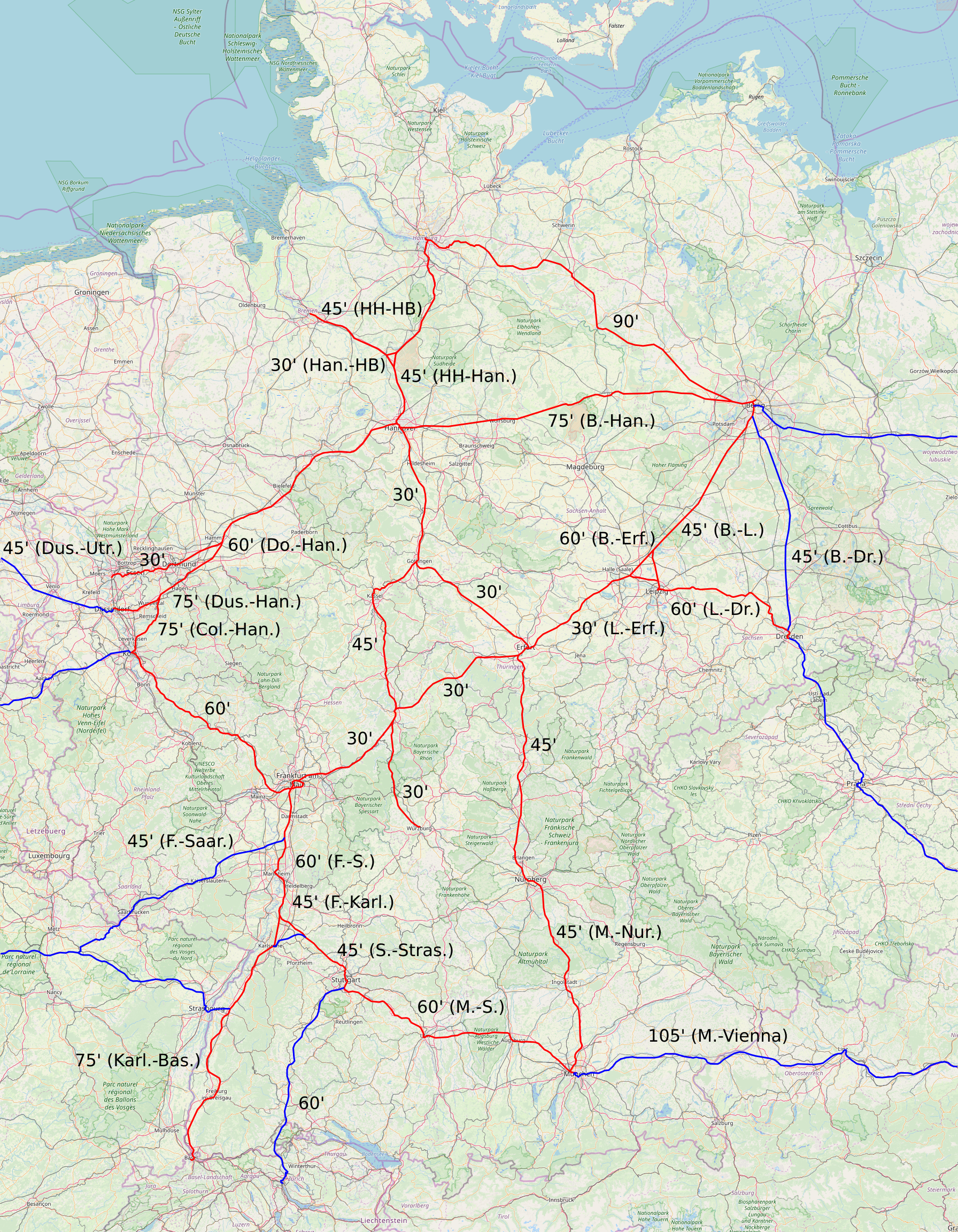
The red lines denote high-speed lines, some legacy 250-280 km/h lines but most built to support 300-320 km/h, that are justifiable within the context of domestic travel. Some of these already exist, such as the Frankfurt-Cologne line and the majority of the Berlin-Munich line; Berlin-Hamburg is a legacy line upgraded to 230, currently tied with Frankfurt-Cologne for fastest average speed between two major cities in Germany. A handful of red lines are key legacy connections, i.e. Dresden-Leipzig and Dortmund-Duisburg. Some more detail on the red lines is available in Google Maps.
The blue lines denote high-speed lines, generally built to 300, that only make sense in an international context. The lines in France are the LGV Est and its short low-speed branch across the border to Saarbrücken. In Belgium the line preexists as well as HSL 3 and HSL 4, but is quite slow, averaging only 140 km/h from Brussels to Aachen thanks to a combination of a slow segment to Leuven and a speed-restricted western approach to Liege. In the Netherlands, Switzerland, Czechia, Austria, and Poland the lines are completely speculative, though in Czechia a high-speed line from Prague to Dresden is under study.
Update 8/19: here is another map of the same network, color-coded differently – red is proposed lines (most by me, a few officially), yellow is lines under construction, blue is existing lines, black is low-speed connections. Note that outside Berlin’s northern approaches, urban approaches are not colored black even if they’re slow.
Trip times
To compute trip times, I dusted off my train performance calculator, linked here. The parameters I used are those planned for the next-generation Velaro (“Velaro Novo“), i.e. a power-to-weight ratio of 20.7 kW/t and an initial acceleration rate of 0.65 m/s^2; the quadratic air resistance term is 0.000012, as any higher term would make it impossible to reach speeds already achieved in tests. On curves, the lateral acceleration in the horizontal plane is set at 2.09 m/s^2 on passenger-priority lines, mirroring what is achieved on Frankfurt-Cologne, and 1.7 elsewhere, accounting for lower superelevation.
These are aggressive assumptions and before running the code, I did not expect Berlin-Munich to be so fast. With intermediate stops at Erfurt, Nuremberg, and maybe also Ingolstadt, this city pair could be connected in 2.5 hours minus a few minutes for interchange time at the terminals. In general, all trip times printed on the map are a few minutes slower than what is achievable even with some schedule padding, corresponding to dwell times at major through-stations plus interchange at terminals. The upshot is that among the largest metro areas in Germany, the longest trips are Hamburg-Stuttgart at 3:30 minus change and Hamburg-Munich at 3:15 minus change; nothing else is longer than 3 hours.
The stopping pattern should be uniform. That is, every 320 km/h train between Berlin and Munich should stop exactly at Berlin Südkreuz, Erfurt, Nuremberg, and maybe Ingolstadt. If these trains skip Ingolstadt, it’s fine to run some 250 km/h trains part of the way, for example between Munich and Nuremberg and then northwest on legacy track to Würzburg and Frankfurt, with the Ingolstadt station added back. Similarly, from Hamburg south, every train should stop at Hanover, Göttingen, Kassel, and Fulda.
In certain cases, the stopping pattern should be decided based on whether trains can make a schedule in an exact number of quarter-hours. That is, if it turns out that Munich-Nuremberg with an intermediate stop in Ingolstadt takes around 42 minutes then the Ingolstadt stop should be kept; but if it takes 46 minutes, then Ingolstadt should be skipped, and instead of running in the depicted alignment, the line should stay near the Autobahn and bypass the city in order to be able to make it in less than 45 minutes. I think Ingolstadt can still be kept, but one place where the map is likely to be too optimistic is Stuttgart-Munich; Ulm may need to be skipped on the fastest trains, and slower trains should pick up extra stops so as to be 15 minutes slower.
Frequency and service planning
Today, the frequency on the major city pairs is hourly. Under the above map, it should be half-hourly, since the faster trip times will induce more ridership. As a sanity check, TGVs connect Paris with each of Lyon’s two stations hourly off-peak and twice an hour at the peak. Paris is somewhat larger than the entire Rhine-Ruhr, Lyon somewhat smaller than Stuttgart or Munich and somewhat larger than the Rhine-Neckar. But the ICE runs somewhat smaller trains and has lower occupancy as it runs trains on a consistent schedule all day, so matching the peak schedule on the TGV is defensible.
The upshot is that Berlin can probably be connected every 30 minutes to each of Hamburg, Munich, Frankfurt, Cologne, Düsseldorf, and the Ruhr proper. Frankfurt-Munich is likely to be every 30 minutes, as are Hamburg-Frankfurt and Hamburg-Munich. To further improve network connectivity, the schedule at Erfurt should be set in such a way that Hamburg-Munich and Berlin-Frankfurt trains are timed with a cross-platform transfer, regardless of the pulse anywhere else. A few connections to smaller cities should be hourly, like Berlin-Bremen (with a timed transfer at Hanover to Hamburg-Frankfurt or Hamburg-Munich), Leipzig-Munich, Leipzig-Frankfurt, and Frankfurt-Basel.
The loop track around Frankfurt is based on a real plan for mainline through-tracks at the station, currently in the early stages of construction. The near-Autobahn loop is not included, but such a connection, if done at-grade, could provide value by letting trains from Munich enter the station from the east and then continue northwest toward Cologne without reversing direction.
If the international connections are built as planned, then additional hourly and even more frequent connections can be attractive. Zurich-Stuttgart might well even support a train every half hour, going all the way to Frankfurt and thence to either Cologne or Berlin. Similarly, Berlin-Frankfurt-Paris could plausibly fill an hourly train if Frankfurt-Paris is cut to 2:30 via Saarbrücken, and maybe even if it takes three hours via Karlsruhe.
The one exception to this interconnected mesh is Fulda-Würzburg. The Hanover-Würzburg line was built as a single 280 km/h spine through West Germany with low-speed branches down to Frankfurt and Munich. Unfortunately, completing the Würzburg-Nuremberg segment has little value: Munich-Frankfurt would be almost as fast via Stuttgart, and Hamburg-Munich would be half an hour faster via Erfurt with not much more construction difficulty on Göttingen-Erfurt. Fulda-Würzburg should thus be a shuttle with timed transfers at Fulda, potentially continuing further south at lower speed to serve smaller markets in Bavaria.
Cost
The domestic network depicted on the map is 1,300 km long, not counting existing or under-construction lines. Some lines require tunneling, like Erfurt-Fulda-Frankfurt, but most do not; the heaviest lifting has already been done, including between Erfurt and Nuremberg and around Stuttgart for Stuttgart 21 and the under-construction high-speed line to Ulm. I doubt 100 km of tunnel are necessary for this network; for comparison, Hanover-Würzburg alone has 120 km of tunnel, as the line has very wide curve radii to support both high-speed passenger rail and low-speed freight without too much superelevation. The cost should be on the order of 30-40 billion euros.
The international network is more complex. Berlin-Prague is easy on the German side and even across the border, and the only real problems are on the Czech side, especially as Czech planners insist on serving Usti on the way with a city center station. But Stuttgart-Zurich is a world of pain, and Frankfurt-Saarbrücken may require some tunneling through rolling terrain as well, especially around Saarbrücken itself.
Even with the international lines added in, the German share of the cost should not be too onerous. Getting everything in less than 50 billion euros should not be hard, even with some compromises with local NIMBYs. Even on an aggressive schedule aiming for completion by 2030, it’s affordable in a country where the budget surplus in 2018 was €58 billion across all levels of government and where there are signs of impending recession rather than inflation.
With its mesh of medium-size cities all over the country following plausible lines, Germany is well-placed to have the largest high-speed rail network in Europe. It has the ability to combine the precise scheduling and connections of Switzerland and the Netherlands with the high point-to-point speeds of France and Spain, creating a system that obsoletes domestic flights and competes well with cars and intercity buses. The government can implement this; all it takes is the political will to invest in a green future.
Why You Should Complete High-Speed Lines
Some countries build complete high-speed rail networks, on which one can travel between cities almost entirely at high speed, such as France, Japan, and China. Others build partial networks, mixing low- and high-speed travel, such as Germany. The planning lingo in the latter is “strategic bypass” or “strategic connection.” And yet, there is nothing strategic about most mixed lines. If a line between two cities is partly high-speed and partly low-speed, it is usually strategic to complete the high-speed line and provide fast travel – the benefits will exceed those of having built the original high-speed partial segment. Since Germany’s rail network largely consists of such mixed lines, the benefits of transitioning to full high-speed rail here are large.
The arguments I’m about to present are not entirely new. To some extent, I discussed an analog years ago when arguing that in the presence of a complete high-speed line, the benefits of building further extensions are large; this post is a generalization of what I wrote in 2013. Then, a few months ago, I blogged about positive and negative interactions. I didn’t discuss high-speed rail, but the effect of travel time on ridership is such that different segments of the same line positively interact.
The upshot is that once the basics of a high-speed rail networks are in place, the benefit-cost ratio of further extensions is high. In a country with no such network, the first line or segments may look daunting, such as India or the UK, but once it’s there, the economics of the rest tend to fall into place. It takes a while for returns to diminish below the point of economic viability.
A toy model
Take a low-speed rail line:
Now build a high-speed line parallel to half of it and connect it with the remaining half:
You will have reduced trip time from 4 hours to 3 hours. This has substantial benefits in ridership and convenience. But then you can go all the way and make the entire line fast:
Are there diminishing returns?
No.
The benefits of reducing travel time per unit of absolute amount of time saved always increase in speed; they never decrease. The gravity model holds that ridership follows an inverse square law in total cost, including ticket fare and the passengers’ value of time, which time includes access and egress time. Reducing in-vehicle travel time by a fixed amount, say an hour, increases ridership more if the initial travel time is already lower.
This is on top of reductions in operating costs coming from higher speed. Trains on high-speed track consume less electricity than on legacy track, because they cruise at a constant speed, and because head-end power demand scales with time rather than distance traveled. Crew wages per kilometer are lower on faster trains. And the cost of rolling stock procurement and maintenance is spread across a longer distance if the same train is run more kilometers per year. In the toy model, there are actually increasing returns coming from rolling stock costs: upgrading half the line to high speed requires running an expensive high-speed train on the entire line, whereas completing the high-speed line does not require increasing the cost per unit of rolling stock.
Diminishing returns do occur, but only in the context of an increase in top speed, not in that of speeding up slow segments to match the top speed of faster segments. In that context, benefits do diminish and costs do rise, but that is not the same as completing high-speed lines.
As the maximum speed is increased from 160 to 200 km/h, the train speeds up from 22.5 seconds per kilometer to 18. To provide the same increase further, that is to reduce the time taken to traverse a kilometer by a further 4.5 seconds to 13.5, the speed must increase to 266.67 km/h. To provide the same 4.5-second increase once more, the speed must increase to 400. Curve radius is proportional to the square of speed, so these increases in speed must be accompanied by much more exacting track geometry. Tunnels may well be unavoidable at the higher speeds in topography that could accommodate 200-250 entirely at-grade.
What’s more, operating costs rise too as top speed increases. The electricity consumption on a 300 km/h cruise is lower than on a legacy line on which trains transition back and forth between 200 and 100 and all speeds in between, but the electricity consumption on a 350 km/h cruise is definitely higher than on a 250 km/h cruise.
However, what is relevant to the decision of what standards to build a line to is not relevant to the decision of how far to extend this standard. Once a 300 km/h segment has been built, with a dedicated fleet of trains that cost €30 million per 200-meter set, the returns to upgrading the entire segment the train runs on are higher than those of just building the initial segment.
Can some strategic segments be easier to build than others?
Yes, but only in one specific situation: that of an urban area. The toy model says nothing of construction costs – in effect, it assumes the cost of making the first 200 km fast is the same as that of making the next 200 km fast. In reality, different areas may have different construction challenges, making some parts easier to build than others.
However, if the construction challenge is mountainous topography, then the higher cost of mountain tunnels balance out the greater benefit of fast trains across mountains. The reason is that in practice, legacy rail lines are faster in flat terrain than in the mountains, where past construction compromises led to sharp curves.
This situation is different in urban areas. In urban areas as in the mountains, costs are higher – land acquisition is difficult, and tunnels may be required in areas where the alternative is buying out entire city blocks. But unlike in the mountains, the existing rail line may well be reasonably straight, permitting average speeds in the 120 km/h area rather than the 70 km/h area. In that case, it may be advisable to postpone construction until later, or even keep the legacy alignment.
One example is the Ruhr area. The tracks between Dortmund and Duisburg are not high-speed rail – the fastest trains do the trip in about 34 minutes, an average speed of about 95 km/h. Speeding them up by a few minutes is feasible, but going much below 30 minutes is not. Thus, even if there is a 300 km/h line from Dortmund to points east, the returns to the same speedup between Dortmund and Duisburg are low. (Besides which, Dortmund is the largest city in the Ruhr, and the second largest, Essen, in the middle between Dortmund and Duisburg.)
Another is Connecticut. East of New Haven, there is relatively little urban development, and constructing a 300-360 km/h line roughly along the right-of-way of I-95 poses few challenges. West of New Haven, such construction would require extensive tunneling and elevated construction – and the legacy line is actually somewhat less curvy, it’s just slower because of poor timetable coordination between Amtrak’s intercity trains and Metro-North’s regional trains. While the returns to building 250-300 km/h bypasses around the line’s slowest points in southwestern Connecticut remain high enough to justify the project, they’re lower than those in southeastern Connecticut.
The situation in Germany
On the following map, black denotes legacy lines and red denotes purpose-built 300 km/h high-speed lines:
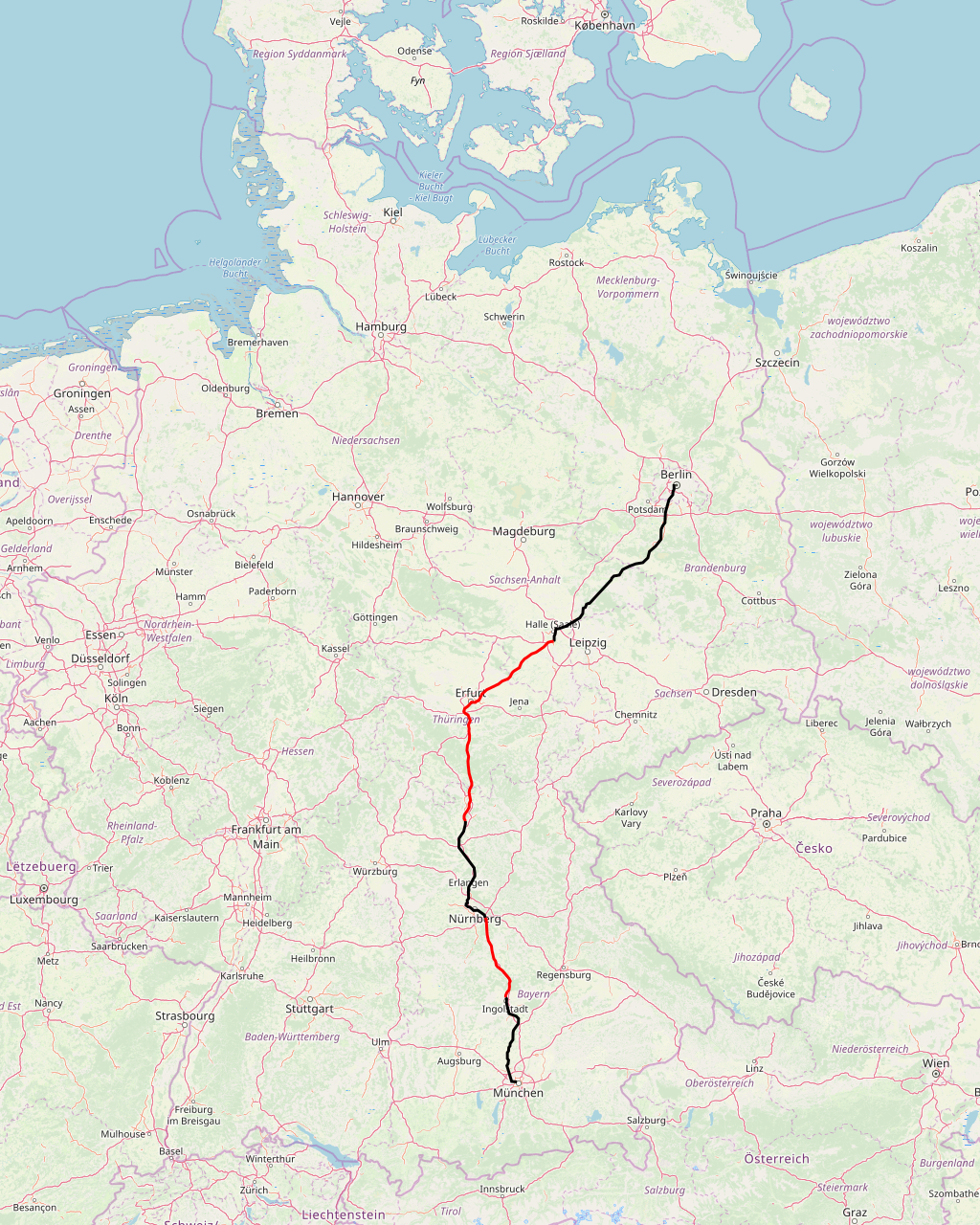
The longer red segment, through Erfurt, is the more challenging one, including long tunnels through the mountains between Thuringia and Bavaria. The complexity and cost of construction led to extensive media controversy. In particular, the choice of the route through Erfurt came about due to Thuringia’s demands that it serve its capital rather than smaller cities; DB’s preference would have been to build a more direct Leipzig-Nuremberg route, which would have had shorter tunnels as the mountains in eastern Thuringia are lower and thinner.
Since then, a lot of water has passed under the bridge. The route opened at the end of 2017 and cut travel time from 6 hours to 4, bypassing the slowest mountain segment, and is considered a success now. In the North German Plain, the trains mostly cruise at 200 km/h, and trains traverse the 163.6 km between Berlin and Halle in 1:09-1:11, an average speed of 140 km/h.
Nonetheless, the benefits of painting the entire map red, roughly from the city limits of Berlin to those of Munich, are considerable. The North German Plain’s flat topography enables trains to average 140 km/h, but also means that building a high-speed line would be cheap – around 137 km of new-build line would be needed, all at-grade, at a cost of about €2.5 billion, which would cut about half an hour from the trip time. In Bavaria, the topography is rougher and consequently the legacy trains’ average speed is lower, but nonetheless, high-speed rail can be built with cut-and-fill, using 4% grades as on the Cologne-Frankfurt line.
I’m uncertain about the exact travel time benefits of such a high-speed line. I put a route through my train performance calculator and got about 2.5 hours with intermediate stops at Südkreuz, Erfurt, Nuremberg, and possibly Ingolstadt (skipping Ingolstadt saves 3 minutes plus the dwell time), using the performance characteristics of the next-generation Velaro. But I’m worried that my speed zones are too aggressive and that the schedule should perhaps accommodate TGVs coming from Paris via Frankfurt, so I won’t commit to 2:30; however, 2:45-2:50 should be doable, even with some unforeseen political compromises.
But even with less optimistic assumptions about trip times, Germany should do it. If it was justifiable to spend €10 billion on reducing trip times from 6 hours to just under 4, it should be justifiable to spend around half that amount on reducing trip times by another hour and change.
Deutschlandtakt and Country Size
Does the absolute size of a country matter for public transport planning? Usually it does not – construction costs do not seem to be sensitive to absolute size, and the basics of rail planning do not either. That Europe’s most intensely used mainline rail networks are those of Switzerland and the Netherlands, two geographically small countries, is not really about the inherent benefits of small size, but about the fact that most countries in Europe are small, so we should expect the very best as well as the very worst to be small.
But now Germany is copying Swiss and Dutch ideas of nationally integrated rail planning, in a way that showcases where size does matter. For decades Switzerland has had a national clockface schedule in which all trains are coordinated for maximum convenience of interchange between trains at key stations. For example, at Zurich, trains regularly arrive just before :00 and :30 every hour and leave just after, so passengers can connect with minimum wait. Germany is planning to implement the same scheme by 2030 but on a much bigger scale, dubbed Deutschlandtakt. This plan is for the most part good, but has some serious problems that come from overlearning from small countries rather than from similar-size France.
In accordance with best industry practices, there is integration of infrastructure and timetable planning. I encourage readers to go to the Ministry of Transport (BMVI) and look at some line maps – there are links to line maps by region as well as a national map for intercity trains. The intercity train map is especially instructive when it comes to scale-variance: it features multihour trips that would be a lot shorter if Germany made a serious attempt to build high-speed rail like France.
Before I go on and give details, I want to make a caveat: Germany is not the United States. BMVI makes a lot of errors in planning and Deutsche Bahn is plagued by delays; these are still basically professional organizations, unlike the American amateur hour of federal and state transportation departments, Amtrak, and sundry officials who are not even aware Germany has regional trains. As in London and Paris, the decisions here are defensible, just often incorrect.
Run as fast as necessary
Switzerland has no high-speed rail. It plans rail infrastructure using the maxim, run trains as fast as necessary, not as fast as possible. Zurich, Basel, and Bern are around 100 km from one another by rail, so the federal government invested in speeding up the trains so as to serve each city pair in just less than an hour. At the time of this writing, Zurich-Bern is 56 minutes one-way and the other two pairs are 53 each. Trains run twice an hour, leaving each of these three cities a little after :00 and :30 and and arriving a little before, enabling passengers to connect to onward trains nationwide.
There is little benefit in speeding up Switzerland’s domestic trains further. If SBB increases the average speed to 140 km/h, comparable to the fastest legacy lines in Sweden and Britain, it will be able to reduce trip times to about 42 minutes. Direct passengers would benefit from faster trips, but interchange passengers would simply trade 10 minutes on a moving train for 10 minutes waiting for a connection. Moreover, drivers would trade 10 minutes working on a moving train for 10 minutes of turnaround, and the equipment itself would simply idle 10 minutes longer as well, and thus there would not be any savings in operating costs. A speedup can only fit into the national takt schedule if trains connect each city pair in just less than half an hour, but that would require average speeds near the high end of European high-speed rail, which are only achieved with hundreds of kilometers of nonstop 300 km/h running.
Instead of investing in high-speed rail like France, Switzerland incrementally invests in various interregional and intercity rail connections in order to improve the national takt. To oversimplify a complex situation, if a city pair is connected in 1:10, Switzerland will invest in reducing it to 55 minutes, in order to allow trains to fit into the hourly takt. This may involve high average speeds, depending on the length of the link. Bern is farther from Zurich and Basel than Zurich and Basel are from each other, so in 1996-2004, SBB built a 200 km/h line between Bern and Olten; it has more than 200 trains per day of various speed classes, so in 2007 it became the first railroad in the world to be equipped with ETCS Level 2 signaling.
With this systemwide thinking, Switzerland has built Europe’s strongest rail network by passenger traffic density, punctuality, and mode share. It is this approach that Germany seeks to imitate. Thus, the Deutschlandtakt sets up control cities served by trains on a clockface schedule every 30 minutes or every hour. For example, Erfurt is to have four trains per hour, two arriving just before :30 and leaving just after and two arriving just before :00 and leaving just after; passengers can transfer in all directions, going north toward Berlin via either Leipzig or Halle, south toward Munich, or west toward Frankfurt.
Flight-level zero airlines
Richard Mlynarik likes to mock the idea of high-speed rail as conceived in California as a flight-level zero airline. The mockery is about a bunch of features that imitate airlines even when they are inappropriate for trains. The TGV network has many flight-level zero airline features: tickets are sold using an opaque yield management system; trains mostly run nonstop between cities, so for example Paris-Marseille trains do not stop at Lyon and Paris-Lyon trains do not continue to Marseille; frequency is haphazard; transfers to regional trains are sporadic, and occasionally (as at Nice) TGVs are timed to just miss regional connections.
And yet, with all of these bad features, SNCF has higher long-distance ridership than DB, because at the end of the day the TGVs connect most major French cities to Paris at an average speed in the 200-250 km/h range, whereas the fastest German intercity trains average about 170 and most are in the 120-150 range. The ICE network in Germany is not conceived as complete lines between pairs of cities, but rather as a series of bypasses around bottlenecks or slow sections, some with a maximum speed of 250 and some with a maximum speed of 300. For example, between Berlin and Munich, only the segments between Ingolstadt and Nuremberg and between Halle and north of Bamberg are on new 300 km/h lines, and the rest are on upgraded legacy track.
Even though the maximum speed on some connections in Germany is the same as in France, there are long slow segments on urban approaches, even in cities with ample space for bypass tracks, like Berlin. The LGV Sud-Est diverges from the classical line 9 kilometers outside Paris and permits 270 km/h 20 kilometers out; on its way between Paris and Lyon, the TGV spends practically the entire way running at 270-300 km/h. No high-speed lines get this close to Berlin or Munich, even though in both cities, the built-up urban area gives way to farms within 15-20 kilometers of the train station.
The importance of absolute size
Switzerland and the Netherlands make do with very little high-speed rail. Large-scale speedups are of limited use in both countries, Switzerland because of the difficulty of getting Zurich-Basel trip times below half an hour and the Netherlands because all of its major cities are within regional rail distance of one another.
But Germany is much bigger. Today, ICE trains go between Berlin and Munich, a distance of about 600 kilometers, in just less than four hours. The Deutschlandtakt plan calls for a few minutes’ speedup to 3:49. At TGV speed, trains would run about an hour faster, which would fit well with timed transfers at both ends. Erfurt is somewhat to the north of the midpoint, but could still keep a timed transfer between trains to Munich, Frankfurt, and Berlin if everything were sped up.
Elsewhere, DB is currently investing in improving the line between Stuttgart and Munich. Trains today run on curvy track, taking about 2:13 to do 250 km. There are plans to build 250 km/h high-speed rail for part of the way, targeting a trip time of 1:30; the Deutschlandtakt map is somewhat less ambitious, calling for 1:36, with much of the speedup coming from Stuttgart21 making the intercity approach to Stuttgart much easier. But with a straight line distance of 200 km, even passing via Ulm and Augsburg, trains could do this trip in less than an hour at TGV speeds, which would fit well into a national takt as well. No timed transfers are planned at Augsburg or Ulm. The Baden-Württemberg map even shows regional trains (in blue) at Ulm timed to just miss the intercity trains to Munich. Likewise, the Bavaria map shows regional trains at Augsburg timed to just miss the intercity trains to Stuttgart.
The same principle applies elsewhere in Germany. The Deutschlandtakt tightly fits trains between Munich and Frankfurt, doing the trip in 2:43 via Stuttgart or 2:46 via Nuremberg. But getting Munich-Stuttgart to just under an hour, together with Stuttgart21 and a planned bypass of the congested Frankfurt-Mannheim mainline, would get Munich-Frankfurt to around two hours flat. Via Nuremberg, a new line to Frankfurt could connect Munich and Frankfurt in about an hour and a half at TGV speed; even allowing for some loose scheduling and extra stops like Würzburg, it can be done in 1:46 instead of 2:46, which fits into the same integrated plan at the two ends.
The value of a tightly integrated schedule is at its highest on regional rail networks, on which trains run hourly or half-hourly and have one-way trip times of half an hour to two hours. On metro networks the value is much lower, partly because passengers can make untimed transfers if trains come every five minutes, and partly because when the trains come every five minutes and a one-way trip takes 40 minutes, there are so many trains circulating at once that the run-as-fast-as-necessary principle makes the difference between 17 and 18 trainsets rather than that between two and three. In a large country in which trains run hourly or half-hourly and take several hours to connect major cities, timed transfers remain valuable, but running as fast as necessary is less useful than in Switzerland.
The way forward for Germany
Germany needs to synthesize the two different rail paradigms of its neighbors – the integrated timetables of Switzerland and the Netherlands, and the high-speed rail network of France.
High investment levels in rail transport are of particular importance in Germany. For too long, planning in Germany has assumed the country would be demographically stagnant, even declining. There is less justification for investment in infrastructure in a country with the population growth rate of Italy or of last decade’s Germany than in one with the population growth rate of France, let alone one with that of Australia or Canada. However, the combination of refugee resettlement and a very strong economy attracting European and non-European work migration is changing this calculation. Even as the Ruhr and the former East Germany depopulate, we see strong population growth in the rich cities of the south and southwest as well as in Berlin.
The increased concentration of German population in the big cities also tilts the best planning in favor of the metropolitan-centric paradigm of France. Fast trains between Berlin, Frankfurt, and Munich gain value if these three cities grow in population whereas the smaller towns between them that the trains would bypass do not.
The Deutschlandtakt’s fundamental idea of a national integrated timed transfer schedule is good. However, a country the size and complexity of Germany needs to go beyond imitating what works in Switzerland and the Netherlands, and innovate in adapting best practices for its particular situation. People keep flying domestically since the trains take too long, or they take buses if the trains are too expensive and not much faster. Domestic flights are not a real factor in the Netherlands, and barely at all in Switzerland; in Germany they are, so trains must compete with them as well as with flexible but slow cars.
The fact that Germany already has a functional passenger rail network argues in favor of more aggressive investment in high-speed rail. The United States should probably do more than just copy Switzerland, but with nonexistent intercity rail outside the Northeast Corridor and planners who barely know that Switzerland has trains, it should imitate rather than innovating. Germany has professional planners who know exactly how Germany falls short of its neighbors, and will be leaving too many benefits on the table if it decides that an average speed of about 150 km/h is good enough.
Germany can and should demand more: BMVI should enact a program with a budget in the tens of billions of euros to develop high-speed rail averaging 200-250 km/h connecting all of its major cities, and redo the Deutschlandtakt plans in support of such a network. Wedding French success in high-speed rail and Swiss and Dutch success in systemwide rail integration requires some innovative planning, but Germany is capable of it and should lead in infrastructure construction.
 Pedestrian Observations

