Category: Good Transit
How Many Tracks Do Train Stations Need?
A brief discussion on Reddit about my post criticizing Penn Station expansion plans led me to write a very long comment, which I’d like to hoist to a full post explaining how big an urban train station needs to be to serve regional and intercity rail traffic. The main principles are,
- Good operations can substitute for station size, and it’s always cheaper to get the system to be more reliable than to build more tracks in city center.
- Through-running reduces the required station footprint, and this is one of the reasons it is popular for urban commuter rail systems.
- The simpler and more local the system is, the fewer tracks are needed: an urban commuter rail system running on captive tracks with no sharing tracks with other traffic and with limited branching an get away with smaller stations than an intercity rail station featuring trains from hundreds of kilometers away in any direction.
The formula for minimum headways
On subways, where usually the rush hour crunches are the worst, trains in large cities run extremely frequently, brushing up against the physical limitation of the tracks. The limit is dictated by the brick wall rule, which states that the signal system must at any point assume that the train ahead can turn into a brick wall and stop moving and the current train must be able to brake in time before it reaches it. Cars, for that matter, follow the same rule, but their emergency braking rate is much faster, so on a freeway they can follow two seconds apart. A metro train in theory could do the same with headways of 15 seconds, but in practice there are stations on the tracks and dealing with them requires a different formula.
With metro-style stations, without extra tracks, the governing formula is,

Platform clearing time is how long it takes the train to clear its own length; the idea of the formula is that per the brick wall rule, the train we’re on needs to begin braking to enter the next station only after the train ahead of ours has cleared the station.
But all of this is in theory. In practice, there are uncertainties. The uncertainties are almost never in the stopping or platform clearing time, and even the dwell time is controllable. Rather, the schedule itself is uncertain: our train can be a minute late, which for our purpose as passengers may be unimportant, but for the scheduler and dispatcher on a congested line means that all the trains behind ours have to also be delayed by a minute.
What this means that more space is required between train slots to make schedules recoverable. Moreover, the more complex the line’s operations are, the more space is needed. On a metro train running on captive tracks, if all trains are delayed by a minute, it’s really not a big deal even to the control tower; all the trains substitute for one another, so the recovery can be done at the terminal. On a mainline train running on a national network in which our segment can host trains to Budapest, Vienna, Prague, Leipzig, Munich, Zurich, Stuttgart, Frankfurt, and Paris, trains cannot substitute for one another – and, moreover, a train can be easily delayed 15 minutes and need a later slot. Empty-looking space in the track timetable is unavoidable – if the schedule can’t survive contact with the passengers, it’s not a schedule but crayon.
How to improve operations
In one word: reliability.
In two words: more reliability.
Because the main limit to rail frequency on congested track comes from the variation in the schedule, the best way to increase capacity is to reduce the variation in the schedule. This, in turn, has two aspects: reducing the likelihood of a delay, and reducing the ability of a delay to propagate.
Reducing delays
The central insight about delays is that they may occur anywhere on the line, roughly in proportion to either trip time or ridership. This means that on a branched mainline railway network, delays almost never originate at the city center train station or its approaches, not because that part of the system is uniquely reliable, but because the train might spend five minutes there out of a one-hour trip. The upshot is that to make a congested central segment more reliable, it is necessary to invest in reliability on the entire network, most of which consists of branch segments that by themselves do not have capacity crunches.
The biggest required investments for this are electrification and level boarding. Both have many benefits other than schedule reliability, and are underrated in Europe and even more underrated in the United States.
Electrification is the subject of a TransitMatters report from last year. As far as reliability is concerned, the LIRR and Metro-North’s diesel locomotives average about 20 times the mechanical failure rate of electric multiple units (source, PDF-pp. 36 and 151). It is bad enough that Germany is keeping some outer regional rail branches in the exurbs of Berlin and Munich unwired; that New York has not fully electrified is unconscionable.
Level boarding is comparable in its importance. It not only reduces dwell time, but also reduces variability in dwell time. With about a meter of vertical gap between platform and train floor, Mansfield has four-minute rush hour dwell times; this is the busiest suburban Boston commuter rail station at rush hour, but it’s still just about 2,000 weekday boardings, whereas RER and S-Bahn stations with 10 time the traffic hold to a 30-second standard. This also interacts positively with accessibility: it permits passengers in wheelchairs to board unaided, which both improves accessibility and ensures that a wheelchair user doesn’t delay the entire train by a minute. It is fortunate that the LIRR and (with one peripheral exception) Metro-North are entirely high-platform, and unfortunate that New Jersey Transit is not.
Reducing delay propagation
Even with reliable mechanical and civil engineering, delays are inevitable. The real innovations in Switzerland giving it Europe’s most reliable and highest-use railway network are not about preventing delays from happening (it is fully electrified but a laggard on level boarding). They’re about ensuring delays do not propagate across the network. This is especially notable as the network relies on timed connections and overtakes, both of which require schedule discipline. Achieving such discipline requires the following operations and capital treatments:
- Uniform timetable padding of about 7%, applied throughout the line roughly on a one minute in 15 basis.
- Clear, non-discriminatory rules about train priority, including a rule that a train that’s more than 30 minutes loses all priority and may not delay other trains at junctions or on shared tracks.
- A rigid clockface schedule or Takt, where the problem sections (overtakes, meets, etc.) are predictable and can receive investment. With the Takt system, even urban commuter lines can be left partly single-track, as long as the timetable is such that trains in opposite directions meet away from the bottleneck.
- Data-oriented planning that focuses on tracing the sources of major delays and feeding the information to capital planning so that problem sections can, again, receive capital investment.
- Especial concern for railway junctions, which are to be grade-separated or consistently scheduled around. In sensitive cases where traffic is heavy and grade separation is too expensive, Switzerland builds pocket tracks at-grade, so that a late train can wait for a slot without delaying cross-traffic.
So, how big do train stations need to be?
A multi-station urban commuter rail trunk can get away with metro-style operations, with a single station track per approach track. However, the limiting factor to capacity will be station dwell times. In cases with an unusually busy city center station, or on a highly-interlinked regional or intercity network, this may force compromises on capacity.
In contrast, with good operations, a train station with through-running should never need more than two station tracks per approach track. Moreover, the two station tracks that each approach track splits into should serve the same platform, so that if there is an unplanned rescheduling of the train, passengers should be able to use the usual platform at least. Berlin Hauptbahnhof’s deep tracks are organized this way, and so is the under-construction Stuttgart 21.
Why two? First, because it is the maximum number that can serve the same platform; if they serve different platforms, it may require lengthening dwell times during unscheduled diversions to deal with passenger confusion. And second, because every additional platform track permits, in theory, an increase in the dwell time equal to the minimum headway. The minimum headway in practice is going to be about 120 seconds; at rush hour Paris pushes 32 trains per hour on the shared RER B and D trunk, which is not quite mainline but is extensively branched, but the reliability is legendarily poor. With a two-minute headway, the two-platform track system permits a straightforward 2.5-minute dwell time, which is more than any regional railway needs; the Zurich S-Bahn has 60-second dwells at Hauptbahnhof, and the Paris RER’s single-level trains keep to about 60 seconds at rush hour in city center as well.
All of this is more complicated at a terminal. In theory the required number of tracks is the minimum turn time divided by the headway, but in practice the turn time has a variance. Tokyo has been able to push station footprint to a minimum, with two tracks at Tokyo Station on the Chuo Line (with 28 peak trains per hour) and, before the through-line opened, four tracks on the Tokaido Main Line (with 24). But elsewhere the results are less optimistic; Paris is limited to 16-18 trains per hour at the four-track RER E terminal at Saint-Lazare.
At Paris’s levels of efficiency, which are well below global best practices, an unexpanded Penn Station without through-running would still need two permanent tracks for Amtrak, leaving 19 tracks for commuter traffic. With the Gateway tunnel built, there would be four two-track approaches, two from each direction. The approaches that share tracks with Amtrak (North River Tunnels, southern pair of East River Tunnels) would get four tracks each, enough to terminate around 18 trains per hour at rush hour, and the approaches that don’t would get five, enough for maybe 20 or 22. The worst bottleneck in the system, the New Jersey approach, would be improved from today’s 21 trains per hour to 38-40.
A Penn Station with through-running does not have the 38-40 trains per hour limit. Rather, the approach tracks would become the primary bottleneck, and it would take an expansion to eight approach tracks on each side for the station itself to be at all a limit.
Watch Our Webinar on Construction Costs Tomorrow
The Italy case, done by Marco Chitti, is up on the website. I encourage people to read the entire report on how Italy has set things up in the last 20-30 years so as to have one of the lowest-cost urban rail infrastructure programs in the world. The Turkey case, by Elif Ensari, will be up shortly.
This is leading to a webinar, to be done tomorrow at 16:00 my time, 10:00 New York time, in which Marco and Elif will present their cases to the general public. I encourage people to register; you’ll be able to ask us questions and we’ll answer in chat or on video. But if you can’t make it, it will be recorded.
Systemic Investments in the New York City Subway
Subway investments can include expansion of the map of lines, for example Second Avenue Subway; proposals for such extensions are affectionately called crayon, a term from London Reconnections that hopped the Pond. But they can also include improvements that are not visible as lines on a map, and yet are visible to passengers in the form of better service: faster, more reliable, more accessible, and more frequent.
Yesterday I asked on Twitter what subway investments people think New York should get, and people mostly gave their crayons. Most people gave the same list of core lines – Second Avenue Subway Phase 2, an extension of the 2 and 5 on Nostrand, an extension of the 4 on Utica, an extension of the N and W to LaGuardia, the ongoing Interborough Express proposal, and an extension of Second Avenue Subway along 125th – but beyond that there’s wide divergence and a lot of people argue over the merits of various extensions. But then an anonymous account that began last year and has 21 followers and yet has proven extremely fluent in the New York transit advocacy conversation, named N_LaGuardia, asked a more interesting question: what non-crayon systemic investments do people think the subway needs?
On the latter question, there seems to be wide agreement among area technical advocates, and as far as I can tell the main advocacy organizations agree on most points. To the extent people gave differing answers in N_LaGuardia’s thread, it was about not thinking of everything at once, or running into the Twitter character limit.
It is unfortunate that many of these features requiring capital construction run into the usual New York problem of excessive construction costs. The same institutional mechanisms that make the region incapable of building much additional extension of the system also frustrate systemwide upgrades to station infrastructure and signaling.
Accessibility
New York has one of the world’s least accessible major metro systems, alongside London and (even worse) Paris. In contrast, Berlin, of similar age, is two-thirds accessible and planned to reach 100% soon, and the same is true of Madrid; Seoul is newer but was not built accessible and retrofits are nearly complete, with the few remaining gaps generating much outrage by people with disabilities.
Unfortunately, like most other forms of capital construction in New York, accessibility retrofits are unusually costly. The elevator retrofits from the last capital plan were $40 million per station, and the next batch is in theory $50 million, with the public-facing estimates saying $70 million with contingency; the range in the European cities with extensive accessibility (that is, not London or Paris) is entirely single-digit million. Nonetheless, this is understood to be a priority in New York and must be accelerated to improve the quality of universal design in the system.
Platform screen doors
The issue of platform screen doors (PSDs) or platform edge doors (PEDs) became salient earlier this year due to a much-publicized homicide by pushing a passenger onto a train, and the MTA eventually agreed to pilot PSDs at three stations. The benefits of PSDs are numerous, including,
- Safety – there are tens of accident and suicide deaths every year from falling onto tracks, in addition to the aforementioned homicide.
- Greater accessibility – people with balance problems have less to worry about from falling onto the track.
- Capacity – PSDs take up platform space but they permit passengers to stand right next to them, and the overall effect is to reduce platform overcrowding at busy times.
- Air cooling – at subway stations with full-height PSDs (which are rare in retrofits but I’m told exist in Seoul), it’s easier to install air conditioning for summer cooling.
The main difficulty is that PSDs require trains to stop at precise locations, to within about a meter, which requires signaling improvements (see below). Moreover, in New York, trains do not yet have consistent door placement, and the lettered lines even have different numbers of doors sometimes (4 per car but the cars can be 60′ or 75′ long) – and the heavily interlined system is such that it’s hard to segregate lines into captive fleets.
But the biggest difficulty, as with accessibility, is again the costs. In the wake of public agitation for PSDs earlier this year, the MTA released as 2019 study saying only 128 stations could be retrofitted with PSDs, at a cost of $7 billion each, or $55 million per station; in Paris, PSDs are installed on Métro lines as they are being automated, at a cost of (per Wikipedia) 4M€ per station of about half the platform length as in New York.
Signaling improvements
New York relies on ancient signaling for the subway. This leads to multiple problems: maintenance is difficult as the international suppliers no longer make the required spare parts; the signals are designed around the performance specs of generations-old trains and reduce capacity on more modern trains; the signals are confusing to drivers and therefore trains run slower than they can.
To modernize them, New York is going straight to the most advanced system available: CBTC, or communications-based train control, also known as moving-block signaling. This is already done on the L and 7 trains and is under installation on other lines, which are not isolated from the rest of the system. CBTC permits much higher peak capacity in London; in New York, unfortunately, this effect has been weaker because of other constraints, including weak electrical substation capacity and bumper tracks at the terminals of both the L and the 7.
Moreover, in New York, the L train’s performance was derated when CBTC was installed, to reduce brake wear. The effect of such computer control should be the opposite, as computers drive more precisely than humans: in Paris, the automation of Line 1 led to a speed increase of 15-20%, and CBTC even without automation has the same precision level as full automation.
As before, costs form a major barrier. I can’t give the most recent analogs, because such projects tend to bundle a lot of extras, such as new trainsets and PSDs in Paris. In Nuremberg, the first city in the world to permanently convert a preexisting metro system to driverless operations, the cost of just the driverless system is said to have been 110M€ in the late 2000s, for what I believe is 13 km of U2 (U3 was built with driverless operations in mind, and then U2, from which it branches, was converted). It is said that automating U1 should cost 100M€ for 19.5 km, but this project is not happening due to stiff competition for federal funds and therefore its real cost is uncertain. In contrast, Reinvent Albany quotes $636 million for the 7 train in New York, of which $202 million must be excluded as rolling stock conversion; the Flushing Line is 16 km long, so this is still $27 million/km and not the $7-12 million/km of Nuremberg.
Maintenance regime
The maintenance regime in New York involves heavy slowdowns and capacity restrictions. Trains run 24/7 without any breaks for regular maintenance. Instead, maintenance is done one track at a time during off-peak periods, with flagging rules that slow down trains on adjacent tracks and have gotten more onerous over the last 10-20 years; only recently have planners begun to use temporary barriers to reduce the burden of flagging.
The result of this system is threefold. First, track maintenance productivity is extremely low – the train on an adjacent track slows down as it passes but the work stops as it passes as well. Second, speeds are unreliable off-peak and the timetable is in perpetual firefighting mode. And third, parts of the system are claimed to be incapable of running more than about 16 trains per hour off-peak, which means that if there is any branching, the branches are limited to 8, which is not enough frequency on a major urban metro system.
It takes a small amount of capital spending to increase efficiency of maintenance, through procuring more advanced machinery, installing barriers between tracks, and installing crossovers at appropriate locations. But it takes a large degree of operations and management reform to get there, which is necessary for reducing the high operating costs of the subway.
Deinterlining
New York has the most complicated interlining of any global metro network. Only four lines – the 1, 6, 7, and L – run by themselves without any track sharing with other lines. The 2, 3, 4, and 5 share tracks with one another. Then the lettered trains other than the L all share tracks on various segments, without any further segregation. Only some commuter rail networks are more complex than this – and even Tokyo has greater degree of segregation between different trunk lines, despite extensive through-service to commuter rail. The New York way guarantees more direct service on more origin-destination pairs, but at low frequency and with poor speed and reliability.
London, the second most interlined system, has long wanted to reduce interlining to increase capacity. The Northern line traditionally had just one southern segment reverse-branching to two central trunks, combining and splitting into two northern branches. When CBTC opened, the busier of the central trunks got 26 peak trains per hour; the more recent Battersea extension removed the interlining to the south, permitting boosting capacity up to 32 tph, and full deinterlining to the north would boost it to 36 tph, as on the most captive Underground lines.
In New York, it is desirable to remove all reverse-branching. At DeKalb Avenue in Downtown Brooklyn, the interlocking switches the four express (bridge) tracks from an arrangement of the B and D on one track pair and the N and Q on the other to the B and Q on one track pair and the D and N on the other; the process is so complex that every train is delayed two minutes just from the operation of the switches. Everywhere within the system, interlining creates too much dependency between the different trains, so that delays on one line propagate to the others, reducing reliability, speed, and capacity.
Some of the problem is, as usual, about high costs. Rogers Avenue Junction controls the branching of the 2, 3, 4, and 5 trains in Brooklyn, transitioning from the 2 and 3 sharing one track pair and the 4 and 5 sharing another to the 3 and 4 running on dedicated tracks and the 2 and 5 sharing tracks. For a brief segment, the 2, 3 and 5 trains all share tracks. This devastates capacity on both trunk lines, which rank first and third citywide in peak crowding as of the eve of the opening of Second Avenue Subway. There are already internal designs for rebuilding the junction to avoid this problem – at a cost of $300 million.
But some of the problem is also about operating paradigms. New York must move away from the scheduling ideas of the 1920s and 30s and understand that independently-operated lines with dedicated fleets and timetables, with passengers making transfers as appropriate, are more robust and overall better for most riders. DeKalb can be deinterlined with no capital spending at all, and so can Columbus Circle. It’s Rogers and Queens Plaza where spending is ideal (but even then, not strictly required if some operational compromises are made), and the 142nd Street Junction in Harlem where an extensive rebuild is obligatory in order to permit splitting the 2 from the 5 in the Bronx permanently.
Labor changes
Staffing levels in New York are very high. Trains have conductors and not just drivers; this is not globally unheard of (Toronto and some lines in Tokyo still have conductors) but it’s rare. With good enough signaling, a retrofit even for full automation is possible, as in Nuremberg, Paris, and Singapore. Maintenance work is likewise unproductive, not because people don’t work hard, but because they work inefficiently.
Improving this situation involves changes on both sides of the ledger – staffing and service. Conductors have to be cut for efficiency and not all of them can be absorbed by other roles, and the same is true of some station facilities and maintenance functions. In contrast, the low productivity of drivers in New York – they spend around 550 hours a year driving a revenue train whereas Berlin’s drivers, who get 6 weeks of annual paid vacation, scratch 900 – is the result of poor off-peak frequency, and must be resolved through increases in off-peak service that increase efficiency without layoffs.
Ultimate goal: six-minute service
I wrote two years ago about what it would take to ensure every public transit service in New York runs every six minutes off-peak, calling it a six-minute city.
Riders Alliance argues for the same goal, with the hashtag #6minuteservice; I do not know if they were basing this on what I’d written or if it’s convergent evolution. But it’s a good design goal for timetabling, with implications for labor efficiency, maintenance efficiency, the schedule paradigm, and the bus system.
No tradeoffs
It is fortunate that the agenda of systemwide improvements does not exhibit significant tradeoffs in investment. Other parts of the transit agenda do not need to suffer to implement those improvements. On the contrary, they tend to interact positively: accessibility and PSDs can be combined (and federal law is written in such a way that PSDs void the grandfather clause permitting the subway to keep most of its stations inaccessible), faster and more reliable trains can be run more frequently off-peak, better service means higher ridership and therefore higher demand for extensions. Only the issue of labor exhibits a clear set of losers from the changes, and those can be compensated in a one-time deal.
Moreover, the budget for such an agenda is reasonable, if New York can keep its construction costs under control. At the per-elevator costs of Berlin or Madrid, New York could make its entire network wheelchair-accessible for around $3.5-4 billion. Parisian PSDs, pro-rated to the greater size of New York trains, would be around $10 million a station, or $5 billion systemwide. Full automation at German costs would be maybe $6 billion with triple- and quad-track lines pro-rated. The entire slate of changes required for full deinterlining, including a pocket track for the 3 train at 135th Street, a rebuild of the 36th Street station in Queens, and a connection between Queensboro Plaza and Queens Plaza, should be measured in the hundreds of millions, not billions.
The overall program still goes into double-digit billions; it requires a big push. But this big push is worth two to three years’ worth of current New York City Transit capital spending. A New York that can do this can also add 50-100 km to its subway network and vice versa, all while holding down operating costs to typical first-world levels. For the most part, the planners already know what needs to be done; the hard part is getting construction costs to reasonable levels so that they can do it on the current budget.
Tails on Commuter Rail
An interesting discussion on Twitter came out of an alternatives analysis for Philadelphia commuter rail improvements. I don’t want to discuss the issue at hand for now (namely, forced transfers), but the discussion of Philadelphia leads to a broader question about tails. Commuter rail systems sometimes have low-frequency tails with through-service to the core system and sometimes don’t, and it’s useful to understand both approaches.
What is a tail?
For the purposes of this post, a tail is whenever there is a frequent line with trains infrequently continuing farther out. Frequency here is relative, so a subway line running every 2.5 minutes to a destination with every fourth train continuing onward is a tail even though the tail still has 10-minute frequency, and a commuter line running every 20 minutes with every third train continuing onward also has a tail, even though in the latter case the core frequency is lower than the tail frequency in the former case.
The key here is that the line serves two markets, one high-intensity and frequent and one lower-intensity warranting less service, with the outer travel market running through to the inner one. Usually the implication is that the inner segment can survive on its own and the contribution of the outer segment to ridership is not significant by itself. In contrast, it’s common enough on S-Bahn systems to have a very frequent trunk (as in Berlin, or Munich, or Paris) that fundamentally depends on through-service from many suburban segments farther out combining to support high frequency in the core; if ridership farther out is significant enough that without it frequency in the core would suffer, I would not call this a tail.
When are tails useful?
Tails are useful whenever there is a core line that happens to be along the same route as a lower-intensity suburban line. In that case, the suburban line behind can benefit from the strong service in the core by having direct through-service to it at a frequency that’s probably higher than it could support by itself. This is especially valuable as the ridership of the tail grows in proportion to that of the core segment – in the limiting case, it’s not even a tail, just outer branches that combine to support strong core frequency.
Tokyo makes extensive use of tails. The JR East commuter lines all have putative natural ends within the urban area. For example, most Chuo Rapid Line trains turn at Takao, at the western end of the built-up area of Tokyo – but some continue onward to the west, running as regional trains to Otsuki or as interregional or as intercity trains farther west to Shiojiri.
Munich and Zurich both use tails as well on their S-Bahns. In Munich, the base frequency of each of the seven main services is every 20 minutes, but some have tails running hourly, and all have tails running two trains per hour with awkward alternation of 20- and 40-minute gaps. In Zurich, the system is more complex, and some lines have tails (for example, S4) and some do not (for example, S3); S4 is not a portion of an intercity line the way the Chuo Line is, and yet its terminus only gets hourly trains, while most of the line gets a train every 20 minutes.
What are the drawbacks of tails?
A tail is a commitment to running similar service as in the core, just at lower frequency. In Philadelphia, the proposal to avoid tails and instead force what would be tails into off-peak shuttle trains with timed transfers to the core system is bundled into separate brands for inner and outer service and a desire to keep the outer stations underbuilt, without accessibility or high platforms. Branding is an exercise in futility in this context, but there are, in other places than Philadelphia, legitimate reasons to avoid tails, as in Paris and Berlin:
- Different construction standards – perhaps the core is electrified and an outer segment is not; historically, this was the reason Philadelphia ended commuter rail service past the limit of electrification, becoming the only all-electrified American commuter rail network. In Berlin, the electrification standards on the mainline and on the S-Bahn differ as the S-Bahn was electrified decades earlier and is run as an almost entirely self-contained system.
- Train size difference – sometimes the gap in demand is such that the tail needs not just lower frequency than the core but also shorter trains. In the United States, Trenton is a good example of this – New York-Trenton is a much higher-demand line than Trenton-Philadelphia and runs longer trains, which is one reason commuter trains do not run through.
- Extra tracks – if there are express tracks on the core segment, then it may be desirable to run a tail express, if it is part of an intercity line like the Chuo Line rather than an isolated regional line like S4 in Zurich, and not have it interface with the core commuter line at all to avoid timetabling complications. If there are no extra tracks, then the tail would have to terminate at the connection point with the core line, as is proposed in Philadelphia, and the forced transfer is a drawback that generally justifies running the tail.
Do the drawbacks justify curtailment?
Not really. On two-track lines, it’s useful to provide service into city center from the entire line, just maybe not at high frequency on outer segments. This can create situations in which intercity-scale lines run as commuter rail lines that keep going farther than typical, and this is fine – the JR East lines do this on their rapid track pairs and within the built-up area of Tokyo people use those longer-range trains in the same way they would an ordinary rapid commuter train.
This is especially important to understand in the United States, which is poor in four-track approaches of the kind that the largest European cities have. I think both Paris and Berlin should be incorporating their regional lines into the core RER and S-Bahn as tails, but they make it work without this by running those trains on dedicated tracks shared with intercity service but not commuter rail. Boston, New York, and Philadelphia do not have this ability, because they lack the ability to segregate S-Bahn and RegionalBahn services. This means Boston should be running trains to Cape Cod, Manchester, and Springfield as tails of the core system, and New York should electrify its entire system and run trains to the Hamptons as LIRR tails, and Philadelphia should run tail trains to the entire reach of its commuter rail system.
How to Spend Money on Public Transport Better
After four posts about the poor state of political transit advocacy in the United States, here’s how I think it’s possible to do better. Compare what I’m proposing to posts about the Green Line Extension in metro Boston, free public transport proposals, federal aid to operations, and a bad Green New Deal proposal by Yonah Freemark.
If you’re thinking how to spend outside (for example, federal) money on local public transportation, the first thing on your mind should be how to spend for the long term. Capital spending that reduces long-term operating costs is one way to do it. Funding ongoing operating deficits is not, because it leads to local waste. Here are what I think some good guidelines to do it right are.
Working without consensus
Any large cash infusion now should work with the assumption that it’s a political megaproject and a one-time thing; it may be followed by other one-time projects, but these should not be assumed. High-speed rail in France, for example, is not funded out of a permanent slush fund: every line has to be separately evaluated, and the state usually says yes because these projects are popular and have good ROI, but the ultimate yes-no decision is given to elected politicians.
It leads to a dynamic in which it’s useful to invest in the ability to carry large projects on a permanent basis, but not pre-commit to them. So every agency should have access to public expertise, with permanent hires for engineers and designers who can if there’s local, state, or federal money build something. This public expertise can be in-house if it’s a large agency; smaller ones should be able to tap into the large ones as consultants. In France, RATP has 2,000 in-house engineers, and it and SNCF have the ability to build large public transport projects on their own, while other agencies serving provincial cities use RATP as a consultant.
It’s especially important to retain such planning capacity within the federal government. A national intercity rail plan should not require the use of outside consultants, and the federal government should have the ability to act as consultant to small cities. This entails a large permanent civil service, chosen on the basis of expertise (and the early permanent hires are likely to have foreign rather than domestic experience) and not politics, and yet the cost of such a planning department is around 2 orders of magnitude less than current subsidies to transit operations in the United States. Work smart, not hard.
However, investing in the ability to build does not mean pre-committing to build with a permanent fund. Nor does it mean a commitment to subsidizing consumption (such as ongoing operating costs) rather than investment.
Funding production, not consumption
It is inappropriate to use external infusions of cash for operations and, even worse, maintenance. When maintenance is funded externally, local agencies react by deferring maintenance and then crying poverty whenever money becomes available. Amtrak fired David Gunn when the Bush administration pressured it to defer maintenance in order to look profitable for privatization and replaced him with the more pliable Joe Boardman, and then when the Obama stimulus came around Boardman demanded billions of dollars for state of good repair that should have built a high-speed rail program instead.
This is why American activists propose permanent programs – but those get wasted fast, due to surplus extraction. A better path forward is to be clear about what will and will not be funded, and putting state of good repair programs in the not-funded basket; the Bipartisan Infrastructure Framework’s negotiations were right to defund the public transit SOGR bucket while keeping the expansion bucket.
Moreover, all funding should be tied to using the money prudently – hence the production, not consumption part. This can be capital funding, with the following priorities, in no particular order:
- Capital funding that reduces long-term operating costs, for example railway electrification and the installation of overhead wires (“in-motion charging“) on bus trunks.
- Targeted investments that improve the transit experience. Bus shelter is extremely cost-effective on this point and a federal program to fund it at a level of around $15,000/stop (not more – it’s easy to make local demands that drive it up to $50,000) would have otherworldly social rates of return. Washington bureaucrats are loath to be this explicit about what to do – they try to speak in circumlocutions, saying “standards for bus stops” instead of just funding shelter, or “transit asset management” instead of just committing to not playing the SOGR game.
- Accessibility upgrades. This require close federal control to eliminate local waste, because much of the money would be going to New York, which has a long-term problem of siphoning accessibility money to other priorities like adding station access points or repairing stations, and has a uniquely incompetent local environment when it comes to construction costs.
- Planning aid for improving bus-rail interface; these two modes are often not planned together in American cities, and commuter rail is not planned in conjunction with other modes. San Jose, for example, has a proposal for large expansion of bus service, part of which is parallel to Caltrain; the local agency, VTA, owns one third of Caltrain and could expand rail service within the county and integrate it with bus service better, but does not do so.
- Rail automation, to reduce long-term operating costs. Bus automation could go in this bucket too but is at this point too speculative; save it for one or two stimuli in the future.
Avoiding local extraction
Local government has very little democratic legitimacy. It’s based on informal power arrangements, in which direct elections play little role; partisan elections are rare and instead primaries reign with severe democratic deficits (for example, it’s hard to form any kind of base for opposition to challenge a sitting New York mayor or governor). Without national ideology to guide it, it is the domain of cranks and people with the time and leisure to attend community meetings on weekdays at 3 pm. Local community takes its illegitimate power and thieves what others create, whether it is the market or the state.
Recognizing this pattern means that federal funding should not under any circumstances coddle local arrangements. If, for example, California cannot spend money cost-effectively because it is constrained by referendum, federal funding can be used to bypass this system, but never work under its rules. If the local business community is traumatized by cut-and-cover construction in the distant past, the feds should insist that subway money that they give will be used for cut-and-cover instead of mined stations.
The typical surplus extraction pattern concerns car dominance. State DOTs are in effect highway departments; transit planning is siloed, usually at separate agencies. They use their power to demand the diversion of transit money to roads. For example, in Tampa, a plan to increase bus service led to a DOT demand to pave the routes with concrete lanes at transit agency expense (with federal or state transit funding). The list of BRT projects that were just highway widenings is regrettably too long. The feds should actively demand to keep transit funding for transit, and not roads, social services, policing, or other priorities.
In particular, the feds should give money for some bus improvements, but demand that agencies prioritize the bus over the car. No bus lanes? No signal priority? No money. Similarly, they should demand they engage in internal efficiency measures like stop consolidation and all-door boarding with proof of payment ticket collection, which a larger and more expert FTA can give technical assistance for.
It may also be prudent to give transitional resources, up to a certain point. Funding private-sector retraining for workers displaced by automation is good, and in some limited cases public-sector retraining, as long as it doesn’t turn into workfare (there is no way for the subway in New York to absorb redundant conductors or surplus maintenance staff). If moderate amounts of capital funding are required for bus improvements, such as traffic signal upgrades to have active control and conditional TSP, then they are good investments as well.
Conclusion
Funding public transportation is useful, provided there is enough of a connection between the source of funds and the management thereof that the money is not wasted. A larger and more technocratic federal government is an ideal organ for this, with enough planning power to propose bus network redesigns, rail planning, integrated fare systems, and intermodal coordination. It can and should have technical priorities – shelter is far and away the lowest-hanging fruit for American bus systems – and state them clearly rather than hiding behind bureaucratic phrases (again, “transit asset management” is a real phrase).
It’s fundamentally an investment rather than consumption. And as with all investments, it’s important to ensure one invests in the right thing and the right people. A local transit agency with a track record of successful projects, short lead times from planning to completion, technical orientation, and the ability to say no to highway departments and other organs that extract surplus is a good investment. One that instead genuflects before antisocial groups that launch nuisance lawsuits is not so good an investment, and funding for such an agency should be contingent on improvement in governance of the kind that will make local notables angry.
How High-Speed and Regional Rail are Intertwined
The Transit Costs Project will wrap up soon with the report on construction cost differences, and we’re already looking at a report on high-speed rail. This post should be read as some early scoping on how this can be designed for the Northeast Corridor. In particular, integration of planning with regional rail is obligatory due to the extensive track sharing at both ends of the corridor as well as in the middle. This means that the project has to include some vision of what regional rail should look like in Boston, New York, Philadelphia, and Washington. This vision is not a full crayon, but should have different options for different likely investment levels and how they fit into an intercity vision, within the existing budget, which is tens of billions thanks to the Bipartisan Infrastructure Framework.
Boston
In Boston, commuter rail and intercity rail interact via the Providence Line, which is double-track. The Providence Line shares the same trunk line into Boston with the Franklin Line and the Stoughton Line, and eventually with South Coast Rail services.
The good news is that the MBTA is seriously looking at electrifying the trains to a substantial if insufficient extent. The Providence Line is already wired, except for a few siding and yard tracks, and the MBTA is currently planning to complete electrification and purchase EMUs on the main line, and possibly also on the Stoughton Line; South Coast Rail is required to be electrified when it is connected to this system anyway, for environmental reasons. If there is no further electrification, then it signals severe incompetence in Massachusetts but is still workable to a large extent.
Options for scheduling depend on how much further the state invests. The timetables I’ve written in the past (for an aggressive example, see here) assume electrification of everything that needs to be electrified but no North-South Rail Link tunnel. An NSRL timetable requires planning high-speed rail in conjunction with the entirety of the regional rail system; this is true even though intercity trains should terminate on the surface and not use the NSRL tunnel.
Philadelphia
Philadelphia is the easiest case. Trenton-Philadelphia is four-track, and has sufficiently little commuter traffic that the commuter trains can be put on the local tracks permanently. In the presence of high-speed rail, there is no need for express commuter trains – passengers can buy standing tickets on Trenton-Philadelphia, and those are not going to create a capacity crunch because train volumes need to be sized for the larger peak market into New York anyway.
On the Wilmington side, the outer end of the line is only triple-track. But it’s a short segment, largely peripheral to the network – the line is four-track from Philadelphia almost all the way to Wilmington, and beyond Wilmington ridership is very low. Moreover, Wilmington itself is so slow that it may be valuable to bypass it roughly along I-95 anyway.
The railway junctions are a more serious interface. Zoo Interlocking controls everything heading into Philadelphia from points north, and needs some facelifts (mainly, more modern turnouts) speeding up trains of all classes. Thankfully, there is no regional-intercity rail conflict here.
Washington
In some ways, the Washington-Baltimore Penn Line is a lot like the Boston-Providence line. It connects two historic city centers, but one is much larger than the other and so commuter demand is asymmetric. It has a tail behind the secondary city with very low ridership. It runs diesel under catenary, thanks to MARC’s recent choice to deelectrify service (it used to run electric locomotives).
But the Penn Line has significant sections of triple- and quad-track, courtesy of a bad investment plan that adds tracks without any schedule coordination. The quad-track segment can be used to simplify the interface; the triple-track segment, consisting of most of the line’s length, is unfortunately not useful for a symmetric timetable and requires some strategic quad-track overtakes. The Penn Line must be reelectrified, with high-performance EMUs minimizing the speed difference between regional and intercity trains. There are only five stations on the double- and triple-track narrows – BWI, Odenton, Bowie State, Seabrook, New Carrollton – and even figuring differences in average speed, this looks like a trip time difference between 160 km/h regional rail and 360 km/h HSR of about 15 minutes, which is doable with a single overtake.
New York
New York is the real pain point. Unlike in Boston and Washington, it’s difficult to isolate different parts of the commuter rail network from one another. Boston can more or less treat the Worcester, Providence+Stoughton, Fairmount, and Old Colony Lines as four different, non-interacting systems, and then slot Franklin into either Providence or Fairmount, whichever it prefers. New York can, with current and under-construction infrastructure, plausibly separate out some LIRR lines, but this is the part of the system with the least interaction with intercity rail.
Gateway could make things easier, but it would require consciously treating it as total separation between the Northeast Corridor and Morris and Essex systems, which would be a big mismatch in demand. (NEC demand is around twice M&E demand, but intercity trains would be sharing tracks with the NEC commuter trains, not the M&E ones; improving urban commuter rail service reduces this mismatch by loading the trains more within Newark but does not eliminate it.)
It’s so intertwined that the schedules have to be done de novo on both systems – intercity and regional – combined. This isn’t as in Boston and Washington, where the entire timetable can be done to fit one or two overtakes. This isn’t impossible – there are big gains to be had from train speedups all over and there. But it requires cutting-edge systems for timetabling and a lot of infrastructure investment, often in places that were left for later on official plans.
Radial Metro Design on Rivers
The most common and most useful design paradigm for an urban metro system is radial. Subway lines should be running across the city, passing through city center with transfers to other radial lines; larger cities can also support a circumferential line, or for the largest megacities (like Moscow) two, and unless there are multiple circumferentials, every pair of lines should intersect with a transfer. For example, here is Prague:

There are three lines, meeting in a Soviet triangle, running from one side of city center to the other. Together with an intact tramway network, this boosts Prague’s annual urban rail ridership to around 830 million a year, which is 310/capita, a figure that isn’t far lower than Tokyo’s and is higher than anywhere else I can think of.
But in some cities – but not Prague – there’s a kink in the radial design. For example, here’s Kyiv, with planned expansion:

The three existing lines form a perfect Soviet triangle. Line 4, Podilsko-Vyhurivska, is under construction and radial as well. And then there is the under-construction eastern extension of Line 3, Syretsko-Pecherska, looping back to meet Line 1 at Darnytsia. This is not standard radial design. But it’s fully understandable given the situation of Kyiv.
Kyiv has a division into left-bank and right-bank Kyiv. The Dnipro is, with islets included, 1-2 km wide, one of the widest rivers of Europe. There are few bridges. The main of the city is on the right bank, but left-bank Kyiv has its own independent center around Darnytsia, encouraged by the city’s development plan precisely because the river is such an obstacle.
The river division is not universal. Prague doesn’t quite have it – the Vltava is 160-200 m wide and there are many bridge crossings, so even though city center grew along the right bank, much of the near-center is on the left bank. The city is also hilly enough that there’s no coherent left- vs. right-bank identity, and the streetcar system is sufficient to connect left-bank neighborhoods with each other without passing through city center.
Conversely, London does have this division. Bank terms are not used there – one says North and South London – but the situation is the same, even though the Thames at 250 meters is not much wider than the Vltava, and has many crossings as well. Nonetheless, a South London identity exists, defined by paucity of river crossings to East London (but not to Central or West London), and by its own centers at Waterloo and London Bridge.
As a result, the radial Underground network forms a coherent sub-network in South London. Just as the Kyiv Metro is planned to feature a loop back on Line 3 in left-bank Kyiv starting 2023, London built the Victoria line to swerve east to cross each trunk of the Northern line twice, once in North London and once in South London, and the crossing with the main line at Stockwell is even cross-platform. Unfortunately, the South London crossing with the Battersea extension is without a transfer, a deliberate design decision made to reduce ridership and perhaps reduce crowding on the Vic.
Finally, New York should think explicitly in terms of right- and wrong-side parts of the city, the right side referring to city center, that is Manhattan. New York’s subway network is not radial, but the same principles apply just the same. There is a strong wrong-side identity for Brooklyn, and historically Downtown Brooklyn was a very large business center; today it remains near-tied with Long Island City for largest job center in the region outside Manhattan. Early-20th century designers did not think in such comparative terms but they understood that it was valuable to connect Brooklyn homes with Brooklyn jobs, and thus most subway lines in Brooklyn converge on Downtown Brooklyn, and only the J/M/Z and the L go directly from Williamsburg to Manhattan.
By a fluke, all four subway lines in Queens connect to Manhattan via Long Island City, the nearest neighborhood to Midtown. Thus, a business center emerged there, growing to rival Downtown Brooklyn; just as the city’s geography can create a subway network, the subway network can create the city’s geography.
Notes on Accessibility and Chronic Pain
I’m surrounded by people who have various chronic pain disorders. I’m not sure why this is; people with disabilities tend to be marginalized and made invisible, and this is especially true for disabilities other than what’s become the universal symbol for the community, the wheelchair. I speculate that queer communities make chronic pain more visible because they normalize talking about one’s body, and this way people casually tell me about their Ehlers-Danlos Syndrome (EDS), their chronic fatigue, their sciatica, their epilepsy, their motion sickness, their sensory issues, their car crash injuries. Not all of the people I’ve spoken to about this in the last five years are queer, but a hefty proportion are, likely a majority, and the rest tend to be public transit advocates who are sensitive to this issue. This makes it not a perfect ethnography, but I do think the combination of talking to experts and members of the lay public is good at showing some of what transit planners have unfortunately so far overlooked.
The issue of chronic pain
Public accommodations for disabled people look at a few classes of disabilities. Wheelchair users are the best-known and form the universal symbol for the group, to the point that the name of the program in Britain is “step-free access”; it makes sense since elevator installation on subways is the most expensive retrofit required, but is not the only issue. Two additional important classes are blind and deaf people; for their benefits, systems install tactile pavements on platforms and arrange things so that station announcements are both visible from the train and clearly audible.
However, chronic pain syndromes are not on the list of disabilities to be so covered by design standards. The assumption is that invisible disabilities do not really exist; one person suffering from both EDS and complications from a debilitating car crash told me that they considered walking around with a cane, not because they needed it, but because otherwise people would assume they were able-bodied and freely run into them and not accommodate their need for a seat at public facilities.
Compounding this issue is the matter of spoons. Spoons are, in the disability community, an analog of hit points or mana pool in RPGs, an abstracted level of energy that is drained by routine activities, such as household chores, work, having a difficult conversation with a romantic partner, or dealing with medical care. In addition to having a more limited pool of spoons, people with disabilities also have to deal with a medical care system that is often adversarial and hostile; doctors flat out disbelieve patients’ pain, especially when they are women or racial minorities, which issue has been publicized more broadly with post-viral fatigue for long covid. The upshot of spoons is that people with disabilities can expend a spoon and act in ways that do not appear different from the behavior of able-bodied people, such as boarding a bus with poor ride quality, but they can’t do so consistently, and accessibility standards should acknowledge this and figure out how to minimize spoon consumption.
The issue of long covid makes accommodations for people with chronic pain an especially pertinent issue. Corona is not the first infection to lead to long-term ill effects, but because it is so much more virulent than the flu and the cold, it affects many more people, including many middle-class people who are used to getting what they need from the medical system to obtain a diagnosis. A hefty fraction of the population has been made permanently disabled, outside corona fortresses like Taiwan, and this means that going forward, access for this class of people will be a serious public issue.
Disability and harassment
People with disabilities do not expect the general public or any authority to be sympathetic to them or their needs. Twitter is full of threads giving people advice about how to deal with hostile doctors, and both in public and in private, people who require regular medical care think little of the medical establishment; I suspect one of the connections with queerness is that trans people tend to have a similar negative experience.
This lack of sympathy includes outright harassment. It’s lesser-known than sexual harassment, but it follows a similar pattern: one asshole makes derisive or threatening remarks, and the general public stands by. In some cases, the public may want to be helpful but not know how and thereby make things worse: one of my interviewees spoke of a friend who has seizures and is afraid to take public transport because if they have an episode on a bus then people might try to help them in the wrong way such as sticking a spoon in their mouth, which could lead to broken teeth.
The people I’ve interviewed who mentioned harassment or public hostility to me, including women and men, did not propose the same mechanisms as women who are afraid of sexual harassment. Women who worry about sexual harassment tend to complain about a general fear of crime, mentioning problems like poor lighting, obstructed sight lines, and loitering, and positives like nearby retail and safety in numbers. I have not heard the same from the disabled people I’ve spoken to. To the extent there’s a specific ask, it’s better public awareness and training, in common with people with other disabilities (wheelchair users object to strangers touching their wheelchairs without permission).
Trains, buses, and automobiles
Most of my interviewees have said that they prefer trains to buses, often strongly. Trains have better ride quality; buses are rickety and make them feel more fatigued, motion sick, or in outright pain. Some did not mention mode choice either way; I don’t recall any who explicitly said they are indifferent between bus and rail transit. The better ride quality of trains must be viewed as a key factor behind the rail bias, the observation that at equal speed and other amenities, trains get around 40% more ridership than buses.
Other opinions are variable. Some have said that even trains induce fatigue, and as a result, they drive everywhere; others have explicitly said the otherwise and prefer trains to cars on ride quality and motion sickness grounds. Bikes are less clear – the German chronic pain podcaster I talked to said that she has difficulty riding bikes but public transit is fine, and the Americans I’ve talked to did not say much about bikes, but then American cities are in general not nearly as bike-friendly as Berlin.
The magnitude of the bus effect varies by person, type of bus, and system. Reasons people have cited for avoiding buses include sudden acceleration and deceleration cycles, uncomfortable seats, insufficient straps to hold on, brake squeal, old buses in general, the noise and rattling of the diesel engine, and the experience of waiting at a bus stop on the street with nowhere to sit. Trolleybuses, lacking a diesel engine, are better according to some but not all people I have spoken to. One person emphasized that driving on the same arterial road used by a bus was much better than riding the bus, singling out Denver for its poor ride quality in comparison with the better buses of Sydney.
Trains vary in quality too. One interviewee complained that the ride quality on the Washington Metro deteriorated after the system switched from automatic (albeit not driverless) operation with smooth acceleration and braking to manual driving, leading to motion sickness.
One thing I did not hear commonly despite asking multiple times was complaints about walking. To the contrary, one source, familiar with modern transit planning conventions, explicitly said they’re fine with walking longer to consolidated stops, and another would walk longer distances to the subway to avoid the bus. But one planner, Allan Rosen who has proposed many bus reforms in New York, has argued in public that his sciatica makes walking longer to the bus stop more difficult.
The need for seats
It’s understood that in public accommodations, the disabled, elderly, and pregnant should have first priority for seats. Signs and PSAs remind passengers on trains and buses to get up if they see such a person, designating priority seats near the doors; there are also strong social norms about getting up for elderly people (my mother taught me this when I started riding the bus alone, at age 10).
This is compounded for people with invisible disabilities. Passengers will not spontaneously get up for someone who is in physical pain. When I would get sick enough that my legs hurt, I had no expectation of being able to get people to give me a seat, and had to seize what I could on Vancouver buses. This is one of the reasons as mentioned above one of my sources considered walking with a cane, which they otherwise did not need.
The implication is that seats must be available. Every bus stop must have a bench and shelter on a system that expects people who are not desperately poor to ride public transport. Train stations and other public facilities must have ample seating space for the general public as well; the hostile architecture trend of eliminating seating in order to repel homeless people must cease.
On vehicles, the seating-standing space tradeoff is murkier. Trains that cram many seats into the same space at the expense of standing space end up cramped. Moreover, for the people I’ve interviewed, a short period of standing typical of urban rail trips, of perhaps 10 minutes or even 20, is tolerable, even at the expense of some spoon expenditure.
Motion sickness
There is ample literature studying motion sickness on various forms of transport, public and private. Examples include Dobie et al cited in Persson, and Cohen et al, regarding trains; Griffin-Turner 1 and 2 regarding buses; and Li-Reda-Butz and Ittner-Mühlbacher-Weisswange regarding car drivers and passengers with further implications to buses.
One of my sources also told me of getting vertigo on the long escalators of the deepest stations of the Washington Metro, those on the Red Line as it transitions from running under hilly terrain to ducking under Rock Creek.
In general, motion sickness levels show great heterogeneity. Backward-facing seats, which the literature implies are less comfortable and which get a 5% discount on Korean high-speed trains, are no trouble for those sources who I asked directly, and yet they are unusually bad for me, an otherwise able-bodied person. Much depends on exact characteristics of acceleration, smoothness of ride, and road quality.
Sensory issues
A pair of people who I interviewed together told me about sensory issues. Those are even worse-known than physical chronic pain, and have implications for system design that are at odds with current norms. The issue is that of lighting quality: lighting that is too harsh or unnatural can induce migraines and repel passengers. The Denver system, already bad for its physical ride quality, also has such harsh white light at stations and on vehicles.
Sensory issues are especially delicate, as the worst cases can induce seizures, and people who get seizures are an important constituency for public transportation as many cannot drive for fear they might be incapacitated while on the road and cause an accident.
The language of universal design
The trend within accessibility advocacy is toward universal design and fostering independence. To that end, wheelchair users are promulgating norms in which it is prohibited to touch a stranger’s wheelchair without consent. Gap standards incorporate this norm by mandating such narrow gaps between train or bus and platform that a wheelchair user can safely traverse it without requiring someone else to push them. For the same reason, there is some agitation by wheelchair users in the United States against local regulations that require drivers to strap them in when they board a bus, such as those of New York City Transit, robbing them of their independent mobility.
Likewise, the trend is toward universal design, rather than special accommodations. Nobody wants to be judged for demanding special treatment or delaying other passengers; my sources, all either middle-class or aspiring to that status, have never once mentioned paratransit as an option. In this mentality, elevators are a lifeline for people in wheelchairs but are also useful for able-bodied people with strollers or heavy luggage, tactile pavements help prevent accidents, and clear audiovisual announcements help able-bodied passengers who are not alert during the trip and are especially helpful for people who don’t speak the language. And far from an obscure radicalism, the practice of universal design was first explained to me by Laura Brelsford, assistant general manager of accessibility at the MBTA.
Accommodating people with EDS, motion sickness, sciatica, or especially in the coming generation long covid is likewise a matter of universal design. Better ride quality on buses and trains means that I have a better user experience and (through precise computer control) faster trips while people who are more sensitive to motion sickness can ride at all without vomiting. Railstituting buses with trams where appropriate likewise has wide-reaching benefits, accruing again the most to people with chronic fatigue, and the same is true of the intermediate option of using trolleybuses or IMC. Bus shelter has very high impact relative to its cost, and this again especially benefits people who can’t stand for 10 minutes waiting for a bus.
All of these design issues are difficult to quantify. This makes them invisible to the manager who asks for metrics and data for everything as an excuse for inaction, as invisible as the chronic pain sufferers who they most benefit. But they are real, and from a broad enough view, their impact on the use and health of a public transport network is large.
How Tramway Networks Look
I’ve been thinking about trams today. The origin of this post is that yesterday’s post about modal versus other questions concerning public transport led to a conversation about how in some places, namely Vancouver, the light rail versus subway debate is big. And that got me thinking about how cities that do not have subways arrange their streetcar networks. These cities exist, mostly in Central and Eastern Europe, and often have very strong public transport – this is for example the Zurich model, based on a combination of streetcars and an S-Bahn system. Some such cities don’t even have an S-Bahn system. How do they arrange their tramway networks?
The top tram cities
I asked on Twitter what the busiest tramway network is in cities without a subway. Across all cities, including ones that have both streetcars and metro tunnels, the answer was Saint Petersburg at the beginning of the 21st century, and today is either still Saint Petersburg, where ridership has been in decline recently, or Budapest; Prague is the third. All have around 400 million annual riders, or somewhat less.
Among cities without subways, it’s harder to tell, because the information isn’t always out there; streetcars are not as well-studied as subways, a pattern of which I am guilty of contributing to with the focus of the Transit Costs Project (for now). Zurich, Brno, Zagreb, and Melbourne all have around 200 million annual passengers each, and Bratislava, Kraków, Łódź, an Belgrade are all plausible contenders except that I have not been able to find ridership figures for them.
Additional cities with strong ridership but not 200 million a year include the Upper Silesia complex with about 100 million, which is weak for its size with high car modal split for a Polish city, and smaller cities like Leipzig, Dresden, Linz, Basel, Geneva, Košice, Gothenburg and Lviv.
The pattern of tram cities
All of the high-ridership tram cities I’ve been able to find have historically maintained their systems. Cities that closed their streetcars in the postwar era and have since reopened them as modern light rail systems sometimes have very strong ridership, like Paris, but that’s in conjunction with a metro system; the Ile-de-France tram network is strikingly circumferential and barely penetrates city limits, where the Métro predominates. In the United States, the busiest modern light rail system is Los Angeles and the busiest without a subway is Portland, with 40 million annual trips, in a metro area of comparable size to Upper Silesia, which is much more auto-oriented than monocentric Polish city regions like those of Warsaw and Kraków.
Moreover, nearly all examples I know are in Central and Eastern Europe. Elsewhere, trams were shut down in the postwar era, or replaced with subway-surface Stadtbahn systems as in San Francisco and most West German cities. This is going to color the analysis, because just as there are American, Soviet, British, French, and German traditions of how to build rapid transit, there are national and areal traditions of how to build tramways, and with the exceptions of Melbourne and Gothenburg, all of the top systems in metro-free cities are in one or two macro-regions (Warsaw Pact and German), which means that shared features may be either the key to success or just a regional cultural feature.
The shape of strong tramway networks
I encourage readers to go to Alexander Rapp’s website with maps of rapid transit and tram networks around the world, and toggle the maps so that the top streetcar networks are visible.
For example, here is Zagreb:

Here is Melbourne, which doesn’t yet have a metro but is building one at very high costs:
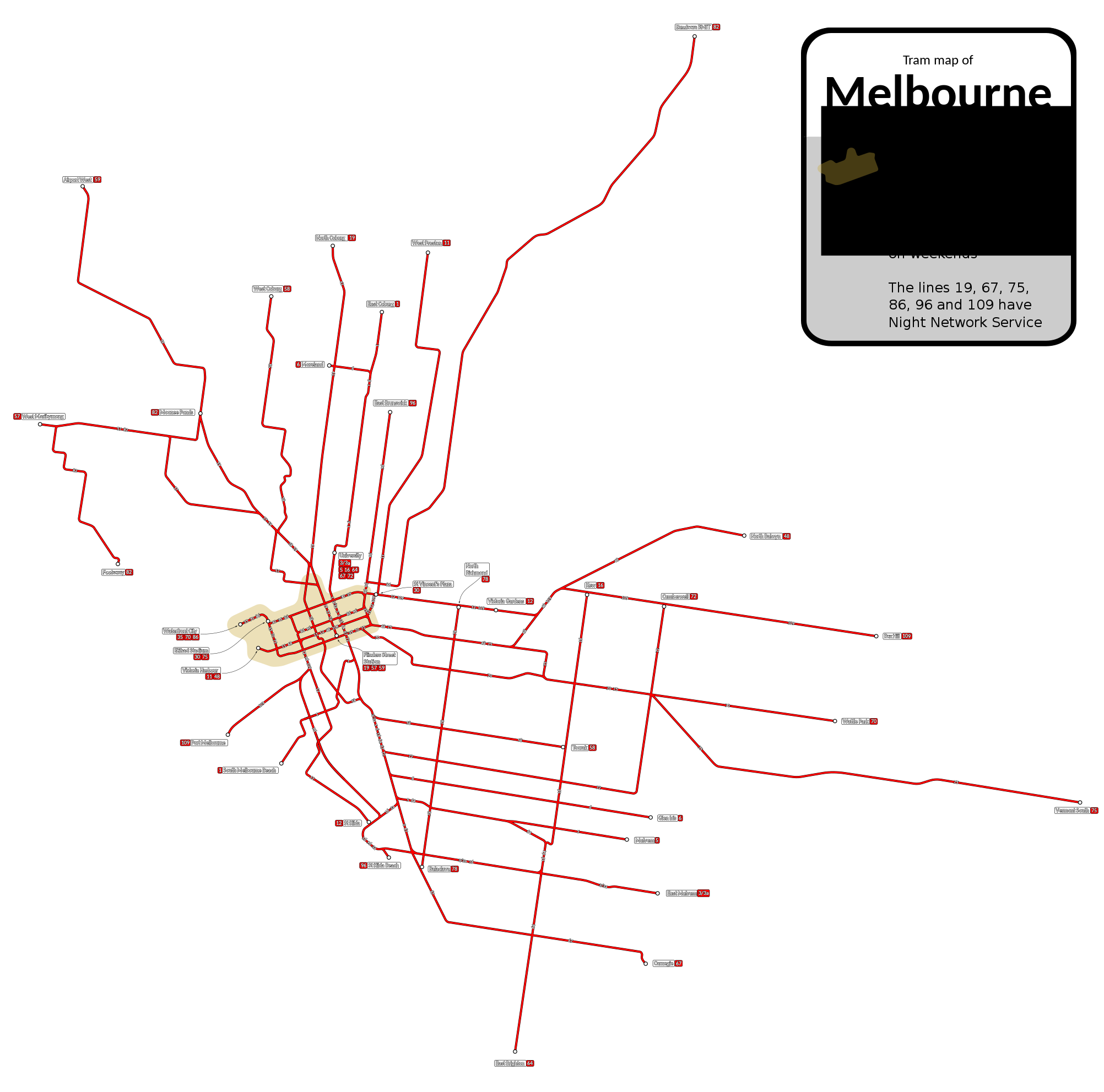
Here is Brno, which has around 200 million annual passengers in a metro area of 700,000:

The striking features of these networks and others without as good maps on Wikipedia (Gothenburg, Zurich), to me, are,
- The network design is radial – crosstown routes are rare and sporadic.
- The lines form something like a mesh in a small city center, perhaps the size of the historic premodern core, in which one can walk from one end to another; Melbourne, which does not have the history of a walled European city, shows convergent evolution with the same pattern.
- Owing to the long history of such systems, the ones I’ve used (Prague, Zurich, Basel, Leipzig, East Berlin) have basic stations with shelter and in Zurich’s case ticketing machines but no other facilities.
- There is extensive interlining and branching in all directions.
Moreover, as I should blog about soon in the future, Melbourne exhibits the same pattern even with a weak city center: the centralmost 100 km^2 of the city, which in Canada or Europe or the most centralized American cities should have 30-40% of metropolitan employment, only have 15%.
The New Triboro/Interboro Plan
Governor Kathy Hochul announced a policy package for New York, and, in between freeway widening projects, there is an item about the Triboro subway line, renamed Interboro and shortened to exclude the Bronx. The item is brief and leaves some important questions unanswered, and this is good – technical analysis should not be encumbered by prior political commitments made ex cathedra. Good transit advocates should support the program as it currently stands and push for swift design work to nail down the details of the project and ensure the decisions are sound.
What is Triboro?
The Bronx Times has a good overview, with maps. The original idea, from the RPA’s Third Regional Plan in the 1990s, was to use various disused or barely-used freight lines, such as the Bay Ridge Branch, to cobble together an orbital subway from Bay Ridge via East New York and Jackson Heights to Yankee Stadium. Only about a kilometer of greenfield tunnel would be needed, at the northern end.
In the Fourth Plan from the 2010s, this changed. The Fourth Plan Triboro was like PennDesign’s Crossboro idea, differing from the Third Plan Triboro in three ways: first, the stop spacing would be wider; second, the technology used would be commuter rail for mainline compatibility and not subway; and third, the Bronx routing would not follow disused tunnels (by then sealed) to Yankee Stadium but go along the Northeast Corridor to Coop City. Years ago, I’ve said that the Fourth Plan Triboro is worse than the Third Plan.
Unlike the RPA Triboro plans, Hochul’s Interboro plan only connects Brooklyn and Queens, running from Jackson Heights to the south. I do not know why, but believe this has to do with right-of-way constraints further north. The Queens-Bronx connection is on Hell Gate Bridge, which has three tracks and room for a fourth (which historically existed), of which Amtrak uses two and CSX uses one; having the service run to the Bronx is valuable but requires figuring out what to do about CSX and track-sharing. The Third Plan version ignored this, which is harder now, in part because freight traffic has increased from effectively zero in the 1990s to light today.
Stop spacing
The stop spacing in the governor’s plan appears to be more express, as in the Fourth Regional Plan, where the service is to run mostly nonstop between subway connections. In contrast, the Third Regional Plan called for regular stop spacing of 800 meters, in line with subway guidelines for new lines, including Second Avenue Subway.
I’m of two minds on this. We can look at formulas derived here in previous years for optimal stop spacing; the formulas are most commonly applied to buses (see here and follow first paragraph links), which can change their stop pattern more readily, but can equally be used for a subway.
The line’s circumferential characteristic gives it two special features, which argue in opposite directions on the issue of stop spacing. On the one hand, trips are likely to be short, because many people are going to use the line as a way of connecting between two subway spokes and those are for the most part placed relatively close to one another; farther-away connections such as end-to-end can be done on a radial line. But on the other hand, trips are not isotropic, because most riders are going to connect to a line, and the stronger the distinguished nodes are on a line, the longer the optimal interstation is.
On this, further research is required and multiple options should be studied. My suspicion is that on balance the longer stop spacing will prove correct, but it’s plausible that the shorter one is better. A hybrid may well be good too, especially in conjunction with a bus redesign ensuring the stops on the new rail link are aligned with bus trunks.
The issue of frequency
The line’s short-hop characteristic has an unambiguous implication about service: it must be very frequent. The average trip length along the line is likely to be short enough, on the order of 15 minutes, that even 10-minute waits are a drag on ridership. Nor is it possible to set up some system of timed transfers to 10-minute subway lines, first of all because the subway does not run on a clockface timetable, and second because the only transfers that could be cross-platform are to the L train.
This means that all-day frequency must be very high, on the order of a train every 5 minutes. This complicates any track-sharing arrangement, because the upper limit of frequency on shared track with trains that run any other pattern is a bit worse than this. The North London Line runs every 10 minutes and shares track with freight, and I believe there are some short shared segments in Switzerland up to a train every 7.5 minutes.
The upshot is that freight can’t run during normal operations. This is mostly fine, there are only 2-4 freight trains a day on the Bay Ridge Branch, where there are segments of the right-of-way that are only wide enough for two tracks, not four. This means if freight is to be retained, it has to run during light periods, such as 5 in the morning or 11 at night, when it’s more acceptable to run passenger trains every 10 minutes and not 5.
 Pedestrian Observations