Category: Urban Transit
More American Station Construction Extravaganza
Los Angeles has plans to extend its urban rail network. They’re taking forever, because construction costs are extremely high – and Nick Andert just pointed out one reason: the station caverns are huge. The overage on the proposed northern extension of the K Line, also known as the Crenshaw/LAX Line, is a good deal larger than on Second Avenue Subway, making it the most wasteful station construction that I am aware of. This is driving up the construction cost estimate to, depending on which alignment the K Line is to take as it goes north into West Hollywood, around $1 billion per kilometer.
Nick provides some station footprint diagrams. The K Line’s stations are designed for a maximum train length of three cars, or about 81 meters in total. The stations on the proposed extension, however, start at 124 meters when there is no crossover, or 50% overage, and most are 300 meters with crossovers. In other words, an underground light rail extension with trains less than half the length of New York City Subway trains is proposed to have stations about as long as those on Second Avenue Subway, which are already about twice as long as they need to be by New York standards. (In the low- and medium-cost countries for which I have this information, the overage is not 50%, but ranges between 3% and 17%.)
The 50% overage without crossovers is completely unjustifiable. But the crossovers, which turn the 50% into nearly 300% overage, are equally unjustifiable. It is not normal to build bored tunnel subways with so many crossovers, precisely because it’s expensive to blast caverns for them. Marco gives the example of Milan M4, which, counting the soon-to-open extension, has four crossovers in 15.5 km and 21 stations.
To this I can add that the Copenhagen Metro, built with bored tunnel with blasted caverns for crossover, has on the original line just two underground crossovers; the City Circle Line has only two as well, plus two on the M4 branch. There are more crossovers above ground, where it’s not so expensive to build them, but still less than one per station. This is a system designed for 24/7 operation; crossovers are required to allow trains to run on a single bidirectional track at night to permit maintenance, one track at a time. Without this constraint, even fewer crossovers are needed – only at the ends of the line, which includes the end of each operating segment if the line opens in stages.
If the K Line extension’s split between station and tunnel costs is similar to that of Second Avenue Subway Phase 1, 3:1, then shrinking the stations to the normal overage of a few percent would slash their cost by a factor of close to four, which would cut the line’s cost by more than half. This is what the extravaganza of crossovers is doing to Los Angeles and its ability to build mass transit infrastructure.
Project 2025 and Public Transportation
The Republican Party’s Project 2025, outlining its governing agenda if it wins the election later this year, has been in the news lately, and I’ve wanted to poke around what it has to say about transportation policy, which hasn’t been covered in generalist news, unlike bigger issues. The answer is that, on public transportation at least, it doesn’t say much, and what it does say seems confused. The blogger Libertarian Developmentalism is more positive about it than I am but does point out that it seems to be written by people who don’t use public transit and therefore treat it as an afterthought – not so much as a negative thing to be defunded in favor of cars, but just as not a priority. What I’m seeing in the two pages the 922-page Project 2025 devotes to public transit is that the author of the transportation section, Diana Furchtgott-Roth, clearly read some interesting critiques but then applies them in a way that shows she didn’t really understand them, and in particular, the proposed solutions are completely unrelated to the problems she diagnoses.
What’s not in the report?
Project 2025 is notable not in what it says about public transit, but in what it doesn’t say. As I said in the lede, the 922-page Project 2025 only devotes slightly less than two pages to public transportation, starting from printed page 634. The next slightly more than one page is devoted to railroads, and doesn’t say anything beyond letting safety inspections be more automated with little detail. Additional general points about transportation that also apply to transit can be found on page 621 about grants to states and pp. 623-4 extolling the benefits of public-private partnerships (PPPs, or P3s). To my surprise, the word “Amtrak,” long a Republican privatization target, appears nowhere in the document.
There are no explicit funding cuts proposed. There are complaints that American transit systems need subsidies and that their post-pandemic ridership recovery has not been great. There is one concrete proposal, to stop using a portion of the federal gas tax revenue to pay for public transit, but then it’s not a proposal to use the money to fund roads instead in context of the rest of the transportation section. The current federal formula is that funds to roads and public transit are given in an 80:20 ratio between the two modes, which has long been the subject of complaints among both transit activists and anti-transit activists, and Project 2025 not only doesn’t side with the latter but also doesn’t even mention the formula or the possibility of changing it.
The love for P3s is just bad infrastructure construction; the analysis speaks highly of privatization of risk, which has turned entire parts of the world incapable of building anything. (Libertarian Developmentalism has specific criticism of that point.) But the section stops short of prescribing P3s or other mechanisms of privatization of risk. In this sense, it’s better than what I’ve heard from some apolitical career civil servants at DOT. In contrast, the Penn Station Reconstruction agreement among the agencies using the station explicitly states that the project must use an alternative procurement mechanism such as design-build, construction manager/general contractor, or progressive-design-build (which is what most of the world calls design-build), of which the last is illegal in New York but unfortunately there are attempts to legalize it. This way, Project 2025’s loose support for privatization of planning is significantly better than the actual privatization of planning seen in New York, ensuring it will stay incapable of building infrastructure.
This aspect of saying very little is not general to Project 2025, I don’t think. I picked a randomly-selected page, printed p. 346, which concerns education. There’s a title, “advance school choice policies,” which comprises a few paragraphs, but these clearly state what the party wants, which is to increase funding for school vouchers in Washington D.C., expanding the current program. Above that title is a title “protect parental rights in policy,” which is exclusively about opposing the rights of transgender children not to tell their parents they’re socially transitioning at school.
Okay, so what does Project 2025 say?
The public transit section of the report, as mentioned above, has little prescription, and instead complains about transit ridership. What it says is not even always true, regarding modal comparisons. For one, it gets the statistical definition of public transit in the United States wrong. Here is Project 2025 on how public transit is defined:
New micromobility solutions, ridesharing, and a possible future that includes autonomous vehicles mean that mobility options—particularly in urban areas—can alter the nature of public transit, making it more affordable and flexible for Americans. Unfortunately, DOT now defines public transit only as transit provided by municipal governments. This means that when individuals change their commutes from urban buses to rideshare or electric scooter, the use of public transit decreases. A better definition for public transit (which also would require congressional legislation) would be transit provided for the public rather than transit provided by a public municipality.
Leaving aside that the biggest public-sector transit agencies in the US are not municipal but state-run or occasionally county-run (in Los Angeles), the definition of public transit in federal statistics and funding is exactly what Project 2025 wants. There are private transit operators; the biggest single grouping is privately-operated buses in New Jersey running into Manhattan via the Lincoln Tunnel. These buses count as public transit in census commuting statistics; they have access to publicly-funded transit-only infrastructure including the Lincoln Tunnel’s peak-only Express Bus Lane (XBL) and Port Authority Bus Terminal.
What’s true is that rideshare vehicles aren’t counted as transit, but as taxis. Larger vanshare systems could count as public transit; the flashiest ones, like last decade’s Bridj in Boston and Chariot in San Francisco, were providing public transit privately, but went to great lengths to insist that they were doing something different.
Other complaints include waste, but as with the rest of this section, there isn’t a lot of detail. Project 2025 complains about the Capital Investment Grants (CIG) program, saying it leads to waste, but it treats canceling it as unrealistic and instead says “a new conservative Administration should ensure that each CIG project meets sound economic standards and a rigorous cost-benefit analysis.” In theory, I could read it as a demand that the FTA should demand benefit-cost analyses as a precondition of funding; current federal practices do not do so, and to an extent this can be blamed on changes in the early Obama administration. But the FTA is not even mentioned in this section, nor is there a specific complaint that American transit projects are federally funded based on vibes more than on benefit-cost analysis.
The two main asks as far as transit is concerned are about labor and grants to states.
On labor, the analysis is solid, and I can tell that the Project 2025 authors read some blue state right-wing thinktanks that do interface with the problems of transit agencies. Project 2025 correctly notes that transit worker compensation is driven by high fringe benefits and pensions but not wages; it’s loath to say “wages are well below competitive levels” but it does say “transit agencies have high compensation costs yet are struggling to attract workers.” So far, so good.
And then the prescribed solution, the only specific in the section, is to reinterpret a section of the Urban Mass Transportation Act of 1964 to permit transit agencies to reduce overall compensation, which is currently illegal. As a solution, it is unhinged: transit agencies are having trouble finding qualified hires, so reducing compensation is only going to make these problems worse. It doesn’t follow at all from Project 2025’s own analysis; what would follow is that agencies should shift compensation from benefits to cash pay, but that’s already legal, and at no point does Project 2025 say “we recommend that agencies shift to paying workers in cash and will legally and politically back agencies that do so against labor wishes,” perhaps with a mention that the Conservatives in the United Kingdom gave such support to rail operators to facilitate getting rid of conductors. There’s no mention of the problems of the seniority system. Furchtgott-Roth used to work at the Manhattan Institute, which talks about way more specific issues including backing management against labor during industrial disputes and how one could cut pensions, but this is nowhere in the report.
On grants to states, Project 2025 is on more solid grounds. It proposes on p. 621 that federal funding should be given to states by formula, to distribute as they see fit:
If funding must be federal, it would be more efficient for the U.S. Congress to send transportation grants to each of the 50 states and allow each state to purchase the transportation services that it thinks are best. Such an approach would enable states to prioritize different types of transportation according to the needs of their citizens. States that rely more on automotive transportation, for example, could use their funding to meet those needs.
American transit activists are going to hate this, because, as in Germany and perhaps everywhere else, they disproportionately use the public transit that most people don’t use. On pre-corona numbers, around 40% of transit commuters in the United States live in metropolitan New York, but among the activists, the New York share looks much lower than 40% – it’s lower than that in my social circle of American transit activists, and I lived in New York five years and founded a New York advocacy group. The advocates I know in Texas and Kentucky and Ohio are aware of their states’ problems and want ridership to be higher, but, at the end of the day, American transit ridership is not driven by these states. Texas is especially unfortunate in how, beyond Houston’s original Main Street light rail line, its investments have not been very good. Direct grants to states are likely going to defund such projects in the future, but such projects are invisible in overall US transit usage, unfortunately.
In the core states to US transit usage – New York, New Jersey, California, Massachusetts, Illinois, Washington, Pennsylvania – the outcome of such change would be to replace bad federal-state interactions with bad state politics. But then, to the extent that there’s a theme to the problems of Project 2025 beyond “they aren’t saying much,” it’s that it’s uninterested in solving competent governance problems in blue states, and essentially all of American public transit ridership today is about the poor quality of blue state governance.
What does this mean?
I’ve seen criticism of Project 2025 on left-wing social media (that is, Bluesky and Mastodon) that portrays it as evil. I haven’t read the document except for the transportation section and the aforementioned randomly-selected pair of pages, so I can’t judge fully, but on public transit, I’m not seeing any of this. I’m not seeing any clear defunding calls. I’m seeing a reference to anti-transit advocate Robert Poole, the director of transportation policy at Reason, but only on air traffic control; he’s written voluminously (and shoddily) about public transit, but Furchtgott-Roth isn’t referencing any of that.
What I am seeing is total passivity. Maybe it’s specific to Furchtgott-Roth, who I didn’t hear about before, and who just doesn’t seem to get transportation as an issue despite having served as a political appointee at USDOT. Or maybe, as Libertarian Developmentalism points out, it’s that the sort of people who’d write a Republican Party governing program don’t think about public transit very much and therefore resort to catechisms about reducing the role of the federal government and repealing a labor law that isn’t a binding constraint. Occasionally this can land on a proposal that isn’t uniformly bad, like granting money to states rather than projects; more commonly, it leads to misstating what the federal and state governments consider to be public transit. I’m not seeing anything nefarious here, but I am seeing a lot of ignorance and poor thinking about solutions.
Red Hook-Manhattan Buses
In 2018, Eric’s and my Brooklyn bus redesign proposal included a new route to run between Red Hook and Lower Manhattan using the Brooklyn-Battery Tunnel. This was not our idea; a junior planner we talked to suggested this. Our plan was not adopted, but in the formal process New York City Transit and consultancy Sam Schwartz engaged in, at community meetings riders proposed the same idea, and junior staff seemed to like it but it was still not adopted. Now, a coalition of neighborhood groups and city-wide transit advocacy groups is directly calling for such a bus to be included in the Brooklyn bus redesign, including ETA. My goal in this post is to look at some alignment possibilities, more carefully than we did in the 2018 proposal. On the Manhattan side, it is not too hard to hit Lower Manhattan jobs and subway transfers on a short bus loop, but on the Brooklyn side, the Red Hook street network and its connection to the tunnel force serious compromises.
Current conditions
There are express buses in the tunnel from points much farther out to Lower Manhattan, but they don’t make stops along the way. Red Hook is instead served exclusively within Brooklyn, in three directions: one north along Van Brunt to Downtown Brooklyn, one east along Lorraine to the Smith/9th Street subway station and Park Slope, and one also along Lorraine to Smith/9th but then going north to Downtown Brooklyn. The first two are together the B61 route, in an awkward C-shaped through-route; the third is the B57, which through-runs past Downtown Brooklyn to points northeast along Flushing Avenue.
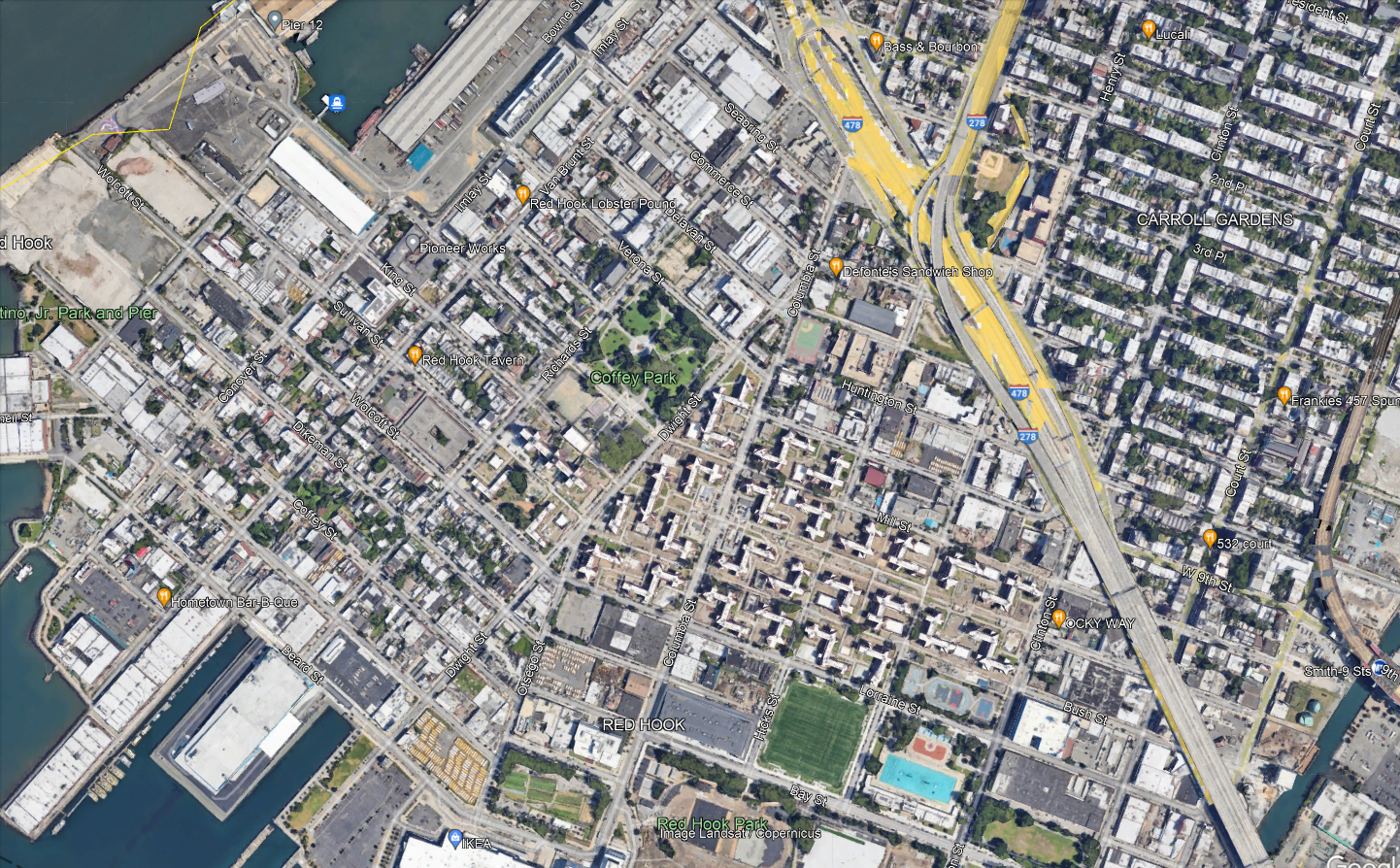
The neighborhood has roughly three major destinations to serve. Visible in the center-bottom of the map are the Red Hook Houses, with a total of 6,000 residents. At the very bottom of the map is Ikea, the main destination for people coming into the neighborhood from elsewhere. Then on the left there is Van Brunt, the local commercial drag.
Per OnTheMap, the entire neighborhood has 6,700 jobs and 5,000 employed residents as of 2019; it is not at all a bedroom community. Ikea is not even one of the main job centers – the biggest are elsewhere, such as the nearby Amazon warehouse. The neighborhood’s residents work about 40% in Manhattan, 40% in Brooklyn, and 20% elsewhere, while the workers are half from Brooklyn with no other origin having much concentration (the second biggest county origin, Queens, is 14%). Only 300 people both live and work in Red Hook, so a transit system connecting the neighborhood to the rest of the city, for both origins and destinations, is vital.
Why the tunnel?
Red Hook’s current bus connections are only with the rest of Brooklyn. This materially slows down travel for the 40% of residents who work in Manhattan and roughly 10% who work in places one accesses via Manhattan, such as the Bronx or Long Island City. The on-street bus connections are slow, and the neighborhood is not well-located relative to the Brooklyn subway network. The B57 only kind of hits Smith/9th southbound, since Smith is one-way northbound and the southbound trip is one block west on Court. Smith/9th itself is not accessible, and is the highest subway station in the system above the local street level as it was built with high clearance below for shipping through the Gowanus Canal.
Let’s look at how fast it is to get to 42nd Street. Via the B57 or B61, it’s about 10 minutes by bus from Ikea to Smith/9th; the B61 runs every 12 minutes and the B57 every 15 or 20, for maximum inconvenience. Then from Smith/9th to Bryant Park, it’s 27 minutes on the F. A bus in the tunnel would get to Fulton Street in 25 minutes and then it’s 12 minutes on the A. In theory, it’s the same trip time from Ikea, and around three minutes faster in relative terms from the Red Hook Houses depending on the route. In practice, being able to connect in Manhattan means having a much wider variety of destinations than just what’s on the F, which doesn’t even get to Lower Manhattan. The benefits for Red Hook-to-rest-of-city commuters would be noticeable.
The Manhattan street section would have variable traffic. On the other hand, the tunnel is less congested than its approaches, and congestion pricing stands to reduce traffic exactly there, as on other roads into the Manhattan core. With no bus stops in the tunnel, the average speed would be reasonable even with a short loop through Lower Manhattan. Diverting ridership from slower buses to Downtown Brooklyn would save revenue-hours, which could then be spent on higher frequency on all remaining routes.
Compromises on the route
The routing within the neighborhood for any bus route using the tunnel cannot be perfect; the neighborhood is not laid out for it. This is seen in how awkward the buses through Red Hook are today, as mentioned above; none of them even goes through the Red Hook Houses, which are the dominant origin. All of the following constraints require creating a single compromise bus route:
- The ridership potential is not there for more than one route. Whatever option is chosen, whether it’s a shuttle as I’m implying in this post or an extension of an existing route that goes deeper into Manhattan (or Brooklyn), that’s the only thing that can run. Even with one route, there may need to be compromises on frequency (by which I mean a bus every 8-10 minutes instead of 6, not 12).
- Van Brunt, Ikea plus the other waterfront jobs, and the Red Hook Houses are not at all collinear.
- The only place to get to the tunnel from Red Hook is the ramp from West 9th or Huntington, and West 9th is one-way west and may need to be converted to two-way. In particular, Van Brunt is too far, and the interface with the tunnel needs to be to and from the Red Hook Houses directly.
In effect, what all of the above implies is that a bus to Manhattan on Van Brunt is not likely to work. Here is one version of what could:

The circles along the path denote control points on Google Maps, and not stops. The western waterfront may have to just not be served; people could walk from Van Brunt across Coffey Park and it would be faster than taking the bus the long way around, down Van Brunt and then along Beard and up Columbia.
At the Manhattan end, the route would either loop just far enough north to hit the Fulton Street subway complex, or through-run. Fulton is necessary because the Wall Street stations are inaccessible, and is generally useful for the connection to World Trade Center. Beyond that, one option is to through-run to the M9, which hits more Manhattan destinations. That said, Manhattan bus speeds are so low that nearly all riders would switch to the subway; M9 frequencies are also low, every 15 minutes off-peak, and when there’s not much traffic this is almost unusably low for Red Hook Houses-Wall Street trips.
Stop Spacing on Crosstown Routes
Two different issues in New York – the bus redesign process and the Interborough Express – are making me think about optimal stop spacing again. I blogged about it in general about buses a few days ago, but crosstown routes present their own special issues, and this is noticeable on rail more than on buses. Circumferential rail routes, in particular, can justify wider stop spacing than radial routes in certain circumstances. This can explain why, over the iterations of Triboro RX leading to the current IBX proposal, the stop spacing has widened: the Third Regional Plan-era effort in the 2000s had a stop every half mile in Brooklyn and Queens, but more recent efforts proposed fewer stops, and the current one if anything has too few and misses a transfer.
Density and isotropy
The tradeoff in stop spacing on both buses and trains is that more stops reduce the amount of walking to the station but increase the in-vehicle trip time for people going through the stop without getting on or off.
Density by itself does not affect this tradeoff. A uniform increase in density along a line equally increases the costs and benefits of changing the stop spacing. However, relative density matters: stop spacing should be tighter in areas with higher density and wider in areas with lower density, both relative to other areas along the same line. This is because higher relative density means passengers are disproportionately likely to have their origin or destination in this area, and disproportionately less likely to be traveling through it, both of which argue in favor of tighter stop spacing, and lower relative density means the opposite.
This then leads to the issue of isotropy. On an isotropic network, relative density is by definition always the same; spikes in relative density make travel less isotropic. As my previous post explains with bus stop spacing formulas, also valid on rail with different parameters, less isotropic density should mean not just that there should be more stops in some places and fewer in others, but also that there should be fewer stops overall. In the simplest case of non-isotropy, assume everyone is traveling to the same distinguished node, which on a rail line can be thought of as city center (let’s say there’s just one central transfer point) and on a bus can be thought of as the connection to the subway. Then, all passengers can be guaranteed to be going to a place with a station, and therefore the cost of widening the stop spacing is halved, since only the origin walk time is increased, not the destination walk time.
Isotropy and circumferential routes
Successful circumferential routes live off of their ability to connect to the rest of the network. Over time, those connection points may grow to become large destinations in their own right – this is the story of how Ikebukuro, Shinjuku, and Shibuya, all at the intersection of the Yamanote Line with radial rail links (JR, private, or subway), became large business districts. But the connections have to come first. If passengers can’t conveniently transfer, then the route has to live off of origin-and-destination traffic just on the line, and then, because it is circumferential and by definition doesn’t go to city center, traffic will be low. This principle is why the G train in New York is so weak: it may connect the two largest non-Manhattan job centers in the region, but that’s still neither Manhattan nor service to the entire city, and with poor transfers, it has to live off of the small number of people living in Williamsburg and Bedford-Stuyvesant working in Long Island City or Downtown Brooklyn.
But the same principle also means that non-transfer stops lose value. This doesn’t mean there shouldn’t be any of them, but it does mean that agencies can afford to be pickier about where to place them. They’re unlikely to be destinations, only origins, and even as origins their value is discounted since some passengers use the circumferential line as the second leg of a three-legged trip, between two radial lines.
The impact on IBX
I used to criticize the decision to build fewer stops on IBX. For example, here, when it was still an RPA proposal in what would later become the Fourth Regional Plan, I outlined several criticisms of the then-Triboro route. I think some of them stand, especially the section on the plan to have the route go into the Bronx and provide local commuter rail service to Coop City. However, on the matter of stop spacing, I must withdraw the criticism.
That said, a station at every connection with a radial rail line remains nonnegotiable. IBX errs in only stopping in East New York at Atlantic Avenue, connecting to the L and the LIRR, with no direct connection to Broadway Junction for the A/C and J. The distance between these two locations is only 350 meters, and it may be awkward to have two stops in short succession, but the meaning of high relative density is exactly that it’s okay to have more closely spaced stops. Alternatively, there could be one stop at a compromise location, with in-system connections at both ends, but then the walk times would be higher, which is less desirable.
Bus Stop Consolidation and Blocks
There are arguments over bus stop spacing in my Discord channel. As the Queens bus redesign process is being finalized, there’s a last round of community input, and as one may expect, community board members amplify the complaints of people who reject any stop consolidation on “they’re taking my stop, I’ll have to walk longer” grounds. I wrote about this in 2018, as Eric and I were releasing our proposed Brooklyn bus redesign, which included fairly aggressive consolidation, to an average interstation of almost 500 meters, up from the current value of about 260. I’d like to revisit this issue in this post, first because of its renewed relevance, and second because there’s a complication that I did not incorporate into my formula before, coming from the fact that the city comprises discrete blocks rather than perfectly isotropic distribution of residents along an avenue.
The formula for bus stop spacing
The tradeoff is that stop consolidation means people have to walk longer to the bus stop but then the bus is faster. In practice, this means the bus is also more frequent by a proportionate amount – the resources required to operate a bus depend on time rather than distance, chiefly the driver’s wage, but also maintenance and fuel, since stops incur acceleration and idling cycles that stress the engines and consume more fuel.
The time penalty of each stop can be modeled as the total of the amount of time the bus needs to pull into the stop, the minimum amount of time it takes to open and close the doors, and the time it takes to pull out. Passenger boardings are not included, because those are assumed to be redistributed to other stops if a stop is deleted. In New York and Vancouver, the difference in schedules between local and limited stop buses in the 2010s was consistent with a penalty of about 25 seconds per stop.
The optimum stop spacing can be expressed with the following formula:

To explain in more detail:
- d is a dimensionless factor indicating how far one must walk, based on the stop spacing; the more isotropic passenger travel is, the lower d is, to a minimum of 2. The specific meaning of d is that if the stop spacing is n, then the average walk is n/d. For example, if there is perfect isotropy, then passengers’ distance from the nearest bus stop is uniformly distributed between 0 and n/2, so the average is n/4, and this needs to be repeated at the destination end, summing to n/2.
- Walk speed and walk penalty take into account that passengers prefer spending time on a moving bus to walking to the bus. In the literature that I’ve seen, the penalty is 2. Usually the literature assumes the walk speed is around 5 km/h, or 1.4 m/s; able-bodied adults without luggage walk faster, especially in New York, but the speed for disabled people is lower, around 1 m/s for the most common cases.
- Stop penalty, as mentioned above, can be taken to be 25 s.
- Average trip length is unlinked; for New York City Transit in 2019, counting NYCT local buses including SBS but not express buses, the average was 3,421 meters.
- Average bus spacing is the headway between buses on the route measured in units of distance, not speed; it’s expressed this way since the resources available can be expressed in how many buses can circulate at a given time, and then the frequency is the product of this figure with speed. In Brooklyn in the 2010s, this average was 1,830 m; our proposed network, pruning weaker routes, cut it to 1,180. The Queens figure as of 2017 appears similar to the Brooklyn figure, maybe 1,860 m. Summing the average trip length and average bus spacing indicates that passengers treat wait time as a worst-case scenario, or, equivalently, that they treat it as an average case but with a wait penalty of 2, which is consistent with estimates in the papers I’ve read.
In the most isotropic case, with d = 2, plugging in the numbers gives,

However, isotropy is more complex than this. For one, if we’re guaranteed that all passengers are connecting to one distinguished stop, say a subway connection point, then consolidating stops will still make them walk longer at the other end, but it will not make them walk any longer at the guaranteed end, since that stop is retained. In that case, we need to set d = 4 (because the average distance to a bus stop if the interstation is n is n/4 and at the other end we’re guaranteed there’s no walk), and the same formula gives,

The Queens bus redesign recognizes this to an extent by setting up what it calls rush routes, designed to get passengers from outlying areas in Eastern Queens to the subway connection points of Flushing and Jamaica; those are supposed to have longer interstations, but in practice this difference has shrunk in more recent revisions.
That said, even then, there’s a complication.
City blocks and isotropy
The models above assume that passengers’ origins are equally distributed along a line. For example, here is Main Street through Kew Gardens Hills, the stretch I am most likely to use a New York bus on:
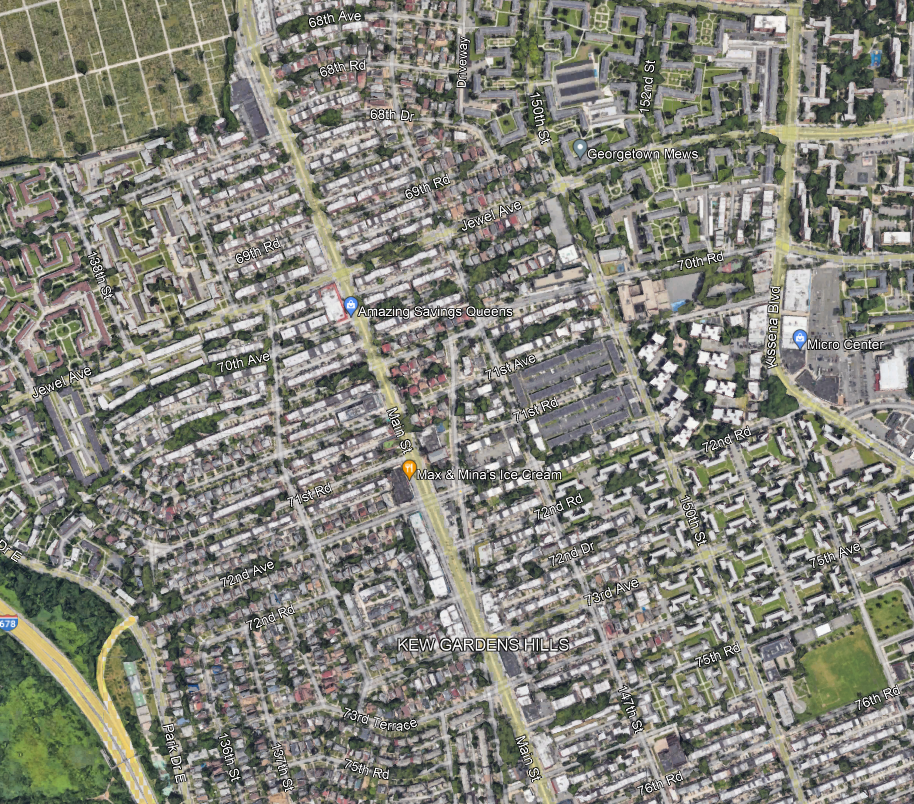
I always take the bus to connect to Flushing or Jamaica, but within Kew Gardens Hills, the assumption of isotropy means that passengers are equally likely to be getting on the bus at any point along Main Street.
And this assumption does not really work in any city with blocks. In practice, neighborhood residents travel to Main Street via the side streets, which are called avenues, roads, or drives, and numbered awkwardly as seen in the picture above (72nd Avenue, then 72nd Road, then 72nd Drive, then 73rd Avenue, then 75th Avenue…). The density along each of those side streets is fairly consistent, so passengers are equally likely to be originating from any of these streets, for the most part. But they are always going to originate from a side street, and not from a point between them.
The local bus along Main, the Q20, stops every three blocks for the most part, with some interstations of only two blocks. Let’s analyze what happens if the system consolidates from a stop every three blocks, which is 240 meters, to a stop every six, which is 480. Here, we assume isotropy among the side streets, but not continuous isotropy – in other words, we assume passengers all come from a street but are equally likely to be coming from any street.
With that in mind, take a six-block stretch, starting and ending with a stop that isn’t deleted. Let’s call this stretch 0th Street through 6th Street, to avoid having to deal with the weird block numbering in Kew Gardens Hills; we need to investigate the impact of deleting a stop on 3rd Street. With that in mind: passengers originating on 0th and 1st keep going to 0th Street and suffer no additional walk, passengers originating on 5th keep going to 6th and also suffer no additional walk, passengers originating on 2nd and 4th have to walk two blocks instead of one, and passengers originating on 3rd have to walk three blocks instead of zero. The average extra walk is 5/6 of a block. This is actually more than one quarter of the increase in the stop spacing; if there is a distinguished destination at the other end (and there is), then instead of d = 4, we need to use d = 3/(5/6) = 3.6. This shrinks the optimum a bit, but still to 576 m, which is about seven blocks.
The trick here is that if the stop spacing is an even number of blocks, then we can assume continuous isotropy – passengers are equally likely to be in the best circumstance (living on a street with a stop) and in the worst (living on a street midway between stops). If it’s an odd number of blocks, we get a very small bonus from the fact that passengers are not going to live on a street midway between stops, because there isn’t one. The average walk distance, in blocks, with stops every 1, 2, 3, … blocks, is 0, 0.5, 2/3, 1, 1.2, 1.5, 12/7, 2, … Thus, ever so slightly, planners should perhaps favor a stop every five or seven blocks and not every six, in marginal cases. To be clear, the stop spacing on each stretch should be uniform, so if there are 12 blocks between two distinguished destinations, there should be one intermediate stop at the exact midpoint, but, perhaps, if there are 30 blocks with no real internal structure of more or less important streets, a stop should be placed every five and not six blocks, especially if destinations are not too concentrated.
The Politics of QueensLink
The abandoned right-of-way of the Rockaway Cutoff, or Rockaway Beach Branch, is an attractive target for reuse by some groups. Area railfans have wanted to do something with it for years, and I was mostly negative about these plans, but more recently, QueensLink has emerged as a serious plan to extend the subway along the Rockaway Cutoff, to connect neighborhoods in southwestern Queens to one another and to Manhattan, where current connections do not exist (in the middle) or only serve Midtown Manhattan indirectly and slowly (in the south, via the A train). The right-of-way is wide enough that most of it can also accommodate additional infrastructure, in the case of this plan a bike trail.
The problem is that this more serious plan is still not getting much political play. This is not because of the typical reasons people may think of, such as high costs or NIMBYism. Rather, a competing plan for the same corridor, Queensway, wants to turn it into pure parkland, and is backed by a power broker with opinions and connections. The QueensLink advocates have asked for and been so far refused planning money for an environmental impact statement, which step is in better infrastructure environments apolitical; instead, Mayor Eric Adams is connected with a Queensway backer and thus favors Queensway.
The QueensLink project
QueensLink is a subway extension, with a short tunnel to get from the Queens Boulevard Line’s local tracks to the Rockaway Cutoff. Where there is room, a bike trail is included on the same corridor.

As this is a former rail mainline, the connections to the crossing subway lines are not great – the subway placed stations at major street intersections, leading to long walks at the Jamaica and Liberty Avenue transfers. In contrast, the connection to the LIRR is good: there is no station there today, but there used to be one, and it could be reopened, especially now that the Atlantic Branch is retooling to be more useful for urban service, with more stops, higher frequency, and perhaps integrated fares.
The subway connection makes this proposal viable. I previously criticized a proposal to run commuter rail service on the Cutoff, since it would crowd out the busy LIRR Main Line. In contrast, QueensLink has the new branch using the Queens Boulevard local tracks, which are undersubscribed even at rush hour, to the point that it may even be possible to run three rush hour services on the same tracks and not just two like today. The G doesn’t run to Forest Hills, for good reason, but the new service would vacate space at the Forest Hills terminal of the local tracks to the point that it could potentially be viable.
At the Transportation and Land Use program at Marron, we’re building tools to estimate not just costs for public transit construction but also ridership, and it’s likely that QueensLink will be next on our agenda right after the Interborough Express. I can’t give more than first-order estimates now, but it’s notable that the closest parallel bus corridor, Woodhaven, has high ridership: it carries four local or SBS routes and four express routes, with 31,000 weekday boardings among them. Then there’s the possibility of faster service to JFK Airport via QueensLink. It’s not going to be the Second Avenue Subway of Queens by ridership, but because only a short tunnel is needed, it’s not going to come close to Second Avenue Subway in costs either.
QueensLink and Queensway
The alternative to QueensLink isn’t doing nothing, as is usually the case. Some political players have eyed the corridor for a trail project called Queensway. The idea of Queensway is to create more parkland in the area, including a hiking and bike trail; as the map above shows, there is no shortage of parkland there. There’s an obsession of urbanists in the United States with linear parks, in imitation of the High Line; one attempt at imitation even wanted to build a park underground in a former streetcar terminal and called it the Lowline.
I want to dwell on the politics of Queensway, because I know I have a lot of readers in the general neoliberal and rationalist communities, including specifically in New York, and the political support for it is not what their first instinct might be.
Often, it’s the case that public transit projects are supported by broadly developmentalist interest groups, who are also fairly YIMBY, and tend to be rooted in professionals and office workers commuting to city center, and opposed by NIMBYs, who tend to be rooted in longstanding neighborhood residents and small business owners. Neighborhood NIMBYs often like parks, because they’re local improvements; when we studied the Green Line Extension in Boston, we saw some local interest groups demand money for a trail as a precondition to supporting the light rail line.
And this is not at all what is happening with the Rockaway Cutoff. Local interest groups are not consistently anti-QueensLink and pro-Queensway. Some are, but in at least one case, a local advocate came to argue on NIMBY grounds against Queensway, which would bring pedestrians to their backyard, and for QueensLink, since the passing train would not cause unwanted impact and would serve the area. On net, YIMBYer groups are more pro-QueensLink – for example much of the community at the northern end of the corridor, in Community Board 6, which due to its location on the subway has a more pro-transit and pro-development orientation. But it doesn’t boil down to these class interests pitting professional workers against small business owners, at all. Rather, it’s rather random, boiling down to individual power brokers for Queensway.
What autocrats want
I highlight the randomness of the interest groups for Queensway, because it relates to the broadly autocratic style of some leaders, who the de facto system of government in New York empowers too much. In the 2010s, Andrew Cuomo liked the idea of Queensway, and if he wanted something, anyone who wanted to stay in the good grace of the local power system had to support it. The backward air train to LaGuardia, hated by transit activists in the city from the start, is such an example – while Cuomo was in power opposition was restricted to people outside city and state politics, like the technical advocacy community or Alexandria Ocasio-Cortez. Then Cuomo left office and because nobody really wanted it, this project died. Queensway survives, I think partly because it’s not a multi-billion dollar investment, and partly because some power brokers do like it and have attached themselves to Mayor Eric Adams, such as political operative and lobbyist Travis Terry.
The point of this is not that Adams wants Queensway and therefore it will happen. Rather, it’s that, in a system with a democratic deficit like New York, professional decisions often boil down to which random advocate happens to have the ear of the autocrat. I keep contrasting this with the situation in Berlin, in which bike lanes and pedestrianization have been put on hold and even been reversed under Mayor Kai Wegner (CDU) – but Wegner ran on this agenda in the election and CDU came first, and the pivotal party, SPD, chose to enter a coalition with him and not with more left-wing parties under a known-quantity (and disgraced) leader in Franziska Giffey, whose conservative-for-SPD politics and poor relationship with the left was well-known. I dislike this outcome, but voters knew what they were getting. In contrast, in New York, Adams did not run on any explicit agenda of not building public transit, or even on support for interest groups that oppose transit (again, the Queensway support is more individualized than neighborhood-scale NIMBYs). He just makes abrupt decisions, often sniping the judgment of the city’s own civil service, based on what one favorite asks.
The way forward
In healthy infrastructure construction systems and also in Germany, the planning is not politicized; the yes/no decision on what to build must be made by politicians, but the menu of options with their costs and benefits is prepared by the civil service. In contrast, in the United States, even the choice of which projects get an environmental impact study is politicized; QueensLink advocates are asking for money for an EIS, which in the United States is where planning is done, but even that is stalled politically.
The problem is that the message this behavior by the city and state sends is that New York is too messed up to invest in. Private actors who make investment decisions need some amount of political stability and predictability. A political culture of caprice, in which everyone must constantly follow political gossip to have any idea what the autocratic mayor or governor (or in some countries president or prime minister) will do, or else be swamped by otherwise inexplicable investment decisions, screams “go elsewhere, we don’t want you.” Even turning an EIS into a big political ask screams the same thing: “we can’t do, so merely studying is an achievement by itself and you must pay fealty.”
New York’s current system deters investment, not through taxes or union empowerment, but through opacity and unpredictability. I don’t want to turn the question of one right-of-way in Queens into an existential issue that it is not, but on the margin, stonewalling on QueensLink because some politically connected actor personally wants Queensway reinforces this system that repels investment, whereas treating the EIS as an apolitical step and then based on the results of further planning building it or not based on broad interest agreement signals that New York can and wants to build things. It’s the city’s choice.
Quick Note: What the Hell is Going on in San Jose?
The BART to San Jose extension always had problems, but somehow things are getting worse. A month and a half ago, it was revealed that the projected cost of the 9.6-kilometer line had risen to $12.2 billion. Every problem that we seemed to identify in our reports about construction costs in New York and Boston appears here as far as I can tell, with the exception of labor, which at least a few years ago showed overstaffing in the Northeastern United States but not elsewhere. In particular, the station and tunnel design maximizes costs – the first link cites Adam Buchbinder on the excessive size of the digs. Unfortunately, the response by the Valley Transportation Authority (VTA) to a question just now about the station shows that not only are the stations insanely expensive, but also not even convenient for passengers (Twitter link, Nitter link).
Cost breakdown
The March 2024 agenda (link, PDF-pp. 488-489) breaks down the costs. The hard costs total $7 billion; the systems : civils ratio is 1:3.5, which is not bad. But the overall hard costs are still extreme. Then on top of them there are soft costs totaling $2.78 billion, or 40% on top of the hard costs. The same percentage for Second Avenue Subway was 21%, and the norm for third-party consultants for the Continental European projects for which we have data (in Italy, Spain, Turkey, and France) is to charge 5-10%. Soft costs should not be this high; if they are, something is deeply wrong with how the agency uses consultants.
Large-diameter tunnel boring machines
The BART to San Jose project has long had two distinct options for tunnels and station: twin bores, and single bore. The twin bore option is conventional construction of two bored tunnels, one for each track, and then stations to be built as dedicated civil construction projects outside the tunnel; this is how most subways are built today. The single bore option is a large-diameter tunnel boring machine (TBM), with the bore large enough to have not just two tracks side by side, but also platforms within the bore, eliminating the need for mined station caverns or for extensive cut-and-cover station digs. Both options cleared environmental reviews; VTA selected the single bore option, which has been controversial.
I’ve written positively about large-diameter TBMs before, and I don’t think I’ve written a full post walking this back. I’ve written about how large-diameter TBMs are inappropriate for San Jose, but the truth is that the method is not treated as a success elsewhere in urban rail, either. This is controversial, and serious engineers still think it works and point to successes in intercity rail, but in urban rail, the problems with building settlement are too serious. The main example of a large-diameter TBM is Barcelona L9/10, which uses the method to avoid having to open up streets under multiple older metro tunnels in Barcelona; it also has high construction costs by Spanish standards (and low costs by non-Spanish ones). In Italy, whose construction costs are also fairly low if not as low as in Madrid, engineers considered using large-diameter TBMs for the sensitive parts of Rome Metro Line C but then rejected that solution as too risky, going for conventional high-cost mined stations instead.
Regardless of the wisdom of doing this in Southern Europe, in San Jose it is stupid. There are wide streets to dig up for cut-and-cover stations. Then, the implementation is bad – the station entryways are too big, whereas Barcelona’s are small elevator banks, and the tunnel bore is wide enough for a platform and two tracks on the same level whereas Barcelona has a narrower bore with stacked platforms.
Thankfully, it is administratively possible to cancel the single bore option, since the twin bore option cleared the environmental reviews as well, and in 2007 was already complete to 65% design (link, PDF-p. 7). Unfortunately, there isn’t much appetite among officials for it. Journalists and advocates are more interested, but the agency seems to stick to its current plans even as their costs are setting non-New York construction cost records.
Is it at least good?
No. Somehow, for this cost, using a method whose primary advantage is that it makes it possible to build a station anywhere at the cost of massively more expensive tunneling, the station at the city’s main train station, named after still-alive Rod Diridon, will not be easily accessible from mainline rail. The walking distance is 400 meters, which has been justified on the grounds that “The decision had to do with impacts and entitlements. It’s also beneficial for the future intermodal station.”
It is, to be clear, not at all beneficial for a future intermodal BART-Caltrain station to require such a long walking distance, provided we take “beneficial” to mean “beneficial for passengers.” It may be beneficial for a Hollywood action sequence to depict characters running through such a space. It is not beneficial for the ordinary users of the station who might be interested in connecting between the two systems. There are 300 meter walks at some transfers in New York, and passengers do whatever they can to avoid them; I’ve taken three-seat rides with shorter transfers to avoid a two-seat ride with a long block transfer, and my behavior is typical of the subway users I know. Transfer corridors of such length are common in Shanghai and are disliked by the system’s users. It’s not the end of the world, but for $1.3 billion/km, I expect better and so should the people who have to pay for this project.
Subway Expansion and Bus Redesign
The ongoing designs for the Interborough Express are making me think about bus redesign again. Before the Transit Costs Project, Eric and I worked on a proposal for a bus redesign in Brooklyn, which sadly was not adopted. The redesign was based on the reality of 2017 – the ridership patterns, the bus speeds, the extent of the system, etc. Since then the subway map has not changed, but IBX stands to change the map, and with it, the buses should change as well.
With our program having produced both the bus redesign proposal and soon a comprehensive proposal for how to change the city’s built-up layout to take advantage of the new line, I should probably say something about how the buses should change. I say I and not we, because so far we don’t have a project under our program for this; for now, this is just a blog post, though one informed by past work on the subject.

Parallel and orthogonal buses
In general, when a new line opens, it reduces demand on parallel bus routes, which it outcompetes, and increases it on orthogonal ones, which feed it. However, what counts as parallel and what counts as orthogonal are not always obvious.
Case in point: when Second Avenue Subway opened at the end of 2016, ridership on the east-west buses between the Upper East and West Sides fell. The new line in theory runs north-south, but it undulates from the Upper East Side to Times Square, where passengers can connect to trains to the Upper West Side and points north; when I lived at 72nd and York and commuted to Columbia by bus and subway in 2009-10, I calculated that if Second Avenue Subway had been open already, a two-seat subway ride with a Times Square connection would have cut my one-way commute from 50 to 37 minutes.
This means that to understand how a new rail line will impact buses, it’s necessary to look beyond just the line itself, and think what it connects to.
For example, note on the above map that the increase in job access at the Flatbush Avenue station, intersecting the Nostrand Avenue Line, is relatively small, and doesn’t have a big north-south footprint along Nostrand. This is because the location already has subway service connecting to Manhattan, a much larger job center than anything IBX would connect to; the buses at the station, the B41 on Flatbush and B44 on Nostrand, already function as connectors to the subway at this point, and are unlikely to acquire more ridership as a result.
In contrast, the stations at Myrtle and Metropolitan are both seen to have a large increase in job access, and in particular a large increase in job access along those two avenues even somewhat away from the stations. On Myrtle, the current buses are the B54 and Q55; the B54 connects to the M train, but it’s one branch, and then the bus continues to Downtown Brooklyn, to which there’s no good subway connection from the future IBX station. The B54 is likely to lose ridership to Downtown Brooklyn but gain it to the new IBX station, and the Q55 is likely to gain in general, as they ferry passengers to a station where they can quickly and with one change go to any number of express lines. Metropolitan has a similar issue – the Q54 already connects to the M, but at least from points west, nobody has any reason to make that connection since it would just double back, whereas with IBX, the Q54 would efficiently connect people to Jackson Heights, and with an additional change to anywhere on the Queens Boulevard and Flushing Lines.
New nodes
Public transit lines serve two functions: to run along a corridor, and to connect nodes. New York usually thinks in terms of corridors, and indeed names nearly all subway lines after the streets they run on (such as a Manhattan avenue) rather than after where they go. But nodes are important as well. Some of that is reflected in the above analysis of the Flatbush-Nostrand Avenue station, currently Brooklyn College on the Nostrand Avenue Line: it really needs to be thought of as a node, and IBX will strengthen it, but not by enough to require running more B41 and B44 buses. In contrast, other nodes will be strengthened enough that bus service increases are warranted.
East New York/Broadway Junction is the biggest standout. East New York’s bus network today is not much of a grid – instead, buses connect outlying areas to the nearest subway station; the bus redesign we did for Brooklyn would make it more of a grid but still follow the logic of feeding the subway wherever it is closest. However, IBX makes Broadway Junction and the Atlantic Avenue station more interesting, which should leads to some changes, turning the new station into more of a node for buses. Buses avoiding this node should instead make sure to stop not just at the subway but also at a new IBX stop, such as Linden.
Jackson Heights is the other. It is a node to some extent today, served by the Q32, Q33, Q47, Q49, Q53, and Q70. But in that general area, the intersection of Woodhaven and Queens Boulevard is an even larger node, and in Queens writ large, the ends of the subway in Jamaica and Flushing are far and away the biggest ones. With IBX, more buses should run to Jackson Heights; for example, all Woodhaven buses, and not just the Q53, should continue along Queens Boulevard and Broadway to reach the station.
Substitutions
In Queens, the street network connecting Jackson Heights with the neighborhoods near the borough line with Brooklyn is not at all conducive for good transit. Buses are usually a good indicator of relative demand along a corridor, but sometimes they aren’t; the situation of IBX is generally one in which they are not, but this is especially bad in Queens. This means that the question of which buses would see demand fall as IBX substitutes for them is even harder than on Second Avenue Subway, the north-south line that efficiently substitutes for east-west buses.
In Brooklyn, I think the answer is relatively straightforward, in that the main crosstown routes, like the B35 on Church, exhibit substitutability. In Queens, it’s harder, and I don’t have concrete answers, only general thoughts that we can turn into a report if there turns out to be demand for it:
- If a bus has sections along the corridor but also away from it, like the Q18 or Q47, then it should be cut to just connect to the line, in these two case at Jackson Heights.
- If a bus runs directly between two nodes that could get faster service via a subway-IBX connection, and it doesn’t serve much along the way, then it’s likely to be analogous to the east-west buses across Central Park, and see reduced ridership demand.
- In general, the routes in Central Queens zigzag so much that IBX is likely to represent a massive improvement in trip times, making such buses less useful.
Frequency in Units of Distance
I have annoying commenters. They nitpick what I say and point out errors in my thinking – or if there are no errors, they take it beyond where I thought it could be taken and find new ways of looking at it. After I wrote about frequency relative to trip length last week, Colin Parker pointed out on the Fediverse that this can be simplified into thinking about frequency not in units of time (trains or buses per hour), but in units of distance (trains or buses per km of route). This post is dedicated to developing this idea on various kinds of transit service, including buses and trains.
The key unit throughout, as Colin points out, is the number of buses available per route, the assumption being that the average trip length is proportional to the average route length. However, this is not a perfect assumption, because then the introduction of network effects changes things – generally in the direction of shorter average trip length, as passengers are likelier to transfer, in turn forcing agencies to run more vehicles on a given route to remain useful. Conversely, timed transfers permit running fewer vehicles, or by the same token more routes with the same resources – but the network had better have a strong node to connect to after a series of vehicle changes, more like the Swiss rail network than like a small American city’s bus network.
Frequency and resources
On a bus network with even frequency across all routes, the following formula governs frequency, as I discussed six years ago:
Daily service hours * average speed per hour = daily trips * network length
When Eric and I proposed our Brooklyn bus redesign, we were working with a service-hour budget of about 10,800 per weekday; status quo as of 2017-8 was 11 km/h, 550 km, and thus 216 daily trips (108 per direction), averaging around a bus per 11 minutes during the daytime, while we were proposing speed up treatments and a redesign to change these figures to 15 km/h, 355 km, and thus 456 daily trips (228 per direction). The six-minute service ideal over 16 hours requires 188 trips per direction; the difference between 188 and 228 is due to higher frequencies on the busiest routes, which need the capacity.
To express this in units of length, we essentially eliminate time from the above dimensional analysis. Daily service hours is a dimensionless quantity: 10,800 hours per weekday means 450 buses circulating at a given time on average, in practice about 570 during the daytime but not many more than 100 buses circulating overnight. If there are 570 buses circulating at a given time, then a 550 km network will average a bus every 1.9 km and a 355 km one will average a bus every 1.25 km. With pre-corona New York bus trips averaging 3.4 km unlinked, a bus every 1.9 km means the maximum headway is a little higher than half the trip time, and a bus every 1.25 km means the maximum headway is a little higher than one third the trip time, independently of speed.
This calculation already illustrates one consequence of looking at frequency in units of distance and not time: your city probably needs to aggressively prune its bus network to limit the wait times relative to overall trip times.
Route length and trip length
On an isolated bus or train route, serving an idealized geography with a destination at its center and isotropic origins along the line, the average trip length is exactly one quarter of the route length. The frequency of service in units of distance should therefore be one eighth of the route length, requiring 16 vehicles to run service plus spares and turnarounds. This is around 18-20 vehicles in isolation, though bear in mind, the 10,800 service hours/day figure for Brooklyn buses above is only for revenue service, and thus already incorporates the margin for turnaround times and deadheads.
Colin points out that where he lives, in Atlanta, bus routes usually have around four vehicles circulating per route at a given time, rather than 16. With the above assumptions, this means that the average wait is twice the average trip time, which goes a long way to explaining why Atlanta’s bus service quality is so poor.
But then, different assumptions of how people travel can reduce the number 16:
- If destinations are isotropic, then the average trip length rises from one quarter of the route length to 3/8 of the route length, and then the frequency should be 1.5/8 of the route length, which requires 11 vehicles in revenue service.
- If origins are not isotropic, then the average trip length can rise or fall, depending on whether they are likelier to be farther out or closer in. A natural density gradient means origins are disproportionately closer-in, but then in a city with a natural density gradient and only four buses to spare per route, the route is likely to be cut well short of the end of the built-up area. If the end of the route is chosen to be a high-density anchor, then the origins relative to the route itself may be disproportionately farther out. In the limiting case, in which the average trip is half the route length, only eight buses are needed to circulate.
To be clear, this is for a two-tailed route; a one-tailed route, connecting city center at one end to outlying areas at the other, needs half the bus service, but then a city needs twice as many such routes for its network.
The impact of transfers
Transfers can either reduce the required amount of service for it to be worth running or increase it, depending on type. The general rule is that untimed transfers occurring at many points along the line reduce the average unlinked trip and therefore force the city to run more service, while timed transfers occurring at a central node lengthen the effective trip relative to the wait time and therefore permit the city to run less service. In practice, this describes both how existing bus practices work in North America, and even why the Swiss rail network is so enamored with timed connections.
To the point of untimed transfers, their benefit is that there can be very many of them. On an idealized grid – let’s call it Toronto, or maybe Vancouver, or maybe Chicago – every grid corner is a transfer point between an east-west and a north-south route, and passengers can get from anywhere to anywhere. But then they have to wait multiple times; in transit usage statistics, this is seen in low average unlinked trip lengths. New York, as mentioned above, averages 3.4 km bus trips, with a network heavily based on bus-subway transfers; Chicago averages a not much higher 3.9 km. This can sort of work for New York with its okay if not great relative frequency, and I think also for Chicago; Vancouver proper (not so much its suburbs) and Toronto have especially strong all-day frequencies. But weaker transit networks can’t do this – the transfers can still exist but are too onerous. For example, Los Angeles has about the same total bus resources as Chicago but has to spread them across a much larger network, with longer average trip times to boot, and is not meaningfully competitive. The untimed grid, then, is a good feature for transit cities, which have the resources and demand to support the required frequencies.
Not for nothing, rapid transit networks love untimed transfers, and often actively prefer to spread them across multiple stations, to avoid overwhelming the transfer corridors. Subways are only built on routes that are strong enough to have many vehicles circulating, to the point that all but the shortest trips have low ratios of wait to in-vehicle times. They are also usually radial, aiming to get passengers to connect between any pair of stations with just one transfer; Berlin, Paris, and New York are among the main exceptions. These features make untimed transfers tolerable, in ways they aren’t on weaker systems; not for nothing, a city with enough resources for a 100 km bus network and nothing else does not mimic a 100 km subway network.
Timed transfers have the opposite effect as untimed transfers. By definition, a timed transfer means the wait is designed to be very short, ideally zero. At this point, the unlinked trip length ceases to be meaningful – the quantity that should be compared with frequency is the entire trip with all timed transfers included. In particular, lower frequencies may be justifiable, because passengers travel to much more than just the single bus or rail route.
This can be seen in small-city American bus networks, or some night bus networks, albeit not with good quality. It can be seen much more so on transfer-based rail networks like Switzerland’s. The idealized timed transfer network comprises many routes all converging on one node where they are timed to arrive and depart simultaneously, with very short transfers; this is called a knot in German transit planning and a pulse in American transit planning. American networks like this typically run a single bus circulating on each one-tailed route; the average wait works out to be four times longer than the average unlinked trip, and still twice as long as a transfer trip, which helps explain why ridership on such networks is a rounding error, and this system is only used for last-resort transportation in small cities where transit is little more than a soup kitchen or on night bus networks that are hardly more ridden. It would be better to redo such networks, pruning weaker routes to run more service on stronger ones, at least two per one-tailed route and ideally more.
But then the Swiss rail network is very effective, even though it’s based on a similar principle: there’s no way to fill more frequent trains than one every hour to many outlying towns, and even what are midsize cities by Swiss standards can’t support more than a train every half hour, so that many routes have a service offer of two to four vehicles circulating at a given time. However, on this network, the timed transfers are more complex than the idealized pulse – there are many knots with pulses, and they work to connect people to much bigger destinations than could be done with sporadic one-seat rides. A succession of timed connections can get one from a small town in eastern Switzerland to St. Gallen, then Zurich, then Basel, stretching the effective trip to hours, and making the hourly base frequency relatively tolerable. The key feature is that the timed transfers work because while individual links are weak enough to need them, there are some major nodes that they can connect to, often far away from the towns that make the most use of the knot system.
Frequency is Relative
Five years ago, I wrote a blog post about frequency-ridership spirals, mentioning as a side comment that the impact of mass transit frequency on ridership can be lumped together with the trip time. I’d like to develop this point here, and talk about how it affects various kinds of public transportation, including intercity trains.
The rule of thumb I’ve advocated for in ETA reports (for example, on commuter rail) is that the maximum headway should be no more than half the trip time. Untimed transfers reset the clock, since passengers have to wait another time every time they make such a transfer; timed transfers do not, but are rare enough that local public transportation doesn’t usually need to consider them in service planning. Intercity transportation can follow the same rule of thumb, but can also get away with worse frequency since passengers time themselves to arrive shortly before the train does; in particular, hourly trains between cities that are three hours apart are frequent enough that increasing service is valuable only insofar as it provides more capacity, and is unlikely to lead to higher ridership through shorter waits.
Wait and transfer penalties
In the literature on modeling public transportation ridership, it is universal that passengers prefer spending time on board a moving vehicle to waiting for a vehicle, walking to the station, or walking between platforms. This preference is expressed as a factor, called the waiting or transfer penalty. different models have different levels for these penalties; passengers also likely have different penalties depending on circumstances, such as familiarity with the route or how much luggage they’re carrying.
The papers I’ve seen have penalties ranging from 1.75 (in the MTA’s model) to 3 (the higher end cited in Lago-Mayworm-McEnroe). I usually model with 2, in Teulings-Ossokina-de Groot. The factor of 2 has the advantage of consistency with an assumption that passengers don’t have a wait penalty but do assume a worst-case scenario for waits, so that the generalized travel time is equal to the maximum headway plus the in-vehicle travel time.
Update 4-19: I was just alerted to a new study by Yap-Wong-Cats using London ridership, finding an out-of-vehicle penalty factor of 1.94 pre-pandemic and 1.92 post-pandemic.
The impact of frequency relative to trip time
If the elasticity of ridership with respect to the generalized travel time, summing the headway and in-vehicle travel time but not walking time to and from the station, is e, then we can compute the elasticity of ridership with respect to frequency as a fraction of e. If the current headway is a proportion r of the in-vehicle trip time, that is to say a fraction r/(r+1) of the generalized travel time, then the elasticity is er/(r+1).
In Lago-Mayworm-McEnroe, the value of e appears to be 0.8. This means that if r = 0.5, the elasticity of ridership with respect to frequency is 0.267. The paper doesn’t quantify elasticities relative to different levels of r but only relative to absolute frequencies, but 0.267 is within the range it finds for different frequencies, dipping to 0.22 for high-frequency lines. Other papers have different figures of e, often higher in the long run as passengers adjust, but those go up to around 1 or, reasoning backward from a VTPI report, a little higher.
Of notes:
- The value of r is not constant across different uses of the same line. A commuter traveling from near the outer end of a subway line to city center faces much lower r than a traveler going a short distance, within city center or within a large outlying neighborhood. In particular, r is generally lower for commutes than for non-commute trips, which is why the latter are more sensitive to frequency.
- Systems that rely on extensive transfers can have very high values of r with short in-vehicle trips. New York averages 13.5 minutes per unlinked subway trip, with many trips facing an effective off-peak headway of 10 or even 12 minutes, at which point e is high enough that increasing off-peak frequency could pay for itself through higher paying ridership (see analysis in a blog post and an ETA report). This, again, depends on the type of trip – commuters may pick an apartment or a job based on ease of travel, reducing the need to transfer, but their non-commute trips are usually a collection of irregular trips to various destinations and are likelier to involve a transfer.
- The cost of higher frequency depends on mode (it’s higher on buses than trains) and time of day (it’s very low on off-peak trains until it matches peak frequency). Together with points 1 and 2, this argues in favor of raising the off-peak frequency on urban and inner suburban trains, potentially to the point of matching peak frequency. On longer-range commuter trains, the impact of frequency on ridership is lower, and thus the marginal cost may be such that a ratio of peak to off-peak service larger than 1 is desirable.
Intercity trains
The papers I’m citing aim to fit elasticity factors to observed ridership on local and regional public transportation. Intercity rail has its own set of models, with different assumptions. Frequency again matters, but because passengers time themselves to arrive at the departing station shortly before the train leaves, its impact is reduced.
I don’t know the elasticity of intercity rail ridership with respect to frequency; Cascetta-Coppola have the elasticity of ridership with respect to in-vehicle trip time as about -2, while Börjesson has it at -1.5 for business travel and -1 for non-business travel with a rough rule of thumb trying to approximate the impact of frequency. At the level of the sanity check, the low frequency of TGV services is not visible in TGV ridership between the provinces and Paris, compared with Japan (which charges higher fares) and as far as I can tell from a few data points Germany. TGV ridership between the provinces is bad, but that involves trains with service gaps that are much larger than the trip times, reaching six hours between Marseille and Lyon. In contrast, those three-hour gaps in service between Paris and cities three hours away by TGV don’t seem to impact ridership visibly.
What this means is that intercity trains do need a certain baseline frequency. The German system of a train every two hours on every city pair is wise, in light of the typical intercity rail travel distances in a large country with slow trains. Higher frequency is warranted if the cities are bigger and therefore require more service, or if they are closer together in time through either a short geographical distance or higher speeds. New York and Philadelphia are about 1:10 apart by rail, and high-speed rail could cut this to about 45 minutes; half-hourly frequencies in the current situation are sufficient that more service would have a second-order effect, and even with high-speed rail, a train every 15 minutes is more than enough for all purposes except capacity (the current offer is 3-4 trains an hour with irregular spacing). Frequency is freedom, but this depends on trip times; what works for four-station subway trips is not what works for trips between cities 140 km apart, let alone 360 km, and vice versa.

