Category: Urbanism
Urbanization in Europe and East Asia
After writing this post about the urban layout of Germany and high-speed rail, I got interested in city size in Europe and Asia more generally. East Asians live in much larger cities than Europeans, and I’m not just talking about Tokyo and Seoul. I was vaguely aware this was the case, but underestimated the size of this effect. By modern definitions of metropolitan areas as those with at least 1 million people, Europe is not majority-urban.
Definitions
The definitions are hard to harmonize – there are international lists but I don’t fully trust them, many just collating national statistics (like the UN’s) and others making some judgments I am uncertain about, like CityPopulation. I believe the effect I’m discussing is robust to changes in definitions, but its magnitude may be different. I use the following definitions:
- In Japan, I’m using the major metropolitan area. This is the part I’m least certain about, hence a subsidiary definition based on smaller metropolitan employment areas (MEAs).
- In South Korea, there are no definitions of a metro area. Seoul is defined as Seoul + Gyeonggi + Incheon, the other cities use city limits.
- In Taiwan, as in Korea, cities are defined by city limits, except that the capital region consists of Taipei + New Taipei + Taoyuan.
- In France, a metropolitan area is an aire urbaine.
- In Germany, a metropolitan area is either the Rhine-Ruhr region, or a Verkehrsverbund.
- In Italy and Spain, a metropolitan area is cobbled from NUTS-3 regions in 2021 definitions; this can also be used in Germany as a secondary check, but not in France, as French NUTS-3 regions are departments, which aren’t granular enough. Population figures can be found here.
Results
Japan
Using the MMA definition, slightly more than half the population lives in the metro areas of Tokyo, Osaka, and Nagoya. Nagoya goes barely over the 50% mark, so the median resident lives either in Nagoya (9.4 million people) or Fukuoka (5.5 million). 56% of the population lives in these four metropolitan areas, 64% lives in metro areas of at least 2 million, 70% lives in metro areas of at least 1 million.
The MEA definition splits polycentric regions like Osaka-Kyoto-Kobe and Fukuoka-Kitakyushu, and also thinks Nagoya is much smaller. On that definition, the median Japanese resident lives in Sapporo (2.4 million), and overall 51% live in metro areas of at least 2 million and 61% in metro area of at least 1 million.
South Korea
The metropolitan area of Seoul has 26.2 million people, which is just a hair over half the population of the country. But it’s so close it’s obligatory to also include the next largest region, which is Busan, population 3.4 million. Together, they have 57% of total population. Daegu adds 2.5 million, and with it 62% of the country’s population lives in cities of at least 2 million. Down to 1 million, the share rises to 70%.
Taiwan
Taipei, New Taipei, and Taoyuan collectively have 8.9 million people, or 38% of total population; Taoyuan is somewhat independent, but Taipei and New Taipei are very closely integrated. The median Taiwanese lives in one of the two second cities, Kaohsiung and Taichung, each with around 2.8 million people; together, 61% live in one of these five municipalities. The next city, Tainan, has 1.8 million people, and including it raises the proportion to 69%.
France
The Paris region has 20% of the country’s population, and the urbanity of the population craters afterward. Only one more metro area has more than 2 million, Lyon; together, the two regions have 23% of national population. Five more metro areas have between 1 and 2 million people; together, these seven regions have 33% of total population. Even allowing metro areas down to 500,000 only increases the metropolitan share to 44%. The median is either Valenciennes or Le Mans, populations 369,000 and 347,000 respectively.
Germany
By any definition, we lump the Rhine-Ruhr into one region of 11,430,361 people, based on the Metropolregion definition (see data here) – usually the German Metropolregionen are way too loose, but in this polycentric region the definition agrees with regional rail extent and with a number of other metro area population lists. In theory this is Germany’s only megacity, but because there are at least 7 independent centers, it doesn’t feel like it’s another London or Paris. Still, it’s 14% of total population.
Using the rather loose Verkehrsverbund limits (still tighter than the Metropolregionen!), we add Frankfurt (6.7 million), Berlin-Brandenburg (6.2 million), Hamburg (3.5 million), Rhine-Neckar (3 million), Munich (2.9 million), Nuremberg (2.8 million), Stuttgart (2.4 million), Bremen (2.2 million), Leipzig-Halle (1.7 million), Karlsruhe (1.4 million), Hanover (1.2 million), Dresden (0.8 million). As a note of caution, some of these regions are drawn very loosely, like Nuremberg, Bremen, and Frankfurt; Hanover and Munich are a lot tighter, Hanover corresponding to a county and Munich to the S-Bahn extent.
On these very loose definitions, the 2+ million regions still only sum up to 49% of the population, and the 1+ million regions to 55%, the median German living in Leipzig-Halle.
Italy
Italy has many distinct definitions of metro area, some disagreeing on Milan by factors approaching 2. Eurostat, using provinces as its level of analysis, has metropolitan area for Milan (4.4 million), Rome (4.3 million), Naples (3.1 million), Turin (2.3 million), Brescia (1.3 million), Palermo (1.3 million), Bari (1.3 million), Bergamo (1.1 million), Catania (1.1 million), Bologna (1 million), Florence (1 million), Padua (0.9 million), Verona (0.9 million), Venice (0.9 million), Genoa (0.8 million), Perugia (0.7 million), Messina (0.6 million), Taranto (0.6 million), Reggio Emilia (0.5 million), Parma (0.5 million), Cagliari (0.4 million), Prato (0.3 million).
The four main metro areas comprise 23% of Italy’s population. Going down to 1 million raises the proportion to 37%. These regions combined have only 48% of Italy’s population. This does not mean Italy is majority-rural – the remaining provinces are full of cities in their own right, some larger than Prato or Cagliari – but it’s hard to detect that level of granularity.
Spain
In Spain, as in Italy, the division isn’t too granular, at the level of a province. We have metro areas for Madrid (6.7 million), Barcelona (5.6 million), Valencia (2.5 million), Seville (2 million), Alicante (1.8 million), Málaga (1.7 million), Murcia (1.4 million), Cádiz (1.2 million), Biscay (1.1 million), A Coruña (1.1 million), Asturias (1 million), Zaragoza (1 million), Vigo (0.9 million), Tenerife (0.9 million), Granada (0.9 million), Mallorca (0.9 million), Gran Canaria (0.9 million), Córdoba (0.8 million), Gipuzkoa (0.7 million), Navarre (0.6 million), Cantabria (0.6 million), Valladolid (0.5 million), Álava (0.3 million).
The two main metro areas are together 26% of Spain’s population; the next two, down to 2 million people, add up to 35%; the next ones going down to 1 million go up to 55%, the median Spaniard living in a metropolitan province of 1.1 million.
Public Transportation in Megacities
I’ve been talking so much lately about integrated timed transfer in the context of Boston that people started asking me if it’s also applicable to New York. The answer is that the basic principles are not scale-dependent, but the implementation is, so in very large cities, public transport planning should not look like in Switzerland, a country whose largest metro area is staring at 2 million people from the bottom.
The one caveat here is that most cities are not huge. The developed world has seven megacities: Tokyo, Seoul, New York, Los Angeles, Osaka, London, Paris. And Los Angeles doesn’t really have public transportation, so we’re down to six. The middle-income world has a bunch more for sanity checking – Mexico City, São Paulo, Rio de Janeiro, Buenos Aires, Johannesburg, Moscow, Istanbul, Tehran, Beijing, Shanghai, Guangzhou, Shenzhen, Bangkok – but all are either still in convergence mode building up their networks or (mostly in Latin America) have given up. So much of this comes down to the idiosyncrasies of six cities, of which the largest three networks are substantially in the same planning tradition.
Demand is huge
Big cities have big centers, which can’t really be served by any mode except rapid transit. Even in Los Angeles, what passes for a central business district has around a 50% public transport modal split. This means that the transport network has to deliver high throughput to a relatively small city center. Even in a low-kurtosis city like Paris, most Métro lines converge on a narrow area ranging from Les Halles to Saint-Lazare; in a high-kurtosis one like New York or Tokyo, there are a few square kilometers with 200,000 jobs per km^2, which require an exceptionally dense network of rapid transit lines.
Some other network design principles follow from the need to amply serve city center. Specifically, high frequency is rarely a worry, because there’s so much demand even off-peak that usually megacity subway systems do not venture into the frequency range where long waits deter traffic; New York’s 10-minute midday gaps are bad, but that’s unusual and it comes from a combination of the legacy of postwar fear of subway crime suppressing demand and excessive branching.
But other principles require careful planning still.
Electronics before concrete, megacity version
The driverless lines in Paris support peak throughput of 42 trains per hour – a train every 85 seconds. CBTC on Line 13 without driverless operation supports 38 tph, and London’s CBTC-equipped lines support 36 tph when the branching isn’t too complex. It is imperative for other cities to learn from this and do whatever they can to reach similar headways. The difference between 21 tph, as in Shanghai, and Paris’s 42, is equivalent to building a brand new subway line. And what’s more, in a city in the size class we’re talking about, the primary concern is capacity – coverage is already good, so there really is no reason to build two 21 tph lines instead of one 42 tph one.
The situation in Paris is in a context with self-contained lines. That said, extremely busy self-contained lines do exist in other megacities – London has a bunch with near-Parisian levels of throughput, New York has some, Tokyo has a few, Seoul and Osaka are both more self-contained than Tokyo is.
Throughput and organization
The primacy of throughput means that it’s worthwhile to build small infrastructure upgrades, even with concrete, if they help with capacity. Right now the Northern line reverse-branches with the branches to the north recombining with those in the center, and Transport for London would like to split the line in two, reducing branching complexity, which would increase capacity. But doing so requires improving pedestrian circulation in the corridors of the branch point, Camden Town, where TfL expects very large transfer volumes if there’s a split and already there are circulation problems today without a split. Hence the plan in the medium term is to upgrade Camden Town and then split.
If there are bumper tracks at the end of a line, as at 8th Avenue on the L or Flushing-Main Street on the 7, then it’s useful to dig up the street for another block just to add some tail tracks. That way, trains could enter the station at full speed. This increases throughput, because the terminal interlocking has trains heading in opposite directions crossing each other at-grade, which imposes schedule constraints; it’s best if trains can go through the interlocking as fast as possible to reduce the time they’re in a constrained environment, but that in turn requires short tail tracks so that an overrun of a few meters is not catastrophic. Ideally the tail tracks should even extend a full train length past the platform to place the interlocking on the other side of it, as is done in Paris and Moscow; in that case, trains cross the interlocking out of service, when it’s easier to control their exact timings.
Such projects are disruptive, but the disruption is very localized, to just one transfer station for a deinterlining project as in London or one terminal as in New York, and the impact on capacity is very large, if not quite as large as the full suite of signaling and track upgrades that make the difference between a train every 3 minutes and a train every 1.5 minutes.
Network design
The ideal metro network is radial. Megacities already support that just because so many lines have to serve city center. However, it’s important to make sure every pair of lines intersects, with a transfer. No large metro network in the world achieves this ideal – Mexico City’s network is the largest without missed connections, but it is not radial and its only three radial lines are overburdened while the other lines have light ridership. Paris has just a single missed connection on the Métro proper, not counting the RER, but it has many pairs of lines that do not intersect at all, such as M1 and M3. London is more or less a pure radial, but there are a handful of misses, including one without any transfer between the two lines anywhere, namely the Metropolian line (including Hammersmith and City) and the Charing Cross branch of the Northern line.
Big cities that plan out a metro network have to make sure they do better. Missed connections reduce passenger ridership and lead riders to overload the lines that do get connections; for example, in Tokyo one reason cited for the high ridership of the Tozai Line is that until Fukutoshin opened it was the only one with a transfer to every other subway line, and in Shanghai, Line 1 was extremely congested as long as the alternatives going north either had critical missed connections (like Line 8) or avoided city center (like Line 3).
The role of regional rail
Regional rail as a basic concept is mostly scale-invariant. However, the design principles for trains that come every half hour are not the same as those for trains that come every 5 minutes. If trains come every half hour, they had better connect cities in a roundtrip time equal to an integer number of half hours minus turnaround times, so that they don’t have to loiter 25 minutes at a terminal collecting dust and depreciating. If they come every 5 minutes, they’re not going to loiter 25 minutes anyway, and the difference between a 5-minute turnaround and a 7-minute turnaround is not really relevant.
The design principles are then mostly about throughput, again. The most important thing is to build independent trunk lines for trains to serve city center. Even in a huge city, the finances of building a purely greenfield subway deep into suburbia are poor; Tokyo has done it with the Tsukuba Express but it’s mostly above-ground, and for the most part regional lines there and elsewhere come from taking existing suburban lines and linking them with city center tunnels.
Tokyo’s insistence on making these city center tunnels also form a coherent metro network is important. Only one non-Tokyo example is worth mentioning to add to all of this: this is Berlin, which is not a megacity but has three independent S-Bahn trunk lines. Berlin, unlike London and Paris, painstakingly made sure the S-Bahn lines would have transfers with the U-Bahn; its network has only one U-Bahn/S-Bahn missed connection, which is better than the situation in Tokyo, Paris, or (with Thameslink and Crossrail) London.
The role of development
All first-world megacities, and I believe also all megacities elsewhere, have high housing demand by domestic standards. All are very wealthy by domestic standards except Los Angeles, and Los Angeles is still incredibly expensive, it just doesn’t have the high wages to compensate that London and New York and Paris have. In such an environment, there’s no need to try to be clever with steering development to transit-oriented sites. Anywhere development is legal, developers will build, and the public transport system has a role to play in opening more land for more intense development through fast trips to the center.
A laissez-faire approach to zoning is useful in such an environment. This contrasts with smaller cities’ reliance on finger plans, like the original one in Copenhagen or the growing one in and around Berlin. No limits on development anywhere are required. The state’s planning role remains strong through transportation planning, and the suburbs may well form natural finger plans if developers are permitted to replace single-family houses with apartment buildings anywhere, since the highest-value land is near train stations. But state planning of where housing goes is counterproductive – high transit ridership comes from the impossibility of serving a large central business district by cars, and the risk of politicization and policy capture by homeowners is too great.
The advantage of this approach is also that because in a high-demand city public transport can to some extent shape and not just serve development, it’s okay to build lines that are good from the perspective of network coherence, even if the areas they serve are a bit light. This principle does not extend indefinitely – subway and regional rail lines should still go where people are – but for example building key transfer points in near-center neighborhoods that are not in high demand is fine, because demand will follow, as is building lines whose main purpose is to close some gap in the network.
Construction costs
The larger the city, the more important cost control is. This may sound counterintuitive, since larger cities have more demand – only in Manhattan could a $1.7 billion/km extension like Second Avenue Subway pencil out – but larger cities also have a bigger risk of cost blowouts. Already Tokyo has stopped building new rapid transit in the core despite very high crowding levels on the existing network, and London builds next to nothing as well. New York’s poor cost control led Philip Plotch to entitle his book about Second Avenue Subway The Last Subway. Even Paris builds mostly in the suburbs. Extensive city center and near-center construction continues in Seoul, in the context of very low construction costs.
The flip side is that a New York (or even London) that can build subways at the cost of Paris, let alone Seoul, is one that can rapidly solve all of its transport problems. My Assume Nordic Costs map fixates on a region of the world with small cities, but the construction costs in South Korea are if anything lower than in the Nordic countries. And even that map, given free reins for developers, is underbuilt – some lines would look ridiculous at current costs and zoning but reasonable given low costs and liberal zoning, for example something meandering through currently industrial parts of New Jersey.
Small cities designed their public transportation philosophy around scarcity: Switzerland really can’t just draw crayon and build it, because housing and transport demand there are finite and limited. Cities like New York and London, in contrast, should think in terms of abundance of infrastructure and housing, provided their regulations are set up in a way that permits the state to build infrastructure at low costs and private homebuilders to redevelop large swaths as they become easily accessible to city center.
You Do Not Owe Staying to a Failed City
New York real estate media is speculating that people may want to leave the city after the total failures of the city, state, and federal governments to protect public health at the peak of corona in March and April. I do not know if this is actually happening and if people actually are moving out, as opposed to just writing about moving out and complaining that bankrupt retail and restaurant chains are closing. But a number of busybodies, including Mayor Bill de Blasio, have already complained that it is somehow immoral to leave. And the only reasonable reaction to this exhortation is, what?
It’s 100% reasonable to leave a city that cannot provide basic services. The problem with white flight is not that it’s immoral to leave; it’s that it’s stupid to treat segregation as a service the city must provide, rather than education, health care, electricity, transportation, affordable housing, and so on.
A lot of New York’s problems have been well-known for a while. It can’t provide affordable housing to anyone – middle-class renters pay $3,000 a month for an apartment that should be renting for $1,000; everyone in New York knows this, even if many (e.g. homeowners) like this arrangement and some others don’t but have the wrong explanation as for why (e.g. left-NIMBYs). Trash on the street has always been a problem, but only recently have New Yorkers begun realizing it doesn’t have to be this way. Crime was at a historic low on the eve of corona, and even with the recent spike is at sub-2000s levels. Schools in New York are as I understand it good by inner-city American standards.
But the health issue is looming. Six months ago, New York seemed like a place with genuinely good public health. Some of it was cultural (e.g. the city is anti-smoking even by American standards, let alone European or East Asian ones); some of it is selective migration of healthy workers; some of it is high physical activity levels in a city where the majority of people do not own cars, which is a policy issue but one coming from investments made in 1900-1940 and not today. But the hospitals enjoyed good reputation and there is a fair bit of public health care in the city.
And then came corona, and it turned out that the city, the state, and the country all failed at providing basic public health. De Blasio told people to go have fun at bars one last time on the day he announced forced closures in March; Governor Andrew Cuomo outdid him by sending elderly corona patients back to nursing homes, prohibiting subway employees from wearing masks early on, and taking a long time to even acknowledge that masks were useful; and the less said of Donald Trump’s response from when Taiwan first warned the world about the new virus around New Year’s to the present, the better.
The issue isn’t even so much that in the future the city is likelier to have a big second wave. The experience of having heard ambulance sirens all night made New Yorkers take the crisis more seriously than people elsewhere; daily infections are flat and higher than in Europe (36/million people, the EU average is around 23), but so much lower than in the rest of the US. But rather, the total failure of government at all levels to deal with this crisis means it will likely fail to deal with other crises in the future. The US doesn’t have the state capacity to deal with a crisis that democratic East Asia or even Western Europe has, and New York is run as a bunch of fiefdoms at both the city and state level in which the person in charge is selected for political loyalty rather than competence.
The criminal justice angle in New York is even more frustrating. It’s not even that there is crime, or police brutality. Politicians are free to run as pro-police, as Rudy Giuliani and Mike Bloomberg did. But de Blasio ran explicitly on a platform of reducing police brutality, in which capacity he failed – NYPD has killed around 10 people a year every year since the early 2000s. Losing an election is understandable, and even winning the election but then losing in negotiations is understandable and politicians often find themselves having to explain a certain compromise. But de Blasio’s response made no acknowledgment of such compromise – he has no ability to exercise civilian control of the police.
You do not owe anything to a place. Places don’t have feelings, and people who base their entire personal identity on emotional attachment to a place are not worth bothering with. If the city works for you, then great! Move there if you can, stay if you’re already there. There are a lot of great things about New York – New Yorkers are curious and diligent people, even if the people governing them are neither of these things. But if it doesn’t, just leave. It’s okay. I’ll help you with some information about how to move to Germany if you want.
Pedestrianizing Streets in New York
I was asked a few months ago about priorities for street pedestrianization in New York. This issue grew in importance during the peak of the corona lockdown, when New Yorkers believed the incorrect theory of subway contagion and asked for more bike and pedestrian support on the street. But it’s now flared again as Mayor de Blasio announced the cancellation of Summer Streets, a program that cordons off a few streets, such a the roads around Grand Central, for pedestrian and bike traffic. Even though the routes are outdoors, the city is canceling them, citing the virus as the reason even though there is very little outdoor infection.
But more broadly, the question of pedestrianization is not about Summer Streets, which is an annual event that happens once and then for the rest of the year the streets revert to car usage. It’s about something bigger, like the permanent Times Square and Herald Square pedestrianization.
In general, pedestrianization of city centers is a good thing. This can be done light, as when cities take lanes off of roadways to expand bike lanes and sidewalks, or heavy, as when an entire street loses car access and becomes exclusive to pedestrians and bikes. The light approach should ideally be done everywhere, to reduce car traffic and make it viable to bike; cycling in New York is more dangerous than in Paris and Berlin (let alone Amsterdam and Copenhagen) since there are too few separated bike lanes and they are not contiguous and since there is heavy car traffic.
The heavy approach should be used when feasible, but short of banning cars cannot be done everywhere. The main obstacle is that in some places a critical mass of consumers access retail by car, so that pedestrianization means drivers will go elsewhere and the region will suffer; this happened with 1970s-era efforts in smaller American cities like Buffalo, and led to skepticism about the Bloomberg-era Times Square pedestrianization until it was completed and showcased success. Of course, Midtown Manhattan is rich in people who access retail by non-auto modes, but it’s not the only such place.
Another potential problem is delivery access. This is in flux, because drone delivery and automation stand to simplify local deliveries, using sidewalk robots at pedestrian scale. If delivery is automated then large trucks no longer offer much benefit (they’re not any faster than a bicycle in a congested city). But under current technology, some delivery access is needed. In cities with alleys the main street can be pedestrianized with bollards while the alleys can be preserved for vehicular access, but New York has about three alleys, which are used in film production more than anything because they connote urban grit.
Taking all of this together, the best places for pedestrianization are,
- City centers and near-center areas. In New York, this is the entirety of Manhattan south of Central Park plus Downtown Brooklyn and Long Island City. There, the car mode share is so low that there is no risk of mass abandonment of destinations that are too hard to reach by car.
- Non-residential areas. The reason is that it’s easier to permit truck deliveries at night if there are no neighbors who would object to the noise.
- Narrow streets with plenty of commerce. They’re not very useful for drivers anyway, because they get congested easily. If there are deliveries, they can be done in off-hours. Of note, traffic calming on wider streets is still useful for reducing pollution and other ills of mass automobile use, but it’s usually better to use light rather than heavy traffic reduction, that is road diets rather than full pedestrianization.
- Streets with easy alternatives for cars, for example if the street spacing is dense. In Manhattan, this means it’s better to pedestrianize streets than avenues.
- Streets that are not useful for buses. Pedestrianized city center streets in Europe are almost never transit malls, and the ones I’m familiar with have trams and not buses, e.g. in Nice.
Taking this all together, some useful examples of where to pedestrianize in New York would be,
- Most of Lower Manhattan. There are no residents, there is heavy commerce, there is very heavy foot traffic at rush hour, and there are enough alternatives that 24/7 pedestrianization is plausible on many streets and nighttime deliveries are on the rest.
- Some of the side streets of Downtown Brooklyn and Long Island City. This is dicier than Manhattan – the mode share in those areas as job centers is far below Manhattan’s. A mid-2000s report I can no longer find claimed 50% for Downtown Brooklyn and 30% for LIC, but I suspect both numbers are up, especially LIC’s; Manhattan’s is 67%, with only 15% car. So there’s some risk, and it’s important to pick streets with easy alternatives. Fulton Mall seems like a success, so presumably expansions can start there and look at good connections.
- St. Mark’s. It’s useless for any through-driving; there’s a bus but its ridership is 1,616 per weekday as of 2018, i.e. a rounding error and a prime candidate for elimination in a bus redesign. There’s so much commerce most buildings have two floors of retail, and the sidewalk gets crowded.
- Certain Midtown side streets with a lot of commerce (that’s most of them) and no buses or buses with trivial ridership (also most of them). One-way streets that have subway stations, like 50th and 53rd, are especially attractive for pedestrianization. Two-way streets, again, are valuable targets for road diets or even transit malls (though probably not in Midtown – the only east-west Manhattan-south-of-59th-Street bus route that screams “turn me into a transit mall” is 14th Street).
School Transit-Oriented Development
Transit-oriented development, or TOD, means building more stuff in places with good access to public transportation, typically the immediate vicinity of a train station. This way people have more convenient access to transit and are encouraged to take it because they live or work near the train, or ideally both. In practice, American implementations heavily focus on residential TOD, and secondarily on commercial TOD, the latter focusing more on office than retail. I covered some retail issues here; in this post, I’m going to look at a completely different form of TOD, namely public-sector institutions that government at various levels can choose the location of by fiat. These includes schools, government offices, and cultural institutions like museums. Of these, the most important are schools, since a huge share of the population consists of schoolchildren, who need convenient transportation to class.
This principle here is that the state or the city can site public schools where it wants, whether it’s by diktat or by inducements through funding for school construction. This occurs even in situations with a great deal of autonomy: American suburban schools are autocephalous, but still receive state funding for school construction, and if anything that incentivizes moving to new suburban campuses inaccessible by public transit. Other cultural institutes are usually less autonomous and more strapped for cash, and getting them to move to where it’s easier for people to access them without a car should be easier.
School siting: central cities
Urban schools tend to spread all over the city. There are more schools in denser and younger neighborhoods; there also are more high-end schools (Gymnasiums, etc.) in richer neighborhoods. But overall, there isn’t much clustering. For example, here is what I get when Googling both Gymnasiums in Berlin:
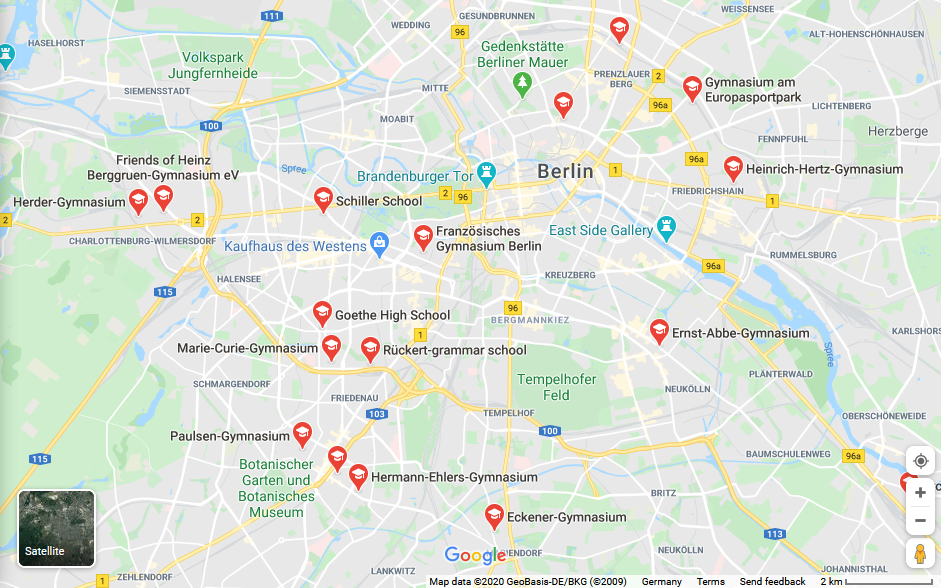
There are many Gymnasiums in rich areas like Wilmersdorf and few in poor areas (the map shows one in Neukölln and none in Gesundbrunnen and Wedding, although a few that aren’t shown at this zoom level do exist). But overall, the school locations are not especially rail-oriented. They’re strewn all over the middle-class parts of the city, even though most students do not live close enough to walk. Only the most specialized of the elite schools is in city center, the French school.
The situation in New York is similar to that of Berlin – the schools in the city are all over. This is despite the fact that there’s extensive school choice at the high school level, so that students typically take the subway and bus network over long distances. New York’s school stratification is not the same as Berlin’s – its Specialized High Schools serve the top 3% of city population, Germany’s Gymnasiums serve maybe 30% – but there, too, schools that explicitly aim to draw from all over the city are located all over the city. Only the most elite of New York’s schools, Stuyvesant, is in the central business district, namely in Lower Manhattan; the second and third most elite, Bronx Science and Brooklyn Tech, are just outside Downtown Brooklyn and in the North Bronx, respectively. A huge fraction of Bronx Science’s student population commutes from feeder neighborhoods like Flushing, Sunset Park, Chinatown, Jackson Heights, and the Upper West Side, and has to wake up early in the morning for an hour-long commute.
If schools are not just for very local neighborhood children, then they should not be isotropic, or even middle-class-isotropic as in Berlin. They should be in areas that are easily accessible by the city’s rapid transit network, on the theory that the time of children, too, is valuable, and replacing an hour-long commute with a half-hour one has noticeable benefits to child welfare and educational outcomes.
Urban school nodes
So to improve transit access to school in transit cities, it’s useful to get schools to move to be closer to key nodes on the rail network. City center may be too expensive – the highest and best use of land around Times Square or Pariser Platz is not a school. But there are other useful nodes.
The first class of good locations is central and near-center areas that don’t have huge business demand. In New York, Lower Manhattan and Downtown Brooklyn both qualify – business prefers Midtown. In Berlin, there are a lot of areas in Mitte that don’t have the development intensity of Potsdamer Platz, and to some extent the French school picked such an area, on the margin of Mitte.
The second is key connection points on the rail network that are not in the center. Berlin is rich in such connections thanks to the Ring. To some extent there are a bunch of schools close to Ringbahn stations, but this isn’t perfect, and for example the Europasportspark shown on the map is between two Ringbahn stations, at one of the few arterial roads through the Ring that doesn’t have an S-Bahn station. In New York, there is no ring, so connections are more sporadic; desirable nodes may include Queensborough Plaza, Metropolitan/Lorimer in Williamsburg, and East New York.
East New York supplies an example of the third class: an area that is rich in transit connections but is commercially undesirable because the population is poor. (The Berlin equivalent is Gesundbrunnen – non-German readers would be astounded by the bile Germans I know, even leftists who vote for anti-racist politicians, heap on U8 and on Gesundbrunnen and Neukölln.) Since everyone goes to school, even working-class children, it is valuable to site schools and other cultural amenities in such areas for easy accessibility.
One important caveat is that freeways, which make office and retail more attractive, have the opposite effect on schools. Air pollution makes learning more difficult, and children do not own cars and thus do not benefit from the convenience offered by the car. If rail lines are near freeways, then schools should be set somewhat away, on the principle that the extra 5-minute walk is worth the gain in health from not sitting hours in a polluted environment.
The suburbs
Outside the cities, the place for schools is the same as that for local retail and offices: the town center, with a regional rail station offering frequent access by train and timed connections by bus. Even when the student population is local, as it is in American suburbs, the density is too low for people to walk, forcing some kind of mechanized transportation. For this, the school bus is a poor option – it is capital-intensive, requiring what is in effect a second bus system, one that is as useless for non-students as the regular buses are for students if the school is far away from the local transit network.
Instead, a central school location means that the suburban bus network, oriented around city center, is useful for students. It increases transportation efficiency rather than decreasing it – there is no duplication of service, and the school peaks don’t usually coincide with other travel peaks, like the office worker peak and the retail worker peak. The bus network, designed around a 15- or 30-minute clockface schedule, also means that students can stay in longer, if they have on-campus club activity or if they have things to do in the town center, such as going shopping.
In some distant suburbs the school peak, arriving around 8 in the morning, may be the same as the peak for office workers who take the bus to the train to go to the central city. This isn’t necessarily a bad thing – for parents who insist on driving, this makes it easier to drop off children on the way to work. If this turns out to create real congestion on the bus, then the solution is to move school start time later, to 9 or so.
It’s crucial to use state power to effect this change when possible. For example, Massachusetts funds school construction through state funds but not renovation, which has encouraged schools to move to new campuses, generally in harder-to-reach areas. Fitchburg’s high school used to be in city center but recently moved to a suburban location close to nothing. Even in environments with a lot of local autonomy, the state should fund school construction in more central areas.
Density and Subway Stop Spacing
Normally, the best interstation distance between subway or bus stops does not depend on population density. To resurrect past models, higher overall density means that there are more people near a potential transit stop, but also that there are more people on the train going through it, so overall it doesn’t influence the decision of whether the stop should be included or deleted. Relative density matters, i.e. there should be more stops in areas that along a line have higher density, for example city centers with high commercial density, but absolute density does not. However, there is one exception to the rule that absolute density does not matter, coming from line spacing and transfer placement. This can potentially help explain why Paris has such tight stop spacing on the Métro and why New York has such tight stop spacing on the local subway lines.
Stop spacing and line spacing
The spacing between transit stops interacts with that between transit lines. The reason is that public transportation works as a combined network, which requires every intersection between two lines to have a transfer. This isn’t always achieved in practice, though Paris has just one missed connection on the Métro (not the RER), M5/M14 near Bastille; New York has dozens, possibly as many as all other cities combined, but the lines built before 1930 only have one or two, the 3/L in East New York and maybe the 1/4-5 around South Ferry.
The upshot is that the optimal stop spacing depends on the line spacing. If the line spacing is tight – say this is Midtown Manhattan and there is a subway line underneath Lex/Park, Broadway, 6th, 7th, and 8th – then crossing lines have to have tight stop spacing in order to connect to all of these parallel lines. In the other direction, there were important streetcars on so many important cross-streets that it was desirable to intersect most or ideally all of them with transfers. With so many streetcar lines extending well past Midtown, it is not too surprising that there had to be frequent subway stops.
So why would denser cities have tighter line spacing?
Line spacing and density
The intuitive relationship between line spacing and density is that denser cities need more capacity, which requires them to build more rail lines.
To see this a bit more formally, think of an idealized city on a grid. Let’s say blocks are 100*100 meters, and the planners can figure out the target density in advance when designing the subway network. If the city is very compact, then the subway could even be a grid, at least locally. But now if we expect a low-density city, say 16 houses per block, then the subway grid spacing should be wide, since there isn’t going to be much traffic justifying many lines. As the city densifies, more subway is justifiable: go up to missing middle, which is around 30-40 apartments per block; then to the Old North of Tel Aviv, which would be around 80; then to a mid-rise euroblock, which is maybe 30-40 per floor and 150-200 per block; then finally a high-rise with maybe 500-1,000 apartments.
Each time we go up the density scale, we justify more subway. This isn’t linear – an area that fills 500 apartments per block, which is maybe 100,000 people per km^2, does not get 20 times the investment of an area on the dense side of single-family with 16 houses per block and 5,000 people per km^2. Higher density justifies intensification of service, with bigger and more frequent trains, as well as more crowding. With more subway lines, there are more opportunities for lines to intersect, leading to more frequent stop spacing.
Even if the first subway lines are not planned with big systems in mind, which New York’s wasn’t, the idea of connections to streetcar lines was historically important. A stop every 10 blocks, or 800 meters, was not considered on the local lines in New York early on; however, stops could be every 5 blocks or every 7, depending on the spacing of the major crosstown streets.
Dense blobs and linear density
Line spacing is important to stop spacing not on parallel lines, but crossing lines. If a bunch of lines go north-south close to one another, this by itself says little about the optimal spacing on north-south lines, but enforces tight spacing on east-west lines.
This means that high density encourages tight stop spacing when it is continuous in a two-dimensional area and not just a line. If large tracts of the city are very dense, then this provides justification for building a grid of subway, since the crosstown direction is likely to fill as well; in New York, 125th Street is a good candidate for continuing Second Avenue Subway Phase 2 as a crosstown line for this reason.
In contrast, if dense development follows a linear corridor, then there isn’t much justification for intense crosstown service. If there’s just one radial line, then the issue of line spacing is moot. Even if there are two closely parallel radial lines in the same area, a relatively linear development pattern means there’s no need for crosstown subways, since the two lines are within walking distance of each other. The radial urban and suburban rail networks of Tokyo and Seoul do not have narrow interstations, nor do they have much crosstown suburb-to-suburb service: density is high but follows linear corridors along rapid transit. Dense development in a finger plan does not justify much crosstown service, because there are big low-density gaps, and suburb-to-suburb traffic is usually served efficiently by trips on radial lines with a transfer in city center.
Transportation Renaissance
Ada Palmer posts rarely, but when she does, it’s always worth reading. She alternates between writing about her science fiction and writing about academic history; her most recent post is the latter, covering the historiography of the Renaissance. She notes that the idea of a three-age system, in which great Ancient knowledge was lost in the Middle Ages and rediscovered in the Renaissance, was first promoted in the Renaissance itself, even if the word renaissance was only used starting in the 19th century, and traces why this idea was accepted then and why it’s remained popular since. In short: it provided political legitimacy to the coterie of thugs (“aristocracy”) who launched coups and counter-coups in the Italian states, who could hire historians to portray them as harbingers of a new era of revival of ancient glory.
This is a paragraph-long summary of a 13,000-word post that summarizes an in-progress book, so I’m glossing over a lot of detail and I recommend that people read the post if they want to talk about Renaissance historiography. I bring this up because this is relevant to transportation, and to some extent urbanism in general, in a number of ways.
The three-age schema
Ada notes that medieval Europeans divided the world into two ages: before and after Jesus. The Renaissance began a trend of a three-age system: Antiquity, a medieval dark age, and the Renaissance or modernity. She further traces the intellectual history of this not just in the Italian Renaissance but also in more recent times, going over the use of the language of renaissance in Johan Burkhardt’s work to argue for a new modernity replacing medieval superstition.
Stepping away from professional historians, I do not know to what extent the average educated Westerner thinks in terms of three ages. The answer is clearly “a great deal,” but I do not know to what extent it is universal. I was taught this schema uncritically in primary and middle school, but what I see in the online discourse is less consistent – for example, Paul Krugman’s writings on Malthusianism back a two-age model, before and after the beginning of the Industrial Revolution. But even with the caveat that economic historians don’t view things this way, the Nike swoosh model of Roman greatness, medieval decline, and modern resurgence still exercises enormous cultural influence.
The relevance of this is that people who propose a change to something often default to the three-age model, transplanted into a specific context. The emergent view of most American and European advocates for rail transport is that rail had a golden age from its invention until the middle of the 20th century, declined subsequently, and is supposed to enter a renaissance now. This is usually connected with urbanism, with a model of the growth of traditional cities, decline through suburban sprawl, and renaissance; variants depend on politics, but Strong Towns, myriads of consultants telling cities how to attract talent, most YIMBYs, and most of the left agree on this picture.
Revival of ancient learning
Renaissance Italy had a MIGA obsession. In an era of the Avignon Papacy and intensifying warfare between different factions and city-states, the appeal of Roman unity and peace is not hard to understand; it’s not as if 14th- and 15th-century Italians had better models. Here’s Ada again:
The solution Petrarch proposed to what he saw as the fallen state of “my Italy” was to reconstruct the education of the ancient Romans. If the next generation of Florentine and, more broadly, Italian leaders grew up reading Cicero and Caesar, the Roman blood within them might become noble again, and they too might be more loyal to the people than to their families, love Truth more than power, and in short love their cities as the Romans loved Rome. Such men would, he hoped, be brave and loyal in strengthening and defending their homelands. Rome started as one city, and did not make itself master of the world without citizens willing to die for it.
“Petrarch says we can become as great as the ancients by studying their ways! Let’s do it!” Petrarch’s call went out and, with amazing speed, Italy listened. Desperate, war-torn city states like Florence who hungered for stability poured money into assembling the libraries which might make the next generation more reliable. Wealthy families who wanted their sons to be princely and charismatic like Caesar had them read what Caesar read. Italy’s numerous tyrants and newly-risen, not-at-all-legitimate dukes and counts filled their courts and houses and public self-presentation with Roman objects and images, to equate themselves with the authority, stability, competence and legitimacy of the Emperors. No one took this plan more to heart than Petrarch’s beloved Florentine republic, and, within it, the Medici, who crammed their palaces with classical and neoclassical art, and with the education of Lorenzo succeeded in producing a classically-educated scion who was more princely than princes.
This provided the template for every Western narrative of decline that I’m familiar with, and a good number of non-Western ones: we were great, we’ve gone into decline, we will reverse the decline by restoring our ancient values. It’s unavoidable in every narrative of American decline; it’s there in the Brexit conception of British nationalism; it’s there in cross-national narratives of the decline of the left since the 1970s. In non-Western countries, it was there in a lot of early colonial rebellions (the Indian Rebellion of 1857 tried to restore the Mughal Empire). Even Japan went through a restorationist phase in the wake of its forced opening, though it famously went in a very different direction once the Meiji restoration happened.
This schema is used at a subnational level extensively. Regions that view themselves as declining, like the American Rust Belt, Northern England, or East Germany, cling fiercely to distinctive local institutions. This includes extensive study of local history and local affairs. It’s unavoidable in, say, Belt Publishing. Sometimes, this history is studied critically; in the broad public, it usually isn’t. The number of times I’ve heard New Yorkers contrast how the First Subway was built in four years (and not, say, 40) with how long subways take today is beyond mortals’ ability to count.
With rail transport specifically, advocacy is usually bundled into railfan interests. This, as per the usual paradigm, dovetails into very deep, usually uncritical, study of the history of the technology back when it was supposedly great. Go on Railroad.net and you will see people talk about the minutiae of historical steam and diesel engines and also brush off every piece of knowledge that was not generated in American mainline railroading. Interest in rail technology as a solution for the future gets bundled into romanticism for steam locomotives and for the particulars of how private railroads chose to operate service in the early 20th century.
The Renaissance Man as the innovator
Finally, Ada’s insight about why the idea of the Renaissance was accepted so quickly matters when looking at modern technology. Here, the three-age model is less relevant. The same emphasis on the innovator bringing the company/city/nation/world into a golden age is produced by other models. The accelerating growth model of the technological singularity produces the same effect even without the need to learn history, and is therefore widely popular among rationalists.
In transportation, the best recent example of this is the idea of the Hyperloop. What it is, underlyingly, is a new technology for running rail service, like maglev but capable of running at higher speed. All aspects of rail service planning with the exception of propulsion remain mostly the same (mostly, because the higher speeds do have special implications, though I don’t think they’re any different from what one can extrapolate from existing high-speed rail). This means that what it takes to build Hyperloop is similar to what it takes to build ordinary rail plus more money. I think Hyperloop One and Virgin understand that, but Elon Musk does not.
The importance of history as legitimacy cannot be discounted here. Court historians were hired to write hagiographies, just as artists were hired to paint and sculpt the likenesses of the biggest thugs (“royalty”). This does not usually apply to modern academic history – historians have political biases but there are layers insulating high-prestige academic historians from donors. But it does apply to a lot of popular writing, especially business journalism. I forget where I’ve read – I think it was in the context of New York real estate – that 2010s journalism is alive and well in trade media, but writing critical investigative pieces about powerful players is not always expected or rewarded in publications that make money as internal trade papers.
The upshot is that analyzing history, whether general or specific, as an abrupt positive change serves to empower people who can claim that they are the new world, and that any and all criticism is just the old way of thinking. It’s a form of epistemic narrowing that blocks off knowledge those people don’t have or can’t easily control.
YIMBY and Production Theory
Two years ago, at a Breakthrough Institute conference, I met Tory Gattis in real life for the first time, having known him on the Internet for maybe ten years. He was doing a debate with Kim-Mai Cutler, except they mostly agreed, and I think the reason for the agreement is their conception of production theory.
Tory’s opening was the most illuminating part, and only then, in 2018, did I understand why in 2008-9 I was so interested in reading him even though he was always pro-car, an unabashed Houston booster, and a fan of Joel Kotkin. He opened by defining himself in opposition to three ideas from the 2000s: smart growth, New Urbanism, and Richard Florida’s conception of the creative class. And there is clicked: these three ideas are all about cities as loci of consumption. Before YIMBYism, when Market Urbanism was an obscure libertarian blog, there wasn’t a lot in there for people who think in terms of urban job and residential growth, who think that consumption follows production and not the reverse.
New Urbanism and Richard Florida’s theory both hold, in different ways, that if cities make themselves nice to specific (different) classes of people, they will attract people who are morally and economically better to have as residents, stimulating further growth. In New Urbanism, this is about designing cities based on principles that are held to be objectively nicer for residents; this quickly boils down to the “when we’re expensive this proves we’re desirable, when you’re expensive this proves you’re unaffordable” principle. Ironically, the blog Old Urbanist holds something similar, it just posits a different (generally better) set of design principles. Richard Florida is less about physical design and more about community amenities for groups that in the 2000s he held were more creative, like gay people, for whom he prescribed more gay bars.
The irony is that even as he has increasingly repudiated the creative class theory, Florida maintains his attachment to consumption theory of cities. The difference is that 18 years ago he thought that building New Left-coded amenities like bike lanes and gay bars would attract creatives and increase social and economic outcomes and now he believes the same except that the final outcome is to raise rents. Tory was critiquing the idea already in the late 2000s, pointing out the anemic outcomes of cities whose development policy was consumption-based – it’s not that they were creating jobs but their rents was rising, but rather that they kept having low job growth and net emigration.
Smart growth is somewhat different, in that it is not explicitly an endorsement of consumption theory. However, in practice its effect is always to make development harder, not easier. The contrast is with transit-oriented development, which in theory means the same thing but in practice counts dwellings build near train stations and not dwellings prevented from being built far from train stations. California celebrates smart growth and smart growth celebrates California, and in practice the effect of California’s housing policy for the last 50 or so years has been to make all housing hard to build, creating a supply shortage.
In comes YIMBY. The central policy proposal of YIMBYism is to build more housing in rich, expensive cities. But the central tenet of YIMBYism is that people’s decisions about where to move to are driven by production rather than by consumption – that is, that people move for work rather than for the sort of consumption amenities that urban policymakers focus on.
This does not mean consumption amenities do not exist. They clearly do, but they operate at different levels from that of neighborhood activism. Albouy-Ehrlich-Liu find extensive consumption effects on urban desirability, but these are almost all geographic, like mild weather and proximity to the coast; only one is affected by policy, air quality, and that is a regional rather than local variable. Other policy-relevant consumption variables may be crime and education, neither of which is that responsive to local-level policy, especially when it pertains to development. People like New York and London and Paris, and maybe they’ll like them more if they provide public services like clean air better, but they’ll certainly not like them less if they replace 150-year-old 4-story buildings with 50-story ones. What people like about New York and London and Paris is not the architecture or the size of the buildings, but the dense job networks.
The Politics of Taking Out the Garbage
There’s a quote bouncing around urbanist media, attributed to Fiorello LaGuardia, that there is no Republican or Democratic way of taking out the garbage; see for examples CityLab and Governing. The idea of this quote is, there is no ideology in urban governance, only pragmatism. In this framework, important questions about how to govern a city are assumed away, as is any conflict between different class-based, ethnic, or industry-based interests.
The object-level political questions
There are key political questions about how to provide city services as delegated to the local government by the state. Berlin is a city as well as a state of Germany and thus has especially high levels of autonomy, with lively political debate about housing, education, and transportation. But even cities with less autonomy, like Paris, still have debates regarding land use, public housing, and street usage. These can be any of the following:
- Is this service worth spending more money on, or should the city prioritize other services?
- Should this service be provided directly by the city government, or by the private sector? If the latter, what kind of regulations are appropriate, if any?
- Where should the city prioritize service? For example, in education, should the city prioritize class integration or build segregated schools (“Gymnasien”)? In garbage, which neighborhoods should the city make sure to prioritize in collection?
- Should the workers be unionized? Should the city side more with the unions or with management in industrial disputes?
- How should the service be run? For example, in education, what should the curriculum focus on, how should assessment work, what is the priority for investment, and how big should schools be? In policing, which crimes should get the most resources, should the city side with the police more or with civil rights activists, and which theories of policing should be implemented (broken windows, community policing, etc.)?
The earlier questions on the above list tend to be the same regardless of service, and generally people who like privatizing one service also like privatizing others. But shouldn’t this be an open ideological debate? A multiparty governing coalition might compromise on which services should be municipal and which private, and political parties would have to put their ideas to the test by either crafting a workable privatization contract or competently running service publicly.
The later questions on the list depend more on the service in question, and usually the biggest ideological load is on bigger issues than sanitation, like education or policing, the former of which especially animates the New Right in Germany and white flighters in the United States. However, even with sanitation, there are questions of priorities like what frequency to collect, how much to prioritize low-income neighborhoods, and how much space to make for dumpsters on the streets. New York infamously has open trash on the sidewalks because dumpsters would have to take up space that is currently devoted to street parking, which the most powerful mass groups of voters in the city consider sacrosanct.
The meta questions
Beyond questions of how to run various services, there are even broader questions about what is appropriate to be decided at what level. For examples:
- How big should the city be? That is, should it annex its suburbs for a greater regional government, as in London, Berlin, and Toronto, or remain more local, as in Paris and most American cities? Should local governments outside the city be very fractionalized as in France and the Northeastern United States, or should there be amalgamations of regional municipalities as in most of non-France Europe?
- Which issues are appropriate to be decided at what level? Should local governments have taxing power at all, or should they only have to make do with the budgets given to them by state taxes? Should education, policing, sanitation, transport, parks, electricity, and water be responsibilities of the state, a regional government, or the city?
- What role, if any, should referendums have in budgetary and other political questions?
- Regardless of what services are provided at what level, how should the bodies providing them be overseen? Should there be an elected board, a ministerial appointment, a civil service, or any combination of those three?
These questions sometimes do and sometimes don’t carry ideological load, but even when they don’t, they deserve to be debated and voted on in the open. In France, Sweden, and Japan, questions regarding zoning and housing production are decided at the national level, so in the 2014 election campaign, political parties in Sweden had posters all over Stockholm promising to build more housing to alleviate the country’s severe shortage. In the United States and in Germany these decisions are more local, but it’s completely legitimate for a political movement to demand that decisions be transferred upward to the state level, and to a large extent the YIMBY movement in California argues openly for state-level mandates and against local control.
This is especially important when there is consistent ideological load. Questions of annexation and boundaries between local or regional governments frequently intersect with inequality. In Israel, there are revenue-generating industrial zones in non-urban regional councils adjacent to low-income cities, where local interests agitate for the right to annex these zones to enhance those cities’ tax bases; conversely, the kibbutzes within those regional councils agitate for keeping borders as they are, and have so far succeeded in forestalling any change.
Interaction between different questions
The various object-level and meta questions about how to run city government – or whether to even have much local empowerment in the first place – interact in ways that make the answers to some questions depend on others.
The issue of pragmatism and apolitical government is especially instructive, because if the idea is to reduce the role of ideology in answering object-level questions, then certain meta elements follow. Specifically, if there is no ideological conflict, then there is no need for elected government. Consensus can be formed entirely at the elite civil service level, and in particular the number of political appointments should be kept to a minimum, ideally zero except for the minister.
The analog here is the military, which is depoliticized in every democracy, to the point that a politicized military generally means a country is not fully democratic. The military appoints its own officers, and even when the elected government must sign off on officer commissions, it is a pure rubber stamp, as the decisions are made internally. Only at the highest levels do politicians decide on appointment to provide civilian oversight, such as the IDF chief of staff. The role of the political system is to make decisions on war and peace and allocate the budget, and even then the military gets considerable latitude in internal allocation of funding. What is more, this arrangement is not a cloak-and-dagger affair – the public fully knows what is going on and is supportive, because the public has high levels of trust in the military as an institution, even in times and places with low public support for war.
Pragmatism and excuses
In practice, self-identified pragmatism in politics tends to mean treating certain positions as so obvious that they do not require any further defense. But then the question of what is obvious depends on time and place; for example, in the late 20th century through today, English-speaking governments have assumed that public-private partnerships with multi-decade contracts are obviously the superior way to provide services, whereas the Nordic countries prefer regionwide governance with more ubiquitous but shorter-term contracting and France and Germany keep most services in the public sector.
Most people do not stop to ask whether a foreign way works better. This has nothing to do with pragmatism – people who identify differently do it just as much. However, the lack of political pluralism means that it is not possible for an opposition movement to point out that other places do things differently and use this to come up with concrete proposals for change. This problem occurs often where there is no regular change in government; multiparty elections can ameliorate it by giving people the option of voting for a different coalition members, for example voting Green in Berlin within the dominant red-red-green coalition to express a wish to stop building highways, but even that works less well than the threat of the opposition actually taking over. In cities with no real ideological choice, it becomes completely impossible to adopt new practices, and this should be viewed as a primary reason why local governance in the United States is so bad by European standards.
Democratic consensus as mediation
In contrast with the idea of a leader who stands about mere politics, democratic consensus governance permits debate on different urban questions, including meta-discussions of which questions are most important. The key here is multiparty elections that force coalition governments. This has three benefits.
- It reduces the ability of an executive to engage in an authoritarian takeover, since junior coalition members in nearly all cases have an incentive to defect – if the opposition is destroyed, they are next on the chopping block.
- It widens the space of permissible ideas, since niche groups can take over smaller parties; environmentalism made the jump from street protests to serious politics through green parties in multiparty states. In cases of extremism it’s still possible to form a cordon sanitaire against unwanted parties like AfD, and this puts pressure on parties to behave in socially acceptable ways to avoid being treated as illegitimate.
- It allows junior members to advocate on a specific issue and get the relevant ministerial portfolio to make changes that can succeed or fail in the real world.
This is a set of answers to meta-questions, much more so than to object-level questions. As always, there is interaction between answers: if political parties are the vessel that mediates between individual voters and the state, then the polity size must be large enough to maintain ideological vote and ideological diversity, which argues in favor of more extensive annexation and against very small, homogeneous municipalities like Eastern and Midwestern American suburbs.
There is extensive room for pragmatism here, since this is a governance method that lives on political compromise, denying any single faction a majority. But it’s a pragmatism layered on ideological questions, because different parties will have different ideas about how to run the police, provide sanitation, allocate street space, etc., and this is fine. Different parties will have different ideas about whether to side with workers or management more, and this too is fine. And different parties will have different ideas about how to prioritize the budget and which services to provide in the first place, and that, like the previous points of contention, is also fine.
A Bigger City is a Better City
There’s a tendency among a number of important American YIMBYs that bothers me – they speak of development as a bad thing, a great burden that must be shared equally across neighborhoods. I’ve even seen this take regarding immigration, portraying it as such a terrible burden that Germany must undertake to redeem itself after the Holocaust. The underlying assumption is that growth is bad, and the ideal world is static and has people living in small communities.
But what if growth is good? What if more urban development is good? What if immigration is good, and immigrants are good people individually and collectively?
Growth is good
There’s a “growth for its own sake is the ideology of the cancer cell” meme out there. Well, no. Growth is not for its own sake. It’s for the sake of the things you can do in a society that produces more stuff: live longer, own refrigerators and other appliances, travel beyond walking range, communicate with people beyond travel range, get your own room, eat more interesting food than whatever scraps concentration camp prisoners fight over, wear more interesting clothes than concentration camp prisoner uniform, play interesting games, etc.
What is true is that no single element of these is in perfect correlation with wealth. You can even devise a large subset of these that aren’t, and focus on places that are exceptional relative to their income levels; Kerala is popular for its high literacy and life expectancy relative to its wealth. But usually these early investments then pay off in growth – this was the case in 1960s and 70s’ Korea, which was approaching universal literacy at the start of this period with astonishingly low incomes, and then used its advantage in relatively skilled, low-wage work to industrialize.
Urban development is good
The ability to access more stuff easily is a good thing and there’s a reason both employers and residents pay extra to have it. More and bigger buildings stimulate this kind of access. On the production side, this means thicker social networks for people who work in related industries and can come up with new innovations – this is why the tech industry sticks in San Francisco and environs, and not the bay view or the state of California’s public services. This, in turn, raises wages. On the consumption side, this means more variety in what to buy.
Moreover, this is true down to the neighborhood level. A denser neighborhood has more amenities, because more people is a good thing, because new people stimulate new social events, new consumption, and new opportunities for job access. If more people move to your neighborhood, that means first of all that employers are more likely to site jobs where convenient for you, and second of all that the city is likelier to want to build more subway lines in your direction.
A corollary of this is that private developers, as a class, are good, because they convert factors of production like labor and capital into finished, habitable apartments and offices. Yes, they can individually be terrible people. But collectively as a class their effect is good and the state needs to stop treating them as a source of loot to be doled to sympathetic neighborhood groups.
The most frustrating thing about it is that New York specifically likes to extol its own size as a reason for its supposed greatness. But then the idea that an even bigger city is a better city makes the political system there wince, and therefore the city permitted not many more than 20,000 housing units per year at the peak of the pre-virus economy, about one quarter the per capita rate of the Seoul metropolitan region or Tokyo (the city proper, but I think the suburbs have similar housing growth), and one third that of Ile-de-France.
Immigrants are good
Vancouver is a racist city, and I say this having lived in Israel. I somehow found myself in a room at a meetup where an all-white group of people were talking about black men’s penis size. Anti-Semitism, anti-black racism, Sinophobia, hate for indigenous people: you name it, I saw it there, used casually, by people who didn’t even think they were saying something controversial. The representatives of the people of that city have come across the realization that there is extensive immigration to their city and therefore it may be prudent to choke housing development because it’s all for immigrants anyway.
There’s a weird kind of defensiveness about immigration, even in societies where it’s fairly popular. Germany and Sweden both think they’re shouldering a great burden by taking in refugees, and even Germans who identify as left-wing and antiracist seem scared of diverse neighborhoods that immigrants of all social classes don’t find anything wrong with. But Germans at least have the excuse of not being used to diversity, and I think they’re slowly learning to be more tolerant. Vancouverites are used to diversity and decided they prefer racial purity to growth. Housing growth in Vancouver was healthy before the crisis but a lot of political forces in the city seem intent on making sure this doesn’t happen again, and with the transit-oriented development sites filling fast, the region will soon have to make tough decisions on upzoning single-family neighborhoods 600 meters from the train rather than 100 meters.
For the same reason a bigger city is a better city, the movement of immigrants into a country is an unalloyed good for the recipient country, unless perhaps that country is extremely dependent on primary resources, which Germany isn’t and even British Columbia isn’t.
Developers may be individually bad people but collectively good as a class; with immigrants, the good is both individual and collective. Immigrants as individuals are good, and it’s better for a country to have more of them (us, really): if anyone wants me to babble about all the statistics about employment (even for refugees in Germany), lower crime rates, cultural emphasis on skills and education, etc., I’ll be happy to do so in comments. Immigrants as a collective are likewise good, through introducing more cultural variety to a place and promoting cultural and social ties to parts of the world this place may not have thought to learn much from.

