High-Speed Rail Doesn’t Depend on Megaregions
On my Discord channel, I was reminded of the late-2000s work by some institutional American urbanists about the concept of megaregions. Wikipedia has a good summary of the late-2000s discourse on the subject. In short, there are linear ties across the East Coast from Boston to Washington (“BosWash”), with more or less continuous suburban development in between, and some urbanists tried to generalize this concept to other agglomerations of metropolitan areas, not usually successfully. The American work on this carved most of the country’s population into 10 or 11 megaregions, sometimes annexing portions of Canada, as in the Regional Plan Association’s America 2050 program:
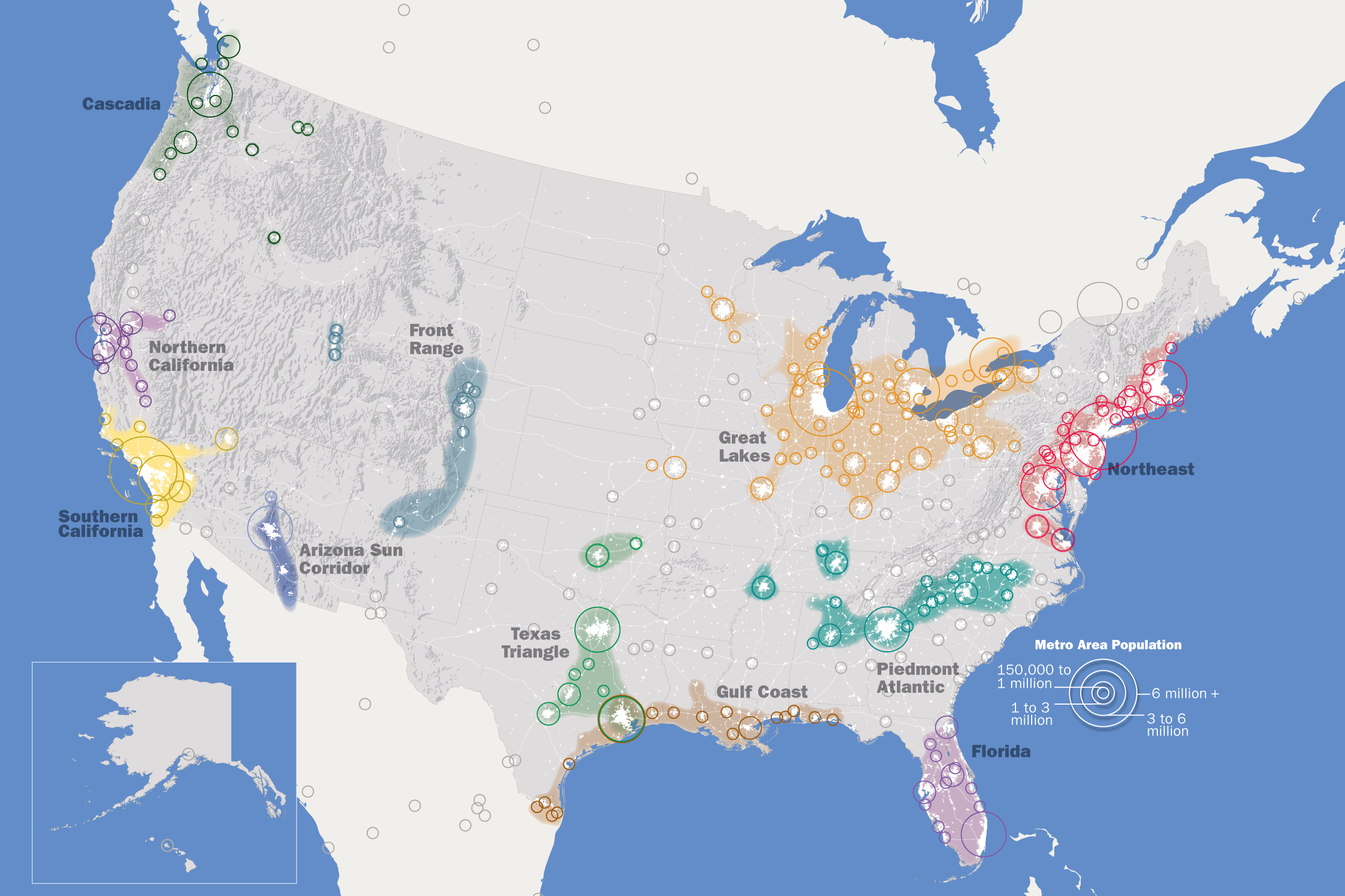
There is a lot to critique about this map. Canada has a strong self-conception as a distinct entity from the United States; while there’s a case for lumping Vancouver with Seattle and Portland as the Pacific Northwest, lumping Toronto with the Midwest is irresponsible. The Hampton Roads region is not meaningfully a periphery of the Northeast, but is rather Southern (for example, it is heavily militarized, and the South has consistently higher enlistment rates than the Northeast). The Rio Grande Valley is not especially connected with New Orleans.
But the core of the program is to propose this as the basis of high-speed rail investment, and that’s where it fails the most visibly. When one of my Discord channel participants posted the map in the channel about high-speed rail, I started talking about my gravity model, and pointed out some patterns that emerge.
For this, consult a table of ridership between any pair of American or Canadian cities in the main connected component of my proposed map:

The table omits Texas, California, and the Pacific Northwest. But it includes lines that I initially considered and rejected, going to Kansas City and Birmingham; the reason is that when I calculated it by hand I omitted very weak long-range connections such as between Boston and the Midwest, whereas the table can automatically calculate them and add them in, producing an estimate of 5 million annual riders between Boston and the entire Midwest region. These extra connections make weak lines like those to Birmingham and Kansas City appear stronger, so those lines are included; it’s plausible they could even justify a connection to Texas via both New Orleans and and Tulsa, but those are not included (and would at any case not impact the analysis below).
The following table includes some connections between two adjacent cities in the table, with their total projected passenger counts. Those are very high numbers, higher than you’d expect; this is because they lump in a great many city pairs – for example, New York-Philadelphia includes all connections from New York, Boston, and Albany to Philadelphia and points south and west, and those sum to a much higher number than just the internal trips on the Northeast Corridor, let alone just trips originating in New York and ending in Philadelphia or the reverse. Also, as a note of caution, there may be small inaccuracies if I mistakenly tabulated very weak markets like Chicago-Charlotte as going via the wrong path; they do not change the main conclusion.
| City pair | Ridership |
| Boston-New York | 39,299,133 |
| Boston-Springfield | 25,482,364 |
| New York-Philadelphia/Harrisburg | 139,860,707 |
| Philadelphia-Washington | 110,010,205 |
| Washington-Richmond | 64,145,050 |
| Richmond-Raleigh | 50,425,578 |
| Raleigh-Greensboro | 42,654,519 |
| New York-Albany | 57,773,629 |
| Philadelphia-Harrisburg | 65,639,871 |
| Harrisburg-Pittsburgh | 61,110,782 |
| Pittsburgh-Cleveland | 62,352,156 |
| Cleveland-Toledo | 56,482,182 |
| Cleveland-Columbus | 46,046,790 |
| Buffalo-Cleveland | 41,584,062 |
Some observations jump from this (partial) table:
- New York-Boston is much weaker than a lot of segments that are by themselves far weaker than the Northeast Corridor. The reason for this is that a full 31.1 million annual riders on New York-Boston are internal to the Northeast Corridor, whereas the other city pairs require large swaths of the network to be built to have such high traffic.
- From Philadelphia to points west, traffic density is fairly consistent. There’s no separation between a Northeastern and Midwestern megaregion evident in the data: Cleveland has about the same traffic density going east and west, as does Pittsburgh. Rather, it’s the connections between the East Coast and the Midwest, chiefly Philadelphia-Pittsburgh-Cleveland but also the Empire corridor between Albany and Cleveland, that create high ridership.
- Washington-Atlanta is a tail gradually weakening with distance from the Northeast Corridor, rather than an independent corridor.
Outside the US, the same observation about the irrelevance of megaregions to high-speed rail is true. The European attempt to describe a megaregion, the so-called Blue Banana, was constructed explicitly to exclude France – but the highest-traffic density intercity rail link in Europe is between Paris and the bifurcation splitting toward Lyon and Dijon. Frankfurt-Mannheim is a close second, but French intercity trains average around 220 km/h and German ones around 130 km/h depending on the line, and the actually existing high-speed rail network gets higher peak traffic density than the medium-speed one.
Ultimately, high-speed rail as a mode of transportation is a means of connecting metropolitan areas. Whether they fall into megaregions or not is immaterial – some strong links connect distinct regions, like Northeast-Midwest, with higher demand for traffic than some of the internal connections.

 Pedestrian Observations