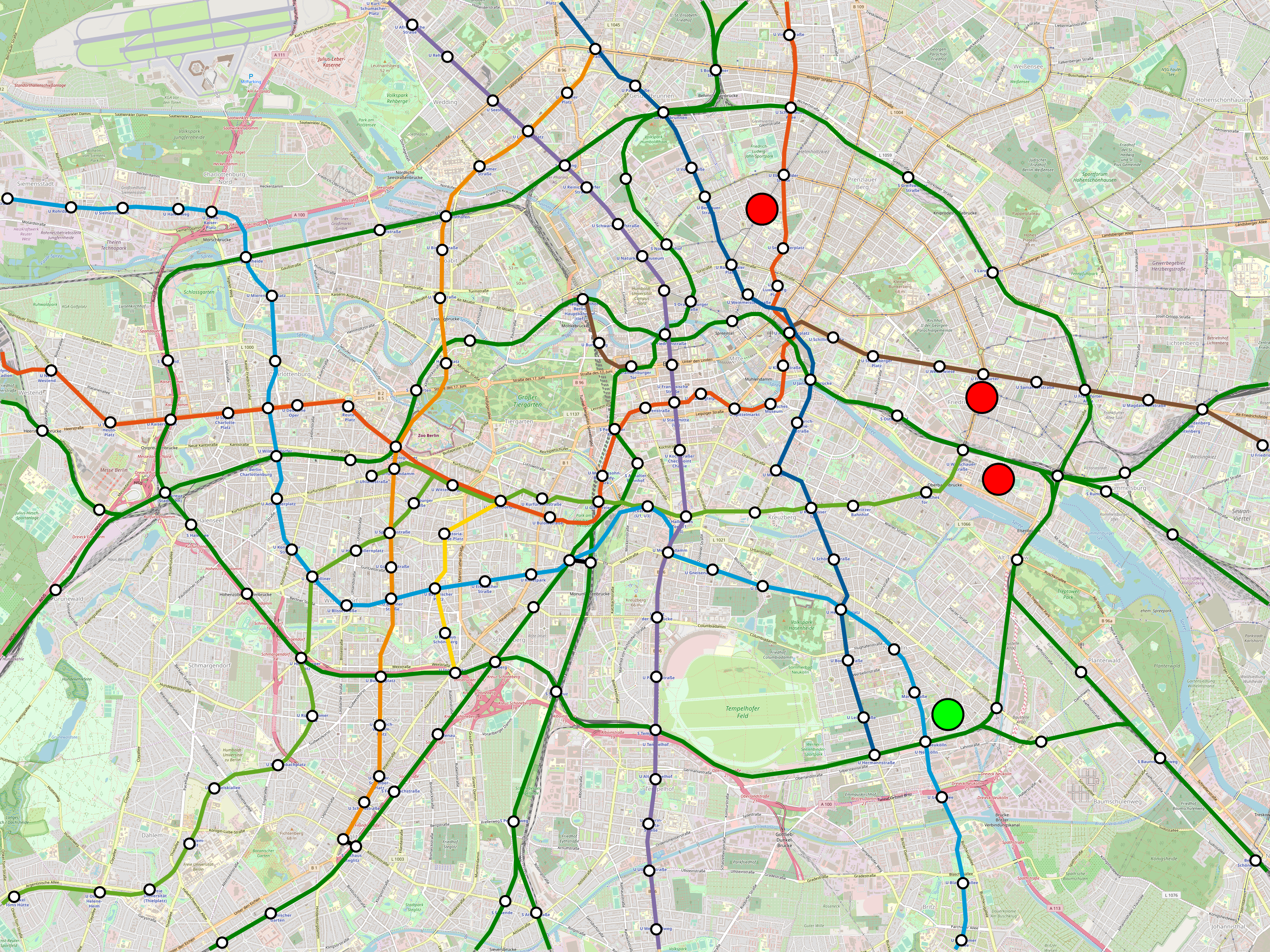
S-Bahn and RegionalBahn
The American rail activist term regional rail refers to any mainline rail service short of intercity, which lumps two distinct service patterns. In some German cities, these patterns are called S-Bahn and RegionalBahn, with S-Bahn referring to urban rail running on mainline tracks and RegionalBahn to longer-range service in the 50-100 km range and sometimes even beyond. It’s useful to distinguish the two whenever a city wishes to invest in its regional rail network, because the key infrastructure for the two patterns is different.
As with many this-or-that posts of mine, the distinction is not always clear in practice. For one, in smaller cities, systems that are labeled S-Bahns often work more like RegionalBahn, for example in Hanover. Moreover, some systems have hybrid features, like the Zurich S-Bahn – and what I’ve advocated in American contexts is a hybrid as well. That said, it’s worth understanding the two different ends of this spectrum to figure out what the priority for rail service should be in each given city.
S-Bahn as urban rail
The key feature of the S-Bahn (or the Paris RER) is that it has a trunk that acts like a conventional urban rapid transit line. There are 6-14 stations on the trunks in the examples to keep in mind, often spaced toward the high end for rapid transit so as to provide express service through city center, and all trains make all stops, running every 3-5 minutes all day. Even if the individual branches run on a clockface schedule, people do not use the trunk as a scheduled railroad but rather show up and go continuously.
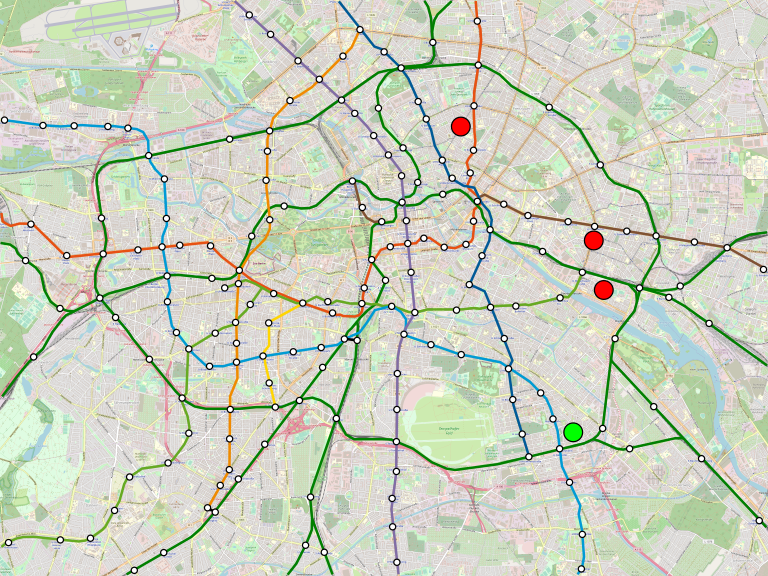
Moreover, the network layout is usually complementary with existing urban rail. The Munich S-Bahn was built simultaneously with the U-Bahn, and there is only one missed connection between them, The Berlin S-Bahn and U-Bahn were built separately as patchworks, but they too have one true missed connection and one possible miss that depends on which side of the station one considers the crossing point to be on. The RER has more missed connections with the Metro, especially on the RER B, but the RER A’s station choice was designed to maximize connections to the most important lines while maintaining the desired express stop spacing.
Urban rail lines rarely terminate at city center, and the same is true for S-Bahn lines. In cities whose rail stations are terminals, such as Paris, Munich, Frankfurt, and Stuttgart, there are dedicated tunnels for through-service; London is building such a tunnel in Crossrail, and built one for Thameslink, which has the characteristics of a hybrid. In Japan, too, the first priority for through-running is the most local S-Bahn-like lines – when there were only six tracks between Tokyo and Ueno, the Yamanote and Keihin-Tohoku Lines ran through, as did the Shinkansen, whereas the longer-range regional lines terminated at the two ends until the recent through-line opened.
The difference between an S-Bahn and a subway is merely that the subway is self-contained, whereas the S-Bahn connects to suburban branches. In Tokyo even this distinction is blurred, as most subway lines connect to commuter rail lines at their ends, often branching out.
RegionalBahn as intercity rail
Many regional lines descend from intercity lines that retooled to serve local traffic. Nearly every trunk line entering London from the north was built as a long-range intercity line, most commuter rail mainlines in New York are inner segments of lines that go to other cities or used to (even the LIRR was originally built to go to Boston, with a ferry connection), and so on.
In Germany, it’s quite common for such lines to maintain an intercity characteristic. The metropolitan layout of Germany is different from that of the English-speaking world or France. Single-core metro regions are rather small, except for Berlin. Instead, there are networks of independent metropolitan cores, of which the largest, the Rhine-Ruhr, forms an urban complex almost as large as the built-up areas of Paris and London. Even nominally single-core metro regions often have significant independent centers with long separate histories. I blogged about the Rhine-Neckar six months ago as one such example; Frankfurt is another, as the city is ringed by old cities including Darmstadt and Mainz.
But this is not a purely German situation. Caltrain connects what used to be two independent urban areas in San Francisco and San Jose, and many outer ends of Northeastern American commuter lines are sizable cities, such as New Haven, Trenton, Providence, and Worcester.
The intercity characteristic of such lines means that there is less need to make them into useful urban rail; going express within the city is more justifiable if people are traveling from 100 km away, and through-running is a lower priority. Frequency can be lower as well, since the impact of frequency is less if the in-vehicle travel time is longer; an hourly or half-hourly takt can work.
S-Bahn and RegionalBahn combinations
The S-Bahn and RegionalBahn concepts are distinct in history and service plan, but they do not have to be distinct in branding. In Paris, the distinction between Transilien and the RER is about whether there is through-running, and thus some lines that are RegionalBahn-like are branded as RER, for example the entire RER C. Moreover, with future extension plans, the RER brand will eventually take over increasingly long-distance regional service, for example going east to Meaux. Building additional tunnels to relieve the worst bottlenecks in the city’s transport network could open the door to connecting every Transilien line to the RER.
Zurich maintains separate brands for the S-Bahn and longer-distance regional trains, but as in Paris, the distinction is largely about whether trains terminate on the surface or run through either of the tunnels underneath Hauptbahnhof. Individual S-Bahn branches run every half hour, making extensive use of interlining to provide high frequency to urban stations like Oerlikon, and many of these branches go quite far out of the city. It’s not the same as the RER A and B or most of the Berlin S-Bahn, with their 10- and 15-minute branch frequencies and focus on the city and innermost suburbs.
But perhaps the best example of a regional rail network that really takes on lines of both types is that of Tokyo. In branding, the JR East network is considered a single Kanto-area commuter rail network, without distinctions between shorter- and longer-range lines. And yet, the rapid transit services running on the Yamanote, Keihin-Tohoku, and Chuo-Sobu Lines are not the same as the highly-branched network of faster, longer-range lines like Chuo Rapid, Yokosuka, Sobu Rapid, and so on.
The upshot is that cities do not need to neatly separate their commuter rail networks into two separate brands as Berlin does. The distinction is not one of branding for passengers, but one of planning: should a specific piece of infrastructure be S-Bahn or RegionalBahn?
Highest and best use for infrastructure
Ordinarily, the two sides of the spectrum – an S-Bahn stopping every kilometer within the city, and a RegionalBahn connecting Berlin with Magdeburg or New York with New Haven – are so different that there’s no real tradeoff between them, just as there is no tradeoff between building subways and light rail in a city and building intercity rail. However, they have one key characteristic leading to conflict: they run on mainline track. This means that transportation planners have to decide whether to use existing mainline tracks for S-Bahn or RegionalBahn service.
Using different language, I talked about this dilemma in Boston’s context in 2012. The situation of Boston is instructive even in other cities, even outside the United States, purely because its commuter rail service is so bad that it can almost be viewed as blank slate service on existing infrastructure. On each of the different lines in Boston, it’s worth asking what the highest and best use for the line is. This really boils down to two questions:
- Would the line fill a service need for intra-urban travel?
- Does the line connect to important outlying destinations for which high speed would be especially beneficial?
In Boston, the answer to question 1 is for the most part no. Thirty to forty years ago the answer would have been yes for a number of lines, but since then the state has built subway lines in the same rights-of-way, ignorant of the development of the S-Bahn concept across the Pond. The biggest exceptions are the Fairmount Line through Dorchester and the inner Fitchburg Line through suburbs of Cambridge toward Brandeis.
On the Fairmount Line the answer to question 2 is negative as well, as the line terminates within Boston, which helps explain why the state is trying to invest in making it a useful S-Bahn with more stops, just without electrification, high frequency, fare integration, or through-service north of Downtown Boston. But on the Fitchburg Line the answer to question 2 is positive, as there is quite a lot of demand from suburbs farther northwest and a decent anchor in Fitchburg itself.
The opposite situation to that of Fairmount is that of the Providence Line. Downtown Providence is the largest job center served by the MBTA outside Boston; the city ranks third in New England in number of jobs, behind Boston and Cambridge and ahead of Worcester and Hartford. Fast service between Providence and Boston is obligatory. However, Providence benefits from lying on the Northeast Corridor, which can provide such service if the regional trains are somewhat slower; this is the main justification for adding a handful of infill stops on the Providence Line.
In New York, the situation is the most complicated, befitting the city’s large size and constrained location. On most lines, the answers to both questions is yes: there is an urban rail service need, either because there is no subway service (as in New Jersey) or because there is subway service and it’s overcrowded (as on the 4/5 trains paralleling the Metro-North trunk and on the Queens Boulevard trains paralleling the LIRR trunk); but at the same time, there are key stations located quite far from the dense city, which can be either suburban centers 40 km out or, in the case of New Haven, an independent city more than 100 km out.
Normally, in a situation like New York’s, the solution should be to interline the local lines and keep the express lines at surface terminals; London is implementing this approach line by line with the Crossrail concept. Unfortunately, New York’s surface terminals are all outside Manhattan, with the exception of Grand Central. Penn Station has the infrastructure for through-running because already in the 1880s and 90s, the ferry transfers out of New Jersey and Brooklyn were onerous, so the Pennsylvania Railroad invested in building a Manhattan station fed by east-west tunnels.
I call for complete through-running in New York, sometimes with the exception of East Side Access, because of the island geography, which makes terminating at the equivalent of Gare du Nord or Gare de Lyon too inconvenient. In other cities, I might come to different conclusions – for example, I don’t think through-running intercity trains in Chicago is a priority. But in New York, this is the only way to guarantee good regional rail service; anything else would involve short- and long-range trains getting in each other’s way at Penn Station.
 Pedestrian Observations