Why You Should Complete High-Speed Lines
Some countries build complete high-speed rail networks, on which one can travel between cities almost entirely at high speed, such as France, Japan, and China. Others build partial networks, mixing low- and high-speed travel, such as Germany. The planning lingo in the latter is “strategic bypass” or “strategic connection.” And yet, there is nothing strategic about most mixed lines. If a line between two cities is partly high-speed and partly low-speed, it is usually strategic to complete the high-speed line and provide fast travel – the benefits will exceed those of having built the original high-speed partial segment. Since Germany’s rail network largely consists of such mixed lines, the benefits of transitioning to full high-speed rail here are large.
The arguments I’m about to present are not entirely new. To some extent, I discussed an analog years ago when arguing that in the presence of a complete high-speed line, the benefits of building further extensions are large; this post is a generalization of what I wrote in 2013. Then, a few months ago, I blogged about positive and negative interactions. I didn’t discuss high-speed rail, but the effect of travel time on ridership is such that different segments of the same line positively interact.
The upshot is that once the basics of a high-speed rail networks are in place, the benefit-cost ratio of further extensions is high. In a country with no such network, the first line or segments may look daunting, such as India or the UK, but once it’s there, the economics of the rest tend to fall into place. It takes a while for returns to diminish below the point of economic viability.
A toy model
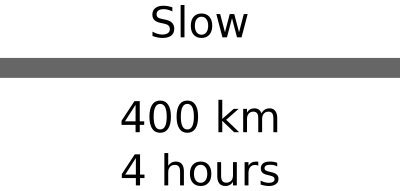
Take a low-speed rail line:
Now build a high-speed line parallel to half of it and connect it with the remaining half:
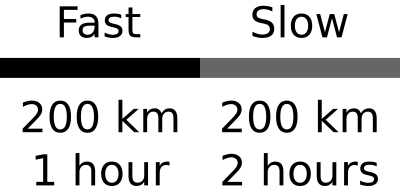
You will have reduced trip time from 4 hours to 3 hours. This has substantial benefits in ridership and convenience. But then you can go all the way and make the entire line fast:
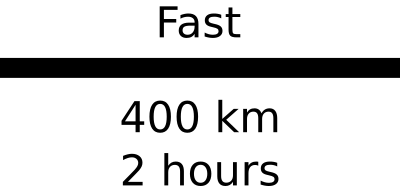
Are there diminishing returns?
No.
The benefits of reducing travel time per unit of absolute amount of time saved always increase in speed; they never decrease. The gravity model holds that ridership follows an inverse square law in total cost, including ticket fare and the passengers’ value of time, which time includes access and egress time. Reducing in-vehicle travel time by a fixed amount, say an hour, increases ridership more if the initial travel time is already lower.
This is on top of reductions in operating costs coming from higher speed. Trains on high-speed track consume less electricity than on legacy track, because they cruise at a constant speed, and because head-end power demand scales with time rather than distance traveled. Crew wages per kilometer are lower on faster trains. And the cost of rolling stock procurement and maintenance is spread across a longer distance if the same train is run more kilometers per year. In the toy model, there are actually increasing returns coming from rolling stock costs: upgrading half the line to high speed requires running an expensive high-speed train on the entire line, whereas completing the high-speed line does not require increasing the cost per unit of rolling stock.
Diminishing returns do occur, but only in the context of an increase in top speed, not in that of speeding up slow segments to match the top speed of faster segments. In that context, benefits do diminish and costs do rise, but that is not the same as completing high-speed lines.
As the maximum speed is increased from 160 to 200 km/h, the train speeds up from 22.5 seconds per kilometer to 18. To provide the same increase further, that is to reduce the time taken to traverse a kilometer by a further 4.5 seconds to 13.5, the speed must increase to 266.67 km/h. To provide the same 4.5-second increase once more, the speed must increase to 400. Curve radius is proportional to the square of speed, so these increases in speed must be accompanied by much more exacting track geometry. Tunnels may well be unavoidable at the higher speeds in topography that could accommodate 200-250 entirely at-grade.
What’s more, operating costs rise too as top speed increases. The electricity consumption on a 300 km/h cruise is lower than on a legacy line on which trains transition back and forth between 200 and 100 and all speeds in between, but the electricity consumption on a 350 km/h cruise is definitely higher than on a 250 km/h cruise.
However, what is relevant to the decision of what standards to build a line to is not relevant to the decision of how far to extend this standard. Once a 300 km/h segment has been built, with a dedicated fleet of trains that cost €30 million per 200-meter set, the returns to upgrading the entire segment the train runs on are higher than those of just building the initial segment.
Can some strategic segments be easier to build than others?
Yes, but only in one specific situation: that of an urban area. The toy model says nothing of construction costs – in effect, it assumes the cost of making the first 200 km fast is the same as that of making the next 200 km fast. In reality, different areas may have different construction challenges, making some parts easier to build than others.
However, if the construction challenge is mountainous topography, then the higher cost of mountain tunnels balance out the greater benefit of fast trains across mountains. The reason is that in practice, legacy rail lines are faster in flat terrain than in the mountains, where past construction compromises led to sharp curves.
This situation is different in urban areas. In urban areas as in the mountains, costs are higher – land acquisition is difficult, and tunnels may be required in areas where the alternative is buying out entire city blocks. But unlike in the mountains, the existing rail line may well be reasonably straight, permitting average speeds in the 120 km/h area rather than the 70 km/h area. In that case, it may be advisable to postpone construction until later, or even keep the legacy alignment.
One example is the Ruhr area. The tracks between Dortmund and Duisburg are not high-speed rail – the fastest trains do the trip in about 34 minutes, an average speed of about 95 km/h. Speeding them up by a few minutes is feasible, but going much below 30 minutes is not. Thus, even if there is a 300 km/h line from Dortmund to points east, the returns to the same speedup between Dortmund and Duisburg are low. (Besides which, Dortmund is the largest city in the Ruhr, and the second largest, Essen, in the middle between Dortmund and Duisburg.)
Another is Connecticut. East of New Haven, there is relatively little urban development, and constructing a 300-360 km/h line roughly along the right-of-way of I-95 poses few challenges. West of New Haven, such construction would require extensive tunneling and elevated construction – and the legacy line is actually somewhat less curvy, it’s just slower because of poor timetable coordination between Amtrak’s intercity trains and Metro-North’s regional trains. While the returns to building 250-300 km/h bypasses around the line’s slowest points in southwestern Connecticut remain high enough to justify the project, they’re lower than those in southeastern Connecticut.
The situation in Germany
On the following map, black denotes legacy lines and red denotes purpose-built 300 km/h high-speed lines:
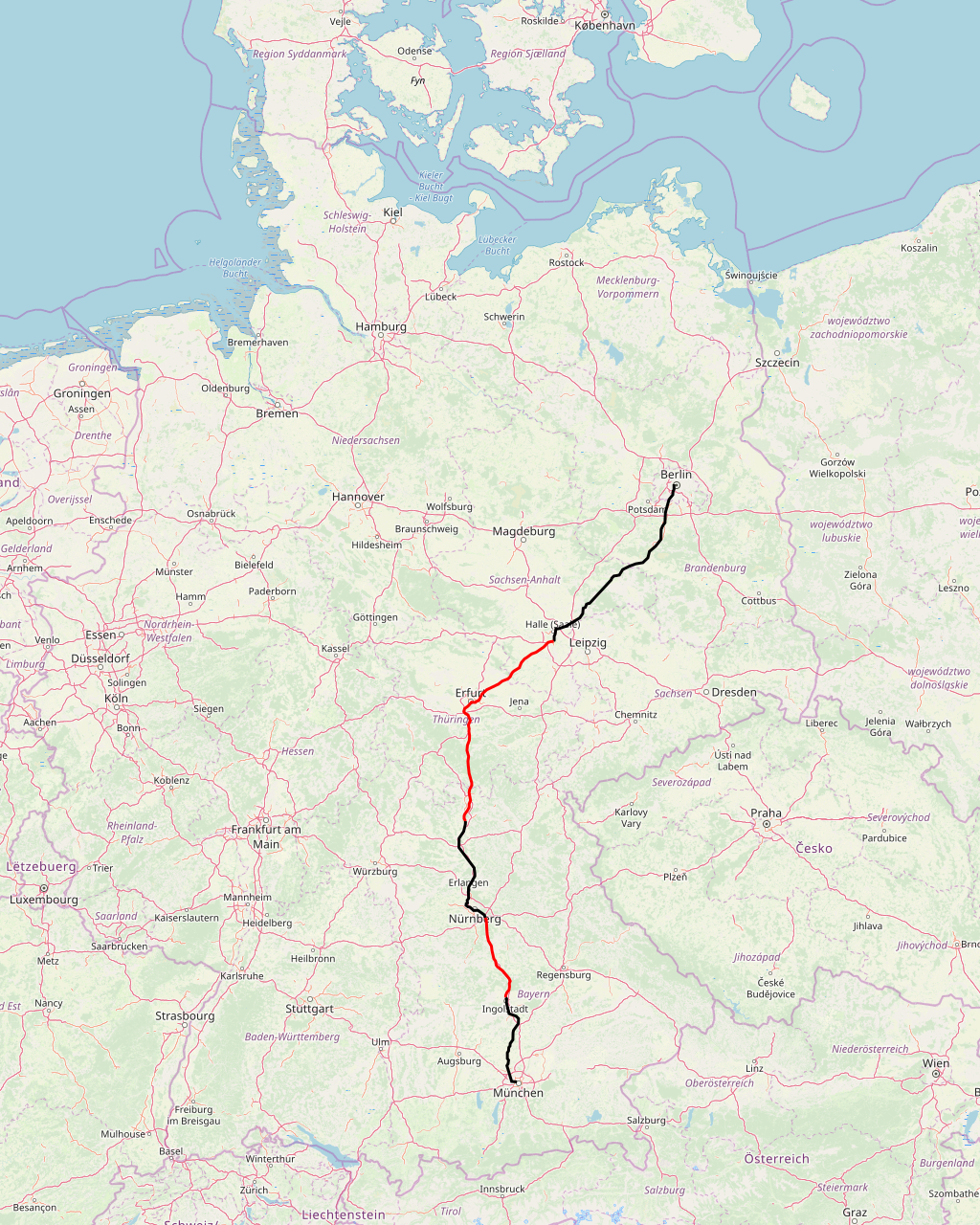
The longer red segment, through Erfurt, is the more challenging one, including long tunnels through the mountains between Thuringia and Bavaria. The complexity and cost of construction led to extensive media controversy. In particular, the choice of the route through Erfurt came about due to Thuringia’s demands that it serve its capital rather than smaller cities; DB’s preference would have been to build a more direct Leipzig-Nuremberg route, which would have had shorter tunnels as the mountains in eastern Thuringia are lower and thinner.
Since then, a lot of water has passed under the bridge. The route opened at the end of 2017 and cut travel time from 6 hours to 4, bypassing the slowest mountain segment, and is considered a success now. In the North German Plain, the trains mostly cruise at 200 km/h, and trains traverse the 163.6 km between Berlin and Halle in 1:09-1:11, an average speed of 140 km/h.
Nonetheless, the benefits of painting the entire map red, roughly from the city limits of Berlin to those of Munich, are considerable. The North German Plain’s flat topography enables trains to average 140 km/h, but also means that building a high-speed line would be cheap – around 137 km of new-build line would be needed, all at-grade, at a cost of about €2.5 billion, which would cut about half an hour from the trip time. In Bavaria, the topography is rougher and consequently the legacy trains’ average speed is lower, but nonetheless, high-speed rail can be built with cut-and-fill, using 4% grades as on the Cologne-Frankfurt line.
I’m uncertain about the exact travel time benefits of such a high-speed line. I put a route through my train performance calculator and got about 2.5 hours with intermediate stops at Südkreuz, Erfurt, Nuremberg, and possibly Ingolstadt (skipping Ingolstadt saves 3 minutes plus the dwell time), using the performance characteristics of the next-generation Velaro. But I’m worried that my speed zones are too aggressive and that the schedule should perhaps accommodate TGVs coming from Paris via Frankfurt, so I won’t commit to 2:30; however, 2:45-2:50 should be doable, even with some unforeseen political compromises.
But even with less optimistic assumptions about trip times, Germany should do it. If it was justifiable to spend €10 billion on reducing trip times from 6 hours to just under 4, it should be justifiable to spend around half that amount on reducing trip times by another hour and change.

 Pedestrian Observations