I’ve discussed before the topic of missed connections on subway systems, both here and on City Metric. I’ve for the most part taken it for granted that on a rapid transit network, it’s important to ensure that whenever two lines intersect, they offer a transfer. This seems like common sense. The point of this post is not to argue for this principle, but to distinguish two different kinds of missed connections: city center misses, and outlying misses. Both are bad; if I had to say which is worse I’d say it’s the city center miss, but city center misses and outlying misses are bad for distinct reasons.
A useful principle is that every pair of rapid transit lines should intersect, unless one is a shuttle, or both are circumferential. If the city is so large that it has multiple circular lines at different radii (Beijing has two, and London vaguely has two as well depending on how one counts the Overground), then they shouldn’t intersect, but rapid transit networks should be radial, and every radial line should connect to every other line, with all radial-radial transfers ideally located within the center. City center misses weaken the network by making some radials not connect, or perhaps connect at an inconvenient spot. Outlying misses often permit more central transfers, and their problem is that they make it harder to transfer to the better or less crowded radial on the way to the center. London supplies a wealth of examples of the latter without the former.
What counts as a missed connection?
Fundamentally, the following picture is a missed subway connection:

The red and blue lines intersect without a transfer. Even if a few stations later there is a transfer, this is a miss. In contrast, the following picture is not a missed connection:
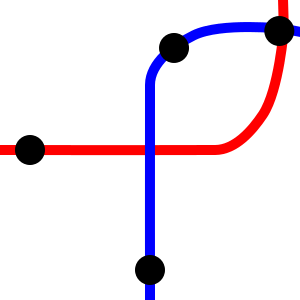
It might be faster for riders to transfer between the southern and western leg if there were a station at the exact physical intersection point, but as long as the next station on the red line has a transfer to the blue line it counts, even if the blue line has one (or more) stations in the middle. Washington supplies an example of this non-miss: it frustrates riders that there’s no connection between Farragut West and Farragut North, but at the next station south from the intersection on the Red Line, Metro Center, there is a transfer to the Blue and Orange Lines. London supplies another pair of examples: the Northern line and the Waterloo and City line appear to intersect the District line without a transfer, but their next station north from the physical intersection point, Bank, has an in-system transfer to Monument on the District.
There are still a few judgment calls in this system. One is what to do at the end of the line. In this case, I rule it a missed connection if the terminal clearly has an intersection without a transfer; if the terminal is roughly between the two stations on the through-line, it doesn’t count. Another is what to do about two lines that intersect twice in close succession, such as the Bakerloo and Hammersmith and City lines in London, and Metro Lines 4 and 10 in Paris. In such cases, I rule that, if there’s just one station on the wrong side (Paddington on Bakerloo, Mabillon on M10) then I rule it a single intersection and allow transfers at the next station over, by which standard London has a missed connection (Edgware Road has no Bakerloo/H&C transfer) and Paris doesn’t (Odeon has an M4/M10 transfer).
How many missed connections are there?
In Paris, there are three missed connections on the Metro there is one missed connection on the Metro (update: see comments below): M9/M12, M5/M14, M9/M14. As I discuss on City Metric, it’s no coincidence that two of these misses involve this miss involves Line 14, which has wide stop spacing. Narrow stop spacing makes it easier to connect within line-dense city centers, and Paris famously has the densest stop spacing of any major metro system. M9/M12 and M9/M14 morally should connect at Saint-Augustin and Saint-Lazare, but in fact there is no in-system transfer. M5/M14 should connect at Gare de Lyon, but when M5 was built it was not possible to get the line to the station underground and then have it cross the Seine above-ground, so instead it meets M1 at Bastille, while M14 doesn’t serve since it expresses from Gare de Lyon to Chatelet. A fourth missed connection is under construction: the extension of M14 to the north misses M2 at Rome, prioritizing long stop spacing over the connection to the M2/M6 circumferential.
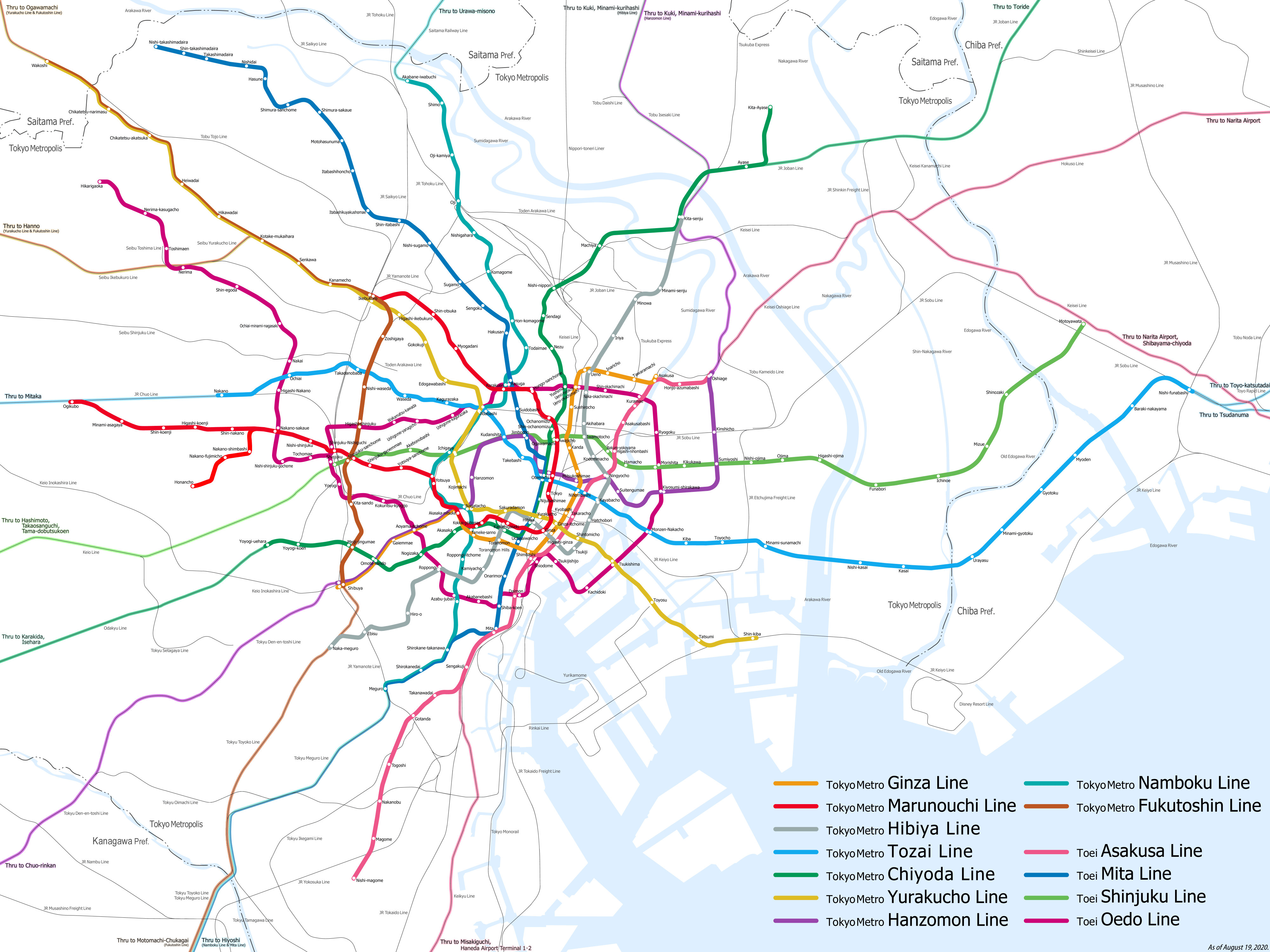
In Tokyo, there are many misses. I am not sure why this is, but judging by line layout, Tokyo Metro and Toei try to stick to major roads whenever possible, to avoid tunneling under private property, and this constrains the ability of newer lines to hit station locations on older lines. If I understand this map correctly, there are 19 missed connections: Ginza/Hibiya (Toranomon and Kasumigaseki should connect), Ginza/Mita, Ginza/Yurakucho, Ginza/Shinjuku, Marunouchi/Mita (Ginza and Hibiya should connect), Marunouchi/Yurakucho, Asakusa/Yurakucho, Asakusa/Hanzomon, Hibiya/Namboku, Hibiya/Yurakucho (Tsukiji and Shintomicho should connect), Hibiya/Hanzomon, Hibiya/Shinjuku, Hibiya/Oedo, Tozai/Oedo, Tozai/Fukutoshin, Mita/Oedo, Chiyoda/Oedo twice, and Oedo/Fukutoshin. Oedo is particularly notable for being a circumferential line that misses a large number of transfers.
In New York, there are even more misses. Here the culprit is clear: the two older layers of the subway, the IRT and BMT, have just two missed connections. One, 3/L at Junius Street and Livonia Avenue, is an outlying miss. The other is central: Bowling Green on the 4-5 and Whitehall on the R-W should connect. But the newer layer, the IND, was built to drive the IRT and BMT into bankruptcy through competition rather than to complement them, and has a brutal number of misses: ABCD/2-3, ACE/1-2-3, AC-F/2-3-4-5, AC-G/2-3-4-5-BQ-DNR, BD/NQRW, BDFM/NQRW, BD/JZ, E/1, E/F, M/NW, R/7, F/BD-NQ, F/NRW, F-Q/4-5-6, F/NW, G/7, G/JMZ. Counting individual track pairs, this is 46 misses, for a total of 48 including the two IRT/BMT misses; I’m excluding local-only transfers, such as Columbus Circle and 53rd/Lex, and counting the 42nd Street Shuttle as an express version of the 7, so it doesn’t miss the BDFM transfer.
Finally, London only has eight misses. In Central London there are three: the Metropolitan or Hammersmith and City line misses the Bakerloo line as discussed above, and also the Victoria line and Charing Cross branch of the Northern line at Euston. The other five are outlying: the Central line misses the Hammersmith and City line at Wood Lane/White City, and its branches miss the Piccadilly line’s Uxbridge branch three times; the fifth miss is Metropolitan/Bakerloo. But one more miss is under construction: the Battersea extension of the Northern line is going to intersect the Victoria line without a transfer.
The difference between the two kinds of miss
Many misses are located just a few stations away from a transfer. In New York, some misses are just a station away from a transfer, including the G/7 miss in Long Island City, the E/1 miss between 50th Street and 59th Street, and several more are a few stations away, such as the various BDFM/NQRW misses. In London, these include two of the three Central London transfers: there is an H&C/Bakerloo transfer at Baker Street and an H&C-Met/Victoria transfer at King’s Cross-St. Pancras. As a result, not counting the Waterloo and City line, only two trunk lines in the system do not have any transfer: the Charing Cross branch of the Northern line and the Metropolitan/H&C line.
On a radial network, if two lines don’t have any transfer, then the network is degraded, since passengers can’t easily connect. In New York, this is a huge problem: some station pairs even within the inner networks require two transfers, or even three counting a cross-platform local/express transfer. My interest in subway networks and how they function came about when I lived in Morningside Heights on the 1 and tried socializing with bloggers in Williamsburg near the JMZ.
In Paris the three misses are also a problem. Line 4 is the only with a transfer to every other main line. Line 9 intersects every other line, and Line 14 will when its northern extension opens, but both miss connections, requiring some passengers to take three-seat rides, in a city infamous for its labyrinthine transfer stations. Fundamentally, the problem is that the Paris Metro is less radial than it should be: some lines are laid out as grid routes, including Lines 3, 5, and 10; moreover, Lines 8, 9, 12, and 13 are radial but oriented toward a different center from Lines 1, 4, 7, and 11.
In London, in contrast, there is almost no pair of stations that require a three-seat ride. The Charing Cross branch of the Northern line doesn’t make any stop that passengers from the H&C or Met line can’t get to from another line with one interchange (Goodge Street is walking distance to Warren Street). A bigger problem is the lack of interchange to the Central line on the west, which makes the connections between the H&C stations on the west and some Central line stations awkward, but it’s still only a small number of stations on each line. So the problem in London is not network robustness.
Rather, the problem in London is severe capacity limitations on some lines. Without good outlying interchanges, passengers who want to get between two lines need to ride all the way to the center. Most likely, passengers between the Piccadilly and Central line branches to the west end up driving, as car ownership in West London is relatively high. Passengers without a car have to instead overload the Central line trunk.
The same problem applies to misses that are strictly speaking not missed connections because the two lines do not actually intersect. In Paris, this occurs on Line 7, which swings by the Opera but doesn’t go far enough west to meet Lines 12 and 13. In London, the best example is Hammersmith station: the H&C and District lines have separate stations without an interchange, but they do not intersect since it’s the terminus of the H&C line and therefore I don’t count it as a miss. But morally it’s an outlying miss, preventing District line riders from changing to the H&C line to reach key destinations like Euston, King’s Cross, and Moorgate without overloading the Victoria or Northern line.
In New York this problem is much less acute. The only outlying misses are the 3/L and the ABCD/2-3; the 3/L connects two very low-ridership tails, so the only serious miss is on the Upper West Side. There, passengers originating in Harlem can walk to either line, since the two trunks are two long blocks apart, and passengers originating in Washington Heights can transfer from the A-C to the 1 at 168th Street; at the other end, passengers bound for Midtown can transfer at Columbus Circle, using the underfull 1 rather than the overcrowded 2 and 3.
The role of circumferential lines
Outlying transfers are useful in distributing passengers better to avoid capacity crunches, but they are incidental. They occur when formerly competing suburban lines get shoehorned into the same subway network, or when two straight roads intersect, as in Queens. But the task of distributing passengers between radial lines remains important and requires good connections between as many pairs of radials as possible.
The usual solution to this is a circumferential line. In Moscow, there are several missed connections in the center (Lines 3/6, 3/7, 6/9) and one more planned (8/9), but the Circle Line helps tie in nearly all the radii together, with just one missed connection (to Line 10 to the north) and one more under construction (to Line 8 to the west). The point of the Circle Line is to allow riders to connect between two outlying legs without congesting the center. This is especially important in the context of Moscow, where there are only a handful of interchange stations in the center, most of which connect more than two lines.
In London, the Overground is supposed to play this role. However, the connections between the Underground and Overground are weak. From Highbury and Islington clockwise, the Overground misses connections to the Central line, the Victoria line, the main line of the District line, the Piccadilly line, the Hammersmith and City line, both branches of the Northern line, and the Piccadilly line (it also misses the Metropolitan line, but that’s on a four-track stretch where it is express and local service is provided by the Jubilee line, with which there is a transfer). Much of this is an unforced error, since the Underground lines are often above-ground this far out, and stations could be moved to be better located for transfers.
In New York, the only circumferential line is the G train, which has uniquely bad transfers, legacy of the IND’s unwillingness to build a system working together with the older subways. Triboro RX (in the original version, not the more recent version) would play this role better: with very little tunneling, it could connect to every subway line going counterclockwise from the R in Bay Ridge to the B-D and 4 at Yankee Stadium. On the way, it would connect to some major intermediate centers, including Brooklyn College and Jackson Heights, but the point is not just to connect to these destinations in the circumferential direction but also to facilitate transfers between different lines.
Going forward, cities with large metro network should aim to construct transfers where feasible. In New York there are perennial proposals to connect the 3 and L trains; these should be implemented. In London, the missed outlying transfers involve above-ground stations, which can be moved. The most important miss, White City/Wood Lane, is already indicated as an interchange on the map, but does not to my understanding have an in-system transfer; this should be fixed.
Moreover, it is especially important to have transfers from the radial lines to the circumferential ones. These improve network connectivity by allowing passengers to change direction (from radial to circumferential, e.g. from east-west to north-south within Queens), but also help passengers avoid congested city centers like outlying radial-radial transfers. Where circumferential lines don’t exist, they should be constructed, including Triboro in New York and Line 15 in Paris; where they do, it’s important to ensure they don’t miss connections the way the Overground does.


 Pedestrian Observations