Category: Good Transit
Subway Expansion and Bus Redesign
The ongoing designs for the Interborough Express are making me think about bus redesign again. Before the Transit Costs Project, Eric and I worked on a proposal for a bus redesign in Brooklyn, which sadly was not adopted. The redesign was based on the reality of 2017 – the ridership patterns, the bus speeds, the extent of the system, etc. Since then the subway map has not changed, but IBX stands to change the map, and with it, the buses should change as well.
With our program having produced both the bus redesign proposal and soon a comprehensive proposal for how to change the city’s built-up layout to take advantage of the new line, I should probably say something about how the buses should change. I say I and not we, because so far we don’t have a project under our program for this; for now, this is just a blog post, though one informed by past work on the subject.

Parallel and orthogonal buses
In general, when a new line opens, it reduces demand on parallel bus routes, which it outcompetes, and increases it on orthogonal ones, which feed it. However, what counts as parallel and what counts as orthogonal are not always obvious.
Case in point: when Second Avenue Subway opened at the end of 2016, ridership on the east-west buses between the Upper East and West Sides fell. The new line in theory runs north-south, but it undulates from the Upper East Side to Times Square, where passengers can connect to trains to the Upper West Side and points north; when I lived at 72nd and York and commuted to Columbia by bus and subway in 2009-10, I calculated that if Second Avenue Subway had been open already, a two-seat subway ride with a Times Square connection would have cut my one-way commute from 50 to 37 minutes.
This means that to understand how a new rail line will impact buses, it’s necessary to look beyond just the line itself, and think what it connects to.
For example, note on the above map that the increase in job access at the Flatbush Avenue station, intersecting the Nostrand Avenue Line, is relatively small, and doesn’t have a big north-south footprint along Nostrand. This is because the location already has subway service connecting to Manhattan, a much larger job center than anything IBX would connect to; the buses at the station, the B41 on Flatbush and B44 on Nostrand, already function as connectors to the subway at this point, and are unlikely to acquire more ridership as a result.
In contrast, the stations at Myrtle and Metropolitan are both seen to have a large increase in job access, and in particular a large increase in job access along those two avenues even somewhat away from the stations. On Myrtle, the current buses are the B54 and Q55; the B54 connects to the M train, but it’s one branch, and then the bus continues to Downtown Brooklyn, to which there’s no good subway connection from the future IBX station. The B54 is likely to lose ridership to Downtown Brooklyn but gain it to the new IBX station, and the Q55 is likely to gain in general, as they ferry passengers to a station where they can quickly and with one change go to any number of express lines. Metropolitan has a similar issue – the Q54 already connects to the M, but at least from points west, nobody has any reason to make that connection since it would just double back, whereas with IBX, the Q54 would efficiently connect people to Jackson Heights, and with an additional change to anywhere on the Queens Boulevard and Flushing Lines.
New nodes
Public transit lines serve two functions: to run along a corridor, and to connect nodes. New York usually thinks in terms of corridors, and indeed names nearly all subway lines after the streets they run on (such as a Manhattan avenue) rather than after where they go. But nodes are important as well. Some of that is reflected in the above analysis of the Flatbush-Nostrand Avenue station, currently Brooklyn College on the Nostrand Avenue Line: it really needs to be thought of as a node, and IBX will strengthen it, but not by enough to require running more B41 and B44 buses. In contrast, other nodes will be strengthened enough that bus service increases are warranted.
East New York/Broadway Junction is the biggest standout. East New York’s bus network today is not much of a grid – instead, buses connect outlying areas to the nearest subway station; the bus redesign we did for Brooklyn would make it more of a grid but still follow the logic of feeding the subway wherever it is closest. However, IBX makes Broadway Junction and the Atlantic Avenue station more interesting, which should leads to some changes, turning the new station into more of a node for buses. Buses avoiding this node should instead make sure to stop not just at the subway but also at a new IBX stop, such as Linden.
Jackson Heights is the other. It is a node to some extent today, served by the Q32, Q33, Q47, Q49, Q53, and Q70. But in that general area, the intersection of Woodhaven and Queens Boulevard is an even larger node, and in Queens writ large, the ends of the subway in Jamaica and Flushing are far and away the biggest ones. With IBX, more buses should run to Jackson Heights; for example, all Woodhaven buses, and not just the Q53, should continue along Queens Boulevard and Broadway to reach the station.
Substitutions
In Queens, the street network connecting Jackson Heights with the neighborhoods near the borough line with Brooklyn is not at all conducive for good transit. Buses are usually a good indicator of relative demand along a corridor, but sometimes they aren’t; the situation of IBX is generally one in which they are not, but this is especially bad in Queens. This means that the question of which buses would see demand fall as IBX substitutes for them is even harder than on Second Avenue Subway, the north-south line that efficiently substitutes for east-west buses.
In Brooklyn, I think the answer is relatively straightforward, in that the main crosstown routes, like the B35 on Church, exhibit substitutability. In Queens, it’s harder, and I don’t have concrete answers, only general thoughts that we can turn into a report if there turns out to be demand for it:
- If a bus has sections along the corridor but also away from it, like the Q18 or Q47, then it should be cut to just connect to the line, in these two case at Jackson Heights.
- If a bus runs directly between two nodes that could get faster service via a subway-IBX connection, and it doesn’t serve much along the way, then it’s likely to be analogous to the east-west buses across Central Park, and see reduced ridership demand.
- In general, the routes in Central Queens zigzag so much that IBX is likely to represent a massive improvement in trip times, making such buses less useful.
Frequency in Units of Distance
I have annoying commenters. They nitpick what I say and point out errors in my thinking – or if there are no errors, they take it beyond where I thought it could be taken and find new ways of looking at it. After I wrote about frequency relative to trip length last week, Colin Parker pointed out on the Fediverse that this can be simplified into thinking about frequency not in units of time (trains or buses per hour), but in units of distance (trains or buses per km of route). This post is dedicated to developing this idea on various kinds of transit service, including buses and trains.
The key unit throughout, as Colin points out, is the number of buses available per route, the assumption being that the average trip length is proportional to the average route length. However, this is not a perfect assumption, because then the introduction of network effects changes things – generally in the direction of shorter average trip length, as passengers are likelier to transfer, in turn forcing agencies to run more vehicles on a given route to remain useful. Conversely, timed transfers permit running fewer vehicles, or by the same token more routes with the same resources – but the network had better have a strong node to connect to after a series of vehicle changes, more like the Swiss rail network than like a small American city’s bus network.
Frequency and resources
On a bus network with even frequency across all routes, the following formula governs frequency, as I discussed six years ago:
Daily service hours * average speed per hour = daily trips * network length
When Eric and I proposed our Brooklyn bus redesign, we were working with a service-hour budget of about 10,800 per weekday; status quo as of 2017-8 was 11 km/h, 550 km, and thus 216 daily trips (108 per direction), averaging around a bus per 11 minutes during the daytime, while we were proposing speed up treatments and a redesign to change these figures to 15 km/h, 355 km, and thus 456 daily trips (228 per direction). The six-minute service ideal over 16 hours requires 188 trips per direction; the difference between 188 and 228 is due to higher frequencies on the busiest routes, which need the capacity.
To express this in units of length, we essentially eliminate time from the above dimensional analysis. Daily service hours is a dimensionless quantity: 10,800 hours per weekday means 450 buses circulating at a given time on average, in practice about 570 during the daytime but not many more than 100 buses circulating overnight. If there are 570 buses circulating at a given time, then a 550 km network will average a bus every 1.9 km and a 355 km one will average a bus every 1.25 km. With pre-corona New York bus trips averaging 3.4 km unlinked, a bus every 1.9 km means the maximum headway is a little higher than half the trip time, and a bus every 1.25 km means the maximum headway is a little higher than one third the trip time, independently of speed.
This calculation already illustrates one consequence of looking at frequency in units of distance and not time: your city probably needs to aggressively prune its bus network to limit the wait times relative to overall trip times.
Route length and trip length
On an isolated bus or train route, serving an idealized geography with a destination at its center and isotropic origins along the line, the average trip length is exactly one quarter of the route length. The frequency of service in units of distance should therefore be one eighth of the route length, requiring 16 vehicles to run service plus spares and turnarounds. This is around 18-20 vehicles in isolation, though bear in mind, the 10,800 service hours/day figure for Brooklyn buses above is only for revenue service, and thus already incorporates the margin for turnaround times and deadheads.
Colin points out that where he lives, in Atlanta, bus routes usually have around four vehicles circulating per route at a given time, rather than 16. With the above assumptions, this means that the average wait is twice the average trip time, which goes a long way to explaining why Atlanta’s bus service quality is so poor.
But then, different assumptions of how people travel can reduce the number 16:
- If destinations are isotropic, then the average trip length rises from one quarter of the route length to 3/8 of the route length, and then the frequency should be 1.5/8 of the route length, which requires 11 vehicles in revenue service.
- If origins are not isotropic, then the average trip length can rise or fall, depending on whether they are likelier to be farther out or closer in. A natural density gradient means origins are disproportionately closer-in, but then in a city with a natural density gradient and only four buses to spare per route, the route is likely to be cut well short of the end of the built-up area. If the end of the route is chosen to be a high-density anchor, then the origins relative to the route itself may be disproportionately farther out. In the limiting case, in which the average trip is half the route length, only eight buses are needed to circulate.
To be clear, this is for a two-tailed route; a one-tailed route, connecting city center at one end to outlying areas at the other, needs half the bus service, but then a city needs twice as many such routes for its network.
The impact of transfers
Transfers can either reduce the required amount of service for it to be worth running or increase it, depending on type. The general rule is that untimed transfers occurring at many points along the line reduce the average unlinked trip and therefore force the city to run more service, while timed transfers occurring at a central node lengthen the effective trip relative to the wait time and therefore permit the city to run less service. In practice, this describes both how existing bus practices work in North America, and even why the Swiss rail network is so enamored with timed connections.
To the point of untimed transfers, their benefit is that there can be very many of them. On an idealized grid – let’s call it Toronto, or maybe Vancouver, or maybe Chicago – every grid corner is a transfer point between an east-west and a north-south route, and passengers can get from anywhere to anywhere. But then they have to wait multiple times; in transit usage statistics, this is seen in low average unlinked trip lengths. New York, as mentioned above, averages 3.4 km bus trips, with a network heavily based on bus-subway transfers; Chicago averages a not much higher 3.9 km. This can sort of work for New York with its okay if not great relative frequency, and I think also for Chicago; Vancouver proper (not so much its suburbs) and Toronto have especially strong all-day frequencies. But weaker transit networks can’t do this – the transfers can still exist but are too onerous. For example, Los Angeles has about the same total bus resources as Chicago but has to spread them across a much larger network, with longer average trip times to boot, and is not meaningfully competitive. The untimed grid, then, is a good feature for transit cities, which have the resources and demand to support the required frequencies.
Not for nothing, rapid transit networks love untimed transfers, and often actively prefer to spread them across multiple stations, to avoid overwhelming the transfer corridors. Subways are only built on routes that are strong enough to have many vehicles circulating, to the point that all but the shortest trips have low ratios of wait to in-vehicle times. They are also usually radial, aiming to get passengers to connect between any pair of stations with just one transfer; Berlin, Paris, and New York are among the main exceptions. These features make untimed transfers tolerable, in ways they aren’t on weaker systems; not for nothing, a city with enough resources for a 100 km bus network and nothing else does not mimic a 100 km subway network.
Timed transfers have the opposite effect as untimed transfers. By definition, a timed transfer means the wait is designed to be very short, ideally zero. At this point, the unlinked trip length ceases to be meaningful – the quantity that should be compared with frequency is the entire trip with all timed transfers included. In particular, lower frequencies may be justifiable, because passengers travel to much more than just the single bus or rail route.
This can be seen in small-city American bus networks, or some night bus networks, albeit not with good quality. It can be seen much more so on transfer-based rail networks like Switzerland’s. The idealized timed transfer network comprises many routes all converging on one node where they are timed to arrive and depart simultaneously, with very short transfers; this is called a knot in German transit planning and a pulse in American transit planning. American networks like this typically run a single bus circulating on each one-tailed route; the average wait works out to be four times longer than the average unlinked trip, and still twice as long as a transfer trip, which helps explain why ridership on such networks is a rounding error, and this system is only used for last-resort transportation in small cities where transit is little more than a soup kitchen or on night bus networks that are hardly more ridden. It would be better to redo such networks, pruning weaker routes to run more service on stronger ones, at least two per one-tailed route and ideally more.
But then the Swiss rail network is very effective, even though it’s based on a similar principle: there’s no way to fill more frequent trains than one every hour to many outlying towns, and even what are midsize cities by Swiss standards can’t support more than a train every half hour, so that many routes have a service offer of two to four vehicles circulating at a given time. However, on this network, the timed transfers are more complex than the idealized pulse – there are many knots with pulses, and they work to connect people to much bigger destinations than could be done with sporadic one-seat rides. A succession of timed connections can get one from a small town in eastern Switzerland to St. Gallen, then Zurich, then Basel, stretching the effective trip to hours, and making the hourly base frequency relatively tolerable. The key feature is that the timed transfers work because while individual links are weak enough to need them, there are some major nodes that they can connect to, often far away from the towns that make the most use of the knot system.
Frequency is Relative
Five years ago, I wrote a blog post about frequency-ridership spirals, mentioning as a side comment that the impact of mass transit frequency on ridership can be lumped together with the trip time. I’d like to develop this point here, and talk about how it affects various kinds of public transportation, including intercity trains.
The rule of thumb I’ve advocated for in ETA reports (for example, on commuter rail) is that the maximum headway should be no more than half the trip time. Untimed transfers reset the clock, since passengers have to wait another time every time they make such a transfer; timed transfers do not, but are rare enough that local public transportation doesn’t usually need to consider them in service planning. Intercity transportation can follow the same rule of thumb, but can also get away with worse frequency since passengers time themselves to arrive shortly before the train does; in particular, hourly trains between cities that are three hours apart are frequent enough that increasing service is valuable only insofar as it provides more capacity, and is unlikely to lead to higher ridership through shorter waits.
Wait and transfer penalties
In the literature on modeling public transportation ridership, it is universal that passengers prefer spending time on board a moving vehicle to waiting for a vehicle, walking to the station, or walking between platforms. This preference is expressed as a factor, called the waiting or transfer penalty. different models have different levels for these penalties; passengers also likely have different penalties depending on circumstances, such as familiarity with the route or how much luggage they’re carrying.
The papers I’ve seen have penalties ranging from 1.75 (in the MTA’s model) to 3 (the higher end cited in Lago-Mayworm-McEnroe). I usually model with 2, in Teulings-Ossokina-de Groot. The factor of 2 has the advantage of consistency with an assumption that passengers don’t have a wait penalty but do assume a worst-case scenario for waits, so that the generalized travel time is equal to the maximum headway plus the in-vehicle travel time.
Update 4-19: I was just alerted to a new study by Yap-Wong-Cats using London ridership, finding an out-of-vehicle penalty factor of 1.94 pre-pandemic and 1.92 post-pandemic.
The impact of frequency relative to trip time
If the elasticity of ridership with respect to the generalized travel time, summing the headway and in-vehicle travel time but not walking time to and from the station, is e, then we can compute the elasticity of ridership with respect to frequency as a fraction of e. If the current headway is a proportion r of the in-vehicle trip time, that is to say a fraction r/(r+1) of the generalized travel time, then the elasticity is er/(r+1).
In Lago-Mayworm-McEnroe, the value of e appears to be 0.8. This means that if r = 0.5, the elasticity of ridership with respect to frequency is 0.267. The paper doesn’t quantify elasticities relative to different levels of r but only relative to absolute frequencies, but 0.267 is within the range it finds for different frequencies, dipping to 0.22 for high-frequency lines. Other papers have different figures of e, often higher in the long run as passengers adjust, but those go up to around 1 or, reasoning backward from a VTPI report, a little higher.
Of notes:
- The value of r is not constant across different uses of the same line. A commuter traveling from near the outer end of a subway line to city center faces much lower r than a traveler going a short distance, within city center or within a large outlying neighborhood. In particular, r is generally lower for commutes than for non-commute trips, which is why the latter are more sensitive to frequency.
- Systems that rely on extensive transfers can have very high values of r with short in-vehicle trips. New York averages 13.5 minutes per unlinked subway trip, with many trips facing an effective off-peak headway of 10 or even 12 minutes, at which point e is high enough that increasing off-peak frequency could pay for itself through higher paying ridership (see analysis in a blog post and an ETA report). This, again, depends on the type of trip – commuters may pick an apartment or a job based on ease of travel, reducing the need to transfer, but their non-commute trips are usually a collection of irregular trips to various destinations and are likelier to involve a transfer.
- The cost of higher frequency depends on mode (it’s higher on buses than trains) and time of day (it’s very low on off-peak trains until it matches peak frequency). Together with points 1 and 2, this argues in favor of raising the off-peak frequency on urban and inner suburban trains, potentially to the point of matching peak frequency. On longer-range commuter trains, the impact of frequency on ridership is lower, and thus the marginal cost may be such that a ratio of peak to off-peak service larger than 1 is desirable.
Intercity trains
The papers I’m citing aim to fit elasticity factors to observed ridership on local and regional public transportation. Intercity rail has its own set of models, with different assumptions. Frequency again matters, but because passengers time themselves to arrive at the departing station shortly before the train leaves, its impact is reduced.
I don’t know the elasticity of intercity rail ridership with respect to frequency; Cascetta-Coppola have the elasticity of ridership with respect to in-vehicle trip time as about -2, while Börjesson has it at -1.5 for business travel and -1 for non-business travel with a rough rule of thumb trying to approximate the impact of frequency. At the level of the sanity check, the low frequency of TGV services is not visible in TGV ridership between the provinces and Paris, compared with Japan (which charges higher fares) and as far as I can tell from a few data points Germany. TGV ridership between the provinces is bad, but that involves trains with service gaps that are much larger than the trip times, reaching six hours between Marseille and Lyon. In contrast, those three-hour gaps in service between Paris and cities three hours away by TGV don’t seem to impact ridership visibly.
What this means is that intercity trains do need a certain baseline frequency. The German system of a train every two hours on every city pair is wise, in light of the typical intercity rail travel distances in a large country with slow trains. Higher frequency is warranted if the cities are bigger and therefore require more service, or if they are closer together in time through either a short geographical distance or higher speeds. New York and Philadelphia are about 1:10 apart by rail, and high-speed rail could cut this to about 45 minutes; half-hourly frequencies in the current situation are sufficient that more service would have a second-order effect, and even with high-speed rail, a train every 15 minutes is more than enough for all purposes except capacity (the current offer is 3-4 trains an hour with irregular spacing). Frequency is freedom, but this depends on trip times; what works for four-station subway trips is not what works for trips between cities 140 km apart, let alone 360 km, and vice versa.
Subway-Intercity Rail Connections
Something Onux said in comments on yesterday’s post, about connecting Brooklyn to intercity rail, got me thinking more about how metro lines and intercity rail can connect better. This matters for mature cities that build little infrastructure like New York or Berlin, but also for developing-world cities with large construction programs ahead of them. For the most part, a better subway system is automatically one that can also serve the train station better – the train station is usually an important destination for urban travel and therefore, usually the same things that make for a stronger subway system also make for better subway-intercity rail connections.
Subways and commuter trains
Like gender, transit mode is a spectrum. There are extensive systems that are clearly metro and ones that are clearly commuter rail, but also things in between, like the RER A, and by this schema, the Tokyo and Seoul subways are fairly modequeer.
The scope of this post is generally pure subway systems – even the most metro-like commuter lines, like the RER A and the Berlin S-Bahn, use mainline rail rights-of-way and usually naturally come to connect with intercity train stations. Of note, RER A planning, as soon as SNCF got involved, was modified to ensure the line would connect with Gare de Lyon and Gare Saint-Lazare; previous RATP-only plans had the line serving Bastille and not Gare de Lyon, and Concorde and not Auber. So here, the first rule is that metro (and metro-like commuter rail) plans should, when possible, be modified to have the lines serve mainline train stations.
Which train stations?
A city designing a subway system should ensure to serve the train station. This involves nontrivial questions about which train stations exactly.
On the one hand, opening more train stations allows for more opportunities for metro connections. In Boston, all intercity trains serve South Station and Back Bay, with connections to the Red and Orange Lines respectively. In Berlin, north-south intercity trains call not just at Hauptbahnhof, which connects to the Stadtbahn and (since 2020) U5, but also Gesundbrunnen and Südkreuz, which connect to the northern and southern legs of the Ringbahn and to the North-South Tunnel; Gesunbrunnen also has a U8 connection. In contrast, trains into Paris only call at the main terminal, and intercity trains in New York only stop at Penn Station.
On the other hand, extra stations like Back Bay and delay trains. The questions that need to be answered when deciding whether to add stations on an intercity line are,
- How constructible is the new station? In New York, this question rules out additional stops; some of the through-running plans involve a Penn Station-Grand Central connection to be used by intercity trains, but there are other reasons to keep it commuter rail-only (for example, it would make track-sharing on the Harlem Line even harder).
- How fast is the line around the new station? More stations are acceptable in already slow zones (reducing the stop penalty), on lines where most trips take a long time (reducing the impact of a given stop penalty). Back Bay and Südkreuz are in slow areas; Gesundbrunnen is north of Hauptbahnhof where nearly passengers are going south of Berlin, so it’s free from the perspective of passengers’ time.
- How valuable are the connections? This depends on factors like the ease of internal subway transfers, but mostly on which subway lines the line can connect to. Parisian train terminals should in theory get subsidiary stations because internal Métro transfers are so annoying, but there’s not much to connect to – just the M2/M6 ring, generally with no stations over the tracks.
Subway operations
In general, most things that improve subway operations in general also improve connectivity to the train station. For example, in New York, speeding up the trains would be noticeable enough to induce more ridership for all trips, including access to Penn Station; this could be done through reducing flagging restrictions (which we briefly mention at ETA), among other things. The same is true of reliability, frequency, and other common demands of transit advocates.
Also in New York, deinterlining would generally be an unalloyed good for Penn Station-bound passengers. The reason is that the north-south trunk lines in Manhattan, other than the 4/5/6, either serve Penn Station or get to Herald Square one long block away. The most critical place to deinterline is at DeKalb Avenue in Brooklyn, where the B/D/N/Q switch from a pattern in which the B and D share one track pair and the N and Q share another to one in which the B and Q share a pair and the D and N share a pair; the current situation is so delicate that trains are delayed two minutes just at this junction. The B/D and N/Q trunk lines in Manhattan are generally very close to each other, so that the drawback of deinterlining is reduced, but when it comes to serving Penn Station, the drawback is entirely eliminated, since both lines serve Herald Square.
If anything, it’s faster to list areas where subway service quality and subway service quality to the train station specifically are not the same than to list areas where they are:
- The train station is in city center, and so circumferential transit, generally important, doesn’t generally connect to the station; exceptions like the Ringbahn exist but are uncommon.
- If too many lines connect to the one station, then the station may become overloaded. Three lines are probably fine – Stockholm has all three T-bana lines serving T-Centralen, adjacent to the mainline Stockholm Central Station, and there is considerable but not dangerous crowding. But beyond that, metro networks need to start spreading out.
- Some American Sunbelt cities if anything have a subway connection to the train station, for example Los Angeles, without having good service in general. In Los Angeles, the one heavy rail trunk connects to Union Station and so does one branch of the Regional Connector; the city’s problems with subway-intercity rail connections are that it doesn’t really have a subway and that it doesn’t really have intercity rail either.
Is There Room for Optimism About New York Construction Costs?
This year, there have been some positive signs about things changing in New York on subway construction – and yet, I’m uncertain about them. There are some signs that construction costs for Second Avenue Subway Phase 2 are coming under control. The New York Post broke in January that the MTA is eying smaller station designs, to reduce costs, to the tun of $300 million; an article released a few hours ago adds that there may be another $600 million in potential savings. So, in theory, costs are going down, and they’re going down as the MTA implements something we’ve been screaming about at the Transit Costs Project, so we should be happy.
And yet, I’m uncertain – not negative, but still somewhat pessimistic about whether this portends an era in which New York can finally build more subways. The main reason isn’t even some mistrust in the MTA at this point – the reduction in station footprints is a genuinely good thing, and to the extent it’s incomplete, it’s because it’s a longstanding project with older designs. Rather, it’s a combination of what this means for future projects, and how it interacts with federal funding. In brief, federal funding is at the level of the project rather than agency, and this makes it hard for cost savings to be plugged into the most straightforward benefit – namely, being able to build more on the same budget.
How is the money being saved?
The New York Post is relying on an MTA presentation from January that defends the cost structure but talks about how to reduce station costs through reducing back-of-house space. Phase 1 of Second Avenue Subway built two deep-mined intermediate stations, at 72nd and 86th Streets; the platforms are 610′ (187 meters) long, and there are no serious prospects of ever running longer trains since the line is an extension of older lines, but the station caverns are, respectively, 398 and 295 meters long, where the norm in the European comparison cases we’ve seen is that the station dig is 3-15% longer than the platforms, not twice as long.
Both stations have extensive back-of-house space, which New York City Transit demanded so that each department using the station would have its own space; 72nd also has a crossover inherited from older designs that would have permitted some trains from the south to terminate there on a third station track, which was later removed from scope to reduce costs. (The terminal station, the cut-and-cover 96th Street, is a 485 meter long dig, but that’s an artifact of block-level geology: the northern end had to go as far as 99th in order to connect with an older tunnel built in the 1970s, whereas the southern end had to go as far as 92nd because the underground geology changes abruptly there and it was easier to start boring at 92nd than at 96th.)
The plan for Phase 2 initially included much longer digs than the platform, for the same reason. However, it has since changed, and now the digs are substantially reduced. The MTA’s presentation looks like the overage at 125th Street is reduced from somewhat more than 100% in the 2004 plan to about 40-50% in the 2023 plan, and the overage at 106th and 116th is somewhat less than that, maybe 30-40%. While the 125th Street station dig is still as deep as in prior plans, the deep-mined station will also extend less far up, reducing the extent of space required to be outfit with systems.
The MTA could shrink the stations’ footprint further and save more money, but it’s fairly late in the design, and thus the opportunity to take full benefit of this improvement is for future projects. If this establishes precedent for future station construction, then it’s an unmixed blessing.
Money is saved. So what?
The broader issue is that the savings from shrinking the stations’ footprint – totaling potentially $1 billion out of a budget of $7 billion – don’t have much to go. The rub is that the project already has a Full Funding Grant Agreement. If the MTA manages to do it for less, then the most obvious, and most pessimistic, answer to where the money goes is “preventing future overruns.” The savings, in the worst case, then transfer waste from one basket, namely oversize stations, to other baskets, which could be future conflict with contractors, last-minute design changes, or betterments to the neighborhood.
That said, there are plans to spend it on something useful. But the problem is that this is limited by the scope of the project itself. Second Avenue Subway in its current iteration dates to the 1990s, and is reusing some infrastructure from the 1970s. The intention in the 1990s was to do the entire thing, or at least Phases 1 and 2, together, and the project was only chopped into four phases due to high costs. There was design work done 20 years ago or more, and the environmental impact statement is roughly that old.
I suspect the reason the cost saving from shrinking the stations is $1 billion and not much more – we estimated that Phase 1’s cost would have been halved if the stations had been only as long as the platforms – is that the designs are already spoken for, with 20 years of optimization involved. Thus the change is reducing the hard costs of construction, but not the soft costs. It will not surprise me if a postmortem will reveal an elevated ratio of soft to hard costs, purely because the cost savings are happening at such a late stage; in this case, and only in this case, it is important to forgive a high ratio of soft to hard costs, since it portends that future designs will be cheaper, and future cost savings larger. Normally, a high soft-to-hard cost ratio suggests red tape and waste involving consultants, but in this one case, it would suggest something else; I highlight this so that watchdogs for government waste, including the New York Post, realize what is going on and avoid hitting the project if it turns out to indeed have a high soft-to-hard cost ratio as I expect.
Current plans include potentially continuing the tunnel boring under 125th Street. Governor Hochul expressed some interest in a subway extension under 125th Street, extending Phase 2 from 125th/Lexington to the Hudson, with stops at the intersections with the subway lines, at Lenox (2/3), St. Nicholas (A/B/C/D), and Broadway (1 and also potential commuter rail). Such an extension was long on the wishlist of New York-area railfans, and an operations planner mentioned it to me as a future desire more than 10 years ago, unprompted. But there is no way to just reallocate $1 billion to this line; that’s not how federal funding works. At best, it will be possible to continue boring the tunnel all the way to the west, and leave the systems and stations to a future project.
My pessimism is that the cost figure given for the 125th Street extension is $7.6 billion, around $3.3 billion per kilometer. Even taking into account future inflation, it’s costlier than Second Avenue Subway Phases 1 and 2. Now, this is an early number, one that hasn’t really made it into any plans. I hope that the current cost savings are then plugged into the 125th Street extension plan, and that this project is pursued seriously at a much lower cost figure; since all stations would have to be complex digs underneath older north-south subway lines, the benefits of shrinking station footprint are especially large. But I worry that this will not happen; I’ve had hopes dashed before – for example, FRA reform did not lead American commuter rail agencies to start buying alt-compliant vehicles. We’ll see what happens if there’s more detailed work on the 125th Street extension proposal.
Funding projects vs. funding agencies
The current way federal funding works for public transportation in the United States is that the government funds specific capital projects. The MTA can ask for funding for big-ticket items like Second Avenue Subway Phase 1, Phase 2, a future 125th Street subway, the Interborough Express, or any similar such line. It can also ask for a rolling program of improvements, for example installing elevators at stations to make them accessible in line with the Americans with Disabilities Act. But the federal government does not make it easy to move money between such projects.
Phase 2 is just one project, but imagine that there are three subway lines funded concurrently: Phase 2, a subway extension under Nostrand, and a subway extension under Utica. If the MTA finds 25% cost savings, it can’t easily flex the money to a fourth line, say under 125th. It would need to start the planning process early, which is so cumbersome and expensive that it wouldn’t do so for a project it wasn’t certain it wanted to do; there is no shelf of subway extensions that are approved and are just waiting for money.
This makes the incentives for cost savings uncertain: cost savings could be used to establish the agency’s bona fides with a distrustful public, or to establish a warchest guarding against future cost overruns, or to trial new ways of working that could lead to bigger cost savings in the future, but the most straightforward benefit of cost savings – building more infrastructure on the same budget – is not generally available. For Phase 2, the best that can happen is, again, continuing boring the tunnel to the western end of 125th Street, which could be connected with the current project because the geology under the street is the same from Second Avenue to Broadway so might as well future-proof it.
And unfortunately, in the United States, the current examples of funding agencies rather than projects have been lacking. The programs in Los Angeles and Seattle, funded by sales taxes, in effect fund the agencies. There are long lists of projects in both metro areas that are funded from them, but they come from the same pool of money in each region. The situation in Los Angeles is that there’s a decided priority list, with money allocated through the end of the 2050s; if Los Angeles figures out how to cut costs significantly, all of the opening dates will be moved closer and additional lines could be planned and built with the money (the planning and environmental review process takes years, not decades, so by 2050 they will have reviews for the additional subways they could build).
And yet, the same process that’s produced lush agency-level funding in both regions has also led to bad prioritization. New York may have the world’s highest construction costs, but at least what it’s building is what it should be building: Second Avenue Subway Phase 2 is indeed the highest priority right now, and among the next priorities, the Interborough Express and 125th Street are solid choices, according to most area rail advocates two of the top five, and potentially even the top two (the other three are Nostrand, Utica, and an elevated extension of the Astoria Line to LaGuardia). In contrast, Los Angeles is prioritizing the wrong projects. The same ballot proposition process there that produces agency-level funding also requires the agency to bribe local actors who care little for public transportation or for ideological politics with lines to their own subregions of the county, not because they or their constituents will ride the trains, but because they will be able to tell their constituents “I managed to force the county to give us infrastructure money.” This way, each region of the county gets a light rail extension, no matter how lightly-ridden, while the core of the system receives little investment: while the busiest bus corridor in Los Angeles, Wilshire, is getting a subway in the D (Purple) Line Extension, the next two busiest, Vermont and Western, are not getting any rail through the 2050s, despite calls from advocates to built a line on Vermont to turn the B (Red) Line into a north-south line rather than a branch with the Purple Line.
Incentives for the future
The MTA is clearly capable of saving money. The question is now how to incentivize doing more of it. First of all, I urge New York-area advocates to pursue the 125th Street extension, and demand that the cost savings identified for Phase 2 apply to it too. The savings may even potentially be relevant to the Interborough Express, though with at-grade and above-ground stations, the impact is greatly reduced. The Phase 2 savings are reactive; applying them to future lines is proactive.
Second, I urge both the MTA and advocates to look for cost savings in areas where it is easier to flex money – namely, ADA accessibility. Being able to make a station accessible not for the current budget of about $70 million per station with contingency but the $25 million of Boston or $10 million of Madrid would enable New York to have an all-accessible subway system not in the 2050s but in the early 2030s.
Finally, at the federal level, it is useful to figure out how to fund agencies with a positive track record and not just specific projects. Potentially, agencies could be encouraged to submit wishlists of future projects that may be cleared in case money becomes available on short notice; this is useful not just in the case of cost savings, but also in the case of an unexpected infrastructure stimulus – neither the scope of the 2009 stimulus in the early Obama era nor that of 2021 under Biden had been telegraphed until shortly before, and so agencies have not always been able to take maximum advantage of the additional funds.
Northeast Corridor Travel Markets and Fares
I’m optimistic about the ability of fast trains on the Northeast Corridor to generate healthy ridership at all times of day. This is not just a statement about the overall size of the travel market, which is naturally large since the line connects three pretty big metro areas and one very big one. Rather, it’s also a statement about how the various travel markets on the corridor fit atypically well together, creating demand that is fairly consistent throughout the day, permitting trains with a fixed all-day schedule to still have high occupancy – but only if the trains are fast. Today, we’re barely seeing glimpses of that, and instead there are prominent peak times on the corridor, due to a combination of fares and slowness.
Who travels by high-speed rail?
High-speed intercity rail can expect to fill all of the following travel markets:
- Business trips
- Tourism and other recreational trips (including visits to friends and family)
- Commute trips
The key here is that the first two kinds of trips can be either day trips or multiday trips. I day-tripped to the Joint Mathematics Meeting in 2012 when I lived in Providence and the conference was in Boston, about an hour away by commuter rail, but when there was an AMS sectional conference in Worcester in 2011 (from which my blog’s name comes – I found Worcester unwalkable and uploaded an album to Facebook with the name “pedestrian observations from Worcester”) I took trains. I probably would have taken trains from New York to Worcester for the weekend rather than day-tripped even if they were fast – fast trains would still be doing it in around 2:30, which isn’t a comfortable day trip for work.
Non-work trips are the same – they can be day trips or not. Usually recreational day trips are uncommon because train travel is expensive, especially at current Amtrak pricing – the Regional costs twice as much per passenger-km as the TGV and ICE, and the Acela costs three times as much. But there are some corner cases: I moved to Providence with a combination of day trips (including two to view apartments and one to pick up keys) and multiday trips. Then, at commuter rail range, there are more recreational day trips – I’ve both done this and invited others to do so on Boston-Providence and New York-New Haven. Recreational rail trips, regardless of length, are more often taken by individuals and not groups, since car travel costs are flat in the number of passengers and train costs are linear, but even groups sometimes ride trains.
We can turn this into a two-dimensional table of the various kinds of trips, classified by purpose and whether they are day trips or multiday trips:
| Purpose | Day trip | Multiday trip |
| Business | Work trips between city centers, usually in professional services or other high-value added firms, such as lawyers traveling between New York and Washington, or tech workers between New York and Boston; academic seminar trips | Conference trips, more intensive work trips often involving an entire team, and likely all business trips between Boston and Washington or Boston and Philadelphia |
| Tourism | Trips to a specific amenity, which could be urban, such as going to a specific museum in New York or Washington or walking around a historic town like Plymouth, or not, such as taking the train to connect to a beach or hiking trail | Long trips to a specific city or region, stringing many amenities at once |
| Other non-work | College visits, especially close to the train stations; meetings with friends within short range (such as New York-Philadelphia); advocacy groups meeting on topics of interest; apartment viewings; some trips to concerts and sports games | Visits to friends and family; some moving trips; some trips to concerts and sports games |
| Commute | Long-range commutes | — |
Day trips and different peaks
The different trips detailed in the above table peak at different times. The commute trips peak at the usual commute times: into the big cities at 9 in the morning, out of them at 5 in the afternoon. But the rest have different peaks.
In particular, multiday tourism trips peak on weekends – out on Friday, back on Sunday night – while multiday business trips peak during the week. This is consistent enough that airlines use this to discriminate in prices between different travelers: trips are cheaper if booked as roundtrips over Saturday nights, because such trips are likely to be taken by more price-sensitive leisure travelers rather than by less price-sensitive business travelers.
Nonetheless, even with this combination of patterns, the most common pattern I am aware of on intercity rail, at the very least on the Northeast Corridor and on the TGV network, is that the trains are busier during the weekend leisure peak than during the weekday business peaks (except during commute times). Regardless of the distribution of business and leisure trips, leisure trips have a narrow peak, leaving within a window just a few hours long on Friday, whereas business trips may occur on any combination of weekdays; for this reason, leisure-dominated railroads, such as any future service to Las Vegas, are likely to have to deal with very prominent peaking, reducing their efficiency (capacity has to be built for all hours of the week).
But then day trips introduce additional trip types. The leisure day trip is unlikely to be undertaken on a Friday – the traveler who is free during the weekend but not the week might as well travel for the entire weekend. Rather, it’s either a Saturday or Sunday trip, or a weekday trip for the traveler who can take a day off, is not in the workforce, or is in the region on a leisure trip from outside the Northeast and is stringing multiple Northeastern cities on one trip. This day trip then misses the leisure peak, and usually also misses the commuter peak.
The business day trip is likely to be undertaken during the week, probably outside the peak commute time – rather, it’s a trip internal to the workday, to be taken midday and in the afternoon. It may overlap the afternoon peak somewhat – the jobs that I think are likeliest to take such trips, including law, academia, and tech, typically begin and end their workdays somewhat later than 9-to-5 – but the worst peak crowding is usually in the morning and not the afternoon, since the morning peak is narrower, in the same manner that the Friday afternoon peak for leisure travel is narrower than other peaks.
The day trips are rare today; I’ve done them even at the New York-Providence range, but only for the purpose of moving to Providence, and other times I visited New York or even New Haven for a few days at a time. However, the possibility of getting between New York and Providence in 1:20 changes everything. The upshot is that high-speed rail on the Northeast Corridor is certain to massively boost demand on all kinds of trips, but stands to disproportionately increase the demand for non-peak travel, making train capacity more efficient – running the same service all day would incur less waste in seat-km.
The issue of fares
All of this analysis depends on fares. These are not too relevant to business trips, and I suspect even to business day trips – if you’re the kind of person who could conceivably day trip between New York and Washington on a train taking 1:45 each way to (say) meet with congressional staffers, you’re probably doing this even if the fares are as high as they are today. But they are very relevant to all other trips.
In particular, non-work day trips are most likely not occurring during any regular peak travel time. Thus, the fare system should not attempt to discourage such trips. Even commute trips, with their usual peak, can be folded into this system, since pure intercity trips peak outside the morning commute period.
The upshot is that it is likely good to sell intercity and commuter rail tickets between the same pair of stations for the same fare. This means that people traveling on sections currently served by both intercity and commuter rail, like Boston-Providence, New York-New Haven, New York-Trenton, and Baltimore-Washington, would all be taking the faster intercity trains. This is not a problem from the point of view of capacity – intercity trains are longer (they serve fewer stations, so the few stations on the corridor not long enough for 16-car trains can be lengthened), and, again, the travel peaks for multiday trips are distinct from the commute peak. Commuter trains on the corridor would be serving more local trips, and help feed the intercity trains, with through-ticketing and fare integration throughout.
Serving Metro-North Fordham Station
In the Bronx, the Metro-North Harlem Line runs north-south, west of the 2/5 subway lines on White Plains Road and east of the 4 on Jerome Avenue and the B/D on Grand Concourse. It makes multiple stops, all served rather infrequently, currently about every half hour, with some hourly midday gaps, at premium fare. The north-south bus lines most directly parallel to the line, the Bx15 and Bx41, ranked #20 and #24 respectively in ridership on the New York City Transit system in 2019, though both have lost considerable ground since the pandemic. Overall, there is serious if not extremely high demand for service at those stations. There is already a fair amount of reverse-peak ridership: while those half-hourly frequencies can’t compete with the subway for service to Manhattan, they are the only non-car option for reverse-peak service to White Plains, and Fordham gets additional frequencies as well as some trains to Stamford. A city report from 2011 says that Fordham has 51 inbound passengers and 3,055 outbound ones boarding per weekday on Metro-North. Figuring out how to improve service in the Bronx requires a paradigm shift in how commuter rail is conceived in North America. Fordham’s reverse-peak service is a genuinely hard scheduling question, which we’re having to wrestle with as we’re proposing a (much) faster and smoother set of timetables for Northeast Corridor trains. Together, they make for a nontrivial exercise in tradeoffs on a busy commuter line, in which all options leave something to be desired.
Harlem Line local service
The bulk of demand from Fordham is local service, mostly toward Manhattan. The area is a bedroom community: within 1 km of the station at Park and Fordham there are 35,338 employed residents and only 22,515 jobs as of 2019; the largest destination is Manhattan (12,734 commuters), followed by the Bronx (7,744), then the rest of the city (8,069 across three boroughs), and only then Westchester (2,207), Long Island (1,660), and Connecticut (220). But to an extent, the station’s shed is larger for reverse-commute service, because people can connect from the Bx12 bus, which ranked second in the city behind the M15 in both 2019 and 2022; in contrast, Manhattan-bound commuters are taking the subway if they live well east or west of the station along Fordham. Nonetheless, the dominance of commutes to city destinations means that the most important service is to the rest of the city.
Indeed, the nearest subway stations have high subway ridership. The city report linked in the lede cites ridership of 11,521 on the B/D and another 12,560 on the 4 every weekday, as of 2012; both stations saw declines by 2019. The West Bronx’s hilly terrain makes these stations imperfect substitutes for each other and for the Metro-North station, despite the overlap in the walk sheds – along Fordham, Park is 600 meters from the Concourse and 950 from Jerome. Nonetheless, “roughly the same as either of the Fordham stations on the subway” should be a first-order estimate for the ridership potential; better Metro-North service would provide a much faster option to East Harlem and Grand Central, but conversely require an awkward transfer to get to points south, which predominate among destinations of workers from the area, who tilt working-class and therefore peak in Midtown South and not in the 50s:
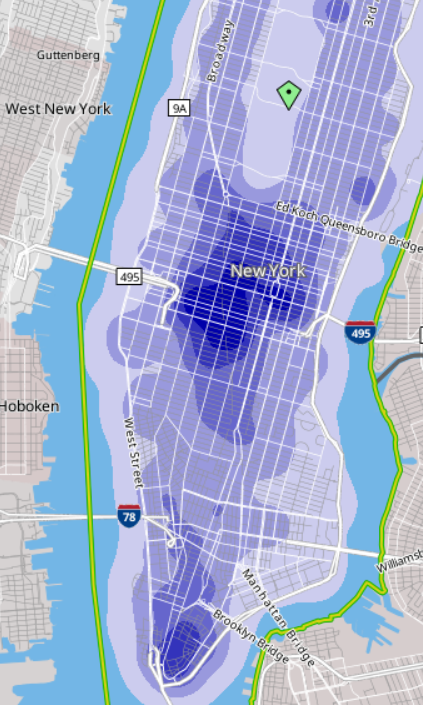
Adding up all the Bronx stations on the line – Wakefield, Woodlawn, Williams Bridge, Botanical Garden, Fordham, Tremont, Melrose – we get 170,049 employed residents (as always, as of 2019), of whom 62,837 work in Manhattan. The line is overall in a subway desert, close to the 4 and B/D but along hills, and not so close to the 2/5 to the east; several tens of thousands of boardings are plausible if service is improved. For comparison, the combination of Westchester, Putnam, and Dutchess Counties has 115,185 Manhattan-bound commuters, split across the Harlem Line, the Hudson Line, and the inner New Haven Line. The Bronx is thus likely to take a majority of Manhattan-bound ridership on the Harlem Line, though not an overwhelming one.
To serve all this latent demand, it is obligatory to run more local service. A minimum service frequency of a train every 10 minutes is required. The current outbound schedule is 20 minutes from Grand Central to Fordham, and about four of those are a slowdown in the Grand Central throat that can be waived (the current speed limit is 10 miles per hour for the last mile; the infrastructure can largely fit trains running three times that fast almost all the way to the bumpers). Lower frequency than this would not really make use of the line’s speed.
Moreover, using the track chart as of 2015 and current (derated) M7 technical performance, the technical trip time is 18 minutes, over which 20 minutes is not too onerously padded; but removing the derating and the four gratuitous minutes crawling into and out of Grand Central, this is about 14 minutes, with some pad. The speed zones can be further increased by using modern values of cant and cant deficiency on curves, but the difference isn’t very large, only 40 seconds, since this is a section with frequent stops. It’s fast, and to reinforce this, even higher frequency may be warranted, a train every 7.5 or 6 or even 5 minutes.
There is room on the tracks for all of this. The issue is that this requires dedicating the local tracks on the Harlem Line in the Bronx to local service, instead of having trains pass the platforms without stopping. This, in turn, requires slowing down some trains from Westchester to make more local stops. Current peak traffic on the Harlem Line is 15 trains per hour, of which 14 run past Mount Vernon West, the current northern limit of the four-track section, and 13 don’t stop in the Bronx at all. The line has three tracks through past Crestwood, and the stations are set up with room for a fourth track, but a full 10 trains per hour, including one that stops in the Bronx, run past Crestwood. In theory it’s possible to run 12 trains per hour to Mount Vernon West making all stops, and 12 trains past it skipping Bronx stops; this slows down the express trains from White Plains, which currently skip seven stops south of White Plains to Mount Vernon West inclusive, but higher speeds in the Bronx, speeding up the Grand Central throat, higher frequency, and lower schedule padding would together lead to improvements in trip times. However, this introduces a new set of problems, for which we need to consider the New Haven Line too.
Harlem Line express service and the New Haven Line
Currently, the New Haven Line runs 20 trains per hour into Grand Central at the peak. This number will go down after Penn Station Access opens in 2027, but not massively; a split of 6-8 trains per hour into Penn Station and 16-18 into Grand Central, with the new service mildly increasing total throughput, is reasonable.
Today, New Haven Line locals stop at Fordham, and nowhere else in the Bronx. This is inherited from the trackage rights agreement between the New York Central and the New York, New Haven and Hartford Railroad, allowing the latter to make only one stop in the Bronx on the former’s territory; it used to be Woodlawn, the branch point, but has been moved to Fordham, which has busier reverse-peak traffic. The two railroads merged in 1969, and all service is currently run by Metro-North, but the practice persists. This is not necessarily stupid: the New Haven locals are long – Stamford is 53 km from Grand Central, 50% farther than White Plains – and a system in which the New Haven trains are more express than the Harlem trains is not by itself stupid, depending on other system constraints. Unfortunately, this setup introduces all manners of constraints into the system:
- Fordham is a local-only station, and thus New Haven locals have to use the local tracks, using awkwardly-placed switches to get between the express and the local tracks. In fact, all stations up to and including Woodlawn are local-only; the first station with platforms on the express tracks is Wakefield, just north of the split between the two lines.
- If there are 12 Harlem Line trains per hour expressing through the Bronx, then the New Haven Line is limited to about 12 trains per hour as well unless the local trains make all the Bronx local stops.
- The Hudson Line has a flat junction with the Harlem Line at Mott Haven Junction, which means that any regular schedule has to have gaps to let Hudson Line trains pass; current peak Hudson Line traffic is 11 trains per hour, but it was 14 before corona.
This leads to a number of different options, each problematic in its own way.
Maximum separation
In this schedule, all Harlem Line trains run local, and all New Haven Line trains run express in the Bronx. This is the easiest to timetable – the junction between the two lines, unlike Mott Haven, is grade-separated. This also requires splitting the Hudson Line between local and express tracks, so delays will still propagate in any situation unless the Hudson Line is moved to the Empire Connection (6-8 trains per hour can stay on the current route); but in a future with Penn Station Access West, building such service, it does allow for neat separation of the routes, and I usually crayon it this way in very high-investment scenarios with multiple through-running tunnels.
But in the near future, it is a massive slowdown for Harlem Line riders who currently have express service from White Plains to Manhattan. The current peak timetable has a 15-minute difference between local and express trains on this section; this figure is padded but not massively so, and conversely, higher speeds on curves increase the express train speed premium.
It also severs the connection between the Bronx and the New Haven Line, unless passengers take east-west buses to the Penn Station Access stations. It is possible to add infill at Wakefield on the New Haven Line: this is north of the junction with the Harlem Line, but barely, so the separation between the lines is short, and a transfer station is feasible. But it wouldn’t be a cross-platform transfer, and so Fordham-Stamford service would still be degraded.
Locals run local
The New Haven Line locals can make local stops in the Bronx. It’s a slowdown of a few minutes for those trains – the current outbound timetable is 18 minutes from Grand Central to Fordham, two minutes faster than on Harlem Line locals while skipping Melrose and Tremont. Overall, it’s a slowdown of around six minutes; the current speed zones are 60 and 75 mph, and while raising the speed limits increases the extent of the slowdown (most of the track geometry is good for 160 km/h), getting new trainsets with better acceleration performance decreases it, and overall it’s likely a wash.
From there, the service pattern follows. New Haven Line locals to Grand Central have little reason to run more frequently than every 10 minutes at peak – the local stations are 30-60 minutes out of Grand Central today, and this is massively padded, but with the timetables Devin produced, fixing the Grand Central throat, New Rochelle would still be 20 minutes out on a local train (stopping at Fordham only as is the case today) and Stamford would be 45 minutes out. What’s more, there will be some local trains to Penn Station starting in three years, boosting the effective frequency to a train every five minutes, with a choice of Manhattan station if express trains can be made to stop at New Rochelle with a timed connection.
Now, if there are six local trains per hour in the Bronx going to Stamford, then the Harlem Line locals only take six trains per hour of their own, and then 12 trains should run express from Wakefield to Harlem. What they do to the north depends. The simplest option is to have all of them make all stops, which costs White Plains 7-8 minutes relative to the express stopping pattern. But if the line can be four-tracked to Crestwood, then half the trains can run local to White Plains and half can run nonstop between Wakefield or Mount Vernon West and White Plains. Two local stations, Scarsdale and Hartsdale, are in two-track territory, but timetabling a local to follow an express when both run every 10 minutes and there are only two local stops’ worth of speed difference is not hard.
The New Haven Line, meanwhile, gets 12 express trains per hour. Those match 12 express Harlem Line trains per hour, and then there’s no more room on the express tracks; Hudson Line trains have to use the local tracks and somehow find slots for the northbound trains to cross both express tracks at-grade.
Status quo
The status quo balances Bronx-Stamford connectivity with speed. Bear in mind, the New Haven Line today has truly massive timetable padding, to the point that making trains make all six stops in the Bronx and not just Fordham would still leave New Rochelle locals faster than they are today if the other speedup treatments were put into place. But the status quo would allow New Rochelle, Larchmont, Rye, and Greenwich to take maximum advantage of the speedup, which is good. The problem with it is that it forces New Haven Line locals to take slots from both the express tracks and the local tracks in the Bronx.
In this situation, the New Haven Line still runs six locals and 12 express trains to Grand Central per hour. The Harlem Line is reduced to six express trains through the Bronx and has to run 12 trains local. Transfers at Wakefield allow people in suburbs south of White Plains to get on a faster train, but this in effect reduces the effective peak-of-peak throughput from the suburbs to Manhattan to just six trains per hour.
Express Fordham station
Rebuilding Fordham as an express station means there’s no longer any need to figure out which trains stop there and which don’t: all would. Then the New Haven Line would run express and the Harlem would either run local or run a mix.
The problem is that Fordham is in a constrained location, where such a rebuild is hard:
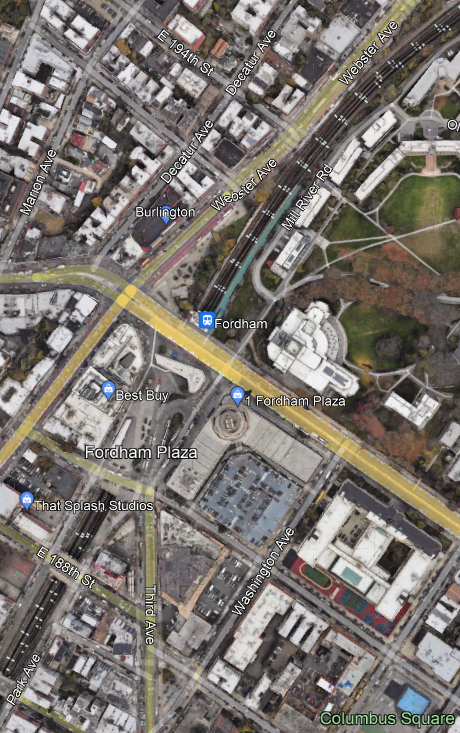
The line is below-grade, with a tunnel from Fordham Road to 189th Street. The platforms are short and narrow, and partly overlap the tunnel. Any conversion has to involve two island platforms north of the tunnel, where there is room but only if the right-of-way is expanded a little, at the expense of some parkland, and possibly a lane of Webster Avenue. The cost would not be pretty, independently of the inability of the MTA to build anything on a reasonable budget.
That said, the timetables on the Northeast Corridor require some infrastructure intervention to smooth things, like grade-separating some junctions for hundreds of millions of dollars each. New Rochelle, which has only a local platform southbound, should almost certainly be rebuilt as a full express stop. So rebuilding Fordham is not out of the question, even if the cost is high (which it is).
In this situation, all New Haven Line trains should use the express tracks. Thus, as in the status quo alternative, the Harlem Line gets six express trains, the other trains having to run local. Potentially, there may be a schedule in which the New Haven Line runs 16 trains to Grand Central and eight to Penn Station, and then the Harlem Line can get eight local and eight express trains; but then the local trains have to be carrying the load well into Westchester, and four-tracking the line to Crestwood is likely obligatory.
The New Haven Line and intercity trains
The above analysis elides one important factor: intercity trains. The current practice in the United States is a three-way separation of urban rail, suburban commuter rail, and intercity rail, with fares designed to discourage riders from taking trains that are not in their sector. However, in much the same way the best industry practice is to charge mode-neutral fares within cities, it is also valuable to charge mode-neutral fares between them. In other words, it’s useful to look at the impact of permitting people with valid commuter rail tickets to take intercity trains, without seat reservations.
To be clear, this means that at rush hour, there are going to be standees on busy commuter routes including Stamford-New York and Trenton-New York. But it’s not necessarily bad. The intercity trip time in our timetables between Stamford and New York is around 29 minutes without high-speed bypasses; the standing time would be less than some subway riders endure today – in the morning rush hour the E train departs Jamaica Center full and takes 34 minutes to get to its first Manhattan stop. And then there’s the issue of capacity: commuter trains on the New Haven Line are eight cars long, intercity trains can be straightforwardly expanded to 16 cars by lengthening the platforms at a very small number of stations.
And if the intercity trains mop up some of the express commuter rail traffic, then the required service on the New Haven Line at rush hour greatly decreases. An intercity train, twice as long as a commuter train (albeit with somewhat fewer seats and less standing space per car), could plausibly displace so much commuter traffic that the peak traffic on the line could be reduced, say to 18 trains per hour from today’s 20. Moreover, the reduction would be disproportionately at longer distance: passengers west of Stamford would not have any replacement intercity train unless they backtracked, but passengers east of Stamford would likely switch. This way, the required New Haven Line traffic shrinks to 12 local trains per hour and six express trains; half the locals run to Penn Station and half to Grand Central, and all express trains run to Grand Central.
In that situation, we can rerun the scenarios for what to do about Fordham; the situation generally improves, since less commuter traffic is required. The maximum separation scenario finally permits actual separation – the Hudson Line would run on the express tracks into Grand Central and have to cross the southbound Harlem Line locals at Mott Haven Junction, with predictable gaps between trains. The locals-run-local scenario gives Harlem Line express trains more wiggle room to slot between New Haven Line express trains. The status quo option lets the Harlem Line run six local trains and 12 express trains, though that likely underserves the Bronx. Converting Fordham to an express stop straightforwardly works with zero, six, or 12 express Harlem Line trains per hour.
Or maybe not. It’s fine to assume that letting passengers get on a train that does Stamford-Penn Station in 29 minutes and New Haven-Penn Station in 57 for the price of a commuter pass is going to remove passengers from the express commuter trains and put them onto longer intercity trains. But by the same token, the massive speed improvements to the other stops could lead to an increase in peak demand. The current trip time to Stamford is 1:12 on a local train; cutting that to 45 minutes means so much faster trips to the suburbs in between that ridership could increase to the point of requiring even more service. I’m not convinced on this – the modal split for peak commutes to Manhattan is already very high (Metro-North claimed 80% in the 2000s), and these suburbs are incredibly NIMBY. But it’s worth considering. At the very least, more local service is easier to add to the timetable than more express service – locals to Grand Central don’t share tracks with intercities at all, and even locals to Penn Station only do on a controllable low-speed section in Queens.
New York-New Haven Trains in an Hour
Devin Wilkins and I are still working on coming up with a coordinated timetable on the Northeast Corridor, north to south. Devin just shared with me the code she was running on both routes from New Haven to New York – to Grand Central and to Penn Station – and, taking into account the quality of the right-of-way and tunnels but not timetable padding and conservative curve speeds – it looks like intercity trains would do it in about an hour. The current code produces around 57 minutes with 7% timetable pad if I’m getting the Penn Station throat and tunnel slowdowns right – but that’s an if; but at this point, I’m confident about the figure of “about an hour” on the current right-of-way.
I bring this up to give updates on how the more accurate coding is changing the timetable compared to previous estimates, but also to talk about what this means for future investment priorities.
First, the curve radii I was assuming in posts I was writing last decade were consistently too optimistic. I wrote three months ago about how even within the highest speed zone in southern Rhode Island, there’s a curve with radius 1,746 meters (1 degree in American parlance), which corresponds to about 215 km/h with aggressive cant and cant deficiency. At this point we’ve found numbers coming straight from Amtrak, Metro-North, and MBTA, letting us cobble together speed zones for the entire system.
But second, conversely, I was being too conservative with how I was setting speed zones. My principle was that the tightest curve on a section sets the entire speed limit; when writing commuter rail timetables, I would usually have each interstation segment be a uniform speed zone, varying from this practice only when the interstation was atypically long and had long straight sections with a tight curve between them. When writing intercity timetables, I’d simplify by having the typical curves on a line set the speed limit and then have a handful of lower speed limits for tighter curves; for example, most curves on the New Haven Line are 873 meters, permitting 153 km/h with aggressive high-speed rail cant and cant deficiency, and 157 km/h with aggressive limits for slower trains, which can run at slightly higher cant deficiency, but those sections are punctuated by some sharper curves with lower limits. Devin, using better code than me, instead lets a train accelerate to higher speed on straight sections and then decelerate as soon as it needs to. Usually such aggressive driving is not preferred, and is used only when recovering from delays – but the timetable is already padded somewhat, so it might as well be padded relative to the fastest technical speed.
The upshot of all of this is that the speed gains from just being able to run at the maximum speed permitted by the right-of-way are massive. The trip time today is 1:37 on the fastest trains between New York and New Haven. Commuter trains take 2:10, making all stops from New Haven to Stamford and then running nonstop between Stamford and Manhattan; in our model, with a top speed of 150 km/h, high-performance regional trains like the FLIRT, Talent 3, or Mireo should do the trip in about 1:15-1:20, and while we didn’t model the current rolling stock, my suspicion is that it should be around six minutes longer. The small difference in trip time is partly because Penn Station’s approach is a few kilometers longer than Grand Central’s and the curves in Queens and on the Hell Gate Bridge are tight.
What this means is that the highest priority should be getting trains down to this speed. In the Swiss electronics-before-concrete schema, the benefits of electronics on the Northeast Corridor are massive; concrete has considerable benefits as well, especially on sections where the current right-of-way constrains not just speed but also reliability and capacity, like New Haven-Kingston, but the benefits of electronics are so large that it’s imperative to make targeted investments to allow for such clean schedules.
Those investments do include concrete, to be clear. But it’s concrete that aims to make the trains flow more smoothly, in support of a repetitive schedule with few variations in train stopping patterns, so that the trains can be timetabled in advance not to conflict. At this point, I believe that grade-separating the interlocking at New Rochelle, popularly called Shell Interlocking and technically called CP 216, is essential and must be prioritized over anything else between the city limits of New York and New Haven Union Station. Currently, there’s very high peak traffic through the interlocking, with a flat junction between trains to Penn Station and trains to Grand Central.
On the electronics side, the timetables must become more regular. There are currently 20 peak trains per hour on the New Haven Line into Grand Central; of those, four go to branches and 16 are on the main line, and among the 16, there are 13 different stopping patterns, on top of the intercity trains. It is not possible to timetable so many different trains on a complex system and be sure that everything is conflict-free, and as a result, delays abound, to which the response is to pad the schedules. But since the padded schedules still have conflicts, there is a ratchet of slowdowns and padding, to the point that a delayed train can recover 20 minutes on less than the entire line. Instead, every train should either be a local train to Stamford or an express train beyond Stamford, and there should only be a single express pattern on the inner line, which today is nonstop between Harlem and Stamford and in the future should include a stop at New Rochelle; this means that, not taking intercity trains into account, the main line should have at most four stopping patterns (local vs. express, and Penn Station vs. Grand Central), and probably just three, since express commuter trains should be going to Grand Central and not Penn Station, as passengers from Stamford to Penn Station can just ride intercity trains.
Also on the electronics side, the way the line is maintained currently is inefficient to an extent measured in orders of magnitude and not factors or percents. Track inspection is manual; Metro-North finally bought a track geometry machine but uses it extremely unproductively, with one report saying it gets one tenth as much work done as intended. Normally these machines can do about a track-mile in an overnight work window, which means the entire four-track line can be regraded and fixed in less than a year of overnights, but they apparently can’t achieve that. Whatever they’re doing isn’t working; the annual spending on track renewal in Connecticut is what Germany spends on once-in-a-generation renewal. The endless renewal work includes a plethora of ever-shifting slow zones, and at no point is the entire system from New York to New Haven clear for trains, even on weekdays. The excessively complex schedule, on tracks that constantly shift due to segment-by-segment daytime repairs, is turning a trip that should be doable on current rolling stock in perhaps 1:23 into one that takes 2:10.
The billions of dollars in the Bipartisan Infrastructure Law that are dedicated to the Northeast Corridor and have not yet been spent can reduce trip times further. But the baseline should be that the bucket of money is a few hundreds of millions smaller and the base case trip time from New York to New Haven is an hour and not 1:37; this is what the system should be compared with.
Security Theater on Metros
In comments, Sarapen asked me about security on urban rail. It’s common in developing Asia to require people to go through metal detectors to get to the platforms; I’ve seen this in Bangkok, she mentions this in the context of Manila, and it’s also the case on Indian metros and Chinese ones. Seung Y. Lee, a BART digital media worker and indispensable commentator on American and Asian metro history who sadly doesn’t blog enough, has an excellent post about it, talking about the use of security as a tool of social control, for example in Hong Kong.
But Sarapen is asking about the need for security to deter terrorism and violence, which do exist in the Philippines.
For this, I naturally went to the country facing terrorism and violence that I know most intimately. I haven’t visited in more than 11 years, and so I’ve never taken the light rail in either Tel Aviv or Jerusalem (which was open on my last visit but I didn’t visit the city then). So I went ahead and asked on my Discord server, and got this:

The person covered up by the two shorter white rectangles also posted a picture of a platform in Tel Aviv, with a vault for bomb disposal:
Israel Railways does have security theater – one has to open one’s bags in front of a security guard and go through a metal detector, and this being Israel, there is extensive racial profililng. But the light rail, including the underground portions in Tel Aviv, do not. There’s a lot of visible security presence, including cameras, security personnel, and K-9 units, but no metal detectors. This is in a country that, in the 1990s and early 2000s, underwent a wave of suicide bombings on buses, and still didn’t put metal detectors on them, because it’s infeasible to install such technology on surface transit, and too expensive and frankly not too useful on metros (a security line is an attractive bombing target).
This shouldn’t be too surprising, in a way. Western Europe did not install security theater on trains in response to far-left terrorism in the 1970s and 80s. Israel’s way of building and running public transportation is intended as a pan-European medley, using consultants who have done work in Europe, and with media discourse that looks up to Europe’s urban transportation systems (on other matters Israel looks up to the United States, but Israelis understand American public transportation is not good). If nobody in Europe (or at least Western Europe) does something, it’s unlikely Israel will do it, not on civilian public infrastructure.
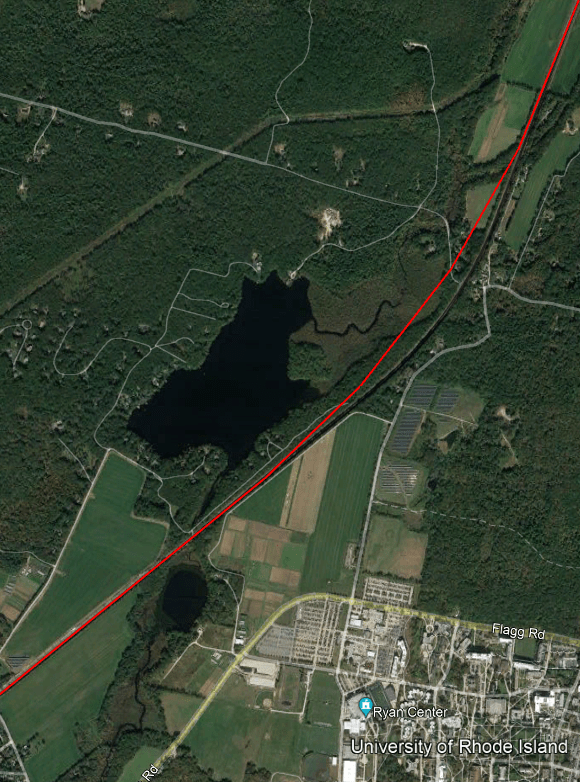
Curves in Fast Zones
I wrote nearly five years ago that the lowest-hanging fruit for speeding up trains are in the slowest sections. This remains true, but as I (and Devin Wilkins) turn crayon into a real proposal, it’s clear what the second-lowest hanging fruit is: curves in otherwise fast sections. Fixing such curves sometimes saves more than a minute each, for costs that are not usually onerous.
The reason for this is that curves in fast zones tend to occur on a particular kind of legacy line. The line was built to high standards in mostly flat terrain, and therefore has long straight sections, or sections with atypically gentle curves. Between these sections the curves were fast for the time; in the United States, high standards for the 19th century meant curves of radius 1,746 meters, at which point each 100′ (30.48 meters) of track distance correspond to one degree of change in azimuth; 30.48*180/pi = 1,746.38. For much more information about speed zones, read this post from four weeks ago first; I’m going to mention some terminology from there without further definitions.
These curves are never good enough for high-speed rail. The Tokaido Shinkansen was built with 2,500 meter curves, and requires exceptional superelevation and a moderate degree of tilting (called active suspension) to reach 285 km/h. This lateral acceleration, 2.5 m/s^2, can’t really be achieved on ordinary high-speed rolling stock, and the options for it always incur higher acquisition and operating costs, or buying sole-sourced Japanese technology at much higher prices than are available to Japan Railways. In practice, the highest number that can be acheived with multi-vendor technology is around 2.07 m/s^2, or at lower speed around 2.2; 1,746*2.07 = 3,614.22, which corresponds to 60.12 m/s, or 216 km/h.
If a single such curve appears between two long, straight sections, then the slowdown penalty for it is 23.6 seconds from a top speed of 300 km/h, 35.5 from a top speed of 320 km/h, or 67 seconds from a top speed of 360 km/h. The curve itself is not instantaneous but has a few seconds of cruising at the lower speed, and this adds a few seconds of penalty as well.
Case in point: the curve between Kingston and Wickford Junction in South County, Rhode Island is such a curve. The red line below denotes a 4 km radius curve, good for a little more than 320 km/h (360 with tilt), deviating from the black line of the existing curve.

The length of the existing curve is about 1.3 km, so to the above penalties, add 6 seconds if the top speed is 300 km/h, 7 if it’s 320, or 8.7 if it’s 360 (in which case the curve needs to be a bit wider unless tilting is used). If it’s not possible to build a wider curve than this, then from a top speed of 360 km/h, the 320 km/h slowdown adds 10 seconds of travel time, including a small penalty for the 1.3 km of the curve and a larger one for acceleration and deceleration; thus, widening the curve from the existing one to 4 km radius actually has a larger effect if the top speed on both sides is intended to be 360 and not 320 km/h.
The inside of this curve is not very developed. This is just about the lowest-density part of the Northeast Corridor. I-95 has four rather than six lanes here. Land acquisition for curve easement is considerably easier than in higher-density sprawl in New Jersey or Connecticut west of New Haven.
The same situation occurs north of Providence, on the Providence Line. There’s a succession of these 1,746 meter curves, sometimes slightly tighter, between Mansfield and Canton. The Canton Viaduct curve is unfixable, but the curves farther to the south are at-grade, with little in the way; there are five or six such curves (the sixth is just south of the viaduct and therefore less relevant) and fixing all of them together would save intercity trains around 1:15.
For context, 1.3 km of at-grade construction in South County with minimal land acquisition should not cost more than $50 million, even with the need to stage construction so that the new alignment can be rapidly connected to the old one during the switchover. Saving more than a minute for $50 million, or even saving 42 seconds for $50 million, is around 1.5 orders of magnitude more cost-effective than the Frederick Douglass Tunnel in Baltimore ($6 billion for 2.5 minutes); there aren’t a lot of places where it’s possible to save so much time at this little cost.
It creates a weird situation in which while the best place to invest in physical infrastructure is near urban stations to allow trains to approach at 50-80 km/h and not 15-25, the next best is to relieve 210 km/h speed zones that should be 300 km/h or more. It’s the curvy sections with long stretches of 120-160 km/h that are usually more difficult to fix.
 Pedestrian Observations