Category: Transportation
The Fish Rots from the Head
All reform agendas run into the same problem: someone needs to implement the reform, and this someone needs to be more politically powerful than the entrenched interests that need reform. The big political incentive for a leader is to swoop in to fix an organization that is broken and get accolades for finally making government work. But whether this work depends on what exactly is broken. If the fish rots from the tail, and better management can fix things, then reformist politicians have an easy time. The problem is that if the fish rots from the head – that is, if the problem is the political leaders themselves – then there is no higher manager that can remove underperforming workers. My contention is that when it comes to poor American public transit practices, the fish usually rots from the head.
Whither fixing construction costs?
I wrote my first comment documenting high New York construction costs at the end of 2009. By 2011 this turned into my first post in my series here with some extra numbers. By the time I jumped from commenting to blogging, the MTA had already made a reference to its high costs in a 2010 report called Making Every Dollar Count (p. 11): “tunneling for the expansion projects has cost between three and six times as much as similar projects in Germany, France and Italy.” New York City Comptroller Scott Stringer has been plagiarizing my 2011 post since 2013.
However, the early recognition has not led to any concrete action. There has not been any attention even from leaders who could gain a lot of political capital from being seen as fixing the problem, such as governors in California, New York, and Massachusetts, as well as successive New York mayors. That Governor Cuomo himself has paid little attention to the subway can be explained in terms of his unique personal background from a car-oriented city neighborhood, but when it’s multiple governors and mayors, it’s most likely a more systemic issue.
What’s more, there has been plenty of time to come up with an actionable agenda, and to see it pay dividends to help catapult the career of whichever politician can take credit. The MTA report came out 9 years ago. An ambitious, forward-thinking politician could have investigated the issue and come up with ways to reduce costs in this timeframe – and in the region alone, four politicians in the relevant timeframe (Mayors Bloomberg and de Blasio, Cuomo, and Governor Christie) had obvious presidential ambitions.
Evidently, there has been action whenever a political priority was threatened. The LIRR had long opposed Metro-North’s Penn Station Access project, on the grounds that by sending trains through a tunnel used by the LIRR, Metro-North would impinge on its turf. As it was a visible project and a priority for Cuomo, Cuomo had to remove the LIRR’s obstruction, and thus fired LIRR President Helena Williams in 2014.
So what’s notable is that construction costs did not become a similar political priority, even though rhetoric of government effectiveness and fighting waste is ubiquitous on the center-left, center, and center-right.
Who benefits?
That successive powerful American leaders have neglected to take on construction costs suggests that there is no benefit to them in fixing the problem. The question is, who benefits from high costs, then?
The answer cannot be that these politicians are all corrupt. The inefficiency in construction does not go to any serious politician’s pockets. Corruption might, but that requires me to believe that all relevant mayors and governors take bribes, which I wouldn’t believe of Italy, let alone the United States. One or two crooks could plausibly lead to cost explosion in one place, but it is not plausible that every serious politician in the New York area in the last decade has been both corrupt and in on the exact same grift.
Another answer I’d like to exclude is powerful interest groups. For example, if the main cause of high American construction costs were unions, then this would explain why governors all over the more liberal states don’t make an effort to build infrastructure more cheaply. However, there are enough high-cost states with right-wing politics and anti-union laws. The other entrenched interest groups are quite weak nationwide, for example planners, who politicians of all flavors love to deride as unelected bureaucrats.
The pattern of competence and incompetence
In my dealings with New York, I’ve noticed a pattern: the individual planners I talk to are curious, informed, and very sharp, and I don’t just mean the ones who leak confidential information to me. This does not stop at the lower levels: while most of my dealings with planners were with people who are my age or not much older, one of my sources speaks highly of their supervisor, and moreover my interactions with senior planners at the MTA when Eric Goldwyn and I pitched our bus redesign were positive. Eric also reports very good interactions with bus drivers and union officials.
In contrast, the communications staff is obstructive and dishonest. Moreover, the most senior layer of management is simply incompetent. Adam Rahbee describes it as “the higher up you get, the less reasonable people are” (my paraphrase, not a direct quote); he brings up work he proposed to do on reworking on the subway schedules, but the head of subway operations did not have the budget to hire an outside consultant and the higher-up managers did not even know that there was a problem with trains running slower than scheduled (“running time”).
A number of area observers have also noticed how MTA head Ronnie Hakim, a Cuomo appointee, was responsible to much of the recent spate of subway slowdowns. Hakim, with background in law rather than operations, insisted speed should not be a priority according to Dan Rivoli’s sources. The operations staff seem to hate her, judging by the number and breadth of anonymous sources naming her as one of several managers who are responsible for the problem.
The pattern is, then, that the put-upon public workers who run the trains day in, day out are fine. It’s the political appointees who are the problem. I don’t have nearly so many sources at other transit agencies, but what I have seen there, at least in Boston and San Francisco, is consistent with the same pattern.
Quite often, governors who aim to control cost institute general hiring freezes, via managers brought in from the outside, even if some crucial departments are understaffed. For example, Boston has an epidemic of bus bunching, is staffed with only 5-8 dispatchers at a given time, and can’t go up to the necessary 15 or so because of a hiring freeze. The 40 or so full-time dispatchers who are needed to make up the difference cost much less than the overtime for bus drivers coming from the bunching, to say nothing of the extra revenue the MBTA could get if, with the same resources, its buses ran more punctually. In the name of prudence and saving money, the MBTA wastes it.
The risk aversion pattern
The above section has two examples of political interference making operations worse: a hiring freeze at the MBTA (and also at the MTA), and Ronnie Hakim deemphasizing train speed out of fear of lawsuits. There is a third example, concerning capital planning: Cuomo’s interference with the L shutdown, well covered by local sources like Second Avenue Sagas, in which the governor effectively took sides in an internal dispute against majority opinion just because engineering professors in the minority had his ear. All three examples have a common thread: the negative political interference is in a more risk-averse direction – hiring fewer people, running slower trains, performing ongoing maintenance with kludges rather than a long-term shutdown.
The importance of risk-aversion is that some of the problems concerning American construction costs are about exactly that. Instead of forcing agencies that fight turf battles to make nice, political leaders build gratuitous extra infrastructure to keep them on separate turf, for example in California for high-speed rail. Only when these turf battles risk a visible project, such as the LIRR’s opposition to Penn Station Access, do the politicians act. Costs are not so visible, so politicians let them keep piling, using slush funds and raiding the rest of the budget.
In New York, the mined stations, too, are a problem of risk-aversion. Instead of opening up portions of Second Avenue for 18 months and putting it platforms, the MTA preferred to mine stations from a smaller dig, a five-year project that caused less street disruption over a longer period of time. An open dig would invite open political opposition from within the neighborhood; dragging it over five years may have caused even more disruption, but it was less obtrusive. The result: while the tunneling for Second Avenue Subway was about twice as expensive as in Paris, the stations were each seven times as expensive. The overall multiplier is a factor of seven because overheads were 11 times as expensive, and because the stop spacing on Second Avenue is a bit narrower than on the Paris Metro extension I’m comparing it with.
In contrast with the current situation in New York, what I keep proposing is politically risky. It involves expanding public hiring, not on a massive level, but on a level noticeable enough that if one worker underperforms, it could turn into a minor political scandal in which people complain about big government. It involves promoting smart insiders as well as hiring smart outsiders – and those outsiders should have industry experience, like Andy Byford at New York City Transit today, not political experience, like the MBTA’s Luis Ramirez or the FRA’s Sarah Feinberg; by itself, hiring such people is not risky, but giving them more latitude to operate is, as Cuomo discovered when Byford began proposing his own agenda for subway investment.
On the engineering level, it involves more obtrusive construction: tunnels and els, not bus lanes that are compromised to death – and the tunnels may involve cut-and-cover at stations to save money. Regional rail is obtrusive politically, as modernization probably requires removal of many long-time managers who are used to the current way of doing things (in Toronto, the engineers at GO Transit obstructed the RER program, which was imposed from Metrolinx), and in New York the elimination of Long Island and the northern suburbs’ respective feudal ownership of the LIRR and Metro-North. The end result saves money, but little kings of hills will object and even though American states have the power to overrule them, they don’t want the controversy.
The fish rots from the head
American transportation infrastructure does not work, and is getting worse. The costs of building more of it are extremely high, and seem to increase with every construction cycle. Operating costs for public transit run the gamut, but in the most important transit city, New York, they are the highest among large world cities, and moreover, the cheapest option for extending high-quality public transit to the suburbs, regional rail, is not pursued except in Silicon Valley and even there it’s a half-measure.
The problems are political. Heavyweight politicians could use their power to force positive reforms, but in a number of states where they’ve been able to do so on favorable terms, they’ve done no such thing. On the contrary, political influence has been negative, installing incompetent or dishonest managers and refusing to deal with serious long-term problems with operations and maintenance.
The reason politicians are obstructive is not that there’s no gain in improving the state of public services. On the contrary, there is a huge potential upside to getting credit for eliminating waste, fraud, and abuse and delivering government projects for much cheaper than was thought possible. But they look at minor controversies that could come from bypassing local power brokers, who as a rule have a fraction of the influence of a governor or big city mayor, or from building bigger projects than the minimum necessary to be able to put their names or something, and stop there.
One animal analogy for this is that the fish rots from the head: the worst abuses come from the top, where politicians prefer slow degradation of public services to a big change that is likely to succeed but risks embarrassment or scandal. The other animal analogy is that, through a system that rewards people who talk big and act small, American politics creates a series of chickenshit leaders.
Where Line 2 Should Go Depends on Where Line 1 Goes
A city that is building a rapid transit network piecemeal has to decide on priorities. There are tools for deciding where to build the first line, such as looking at the surface transit network and seeing what the busiest corridor is. These are relatively well-understood. In this post I’d like to focus on where to build the second line, because that question depends not only on the usual factors for where to build transit, but also on how the first line is expected to change the network. This is relevant not only to cities that are building a new rapid transit system, but also to cities that have such a network and are adding new lines one at a time: the usual tools can straightforwardly suggest where to build one line, but figuring out where to build a second line requires some additional work.
A toy model
Consider the following city, with its five busiest buses, labeled A-E from busiest to fifth busiest:

Let’s stipulate that there’s a wealth of arterial roads radiating in the right directions, and no motorways entering city center, so the exceptions to the rule that trains should go where the busiest buses are don’t apply. Let’s also stipulate that the other buses in the city don’t affect the internal ranking of the first five much – so if there are a bunch of north-south buses close to route C not depicted on the map, they’re not busy enough to make it busier than route A.
Clearly, based on the A > B > C > D > E ranking, the top priority for a first rapid transit line is A. Not only is it the busiest bus but also it is parallel to the second busiest.
But the second priority is not B, but C. The reason is that a rapid transit line on A captures east-west traffic, and then from the eastern and western neighborhoods people on route B are likely to walk south or ride a circumferential bus to get to the train. In the presence of a subway underneath the arterial carrying route A, the strongest bus corridor will almost certainly become C, and thus planners should aim to build a subway there as their second line, and begin design even before the first subway opens.
Fourth Avenue in Vancouver
Vancouver already has a rapid transit system, with three SkyTrain lines. However, the issue of the second line crops up when looking at remaining bus corridors and future subway plans. The strongest bus route is by far Broadway, which had higher ridership than the buses that became the Millennium and Canada Lines even when those lines were planned. The Millennium Line was only built first because it was easier, as it is elevated through the suburbs, and the Canada Line because Richmond demanded a SkyTrain connection.
Fortunately, Broadway is finally getting a subway, running from the Millennium Line’s current terminus at VCC-Clark to Arbutus, halfway toward the corridor’s natural end at UBC. The question is, what next? The second busiest bus corridor in Vancouver is Fourth Avenue, where the combined ridership of the 4, 44, and 84 buses and the part of the 7 that is on Fourth exceeds that of any corridor except Broadway; only Hastings, hosting the 95 and 160, comes close.
And yet, it is obviously wrong to plan any subway on Fourth Avenue. Fourth is half a kilometer away from Broadway; the 44 and 84 are relief for the 99 on Broadway. TransLink understands it and therefore there are no plans to do anything on Fourth – the next priority is extending the Expo Line farther out into Surrey or Langley, with the exact route to be determined based on political considerations.
Regional rail and subways in New York
In New York, two commonly-proposed subway extensions, down Nostrand and Utica, are closely parallel. The fact that they are so close to each other means that if one is built, the case for the other weakens. But these two corridors are so strong it is likely that if one is built, the second remains a very high priority. The only subway priority that is plausibly lower than the first of the two and higher than the second, regardless of which of Utica and Nostrand is built first, is a 125th Street crosstown extension of Second Avenue Subway.
But a more serious example of one future line weakening another occurs for regional rail. The top priority for regional rail in New York is four-tracking the tunnels to Penn Station under the Hudson; based on this priority, organizations that look beyond the next gubernatorial or congressional election have come up with farther-reaching proposals. Here, for example, is the map from the RPA’s Fourth Regional Plan:
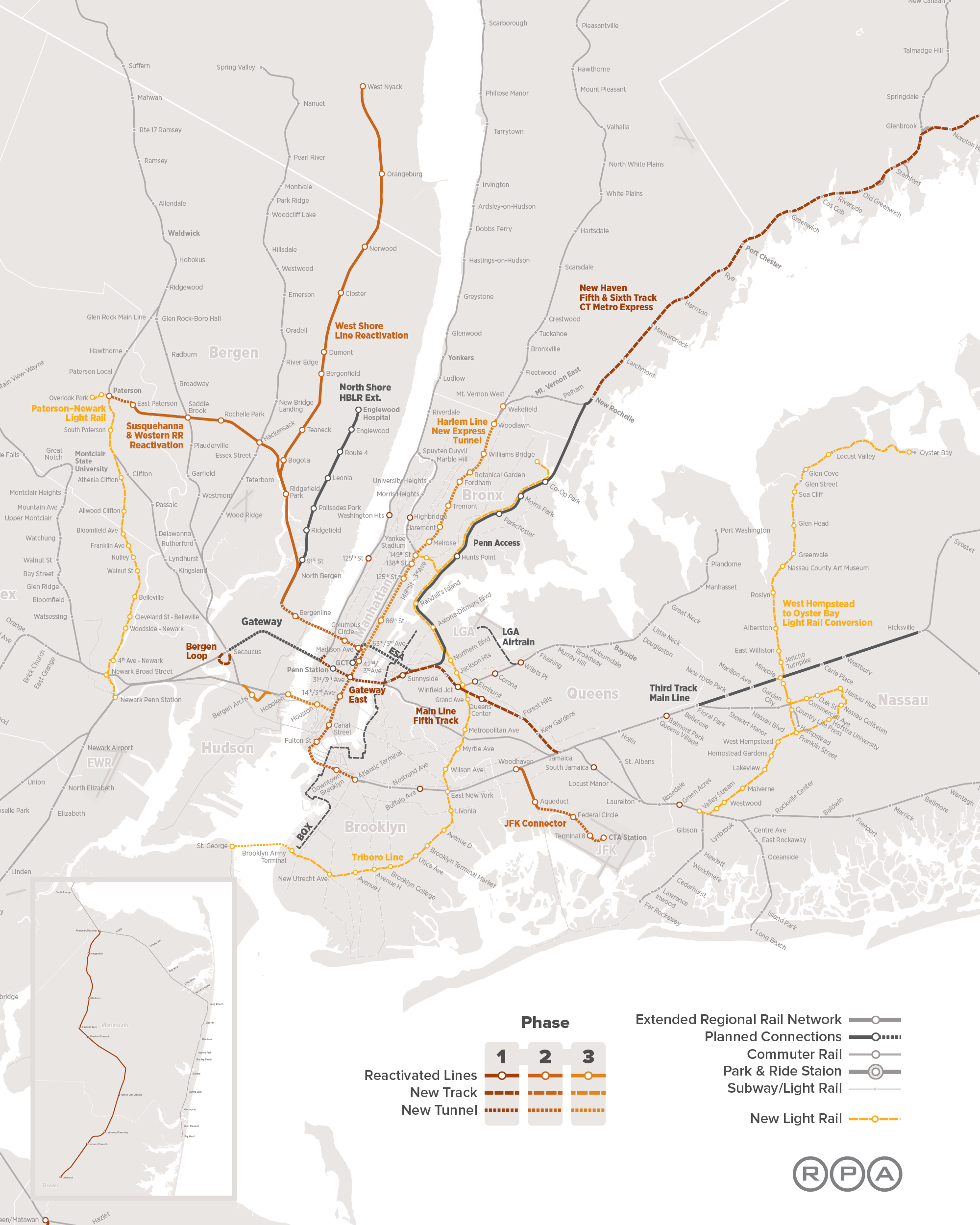
In addition to four-tracking the North River Tunnels under the aegis of the Gateway project, the RPA calls for two additional two-track tunnels under the Hudson, in phases 2 and 3 of its proposal. Both are to feed Midtown: the phase 2 tunnel is to connect regional rail lines to be reactivated with Columbus Circle, Grand Central, and other destinations in the city, and the phase 3 tunnel is to then carry the same line out of the city and back into New Jersey via Hoboken and the existing commuter lines serving southern and southwestern suburbs.
The logic, as I understand it, is that Midtown is the core of the New York region, and so it is the most important to connect there. I don’t know if this is what the RPA was thinking, but I asked at an IRUM meeting in 2010 why all plans involve connections to Midtown rather than Lower Manhattan and was told Lower Manhattan was not as important a business district.
The toy model has one fixed city center and varying outlying areas, the opposite of the situation here. Here, my criticism is of plans that serve the dominant city center while ignoring the second most important center. The total number of jobs in Midtown is 800,000 whereas Lower Manhattan has 250,000 – but Lower Manhattan is more compact, so a single station at Fulton with several exits can plausibly serve the entire area, whereas Midtown has areas that are too far from both Penn Station and Grand Central. The next pair of tracks should serve Midtown, but the pair after them should serve Lower Manhattan, to ensure good coverage to both business districts.
The Soviet Bloc Way of Building Rapid Transit
Based on positive feedback from Patreon backers, I am expanding my post about the American way of building rapid transit into a series covering various national traditions. The Soviet bloc’s tradition is the most globally widespread, as Soviet advisors trained engineers in the USSR’s entire sphere of influence, ranging from just east of the Iron Curtain to North Korea. It is especially fascinating as it evolved independently of Western and Japanese metro-building traditions, from its origins in Moscow in the 1930s.
Like the American tradition, the Soviet tradition has aspects that are worth emulating and ones that are not. But it’s useful to understand where the design aspects come from. It’s especially interesting as Moscow has influences from London, so comparing where the Russians did better and where they did worse is a good case study of adapting a foreign idea to a different national context. Similarly, China imported Russian ideas of how to build metro networks while making considerable adaptations of its own, and I hope to cover China more fully in a future post, discussing there too how the tradition changed in the transmission.
Technical characteristics
The Soviet way is characterized by four major features:
Wide station spacing: the average interstations on the systems in question are all long. Moscow’s is 1.7 km, and for the most part cities in the former USSR with metros have similar interstations; in this table, length is in the row labeled 1 and number of stations in the row labeled 3. This is also true of the metro systems in China and North Korea, but in the Eastern European satellite states it’s less true, with Prague and the newer lines in Budapest averaging not much more than 1 km between stations.
Very little branching: Soviet lines do not branch, with a small handful of exceptions. Moscow’s only branching line, Line 4, is unique in multiple ways, as it was redesigned with American influence after Nikita Khrushchev’s visit to the United States. Eastern European satellite state metros do not branch, either, in contrast with contemporary postwar Western European networks like those of Stockholm and Milan. China has more branching, albeit less than Western and Japanese systems of comparable scope.
Radial network design: what I call the Soviet triangle, while not really a Soviet invention (it has antecedents in Boston and London), became a rigid system of network design in the communist bloc. Subway lines all run as rough diameters through the disk of the built-up area, and meet in the center in a triangle rather than in a three-way intersection in order to spread the load. Moscow adds a single circular line to the mix for circumferential travel, subsequently refined by a second and soon a third ring. Here, China diverges significantly, in that Beijing has grid elements like parallel lines.
Deep boring: Soviet and Soviet-influenced metro networks run deep underground. Traditionally, there was limited above-ground construction, for reasons of civil defense; in Moscow, only Line 4 is shallow, again due to American influence.
London’s long shadow
The decision to deep-bore the Moscow Metro was undertaken in the 1920s and 30s, long before the Cold War and the militarization of Soviet society. It even predates the turn to autarky under Stalin; as Branko Milanovic notes, the USSR spent most of the 1920s trying to obtain foreign loans to rebuild after the Revolution, and only when foreign capital was not forthcoming did it turn to autarky. The NKVD arrested the British advisors, conducted show trials, and deported them for espionage in 1933; the basic technical characteristics were already set then.
In London, the reason for deep boring is that the city has one street wide and straight enough for a cut-and-cover subway, Euston Road hosting the Metropolitan line. In Moscow, such streets are abundant. British planners were exporting both the idea of constructing wide throughfares based on modernist planning principles and that of deep-boring metro lines, an invention based on the context of a city that lacks such throughfares.
The network design bears similarity to what London would have liked to be. London is not as cleanly radial as Moscow, but it clearly tries to be radial, unlike New York or Paris. In general, it’s best to think of the early Moscow Metro as like early-20th century London Underground lines but cleaner – stations spaced farther apart, more regular radial structure, none of the little quirks that London’s had to build around like the Piccadilly line’s since-closed Aldwych branch.
Transit and socialism
The Soviet method of building metros may have originated in British planning, but its implementation throughout the 20th century was under socialist states, in which there was extensive central planning of the entire economy. Decisions regarding who got to live in the cities, where factories were to be sited, what goods were to be produced, and which sectors each city would specialize in were undertaken by the state.
There are several consequences of this political situation. First, by definition all urban development was social housing and all of it was TOD. Housing projects were placed regularly in ever-expanding rings around city center, where all the jobs were. There was no redevelopment, and thus density actually increased going out, while industrial jobs stayed within central cities even though in the capitalist bloc they suburbanized early, as factories are land-intensive.
Of note, some of this central planning also existed under social democracy: Sweden built the Million Program housing in Stockholm County on top of metro stations, creating a structure of density enabling high transit ridership.
But a second aspect is unique to proper communism: there were virtually no cars. Socialist central planning prioritized capital goods over consumer goods, and the dearth of the latter was well-known in the Cold War. At the same time, modernist city planning built very large roads. With no cars to induce people to fight for livable streets nor anything like the Western and Japanese New Left, urban design remained what today we can recognize as extremely car-oriented, before there were any cars. Major Eastern European cities are thus strongly bifurcated, between ones where a centrally planned metro has ensured very high per capita ridership, like Prague, Budapest, and Moscow (and also Bratislava, with trams), and ones where as soon as communism fell and people could buy cars the tramway network’s ridership cratered, like Tallinn, Riga, and I believe Vilnius.
The third and last aspect is that with extensive central planning, the seams that are visible in cities with a history of competition between different transit operators are generally absent. The incompatible gauges of Tokyo and the missed connections of New York (mostly built by the public-sector IND in competition with the private-sector IRT and BMT) do not exist in Moscow; Moscow does have missed connections between metro lines, but not many, and those are an awkward legacy of long interstations.
Of note, the autocratic aspects of socialism do not come into play in Soviet metro design. One would think that the Stalinist state would be able to engage in projects that in democracies are often unpopular due to NIMBYism, such as cut-and-cover subways, but the USSR did not pursue them. China does build elevated metro lines outside city centers, but evidently its plans to extend the Shanghai Maglev Train ran into local NIMBYism. People complained that the separation between the tracks and adjacent buildings was much less than in the German Transrapid standards; the Chinese state’s credibility on environmental matters is so low that people also trafficked in specious concerns about radiation poisoning.
The role of regional rail
The European socialist states all inherited the infrastructure of middle-income countries with extensive proto-industry – in particular, mainline rail. Russia had even completed the Trans-Siberian Railway before WW1. The bigger cities inherited large legacy commuter rail networks, where they operate commuter EMUs.
But while there are many regional trains in the European part of the former Soviet bloc, they are not S-Bahns. There was and still is no through-service, or frequent off-peak service. Connections between the metro and mainline rail were weak: only in 2016 did Moscow start using a circular legacy railway as its second urban rail ring.
The situation is changing, and just as Moscow inaugurated the Central Circle, so is it planning to begin through-service on radial commuter rail, called the Moscow Central Diameters. However, this is early 21st century planning, based on Western European rapid transit traditions.
Does this work?
In the larger cities, the answer is unambiguously yes: they have high transit ridership even when the population is wealthy enough to afford cars. The smaller cities are more auto-oriented, but that’s hardly the fault of Soviet metro planning when these cities don’t have metro networks to begin with; the fault there concerns urban planning more than anything.
Three aspects of Soviet metro planning deserve especial positive mention. The clean radial structure best approximates how single-core cities work, and Moscow and the cities it inspired deserve credit for not wasting money on low-ridership tangential lines, unlike Mexico City or (at smaller scale) Paris. It’s not too surprising that the Soviet triangle in particular exists outside the Soviet bloc, if not as regularly as in Eastern Europe.
The second positive aspect is the use of headway management in Moscow. With no branching and high frequency, Moscow Metro lines do not need to run on a timetable. Instead, they run on pure headway management: clocks at every station count the time elapsed since the last train arrived, and drivers speed up or slow down depending on what these clocks show relative to the scheduled headway between trains. At the peak, some lines run 39 trains per hour, the highest frequency I am aware of on lines that are not driverless (driverless metro technology is capable of 48 trains per hour, at least in theory, and runs 42 in practice on M14 in Paris).
The third and last is the importance of central planning. All public transportation in a metro region should be planned by a single organ, which should also interface with housing planners to ensure there is ample TOD. If anything, one of the bigger failures of Soviet metro planning is that it did not take this concept all the way, neither integrating metros with regional rail nor building a finger plan.
In contrast with these three positive aspects, station design is lacking. As frequent commenter and Patreon supporter Alexander Rapp noted in comments, there are some cross-platform transfers in Moscow; however, the initial three lines do not have such transfers, and instead the transfers became congested early, creating the impetus for the Circle Line. The deep-bored stations are expensive: Line 4 was built cut-and-cover to save money, not out of some cultural cringe toward New York, and today Russia is looking at cut-and-cover stations as a way to reduce construction costs.
Moreover, the wide interstations are too clean. The Underground has long interstations outside Central London and short ones within Central London, facilitating interchanges; while London has eight missed connections, these result from seams on lines running alongside each other or on branches, and only one pair of trunks has no transfer at all, the Metropolitan line and the Charing Cross half of the Northern line. In contrast, the relentlessly long interstations in Moscow lead to more misses.
Cross-Platform Transfers
I did a complex Patreon poll about series to write about. In the poll about options for transit network design the winning entry was difficult urban geography, covered here and here; the runner-up was cross-platform transfers.
Subway users have usually had the experience of connecting at a central station so labyrinthine they either were lost or had to walk long distances just to get to their onward train. Parisians know to avoid Chatelet and New Yorkers know to avoid Times Square. It’s not just an issue for big cities: every metro system I remember using with more than one line has such stations, such as T-Centralen in Stockholm, Waterfront in Vancouver, and Dhoby Ghaut in Singapore. To prevent such connections from deterring passengers, some cities have invested in cross-platform interchanges, which permit people to transfer with so little hassle that in some ridership models, such as New York’s, they are treated as zero-penalty, or equivalent to not having to transfer at all.
Unfortunately, improving the transfer experience is never as easy as decreeing that all interchanges be cross-platform. While these connections are always better for passengers than the alternative, they are not always feasible, and even when feasible, they are sometimes too expensive.
Cross-platform transfer to wherest?
Consider the following two-line subway interchange:

A cross-platform transfer involves constructing the station in the center so that the north-south and east-west lines have platforms stacked one on top of the other, with each east-west track facing a north-south track at the same platform. The problem: do eastbound trains pair up with northbound ones and westbound trains with southbound ones, or the other way around?
In some cases, there is an easy answer. If two rail lines heading in the same general direction happen to cross, then this provides a natural pairing. For example, the Atlantic Branch and Main Line of the LIRR meet at Jamaica Station, where the cross-platform transfer pairs westbound with westbound trains and eastbound with eastbound trains. In Vienna, this situation occurs where U4 and U6 intersect: there is a clear inbound direction on both lines and a clear outbound lines, so inbound pairs with inbound and outbound with outbound.
However, in most cases, the transfer is within city center, and there is no obvious pairing. In that case, there are two options.
Near-cross platform transfer
Some transfers are nearly cross-platform. That is to say, they have trains on two levels, with easy vertical circulation letting people connect between all four directions. In Berlin, there is such a transfer at Mehringdamm between U6 and U7 – and in the evening, when trains come every 10 minutes, they are scheduled to offer a four-way timed interchange, waiting for connecting passengers even across a level change.
Multi-station transfer complex
Singapore, Stockholm, and Hong Kong all offer cross-platform transfers in multiple directions by interweaving two lines for two or three consecutive stations. The three-station variant is as in the following diagram:

At the two outer transfer stations, the cross-platform connections are wrong-way relative to the shared trunk corridor: eastbound pairs with northbound, westbound pairs with southbound. At the middle station, connections are right-way: eastbound pairs with southbound, westbound pairs with northbound.
Of note, the shared trunk has four tracks and no track sharing between the two different subways. I’ve proposed this for the North-South Rail Link. The reason three stations are needed for this and not two is that with only two stations, passengers would have to backtrack in one pairing. Nonetheless, backtracking is common: Stockholm has three stations for the transfer between the Green and Red Lines but only the northern one is set up for wrong-way transfers, so passengers connecting wrong-way in the south have to backtrack, and Singapore has two stations between the East-West and North-South Lines, since one of the pairings, west-to-south, is uncommon as the North-South Line extends just one station south of the transfer.
Why are they not more widespread?
The inconvenience of Parisian transfers is a general fact, and not just at Chatelet. Two lines that meet usually meet at right angles, and the platforms form a right angle rather than a plus sign, so passengers have to be at one end of the train to have easy access to the connecting platforms. The reason for this is that Paris built the Metro cut-and-cover, and there was no space to reorient lines to have cross-platform transfers.
In contrast, both Stockholm and Singapore had more flexibility to work with. Singapore deep-bored the MRT for reasons of civil defense, contributing to its recent high construction costs; the tradeoff is that deep boring does permit more flexibility underneath narrow streets, which all streets are compared with the footprint of a cross-platform interchange. Stockholm used a mixture of construction methods, but the four-track trunk carrying the Green and Red Lines is above-ground in the Old City but was built with a sunk caisson at T-Centralen.
In London, similarly, there are cross-platform transfers, involving the Victoria line. It was built in the 1960s around older infrastructure, but at a few spots in Central London, the tubes were built close enough to old lines to permit cross-platform interchange in one direction (northbound-to-northbound, southbound-to-southbound). In contrast, the surface network, constrained by land availability, does not feature easy interchanges.
While deep boring makes cross-platform transfers easier, either can exist without the other. If I understand this correctly, U6 was built cut-and-cover. There were even weaves on the IND in New York, but they were expensive. Moreover, when two lines are built under a wide street with two branching streets, rather than on something like a grid (or even Paris’s street network, which is gridded at key places like where M4 runs under Sevastopol), cut-and-cover construction can produce a cross-platform transfer. Conversely, such transfers do not exist in all-bored Moscow and are rare in London.
The importance of planning coordination
Ultimately, cross-platform transfers boil down to coordinated planning. Some cities can’t build them even with coordination – Paris is a good example – but absent coordination, they will not appear no matter how good the geography is. Stockholm, Berlin, Vienna, Singapore, and Hong Kong are all examples of centrally planned metro networks, without the haphazard additions of New York (which was centrally planned on three separate occasions) or London (where the early lines were built privately).
Even with coordination, it is not guaranteed cross-platform transfers will appear, as in Moscow. Planners must know in advance which lines they will build, but they must also care enough about providing a convenient transfer experience. This was not obvious when Moscow began building its metro, and regrettably is still not obvious today, even though the benefits are considerable. But planners should have the foresight to design these transfers when possible in order to reduce passenger trip times; ultimately it is unlikely to cost more than providing the same improvements in trip times through faster trains.
Public Transit is Greener Than It Seems
The main way to judge how good public transportation is for the environment is to measure how many car trips it displaces. But in reality, it’s better, and I’d like to explain why. As a warning, this is a theoretical rather than empirical post. My main empirical evidence for it is that European car usage is lower relative to American levels than one might expect given public transit mode shares; in a way, it’s an explanation for why this is the case.
While the explanation relies on changes in land use, it is not purely a story of zoning. The population density in much of my example case of auto-oriented density – Southern California – is well below the maximum permitted by zoning, thanks to the lack of good transit alternatives. Thus, even keeping zoning regimes mostly as they are, public transportation has an impact on land use and therefore on car pollution.
Transit always displaces the longest car commutes
In an auto-oriented city, the limiting factor to the metro area’s density is car traffic. Adding density with cars alone leads to extra congestion. Devin Bunten’s paper entitled Is the Rent Too High? finds that, assuming no changes in travel behavior (including no change in the option of public transit), zoning abolition would actually reduce American welfare by 6%, even while increasing GDP by 6%, because of much worse congestion; optimal upzoning would increase GDP by 2.1% and welfare by 1.4%, which figures are lower than in the Hsieh-Moretti model.
The upshot is that if there is no public transportation, people live at low density just because the alternative is the traffic jams of dense car-oriented cities; Los Angeles is the most familiar American example, but middle-income examples like Bangkok are denser and worse for it. Low density means people travel longer to reach their jobs, by car, increasing total vehicle travel.
In the presence of mass transit, people don’t have to sprawl so far out. Los Angeles’s “drive until you qualify” mentality is such that, if there were room for a million transit users in the inner parts of the region, then no matter which exact group of million people from the five-county area started taking transit, ultimately the shuffle would be such that there would be a million fewer people driving in from Antelope Valley, Victor Valley, and the Inland Empire.
The model
Consider a city that comprises concentric rings, as in the following diagram:
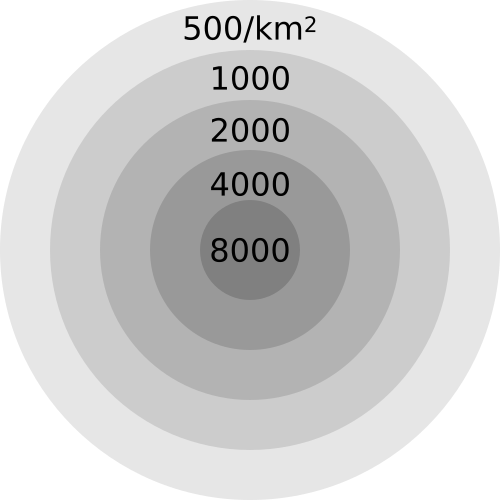
The average density of the city region is 1,660 people per square kilometer, and the weighted density is about 3,400; both figures are typical for the denser American Sunbelt cities, like Los Angeles, San Diego, Miami, and Las Vegas (see table as of 2000 here).
Let us assume that the amount of v-km per inhabitant within each concentric circle is proportional to the outer radius of the circle, so people in the outermost ring drive 5 times as long as those in the inner circle. For concrete numbers, let us assume these figures are 5,000, 10,000, 15,000, 20,000, and 25,000 v-km per year; they average about 13,550 v-km/capita, which is somewhat less than the US average, just below 16,000 per FRED. Note that the outermost ring has 10.8% of the city’s population and 20% of its v-km.
If the modeled density is close to optimal for congestion management given the current state of public transit, then adding transit means subtracting people from the outer ring, not from the inner rings. Say the city builds rapid transit reaching the inner two rings, allowing these areas to densify by exactly 22.5%, which is the ratio of the outer ring’s population to the inner two’s total’s. The total non-auto mode share will rise by 10.8 percentage points, divided between public transit and walking because people in dense, walkable neighborhoods have the option of non-motorized transport; but v-km and the attending greenhouse gas emissions will fall 20%.
If the city keeps growing, the situation is even more extreme. We can add a sixth ring, on the same model, with a density of 250 people per km^2, 30,000 annual v-km per capita, and population equal to 6.6% of the total of the five existing rings or 6.2% of the six-ring total. This 6.6% increase in population raises v-km by 14.7%; in contrast, a transit system capable of supporting this population increase would show an increase of 6.2 points in the non-auto mode share even while avoiding a 14.7% increase in car traffic.
European car usage
We can obtain total v-km per capita by country from a table of traffic accident fatalities: the OECD reports numbers per capita and per v-km, so if we go to PDF-p. 60 of its report, divide the per-capita figure by the per-v-km figure, and multiply by a scaling factor of 10,000, we get v-km per capita. In the US, this figure is just short of 16,000, just as in the FRED graph. The US’s transit mode share for work trips is 5%, so this is about as close as possible to a purely auto-oriented country.
In the Western European countries for which there’s data, including France and Germany, the figure is just short of 10,000. This is close to INSEE’s figure of 756 billion passenger-km in 2016, the difference accounted for by the fact that sometimes multiple people ride in the same car.
The reason people here travel 40% less by car than in the US is not that they instead travel the same distance by public transit. INSEE reports 132 billion passenger-km in buses, trams, and trains excluding TGVs in 2016, and this includes a fair amount of intercity bus and rail travel (9 billion p-km on intercity rail as of 2010 per p. 53 here). Overall, the French modal split is 70% car, 15% transit, 6.7% walk, 4.3% work from home, 4% bike and motorcycle. The American one is 85% car, 5% transit, 2.7% walk, 5.2% work from home. Even relative to the volume of car commuters, the Americans drive 40% further than the French.
Much of my understanding of how provincial France works comes from the Riviera. The Riviera is not the best representative: Alpes-Maritimes is among the richest departments outside Ile-de-France, is among the most conservative, and near-ties Toulouse’s Haute-Garonne and Strasbourg’s Bas-Rhin for third highest provincial transit mode share (13%, behind Rhone’s 23% and Bouches-du-Rhone’s 14%). But it’s a good representative nonetheless of a major provincial city region. There, the coastal towns as well as some interior ones are filled with sprawl, even going up the mountains. There is density in Monaco and Nice, and public transit ridership mostly consists primarily of people who live in Nice and secondarily of people who commute to Monaco. It’s the tramway, the buses, and the general walkability that permit Nice to be what it is, coexisting alongside the offices parks of Sophia-Antipolis and the low-density sprawl up the mountains.
What about zoning?
Devin’s paper is about the economic cost of zoning. Even with the assumption of no change in built form or in transportation modal choice, it does find welfare gains from upzoning, saying that high-demand areas would gain 10-15% in population. This implies that realizing the full environmental gains from public transit requires upzoning areas near stations, to permit the inner two rings in my model city to gain residents who would have otherwise populated a sixth ring.
And yet, the appropriate zoning to some extent already exists. California abolished single-family zoning in 2016 and 2017: accessory dwelling units, or ADUs, are permitted anywhere that residential development is permitted, and homeowners are free to build ADUs in their backyards or carve out ADUs out of their existing buildings. Moreover, in select zones, cities have encouraged transit-oriented development through upzoning or relaxing parking minimums: San Francisco’s TDM process abolished parking minimums anywhere that buildings with at least 10 apartments are permitted, and San Diego slashed parking minimums in an attempt to encourage TOD in North Park along the University Avenue corridor.
The results of TDM in San Francisco are still unclear – the program passed too recently. The same is true of ADUs – existing homeowners react slowly, and new developers may build more two-family houses and fewer single-family houses, but new tract housing would go in the exurbs, not in the coastal cities. But in San Diego the results are clear: developers build more parking than the required minimum at University and 30th, because the public transit option there is a north-south bus that comes every 15 minutes and an east-west bus that comes every 10, which is not actually enough to persuade people who can afford a car not to drive one.
Conclusion
It is difficult to build TOD without public transport. The urban middle class of the 21st century expects travel convenience, which can come in the form of a large rapid transit network or in that of cars and freeways. Thus, even when development sites are available, even in expensive cities, developers sometimes build less than they are allowed to, or insist on more parking than is required, if alternative transportation is inadequate.
The upshot is that adding the layer of transit is likely to stimulate development in the affected urban neighborhoods. The people who would live in this development would not otherwise drive to the outer margin of the city to save on rent, but they would still drive, displacing people would then drive further. The exact details of the churn matter less than the net impact, which is that absent urban transit, cities end up sprawling farther out, forcing people to drive ever-longer distances to work and to other destinations.
A city that succeeds in replacing half of its car trips by public transit, such as Paris, will end up replacing far more than just half of its vehicle-km by transit. Even if the trains are densest within the city core, as is the case even in Paris and other cities with expansive regional rail, the net impact of the transit network is reduction in car travel in the outer parts of the built-up area, where distances are the longest. Planetoscope’s figures for car travel and average distance in Ile-de-France point to a total of just 2,900 v-km/capita in this region – less than one third the national average, and barely one half the national average per car commuter.
The benefit of transit thus goes well beyond the people who use it. The car trips it displaces, even if indirectly, are the ones that cause the worst problems – congestion, pollution, car accidents, greenhouse gas emissions – because they are the longest. Building urban rapid transit can have twice the direct mitigating effect on the harms of car travel as might appear based purely on counting mode choice. With twice the apparent positive environmental impact, mass transit must become a higher priority: nearly every new rapid transit line that’s judged as good must be a top priority for public investment, and many projects that appear marginal must be reevaluated and constructed as planned.
Meme Weeding: Unions and Construction Costs
Lately I’ve seen some very aggressive people on social media assert that high American transit construction and operating costs are the fault of unions, and thus, the solution is to break the unions using the usual techniques of subterfuge and breaking implicit promises. A while back, maybe a year ago, I even saw someone argue that gadgetbahn (monorails, PRT, Hyperloop, etc.) is specifically a solution to union agreements covering traditional transit but not things that are marketed as new things. This is an incorrect analysis of the problem, and like many other incorrect analyses, the solutions that would follow were this analysis correct are in fact counterproductive.
American costs are high even without unions
The majority of American transit construction occurs in parts of the country with relatively strong unions. This is for historical reasons: American cities with large prewar cores are both more unionized and more densely populated than newer Sunbelt cities. Thus, a table with cities and their subway construction costs, such as what one might get cobbling together my posts, will show very high costs mostly in cities with American unions.
However, American cities with weak unions build transit too, it’s just unlikely to come with subway tunnels. We can look at above-ground urban rail construction costs in a variety of American states with right-to-work laws. There is one recent above-ground metro line in a right-to-work state, the Washington Silver Line in Virginia, and another proposal, an extension of MARTA. Let’s compare their costs with those of other mostly at-grade urban rail lines in unionized West Coast states:
- The second phase of the Silver Line cost $2.8 billion, or about $150 million per km.
- The proposed MARTA extension is projected to cost about $110 million per km.
- Portland’s Milwaukie MAX extension, which Wikipedia says cost $1.5 billion for 11.7 km, or $130 million per km.
- San Diego’s mixed elevated and rail right-of-way Blue Line extension is currently budgeted at $2.1 billion, or $120 million per km.
- The canceled BART extension to Livermore in a freeway median would have cost $1.6 billion, or $180 million per km.
We can go lower than this range by looking at street-running light rail lines, which are popular in such Sunbelt cities as Dallas, Houston, Phoenix, and Charlotte, but then we can compare them with light rail lines in Minneapolis, which has no right-to-work laws.
- Dallas’s Orange Line cost either $1.3 billion or $1.8 billion, or $2.8 billion, so either $58 or 80 million per km.
- Houston’s Green and Purple Lines together cost $1.3 billion, about $80 million per km.
- Phoenix’s light rail extension to Gilbert Road is $186 million, about $60 million per km. A canceled extension to Glendale was projected to cost $900 million to $1 billion, around $90 million per km.
- Charlotte’s light rail extension cost $1.1 billion, about $75 million per km.
- Minneapolis’s light rail extensions, the Blue Line extension and the Southwest LRT, are $1.5 and $2 billion respectively, or about $75 and $80 million per km.
Let’s also look at commuter rail. Dallas’s Cotton Belt Line, a diesel line in a disused freight right-of-way, is projected to cost $1.1 billion for 42 km. The cost, $26 million per km, is within the normal European range for greenfield high-speed rail without tunnels, and more than an order of magnitude higher than some German examples from Hans-Joachim Zierke’s site. In Massachusetts, the plans for South Coast Rail cost around $3 billion for 77.6 km before some recent modifications cutting both cost and length, about $40 million per km; this would have included electrification and right-of-way construction through an environmentally sensitive area, since bypassed to cut costs.
Finally, what of operating costs? There, the Sunbelt is unambiguously cheaper than the Northeast, Chicago, and California – but only by virtue of lower market wages. The cost ranges for both sets of states are wide. In Chicago and San Francisco, the operating costs of rapid transit are not much higher than $5/car-km per the NTD, which is normal or if anything below average by first-world standards. Light rail looks more expensive to operate in old unionized cities, but only because Boston, Philadelphia, and San Francisco’s light rail lines are subway-surface lines with low average speeds, which are more expensive to run than the faster greenfield light rail lines built elsewhere in North America. The lowest operating costs on recently-built light rail lines in the US are in Salt Lake City, San Diego, and Denver, and among those only the first is in a right-to-work state.
Non-labor problems in American transit
I urge everyone to look at the above lists of American transit lines and their costs again, because it showcases something important: high American costs are not a uniform problem, but rather afflict some areas more than others. Commuter rail construction costs are the worst, casually going over European levels by a full order of magnitude or even more. Subway operating costs are the best, ranging from no premium at all in some cities (Chicago) to a factor-of-2 premium in others (New York). Light rail construction costs are in the middle. The variety of cost premiums suggests that there are other problems in play than just labor, which should hit everything to about the same extent.
When I’m asked to explain high American construction costs, I usually cite the following explanations:
- Poor contracting practices, which include selection of bidders based exclusively on cost, micromanagement making companies reluctant to do business with New York public works, and design-build contracts removing public oversight and encouraging private-sector micromanagement.
- Poor project management: Boston’s Green Line Extension is now budgeted at about $1 billion for 7.6 km, but this is on the heels of an aborted attempt from earlier this decade, driving up total money spent beyond $2 billion.
- Indifference to foreign practices: Americans at all levels, including transit agencies, shadow agencies like the Regional Plan Association, and government bodies do not know or care how things work in other countries, with the partial exception of Canada and the UK, which have very high costs as well. The area where there has been the greatest postwar innovation in non-English-speaking countries, namely commuter rail, is the one where the US is the farthest behind when it comes to cost control. Explanation #1 can be folded into this as well, since the insistences on cost + technical score bid selection and on separation of design and construction are Spanish innovations, uncommon and obscure in the English-speaking world.
- Overbuilding: extra infrastructure required by agency turf battles, extra construction impact required by same, and mined stations. Other than the mined stations, the general theme is poor coordination between different agencies, which once again is especially bad when commuter rail is involved for historical reasons, and which in addition to raising costs also leads to lower project benefits.
Labor is a factor, but evidently, the intransigent BART unions coexist with low operating costs, as do the Chicago L unions. American unions are indifferent to productivity more than actively hostile to it, and in some cases, i.e. bus reforms in New York, they’re even in favor of treatments that would encourage more people to ride public transit.
But union rules force transit agencies to overstaff, right?
In the Northeast, there are unambiguous examples of overstaffing. Brian Rosenthal’s article for the New York Times found horror stories, and upon followup, frequent commenter and Manhattan Institute fellow Connor Harris has found more systematic cases, comparing the ~25 people it takes to staff a tunnel-boring machine in New York with the 12 required in Germany. The unions themselves have pushed back against this narrative, but it appears to be a known problem in the infrastructure construction industry.
So what gives? In Texas, the unions are too weak to insist on any overstaffing. Texas is not New York or even California. Without knowing the details of what goes on in Texas, my suspicion is that there is an informal national standard emerging out of mid-20th century practices in the cities that were big then. I see this when it comes to decisions about construction techniques: features that came out of the machinations of interwar New York, like the full-length subway mezzanine, spread nationwide, raising the cost of digging station caverns. I would not be surprised to discover something similar when it comes to staffing. Obvious economies like running driver-only train are already widespread nearly everywhere in the US, New York being the exception. Less obvious economies concerning maintenance regimes are harder to implement without very detailed knowledge, which small upstart Sunbelt transit agencies are unlikely to have, and if they invite consultants or other experts, they will learn to work in the same manner as the big American transit agencies.
The reality that the entirety of the American transit industry is used to doing things a certain way means that there needs to be a public discussion about staffing levels. There are jobs that look superfluous but are in fact crucial, and jobs that are the opposite. The cloak-and-dagger mentality of anti-union consultants does not work in this context at all. Experimentation is impossible on a safety-critical system, and nothing should be changed without double- and triple-checking that it works smoothly.
Anti-union explanations are harmful, not neutral
While union overstaffing does drive up tunneling costs in the United States, there are many other factors in play, which must be solved by other means than union-busting. By itself, this would make union-busting either neutral or somewhat positive. However, in reality, the politics of union-busting wreck government effectiveness in ways that make the overall cost problem worse.
The people who try to tell me the problem is all about the unions are not, as one might expect, Manhattan Institute hacks. Connor himself knows better, and Nicole Gelinas has been making narrow arguments about pension cuts rather than calling for sweeping changes to leave unions in the dust. Rather, the loudest anti-union voices are people who either are in tech or would like to be, and like using the word “disruption” in every sentence. The Manhattan Institute is pretty open about its goals of union-busting and race-baiting; in contrast, the people who tell me gadgetbahn is necessary to avoid union agreements insist on never being public about anything.
The rub is that it’s not possible to solve the coordination problem of public transit agencies without some sort of public process. Adding gadgetbahn to the mix creates the same result as the XKCD strip about 14 competing standards. The more the people building it insist that they’re disruptive synergistic innovators inventing the future with skin in the game, the less likely they are to build something that’s likely to be backward-compatible with anything or cohere to form a usable network.
Nor is it possible to assimilate good industry practices by cloak and dagger politics. The universe of industry practices is vast and the universe of good practices isn’t much smaller. The only way forward is via an open academic or quasi-academic process of publication, open data, peer review, and replication. A single consultancy is unlikely to have all the answers, although with enough study it could disseminate considerable knowledge.
There needs to be widespread public understanding that the United States is behind and needs to import reforms to improve its transportation network. This can happen in parallel with a process that weakens unions or for that matter with a process that strengthens them, but in practice the subterfuge of managers looking for union-busting opportunities makes it difficult to attack all cost drivers at once. Whatever happens with conventional left-right politics, there is no room for people who reduce the entirety or even the majority of America’s transit cost problem to labor.
Air Travel in 2018’s America and High-Speed Rail
One of my go-to datasets for analyzing American intercity traffic is the Consumer Airfare Report. It reports on average airfares paid for domestic airline traffic, and on the way gives exact counts for O&D traffic between any pair of cities in the contiguous United States. Six and a half years ago I used this dataset to look at potential demand for high-speed rail, back when high-speed rail was still a topic of conversation in American politics, and a few days ago I got curious and looked again.
Unfortunately, the Consumer Airfare Report is no longer available as an easily downloadable table, due to web design horror. The relevant table, Table 6, used to be downloadable per quarter; today the only version lumps all data going back to 1996 and is 100 MB. Here are two cleaned up versions in .ods format, one a 40 MB table going back to 1996 and one an 800 KB table of just the most recent quarter available, the second quarter of 2018. The files lump all airports in a metro area together, such as JFK and Newark, and reports data in ridership per day; be aware that in the smaller file I repeat every city pair, one for each direction, making it easy to sort by city to figure out each city’s total air traffic, which means that just summing up ridership for all city pairs together yields double the actual traffic. In this post I’m going to compare data from 2018 to data from 2011, the year used in my previous post.
Air traffic is increasing
In 2011 Q3, the total volume of domestic air traffic in the US was 1,020,673 per day. By 2018 Q2, it had risen to 1,303,397. A small proportion of this increase is seasonality – Q2 is the busiest – but most of it is real. Here is a table of air traffic and average distance flown (in miles) by quarter:
| Year | Quarter | Passengers | Distance |
| 1996 | 1 | 661,862 | 995.1 |
| 1996 | 2 | 766,496 | 983.6 |
| 1996 | 3 | 741,927 | 1,001.6 |
| 1996 | 4 | 751,128 | 992.3 |
| 1997 | 1 | 739,073 | 994.9 |
| 1997 | 2 | 848,426 | 990.3 |
| 1997 | 3 | 836,128 | 996.0 |
| 1997 | 4 | 827,477 | 978.9 |
| 1998 | 1 | 773,065 | 980.9 |
| 1998 | 2 | 878,737 | 1,000.3 |
| 1998 | 3 | 848,688 | 997.9 |
| 1998 | 4 | 861,767 | 985.3 |
| 1999 | 1 | 817,247 | 992.5 |
| 1999 | 2 | 925,579 | 996.2 |
| 1999 | 3 | 903,603 | 1,004.4 |
| 1999 | 4 | 916,802 | 993.8 |
| 2000 | 1 | 864,645 | 998.8 |
| 2000 | 2 | 1,015,251 | 1,007.6 |
| 2000 | 3 | 956,562 | 1,011.1 |
| 2000 | 4 | 962,971 | 1,001.4 |
| 2001 | 1 | 899,230 | 1,000.3 |
| 2001 | 2 | 1,000,973 | 1,018.6 |
| 2001 | 3 | 864,262 | 1,039.6 |
| 2001 | 4 | 772,924 | 1,047.9 |
| 2002 | 1 | 778,610 | 1,036.9 |
| 2002 | 2 | 897,218 | 1,033.6 |
| 2002 | 3 | 863,277 | 1,050.6 |
| 2002 | 4 | 864,537 | 1,041.8 |
| 2003 | 1 | 794,776 | 1,040.4 |
| 2003 | 2 | 901,628 | 1,059.1 |
| 2003 | 3 | 881,716 | 1,071.2 |
| 2003 | 4 | 917,454 | 1,057.2 |
| 2004 | 1 | 863,650 | 1,062.5 |
| 2004 | 2 | 1,001,499 | 1,079.9 |
| 2004 | 3 | 973,370 | 1,083.9 |
| 2004 | 4 | 983,740 | 1,065.6 |
| 2005 | 1 | 937,691 | 1,067.6 |
| 2005 | 2 | 1,083,554 | 1,060.0 |
| 2005 | 3 | 1,042,798 | 1,069.8 |
| 2005 | 4 | 1,025,538 | 1,053.8 |
| 2006 | 1 | 994,088 | 1,049.3 |
| 2006 | 2 | 1,118,003 | 1,054.4 |
| 2006 | 3 | 1,037,597 | 1,060.4 |
| 2006 | 4 | 1,066,004 | 1,039.8 |
| 2007 | 1 | 1,006,113 | 1,045.3 |
| 2007 | 2 | 1,128,317 | 1,056.5 |
| 2007 | 3 | 1,067,657 | 1,066.4 |
| 2007 | 4 | 1,047,234 | 1,050.4 |
| 2008 | 1 | 976,701 | 1,050.5 |
| 2008 | 2 | 1,110,267 | 1,049.8 |
| 2008 | 3 | 1,024,983 | 1,063.2 |
| 2008 | 4 | 979,031 | 1,042.3 |
| 2009 | 1 | 897,849 | 1,053.2 |
| 2009 | 2 | 1,037,048 | 1,064.6 |
| 2009 | 3 | 1,001,012 | 1,068.8 |
| 2009 | 4 | 964,406 | 1,054.9 |
| 2010 | 1 | 897,906 | 1,065.7 |
| 2010 | 2 | 1,025,152 | 1,070.5 |
| 2010 | 3 | 1,004,906 | 1,074.8 |
| 2010 | 4 | 1,012,277 | 1,057.5 |
| 2011 | 1 | 918,355 | 1,064.8 |
| 2011 | 2 | 1,056,564 | 1,075.3 |
| 2011 | 3 | 1,020,673 | 1,081.0 |
| 2011 | 4 | 996,383 | 1,060.6 |
| 2012 | 1 | 923,234 | 1,061.2 |
| 2012 | 2 | 1,048,600 | 1,075.5 |
| 2012 | 3 | 1,003,384 | 1,083.7 |
| 2012 | 4 | 996,905 | 1,066.8 |
| 2013 | 1 | 937,946 | 1,066.6 |
| 2013 | 2 | 1,067,682 | 1,078.9 |
| 2013 | 3 | 998,909 | 1,093.3 |
| 2013 | 4 | 1,020,700 | 1,073.6 |
| 2014 | 1 | 954,679 | 1,075.8 |
| 2014 | 2 | 1,092,447 | 1,085.3 |
| 2014 | 3 | 1,052,161 | 1,093.7 |
| 2014 | 4 | 1,053,878 | 1,075.2 |
| 2015 | 1 | 983,278 | 1,083.9 |
| 2015 | 2 | 1,130,227 | 1,100.2 |
| 2015 | 3 | 1,109,443 | 1,104.0 |
| 2015 | 4 | 1,116,866 | 1,087.0 |
| 2016 | 1 | 1,025,994 | 1,092.5 |
| 2016 | 2 | 1,191,304 | 1,101.0 |
| 2016 | 3 | 1,150,247 | 1,107.9 |
| 2016 | 4 | 1,143,414 | 1,086.5 |
| 2017 | 1 | 1,076,006 | 1,089.4 |
| 2017 | 2 | 1,227,913 | 1,099.8 |
| 2017 | 3 | 1,181,006 | 1,106.5 |
| 2017 | 4 | 1,198,662 | 1,085.1 |
| 2018 | 1 | 1,111,920 | 1,090.6 |
| 2018 | 2 | 1,303,397 | 1,100.4 |
Long-distance air traffic is especially increasing
The proposition of high-speed rail is that it can replace short-haul flights. A plane averages about 1,000 km/h but incurs considerable taxi, takeoff, and landing time, and passengers also have considerable airport access and egress times, including security and other queues. High-speed trains average about 200-250 km/h, but need no security – a well-run system allows passengers to show up at the station less than five minutes before the train departs – and have much shorter access and egress times as stations are located near city centers.
The above table shows a small increase in average distance flown, about 2% since 2011. However, this masks patterns in the largest cities. New York-Los Angeles traffic grew 30%, compared with 23% in national traffic growth; it is now barely behind New York-Miami (with West Palm Beach separated out) for third busiest American air city pair, the first being far and away Los Angeles-San Francisco.
We can look at the change in the proportion of traffic that can be served by HSR in the largest six American air markets since 2011; consult my post from 2012 for the exact definitions of which corridors count within which buckets – there are some revisions and fixed to be made, but I’ve not done them in order to keep the list of city pairs constant. Las Vegas is no longer ahead of Boston, and Dallas is a fraction of a percent below Boston as of 2018.
| City | Traffic (2011 Q3) | Traffic (2018 Q2) | < 3:00 (2011) | < 3:00 (2018) | < 5:00 (2011) | < 5:00 (2018) |
| New York | 153,386 | 188,702 | 10.7% | 9.2% | 32.2% | 29.1% |
| Los Angeles | 132,556 | 167,788 | 26.4% | 26.6% | 26.4% | 26.6% |
| San Francisco | 103,752 | 133,346 | 18.1% | 18.6% | 33.3% | 33.1% |
| Chicago | 103,540 | 122,376 | 16.5% | 12.2% | 34.1% | 29.9% |
| Washington | 97,234 | 116,878 | 16.7% | 14.9% | 31.3% | 28.5% |
| Boston | 75,329 | 90,747 | 21.3% | 18.7% | 31.8% | 26.9% |
In the East, short-distance markets have shrunk, in relative terms. Observe that in Chicago the entire difference is within the 3-hour radius, including the spokes of any Midwest HSR network, where air travel has srhunk 12.6% in absolute terms, whereas the 3-to-5-hour annulus, including farther away cities like Atlanta and New York, has not only grown but kept up with Chicago’s overall domestic air travel volumes. But in New York, Washington, and Boston, both the 3-hour radius and the 3-to-5-hour annulus have shrunk, reflecting flights to intermediate Midwestern cities east of Chicago as well as to the South; Boston’s 3-to-5-hour annulus has shrunk 6% in absolute terms.
California holds steady
Since 2011 there has been an increase in air travel to California, especially San Francisco. Los Angeles-San Francisco, once the second largest air market in the US behind New York-Miami, is now far ahead of it, and on its strength, the share of air travel out of Los Angeles and San Francisco that’s within HSR radius has held up.
California’s HSR problems are not about whether there’s demand for such infrastructure. There clearly is. The problems are exclusively about construction costs. But as the state’s economy grows, demand for internal travel is increasing, making HSR a better proposition.
What does this mean for HSR?
The cynical answer is nothing, because in an America where even high-spending Green New Deal proposals neglect HSR and focus on electric cars, it’s unlikely there will be a political effort to build anything. Even Amtrak seems content with justifying capital expense on grounds of climate adaptation rather than reducing trip times.
That said, in the event of a concerted national effort to build HSR, the changes in travel patterns this decade suggest some changes on the margins. California and Texas grow in value while the Midwest falls in value.
In the Midwest, the core lines remain strong, but more peripheral Midwestern lines, say a bypass around Chicago for cross-regional traffic or improved rail service due west toward Iowa, are probably no longer worth it. The Cleveland-Columbus-Cincinnati corridor may not be worth it to build as full HSR – instead it may be downgraded to an electrified passenger-primary corridor (as I understand it it already has very little freight).
There is asymmetry in this situation in that there aren’t a lot of peripheral lines in California and Texas that are becoming interesting now that these states’ economies are bigger than they were when rail advocates first came up with maps in the late 2000s. There is still far too little traffic to justify stringing HSR from Las Vegas to Salt Lake City or from Sacramento to Portland under the mountains. In Texas, there has been a shift from the T-bone alignment to a more triangle-shaped network, since a direct Dallas-Houston line is already under construction, but beyond the Texas triangle, tails like Dallas-Oklahoma City and Houston-New Orleans aren’t getting stronger – Houston-New Orleans air travel volumes are actually down from 2011, though Dallas-New Orleans volumes are up.
The core lines, of course, don’t change. The Northeast Corridor is still the most important corridor, the next most important are still tie-ins extending it to the south and west, and the following is still California HSR. But the dreams of a nationally connected network, or at least a connected network in the eastern two-thirds of the US, should be cast aside – the in-between links, always peripheral, have weakened in this decade.
Difficult Urban Geography Part 2: Hilly Topography
This is the second and last part of a series about difficult urban geography for public transit, following a Patreon poll. Part 1 covers narrow streets.
A few years ago, Sandy Johnston remarked that Jerusalem had the least gridded street network he ever saw, and this complicates any surface transit planning there. At the time he was familiar with New England already, but Jerusalem seemed different.
Here are street maps of West Jerusalem and Boston, at the same scale:

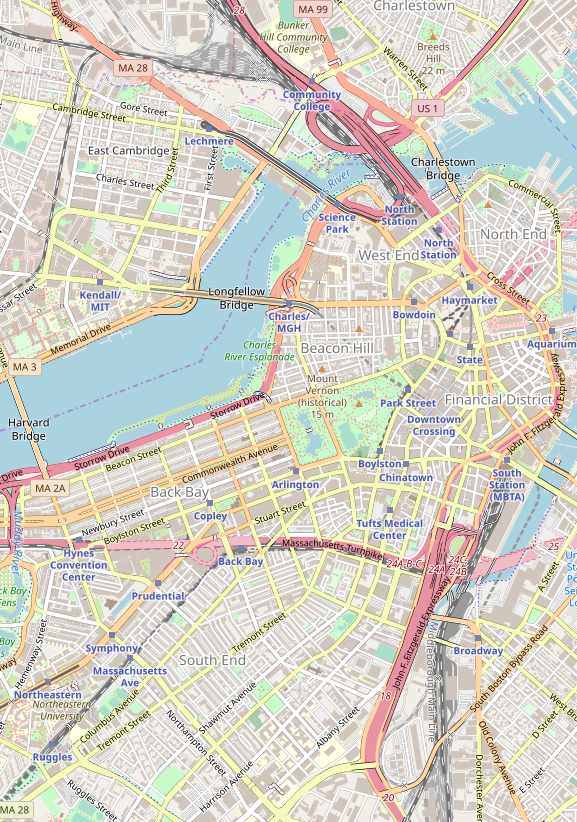
Boston has some gridded sub-areas, like Back Bay, but Downtown Boston is as messy as Jerusalem, and on the level of arterial streets, even the rest of the city isn’t too different. The real issue affecting Jerusalem is the hilly topography. Once one gets out of the core of West Jerusalem, the city turns into a mess of hills with internal street networks and poor connectivity between them. Boston maintains a coherent structure of arterial streets that host buses and tramways, with a cobweb structure that feeds the subway efficiently; in Jerusalem, there is little chance of that.
Surface vs. rapid transit
Rapid transit is mostly insensitive to hills. A subway can be built across hills, partly underground, partly elevated. This is the case in Upper Manhattan, where the 1 train runs in a mix of cut-and-cover subway, elevated structures, and mined deep-level tunnel.
Even if the hills slope down into the natural arterial, this is not such a problem. Train stations can incorporate escalator access and have exits at different elevations. New York manages this in the same neighborhood where the 1 runs, in Washington Heights, on the A train. Monaco, on a sloping hill, manages the same at its train station, which is located underground, using elevator access from multiple neighborhoods at different altitudes.
The deep mining required for such construction doesn’t even raise costs that much. If it’s possible to secure horizontal access to the station site, construction becomes easier. Moreover, running elevated through the valleys, as the 1 does in Manhattan Valley and Inwood, cuts costs rather than increasing them.
Evidently, the hilliness of Rome has not prevented the city from building a subway. Line C’s construction costs were very high, but not because of topography but because of millennia-old archeology, which is not really a question of the street network.
Since rapid transit is not affected as much by hills as surface transit, a city with hilly topography should be biased toward rapid transit and against surface transit. This does not mean every flat city should be content with surface transit and every steep city should build subways and els, but it does mean that the population and density thresholds for rapid transit are smaller in hillier cities.
Pod development
Some cities are very hilly, but this does not affect their street networks. San Francisco is famous for this: north of Market, in neighborhoods like Telegraph Hill and Russian Hill, the street grid continues mostly uninterrupted, and the result is famously steep streets. In these cities, transit network planning need not pay much attention to the topography: the only concession that need be made is that agencies should preferentially electrify and run trolleybuses, which have better hill-climbing performance than diesel buses – as San Francisco Muni in fact has, retaining trolleybuses rather than replacing them with diesels as nearly all other American cities have.
The more interesting and difficult case is when the street network respects the hills. It can naturally turn the city’s street layout into that of multiple distinct pods, each surrounding a different hill. This is popular in Jerusalem, especially the settlements within East Jerusalem, but also in some of the newer parts of West Jerusalem. There is not much connectivity between these different pods: there may be a single arterial road with the rest of the city, as is the case for the settlements of Pisgat Ze’ev, Ramot, and Ramat Shlomo.
This kind of pod development is popular in a lot of auto-oriented suburbia. The cul-de-sac is a defining feature of many an American suburb. However, in Jerusalem we see it happen even in the context of a dense city: Jerusalem proper has a density of 7,200 people per square kilometer, and all the settlements in question are within the jurisdiction of the city. It comes out of a combination of modernist central planning (Israeli neighborhoods and cities are designed top-down, rather than expanding piecemeal as in North America or France) and the hilly terrain.
Transit planning for such a city is a chore. In theory, choke points are good for transit, because they have high intensity of travel, where dedicated lanes can make buses very efficient. In practice, choke points work for transit only when there are coherent corridors on both sides for the buses to feed. For example, on a wide river spanned by few bridges, buses can run on the bridges, and then continue on the arterials feeding them on either side. Pod development, in contrast, has no coherent arterials within each pod, just collector roads feeding the main drag. Buses can still run on these streets, but there is no structure to the density that encourages them to serve particular locations and not others.
One solution is a type of transit that is overused in flatter cities: the direct express bus, or open BRT. This bus runs local within each pod and then continues on the arterial, making few stops; it could run as open BRT if the arterial has enough development to justify such service, or as a nonstop express service if it is a full freeway. This form of transit developed for both low-density American suburbia and Israeli pod development towns (where this is buttressed by the tendency of the ultra-Orthodox to travel in large families, in which case transfer penalties are much higher, encouraging low-frequency direct service).
Another solution is to go in the air. Gondola lifts are seeing increasing use in extremely hilly cities, where surface transit must wend its way through switchbacks. Medellin’s Metrocable has a vertical rise of 400 meters. Even in cities that are less steep, gondolas could be a solution if arterial roads are simply not available. In the Arab neighborhoods of East Jerusalem, arterials are rarely available, and gondolas bridging ravines could be of use. Gondolas could also be useful for neighborhoods that are only connected by arterial in a radial rather than circumferential direction – they could again bridge ravines to connect peripheral neighborhoods to one another rather than just to the center.
When Transit Serves the Poor Better Than the Rich
In major transit cities, rich areas have better access to public transportation than poor areas – in fact, what makes them valuable is precisely the easy access to high-paying jobs. Even in cities with bad transit, this is often the case: the transit systems of cities with mode shares in the 10-15% area, like Boston and Chicago, tend to be good at serving city center and little else, and city center workers tend to be richer because professional work tends to cluster whereas low-skill work tends to disperse.
However, there are exceptions to this rule. One, the French Riviera, occurs in a city region with a transit mode share of 13%, comparable to that of American city regions where transit commuters outearn solo drivers. Two more cities are would-be exceptions, for opposite reasons: Providence has no public transit to speak of, but if it invested in creating a transit network, the natural corridors would serve the poor better than the rich; and Vancouver currently has better SkyTrain service in working-class areas than in richer ones, but its current investment is in middle-class areas, and moreover its extensive transit-oriented development has been middle-class as well.
Moreover, all three cities have patterns that generalize. The situation in the Riviera arises because of the classed nature of work there, and generalizes to other places with extensive tourism. That in Providence arises because of the city’s industrial history, and may generalize to other deindustrialized small cities with underutilized legacy rail networks. In Vancouver, part of this situation is because easy rail corridors were more readily available in poorer areas for an essentially random reason, but another part is extensive transit-oriented development concentrating working-class jobs near train stations.
The Riviera: the casinos are walkable, the tech jobs aren’t
Before I go any further, I’d like to stress something important: my observation of the Riviera is largely based on qualitative observations. I don’t know of INSEE data comparable to the Census Bureau’s Means of Transportation to Work by Selected Characteristics table, which could allow me to test the theory that transit ridership in the Riviera skews poor. All I am going by is what I have seen riding trains and occasionally buses as well as what I know of the distribution of jobs.
What I’ve seen is that transit use in the Riviera skews working class. Middle-class Parisians sometimes drive and sometimes take the trains. In contrast, the rich people who I’ve met in the Riviera have as far as I can tell never set foot on the TER. This is despite the fact that the TER is competitive with driving on the area’s main arterial road, the Moyenne Corniche, and is even competitive with the A8 freeway over short distances because the A8 has difficult access time to the relevant exits. Not for nothing, train stations in rich areas have very little ridership: per SNCF’s ridership data, stations in rich areas like Cap d’Ail and Cap Martin-Roquebrune have around 60,000 boardings plus alightings per year, so around 100 weekday boardings, whereas in working- and lower-middle-class Menton the annual total is 1.4 million, or around 2,300 weekday boardings.
The train stations, too, signal poverty. They’re not neglected, but what I’ve seen of them reminded me of working-class suburbs of Paris like Boissy much more than middle-class ones like Bures-sur-Yvette. I was even warned off of spending too much time near Nice’s train station by people echoing local middle-class prejudices. The buses look even poorer: the main east-west bus on the Moyenne Corniche is full of migrant workers.
A key clue for what is happening can be found when selecting a destination station at the fare machines in Menton. As far as I remember, the first option given is not Nice, but Monaco. SNCF’s data table doesn’t include ridership for Monaco, but Wikipedia claims 5.5 million a year without citation, and SNCF’s own blurb claims more than 6 million. Either figure is narrowly behind Nice’s 6.9 million for second in the Riviera and well ahead of third-place Cannes’s 3.2 million – and Nice also has some intercity traffic.
While Monaco’s residents are rich, its commuters are not. There are no corporate jobs in Monaco, because its tax haven status does not extend to corporations with substantial sales outside the city-state, only to local businesses like restaurants and stores. The commuters work low-pay service jobs at hotels and casinos, which they access by train, or perhaps on foot if they live in Beausoleil, as many a domestic service worker in Monaco does.
In contrast, the mass of middle-class jobs cluster in a purpose-built edge city in Antibes, called Sophia-Antipolis. While Antibes itself has a decent transit mode share for residents (10.5%, cf. Menton’s 14.8% and Nice’s 25.4%), and its train station gets 1.6 million annual boardings and alightings, the edge city is unwalkable and far from the train. There’s some traffic in the Riviera, but not enough that middle-class people, who can afford cars, clamor for transit alternatives to their suburban jobs.
The main lesson here is that while the jobs most likely to cluster are usually middle-class city center jobs, working-class tourism jobs cluster as well in regions that have plenty of them. Tourism in the Riviera is the most intense in Monaco specifically and in other coastal cities generally, which encourages travel along the linear corridor, where rail shines. It’s usually hard to see, because for the most part the top tourist destinations are enormous like London, Paris, and New York, but in specialized tourist regions the separation is clearer.
Already we see some evidence of this in Las Vegas, where working-class jobs cluster along the Strip. The city has a monorail, serving the hotels and casinos rather than city center. Were it interested in improving public transportation, it could build an elevated railroad on the Strip itself for better service.
Orlando is another potential example. I named it as a specific example of a region that would be difficult to retrofit for public transit earlier this year, but Disney World remains a major clustering of working-class jobs as well as some middle-class leisure travel. The problem there is that Disney World is far from the train and, unlike the Riviera, does not lie on any line with other potential ridership draws; nonetheless, a train connecting the Orlando CBD, the airport, and Disney World could get some traffic.
Finally, picturesque mountain resorts that happen to lie near rail could see working-class travel on the train to their tourism jobs. Many of these resorts are where they are specifically because a legacy rail trunk happened to be there and the railroad developed the area to generate demand for its services; this is the case for Jasper, Lake Louise, and Banff, all on the Alberta side of the Continental Divide. Aspen is not on a railroad, but is on a road where buses carry working-class commuters displaced by the town’s high housing costs.
Providence: once upon a time, there were factories near the railroad
When I lived in Providence seven years ago, I discussed transit improvements with local urbanists who I met through Greater City: Providence. We talked about improvements to both bus and rail; we had little appetite for the proposed city center streetcar, which has since been downgraded to a proposed frequent bus, and instead talked about improvements to the busiest buses as well as rail service along the main spine of the Northeast Corridor.
The improvements to the busiest buses were already under discussion by the state, including signal priority on key routes and investment in queue jump lanes and shelter amenities. The two routes that were by far the state’s busiest, the 99 on North Main and 11 on Broad, were permanently combined to a single through-running service branded as the R bus, for rapid, with limited-stop service. These routes serve very poor parts of the built-up area, including Pawtucket on the 99 and South Providence on the 11. This is a consequence of the fact that transit in Rhode Island is so bad that only the poor use it, and thus the preexisting busy routes serve poor areas; the best physical bus infrastructure is a bus tunnel to College Hill, the richest neighborhood in the city, but ridership there is weak and therefore the routes were never high priorities for further investment.
The improvements to rail never went beyond blogging; we didn’t have the pull of Boston’s TransitMatters, which itself is better at proposing small improvements than big ones that go up against political obstruction. What we called for was frequent local rail within the urban area: Peter Brassard wrote up the initial proposal, and I added some refinements. The Northeast Corridor, where the service would run, is primarily an intercity rail corridor, but there is room for four tracks in the right-of-way, and while there is freight traffic, it runs at the same approximate speed of a local passenger train.
As we discussed this proposal, Greater City’s Jef Nickerson noted something: what the train would do if implemented is produce better transit service in working-class areas than in more comfortable ones. Unlike the situation with the buses, this was not an intentional process. We would like Rhode Island to improve rail service using an existing right-of-way, which happens to serve Central Falls, Pawtucket, Olneyville, Hartford, Cranston, and Warwick, and miss the East Side and the middle-class suburbs. We realized that the city and inner-suburbs like Pawtucket are poorer than the proper suburbs, but that the train would serve Olneyville but not the East Side seemed like a coincidence.
But is it really a coincidence? Providence developed from east to west. The city was initially founded on the western side of what is now the East Side, sloping down to the river. What is now Downcity was only the second part of the city to develop. It became the center of the city because, as the Northeast Corridor was constructed, it was not possible to provide through-service via the hilly historic core of the city, only via the flatter areas that are now Downcity. A tunnel across College Hill opened in 1908, but by then the city’s basic urban geography was set: the university and port jobs on the East Side, industrial jobs to the west near the rail mainline.
The industrial jobs are long gone now. New England was the first part of America to industrialize and the first to deindustrialize, the mills moving to lower-wage Southern states already in the middle of the 20th century. In very large cities, declining industrial jobs can be replaced with urban renewal serving the middle class: the West India Docks became Canary Wharf, the freight railyards of Gare de Lyon became Bercy, the industrial Manhattan and Brooklyn waterfronts became sites for condos with nice views. In Providence-size cities, no such urban renewal is possible: there is no large mass of middle-class people clamoring to live or work in Olneyville, so the neighborhood became impoverished.
While factories may seem like attractive targets for transit commuting, they’re so clustered, in reality they have not been walkable ever since electrification made open-plan single-story factories viable. Factories are land-intensive and have been since around the 1910s. Moreover, whereas hotels and retail have a reason to locate in walkable areas for their consumption amenities – tourists like walking around the city – factories do not, and if anything depress an area’s desirability through noise and pollution. Working industrial districts are not attractive for transit, but post-industrial ones are, even if they are not gentrified the way so much of London, Paris, and New York have.
A large number of cities share Providence’s history as a medium-size post-industrial city. Nearly every English city except London qualifies, as do the cities of the American Northeast and Midwest below the size class of Boston and Philadelphia. Moreover, all of these cities have undergone extensive middle-class flight, with the racial dimension of white flight in the US but even without it in Britain; thus, the relatively dense neighborhoods, where transit service is more viable, are disproportionately poor. However, the feasibility of mainline rail service to post-industrial neighborhoods is uneven, and depends on local idiosyncrasies.
One positive example I’m more familiar with that’s a lot like Providence is in New Haven. Its best potential local rail route, the Farmington Canal Trail, serves lower middle-class areas like Hamden, and fortunately parallels the busiest bus route, the D-Dixwell. While Hamden is not poor, such service would still lead to the inversion we discussed for Providence, since the rich live in thoroughly auto-oriented suburbs or within walking distance of Yale. The main drawbacks are that it would require replacing an active trail with rail service, and that either street running or brief tunneling would be needed in the final few hundred meters in Downtown New Haven.
Vancouver: easy corridors and TOD for the working class
With a modal share of 21%, Vancouver is in a somewhat higher class of transit quality than the Riviera, Boston, or Chicago. However, it remains a far cry from the numbers beginning with a 3, 4, and 5 seen in New York and in European and Asian transit cities. As with the Riviera, I am somewhat speculating from my own observations, lacking a table that clearly states transit usage by socioeconomic class. However, two factors make me believe that transit in Vancouver serves the working class better than it does the middle class.
The first factor is the corridors served by SkyTrain. The first to be built, the Expo Line, runs in a preexisting interurban right-of-way, with minor greenfield elevated and underground construction; even the downtown tunnel is repurposed from a disused mainline rail branch. It passes through a mixture of working-class and lower middle-class neighborhoods on its way to Surrey, which is working-class and very negatively stereotyped. The second, the Millennium Line, branches east, to lower middle-class suburbs, running on a greenfield el. The third, the Canada Line, is a partially tunneled, partially elevated route through the middle-class West Side to working-class Richmond. Only the fourth line to be built, the Evergreen extension of the Millennium Line, finally serves a comfortable area, as will the next line, the Broadway extension of the Millennium Line deeper into the West Side.
The second factor is the job distribution within Metro Vancouver. Usually, we see concentration of professional jobs in city centers and dispersal of working-class jobs among many stores. In the Riviera this relationship between job concentration and income is only inverted because the working-class jobs are disproportionately in tourism while the professional ones are in an edge city. In Vancouver I don’t believe there is any such inversion, but there is leveling: jobs of either type are concentrated in transit-rich areas. This leveling is the result of extensive commercial transit-oriented development, most notably Metrotown, which has many office jobs on top of Canada’s third largest shopping mall.
The first factor is idiosyncratic. The easy corridors happened to serve poorer areas, on a line from East Vancouver to Surrey. The rich live in North Vancouver, which has a ferry and doesn’t have enough population density for a SkyTrain tunnel; on the West Side, which is separated from downtown by False Creek and was thus late to get a rail connection; and in Port Moody and Coquitlam, which were only connected to SkyTrain recently via the Evergreen extension.
The second factor is more systemic. While American and European cities rarely have big urban shopping malls, Canadian cities are full of them. The Metropolis at Metrotown has 27 million annual visitors, not far behind the 37 million of the Forum des Halles, at the center of a metro area five times the size of Metro Vancouver – and the Metropolis has more than twice the total commercial floor area. In this, Canada is similar to Israel and Singapore, which like Canada have harsh climates, only hot instead of cold. Moreover, Vancouver has encouraged this centralization through TOD: Burnaby built Metrotown from scratch in the 1980s, simultaneously with the Expo Line.
It is difficult to engage in concerted residential TOD for the working class, since it requires extensive housing subsidies. Vancouver’s residential TOD near SkyTrain stations is thoroughly middle-class. However, concerted commercial TOD is easier: hospitals, universities, and shopping centers all employ armies of unskilled workers (the first two also employing many professional ones), the first two while satisfying general social goals for health care and education provision and the last while making the owners a profit on the open market.
Moreover, Vancouver’s TOD within downtown, too, has made it easier to provide transit service for the working and lower middle classes. Where constraints on office towers lead to high office rents, only the most critical jobs are in city centers, and those are typically high-end ones; in the US, it’s common for big corporations to site their top jobs in the center of New York or Chicago or another large city but outsource lower-end office jobs to cheaper cities. In Vancouver, as elsewhere in Canada, extensive downtown commercialization means that even semi-skilled office jobs like tech support can stay in the center rather than at suburban office parks.
Conclusion
Based on my own observations, I believe the Riviera provides better public transportation for the working class than for the middle class, and to some extent so does Vancouver. Providence provides uniformly poor transit service, but its lowest-hanging fruit are in working-class urban neighborhoods.
The reasons vary, but the unifying theme is that, in the Riviera and Vancouver, there is none of the typical big-city pattern in which the rich work in walkable city centers more than the poor (e.g. in New York). In Vancouver it’s the result of commercial TOD as well as a Canadian culture of urban shopping centers; in the Riviera it’s the result of unique dependence on tourism. In Providence the situation is not about job concentration but about residential concentration: lower-income neighborhoods are likelier to arise near rail because historically that’s where industry arose, and all that remains is for Providence to actually run local passenger trains on the mainline.
It is not possible to replicate culture. If your city does not have the tourism dependence of Monaco, or the shopping mall culture of Vancouver, or the post-industrial history of Providence, there’s little it can do to encourage better urban geography for working-class transit use. At best, can build up more office space in the center, as Vancouver did, and hope that this encourages firms to locate their entire operations there rather than splitting them between a high-end head office and lower-end outlying ones. Fortunately, there exist many cities that do have the special factors of the Riviera, Vancouver, or Providence. In such cities, transit planners should make note of how they can use existing urban geography to help improve transit service for the population that most depends on it.
The Red-Blue Connector and the Importance of Connectivity
The Boston rapid transit network has the shape of the hex symbol, #. In Downtown Boston, the two north-south legs are the Green Line on the west and the Orange Line on the east, and the two east-west legs are the Red Line on the south and the Blue Line on the north. The Orange and Green Lines meet farther north, but the Red and Blue Lines do not. The main impact of this gap in systemwide connectivity is that it’s really hard to get between areas only served by the Blue Line, i.e. East Boston, and ones only served by the Red Line, i.e. Cambridge, Dorchester, and Quincy. However, there is a second impact: people who do transfer between the Red and Blue Lines overload one central transfer point at Park Street, where the Red and Green Lines meet. This way, the weak connectivity of the Boston rapid transit network creates crowding at the center even though none of the individual lines is particularly crowded in the center. The topic of this post is then how crowding at transfer points can result from poor systemwide connectivity.
The current situation in Boston
Connecting between the Blue and Red Lines requires a three-seat ride, with a single-stop leg on either the Orange or Green Line. In practice, passengers mostly use the Green Line, because the Orange Line has longer transfer corridors.
Travel volumes between East Boston and Cambridge are small. Only 1,800 people commute from East Boston, Winthrop, and the parts of Revere near the Blue Line to Cambridge, and only 500 commute in the other direction. I don’t have data on non-work travel, but anecdotally, none of the scores of Cantabrigians I know travels to the Blue Line’s service area except the airport, and to the airport they drive or take the Silver Line, and moreover, only two people moved from Cambridge or Somerville to the area, a couple that subsequently left the region for Bellingham. Travel volumes between East Boston and the southern legs of the Red Line are barely larger: 1,200 from East Boston to Dorchester, Mattapan, and Quincy, 1,600 in the other direction, most likely not taking public transit since cars are a good option using the Big Dig.
Nonetheless, this small travel volume, together with connections between East Boston and South Station or Dorchester, is funneled through Park Street. According to the 2014 Blue Book, which relies in 2012 data, transfer volumes at Park Street are 29,000 in each direction (PDF-p. 16), ahead of the Red/Orange connection at Downtown Crossing, where 25,000 people transfer in each direction every weekday. Riders connecting between the Blue and Red Lines are a noticeable proportion of this volume – the East Boston-Cambridge connection, where I believe the transit mode share is high, is around 8% of the total, and then the East Boston-Dorchester connection would add a few more percentage points.
Why Soviet triangles exist
In a number of metro networks, especially ones built in the communist bloc, there are three lines meeting in a triangle, without a central transfer point. This is almost true of the first three subway lines in Boston, omitting the Red Line: they meet in a triangle, but the Green and Orange Lines do not cross, whereas in true Soviet triangles lines meet and cross.
The reason for this typology rather than for the less common one in which all three lines meet at one station, as in Stockholm, is that it spreads transfer loads. Stockholm’s transfer point, T-Centralen, has 184,000 daily boardings (source, PDF-p. 13), almost as many as Times Square, which is served by 14 inbound tracks to T-Centralen’s 5 and is in a city with 5.6 million weekday trips to Stockholm’s 1.1 million. Urban transit networks should avoid such situations, which lead to central crowding that is very difficult to alleviate. Adding pedestrian circulation is always possible, but is more expensive at a multilevel central station than at a simple two-line crossing.
The triangle is just a convenient way of building three lines. As the number of lines grows beyond three, more connectivity is needed. Moscow’s fourth line, Line 5, is a circle, constructed explicitly to decongest the central transfer station between the first three lines. More commonly, additional lines are radials, especially in cities with water constraints that make circles difficult, like Boston and New York; but those should meet all the older radii, ideally away from existing transfer stations in order to reduce congestion. When they miss connections, either by crossing without interchange or by not crossing at all, they instead funnel more cross-city traffic through the existing transfer points, increasing ridership without increasing the capacity required to absorb it.
The way out
The situation is usually hard to fix. It’s much harder to fix missed connections, or parallel lines that diverge in both directions, than to connect two parallel lines when one of these lines terminates in city center, which Boston’s Blue Line does. The one saving grace is that cities with many missed connections, led by New York and Tokyo, also have very expansive networks with so many transfer points that individual interchanges do not become overloaded.
In large cities that do have problems with overcrowded transfer points, including London and Paris, the solution is to keep building out the network with many connections. London tries to weaken the network by reducing transfer opportunities: thus, Crossrail has no connection to Oxford Circus, the single busiest non-mainline Underground station, in order to prevent it from becoming any more crowded, and the Battersea extension of the Northern line deliberately misses a connection to the Victoria line. Paris has a better solution – it invests in circumferential transit, in the form of Metro Line 15 ringing the city at close distance, as well as extensions to Tramway Line 3, just inside city limits.
While the solution always involves investing more in the transit network, its precise nature depends on the city’s peculiar geography. In Paris, a compact city on a narrow river, adding more circles is an option, as is adding more RER lines so that people would be able to avoid difficult Metro-to-RER transfers. In London, the population density is too low and the construction costs are too high for a greenfield circle; the existing circle, the Overground, is cobbled together from freight bypasses and is replete with missed radial Underground connections. Thus, the solution in London has to come from radials that offer alternatives to the congestion of the Victoria line.
In Boston, a much smaller city, the Red-Blue Connector is easier since the Red and Blue Lines almost touch. It only takes about 600 meters of cut-and-cover tunnel under a wide road to continue the Blue Line beyond its current terminus in Downtown Boston and meet the Red Line at Charles-MGH; to first order, it should cost not much more than $100 million. The transfer would not be easy, since the Red Line is elevated there and the Blue Line would be underground, but it would still be better than the three-seat ride involving the Green Line. A competent state government with interest in improving transportation connectivity for its residents – that is, a government that is nothing like the one Massachusetts has – would fix this problem within a few years. Boston is fortunate in not needing painful deep tunneling under a medieval city center like London or hundreds of kilometers of inner suburban tunneling like Paris – it only needs to kick out the political bums, unfortunately a much harder task.
 Pedestrian Observations
