Category: Urban Transit
Scooters
Three weeks ago, the consultancy 6t released a study about dockless e-scooters in France. The study is available only in French but there is an executive summary in English. It has convenient demographic profiles of e-scooter riders in Paris, Lyon, and Marseille, and generated some media controversy over the fact that scooters are barely displacing car trips – rather, they’re replacing trips by foot or public transit. This is on top of calls for greater regulations of the mode in multiple countries, not just by NIMBYs but also by serious urbanists like Streestblog’s Angie Schmitt; I was alerted to the study in the first place by Jonathan Rosin, who proposes regulations requiring geofencing to prevent riding on the sidewalk.
And yet, there’s something interesting about scooters and transit in the study, which suggests to me scooters have a positive role to play in a transit city. On p. 80, figure 48 shows combination of scooters with other modes. Out of about 4,000 respondents, 886 say they used scooters in combination with another mode – and of the latter, 66% used it in combination with public transportation.
How worried should we be about rider behavior?
Not really. There is an American discourse concerning dockless transportation that complains about clutter, scooter-pedestrian conflict, and nuisance scooters or bikes left on the sidewalk. The study itself discusses the regulations of e-scooters in various countries. In Britain and Italy e-scooters are legally classified as motor vehicles, which is effectively a ban, and in the US there are onerous regulations such as a requirement for a driver’s license and a minimum age of 18, such as in California. In France, Germany, Switzerland, Austria, Sweden, and Denmark, regulations are laxer, e.g. in Germany the minimum age is 14 and the e-scooter is treated as a bike.
The sort of clutter that Americans complain about was not evident to me in Paris, one of the largest markets in the world for e-scooters as well as bike share (it still has the largest bike share program in the world outside China). As far as I could tell, scooters were mostly used around Nation for recreational trips – at the very least, people did not preferentially leave them right at the Metro and RER station, and I did see a fair number of dockless vehicles (I forget if just bikes or also scooters) at the Bois de Boulogne. Central Paris had a higher density of scooters, but they too did not seem to clutter on the street, and I don’t remember ever having had to dodge a scooter even though people did ride on the sidewalk.
At least at eye level, the lax regulations France does have – the minimum age is 8, cities may choose to permit or prohibit riding on the sidewalk, riding on all streets with speed limit up to 50 km/h is required – appear sufficient. The American, British, and Italian approaches are too draconian and only serve to discourage this mode of transportation.
Gaps in the transit system
Pp. 111-4 have tables describing mode switching. Few of the scooter users would have traveled by car if the scooters hadn’t been available, only 8% including taxis and TNCs (“VTC” in French). In contrast, 46% would have walked and 32% would have taken public transportation.
But is this even a problem? The same tables have the average transit-to-scooter switcher gaining 5 minutes, taking 19 minutes instead of 24. On short trips, scooters are useful for filling little gaps in the regional public transport network. Maybe the origin and destination are not well-connected by Metro, as is for example the case for Nation and much of the Left Bank, so that a transit trip would require transfers. On a poll suggesting non-mutually-exclusive options for why people choose scooters over transit, 68% say it’s nicer, but 44% say it’s faster and 39% say it’s direct. From the perspective of the transit agencies, a mode that makes certain crosstown trips easier without changing trains at Chatelet is a net positive, as it decongests the station as well as other complex transfer points.
According to Owen Gutfreund’s book 20th Century Sprawl, in the 1900s and 1910s the American railroads were supportive of road expansion. To the railroads, cars were a natural complement to trains, extending their range beyond that of a horse or bicycle. Of course, soon the cars turned into competitors, once roads improved to the point of allowing longer-distance travel. But scooters, limited to 25 km/h, do not have that capability. The mode of transportation most comparable to the e-scooter, the bicycle, coexists with a solid regional and intercity rail network in the Netherlands.
Ban cars
The ultimate goal of the green movement in general and of public transit activism in particular should be to ban cars, or else get as close as possible to banning them. Modes of transportation that are not cars that provide alternative functionality to cars are almost always a good idea in this scheme.
Trains are an excellent alternative for long trips, that is out-of-neighborhood trips for such purposes as work, school, citywide social events, and intercity travel. Shorter trips are dominated by walking in transit cities. However, there are two important caveats for the idea of doing short trips on foot. First, there is a genuine in-between region in the 2-4 km range. And second, people with disabilities may not be able to walk long distances, which lowers the upper limit from the 1-2 km range to a much shorter point, perhaps 500 meters – and if their disabilities do not require the use of a wheelchair, then they may well find scooters an acceptable alternative.
In Paris itself, which dominates the survey, scooters are not replacing cars, for a simple reason: few trips in Paris are done by car in the first place. But a robust scooter network can expand out of the city into suburbs with higher present-day car usage, and those suburbs can then become ever more walkable thanks to the displacement of cars by greener modes of travel.
Assume Nordic Costs: London Edition
A month ago I made maps proposing some subway and regional rail extensions in New York and noting what they would cost if New York could build as cheaply as the Scandinavian capitals. Here is the same concept, but with London rather than New York. Here is everything in a single large map:
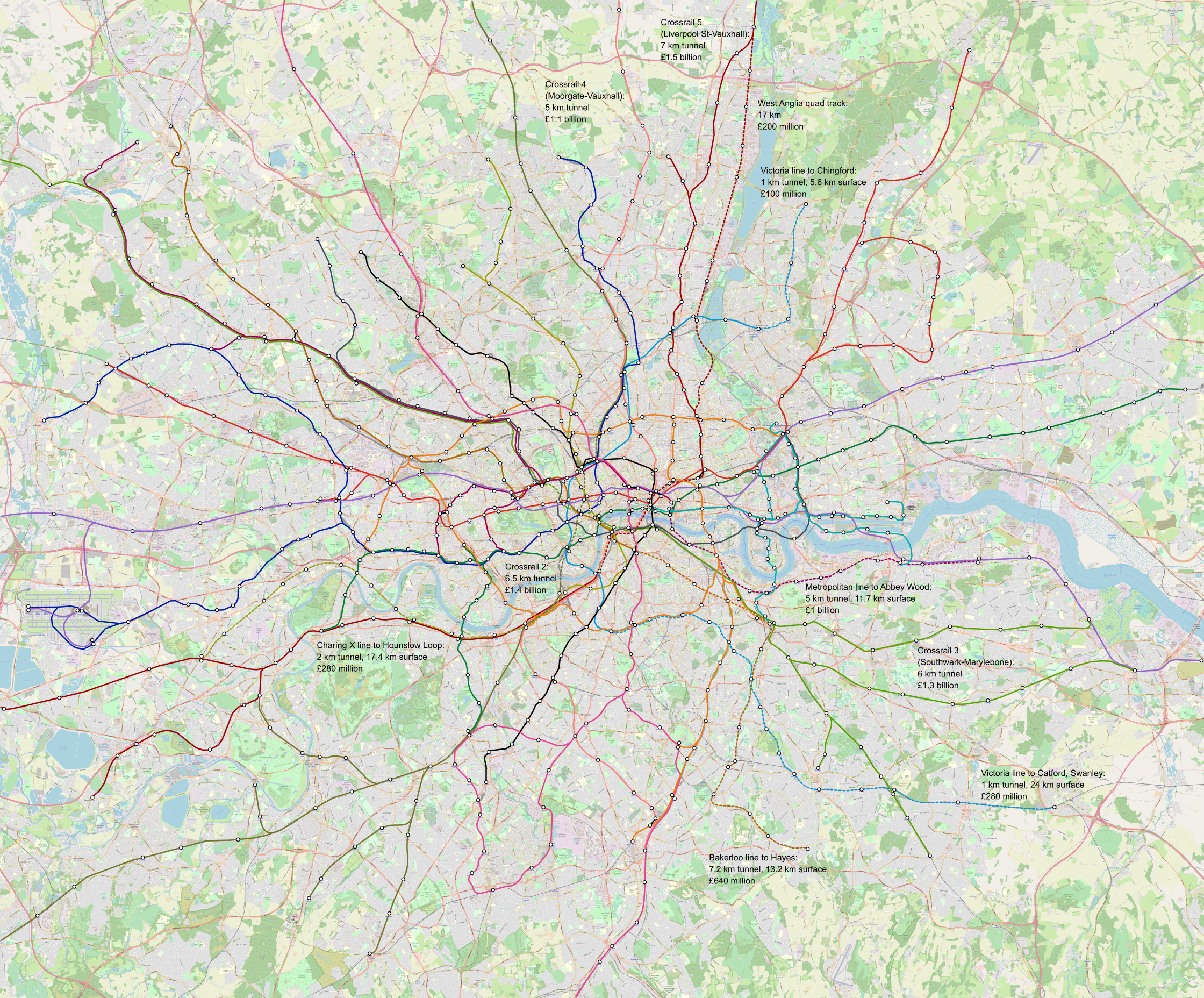
A full-size (74 MB) map can be viewed here.
Solid lines are existing or under construction, that is Crossrail and the Battersea extension; proposed lines are dashed. Commuter rail lines, that is Thameslink, the soon-to-open Crossrail, and four additional Crossrail tunnels labeled 2 through 5, are always depicted as having separate stations from the other modes, to avoid confusion where one Crossrail station has connections to two adjacent Tube stations (such as Farringdon-Barbican and Moorgate-Liverpool Street). It has many additional interchanges between lines and branches, including some that were left out on purpose, like a Crossrail 1 connection to Oxford Circus, omitted from the under-construction line to discourage riders from using the oversubscribed Victoria line; with four more cross-city lines, the capacity problems would be lessened substantially.
The overall picture is sparser than my New York map. The total projected cost of all of these projects, including some allocated for redoing stations on commuter branches to be given to Tube lines, is £6.8 billion, compared with $37 billion for the New York maps. The reason is that unlike New York, London already has excellent coverage thanks to extensive branching – what it needs is core capacity, which consists of city center tunnels that have high cost per kilometer but need not be long.
There is considerable overbuilding planned in London. Crossrail 2 as depicted on my map is a 6.5 km tunnel between the approach to Victoria Station and the approach to Kings Cross. But as planned, Crossrail 2 extends to a long tunnel parallel to the South West Main Line, a four-track line in a right-of-way that could if truly necessary accommodate six, as well as a long tunnel going north to take over the Lea Valley Lines, which on my map go into Crossrail 5. With gratuitous suburban tunnels and extremely high British construction costs, the budget for Crossrail 2 is around £30 billion, about 20 times what Scandinavia might spend on such a project. Even allowing for the possibility that crossing under three lines at once at Bank is more complex than crossing under two at T-Centralen, this is a difference of a full order of magnitude, counting both total required tunnel length and cost per km.
In addition, there is network simplification. On the Tube this consists of segregating the Northern line’s Bank and Charing Cross branches (already in planning pending the Battersea extension and reconstruction of Camden Town) and through breaking the Circle line into separate Metropolitan and District lines. The latter was estimated by a British blogger to cost £5 billion, based on a rubric in which the Met/District transfer at Aldgate (or Tower Hill) should by itself cost £1 billion; Crossrail and Second Avenue Subway stations cost around half that much, and the more complex T-Centralen and Odenplan stations on Citybanan cost less.
On mainline rail, the service plan is supposed to be deinterlined, as is Transport for London’s long-term goal. The slow tracks of the various mainlines feeding into Central London turn into Crossrail branches, or occasionally Underground extensions, such as Hayes and the Hounslow Loop. The fast tracks stay on the surface to avoid interfering with high-frequency regional metro service. For historic reasons Thameslink mostly stays as-is, with a combination of fast and stopping services, but the curve toward London Bridge should not be used – instead, passengers should have access to Crossrail 3 plus interchanges to the City at London Bridge and a new infill station at Southwark.
London owes it to itself to understand why its construction costs are so high that instead of solving its transport capacity problems with multiple cross-city tunnels in a decade, it’s taking multiple generations to build out such a system. There’s a lot of ongoing discussion about the last-minute delays and cost overruns on Crossrail, but the absolute costs even before the overrun were very high, the highest in the world outside New York City – and Crossrail 2 is set to break that record by a margin.
Trip Chaining, Redux
There’s been an ongoing conversation about how public transport can be used for non-work trips (and what it means for women) that makes me go back to something I wrote in 2012 about trip chaining. In that post I asserted a distinction between long and short trips, but I didn’t make it very clear. The importance of this distinction is that even though a large majority of trips are not work trips, the sort of urban layout that makes long trips (including work trips) usable by train tends to also make other trips doable on foot.
Trip length and purpose
Mobilität in Deutschland periodically reports on national travel patterns. The 2017 MiD report includes mode shares, trip lengths, and purposes, some broken down by state. Unlike in the Anglosphere or in France, the headline modal share is for all trips, not just work or school trips, and therefore the numbers for public transit look lower and those for walking and cycling look higher.
The important statistic for trip-chaining comes from a table on p. 19. There were 42 million work trips and 41 million shopping trips nationwide in 2017, but the work trips were on average more than three times as long, 16 vs. 5.3 kilometers. The only trip category longer than work was business trips, on average 19 km, including an extensive number of intercity trips, and the only category close to work trips was recreational trips, averaging 15.5 km, also including extensive intercity travel; the median work trip was by a fair margin the longest, 8 km, whereas the median shopping trip was 2 km. Likewise, errand trips were 10.2 km on average with a median of 3.6.
MiD doesn’t break down this data by region, unfortunately. So I can only speculate that if the median trip that people talk about when they talk about trip chaining is 2 km long, then the median trip in the parts of Germany with good public transit is short enough to be done on foot, probably shorter than a kilometer.
Short and long trips
I think it’s useful to collapse the distinction between trips into a binary one: short versus long. Trip length is of course a continuous variable, but a good classification scheme is “can it be done internally to a neighborhood or town?”. If the answer is yes then the trip is short, otherwise it is long.
The commute is an example of a long trip. Commuting to school is usually a long trip as well; even in an environment with school zoning and no selection or choice, a secondary school draws from too large an area to be a single neighborhood except in an extremely large and dense city. Social trips can be long as well – if I go to a gaming convention or a performance in Berlin, or if someone who cares about sports goes to see a football match, it’s a long trip.
Short trips include shopping, errands, eating out, and daycare. The common aspect to them is that they involve common activities with small draws. The supermarket draws from a community of a few thousand, as does the neighborhood restaurant. In contrast, the performance is unique – while many people go to concerts, different people are fans of different artists, so a single band may need to visit a city of millions to fill an auditorium.
Making transit useful for non-work long trips
I bring up the example of going to a sports game as a long trip because American transit agencies deal with that routinely even if they otherwise only care about work trips. Commute trips tend to happen at specific times of day, especially if you’re from the same middle class that transit managers are drawn from. Other long trips have different peaks. Leisure trips tend to happen in the evening and on weekends. Business trips within metropolitan areas tend to happen in the middle of the day during work hours. Trips to the airport depend on time zones – in New York the ones to JFK are concentrated in the afternoon peak, but it’s hard to make generalizations.
Like work trips, non-work long trips are not isotropic – people travel to specific places. A few are as a rule outside city center, such as sports stadiums and airports. Others are within city center to appeal to a wide cross-section of residents, such as event spaces for performances; conventions run the gamut, but richer and more important conventions are likelier to shell out money for city center real estate. Universities may be in or outside city center, depending on the city. Museums are usually city center or in neighborhoods just outside it, such as the Upper East and West Sides in New York or Balboa Park in San Diego.
The length means that the optimal transit network for all non-work trips is largely the same. If trains arrive at a reasonable frequency all day, every day, and form a coherent radial network, then passengers will able to use them for all long trips, even ones that are not for work. The major destinations that are outside city center should whenever possible be junctions between different branches, or get circumferential and not just radial service.
Moreover, there is little point in trying to vary modes for work and non-work trips. Surface transit that averages 15 km/h but saves you a 1-minute trip down to the subway is no more useful for going to a concert than for going to work. If poor urban planning has resulted in an airport that’s nowhere on the rail network or in regional convention centers that are impossible to serve, then buses can fill in the gap, but that’s not optimizing for non-work trips but rather fixing past design mistakes, no different from doing the same when suburban office parks are built far from the train.
The one serious change one needs to make is that the definition of city center needs to be broader than the few square blocks that comprise most American cities’ downtowns. The London Underground’s conception of Central London is not just the City, and likewise cities need to ensure that their West Ends (like, again, San Diego’s Balboa Park) are served as if they were central rather than peripheral areas.
Short trips
It is wrong for cities to try optimizing public transportation for short trips. Most short trips can be done by foot; if they can’t, something is wrong with the city’s urban design. The minimum density required for people to be able to walk to retail is not high – I have a choice of supermarkets within walking distance, and Berlin is not an especially dense city. In Paris, which unlike Berlin is especially dense, I walked to the hypermarket.
Occasionally, when a short trip needs to be done on mechanized transportation, if the city has good transit-oriented commercial development then it is doable by riding the trains a few stops. I recently bought a mattress at Hermannplatz, 3 stops away on U7, longer than most people inside the Ring have to go to such a store, and mattresses are a special case in that dragging them on the streets for a kilometer isn’t fun.
Suppression of auto use is especially valuable for short trips. The reason is that in auto-oriented areas, short as well as long trips are done by car, and if businesses locate based on automobile scale, then only transit can compete – walking and cycling take too long. A hefty proportion of the urban upper middle class prefers to own cars and drive them for short trips, which may induce short trip destinations to locate based on automobile scale even in a walkable city; when I lived in Providence, I walked to the supermarket, but it was located right next to a freeway exit and had ample parking.
Trip chaining
The concept of trip chaining – going directly between destinations in a row rather than just going back and forth between home and a destination – works best with the mode of transportation with the highest frequency and lowest access time: walking. Buying different items at different stores is so ubiquitous that shopping malls were invented specifically to make that experience more pleasant than that of chaining car trips.
Transit cities should not design themselves around trip chaining on transit, destinations for short trips are too difficult to serve. Many cluster on major corridors, but some don’t and stay on residential streets or at street corners. In walkable cities they tend to be fairly isotropic. With short average trips and no discernable centers, the optimal stop spacing on transit is extremely short, to the point of uselessness for all other purposes. If there’s trip chaining, the required frequency is so high that operating costs become unaffordable; a 5-minute wait for a bus may well be unconscionable.
Outside dense cities, suburbs should have a structure of density in which all the plausible destinations are within walking distance of the train station, permitting chaining walking trips with a transit trip. With such structure, the minimum viable density is lower, because buses can connect to the train with a timed transfer and have longer stop spacing as the destinations are all at the town center. In effect, such a structure gives the town center most of the convenience benefits of a shopping mall even without other features such as enclosure and single ownership of the real estate.
Infrastructure is scale-dependent. Public transportation makes this a lot clearer than cars – different modes are used at different scales, and the shape of the network can look visibly different as well. At the scale of short trips, the correct choice of public transportation mode is none – people can and should walk. If the city has generally viable public transit, its urban layout will equally well permit trip chaining on foot. If it doesn’t, then the priority should be to establish a transit city and not to try dragging buses every block.
Overnight Public Transit
American cities try to aim for 24/7 rail service, imitating New York. European cities except Copenhagen do not, and instead have night bus networks. Both of these options have fascinated various transit reformers, but unfortunately sometimes the reformers propose the wrong option for the specific city. This post is intended to be a set of guidelines for night buses and the possibility of 24/7 urban rail.
Maintenance windows
The reason rail service does not run 24/7 is maintenance. Tracks require regular inspections and work, which are done in multi-hour windows. Over the last century or so, the big urban rail systems of the world have standardized on doing this maintenance at night. For example, in Paris there are about 4.5-5 hours every weeknight between the last train of the night and the first train of the morning, and one hour less every weekend night. In Berlin trains run all night on weekends and have 3.5-hour windows of closure on weeknights.
The regular windows may be supplemented by long-term closures, during which passengers are told to use alternatives. Berlin occasionally closes some S-Bahn segments for a few days, and (I believe much more rarely) U-Bahn segments. Paris does so very rarely, usually for an entire summer month during which many Parisians are away on vacation and systemwide ridership is lower, and usually when there are easy alternatives, such as the RER A and Metro Line 1 substituting for each other.
The English-speaking world tends to have extensive weekend shutdowns for maintenance. London has them quite often in addition to nighttime shutdowns. New York runs trains 24/7, using the express tracks on most of its trunk lines to provide service even when the local stations on some segment are closed for maintenance. As American cities have mostly copied New York, they do not know how to wrap up maintenance during their usual nighttime windows and seek weekend closures or shorter hours as well. Thus, for example, BART has claimed that it needs 7-hour windows during weekend nights, citing the example of Paris, whose weekend night closures actually last less than 4 hours.
Flagging
I know of one city that runs its subway 24/7 without interruptions: Copenhagen. Overnight, Copenhagen single-tracks around worksites – frequency is low enough that trains can be scheduled not to conflict. As the trains are driverless, wrong-way running is quite easy. Moreover, there is ample separation between the tracks thanks to the Copenhagen Metro’s twin bore construction; thus, trains do not need to slow down next to worksites, nor must work slow down when a train runs on an adjacent track.
In New York, tracks on each line are right next to each other, with little separation between them. Thus, there are rules that are collectively called flagging under which trains must slow down to a crawl (I believe 10 miles per hour, or 16 km/h) when next to a worksite, while work must pause next to a moving train. The flagging rules apply even when there is more substantial separation between adjacent tracks, such as columns and retaining walls, provided there is any opening allowing passage between the tracks. The safety margins have been made more generous over the last 20 years, which is part of the reasons trains have slowed down, as reported separately by myself, Dan Rivoli, and Aaron Gordon. At the other end, maintenance costs in New York are very high thanks to the constant interruptions.
If it is possible to single-track at night without onerous flagging rules, then cities should go in that direction, using automated rail signaling such as CBTC, even stopping short of driverless trains. In cities with twin-bored tunnels this works provided there are regularly-spaced crossovers between tracks in opposite directions. London is generally poor in such crossovers, and installing new ones may be prohibitively expensive if blasting new connections between tunnels is required. In contrast, on Line 14 in Paris, there are almost sufficient crossovers – the longest stretch is between Bibliotheque and Madelaine, at 14 minutes one-way, and single-direction switches exist at Chatelet and Gare de Lyon, just one of which needs to upgraded to a full diamond crossover. There, 24/7 operation is plausible, though perhaps not so useful as the rest of the system is not 24/7.
Even some cut-and-cover metros can have sufficient separation between tracks for nighttime single-tracking. In Berlin the distance is adequate, at least for some stretches – the tracks are not right next to each other. Even in New York, there are segments where it is feasible to construct partitions between tracks, provided the agency changes flagging rules to permit regular operations and maintenance on adjacent tracks if a partition has been constructed. The cut-and-cover nature of these systems should facilitate this pattern since the cost of building the required crossovers is not prohibitive, just high.
Night buses
Night buses are attractive for a number of reasons. The most important is that in the after hours there is so little surface traffic that buses can match the speed of rapid transit. Moreover, ridership is usually low enough that a bus has adequate capacity. Finally, surface transit can make small detours, for example to reach a common timed transfer, since transit is dependent on both scale and mode. During the day Vancouver has a bus grid, with most buses arriving every 8-10 minutes, but at night it has a half-hourly radial network with a timed transfer, and little relationship with the shape of the SkyTrain network.
Nevertheless, not every city can make appropriate use of night buses. The important factors to consider include the following:
- How much does the rapid transit network follow major streets? If it mostly runs on two-way streets, as in Berlin, then running buses that duplicate the metro is easy. But if there are major deviations, especially if there are water crossings involved, then this is harder; in New York, where there are far more crossings of the East River by subway than by road, a night bus network would be virtually useless. Shuttle buses substituting for weekend trackwork are likewise complete failures whenever the subway is more direct than the streets, e.g. the Boston Red Line between Charles-MGH and Park Street.
- What is the expected size of the network? A minimum number of lines is required for success, and unless they are very frequent, transfers have to be timed. The half-hourly night buses in Berlin do not work well if untimed, for example.
- How long are the routes? This has two aspects. First, very long routes are less competitive with taxis if there are motorways. And second, a half-hourly night bus had better take around an integer number of half-hours minus turnaround time per roundtrip, to avoid wasting service hours. A 25-minute one-way trip is excellent, a 32-minute one a disaster.
Public Transportation and Active Planning
This post is an attempt at explaining the following set of observations concerning government interference and transportation mode choice:
- High auto usage tends to involve government subsidies to motorways and other roads
- Nonetheless, more obtrusive government planning tends to correlate with more public transport and intercity rail
- In places where state planning capacity is weak, transportation evolves in a generally pro-car direction
The main thread tying this all together is that building roads requires a lot of money, but the money does not need to be coordinated. Local districts could pave roads on a low budget and improve incrementally; this is how the US built its road network in the 1910s and 20s, relying predominantly on state and even local planning. In contrast, public transportation requires very good planning. Rapid transit as an infrastructure project is comparable to motorways, with preplanned stopping locations and junctions, and then anything outside dense city cores requires network-wide rail schedule coordination. Good luck doing that with feuding agencies.
I’ve talked a bunch about scale before, and this isn’t exactly about that. Yes, as Adirondacker likes to say in comments, cars are great at getting people to where not a lot of other people want to go. But in cities that don’t make much of an effort to plan transportation, anyone who can get a car will, even for trips to city center, where there are horrific traffic jams. An apter saying is that a developed country is not one where even the poor drive but one where even the rich use public transport.
Right of way and surface transit
The starting point is that on shared right-of-way, cars handily beat any shared vehicle on time. Shared vehicles stop to pick up and drop off passengers, and are just less nimble, especially if they’re full-size buses rather than jitneys. No work needs to be done to ensure that single-occupant vehicles crowd out buses with 20, 40, or even 60 passengers. This happens regardless of the level of investment in roads, which, after all, can be used by buses as well as by cars.
Incremental investment in roads will further help cars more than buses. The reason is that the junctions most likely to be individually grade-separated are the busiest ones, where buses most likely have to stop to pick up and discharge passengers at the side of the road at-grade, whereas cars can go faster using the flyover or duckunder. For example, in New York, the intersection of Fordham Road (carrying the Bx12, currently the city’s busiest bus) and Grand Concourse (carrying the Bx1/2, the city’s sixth and the Bronx’s second busiest route) is grade-separated, but buses have to stop there and therefore cannot have to cross more slowly at-grade.
Within cities, the way out involves giving transit dedicated right of way. This can be done on the surface, but that removes space available for cars. Since cars are faster than public transport in cities that have not yet given transit any priority over private vehicles, they are used by richer people, which means the government needs to be able to tell the local middle class no.
The other option is rapid transit. This can be quite popular it if is seen as modern, which is true in the third world today and was equally true in turn of the century New York. The problem: it’s expensive. The government needs to brandish enough capital at the start for a full line. This is where transit’s scale issue becomes noticeable: while a metro area of 1-2 million will often support a rapid transit line, the cost of a complete line is usually high compared with the ability of the region to pay for it, especially if the state is relatively weak.
The third world’s situation
The bulk of the third world has weak state capacity. Tax revenue is low, perhaps because of political control by wealthy elites, perhaps because of weak ability to monitor the entire economy to ensure compliance with broad taxes.
This does not characterize the entire middle- and low-income world. China has high state capacity, for one, leading to massive visible programs for infrastructure, including the world’s largest high-speed rail network and a slew of huge urban metro networks. In the late 20th century, the four East Asian Tigers all had quite high state capacity (and the democratic institutions of Korea and Taiwan are just fine – the administrative state is not the same as authoritarianism).
In 1999, Paul Barter’s thesis contrasted the transit-oriented character of Tokyo, Seoul, Hong Kong, and Singapore, with the auto-oriented character of Bangkok and Kuala Lumpur, and predicted that Manila, Jakarta, and Surabaya would evolve more like the latter set of cities. Twenty years later, Jakarta finally opened its first metro line, and while it does have a sizable regional rail network, it is severely underbuilt for its size and wealth, which are broadly comparable to the largest Chinese megacities. Manila has a very small metro network, and thanks to extremely high construction costs, its progress in adding more lines is sluggish.
Kuala Lumpur and Bangkok both have very visible auto-centric infrastructure. Malaysia encouraged auto-centric development in order to stimulate its state-owned automakers, and Thailand has kept building ever bigger freeways, some double-deck. More to the point, Thailand has not been able to restrain car use the way China has, nor has it been able to mobilize resources to build a large metro system for Bangkok. However, Indonesia and the Philippines are not Thailand – Jakarta appears to have a smaller freeway network than Bangkok despite being larger, and Manila’s key radial roads are mostly not full freeways but fast arterials.
Planning capacity
Public transportation and roads both form networks. However, the network effects are more important for transit, for any number of reasons:
- Public transportation works better at large scale than small scale, which means that urban transit networks need to preplan connections between different lines to leverage network effects. Freeway networks can keep the circumferential highways at-grade because at least initially they are less likely to be congested, and then built up gradually.
- Public transportation requires some integration of infrastructure, service, and rolling stock, and this is especially true when the national rail network is involved rather than an urban subway without any track connections to the mainline network.
- The biggest advantage of trains over cars is that they use land more efficiently, and this is more important in places with higher land prices and stronger property rights protections. This is especially true when junctions are involved – building transfers between trains does not involve condemning large tracts of land, but building a freeway interchange does.
None of this implies that cars are somehow smaller-government than trains. However, building a transportation network around them does not require as competent a planning department. If decisions are outsourced to local notables who the state empowers to act as kings of little hills in exchange for political support, then cobbling together a road network is not difficult. It helps those local notables too, as they get to show off their expensive cars and chauffeurs.
Trains are more efficient and cleaner than cars, but building them requires a more actively planned infrastructure network. Even if the total public outlay is comparable, some competent organ needs to decide how much to appropriate for which purpose and coordinate different lines – and this organ should ideally be insulated from the corruption typical of the average developing country.
Bronx Bus Redesign
New York is engaging in the process of redesigning its urban bus network borough by borough. The first borough is the Bronx, with an in-house redesign; Queens is ongoing, to be followed by Brooklyn, both outsourced to firms that have already done business with the MTA. The Bronx redesign draft is just out, and it has a lot of good and a great deal of bad.
What does the redesign include?
Like my and Eric Goldwyn’s proposal for Brooklyn, the Bronx redesign is not just a redrawing of lines on a map, but also operational treatments to speed up the buses. New York City Transit recognizes that the buses are slow, and is proposing a program for installing bus lanes on the major streets in the Bronx (p. 13). Plans for all-door boarding are already in motion, to be rolled out after the OMNY tap card is fully operational; this is incompetent, as all-door boarding can be implemented with paper tickets, but at this stage this is a delay of just a few years, probably about 4 years from now.
But the core of the document is the network redesign, explained route by route. The map is available on p. 14; I’d embed it, but due to file format issues I cannot render it as a large .png file, so you will have to look yourselves.
The shape of the network in the core of the Bronx – that is, the South Bronx – seems reasonable. I have just one major complaint: the Bx3 and Bx13 keep running on University Avenue and Ogden Avenue respectively and do not interline, but rather divert west along Washington Bridge to Washington Heights. For all of the strong communal ties between University Heights and Washington Heights, this service can be handled with a high-frequency transfer at the foot of the bridge, which has other east-west buses interlining on it. The subway transfer offered at the Washington Heights end is low-quality, consisting of just the 1 train at the GWB bus station; a University-Ogden route could instead offer people in University Heights a transfer to faster subway lines at Yankee Stadium.
Outside the South Bronx, things are murkier. This is not a damn by faint praise: this is an acknowledgement that, while the core of the Bronx has a straightforward redesign since the arterials form a grid, the margins of the Bronx are more complicated. Overall the redesign seems fairly conservative – Riverdale, Wakefield, and Clasons Point seem unchanged, and only the eastern margin, from Coop City down to Throgs Neck, sees big changes.
The issue of speed
Unfortunately, the biggest speed improvement for buses, stop consolidation, is barely pursued. Here is the draft’s take on stop consolidation:
The spacing of bus stops along a route is an important factor in providing faster and more reliable bus service. Every bus stop is a trade-off between convenience of access to the bus and the speed and reliability of service. New York City buses spend 27 percent of their time crawling or stopped with their doors open and have the shortest average stop distance (805 feet/245 m) of any major city. London, which has the second closest stop spacing of peer cities, has an average distance between stops of 1,000 ft/300 m.
Bus stop spacing for local Bronx routes averages approximately 882 feet/269 meters. This is slightly higher than the New York City average, but still very close together. Close stop spacing directly contributes to slow buses and longer travel times for customers. When a bus stops more frequently along a route, exiting, stopping, and re-entering the flow of traffic, it loses speed, increases the chance of being stopped at a red traffic signal, and adversely affects customers’ travel time. By removing closely-spaced and under-utilized stops throughout the Bronx, we will reduce dwell time by allowing buses to keep moving with the flow of traffic and get customers where they need to go faster.
Based on what I have modeled as well as what I’ve seen in the literature, the optimal bus stop spacing for the Bronx, as in Brooklyn, is around 400-500 meters. However, the route-by-route descriptions reveal very little stop consolidation. For example, on the Bx1 locals, 3 out of 93 stops are to be removed, and on the Bx2, 4 out of 99 stops are to be removed.
With so little stop consolidation, NYCT plans to retain the distinction between local and limited buses, which reduces frequency to either service pattern. The Bx1 and Bx2 run mostly along the same alignment on Grand Concourse, with some branching at the ends. In the midday off-peak, the Bx1 runs limited every 10 minutes, with some 12-minute gaps, and the Bx2 runs local every 9-10 minutes; this isn’t very frequent given how short the typical NYCT bus trip is, and were NYCT to eliminate the local/limited distinction, the two routes could be consolidated to a single bus running every 4-5 minutes all day.
How much frequency is there, anyway?
The draft document says that consolidating routes will allow higher frequency. Unfortunately, it makes it difficult to figure out what higher frequency means. There is a table on p. 17 listing which routes get higher frequency, but no indication of what the frequency is – the reader is expected to look at it route by route. As a service to frustrated New Yorkers, here is a single table with all listed frequencies, weekday midday. All figures are in minutes.
| Route | Headway today | Proposed headway |
| Bx1 | 10 | 10 |
| Bx2 | 9 | 9 |
| Bx3 | 8 | 8 |
| Bx4/4A | 10 | 8 |
| Bx5 | 10 | 10 |
| Bx6 local | 12 | 8 |
| Bx6 SBS | 12 | 12 |
| Bx7 | 10 | 10 |
| Bx8 | 12 | 12 |
| Bx9 | 8 | 8 |
| Bx10 | 10 | 10 |
| Bx11 | 10 | 8 |
| Bx12 local | 12 | 12 |
| Bx12 SBS | 6 | 6 |
| Bx13 | 10 | 8 |
| Bx15 local | 12 | 12 |
| Bx15 limited | 10 | 10 |
| Bx16 | 15 | 15 |
| Bx17 | 12 | 12 |
| Bx18 | 30 | 20 |
| Bx19 | 9 | 9 |
| Bx20 | Peak-only | Peak-only |
| Bx21 | 10 | 10 |
| Bx22 | 12 | 8 |
| Bx23 | 30 | 8 |
| Bx24 | 30 | 30 |
| Bx26 | 15 | 15 |
| Bx27 | 12 | 12 |
| Bx28 | 17 | 8 |
| Bx38 (28 variant) | 17 | discontinued |
| Bx29 | 30 | 30 |
| Bx30 | 15 | 15 |
| Bx31 | 12 | 12 |
| Bx32 | 15 | 15 |
| Bx33 | 20 | 20 |
| Bx34 | 20 | 20 |
| Bx35 | 7 | 7 |
| Bx36 | 10 | 10 |
| Bx39 | 12 | 12 |
| Bx40 | 20 | 8 |
| Bx42 (40 variant) | 20 | cut to a shuttle, 15 |
| Bx41 local | 15 | 15 |
| Bx41 SBS | 10 | 8 |
| Bx46 | 30 | 30 |
A few cases of improving frequency on a trunk are notable, namely on the Bx28/38 and Bx40/42 pairs, but other problem spots remain, led by the Bx1/2 and the local and limited variants on some routes.
The principle of interchange
A transfer-based bus network can mean one of two things. The first, the one usually sold to the public during route redesigns, is a grid of strong routes. This is Nova Xarxa in Barcelona, as well as the core of this draft. Eric’s and my proposal for Brooklyn consists entirely of such a grid, as Brooklyn simply does not have low-density tails like the Bronx, its southern margin having high population density all the way to the boardwalk.
But then there is the second meaning, deployed on networks where trunk routes split into branches. In this formulation, instead of through-service from the branches to the trunk, the branches should be reduced to shuttles with forced transfers to the trunk. Jarrett Walker’s redesign in Dublin, currently frozen due to political opposition (update: Jarrett explains that no, it’s not really frozen, it’s in revision after public comments), has this characteristic. Here’s a schematic:

The second meaning of the principle of interchange is dicey. In some cases, it is unavoidable – on trains, in particular, it is possible to design timed cross-platform transfers, and sometimes it’s just not worth it to deal with complex junctions or run diesels under the catenary. On buses, there is some room for this principle, but less than on trains, as a bus is a bus, with no division into different train lengths or diesels vs. electrics. Fundamentally, if it’s feasible to time the transfers at the junctions, then it’s equally possible to dispatch branches of a single route to arrive regularly.
New York’s bus network is already replete with the first kind of interchange, and then the question is where to add more of it on the margins. But the Bronx draft includes some of the second, justified on the grounds of breaking long routes to improve reliability. Thus, for example, there is a proposed 125th Street crosstown route called the M125, which breaks apart the Bx15 and M100. Well, the Bx15 is a 10.7 km route, and the M100 is an 11.7 km route. The Bx15 limited takes 1:15-1:30 end to end, and the M100 takes about 1:30; besides the fact that NYCT should be pushing speedup treatments to cut both figures well below an hour, if routes of this length are unreliable, the agency has some fundamental problems that network redesign won’t fix.
In the East Bronx, the same principle of interchange involves isolating a few low-frequency coverage routes, like the Bx24 and Bx29, and then making passengers from them transfer to the rest of the network. The problem is that transferring is less convenient on less frequent buses than on more frequent ones. The principle of interchange only works at very high frequency – every 8 minutes is not the maximum frequency for this but the minimum, and every 4-6 minutes is better. It would be better to cobble together routes to Country Club and other low-density neighborhoods that can act as tails for other trunk lines or at least run to a transfer point every 6-8 minutes.
Is any of this salvageable?
The answer is yes. The South Bronx grid is largely good. The disentanglement of the Bx36 and Bx40 is particularly commendable: today the two routes zigzag and cross each other twice, whereas under any redesign, they should turn into two parallel lines, one on Tremont and one on 180th and Burnside.
But outside the core grid, the draft is showing deep problems. My semi-informed understanding is that there has been political pressure not to cut too many stops; moreover, there is no guarantee that the plans for bus lanes on the major corridors will come to fruition, and I don’t think the redesign’s service hours budget takes this into account. Without the extra speed provided by stop consolidation or bus lanes, there is not much room to increase frequency to levels that make transfers attractive.
Assume Nordic Costs
I wrote a post last year proposing some more subway lines for New York, provided the region could bring down construction costs. The year before, I talked about regional rail. Here are touched-up maps, with costs based on Nordic levels. To avoid cluttering the map in Manhattan, I’m showing subway and regional rail lines separately.
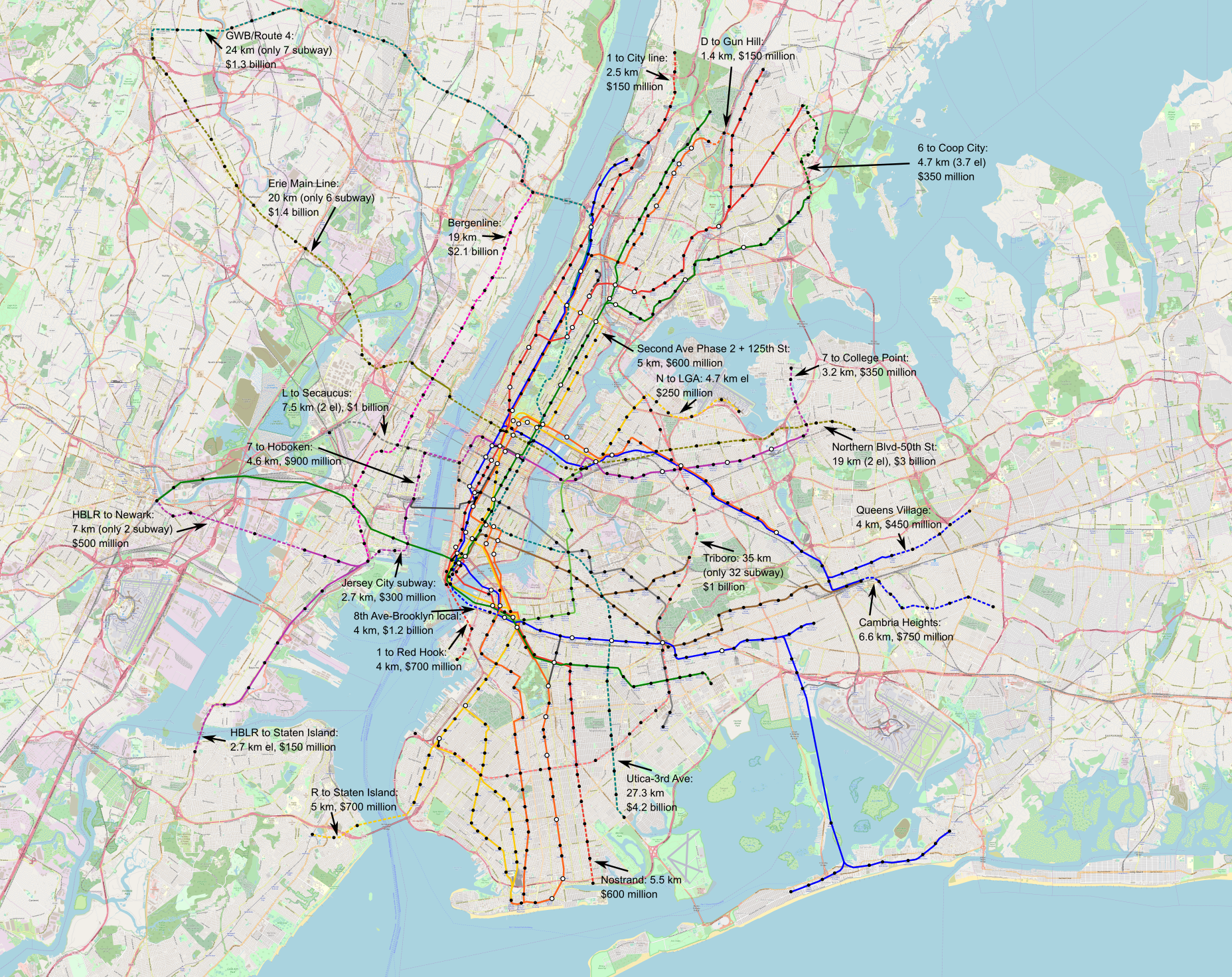

A full-size 52 MB version of the subway map can be found here and a 52 MB version of the regional rail map can be found here.
Subways are set at $110 million per km underground, outside the Manhattan core; in more difficult areas, including underwater they go up to $200-300 million per km, in line with Stockholm Citybanan. Lacking data for els, I set them at $50 million per km, in line with normal subway : el cost ratios. The within-right-of-way parts of Triboro are still set at $20 million per km (errata 5/30: 32 out of 35 km are in a right-of-way and 3 are in a new subway, despite what the map text says, but the costs are still correct).
Overall, the subway map costs $22 billion, and the regional rail one $15 billion, about half as high as the figure I usually quote when asked, which is based on global averages. This excludes the $2 billion for separated intercity rail tracks, which benefit from having no stations save Penn (by the same token, putting the express rather than local lines in the tunnel is a potential cost saving for Crossrail 2). It also excludes small surface projects, such as double-tracking the Northern Branch and West Shore Line, a total of 25 and 30 km respectively, which should be $300-550 million in total, and some junction fixes. There may also be additional infill stations on commuter rail, e.g. at intersection points with new subway extensions; I do not have Nordic costs for them, but in Madrid they cost €9 million each.
The low cost led me to include some lines I would not include elsewhere, and decide marginal cases in favor of subways rather than els. There is probably no need for the tunnel connecting the local tracks of Eighth Avenue and Fulton Street Lines, but at just $1.2 billion, it may be worth it. The line on Northern Boulevard and the Erie Main Line should probably be elevated or in a private right of way the entire way between the Palisades and Paterson, but at an incremental cost of $60 million per km, putting the Secaucus and East Rutherford segments underground can be justified.
In fact, the low cost may justify even further lines into lower-density areas. One or two additional regional rail tunnels may be cost-effective at $300 million per kilometer, separating out branches like Port Washington and Raritan Valley and heading to the airports via new connections. A subway line taking over lanes from the Long Island Expressway may be useful, as might another north-south Manhattan trunk feeding University Avenue (or possibly Third Avenue) in the Bronx and separating out two of the Brighton Line tracks. Even at average costs these lines are absurd unless cars are banned or zoning is abolished, but at low costs they become more interesting.
The Nordic capitals all have extensive urban rail networks for their sizes. So does Madrid: Madrid and Berlin are similar in size and density, but Berlin has 151 km of U-Bahn whereas Madrid has 293 km of metro, and Madrid opened a second Cercanías tunnel in 2008 for around $100 million per km and is planning a third tunnel for next decade (source, PDF-pp. 104-108). Things that are completely ridiculous at American costs – say, any future subway expansion – become more reasonable at average costs; things that are completely ridiculous at average costs likewise become more reasonable at Nordic or Spanish costs.
Informed Voting and the Democratic Deficit
The expression democratic deficit is most commonly used to refer to the European Union and its behind-the-scenes style of lawmaking. I’ve long held it is equally applicable to local politics, especially in the United States. With the EU election taking place later today, I am going to take this opportunity to zoom in one a key aspect: who gets to vote informedly? This is a critical component of the local democratic deficit. After all, there is universal franchise at the local level in modern democracies, same as at the national level, and when election dates coincide the turnout rates coincide as well. EU elections have had low turnout, but this has to be understood as a consequence rather than a cause of the democratic deficit.
This does not exist on the national level anywhere that I know of. In federal states it may not exist on the state level, either: as far as I can tell, Canada and Germany offer voters clear choices on the province/state level, and it’s only in the United States that the democratic deficit exists in the states.
On the EU level, the problem is slowly solving itself, since a highly salient issue is growing, namely, the legitimacy of the EU itself. People can clearly vote for parties that hold that the EU as it currently exists is illegitimate, such as right-populist parties under the ENF umbrella; for parties that offer continuity with the EU as it is, that is Christian-democratic, social-democratic, and liberal parties; and for various reform parties, that is greens and the far left on the left, or whatever remains of the Tories on the right. For what it’s worth, turnout so far has inched up from 2014 levels.
But on the local level, the problem remains as strong as ever. The main consequence is that local elections empower NIMBYs, simply because they have the ability to make an informed choice based on their ideology and other groups lack that power. The interest groups that benefit from housing shortages naturally get more political powers than those that benefit from abundant housing. In transportation, too, transit users tend to be politically weaker than drivers relative to their share of the electorate, but the problem is nowhere near as acute as that of general NIMBYism.
What is informed voting?
Informed voting does not mean voting the right way. A voter may be able to make an informed choice even for an uninformed position; for example, people who think cutting taxes reduces the deficit have an economically uninformed belief, but still count as informed voters if they recognize which parties they can vote for in order to prioritize tax cuts. Informed voting, at least to me, means being able to answer the following questions correctly:
- What are the political issues at stake?
- Which positions on these issues can plausibly be enacted, and how difficult would such enactment be?
- Which organs of state undertake the relevant decisions? Is it the entire legislature, a specific standing committee, the courts, the civil service, etc.?
- Which political groups have which positions on these issues, and how much they’re going to prioritize each issue? Which political groups may not have strong positions but are nonetheless potential allies?
National elections exhibit the most informed voting. For example, in the United States, most voters can identify that the key issues differentiating the Democrats and Republicans are abortion rights, tax rates (especially on higher incomes), and health care, and moreover, the abortion issue is decided through Supreme Court nominations whereas the others are in Congress with the consent of the president. Additional issues like foreign policy, environmental protection, and labor may not be as salient nationwide, but people who care about them usually know which party has what positions, where decisions are made (e.g. foreign policy is decided by the president and appointed advisors, not Congress), and which factions within each party prioritize these issues and which have other priorities.
This does not mean all voters are informed. This does not even mean most swing voters are informed. In the United States it’s a commonplace among partisans that swing voters are exceedingly uninformed. For example, here is Chris Hayes reporting on the 2004 election:
Often, once I would engage undecided voters, they would list concerns, such as the rising cost of health care; but when I would tell them that Kerry had a plan to lower health-care premiums, they would respond in disbelief–not in disbelief that he had a plan, but that the cost of health care was a political issue. It was as if you were telling them that Kerry was promising to extend summer into December.
But the low levels of information among undecided voters, while important on the margins, come from a context in which a large majority of American voters consistently support one party or another, and over the generations the parties have perfected a coalition of interests ensuring each will get about half the vote.
This situation is not US-specific. Israeli voters are highly informed about the relevant issues, led by the control over the Palestinians in the West Bank and the Gaza Strip. They know which parties are prepared to negotiate with the Palestinian Authority, withdraw from the settlements, and recognize an independent Palestinian state, and which will do no such thing, and vote accordingly. Parties for the most part announce in advance which bloc they are to be part of; even parties that would be fine cooperating with either side in order to get money for their special interests, such as the ultra-Orthodox parties, are compelled to announce in advance which side they’ll back (the right), and so far they have not deviated from it. Every single party in Israel’s most recent election had an obvious bloc, left or right; in 2015, every single party did but one, Kulanu, which was a member of the right bloc but at the time pretended to be undecided.
The European democratic deficit
The democratic deficit occurs when it is not possible for a large majority of voters to know in advance what the issues are and how to vote on them.
The European Parliament suffers from a democratic deficit, despite having strong, coherent political parties, because of its tradition of behind-the-scenes government by consensus of EPP and S&D. It is difficult for a voter to know what exactly the difference would be if S&D were somewhat stronger and EPP somewhat weaker. Europe Elects’ latest projection has a tight race for whether ALDE and the parties to its left will have a majority, making ALDE the median party on the left-right scale, or whether they will come just short, making EPP the median. And yet, I have no idea what it would mean, despite the fact that there are important issues, including climate change and immigration, on which there is a cleave between ALDE-and-leftward parties and EPP-and-rightward parties.
I am planning to vote for the Green Party rather than for the Social Democrats, since the Greens here opposed Article 13 whereas the Social Democrats expressed concern but mostly voted for it. But I genuinely do not know whether a stronger G/EFA and weaker S&D would matter much for digital freedom, nor do I know whether behind the scenes a stronger S&D and a weaker EPP would’ve resulted in a different law.
I found myself in a similar situation in the previous (and first) time I was enfranchised, in the Swedish local and regional elections of 2014. Thanks to EU reciprocity laws, I could vote in the local and regional elections but not the coincident national election. I had some knowledge of the salient political issues at the national level from reading the news, looking at slogans on street signs, and browsing party platforms, but had no idea what this would mean within the context of Stockholm County; lacking much of a local social network, I listened to my postdoc advisor’s advice to read the national platforms and vote based on the one I liked most, and voted Green (which, judging by my advisor’s reaction, was not what he would have preferred). Put another way, EU laws let me vote for a mayor and city council whose name I did not even know, but not for the Riksdag, where I had a decent idea of what the difference between the Greens and Social Democrats was.
The extreme right in Europe has ironically improved democracy, because it has given people something to vote against. I may not know how the EU would look different if EPP lost a few percentage points of its vote share and S&D and the Greens gained a few each, but I definitely know how it will look if ENF and parties that aren’t part of ENF but should be, like Hungary’s Fidesz, gain power. When the very existence of a multiracial EU is at stake, it is easier to figure out which parties are firmly committed (G/EFA, S&D, ALDE, and to a large extent EPP) and which aren’t, and on what grounds (GUE/NGL from the left, the Tories from the mainline right, ENF from the extreme right). That the pro-European parties will certainly win a huge majority of the vote among them is less relevant – the point is not to get more votes than ENF but to completely delegitimize ENF, so the margin of defeat counts.
The American democratic deficit
If in Europe the problem is the disconnect between voting for a party at the non-national (or non-state) level and seeing policy results, in the United States local government has no parties at all. Cities of primaries like New York, and cities with nonpartisan elections like San Francisco, make it exceedingly difficult for voters to know which politicians are likely to enact their local ideological agenda.
Knowing what the salient issues are is the easy part in the United States – education, crime, and housing tend to be the main issues across a variety of cities. The hard part is knowing which politicians will take which positions and have which priorities. Occasionally, one-party cities and one-party states have consistent factions, one moderate and more progressive or more conservative, but even then the factional identification is fluid.
David Schleicher has proposed to resolve this problem by forming state parties aiming at capturing about half the voters, on a similar model to that of Canada, where most provincial parties are distinct from federal parties, with ideological cleaves decided by provincial rather than federal voter preferences. Cities like New York and San Francisco would not have informal factions under this system but formal party institutions, one progressive and one moderate with perhaps some cross-party appeal to Republicans, and the parties could even compete in federal Democratic primaries for Congress.
Without parties, collegial institutions can create feudal results. Schleicher gives the example of councilmanic privilege, in which single-party city councils defer on local issues, such as housing, to the member representing the locality in question. Another possibility is standing committees with powerful chairs, as is the case in California today and as was the case in Congress before Newt Gingrich’s Republican Revolution of 1994. Despite widespread support, the YIMBY political priority SB 50 was recently frozen by fiat of one committee chair, Anthony Portantino, who represents a NIMBY suburb of Los Angeles; SB 50 passed two committees by majority vote but needed a pro forma vote from Portantino’s appropriations committee before the final vote in the entire State Senate. At the federal level, powerful postwar committee chairs tended to be Southern Democrats, who blocked civil rights law that enjoyed widespread support in Congress.
Empowerment for whomst?
Without political parties, the people who can make informed voting in local elections – that is, the people who know the salient issues, the reasonable positions, and who will prioritize what – are from specific demographics. They must have very strong social ties within the locality – they may well know the candidates personally, or know people who know them personally. They must have lived in the locality for a long time to have had these ties. There is no way I could have these ties in Berlin – I moved here three months ago, and socialize largely with foreigners.
Even though there is universal vote among citizens (and even among EU citizens here), people who lack these ties may not be able to vote informedly. Thus, their (our) vote may be completely random; in Berlin I have enough of an idea of what the difference between the left-wing parties and CDU is on transportation, but the Green-SPD difference is still subtle and unless I see more in the next few years in advance of the election I’m likely to vote based on other cues, such as which party has a more diverse slate of candidates.
With people like me not really having much political power even when enfranchised, local politics becomes the domain of the specific socioeconomic classes that do have access to information. These are typically retirees and small business owners. If you own a store, you almost certainly know all the little details of your neighborhood because that’s where your clients are located. If you work for a big business, your social network is much wider, as your coworkers are likely to commute from a wide variety of places, so even though your income is similar to that of the shopkeeper you are much weaker in local elections.
With much more power than the rest of the electorate, retirees and the petite bourgeoisie can create a political culture in which their situation is considered more moral than that of the rest – hence the use of the word transient as a pejorative.
The relevance to housing and transportation is that people with mostly local ties tend to be consistently NIMBY. They usually own housing rather than rent – if you live in one place for a long time you benefit from owning more than the average person. They have real local political power, which redevelopment may disrupt by introducing a large cohort of new people into the neighborhood. They have the ability to extort developers into providing community amenities in exchange for getting a building permit. Not for nothing, the vanguard class for YIMBY is working-age people who work for other people and have national social ties rather than local ones.
In transportation, too, the favored classes in local politics with a democratic deficit tend to be pro-car. Part of it is that enfranchised voters drive more than the disenfranchised – in the United States (per census data) and the Netherlands, immigrants drive less and use transit more than natives. Even within the electorate, the groups that have higher turnouts, such as comfortable retirees, drive more than groups that have lower turnouts, such as students. The petite bourgeoisie in particular drives a lot – if you own a store you probably drive to it because your store is on a local main street with a single bus line, whereas salaried workers are likelier to work in city center and take transit. The latter are less empowered in local politics, especially American politics, so their preferences count less than those of people who can show up to meetings during business hours and complain about bus lanes.
Democratic consensus, not democratic deficit
Tories like to use the real problem of democratic deficit at the EU level as well as the local level to argue in favor of strong unitary nations. But there are better democratic mechanisms than voting for a party once every four or five years and letting an internal party hierarchy decide everything in the interim.
Germany and Canada have strong democratic institutions at the state/province level as far as I can tell, Germany through a multiparty system and Canada through provincial parties. Canadian leftists like to complain about Rob Ford and Doug Ford, but the voters of both Toronto and Ontario knew what they were voting for. It’s not like when Donald Trump ran on promises about immigration and trade that he couldn’t keep and then cut corporate taxes.
There are glimpses of real democracy in the largest cities, at least the mayoral level: Rob Ford, Bill de Blasio, Sadiq Khan, Anne Hidalgo. This is not every city of that size class (Chicago has no such institutions), but mayors of large enough cities can at least be familiar to large enough swaths of the electorate that more than just retirees, retail landlords, and small business owners can express an opinion. In smaller cities, it may be completely impossible to have such democracy – too many residents work outside the city, or work in the city alongside suburban commuters.
Forced amalgamations of cities are likely required in the US as well as France, on the model of Britain, Sweden, the Netherlands, or any other European country with postwar municipal consolidation. Below a certain size class, moreover, it is not possible to have a professional full-time legislature; smaller US states have very small districts (New Hampshire has 400 Representatives for 1.3 million people, paid $100 a year each), leading to hobbyist legislators and bills written by lobbyists.
Referendums are an important component of democracy as well, provided precautions are undertaken to ensure they are more like Swiss ones and less like Californian ones. It is appropriate to vote on individual spending packages, such as a high-speed rail project or a subway, by a simple majority; it is not appropriate to vote on part of a project, as California did for high-speed rail, and put the remaining funding sources in a magic asterisk.
Democracy and housing
Even when homeowners are the majority, as in nearly every first-world country, there is no general interest in a housing shortage. Only homeowners in the most expensive and constrained areas as well as homeowners who look down on people who move frequently have this interest. These two groups can win thanks to a sustained democratic deficit on the local level.
This is why higher-level decisionmaking is consistently more YIMBY than local decisionmaking. At the national or even state level, homeowners can easily form a housing cartel and restrict construction – and yet, higher-level decisionmaking, such as in Japan (national) or Canada (provincial) is associated with higher construction rates. At the state level, interest groups like that of NIMBY homeowners have to share power with other interest groups, including middle-class renters, organized labor, and real estate; in California the NIMBYs just scored a win thanks to control of a legislative committee, but a full legislative vote might well go the other way. But at the local level, the NIMBYs have stronger local ties than the rest and can keep outsiders out, and even manipulate local interest groups, offering them scraps of the extortion money from developers in exchange for loyalty.
In accordance with the observation that higher-level decisionmaking yields YIMBYer results, France and Sweden have recently accelerated housing construction in their expensive capitals, both by force of national power. In the 2014 election, party posters on Stockholm pledged to build more housing, and after winning the election, the Social Democrats set a target for national housing production. Local NIMBYs still maintain some power in that housing production in Sweden has come from finding new brownfield sites to redevelop rather than from replacing smaller buildings with bigger ones, but construction rates in the last few years have been high, especially in Stockholm County; The Local describes the overall rental situation in Sweden as “cooling.” In France there has been acceleration in housing production as well, powered by both national and regional concerns, over the objections of rich NIMBY suburbs over social housing mandates.
The United States has continued devolving housing decisions to hyperlocal organs, with predictable results. YIMBYs in California may not have fully theorized this, but they understand the implications enough to focus on getting the state to override local control to permit mid-rise transit-oriented development. Whatever reasoning has led to this, the praxis of state preemption is solid, and activists in the United States should work to weaken local governments until and unless they begin solving their democratic deficit problems.
Positive and Negative Interactions
This is a theoretical post about a practical matter that arises whenever multiple variables interact. Two variables x and y, both correlated positively a dependent variable z, are said to positively interact if when x is larger, the effect of y on z gets larger and vice versa, and to negatively interact if when x is larger, the effect of y on z gets smaller. If z is transit ridership, let alone any of the direct benefits of good transit (good job access, environmental protection, public health, etc.), then it is affected by a slew of variables concerning service provision, infrastructure, and urban design, and they interact in complex ways.
I have not found literature on this interaction, which does not mean that this literature does not exist. The papers I’ve seen about correlates of bus ridership look at it one variable at a time, and yet they are suggestive of positive as well as negative interactions. More broadly, there are interactions between different types of service.
Positive interactions tend to involve network effects. These include the interaction between transit and transit-oriented development, as well as that between different aspects of rail modernization. Whenever there is positive interaction between variables, half-measures tend to flop; some are a reverse 80/20 situation, i.e. 80% of the cost yields 20% of the benefits. In some cases, compromises are impossible without making service useless. In others, some starter service is still viable, but in its presence, the case for expansion becomes especially strong, which can lead to a natural virtuous cycle.
Negative interactions occur when different improvements substitute for one another. One straightforward example is bus stops and frequency: frequency and the quality of bus shelter both impact bus ridership, but have a negative interaction, in that at higher frequency, the inconvenience coming from not having bus shelter is less important. In some cases, negative interactions can even lead to either/or logic, in which, in the presence of one improvement, another may no longer be worth the economic or political cost. In others it’s still useful to pursue multiple improvements, but the negative interaction implies the benefits are not as great as one might assume in isolation, and transit planners and advocates must keep this in mind and not overpromise.
Door-to-door trip times
The door-to-door trip time includes walking distance to and from the station, waiting time, transferring time, and in-vehicle time. Each of these components affects ridership in that longer trips reduce people’s propensity to choose public transport.
There is strong positive interaction between variables affecting the trip time. This is not directly attested in the literature that I know of, but it is a consequence of any ridership model that lumps the different components of trip time into one. If public transportation runs faster, that is if the in-vehicle time is reduced, then the share of the other components of the trip time rises, which means that the importance of frequency for reducing wait time is increased. Thus, speed and frequency have a positive interaction.
However, at the same time, there is a subtle negative interaction between speed and service provision on buses. The reason is that bus operating expenses are largely a linear function of overall service-hours, since costs are dominated by driver wages, and even maintenance is in practice a function of service-hours and not just service-km, since low speeds come from engine-stressing stop-and-go traffic conditions. In this case, increasing the speed of buses automatically means increasing their frequency, as the same resources are plugged into more service-km. In that case, the impact of a further increase in service is actually decreased: by speeding up the buses, the transit agency has reduced the share of the door-to-door trip time that is either in-vehicle or waiting at a stop, and thus further reductions in wait time are less valuable.
In the literature, the fact that investing in one portion of the trip makes its share of the overall trip length smaller and thus reduces the impact of further investments is seen in research into ridership-frequency elasticity. My standard references on this – Lago-Mayworm-McEnroe and Totten-Levinson – cite lit reviews in which the elasticity is far higher when frequency is low than when it is high, about 1 in the lowest-frequency cases and 0.3 in the highest-frequency ones. When frequency is very low, for example hourly, the elasticity is so high that adding service increases ridership proportionally; when frequency is a bus every few minutes, the impact of service increase on ridership is much smaller.
I’ve focused on in-vehicle time and waiting time, but the other two components are sometimes within the control of the transit agency as well, especially on rapid transit. Station design can reduce transfer time by providing clear, short passageways between platforms; it can also reduce access time by including more exits, for example at both ends of the platform rather than just at one end or in the middle. As such design positively interacts with other improvements to speed, it makes sense to bundle investments into more exits and better transfers with programs that add train service and speed up the trains.
Network effects
There is positive interaction between different transit services that work together in a network. In the presence of a north-south line through a city, the case for east-west transportation strengthens, and vice versa. This is not a new insight – Metcalfe’s law predicts usage patterns of communications technologies and social networks. The same effect equally holds for fixed infrastructure such as rail, and explains historical growth patterns. The first intercity steam railway opened in 1830, but the fastest phase of growth of the British rail network, the Railway Mania, occurred in the late 1840s, after main lines such as the London and Birmingham had already been established. 150 years later, the first TGV would start running in 1981, but the network’s biggest spurt of growth in terms of both route-km and passenger numbers occurred in the 1990s.
Using a primitive model in which high-speed rail ridership is proportional to the product of city populations, and insensitive to trip length, the United States’ strongest potential line is naturally the Northeast Corridor, between Boston and Washington. However, direct extensions of the line toward Virginia and points south are extremely strong per the same model and, depending on construction costs, may have even higher return on investment than the initial line, as 180 km of Washington-Richmond construction produce 540 km of New York-Richmond passenger revenue. In some places, the extra link may make all the difference, such as extending New York-Buffalo high-speed rail to Toronto; what looks like a basic starter system may be cost-ineffective without the extra link.
Network effects produce positive interactions not just between different high-speed rail lines, but also between transit services at lower levels. Rail service to a particular suburb has positive interaction with connecting bus service, for which the train station acts as an anchor; in some cases, such as the Zurich model for suburban transit planning, these are so intertwined that they are planned together, with timed transfers.
Network effects do not go on forever. There are diminishing returns – in the case of rail, once the biggest cities have been connected, new lines duplicate service or connect to more marginal nodes. However, this effect points out to a growth curve in which the first application has a long lead time, but the next few additions are much easier to justify. This is frustrating since the initial service is hard to chop into small manageable low-risk pieces and may be canceled entirely, as has happened repeatedly to American high-speed rail lines. And yet, getting over the initial hurdle is necessary as well as worth it once subsequent investments pan out.
Either-or improvements
In the introduction, I gave the example of negative interaction between bus shelter amenities and frequency: it’s good to have shelter as well as shorter waits, but if waits are shorter, the impact of shelter is lessened. There are a number of other negative interactions in transit. While it is good to both increase bus frequency and install shelter at every stop, some negative interactions lead to either-or logic, in which once one improvement is made, others are no longer so useful.
Fare payment systems exhibit negative interactions between various positive features. The way fare payment works in Germany and Switzerland – paper tickets, incentives for monthly passes to reduce transaction costs, proof of payment – is efficient. But the same can be said about the smartcard system in Singapore, EZ-Link. EZ-Link works so rapidly that passengers can board buses fast, which reduces (but does not eliminate) the advantage of proof-of-payment on buses. It also drives transaction costs down to the point of not making a monthly pass imperative, so Singapore has no season passes, and it too works.
Interior circulation displays negative interactions as well. There are different aspects of rolling stock design that optimize for fast boarding and disembarking of passengers, which is of critical importance on the busiest rail lines, even more than interior capacity. Trains so designed have a single level, many doors (four pairs per 20-meter car in Tokyo), interiors designed for ample standing space, and level boarding. Each of these factors interacts negatively with the others, and in cities other than Tokyo, regional trains like this are overkill, so instead designers balance circulation with seated capacity. Berlin has three door pairs per car and seats facing front and back, Zurich has double-deckers with two pairs of triple-wide doors and has been quite tardy in adopting level boarding, Paris has single-level cars with four door pairs and crammed seats obstructing passageways (on the RER B) and bespoke double-deckers with three pairs of triple-wide doors (on the RER A).
Finally, speed treatments on scheduled regional and intercity trains may have negative interactions. The Swiss principle of running trains as fast as necessary implies that once various upgrades have cut a route’s trip time to that required for vigorous network connections – for example, one hour or just a few minutes less between two nodes with timed transfers – further improvements in speed are less valuable. Turning a 1:02 connection into a 56-minute one is far more useful than further turning a 56-minute service into a 50-minute trip. This means that the various programs required to boost speed have negative interactions when straddling the boundary of an even clockface interval, such as just less than an hour, and therefore only the cheapest ones required to make the connections should receive investment.
Conclusion
Good transit advocates should always keep the complexities that affect transportation in mind. Negative interactions between different investments have important implications for activism as well as management, and the same is true for positive interactions.
When variables interact negatively, it is often useful to put a service in the good enough basket and move on. In some cases, further improvements are even cost-ineffective, or require unduly compromising other priorities. Even when such improvements remain useful, the fact that they hit diminishing returns means advocates and planners should be careful not to overpromise. Cutting a two-hour intercity rail trip to an hour is great; cutting a 40-minute trip to a 20-minute one may seem like a game changer, but really isn’t given the importance of access and egress times, so it’s usually better to redeploy resources elsewhere.
Conversely, when variables interact positively, transit service finds itself in an 80% of the cost for 20% of the benefits situation. In such case, compromises are almost always bad, and advocates have to be insistent on getting everything exactly right, or else the system will fail. Sometimes a phased approach can still work, but then subsequent phases become extremely valuable, and it is useful to plan for them in advance; other times, no reasonable intermediate phase exists, and it is on activists to convince governments to spend large quantities of upfront money.
Transportation is a world of tradeoffs, in which benefits are balanced against not just financial costs but also costs in political capital, inconvenience during construction, and even activist energy. Positive and negative interactions have different implications to how people who want to see better public transport should allocate resources; one case encourages insisting on grand plans, another encourages compromise.
The Importance of Radial Urban Rail
Most urban rail networks consist predominantly of radial lines, connecting city center with outlying areas. However, a fair minority attempt a different typology, reminiscent of a grid. This does not work so well in practice, and I want to bring it up in the context of both my current domicile and my previous one, which have non-radial metro systems, for different reasons. The problem with non-radial metro networks is that many trips require multiple transfers, and even single-transfer trips often place the connection far out of the way. The average effective speed in such cases is often lower than that of a slow bike.
Berlin
Berlin’s S-Bahn network is fully radial, consisting of two radial trunks and the Ringbahn. However, its U-Bahn network fails to be radial in three distinct ways. First, the two north-south trunks, U6 and U8, are parallel. Second, the east-west U5 only goes from Alexanderplatz eastward, although an under-construction extension will extend it slightly to the west and connect with U6. And third, the postwar lines were constructed in a Cold War context around a temporary city center.
The problem can be summarized with the following map, in which the green dot is where I live and the three red dots are places I’ve gone to recently:
A larger 13 MB image can be seen here.
My trips to the two southern red dots, both gaming events, are not too onerous, using the Ringbahn. But my trip to the northern red dot isn’t so easy; besides being circuitous, the Ringbahn is currently shut down for maintenance for a segment in between. Now, there’s redundancy, I can still get there, but it requires a three-seat ride involving U7, U8, and U2, and what’s more, the U8/U2 transfer at Alexanderplatz is long.
The route U7 takes is a Cold War relic. During the division of Berlin, city center was in East Berlin, forcing West Berlin to build a new city center, currently called City West. East Berlin got the S-Bahn, which West Berliners eventually began to boycott even when it served the West, and West Berlin got nearly the entire U-Bahn, with the exception of just U5 and the eastern parts of U2. U6 and U8 served West Berlin going from the north to the south without stopping in the Walled center. To provide entirely Western routes, West Berlin built two new lines, U7 and U9.
The decisions made about U7 and U9 routing were then about the context of the Wall. U9 is a straight north-south trunk passing through City West, with connections to every West Berlin U-Bahn line with the exception of the low-ridership U4 stub. U7, originally part of the U6 mainline south of their junction, was extended northwest to become a new trunk line, and it too is designed to connect to the U-Bahn network of West Berlin alone rather than to the combined one. Thus, there is a reasonable U7-U1 connection at Möckernbrücke, but instead of continuing due west to connect with U2, U7 detours southwest and only connects with U2 at Bismarck Strasse, too far to the west to be of use for people connecting between the two lines’ eastern legs. In the Cold War, this worked, in the sense that the parts of U2 on the Western side of the Wall are either still convenient with the Bismarck Strasse transfer or very close to U1. In the context of reunification, this doesn’t work so well.
Here is a map of passenger rail traffic by interstation segment:

Note that U9 goes strong throughout its run; while the area it serves is no longer the CBD, it is still a strong high-end retail center, defined around Kurfürstendamm. However, U7’s traffic actually peaks in Neukölln and Kreuzberg and is lower west of the junction with U6 at Mehringdamm. Moreover, coming from Spandau at the other end, U7 loses traffic as it crosses the Ringbahn (as do many lines coming from the west) rather than gaining it. The shift in the center of the city has rendered U7 a mixed radial-circumferential line.
Paris
Like Berlin, Paris has a radial mainline rail network and a more complicated dedicated urban rail system.

The Metro defies easy categorization. It has the characteristics of a grid, with Lines 1, 3, 8, 9, and 10 running east-west, and Lines 4, 5, 7, 12, and 13 running north-south. It also has the characteristics of two overlain radial networks, one consisting of Lines 1, 4, 7, 11, and 14 around Chatelet, and one consisting of Lines 3, 7, 8, 9, 12, 13, and 14 around the Opera and Saint-Lazare. Some support for the latter view is that the weakest lines are M5 and M10, passing respectively too far east and south of city center.
Out of 14 Paris Metro lines, only two can connect to every other line in the network, M4 and M9, and the latter has an unadvertised connection from Saint-Augustin to Saint-Lazare, without which no transfer to M12 or M14 is possible.
This is not quite as dire as it may seem at first glance. So many stations are transfers, and stations are spaced so close together, that even though M1 runs parallel to M3 and M10, nearly all intra muros M1 stations still have two-seat rides to M3 and M10 via a different line.
Nevertheless, some parts of the city are poorly connected as a result. Eastern Paris’s connections to the Left Bank are not good. Some are more circuitous than they need to be, such as between a dorm I stayed at near Porte de Vincennes in 2010 for a conference and the site of the conference itself at Jussieu. Some are three-seat rides. Most involve changing trains at Chatelet, which adds 5-7 minutes to the trip in walking time alone.
In the case of Berlin, explaining how it got this way requires going into Cold War history. In that of Paris, a city with continuous development, this is just a matter of uncoordinated layers of planning. The plan from the 1890s produced M1-6, shaped as a hex symbol inside a circle; the lack of connection between M1 and M3 was not thought a problem then, and the remaining lack of connectivity if one originates in the suburbs was never a planning priority either.
There is another way
Paris may have Europe’s largest rail network, and Berlin may have the fourth largest, but they are in this sense atypical. London’s radial Underground network provides better connectivity, and the radial typology is increasingly dominant as Chinese metro networks follow the Soviet model, which is even more strictly radial than the British one.
The distance between my apartment and the northernmost red dot on the Berlin map is 8 kilometers. I looked at similar 8-kilometer trips within Inner London, picking two different starting points at Brixton and Bromley-by-Bow. Each 8-kilometer trip passing through or near Central London had a viable one- or two-seat ride, with the exception of Brixton-Canary Wharf, which is a three-seat ride with a cross-platform interchange at Stockwell.
There are a lot of defects in the London Underground network, and the two starting points I picked are somewhat cherrypicked to avoid them. Every pair of London Underground main lines intersects with a transfer, except the Metropolitan line and the Charing Cross branch of the Northern line, which have a missed connection at Euston and Euston Square; my two starting points are on neither of these two lines. Moreover, going northwest, there are some suburban missed connections between branches. This is on top of serious problems with capacity coming from the trains’ small size.
However, it’s notable that nobody is reproducing the small profile of the Tube networks. What cities around the world are reproducing is the radial network design, in which most trips within the urban core are reasonably direct. Going forward, Paris may even consider building connections between Metro lines to make its network more radial, for example extending M11 to the west. Berlin, likewise, should look to invest in radial S-Bahn trunks, following the busiest corridors connecting more areas to and beyond Mitte, where it’s already building extensive office space.