Category: Urban Transit
Optimization
This post may be of general interest to people looking at optimization as a concept; it’s something I wish I’d understood when I taught calculus for economics. The transportation context is network optimization – there is a contrast between the sort of continuous optimization of stop spacing and the discrete optimization of integrated timed transfers.
Minimum and maximum problems: short background
One of the most fundamental results students learn in first-semester calculus is that minimum and maximum points for a function occur when the derivative is zero – that is, when the graph of the function is flat. In the graph below, compare the three horizontal tangent lines in red with the two non-horizontal ones:
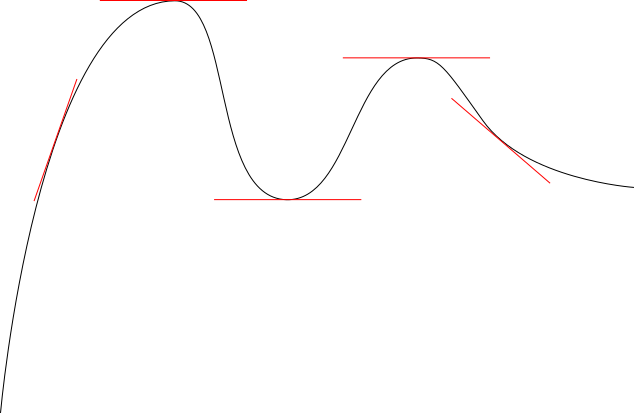
A nonzero derivative – that is, a tangent line slanting up or down – implies that the point is neither a local minimum nor a local maximum, because on one side of the point the value of the function is higher and on the other it is lower. Only when the derivative is zero and the tangent line is flat can we get a local extreme point.
Of course, a local extreme point does not have to be a global one. In the graph above, there are three local extreme points, two local maxima and one local minimum, but only the local maximum on the left is also a global maximum since it is higher than the local maximum on the right, and the local minimum is not a global minimum because the very left edge of the graph dips lower. In real-world optimization problems, the global optimum is one of the local ones, rather than an edge case like the global minimum of the above graph.
First-semester calculus classes love giving simplified min/max problems. This class of problems is really one of two or three serious calc 1 exercises; the other class is graphing a function, and the potential third is some integrals, at universities that teach the basics of integration in calc 1 (like Columbia and unlike UBC, which does so in calc 2). There’s a wealth of functions that are both interesting from a real-world perspective and doable by a first-semester calc student, for example maximizing the volume of some shape with prescribed surface area.
My formulas for stop spacing come from one of these functions. The overall travel time is a function of walking time, which increases as stops get farther apart, and in-vehicle time, which decreases as stops get farther apart. A certain stop spacing produces the minimum overall trip time; this is precisely the global minimum of the travel time function, which is ultimately of the form 
Continuous optimization
The fundamental fact of continuous optimization, one I wish I’d learned in time to teach it to students, is that at the optimum the derivative is zero, and therefore making a small mistake in the value of the optimum is not a big problem.
What does “mistake” mean in this context? It does not mean literally getting the computation wrong. There is no excuse for that. Rather, it means choosing a value that’s slightly suboptimal for ancillary reasons – perhaps small discontinuities in the shape of the network, perhaps political considerations.
Paul Krugman brings this concept up in the context of wages. The theory of efficiency wages asserts that firms often pay workers above the bare minimum required to get any workers at all, in order to get higher-quality workers and incentivize them to work harder. In this theory, the wage level is set to maximize employer productivity net of wages. At the employer’s optimum the derivative of profit is by definition zero, so a small change in wages has little impact to the employer. However, to the workers, any wage increase is good, as their objective function is literally their wage rather than profits. They may engage in industrial action to raise wages, or push for favorable regulations like a high minimum wage, and these will have a limited effect on profits.
In the context of transit, this has the obvious implication to wages – it’s fine to set them somewhat above market rate since the agency will get better workers this way. But there are additional implications to other continuous variables.
With stop spacing specifically, the street network isn’t perfectly continuous. There are more important and less important streets. Getting transit stops to align with major streets is important, even if it forces the stop spacing to be somewhat different from the optimum. The same is true of ensuring that whenever two transit lines intersect, there is a transfer between them. This is the reason my bus redesign for Brooklyn together with Eric Goldwyn involved drawing the map before optimizing route spacing – the difference between 400 and 600 meters between bus stops is not that important. For the same reason, my prescription for Chicago, and generally other American cities with half-mile grids of arterial roads, is a bus stop every 400 meters, to align with the grid distance while still hewing close to the optimum, which is about 500.
When I talked about stop consolidation with a planner at New York City Transit who worked on the Staten Island express bus redesign, the planner explained the philosophy to me: “get rid of every other stop.” In the context of redesigning a single route, this is an excellent idea as well: the process of adding and removing bus stops in New York is not easy, so minimizing the net change by deleting stops at regular intervals so as to space the remaining stops close to the optimum is a good idea.
The world of public transit is full of these tradeoffs with continuous variables. It’s not just wages and interstations. Fares are another continuous variable, involving particular tensions as different political factions have different objective functions, such as revenue, social rate of return, and social rate of return for the working class alone. Frequency is a continuous variable too in isolation. Top speed for a regional train is in effect a continuous variable. All of these have different optimization processes, and in all cases, it’s fine to slightly deviate from the strict optimum to fulfill a different goal.
Discrete optimization
Whereas continuous optimization deals with flat tangent lines, discrete optimization may deal with delicate situations in which small changes have catastrophic consequences. These include connections between different lines, clockface scheduling, and issues of integration between different services in general.
An example that I discussed in the early days of this blog, and again in a position paper I just wrote to some New Hampshire politicians, is the Lowell Line, connecting Boston with Lowell, a distance of 41 km. The line is quite straight, and were it electrified and maintained better, trains could run at 160 km/h between stops with few slowdowns. The current stop spacing is such that the one-way trip time would be just less than half an hour. The issue is that it matters a great deal whether the trip time is 25 or 27 minutes. A 25-minute trip allows a 5-minute turnaround, so that half-hourly service requires just two trainsets. A 27-minute trip with half-hourly service requires three trainsets, each spending 27 minutes carrying passengers and 18 minutes depreciating at the terminal.
A small deterioration in trip time can literally raise costs by 50%. It gets to the point that extending the line another 50 kilometers north to Manchester, New Hampshire improves operations, because the Lowell-Manchester trip time is around 27-28 minutes, so the extension can turn a low-efficiency 27-minute trip into a high-efficiency 55-minute trip, providing half-hourly service with four trainsets.
In theory, frequency is a continuous variable. However, in the range relevant to regional rail, it is discrete, in fractions of an hour. Passengers can memorize a half-hourly schedule: “the inbound train leaves my stop at :10 and :40.” They cannot and will not memorize a schedule with 32-minute frequency, and needing to constantly consult a trip planner will degrade their travel experience significantly. Not even smartphone apps can square this circle. It’s telling that the smartphone revolution of the last decade has not been accompanied with rapid increase in ridership on transit lines without clockface schedules, such as those of the United States – if anything, ridership has grown faster in the clockface world, such as Germany and Switzerland.
Transit networks involving timed connections are another case of discrete optimization in which all parts of the network must work together, and small changes can make the network fall apart. If a train is late by a few minutes and its passengers miss their connection, the short delay turns into a long one for them. As a result, conscientious schedule planners make sure to write timetables with some contingency time to recover from delays; in Switzerland this is 7%, so in practice, out of every 15 minutes, one minute is contingency, typically spent waiting at a major station.
But this gets even more delicate, because different aspects of the transit network impact how reliable the schedule is. If it’s a bus, it matters how much traffic there is on the line. Buses in traffic not reliable enough for tight connections, so optimizing the network means giving buses dedicated lanes wherever there may be traffic congestion. Even though it’s a form of optimization, and even though there’s a measure of difficulty coming from political opposition by drivers, it is necessary to overrule the opposition, unlike in continuous cases such as wages and fares.
Infrastructure planning for rail has the same issues of discrete optimization. It is necessary to design complex junctions to minimize the ability of one late train to delay other trains. This can take the form of flying junctions or reducing interlining; in Switzerland there are also examples of pocket tracks at flat junctions where trains can wait without delaying other trains behind them. Then, the decision of how much to upgrade track speed, and even how many intermediate stations to allow on a line, has to come from the schedule, in similar vein to the Lowell Line’s borderline trip time.
Continuous and discrete optimization
Many variables relevant to transit are in theory continuous, such as trip time, frequency, stop spacing, wages, and fares. However, some of these have discontinuities in practice. Stop spacing on a real-world city street network must respect the hierarchy of more and less important destinations. Frequency and trip times are discrete variables except at the highest intensity of service, perhaps every 7.5 minutes or better; 11-minute frequency is worse to the passenger who has to memorize a difficult schedule than either 10- or 12-minute frequency.
New York supplies a great example showcasing how bad it can be to slavishly hew to some optimal interstation and not consider the street network. The Lexington Avenue Line has a stop every 9 blocks from 33rd Street to 96th, offset with just 8 blocks between 51st and 59th and 10 between 86th and 96th. In particular, on the Upper East Side it skips the 72nd and 79th Street arterials and serves the less important 68th and 77th Streets instead. As a result, east-west buses on the two arterials cross Lexington without a transfer.
Just east of Lex, there is also a great example of optimization on Second Avenue Subway. The stops on Second Avenue are at 72nd, 86th, and 96th, skipping 79th. It turns out that skipping 79th is correct – the optimum for the subway is to the meter the planned stop spacing for the line between 125th and Houston Streets, so it’s okay to have slightly non-uniform stop spacing to make sure to hit the important east-west streets.
Frequency and trip times are subject to the Swiss maxim, run trains as fast as necessary, not as fast as possible. Hitting trip times equal to an integer or half-integer number of hours minus a turnaround time has great value, but small further speedups do not. Passengers still benefit from the speedup, but the other benefits of higher speed to the network, such as better connections and lower crew costs, are no longer present.
The most general rule here is really that continuous optimization tolerates small errors, whereas discrete optimization does not. Therefore, it’s useful to do both kinds of optimization in isolation, and then modify the continuous variable somewhat based on the needs of the discrete one. If you calculate and find that the optimal frequency for your bus or train is once every 16 minutes, you should round it to 15, based on the discrete optimization rule that the frequency should be a divisor of the hour to allow for clockface timetable. If you calculate and find that the optimal bus stop spacing is 45% of the distance between two successive arterial streets, you should round it to 50% so that every arterial gets a bus stop.
Getting continuous optimization right remains important. If the optimal stop spacing is 500 meters and the current one is 200 meters, the network is so far from the local maximum of passenger utility that the derivative is large and stop consolidation has strong enough positive effects to justify overruling any political opposition. However, it is subsequently fine to veer from the optimum based on discrete considerations, including political ones if removing every 1.7th bus stop is harder than removing every other stop. Close to the local maximum or minimum, small changes really are not that important.
Circles
Rail services can be lines or circles. The vast majority are lines, but circles exist, and in cities that have them they play an important niche. Owing to an overreaction, they are simultaneously overused and underused in different parts of the world. However, that some places overuse circles does not mean that circles are bad, nor does it mean that specific operational problems in certain cities are universal.
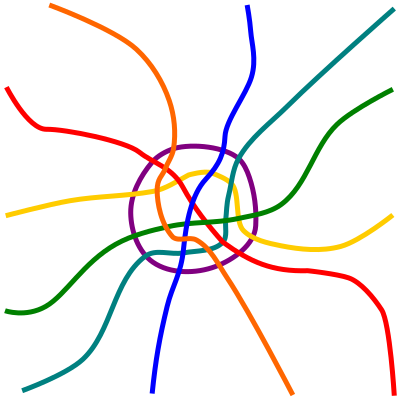
In particular, what I think of as the ideal urban rapid transit network should feature circles once the network reaches a certain scale, as in the following diagram that I use as my Patreon avatar:
Circles and circumferentials
Circles are transit lines that run in a loop without having a definitive start or end. Circumferentials are lines that go around city center, connecting different branches without passing through the most congested part of the city. In the ideal diagram above, the purple line is both a circle and a circumferential. However, lines can be one without being the other, and in fact examples of lines that are only one of the two outnumber examples of lines that are both.
For example, here is the Paris Metro:

Paris has a circle consisting of Metro Lines 2 and 6, which are operationally lines; people wishing to travel on the arcs through the meeting points at Nation and Etoile must transfer. Farther out, there is an incomplete circle consisting of Tramway Line 3, where the forced transfer between 3a and 3b is Porte de Vincennes. Even farther out there is an under-construction line not depicted on the map, Line 15 of Grand Paris Express, which has a pinch point at its southeast end rather than continuous circular service. All three systems are great example of circumferential lines with very high ridership that are not operationally circles.
Another rich source of circumferential lines that are not circles is cities near bodies of water. In those cities, a circumferential line is likely to be a semicircle rather than a circle. This is responsible for the current state of the Singapore Circle Line, although in the future it will be closed to form a full circle. The G train in New York is a single-sided circumferential line to the east of Manhattan, not linking with anything to the west of Manhattan because of the combination of wide rivers and the political boundaries between New York and New Jersey.
In the opposite direction – circles that are not circumferentials – there are circular lines that don’t neatly orbit city center. The Yamanote Line in Tokyo is one such example: its eastern end is at city center, so it combines the functions of a north-south radial line with those of a north-south circumferential line connecting secondary centers west of Central Tokyo. London’s Circle Line is no longer operationally a circle but was one for generations, and yet it was never a circumferential – it combined the central legs of two east-west radial mainlines, the Metropolitan and District lines.
We can collect this distinction into a table:
| Circle, not circumferential | Circumferential, not a circle | Circumferential circle |
| Yamanote Line Osaka Loop Line Seoul Metro Line 2 London Circle line (until 2009) Madrid Metro Line 12 |
Paris M2/6, T1, T2, T3, future M15 Copenhagen F train New York G train, proposed Triboro London Overground services Chicago proposed Circle Line Singapore Circle line (today) |
Moscow Circle Line, Central Circle Berlin S41/S42 Beijing Subway Line 2, Line 10 Shanghai Metro Line 4 Madrid Metro Line 6 |
Operational concerns: the steam era
In the 19th century, it was very common to build circular lines in London. In the steam era, reversing a train’s direction was difficult, so railways preferred to build circles. This was the impetus for joining the Metropolitan and District lines to form the Circle line. Mainline regional rail services often ran in loops as well: these were as a rule never or almost never complete circles, but instead involved trains leaving one London terminus and then looping around to another terminus.
Another city with a legacy inherited from steam-era train operations is Chicago. The Loop was built to easily reverse the direction of trains heading into city center. At the outer ends they would need to reverse direction the traditional way, but there was no shortage of land for yards there, unlike in the Chicago CBD since named after the Loop.
As soon as multiple-unit control was invented in the 1890s, this advantage of circles evaporated. Subsequently rapid transit lines mostly stopped running as circles unless they were circumferential. London’s Central line, originally pitched as two long east-west lines forming a circle, became a single east-west line, on which trains would reverse direction.
Operational concerns: the modern era
Today, it is routine to reverse the direction of a rapid transit train. The vast majority of rapid transit routes run as lines rather than circles.
If anything, there have been complaints that circles are harder to run service on than lines. However, I believe these concerns are all specific to London, which changed its Circle line from a continuous loop to a spiral in 2009. I have heard concerns about the operations of the Ringbahn here, but as far as I can tell the people who express them are doing so in analogy with what happened in London, and are not basing them on the situation on the ground here. Moreover, there are no plans to make the Yamanote Line run as anything other than the continuous loop it is today.
The situation in London is that the Circle line has always shared tracks with both the Metropolitan and District lines. There has always been extensive branching, in which a delay on one train propagates to the entire network formed by these two mainlines. To this day, Transport for London does not expect the lines in the subsurface network to have the same capacity as the isolated deep tube lines: with moving block signaling it expects 32 trains per hour, compared with 36 on isolated lines.
What’s more, the junctions in London are generally flat. Trains running in opposite directions can conflict at such junctions, which makes the schedules more fragile. Until 2009, London ran the Circle line trains every 7 minutes, which was bound to create conflicts with other lines.
The importance of this London-specific background is that the argument against circles is that they make schedules more fragile. If there is no point on the line where trains are regularly taken out of service, then it is hard to recover from timetable slips, and delays compound throughout the day. However, this is relevant mainly in the context of an extensively-branching system like London’s. Berlin has some of that branching as well, but much less so; one of the sources of reverse-branching on the S-Bahn is a line that should get its own cross-city route anyway, and another is a Cold War relic swerving around West Berlin (S8/85).
The benefits of complete circles
The complete circle of the Yamanote Line or the Ringbahn can be compared with incomplete circles, such as the Oedo Line or the various circumferentials in Paris. From passengers’ perspective, it’s better to have a complete circle, because then they can undertake more trips.
Circumferential lines broadly have two purposes:
- They offer service on strong corridors that are orthogonal to the direction of city center, such as the various boulevards hosting the M2/6 ring as well as the Boulevards des Maréchaux hosting T3.
- They offer connections between two radial lines that may not connect in city center, or may connect so far from the route of the circumferential that transferring via the circumferential is faster.
Both purposes are enhanced when the route is continuous. In the case of Paris, a north-south trip east of Nation is difficult to undertake, as it requires a transfer at Porte de Vincennes. Passengers connecting from just south, on M8 or even on M7, may not save as much time traveling to lines just north, such as M9 or M3, and might end up transferring at the more central stations of Republique or Opera, adding to congestion there.
In contrast, in Berlin the continuous nature of the Ring makes trips across the main transfer points more feasible. Just today I traveled from my new apartment to a gaming event on the Ringbahn across Ostkreuz. At Ostkreuz the trains dwelled longer than the usual, perhaps 2 minutes rather than the usual 30 seconds, which I imagine is a way to keep the schedule. That delay was, all things considered, minor. Had I had to transfer to a new train, I would have almost certainly taken a different combination of trains altogether; the extra waiting time adds up.
Why are circles so uncommon?
The operational concerns of London aside, it’s still uncommon to see complete circles on rapid transit networks. They are the ideal for cities that grow beyond the scale of three or four radial trunks, but there are only a handful of examples. Why is that?
The answer is always some sort of special local concern. If city center is offset to one side of the built-up area, such as in a coastal city, then circumferential lines will be semicircles and not full circles. If there is some dominant transfer point that requires a pinch, then cities prefer to build a pinch into the system, as is the case for Porte de Vincennes on T3 or for some of the lines cobbled together to form the London Overground.
This is similar to the question of missed connections. Public transportation networks must work hard to ensure that whenever two lines meet, they will have a transfer. Nonetheless, missed connections exist in virtually all large rapid transit networks. Some of those are a matter of pure incompetence, but in many, rail networks that developed over generations may end up having one subway line that happens to intersect another far from any station on the older line, and there is little that can be done.
Likewise, it is useful to ensure that circumferential lines be complete circles whenever the city is symmetric enough to warrant circles. Paris, like other big cities with strong transit networks, is good but not perfect, and it is important to call it on the mistakes it makes, in this case building M15 to have a jughandle rather than running as a complete circle.
Stop Spacing and Route Spacing
Six months ago I blogged a model for optimal stop spacing on an urban transit route. These models exist in the published literature, but they assume that the speed benefit of stop consolidation reduces operating costs, which requires introducing new variables for the value of time. My model assumes the higher speed of stop consolidation is plugged into higher frequency, which means only five variables are needed, and only two of them vary substantially between different cities and their networks. The formula is a square root.
In this post, I’m going to extend this formula to optimizing route spacing on a grid.

I’m using mode-neutral language like “vehicle,” but this is really just about buses, because to a good approximation, urban rail networks are never grids. I’m sorry, Mexico City, I know your Metro network does its best to pretend you have an isotropic city, but your three core radial lines are just far busier than the tangential ones.
Optimal stop spacing: a recap
My previous post uses words rather than symbolic language, since there are only five relevant parameters. Here I’m going to use symbols for the variables to make the calculation even somewhat tractable. All units I’m using are base SI units, so speed is expressed in meters per second rather than kilometers per hour, but the dimensional analysis works out so that it’s not necessary to pick units in advance.
- s: stop spacing
- v: walk speed
- p: stop penalty
- d: average distance traveled
- w: walk/wait penalty, expressed as a ratio of perceived walk or wait time to in-vehicle time
- λ: average distance between successive vehicles, or in other words headway in units of distance, not time
The variables v and p are fairly consistent from place to place. The variable w is as well, but may well differ by circumstance, e.g. people with luggage may have a higher walk penalty and a lower wait penalty, and people who are more familiar with the system usually have lower w. The parameter λ is a function of how much service runs on the line, as we will see when we expand to cover route spacing.
A key assumption in this model is that d does not change based on the network. This is a simplification: if s is too low then it will drag down d with it, as people who are discouraged by the slow in-vehicle speed avoid long trips or choose other modes of travel, whereas if s is too high then it will drag d up, as people who have to walk too long to the stop may just walk all the way to their destination if it’s nearby. In Carlos Daganzo’s textbook this situation is resolved by replacing an empirically determined d with the size of the city, assuming travel is isotropic, but the effect is essentially the same as just setting d to be half the length of a square city.
The formula for perceived travel time is

if travel along the line is isotropic, or

if one end of the travel (e.g. the residential end) is isotropic and the other is at a fixed node (e.g. a subway transfer). In either case, in-vehicle time excluding stops is omitted, as it is constant.
The minimum travel time occurs at

if travel is isotropic and

if there is a distinguished node at one end of the trip.
Observe that there is negative interaction between stop consolidation and other aspects of bus modernization. First, higher frequency, as expressed in concentrating service on strong routes, reduces the value of λ and therefore slightly reduces the optimal stop spacing. Second, the model assumes the same penalty w for walking and waiting, but sometimes these two activities have distinct penalties, and then the walk penalty is responsible for the occurrence of w in the denominator in the formula whereas the wait penalty supplies the appearance of w in the numerator. Improving bus stop facilities reduces the wait penalty, pushing the optimal s farther down, even though at the same time it’s cheaper to improve bus stops if there are fewer of them.
The empirically determined values of the five variables in the formula are as follows:
- v is 1.45 m/s in Forde-Daniel, 1.3-1.4 m/s in Bohannon, and 1.38 in TRB Part 4, PDF-p. 16; I take v = 4/3
- p is 25 seconds based on examining the differences in schedules between local and limited buses in New York and Vancouver
- d is 3,360 meters per unlinked trip per the NTD
- w is around 2 for waiting in Fan-Guthrie-Levinson, 2 in general for buses in Teulings-Ossokina-de Groot, PDF-p. 25, 1.75 in the New York MTA’s internal model, 2.25 in the MBTA’s (as mentioned in one of Reinhard Clever’s papers), and a range of 2-3 in Lago-Mayworm-McEnroe; I take w = 2
- λ is single-lane network length (that is, twice the route-length, modulo one-way loops) divided by fleet size in actual use, which is 1,830 meters in Brooklyn today and 1,160 based on what Eric Goldwyn and I recommend
This leads to optimal stop spacing equal to

if travel is isotropic and

if there is a distinguished node. The numbers are slightly lower than in my older post since I’m using a slightly lower walk speed, 1.33 m/s rather than 1.5.
Optimal route spacing: stops at intersection points
Studying route spacing has to incorporate stop spacing for a simple reason: there should be a stop at every intersection between routes, and therefore the route spacing should be an integer multiple of the stop spacing. There are three modifications required to the above formula, of which the first is easy, the second requires defining more parameters but is mathematically still easy, and the third is very hard:
- Passengers need to walk not just along the route to their stop but also from their origin to the route, which increases walk time
- The value of λ may change, since fewer routes imply more vehicles per route and thus denser vehicle spacing, and in particular wait time depends not just on how many stops are on the way but also on the speed net of stops
- Increasing the route and stop spacing in tandem reduces the number of stops involved in waiting for the bus (this is λ again) twice, that is quadratically
The first modification means that instead of traveling an average distance of s/4 to the stop at each end, assuming isotropy, people have to travel a distance of s/4 along the route and also s/4 to the route itself. In the travel time formula, we replace sw/2v with just sw/v with isotropic travel.
To deal with the second modification, we define the following variables, in addition to the ones from the section above on stop spacing:
- f: fleet size in independent vehicles in actual revenue operation (buses or trains, not train cars)
- a: area of the network to be covered by the grid, e.g. a city, metro area, or borough
- u: speed assuming there are no stops along the route
If the area is a, then we can approximate it as a square of side 


Moreover, people wait an additional λw/2u; in the previous section this wait existed as well but was ignored in the formula as it did not depend on s, but here it does, and thus we need to add this wait factor.
We deal with the third modification by replacing λ with 4a/sf in the formula for wait time. If people travel isotropically and do not transfer, the travel time formula is now

The summand d/u is constant but is included for completeness here, in analogy with the no-longer-constant summand 2aw/sfu.
But it’s the last summand that gives the most problems: it turns the optimization problem from extracting a square root to solving a cubic. This is technically possible, but the formula is opaque and does not really help showcase how the parameters affect the final outcome. We need to solve for s:

We can plug in the above values of w, v, d, and p, as well as the following values of the new variables, and use any cubic solver:
- f = 612 buses in Brooklyn, excluding vehicles in turnaround, non-revenue service, etc. (it’s actually slightly lower today, around 600, but our network is a bit more efficient with depot moves)
- a = 180,000,000 m^2 for Brooklyn
- u = 5.3 m/s net of stops, assuming our other proposals, such as bus lanes, are implemented
The cubic formula turns into

for which the positive solution is s = 528 meters.
We can complicate this formula in two ways.
First, we can let go of the assumption of isotropy. If there is a distinguished node at one end, then walk time is halved, as in the formula for stop spacing on a given route. The overall travel time is equal to

and this is optimized when

Plugging the usual values of the parameters, we get

for which the positive solution is s = 719 meters. The ratio between the results with isotropy and a distinguished node is 1.36, close to the square root of 2 that we get in the formula for stop spacing on a predetermined route; the reason is that in the cubic formula the linear term is much larger than the constant term near the root, so the effect of changing the cubic term is much closer to the square root than to the cube root.
The second complication is introducing transfers. Transfers do not change the walk time – the walking time between platforms or curbside waiting areas is small and constant – but introduce additional wait time, which means we need to double both terms that include waits. But if we have transfers we need to restore the assumption of isotropic travel, since for the most part the distinguished nodes for Brooklyn buses involve subway transfers.
In that case, the travel time formula is

which is minimized at the positive root of the cubic

We need to figure out the value of d, which is difficult in this case – the New York bus network discourages bus-to-bus transfers through low frequency and poor bus stop amenities. That the formulas I’m using do not allow for how the shape of the network influences d is a real drawback here. But if we let d be the usual 3,360 meters that it is for unlinked trips, and plug the usual values of the other parameters, we get,

to which the solution is s = 683 meters.
Optimal route spacing: the general case
The above section makes a critical assumption about route spacing and stop spacing: they must be equal, making every stop a transfer. However, this assumption is not strictly necessary. Indeed, if we assume isotropy, and let the route spacing be 860 meters, then it’s better for passengers to double the density of stops to one every 430 meters just from looking at the formula for stop spacing.
In this section, we look at the optimal formulas assuming route spacing is twice or thrice the stop spacing. Then in the next section we will compare everything together.
We keep all the variable names from before, and set s to be the stop spacing, not the route spacing. Instead, we will find formulas for route spacing equal to 2s and 3s and compare their optima with that for the special case in which stop and route spacing are equal.
We need to modify the formula in the previous section in two ways. First, walk time is, in the isotropic case, half the stop spacing plus half the route spacing. And second, the dependence of λ on the shape of the network comes from route spacing rather than stop spacing. If route spacing is 2s, the formula for travel time is

and its minimum is at the positive solution to

We retain the New York- and Brooklyn-oriented variables from the above sections and obtain

The solution is s = 352 meters, i.e. routes are to be spaced 704 meters apart, with one intermediate station on each route between each pair of successive crossing routes.
If we have three interstation segments between two successive routes, then we need to solve the cubic

or

to which the solution is s = 276 meters.
In the above section we also looked at two potential complications: introducing transfers, and introducing non-isotropy. Non-isotropy, expressed as an isotropic origin and a distinguished destination, halves the cubic term; transfers double the wait times and thus double the constant term and the larger of the two summands adding up to the linear term.
If the route spacing is exactly twice the stop spacing, then the non-isotropic formula is

or, using the same parameters as always,

The solution is s = 420 meters, with routes spaced 840 meters apart.
The isotropic cubic with transfers is

and with the usual parameters, again sticking with d = 3,360 even though in practice it is likely to be higher, this is

and then the root is s = 442 meters, with routes spaced 884 meters apart.
We conclude this section with the same formulas assuming the route spacing is not 2s but 3s. The non-isotropic, one-seat ride formula is

or with the usual parameters

of which the positive root is s = 374 meters, with routes spaced 1,123 meters apart,
The transfer-based isotropic formula is,

or

The positive root is s = 340 meters, with routes spaced 1,021 meters apart.
What’s the best route spacing?
We have optimums based on assumptions about the interaction between stop and route spacing, but so far we have not compared these assumptions with each other. In this section, we do. For each scenario – isotropic, transfer-free travel; a distinguished node along transfer-free travel; and isotropic travel with a transfer – we look at the optimal values of route spacing equal to one, two, or three times the stop spacing.
In the table below, the walk and wait times are without penalty; but the penalty is applied to them when summed with in-vehicle time.
| Scenario | Component | Route spacing = s | Route spacing = 2s | Route spacing = 3s |
| Isotropy; 1-seat ride | Optimal s | 528 | 352 | 276 |
| Walk time | 396 | 396 | 414 | |
| Wait time | 262.954 | 216.997 | 198.394 | |
| In-vehicle time | 793.053 | 872.599 | 938.31 | |
| Total time | 2110.962 | 2098.593 | 2163.097 | |
| Distinguished node; 1-seat ride | Optimal s | 719 | 420 | 374 |
| Walk time | 269.625 | 236.25 | 280.5 | |
| Wait time | 182.811 | 173.812 | 133.965 | |
| In-vehicle time | 750.791 | 833.962 | 858.561 | |
| Total time | 1655.663 | 1654.086 | 1687.49 | |
| Isotropy; 2-seat ride | Optimal s | 683 | 442 | 340 |
| Walk time | 512.25 | 497.25 | 510 | |
| Wait time | 388.05 | 326.378 | 302.432 | |
| In-vehicle time | 756.949 | 824.008 | 881.021 | |
| Total time | 2557.549 | 2471.263 | 2505.885 |
The table implies that in all scenarios it’s optimal to have two interstations between parallel routes, though if there’s a distinguished node the difference with having just one interstation between parallel routes is very small. The three-interstation option is never optimal, but is also never far from the optimum, only half a minute to a minute worse.
But please interpret the table with caution, especially the two-seat ride section. The total time for a 3.36-kilometer trip without applying the walk or wait penalty is about 28 minutes regardless of whether the route to stop spacing ratio is 1, 2, or 3. This is still faster than walking, but not by much, and riders may well be so discouraged as to walk the entire way. If the trip is much shorter than 3.36 kilometers or the rider’s particular disutility of walking is much lower than 2 then transit will not be competitive with walking. In turn, a network set up with the stop spacing implied by the above formulas will only get transfer trips if they’re much longer, which should raise the optimal interstation somewhat. If d = 6,000 then in the transfer scenario the optimum if stop and route spacing are equal is 711 meters and that if route spacing is twice as high as stop spacing is 470 meters, and the latter option is noticeable faster.
How does our bus redesign compare with the theory?
We drew our redesigned map with full knowledge of how to optimize stop spacing on a single route, but we didn’t look at route spacing optimization. Of course, the assumption of regular route spacing is less realistic than that of regular stop spacing, as some areas have higher demand, or more distinguished arterials. But we can still discuss the average route spacing in our plan, by comparing our proposed route-length with Brooklyn’s land area.
With a 356-kilometer network in a borough of 180 km^2, effective route spacing is 1,010 meters. This is a little longer than I expected; in Southern Brooklyn the north-south and east-west routes we propose are spaced around 800-850 meters apart, and in Bed-Stuy the east-west routes tighten to 600 meters as they’re all radial toward Downtown Brooklyn and quite busy. The reason the answer is 1,010 meters is that there are margins of the borough with no service (like Floyd Bennett Field) or grid interruptions due to parks (such as Prospect Park) or already-good subway service (South Brooklyn).
The stop spacing we use is 480 meters, excluding nonstop freeway segments in the Brooklyn-Battery Tunnel and toward JFK. In the Southern Brooklyn grid, we’re pretty close to a regular spacing of two interstations between parallel routes. In the Bed-Stuy grid, the north-south routes have a stop per crossing route since the east-west routes are so densely placed, and the east-west routes have one, two, or three interstations between crossing routes, but the average is two.
To the extent the optimization formulas tell us anything, it’s that we should consider adding a few more routes. Target additions include another north-south Bed-Stuy route, an east-west route in South Brooklyn restoring the discontinued B71, and a north-south route through Southern Brooklyn on 16th Avenue. Altogether this would add around 20 km to our network. Beyond that, additional routes would duplicate subway routes, which my analysis above excludes even when they form a coherent grid with the buses.
Rules of thumb for your city
If your city has streets that form a coherent grid, then you can design a bus grid without too many constraints. By constraints I mean street networks that interrupt the grid so often so as to force you to use particular streets at particular spacing, for example the Bronx or Queens. Constraints in a way make planning easier, by reducing the search space; I contend Brooklyn is the hardest of the four main boroughs to redesign precisely because it has the fewest constraints in its grids and yet its grid is just interrupted enough that it cannot be treated as tabula rasa.
In general, you probably want buses spaced around 800 meters to a kilometer apart. While the value of d will differ between cities, the optimum route spacing isn’t that sensitive to it. If d rises to as high as 10,000, the optimal s in the scenario with transfers is 753 meters if route spacing equals stop spacing and 511 meters if it equals twice stop spacing, compared with 683 and 442 meters respectively with d = 3,360; the one-interstation-per-parallel-route scenario becomes better than the two-interstation scenario, but the difference is half a minute, compared with a minute and a half in favor of two interstations with d = 3,360.
In practice I don’t know of any city whose grid is so unconstrained and so isotropic that you can seriously debate 700, 800, 900, 1,000, etc. meters between routes. At that resolution you’re always constrained by arterial spacing, which in American cities tends to be 800 because it’s half a mile and in Canada is irregular (de facto close to a mile) due to constant grid interruptions on intermediate would-be arterials in both Toronto and Vancouver. In this range of arterial spacing, you want exactly two interstations between parallel routes; if you want more or fewer then you should have a very good reason, such as a major destination such as a hospital located at an awkward offset.
Something that does matter very much is fleet size relative to the area served – the quantity a/f. If you aren’t running much service, then you need wider route spacing just to avoid reducing frequency to unusable levels. If instead of f = 612 we use f = 200, then the optimum with one interstation per parallel routes with the transfer scenario is s = 1087, with two it’s s = 676, with three it’s s = 508, and with four it’s s = 414, and among these three is best and even four is a few seconds faster than two. In that case route spacing of about a kilometer and a half, which may be a mile in American arterials, is fully justified.
Conversely, if buses are faster, that is if u is higher, then the optimal interstations fall in all cases. This is because the impact of u comes from its effect on wait times, so faster buses mean that it’s less important to reduce λ.
The effects of a/f and u relate again to the negative interactions between various components of bus reform. Running more service means it’s justifiable to have more closely-spaced routes, since pruning routes to increase frequency from 10 to 5 minutes is much less valuable than pruning them to increase frequency from 30 to 15 minutes. Likewise, running faster service means wait times fall, again reducing the need to prune routes.
If you’re tasked with designing bus routes, then make sure to use correct values for a, f, u, and d for your city, as they are likely to be very different from those of New York. The formulas are more intricate when optimizing route spacing and it’s useful to play with them until you get comfortable with them on an intuitive level, but ultimately they do give reasonable answers for how to design a bus network.
How Ambitious is Mayor de Blasio’s Bus Plan?
You have to give Bill de Blasio credit: when someone else forces his hand, he will immediately claim that he was on the more popular-seeming side all along. After other people brought up the idea of a bus turnaround, starting with shadow agencies like TransitCenter and continuing with his frontrunning successor Corey Johnson, the mayor released an action plan called Better Buses. The plan has a bold goal: to speed up buses to 16 km/h using stop consolidation and aggressive enforcement of bus priority. And yet, elements of the plan leave a bad taste in my mouth.
Bus speeds
The Better Buses plan asserts that the current average bus speed in New York is 8 miles per hour, and with the proposed treatments it will rise to 10. Unfortunately, the bus speed in New York is lower. The average according to the NTD is 7.05 miles per hour, or 11.35 km/h. This includes the Select Bus Service routes, whose average speed is actually a hair less than the New York City Transit average, since most of them are in more congested parts of the city. The source the report uses for the bus speed is an online feed that isn’t reliable; when I asked one of the bus planners while working on the Brooklyn route redesign, I was told the best source to use was the printed schedules, and those agree with the slower figures.
In Brooklyn, the average bus speed based on the schedules is around 11 km/h. But the starting point for the speed treatment Eric Goldwyn and I recommended is actually somewhat lower, around 10.8 km/h, for two reasons: first, the busiest routes already have faster limited-stop overlays, and second, the redesign process itself reduces the average speed by pruning higher-speed lightly-used routes such as the B39 over the Williamsburg Bridge.
The second reason is not a general fact of bus redesigns. In Barcelona, Nova Xarxa increased bus speeds by removing radial routes from the congested historic center of the city. However, in Brooklyn, the redesign marginally slows down the buses. While it does remove some service from the congested Downtown Brooklyn area, most of the pruning in is outlying areas, like the industrial nooks and crannies of Greenpoint and Williamsburg. Without having drawn maps, I would guess the effect in Queens should be marginal in either direction, for essentially the same set of reasons as in Brooklyn, but in the Bronx it should slow down the buses by pruning coverage routes in auto-oriented margins like Country Club.
With all of the treatments Eric and I are proposing, the speed we are comfortable promising if our redesign is implemented as planned is 15 km/h and not 16 km/h.
How does the plan compare with the speaker’s?
City Council Speaker Johnson’s own plan for city control of NYCT proposes a bus turnaround as well. Let us summarize the differences between the two plans:
| Aspect | Johnson’s plan | De Blasio’s plan |
| Route redesign | Yes | Yes |
| Bus shelters | Yes | Probably |
| Stop consolidation | Not mentioned | Yes |
| Bus lanes | 48 km installed per year | 16-24 km installed per year |
| Bus lanes vs. cars | Parking removal if needed | Not mentioned |
| Physically separated bus lanes | Yes | 3 km pilot |
| Median bus lanes | Probably | Maybe |
| Signal priority | 1000 intersections equipped per year | 300 intersections equipped per year |
For the most part, the mayor’s plan is less ambitious. The question of bus lanes is the most concerning. What Eric and I think the Brooklyn bus network should look like is about 350 km. Even excluding routes that already have bus lanes (like Utica) or that have so little congestion they don’t need bus lanes (like the Coney Island east-west route), this is about 300 km. Citywide this should be on the order of 1,000 km. At the speaker’s pace this is already too slow, taking about 20 years, but at the mayor’s, it will take multiple generations.
The plan does bring up median lanes positively, which I appreciate: pp. 10-11 talk about center-running lanes in the context of the Bx6, which has boarding islands similar to those I have observed on Odengatan in Stockholm and Boulevard Montparnasse in Paris. Moreover, it suggests physically separated lanes, although the picture shown for the Bx6 involves a more obtrusive structure than the small raised curbs of Paris, Stockholm, and other European cities where I’ve seen such separation. Unfortunately, the list of tools on pp. 14-15 assumes bus lanes remain in or near the curb, talking about strategies for curb management.
The omission of Nostrand
The mayor’s plan has a long list of examples of bus lane installation. These include some delicate cases, like Church Avenue. However, the most difficult, Nostrand, is entirely omitted.
Nostrand Avenue carries the B44, the second busiest bus in the borough and fifth in the city. The street is only 24 meters wide and therefore runs one-way southbound north of Farragut Avenue, just north of the crossing with Flatbush Avenue and Brooklyn College. Northbound buses go on New York Avenue if they’re local or on Rogers if they’re SBS, each separated from Nostrand by about 250 meters. The argument for the split is that different demographics ride local and SBS buses, and they come from different sides of Nostrand. The subway is on Nostrand and so is the commerce. And yet, parking is more important to the city than a two-way bus lane on the street to permit riders to access the main throughfare of the area most efficiently.
Moreover, even the bus lanes that the plan does discuss leave a lot to be desired. The second most important street in Brooklyn to equip with high-quality physically separated bus lanes, after Nostrand, is Church, like Nostrand a 24-meter street where something has to give. The plan trumpets its commitment to transit priority, and yet on Church it includes a short segment with curb lanes partly shared with delivery trucks using curb management. Limiting merchant complaints is more important to the mayor than making sure people can ride buses that are reliably faster than a fast walk.
Can the city deliver?
Probably not.
The mayor has recurrently prioritized the needs of people who are used to complaining at public meetings, who are typically more settled in the city, with a house and a car. New York may have a majority of its households car-free, but to many of them car ownership remains aspirational and so does home ownership, to the point that the transit-oriented lifestyle remains a marker of either poverty or youth, to be replaced with the suburban auto-oriented lifestyle as one achieves middle-class status. Even as there is cultural change and this mentality is increasingly not true, the city’s political system keeps a process that guarantees that millions of daily transit users must listen to drivers who complain that they have to park a block away.
The plan has an ambitious number: 16 km/h. But when it comes to actually implementing it, it dithers. Its examples of bus lanes are half-measures. There’s no indication that the city is willing to overrule merchants who think they have a God-given right to the street that their transit-riding customers do not. Without this, bus lanes will remain an unenforced joke, and the vaunted speed improvements will be localized to too small a share of bus route-km to truly matter.
The most optimistic take on Better Buses is that the mayor is signaling that he’s a complete nonentity when it comes to bus improvement, rather than an active obstacle. But more likely, the signal is that the mayor has heard that there are political and technical efforts to improve bus service in the city and he wants to pretend to participate in them while doing nothing.
Little Things That Matter: Bus Shelter
Many years ago, probably even before I started this blog, I visited family in Hamden, a suburb of New Haven. I took the bus from Union Station. When it was time to go back to New York, I timed myself to get to the bus that would make my train, but it rained really hard and there was no shelter. The time passed and as the bus didn’t come, I sought refuge from the rain under a ceiling overhang at a store just behind the bus stop, in full view of the road. A few minutes later, the bus went through the station at full speed, not even slowing down to see if anyone wanted to get on, and to get to my train I had to hitchhike, getting a ride from people who saw that I was a carless New Yorker.
Fast forward to 2018. My Brooklyn bus redesign plan with Eric Goldwyn calls for installing shelter everywhere, which I gather is a long-term plan for New York but one that the city outsourced to a private advertising firm, with little public oversight over how fast the process is to take. When I asked about the possibility of reducing costs by consolidating stops I was told there is no money for shelter, period. It was not a big priority for us in the plan so we didn’t have costs off-hand, but afterward I went to check and found just how cheap this is.
Streetsblog lists some costs in peripheral American cities, finding a range of $6,000-12,000 per stop for shelter. Here‘s an example from Florida for $10,000 including a bench. In Providence I asked and was told “$10,000-20,000.” In Southern California a recent installation cost $33,000 apiece. I can’t find European costs for new installation, but in London replacing an existing shelter with a new one is £5,700, or $8,000.
So let’s say the costs are even somewhat on the high American side, $15,000. What are the benefits?
I’ve found one paper on the subject, by Yingling Fan, Andrew Guthrie, and David Levinson, entitled Perception of Waiting Time at Transit Stops and Stations. The key graph is reproduced below:
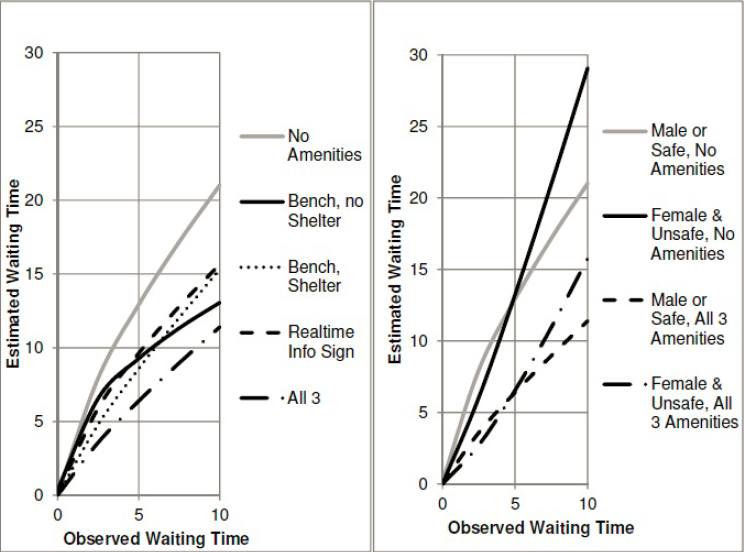
The gender breakdown comes from the fact that in unsafe neighborhoods, women perceive waits as even longer than the usual penalty, whereas in safe ones there is no difference between women and men.
The upshot is that if the wait time is 10 minutes, then passengers at a stop with a bench and shelter perceive the wait as 15 minutes, and if there’s also real-time information then this shrinks to 11 minutes. If there are no amenities, then passengers perceive a 15-minute wait when they’ve waited just 6.5 minutes and an 11-minute wait when they’ve waited just 4. In other words, to estimate the impact of shelter we can look at the impact of reducing waits from 10 minutes to 6.5, and if there’s also real-time info then it’s like reducing waits to 4 minutes.
If the wait is 5 minutes then the impact is similar. With bench and shelter the perceived wait is 8.5 minutes, equivalent to a 3-minute wait without any amenities; with real-time information, the perceived wait is 6.5 minutes, equivalent to a 2-minute wait without amenities. There is some scale-dependence, but not too much, so we can model the impact of shelter as equivalent to that of increasing frequency from every 10 minutes to every 6.5 minutes (without real-time displays) or every 4 minutes (with real-time displays).
I have some lit review of ridership-frequency elasticity here. On frequent buses it is about 0.4, but this is based on the assumption that frequency is 7.5-12 minutes, not 4-6 minutes. At the low end this is perhaps just 0.3, the lowest found in the literature I’ve seen. To avoid too much extrapolation, let’s take the elasticity to be 0.3. Fan-Guthrie-Levinson suggests shelter alone is equivalent to a 50-66% increase in frequency, say 60%; thus, it should raise ridership by 15%. With real-time info, make this increase 30%.
What I think of as the upper limit to acceptable cost of capital construction for rail is $40,000-50,000 per weekday rider; this is based on what makes activists in Paris groan and not on first principles. But we can try to derive an equivalent figure for buses. On the one hand, we should not accept such high costs for bus projects, since buses have higher operating expenses than rail. But this is not relevant to shelter, since it doesn’t increase bus expenses (which are mostly driver labor) and can fund its ongoing maintenance from ads. On the other hand, a $40,000/rider rail project costs somewhat more per new rider – there’s usually some cannibalization from buses and other trains.
But taking $40,000/rider as a given, it follows that a bus stop should be provided with shelter if it has at least ($15,000/$40,000)/0.15 = 2.5 weekday boardings. If the shelter installation includes real-time info then the denominator grows to 0.3 and the result falls to 1.25 weekday boardings.
In New York, there are 13,000 bus stops, so on average there are around 180 boardings per stop. Even in Rhode Island, where apparently the standard is that a bus stop gets shelter at 50 boardings (and thus there is very little shelter because apparently it’s more important to brand a downtown trunk as a frequent bus), there are 45,000 weekday riders and 3,000 stops, so at 15 riders per stop it should be fine too put up shelter everywhere.
The only type of stop where I can see an exception to this rule is alighting-only stops. If a route is only used in a peak direction, for example toward city center or away from city center, then the outbound stops may be consistently less used to the point of not justifying shelter. But even that notion is suspicious, as American cities with low transit usage tend to have weak centers and a lot of job and retail sprawl. It’s likely that a large majority of bus stops in Rhode Island and all stops within Providence proper pass the 2.5 boardings rule, and it’s almost guaranteed that all pass the 1.25 boardings rule. And that’s even before consolidating stops, which should be done to improve bus speed either way.
At least based on the estimates I’ve found, installing bus shelter everywhere is a low-hanging fruit in cities where this is not already done. In the situation of New York, this is equivalent to spending around $550 per new weekday rider on transit – maybe somewhat more if the busier stops already have shelter, but not too much more (and actually less if there’s stop consolidation, which there should be). Even in that of Providence, the spending is equivalent to about $6,600 per rider without stop consolidation, or maybe $3,000 with, which is much better than anything the state will be able to come up with through the usual channels of capital expansion.
If it’s not done, the only reason for it is that transit agencies just don’t care. They think of buses as a mode of transportation of last resort, with a punishing user experience. Cities, states, and transit agencies can to a large extent decide what they have money for, and letting people sit and not get drenched is just not a high priority, hence the “we don’t have money” excuse. The bosses don’t use the buses they’re managing and think of shelter as a luxury they can’t afford, never mind what published transportation research on this question says.
Prudence Theater
The phrase security theater refers to the elaborate selling of airport security to the public through humiliating spectacle, like making people take off their shoes, with no safety value whatsoever. By the same token, prudence theater is the same kind of ritual of humiliating people, often workers, in the name of not wasting money. Managers who engage in prudence theater will refuse pay hikes and lose the best employees in the process, institute hiring freezes at understaffed departments and wonder why things aren’t working, and refuse long-term investments that look big even if they have limited risk and high returns. This approach is endemic to authoritarian managers who do not understand the business they are running – such as a number of do-nothing political leaders who make decisions regarding public transit.
I’ve talked a bunch about this issue in the context of capital investment, for example Massachusetts’ Charlie Baker, California’s Gavin Newsom, New Jersey’s Chris Christie, and New York‘s Andrew Cuomo, using phrases such as “Chainsaw Al” and “do-nothing.” But here I want to talk specifically about operations, because there is an insidious kind of prudence theater there: the hiring freeze. The MBTA and MTA both have hiring freezes, though thankfully New York is a little more flexible about it.
Both New York and Boston have very high operating costs, for both subways and buses. They have extensive overstaffing in general, but that does not extend to overstaffing at every department. On the contrary, some departments are understaffed. Adam Rahbee told me a year and a half ago that subway operations planning in New York was short on workers, in contrast to the overstaffed department he saw in London. Of course London on average has much lower costs than New York, but individual departments can still be short on manpower even in otherwise-overstaffed cities. If anything, leaving one department understaffed can cause inefficiencies at adjacent departments, making them in effect overstaffed relative to the amount of service they can offer.
Bus dispatching
Buses require active supervision by a centralized control center that helps drivers stay on schedule. New York currently has 20 dispatchers but is planning an increase to 59, in tandem with using new technology. Boston has 5 at any given time, and needs to staff up to 15, which involves increasing hiring to about 40 full-time workers and doing minor rearrangement of office space to give them a place to work. With too few dispatchers, drivers end up going off-schedule, leading to familiar bunching, wasting hundreds of bus drivers’ work in order to save money on a few tens of supervisors.
I went over the issue of bus bunching in a post from last summer, but for the benefit of non-technical readers, here is a diagram that explains in essence what the problem of chaos is:

The marble on top of the curve is unlikely to stay where it is for a long time, because any small disturbance will send it sliding down one side or the other. Moreover, it’s impossible to predict in advance which direction the marble will land in, because a disturbance too small to see will compound to a big one over time.
Chaotic systems like this are ubiquitous: weather is a chaotic system, which is why it’s not possible to predict it for more than about two weeks in advance – small changes compound in unexpected directions. Unfortunately, bus service is a chaotic system too. For the bus to be on schedule is an unstable equilibrium. If the bus runs just a little behind, then it will have to pick up more passengers on its way, as passengers who would have just missed the bus will instead just make it. Those extra passengers will take some extra time to board, putting the bus even further behind, until the bus behind it finally catches it and the two buses leapfrog each other in a platoon.
There are ways to mitigate this problem, including dedicated bus lanes and off-board fare collection. But they do not eliminate it – they merely slow it down, increasing the time it takes for a bus to bunch.
The connection between dispatching and chaotic bus schedules may not be apparent, but it is real. The transportation engineering academic community has had to deal with the question of how to keep buses on schedule; here, here, and here are three recent examples. The only real way to keep buses on schedule is through active control – that is, dispatching. A dispatcher can tell a driver that the bus is too far ahead and needs to slow down, or that it is behind and the driver should attempt to speed up. If the traffic light system is designed for it, the dispatcher can also make sure a delayed bus will get more green lights to get back on track, a technology called conditional signal priority, or CSP. This contrasts with unconditional transit signal priority, or TSP, which speeds up buses but does not preferentially keep them evenly spaced to prevent bunching.
Moreover, some of the people who have done academic work on this topic have gone on to work in the transit industry, whether for the MBTA (such as David Maltzan and Joshua Fabian) or for thinktanks or private companies (such as Chris Pangilinan). Specific strategies to keep the buses on track include CSP giving delayed buses more green lights, holding buses at the terminal so that they leave evenly spaced, and in some cases even holding at mid-route control points. Left to their own devices, buses will bunch, requiring constant correction by a competent dispatching department with all the tools of better data for detection of where bunching may occur as well as control over the city’s streetlights.
Managers’ point view vs. passengers’ point of view
When I talk to transit riders about their experiences, I universally hear complaints. The question is just a matter of what they complain about. In suburban Paris people complain plenty about the RER, talking about crowding and about how the system isn’t as frequent or reliable as the Metro. These are real issues and indicate what Ile-de-France Mobilités should be focusing its attention on.
Americans in cities with public transit talk about bunching. In New York I’ve routinely sighted platoons of two buses even on very short routes, where such problems should never occur, like the 3 kilometer long M86. A regular rail user who talked to me a few months ago mentioned three-bus platoons in Brooklyn on a route that has a nominal frequency of about 10 minutes.
From the perspective of the transit operator or the taxpayer, if buses are scheduled to arrive every ten minutes, that’s an expenditure of six buses per hour. From that of the rider, if the buses in fact come in platoons of two due to bunching, then the effective frequency is 20 minutes, and most likely the bus they ride on will be the more crowded one as well. What looks like a service improvement to managers who never take the system they’re running may offer no relief to the customers on the ground.
I wish my mockery of transit managers who don’t use their own system were facetious, but it’s not. In New York, some of the more senior managers look at NYCT chief Andy Byford askance for not owning a car and instead using the subway to get to places. Planner job postings at North American transit agencies routinely require a driver’s license and say that driving around the city is part of the job. Ignorant of both the science of chaos and the situation on the ground, the managers and politicians miss low-hanging fruits while waxing poetic about the need to save money.
Is anything being done?
In New York there are some positive signs, such as the increase in the number of dispatchers. The warm reception Eric Goldwyn and I got from some specific people at the MTA is a good sign as well. The problem remains political obstruction by a governor and mayor who don’t know or care to know about good practices. Cuomo’s constant sidelining of Byford has turned into a spectacle among New York transit journalists.
In Boston, the answer is entirely negative. Last week’s draft of the Focus40 plan, released by the MBTA’s Fiscal Management and Control Board (FMCB), unfortunately entirely omits dispatching and operational supervision from its scope. It includes a variety of investments for the future, some of which are welcome, such as the Red-Blue Connector. But it reduces the issue of bus timetable keeping to a brief note in the customer experience section that mentions “Computer Aided Dispatch / Automatic Vehicle Location technology.” Good data is not a bad thing, but it is not everything. Warm bodies are required to act on this data.
Thus prudence theater continues. Massachusetts will talk about reform before revenue and about spending money wisely, but it is run by people with little knowledge of public transportation and no interest in acquiring said knowledge. Its approach to very real issues of high costs is to cut, even when there are parts of the system that are underfunded and undermanned. Staffing up to 15 dispatchers at a time, raising the headcount to about 40 full-time workers, would have the same effect on ridership as literally hundreds of bus drivers through better control. Will the administration listen? As usual, I hope for the best but have learned to expect the worst.
Battery-Electric Buses: New Flyer
Two months ago, after my article about battery-electric buses appeared in CityLab, New Flyer reached out to me for an interview. Already in one of the interviews I’d done for the article, I heard second-hand that New Flyer was more reasonable than Proterra and BYD and was aware of the problem of battery drain in cold weather. I spoke to the company’s director of sustainable transportation, the mechanical engineer David Warren, and this confirmed what I’d been told.
Most incredibly, I learned at the interview that the headline figures used in the US for electric bus performance explicitly exclude heating needs. The tests are done at the Altoona site and only look at electricity consumption for propulsion, not heating. New Flyer says that it is aware of this issue and has tried not to overpromise, but evidently Proterra and BYD both overpromise, and regardless of what any vendor says, American cities have bought into the hype. In Duluth this was only resolved with fuel-fired heaters; the buses only use electricity for propulsion, which is not the majority of their energy consumption in winter.
Warren and I discussed New York specifically, as it has a trial there on the M42. The heater there puts out 22 kW of energy at the peak, but on the day we discussed, January 29th, when the air temperature was about -7*, actual consumption was on average about 10 kW. Electricity consumption split as 40% heating, 20% propulsion, and 40% other things, such as the kneeling system for easier boarding.
The battery can last many roundtrips on the M42, specifically a very slow route. Electric vehicles tend to do much better then fuel-powered ones at low speed in city traffic, because of regenerative braking and higher efficiency. When I discussed the Proterra trial with MVTA, I was told specifically that the buses did really well on days when the temperature was above freezing, since the battery barely drained while the bus was sitting in rush hour Downtown Minneapolis traffic. This pattern is really a more extreme version of one that may be familiar to people who have compared fuel economy ratings for hybrid and conventional cars: hybrids are more fuel-efficient in city driving than on the highway, the opposite of a non-hybrid, because their electric acceleration and deceleration cycles allow them some of that regeneration.
The current system is called OppCharge (“opportunity charging”), and currently requires the bus to spend 6 minutes out of every hour idling for recharge; the Xcelsior presentation shows a bus with a raised pantograph at a charging station, and I wonder whether it can be extended to an appropriate length of wire to enable in-motion charging.
The New Flyer examples I have seen are in large cities – New York and Vancouver. New York’s system for opportunity charging does not require an attendant; Vancouver’s may or may not, but either way the charging is at a bus depot, where the logistics are simpler. In contrast, in Albuquerque the need for midday charging was a deal breaker. When I talked to someone who knew the situation of Albuquerque’s BRT line, ART, I was told that the BYD midday charge system would require an attendant as well as room for a charging depot. Perhaps an alternative system could get rid of the attendant, but the land for a bus that at the end of the day isn’t that busy has nontrivial cost even in Albuquerque.
Even with opportunity charging, batteries remain hefty. Warren said that they weigh nearly 4 tons per standard-length bus; the XE40 weighs 14 metric tons, compared with 11.3 for the older diesel XD40 platform. Specifically on a short, high-ridership density like the M42 and many other New York buses, there is likely to be a case for installing trolleywire and using in-motion charging. In-motion charging doesn’t work well with grids, since it is ideally suited to when several branches interline to a long trunk route that can be electrified, but ultimately it’s a bus network with ridership density comparable to that of some big American light rail networks like Portland’s.
*In case it’s unclear to irregular readers, I exclusively use metric units unless I mention otherwise, so this is -7 Celsius and not -7 Fahrenheit; the latter temperature would presumably drain the battery a lot faster.
Quick Note: the Importance of Long-Term Planning
Last week, Strong Towns ran a piece complaining about what it calls “go big or go home” transit. Per Strong Towns’ Daniel Herriges, rail expansion takes 20 years and reflects an obsession with megaprojects, so it’s better to look at small things. Strong Towns’ take is as follows:
“After 20 years of planning, the North Carolina Research Triangle’s signature transit project is fighting for its life.”
Boy. If this sentence doesn’t perfectly capture the folly of our megaproject-obsessed transit paradigm, we don’t know what does.
Here’s a better idea: Ask transit riders in Durham and Chapel Hill what’s the next, small step you could take that would improve their commutes *this* year. Then do it. Then next year, ask the same question. There are so many pressing needs going unmet while our cities focus on shaky silver-bullet efforts like this one; what do we have to lose?
It’s a perfect encapsulation of what is wrong with more traditionalist attitudes toward urbanism and green transport, and I want to explain why.
Short-term thinking – “what could improve this year” – does not scale. The Strong Towns article talks about scalability as a reason to improve bus service and add sidewalks rather than adding urban rail, but the reality is the exact opposite. Incrementalism works in cities that have 35% transit mode share and want to go up to 50% – and since, in the first world, all of these cities have rapid transit systems, getting to 50% means building more lines, as is happening in Paris and Berlin and London and Stockholm and Vienna and Copenhagen, and the last three don’t even have that many more people than the Research Triangle, where the rail link in question is to be built.
The Research Triangle does not have 35% transit mode share. For work trips the share in the Durham-Raleigh combined statistical area is 1.4%. All the things that year-by-year incremental progress does do not work, because improving the bus network increases ridership in relative numbers to current traffic.
Strong Towns understands this, in a way. It uses the “what do we have to lose?” language. And yet, it recommends not doing anything of importance, because building big things means megaprojects. Megaprojects involve doing something that visibly involves the government, requires central planning, and is new to the region. They empower planners whose expertise comes from elsewhere, because the local knowledge in a 1.4% transit share region is 100% useless for offering transportation alternatives.
It’s a mentality that seems endemic to groups that romanticize midcentury small towns. Strong Towns literally names itself after the idea of the old small-town main street, in which cars exist but do not dominate, back before hypermarkets and motorway bypasses and office parks changed it all. It’s an idea that evokes nostalgia among people who grew up in cities like that or in suburbs that imitated them and dread among people who didn’t. And it’s completely dead, because it’s too small-scale for transit to work and too spread out for a developer to have any interest in reproducing it today.
Transit revival doesn’t look like the 1950s, and planning for it doesn’t involve the same social groups that dominated then. That era between World War Two and the counterculture was dominated by an elite consensus that built megaprojects, but the middle-class elements of said consensus were precisely the one that bolted to the anti-state New Right, with its ethos of mocking the idea of “I’m from the government and I’m here to help.”
In a metro area that wants to get from 1.4% transit share to a transit share that’s not a rounding error, a few things need to happen, and none of them will make nostalgists happy. First, planning has to be for the long term. “What can be done this year?” means nothing. Second, extensive redevelopment is required, and it can’t be incremental. If you want transit-oriented development, look at what Calgary did in city center and what Vancouver did around suburban stations like Metrotown and Edmonds and do it in your Sunbelt American city. Third, wider sidewalks are cool and so is more bus service, but in a spread-out region, interurban rail is a must, and this means big projects with an obtrusive government and a public planning process. And fourth, people will complain because not everything is a win-win, and the government will need to either ignore those people (if they’re committee meeting whiners) or break them (if they’re Duke, which is opposing the light rail line on NIMBY grounds).
American transit reformers tend not to know much about good practices, but many are interested in learning. But then there are the ones who cling to traditional railroading, mixed-traffic heritage streetcars, village main streets, or really anything that lets them portray the car as an outside enemy of Real America rather than its apex with which it annihilated groups it deemed too deviant. It’s an attractive mythology, playing to a lot of powerful notions of community. It’s also how American cities got to be the car-choked horrors that they are today, rather than how they will turn into something better.
The Boundary Between the Transit City and Auto-Oriented Suburbia
Public transportation use is higher in cities than in suburbs. Cities with stronger transit networks have larger transit-rich, auto-hostile cores, and some have good transit in lower-density suburbs, but ultimately the transit city has a limited radius, beyond which automobiles dominate. Successful examples of suburban transit, like Zurich, just keep the city-suburb gradient shallower than in other transit cities.
The most fascinating aspect of this is the boundary between the transit-oriented city and the auto-oriented suburbs. Uniquely in the metro area, the boundary region has good access by car as well as by transit, making it ideal for uses that want to interface with both modes of transportation. This specifically includes bus stations, stadiums, and big box retail, as well as more sporadic meeting points between urban and suburban residents.
Where the boundary is
Because the boundary zone is defined by good transit as well as highway access, it may not be the literal boundary as defined by modal split, car ownership, or any other metric of transportation usage. It can be the outer end of some rail line extending into the suburbs, and in that case it may be a salient into auto-oriented territory. There are a number of examples in the United States, where the postwar rapid transit projects have not been accompanied by much transit-oriented development, and thus their outer stations are in low-density suburbs where transit service functions as expensive S-Bahns. BART and most of the Washington Metro are like this, as are the suburban lines of the Boston subway.
For example, here is Newton Centre, on the Green Line D branch:
The light rail station is just to the left (south) of the street. This is a walkable suburban street with a train that comes pretty frequently all day, and yet the dominant mode of transportation here is clearly cars, as one can see in the parking lot to the left. Transit usage here is similar to the metro area’s average – Newton averages 11.9%, the Boston metro area 13.4% – but this says more about the rest of metro Boston than about Newton Centre. Nonetheless, such a location is convenient to access from the city if one lives near the Green Line, and is also reasonable convenient by car, as it is just 4 km from the freeway, and the majority of the distance is along the fast arterial that is Route 9.
The importance of highway access also works in reverse. In cities with strong transit networks and weak motorway network, there may be a freeway salient into the city, creating a zone that is car-friendlier than the rest. If it also has ample parking, which it usually does, then it will end up creating a boundary within an area that is on most metrics transit-oriented.
In London, the urban renewal zones around Stratford and Canary Wharf are examples – the city is unusually poor in freeway infrastructure, but two of the few radial motorways hit these two business districts. Here is Stratford:

The built-up density is high, and Stratford is one of the busiest Underground stations. But the roads are big for the city they’re in and there are large surface parking lots all over.
I’m deliberately including two examples with very different urban layouts and actual transit usage levels to hammer home the point that the boundary is defined merely by the existence of supportive infrastructure for both cars and public transit.
Can the entire city be friendly to both cars and public transit?
No.
There are several reasons for this. The first and most fundamental is that public transit is only successful if it can leverage scale. The adage frequency is freedom comes from this fact, but the same can be said about related issues of span, reach, and network effects. This is why frequency-ridership spirals are so dangerous – a small cut in service can lead to a much greater reduction in ridership.
The second reason is that drivers prefer a different urban layout from transit users, cyclists, and pedestrians. Cars are space-intensive on the road as well as on the parking lot, but can achieve high average speed if there’s no traffic, so they end up preferring spread-out development. Public and active transport are space-efficient but involve a lot of slow walking, so they prefer dense development at distinguished nodes with train stations, featuring strong commercial city centers with high job concentration. The boundary zone I speak of must be underlain by a strong enough transit network in the city core that people will fill the trains at all hours of day.
Concretely, neither the example of Newton nor that of Stratford can work citywide. Newton cannot work citywide because if every residential metro station is a parking lot, then nobody will ride the trains off-peak, and the city will de facto be exclusively auto-oriented as a result. Two years ago I compared the proportion of boardings at suburban stations that occur in the morning peak in New York (67% LIRR, 69% Metro-North) and Paris (46% on the SNCF network). Well, I would later find data for the Washington Metro, which has high off-peak frequency like the RER but low-density parking lot stations like the LIRR and Metro-North, and the proportion of riders in the morning peak is much closer to that of the LIRR than to that of the RER.
Likewise, Stratford can’t work citywide, because most of the city is not a reclaimed railyard with enormous space for all manners of new development. Building the expansive motorway network that would allow cars to rapidly reach every part of the city would normally require extensive neighborhood demolitions; American cities only managed to do so because to the road builders, destroying working-class (and often black) neighborhoods was a feature rather than a bug. Building a new city with ample road infrastructure is possible without this history, but then one gets Houston, hardly an example of good transit accessibility.
Land use at the boundary
The boundary zone’s unique accessibility by both cars and transit makes it ideally suited for land use that really wants both. Such land use has to have the following features:
- It needs to have a large regional draw, or else distinct neighborhood centers, some transit-oriented and some car-oriented, can do better.
- It needs to specifically benefit from good highway access, for example for deliveries, but also from good transit access.
- It is not so high-value that city center’s better transit access in multiple directions trumps access by transit in one direction and by cars in another.
Sporadic meetings satisfy all three criteria. For one personal example, in 2013 I visited New York and participated in a LARP taking place in a camp somewhere in Massachusetts, accessible only by car; I traveled with friends in the suburbs and we arranged that they would pick me up at Southeast, the northern end of the Metro-North Harlem Line’s electrification, so chosen because of its excellent multidirectional freeway access.
I bring up LARPing because it’s such a small community that it has to draw regionwide – in the case of the one I went to, participants came from all over Eastern New England and even beyond – and thus, anywhere with lower transit usage than New York, must appeal primarily to the driver, not the transit user. Nerdy conventions in general tend to either be enormous, like Comic-Con, or take place in cheap suburban edge city hotels, with meetings for carpools arranged at choice suburban train stations.
More common uses that like the boundary zones include major stadiums and big box retail. Stadiums appeal to a broad section of the population with little differentiation between city residents and suburbanites. They have to have good transit access even in auto-oriented American cities for reasons of capacity, but they also have to have good auto access for the use of drivers; stadiums are land-intensive enough that they can’t locate in city center at all, with its omnidirectional transit access, so instead they must be at the boundary zone. Thus Stratford hosts the London Stadium, the Stade de France is in Saint-Denis with good motorway as well as RER access, and Yankee Stadium is tucked at a corner of the Bronx with two subway lines and good expressway infrastructure.
Big box retail is more complicated – for one, its draw is so local that even a small city can support several Walmarts, Carrefours, and Aldis (Walmart is weak in big cities, but the big European retailers aren’t). Nonetheless, boundary zone stores exist: the big supermarket I’m most familiar with in Boston, Star Market at Porter, is on top of a subway station but also has a large parking lot, while the supermarket I shop at here in Berlin, Kaufland, is a two-story big box next to the Gesundbrunnen U- and S-Bahn station, with the ground floor devoted to parking.
I suspect the reason big box retail likes the boundary zone is that while it is local, there are extensive mixed areas rich in both drivers and non-drivers, where a big store must appeal to both in order to succeed. The Gesundbrunnen area is one of the city’s densest, but car ownership in Berlin is still higher than in Paris or New York. The same is true of the area around Porter Square in Cambridge and Somerville, albeit at lower density and with lower transit usage, so Star Market puts its parking on the surface rather than in a structure.
Bus station siting
The most interesting land use that prefers the boundary zone, and the origin of this post, is the intercity bus station. Here is Herbert in comments:
Can you do a post on the contradictory demands for the site of the main intercity bus station?
On the one hand, it is desirable that it is within easy reach from the highway. On the other hand it should be as close to downtown as possible and also easily reachable by public transit. And last but not least there should of possible be one interchange station for every city for connecting passengers.
It’s almost impossible to find a site that goes all requirements. Berlin ZOB certainly doesn’t…
Whereas train stations have obvious preferred sites – the central business district – bus stations have to balance centrality with highway access. In Paris, this is Gallieni. This station is just outside the city at the end of Metro Line 3, where the Boulevard Peripherique meets the A3 autoroute, which connects to further motorways with good access to the north, south, and east. Like Stade de France, Gallieni is a salient of the auto-oriented suburbs almost into city limits, in inner suburbs with high public transit usage.
In New York, there are a few sites that would work fine, but each points in a different direction, making interchange difficult. Port Authority is excellent for buses going to New Jersey and points west and south, and curbside buses tend to pick up in that general area as well, often near Hudson Yards; this is facilitated by a unique situation in which the Lincoln Tunnel has a dedicated inbound bus lane in the morning peak, which many area transit activists wish existed in both directions all day. Buses to Boston could depart from Yankee Stadium, which also benefits from being just beyond the outer end of subway express service, so that travel speeds to Manhattan are faster. However, in practice they depart from the same curbside location on the Far West Side as the buses to Philadelphia and Washington, frustrating riders who see their bus spend an hour in city traffic.
The situation of New York is unusual in that it is located next to two wide rivers with few crossings, and thus does not have a proper orbital motorway with a location like Gallieni. But New York is not unique in having difficult bus station siting choices. London has the same problem: for one, the M25 orbital is so far out of the city; and perhaps more importantly, British buses are priced cheaper than trains in order to control crowding levels on trains to London, and thus dumping bus passengers on a regional train to Central London would be strictly worse than just letting them ride the train the entire way for a reasonable fare.
Stroads and Strails
In 2011, Chuck Marohn of Strong Towns coined the word stroad for a street that functions as a road. Chuck argues that there should be a separation between streets, which are destinations in and of themselves and are to be lined with walkable retail, and roads, which exist to move people between destinations. In contrast, auto-oriented arterials function as both: they are designed for high speed for through-traffic but also have extensive streetside destinations built at automobile scale, hence the portmanteau stroad.
In the last seven years this mentality has become quite popular within online urbanist circles. Unfortunately, it misses why major streets arise in the first place. Moreover, this is not just an issue for cars and car traffic – other modes of transportation want to funnel local and interregional traffic through the same corridors, creating a number of arteries that are in essence strails, like the Berlin S-Bahn. Good planning has to recognize that where people to go through and where people want to go to are often the same, and provide road and rail infrastructure of sufficient size to accommodate.
What is a street, anyway?
The main purpose of a city street is to connect destinations within the city. Major streets routinely form out of trails, post roads, and turnpikes connecting the city with villages that it swallows as it industrializes and grows. Broadway in New York started out as an Indian trail, the Strand grew as a road connecting London with Westminster and had previously been part of an intercity Roman road, Champs Elysees was built as a promenade into the periphery of Paris and gradually filled in with palaces, the Sveavägen/Götgatan axis goes back to the Early Modern era with connections from Stockholm to Roslag to the north and Götland in the south.
Not every street has this intercity or suburban history, but the important ones frequently do. The Manhattan grid was mapped as an entirely urban street network, but the wide north-south avenues were designed for easy access to the Lower Manhattan core from future residential areas. In ungridded cities, usually you can tell which streets are the oldest because they are longer, more continuous, and more commercially developed, and the exceptions come from heavyhanded state planning, like the shift from Rue Saint-Jacques to Boulevard Saint-Michel in Haussmannian Paris.
The importance of through-streets within cities continues even today, and even when cars are not too relevant. People who walk or take transit are likelier to do so on the main streets, and as a result, businesses prefer locating there. In Manhattan there’s even an expression for this: avenue rents versus street rents. In Vancouver, I could walk on any street, but crossing wasn’t any harder on the main streets than on the side streets, and there was more interesting stuff to look at on the main streets; even ignoring zoning, retail would prefer to locate on the main streets because that’s where all the other retail is. There’s a wealth of good restaurants I discovered just by walking next to them, to say nothing of the gaming store on 4th Avenue near MacDonald, which I saw from the bus to UBC.
All of this is magnified in cities that do not have consistent grids, like Paris, Berlin, and even Stockholm. In those cities, zoning does not micromanage use as much as in North America, and yet businesses locate on major streets where possible. Here is a map of the area I live in: the green dot is where I live, and the red dot is a government office I went to last week to register.
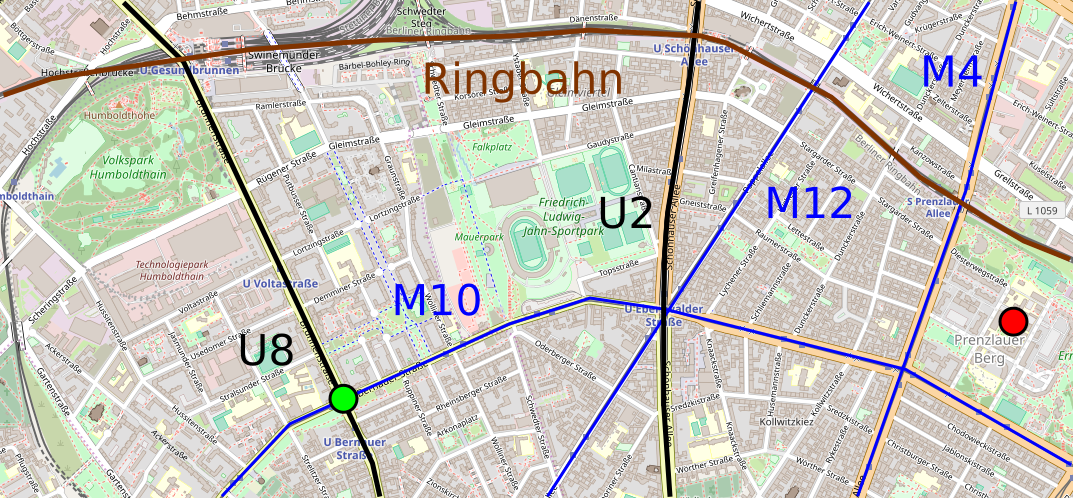
Walking east or west, I exclusively use Bernauer Strasse, the street the M10 tramway runs on; walking north or south, I use Brunnen Strasse, which hosts U8. Other streets can function as shortcuts, but with parks and small changes interrupting the grid, they’re less reliable for through-walking. And indeed, they are much quieter and largely residential, with retail mostly at street corners.
The invention of the stroad
The early American roads connected distinct cities, or linked cities with rural hinterlands. Within the cities, they fed preexisting arterial streets. For the most part these arterial streets were fairly wide – they were mapped in the 19th century based on 19th-century design standards, often 30 meters of width, rather than the narrow medieval streets London is famous for – but they still filled with cars fast. Two parking lanes and four moving lanes in a dense city with busy crossings aren’t much. American cities had traffic jams in the 1920s already.
My two go-to references about the history of American roadbuilding – Owen Gutfreund’s 20th-Century Sprawl, and Earl Swift’s The Big Roads – both explain what happened beginning in the 1920s: cities built bypasses. The idea was that the bypasses would segregate through-traffic from urban traffic, separating roads from streets properly.
This never happened. For the same reason preindustrial roads turned into busy streets, bypasses turned into busy auto-oriented streets. Retailers found that the best place to locate was where all the cars were. These bypasses became congested roads themselves, partly due to the induced auto-oriented development and partly due to general growth in car traffic volumes. This trend intensified after WW2, with the freeways leading another cycle of bypasses around congested urban roads becoming congested with urban traffic themselves. Wal-Mart and Carrefour invented the hypermarket in 1962-3, and in the 1960s office space began suburbanizing as well, since traffic conditions were better than in congested city centers.
This is not an obscure history, and Chuck is fully aware of it: among his complaints about stroads is that they reduce the tax base of the city by encouraging retail to decamp for the suburbs. He just fails to follow this through to the logical conclusion: the most intense demand for real estate is near the busiest through-routes. There is no real separation between the street and the road; the best you can do for walkability is run better public transit to the urban core and make sure the roads have street-facing retail rather than front parking lots.
Strails
The principle that the best place for local traffic is where long-distance traffic is is equally true of trains. An intermediate station on an intercity railway sited a convenient commute away from the city will soon fill with suburban travelers. The term commuter itself derives from the discounted commutation tickets American intercity railroads offered regular riders, starting in New York and Boston in the middle of the 19th century.
19th-century railways were not a complex system of branched lines dedicated to regional traffic. Such lines existed, for example the Ligne de Saint-Germain-en-Laye, now part of the RER A, but most of the lines continued onward to long-distance destinations, or had been built with the intention of continuing so. Look at this map of extant London-area railways by year of construction: there aren’t that many branches predating the Late Victorian era, and the branches that do exist tend to be reverse-branches in South London offering service to either a City station like Cannon Street or Blackfriars or a West End station like Victoria. The remainder are loop lines, built to offer four tracks’ worth of capacity on lines that had originally been built with only two, but then both routes filled with local traffic, making it harder to schedule express trains; for an example easily visible on the map, see the Lea Valley lines connecting to Cheshunt.
In contrast with the London loop lines, Prussian State Railways made sure to rebuild the Ringbahn and Stadtbahn to have adequate capacity, that is four tracks, two for local service and two for longer-distance service; the Ringbahn had initially been built with two tracks, but would be expanded to four in the 1880s and 90s. But even here, there are seams. German Wikipedia explains that the Stadtbahn had to take a less desirable route to avoid expensive takings on Leipziger Strasse, and has a winding route with S-curves between Alexanderplatz and Jannowitz Brücke. Moreover, some individual branches only have two tracks even if they are the best intercity routes: the S2 route is the most direct route to Dresden, but with two tracks, heavy local traffic, and only DC electrification, it cannot host intercity trains, and thus intercity trains to Dresden spend 20 minutes out of a 2-hour trip getting around this line.
Berlin at least has the good fortune that four tracks here are enough. Tokyo is so big and strongly-centered that it has ten tracks going south of Tokyo on the Tokaido Line and eight going north on the Tohoku Line, including four for local service, two for Shinkansen service, and two or four for medium-distance express regional trains. Widening railways to serve city centers is expensive, and only done when absolutely necessary, and yet JR East spent considerable money on widening the innermost Tohoku trunk from six to eight tracks.
Even high-speed rail can induce the same development effect as a freeway. It doesn’t have closely-spaced stations, but people might demand stations as a mitigation of construction impact and train noise. The Tohoku Shinkansen diverges from the Tohoku Main Line a few kilometers north of Tokyo, but the local communities demanded local service as well as a mitigation, and as a result Japan National Railways built a four-track line, with two Shinkansen tracks and two local tracks for the Saikyo Line.
Main streets want to be everything
Major streets are the best location for every destination and every mode of transportation. This extends beyond walking. Buses prefer wide streets optimized for higher traffic speed – and the few main streets that are not so optimized, such as the Manhattan crosstown streets (since traffic is optimized for north-south avenue throughput), have buses that win awards for how slow they are. Bicyclists prefer riding on major streets as well, which is why Copenhagen prioritizes bike infrastructure on major streets rather than on side streets – on side streets car traffic is so light and slow that mixed traffic is not so bad, but the desirable through-routes remain the major streets.
The problem is that every mode of transportation requires some piece of the street, whereas street width is finite. Brunnen Strasse is 40 meters wide, and hosts very wide sidewalks including a dedicated path for on-sidewalk cycling, a combination of parallel and angled parking, two moving lanes in each direction, and a generous road median. Even that width does not include dedicated public transit infrastructure: U8 runs underneath the street, leaving the street’s width for sidewalks and roadways.
The same situation occurs on railroads: all uses want the same piece of infrastructure, leading to the usual problems of mixing trains of different speed classes on the same tracks. Freight bypasses are possible, but passenger bypasses are rare – train passengers tend to want to go to the city rather than to some suburb, and unlike cars, trains have prescribed stop patterns. By rail as by road, bigger infrastructure is needed: four tracks for a mixed local and interregional railway, or about 36-40 meters or even more on a main street.
Wide enough streets don’t exist everywhere. New England streets are narrow. Midwestern streets are wider, but at least the one I’m most familiar with, Ann Arbor’s Washtenaw Avenue, is only around 25 meters wide – it only gets up to 40 if one includes setbacks. Road widening would be needed, which is exactly the opposite of what the Strong Towns approach prescribes. Cities this small could mix decent local and intercity rail service on two tracks with timed overtakes, but that would require them to run any passenger rail service to begin with, and to make sure to have enough development near the stations, both residential and commercial, that people would ride the trains.
But on a 30-meter wide street, something has to give. There simply is not enough room for everything. Give pedestrians their 4 or 5 meters of sidewalk in each direction, cyclists their 2 meters of bike lane, and cars their parking lane and two moving lanes, and you’re already at 30-32 meters. You can go with complete streets and reduce the extent of car infrastructure, for example by turning a moving lane per direction into a bus or tram lane, or by getting rid of street parking, but unless you’re in a city with high transit mode share, you’re driving away eyeballs from retailers. Paris can definitely do it, New York and Berlin can do it, even Boston can do it. Can a small American city where planners aspire to run a handful of buses every 15 minutes do it? Probably not.

