Category: Urban Transit
How Comparisons are Judged
I’m about to complete the report for the Transit Costs Project about Sweden. For the most part, Sweden is a good comparison case: its construction costs for public transport are fairly low, as are those of the rest of Scandinavia, and the projects being built are sound. And yet, the Nordic countries and higher-cost countries in the rest of Northern Europe, that is Germany and the Netherlands, share a common prejudice against Southern Europe, which in the last decade or so has been the world leader in cost-effective infrastructure. (Turkey is very cheap as well but in many ways resembles Southern Europe, complete with having imported Italian expertise early on.)
This is not usually an overt prejudice. Only one person who I’ve talked to openly discounted the idea that Italy could be good at this, and they are not Nordic. But I’ve been reading a lot of material out of Nordic countries discussing future strategy, and it engages in extensive international comparisons but only within Northern Europe, including high-cost Britain, ignoring Southern Europe. The idea that Italians can be associated with good engineering is too alien to Northern Europeans.
The best way to illustrate it is with a toy model, about the concept of livable cities.
Livable cities
Consider the following list of the world’s most livable cities:
- Vienna
- Stockholm
- Auckland
- Zurich
- Amsterdam
- Melbourne
- Geneva
- Copenhagen
- Munich
- Vancouver
The list, to be clear, is completely made up. These are roughly the cities I would expect to see on such a list from half-remembering Monocle’s actual lists and some of the discourse that they generate: they should be Northern European cities or cities of the peripheral (non-US/UK) Anglosphere, and not too big (Berlin might raise eyebrows). These are the cities that urbanist discourse associates with livability.
The thing is, prejudices like “Northern Europe is just more livable” can tolerate a moderate level of heresy. If I made the above list, but put Taipei at a high place shifting all others down and bumping Vancouver, explaining this on grounds like Taipei’s housing affordability, strong mass transit system, and low corona rates (Taiwan spent most of the last two years as a corona fortress, though it’s cracked this month), it could be believed. In effect, Taipei’s status as a hidden gem could be legitimized by its inclusion on a list alongside expected candidates like Vienna and Stockholm.
But if instead the list opened with Taipei, Kaohsiung, Taichung, and Tainan, it would raise eyebrows. This isn’t even because of any real criteria, though they exist (Taiwan’s secondary cities are motorcycle- and auto-oriented, with weak metro systems). It just makes the list too Taiwanese, which is not what one expects from such a list. Ditto if the secondary Taiwanese cities were bumped for other rich Asian cities like Singapore or Seoul; Singapore is firmly in the one-heresy status – it can make such a list if every other city on the list is as expected – but people have certain prejudices of how it operates and certain words they associate with it, some right and some laughably wrong, and “livable” is not among them.
The implication for infrastructure
A single number is more objective than a multi-factor concept like livability. In the case of infrastructure, this is cost per kilometer for subways, and it’s possible to establish that the lowest-cost places for this are Southern Europe (including Turkey), South Korea, and Switzerland. The Nordic countries used to be as cheap but with last decade’s cost overruns are somewhat more expensive to dig in, though still cheaper than anywhere else in the world; Latin America runs the gamut, but some parts of it, like Chile, are Sweden-cheap.
Per the one-heresy rule, the low costs of Spain are decently acknowledged. Bent Flyvbjerg even summarized the planning style of Madrid as an exemplar of low costs recently – and he normally studies cost overruns and planning failures, not recipes for success. But it goes deeper than just this, in a number of ways.
- While Madrid most likely has the world’s lowest urban subway costs, the rest of Southern Europe achieves comparable results and so does South Korea. So it’s important to look at shared features of those places and learn, rather than just treat Spain as an odd case out while sticking with Northern European paradigms.
- Like Italy, Spain has not undergone the creeping privatization of state planning so typical in the UK and, through British soft power, other parts of Northern Europe. Design is done by in-house engineers; there’s extensive public-sector innovation, rather than an attempt to activate private-sector innovation in construction.
- Southern European planning isn’t just cheap, but also good. Metro Milano says that M5 carries 176,000 passengers per day, for a cost of 1.35b€ across both phases; in today’s money it’s around $13,000 per rider, which is fairly low and within the Nordic range. Italian driverless metros push the envelope on throughput measured in peak trains per hour, and should be considered at the frontier of the technology alongside Paris. Milan, Barcelona, and Madrid have all been fairly good at installing barrier-free access to stations, roughly on a par with Berlin; Madrid is planning to go 100% accessible by 2028.
- As a corollary of point #3, there are substantial similarities between Southern and Northern Europe. In particular, both were ravaged by austerity after the financial crisis; Northern Europe quickly recovered economically, but in both, infrastructure investment is lagging. In general, if you keep finding $10,000/rider and $15,000/rider subways to build, you should be spending more money on more subway lines. Turkey is the odd one out in that it builds aggressively, but on other infrastructure matters it should be viewed as part of the European umbrella.
- Italian corruption levels in infrastructure are very low, and from a greater distance this also appears true of Spain. Italy’s governance problems are elsewhere – the institutional problems with tax avoidance drag down the private sector, which has too many family-scale businesses that can’t grow and too few large corporations, and not the public sector.
I’m not going to make a list of the cities with the best urban rail networks in the world, even in jest; people might take this list as authoritative in ways they wouldn’t take a list I made up about livability. But in the same way that there are prejudices that militate in favor of associating livability with Northern Europe and the peripheral Anglosphere, there are prejudices that militate in favor of associating good public transport with Northern and Central Europe and the megacities of rich Asia. All of those places indeed have excellent public transportation, but this is equally true of the largest Southern European cities; Istanbul is lagging but it’s implementing two large metro networks, one for Europe and one for Asia, and already has Marmaray connecting them under the Bosporus.
And what’s more, just as Southern Europe has things to learn from Northern Europe, Northern Europe has things to learn from the South. But it doesn’t come naturally to Germans or Nordics. It’s expected that every list of the best places in Europe on every metric should show a north-south gradient, with France anywhere in between. If something shows the opposite, it must in this schema be unimportant, or even fraudulent. Northerners know that Southerners are lazy and corrupt – when they vacation in Alicante they don’t see anyone work outside the hospitality industry, so they come away with the conclusion that there is no high-skill professional work in the entire country.
But at a time when Germany is building necessary green infrastructure at glacial rates and France and Scandinavia have seen real costs go up maybe 50% in 20 years, it’s necessary to look beyond the prejudice. Madrid, Barcelona, Rome, Milan, Istanbul, Lisbon, and most likely also Athens have to be treated as part of the European core when it comes to urban rail infrastructure, with as much to teach Stockholm as the reverse and more to teach Berlin than the reverse.
Consolidating Stops with Irregular Spacing
There was an interesting discussion on Twitter a few hours ago about stop consolidation on the subway in New York. Hayden Clarkin, the founder of TransitCon, brings up the example of 21st Street on the G in Long Island City. The stop is lightly-used and very close to Court Square, which ordinarily makes it a good candidate for removal, a practice that has been done a handful of times in the city’s past. However, the spacing is irregular and in context this makes the stop’s removal a lower-value proposition; in all likelihood there should not be any change and trains should keep calling at the station as they do today.
What is 21st Street?
The G train, connecting Downtown Brooklyn with Long Island City directly, makes two stops in Queens today: Court Square, at the southern end of the Long Island City business district, and 21st Street, which lies farther south. Here is a map of the area:
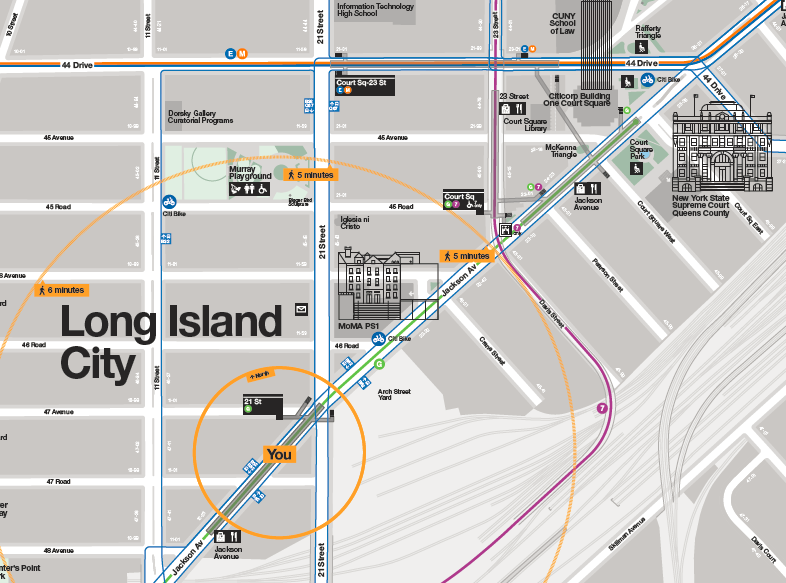
At closest approach, the platforms of 21st are 300 meters away from those of Court Square on the G; taking train length into account, this is around 400 meters (the G runs short trains occupying only half the platform). Moreover, Court Square is a more in-demand area than 21st Street: Long Island City by now near-ties Downtown Brooklyn as the largest job center in the region outside Manhattan, and employment clusters around Queens Plaza, which used to be one stop farther north on the G before the G was curtailed to Court Square in order to make more room for Manhattan-bound trains at Queens Plaza. Court Square is still close to jobs, but 21st Street is 400 meters farther away from them, with little on its side of the neighborhood.
Stop spacing optimization
Subways cannot continuously optimize their stop spacing the way buses can. Building a new bus stop costs a few thousand dollars, or a few ten thousand if you’re profligate. Building a new subway stop costs tens of millions, or a few hundred million if you’re profligate. This means that the question of subway stop optimization can only truly be dealt with during the original construction of a line. Subsequently, it may be prudent to build a new stop but only at great expense and usually only in special circumstances (for example, in the 1950s New York built an infill express station on the 4 and 5 trains at 59th, previously a local-only station, to transfer with the N, R, and W). But deleting a stop is free; New York has done it a few times, such as at 18th Street on the 6 trains or 91st on the 1. Is it advisable in the case of 21st?
The answer has to start with the formula for stop spacing. Here is my earliest post about it, in the context of bus stops. The formula is,

The factor of 4 in the formula depends on circumstances. If travel is purely isotropic along the line, then the optimum is at its minimum and the factor is 2. The less isotropic travel is, the higher the factor; the number 4 is when origins are purely isotropic, which reflects residential density in this part of New York, but destinations are purely anisotropic and can all be guaranteed to be at distinguished nodes, like business centers and transfer points. Because 21st Street is a residential area and Court Square is a commercial area and a transfer point, the factor of 4 is justified here.
Walk speed is around 1.33 m/s, the walk penalty is typically 2, the stop penalty on the subway is around 45 seconds, and the average unlinked trip on the subway is 6.21 km; the formula spits out an optimum of 863 m, which means that a stop that’s 400 meters from nearby stops should definitely be removed.
But there’s a snag.
The effect of irregular stop spacing
When the optimal interstation is 863 meters, the rationale for removing a stop that’s located 400 meters from adjacent stations is that the negative impact of removal is limited. Passengers at the stop to be removed have to walk 400 meters extra, and passengers halfway between the stop and either of the adjacent stops have no more walking to do because they can just walk to the other stop; the average extra walk is then 200 meters. The formula is based on minimizing overall travel time (with a walk penalty) assuming that removing a stop located x meters from adjacent stops incurs an extra walk of x/2 meters on average near the station. Moreover, only half of the population lives near deleted stops, so the average of x/2 meters is only across half the line.
However, this works only when stop spacing is regular. If the stop to be removed is 400 meters from an adjacent stop, but much farther from the adjacent stop on the other side, then the formula stops applying. In the case of 21st Street, the next stop to the south, Greenpoint Avenue, is 1.8 km away in Brooklyn, across an unwalkable bridge. Removing this stop does not increase the average walk by 200 meters but by almost 400, because anywhere from 21st south in Long Island City the extra walk is 400. Moreover, because this is the entire southern rim of Long Island City, this is more than just half the line in this area.
In the irregular case, we need to halve the factor in the formula, in this case from 4 to 2 (or from 2 to 1 if travel is isotropic). Then the optimum falls to 610; this already takes into account that 21st Street is a weaker-demand area than Court Square, or else the factor in the formula would drop by another factor of 2. At 610 meters, the impact of removing a stop 400 meters from an adjacent stop is not clearly positive. In the long run, it is likely counterproductive, since Long Island City is a growth area and demand is likely to grow in the future.
Does this generalize?
Yes!
In New York, this situation occurs at borough boundaries, and also at the state boundary if more service runs between the city and New Jersey. For example, in retrospect, it would have been better for the east-west subway lines in Manhattan to make a stop at 1st or 2nd Avenue, only 300-500 meters from the typical easternmost stop of Lexington. The L train does this, and if anything does not go far enough – there’s demand for opening a new entrance to the 1st Avenue stop (which is one of the busiest on the line) at Avenue A, and some demand for a likely-infeasible infill stop at Avenue C. These are all high-density areas, but they’re residential – most people from Queens are not going to 2nd Avenue but to Lex and points west, and yet, 2nd would shorten the walk for a large group of residential riders by around 400 meters, justifying its retrospective inclusion.
No Federal Aid to Transit Operations, Please
This is the third in a series of four posts about the poor state of political transit advocacy in the United States, following posts about the Green Line Extension in metro Boston and free public transport proposals, to be followed by an Urban Institute report by Yonah Freemark.
In the United States, political transit activists in the last few years have set their eyes on direct federal aid for operating subsidies for public transport. Traditionally, this has not been allowed: federal aid goes to capital planning (including long-term maintenance), and only a small amount of money goes to operations, all in peripheral bus systems. Urban transit agencies had to operate out of fares and local and state money. Demands for federal aid grew during corona, where emergency aid to operations led to demands for permanent subsidies, and have accelerated more recently as corona recovery has flagged (New York’s subway ridership is only around 60% of pre-corona levels). But said demands remain a bad idea in the short and long terms.
In the early 20th century, when public transport was expected to support itself out of fares, operating costs grew with wages, but were tempered by improvements in efficiency. New York City Transit opened with ticket-takers at every subway entrances and a conductor for every two cars; within a generation this system was replaced with automatic turnstiles and one conductor per train. Kyle Kirschling’s thesis has good data on this, finding that by the 1930s, the system grew to about 16,000 annual car-miles (=26,000 car-km) per employee.
And then it has stagnated. Further increases in labor efficiency have not happened. Most American systems have eliminated conductors, often through a multi-decade process of attrition rather than letting redundant workers go, but New York retains them. The network today actually has somewhat less service per employee than in the 1930s, 14,000 car-miles as of 2010, because fixed costs are spread across a slightly smaller system. Compare this with JICA’s report for Mumbai Metro comparing Japanese cities: Tokyo Metro has 283,871,000 car-km (PDF-p. 254) on 8,474 employees (PDF-p. 9), which is 33,500/employee, and that’s without any automation and with only partially conductor-less operations; Yokohama gets 40,000.
Moreover, the timeline in the US matches the onset of subsidies, to some extent: state and local subsidies relieved efficiency pressure. In Canada, TTC saw this and lobbied against subsidies for its own operations in the 1960s, on the grounds that without a breakeven mandate, the unions would capture all surplus; it took until the 1970s for it to finally receive any operating subsidies.
Federal subsidies make all of this worse. They are other people’s money (OPM), so local agencies are likely to maximize them at the expense of good service; this is already what they do with capital money, lading projects with local demands for betterments figuring that if everyone else hogs the trough then they should as well.
Then there is the issue of wages. Seniority systems in American unionized labor create labor shortages even when pay is high, because of how they interact with scheduling and tiered wage structures. Bus drivers in Boston earn around $80,000 a year, a pay that German bus and train drivers can only dream of, but starting drivers are in probational status and have a lower wage (they are not even given full-time work until they put in a long period of part-time work). Moreover, because drivers pick their shifts in seniority order, drivers for about the first 10 years are stuck with the worst shifts: split shifts, graveyard shifts at inconsistent intervals, different garages to report to. New York manages to find enough bus drivers to fill its ranks but only by paying around $85,000 a year; other American cities, paying somewhat less, are seeing thousands of missed runs over the year because they can’t find drivers.
And outside aid does nothing to fix that. Quite to the contrary, it helps paper over these problems and perpetuates the labor gerontocracy. New York City Transit has learned to react to every crisis by demanding a new source of income; there is not enough political appetite for transparent taxation, so the city and state find ever more opaque sources of funds, avoiding political controversy over wanton inefficiency but creating more distortion than a broad income tax would.
Instead of subsidizing current consumption, a developmental state should subsidize production. Don’t pay money to hire more bus drivers; pay for automating subway systems, for better dispatching, for better planning around intermodal integration. Current American wages, not to mention the unemployment rate, scream “invest in labor-saving technology” and not “expand labor-intensive production.”
The G Train
The G train is bad. I say this, 16 years after I moved to New York, 11 years after I left, and I know it’s what every New Yorker knows. Tourists walk too slowly, rent is too high for small apartments, and the G train sucks. What I want to highlight in this post is how the subway’s scheduling paradigm is especially bad for the G train and leads to a vicious cycle making the train less frequent and less useful for passengers.
The role of the G train
The G train is the only mainline subway service in New York that does not enter Manhattan; see map here. It connects what are now the region’s two largest non-Manhattan business centers, Long Island City and Downtown Brooklyn, running vaguely parallel to the East River on the Queens and Brooklyn side of it. To the south of Downtown Brooklyn, it has a tail serving the wealthy neighborhoods collectively called South Brooklyn, such as Carroll Gardens and Park Slope.
I’ve criticized the G before for its poor construction. It misses critical transfers, like the other lines built in the IND program in the 1920s-30s. In Queens it misses Queensboro Plaza and the transfer to the N/W trains on the Astoria Line, and in Brooklyn it misses every single non-IND line except the L (and, at a suboptimal location, the R). This already makes it less useful as a circumferential line – such lines live on convenient transfers to radial lines, because direct O&D service is less valuable to secondary destinations than to primary ones.
But what I realized last week, commuting from Long Island City to Downtown Brooklyn, is more delicate. My hotel was near Queensboro Plaza, which the G doesn’t serve, but the station is served by the 7, which connects to the G one stop away at Court Square; Marron’s new office is in Downtown Brooklyn right on top of the Jay Street station, on the IND-built A/C and F trains, which is either a cross-platform connection or a short walk from the G. So for my trip, the connections worked. And yet, I was regularly facing 10-minute waits on the shoulders of rush hour, and on the subway countdown clock I saw a 15-minute gap.
To explain what went so wrong that the G should have such low frequency at 10 in the morning, it’s necessary to explain how New York City Transit decides the frequency of each service during each time of day.
New York City Subway frequency
In New York, the system for deciding the frequency of each subway service at each time of day is based on average peak crowding. This means that for all trains using the service in a given time period, the crowding level at the peak crowding point of the journey is averaged; frequency is adjusted so that off-peak the peak crowding level is 125% of seated capacity, and at rush hour it is based on published standing capacity per car that works out to about 300% of seated capacity depending on car design.
This system is done per numbered or lettered service. Thus, for example, the 2 and 3 trains run on the same track most of the way, but where they diverge, the 2 is considerably busier, and therefore the 2 runs slightly higher frequency (most ridership on the 2 and 3 is on the shared segment, not the tails). As a result, on the shared trunk, there cannot be perfect alternation of 2 and 3 trains; a few times an hour, a 2 train is followed by another 2 train, which means that on the tail, the frequency is uneven. When two 2 trains follow each other with no 3 between them, the leading 2 train is more crowded than the trailing one; this variation is averaged out in the guidelines – it is not the busiest train that sets the frequency guidelines.
These guidelines are not a good way to timetable trains. The above example of how it can create uneven crowding on the 2 is one problem with this system; if instead there were regular alternation of 2 and 3 trains then the 2 would be persistently slightly more crowded than the 3, just as today there is uneven crowding whenever two 2 trains run with no 3 in between, but the frequency on both the shared trunk and the branches would be more regular. This is especially important on more complexly interlined parts of the network, where the current system leads to large programmed gaps between trains occasionally.
The G is not very heavily interlined; the issue there relates to another criticism of the guidelines, which is that they assume travel demand is fixed. If the ridership on a train is independent of frequency, which it is if the headway between trains is very short compared to the trip time (say, if the trains run every 2-3 minutes), then the sole purpose of service is to provide the capacity the passengers need, and so the guidelines make sense as a way of rationing service convenience. However, in reality, the elasticity of ridership with respect to service provision is not zero. Three years ago I did some analysis of New York’s situation and the existing literature on ridership-frequency elasticity, suggesting it is equal to about 0.4. So the low frequency of the G deters ridership, which then appears to justify the low frequency.
But 0.4 < 1. And I believe that there are two reasons why on the G, and on circumferential lines in general, the elasticity of ridership with respect to frequency should be higher.
Trip length
Circumferential lines in general tend to have shorter average trip time. Between two nearby spokes, say between Downtown Brooklyn and Williamsburg, they are the only real option; between two farther away ones, a direct radial may be an alternative.
The G is different from (say) the Ringbahn in that it misses most transfers, but this should not impact this pattern too much. The missed transfers in Downtown Brooklyn weaken the G for short as well as long trips involving a connection there. In contrast, in the middle the G does make the most important transfer, that with the L, and only misses the weaker J/M/Z.
The 0.4 estimate for ridership elasticity with respect to frequency assumes average behavior for trip length. But if trips are shorter, then the impact of frequency is larger. The 0.4 estimate comes out of an estimate of about -0.8 of ridership with respect to generalized trip time, which includes in-vehicle time, walk time, and wait time, the latter two given extra weight to account for transfer penalty. If one of the three components of trip times is shortened, the other two grow in importance.
The role of options
The G is not usually passengers’ only choice for making the trip. They can connect in Manhattan, or, in some cases, go directly via Manhattan, for example taking the N or R from Downtown Brooklyn to Queens (in the opposite direction, they serve separate station so it’s a harder choice, leading to asymmetric demand). Going between Marron and the East Village, Eric Goldwyn could connect to the L via the A/C/F or the G; I never once saw him use the G, only the lines via Manhattan.
I have not seen the impact of different transit paths on demand elasticity in the literature. It is likely that the elasticity in such case must be higher, because it is standard in economics that demand is more elastic for goods sold on a competitive market than by a monopolist.
Note also that it is to the overall system’s benefit to convince passengers to switch from radial lines to the G. The G is less crowded, so such a switch distributes ridership better on the system. And the G starts out much less frequent, so that even on a fixed operating budget, the impact of a service increase on the G on ridership is larger than on an already frequent trunk.
Quick Note: the LaGuardia Transit Connector
It’s amazing how much good can happen when an obstacle like Andrew Cuomo is removed. In lieu of his backward air train proposal, hated by just about everyone not on his payroll, Governor Kathy Hochul is moving forward on a better set of alternatives for a mass transit connection to LaGuardia. It’s interesting to see what the process is looking at but also what it isn’t; so far this looks better than the alternatives analysis for Interborough Express (ex-Triboro).
So far I have not seen analysis, only drawings of 14 alternatives. As with the IBX study, the LGA plan distinguishes different modes of public transit – there are bus, light rail, subway, and even ferry options. But it doesn’t stop there. It looks at multiple alignments: the scope is how to connect LGA to the rest of the city the best, and this can be done from a number of different directions – even a backward train (as light rail) along an alignment similar to Cuomo’s is present, and will likely not advance further because of its circuitous route.
Among the 14 alternatives, I think the obviously best one is a subway extension (slide 12 above); another subway option, a branch following the Grand Central Parkway (slide 11), is inferior because of branching splits frequencies and ridership at the cut off Astoria-Ditmars Boulevard station is high. A subway extension promises a connection in around 30 minutes to Times Square, every 5 minutes all day, with good connections to other destinations via the transfers at Queensboro Plaza and in Midtown.
The one thing that I’m sad the analysis hasn’t looked at is intermediate stations. It’s around 4.5 km from Ditmars to the main LGA terminal along the proposed alignment, passing through redevelopable industrial land and through residential land in Astoria Heights awkwardly tucked between airport grounds and Astoria proper. The same quality of service that the airport could get, these neighborhoods could get as well, except a hair faster because they’re closer.
Extending the Astoria Line is especially useful since it is short and not especially crowded until it hits Queensboro Plaza and inherits the crowding of the 7 train and its riders. In the context of deinterlining the subway, this is especially valuable: right now 60th Street Tunnel carries the N and W from Astoria but also the R from Queens Boulevard, and under deinterlining the tunnel would carry only Astoria riders, and so to match the high demand to 60th Street it’s valuable to create as much ridership as possible on the Astoria Line past Queensboro Plaza.
I hope that the alternatives analysis considers multiple stopping patterns in the future – that is, not just a nonstop route from Ditmars to the airport, but also an option with intermediate stations. (This does not mean local and express trains – either all trains should run locals, or all should run nonstop.) The cost of those stations is not high as it’s an elevated line, and the stop penalty on the subway is less than a minute since the top speed is so low (it looks like 45 seconds in practice comparing local and express trains on the same line).
Leapfrogging
Eric Stoothoff is the chief engineer of the MBTA. Last month, he offered the following excuse for why the MBTA just deelectrified the trolleybuses in Cambridge, replacing them with diesel buses and hoping in a few years to obtain battery-electric buses (BEBs):
We want to leapfrog Europe, not play catch-up. If BEBs are the future, why not have the future now?
https://twitter.com/mbtaroc/status/1493768313154904073
Unfortunately for Stoothoff, BEB technology still does not work in freezing temperatures. The current state of it is buses that have diesel heaters – otherwise the battery drains too fast in winter, as it did three years ago when I reported it for CityLab.
The actual cutting edge of electric bus technology is in-motion charging (IMC), in which the bus spends part of the route under wire and then part under battery, with an off-wire range of about 10 km. IMC is especially valuable for Boston, which is unusual for an American city in having an unplanned street network in which the same trunk road splits into several farther out, and then the trunk can be wired. Cambridge’s now-defunct trolleybus network had a short trunk, but could still be an attractive IMC target. In Boston proper, Washington Street is a valuable trunk for wire, with routes splitting off-wire to destinations in Dorchester and Mattapan farther south.
Stoothoff seems unaware of this, because he is an insular, ignorant, incurious manager. He uses leapfrogging as an excuse not to learn. Other American agencies buy BEBs, and then find that they don’t work in winter without diesel heaters, and instead of seeing what Europe does, he talks of leapfrogging.
Leapfrogging means something completely different. It means skipping an intermediate tech that has been obsoleted by newer tech. A classic example of leapfrogging is China’s phone network: by the time China developed enough for mass use of phones, in the 2000s, cellular phones were ubiquitous and mature enough that China skipped wired phones entirely, and did not have to spend money on building phone cable infrastructure in rural areas. More recently, mobile payments are connecting rural areas in Africa between the Sahara and the Kalahari to banking without the need for physical branches.
On the level of infrastructure, it makes sense: there is no need to invest in intermediate technology if something better is available. In the realm of rail, there are a lot of technological dead-ends that nobody needs to develop anymore – superseded electrification standards, experimental jet- or nuclear-powered trains, obsolete track geometry standards, etc. Train stations today are designed differently from in the steam era: the train is not noxious to be nearby, so the train shed is integrated into the passenger concourse, and train turn times are short, permitting much smaller station footprints even in major cities.
But on the level of knowledge, it’s daft. Leapfrogging requires knowing what the cutting edge is. Chinese development experts know exactly what technology is used in developed countries and what they should imitate and what they can bypass. The PLA began its modernization process in 1991 after Desert Storm and only began innovating rather than implementing NATO standards a few years ago. African development experts are generally aware of trends in rich countries as well.
This knowledge is especially important in public transportation, because many legacy cities had higher ridership before WW2 than they do today and there’s a lot of nostalgia for that era. Understanding why the modern train station can be compact and platform-centric, without a waiting concourse and space for a telegraph operator and baggage handlers, is crucial in limiting the construction costs of stations on new lines. Without such understanding, it’s easy to imitate historic stations; even in Europe, where trains are integrated into train sheds without the separate waiting halls characteristic of North America, most major-city stations are historic and very big, because they’re inherited from when they needed to be and the land was at the edge of the city and therefore cheaper.
But what one does not do is tear up legacy infrastructure that is still useful. Europe’s great train terminals are almost all oversize, but there’s no point in blowing them up and shrinking them just because it’s more modern. Urban renewal projects at train stations are common, but they replace goods yards that left the cities alongside industry, not passenger circulation. And at least shrinking station footprints has redevelopment value in major city centers; deelectrifying trolleybuses has no such value.
So under no circumstances should cities with existing trolleys remove the tail electrification for IMC. This is not what IMC-using cities do – they use IMC to expand the network rather than shrink it. It may be too late for Boston, but San Francisco, Seattle, and Vancouver should keep what they have.
And it’s even worse, because Stoothoff wasn’t justifying deelectrifying on the way to the future. No: he misstated what the future is. His incuriosity is such that he assumes BEBs are the future, from a position of interacting with American agencies that think the same and find fixed wire infrastructure too hard. Peripheries that engage in leapfrogging are voracious consumer of the metropole’s learning in order to apply it to their own circumstances, but Stoothoff cannot even bring himself to admit that the United States is a periphery and needs to absorb this knowledge.
A better MBTA is one in which Stoothoff is replaced with a more competent chief engineer, perhaps hired from abroad. But it’s not just him. He’s a removable obstacle to progress, but there are many like him – many managers who assume the future is one thing when it’s the other, and use their wrong beliefs to justify not imitating best practices. They have an assortment of excuses, and misstating what technological leapfrogging is is among them.
What’s going on in Czechia?
Prague has one of Europe’s busiest metros, and what looks like the highest per capita rail ridership in not just Europe but also the non-Tokyo world. And yet, expansion is seeing exploding costs.
In our database, the past extensions in Prague are not especially expensive. The most recent expansion to open was that of Line A to Nemocnine Motol, built 2010-5. It cost 20.2 billion CZK for 6.1 km, or 3.3 billion CZK/km; in PPP dollars, this is around $250 million/km. This is just how much things in Czechia would cost. The previous extension was that of Line C to Letňany, built 2004-8; it cost 15 billion CZK/4.6 km, the same as the later Line A extension per km, and in the interim period, Czechia had practically no inflation. Both lines had a feature that should slightly suppress costs: the Line C extension was partly cut-and-cover and partly bored, and the Line A extension, otherwise fully underground, has a daylit terminus built into the side of a hill.
And now Prague is building Line D, at a far higher cost. The current estimate is 73 billion CZK/10.5 km. This is in PPP terms $540 million per km, making it the most expensive metro (not S-Bahn) line I know of in Continental Europe, and only marginally cheaper per km than the Battersea extension of the Northern line in London.
The map provided in the link shows the line not even going all the way to city center. Its northern terminus, Náměstí Míru, connects with Line A, is in the center, but is just outside the historic core where the three current lines meet; from there the line is to go south, intersecting Line C peripherally and Line B not at all. Nor is the line quite fully underground – like the Nemocnine Motol extension, it has minor daylit segments, including a river crossing, a station, and a depot; overall, it looks 90% underground, not 100%.
I do not know what’s going on there. The Czech economy is growing, but there’s no singular boom that should explain why the 2020s are so profoundly different from the 2000s and 10s. On my Twitch stream, a Czech commenter speculated that the contractor ecosystem is breaking, with only 5-6 contractors, all domestic, and reticence to hire foreign, whereas for example in Sweden there’s a steady influx of Turkish and Chinese contractors, and in the private sector Prague’s construction sites are full of immigrants from poorer countries. But then Skanska was one of the lead contractors for the extension to Letňany.
Radial Metro Design on Rivers
The most common and most useful design paradigm for an urban metro system is radial. Subway lines should be running across the city, passing through city center with transfers to other radial lines; larger cities can also support a circumferential line, or for the largest megacities (like Moscow) two, and unless there are multiple circumferentials, every pair of lines should intersect with a transfer. For example, here is Prague:

There are three lines, meeting in a Soviet triangle, running from one side of city center to the other. Together with an intact tramway network, this boosts Prague’s annual urban rail ridership to around 830 million a year, which is 310/capita, a figure that isn’t far lower than Tokyo’s and is higher than anywhere else I can think of.
But in some cities – but not Prague – there’s a kink in the radial design. For example, here’s Kyiv, with planned expansion:

The three existing lines form a perfect Soviet triangle. Line 4, Podilsko-Vyhurivska, is under construction and radial as well. And then there is the under-construction eastern extension of Line 3, Syretsko-Pecherska, looping back to meet Line 1 at Darnytsia. This is not standard radial design. But it’s fully understandable given the situation of Kyiv.
Kyiv has a division into left-bank and right-bank Kyiv. The Dnipro is, with islets included, 1-2 km wide, one of the widest rivers of Europe. There are few bridges. The main of the city is on the right bank, but left-bank Kyiv has its own independent center around Darnytsia, encouraged by the city’s development plan precisely because the river is such an obstacle.
The river division is not universal. Prague doesn’t quite have it – the Vltava is 160-200 m wide and there are many bridge crossings, so even though city center grew along the right bank, much of the near-center is on the left bank. The city is also hilly enough that there’s no coherent left- vs. right-bank identity, and the streetcar system is sufficient to connect left-bank neighborhoods with each other without passing through city center.
Conversely, London does have this division. Bank terms are not used there – one says North and South London – but the situation is the same, even though the Thames at 250 meters is not much wider than the Vltava, and has many crossings as well. Nonetheless, a South London identity exists, defined by paucity of river crossings to East London (but not to Central or West London), and by its own centers at Waterloo and London Bridge.
As a result, the radial Underground network forms a coherent sub-network in South London. Just as the Kyiv Metro is planned to feature a loop back on Line 3 in left-bank Kyiv starting 2023, London built the Victoria line to swerve east to cross each trunk of the Northern line twice, once in North London and once in South London, and the crossing with the main line at Stockwell is even cross-platform. Unfortunately, the South London crossing with the Battersea extension is without a transfer, a deliberate design decision made to reduce ridership and perhaps reduce crowding on the Vic.
Finally, New York should think explicitly in terms of right- and wrong-side parts of the city, the right side referring to city center, that is Manhattan. New York’s subway network is not radial, but the same principles apply just the same. There is a strong wrong-side identity for Brooklyn, and historically Downtown Brooklyn was a very large business center; today it remains near-tied with Long Island City for largest job center in the region outside Manhattan. Early-20th century designers did not think in such comparative terms but they understood that it was valuable to connect Brooklyn homes with Brooklyn jobs, and thus most subway lines in Brooklyn converge on Downtown Brooklyn, and only the J/M/Z and the L go directly from Williamsburg to Manhattan.
By a fluke, all four subway lines in Queens connect to Manhattan via Long Island City, the nearest neighborhood to Midtown. Thus, a business center emerged there, growing to rival Downtown Brooklyn; just as the city’s geography can create a subway network, the subway network can create the city’s geography.
Why is Princeton Trying to Downgrade the Dinky?
Regular users of the Northeast Corridor in New Jersey know that there is a short branch off the line serving Princeton. Mainline trains do not use it – they continue between New York and Trenton – but a two-car shuttle, affectionately called the Dinky, connects the city with the train station. Historically, this is because the Northeast Corridor in New Jersey is a then-high-speed rail cutoff from 1863, which cut off Princeton from the old line. Trains run back and forth, with timed connections between New York (but not Trenton) and Princeton.
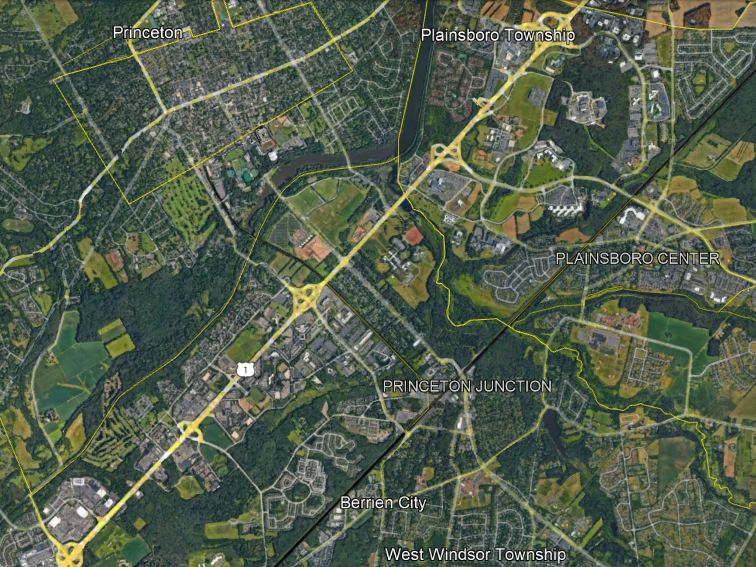
The Princeton stop on the Dinky, as can be seen in the satellite image, lies just outside the historic municipal limits of Princeton (since merged with the surrounding township). It serves the university fairly well, but is 800 meters at closest approach to the town’s main street, Nassau Street. So there has been a study for what to do to improve city access, in which a tram-train option was studied, looked good, and was dropped anyway. There are two options left: status quo, and a downgrade of the right-of-way to light rail with buses using the same corridor.
Unfortunately, transit advocates I respect, like Sandy Johnston, think the downgrade is an upgrade. So let me explain why in fact the light rail and bus option is inferior to current commuter rail operations.
The current use of the Dinky is as a connector to the Northeast Corridor. There is approximately nothing else at Princeton Junction: it’s one of the two busiest suburban stations in New Jersey, but like the other top station, Metropark, it’s a park-and-ride, designed exclusively for car-train interface. People who ride the Dinky do so to get to New York.
This means that the timed transfer with the mainline trains is critical. Frequency on the Dinky is irrelevant: all ridership from Princeton Junction into the town is going to be on the first train or bus after the mainline trains arrive, and almost all ridership to the junction is going to be on the last train that makes the connection. While frequency is not important except insofar as it matches that of the mainline, on-train capacity is important. My 2015 recollection is that off-peak ridership on the Dinky is maybe enough to fill an articulated bus (which New Jersey Transit only runs in Newark), maybe enough for a standard bus, depending on time of day – standees are likely, and standing on a bus is an awful passenger experience. At rush hour, the Dinky runs three-car trains (update 2022-2-18: no, it’s two-car trains) and they’re full.
The timed transfer is so important that the discussion of how to improve service must center how to make the transfer more efficient. The ideal improvement should be to regularize the timetable on the mainline commuter trains, and ensure that trains in opposite directions serve Princeton Junction around the same time (this is called a knot) so that the Dinky can connect to Trenton too, and even to Philadelphia with another timed transfer at Trenton or even through-service if that fits the New Jersey Transit and SEPTA schedules.
Sandy points out to me that while the Dinky only connects Princeton with the mainline, the right-of-way of the Dinky can serve more destinations – namely, the Route 1 job cluster, visible on the map as a line of office parks.
However, bus service from town to Route 1 is unlikely to succeed. It’s going to struggle to run sufficient frequency for what it needs, even as lower-frequency rail is sufficient for the Dinky’s current role:
- Route 1 is not on the way between town and the station – there would have to be separate buses to Route 1 from the service to the train station (which I presume will stay on rail even if the downgrade is picked). This means there’s no bundling of destinations – the buses to Route 1 have to live off of Princeton-Route 1 trips.
- Route 1 is a freeway with destinations located somewhat away, at automobile scale. Buses can stop on the side of the road but the walk is not great on the same side of the road and hostile and unsafe if crossing the road is required. A more pleasant experience is only possible if buses turn onto side roads, splitting frequency or increasing trip times.
- Route 1 is not a large job center. OnTheMap says that between the route of the Dinky and the junction with I-295 beyond the above satellite image, which ends at Quakerbridge Road, there are 21,000 jobs. The origins of those jobs are dispersed – only 5,000 come from within the county, and only 368 come from within Princeton.
- Conversely, the short distance traveled means that high frequency is crucial. A one-way trip from the townhouses just north of Nassau Street to the center of the Route 1 cluster along the right-of-way of the Dinky is 5.5 km, which at BRT and freeway speed is around 10 minutes one-way; a bus running less than once every 10 minutes might as well not run – but there is no chance for such a bus to fill at current demand.
Of course, the analysis of Route 1 assumes current development patterns stay with no or moderate change. A bigger change, such as greater development along Route 1 with sprawl repair, can make this option pencil out; O&D volumes need to rise by a factor of 3 assuming 100% transit modal split, or more if modal split is lower (which it invariably is, Route 1 is not Manhattan).
But then that raises the question – why engage in development in sprawl around a plan to downgrade a rail service?
If sprawl repair is plausible, then make Princeton more bikable and then set up bike lanes on Route 1 so that people can cycle to Route 1 jobs. The same bike lanes can also connect to the Dinky, with bike parking at the station, or even potentially at Princeton Junction if it’s faster to bike those 4 km than to ride a train and transfer. In the long run, all buses are going to have to be replaced by bikes anyway – bus operating costs are only going to go up.
And if redevelopment is plausible, look again at the satellite image and see what the land use at the existing train stations is like. Princeton is one of the most expensive places in the United States, and the Dinky station has a golf course on one side; that’s 0.5 km^2 of land, or, as I prefer to think of it, 50,000 housing units. Another 0.05 km^2 consists of parking lots right near the station, and can and should be redeveloped as a town center extension for a population that can swamp the existing town population by a factor of 4. The parking lots at Princeton Junction and the undeveloped land between them are another 0.4 km^2 of prime real estate.
In general, I cannot think of any railway where service would be improved by a downgrade from mainline rail to bus. But the Dinky has specific issues making such a downgrade especially deleterious for current users, namely the need for a timed connection, while the proposed source of new trips, namely Route 1, is too weak to be worth much. Thankfully, a no-build option keeping the status quo is still under consideration, and I hope that the region chooses it and invests in making the Dinky better rather than in replacing it.
How Tramway Networks Look
I’ve been thinking about trams today. The origin of this post is that yesterday’s post about modal versus other questions concerning public transport led to a conversation about how in some places, namely Vancouver, the light rail versus subway debate is big. And that got me thinking about how cities that do not have subways arrange their streetcar networks. These cities exist, mostly in Central and Eastern Europe, and often have very strong public transport – this is for example the Zurich model, based on a combination of streetcars and an S-Bahn system. Some such cities don’t even have an S-Bahn system. How do they arrange their tramway networks?
The top tram cities
I asked on Twitter what the busiest tramway network is in cities without a subway. Across all cities, including ones that have both streetcars and metro tunnels, the answer was Saint Petersburg at the beginning of the 21st century, and today is either still Saint Petersburg, where ridership has been in decline recently, or Budapest; Prague is the third. All have around 400 million annual riders, or somewhat less.
Among cities without subways, it’s harder to tell, because the information isn’t always out there; streetcars are not as well-studied as subways, a pattern of which I am guilty of contributing to with the focus of the Transit Costs Project (for now). Zurich, Brno, Zagreb, and Melbourne all have around 200 million annual passengers each, and Bratislava, Kraków, Łódź, an Belgrade are all plausible contenders except that I have not been able to find ridership figures for them.
Additional cities with strong ridership but not 200 million a year include the Upper Silesia complex with about 100 million, which is weak for its size with high car modal split for a Polish city, and smaller cities like Leipzig, Dresden, Linz, Basel, Geneva, Košice, Gothenburg and Lviv.
The pattern of tram cities
All of the high-ridership tram cities I’ve been able to find have historically maintained their systems. Cities that closed their streetcars in the postwar era and have since reopened them as modern light rail systems sometimes have very strong ridership, like Paris, but that’s in conjunction with a metro system; the Ile-de-France tram network is strikingly circumferential and barely penetrates city limits, where the Métro predominates. In the United States, the busiest modern light rail system is Los Angeles and the busiest without a subway is Portland, with 40 million annual trips, in a metro area of comparable size to Upper Silesia, which is much more auto-oriented than monocentric Polish city regions like those of Warsaw and Kraków.
Moreover, nearly all examples I know are in Central and Eastern Europe. Elsewhere, trams were shut down in the postwar era, or replaced with subway-surface Stadtbahn systems as in San Francisco and most West German cities. This is going to color the analysis, because just as there are American, Soviet, British, French, and German traditions of how to build rapid transit, there are national and areal traditions of how to build tramways, and with the exceptions of Melbourne and Gothenburg, all of the top systems in metro-free cities are in one or two macro-regions (Warsaw Pact and German), which means that shared features may be either the key to success or just a regional cultural feature.
The shape of strong tramway networks
I encourage readers to go to Alexander Rapp’s website with maps of rapid transit and tram networks around the world, and toggle the maps so that the top streetcar networks are visible.
For example, here is Zagreb:

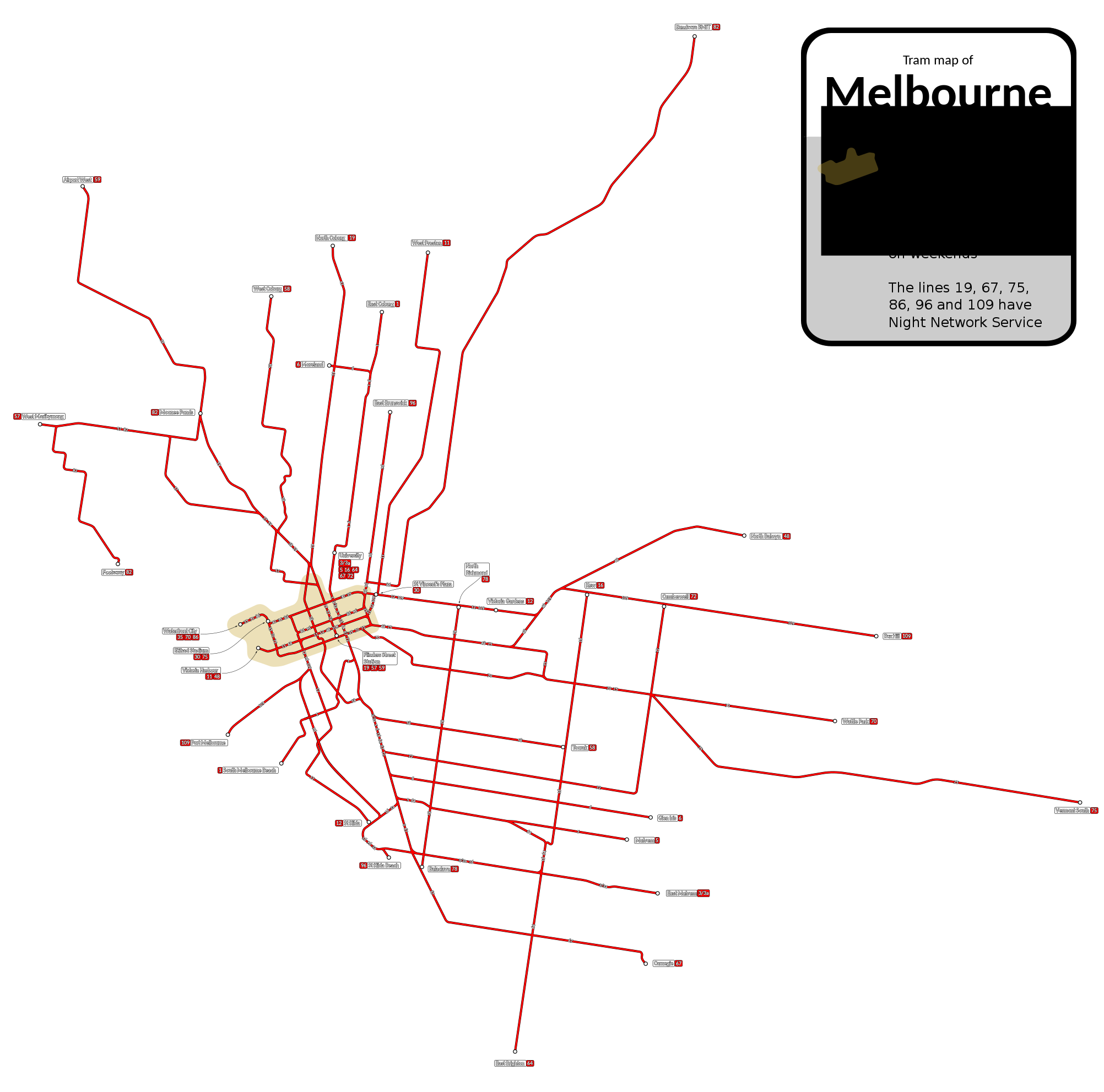
Here is Melbourne, which doesn’t yet have a metro but is building one at very high costs:
Here is Brno, which has around 200 million annual passengers in a metro area of 700,000:

The striking features of these networks and others without as good maps on Wikipedia (Gothenburg, Zurich), to me, are,
- The network design is radial – crosstown routes are rare and sporadic.
- The lines form something like a mesh in a small city center, perhaps the size of the historic premodern core, in which one can walk from one end to another; Melbourne, which does not have the history of a walled European city, shows convergent evolution with the same pattern.
- Owing to the long history of such systems, the ones I’ve used (Prague, Zurich, Basel, Leipzig, East Berlin) have basic stations with shelter and in Zurich’s case ticketing machines but no other facilities.
- There is extensive interlining and branching in all directions.
Moreover, as I should blog about soon in the future, Melbourne exhibits the same pattern even with a weak city center: the centralmost 100 km^2 of the city, which in Canada or Europe or the most centralized American cities should have 30-40% of metropolitan employment, only have 15%.
 Pedestrian Observations