High-Speed Rail for Germany and Capacity Issues
After feedback regarding the post I wrote last month about high-speed rail in Germany, here is an updated proposal:

Blue indicates lines that already exist or are under-construction, the latter category including Stuttgart-Ulm and Karlsruhe-Basel. Red indicates lines that are not; some are officially proposed, like Frankfurt-Mannheim and the Hanover-Hamburg-Bremen Y, others are not but should be.
Würzburg and capacity
The primary difference with the older map is that there’s more service to Würzburg, connecting it to Nuremberg, Frankfurt, and Stuttgart, in addition to the already existing line north toward Hamburg.
The reason for the added connections is not so much that they are by themselves great. Würzburg is not a large city. The through-services have some value, but the Stuttgart-Würzburg line saves travelers from Stuttgart or Zurich to Hamburg or Berlin half an hour, which is nice but not a big game-changer. The Frankfurt-Nuremberg connection is likewise of noticeable but not amazing value: Munich-Frankfurt and Munich-Cologne are shortened by about 15 minutes, and Nuremberg itself gets direct service to Frankfurt and points northwest but is only a medium-size city.
Rather, the most important reason for these connections is capacity. Today, the Frankfurt-Mannheim railway is the busiest in Germany; a high-speed line between the two cities is proposed for capacity more than for speed. However, under a more expansive high-speed rail program, this line would soon reach capacity as well. The demand for trains connecting Frankfurt to Basel, Zurich, and Munich in two hours is likely to be high, at least a train every half hour to each. Moreover, all of these cities would be connected with Cologne in three hours, and Stuttgart would be three hours from Berlin and three and a half from Hamburg. Raw demand may turn the Frankfurt-Mannheim trunk into the busiest high-speed rail trunk in the world off-peak, even ahead of the Tokaido Shinkansen and its six off-peak trains per hour in each direction. Moreover, this trunk would exhibit complex branching, in particular entering Frankfurt from either direction for through-service to either Cologne or Berlin and Hamburg.
The Würzburg connections change this situation. Trains from Stuttgart to Hamburg and Berlin do not need to pass through Mannheim and Frankfurt, and trains from Munich to Frankfurt do not need to pass through Stuttgart and Mannheim.
Half-hourly frequencies
Paris-Marseille fills about two trains per hour most of the day, Paris-Lyon counting both Part-Dieu and the airport fills around 1.5 trains per hour off-peak and 4 per hour at the peak. The TGV averages higher seat occupancy than the ICE, about 70% vs. 50%, because it varies service by time of day and has practically no seat turnover. It also runs trains with more seats, about 1,100 on a TGV Duplex vs. 900 on a single-level Velaro. This means that for the same ridership, Germany needs to run about two-thirds more frequency than France, which for the most part means matching the frequency France runs at the peak all day.
The largest metro region in Germany is the Rhine-Ruhr, with around 10 million people, not many fewer than Paris. It is polycentric, which normally works against a region – passengers are more likely to be traveling to a destination far from the central train station – but in this case works in favor of it, since the east-west network branches and makes stops at all major cities in the region. The second largest region is Berlin, with around 5 million people, twice as many as Lyon and three times as many as Marseille. Comparing this with Paris-Lyon and Paris-Marseille, an all-day frequency of six trains every hour is reasonable, two connecting Berlin to each of Cologne, Wuppertal-Dusseldorf, and the Ruhr proper from Dortmund to Duisburg.
In general, it’s best to think of this system as a series of city pairs each connected every half hour. The following list looks reasonable:
- Hamburg-Berlin-Dresden-Prague
- Berlin-Duisburg
- Berlin-Dusseldorf-Amsterdam
- Berlin-Cologne-Aachen-Brussels
- Berlin-Bremen
- Hamburg-Bremen
- Berlin-Frankfurt-Saarbrücken-Paris
- Berlin-Munich
- Berlin-Stuttgart-Zurich
- Berlin-Leipzig
- Hamburg-Munich
- Hamburg-Frankfurt-Basel
- Amsterdam-Cologne-Frankfurt-Nuremberg-Munich
- Duisburg-Cologne-Frankfurt-Basel
- Duisburg-Cologne-Frankfurt-Stuttgart-Zurich
- Cologne-Frankfurt-Leipzig-Dresden-Prague
- Paris-Strasbourg-Karlsruhe-Munich
- Munich-Vienna
- Hamburg-Copenhagen
Not counting international tie-ins like Dresden-Prague, Munich-Vienna, or Aachen-Brussels, these lines total around 9,000 km with repetition, so the total service provision over 15 daily hours of full service is to be 540,000 train-km, maybe somewhat less if the weaker lines (especially Berlin-Leipzig) are served with single 200-meter trainsets rather than double trainsets. Filling seats at today’s rate, say with an average trip length of 350 km, requires ridership to be on the order of 250 million a year, which is about twice what it is today, and around two-thirds that of the Shinkansen. Germany has two-thirds Japan’s population, and the proposed network nearly doubles the average speed on a number of key city pairs, so at least on the level of a sanity check, this ridership level looks reasonable.
The half-hourly connections should be timed so that passengers have easy transfers on city pairs that do not have direct trains. For example, there are no direct Berlin-Karlsruhe-Basel or Hamburg-Stuttgart-Zurich trains, so the Berlin-Zurich and Hamburg-Basel trains should have a timed transfer at Fulda. A wrong-way timed connection between one of the Zurich-Stuttgart lines and the Munich-Stuttgart line toward Strasbourg should speed up Zurich-Munich travel, replacing the current slog through Austria.
Frankfurt, the center of the universe
Frankfurt is the most served station in this scheme, making it the key bottleneck: it has six connections in each direction, for a total of 12 trains per hour in each direction through the central tunnel. Berlin, in contrast, is the terminus on eight out of nine connections, so it only gets 10 trains per hour through the North-South Main Line (not counting Gesundbrunnen stub-ends), which has four tracks at any case.
The implication is that the Frankfurt tunnel should be used exclusively by high-speed trains, and regional trains should terminate on the surface. There may be capacity for a few regional connections in the tunnel, but unless they are extremely punctual, one delay would propagate to the entire country. An ICE network running largely on dedicated tracks would not have this problems – delays would be uncommon to begin with. In Berlin, the same is true in two tracks of the North-South Main Line; some regional trains can mix in the other two tracks, as well as on the express tracks of the Stadtbahn.
West of Frankfurt, eight trains per hour travel up the existing high-speed tracks to Cologne. This may be excessive, but six is not excessive given the sizes of the cities so connected. Passengers from all over central and southern Germany would have regular train access to Frankfurt itself as well as to the airport and some of the major cities of the Rhine-Ruhr. This is likely to be one of the two biggest long-distance bottlenecks, alongside Frankfurt-Mannheim, which is to get six trains per hour, two entering Frankfurt from the west to continue to Hamburg and four from the east to continue to Cologne.
Frankfurt’s position is not surprising given its geography. It’s near the center of western Germany’s north-south spine, right between the Rhine-Ruhr and the major cities of southern Germany and Switzerland. To its west lies Paris, two and a half hours away once a high-speed line to the French border opens. Berlin may be the larger city center, but it is located in Germany’s eastern margin, the capital of one historic state rooted in the east; Frankfurt is in a region that has always been denser and more economically developed, and high-speed rail is likely to strengthen its role as its distance from Paris and northern Switzerland is especially convenient by fast trains.
Additional connections
An environmental activist who saw the map asked why it was so thin in northwest Germany, mentioning a continuation of the line from Bremen to Oldenburg and even west to Groningen and Amsterdam as a possibility, as it has proven demand for intercity bus service. This connection may be prudent, I am not sure. My skepticism comes from the fact that northwest Germany does not have very big cities other than Hanover and Bremen, and medium-size cities like Oldenburg, Osnabrück, and Münster do not lie on convenient linear corridors.
Nonetheless, Oldenburg itself could be usefully served by a continuation of Berlin-Bremen or Hamburg-Bremen trains on legacy track. The same is true of a number of lines not indicated on the map, for example Hamburg-Kiel, or potentially some connections from Berlin and Hamburg to cities in Mecklenburg-Vorpommern branching off of the Berlin-Hamburg line. Moreover, among the four lines running on Frankfurt-Cologne, the one that does not run through to either Duisburg or the Netherlands could turn west to serve Aachen and maybe even continue to Brussels. Connections beyond Brussels are undesirable as Paris gets a faster direct link to Frankfurt, and London is a morass of delays due to border controls and Eurostar boarding slowness.
At the other end of the country, tie-ins to proposed tunnels across the Alps may be desirable. The problem is that these tunnels still leave the tracks with tens of kilometers of slow approaches that are not fixable without extensive tunneling. The air line distance between Zurich and Milan is 216 kilometers. The idea that a train could ever connect the two cities in an hour is complete fantasy, and even two hours is a stretch; Switzerland’s plans for the Ceneri and Zimmerberg base tunnels go down to about three hours. Farther east, the Brenner Base Tunnel’s northern portal is deceptively about a hundred kilometers by air from Munich, but half of that distance is across the Karwendel Alps and fast trains would require an entirely new route of complexity approaching that of the under-construction base tunnel.
Whither the Deutschlandtakt?
The Deutschlandtakt plan was meticulously developed over the years with the input of technical rail activists aiming to imitate Europe’s two best intercity rail networks, those of Switzerland and the Netherlands. Detailed maps of service in each region as well as nationwide for intercity trains are available, aiming to have timed connections between medium-speed trains wherever possible. But it is not the right way forward for a large country. With so many city pairs that high-speed trains could connect in two to four hours, Germany can and should build a network allowing trains to run largely on dedicated tracks, interlining so that most lines would see four to six trains per hour in each direction to ensure high utilization and return on investment.
At high service levels, trying to design lines to be utilized in bursts every half hour is not feasible or desirable. It’s more useful to space trains on intermediate connections like Berlin-Hanover to overlie to provide walk-up frequency, as high frequency is useful on short trips and encourages higher ridership. Moreover, key links like a tunnel through Frankfurt can’t really be used in bursts, as activists are pointing out in connection with Stuttgart 21. This is fine: Switzerland’s design methodology works well for a small country whose largest city would be Germany’s 16th largest, and Germany ought to see what France and Japan do that works and not just what Switzerland and the Netherlands do.
Is this feasible?
This high-speed plan does require high investment levels. But this is not outlandish. After fourteen years of stonewalling on climate change, with a flat fuel tax and more concern for closing nuclear plants than for closing coal plants, Angela Merkel has begun showing flexibility in face of massive climate change protests and announced a plan for a carbon tax.
Millennial and postmillennial Green voters lack the small-is-beautiful mentality of aging hippies. I did not see references to high-speed trains at the climate march a week ago (see selected signs on my Twitter feed), but I did see many calls for replacing cars with trains, and few small-is-beautiful signs, just one NIMBY sign against tall building and one anti-nuclear sign held by someone who looked 35-40 and someone who looked 60-70. Felix Thoma pointed out to me that as the Greens’ voter base is increasingly weighted in favor of educated millennials who travel often between cities, the next generation of the German center-left is likely to be warm to a national and international high-speed rail program.
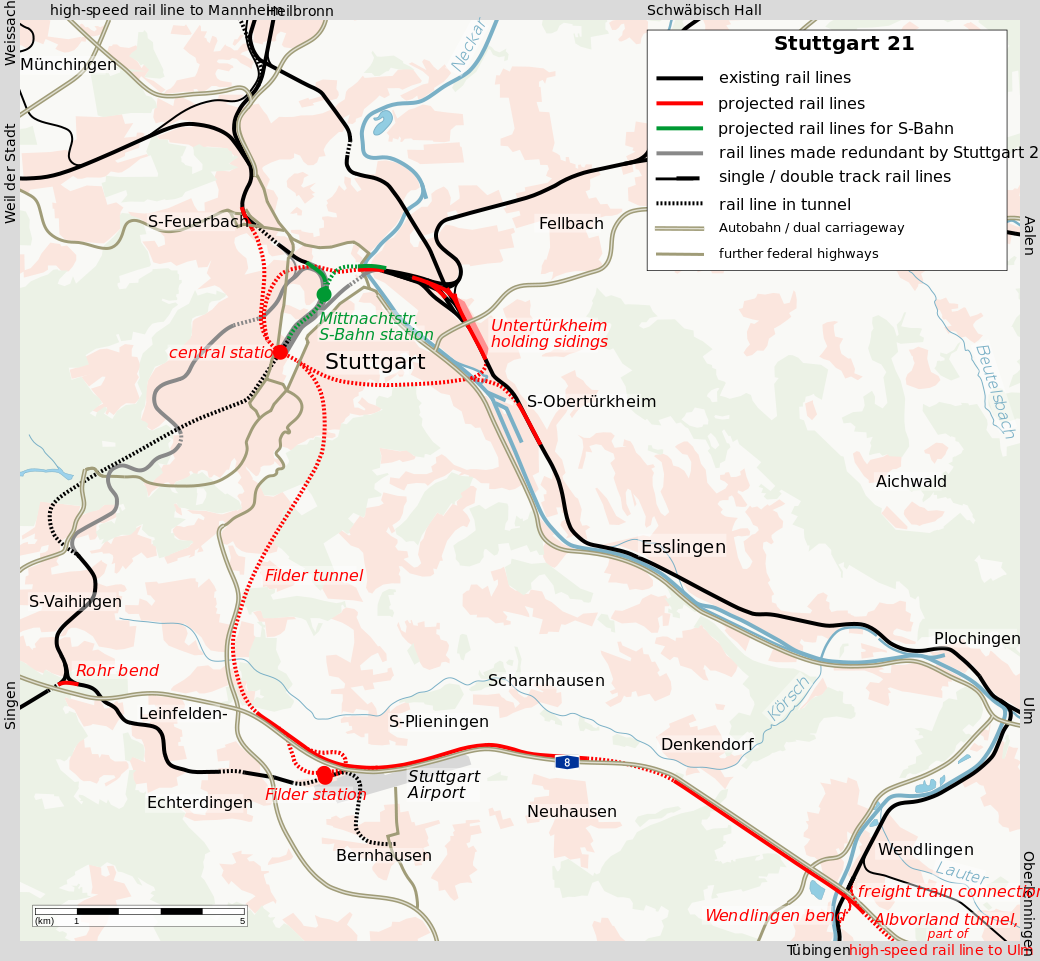
The barrier, as always, is money. But Germany is not the United States. Costs here are higher than they should be, but they’re rarely outrageous – even Stuttgart 21 costs mostly in line with what one would expect such extensive regional rail tunnels to amount to. The core domestic network I’m proposing, that is excluding lines within Germany that are only useful for international connections like Stuttgart-Singen toward Zurich, adds 1,900 km of new high-speed rail, of which maybe 100 km is in tunnel. An investment of 60 billion euros would do it with some error margin.
A green future for Germany requires a network like the one I’m proposing. A green future can’t be one exclusively based around slow travel and return to the living standards of the early 20th century. It must, whenever possible, provide carbon-neutral alternatives to the usual habits that define modern prosperity. Trans-Atlantic travel may be too hard, but domestic travel within Germany is not, and neither is travel to adjacent countries: high-speed trains are an essential tool to permit people to travel conveniently between the major and medium-size cities of the country.
 .
.