Frequency-Ridership Spirals

I was reticent to post about this topic; I polled it on Patreon in December and it got just under 50% while the two topics I did blog, difficult urban geography and cross-platform transfers, got 64% and 50% respectively. However, between how close the vote was and the conversation about the current state of the subway in New York, I felt obligated to explain what’s been going on. The short version is that practically the entire change in subway ridership in New York over the last generation or two has come from the off-peak, and the way American cities set their frequency guidelines off-peak amplify small changes in demand, so that a minor setback can lead to collapse and a minor boost can lead to boom.

The good news is that by setting frequency to be high even if it does not look like ridership justifies it, cities can generate a virtuous cycle on the upswing and avoid a vicious one on the downswing. However, it requires the discipline to run good service even in bad times, when bean counters and budget cutters insist on retrenchment. The Chainsaw Al school of management looks appealing in recessions or when ridership is falling, and this is precisely when people who run transit agencies must resist the urge to cut frequency to levels that lead to a positive feedback loop wrecking the system.

Ridership-frequency elasticity

The key to the frequency-ridership spiral is that cutting frequency on transit makes it less useful to passengers, since door-to-door trip times are longer and less reliable. The size of this effect can be measured as the elasticity of ridership with respect to service: if increasing service provision by 1% is demonstrated to raise ridership by e%, we say that the elasticity is e.

Fortunately, this question is fundamental enough to transit that there is extensive published literature on the subject:

  • In a classical TRB paper, Armando Lago, Patrick Mayworm, and Matthew McEnroe look at data from several American cities as well as one British one, disaggregating elasticity by frequency, mode (bus or commuter rail), and period (peak or off-peak). The aggregate average value is e = 0.44 for buses and e = 0.5 for commuter rail, but when frequency is better than every 10 minutes, e = 0.22 on average.
  • Todd Litman of the advocacy organization VTPI has a summary mostly about fare elasticity but also service elasticity, suggesting e is in the 0.5-0.7 range in the short term and in the 0.7-1.1 range in the long term.
  • A paper by Joe Totten and David Levinson includes its own lit review of several studies, including the two above, finding a range of 0.3 to 1.1 across a number of papers, with the lower figures associated with urban service and the higher ones with low-frequency suburban service. The paper’s own research, focusing on transit in Minneapolis, finds that on weekdays, e = 0.39.

One factor that I have unfortunately not seen in the papers I have read is trip length. Frequency is more important for short trips than long ones. This is significant, since when the headway is shorter relative to in-vehicle trip time we should expect lower elasticity with respect to the headway. Waiting 10 minutes rather than 5 minutes for an hour-long trip is not much of an imposition; waiting 30 minutes rather than 15 for the same trip is a greater imposition, as is waiting 10 minutes rather than 5 for a 20-minute trip.

In New York, the average unlinked subway trip is 13.5 minutes long, so the difference between 10 and 5 minutes is very large. Lago-Mayworm-McEnroe cite research saying passengers’ disutility for out-of-vehicle time is 2-3 times as large as for in-vehicle time; the MTA’s own ridership screen states that this penalty is 1.75, the MBTA’s states that it is 2.25, and a study by Coen Teulings, Ioulina Ossokina, and Henri de Groot says that it is 2 in the Netherlands. Figuring that this penalty is 2, the worst-case scenario for off-peak weekday wait time in New York, 10 minutes, has passengers spending more perceived time waiting for the train than riding it, and even in the average case, 10/2 = 5 minutes, it is close. In that case, higher values of e are defensible. Lago-Mayworm-McEnroe have less data about in-vehicle time elasticity and do not attempt to aggregate in- and out-of-vehicle time. But adding everything together is consistent with e = 0.8 relative to speed averaged over the total wait and in-vehicle time, and then e is maybe 0.4 relative to frequency.

The impact of service cuts

If the elasticity of ridership relative to frequency is 0.4, then cutting service by 1% means cutting ridership by 0.4%. If half the operating costs are covered by fares, then revenue drops by 0.2% of total operating expenses, so the 1% cut only saves 0.8% of the total subsidy. Achieving a 1% cut in operating costs net of fare revenue thus requires a 1.25% cut in service, which reduces ridership by 0.5%.

This may not sound too bad, but that’s because the above analysis does not incorporate fixed costs. Rail comes equipped with fixed costs for maintenance, station staffing, rolling stock, and administration, regardless of how much service the agency runs. Lisa Schweitzer uses this fact to defend Los Angeles’s MTA from my charge of high operating costs: she notes that Los Angeles runs much less service than my comparison cases in the US and Europe and thus average cost per train-km is higher even without undue inefficiency. In contrast, bus costs are dominated by driver wages, which are not fixed.

New York does not keep a headcount of transit employees in a searchable format – the Manhattan Institute’s See Through New York applet helps somewhat but is designed around shaming workers who make a lot of money through overtime rather than around figuring out how many people work (say) maintenance. But Chicago does, and we can use its numbers to estimate the fixed and variable costs of running the L.

The CTA has somewhat more than 10,000 workers, split fairly evenly between bus and rail. The rail workers include about 800 working for the director of maintenance, working on the rolling stock, which needs regular servicing and inspections regardless of how often it’s run; 550 working for facilities maintenance; (say) 400 out of 800 workers in administrative capacity like communications, general counsel, purchasing, and the chief engineer’s office; 600 workers in power and way maintenance; nearly 1,000 customer service agents; and 450 workers in flagging, switching, and the control towers. Only 500 workers drive trains, called rapid transit operators or extra board, and there may charitably be another 200 clerks, managers, and work train operators whose jobs can be cut if there is a service cut. A service cut would only affect 15% of the workers, maybe 20% if some rolling stock maintenance work can be cut.

In New York the corresponding percentage is somewhat higher than 15% since trains have conductors. Train operators and conductors together are about 13% of the NYCT headcount, so maybe 20% of subway employees, or 25% with some extra avoidable maintenance work.

What this means is that achieving a 2% cut in subsidy through reducing service requires a service cut of much more than 2%. If only 25% of workers are affected then, even without any frequency-ridership elasticity, the agency needs to cut service by 8% to cut operating costs by 2%.

The Uber effect

The combination of elasticity and fixed costs means that rail ridership responds wildly to small shocks to ridership. For a start, if the agency cuts service by 1%, then operating costs fall by 0.25%. Ridership falls by 0.4%, and thus revenue also falls by 0.4%, which is 0.2% of total operating costs. Thus operating costs net of revenue only fall by 0.05%. The only saving grace is that this is 0.05% of total operating costs; since by assumption fare revenue covers half of operating costs, this saves a full 0.1% of the public subsidy.

Read the above paragraph again: taking fixed costs and elasticity into account, cutting service by 1% only reduces the public subsidy to rail service by 0.1%. A 2% cut in subsidy in a recession requires a brutal 20% cut in service, cutting ridership by 8%. And this only works because New York overstaffs its trains by a factor of 2, so that it’s plausible that 25% of employees can be furloughed in a service cut; using Chicago numbers this proportion is at most 20%, in which case revenue falls one-to-one with operating costs and there is no way to reduce the public subsidy to rail operations through service cuts.

Of course, this has a positive side: a large increase in service only requires a modest increase in the public subsidy. Moreover, if trains have the operating costs of Chicago, which are near the low end in the developed world, then the combined impact of fixed costs and elasticity is such that the public subsidy to rapid transit does not depend on frequency, and thus the agency could costlessly increase service.

This is relevant to the Uber effect – namely, the research arguing that the introduction of ride-hailing apps, i.e. Uber and Lyft, reduces transit ridership. I was skeptical of Bruce Schaller’s study to that effect since it came out two years ago, since the observed reduction in transit ridership in New York in 2016 was a large multiple of the increase in total taxi and ride-hailing traffic once one concentrated on the off-peak and weekends, when the latter rose the most.

But if small shocks to ridership are magnified by the frequency-ridership spiral, then the discrepancy is accounted for. If a shock cuts ridership by 1%, which could be slower trains, service disruptions due to maintenance, or the Uber effect, then revenue falls 1% and the subsidy has to rise 1% to compensate. To cover the subsidy through service cuts requires a 10% cut in service, further cutting ridership by 4%.

Off-peak service guidelines

The above analysis is sobering enough. However, it assumes that service cuts and increases are uniformly distributed throughout the day. This is not the actual case for American transit agency practice, which is to concentrate both cuts and increases in the off-peak.

Unfortunately, cuts in off-peak service rather than at rush hour do not touch semi-fixed labor costs. The number of employees required to run service is governed by the peak, so running a lot of peak service without off-peak service leads to awkward shift scheduling and poor crew utilization. Higher ratios of peak to base frequency correlate with lower total service-hours per train driver: in addition to the examples I cite in a post from 2016, I have data for Berlin, where the U-Bahn’s peak-to-base ratio is close to 1, and there are 829 annual service-hours per driver.

I discussed the fact that the marginal cost of adding peak service is several times that of adding off-peak service in a post from last year. However, even if we take rolling stock acquisition as a given, perhaps funded by a separate capital plan, marginal crew costs are noticeably higher at the peak than off-peak.

In New York, the rule is that off-peak subway frequency is set so that at the most crowded point of each route, the average train will be filled to 125% seated capacity; before the round of service cuts in 2010 this was set at 100%, so the service cut amounted to reducing frequency by 20%. The only backstop to a vicious cycle is that the minimum frequency on weekdays is set at 10 minutes; on weekends I have heard both 10 and 12 minutes as the minimum, and late at night there is a uniform 20-minute frequency regardless of crowding.

Peak frequency is governed by peak crowding levels as well, but much higher crowding than 125% is permitted. However, the busiest lines are more crowded than the guidelines and run as frequently as there is capacity for more trains, so there is no feedback loop there between ridership and service.

The saving grace is that revenue is less sensitive to off-peak ridership, since passengers who get monthly passes for their rush hour trips ride for free off-peak. However, this factor requires there to be substantial enough season pass discounts so that even rush hour-only riders would use them. Berlin, where U-Bahn tickets cost €2.25 apiece in bundles of 4 and monthly passes cost €81, is such a city: 18 roundtrips per month are enough to justify a monthly. New York is not: with a pay-per-ride bonus a single ride costs $2.62 whereas a 30-day pass costs $121, so 23.1 roundtrips per month are required, so the breakeven point requires a roundtrip every weekday and every other weekend.

New York subway ridership evolution

The subway’s crisis in the 1970s reduced ridership to less than 1 billion, a level not seen since 1918. This was on the heels of a steady reduction in ridership over the 1950s and 60s, caused by suburbanization. In 1991, ridership was down to 930 million, but the subsequent increase in reliability and fall in crime led to a 24-year rally to a peak of 1,760 million in 2015.

Throughout this period, there was no increase in peak crowding. On the contrary. Look at the 1989 Hub Bound Report: total subway ridership entering Manhattan south of 60th Street between 7 and 10 am averaged about 1 million, down from 1.1 million in 1971 – and per the 2016 report, the 2015 peak was only 922,000. Between 1989 and 2015, NYCT actually opened a new route into Manhattan, connecting the 63rd Street Tunnel to the Queens Boulevard Line; moreover, a preexisting route, the Manhattan Bridge, had been reduced from four tracks to two in 1986 and went back to four tracks in 2004.

Nor was there much of an increase in mode share. The metropolitan statistical area’s transit mode share for work trips rose from 27% in 2000 to 30% in 2010. In the city proper it rose from 52% in 1990 to 57% in 2016. No: more than 100% of the increase in New York subway ridership between 1991 and 2015 was outside the peak commute hours, and nearly 100% of it involved non-work trips. These trips are especially affected by the frequency-ridership spiral, since frequency is lower then, and thus a mild positive shock coming from better maintenance, a lower crime rate, and perhaps other factors translated to a doubling in total ridership, and a tripling of off-peak ridership. Conversely, today, a very small negative shock is magnified to a minor crisis, even if ridership remains well above the levels of the 1990s.

The way out

Managers like peak trains. Peak trains are full, so there’s no perception of wasting service on people who don’t use it. Managers also like peak trains because they themselves are likelier to ride them: they work normal business hours, and are rich enough to afford cars. That current NYCT head Andy Byford does not own a car and uses the city’s transit network to get around scandalizes some of the longstanding senior managers, who don’t use their own system. Thus, the instinct of the typical manager is to save money by pinching pennies on off-peak service.

In contrast, the best practice is to run more service where possible. In Berlin, nearly all U-Bahn trains run every 5 minutes flat; a few lines get 4-minute peak service, and a few outer ends and branches only get half-service, a train every 10 minutes. At such high frequency, the frequency-ridership spiral is less relevant: an increase to a train every 4 minutes would require increasing service by 25%, raising costs by around 5% (Berlin’s one-person crews are comparable to Chicago’s, not New York’s), but not result in a significant increase in ridership as the shorter headway is such a minute proportion of total travel time. However, New York’s 10-minute off-peak frequency is so low that there is room to significantly increase ridership purely by running more service.

In 2015 I criticized the frequency guidelines in New York on the grounds of branching: a complexly branched system must run interlined services at the same frequency, even if one branch of a trunk line is somewhat busier than the other. However, the frequency-ridership spiral adds another reason to discard the current frequency guidelines. All branches in New York should run at worst every 6 minutes during the daytime, yielding 3-minute frequency on most trunks, and the schedules should be designed to avoid conflicts at junctions; non-branching trunk lines, that is the 1, 6, 7, and L trains, should run more frequently, ideally no more than every 4 minutes, the lower figure than in Berlin following from the fact that the 1 and 6 trains are both local and mostly serve short trips.

Moreover, the frequency should be fixed by a repeating schedule, which should be clockface at least on the A train, where the outer branches would only get 12-minute frequency. If ridership increases by a little, trains should be a little more crowded, and if it decreases by a little, they should be a little less crowded. Some revision of schedules based on demand may be warranted but only in the long run, never in the short run. Ideally the system should aim at 5-minute frequency on every route, but as the N, R, and W share tracks, this would require some deinterlining in order to move more service to Second Avenue.

This increase in frequency is not possible if politicians and senior managers respond to every problem by cutting service while dragging their feet about increasing service when ridership increases. It requires proactive leadership, interested in increasing public transit usage rather than in avoiding scandal. But the actual monetary expense required for such frequency is not large, since large increases in frequency, especially in the off-peak, mostly pay for themselves through extra ridership. The initial outlay required to turn the vicious cycle into a virtuous one is not large; all that is required is interest from the people in charge of American transit systems.

30-30-30 is Feasible

This piece first appeared as a study attached to an article in the Connecticut Mirror by SE Coast’s Gregory Stroud.

Fresh off the election, Connecticut Governor Ned Lamont has proposed an ambitious infrastructure plan, dubbed 30-30-30, in which train travel between New York and Stamford, Stamford and New Haven, and New Haven and Hartford would be cut to 30 minutes. With an average speed of about 110 km/h, this is only about half the average speed typical of high-speed rail, but still slightly higher than that of the Northeast Regional between New York and Washington, which is competitive with cars and buses provided there is enough capacity.

For 30-30-30 to truly be cost-effective, the plan needs to speed up trains with relatively little infrastructure investment, at a cost measured in hundreds of millions of dollars. Is that feasible? The topline answer is yes. All three segments can be done in the specified amount of time. North of New Haven, there are generous margins, but 30-minute travel times will rely on electrifying the Shuttle and running high-quality electric trains. South of New Haven, each segment has just seconds to spare to achieve the governor’s goal, and no big-ticket capital investment would be needed, but the plan will require a complete overhaul in Metro-North operations.

Some additional repairs are needed on tracks straight enough to allow trains to run at 160 km/h, which are today only maintained to allow 75 mph, or 120 km/h. The state may also need to procure lighter trains, able to accelerate faster than the current equipment. On a fast schedule, with few intermediate stops, the difference with the current M8 trains is small, but in practice north of Stamford, where trains are likely to make many stops, the difference would be noticeable.

Most of all, reliability must improve enough that is possible to remove the extensive schedule padding in the timetable today. Metro-North is in a perpetual maintenance cycle. At any time there is a slow zone somewhere on the tracks, with generous schedule padding on top of it. Maintenance must be switched to the nighttime, as is practiced on high-speed lines in Japan and France and on subways everywhere in the world outside New York, in order to improve daytime reliability.

The simulation of train performance

In order to figure out the best possible trip times, I made a table of speed zones on the New Haven Line, from Grand Central to New Haven. But instead of using current speed zones, which are very conservative, I looked for the maximum speed that is feasible within the current right-of-way.

The most important rule I followed is no curve modifications, even modifications that are likely to happen under any high-speed rail scenario. While some capital investment may still be required, it is entirely within existing rights-of-way.

In the simulation, I used code outputting slow penalties for trains based on prescribed performance characteristics. For this, I used two sets of characteristics. The first, is for the M8 trains used by Metro-North today. The second is an average of modern European regional trains, such as the Stadler FLIRT, the Alstom Coradia, the Bombardier Talent 2, the CAF Civity, and the Siemens Mireo. Because they are much lighter-weight, all have about 50% better acceleration than the M8 at any speed. Both sets of trains can reach the same top speed, 160 km/h, but when the M8 slows down from top speed to make a station stop, the extra acceleration and deceleration time add another 69 seconds to the trip, compared with only 46 seconds on the European regional trains.

That said, the proposed schedule has few intermediate stops, and even with frequent slowdowns due to curves, the total difference in time between the two sets of trains is about two minutes. So, while I would urge Connecticut to buy modern trains at its next procurement, based on the latest revision in FRA regulations permitting lightly-modified European trains, the present-day rolling stock is good enough, it’s just much heavier than it needs to be.

While I did not assume any curve modifications, I did assume that trains could run faster on curves than they do today. The New Haven Line has conservative values for the permitted centrifugal force acting on trains. I explain more about this in a previous post about trains in Connecticut, but the relevant figures are about 8” of total equivalent cant on the New Haven Line today, or about 200 mm, whereas light trackwork increasing total cant and already-existing regulatory changes above the rails could raise this to 12” on existing trains, about 300 mm, and even more on tilting trains like the Acela. The difference between 200 and 300 mm of total equivalent cant corresponds to a 22% increase in speed; the formula is \sqrt{1.5} = 1.22.

Moreover, in some areas the maximum speeds are even lower than one might assume based on curve radius and current permitted curve speeds. These include the movable bridges over the waterways, which have very low speed limits even when the tracks are mostly straight; if the bridges physically cannot accommodate faster trains then they should be replaced, a capital investment already on the state and the region’s official wishlist.

In addition to speed limits imposed by curves and bridges, there is a uniform speed limit of 90 mph (145 km/h) on the New York segment of the line and 75 mph on the Connecticut segment. This is entirely a matter of poor maintenance: the right-of-way geometry could support higher speed today in some places, even without curve modifications.

Finally, trains today go at excruciatingly slow speed in the throat heading into the bumper tracks at Grand Central, 10 miles per hour. This is bad practice: even with bumper tracks, German train throats with complex switches are capable of 70 km/h. This change alone would save about 4 minutes. Overall, trains today are scheduled to take about 11-12 minutes between Grand Central and Harlem, and the proposed schedule cuts this down to 5-6.

The proposed schedule

I am attaching a spreadsheet with exact speed zones, rounded down in 5 km/h increments. People who wish to see what’s behind the timetable I’m proposing can go look there for intermediate times. These may be especially useful to people who want to see what happens if more stops on the Lower New Haven Line are included. For example, one might notice that all technical travel times are padded 7%, as is standard practice in Switzerland, and that trains dwell exactly 30 seconds at each station, which is observed on busy commuter lines in Zurich as well as Paris.

I am including two stopping patterns: regional and intercity. Regional trains make the same stops as the Upper New Haven Line trains do today, plus New Rochelle. Intercity trains only make a few stops beyond Stamford, with a stopping pattern close to that of Amtrak. In addition, I am including two different sets of rolling stock: the current M8, and lighter, faster-accelerating European trainsets. The difference in the regional train pattern is noticeable, while that in the intercity one is less so.

Finally, at stations, it’s possible to state the scheduled the time the train arrives at the station or the one it departs. At all intermediate stations, the timetable below states the arrival time, unlike the attached spreadsheet, which uses departure times to permit calculating exact average speeds.

Stop Regional, M8 Regional, euro Intercity, M8 Intercity, euro
Grand Central 0:00 0:00 0:00 0:00
Harlem-125th 0:05 0:05 0:05 0:05
New Rochelle 0:17 0:16 0:17 0:16
Stamford 0:30 0:29 0:30 0:29
Noroton Heights 0:34 0:33
Darien 0:37 0:35
Rowayton 0:39 0:37
South Norwalk 0:42 0:40 0:37 0:36
East Norwalk 0:45 0:42
Westport 0:48 0:45
Greens Farms 0:52 0:48
Southport 0:55 0:51
Fairfield 0:57 0:53
Fairfield Metro 1:00 0:56
Bridgeport 1:04 0:59 0:49 0:47
Stratford 1:09 1:03
Milford 1:13 1:07
West Haven 1:19 1:13
New Haven 1:23 1:17 1:03 1:01

New Haven-Hartford-Springfield

In theory, achieving the governor’s proposed timetable is easier north of New Haven. The Hartford Line is a straight route. Most of it has a top speed of 80 mph, and outside the approaches to New Haven and Hartford, the speed restrictions are caused by arbitrarily slowdowns for grade crossings rather than by constrained geometry.

However, in practice, the line is in poor state of repair. Grade crossings are unprotected. The entire line is not electrified, and there are no plans to electrify it, for reasons that can only be explained as an allergy that North American railroaders have to electrification. The stations have low platforms, which are not accessible to people in wheelchairs without labor-intensive, time-consuming lift operations—and even if there are no riders with disabilities, it just takes longer for passengers to board from low platforms.

The above schedule assumes 7% padding and 30-second dwell times at stations, but such assumptions only work when the equipment is reliable, and when there are wide doors letting passengers on the train with level boarding or at worst short steps. Traditional commuter lines pulled by diesel locomotives, serving low-platform stations with narrow doors, have to be much slower. Clem Tillier‘s example timetable for Caltrain requires 15% padding and 45-second dwell times with today’s diesel operations—and at rush hour some station dwells stretch over minutes due to the railroad’s uniquely high number of passengers with bicycles.

The good news is that electrification and high platforms are, in the grand scheme of things, cheap. Amtrak electrified the Northeast Corridor between New Haven and Boston at $3.5 million per kilometer in the 1990s, adjusted for inflation; at that cost, wiring the entire New Haven-Springfield shuttle would run up to $350 million. Moreover, Boston has been equipping a number of commuter rail stations with high platforms in order to provide wheelchair accessibility, and in ordinary circumstances, the costs have been on the order of $6-10 million per station. This entire package on the Hartford Line would be cheaper than replacing any of the movable bridges on the New Haven Line.

Moreover, upgrading grade crossings with four-quadrant gates, which make it impossible for cars to drive around the gates while they are closed, is affordable as well—and would permit the towns along the route to institute quiet zones, eliminating the loud train horns. In Boulder, the same installation costs about $500,000 per grade crossing for quad gates and another $300,000 for an alternative to horns; in federal regulations, quad gates are good up to 110 mph. There are 23 level crossings between New Haven and Hartford and another 11 between Hartford and Springfield; $30 million would upgrade them all.

The importance of a good maintenance regime

In Switzerland, schedules are padded by 7% over the technical travel time, to permit trains to recover from delays. By American standards, this is a low figure: the LIRR’s schedules are padded by 20-30%, and I have personally seen an express New Haven Line train do Stamford-Grand Central in about 15% less than the scheduled trip time.

Switzerland achieves high punctuality with relatively tight scheduling by making sure delays do not propagate. Railroad junctions are grade-separated when possible, and if not then they are equipped with pocket tracks to allow trains to wait without delaying crossing traffic. To achieve comparable reliability, Metro-North should grade-separate its most important junctions: Shell, where the line joins with the Northeast Corridor tracks carrying Amtrak (and soon Penn Station Access); and Stam, where the New Canaan Branch joins. It could potentially also grade-separate Berk, where the Danbury Branch joins, and Devon, where the Waterbury Branch joins, but the traffic at these junctions is lighter and delayed branch trains can wait without disturbing mainline trains.

Moreover, like the rest of Europe as well as Japan, Switzerland conducts maintenance at night. The daytime maintenance with work zones that are a common sight on American passenger railroads are unknown on most European railroads. Only mixed lines running high-speed passenger trains in the day and freight at night have to schedule trains next to active work zones, and those are indeed much harder to maintain.

The laws of physics are the same on both sides of the Atlantic. If it’s possible to maintain tracks adequately during four-hour nighttime windows in Europe, it’s possible to do the same in the United States. Freight traffic on the Northeast Corridor is lighter than on many Swiss mainlines, and while passenger traffic at rush hour is very heavy, in the off-peak it is considerably lighter than on the urban commuter rail line trunks of Zurich. While four Metro-North trains run between New York and Stamford every off-peak hour, as does a single Amtrak train, ten Zurich S-Bahn trains run per hour between Zurich and Winterthur, as do six interregional and intercity trains.

The importance of maintenance was underscored in a recent article describing an independent plan to drastically cut travel times through better track standards, spearheaded by Joe McGee of the Business Council of Fairfield County and authored by San Francisco consultant Ty Lin and former Metro-North president Joseph Giulietti. In response to their plan, CDOT said it was not possible—and to emphasize this fact, the article notes that an upcoming schedule revision will slow down the trains by 6 to 10 minutes due to trackwork delays.

The one thing that the state must avoid is funneling any money into State of Good Repair (SOGR) programs. SOGR is a black hole permitting incompetent officials to spend capital money without anything to show for it: agencies around the country have SOGR programs decade after decade and somehow their stated maintenance backlogs never shrink.

Instead, 30-30-30 is the closest thing to a true program for what SOGR is supposed to be. Were the tracks in good shape, and were speeds on curves in line with modern railroading practices in other developed countries, express trains would take exactly half an hour to travel between Grand Central and Stamford and between Stamford and New Haven. So 30-30-30 is really setting a standard for a program that, up until now, has only served as an excuse for CDOT to do nothing.

It’s not yet clear what CDOT and Metro-North’s reaction to 30-30-30 will be. Is the governor’s goal achievable? Absolutely, give or take a few minutes. Is it achievable on a reasonable budget? Definitely. Are the managers who have let train schedules slip over the years, as their counterparts in New York have, capable of running the trains punctually enough in order to meet the timetable? That is the big question mark.

Leaving Paris for Berlin

I’m sitting on a train heading to Germany, about to depart Paris. I’m less comfortable writing about myself than some other urbanists I admire like Alex Baca and Kristen Jeffers, but I will still try to explain.

I didn’t intend to live here long-term. As I said two years ago, I moved here for the universities, and stayed even after I left academia, and even as I stayed, I didn’t know it would be for such a long period of time. I kept renting on three-month cycles because with my self-employment and variable income landlords wouldn’t rent to me on an annual contract. Many of the renewals were uncertain, depending on various circumstances like whether I would hear from NYU about grants. But this turned into my longest stint living in the same apartment in my adult life: two years and three months. And now it’s ending.

I spent 2017 building my professional life, sending pitches to anyone I could find an email for. I knew I was in an expensive city, but even then, I looked at housing costs elsewhere and didn’t think I’d even save money net of moving expenses. I still don’t; I don’t expect my living expenses to fall in Berlin once you add mandatory health insurance to rent. This is not why I’m leaving.

Rather, the situation in 2018 got to the point that I needed to ask myself where I really wanted to live. The rule was, anywhere in the EU or where EU citizens could live freely, like Norway. In July I visited London, which was an option depending on how EU migrant rights would be treated under Brexit, but between high rents and trademark Theresa May hostile environment rules in the Brexit deal, it wasn’t so attractive.

So far, all of my moves had been job-related: New York for grad school, then Providence, Vancouver, and Stockholm for a string of postdocs, then Paris to intersect my grad school advisor while I was waiting on an answer from Calgary. Working from home means I had to choose where to live based on which city in Europe I actually liked. I had to ask myself the same question every three months:

Do I like Paris?

For a while, I really did like it here. I saw things that I never got to see in the United States or in Sweden: at the nearby high school, as well as at Bois de Vincennes, white and Arab and black children were playing together. Eastern Paris is the kind of integrated neighborhood that, in North America, everyone pretends to want to build and yet nobody seems capable of building.

I knew about the diesel pollution from my first winter here, but things seemed to be getting better, with a steady decrease in the proportion of cars powered by diesels, Anne Hidalgo’s pedestrianization of streets and city squares, and the Macron cabinet’s hike in taxes on fuel. My best recollection is that the pollution was less bad in the winter of 2017-8 than in 2016-7, and I took it at a sign things were getting better.

The Gilets Jaunes

Macron is not a popular president. Polls consistently put his approval rate in the 30s, even as, as the median French politician on the main issues, he was and still is handily winning reelection against the cadre of sacrificial lambs offered by the parties on the left and right. Previous protest movements concerned labor issues, sometimes winning, as when they defeated his 2017 labor law reforms (since passed in a weaker form last year), and sometimes losing, as when the railway workers struck to fight the SNCF governance reforms.

And then came the Gilets Jaunes, so-called because of the mandatory reflective yellow vests within cars. Their initial grievances were the diesel taxes and the reduction in the speed limit on non-motorway roads from 90 km/h to 80. The taxes were no more popular than any other tax hike, and they got sympathy early, protesting in the usual French way of blocking roads.

Even then, in late November, there were signs they were nastier than the usual. CRIF warned about anti-Semitism at the protests; SOS Racism warned about harassment of immigrants. White Christian France did not listen. Then the Gilets Jaunes escalated to rioting, and even as the public grew hostile to their methods, the state dithered.

The political movements outside En Marche maintained their support. I never had any illusions about La France Insoumise and other far left movements, but the Green Party joined in, echoing the fake news of the extreme right about how what really matters is taxing ship fuel rather than cars. Soi-disant green protesters tried to connect their agenda to that of the Gilets Jaunes, saying “the fight for the climate and the fight for purchase power are the same.” Antifa joined in, having some internal fights with the most overtly fascist members, but not with the main of the movement, which is still about half National Front voters. Nobody saw fit to mention the racism. Politics in France is so white—Macron’s rainbow coalition has a less racially diverse cabinet than Trump, and he’s still under criticism for not being racism enough from both directions; the top far left leader, Jean-Luc Melenchon, wrote an angry blog post saying that France did not collaborate with the Nazis in WW2.

The big protest, on December 8th, involved vandalism in central Paris. At Nation things were tamer. I visited briefly and saw an all-white crowd in a neighborhood where these are not the usual demographics. Two people who looked my age or slightly younger, both white, sat on a bench near the square, one taping “down with the state” on the back of the other’s jacket. Everything about that crowd screamed “hipsters going through the motions.” Eastern Paris has a lot of that, too.

Elsewhere, things got a lot worse, with violent threats against foreigners, Jews, and racial minorities. Protesters vandalized stores with graffiti like “Rothschild” and “Juden,” and the reaction among supporters on Twitter was either justification and denial that the Rothschild tag was anti-Semitic, or denial that the Gilets Jaunes were the vandals. This is on top of homophobia (Gilets Jaunes protesters have demanded a referendum on repealing gay marriage) and general idiocy (they oppose mandatory vaccination).

Macron did what France does best in the face of fascism: he surrendered. In overseas France he’d declared martial law, but at home, facing white people, he didn’t; he canceled the planned tax increase, and announced a host of tax cuts and pension benefit increases to try to mollify them. The difference between that and how the state treated Muslim rioters in 2005 was jarring.

A single spineless leader might be survivable, but the entire political system here supports rioters provided they are white. This percolates outside the country. The alt-right is of course in full support, but the decidedly non-extreme Wall Street Journal positively spun the movement as a tax revolt. On the other side, the alt-left celebrated, since it’s always hated Macron. Pan-European anarchists like Quinn Norton celebrated the Gilets Jaunes. Alexandria Ocasio-Cortez tweeted in support of the movement, in response to a tweet saying the police was threatening to join them if the state didn’t increase cops’ pay, and nearly every American socialist I’ve interacted with since has tried to defend her in ways they never would if she’d tweeted in enthusiasm about Pinochet.

Why do I need to be here?

The pollution will not get better, or, if it does, it will be at a glacial rate; the revocation of the diesel taxes will make sure of that. Neither will the French state’s responsiveness to the needs of the city and the people who live here, many of whom are not the grandchildren of the Milice but of its and of the French colonial army’s victims. White Europe’s public intellectuals pattern-matched the movement to a right-populist resurgence that they love to blame on neoliberalism and not on the populists’ racism.

While this was going on, I was glued to AQI. There were days in December when the air here was worse than in Milan, worse than in Katowice. Germany was entirely clean. This is not just an issue of Germany having a government that feels sufficiently guilty about leading the pan-European project that was the Holocaust that it dials down the racism. Somehow, German cities manage far cleaner air than Paris, and the political system there looks forward. The Greens there fight for an open society rather than looking for excuses to protest fuel taxes.

Paris keeps defining itself by global city attractions, like the Opera or the cafes or the museums. But that’s not a reason to live in a city. It’s a reason to visit for a week. Already Hidalgo is unpopular for her attempt to make the city livable, and the poster boards of Nation, once filled with communist slogans and with the face of one crank calling for Frexit, are now filled with posters complaining that the mayor is immiserating the French. If the city and the state are not going to provide basic necessities like clean air and streets that I can cross safely, I don’t really need to live here.

All the programs in the world won’t keep me in a place where I do not get these basic necessities. Even before Macron, France tried to build up tech clusters, which effort has only intensified in the last two years. The state will do anything except improving the business climate and providing services like protecting foreigners from marauding hordes of vandals.

The message the surrender has sent is not just that air quality will remain among Europe’s worst but also that foreigners are not really welcome here. This is not the message Macron wants to send; I get the impression he genuinely wants a more open and more globalized France. But he is unwilling to do what it takes to send the right message. In that way, he is like many ineffectual leaders in semi-democracies like Nigeria, Pakistan, and Bangladesh, where there’s no autocracy in the sense of China or Russia, just a crowd of traditionalist pogromchiks who the state either can’t or won’t stop from hacking at gays, religious minorities, or journalists who offended some local notable.

I will miss Paris. I really will. Eastern Paris is delightful and supposed no-go zones like Belleville have grocery stores selling good food items that the European-owned stores don’t. It’s the supposed Real France that’s a problem, defined around closedness, monolingualism, and an ethnic hierarchy.

Berlin

If I’m looking for a place that’s functional enough I can expect it to not just have clean air but also deal with other social problems appropriately, I don’t have that many options. Eastern Europe is out, Mediterranean Europe not much better, France by definition not good. Ireland might be an option because they speak English there, but moving by plane is a chore and Dublin is ultimately not a large city. Scandinavia is Anglophone and has food items I’m craving at supermarkets that I can’t find anywhere in Paris, but it’s expensive and my two years there were two more than enough.

I told a Twitter follower I was moving to Germany and their first question was “are you a Berlin person or a Munich person?” I of course don’t know the answer to this question, not knowing the subtleties. The Germans I know tend to be northerners; I asked a German professor in Stockholm why the Germans at KTH seem to all be northerners and was told that Scandinavia and northern Germany are similar in ways that are distinct from southern Germany. So I don’t have a basis of comparison, I just know what the rents are and which governments are in charge.

Two years ago, I noticed Berlin’s cheapness, but wasn’t sure where to live, and knew the moving expenses would be high. But given that I have to undertake these moving expenses anyway, I might as well move to the cheaper city. The job market there is weak in the private sector, but since I’m not getting work at someone else’s company either way I might as well go for the cheap rents.

What does this mean?

I will of course keep blogging. I imagine I will talk more about the details of proof-of-payment systems and S-Bahn scheduling and less about driverless metro implementation, but ultimately I read trade publications and look at timetables rather than writing about my experiences taking urban rapid transit. Not much will change—expect a few days’ gap in new posts, but with my schedule of posting eight or nine times per month such gaps are routine anyway. I will just say “here” and mean Berlin and not Paris.

The British Way of Building Rapid Transit

By a more than 2-1 vote among my Patreon backers, the third installment in my series about national traditions of building urban rail is the British one, following the American and Soviet ones. While rapid transit in Britain outside London is even smaller than in the US outside New York, the British tradition is influential globally for two reasons: first, Britain invented the railway as well as urban rapid transit, and second, Britain had a vast empire much of which still looks up to it as a cultural and scientific metropole.

Nonetheless, despite the fact that all rapid transit traditions technically descend from London’s, it is worthwhile talking about the British way. What London built inspired and continues to inspire other cities, but many, mainly in the United States, Japan, and Continental Europe, diverged early, forming distinct tradition. As I noted in the post about the Soviet bloc, Moscow was heavily influenced by British engineering, and its own tradition has evolved separately but began as a more orderly way of reproducing the London Underground’s structure in the 1930s.

In taxonomy, this is called a paraphyletic group. Monophyly means a taxon descending from a single ancestor, for example mammals; paraphyly means a taxon descending from a single ancestor excluding certain monophyletic subgroups, for example reptiles, which exclude mammals and birds, both of which descend from the same common ancestor.

The invention of rapid transit

Like most other things Britain became known for, like constitutional government and colonialism, rapid transit evolved gradually in London. Technically, the first railway in London, 1836’s London and Greenwich, meets the definition of urban rapid transit, as trains made some local stops, ran every 20 minutes, and were grade-separated, running on brick arches. However, it is at best an ancestor of what we think of as rapid transit, since it lacked the really frequent stops of the Underground or the New York els.

The first proper rapid transit line in London, the Metropolitan line, opened in 1863. It, too, lacked some features that are standard on nearly all rapid transit systems today: most importantly, it was not self-contained, but rather had some through-service with intercity rail, and was even built dual-gauge to allow through-service with the Great Western Railway, which at the time had broad gauge. Trains ran every 10 minutes, using steam locomotives; to limit the extent of smoke in the tunnels, the line was not fully underground but had a long trench between King’s Cross and Farringdon.

The Met line and the second Underground line, 1868’s District line, were both built cut-and-cover. However, whereas Met line construction went smoothly, the District line had to carve a right-of-way, as the city did not have adequate wide streets for serving the proposed route. The areas served, Kensington and Chelsea, were even then a tony neighborhood with expensive real estate, and the construction costs exploded due to land acquisition. In today’s terms the Met line cost about $32 million per kilometer and the District $90 million, a record that among the historical lines I know of remained unbroken until New York built the Independent Subway System in the 1930s.

The Met and District met to form a circle, and in general, London loved building circular lines. In addition to what would be called the Circle line until a revision last decade, there were two circles farther out, called the Middle Circle and Outer Circle. These were run by mainline railroads; there was still no legal distinction between the two urban railroads and the mainlines, and through-service and even some freight service continued on the Met well into the 20th century, which the company used as an excuse to delay its merger with the other Underground companies.

Even electric rapid transit took time to take shape. After the bad experience with the District line, there was no more cut-and-cover in Central London. The next line to open, 1890’s Northern line, required the invention of deep boring and electric traction; it was not the first rail line to use electricity, but was the first excluding streetcars. However, while the line looked like a normal self-contained rapid transit line, it was pulled by electric locomotives; electric multiple units only came a few years later, starting haphazardly in Liverpool in 1893 (each car required separate controls) and in the more conventional way on the Chicago L in 1897.

Spontaneous order and radial network design

Among the inventions that came out of London was the radial network design. Unlike the physical inventions like underground rail and electric traction, this was not a deliberate choice. It evolved through spontaneous order, owing to the privately-funded nature of British railways. A British railway had to obtain the approval of Parliament to begin construction, which approval would also permit compulsory purchase of land along the way, but funding was entirely private. An early proposal for an underground railway, an 1860s route running what would later become the Charing Cross branch of the Northern line, was approved but could not secure funding and thus was not built.

The upshot is that with private planning, only the strongest lines were built. The strongest travel demand was to the center of London, and thus the lines were all radial, serving either the City of London or the West End. There was no circumferential service. While there were many circles and loops, these were conceived as reverse-branches allowing some railroads to access multiple Central London terminals, or as ways to join two radials like the Met and District without having to go through the difficult process of turning a train underground in a world in which all trains had to be pulled by locomotives.

The same preponderance of radial lines can be seen in other privately-planned contexts. Today, the best-known example is the matatu network of Nairobi. It is informal transit, but has been painstakingly mapped by urbanists, and the network is entirely radial, with all lines serving city center, where the jobs requiring commuting are.

Despite the private planning, London has only a handful of missed connections between lines: it has eight, but only one, between the Met line and the Charing Cross branch of the Northern line, is a true miss between two lines – the other seven are between parallel outer branches or between two lines that intersect a few times in close succession but only have one transfer (namely, the Bakerloo and Met). This is not because private planners build connections spontaneously – Parliament occasionally demanded some minor route changes, including interchange stations at intersections.

The role of regional rail

Like rapid transit, regional rail evolved in London in a haphazard fashion. The London and Greenwich was a mainline railway and the Met line had some mainline through-service, and even the deep-level tube lines are compatible enough with mainline rail that there is some track-sharing, namely between the Bakerloo line and the Watford DC line. The trench between King’s Cross and Farringon was widened to four tracks and turned into a north-south through-route in the 1870s but then abandoned in the 1920s and only reactivated in the 1980s as Thameslink.

The upshot is that London ended with the bones of a regional rail network but no actual service. The ideal was self-contained Underground lines, so even when connections suggested themselves they were not pursued. For example, the original proposal for an underground line between Euston and Charing Cross involved some through-service to the railways at both ends, but when the line was finally built as the Charing Cross branch of the Northern line it was not connected to the mainline and only took over minor branches in suburban North London.

While British planners did eventually plan for through-service – plans for Crossrail date to World War Two or just afterward – by then London was not innovating but rather imitating. By the war, Berlin had already had two S-Bahn through-lines, Munich was planning one, and Tokyo had three. The modern design for Crossrail is best compared with the RER A, in a city London has treated as its primary competitor for a long time now.

Exporting London’s network design

Moscow was heavily influenced by London early on. Later on, Singapore and Hong Kong both drew on British engineering expertise. London’s status as the first city to build rapid transit may have influenced Moscow, but by the 1920s New York had surpassed it in city size as well as urban rail ridership. Moscow’s drawing on London was as I understand it accidental – the chief engineer happened to have London connections – but in Singapore, Hong Kong, Australia, and so on the relationship is colonial, with extensive cultural cringe.

In all of these non-British cities, the British design as exported was cleaner. What I mean is, the systems have a radial structure like London, but the radii are cleaner in that two lines will generally cross just once, especially in Moscow; it’s not like London, where the Central line is always north of the District line, meeting once in a tangent at Bank and Monument, or where the Victoria line and Northern line cross twice.

Another cleaner aspect is the transfer experience. Singapore and Hong Kong both make extensive use of cross-platform transfers between otherwise perpendicular lines; London only does sporadically, on the Victoria line.

A third aspect is uniformly wide interstations. London’s average interstation is about 1.25 km, which is what I think of as the standard because it is very close to the average in Tokyo and Mexico City as well, and at the time I started tracking this statistic in the late 2000s, the Chinese systems were still small. Moscow’s average is 1.7 km, and Singapore’s is similar. Hong Kong is actually divergent there: the MTR mixes core urban lines averaging about the same as in London with the more widely-spaced historically mainline East and West Rail lines and the airport express.

The relative paucity of circumferential rail is hard to judge in the export cases. Moscow came up with the idea for the Circle Line natively; there is an urban legend that it was accidentally invented by Stalin when he left a coffee cup on the map and it stained it in the shape of a circle. Hong Kong doesn’t have much circumferential rail, but its geography is uniquely bad for such service, even more so than New York’s. Singapore does have a Circle Line, but it’s one of the two worst-designed parts of the MRT, with a reverse-branch (the other one is the self-intersecting, connection-missing Downtown Line).

At the same time, it’s worth viewing which aspects British-influenced systems are getting rid of when designing cleaner version of the Underground. The most important is regional rail. Singapore has none: it has a legacy narrow-gauge rail line to Malaysia, but has never made an effort to take control of it and develop it as an urban regional rail line.

Another negative aspect exported by London is the preponderance of deep boring. I made the same complaint when discussing the Soviet bloc: while London is poor in wide arterials that a cut-and-cover subway could go underneath, Moscow is rich in them, and the same is true of Singapore.

Does this work?

London invented rapid transit as we know it, but it did so gradually and with many seams. In some sense, asking if this works is like asking if rapid transit as a technology works, for which the answer is that it is a resounding success. But when it comes to the details, it’s often the case that London has accidental successes as well as accidental mistakes.

In particular, the fact that London almost invented regional rail is a source of endless frustration and extensive retro-crayon. The Met line is almost a 19th-century Crossrail, the Widened Lines are almost a 19th-century Thameslink, and so on. Instead, as time went on the trend has been toward more self-contained lines, which is good for reliability but not when there are self-contained slow tracks of mainlines to hook into, as is planned for Crossrail and as has sporadically been the case for the Watford DC line.

The British focus on radial systems has generally been good. To the extent London has underused metro lines, it’s not because they are poorly-routed as some of the lines in Paris are, but because they serve areas that have many urban rail lines and not a lot of population density; London is not a dense city, going back to the Victorian era, when it standardized on the rowhouse as the respectable urban housing form rather than the mid-rise apartment of Continental Europe or New York.

To the credit of British-influenced planning, Singapore has managed to fit a circumferential line into its system with good connections, just with an awkward reverse-branch. London’s own circumferential transit, that is the Overground, misses a large number of Underground connections due to its separate origin in freight bypasses and mainline rail reverse-branches, where Parliament saw no point in requiring interchange stations the way it did on the Tube. However, the cleaner version seen in Singapore only misses connections involving the Downtown Line, not the Circle Line.

What is perhaps the worst problem with the British style of design is the construction cost. The Northern line was not expensive – in today’s terms it cost around $35 million per km, give or take. However, after WW2 a gap opened between the cost of cut-and-cover and bored metros. The Milan method for cut-and-cover built a subway for around $45 million per km a few years before London bored the Victoria Line for $110 million. Britain exported its more expensive method, which must be treated as one factor behind high construction costs in Singapore, Hong Kong, Australia, and New Zealand; in New Zealand the regional rail tunnel is expensive even as electrifying the system was not.

In the future, cities that wish to build urban rail would be wise to learn from the network design pioneered by London. Urban rail should serve city centers, with transfers – and as in the subsequent refinements of cities that adapted London’s methods to their own needs, there should be some circumferential transit as well. But if mainlines are available, it would be wise to use them and run trains through on the local tracks where available. Moreover, it would be unwise to conduct deep boring under wide streets; elevated or cut-and-cover construction is well-suited for such avenues, causing some street disruption but producing considerable less expensive lines.

The California HSR Bombshell, Redux

California Governor Gavin Newsom spoke his piece, and California HSR is most likely dead. His state of the state speech tried to have it both ways, and his chief of staff insisted that no, he had not just canceled the HSR project, but his language suggests he’s not going to invest any more money or political capital in going beyond the Central Valley. Lisa Schweitzer put it best when she talked about his sense of priorities.

I actually don’t want to talk about the costs of the project; an article about this topic will appear in the Bay City Beacon any day now, and I will update this post with a link when it does. Rather, I want to talk about alignments. For those of you who’ve been reading me since the start, this means reopening some topics that involved tens of thousands of comments’ worth of flamewars on California HSR Blog.

What they should be building

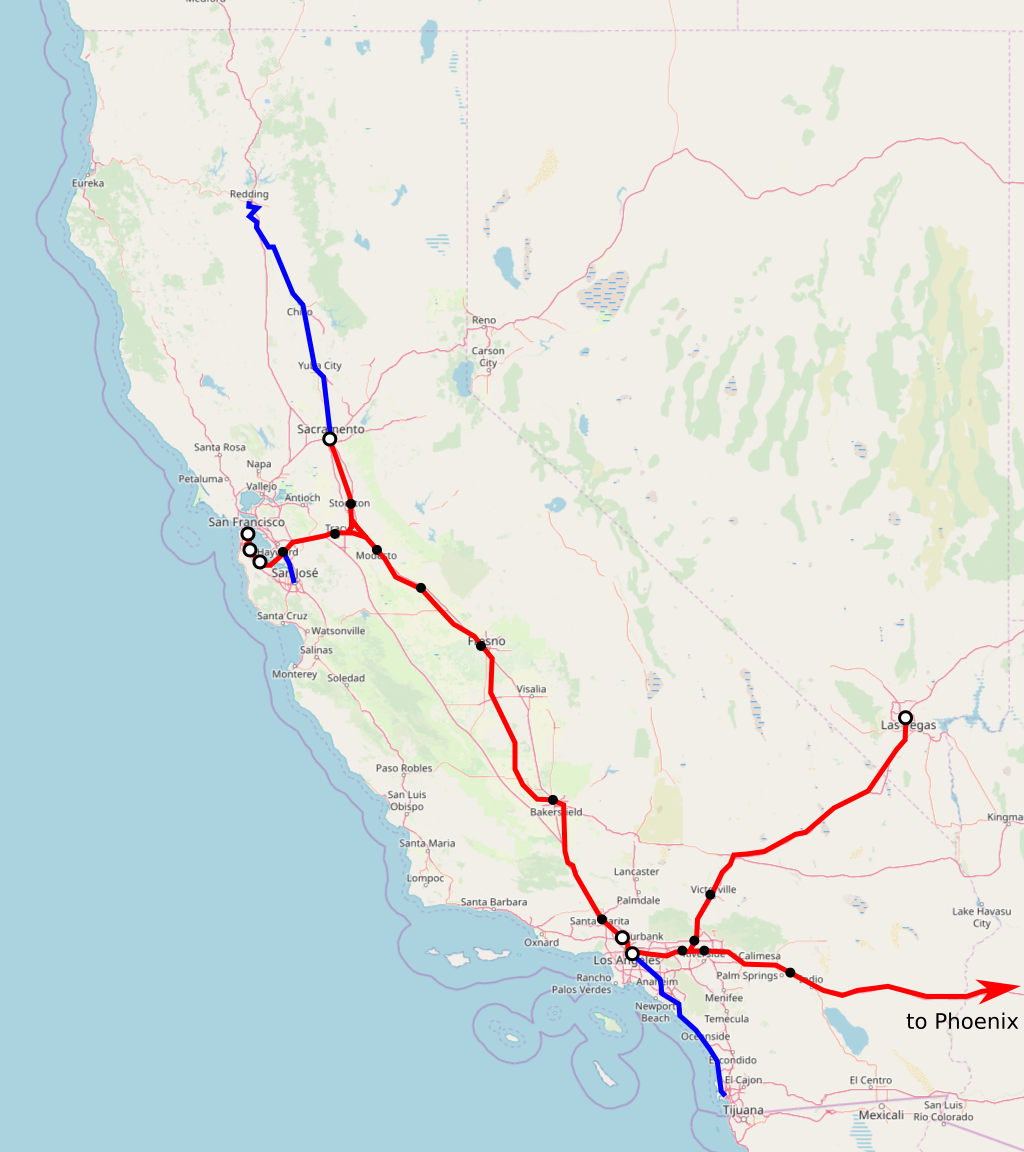
As before, red denotes HSR with top speed of 350 km/h outside the built-up areas of the largest cities, and blue denotes legacy lines with through-service. I ask that people not overinterpret pixel-level alignments. The blue alignment in Southern California is the legacy route taken by Amtrak, the one in the Bay Area is a legacy line from Fremont to San Jose that some area transit advocates want a Caltrain extension on (and if it’s unavailable then it can be deleted with a forced transfer to BART), the one in the far north of the state is the freight line up to Redding.

The mid-2000s environmental impact study claims that Los Angeles-San Francisco via Altamont Pass would take 2:36 nonstop. The Tejon route I’m drawing is 12 minutes faster, so in theory this is 2:24. But three express stops in the middle, even in lower-speed territory right near Los Angeles and San Francisco, lead to somewhat longer trip times, as do various design compromises already made to reduce costs. My expectation is that the alignment drawn is about 2:45 on LA-SF and somewhat less on LA-Sacramento, on the order of 2:15 nonstop.

Why Tejon and not the Tehachapis

There are two ways to get between Los Angeles and Bakersfield. The first is the alignment taken by the I-5, called the Grapevine or Tejon Pass. The second is to detour far to the east via Palmdale and Tehachapi Pass. The alignment I drew is Tejon, that chosen by the HSR Authority is the Tehachapis.

Clem Tillier made a presentation about why Tejon is far superior. It is shorter, reducing trip times by about 12 minutes. It is less expensive, since the shorter length of the route as well as the reduced tunneling requirement means fewer civil structures are required; Clem’s presentation cites a figure of $5 billion, but with recent overruns I’ve heard a figure closer to $7 billion.

The exact cost of either alignment depends on standards. Unlike Northeastern passenger rail efforts, which are based on bad American design standards that recommend very shallow grades, ideally no more than 1.5-2%, California HSR uses a generic European standard of up to 3.5%, the same as in France. However, 3.5% is a conservative value, designed around TGVs, which almost uniquely in the HSR world have separate power cars. Distributed traction, that is EMUs, has higher initial acceleration and can climb steeper grades. One German HSR line goes up to 4%, and only the EMU ICE 3 train is allowed to use it, not the ICE 1 and 2, which have power cars like the TGVs. Even 5% is achievable far from stations and slow zones, which would reduce tunneling requirements even further.

In the mid-2000s, it was thought that the Tehachapi alignment could be done with less tunneling than Tejon. Only one 3.5% alignment through Tejon was available without crossing a fault line underground, so Tehachapi seemed safer. But upon further engineering, it became clear more tunneling was needed through Soledad Canyon between Los Angeles and Palmdale, while the Tejon alignment remained solid. The HSR Authority resisted the calls to shift to Tejon, and even sandbagged Tejon in its study, for two reasons:

1. Los Angeles County officials favored the Tehachapi route in order to develop Palmdale around the HSR station.

2. A private real estate company called Tejon Ranch planned to build greenfield development near the Tejon HSR route called Tejon Mountain Village, and opposed HSR construction on its property.

As Clem notes, the market capitalization of Tejon Ranch is about an order of magnitude less than the Tehachapi-Tejon cost difference. As for the county’s plans for Palmdale, spending $5 billion on enabling more sprawl in Antelope Valley is probably not the state’s highest priority, even if an HSR station for (optimistically) a few thousand daily travelers in a region of 400,000 exists to greenwash it.

Why follow the coast to San Diego

Two years ago I wrote an article for the Voice of San Diego recommending electrifying the Los Angeles-San Diego Amtrak line and running trains there faster, doing the trip in about 2 hours, or aspirationally 1:45. Amtrak’s current trip time is 2:48-2:58 depending on time of day.

The alignment proposed by the HSR Authority instead detours through the Inland Empire. The good thing about it is that as a greenfield full-speed route it can actually do the trip faster than the legacy coast line could – the plan in the 2000s was to do it in 1:18, an average speed of about 190 km/h, on account of frequent curves limiting trains to about 250 km/h. Unfortunately, greenfield construction would have to be postponed to phase 2 of HSR, after Los Angeles-San Francisco was complete, due to costs. Further design and engineering revealed that the route would have to be almost entirely on viaducts, raising costs.

If I remember correctly, the estimated cost of the HSR Authority’s proposed alignment to San Diego was $10 billion in the early 2010s, about $40 million per kilometer (and so far Central Valley costs have been higher). Even excluding the Los Angeles-Riverside segment, which is useful for HSR to Phoenix, this is around $7 billion for cutting half an hour out of trips from Los Angeles and points north to San Diego. Is it worth it? Probably not.

What is more interesting is the possibility of using the Inland Empire detour to give San Diego faster trips to Phoenix and Las Vegas. San Diego-Riverside directly would be around 45 minutes, whereas via Los Angeles it would be around 2:20.

However, the same question about the half hour’s worth of saving on the high-speed route can equally be asked about connecting San Diego to Las Vegas and Phoenix. These are three not especially large, not especially strong-centered cities. The only really strong center generating intercity travel there is the Las Vegas Strip, and there San Diego is decidedly a second-order origin compared with Los Angeles; the same is even true of San Francisco, which could save about 40 minutes to Las Vegas going via Palmdale and Victorville, or 55 minutes via Mojave and Barstow.

Ultimately, the non-arboreal origin of money means that the $7 billion extra cost of connecting Riverside to San Diego is just too high for the travel time benefits it could lead to. There are better uses of $7 billion for improving connectivity to San Diego, including local rail (such as a light rail tunnel between city center and Hillcrest, branching out to Mid-City and Kearny Mesa) and a small amount of extra money on incrementally upgrading the coast line.

Why Altamont is better than Pacheco

I’m leaving the most heated issue to last: the route between the Central Valley and the Bay Area. I am not exaggerating when I am saying tens of thousands of comments have been written in flamewars on California HSR Blog over its ten years of existence; my post about political vs. technical activists treated this flamewar as almost a proxy for which side one was on.

The route I drew is Altamont Pass. It carries I-580 from Tracy to Livermore, continuing onward to Pleasanton and Fremont. It’s a low pass and trains can go over the pass above-ground, and would only need to tunnel further west in order to reach Fremont and then cross the Bay to Redwood City. Many variations are possible, and the one studied in the mid-2000s was not the optimal one: the technical activist group TRANSDEF, which opposes Pacheco, hired French consultancy SETEC to look at it and found a somewhat cheaper and easier-to-construct Altamont alignment than the official plan. The biggest challenge, tunneling under the Bay between Fremont and Redwood City, is parallel to a recently-built water tunnel in which there were no geotechnical surprises. Second-hand sources told me at the beginning of this decade that such a rail tunnel could be built for $1 billion.

Pacheco Pass is far to the south of Altamont. The route over that pass diverges from the Central Valley spine in Chowchilla, just south of Merced, and heads due west toward Gilroy, thence up an alignment parallel to the freight line or US 101 to San Jose. The complexity there is that the pass itself requires tunneling as the terrain there is somewhat more rugged than around Altamont.

As far as connecting Los Angeles and San Francisco goes, the two alignments are equivalent. The old environmental impact reports stated a nonstop trip time of 2:36 via Altamont and 2:38 via Pacheco; Pacheco is somewhat more direct but involves somewhat more medium-speed running in suburbia, so it cancels out. The early route compromises, namely the Central Valley route, affected Altamont more than Pacheco, but subsequent compromises in the Bay Area are the opposite; nonetheless, the difference remains small. However, Pacheco is superior for service between Los Angeles and San Jose, where it is about 10 minutes faster, while Altamont is superior for service between the Bay Area and Sacramento, where it is around an hour faster and requires less additional construction to reach Sacramento.

As with the Tehachapis, the Authority sandbagged the alignment it did not want. San Jose-based HSR Authority board member Rod Diridon wanted Pacheco for the more direct route to Los Angeles, perhaps realizing that if costs ran over or the promised federal and private funding did not materialize, all three of which would indeed happen, the spur to San Jose was the easiest thing to cut, leaving the city with a BART transfer to Fremont. Consequently, the Authority put its finger on the study’s scale: it multiplied the frequency effect on passenger demand by a factor of six, to be able to argue that splitting trains between two Bay Area destinations would reduce ridership; it conducted public hearings in NIMBY suburbs near Altamont but not in ones near Pacheco; and early on it even planned to build San Francisco-San Jose as its first segment, upgrading Caltrain in the meantime.

And as with the Tehachapis, the chosen route turned out to be worse than imagined. Subsequent business plans revealed more tunneling was needed. The route through San Jose itself was compromised with curvy viaducts, and the need to blend regional and intercity traffic on the Caltrain route forced further slowdowns in intercity train speed, from a promised 30 minutes between San Francisco and San Jose to about 45. The most recent business plan even gave up on high speed between Gilroy and San Jose and suggested running on the freight mainline in the initial operating stage, at additional cost and time given Union Pacific’s hostility to passenger rail.

What is salvageable?

The HSR Authority has made blunders, perhaps intentionally and perhaps not, that complicate any future project attempting to rescue the idea of HSR. In both Los Angeles and the Bay Area, delicate timetabling is needed to blend regional and intercity rail. Heavy freight traffic interferes with this scheduling, especially as Union Pacific demands unelectrified track, generous freight slots, and gentle grades for its weak diesel locomotives, frustrating any attempt to build grade-separations cheaply by using 3-4% grades. Caltrain’s trackage rights agreement with UP contained a guillotine clause permitting it to kick freight off the line if it changed in favor of an incompatible use, originally intended to permit BART to take over the tracks; Caltrain gave up this right. UP is not making a profit on the line, where it runs a handful of freight trains per day, but the industrial users insisted on freight rail service.

Likewise, the Central Valley segment has some route compromises baked in, although these merely raise costs rather than introducing forced slowdowns or scheduling complications. A future project between Merced, the northern limit of current construction, and Sacramento, could just spend more time early on negotiating land acquisitions with the farmers.

It is in a way fortunate that in its incompetence, the HSR Authority left the most important rail link in the state – Los Angeles-Bakersfield – for last. With no construction on the Tehachapi route, the state will be free to build Tejon in the future. It will probably need to buy out Tejon Mountain Village or add some more tunneling, but the cost will still be low compared with that of the Palmdale detour.

Ultimately, the benefits of HSR increase over time as cities increase in size, economic activity, and economic connectivity. The Shinkansen express trains ran hourly in 1965; today, they run six times per hour off-peak and ten at the peak. Going back even earlier, passenger traffic on the London Underground at the beginning of the 20th century was not impressive by today’s standards. The fact that national rail traffic plummeted in most developed countries due to the arrival of mass motorization should not distract from the fact that overall travel volumes are up with economic growth, and thus, in a growing area, the case for intercity rail investment steadily strengthens over time.

Chickenshit governors like Newsom, Andrew Cuomo, and Charlie Baker are not an immutable fact of life. They are replaced after a few terms, and from time to time they are replaced by more proactive leaders, ones who prefer managing big-ticket public projects successfully to canceling them or scaling them back on the grounds that they are not competent enough to see them through.

High-Speed Rail for the Eastern United States

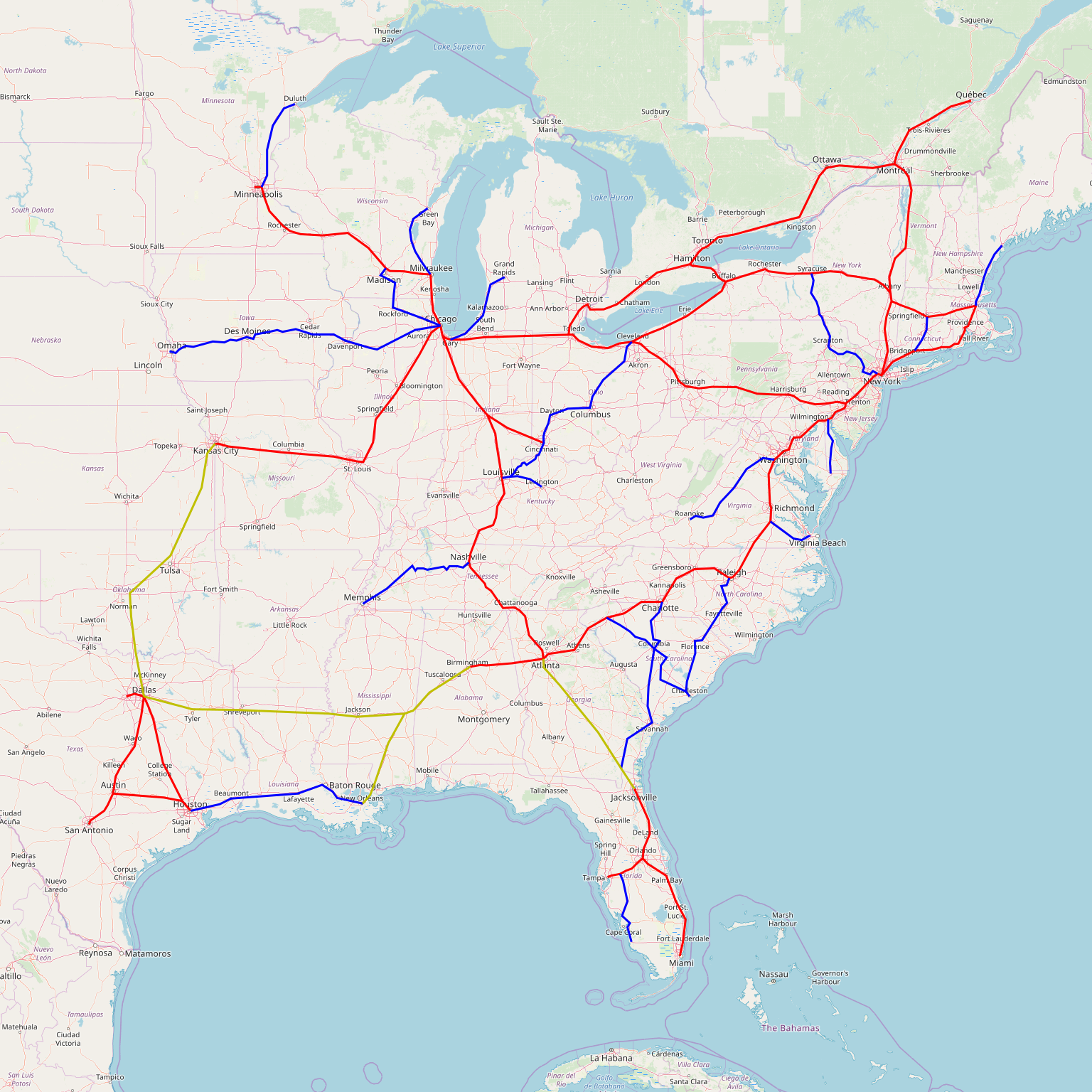
Yesterday, I tweeted this proposal for a high-speed rail network for the eastern half of the United States:

I’d like to go over what the map means and address questions that have appeared on Twitter.

The color scheme

Red denotes high-speed lines, with a top speed in the 300-360 km/h range, not including the occasional enforced slow zone. The average speed would be around 225-250 km/h in the Northeast, where the routes are all compromised by existing infrastructure, and 300 km/h in the Midwest, where flat expanses and generous rail rights-of-way into the major cities should allow the same average speeds achieved in China. The South is intermediate, due to the rolling terrain and extensive suburban sprawl in the Piedmont.

Yellow denotes high-speed lines as well, but they are more marginal (in the linked tweet this is purple, but yellow is friendlier to the colorblind). This means that I expect much lower social return on investment there, so whether these lines could succeed depends on the price of fuel, trends in urban sprawl, and construction costs within the normal first-world range. Some of these lines, namely Atlanta-New Orleans and the connection from Savannah to Jacksonville, should be legacy lines if HSR does not pan out; others, like Kansas City-Oklahoma City, are unlikely to be worth it.

Blue denotes legacy lines that are notable for the network. It does not include the entire set of legacy intercity lines the US should be running, but does include all lines that I believe should get through-service to high-speed lines; but note that some lines, like Minneapolis-Duluth and Charleston-Greenville, do not have through-service. Some of these lines are potentially very strong, like New Haven-Springfield as a Northeast Corridor extension. Others are marginal, like Binghamton-Syracuse, which Adirondacker has recurrently criticized in comments on the grounds that New York-Syracuse is much faster on HSR and the intermediate cities are too small to justify more than a bus.

This is not meant to be an exhaustive list. Some of the alignments may not be optimal, and one of the red lines, Albany-Montreal, can plausibly be reclassified as yellow due to the weakness of travel markets from the United States to Montreal.

Trip times

The schedules I’m proposing are fast – all faster than in Germany and Italy, many faster than in France and Spain. The reason for this is the long expanses between American cities. Germany and Italy have high population density, which is in theory good for HSR, but in practice means the closely-spaced cities yield lines with a lot of route compromises. In Britain people who advocate for the construction of High Speed 2 complain that England’s population density is too high, making it harder to build lines through undeveloped areas (that is, farms) between big cities the way France and Spain did.

Out of New York, the target trip times are:

  • Boston: 1:40
  • Philadelphia: 0:40
  • Washington: 1:35
  • Albany: 0:55, an hour minus half a turnaround time, useful for Swiss run-trains-as-fast-as-necessary timetabling
  • Syracuse: 1:50
  • Rochester: 2:25
  • Buffalo: 2:45
  • Toronto: 3:20
  • Harrisburg: 1:20
  • Pittsburgh: 2:30
  • Cleveland: 3:10
  • Richmond: 2:15
  • Raleigh: 3:10
  • Charlotte: 4:05
  • Atlanta: 5:30
  • Birmingham: 6:15, probably no direct service from New York except at restricted times of day, but hourly or 30-minute service to Atlanta

Out of Chicago, they are:

  • Milwaukee: 0:30
  • Minneapolis: 2:30
  • St. Louis: 1:30
  • Kansas City: 2:50
  • Indianapolis: 0:55
  • Cincinnati: 1:30
  • Louisville: 1:35
  • Nashville: 2:35
  • Atlanta: 4:00
  • Toledo: 1:15
  • Detroit: 1:35
  • Toronto: 2:55
  • Cleveland: 1:50
  • Buffalo: 2:50

Stop spacing

For the most part, there should be a stop in each metropolitan area. What counts as a metropolitan area remains a question; truly multicore regions can get one stop per core, for example there should definitely be a stop in Newark in addition to New York, and South Florida should have individual stops for Miami, Fort Lauderdale, and West Palm Beach. On the Northeast Corridor, what I think the optimal express stopping pattern is is one stop per state, with additional local trains making some extra stops like New London, Stamford, New Rochelle, and Trenton; Wilmington can be a local or an express stop – whether the infrastructure required to skip it at speed is worth it is a close decision.

On most lines, multiple stopping patterns are unlikely to be worth it. The frequency wouldn’t be high in the first place; moreover, the specific stations that are likely candidates for local stops are small and medium-size cities with mostly short-range travel demand, so serving them on a train stopping less than hourly is probably not going to lead to high ridership. Among the lines coming out of Chicago, the only one where I’m comfortable prescribing multiple stopping patterns is the one headed east toward Cleveland and Detroit.

Another consideration in the stop spacing is where most passengers are expected to travel. If there is a dominant city pair, then it can get express trains, which is the justification for express trains on the Northeast Corridor and on Chicago-Detroit and Chicago-Cleveland. However, in Upstate New York, there is no such dominant city pair: travel demand from New York to Toronto is not much more than to Buffalo (the air travel market is around a million people annually, whereas New York-Buffalo is 600,000) even though Toronto is a lot bigger, so there’s little point in skipping Syracuse, Rochester, and Buffalo to speed up end-to-end trips.

Ultimately, stops don’t cost that much time. In 360 km/h territory, a late-model Shinkansen has a stop penalty of a little under 3 minutes excluding dwell time – figure about 4 minutes with dwell. Those minutes add up on short-range lines with a lot of stops, but as long as it’s restricted to about a stop every 150 km or more in high-speed territory, this should be fine.

Highland gaps in service

Several people on Twitter complained about the lack of service to West Virginia and Arkansas. West Virginia is a politically distinguished part of the US nowadays, a metonym for white working-class decline centered on the coal industry, and as a result people notice it more than they do Midwestern poverty, let alone Southern or Western poverty. Poor cities are often served by red lines on my map, if they are between larger cities: Youngstown and Bowling Green are both noticeably poorer than Charleston, West Virginia, and Lafayette, Killeen-Temple, and Erie are barely richer. In the West, not depicted on my map, Pueblo, Chico, and Redding are all as poor as Charleston and are on standard wishlists for upgraded legacy rail while Tucson is a hair poorer and probably should get a full HSR extension of Los Angeles-Phoenix.

The reason Appalachia is underserved is the highland topography. Construction costs go up sharply once tunnels are needed; the route through Pennsylvania connects New York and Philadelphia with Pittsburgh, Cleveland, Detroit, and Chicago, which are big enough urban centers to justify the expense, but additional routes would connect smaller cities. Washington awkwardly gets poor service to the Midwest; a yellow line between Baltimore and Harrisburg may be prudent, but a blue line is not, since the legacy line is so curvy that a high-speed detour through Philadelphia would still be faster. The Piedmont South gets a red line parallel to the mountains and some branches, but nothing that justifies going over the mountains.

Legacy rail additions are still plausible. Amtrak connects Charleston with Cincinnati in 5 hours, but cutting this to about 3.5 should probably be feasible within existing right-of-way, provided CSX does not mind faster passenger rail on its tracks; thence, Chicago-Cincinnati would take around 1.5 hours. However, the negotiations with CSX may be difficult given the line’s use by slow, heavy freight; the blue lines shown on my map are mostly not important freight mainlines.

In Arkansas, the question is whether a line to Little Rock is justifiable. The yellow route between Atlanta and Dallas could plausible detour north through Memphis and Little Rock instead of the depicted direct alignment; Atlanta-Dallas is about the same distance as New York-Chicago, a trip of about 5 hours, so the line would have to survive based on intermediate markets, making the less direct route better. On the other hand, Memphis and Little Rock are small, and while Atlanta and Dallas are big, they’re nowhere near the size of New York, and have very weak centers, encouraging driving rather than riding paid transportation whether it’s a train or plane.

Regional rail additions

As I said above, the blue line list is not intended to be exhaustive. I suspect it is exhaustive among long-range intercity lines, not counting yellow routes like Dallas-Oklahoma City or Atlanta-New Orleans. I was specifically asked about Amtrak’s City of New Orleans route, connecting Chicago, St. Louis, Memphis, and New Orleans, since there is no trace of it on the map beyond the Chicago-St. Louis HSR. There could certainly be a high-speed line down to Memphis, which would place the city around 3 hours from Chicago. However, Memphis is not a large city; St. Louis, Memphis, and New Orleans have all stagnated in the last hundred years, making them weaker candidates for HSR than they were for legacy rail in the postwar era.

In contrast with the deliberate omission of the City of New Orleans routes, there are many regional lines that could be added. In the Northeast, a number of lines are every bit as valuable candidates for a national map as Boston-Portland, including Boston-Cape Cod, Boston-Manchester, New York-Allentown, Philadelphia-Allentown, and maybe Syracuse-Watertown with a timed HSR connections. Boston-Portland could have through-service to the Northeast Corridor or it could not, depending on timetabling in the North-South Rail Link tunnel; my current position is that it should only have through-service to other regional lines, but it’s a close decision.

Outside the Northeast there may be strong in-state networks. I showed the one in South Carolina since it substitutes for lines that I think are just a little too weak to even be in yellow, connecting North Carolina directly with Jacksonville, as well as the one in Wisconsin, based on through-service to HSR to Chicago. But Michigan can have an in-state network, either electrified or unelectrified, connecting cities orthogonally to HSR, and maybe also an electrified spine running the current Wolverines route with through-service to HSR. Indiana can have interregional lines from Indianapolis to outlying cities, but there would need to be more stuff in the center of Indianapolis for such service to attract drivers. Florida has some decent regional lines, even with how unusually weak-centered its cities are, for example Tampa-St. Petersburg and Tampa-Sarasota.

Alignment questions

In a few places, the alignment is either vague or questionable. In the Northeast the biggest question is whether to serve Hartford on the mainline. I dealt with that issue years ago, and my answer has not changed: probably not. The second biggest is which alignment to take across the Appalachians in Pennsylvania; this requires a detailed engineering survey and the line I drew is merely a placeholder, since further design is required to answer questions about the precise costs and benefits of serving intermediate cities like State College and Altoona.

By far the biggest criticism I’ve gotten about macro alignment concerns how to get between the Midwest and the Northeast. The alignment I drew connects Chicago with points east via Cleveland. Due to the decline of Cleveland and slow growth of Columbus in its stead, multiple people have posited that it’s better to draw the red line well to the south, passing via Fort Wayne and Columbus. This would give Columbus fast service to Chicago, in not much more than 1:30, and also connect Pittsburgh better with Columbus, Cincinnati, and plausibly Louisville.

The problem with the Columbus route is that Detroit exists. The drawn alignment connects Pittsburgh with Detroit in about 1:35 and New York with Detroit in about 4:05, in addition to the fast connection to Chicago. A legacy connection in Fort Wayne would slow Chicago-Detroit to about 2:50, nearly doubling the trip time between the Midwest’s two largest cities; it would lengthen New York-Detroit to around 6 hours via Pennsylvania; the route via Canada would take a little more than 4 hours, but might not even exist without the ability to connect it west to Chicago – Canadian HSR studies are skeptical about the benefits of just Toronto-Windsor.

In contrast, the new city pairs opened by the Columbus alignment, other than Chicago-Columbus, involve small, weak-centered cities. Detroit is extremely weak-centered as well, but Chicago and New York are not, which means that suburban drivers will still drive to the train station to catch a ride to Chicago or New York if HSR is available; in contrast, city pairs like Pittsburgh-Cincinnati are very unlikely to get substantial rail mode share without completely revamping the way the geography of jobs in American cities is laid out.

Changing the geography of the nation

In one of the interminable Green New Deal papers, there was some comment about having HSR obviate the need for air travel. This proposition is wrong and misses what makes HSR work here and in Japan, South Korea, and China. The median distance of a domestic American air trip is well above the point beyond which HSR stops being competitive with air travel.

Counting only city pairs at a plausible HSR range of around 4-5 hours, maybe a bit more for New York-Atlanta, my estimate is that about 20-25% of domestic US air trips can be substituted by rail. This excludes city pairs at plausible HSR distance on which there will never be any reason to build HSR, like El Paso-Albuquerque, Minneapolis-Denver, and Charlotte-Columbus. Higher-end estimates, closer to 25% than to 20%, require all the yellow lines and a few more, as well as relying on some long-range city pairs that happen to be on the way of relatively direct HSR and have no direct air traffic.

However, the fact that people will continue flying until vactrains are invented does not make HSR useless or unnecessary. After all, people fly within Europe all the time, even within individual countries like France. Not only do people fly within Japan, but also the country furnishes two of the world’s top air routes in Tokyo-Sapporo and Tokyo-Fukuoka. As an alternative at its optimum range of under about 1,000 km, HSR remains a solid mode of travel.

Moreover, HSR has a tendency to change the geography of the nation. In France and Japan, it’s helped cement the capital’s central location in national economic geography. Tokyo and Paris are the world’s top two cities in Fortune Global 500 headquarters, not because those cities have notable economic specialization like New York but because a large company in Japan and France will usually be headquartered in the capital.

The likely impact of HSR on the US is different, because the country is too big for a single city’s network. However, the Midwest is likely to become a more tightly integrated network focused on Chicago, Texas and Florida are likely to have tighter interconnections between their respective major cities, and the links between the Piedmont South and the Northeast are likely to thicken. HSR cannot supplant air travel at long distances, but it can still create stronger travel volumes within its service range, such that overall trip numbers will be much higher than those of air travel, reducing the latter’s relative importance.

Fix the Slowest Speed Zones

I am wrapping up a project to look at speedup possibilities for trains between New York and New Haven; I’ll post a full account soon, but the headline result is that express trains can get between Grand Central and New Haven in a little more than an hour on legacy track. In this calculation I looked at speed zones imposed by the curves on the line. The biggest possible speedups involve speed limits that are not geometric – and those in turn come from some very sharp slow zones. The worst is the Grand Central station throat, and I want to discuss that in particular since fixing the slowest zones usually yields the most benefits for train travel times.

Best practice for terminal approaches

Following Richard Mlynarik’s attempt to rescue the Downtown Extension in San Francisco, I’ve assumed that trains can approach terminals at 70 km/h, based on German standards. At this speed, an EMU on level track can stop in about 150 meters. In Paris, the excellent Carto Metro site details speed limits, and at most terminals with bumper tracks the speed limit is 60 km/h, with a few going up to 100 km/h.

Even with bumper tracks, 70 km/h can be supported, provided the train is not intended to stop right at the bumpers. At a fixed speed, the deceleration distance is the inverse of the deceleration rate. There is some variation in braking performance, but it’s in a fairly narrow range; on subway trains in New York, everything is supposed to brake at the same nominal rate of 3 mph/s, or 1.3 m/s^2, and when trains brake more slowly it’s because of a deliberate decision to avoid wearing the brakes out. As long as the train stops 1-2 car lengths away from the bumpers, as is routine on Metro-North, the variation will be much smaller than the margin of safety.

Fast movement through the station throat is critical for several reasons. First, as I’ll explain below, sharp speed limits have an outsize effect on trip times, and can be fixed without expensive curve easements or top-rate rolling stock. And second, at train stations with a limited number of tracks, the station throat is the real limiting factor to capacity, since trains would be moving in and out frequently, and if they move too slowly, they’ll conflict. With its 60 km/h throat, Saint-Lazare on the RER E turns 16 trains per hour at the peak on only four tracks.

American practice

I had a conversation with other members of TransitMatters in Boston yesterday, in which we discussed work to be done for our regional rail project. One of the other members, I forget who, asked me, do European train protection systems shut down in station throats too?

The answer to the question is so obviously yes that I wanted to understand why anyone would ask it. Apparently, the American mandate for automatic train protection on all passenger rail lines, under the name positive train control, or PTC, is only at speeds higher than 10 miles per hour. At 10 mph or less train operators can drive the train by sight, and no signaling is required, which is why occasionally trains overrun the bumpers even on PTC-equipped lines if the driver has sleep apnea.

Without video, nobody could see the facial expressions I was making. I believe my exact words were “…What? No! What? What the hell?”.

The conversation was about South Station, but the same situation occurs at Grand Central. Right-of-way geometry is good for decent station approach speed – there is practically no limit at Grand Central except tunnel clearances, which should be good for 100 km/h, and at South Station the sharp curve into the station from the west is still good for around 70 km/h given enough superelevation.

The impact of slow zones near stations

Last year, I published code for figuring out acceleration penalties based on prescribed train characteristics. The relevant parameters for Metro-North’s M8 is initial acceleration = 0.9 m/s^2, power/weight = 12 kW/t. Both of these figures are about two-thirds as high as what modern European EMUs are capable of, but it turns out that at low speed it does not matter too much.

Right now the Grand Central throat has a 10 mph speed limit starting just north of 59th Street, just south of milepoint 1. The total travel time over this stretch is 6 minutes, a familiar slog to every regular Metro-North rider; overall, the schedule between Grand Central and Harlem-125th Street is 10 minutes northbound and 12-13 minutes southbound, the difference coming from schedule padding. The remaining 65 or so blocks are taken at 60 mph, nearly 100 km/h, and take around 4 minutes.

Now, let’s eliminate the slow zone. Let trains keep cruising at 100 km/h until they hit the closer-in parts of the throat, say the last kilometer, where the interlocking grows in complexity and upgrading the switches may be difficult; in the last kilometer, let trains run at 70 km/h. The total travel time in the last mile now shrinks to a minute, and the total travel time between Grand Central and Harlem shrinks to 5 minutes and change. Passengers have gained 5 minutes based on literally the last mile.

For the same reason, the Baltimore and Potomac Tunnel imposes a serious speed limit – currently 30 mph through the tunnel, lasting about 2 miles; removing this limit would cut 2-2.5 minutes from the trip time, less than Grand Central’s 5 because the speed limit isn’t as wretched.

The total travel time between New York and New Haven on Metro-North today is about 1:50 off-peak, on trains making all stops north of Stamford. My proposed schedule has trains making the same stops plus New Rochelle doing the trip in 1:23. Out of the 27-28 minutes saved, 5 come from the Grand Central throat, the others coming from higher speed limits on the rest of the route as well as reduced schedule padding; lifting the blanket 75 mph speed limit in Connecticut is only worth about 3 minutes on a train making all stops north of Stamford, and even on an express train it’s only worth about 6 minutes over a 73 kilometer stretch.

What matters for high-speed travel

High-speed rail programs like to boast about their top speeds. But in reality, the difference between a vanilla 300 km/h train and a top of the line 360 km/h only adds up to a minute every 30 kilometers, exclusive of acceleration time. Increasing top speed is still worth it on lines with long stretches of full-speed travel, such as the Tohoku Shinkansen, where there are plans to run trains at 360 over hundreds of kilometers once the connection to Hokkaido reaches Sapporo. However, ultimately, all this extra spending on electricity and noise abatement only yields a second-order improvement to trip times.

In contrast, the slow segments offer tremendous opportunity if they are fixed. The 10 mph limit in the immediate Penn Station throat slows trains down by around 2 minutes, and those of Grand Central and South Station slow trains by more. A 130 km/h slog through suburbia where 200 km/h is possible costs a minute for every 6.2 km, which easily adds up to 5 minutes in a large city region like Tokyo. An individual switch that imposes an undue speed limit can meaningfully slow the schedule, which is why the HSR networks of the world invented high-speed turnouts.

Richard Mlynarik notes that in Germany, the fastest single end-to-end intercity rail line used to be Berlin-Hamburg, a legacy line limited to 230 km/h, where trains averaged about 190 km/h when Berlin Hauptbahnhof opened (they’ve since been slowed and now average 160). Trains go at full speed for the entire way between Berlin and Hamburg, whereas slow urban approaches reduce the average speed of nominally 300 km/h Frankfurt-Cologne to about 180, and numerous compromises reduce that of the nominally 300 km/h Berlin-Munich line to 160; even today, trains from Berlin to Hamburg are a hair faster than trains to Munich because the Berlin-Hamburg line’s speed is more consistent.

The same logic applies to all travel, and not just high-speed rail. The most important part of a regional railway to speed up is the slowest station throats, followed by slow urban approaches if they prove to be a problem. The most important part of a subway to speed up is individual slow zones at stations or sharp curves that are not properly superelevated. The most important part of a bus trip to speed up is the most congested city center segment.

The Rhine-Neckar Region

The weekend before last, I visited Kaiserslautern and Mainz; I have photos from Mainz and will blog about it separately later this week. Due to a train cancellation, my 2.5-hour direct train to Kaiserslautern was replaced with a three-leg itinerary via Karlsruhe and Neustadt that took 5.5 hours. Even though neither Kaiserslautern nor Karlsruhe is contained within the region, they are both served by the Rhine-Neckar regional rail network. After riding the trains I looked up the network, and want to explain how things work in a metro area that is not very well-known for how big it is.

How polycentric is the system?

The Rhine-Neckar is polycentric, but only to a limited extent. It does have a single central city in Mannheim, with 300,000 people, plus another 170,000 in Ludwigshafen, a suburb across the Rhine. With Heidelberg (which has 160,000 people) and many surrounding suburbs, the total population of this region is 2.5 million, about comparable to Stockholm, Copenhagen, and Hamburg.

The liminal polycentricity comes from the fact that Mannheim has a distinguished position that no single central city has in the Ruhr or Randstad. However, Heidelberg, Neustadt, Worms, and Speyer are all independent cities, all of which have long histories. It’s not like Paris, where the suburbs were all founded explicitly as new towns – Versailles in the Early Modern era, and the rest (Cergy, La Defense, Evry, Marne-la-Vallee, etc.) in the postwar era.

The rail network has the same liminal characteristic, which is what makes it so interesting. There is an S-Bahn, centered on Mannheim. There are two main trunk lines, S1/2 and S3/4: every numbered line runs on an hourly clockface schedule, and S2 and S4 provide short-turn overlays on the S1 and S3 lines respectively, giving half-hourly service on the combined lines. Some additional lines are not Mannheim-centered: the S33 is circumferential, and the S5/51 are two branches terminating at Heidelberg. Additional lines fanning out of Mannheim are under construction, to be transferred from the RegionalBahn system; already S6 to Mainz is running every half hour, and there are plans for lines going up to S9.

However, it is wrong to view the Rhine-Neckar regional rail network as a Mannheim-centric system the way the RER is Paris-centric and the Berlin S-Bahn is Berlin-centric. The Mannheim-centered S-Bahn lines run alongside a large slew of legacy RegionalBahn lines, which run on hourly clockface schedules. The S3 serves Karlsruhe and the S1 and S2 serve Kaiserslautern, but this is not how I got from Karlsruhe to Kaiserslautern: I took a regional train via Neustadt, running on a more direct route with fewer stops via Wörth and Landau, and transferred to the S1 at Neustadt.

Integrated timed transfers

Kaiserslautern is not really part of the Rhine-Neckar region. It is too far west. However, it is amply connected to the core of the region: it has S1 and S2 rail service (in fact it is the western terminus of the S2), and it has regional trains to Mannheim as well as to other cities within the region. The regional train from Mannheim to Kaiserslautern and points west is timed to leave Neustadt a few minutes ahead of the S1, as it runs on the same line but makes fewer stops.

In addition, all these trains to cities of varying levels of importance have a system of timed transfers. I took this photo while waiting for my delayed train back to Paris:

Other than the S-Bahn east, the trains all leave a few minutes after 8:30, and I saw them all arrive at the station just before 8:30, allowing passengers to interchange across as well as between platforms. Judging by static arrival boards posted at stations, this integrated timed transfer repeats hourly.

Some of the lines depicted on the map serve cities of reasonable size, including Mannheim and Heidelberg, but also Homburg, the western terminus of the S1. Others don’t; Pirmasens is a town of 40,000, and the intermediate towns on the line as it winds through the Palatinate valleys have a few thousand people each. Nonetheless, there is evidently enough demand to run service and participate in the integrated timed transfer plan.

Population density and the scope of the network

As I’ve mentioned above, neither Kaiserslautern nor Karlsruhe is properly part of the Rhine-Neckar. Neither is Mainz, which is within the Frankfurt region. Nonetheless, all are on the Rhine-Neckar S-Bahn, and Kaiserslautern isn’t even an outer terminus – it’s on the way to Homburg.

This is for two reasons. The first is that this is a new S-Bahn network, cobbled together from regional lines that were formally transferred to the S-Bahn for planning purposes. It lacks the features that bigger S-Bahn networks have, like strong urban service. The Rhine-Neckar is about the same size as Hamburg, where the S-Bahn provides 10-minute frequencies to a variety of urban neighborhoods; in contrast, the S1/2 and S3/4 trunk lines in Mannheim aren’t even set up to overlay to exact 15-minute frequencies on the shared segment to Heidelberg.

I’ve talked about the distinction between regional and intercity service in the context of Boston. In Boston I recommend that some lines be run primarily as intercities, with long-range service and fewer stops, such as the Providence and Lowell Lines, both serving independent urban centers with weak inner suburbs on the way, while others be run primarily as locals, with more urban stops, such as the Fairmount-Franklin Line, which has no strong outer anchor but does pass through dense neighborhoods and inner suburbs.

The same distinction can be seen in Germany, all falling under the S-Bahn rubric. Wikipedia has a map of all S-Bahn systems in Germany at once: it can be readily seen that Hamburg, Berlin, Munich, Stuttgart, and Frankfurt have predominantly local systems, while Hannover, Nuremberg, the Rhine-Neckar, and Middle Germany (where the largest city is Leipzig) have predominantly intercity systems that are run as if they were S-Bahns.

The second reason owes to the urban geography of the Rhineland. Paris, Berlin, and Hamburg are all clearly-defined city centers surrounded by rings of suburbs. The Rhineland instead has a variety of smaller urban centers, in which suburb formation often takes the form of people hopping to a nearby independent city and commuting from there. All of these cities have very small contiguous built-up areas relative to the size of their metropolitan regions, and contiguous suburbs like Ludwigshafen are the exception rather than the rule.

Moreover, the background population density in the Rhineland is very high, so the cities are spaced very close together. This enabled the Rhine-Ruhr to form as a polycentric metro area comparable in size to London and Paris without having any core even approaching the importance of Central London or central Paris. The Upper Rhine is not as industrialized as the Ruhr, but has the same interconnected network of cities, stretching from Frankfurt and Wiesbaden up to Karlsruhe. In such a region, it’s unavoidable that commuter lines serving different urban cores will touch, forcing an everywhere-to-everywhere network.

To reinforce the importance of high density, we can look at other areas of high population density. The Netherlands is one obvious example, underlying Randstad and an extremely dense national rail network in which it’s not really possible to separate different regions for planning purposes. England overall is dense as well, but the south is entirely London-centric; however, the same interconnected network of cities typical of the Middle and Upper Rhine exists in Northern England, which not only invented the railway but also maintains a fairly dense rail network and has a variety of connecting services like TransPennine. Finally, the Northeastern United States has commuter rail line on nearly the entire length of the Northeast Corridor, touching in Trenton between New York and Philadelphia, with perennial plans to extend services in Maryland, Connecticut, and Rhode Island to close the remaining gaps.

Swiss lessons

Switzerland has long had a national integrated transfer timetable, overlaying more local S-Bahn trains in the biggest cities. As long as there is more than one node in such a network, it is necessary to ensure travel times between nodes permit trains to make multiple transfers.

This leads to the Swiss slogan, run trains as fast as necessary, not as fast as possible. This means that, in a system based on hourly clockface schedules, the trip times between nodes should be about an hour minus a few minutes to allow for transfer time and schedule recovery. Potentially it’s possible to set up some intermediate nodes to have transfers at half-integer hours rather than integer hours, allowing half-integer hour timed transfers. Switzerland’s main intercity lines run on a half-hourly takt, with timed transfers on the hour every half hour in Zurich, Bern, and Basel, which are connected in a triangle with express trains taking about 53 minutes per leg; additionally, some smaller cities have timed transfers 15 and 45 minutes after the hour.

Germany’s rail network is less modern than Switzerland’s, and the Rhine-Neckar schedule shows it. S-Bahn trains run between Kaiserslautern and Mannheim in a few minutes more than an hour, which is why the S-Bahn train depicted in the photo above does not participate in the hourly pulse. In contrast, the regional express trains take 45 minutes, which allows them to participate in the pulse with a little bit of wasted time at Mannheim. Potentially, the region may want to level these two service patterns into one local pattern with a one-way trip time of about 50 minutes, through speeding up the trains if possible. A speedup would not be easy – the rolling stock is already very powerful, and the line is 64 km and has 16 stations and a curvy western half. Discontinuing service on the S2 to two neighborhood stations in Ludwigshafen, which the S1 already skips, is most likely required for such a hybrid S-Bahn/RegionalExpress service.

However, it’s critical to stress that, while Germany is lagging Switzerland, Austria, the Netherlands, and Sweden, it is not to be treated as some American basket case. The Rhine-Neckar rail network is imperfect and it’s useful to understand how it can improve by learning from comparable examples, but it’s good enough so as to be a model for other systems in polycentric regions, such as New England, the Lehigh Valley, Northern England, and Nord-Pas-de-Calais.

The Fish Rots from the Head

All reform agendas run into the same problem: someone needs to implement the reform, and this someone needs to be more politically powerful than the entrenched interests that need reform. The big political incentive for a leader is to swoop in to fix an organization that is broken and get accolades for finally making government work. But whether this work depends on what exactly is broken. If the fish rots from the tail, and better management can fix things, then reformist politicians have an easy time. The problem is that if the fish rots from the head – that is, if the problem is the political leaders themselves – then there is no higher manager that can remove underperforming workers. My contention is that when it comes to poor American public transit practices, the fish usually rots from the head.

Whither fixing construction costs?

I wrote my first comment documenting high New York construction costs at the end of 2009. By 2011 this turned into my first post in my series here with some extra numbers. By the time I jumped from commenting to blogging, the MTA had already made a reference to its high costs in a 2010 report called Making Every Dollar Count (p. 11): “tunneling for the expansion projects has cost between three and six times as much as similar projects in Germany, France and Italy.” New York City Comptroller Scott Stringer has been plagiarizing my 2011 post since 2013.

However, the early recognition has not led to any concrete action. There has not been any attention even from leaders who could gain a lot of political capital from being seen as fixing the problem, such as governors in California, New York, and Massachusetts, as well as successive New York mayors. That Governor Cuomo himself has paid little attention to the subway can be explained in terms of his unique personal background from a car-oriented city neighborhood, but when it’s multiple governors and mayors, it’s most likely a more systemic issue.

What’s more, there has been plenty of time to come up with an actionable agenda, and to see it pay dividends to help catapult the career of whichever politician can take credit. The MTA report came out 9 years ago. An ambitious, forward-thinking politician could have investigated the issue and come up with ways to reduce costs in this timeframe – and in the region alone, four politicians in the relevant timeframe (Mayors Bloomberg and de Blasio, Cuomo, and Governor Christie) had obvious presidential ambitions.

Evidently, there has been action whenever a political priority was threatened. The LIRR had long opposed Metro-North’s Penn Station Access project, on the grounds that by sending trains through a tunnel used by the LIRR, Metro-North would impinge on its turf. As it was a visible project and a priority for Cuomo, Cuomo had to remove the LIRR’s obstruction, and thus fired LIRR President Helena Williams in 2014.

So what’s notable is that construction costs did not become a similar political priority, even though rhetoric of government effectiveness and fighting waste is ubiquitous on the center-left, center, and center-right.

Who benefits?

That successive powerful American leaders have neglected to take on construction costs suggests that there is no benefit to them in fixing the problem. The question is, who benefits from high costs, then?

The answer cannot be that these politicians are all corrupt. The inefficiency in construction does not go to any serious politician’s pockets. Corruption might, but that requires me to believe that all relevant mayors and governors take bribes, which I wouldn’t believe of Italy, let alone the United States. One or two crooks could plausibly lead to cost explosion in one place, but it is not plausible that every serious politician in the New York area in the last decade has been both corrupt and in on the exact same grift.

Another answer I’d like to exclude is powerful interest groups. For example, if the main cause of high American construction costs were unions, then this would explain why governors all over the more liberal states don’t make an effort to build infrastructure more cheaply. However, there are enough high-cost states with right-wing politics and anti-union laws. The other entrenched interest groups are quite weak nationwide, for example planners, who politicians of all flavors love to deride as unelected bureaucrats.

The pattern of competence and incompetence

In my dealings with New York, I’ve noticed a pattern: the individual planners I talk to are curious, informed, and very sharp, and I don’t just mean the ones who leak confidential information to me. This does not stop at the lower levels: while most of my dealings with planners were with people who are my age or not much older, one of my sources speaks highly of their supervisor, and moreover my interactions with senior planners at the MTA when Eric Goldwyn and I pitched our bus redesign were positive. Eric also reports very good interactions with bus drivers and union officials.

In contrast, the communications staff is obstructive and dishonest. Moreover, the most senior layer of management is simply incompetent. Adam Rahbee describes it as “the higher up you get, the less reasonable people are” (my paraphrase, not a direct quote); he brings up work he proposed to do on reworking on the subway schedules, but the head of subway operations did not have the budget to hire an outside consultant and the higher-up managers did not even know that there was a problem with trains running slower than scheduled (“running time”).

A number of area observers have also noticed how MTA head Ronnie Hakim, a Cuomo appointee, was responsible to much of the recent spate of subway slowdowns. Hakim, with background in law rather than operations, insisted speed should not be a priority according to Dan Rivoli’s sources. The operations staff seem to hate her, judging by the number and breadth of anonymous sources naming her as one of several managers who are responsible for the problem.

The pattern is, then, that the put-upon public workers who run the trains day in, day out are fine. It’s the political appointees who are the problem. I don’t have nearly so many sources at other transit agencies, but what I have seen there, at least in Boston and San Francisco, is consistent with the same pattern.

Quite often, governors who aim to control cost institute general hiring freezes, via managers brought in from the outside, even if some crucial departments are understaffed. For example, Boston has an epidemic of bus bunching, is staffed with only 5-8 dispatchers at a given time, and can’t go up to the necessary 15 or so because of a hiring freeze. The 40 or so full-time dispatchers who are needed to make up the difference cost much less than the overtime for bus drivers coming from the bunching, to say nothing of the extra revenue the MBTA could get if, with the same resources, its buses ran more punctually. In the name of prudence and saving money, the MBTA wastes it.

The risk aversion pattern

The above section has two examples of political interference making operations worse: a hiring freeze at the MBTA (and also at the MTA), and Ronnie Hakim deemphasizing train speed out of fear of lawsuits. There is a third example, concerning capital planning: Cuomo’s interference with the L shutdown, well covered by local sources like Second Avenue Sagas, in which the governor effectively took sides in an internal dispute against majority opinion just because engineering professors in the minority had his ear. All three examples have a common thread: the negative political interference is in a more risk-averse direction – hiring fewer people, running slower trains, performing ongoing maintenance with kludges rather than a long-term shutdown.

The importance of risk-aversion is that some of the problems concerning American construction costs are about exactly that. Instead of forcing agencies that fight turf battles to make nice, political leaders build gratuitous extra infrastructure to keep them on separate turf, for example in California for high-speed rail. Only when these turf battles risk a visible project, such as the LIRR’s opposition to Penn Station Access, do the politicians act. Costs are not so visible, so politicians let them keep piling, using slush funds and raiding the rest of the budget.

In New York, the mined stations, too, are a problem of risk-aversion. Instead of opening up portions of Second Avenue for 18 months and putting it platforms, the MTA preferred to mine stations from a smaller dig, a five-year project that caused less street disruption over a longer period of time. An open dig would invite open political opposition from within the neighborhood; dragging it over five years may have caused even more disruption, but it was less obtrusive. The result: while the tunneling for Second Avenue Subway was about twice as expensive as in Paris, the stations were each seven times as expensive. The overall multiplier is a factor of seven because overheads were 11 times as expensive, and because the stop spacing on Second Avenue is a bit narrower than on the Paris Metro extension I’m comparing it with.

In contrast with the current situation in New York, what I keep proposing is politically risky. It involves expanding public hiring, not on a massive level, but on a level noticeable enough that if one worker underperforms, it could turn into a minor political scandal in which people complain about big government. It involves promoting smart insiders as well as hiring smart outsiders – and those outsiders should have industry experience, like Andy Byford at New York City Transit today, not political experience, like the MBTA’s Luis Ramirez or the FRA’s Sarah Feinberg; by itself, hiring such people is not risky, but giving them more latitude to operate is, as Cuomo discovered when Byford began proposing his own agenda for subway investment.

On the engineering level, it involves more obtrusive construction: tunnels and els, not bus lanes that are compromised to death – and the tunnels may involve cut-and-cover at stations to save money. Regional rail is obtrusive politically, as modernization probably requires removal of many long-time managers who are used to the current way of doing things (in Toronto, the engineers at GO Transit obstructed the RER program, which was imposed from Metrolinx), and in New York the elimination of Long Island and the northern suburbs’ respective feudal ownership of the LIRR and Metro-North. The end result saves money, but little kings of hills will object and even though American states have the power to overrule them, they don’t want the controversy.

The fish rots from the head

American transportation infrastructure does not work, and is getting worse. The costs of building more of it are extremely high, and seem to increase with every construction cycle. Operating costs for public transit run the gamut, but in the most important transit city, New York, they are the highest among large world cities, and moreover, the cheapest option for extending high-quality public transit to the suburbs, regional rail, is not pursued except in Silicon Valley and even there it’s a half-measure.

The problems are political. Heavyweight politicians could use their power to force positive reforms, but in a number of states where they’ve been able to do so on favorable terms, they’ve done no such thing. On the contrary, political influence has been negative, installing incompetent or dishonest managers and refusing to deal with serious long-term problems with operations and maintenance.

The reason politicians are obstructive is not that there’s no gain in improving the state of public services. On the contrary, there is a huge potential upside to getting credit for eliminating waste, fraud, and abuse and delivering government projects for much cheaper than was thought possible. But they look at minor controversies that could come from bypassing local power brokers, who as a rule have a fraction of the influence of a governor or big city mayor, or from building bigger projects than the minimum necessary to be able to put their names or something, and stop there.

One animal analogy for this is that the fish rots from the head: the worst abuses come from the top, where politicians prefer slow degradation of public services to a big change that is likely to succeed but risks embarrassment or scandal. The other animal analogy is that, through a system that rewards people who talk big and act small, American politics creates a series of chickenshit leaders.

Where Line 2 Should Go Depends on Where Line 1 Goes

A city that is building a rapid transit network piecemeal has to decide on priorities. There are tools for deciding where to build the first line, such as looking at the surface transit network and seeing what the busiest corridor is. These are relatively well-understood. In this post I’d like to focus on where to build the second line, because that question depends not only on the usual factors for where to build transit, but also on how the first line is expected to change the network. This is relevant not only to cities that are building a new rapid transit system, but also to cities that have such a network and are adding new lines one at a time: the usual tools can straightforwardly suggest where to build one line, but figuring out where to build a second line requires some additional work.

A toy model

Consider the following city, with its five busiest buses, labeled A-E from busiest to fifth busiest:

Let’s stipulate that there’s a wealth of arterial roads radiating in the right directions, and no motorways entering city center, so the exceptions to the rule that trains should go where the busiest buses are don’t apply. Let’s also stipulate that the other buses in the city don’t affect the internal ranking of the first five much – so if there are a bunch of north-south buses close to route C not depicted on the map, they’re not busy enough to make it busier than route A.

Clearly, based on the A > B > C > D > E ranking, the top priority for a first rapid transit line is A. Not only is it the busiest bus but also it is parallel to the second busiest.

But the second priority is not B, but C. The reason is that a rapid transit line on A captures east-west traffic, and then from the eastern and western neighborhoods people on route B are likely to walk south or ride a circumferential bus to get to the train. In the presence of a subway underneath the arterial carrying route A, the strongest bus corridor will almost certainly become C, and thus planners should aim to build a subway there as their second line, and begin design even before the first subway opens.

Fourth Avenue in Vancouver

Vancouver already has a rapid transit system, with three SkyTrain lines. However, the issue of the second line crops up when looking at remaining bus corridors and future subway plans. The strongest bus route is by far Broadway, which had higher ridership than the buses that became the Millennium and Canada Lines even when those lines were planned. The Millennium Line was only built first because it was easier, as it is elevated through the suburbs, and the Canada Line because Richmond demanded a SkyTrain connection.

Fortunately, Broadway is finally getting a subway, running from the Millennium Line’s current terminus at VCC-Clark to Arbutus, halfway toward the corridor’s natural end at UBC. The question is, what next? The second busiest bus corridor in Vancouver is Fourth Avenue, where the combined ridership of the 4, 44, and 84 buses and the part of the 7 that is on Fourth exceeds that of any corridor except Broadway; only Hastings, hosting the 95 and 160, comes close.

And yet, it is obviously wrong to plan any subway on Fourth Avenue. Fourth is half a kilometer away from Broadway; the 44 and 84 are relief for the 99 on Broadway. TransLink understands it and therefore there are no plans to do anything on Fourth – the next priority is extending the Expo Line farther out into Surrey or Langley, with the exact route to be determined based on political considerations.

Regional rail and subways in New York

In New York, two commonly-proposed subway extensions, down Nostrand and Utica, are closely parallel. The fact that they are so close to each other means that if one is built, the case for the other weakens. But these two corridors are so strong it is likely that if one is built, the second remains a very high priority. The only subway priority that is plausibly lower than the first of the two and higher than the second, regardless of which of Utica and Nostrand is built first, is a 125th Street crosstown extension of Second Avenue Subway.

But a more serious example of one future line weakening another occurs for regional rail. The top priority for regional rail in New York is four-tracking the tunnels to Penn Station under the Hudson; based on this priority, organizations that look beyond the next gubernatorial or congressional election have come up with farther-reaching proposals. Here, for example, is the map from the RPA’s Fourth Regional Plan:

In addition to four-tracking the North River Tunnels under the aegis of the Gateway project, the RPA calls for two additional two-track tunnels under the Hudson, in phases 2 and 3 of its proposal. Both are to feed Midtown: the phase 2 tunnel is to connect regional rail lines to be reactivated with Columbus Circle, Grand Central, and other destinations in the city, and the phase 3 tunnel is to then carry the same line out of the city and back into New Jersey via Hoboken and the existing commuter lines serving southern and southwestern suburbs.

The logic, as I understand it, is that Midtown is the core of the New York region, and so it is the most important to connect there. I don’t know if this is what the RPA was thinking, but I asked at an IRUM meeting in 2010 why all plans involve connections to Midtown rather than Lower Manhattan and was told Lower Manhattan was not as important a business district.

The toy model has one fixed city center and varying outlying areas, the opposite of the situation here. Here, my criticism is of plans that serve the dominant city center while ignoring the second most important center. The total number of jobs in Midtown is 800,000 whereas Lower Manhattan has 250,000 – but Lower Manhattan is more compact, so a single station at Fulton with several exits can plausibly serve the entire area, whereas Midtown has areas that are too far from both Penn Station and Grand Central. The next pair of tracks should serve Midtown, but the pair after them should serve Lower Manhattan, to ensure good coverage to both business districts.