Category: New York
Quick Note: Bureaucratic Legalism in the United States
After I wrote about the absurdly high construction cost of wheelchair accessibility in New York and the equally absurd timeline resulting from said cost, I got some criticism from people I respect, who say, in so many words, that without government by lawsuit, there’s no America. Here, for example, is Alex Block extolling the notion of accessibility as a right, and talking about how consent decrees can compel change.
But in reality, accessibility is never a right. Accessibility is a feature. The law can mandate a right to certain standards, but the practice of accessibility law in the United States is a constant negotiation. The Americans with Disabilities Act mandated full accessibility everywhere – but even the original text included a balancing test based on the cost of compliance. In practice, legacy public transportation providers negotiated extensive grandfather clauses, and in New York the result was an agreement to make 100 key stations accessible by 2020. Right now, the negotiation has been extended to making 95% of the system accessible by 2055.
And this is why adversarial legalism must be viewed as a dead-end. The courts are not expert on matters of engineering or planning, and in recognizing their technical incompetence they remain extremely deferential to the state on matters of fact. If the MTA says “we can’t,” the courts are not going to order the system shut down until it is compliant, nor do they have the ability to personally penalize can’t-do or won’t-do managers. They can impose consent decrees but the people implementing those decrees can remain adversarial and be as difficult as possible when it comes to coordinating plans; the entire system assumes the state cannot function, and delivers as intended.
So as adversarial legalism is thrown into the ashbin of history as it should be, what can replace it? The answer is, bureaucratic legalism. This already has plenty of precedents in the United States:
- Drug approval is a bureaucratic process – the courts were only peripherally involved in the process of corona vaccination policy.
- The US Army Corps of Engineers can make determinations regarding environmental matters, for example the wetlands that the deactivated railway to be restored for South Coast Rail passes through, with professional opinions about mitigations required through Hockomock and Pine Swamp.
- Protection of National Parks is a bureaucratic process: the National Park Service can impose regulations on the construction of infrastructure, and during the planning for the Washington Metro it demanded that the Red Line cross Rock Creek in tunnel rather than above ground to limit visual impact.
- While the ADA is said to be self-enforcing via the courts, in practice many of the accessibility standards in the US, such as ramp slope, maximum gap between train and platform, elevator size, maximum path of travel, and paratransit availability are legislative or regulatory.
Right now, there’s an attempt by the FTA to improve public transit access to people with limited English proficiency. This, too, can be done the right way, that is bureaucratically, or the wrong way, that is through lawsuits. Last year, we wrote a response to an RFI about planning for equity highlighting some practices that would improve legibility to users who speak English poorly. Mandating certain forms of clarity in language to be more legible to immigrants who speak poor English and recommending others on a case-by-case basis does not involve lawsuits. It has no reason to – people who don’t speak the language don’t have access to the courts except through intermediaries, and if intermediaries are needed, then they might as well be a regulator with ethnographic experience.
What’s more, the process of government by lawsuits doesn’t just fail to create value (unless 95% accessibility by 2055 counts as value). It also removes value. The constant worry about what if the agency gets sued leads to kludgy solutions that work for nobody and often create new expected and unexpected problems.
Public Transportation in the Southeastern Margin of Brooklyn
Geographic Long Island’s north and south shores consist of series of coves, creeks, peninsulas, and barrier islands. Brooklyn and Queens, lying on the same island, are the same, and owing to the density of New York, those peninsulas are fully urbanized. In Southeastern Brooklyn, moreover, those peninsulas are residential and commercial rather than industrial, with extensive mid-20th century development. Going northeast along the water, those are the neighborhoods of Manhattan Beach, Gerritsen Beach, Mill Basin, Bergen Beach, Canarsie, Starrett City, and Spring Creek. The connections between them are weak, with no bridges over the creeks, and this affects their urbanism. What kind of public transportation solution is appropriate?
The current situation
The neighborhoods in the southeastern margin of Brooklyn and the southern margin of Queens (like Howard Beach) are disconnected from one another by creeks and bays; transportation arteries, all of which are currently streets rather than subway lines, go north and northwest toward city center. At the outermost margin, those neighborhoods are connected by car along the Shore Parkway, but there is no access by any other mode of transportation, and retrofitting such access would be difficult as the land use near the parkway is parkland and some auto-oriented malls with little to no opportunity for sprawl repair. The outermost street that connects these neighborhoods to one another is Flatlands, hosting the B6 and B82 buses, and if a connection onward to Howard Beach is desired, then one must go one major street farther from the water to Linden, hosting the B15.
For the purposes of this post, the study area will be in Brooklyn, bounded by Linden, the Triboro/IBX corridor, and Utica:
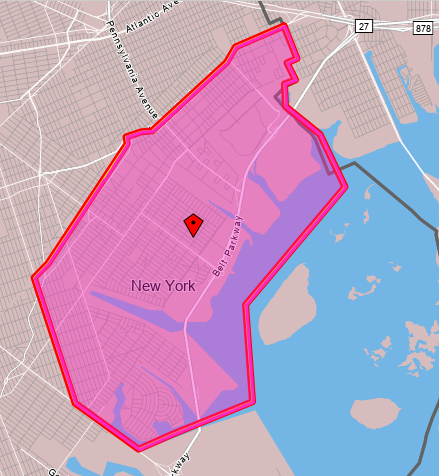
This is on net a bedroom community. In 2019, it had 85,427 employed residents and 39,382 jobs. Very few people both live and work in this area – only 4,005. This is an even smaller proportion than is typical in the city, where 8% of employed city residents work in the same community board they live in – the study zone is slightly smaller than Brooklyn Community Board 18, but CB 18 writ large also has a lower than average share of in-board workers.
In contrast with the limited extent of in-zone work travel, nearly all employed zone residents, 76,534, work in the city as opposed to its suburbs (and 31,685 of the zone’s 39,382 jobs are held by city residents). Where they work looks like where city workers work in general, since the transportation system other than the Shore Parkway is so radial:
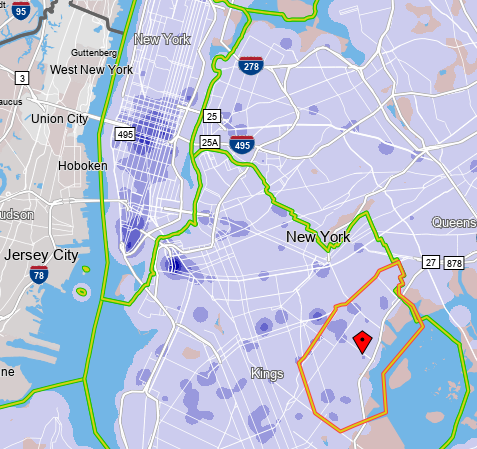
Within the zone, the southwestern areas, that is Mill Basin and Bergen Beach, are vaguely near Utica Avenue, hosting the B46 and hopefully in the future a subway line, first as an extension of the 4 train and later as an independent trunk line.
To the northeast, Canarsie, Starrett City, and Spring Creek are all far from the subway, and connect to it by dedicated buses to an outer subway station – see more details on the borough’s bus map. Canarsie is connected to the L subway station named after it by the B42, a short but high-productivity bus route, and to the 3 and 4 trains at Utica by the B17, also a high-productivity route. Starrett City does not have such strong dedicated buses: it is the outer terminus of the circumferential B82 (which is very strong), but its dedicated radial route, the B83 to Broadway Junction, is meandering and has slightly below-average ridership for its length. Spring Creek is the worst: it is a commercial rather than residential area, anchored by the Gateway Center mall, but the mall is served by buses entering it from the south and not the north, including the B83, the B84 to New Lots on the 3 (a half-hourly bus with practically no ridership), the rather weak B13 to Crescent Street and Ridgewood, and the Q8 to Jamaica.
The implications for bus design
The paucity of east-west throughfares in this area deeply impacts how bus redesign in Brooklyn ought to be done, and this proved important when Eric and I wrote our bus redesign proposal.
First, there are so few crossings between Brooklyn and Queens that the routes crossing between the two boroughs are constrained and can be handled separately. This means that it’s plausible to design separate bus networks for Brooklyn and Queens. In 2018 it was unclear whether they’d be designed separately or together; the MTA has since done them separately, which is the correct decision. The difficulty of crossings argues in favor of separation, and so does the difference in density pattern between the two boroughs: Brooklyn has fairly isotropic density thanks to high-density construction in Coney Island, which argues in favor of high uniform frequency borough-wide, whereas Queens grades to lower density toward the east, which argues in favor of more and less frequent routes depending on neighborhood details.
Second, the situation in Starrett City is unacceptable. This is an extremely poor, transit-dependent neighborhood, and right now its bus connections to the rest of the world are lacking. The B82 is a strong bus route but many rush hour buses only run from the L train west; at Starrett City, the frequency is a local bus every 10-12 minutes and another SBS bus every 10-12 minutes, never overlying to produce high base frequency. The B83 meanders and has low ridership accordingly; it should be combined with the B20 to produce a straight bus route going direct on Pennsylvania Avenue between Starrett City and Broadway Junction, offering neighborhood residents a more convenient connection to the subway.
Third, the situation in Spring Creek is unacceptable as well. Gateway Center is a recent development, dating only to 2002, long after the last major revision of Brooklyn buses. The bus network grew haphazardly to serve it, and does so from the wrong direction, forcing riders into a circuitous route. Only residents of Starrett City have any direct route to the mall, but whereas Starrett City has 5,724 employed residents (south of Flatlands), and Spring Creek has 4,980 workers, only 26 people commute from Starrett City to Spring Creek. It’s far more important to connect Spring Creek with the rest of the city, which means buses entering it from the north, not the south. Our bus redesign proposal does that with two routes: a B6/B82 extension making this and not Starrett City the eastern anchor, and a completely redone B13 going directly north from the mall to New Lots and thence hitting Euclid Avenue on the A/C and Crescent Street on the J/Z.
What about rail expansion?
New York should be looking at subway expansion, and not just Second Avenue Subway. Is subway expansion a good solution for the travel needs of this study zone?
For our purposes, we should start with the map of the existing subway system; the colors indicate deinterlining, but otherwise the system is exactly as it is today, save for a one-stop extension of the Eastern Parkway Line from New Lots to the existing railyard.

Starrett City does not lie on or near any obvious subway expansion; any rail there has to be a tram. But Canarsie is where any L extension would go – in fact, the Canarsie Line used to go there until it was curtailed to its current terminus in 1917, as the trains ran at-grade and grade-separating them in order to run third rail was considered impractically expensive. Likewise, extending the Eastern Parkway Line through the yard to Gateway Center is a natural expansion, running on Elton Street.
Both potential extensions should be considered on a cost per rider basis. In both cases, a big question is whether they can be built elevated – neither Rockaway Parkway nor Elton is an especially wide street most of the way, about 24 or 27 meters wide with 20-meter narrows. The Gateway extension would be around 1.3 km and the Canarsie one 1.8 km to Seaview Avenue or 2.3 km to the waterfront. These should cost around $250 million and $500 million respectively underground, and somewhat less elevated – I’m tempted to say elevated extensions are half as expensive, but this far out of city center, the underground premium should be lower, especially if cut-and-cover construction is viable, which it should be; let’s call it two-thirds as expensive above-ground.
Is there enough ridership to justify such expansion?
Let’s start with Canarsie, which has 28,515 employed residents between Flatlands and the water. Those workers mostly don’t work along the L, which manages to miss all of the city’s main job centers, but the L does have good connections to lines connecting to Downtown Brooklyn (A/C), Lower Manhattan (A/C again), and Midtown (4/5/6, N/Q/R/W, F/M, A/C/E). Moreover, the density within the neighborhood is uniform, and so many of the 28,515 are not really near where the subway would go – Rockaway/Flatlands, Rockaway/Avenue L, Rockaway/Seaview, and perhaps Belt Parkway for the waterfront. Within 500 meters of Rockaway/L and Rockaway/Seaview there are only 9,602 employed residents, but then it can be expected that nearly all would use the subway.
The B42 an B17 provide a lower limit to the potential ridership of a subway extension. The subway would literally replace the B42 and its roughly 4,000 weekday riders; nearly all of the 10,000 riders of the B17 would likely switch as well. What’s more, those buses were seeing decreases in ridership even before corona due to traffic and higher wages inducing people to switch away from buses – and in 2011, despite high unemployment, those two routes combined to 18,000 weekday riders.
If that’s the market, then $500 million/18,000 weekday riders is great and should be built.
Let’s look at Gateway now. Spring Creek has 4,980 workers, but first of all, only 3,513 live in the city. Their incomes are very low – of the 3,513, only 1,030, or 29%, earned as much as $40,000/year in 2019 – which makes even circuitous mass transit more competitive with cars. There’s a notable concentration of Spring Creek workers among people living vaguely near the 3/4 trains in Brooklyn, which may be explained by the bus connections; fortunately, there’s also a concentration among people living near the proposed IBX route in both Brooklyn and Queens.
The area is the opposite of a bedroom community, unlike the other areas within the study zone – only 1,114 employed people live in it. Going one block north of Flatlands boosts this to 1,923, but a block north of Flatlands it’s plausible to walk to a station at Linden at the existing railyard. 51% of the 1,114 and 54% of the 1,923 earn at least $40,000 a year. Beyond that, it’s hard to see where neighborhood residents work – nearly 40% work in the public sector and OnTheMap’s limitations are such that many of those are deemed to be working at Brooklyn Borough Hall regardless of their actual commute destination.
There’s non-work travel to such a big shopping center, but there are grounds to discount it. It’s grown around the Shore Parkway, and it’s likely that every shopper in the area who can afford a car drives in; in Germany, with generally good off-peak frequency and colocation of retail at train stations, the modal split for public transit is lower for shopping trips than for commutes to work or school. Such trips can boost a Gateway Center subway extension but they’re likely secondary, at least in the medium run.
The work travel to the mall is thankfully on the margin of good enough to justify a subway at $50,000/daily trip, itself a marginal cost. Much depends on IBX, which would help deliver passengers to nearby subway nodes, permitting such radial extensions to get more ridership.
Adversarial Legalism and Accessibility
New York State just announced that per the result of a legal settlement, it is committing to make 95% of the subway accessible… by 2055. Every decade, 80-90 stations will be made accessible, out of 472. Area advocates for disability rights are elated; in addition to those cited in the press release or in the New York Times article covering the news, Effective Transit Alliance colleague Jessica Murray speaks of it as a great win and notes that, “The courts are the only true enforcement mechanism of the Americans with Disabilities Act.” But to me, it’s an example not of the success of the use of the courts for civil rights purposes, in what is called adversarial legalism, but rather its failure. The timeline is a travesty and the system of setting the government against itself with the courts as the ultimate arbiter must be viewed as a dead-end and replaced with stronger administration.
The starting point for what is wrong is that 2055 is, frankly, a disgrace. By the standards of most other old urban metro systems, it is a generation behind. In Berlin, where the U-Bahn opened in 1902, two years before the New York City Subway did, there has been media criticism of BVG for missing its 2022 deadline for full accessibility; 80% of the system is accessible, and BVG says that it will reach 100% in 2024. Madrid is slower, planning only for 82% by 2028, with full accessibility possible in the 2030s. Barcelona is 93% accessible and is in the process of retrofitting its remaining stations. Milan has onerous restrictions such that only one wheelchair user may board each train, but the majority of stations have elevators, and 76% have elevators or stairlifts. In Tokyo, Toei is entirely accessible, and so is nearly the entirety of Tokyo Metro. Even London is 40% accessible, somewhat ahead of New York. Only Paris stands as a less accessible major world metro system.
The primary reason for this is costs. The current program to make 81 stations accessible by 2025 is $5.2 billion. This is $64 million per station, and nearly all are single-line stations requiring three elevators, one between the street and the outside of fare control and one from just inside fare control to each of two side platforms. Berlin usually only requires one elevator as it has island platforms and no fare barriers, but sometimes it needs two at stations with side platforms, and the costs look like 1.5-2 million € per elevator. Madrid the cost per elevator is slightly higher, 3.2 million €. New York, in contrast, spends $20 million, so that a single station in New York is comparable in scope to the entirety of the remainder of the Berlin U-Bahn.
And this is what adversarial legalism can’t fix. The courts can compel the MTA to install elevators, but have no way of ensuring the MTA do so efficiently. They can look at capital plans and decree that a certain proportion be spent on accessibility; seeing $50 billion five-year capital plans, they can say, okay, you need to spend 5-10% of that on subway accessibility. But if the MTA says that a station costs $64 million to retrofit and therefore there is no room in the budget to do it by 2030, the courts have to defer.
This, in turn, is a severe misjudgment of what the purpose of civil rights legislation is. Civil rights laws giving individuals and classes the right to sue the government already presuppose that the government may be racist, sexist, or ableist. This is why they confer individual and group rights to sue under Title VI (racial equality in transportation and other facilities), Title IX (gender equality in education), and the ADA. If the intention was to defer to the judgment of government agencies, no such laws would be necessary.
And yet, the nature of adversarial legalism is that on factual details, courts are forced to defer to government agencies. If the MTA says it costs $64 million to retrofit a station, the courts do not have the power to dismiss managers and hire people who can do it for $10 million. If the MTA says it has friction with utilities, the courts cannot compel the utilities to stop being secretive and share the map of underground infrastructure in the city or to stop being obstructive and start cooperating with the MTA’s contractors when they need to do street work to root an elevator. Judges are competent in legal analysis and incompetent in planning or engineering, and this is the result.
Worse, the adversarial process encourages obstructive behavior. The response to any request from the public or the media soon becomes “make me”; former Capital Construction head and current MTA head Janno Lieber said “file a Freedom of Information request” to a journalist who asked what 400 questions federal regulators asked regarding congestion pricing. Nothing goes forward this way, unless accessibility in 33 years counts, and it shouldn’t.
How Many Tracks Do Train Stations Need?
A brief discussion on Reddit about my post criticizing Penn Station expansion plans led me to write a very long comment, which I’d like to hoist to a full post explaining how big an urban train station needs to be to serve regional and intercity rail traffic. The main principles are,
- Good operations can substitute for station size, and it’s always cheaper to get the system to be more reliable than to build more tracks in city center.
- Through-running reduces the required station footprint, and this is one of the reasons it is popular for urban commuter rail systems.
- The simpler and more local the system is, the fewer tracks are needed: an urban commuter rail system running on captive tracks with no sharing tracks with other traffic and with limited branching an get away with smaller stations than an intercity rail station featuring trains from hundreds of kilometers away in any direction.
The formula for minimum headways
On subways, where usually the rush hour crunches are the worst, trains in large cities run extremely frequently, brushing up against the physical limitation of the tracks. The limit is dictated by the brick wall rule, which states that the signal system must at any point assume that the train ahead can turn into a brick wall and stop moving and the current train must be able to brake in time before it reaches it. Cars, for that matter, follow the same rule, but their emergency braking rate is much faster, so on a freeway they can follow two seconds apart. A metro train in theory could do the same with headways of 15 seconds, but in practice there are stations on the tracks and dealing with them requires a different formula.
With metro-style stations, without extra tracks, the governing formula is,

Platform clearing time is how long it takes the train to clear its own length; the idea of the formula is that per the brick wall rule, the train we’re on needs to begin braking to enter the next station only after the train ahead of ours has cleared the station.
But all of this is in theory. In practice, there are uncertainties. The uncertainties are almost never in the stopping or platform clearing time, and even the dwell time is controllable. Rather, the schedule itself is uncertain: our train can be a minute late, which for our purpose as passengers may be unimportant, but for the scheduler and dispatcher on a congested line means that all the trains behind ours have to also be delayed by a minute.
What this means that more space is required between train slots to make schedules recoverable. Moreover, the more complex the line’s operations are, the more space is needed. On a metro train running on captive tracks, if all trains are delayed by a minute, it’s really not a big deal even to the control tower; all the trains substitute for one another, so the recovery can be done at the terminal. On a mainline train running on a national network in which our segment can host trains to Budapest, Vienna, Prague, Leipzig, Munich, Zurich, Stuttgart, Frankfurt, and Paris, trains cannot substitute for one another – and, moreover, a train can be easily delayed 15 minutes and need a later slot. Empty-looking space in the track timetable is unavoidable – if the schedule can’t survive contact with the passengers, it’s not a schedule but crayon.
How to improve operations
In one word: reliability.
In two words: more reliability.
Because the main limit to rail frequency on congested track comes from the variation in the schedule, the best way to increase capacity is to reduce the variation in the schedule. This, in turn, has two aspects: reducing the likelihood of a delay, and reducing the ability of a delay to propagate.
Reducing delays
The central insight about delays is that they may occur anywhere on the line, roughly in proportion to either trip time or ridership. This means that on a branched mainline railway network, delays almost never originate at the city center train station or its approaches, not because that part of the system is uniquely reliable, but because the train might spend five minutes there out of a one-hour trip. The upshot is that to make a congested central segment more reliable, it is necessary to invest in reliability on the entire network, most of which consists of branch segments that by themselves do not have capacity crunches.
The biggest required investments for this are electrification and level boarding. Both have many benefits other than schedule reliability, and are underrated in Europe and even more underrated in the United States.
Electrification is the subject of a TransitMatters report from last year. As far as reliability is concerned, the LIRR and Metro-North’s diesel locomotives average about 20 times the mechanical failure rate of electric multiple units (source, PDF-pp. 36 and 151). It is bad enough that Germany is keeping some outer regional rail branches in the exurbs of Berlin and Munich unwired; that New York has not fully electrified is unconscionable.
Level boarding is comparable in its importance. It not only reduces dwell time, but also reduces variability in dwell time. With about a meter of vertical gap between platform and train floor, Mansfield has four-minute rush hour dwell times; this is the busiest suburban Boston commuter rail station at rush hour, but it’s still just about 2,000 weekday boardings, whereas RER and S-Bahn stations with 10 time the traffic hold to a 30-second standard. This also interacts positively with accessibility: it permits passengers in wheelchairs to board unaided, which both improves accessibility and ensures that a wheelchair user doesn’t delay the entire train by a minute. It is fortunate that the LIRR and (with one peripheral exception) Metro-North are entirely high-platform, and unfortunate that New Jersey Transit is not.
Reducing delay propagation
Even with reliable mechanical and civil engineering, delays are inevitable. The real innovations in Switzerland giving it Europe’s most reliable and highest-use railway network are not about preventing delays from happening (it is fully electrified but a laggard on level boarding). They’re about ensuring delays do not propagate across the network. This is especially notable as the network relies on timed connections and overtakes, both of which require schedule discipline. Achieving such discipline requires the following operations and capital treatments:
- Uniform timetable padding of about 7%, applied throughout the line roughly on a one minute in 15 basis.
- Clear, non-discriminatory rules about train priority, including a rule that a train that’s more than 30 minutes loses all priority and may not delay other trains at junctions or on shared tracks.
- A rigid clockface schedule or Takt, where the problem sections (overtakes, meets, etc.) are predictable and can receive investment. With the Takt system, even urban commuter lines can be left partly single-track, as long as the timetable is such that trains in opposite directions meet away from the bottleneck.
- Data-oriented planning that focuses on tracing the sources of major delays and feeding the information to capital planning so that problem sections can, again, receive capital investment.
- Especial concern for railway junctions, which are to be grade-separated or consistently scheduled around. In sensitive cases where traffic is heavy and grade separation is too expensive, Switzerland builds pocket tracks at-grade, so that a late train can wait for a slot without delaying cross-traffic.
So, how big do train stations need to be?
A multi-station urban commuter rail trunk can get away with metro-style operations, with a single station track per approach track. However, the limiting factor to capacity will be station dwell times. In cases with an unusually busy city center station, or on a highly-interlinked regional or intercity network, this may force compromises on capacity.
In contrast, with good operations, a train station with through-running should never need more than two station tracks per approach track. Moreover, the two station tracks that each approach track splits into should serve the same platform, so that if there is an unplanned rescheduling of the train, passengers should be able to use the usual platform at least. Berlin Hauptbahnhof’s deep tracks are organized this way, and so is the under-construction Stuttgart 21.
Why two? First, because it is the maximum number that can serve the same platform; if they serve different platforms, it may require lengthening dwell times during unscheduled diversions to deal with passenger confusion. And second, because every additional platform track permits, in theory, an increase in the dwell time equal to the minimum headway. The minimum headway in practice is going to be about 120 seconds; at rush hour Paris pushes 32 trains per hour on the shared RER B and D trunk, which is not quite mainline but is extensively branched, but the reliability is legendarily poor. With a two-minute headway, the two-platform track system permits a straightforward 2.5-minute dwell time, which is more than any regional railway needs; the Zurich S-Bahn has 60-second dwells at Hauptbahnhof, and the Paris RER’s single-level trains keep to about 60 seconds at rush hour in city center as well.
All of this is more complicated at a terminal. In theory the required number of tracks is the minimum turn time divided by the headway, but in practice the turn time has a variance. Tokyo has been able to push station footprint to a minimum, with two tracks at Tokyo Station on the Chuo Line (with 28 peak trains per hour) and, before the through-line opened, four tracks on the Tokaido Main Line (with 24). But elsewhere the results are less optimistic; Paris is limited to 16-18 trains per hour at the four-track RER E terminal at Saint-Lazare.
At Paris’s levels of efficiency, which are well below global best practices, an unexpanded Penn Station without through-running would still need two permanent tracks for Amtrak, leaving 19 tracks for commuter traffic. With the Gateway tunnel built, there would be four two-track approaches, two from each direction. The approaches that share tracks with Amtrak (North River Tunnels, southern pair of East River Tunnels) would get four tracks each, enough to terminate around 18 trains per hour at rush hour, and the approaches that don’t would get five, enough for maybe 20 or 22. The worst bottleneck in the system, the New Jersey approach, would be improved from today’s 21 trains per hour to 38-40.
A Penn Station with through-running does not have the 38-40 trains per hour limit. Rather, the approach tracks would become the primary bottleneck, and it would take an expansion to eight approach tracks on each side for the station itself to be at all a limit.
The Northeastern United States Wants to Set Tens of Billions on Fire Again
The prospect of federal funds from the Bipartisan Infrastructure Bill is getting every agency salivating with desires for outside money for both useful and useless priorities. Northeastern mainline rail, unfortunately, tilts heavily toward the useless, per a deep dive into documents by New York-area activists, for example here and here.
Amtrak is already hiring project management for Penn Station redevelopment. This is a project with no transportation value whatsoever: this is not the Gateway tunnels, which stand to double capacity across the Hudson, but rather a rebuild of Penn Station to add more tracks, which are not necessary. Amtrak’s current claim is that the cost just for renovating the existing station is $6.5 billion and that of adding tracks is $10.5 billion; the latter project has ballooned from seven tracks to 9-12 tracks, to be built on two levels.
This is complete overkill. New train stations in big cities are uncommon, but they do exist, and where tracks are tunneled, the standard is two platform tracks per approach tracks. This is how Berlin Hauptbahnhof’s deep section goes: the North-South Main Line is four tracks, and the station has eight, on four platforms. Stuttgart 21 is planned in the same way. In the best case, each of the approach track splits into two tracks and the two tracks serve the same platform. Penn Station has 21 tracks and, with the maximal post-Gateway scenario, six approach tracks on each side; therefore, extra tracks are not needed. What’s more, bundling 12 platform tracks into a project that adds just two approach tracks is pointless.
This is a combined $17 billion that Amtrak wants to spend with no benefit whatsoever; this budget by itself could build high-speed rail from Boston to Washington.
Or at least it could if any of the railroads on the Northeast Corridor were both interested and expert in high-speed rail construction. Connecticut is planning on $8-10 billion just to do track repairs aiming at cutting 25-30 minutes from the New York-New Haven trip times; as I wrote last year when these plans were first released, the reconstruction required to cut around 40 minutes and also upgrade the branches is similar in scope to ongoing renovations of Germany’s oldest and longest high-speed line, which cost 640M€ as a once in a generation project.
In addition to spending about an order of magnitude too much on a smaller project, Connecticut also thinks the New Haven Line needs a dedicated freight track. The extent of freight traffic on the line is unclear, since the consultant report‘s stated numbers are self-contradictory and look like a typo, but it looks like there are 11 trains on the line every day. With some constraints, this traffic fits in the evening off-peak without the need for nighttime operations. With no constraints, it fits on a single track at night, and because the corridor has four tracks, it’s possible to isolate one local track for freight while maintenance is done (with a track renewal machine, which US passenger railroads do not use) on the two tracks not adjacent to it. The cost of the extra freight track and the other order-of-magnitude-too-costly state of good repair elements, including about 100% extra for procurement extras (force account, contingency, etc.), is $300 million for 5.4 km.
I would counsel the federal government not to fund any of this. The costs are too high, the benefits are at best minimal and at worst worse than nothing, and the agencies in question have shown time and time again that they are incurious of best practices. There is no path forward with those agencies and their leadership staying in place; removal of senior management at the state DOTs, agencies, and Amtrak and their replacement with people with experience of executing successful mainline rail projects is necessary. Those people, moreover, are mid-level European and Asian engineers working as civil servants, and not consultants or political appointees. The role of the top political layer is to insulate those engineers from pressure by anti-modern interest groups such as petty local politicians and traditional railroaders who for whatever reasons could not just be removed.
If federal agencies are interested in building something useful with the tens of billions of BIL money, they should instead demand the same results seen in countries where the main language is not English, and staff up permanent civil service run by people with experience in those countries. Following best industry practices, $17 billion is enough to renovate the parts of the Northeast Corridor that require renovation and bypass those that require greenfield bypasses; even without Gateway, Amtrak can squeeze a 16-car train every 15 minutes, providing 4,400 seats into Penn Station in an hour, compared with around 1,700 today – and Gateway itself is doable for low single-digit billions given better planning and engineering.
Systemic Investments in the New York City Subway
Subway investments can include expansion of the map of lines, for example Second Avenue Subway; proposals for such extensions are affectionately called crayon, a term from London Reconnections that hopped the Pond. But they can also include improvements that are not visible as lines on a map, and yet are visible to passengers in the form of better service: faster, more reliable, more accessible, and more frequent.
Yesterday I asked on Twitter what subway investments people think New York should get, and people mostly gave their crayons. Most people gave the same list of core lines – Second Avenue Subway Phase 2, an extension of the 2 and 5 on Nostrand, an extension of the 4 on Utica, an extension of the N and W to LaGuardia, the ongoing Interborough Express proposal, and an extension of Second Avenue Subway along 125th – but beyond that there’s wide divergence and a lot of people argue over the merits of various extensions. But then an anonymous account that began last year and has 21 followers and yet has proven extremely fluent in the New York transit advocacy conversation, named N_LaGuardia, asked a more interesting question: what non-crayon systemic investments do people think the subway needs?
On the latter question, there seems to be wide agreement among area technical advocates, and as far as I can tell the main advocacy organizations agree on most points. To the extent people gave differing answers in N_LaGuardia’s thread, it was about not thinking of everything at once, or running into the Twitter character limit.
It is unfortunate that many of these features requiring capital construction run into the usual New York problem of excessive construction costs. The same institutional mechanisms that make the region incapable of building much additional extension of the system also frustrate systemwide upgrades to station infrastructure and signaling.
Accessibility
New York has one of the world’s least accessible major metro systems, alongside London and (even worse) Paris. In contrast, Berlin, of similar age, is two-thirds accessible and planned to reach 100% soon, and the same is true of Madrid; Seoul is newer but was not built accessible and retrofits are nearly complete, with the few remaining gaps generating much outrage by people with disabilities.
Unfortunately, like most other forms of capital construction in New York, accessibility retrofits are unusually costly. The elevator retrofits from the last capital plan were $40 million per station, and the next batch is in theory $50 million, with the public-facing estimates saying $70 million with contingency; the range in the European cities with extensive accessibility (that is, not London or Paris) is entirely single-digit million. Nonetheless, this is understood to be a priority in New York and must be accelerated to improve the quality of universal design in the system.
Platform screen doors
The issue of platform screen doors (PSDs) or platform edge doors (PEDs) became salient earlier this year due to a much-publicized homicide by pushing a passenger onto a train, and the MTA eventually agreed to pilot PSDs at three stations. The benefits of PSDs are numerous, including,
- Safety – there are tens of accident and suicide deaths every year from falling onto tracks, in addition to the aforementioned homicide.
- Greater accessibility – people with balance problems have less to worry about from falling onto the track.
- Capacity – PSDs take up platform space but they permit passengers to stand right next to them, and the overall effect is to reduce platform overcrowding at busy times.
- Air cooling – at subway stations with full-height PSDs (which are rare in retrofits but I’m told exist in Seoul), it’s easier to install air conditioning for summer cooling.
The main difficulty is that PSDs require trains to stop at precise locations, to within about a meter, which requires signaling improvements (see below). Moreover, in New York, trains do not yet have consistent door placement, and the lettered lines even have different numbers of doors sometimes (4 per car but the cars can be 60′ or 75′ long) – and the heavily interlined system is such that it’s hard to segregate lines into captive fleets.
But the biggest difficulty, as with accessibility, is again the costs. In the wake of public agitation for PSDs earlier this year, the MTA released as 2019 study saying only 128 stations could be retrofitted with PSDs, at a cost of $7 billion each, or $55 million per station; in Paris, PSDs are installed on Métro lines as they are being automated, at a cost of (per Wikipedia) 4M€ per station of about half the platform length as in New York.
Signaling improvements
New York relies on ancient signaling for the subway. This leads to multiple problems: maintenance is difficult as the international suppliers no longer make the required spare parts; the signals are designed around the performance specs of generations-old trains and reduce capacity on more modern trains; the signals are confusing to drivers and therefore trains run slower than they can.
To modernize them, New York is going straight to the most advanced system available: CBTC, or communications-based train control, also known as moving-block signaling. This is already done on the L and 7 trains and is under installation on other lines, which are not isolated from the rest of the system. CBTC permits much higher peak capacity in London; in New York, unfortunately, this effect has been weaker because of other constraints, including weak electrical substation capacity and bumper tracks at the terminals of both the L and the 7.
Moreover, in New York, the L train’s performance was derated when CBTC was installed, to reduce brake wear. The effect of such computer control should be the opposite, as computers drive more precisely than humans: in Paris, the automation of Line 1 led to a speed increase of 15-20%, and CBTC even without automation has the same precision level as full automation.
As before, costs form a major barrier. I can’t give the most recent analogs, because such projects tend to bundle a lot of extras, such as new trainsets and PSDs in Paris. In Nuremberg, the first city in the world to permanently convert a preexisting metro system to driverless operations, the cost of just the driverless system is said to have been 110M€ in the late 2000s, for what I believe is 13 km of U2 (U3 was built with driverless operations in mind, and then U2, from which it branches, was converted). It is said that automating U1 should cost 100M€ for 19.5 km, but this project is not happening due to stiff competition for federal funds and therefore its real cost is uncertain. In contrast, Reinvent Albany quotes $636 million for the 7 train in New York, of which $202 million must be excluded as rolling stock conversion; the Flushing Line is 16 km long, so this is still $27 million/km and not the $7-12 million/km of Nuremberg.
Maintenance regime
The maintenance regime in New York involves heavy slowdowns and capacity restrictions. Trains run 24/7 without any breaks for regular maintenance. Instead, maintenance is done one track at a time during off-peak periods, with flagging rules that slow down trains on adjacent tracks and have gotten more onerous over the last 10-20 years; only recently have planners begun to use temporary barriers to reduce the burden of flagging.
The result of this system is threefold. First, track maintenance productivity is extremely low – the train on an adjacent track slows down as it passes but the work stops as it passes as well. Second, speeds are unreliable off-peak and the timetable is in perpetual firefighting mode. And third, parts of the system are claimed to be incapable of running more than about 16 trains per hour off-peak, which means that if there is any branching, the branches are limited to 8, which is not enough frequency on a major urban metro system.
It takes a small amount of capital spending to increase efficiency of maintenance, through procuring more advanced machinery, installing barriers between tracks, and installing crossovers at appropriate locations. But it takes a large degree of operations and management reform to get there, which is necessary for reducing the high operating costs of the subway.
Deinterlining
New York has the most complicated interlining of any global metro network. Only four lines – the 1, 6, 7, and L – run by themselves without any track sharing with other lines. The 2, 3, 4, and 5 share tracks with one another. Then the lettered trains other than the L all share tracks on various segments, without any further segregation. Only some commuter rail networks are more complex than this – and even Tokyo has greater degree of segregation between different trunk lines, despite extensive through-service to commuter rail. The New York way guarantees more direct service on more origin-destination pairs, but at low frequency and with poor speed and reliability.
London, the second most interlined system, has long wanted to reduce interlining to increase capacity. The Northern line traditionally had just one southern segment reverse-branching to two central trunks, combining and splitting into two northern branches. When CBTC opened, the busier of the central trunks got 26 peak trains per hour; the more recent Battersea extension removed the interlining to the south, permitting boosting capacity up to 32 tph, and full deinterlining to the north would boost it to 36 tph, as on the most captive Underground lines.
In New York, it is desirable to remove all reverse-branching. At DeKalb Avenue in Downtown Brooklyn, the interlocking switches the four express (bridge) tracks from an arrangement of the B and D on one track pair and the N and Q on the other to the B and Q on one track pair and the D and N on the other; the process is so complex that every train is delayed two minutes just from the operation of the switches. Everywhere within the system, interlining creates too much dependency between the different trains, so that delays on one line propagate to the others, reducing reliability, speed, and capacity.
Some of the problem is, as usual, about high costs. Rogers Avenue Junction controls the branching of the 2, 3, 4, and 5 trains in Brooklyn, transitioning from the 2 and 3 sharing one track pair and the 4 and 5 sharing another to the 3 and 4 running on dedicated tracks and the 2 and 5 sharing tracks. For a brief segment, the 2, 3 and 5 trains all share tracks. This devastates capacity on both trunk lines, which rank first and third citywide in peak crowding as of the eve of the opening of Second Avenue Subway. There are already internal designs for rebuilding the junction to avoid this problem – at a cost of $300 million.
But some of the problem is also about operating paradigms. New York must move away from the scheduling ideas of the 1920s and 30s and understand that independently-operated lines with dedicated fleets and timetables, with passengers making transfers as appropriate, are more robust and overall better for most riders. DeKalb can be deinterlined with no capital spending at all, and so can Columbus Circle. It’s Rogers and Queens Plaza where spending is ideal (but even then, not strictly required if some operational compromises are made), and the 142nd Street Junction in Harlem where an extensive rebuild is obligatory in order to permit splitting the 2 from the 5 in the Bronx permanently.
Labor changes
Staffing levels in New York are very high. Trains have conductors and not just drivers; this is not globally unheard of (Toronto and some lines in Tokyo still have conductors) but it’s rare. With good enough signaling, a retrofit even for full automation is possible, as in Nuremberg, Paris, and Singapore. Maintenance work is likewise unproductive, not because people don’t work hard, but because they work inefficiently.
Improving this situation involves changes on both sides of the ledger – staffing and service. Conductors have to be cut for efficiency and not all of them can be absorbed by other roles, and the same is true of some station facilities and maintenance functions. In contrast, the low productivity of drivers in New York – they spend around 550 hours a year driving a revenue train whereas Berlin’s drivers, who get 6 weeks of annual paid vacation, scratch 900 – is the result of poor off-peak frequency, and must be resolved through increases in off-peak service that increase efficiency without layoffs.
Ultimate goal: six-minute service
I wrote two years ago about what it would take to ensure every public transit service in New York runs every six minutes off-peak, calling it a six-minute city.
Riders Alliance argues for the same goal, with the hashtag #6minuteservice; I do not know if they were basing this on what I’d written or if it’s convergent evolution. But it’s a good design goal for timetabling, with implications for labor efficiency, maintenance efficiency, the schedule paradigm, and the bus system.
No tradeoffs
It is fortunate that the agenda of systemwide improvements does not exhibit significant tradeoffs in investment. Other parts of the transit agenda do not need to suffer to implement those improvements. On the contrary, they tend to interact positively: accessibility and PSDs can be combined (and federal law is written in such a way that PSDs void the grandfather clause permitting the subway to keep most of its stations inaccessible), faster and more reliable trains can be run more frequently off-peak, better service means higher ridership and therefore higher demand for extensions. Only the issue of labor exhibits a clear set of losers from the changes, and those can be compensated in a one-time deal.
Moreover, the budget for such an agenda is reasonable, if New York can keep its construction costs under control. At the per-elevator costs of Berlin or Madrid, New York could make its entire network wheelchair-accessible for around $3.5-4 billion. Parisian PSDs, pro-rated to the greater size of New York trains, would be around $10 million a station, or $5 billion systemwide. Full automation at German costs would be maybe $6 billion with triple- and quad-track lines pro-rated. The entire slate of changes required for full deinterlining, including a pocket track for the 3 train at 135th Street, a rebuild of the 36th Street station in Queens, and a connection between Queensboro Plaza and Queens Plaza, should be measured in the hundreds of millions, not billions.
The overall program still goes into double-digit billions; it requires a big push. But this big push is worth two to three years’ worth of current New York City Transit capital spending. A New York that can do this can also add 50-100 km to its subway network and vice versa, all while holding down operating costs to typical first-world levels. For the most part, the planners already know what needs to be done; the hard part is getting construction costs to reasonable levels so that they can do it on the current budget.
Quick Note: How to Incentivize Transit-Oriented Development
The Biden administration recently put out a statement saying that it would work to increase national housing production. It talks about the need to close the housing shortfall, estimated at 1.5 million dwellings, and proposes to use the Bipartisan Infrastructure Law (BIL) to dole out transport funding based on housing production. This is a welcome development, and I’d like to offer some guidelines for how this can be done most effectively.
Incentives mean mistrust
You do not need to give incentives to trustworthy people. The notion of incentives already assumes that the people who are so governed would behave poorly by themselves, and that the governing body, in this case the federal government, surveils them loosely so as to judge them by visible metrics set in advance. Once this fundamental fact is accepted – the use of BIL funding to encourage housing production implies mistrust of all local government to build housing – every other detail should be set up in support of it.
Demand conflict with community
Federal funding should, in all cases, require state and local governments to discipline community groups that fight housing and extract surplus from infrastructure. Regions that cannot or do not do so should receive less funding; the feds should communicate this in advance, stating both the principle and the rules by which it will be judged. For example, a history of surrender to local NIMBYs to avoid lawsuits, or else an unwillingness to fight said lawsuits, should make a region less favored for funds, since it’s showing that they will be wasted. In contrast, a history of steamrolling community should be rewarded, showing that the government is in control and prioritizes explicit promises to the feds and the voters over implicit promises to the local notables who form the base of NIMBYism.
Spend money in growth regions
In cities without much housing demand, like Detroit and Cleveland, the problem of housing affordability is one of poverty; infrastructure spending wouldn’t fix anything. This means that the housing grant should prioritize places with growth demand, where current prices greatly exceed construction costs. These include constrained expensive cities like New York and San Francisco, but increasingly also other wealthy cities like Denver and Nashville, whose economic booms translate to population increase as well as income growth, but unfortunately housing growth lags demand. Even poorer interior cities are seeing rent increases as people flee the high prices of richer places, and encouraging housing growth in their centers is welcome (but not in their suburbs, where housing is abundant and not as desirable).
Look at residential, not commercial development
In the United States, YIMBY groups have focused exclusively on residential development. This is partly for political reasons: it’s easier to portray housing as more moral, benefiting residents who need affordable housing even if the building in question is market-rate, than to portray an office building as needing political support. In some cases it’s due to perceived economic reasons – the two cities driving the American YIMBY discourse, New York and San Francisco, have unusually low levels of job sprawl for the United States, and in both cities YIMBY groups are based near city center, where jobs look especially plentiful. At the local and state level, this indifference to commercial YIMBY is bad, because it’s necessary to build taller in city center and commercialize near-center neighborhoods like the West Village to fight off job sprawl.
However, at the federal level, a focus on residential development is good. This is a consequence of the inherent mistrust assumed in the incentive system. While economically, American cities need city centers to grow beyond the few downtown blocks they currently occupy, politically it’s too easy for local actors to bundle a city center expansion with an outrageously expensive urban renewal infrastructure plan. In New York, this is Penn Station redevelopment, including some office towers in the area that are pretty useful and yet have no reason to be attached to the ill-advised Penn Station South project digging up an entire block to build new tracks. Residential development is done at smaller scale and is harder to bundle with such unnecessary signature projects; the sort of projects that are bundled with it are extensions of urban rail to new neighborhoods to be redeveloped, and those are easier to judge on the usual transport metrics.
Consolidating Stops with Irregular Spacing
There was an interesting discussion on Twitter a few hours ago about stop consolidation on the subway in New York. Hayden Clarkin, the founder of TransitCon, brings up the example of 21st Street on the G in Long Island City. The stop is lightly-used and very close to Court Square, which ordinarily makes it a good candidate for removal, a practice that has been done a handful of times in the city’s past. However, the spacing is irregular and in context this makes the stop’s removal a lower-value proposition; in all likelihood there should not be any change and trains should keep calling at the station as they do today.
What is 21st Street?
The G train, connecting Downtown Brooklyn with Long Island City directly, makes two stops in Queens today: Court Square, at the southern end of the Long Island City business district, and 21st Street, which lies farther south. Here is a map of the area:
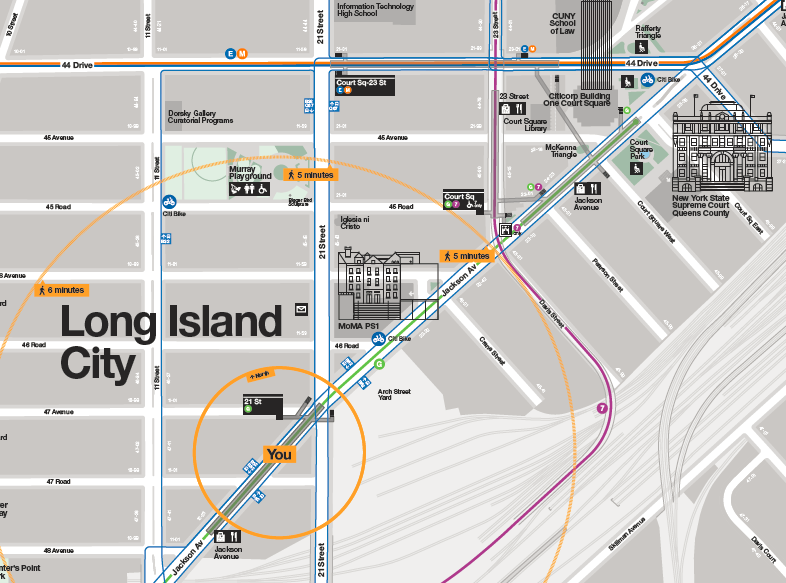
At closest approach, the platforms of 21st are 300 meters away from those of Court Square on the G; taking train length into account, this is around 400 meters (the G runs short trains occupying only half the platform). Moreover, Court Square is a more in-demand area than 21st Street: Long Island City by now near-ties Downtown Brooklyn as the largest job center in the region outside Manhattan, and employment clusters around Queens Plaza, which used to be one stop farther north on the G before the G was curtailed to Court Square in order to make more room for Manhattan-bound trains at Queens Plaza. Court Square is still close to jobs, but 21st Street is 400 meters farther away from them, with little on its side of the neighborhood.
Stop spacing optimization
Subways cannot continuously optimize their stop spacing the way buses can. Building a new bus stop costs a few thousand dollars, or a few ten thousand if you’re profligate. Building a new subway stop costs tens of millions, or a few hundred million if you’re profligate. This means that the question of subway stop optimization can only truly be dealt with during the original construction of a line. Subsequently, it may be prudent to build a new stop but only at great expense and usually only in special circumstances (for example, in the 1950s New York built an infill express station on the 4 and 5 trains at 59th, previously a local-only station, to transfer with the N, R, and W). But deleting a stop is free; New York has done it a few times, such as at 18th Street on the 6 trains or 91st on the 1. Is it advisable in the case of 21st?
The answer has to start with the formula for stop spacing. Here is my earliest post about it, in the context of bus stops. The formula is,

The factor of 4 in the formula depends on circumstances. If travel is purely isotropic along the line, then the optimum is at its minimum and the factor is 2. The less isotropic travel is, the higher the factor; the number 4 is when origins are purely isotropic, which reflects residential density in this part of New York, but destinations are purely anisotropic and can all be guaranteed to be at distinguished nodes, like business centers and transfer points. Because 21st Street is a residential area and Court Square is a commercial area and a transfer point, the factor of 4 is justified here.
Walk speed is around 1.33 m/s, the walk penalty is typically 2, the stop penalty on the subway is around 45 seconds, and the average unlinked trip on the subway is 6.21 km; the formula spits out an optimum of 863 m, which means that a stop that’s 400 meters from nearby stops should definitely be removed.
But there’s a snag.
The effect of irregular stop spacing
When the optimal interstation is 863 meters, the rationale for removing a stop that’s located 400 meters from adjacent stations is that the negative impact of removal is limited. Passengers at the stop to be removed have to walk 400 meters extra, and passengers halfway between the stop and either of the adjacent stops have no more walking to do because they can just walk to the other stop; the average extra walk is then 200 meters. The formula is based on minimizing overall travel time (with a walk penalty) assuming that removing a stop located x meters from adjacent stops incurs an extra walk of x/2 meters on average near the station. Moreover, only half of the population lives near deleted stops, so the average of x/2 meters is only across half the line.
However, this works only when stop spacing is regular. If the stop to be removed is 400 meters from an adjacent stop, but much farther from the adjacent stop on the other side, then the formula stops applying. In the case of 21st Street, the next stop to the south, Greenpoint Avenue, is 1.8 km away in Brooklyn, across an unwalkable bridge. Removing this stop does not increase the average walk by 200 meters but by almost 400, because anywhere from 21st south in Long Island City the extra walk is 400. Moreover, because this is the entire southern rim of Long Island City, this is more than just half the line in this area.
In the irregular case, we need to halve the factor in the formula, in this case from 4 to 2 (or from 2 to 1 if travel is isotropic). Then the optimum falls to 610; this already takes into account that 21st Street is a weaker-demand area than Court Square, or else the factor in the formula would drop by another factor of 2. At 610 meters, the impact of removing a stop 400 meters from an adjacent stop is not clearly positive. In the long run, it is likely counterproductive, since Long Island City is a growth area and demand is likely to grow in the future.
Does this generalize?
Yes!
In New York, this situation occurs at borough boundaries, and also at the state boundary if more service runs between the city and New Jersey. For example, in retrospect, it would have been better for the east-west subway lines in Manhattan to make a stop at 1st or 2nd Avenue, only 300-500 meters from the typical easternmost stop of Lexington. The L train does this, and if anything does not go far enough – there’s demand for opening a new entrance to the 1st Avenue stop (which is one of the busiest on the line) at Avenue A, and some demand for a likely-infeasible infill stop at Avenue C. These are all high-density areas, but they’re residential – most people from Queens are not going to 2nd Avenue but to Lex and points west, and yet, 2nd would shorten the walk for a large group of residential riders by around 400 meters, justifying its retrospective inclusion.
No Federal Aid to Transit Operations, Please
This is the third in a series of four posts about the poor state of political transit advocacy in the United States, following posts about the Green Line Extension in metro Boston and free public transport proposals, to be followed by an Urban Institute report by Yonah Freemark.
In the United States, political transit activists in the last few years have set their eyes on direct federal aid for operating subsidies for public transport. Traditionally, this has not been allowed: federal aid goes to capital planning (including long-term maintenance), and only a small amount of money goes to operations, all in peripheral bus systems. Urban transit agencies had to operate out of fares and local and state money. Demands for federal aid grew during corona, where emergency aid to operations led to demands for permanent subsidies, and have accelerated more recently as corona recovery has flagged (New York’s subway ridership is only around 60% of pre-corona levels). But said demands remain a bad idea in the short and long terms.
In the early 20th century, when public transport was expected to support itself out of fares, operating costs grew with wages, but were tempered by improvements in efficiency. New York City Transit opened with ticket-takers at every subway entrances and a conductor for every two cars; within a generation this system was replaced with automatic turnstiles and one conductor per train. Kyle Kirschling’s thesis has good data on this, finding that by the 1930s, the system grew to about 16,000 annual car-miles (=26,000 car-km) per employee.
And then it has stagnated. Further increases in labor efficiency have not happened. Most American systems have eliminated conductors, often through a multi-decade process of attrition rather than letting redundant workers go, but New York retains them. The network today actually has somewhat less service per employee than in the 1930s, 14,000 car-miles as of 2010, because fixed costs are spread across a slightly smaller system. Compare this with JICA’s report for Mumbai Metro comparing Japanese cities: Tokyo Metro has 283,871,000 car-km (PDF-p. 254) on 8,474 employees (PDF-p. 9), which is 33,500/employee, and that’s without any automation and with only partially conductor-less operations; Yokohama gets 40,000.
Moreover, the timeline in the US matches the onset of subsidies, to some extent: state and local subsidies relieved efficiency pressure. In Canada, TTC saw this and lobbied against subsidies for its own operations in the 1960s, on the grounds that without a breakeven mandate, the unions would capture all surplus; it took until the 1970s for it to finally receive any operating subsidies.
Federal subsidies make all of this worse. They are other people’s money (OPM), so local agencies are likely to maximize them at the expense of good service; this is already what they do with capital money, lading projects with local demands for betterments figuring that if everyone else hogs the trough then they should as well.
Then there is the issue of wages. Seniority systems in American unionized labor create labor shortages even when pay is high, because of how they interact with scheduling and tiered wage structures. Bus drivers in Boston earn around $80,000 a year, a pay that German bus and train drivers can only dream of, but starting drivers are in probational status and have a lower wage (they are not even given full-time work until they put in a long period of part-time work). Moreover, because drivers pick their shifts in seniority order, drivers for about the first 10 years are stuck with the worst shifts: split shifts, graveyard shifts at inconsistent intervals, different garages to report to. New York manages to find enough bus drivers to fill its ranks but only by paying around $85,000 a year; other American cities, paying somewhat less, are seeing thousands of missed runs over the year because they can’t find drivers.
And outside aid does nothing to fix that. Quite to the contrary, it helps paper over these problems and perpetuates the labor gerontocracy. New York City Transit has learned to react to every crisis by demanding a new source of income; there is not enough political appetite for transparent taxation, so the city and state find ever more opaque sources of funds, avoiding political controversy over wanton inefficiency but creating more distortion than a broad income tax would.
Instead of subsidizing current consumption, a developmental state should subsidize production. Don’t pay money to hire more bus drivers; pay for automating subway systems, for better dispatching, for better planning around intermodal integration. Current American wages, not to mention the unemployment rate, scream “invest in labor-saving technology” and not “expand labor-intensive production.”
The G Train
The G train is bad. I say this, 16 years after I moved to New York, 11 years after I left, and I know it’s what every New Yorker knows. Tourists walk too slowly, rent is too high for small apartments, and the G train sucks. What I want to highlight in this post is how the subway’s scheduling paradigm is especially bad for the G train and leads to a vicious cycle making the train less frequent and less useful for passengers.
The role of the G train
The G train is the only mainline subway service in New York that does not enter Manhattan; see map here. It connects what are now the region’s two largest non-Manhattan business centers, Long Island City and Downtown Brooklyn, running vaguely parallel to the East River on the Queens and Brooklyn side of it. To the south of Downtown Brooklyn, it has a tail serving the wealthy neighborhoods collectively called South Brooklyn, such as Carroll Gardens and Park Slope.
I’ve criticized the G before for its poor construction. It misses critical transfers, like the other lines built in the IND program in the 1920s-30s. In Queens it misses Queensboro Plaza and the transfer to the N/W trains on the Astoria Line, and in Brooklyn it misses every single non-IND line except the L (and, at a suboptimal location, the R). This already makes it less useful as a circumferential line – such lines live on convenient transfers to radial lines, because direct O&D service is less valuable to secondary destinations than to primary ones.
But what I realized last week, commuting from Long Island City to Downtown Brooklyn, is more delicate. My hotel was near Queensboro Plaza, which the G doesn’t serve, but the station is served by the 7, which connects to the G one stop away at Court Square; Marron’s new office is in Downtown Brooklyn right on top of the Jay Street station, on the IND-built A/C and F trains, which is either a cross-platform connection or a short walk from the G. So for my trip, the connections worked. And yet, I was regularly facing 10-minute waits on the shoulders of rush hour, and on the subway countdown clock I saw a 15-minute gap.
To explain what went so wrong that the G should have such low frequency at 10 in the morning, it’s necessary to explain how New York City Transit decides the frequency of each service during each time of day.
New York City Subway frequency
In New York, the system for deciding the frequency of each subway service at each time of day is based on average peak crowding. This means that for all trains using the service in a given time period, the crowding level at the peak crowding point of the journey is averaged; frequency is adjusted so that off-peak the peak crowding level is 125% of seated capacity, and at rush hour it is based on published standing capacity per car that works out to about 300% of seated capacity depending on car design.
This system is done per numbered or lettered service. Thus, for example, the 2 and 3 trains run on the same track most of the way, but where they diverge, the 2 is considerably busier, and therefore the 2 runs slightly higher frequency (most ridership on the 2 and 3 is on the shared segment, not the tails). As a result, on the shared trunk, there cannot be perfect alternation of 2 and 3 trains; a few times an hour, a 2 train is followed by another 2 train, which means that on the tail, the frequency is uneven. When two 2 trains follow each other with no 3 between them, the leading 2 train is more crowded than the trailing one; this variation is averaged out in the guidelines – it is not the busiest train that sets the frequency guidelines.
These guidelines are not a good way to timetable trains. The above example of how it can create uneven crowding on the 2 is one problem with this system; if instead there were regular alternation of 2 and 3 trains then the 2 would be persistently slightly more crowded than the 3, just as today there is uneven crowding whenever two 2 trains run with no 3 in between, but the frequency on both the shared trunk and the branches would be more regular. This is especially important on more complexly interlined parts of the network, where the current system leads to large programmed gaps between trains occasionally.
The G is not very heavily interlined; the issue there relates to another criticism of the guidelines, which is that they assume travel demand is fixed. If the ridership on a train is independent of frequency, which it is if the headway between trains is very short compared to the trip time (say, if the trains run every 2-3 minutes), then the sole purpose of service is to provide the capacity the passengers need, and so the guidelines make sense as a way of rationing service convenience. However, in reality, the elasticity of ridership with respect to service provision is not zero. Three years ago I did some analysis of New York’s situation and the existing literature on ridership-frequency elasticity, suggesting it is equal to about 0.4. So the low frequency of the G deters ridership, which then appears to justify the low frequency.
But 0.4 < 1. And I believe that there are two reasons why on the G, and on circumferential lines in general, the elasticity of ridership with respect to frequency should be higher.
Trip length
Circumferential lines in general tend to have shorter average trip time. Between two nearby spokes, say between Downtown Brooklyn and Williamsburg, they are the only real option; between two farther away ones, a direct radial may be an alternative.
The G is different from (say) the Ringbahn in that it misses most transfers, but this should not impact this pattern too much. The missed transfers in Downtown Brooklyn weaken the G for short as well as long trips involving a connection there. In contrast, in the middle the G does make the most important transfer, that with the L, and only misses the weaker J/M/Z.
The 0.4 estimate for ridership elasticity with respect to frequency assumes average behavior for trip length. But if trips are shorter, then the impact of frequency is larger. The 0.4 estimate comes out of an estimate of about -0.8 of ridership with respect to generalized trip time, which includes in-vehicle time, walk time, and wait time, the latter two given extra weight to account for transfer penalty. If one of the three components of trip times is shortened, the other two grow in importance.
The role of options
The G is not usually passengers’ only choice for making the trip. They can connect in Manhattan, or, in some cases, go directly via Manhattan, for example taking the N or R from Downtown Brooklyn to Queens (in the opposite direction, they serve separate station so it’s a harder choice, leading to asymmetric demand). Going between Marron and the East Village, Eric Goldwyn could connect to the L via the A/C/F or the G; I never once saw him use the G, only the lines via Manhattan.
I have not seen the impact of different transit paths on demand elasticity in the literature. It is likely that the elasticity in such case must be higher, because it is standard in economics that demand is more elastic for goods sold on a competitive market than by a monopolist.
Note also that it is to the overall system’s benefit to convince passengers to switch from radial lines to the G. The G is less crowded, so such a switch distributes ridership better on the system. And the G starts out much less frequent, so that even on a fixed operating budget, the impact of a service increase on the G on ridership is larger than on an already frequent trunk.

