Category: Urban Transit
New Report on Construction Costs Misses the Mark
In the last few years, ever more serious and powerful actors have begun investigating the fact of high American infrastructure construction costs. First it was Brian Rosenthal’s excellent New York Times exposé, and then it was the Regional Plan Association’s flop of a study. At the same time, I was aware that the congressional Government Accountability Office, or GAO, was investigating the same question, planning to talk to sources in the academic world as well as industry in order to make recommendations.
The GAO report is out now, and unfortunately it is a total miss, for essentially the same reason the RPA’s report was a miss: it did not go outside the American (and to some extent rest-of-Anglosphere) comfort zone. Its literature review is if anything weaker than the RPA’s. Its interviews with experts are telling: out of nine mentioned on PDF-p. 47, eight live in English-speaking countries. Even when more detailed information about non-English-speaking countries is readily available, even in English, the GAO report makes little use of it. It is a lazy study, and people who ideologically believe the American federal government does not work should feel confident citing this as an example.
Cost comparisons
Brian himself already notes one of the reasons the report is so weak: Congress mandated a comparative study, but the report made no international comparisons at all. Instead, the report offered this excuse (PDF-p. 27):
The complexity of rail transit construction projects and data limitations, among other things, limits the ability to compare the costs of these projects, according to the stakeholders we interviewed. As highlighted above, each project has a unique collection of specific factors that drive its costs. According to FTA officials, each proposed transit project has its own unique characteristics, physical operating environment, and challenges. Some stakeholders said that the wide disparity in the relative effect of different cost factors renders cost comparisons between projects difficult. For example, representatives of an international transit organization said that because of the large number of elements that can affect a project’s costs and the differences in what costs are included in different projects’ data, projects should be compared only at a very granular level and that aggregate cost comparisons, such as between the costs per mile or costs per kilometer of different projects, are likely flawed. Some stakeholders also said that project costs should not be compared without considering the projects’ contexts, such as their complexity. For example, one academic expert contended that project costs cannot be compared without considering the context of each project, and that analysis of projects should focus on leading practices and lessons learned instead.
There is a big problem with the above statement: disaggregated costs for many aspects of urban rail construction do exist. The Manhattan Institute’s Connor Harris has done a lot of legwork comparing tunnel boring machine staffing levels and wages in New York and in Germany, and found that New York pays much higher wages but also has much higher staffing levels, 25-26 workers compared with 12. I have done some work looking at station costs specifically, and at the cost of installing elevators for wheelchair accessibility.
There is a lot of detailed comparative research about the costs of high-speed rail; the report even references one such meta-study undertaken within Europe, but omits the study’s analysis of causes of cost differences and instead asserts that it shows that comparing different projects is hard. In the interim, California contracted Deutsche Bahn to do a post-mortem of its elevated high-speed rail costs, which found that California needlessly built larger structures than necessary, explaining its cost premium over Germany.
Instead of probing these disaggregated estimates, the GAO preferred to say that they are too hard and move on.
Sanity checks
Even without disaggregation, there are some good sanity checks one can make about construction costs. The most important is that big projects – major subway expansions, regional rail tunnels, high-speed rail – cost an appreciable amount of the government’s budget. The budget for the 200-kilometer Grand Paris Express project is €35 billion, plus another €3 billion in contributions for related suburban rail extensions such as that of the RER E. There may be future cost overruns, but they will be reported in the media, just as the current overrun has been; it is extremely difficult to hide cost overruns measured in tens of billions in a Paris-size city, and even in a China-size country it may not be easy.
Is it plausible that GPX is inherently easier to build than New York’s $1+ billion/km subway tunnels? Yes. It’s equally plausible that it is inherently harder. Second Avenue Subway runs under a wide, straight throughfare, a situation that simplifies construction. In Israel, the ministry of transportation has long mentioned the ease of tunneling under wide, straight boulevards in connection with plans to extend the second line of the Tel Aviv subway to North Tel Aviv under Ibn Gabirol, and admitted this even when it opposed the extension on land use grounds.
The most important sanity check is that in a world with several dozens of cities with a wide variety of wealth levels, land use patterns, geologies, and topographies, no city has managed to match or even come close to New York’s construction costs. New York is not special enough to be an edge case in all or even most relevant geographic variables – it is dense but no denser than Seoul or Paris, it is wealthy but no wealthier than London or Paris or Munich and barely wealthier than Stockholm, it has hard rock but less hard than Stockholm (and in Stockholm the gneiss is cited as a cost saver – bored tunnels do not require concrete lining), etc.
Moreover, the cities that have the highest construction costs outside New York are almost without exception in the same set of countries: the US, Canada, Britain, Singapore, Australia. What’s likelier – that there is some special geographic feature common to the entire Anglosphere (including Quebec) but absent from all other developed countries, or that there is a shared set of legal and political traditions that developed in the last 50 years that impede cost-effective construction? Instead of probing this pattern, the GAO preferred to wash its hands and refuse to compare projects across countries.
Internal comparisons
In lieu of making international comparisons, the GAO has engaged in extensive internal comparison. It cites aspects that have raised the costs of Second Avenue Subway above other American subway projects, such as overdesign for stations. Apparently, it’s completely legit to compare two different cities’ construction if they’re in the same country.
Over and over again, it references its own domestic standards. The GAO has 12 design standards, e.g. on PDF-pp. 51-52 and 56-60; the report mentions that existing cost estimation methodologies by the Federal Transit Administration, or FTA, meet 7 of them; thus, it exhorts transit agencies to meet the other 5 standards.
The only problem is that there is no evidence supplied that those design standards are really useful. After all, the United States has very high costs, so why should anyone trust its standards? Even domestically, the report makes no effort to bring up successful examples of low overall costs coming from following prescribed standards. Seattle recently opened a light rail tunnel built for around $400 million per kilometer, a cost that would get most European project managers fired but that is still the lowest for an American urban rail tunnel built in this century. But the report never brings up Seattle at all, never mind that New York would salivate over the prospect of tunneling at Seattle’s cost.
The real internal comparisons then are not between different cities in the United States. Rather, they’re between different stages of cost estimation for the same project. There is published literature on cost overruns, most famously by Bent Flyvbjerg and his research group. The report cites Flyvbjerg. Moreover, one of the nine academic experts it consulted is Don Pickrell, who published a seminal paper on American cost overruns and ridership shortfalls in 1990. Pickrell was influential enough that a 2009 review found that not only had cost and ridership projections improved greatly in the intervening two decades, but also there was an improvement in ridership estimate quality attributable to Pickrell’s paper.
The GAO report is not the best source on cost overruns, but it is not completely useless there. Unfortunately, it remains useless when it comes to discussing absolute costs, a different topic from relative increases. Flyvbjerg’s original paper found that the US did not have higher cost overruns than Europe; but absolute costs in the US are several times as high. Flyvbjerg’s paper found that urban rail has higher cost overruns than road projects; but when a rail tunnel and a road tunnel are built in the same city, the road tunnel is more expensive by a factor of 1.5-2.5, at least in the four-city pilot I reported in 2017, owing to the need to build bigger bores with ventilation to carry heavy car traffic.
Lazy analysis, lazy synthesis
Americans who think of themselves as reformers like to point out real problems to solve, but then propose solutions that they made up without any connection with their analysis. The RPA study is one such example: even though one of its sources (namely, former Madrid Metro CEO Manuel Melis Maynar’s writeup about low Spanish costs) explicitly calls for separation of design and construction, its recommendations include a greater reliance on design-build. The same design-build recommendation appeared in a 2008 report in Toronto comparing the costs of the Sheppard subway, opened in 2002, with those of subways in Madrid; construction costs in Toronto have since tripled, while those of Madrid have barely risen.
To the GAO report’s credit, it does not recommend design-build. It even mentions the biggest drawback of design-build: it shifts cost risk to the private contractor, who compensates by demanding more public money up front. Nonetheless, it does not follow through and does not make the correct recommendation on this subject – namely, that cities and states should cease using this approach. It buries a recommendation for in-house expertise alongside a fad for peer review of projects.
Instead of lazily proposing design-build, the GAO lazily proposes two barely relevant tweaks (PDF-p. 43):
- The FTA administrator should ensure that FTA’s cost estimating information for project sponsors is consistent with all 12 steps found in GAO’s Cost Estimating and Assessment Guide and needed for developing reliable cost estimates.
- The FTA Administrator should provide a central, easily accessible source with all of FTA’s cost estimating information to help project sponsors improve the reliability of their cost estimates.
In other words, the report makes no recommendation about how to reduce costs, only about how to tell the public in advance that costs will be unaffordably high.
Why are these reports so bad?
This is not the first time a serious group releases an incurious study of American construction costs. What gives?
I suspect the answer has to be a combination of the following problems:
- Reform factions often have a lot of internal ideas about how to improve things based on what they already know. They will cite new information if they feel like they must do so to save face, but they will not let new evidence change their conclusions. A little knowledge can be dangerous.
- Finding information from outside the US, especially outside the English-speaking world, puts Americans (and Canadians) at a disadvantage. They know few to no foreigners, have little experience with cities abroad except as tourists, and do not speak foreign languages. Even when machine translation is decently accurate, which it is in the engineering literature in European languages, they are intimidated by the idea of dealing with non-English material. The process of learning is humbling, and some people prefer to remain proud and ignorant.
- Open-ended analysis does not always lend itself to easy explanations or easy solutions. Even when solutions do present themselves, they may not flatter the people in power. Ten years ago I did not think senior management at American transit organs should be fired; today I think mass layoffs of the top brass, especially the political appointees, are somewhere between very useful and essential.
All three problems interact. For example, senior management is even less likely to be multilingual than junior staffers, who may be second-generation immigrant heritage speakers of a foreign language; thus, anything relying on foreign material disempowers the high-ups in favor of up-and-comers. The quick-and-easy-and-wrong solutions reformists seize upon if they find a little bit of knowledge let outfits like the GAO feel more powerful without actually challenging any obstructive politician or interest group, and if those solutions fail, they can always keep churning reports about implementation.
Last year, I did not know whether the GAO was capable of providing a blueprint for improving American infrastructure at lower cost. I assumed good faith because I had no reason not to. With this report, it is clear to me as well as to other observers of American public transit that the GAO is not so capable. Instead of doing what was in the country’s best interest, the people who commissioned and wrote the report delivered the minimal product that would get them kudos from superiors who do not know any better. They could have learned, or made a serious effort to learn, but that might challenge their assumptions or those of the high political echelons, and thus they preferred to say nothing and propose to do nothing.
Little Things That Matter: Interchange Siting
I’ve written a lot about the importance of radial network design for urban metros, for examples here, here, here, here, and here. In short, an urban rail network should look something like the following diagram:
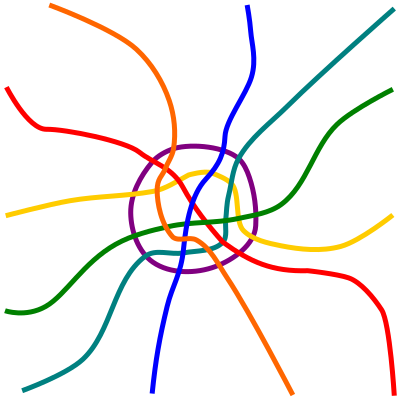
That is, every two radial routes should intersect exactly once, with a transfer. In this post I am going to zoom in on a specific feature of importance: the location of the intersection points. In most cities, the intersection points should be as close as possible to the center, first in order to serve the most intensely developed location by all lines, and second in order to avoid backtracking.
The situation in Berlin
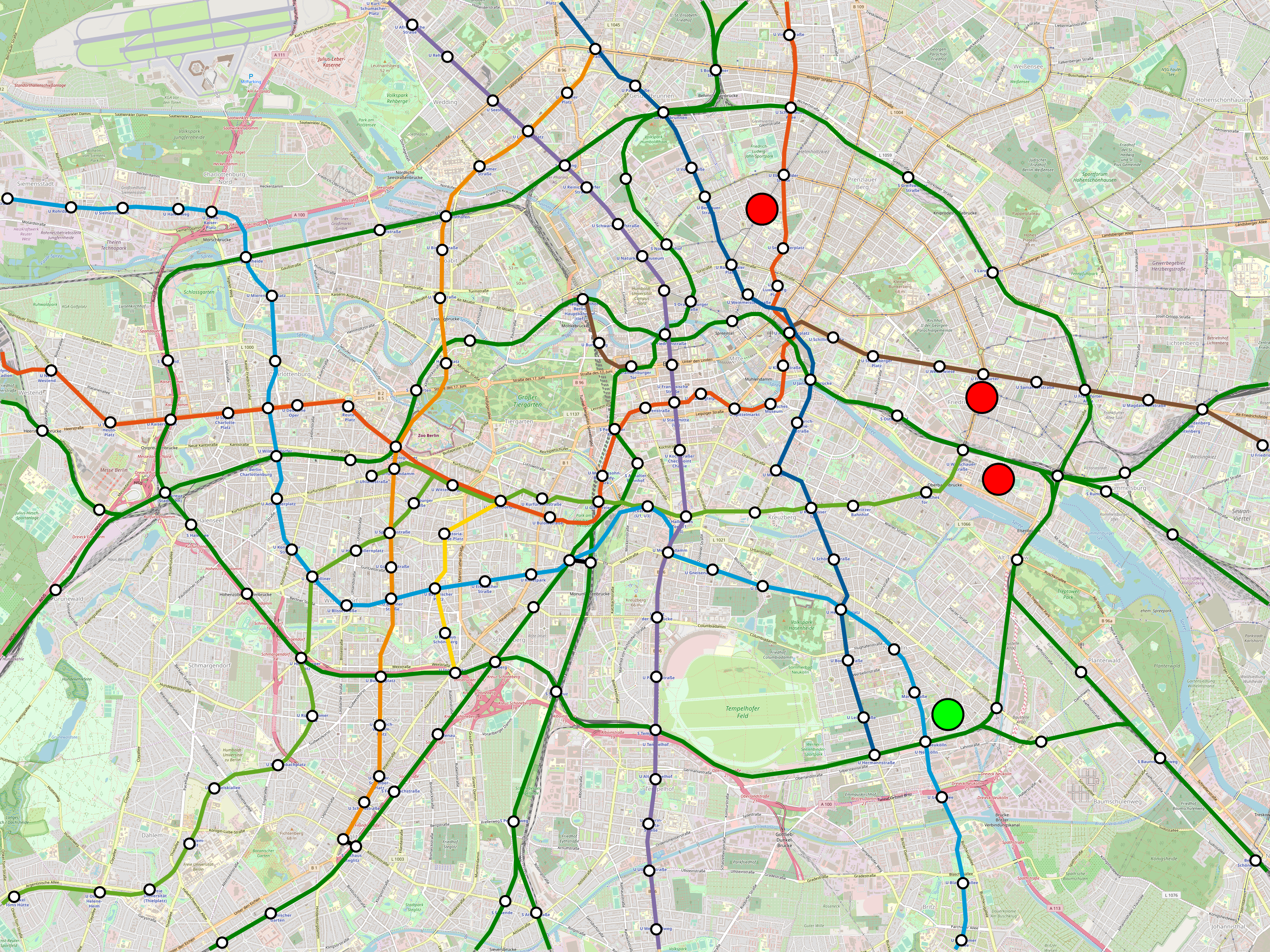
Here is the map of the central parts of Berlin’s U- and S-Bahn network, with my apartment in green and three places I frequently go to in red:
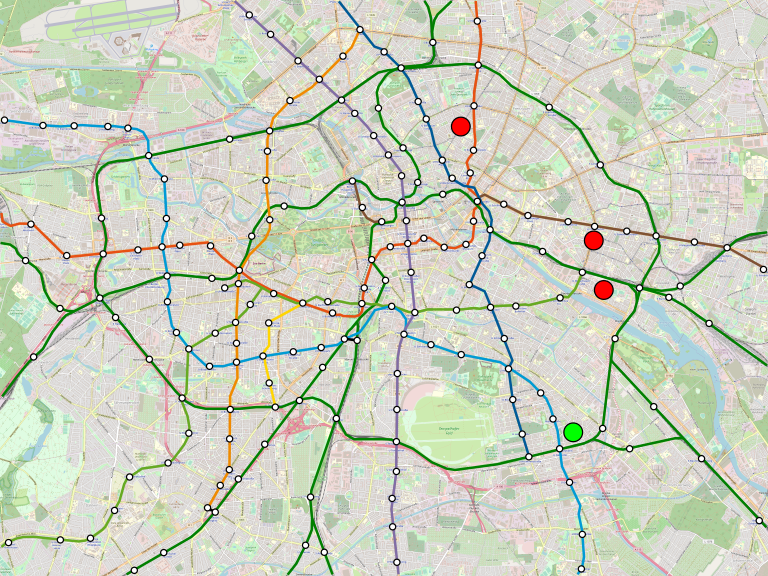
(Larger image can be found here.)
The Ring is severed this month due to construction: trains do not run between Ostkreuz, at its intersection with the Stadtbahn, and Frankfurter Allee, one stop to the north at the intersection with U5. As a result, going to the locations of the two northern red dots requires detours, namely walking longer from Warschauer Strasse to the central dot, and making a complex trip via U7, U8, and U2 to the northern dot.
But even when the Ring is operational, the Ring-to-U2 trip to the northern dot in Prenzlauer Berg is circuitous, and as a result I have not made it as often as I’d have liked; the restaurants in Prenzlauer Berg are much better than in Neukölln, but I can’t go there as often now. The real problem is not just that the Ring is interrupted due to construction, but that the U7-U2 connection is at the wrong place for the city’s current geography: it is too far west.
As with all of my criticism of Berlin’s U-Bahn network layout, there is a method to the madness: most of the route of U7 was built during the Cold War, and if you assumed that Berlin would be divided forever, the alignment would make sense. Today, it does not: U7 comes very close to U2 in Kreuzberg but then turns southwest to connect with the North-South Tunnel, which at the time was part of the Western S-Bahn network, running nonstop in the center underneath Mitte, then part of the East.
On hindsight, a better radial design for U7 would have made it a northwest-southeast line through the center. West of the U6 connection at Mehringdamm it would have connected to the North-South Tunnel at Anhalter Bahnhof and to U2 at Mendelssohn Park, and then continued west toward the Zoo. That area between U1/U2 and Tiergarten Park is densely developed, with its northern part containing the Cold War-era Kulturforum, and in the Cold War the commercial center of West Berlin was the Zoo, well to the east of the route of U7.
Avoiding three-seat rides
If the interchange points between lines are all within city center, then the optimal route between any two points is at worst a two-seat ride. This is important: transfers are pretty onerous, so transit planners should minimize them when it is reasonably practical. Two-seat rides are unavoidable, but three-seat rides aren’t.
The two-seat ride rule should be followed to the spirit, not the letter. If there are two existing lines with a somewhat awkward transfer, and a third line is built that makes a three-seat ride better than connecting between those two lines, then the third line is not by itself a problem, and it should be built if its projected ridership is sufficient. The problem is that the transfer was at the wrong location, or maybe at the right location but with too long a walk between the platforms.
Berlin’s awkward U-Bahn network is such that people say that the travel time between any two points within the Ring is about 30 minutes, no matter what. When I tried pushing back, citing a few 20-minute trips, my interlocutors noted that with walking time to the station, the inevitable wait times, and transfers, my 20-minute trips were exceptional, and most were about 30 or slightly longer.
The value of an untimed transfer rises with frequency. Berlin runs the U-Bahn every 5 minutes during the daytime on weekdays and the S-Bahn mostly every 5 minutes (or slightly better) as well; wait times are shorter in a city like Paris, where much of the Metro runs every 3 minutes off-peak, and only drops to 5 or 6 minutes late in the evening, when Berlin runs trains every 10 minutes. However, Parisian train frequencies are only supportable in huge cities like Paris, London, and Tokyo, all of which have very complex transfers, as the cities are so intensely built that the only good locations for train platforms require long walks between lines.
New York of course has the worst of all worlds: a highly non-radial subway network with dozens of missed connections, disappointing off-peak frequencies, and long transfer corridors in Midtown. In New York, three-seat rides are ubiquitous, which may contribute to weak off-peak ridership. Who wants to take three separate subway lines, each coming every 10 minutes, to go 10 kilometers between some residential Brooklyn neighborhood and a social event in Queens?
Free Public Transportation
Note: this may turn into a long series of posts about public transportation fare systems and payments.
From time to time, people propose free public transport. Supporters have a variety of motivations, including an attempt to mirror cars (“do state roads charge tolls?”), ideological socialism, positive externalities, and the efficiencies of getting rid of fare collection.
In reality, making service free at the point of use means spending money on subsidies from other sources – money that could be spent on other things than zeroing out the fares. There are opportunity costs, and robust public transportation networks do not gain much efficiency from being free. If there is money to make service free, there is money to spend on service improvements, including more metro lines, higher frequency, and wheelchair accessibility where it isn’t already present.
Literature review
A tweetstorm from two days ago includes references to a number of studies on this issue:
- After Tallinn made its public transportation network free for city residents, ridership rose 10% while car traffic fell 15%.
- Trenton and Denver’s 1970s experiments with free off-peak fares led to 15% overall increase in ridership, and 45% in the off-peak, but no change in car traffic – ridership was entirely induced.
- A report by Jennifer Perone citing American examples including Trenton and Denver as well as Austin’s 1989-1990 experiment concludes that “it is nearly certain that fare-free implementation would not be appropriate for larger transit systems,” citing joyriding and an increase in harassment in Austin rather than any diversion from driving.
Proof of payment
One argument for free transit is that it simplifies operations because no fare collection is needed. Front-door boarding and paying the drivers slow down bus boarding – each passenger takes 2.6-3 seconds to board (source, PDF-p. 20). Rapid transit systems also suffer from the complexity of fare collection infrastructure: batteries of faregates create chokepoints and require maintenance, and usually rapid transit agencies also have to hire station agents to watch the gates.
However, proof-of-payment fare enforcement, or POP, gets around most of these issues. If passengers do not need to pay at entry, everything becomes much simpler: they can board buses from any door, and get onto the train without crossing faregates. Berlin has all-door boarding and open, unstaffed U-Bahn stations. There are fare-vending machines, which are not free, but they are cheap. There are fare inspectors working on consignment – they get paid by catching non-paying riders.
Better uses for money
New York City Transit has $9.1 billion in operating and maintenance expenses as of 2016, and $4.3 billion in fare revenue (source). Ile-de-France Mobilités has a total of about €10 billion in annual operating and capital expenses, with about 10% of this being capital and the rest operating, and €2.8 billion in fare revenue. As of 2015, BVG had a total transport income of €1.344 billion (PDF-p. 7) and an additional subsidy of €620 million (PDF-p. 21).
In all of these cities, if there is money for fare elimination, there is money for further improvements in service. A disability rights advocacy group in Paris estimates the cost of making the Metro accessible at €4-6 billion, or 1.5-2 years’ worth of fares. Parisian construction costs for further Metro extensions are such that the budget for free fares could instead be spent on adding around 14 annual kilometers of new tunnels. In Berlin, a third S-Bahn trunk line running northwest-southeast would require about a year and a half’s worth of present-day fares to construct; adding service to guarantee 5-minute frequency on all trunk lines even on weekends and evenings would require a small increase in operating expenses.
New York’s construction costs are much higher than those of Paris and Berlin, and even its operating costs are elevated, but then it also charges higher fares. If there is $4.3 billion a year for free fares, there is much less $4.3 billion a year for boosting off-peak frequency on every named route (2, 4, A, etc.) to at worst 6 minutes, with 2- and 3-minute off-peak frequencies on interlined trunk lines. As with Paris, there is also a dire need for wheelchair accessibility; thanks to very high costs, full installation would not cost just 1.5-2 years’ worth of fare revenue, but more like 3 years’ worth.
Cities with and without public transport
The above discussion centers where the vast majority of public transportation takes place – that is, in cities with serious public transportation systems. The argument changes completely in smaller cities, which run the occasional bus but not at the required speed, coverage, or frequency for it to count as a real public transport network.
In Germany, there is no free transit, but the difference between big-city and small-city fare enforcement is telling: only relatively big cities have POP systems. Small-town Germany makes bus passengers pay the fare to the driver, and runs trains with conductors checking tickets. The reason is that roving inspectors only work on systems with enough frequency and coverage, or else they can’t efficiently ride the buses and trains and check tickets.
If POP is not possible, then the cost of collecting fares rises: buses are slowed down by every additional passenger, and trains require a second crew member. Such systems often have very low farebox recovery in the first place, and a very low-income rider profile, since everyone who can afford to drive drives rather than waits 25 minutes for the bus. In Los Angeles, total fare revenue on Metro (which includes most buses) is $350 million a year and total operating and maintenance expenses amount to $1.57 billion, and the average public transport commuter has about half the average income of the average solo driver. In that specific use case, making public transport free may be justified.
The one caveat is that if the plan is to convert a city from one without public transportation to speak of to one with a good system, for example in Los Angeles, then in the future, revenue will become more important. Even if free public transport is a good idea in the conditions of 2019, it may not be such a good idea in those of 2035, at least if grandiose transit city plans materialize (and I don’t think they will – the state of American local governance just isn’t good enough for cities to follow through).
Scooters
Three weeks ago, the consultancy 6t released a study about dockless e-scooters in France. The study is available only in French but there is an executive summary in English. It has convenient demographic profiles of e-scooter riders in Paris, Lyon, and Marseille, and generated some media controversy over the fact that scooters are barely displacing car trips – rather, they’re replacing trips by foot or public transit. This is on top of calls for greater regulations of the mode in multiple countries, not just by NIMBYs but also by serious urbanists like Streestblog’s Angie Schmitt; I was alerted to the study in the first place by Jonathan Rosin, who proposes regulations requiring geofencing to prevent riding on the sidewalk.
And yet, there’s something interesting about scooters and transit in the study, which suggests to me scooters have a positive role to play in a transit city. On p. 80, figure 48 shows combination of scooters with other modes. Out of about 4,000 respondents, 886 say they used scooters in combination with another mode – and of the latter, 66% used it in combination with public transportation.
How worried should we be about rider behavior?
Not really. There is an American discourse concerning dockless transportation that complains about clutter, scooter-pedestrian conflict, and nuisance scooters or bikes left on the sidewalk. The study itself discusses the regulations of e-scooters in various countries. In Britain and Italy e-scooters are legally classified as motor vehicles, which is effectively a ban, and in the US there are onerous regulations such as a requirement for a driver’s license and a minimum age of 18, such as in California. In France, Germany, Switzerland, Austria, Sweden, and Denmark, regulations are laxer, e.g. in Germany the minimum age is 14 and the e-scooter is treated as a bike.
The sort of clutter that Americans complain about was not evident to me in Paris, one of the largest markets in the world for e-scooters as well as bike share (it still has the largest bike share program in the world outside China). As far as I could tell, scooters were mostly used around Nation for recreational trips – at the very least, people did not preferentially leave them right at the Metro and RER station, and I did see a fair number of dockless vehicles (I forget if just bikes or also scooters) at the Bois de Boulogne. Central Paris had a higher density of scooters, but they too did not seem to clutter on the street, and I don’t remember ever having had to dodge a scooter even though people did ride on the sidewalk.
At least at eye level, the lax regulations France does have – the minimum age is 8, cities may choose to permit or prohibit riding on the sidewalk, riding on all streets with speed limit up to 50 km/h is required – appear sufficient. The American, British, and Italian approaches are too draconian and only serve to discourage this mode of transportation.
Gaps in the transit system
Pp. 111-4 have tables describing mode switching. Few of the scooter users would have traveled by car if the scooters hadn’t been available, only 8% including taxis and TNCs (“VTC” in French). In contrast, 46% would have walked and 32% would have taken public transportation.
But is this even a problem? The same tables have the average transit-to-scooter switcher gaining 5 minutes, taking 19 minutes instead of 24. On short trips, scooters are useful for filling little gaps in the regional public transport network. Maybe the origin and destination are not well-connected by Metro, as is for example the case for Nation and much of the Left Bank, so that a transit trip would require transfers. On a poll suggesting non-mutually-exclusive options for why people choose scooters over transit, 68% say it’s nicer, but 44% say it’s faster and 39% say it’s direct. From the perspective of the transit agencies, a mode that makes certain crosstown trips easier without changing trains at Chatelet is a net positive, as it decongests the station as well as other complex transfer points.
According to Owen Gutfreund’s book 20th Century Sprawl, in the 1900s and 1910s the American railroads were supportive of road expansion. To the railroads, cars were a natural complement to trains, extending their range beyond that of a horse or bicycle. Of course, soon the cars turned into competitors, once roads improved to the point of allowing longer-distance travel. But scooters, limited to 25 km/h, do not have that capability. The mode of transportation most comparable to the e-scooter, the bicycle, coexists with a solid regional and intercity rail network in the Netherlands.
Ban cars
The ultimate goal of the green movement in general and of public transit activism in particular should be to ban cars, or else get as close as possible to banning them. Modes of transportation that are not cars that provide alternative functionality to cars are almost always a good idea in this scheme.
Trains are an excellent alternative for long trips, that is out-of-neighborhood trips for such purposes as work, school, citywide social events, and intercity travel. Shorter trips are dominated by walking in transit cities. However, there are two important caveats for the idea of doing short trips on foot. First, there is a genuine in-between region in the 2-4 km range. And second, people with disabilities may not be able to walk long distances, which lowers the upper limit from the 1-2 km range to a much shorter point, perhaps 500 meters – and if their disabilities do not require the use of a wheelchair, then they may well find scooters an acceptable alternative.
In Paris itself, which dominates the survey, scooters are not replacing cars, for a simple reason: few trips in Paris are done by car in the first place. But a robust scooter network can expand out of the city into suburbs with higher present-day car usage, and those suburbs can then become ever more walkable thanks to the displacement of cars by greener modes of travel.
Assume Nordic Costs: London Edition
A month ago I made maps proposing some subway and regional rail extensions in New York and noting what they would cost if New York could build as cheaply as the Scandinavian capitals. Here is the same concept, but with London rather than New York. Here is everything in a single large map:
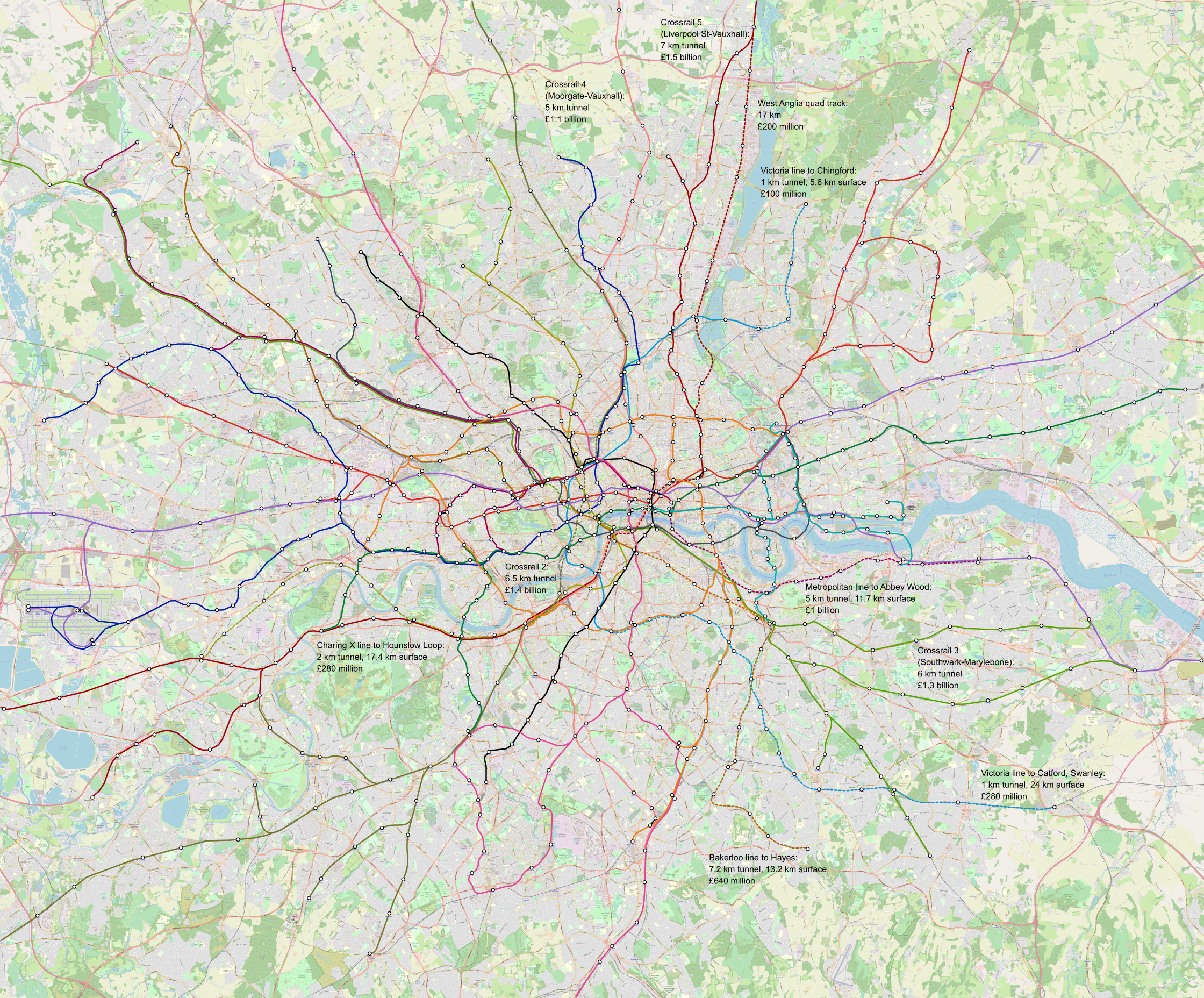
A full-size (74 MB) map can be viewed here.
Solid lines are existing or under construction, that is Crossrail and the Battersea extension; proposed lines are dashed. Commuter rail lines, that is Thameslink, the soon-to-open Crossrail, and four additional Crossrail tunnels labeled 2 through 5, are always depicted as having separate stations from the other modes, to avoid confusion where one Crossrail station has connections to two adjacent Tube stations (such as Farringdon-Barbican and Moorgate-Liverpool Street). It has many additional interchanges between lines and branches, including some that were left out on purpose, like a Crossrail 1 connection to Oxford Circus, omitted from the under-construction line to discourage riders from using the oversubscribed Victoria line; with four more cross-city lines, the capacity problems would be lessened substantially.
The overall picture is sparser than my New York map. The total projected cost of all of these projects, including some allocated for redoing stations on commuter branches to be given to Tube lines, is £6.8 billion, compared with $37 billion for the New York maps. The reason is that unlike New York, London already has excellent coverage thanks to extensive branching – what it needs is core capacity, which consists of city center tunnels that have high cost per kilometer but need not be long.
There is considerable overbuilding planned in London. Crossrail 2 as depicted on my map is a 6.5 km tunnel between the approach to Victoria Station and the approach to Kings Cross. But as planned, Crossrail 2 extends to a long tunnel parallel to the South West Main Line, a four-track line in a right-of-way that could if truly necessary accommodate six, as well as a long tunnel going north to take over the Lea Valley Lines, which on my map go into Crossrail 5. With gratuitous suburban tunnels and extremely high British construction costs, the budget for Crossrail 2 is around £30 billion, about 20 times what Scandinavia might spend on such a project. Even allowing for the possibility that crossing under three lines at once at Bank is more complex than crossing under two at T-Centralen, this is a difference of a full order of magnitude, counting both total required tunnel length and cost per km.
In addition, there is network simplification. On the Tube this consists of segregating the Northern line’s Bank and Charing Cross branches (already in planning pending the Battersea extension and reconstruction of Camden Town) and through breaking the Circle line into separate Metropolitan and District lines. The latter was estimated by a British blogger to cost £5 billion, based on a rubric in which the Met/District transfer at Aldgate (or Tower Hill) should by itself cost £1 billion; Crossrail and Second Avenue Subway stations cost around half that much, and the more complex T-Centralen and Odenplan stations on Citybanan cost less.
On mainline rail, the service plan is supposed to be deinterlined, as is Transport for London’s long-term goal. The slow tracks of the various mainlines feeding into Central London turn into Crossrail branches, or occasionally Underground extensions, such as Hayes and the Hounslow Loop. The fast tracks stay on the surface to avoid interfering with high-frequency regional metro service. For historic reasons Thameslink mostly stays as-is, with a combination of fast and stopping services, but the curve toward London Bridge should not be used – instead, passengers should have access to Crossrail 3 plus interchanges to the City at London Bridge and a new infill station at Southwark.
London owes it to itself to understand why its construction costs are so high that instead of solving its transport capacity problems with multiple cross-city tunnels in a decade, it’s taking multiple generations to build out such a system. There’s a lot of ongoing discussion about the last-minute delays and cost overruns on Crossrail, but the absolute costs even before the overrun were very high, the highest in the world outside New York City – and Crossrail 2 is set to break that record by a margin.
Trip Chaining, Redux
There’s been an ongoing conversation about how public transport can be used for non-work trips (and what it means for women) that makes me go back to something I wrote in 2012 about trip chaining. In that post I asserted a distinction between long and short trips, but I didn’t make it very clear. The importance of this distinction is that even though a large majority of trips are not work trips, the sort of urban layout that makes long trips (including work trips) usable by train tends to also make other trips doable on foot.
Trip length and purpose
Mobilität in Deutschland periodically reports on national travel patterns. The 2017 MiD report includes mode shares, trip lengths, and purposes, some broken down by state. Unlike in the Anglosphere or in France, the headline modal share is for all trips, not just work or school trips, and therefore the numbers for public transit look lower and those for walking and cycling look higher.
The important statistic for trip-chaining comes from a table on p. 19. There were 42 million work trips and 41 million shopping trips nationwide in 2017, but the work trips were on average more than three times as long, 16 vs. 5.3 kilometers. The only trip category longer than work was business trips, on average 19 km, including an extensive number of intercity trips, and the only category close to work trips was recreational trips, averaging 15.5 km, also including extensive intercity travel; the median work trip was by a fair margin the longest, 8 km, whereas the median shopping trip was 2 km. Likewise, errand trips were 10.2 km on average with a median of 3.6.
MiD doesn’t break down this data by region, unfortunately. So I can only speculate that if the median trip that people talk about when they talk about trip chaining is 2 km long, then the median trip in the parts of Germany with good public transit is short enough to be done on foot, probably shorter than a kilometer.
Short and long trips
I think it’s useful to collapse the distinction between trips into a binary one: short versus long. Trip length is of course a continuous variable, but a good classification scheme is “can it be done internally to a neighborhood or town?”. If the answer is yes then the trip is short, otherwise it is long.
The commute is an example of a long trip. Commuting to school is usually a long trip as well; even in an environment with school zoning and no selection or choice, a secondary school draws from too large an area to be a single neighborhood except in an extremely large and dense city. Social trips can be long as well – if I go to a gaming convention or a performance in Berlin, or if someone who cares about sports goes to see a football match, it’s a long trip.
Short trips include shopping, errands, eating out, and daycare. The common aspect to them is that they involve common activities with small draws. The supermarket draws from a community of a few thousand, as does the neighborhood restaurant. In contrast, the performance is unique – while many people go to concerts, different people are fans of different artists, so a single band may need to visit a city of millions to fill an auditorium.
Making transit useful for non-work long trips
I bring up the example of going to a sports game as a long trip because American transit agencies deal with that routinely even if they otherwise only care about work trips. Commute trips tend to happen at specific times of day, especially if you’re from the same middle class that transit managers are drawn from. Other long trips have different peaks. Leisure trips tend to happen in the evening and on weekends. Business trips within metropolitan areas tend to happen in the middle of the day during work hours. Trips to the airport depend on time zones – in New York the ones to JFK are concentrated in the afternoon peak, but it’s hard to make generalizations.
Like work trips, non-work long trips are not isotropic – people travel to specific places. A few are as a rule outside city center, such as sports stadiums and airports. Others are within city center to appeal to a wide cross-section of residents, such as event spaces for performances; conventions run the gamut, but richer and more important conventions are likelier to shell out money for city center real estate. Universities may be in or outside city center, depending on the city. Museums are usually city center or in neighborhoods just outside it, such as the Upper East and West Sides in New York or Balboa Park in San Diego.
The length means that the optimal transit network for all non-work trips is largely the same. If trains arrive at a reasonable frequency all day, every day, and form a coherent radial network, then passengers will able to use them for all long trips, even ones that are not for work. The major destinations that are outside city center should whenever possible be junctions between different branches, or get circumferential and not just radial service.
Moreover, there is little point in trying to vary modes for work and non-work trips. Surface transit that averages 15 km/h but saves you a 1-minute trip down to the subway is no more useful for going to a concert than for going to work. If poor urban planning has resulted in an airport that’s nowhere on the rail network or in regional convention centers that are impossible to serve, then buses can fill in the gap, but that’s not optimizing for non-work trips but rather fixing past design mistakes, no different from doing the same when suburban office parks are built far from the train.
The one serious change one needs to make is that the definition of city center needs to be broader than the few square blocks that comprise most American cities’ downtowns. The London Underground’s conception of Central London is not just the City, and likewise cities need to ensure that their West Ends (like, again, San Diego’s Balboa Park) are served as if they were central rather than peripheral areas.
Short trips
It is wrong for cities to try optimizing public transportation for short trips. Most short trips can be done by foot; if they can’t, something is wrong with the city’s urban design. The minimum density required for people to be able to walk to retail is not high – I have a choice of supermarkets within walking distance, and Berlin is not an especially dense city. In Paris, which unlike Berlin is especially dense, I walked to the hypermarket.
Occasionally, when a short trip needs to be done on mechanized transportation, if the city has good transit-oriented commercial development then it is doable by riding the trains a few stops. I recently bought a mattress at Hermannplatz, 3 stops away on U7, longer than most people inside the Ring have to go to such a store, and mattresses are a special case in that dragging them on the streets for a kilometer isn’t fun.
Suppression of auto use is especially valuable for short trips. The reason is that in auto-oriented areas, short as well as long trips are done by car, and if businesses locate based on automobile scale, then only transit can compete – walking and cycling take too long. A hefty proportion of the urban upper middle class prefers to own cars and drive them for short trips, which may induce short trip destinations to locate based on automobile scale even in a walkable city; when I lived in Providence, I walked to the supermarket, but it was located right next to a freeway exit and had ample parking.
Trip chaining
The concept of trip chaining – going directly between destinations in a row rather than just going back and forth between home and a destination – works best with the mode of transportation with the highest frequency and lowest access time: walking. Buying different items at different stores is so ubiquitous that shopping malls were invented specifically to make that experience more pleasant than that of chaining car trips.
Transit cities should not design themselves around trip chaining on transit, destinations for short trips are too difficult to serve. Many cluster on major corridors, but some don’t and stay on residential streets or at street corners. In walkable cities they tend to be fairly isotropic. With short average trips and no discernable centers, the optimal stop spacing on transit is extremely short, to the point of uselessness for all other purposes. If there’s trip chaining, the required frequency is so high that operating costs become unaffordable; a 5-minute wait for a bus may well be unconscionable.
Outside dense cities, suburbs should have a structure of density in which all the plausible destinations are within walking distance of the train station, permitting chaining walking trips with a transit trip. With such structure, the minimum viable density is lower, because buses can connect to the train with a timed transfer and have longer stop spacing as the destinations are all at the town center. In effect, such a structure gives the town center most of the convenience benefits of a shopping mall even without other features such as enclosure and single ownership of the real estate.
Infrastructure is scale-dependent. Public transportation makes this a lot clearer than cars – different modes are used at different scales, and the shape of the network can look visibly different as well. At the scale of short trips, the correct choice of public transportation mode is none – people can and should walk. If the city has generally viable public transit, its urban layout will equally well permit trip chaining on foot. If it doesn’t, then the priority should be to establish a transit city and not to try dragging buses every block.
Overnight Public Transit
American cities try to aim for 24/7 rail service, imitating New York. European cities except Copenhagen do not, and instead have night bus networks. Both of these options have fascinated various transit reformers, but unfortunately sometimes the reformers propose the wrong option for the specific city. This post is intended to be a set of guidelines for night buses and the possibility of 24/7 urban rail.
Maintenance windows
The reason rail service does not run 24/7 is maintenance. Tracks require regular inspections and work, which are done in multi-hour windows. Over the last century or so, the big urban rail systems of the world have standardized on doing this maintenance at night. For example, in Paris there are about 4.5-5 hours every weeknight between the last train of the night and the first train of the morning, and one hour less every weekend night. In Berlin trains run all night on weekends and have 3.5-hour windows of closure on weeknights.
The regular windows may be supplemented by long-term closures, during which passengers are told to use alternatives. Berlin occasionally closes some S-Bahn segments for a few days, and (I believe much more rarely) U-Bahn segments. Paris does so very rarely, usually for an entire summer month during which many Parisians are away on vacation and systemwide ridership is lower, and usually when there are easy alternatives, such as the RER A and Metro Line 1 substituting for each other.
The English-speaking world tends to have extensive weekend shutdowns for maintenance. London has them quite often in addition to nighttime shutdowns. New York runs trains 24/7, using the express tracks on most of its trunk lines to provide service even when the local stations on some segment are closed for maintenance. As American cities have mostly copied New York, they do not know how to wrap up maintenance during their usual nighttime windows and seek weekend closures or shorter hours as well. Thus, for example, BART has claimed that it needs 7-hour windows during weekend nights, citing the example of Paris, whose weekend night closures actually last less than 4 hours.
Flagging
I know of one city that runs its subway 24/7 without interruptions: Copenhagen. Overnight, Copenhagen single-tracks around worksites – frequency is low enough that trains can be scheduled not to conflict. As the trains are driverless, wrong-way running is quite easy. Moreover, there is ample separation between the tracks thanks to the Copenhagen Metro’s twin bore construction; thus, trains do not need to slow down next to worksites, nor must work slow down when a train runs on an adjacent track.
In New York, tracks on each line are right next to each other, with little separation between them. Thus, there are rules that are collectively called flagging under which trains must slow down to a crawl (I believe 10 miles per hour, or 16 km/h) when next to a worksite, while work must pause next to a moving train. The flagging rules apply even when there is more substantial separation between adjacent tracks, such as columns and retaining walls, provided there is any opening allowing passage between the tracks. The safety margins have been made more generous over the last 20 years, which is part of the reasons trains have slowed down, as reported separately by myself, Dan Rivoli, and Aaron Gordon. At the other end, maintenance costs in New York are very high thanks to the constant interruptions.
If it is possible to single-track at night without onerous flagging rules, then cities should go in that direction, using automated rail signaling such as CBTC, even stopping short of driverless trains. In cities with twin-bored tunnels this works provided there are regularly-spaced crossovers between tracks in opposite directions. London is generally poor in such crossovers, and installing new ones may be prohibitively expensive if blasting new connections between tunnels is required. In contrast, on Line 14 in Paris, there are almost sufficient crossovers – the longest stretch is between Bibliotheque and Madelaine, at 14 minutes one-way, and single-direction switches exist at Chatelet and Gare de Lyon, just one of which needs to upgraded to a full diamond crossover. There, 24/7 operation is plausible, though perhaps not so useful as the rest of the system is not 24/7.
Even some cut-and-cover metros can have sufficient separation between tracks for nighttime single-tracking. In Berlin the distance is adequate, at least for some stretches – the tracks are not right next to each other. Even in New York, there are segments where it is feasible to construct partitions between tracks, provided the agency changes flagging rules to permit regular operations and maintenance on adjacent tracks if a partition has been constructed. The cut-and-cover nature of these systems should facilitate this pattern since the cost of building the required crossovers is not prohibitive, just high.
Night buses
Night buses are attractive for a number of reasons. The most important is that in the after hours there is so little surface traffic that buses can match the speed of rapid transit. Moreover, ridership is usually low enough that a bus has adequate capacity. Finally, surface transit can make small detours, for example to reach a common timed transfer, since transit is dependent on both scale and mode. During the day Vancouver has a bus grid, with most buses arriving every 8-10 minutes, but at night it has a half-hourly radial network with a timed transfer, and little relationship with the shape of the SkyTrain network.
Nevertheless, not every city can make appropriate use of night buses. The important factors to consider include the following:
- How much does the rapid transit network follow major streets? If it mostly runs on two-way streets, as in Berlin, then running buses that duplicate the metro is easy. But if there are major deviations, especially if there are water crossings involved, then this is harder; in New York, where there are far more crossings of the East River by subway than by road, a night bus network would be virtually useless. Shuttle buses substituting for weekend trackwork are likewise complete failures whenever the subway is more direct than the streets, e.g. the Boston Red Line between Charles-MGH and Park Street.
- What is the expected size of the network? A minimum number of lines is required for success, and unless they are very frequent, transfers have to be timed. The half-hourly night buses in Berlin do not work well if untimed, for example.
- How long are the routes? This has two aspects. First, very long routes are less competitive with taxis if there are motorways. And second, a half-hourly night bus had better take around an integer number of half-hours minus turnaround time per roundtrip, to avoid wasting service hours. A 25-minute one-way trip is excellent, a 32-minute one a disaster.
Public Transportation and Active Planning
This post is an attempt at explaining the following set of observations concerning government interference and transportation mode choice:
- High auto usage tends to involve government subsidies to motorways and other roads
- Nonetheless, more obtrusive government planning tends to correlate with more public transport and intercity rail
- In places where state planning capacity is weak, transportation evolves in a generally pro-car direction
The main thread tying this all together is that building roads requires a lot of money, but the money does not need to be coordinated. Local districts could pave roads on a low budget and improve incrementally; this is how the US built its road network in the 1910s and 20s, relying predominantly on state and even local planning. In contrast, public transportation requires very good planning. Rapid transit as an infrastructure project is comparable to motorways, with preplanned stopping locations and junctions, and then anything outside dense city cores requires network-wide rail schedule coordination. Good luck doing that with feuding agencies.
I’ve talked a bunch about scale before, and this isn’t exactly about that. Yes, as Adirondacker likes to say in comments, cars are great at getting people to where not a lot of other people want to go. But in cities that don’t make much of an effort to plan transportation, anyone who can get a car will, even for trips to city center, where there are horrific traffic jams. An apter saying is that a developed country is not one where even the poor drive but one where even the rich use public transport.
Right of way and surface transit
The starting point is that on shared right-of-way, cars handily beat any shared vehicle on time. Shared vehicles stop to pick up and drop off passengers, and are just less nimble, especially if they’re full-size buses rather than jitneys. No work needs to be done to ensure that single-occupant vehicles crowd out buses with 20, 40, or even 60 passengers. This happens regardless of the level of investment in roads, which, after all, can be used by buses as well as by cars.
Incremental investment in roads will further help cars more than buses. The reason is that the junctions most likely to be individually grade-separated are the busiest ones, where buses most likely have to stop to pick up and discharge passengers at the side of the road at-grade, whereas cars can go faster using the flyover or duckunder. For example, in New York, the intersection of Fordham Road (carrying the Bx12, currently the city’s busiest bus) and Grand Concourse (carrying the Bx1/2, the city’s sixth and the Bronx’s second busiest route) is grade-separated, but buses have to stop there and therefore cannot have to cross more slowly at-grade.
Within cities, the way out involves giving transit dedicated right of way. This can be done on the surface, but that removes space available for cars. Since cars are faster than public transport in cities that have not yet given transit any priority over private vehicles, they are used by richer people, which means the government needs to be able to tell the local middle class no.
The other option is rapid transit. This can be quite popular it if is seen as modern, which is true in the third world today and was equally true in turn of the century New York. The problem: it’s expensive. The government needs to brandish enough capital at the start for a full line. This is where transit’s scale issue becomes noticeable: while a metro area of 1-2 million will often support a rapid transit line, the cost of a complete line is usually high compared with the ability of the region to pay for it, especially if the state is relatively weak.
The third world’s situation
The bulk of the third world has weak state capacity. Tax revenue is low, perhaps because of political control by wealthy elites, perhaps because of weak ability to monitor the entire economy to ensure compliance with broad taxes.
This does not characterize the entire middle- and low-income world. China has high state capacity, for one, leading to massive visible programs for infrastructure, including the world’s largest high-speed rail network and a slew of huge urban metro networks. In the late 20th century, the four East Asian Tigers all had quite high state capacity (and the democratic institutions of Korea and Taiwan are just fine – the administrative state is not the same as authoritarianism).
In 1999, Paul Barter’s thesis contrasted the transit-oriented character of Tokyo, Seoul, Hong Kong, and Singapore, with the auto-oriented character of Bangkok and Kuala Lumpur, and predicted that Manila, Jakarta, and Surabaya would evolve more like the latter set of cities. Twenty years later, Jakarta finally opened its first metro line, and while it does have a sizable regional rail network, it is severely underbuilt for its size and wealth, which are broadly comparable to the largest Chinese megacities. Manila has a very small metro network, and thanks to extremely high construction costs, its progress in adding more lines is sluggish.
Kuala Lumpur and Bangkok both have very visible auto-centric infrastructure. Malaysia encouraged auto-centric development in order to stimulate its state-owned automakers, and Thailand has kept building ever bigger freeways, some double-deck. More to the point, Thailand has not been able to restrain car use the way China has, nor has it been able to mobilize resources to build a large metro system for Bangkok. However, Indonesia and the Philippines are not Thailand – Jakarta appears to have a smaller freeway network than Bangkok despite being larger, and Manila’s key radial roads are mostly not full freeways but fast arterials.
Planning capacity
Public transportation and roads both form networks. However, the network effects are more important for transit, for any number of reasons:
- Public transportation works better at large scale than small scale, which means that urban transit networks need to preplan connections between different lines to leverage network effects. Freeway networks can keep the circumferential highways at-grade because at least initially they are less likely to be congested, and then built up gradually.
- Public transportation requires some integration of infrastructure, service, and rolling stock, and this is especially true when the national rail network is involved rather than an urban subway without any track connections to the mainline network.
- The biggest advantage of trains over cars is that they use land more efficiently, and this is more important in places with higher land prices and stronger property rights protections. This is especially true when junctions are involved – building transfers between trains does not involve condemning large tracts of land, but building a freeway interchange does.
None of this implies that cars are somehow smaller-government than trains. However, building a transportation network around them does not require as competent a planning department. If decisions are outsourced to local notables who the state empowers to act as kings of little hills in exchange for political support, then cobbling together a road network is not difficult. It helps those local notables too, as they get to show off their expensive cars and chauffeurs.
Trains are more efficient and cleaner than cars, but building them requires a more actively planned infrastructure network. Even if the total public outlay is comparable, some competent organ needs to decide how much to appropriate for which purpose and coordinate different lines – and this organ should ideally be insulated from the corruption typical of the average developing country.
Bronx Bus Redesign
New York is engaging in the process of redesigning its urban bus network borough by borough. The first borough is the Bronx, with an in-house redesign; Queens is ongoing, to be followed by Brooklyn, both outsourced to firms that have already done business with the MTA. The Bronx redesign draft is just out, and it has a lot of good and a great deal of bad.
What does the redesign include?
Like my and Eric Goldwyn’s proposal for Brooklyn, the Bronx redesign is not just a redrawing of lines on a map, but also operational treatments to speed up the buses. New York City Transit recognizes that the buses are slow, and is proposing a program for installing bus lanes on the major streets in the Bronx (p. 13). Plans for all-door boarding are already in motion, to be rolled out after the OMNY tap card is fully operational; this is incompetent, as all-door boarding can be implemented with paper tickets, but at this stage this is a delay of just a few years, probably about 4 years from now.
But the core of the document is the network redesign, explained route by route. The map is available on p. 14; I’d embed it, but due to file format issues I cannot render it as a large .png file, so you will have to look yourselves.
The shape of the network in the core of the Bronx – that is, the South Bronx – seems reasonable. I have just one major complaint: the Bx3 and Bx13 keep running on University Avenue and Ogden Avenue respectively and do not interline, but rather divert west along Washington Bridge to Washington Heights. For all of the strong communal ties between University Heights and Washington Heights, this service can be handled with a high-frequency transfer at the foot of the bridge, which has other east-west buses interlining on it. The subway transfer offered at the Washington Heights end is low-quality, consisting of just the 1 train at the GWB bus station; a University-Ogden route could instead offer people in University Heights a transfer to faster subway lines at Yankee Stadium.
Outside the South Bronx, things are murkier. This is not a damn by faint praise: this is an acknowledgement that, while the core of the Bronx has a straightforward redesign since the arterials form a grid, the margins of the Bronx are more complicated. Overall the redesign seems fairly conservative – Riverdale, Wakefield, and Clasons Point seem unchanged, and only the eastern margin, from Coop City down to Throgs Neck, sees big changes.
The issue of speed
Unfortunately, the biggest speed improvement for buses, stop consolidation, is barely pursued. Here is the draft’s take on stop consolidation:
The spacing of bus stops along a route is an important factor in providing faster and more reliable bus service. Every bus stop is a trade-off between convenience of access to the bus and the speed and reliability of service. New York City buses spend 27 percent of their time crawling or stopped with their doors open and have the shortest average stop distance (805 feet/245 m) of any major city. London, which has the second closest stop spacing of peer cities, has an average distance between stops of 1,000 ft/300 m.
Bus stop spacing for local Bronx routes averages approximately 882 feet/269 meters. This is slightly higher than the New York City average, but still very close together. Close stop spacing directly contributes to slow buses and longer travel times for customers. When a bus stops more frequently along a route, exiting, stopping, and re-entering the flow of traffic, it loses speed, increases the chance of being stopped at a red traffic signal, and adversely affects customers’ travel time. By removing closely-spaced and under-utilized stops throughout the Bronx, we will reduce dwell time by allowing buses to keep moving with the flow of traffic and get customers where they need to go faster.
Based on what I have modeled as well as what I’ve seen in the literature, the optimal bus stop spacing for the Bronx, as in Brooklyn, is around 400-500 meters. However, the route-by-route descriptions reveal very little stop consolidation. For example, on the Bx1 locals, 3 out of 93 stops are to be removed, and on the Bx2, 4 out of 99 stops are to be removed.
With so little stop consolidation, NYCT plans to retain the distinction between local and limited buses, which reduces frequency to either service pattern. The Bx1 and Bx2 run mostly along the same alignment on Grand Concourse, with some branching at the ends. In the midday off-peak, the Bx1 runs limited every 10 minutes, with some 12-minute gaps, and the Bx2 runs local every 9-10 minutes; this isn’t very frequent given how short the typical NYCT bus trip is, and were NYCT to eliminate the local/limited distinction, the two routes could be consolidated to a single bus running every 4-5 minutes all day.
How much frequency is there, anyway?
The draft document says that consolidating routes will allow higher frequency. Unfortunately, it makes it difficult to figure out what higher frequency means. There is a table on p. 17 listing which routes get higher frequency, but no indication of what the frequency is – the reader is expected to look at it route by route. As a service to frustrated New Yorkers, here is a single table with all listed frequencies, weekday midday. All figures are in minutes.
| Route | Headway today | Proposed headway |
| Bx1 | 10 | 10 |
| Bx2 | 9 | 9 |
| Bx3 | 8 | 8 |
| Bx4/4A | 10 | 8 |
| Bx5 | 10 | 10 |
| Bx6 local | 12 | 8 |
| Bx6 SBS | 12 | 12 |
| Bx7 | 10 | 10 |
| Bx8 | 12 | 12 |
| Bx9 | 8 | 8 |
| Bx10 | 10 | 10 |
| Bx11 | 10 | 8 |
| Bx12 local | 12 | 12 |
| Bx12 SBS | 6 | 6 |
| Bx13 | 10 | 8 |
| Bx15 local | 12 | 12 |
| Bx15 limited | 10 | 10 |
| Bx16 | 15 | 15 |
| Bx17 | 12 | 12 |
| Bx18 | 30 | 20 |
| Bx19 | 9 | 9 |
| Bx20 | Peak-only | Peak-only |
| Bx21 | 10 | 10 |
| Bx22 | 12 | 8 |
| Bx23 | 30 | 8 |
| Bx24 | 30 | 30 |
| Bx26 | 15 | 15 |
| Bx27 | 12 | 12 |
| Bx28 | 17 | 8 |
| Bx38 (28 variant) | 17 | discontinued |
| Bx29 | 30 | 30 |
| Bx30 | 15 | 15 |
| Bx31 | 12 | 12 |
| Bx32 | 15 | 15 |
| Bx33 | 20 | 20 |
| Bx34 | 20 | 20 |
| Bx35 | 7 | 7 |
| Bx36 | 10 | 10 |
| Bx39 | 12 | 12 |
| Bx40 | 20 | 8 |
| Bx42 (40 variant) | 20 | cut to a shuttle, 15 |
| Bx41 local | 15 | 15 |
| Bx41 SBS | 10 | 8 |
| Bx46 | 30 | 30 |
A few cases of improving frequency on a trunk are notable, namely on the Bx28/38 and Bx40/42 pairs, but other problem spots remain, led by the Bx1/2 and the local and limited variants on some routes.
The principle of interchange
A transfer-based bus network can mean one of two things. The first, the one usually sold to the public during route redesigns, is a grid of strong routes. This is Nova Xarxa in Barcelona, as well as the core of this draft. Eric’s and my proposal for Brooklyn consists entirely of such a grid, as Brooklyn simply does not have low-density tails like the Bronx, its southern margin having high population density all the way to the boardwalk.
But then there is the second meaning, deployed on networks where trunk routes split into branches. In this formulation, instead of through-service from the branches to the trunk, the branches should be reduced to shuttles with forced transfers to the trunk. Jarrett Walker’s redesign in Dublin, currently frozen due to political opposition (update: Jarrett explains that no, it’s not really frozen, it’s in revision after public comments), has this characteristic. Here’s a schematic:
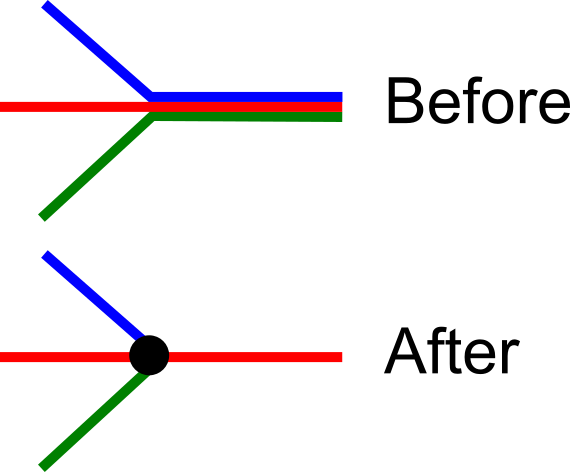
The second meaning of the principle of interchange is dicey. In some cases, it is unavoidable – on trains, in particular, it is possible to design timed cross-platform transfers, and sometimes it’s just not worth it to deal with complex junctions or run diesels under the catenary. On buses, there is some room for this principle, but less than on trains, as a bus is a bus, with no division into different train lengths or diesels vs. electrics. Fundamentally, if it’s feasible to time the transfers at the junctions, then it’s equally possible to dispatch branches of a single route to arrive regularly.
New York’s bus network is already replete with the first kind of interchange, and then the question is where to add more of it on the margins. But the Bronx draft includes some of the second, justified on the grounds of breaking long routes to improve reliability. Thus, for example, there is a proposed 125th Street crosstown route called the M125, which breaks apart the Bx15 and M100. Well, the Bx15 is a 10.7 km route, and the M100 is an 11.7 km route. The Bx15 limited takes 1:15-1:30 end to end, and the M100 takes about 1:30; besides the fact that NYCT should be pushing speedup treatments to cut both figures well below an hour, if routes of this length are unreliable, the agency has some fundamental problems that network redesign won’t fix.
In the East Bronx, the same principle of interchange involves isolating a few low-frequency coverage routes, like the Bx24 and Bx29, and then making passengers from them transfer to the rest of the network. The problem is that transferring is less convenient on less frequent buses than on more frequent ones. The principle of interchange only works at very high frequency – every 8 minutes is not the maximum frequency for this but the minimum, and every 4-6 minutes is better. It would be better to cobble together routes to Country Club and other low-density neighborhoods that can act as tails for other trunk lines or at least run to a transfer point every 6-8 minutes.
Is any of this salvageable?
The answer is yes. The South Bronx grid is largely good. The disentanglement of the Bx36 and Bx40 is particularly commendable: today the two routes zigzag and cross each other twice, whereas under any redesign, they should turn into two parallel lines, one on Tremont and one on 180th and Burnside.
But outside the core grid, the draft is showing deep problems. My semi-informed understanding is that there has been political pressure not to cut too many stops; moreover, there is no guarantee that the plans for bus lanes on the major corridors will come to fruition, and I don’t think the redesign’s service hours budget takes this into account. Without the extra speed provided by stop consolidation or bus lanes, there is not much room to increase frequency to levels that make transfers attractive.
Assume Nordic Costs
I wrote a post last year proposing some more subway lines for New York, provided the region could bring down construction costs. The year before, I talked about regional rail. Here are touched-up maps, with costs based on Nordic levels. To avoid cluttering the map in Manhattan, I’m showing subway and regional rail lines separately.
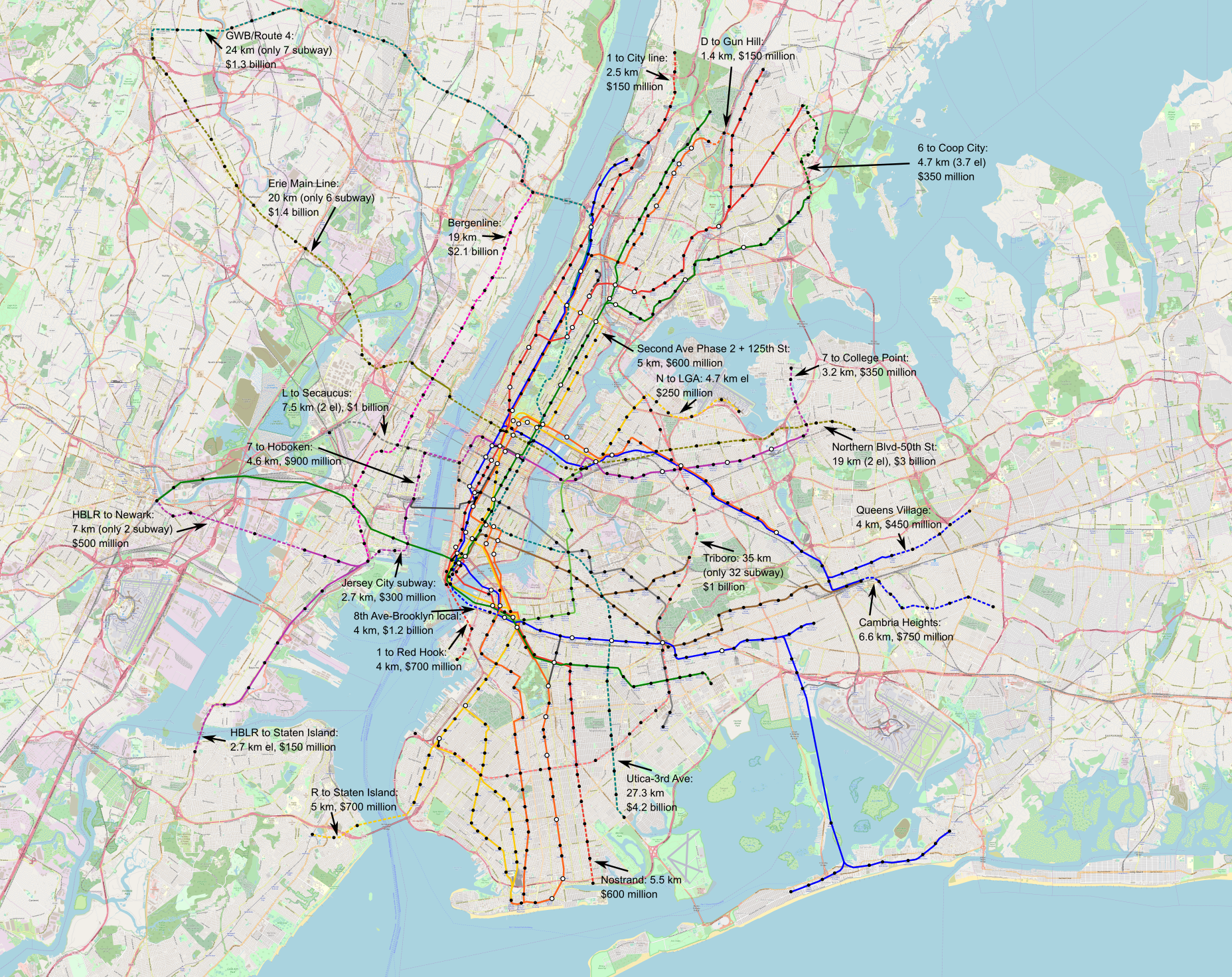

A full-size 52 MB version of the subway map can be found here and a 52 MB version of the regional rail map can be found here.
Subways are set at $110 million per km underground, outside the Manhattan core; in more difficult areas, including underwater they go up to $200-300 million per km, in line with Stockholm Citybanan. Lacking data for els, I set them at $50 million per km, in line with normal subway : el cost ratios. The within-right-of-way parts of Triboro are still set at $20 million per km (errata 5/30: 32 out of 35 km are in a right-of-way and 3 are in a new subway, despite what the map text says, but the costs are still correct).
Overall, the subway map costs $22 billion, and the regional rail one $15 billion, about half as high as the figure I usually quote when asked, which is based on global averages. This excludes the $2 billion for separated intercity rail tracks, which benefit from having no stations save Penn (by the same token, putting the express rather than local lines in the tunnel is a potential cost saving for Crossrail 2). It also excludes small surface projects, such as double-tracking the Northern Branch and West Shore Line, a total of 25 and 30 km respectively, which should be $300-550 million in total, and some junction fixes. There may also be additional infill stations on commuter rail, e.g. at intersection points with new subway extensions; I do not have Nordic costs for them, but in Madrid they cost €9 million each.
The low cost led me to include some lines I would not include elsewhere, and decide marginal cases in favor of subways rather than els. There is probably no need for the tunnel connecting the local tracks of Eighth Avenue and Fulton Street Lines, but at just $1.2 billion, it may be worth it. The line on Northern Boulevard and the Erie Main Line should probably be elevated or in a private right of way the entire way between the Palisades and Paterson, but at an incremental cost of $60 million per km, putting the Secaucus and East Rutherford segments underground can be justified.
In fact, the low cost may justify even further lines into lower-density areas. One or two additional regional rail tunnels may be cost-effective at $300 million per kilometer, separating out branches like Port Washington and Raritan Valley and heading to the airports via new connections. A subway line taking over lanes from the Long Island Expressway may be useful, as might another north-south Manhattan trunk feeding University Avenue (or possibly Third Avenue) in the Bronx and separating out two of the Brighton Line tracks. Even at average costs these lines are absurd unless cars are banned or zoning is abolished, but at low costs they become more interesting.
The Nordic capitals all have extensive urban rail networks for their sizes. So does Madrid: Madrid and Berlin are similar in size and density, but Berlin has 151 km of U-Bahn whereas Madrid has 293 km of metro, and Madrid opened a second Cercanías tunnel in 2008 for around $100 million per km and is planning a third tunnel for next decade (source, PDF-pp. 104-108). Things that are completely ridiculous at American costs – say, any future subway expansion – become more reasonable at average costs; things that are completely ridiculous at average costs likewise become more reasonable at Nordic or Spanish costs.
 Pedestrian Observations