Prudence Theater

The phrase security theater refers to the elaborate selling of airport security to the public through humiliating spectacle, like making people take off their shoes, with no safety value whatsoever. By the same token, prudence theater is the same kind of ritual of humiliating people, often workers, in the name of not wasting money. Managers who engage in prudence theater will refuse pay hikes and lose the best employees in the process, institute hiring freezes at understaffed departments and wonder why things aren’t working, and refuse long-term investments that look big even if they have limited risk and high returns. This approach is endemic to authoritarian managers who do not understand the business they are running – such as a number of do-nothing political leaders who make decisions regarding public transit.

I’ve talked a bunch about this issue in the context of capital investment, for example Massachusetts’ Charlie Baker, California’s Gavin Newsom, New Jersey’s Chris Christie, and New York‘s Andrew Cuomo, using phrases such as “Chainsaw Al” and “do-nothing.” But here I want to talk specifically about operations, because there is an insidious kind of prudence theater there: the hiring freeze. The MBTA and MTA both have hiring freezes, though thankfully New York is a little more flexible about it.

Both New York and Boston have very high operating costs, for both subways and buses. They have extensive overstaffing in general, but that does not extend to overstaffing at every department. On the contrary, some departments are understaffed. Adam Rahbee told me a year and a half ago that subway operations planning in New York was short on workers, in contrast to the overstaffed department he saw in London. Of course London on average has much lower costs than New York, but individual departments can still be short on manpower even in otherwise-overstaffed cities. If anything, leaving one department understaffed can cause inefficiencies at adjacent departments, making them in effect overstaffed relative to the amount of service they can offer.

Bus dispatching

Buses require active supervision by a centralized control center that helps drivers stay on schedule. New York currently has 20 dispatchers but is planning an increase to 59, in tandem with using new technology. Boston has 5 at any given time, and needs to staff up to 15, which involves increasing hiring to about 40 full-time workers and doing minor rearrangement of office space to give them a place to work. With too few dispatchers, drivers end up going off-schedule, leading to familiar bunching, wasting hundreds of bus drivers’ work in order to save money on a few tens of supervisors.

I went over the issue of bus bunching in a post from last summer, but for the benefit of non-technical readers, here is a diagram that explains in essence what the problem of chaos is:

The marble on top of the curve is unlikely to stay where it is for a long time, because any small disturbance will send it sliding down one side or the other. Moreover, it’s impossible to predict in advance which direction the marble will land in, because a disturbance too small to see will compound to a big one over time.

Chaotic systems like this are ubiquitous: weather is a chaotic system, which is why it’s not possible to predict it for more than about two weeks in advance – small changes compound in unexpected directions. Unfortunately, bus service is a chaotic system too. For the bus to be on schedule is an unstable equilibrium. If the bus runs just a little behind, then it will have to pick up more passengers on its way, as passengers who would have just missed the bus will instead just make it. Those extra passengers will take some extra time to board, putting the bus even further behind, until the bus behind it finally catches it and the two buses leapfrog each other in a platoon.

There are ways to mitigate this problem, including dedicated bus lanes and off-board fare collection. But they do not eliminate it – they merely slow it down, increasing the time it takes for a bus to bunch.

The connection between dispatching and chaotic bus schedules may not be apparent, but it is real. The transportation engineering academic community has had to deal with the question of how to keep buses on schedule; here, here, and here are three recent examples. The only real way to keep buses on schedule is through active control – that is, dispatching. A dispatcher can tell a driver that the bus is too far ahead and needs to slow down, or that it is behind and the driver should attempt to speed up. If the traffic light system is designed for it, the dispatcher can also make sure a delayed bus will get more green lights to get back on track, a technology called conditional signal priority, or CSP. This contrasts with unconditional transit signal priority, or TSP, which speeds up buses but does not preferentially keep them evenly spaced to prevent bunching.

Moreover, some of the people who have done academic work on this topic have gone on to work in the transit industry, whether for the MBTA (such as David Maltzan and Joshua Fabian) or for thinktanks or private companies (such as Chris Pangilinan). Specific strategies to keep the buses on track include CSP giving delayed buses more green lights, holding buses at the terminal so that they leave evenly spaced, and in some cases even holding at mid-route control points. Left to their own devices, buses will bunch, requiring constant correction by a competent dispatching department with all the tools of better data for detection of where bunching may occur as well as control over the city’s streetlights.

Managers’ point view vs. passengers’ point of view

When I talk to transit riders about their experiences, I universally hear complaints. The question is just a matter of what they complain about. In suburban Paris people complain plenty about the RER, talking about crowding and about how the system isn’t as frequent or reliable as the Metro. These are real issues and indicate what Ile-de-France Mobilités should be focusing its attention on.

Americans in cities with public transit talk about bunching. In New York I’ve routinely sighted platoons of two buses even on very short routes, where such problems should never occur, like the 3 kilometer long M86. A regular rail user who talked to me a few months ago mentioned three-bus platoons in Brooklyn on a route that has a nominal frequency of about 10 minutes.

From the perspective of the transit operator or the taxpayer, if buses are scheduled to arrive every ten minutes, that’s an expenditure of six buses per hour. From that of the rider, if the buses in fact come in platoons of two due to bunching, then the effective frequency is 20 minutes, and most likely the bus they ride on will be the more crowded one as well. What looks like a service improvement to managers who never take the system they’re running may offer no relief to the customers on the ground.

I wish my mockery of transit managers who don’t use their own system were facetious, but it’s not. In New York, some of the more senior managers look at NYCT chief Andy Byford askance for not owning a car and instead using the subway to get to places. Planner job postings at North American transit agencies routinely require a driver’s license and say that driving around the city is part of the job. Ignorant of both the science of chaos and the situation on the ground, the managers and politicians miss low-hanging fruits while waxing poetic about the need to save money.

Is anything being done?

In New York there are some positive signs, such as the increase in the number of dispatchers. The warm reception Eric Goldwyn and I got from some specific people at the MTA is a good sign as well. The problem remains political obstruction by a governor and mayor who don’t know or care to know about good practices. Cuomo’s constant sidelining of Byford has turned into a spectacle among New York transit journalists.

In Boston, the answer is entirely negative. Last week’s draft of the Focus40 plan, released by the MBTA’s Fiscal Management and Control Board (FMCB), unfortunately entirely omits dispatching and operational supervision from its scope. It includes a variety of investments for the future, some of which are welcome, such as the Red-Blue Connector. But it reduces the issue of bus timetable keeping to a brief note in the customer experience section that mentions “Computer Aided Dispatch / Automatic Vehicle Location technology.” Good data is not a bad thing, but it is not everything. Warm bodies are required to act on this data.

Thus prudence theater continues. Massachusetts will talk about reform before revenue and about spending money wisely, but it is run by people with little knowledge of public transportation and no interest in acquiring said knowledge. Its approach to very real issues of high costs is to cut, even when there are parts of the system that are underfunded and undermanned. Staffing up to 15 dispatchers at a time, raising the headcount to about 40 full-time workers, would have the same effect on ridership as literally hundreds of bus drivers through better control. Will the administration listen? As usual, I hope for the best but have learned to expect the worst.

Battery-Electric Buses: New Flyer

Two months ago, after my article about battery-electric buses appeared in CityLab, New Flyer reached out to me for an interview. Already in one of the interviews I’d done for the article, I heard second-hand that New Flyer was more reasonable than Proterra and BYD and was aware of the problem of battery drain in cold weather. I spoke to the company’s director of sustainable transportation, the mechanical engineer David Warren, and this confirmed what I’d been told.

Most incredibly, I learned at the interview that the headline figures used in the US for electric bus performance explicitly exclude heating needs. The tests are done at the Altoona site and only look at electricity consumption for propulsion, not heating. New Flyer says that it is aware of this issue and has tried not to overpromise, but evidently Proterra and BYD both overpromise, and regardless of what any vendor says, American cities have bought into the hype. In Duluth this was only resolved with fuel-fired heaters; the buses only use electricity for propulsion, which is not the majority of their energy consumption in winter.

Warren and I discussed New York specifically, as it has a trial there on the M42. The heater there puts out 22 kW of energy at the peak, but on the day we discussed, January 29th, when the air temperature was about -7*, actual consumption was on average about 10 kW. Electricity consumption split as 40% heating, 20% propulsion, and 40% other things, such as the kneeling system for easier boarding.

The battery can last many roundtrips on the M42, specifically a very slow route. Electric vehicles tend to do much better then fuel-powered ones at low speed in city traffic, because of regenerative braking and higher efficiency. When I discussed the Proterra trial with MVTA, I was told specifically that the buses did really well on days when the temperature was above freezing, since the battery barely drained while the bus was sitting in rush hour Downtown Minneapolis traffic. This pattern is really a more extreme version of one that may be familiar to people who have compared fuel economy ratings for hybrid and conventional cars: hybrids are more fuel-efficient in city driving than on the highway, the opposite of a non-hybrid, because their electric acceleration and deceleration cycles allow them some of that regeneration.

The current system is called OppCharge (“opportunity charging”), and currently requires the bus to spend 6 minutes out of every hour idling for recharge; the Xcelsior presentation shows a bus with a raised pantograph at a charging station, and I wonder whether it can be extended to an appropriate length of wire to enable in-motion charging.

The New Flyer examples I have seen are in large cities – New York and Vancouver. New York’s system for opportunity charging does not require an attendant; Vancouver’s may or may not, but either way the charging is at a bus depot, where the logistics are simpler. In contrast, in Albuquerque the need for midday charging was a deal breaker. When I talked to someone who knew the situation of Albuquerque’s BRT line, ART, I was told that the BYD midday charge system would require an attendant as well as room for a charging depot. Perhaps an alternative system could get rid of the attendant, but the land for a bus that at the end of the day isn’t that busy has nontrivial cost even in Albuquerque.

Even with opportunity charging, batteries remain hefty. Warren said that they weigh nearly 4 tons per standard-length bus; the XE40 weighs 14 metric tons, compared with 11.3 for the older diesel XD40 platform. Specifically on a short, high-ridership density like the M42 and many other New York buses, there is likely to be a case for installing trolleywire and using in-motion charging. In-motion charging doesn’t work well with grids, since it is ideally suited to when several branches interline to a long trunk route that can be electrified, but ultimately it’s a bus network with ridership density comparable to that of some big American light rail networks like Portland’s.

*In case it’s unclear to irregular readers, I exclusively use metric units unless I mention otherwise, so this is -7 Celsius and not -7 Fahrenheit; the latter temperature would presumably drain the battery a lot faster.

Quick Note: the Importance of Long-Term Planning

Last week, Strong Towns ran a piece complaining about what it calls “go big or go home” transit. Per Strong Towns’ Daniel Herriges, rail expansion takes 20 years and reflects an obsession with megaprojects, so it’s better to look at small things. Strong Towns’ take is as follows:

“After 20 years of planning, the North Carolina Research Triangle’s signature transit project is fighting for its life.”

Boy. If this sentence doesn’t perfectly capture the folly of our megaproject-obsessed transit paradigm, we don’t know what does.

Here’s a better idea: Ask transit riders in Durham and Chapel Hill what’s the next, small step you could take that would improve their commutes *this* year. Then do it. Then next year, ask the same question. There are so many pressing needs going unmet while our cities focus on shaky silver-bullet efforts like this one; what do we have to lose?

It’s a perfect encapsulation of what is wrong with more traditionalist attitudes toward urbanism and green transport, and I want to explain why.

Short-term thinking – “what could improve this year” – does not scale. The Strong Towns article talks about scalability as a reason to improve bus service and add sidewalks rather than adding urban rail, but the reality is the exact opposite. Incrementalism works in cities that have 35% transit mode share and want to go up to 50% – and since, in the first world, all of these cities have rapid transit systems, getting to 50% means building more lines, as is happening in Paris and Berlin and London and Stockholm and Vienna and Copenhagen, and the last three don’t even have that many more people than the Research Triangle, where the rail link in question is to be built.

The Research Triangle does not have 35% transit mode share. For work trips the share in the Durham-Raleigh combined statistical area is 1.4%. All the things that year-by-year incremental progress does do not work, because improving the bus network increases ridership in relative numbers to current traffic.

Strong Towns understands this, in a way. It uses the “what do we have to lose?” language. And yet, it recommends not doing anything of importance, because building big things means megaprojects. Megaprojects involve doing something that visibly involves the government, requires central planning, and is new to the region. They empower planners whose expertise comes from elsewhere, because the local knowledge in a 1.4% transit share region is 100% useless for offering transportation alternatives.

It’s a mentality that seems endemic to groups that romanticize midcentury small towns. Strong Towns literally names itself after the idea of the old small-town main street, in which cars exist but do not dominate, back before hypermarkets and motorway bypasses and office parks changed it all. It’s an idea that evokes nostalgia among people who grew up in cities like that or in suburbs that imitated them and dread among people who didn’t. And it’s completely dead, because it’s too small-scale for transit to work and too spread out for a developer to have any interest in reproducing it today.

Transit revival doesn’t look like the 1950s, and planning for it doesn’t involve the same social groups that dominated then. That era between World War Two and the counterculture was dominated by an elite consensus that built megaprojects, but the middle-class elements of said consensus were precisely the one that bolted to the anti-state New Right, with its ethos of mocking the idea of “I’m from the government and I’m here to help.”

In a metro area that wants to get from 1.4% transit share to a transit share that’s not a rounding error, a few things need to happen, and none of them will make nostalgists happy. First, planning has to be for the long term. “What can be done this year?” means nothing. Second, extensive redevelopment is required, and it can’t be incremental. If you want transit-oriented development, look at what Calgary did in city center and what Vancouver did around suburban stations like Metrotown and Edmonds and do it in your Sunbelt American city. Third, wider sidewalks are cool and so is more bus service, but in a spread-out region, interurban rail is a must, and this means big projects with an obtrusive government and a public planning process. And fourth, people will complain because not everything is a win-win, and the government will need to either ignore those people (if they’re committee meeting whiners) or break them (if they’re Duke, which is opposing the light rail line on NIMBY grounds).

American transit reformers tend not to know much about good practices, but many are interested in learning. But then there are the ones who cling to traditional railroading, mixed-traffic heritage streetcars, village main streets, or really anything that lets them portray the car as an outside enemy of Real America rather than its apex with which it annihilated groups it deemed too deviant. It’s an attractive mythology, playing to a lot of powerful notions of community. It’s also how American cities got to be the car-choked horrors that they are today, rather than how they will turn into something better.

Park-and-Rides (Hoisted from Comments)

My post about the boundary zone between the transit-oriented city and its auto-oriented suburbs led to a lot of interesting discussions in comments, including my favorite thing to hear: “what you said describes my city too.” The city in question is Philadelphia, and the commenter, Charles Krueger, asked specifically about park-and-ride commuter rail stations. My post had mentioned Southeast on the Harlem Line as an interface between commuter rail and the Westchester motorway network, and the natural followup question is whether this is true in general.

The answer is that it’s complicated, because like the general concept of the cars/transit boundary zone, park-and-rides have to be rare enough. If they’re too common, the entire rail system is oriented around them and is not really a boundary but just an extension of the road network. This is the situation on every American commuter rail system today – even lines that mostly serve traditional town centers, like the New Haven Line, focus more on having a lot of parking at the station and less on transit-oriented development. Even some suburban rapid transit lines, such as the Washington Metro, BART, and the recent Boston subway extensions, overuse park-and-rides.

However, that American suburban rail systems overuse such stations does not mean that such stations must never be built. There are appropriate locations for them, provided they are used in moderation. Those locations should be near major highways, in suburbs where there is a wide swath of low-density housing located too far from the rail line for biking, and ideally close to a major urban station for maximum efficiency. The point is to use suburban rail to extend the transit city outward rather than the auto-oriented suburban zone inward, so the bulk of the system should not be car-oriented, but at specific points park-and-rides are acceptable, to catch drivers in suburbs that can’t otherwise be served or redeveloped.

Peakiness and park-and-rides

I’ve harped on the importance of off-peak service. The expensive part of rail service is fixed costs, including the infrastructure and rolling stock; even crew labor has higher marginal costs at the peak than off-peak, since a high peak-to-base ratio requires split shifts. This means that it’s best to design rail services that can get ridership at all times of day and in both directions.

The need for design that stimulates off-peak service involves supportive service, development, and infrastructure. Of these, service is the easiest: there should be bidirectional clockface schedule, ideally with as little variation between peak and off-peak as is practical. Development is politically harder, but thankfully in the main example case, the Northeastern United States, commuter rail agencies already have zoning preemption powers and can therefore redevelop parking lots as high-intensity residential and commercial buildings with walkable retail.

Infrastructure is the most subtle aspect of design for all-day service. Park-and-ride infrastructure tends to be peaky. Whereas the (peakier, more suburban) SNCF-run RER and Transilien lines have about 46% of their suburban boardings at rush hour, the LIRR has 67%, Metro-North 69%, and the MBTA 79%. My linked post explains this difference as coming from a combination of better off-peak service on the RER and more walkable development, but we can compare these two situations with the Washington Metro, where development is mostly low-density suburban but off-peak frequency is not terrible for regional rail. Per data from October 2014, this proportion is 56%, about midway between Transilien and the LIRR.

This goes beyond parking. For one, railyards should be sited at suburban ends of lines, where land is cheap, rather than in city center, where land is expensive and there is no need to park trains midday if they keep circulating. But this is mostly about what to put next to the train stations: walkable development generating a habit of riding transit all day, and not parking lots.

Where parking is nonetheless useful

In response to Charles’ comment, I named a few cases of park-and-rides that I think work well around New York, focusing on North White Plains and Jersey Avenue. There, the parking-oriented layout is defensible, on the following grounds:

  1. They are located in suburban sections where the reach of the highway network is considerable, as there is a large blob of low density, without much of the structure created by a single commuter line.
  2. They are near freeways, rather than arterials where timed connecting buses are plausible.
  3. They are immediately behind major stations in town centers with bidirectional service, namely White Plains and New Brunswick, respectively.

The importance of proximity is partly about TOD potential and partly about train operating efficiency. If the park-and-rides are well beyond the outer end of bidirectional demand, then the trains serving them will be inefficient, as they will get relatively few off-peak riders. A situation like that of Ronkonkoma, which is located just beyond low-ridership, low-intensity suburbs and tens of kilometers beyond Hicksville, encourages inefficient development. Thus, they should ideally be just beyond the outer end, or anywhere between the city and the outer end.

However, if they are far from the outer end, then they become attractive TOD locations. For example, every station between New York and White Plains is a potential TOD site. It’s only near White Plains that the desirability of TOD diminishes, as White Plains itself makes for a better site.

On rapid transit in American suburbia, one example of this principle is the Quincy Adams garage on the Red Line just outside Boston. While the station itself can and should be made pedestrian-friendlier, for one by reopening a gate from the station to a nearby residential neighborhood, there’s no denying the main access to the station will remain by car. Any TOD efforts in the area are better spent on Quincy Center and Braintree, which also have commuter rail service.

Where parking should urgently be replaced by TOD

American suburban rail lines overuse park-and-rides, but there are specific sites where this type of development is especially bad. Often these are very large park-and-ride structures built in the postwar era for the explicit purpose of encouraging suburban drivers to use mainline rail for commuter and intercity trips. With our modern knowledge of the importance of all-day demand, we can see that this thinking is wrong for regional trips – it encourages people to take rail where it is the most expensive to provide and discourages ridership where it is free revenue.

The most important mistake is Metropark. The station looks well-developed from the train, but this is parking structures, not TOD. Worse, the area is located in the biggest edge city in the Northeast, possibly in the United States, possibly in the world. Middlesex County has 393,000 jobs and 367,000 employed residents, and moreover these jobs are often high-end, so that what the Bureau of Economic Analysis calls adjustment for residence, that is total money earned by county residents minus total money earned in the county, is negative (Manhattan has by far the largest negative adjustment in the US, while the outer boroughs have the largest positive one). The immediate area around Metropark and Woodbridge has 46,000 jobs, including some frustratingly close to the station and yet not oriented toward it; it’s a huge missed opportunity for commercial TOD.

In general, edge cities and edgeless cities should be prime locations for sprawl repair and TOD whenever a suburban rail line passes nearby. Tysons, Virginia is currently undertaking this process, using the Silver Line extension of the Metro. However, preexisting lines do not do so: Newton is not making an effort at TOD on the existing Green Line infrastructure, it’s only considering doing so in a part of town to be served by a potential branch toward Needham; and the less said about commuter rail, the better. Mineola and Garden City on Long Island, Tarrytown in Westchester, and every MBTA station intersecting Route 128 are prime locations for redevelopment.

Commuter rail for whomst?

I believe it’s Ant6n who first came up with the distinction between commuter rail extending the transit city into the suburbs and commuter rail extending the suburbs into the city. If the trains are frequent and the stations well-developed, then people from the city can use them for trips into suburbia without a car, and their world becomes larger. If they are not, then they merely exist to ferry suburban drivers into city center at rush hour, the one use case that cars are absolutely infeasible for, and they hem car-less city residents while extending the world of motorists.

Park-and-rides do have a role to play, in moderation. Small parking lots at many stations are acceptable, provided the station itself faces retail, housing, and offices. Larger parking structures are acceptable in a handful of specific circumstances where there is genuinely no alternative to driving, even if the rest of the rail service interfaces with walkable town centers. What is not acceptable is having little development except parking at the majority of suburban train stations.

The Boundary Between the Transit City and Auto-Oriented Suburbia

Public transportation use is higher in cities than in suburbs. Cities with stronger transit networks have larger transit-rich, auto-hostile cores, and some have good transit in lower-density suburbs, but ultimately the transit city has a limited radius, beyond which automobiles dominate. Successful examples of suburban transit, like Zurich, just keep the city-suburb gradient shallower than in other transit cities.

The most fascinating aspect of this is the boundary between the transit-oriented city and the auto-oriented suburbs. Uniquely in the metro area, the boundary region has good access by car as well as by transit, making it ideal for uses that want to interface with both modes of transportation. This specifically includes bus stations, stadiums, and big box retail, as well as more sporadic meeting points between urban and suburban residents.

Where the boundary is

Because the boundary zone is defined by good transit as well as highway access, it may not be the literal boundary as defined by modal split, car ownership, or any other metric of transportation usage. It can be the outer end of some rail line extending into the suburbs, and in that case it may be a salient into auto-oriented territory. There are a number of examples in the United States, where the postwar rapid transit projects have not been accompanied by much transit-oriented development, and thus their outer stations are in low-density suburbs where transit service functions as expensive S-Bahns. BART and most of the Washington Metro are like this, as are the suburban lines of the Boston subway.

For example, here is Newton Centre, on the Green Line D branch:

The light rail station is just to the left (south) of the street. This is a walkable suburban street with a train that comes pretty frequently all day, and yet the dominant mode of transportation here is clearly cars, as one can see in the parking lot to the left. Transit usage here is similar to the metro area’s average – Newton averages 11.9%, the Boston metro area 13.4% – but this says more about the rest of metro Boston than about Newton Centre. Nonetheless, such a location is convenient to access from the city if one lives near the Green Line, and is also reasonable convenient by car, as it is just 4 km from the freeway, and the majority of the distance is along the fast arterial that is Route 9.

The importance of highway access also works in reverse. In cities with strong transit networks and weak motorway network, there may be a freeway salient into the city, creating a zone that is car-friendlier than the rest. If it also has ample parking, which it usually does, then it will end up creating a boundary within an area that is on most metrics transit-oriented.

In London, the urban renewal zones around Stratford and Canary Wharf are examples – the city is unusually poor in freeway infrastructure, but two of the few radial motorways hit these two business districts. Here is Stratford:

The built-up density is high, and Stratford is one of the busiest Underground stations. But the roads are big for the city they’re in and there are large surface parking lots all over.

I’m deliberately including two examples with very different urban layouts and actual transit usage levels to hammer home the point that the boundary is defined merely by the existence of supportive infrastructure for both cars and public transit.

Can the entire city be friendly to both cars and public transit?

No.

There are several reasons for this. The first and most fundamental is that public transit is only successful if it can leverage scale. The adage frequency is freedom comes from this fact, but the same can be said about related issues of span, reach, and network effects. This is why frequency-ridership spirals are so dangerous – a small cut in service can lead to a much greater reduction in ridership.

The second reason is that drivers prefer a different urban layout from transit users, cyclists, and pedestrians. Cars are space-intensive on the road as well as on the parking lot, but can achieve high average speed if there’s no traffic, so they end up preferring spread-out development. Public and active transport are space-efficient but involve a lot of slow walking, so they prefer dense development at distinguished nodes with train stations, featuring strong commercial city centers with high job concentration. The boundary zone I speak of must be underlain by a strong enough transit network in the city core that people will fill the trains at all hours of day.

Concretely, neither the example of Newton nor that of Stratford can work citywide. Newton cannot work citywide because if every residential metro station is a parking lot, then nobody will ride the trains off-peak, and the city will de facto be exclusively auto-oriented as a result. Two years ago I compared the proportion of boardings at suburban stations that occur in the morning peak in New York (67% LIRR, 69% Metro-North) and Paris (46% on the SNCF network). Well, I would later find data for the Washington Metro, which has high off-peak frequency like the RER but low-density parking lot stations like the LIRR and Metro-North, and the proportion of riders in the morning peak is much closer to that of the LIRR than to that of the RER.

Likewise, Stratford can’t work citywide, because most of the city is not a reclaimed railyard with enormous space for all manners of new development. Building the expansive motorway network that would allow cars to rapidly reach every part of the city would normally require extensive neighborhood demolitions; American cities only managed to do so because to the road builders, destroying working-class (and often black) neighborhoods was a feature rather than a bug. Building a new city with ample road infrastructure is possible without this history, but then one gets Houston, hardly an example of good transit accessibility.

Land use at the boundary

The boundary zone’s unique accessibility by both cars and transit makes it ideally suited for land use that really wants both. Such land use has to have the following features:

  1. It needs to have a large regional draw, or else distinct neighborhood centers, some transit-oriented and some car-oriented, can do better.
  2. It needs to specifically benefit from good highway access, for example for deliveries, but also from good transit access.
  3. It is not so high-value that city center’s better transit access in multiple directions trumps access by transit in one direction and by cars in another.

Sporadic meetings satisfy all three criteria. For one personal example, in 2013 I visited New York and participated in a LARP taking place in a camp somewhere in Massachusetts, accessible only by car; I traveled with friends in the suburbs and we arranged that they would pick me up at Southeast, the northern end of the Metro-North Harlem Line’s electrification, so chosen because of its excellent multidirectional freeway access.

I bring up LARPing because it’s such a small community that it has to draw regionwide – in the case of the one I went to, participants came from all over Eastern New England and even beyond – and thus, anywhere with lower transit usage than New York, must appeal primarily to the driver, not the transit user. Nerdy conventions in general tend to either be enormous, like Comic-Con, or take place in cheap suburban edge city hotels, with meetings for carpools arranged at choice suburban train stations.

More common uses that like the boundary zones include major stadiums and big box retail. Stadiums appeal to a broad section of the population with little differentiation between city residents and suburbanites. They have to have good transit access even in auto-oriented American cities for reasons of capacity, but they also have to have good auto access for the use of drivers; stadiums are land-intensive enough that they can’t locate in city center at all, with its omnidirectional transit access, so instead they must be at the boundary zone. Thus Stratford hosts the London Stadium, the Stade de France is in Saint-Denis with good motorway as well as RER access, and Yankee Stadium is tucked at a corner of the Bronx with two subway lines and good expressway infrastructure.

Big box retail is more complicated – for one, its draw is so local that even a small city can support several Walmarts, Carrefours, and Aldis (Walmart is weak in big cities, but the big European retailers aren’t). Nonetheless, boundary zone stores exist: the big supermarket I’m most familiar with in Boston, Star Market at Porter, is on top of a subway station but also has a large parking lot, while the supermarket I shop at here in Berlin, Kaufland, is a two-story big box next to the Gesundbrunnen U- and S-Bahn station, with the ground floor devoted to parking.

I suspect the reason big box retail likes the boundary zone is that while it is local, there are extensive mixed areas rich in both drivers and non-drivers, where a big store must appeal to both in order to succeed. The Gesundbrunnen area is one of the city’s densest, but car ownership in Berlin is still higher than in Paris or New York. The same is true of the area around Porter Square in Cambridge and Somerville, albeit at lower density and with lower transit usage, so Star Market puts its parking on the surface rather than in a structure.

Bus station siting

The most interesting land use that prefers the boundary zone, and the origin of this post, is the intercity bus station. Here is Herbert in comments:

Can you do a post on the contradictory demands for the site of the main intercity bus station?

On the one hand, it is desirable that it is within easy reach from the highway. On the other hand it should be as close to downtown as possible and also easily reachable by public transit. And last but not least there should of possible be one interchange station for every city for connecting passengers.

It’s almost impossible to find a site that goes all requirements. Berlin ZOB certainly doesn’t…

Whereas train stations have obvious preferred sites – the central business district – bus stations have to balance centrality with highway access. In Paris, this is Gallieni. This station is just outside the city at the end of Metro Line 3, where the Boulevard Peripherique meets the A3 autoroute, which connects to further motorways with good access to the north, south, and east. Like Stade de France, Gallieni is a salient of the auto-oriented suburbs almost into city limits, in inner suburbs with high public transit usage.

In New York, there are a few sites that would work fine, but each points in a different direction, making interchange difficult. Port Authority is excellent for buses going to New Jersey and points west and south, and curbside buses tend to pick up in that general area as well, often near Hudson Yards; this is facilitated by a unique situation in which the Lincoln Tunnel has a dedicated inbound bus lane in the morning peak, which many area transit activists wish existed in both directions all day. Buses to Boston could depart from Yankee Stadium, which also benefits from being just beyond the outer end of subway express service, so that travel speeds to Manhattan are faster. However, in practice they depart from the same curbside location on the Far West Side as the buses to Philadelphia and Washington, frustrating riders who see their bus spend an hour in city traffic.

The situation of New York is unusual in that it is located next to two wide rivers with few crossings, and thus does not have a proper orbital motorway with a location like Gallieni. But New York is not unique in having difficult bus station siting choices. London has the same problem: for one, the M25 orbital is so far out of the city; and perhaps more importantly, British buses are priced cheaper than trains in order to control crowding levels on trains to London, and thus dumping bus passengers on a regional train to Central London would be strictly worse than just letting them ride the train the entire way for a reasonable fare.

Stroads and Strails

In 2011, Chuck Marohn of Strong Towns coined the word stroad for a street that functions as a road. Chuck argues that there should be a separation between streets, which are destinations in and of themselves and are to be lined with walkable retail, and roads, which exist to move people between destinations. In contrast, auto-oriented arterials function as both: they are designed for high speed for through-traffic but also have extensive streetside destinations built at automobile scale, hence the portmanteau stroad.

In the last seven years this mentality has become quite popular within online urbanist circles. Unfortunately, it misses why major streets arise in the first place. Moreover, this is not just an issue for cars and car traffic – other modes of transportation want to funnel local and interregional traffic through the same corridors, creating a number of arteries that are in essence strails, like the Berlin S-Bahn. Good planning has to recognize that where people to go through and where people want to go to are often the same, and provide road and rail infrastructure of sufficient size to accommodate.

What is a street, anyway?

The main purpose of a city street is to connect destinations within the city. Major streets routinely form out of trails, post roads, and turnpikes connecting the city with villages that it swallows as it industrializes and grows. Broadway in New York started out as an Indian trail, the Strand grew as a road connecting London with Westminster and had previously been part of an intercity Roman road, Champs Elysees was built as a promenade into the periphery of Paris and gradually filled in with palaces, the Sveavägen/Götgatan axis goes back to the Early Modern era with connections from Stockholm to Roslag to the north and Götland in the south.

Not every street has this intercity or suburban history, but the important ones frequently do. The Manhattan grid was mapped as an entirely urban street network, but the wide north-south avenues were designed for easy access to the Lower Manhattan core from future residential areas. In ungridded cities, usually you can tell which streets are the oldest because they are longer, more continuous, and more commercially developed, and the exceptions come from heavyhanded state planning, like the shift from Rue Saint-Jacques to Boulevard Saint-Michel in Haussmannian Paris.

The importance of through-streets within cities continues even today, and even when cars are not too relevant. People who walk or take transit are likelier to do so on the main streets, and as a result, businesses prefer locating there. In Manhattan there’s even an expression for this: avenue rents versus street rents. In Vancouver, I could walk on any street, but crossing wasn’t any harder on the main streets than on the side streets, and there was more interesting stuff to look at on the main streets; even ignoring zoning, retail would prefer to locate on the main streets because that’s where all the other retail is. There’s a wealth of good restaurants I discovered just by walking next to them, to say nothing of the gaming store on 4th Avenue near MacDonald, which I saw from the bus to UBC.

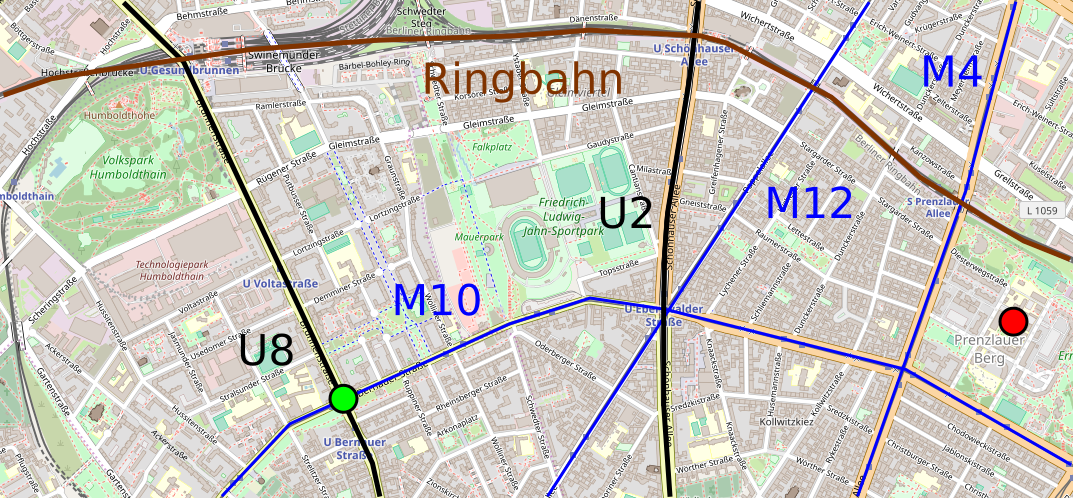
All of this is magnified in cities that do not have consistent grids, like Paris, Berlin, and even Stockholm. In those cities, zoning does not micromanage use as much as in North America, and yet businesses locate on major streets where possible. Here is a map of the area I live in: the green dot is where I live, and the red dot is a government office I went to last week to register.

Walking east or west, I exclusively use Bernauer Strasse, the street the M10 tramway runs on; walking north or south, I use Brunnen Strasse, which hosts U8. Other streets can function as shortcuts, but with parks and small changes interrupting the grid, they’re less reliable for through-walking. And indeed, they are much quieter and largely residential, with retail mostly at street corners.

The invention of the stroad

The early American roads connected distinct cities, or linked cities with rural hinterlands. Within the cities, they fed preexisting arterial streets. For the most part these arterial streets were fairly wide – they were mapped in the 19th century based on 19th-century design standards, often 30 meters of width, rather than the narrow medieval streets London is famous for – but they still filled with cars fast. Two parking lanes and four moving lanes in a dense city with busy crossings aren’t much. American cities had traffic jams in the 1920s already.

My two go-to references about the history of American roadbuilding – Owen Gutfreund’s 20th-Century Sprawl, and Earl Swift’s The Big Roads – both explain what happened beginning in the 1920s: cities built bypasses. The idea was that the bypasses would segregate through-traffic from urban traffic, separating roads from streets properly.

This never happened. For the same reason preindustrial roads turned into busy streets, bypasses turned into busy auto-oriented streets. Retailers found that the best place to locate was where all the cars were. These bypasses became congested roads themselves, partly due to the induced auto-oriented development and partly due to general growth in car traffic volumes. This trend intensified after WW2, with the freeways leading another cycle of bypasses around congested urban roads becoming congested with urban traffic themselves. Wal-Mart and Carrefour invented the hypermarket in 1962-3, and in the 1960s office space began suburbanizing as well, since traffic conditions were better than in congested city centers.

This is not an obscure history, and Chuck is fully aware of it: among his complaints about stroads is that they reduce the tax base of the city by encouraging retail to decamp for the suburbs. He just fails to follow this through to the logical conclusion: the most intense demand for real estate is near the busiest through-routes. There is no real separation between the street and the road; the best you can do for walkability is run better public transit to the urban core and make sure the roads have street-facing retail rather than front parking lots.

Strails

The principle that the best place for local traffic is where long-distance traffic is is equally true of trains. An intermediate station on an intercity railway sited a convenient commute away from the city will soon fill with suburban travelers. The term commuter itself derives from the discounted commutation tickets American intercity railroads offered regular riders, starting in New York and Boston in the middle of the 19th century.

19th-century railways were not a complex system of branched lines dedicated to regional traffic. Such lines existed, for example the Ligne de Saint-Germain-en-Laye, now part of the RER A, but most of the lines continued onward to long-distance destinations, or had been built with the intention of continuing so. Look at this map of extant London-area railways by year of construction: there aren’t that many branches predating the Late Victorian era, and the branches that do exist tend to be reverse-branches in South London offering service to either a City station like Cannon Street or Blackfriars or a West End station like Victoria. The remainder are loop lines, built to offer four tracks’ worth of capacity on lines that had originally been built with only two, but then both routes filled with local traffic, making it harder to schedule express trains; for an example easily visible on the map, see the Lea Valley lines connecting to Cheshunt.

In contrast with the London loop lines, Prussian State Railways made sure to rebuild the Ringbahn and Stadtbahn to have adequate capacity, that is four tracks, two for local service and two for longer-distance service; the Ringbahn had initially been built with two tracks, but would be expanded to four in the 1880s and 90s. But even here, there are seams. German Wikipedia explains that the Stadtbahn had to take a less desirable route to avoid expensive takings on Leipziger Strasse, and has a winding route with S-curves between Alexanderplatz and Jannowitz Brücke. Moreover, some individual branches only have two tracks even if they are the best intercity routes: the S2 route is the most direct route to Dresden, but with two tracks, heavy local traffic, and only DC electrification, it cannot host intercity trains, and thus intercity trains to Dresden spend 20 minutes out of a 2-hour trip getting around this line.

Berlin at least has the good fortune that four tracks here are enough. Tokyo is so big and strongly-centered that it has ten tracks going south of Tokyo on the Tokaido Line and eight going north on the Tohoku Line, including four for local service, two for Shinkansen service, and two or four for medium-distance express regional trains. Widening railways to serve city centers is expensive, and only done when absolutely necessary, and yet JR East spent considerable money on widening the innermost Tohoku trunk from six to eight tracks.

Even high-speed rail can induce the same development effect as a freeway. It doesn’t have closely-spaced stations, but people might demand stations as a mitigation of construction impact and train noise. The Tohoku Shinkansen diverges from the Tohoku Main Line a few kilometers north of Tokyo, but the local communities demanded local service as well as a mitigation, and as a result Japan National Railways built a four-track line, with two Shinkansen tracks and two local tracks for the Saikyo Line.

Main streets want to be everything

Major streets are the best location for every destination and every mode of transportation. This extends beyond walking. Buses prefer wide streets optimized for higher traffic speed – and the few main streets that are not so optimized, such as the Manhattan crosstown streets (since traffic is optimized for north-south avenue throughput), have buses that win awards for how slow they are. Bicyclists prefer riding on major streets as well, which is why Copenhagen prioritizes bike infrastructure on major streets rather than on side streets – on side streets car traffic is so light and slow that mixed traffic is not so bad, but the desirable through-routes remain the major streets.

The problem is that every mode of transportation requires some piece of the street, whereas street width is finite. Brunnen Strasse is 40 meters wide, and hosts very wide sidewalks including a dedicated path for on-sidewalk cycling, a combination of parallel and angled parking, two moving lanes in each direction, and a generous road median. Even that width does not include dedicated public transit infrastructure: U8 runs underneath the street, leaving the street’s width for sidewalks and roadways.

The same situation occurs on railroads: all uses want the same piece of infrastructure, leading to the usual problems of mixing trains of different speed classes on the same tracks. Freight bypasses are possible, but passenger bypasses are rare – train passengers tend to want to go to the city rather than to some suburb, and unlike cars, trains have prescribed stop patterns. By rail as by road, bigger infrastructure is needed: four tracks for a mixed local and interregional railway, or about 36-40 meters or even more on a main street.

Wide enough streets don’t exist everywhere. New England streets are narrow. Midwestern streets are wider, but at least the one I’m most familiar with, Ann Arbor’s Washtenaw Avenue, is only around 25 meters wide – it only gets up to 40 if one includes setbacks. Road widening would be needed, which is exactly the opposite of what the Strong Towns approach prescribes. Cities this small could mix decent local and intercity rail service on two tracks with timed overtakes, but that would require them to run any passenger rail service to begin with, and to make sure to have enough development near the stations, both residential and commercial, that people would ride the trains.

But on a 30-meter wide street, something has to give. There simply is not enough room for everything. Give pedestrians their 4 or 5 meters of sidewalk in each direction, cyclists their 2 meters of bike lane, and cars their parking lane and two moving lanes, and you’re already at 30-32 meters. You can go with complete streets and reduce the extent of car infrastructure, for example by turning a moving lane per direction into a bus or tram lane, or by getting rid of street parking, but unless you’re in a city with high transit mode share, you’re driving away eyeballs from retailers. Paris can definitely do it, New York and Berlin can do it, even Boston can do it. Can a small American city where planners aspire to run a handful of buses every 15 minutes do it? Probably not.

Construction Costs: Metro Accessibility

It is much harder to find estimates of construction costs for elevator access to metro stations than to find estimates for the costs of new tunnels. Accessibility isn’t as flashy, so it does not get reported in the international trade press. If you’re a humble blogger who has no idea what the Japanese phrases for “elevator,” “wheelchair accessibility,” and “construction costs” are, you have no way of figuring out how much it cost Tokyo to get its legacy subway network to be about 80-90% accessible. Thankfully, there are enough European cities where I do know those phrases that I do have a list. It comprises just eight cities, two in the US and six in Europe, and in at least one case (Milan) I don’t fully trust the numbers.

New York:the current capital plan spends $740 million on 19 stations, and a single elevator is $10 million if I understand Curbed correctly. The headline figure is $39 million per station.

Boston: MBTA head of systemwide accessibility, Laura Brelsford, told me that Symphony is a $25 million, 4 elevator project, and that Copley and Arlington were in the $30-40 million range each. I can’t find a link, unfortunately.

London: here is a source saying a £76 million fund would make 12 stations step-free, but I don’t know which stations. This source states a higher figure, £200 million for 13 stations, which in PPP terms is about $22 million per station. The lower figure is only $9 million per station.

Paris: nothing is accessible except M14 and the RER and there are no plans to make anything accessible, but a disability rights organization estimates the cost of making all 303 Metro stations accessible at €4-6 billion. Subtracting M14-only stations this is also about $22 million per station at the midpoint.

Madrid: a 2016-20 plan breaks down costs per station. They’re about €5 million per station per line it serves (so a 3-line transfer is €15 million), and a single elevator is €1.5 million. The relevant numbers are on PDF-pp. 12-17. This document used to exist in English too but the URL broke and the Web Archive doesn’t have it. Lumping all remaining stations together, few of which are transfers, gives €531.9 million for 93 stations, or $7.5 million per station.

Berlin: follow the link from my tweetstorm. The U-Bahn is about to complete step-free access by 2020. The cost is €800,000 per elevator, €2 million per station, or $2.6 million per station.

Barcelona: I have three separate sets of numbers, and am placing the city on this list with the lower two. Here is a source describing the installation of elevators at 14 stations for €26.8 million. Here is a source describing a single station on a different line to be made accessible for €2.1 million. In contrast, a document describing the plan for universal accessibility states the cost up to 2009 at €390.97 million euros (PDF-p. 87) for 73 stations (PDF-p. 83). The first two sources average to $2.5 million per station, but the third one, covering more stations, including complex transfer points, averages $7 million per station in what I imagine are in 2009 prices.

Milan: this article seems to be saying that elevator installation at 21 stations is budgeted at €24.5 million, all on Lines 1 and 2, which are shallow cut-and-cover lines built under narrow medieval streets. I’m not sure whether all of these are elevators, though – the Milan Metro site says that it has elevators at some stations and stairlifts at others. This totals $1.5 million per station.

The low construction cost of elevator accessibility in Berlin is notable since the city’s tunneling costs are not so low. I am still trying to talk to local transit officials about this, but my surface understanding is that fewer elevators are needed per station. The city uses island platforms rather than side platforms and has shallow subsurface stations with access from raised street medians, so a single elevator covers the entire station.

That said, Paris and New York both have extensive cut-and-cover construction under very wide streets, much like Berlin. A multiple of 2 over Berlin costs is to be expected as they have side platforms, and thus all station infrastructure needs to be doubled. However, Paris’s costs are (apparently) higher than Berlin’s by a factor of 9 and New York’s by a factor of 15. Paris is not a high-cost city when it comes to tunneling, and it’s possible that the activists just estimated it based on London costs, or that the government made up a high number in order to sandbag the calls for step-free accessibility.

American Construction Costs and National Stereotypes

I’ve spoken my piece about why American infrastructure construction is so expensive. This is very much a work-in-progress, but it represents about the extent of my current knowledge on the subject. I want to follow up on this by talking about stereotypes and how they affect what people believe is possible when it comes to construction costs. I wrote about this to some extent here, 4.5 years ago, noting that my impression is that people on the Internet are far more willing to believe that there is efficient construction in Northern Europe than in Southern Europe even though the latter actually has lower construction costs.

Here I want to delve somewhat deeper into what stereotypes I’ve seen and how they lead people astray when it comes to infrastructure. It’s a lot more than just Southern and Northern Europe. Each of the following sections describes an aspect of infrastructure planning that doesn’t conform to American stereotypes.

The US has weak property rights

Americans are taught from a young age that America is about freedom. They’re taught about the American struggle against British tyranny, about the life-liberty-property triad, and about all manners of national origin stories that get extended to a ridiculous extent. The result is that Americans and even some immigrants who made it big in America and absorbed American ideas readily believe that they are the freest nation in the world in all ways. Faced with the reality that (for example) Germany has far stronger privacy protections, the reaction is either indifference (among most people in the US) or an attempt to castigate privacy as actually a weird imposition (among some tech boosters).

The same issue occurs with property rights. Objectively speaking, American law does not have strong protections for property rights. Japan has stronger individual protections in property rights. In addition to strong legal protections, there are strong extralegal protections in countries that have some tolerance of street protests; France is famously such a country, at least if the protesters are white, but Japan had airport riots delaying the construction of Narita and earlier riots blocking the expansion of an American military base.

In contrast to these cases, in the US, when the state wants your property, it will get it. Lawsuits can cause delays but not stop a project the state is committed to. Moreover, the state is allowed to time the market. The only thing the government is not allowed to do is excess takings – that is, taking more property than needed to build infrastructure in order to sell it at a profit later. If your property has low value due to past government activity, the government does not need to pay you extra. As mentioned in The Big Roads, the United States built the Interstates through redlined black inner-city neighborhoods because land there was cheaper; after the race riots of the 1960s Washington-area road builders even wanted to build a new round of roads since land would be especially cheap, and they were stopped only by political opposition to such optics rather than by any legal or extralegal challenge.

NIMBYism in the US in the context of infrastructure has to be understood as not a reaction to a state that is too weak but to one that is too strong. The denizens of rich suburbs like the sundown town Darien, Connecticut rely on the state to prop up their property values through exclusion, and any change that threatens such exclusion may cause losses that they have no way to recover. Lacking any way to legally prevent the state from slicing through the town to build faster roads and trains, they have to use political influence to prevent infrastructure from being built.

The US does not have safe railway operations

I made a post eight years ago scrubbing lists of rail accidents from Wikipedia and comparing the US, the EU, Japan, China, and India. I don’t believe the numbers are true for India or China as not everything may be reported in English sources, although I do believe they’re true for Chinese high-speed rail; but for Japan, the EU, and the US, the numbers are solid. American trains are several times less safe for passengers than European ones, and more than a full order of magnitude less safe than Japanese ones.

The US in theory has a culture of safety-first, but in reality it’s more safety theater than safety. Rail signaling is primitive, and automatic train protection (“positive train control,” or PTC) is not required in terminal zones with restricted speed, leading to fatal crashes. The favorite way to deal with danger is to slap an arbitrary speed limit – for example, to permit trains to use a bridge that has just been burned down but at restricted speed, with exactly the result you’d expect.

This is difficult for Americans to believe, especially with respect to Asia. I’ve repeatedly seen people insist that Japan does not prioritize safety, and the idea that China does not seems universal in the developed world. Richard Mlynarik’s report of a Caltrain official who, when told Japan turns trains faster than the official thought was possible, responded “Asians don’t value life the way we do,” seems par for the course when it comes to Western attitudes. Westerners are certain that Asians are not fully human but are part machine, with no individuality, perhaps thinking that since Westerners can’t tell East Asians apart East Asians can’t tell one another apart either.

China is not particularly efficient

The epitome of the American stereotype of dangerous tyrannical efficiency today is China. Ray Lahood, Obama’s first-term secretary of transportation, even mentioned that in connection with high-speed rail. In reality, Chinese infrastructure construction costs do not seem especially low. Not much information makes it to English-language media, and unlike in French or German I don’t know how to look up construction costs in Chinese, but the lines for which I can find data seem to be in line with the global average. Metro Report has an article mentioning two Shanghai Metro extensions: the all-underground Line 9 extension at $225 million per km, and the 46% underground Line 17 at $123 million per km, with very wide stop spacing.

Moreover, high-speed rail in China is on the expensive side. There are studies asserting that it isn’t, but they do not control for PPP. The Beijing-Shanghai high-speed line cost 218 million yuan, or about $55 billion adjusted for PPP, making it about $42 million per km, a high figure for a line with almost no tunnels (only 1.2% of the line’s length).

The other famously efficient East Asian dictatorship, Singapore, has high infrastructure costs as well, judging by what’s going on with the Thomson MRT Line.

Americans fixate on China because it’s so big and because they consider it a rival. But there is no reason to expect the best results to come from a large country. Most countries are small, so we should expect both the most successful and the least successful ones to be small. The actually cheap places to build infrastructure in, like Spain and South Korea, don’t really pattern-match to any American or European self-perception, so it’s much easier to ignore them than to look at Chinese or German efficiency.

Corruption does not work the same way everywhere

The United States has a fair amount of political corruption, but it’s not exceptional for this in the developed world. There’s widespread American belief that the public sector is incompetent, and Americans who have compared American and generic first-world public projects correctly think this is especially true of the American public sector, but this is not exactly about corruption. My quip on the subject is that Italy has low construction costs – and Italy’s high corruption levels are no mere stereotype, but are mirrored in Transparency International’s Corruption Perceptions Index. Moreover, low costs and high corruption perceptions seem endemic to Southern Europe and South Korea.

I’m not familiar with the precise nature of corruption everywhere. But what I’ve read from Italy and Greece suggests that it’s different from what happens in the United States. In diagnosing Italy’s stagnation over the last generation, Bruno Pellegrino and Luigi Zingales note that Italy has a widespread problem of tax avoidance, leading private companies to mostly hire within extended clans rather than by merit; the reason for the recent stagnation, they posit, is that the computer revolution has made hiring by merit especially important. In Greece the same problem of tax avoidance is endemic – see some links through Wikipedia – and Stathis Kalyvas’s paper about clientelism and political populism notes that Greece does not really have large prestigious private businesses with workers vs. bosses politics the way the US, Japan, South Korea, and the European core do.

In Southern Europe, or at least in Greece and Italy, it looks like corruption is endemic to the private sector. The public sector is affected by clientelism, but perhaps infrastructure construction is so removed from politics that there is no unusual corruption there, and thus engineers can innovate their way into lower costs, as postwar Milan did. If the public sector in Italy is as efficient in Germany, it will have lower costs than Germany simply because market wages in Italy are lower thanks to the private sector’s low productivity. This is not a complete story, since it specifically predicts that Italy should have a growing construction cost gap with Germany as their wages diverge, whereas at least based on the smattering of projects I’ve seen Italy was cheaper even in the 1990s and early 2000s, when wages were similar in both countries. Moreover, Scandinavia has low corruption, high wages, and low construction costs. But this is suggestive of how come countries with wages on the margin of the first world tend to consistently have lower construction costs.

The nature of American corruption is different. The private sector has little of it. Tax avoidance exists in the US, but not to the same extent as in Italy or Greece. Managerial fraud at big business exists, but is nowhere near the levels of Mediterranean small businesses. Instead, the public sector is inefficient, due to different problems – not quite clientelism, which describes party loyalty as a condition of hiring, but hiring based on personal loyalty to the governor or mayor. What’s more, since the problem goes all the way to the top, expecting the same authoritarian state and municipal officials to successfully privatize infrastructure to unleash private-sector productivity is fruitless.

The bureaucratic state can guarantee fairer outcomes than litigation

When writing my post about the causes of high American construction costs, I read different takes on the American tradition of adversarial legalism. A paper by Shep Melnick, which I linked in my post, asserts that adversarial legalism is good for various oppressed minorities, focusing on lawsuits forcing better accessibility for people with disabilities, looking at special education as an example.

And yet, if we look at the usual liberal standard of fair outcomes rather than fair processes, the outcomes in the United States do not seem especially fair. Workplace discrimination levels against nonwhites range widely between countries as well as between different studies in the same country, but the US seems to be roughly within the European median; there is a large set of references in the OECD’s International Migration Outlook of 2013, PDF-pp. 11-12, as well as a smaller list in the OECD’s The Price of Prejudice, p. 16. The latter source also compares international gender gaps, and the US seems fairly average as well. Only in the employment gap between second-generation immigrants and children of natives does the US do especially well, and that’s in the context of an unusually high-skill mix of immigrants, like similar high performers Canada and Switzerland, neither of which has an especially low discrimination level in equal resume studies.

When it comes to Melnick’s question of disability rights, the US is increasingly falling behind thanks to high construction costs. Berlin is about to complete installing elevators at all U-Bahn stations, aided by a process that allows it to make a station accessible for 2 million. Madrid, where this cost is about €5 million per line served by each station, has a large majority of accessible stations already and is looking at full installation next decade. Compare this with the tardiness of New York, where layers of consent decrees and grandfather clauses have created a subway system that is about as old as Berlin’s and only 25% accessible.

Incuriosity affects all American groups

I literally just saw a comment on Reddit that tried to slot the idea that the US should learn from the rest of the world into political liberalism or Democratic partisanship (“blue tribe”). This is not an idiosyncratic connection. In 2006, at Yearly Kos, a performer used the expression “French-loving” as a self-description for American liberals, and the entire audience said “preach on” in agreement; this and similar epithets hurled by conservatives in the same era may have been a unique artifact of France’s opposition to the Iraq War, but years later Republicans would keep complaining that Democrats want the US to imitate European welfare states.

The reality is very different. American indifference to rest-of-world practice is national. So is English Canadian indifference to rest-of-world practice excluding the US and occasionally Britain. If anything, New York is even more solipsistic than the rest of the US. I’ve recurrently seen New Yorkers use the same dismissive language that Americans use for the world outside their country for anything outside the city. In contrast, Bostonians do try to look at how things work in the rest of the US and the same is true of people in Sunbelt cities that build light rail.

The upshot of this is that there is not much to look for in intra-American politics. The institutions of American partisanship are not useful for this. Some good ideas can come from people who happen to identify with a party, but the distance between the legal scholars criticizing adversarial legalism and the practice of tort reform, like that between the recommendations of academic environmentalists and the practice of green jobs programs, is vast.

Moreover, the elite centrist politics that claims to be above partisanship has to be seen as yet another partisan institution, working hard to limit the scope of debate to what the same elites that have failed to provide good government services will find comfortable. The same can be said for populism. There is nothing to look for on the populist left and right, because as movements they are not concerned with governing, and tend to boost voices that are long on rhetoric and short on knowledge. Alexandria Ocasio-Cortez does not need to be correct for leftists to admire her, for one since the veto points on implementation details are members of Congress well to her right; why should she make an effort to educate herself about fuel taxes or about the white supremacy of the Gilets Jaunes? And the less said about ideological experiments like Walker-era Wisconsin or Brownback-era Kansas, the better.

Ultimately, not everyone has the same stereotypes

I focus on American stereotypes, and to some extent pan-Western ones, because stereotypes differ by culture. Americans self-perceive as risk-taking and entrepreneurial. Israelis perceive Americans as hopelessly square and rulebound, even in comparison with Europeans. Westerners perceive all East Asians as rulebound and machine-like. Chinese and Malay people self-perceive as dog-eat-dog societies, at least in Southeast Asia, to the point that when I learned Mahatir Mohamed’s criticism of human rights in Asia in university, I learned his take as “we Asians don’t naturally cooperate and require an authoritarian government” rather than as the more typically Western belief that Asians are naturally obedient.

The incredulity I’ve encountered when trying to tell Americans how Israelis and Singaporeans perceive things is not just a matter of American solipsism. I’ve seen similar incredulity on this side of the Pond, for example when I told Spanish mathematicians, who are not railfans, that Spain has really low construction costs; they found it hard to believe, due to the widely-shared stereotype of Southern European corruption. By their nature, stereotypes appeal to base instincts, working through unexamined prejudices. Not for nothing, the people most invested in stereotypes, the racists, tend to be the most closed, to the point that openness to experience as a personality trait is almost a proxy for antiracist politics.

Neither widely-shared stereotypes (Japanese order, Southern European corruption, etc.) nor more internationally variable ones are enlightening when it comes to actual differences in infrastructure construction costs. The importance of international variability is that Westerners who are closed to the fact that how Asians perceive themselves is different from how Westerners perceive them are likely to be equally closed to a thousand details of governance, business, and engineering between successful and failed infrastructure programs.

The most importance difference in stereotypes when it comes to infrastructure is how Americans perceive the difference between Europe and the US and how Europeans perceive it. The US is certain it’s at the top of the world, so if there’s an aspect on which it isn’t, like life expectancy or public transit, then this aspect probably doesn’t matter much and the American entrepreneurial spirit will soon fix it anyway. Few people in the core European countries share this attitude. Americans need to choose between a sense of national pride and improving their infrastructure; for all the glory infrastructure can give, the methods with which they need to build it require letting go of their prejudices against the rest of the world.

Corey Johnson’s Report on City Control of the Subway

Yesterday, New York City Council speaker and frontrunner in the 2021 mayoral race Corey Johnson released a document outlining his plan to seek city control of the subway and buses. In addition to the governance questions involved in splitting the state-run MTA between a city-owned urban transit agency and state- or suburb-owned commuter rail, it talks about what Johnson intends to do to improve public transit, befitting a mayor in full control of subway and bus operations. There are a lot of excellent ideas there, but also some not so good ones and some that require further work or further analysis to be made good.

Governance

Johnson proposes to spin the urban parts of the MTA into a new agency, called BAT, or Big Apple Transit. The rump-MTA will remain in control of suburban operations and keep MTA Capital Construction (p. 35), and there will be a shared headquarters. Some cooperation will remain, such as contributions toward cheaper in-city commuter rail fares, but there is no call for fully integrated fares and schedules: the recommendation “all trains and buses in the city will cost the same and transfers will be free” does not appear anywhere in the document.

Johnson also proposes that the BAT board will be required to live in the city and use transit regularly. There is a serious problem today with senior managers and board members driving everywhere, and the requirement is intended to end this practice. Cynically, I might suggest that this requirement sounds reasonable in 2019 but would have been unthinkable until the 2000s and remains so in other American cities, even though it would be far more useful there and then; the off-peak frequency-ridership spiral is nowhere nearly as bad in New York as it is in Washington or Boston.

One strong suggestion in this section involves appointing a mobility czar (p. 36), in charge of the NYC Department of Transportation as well as BAT. Given the importance of the subway, this czar would be in effect the new minister of transportation for the city, appointed by the mayor.

Ultimately, this section tends toward the weaker side, because of a problem visible elsewhere in the report: all of the recommendations are based on internal analysis, with little to no knowledge of global best practices. Berlin has city-controlled transit in full fare union with Deutsche Bahn-run mainline rail, but there has been no attempt to learn how this could be implemented in New York. The only person in New York who I’ve seen display any interest in this example is Streetsblog’s David Meyer, who asked me how DB and Berlin’s BVG share revenue under the common umbrella of the Berlin Transport Association (or VBB); I did not know and although I’ve reached out to a local source with questions, I could not get the answer by his filing deadline.

Finance and costs

This is by far the weakest section in the proposal. The MTA funds itself in large part by debt; Johnson highlights the problem of mounting debt service, but his recommendations are weak. He does not tell New Yorkers the hard truth that if they can’t afford service today then they can’t afford it at debt maturity either. He talks about the need to “address debt” but refrains from offering anything that might inconvenience a taxpayer, a rider, or an employee (pp. 42-43), and offers a melange of narrow funding sources that are designed for maximum economic distortion and minimum visible inconvenience.

In fact, he calls transit fares regressive (pp. 59, 61) and complains about century-long fare increases: real fares have risen by a factor of 2.1 since 1913 – but American GDP per capita has risen by a factor of 7.7, and operating costs have mostly risen in line with incomes.

He brings up ways to reduce costs. In operations these involve negotiations with the unions; even though the report mentions that drivers get paid half-time for hours they’re not working between the morning and afternoon peaks (“swing shift,” p. 48), it does not recommend increasing off-peak service in order to provide more mobility at low marginal cost. There is no mention of two-person crews on the subway or of the low train operator efficiency compared with peer cities – New York City Transit train operators average 556 revenue hours per year, Berlin U-Bahn operators average 829.

In capital construction the recommendations are a mixed bag of good and bad, taken from a not-great RPA report from a year ago. Like the RPA, Johnson recommends using more design-build, in flagrant violation of one of the rules set by global cost reduction leader Madrid. However, to his credit, Johnson zooms in on real problems with procurement and conflict resolution, including change orders (pp. 50-51), and mentions the problem of red tape as discussed in Brian Rosenthal’s article from the end of 2017. He suggests requiring that contractors qualify to bid, which is a pretty way of saying that contractors with a history of shoddy work should be blacklisted; I have heard the qualify-to-bid suggestion from some sporadic inside sources for years, alongside complaints that New York’s current bid-to-qualify system encourages either poor work or red tape discouraging good contractors. Unfortunately, there is no talk of awarding bids based on a combination of technical score and cost, rather than just cost.

Overall the talk of cost is better than what I’ve seen from other politicians, who either say nothing or use high costs as an excuse to do nothing. But it has a long way to go before it can become a blueprint for reducing subway construction costs, especially given the other things Johnson proposes elsewhere in the document.

Accessibility

Another mixed part of the document is the chapter about accessibility for people with disabilities. Johnson recounts the lack of elevators at most subway stations and the poor state of the bus network, featuring drivers who are often hostile to people in wheelchairs. However, while his analysis is solid, his recommendations aren’t.

First of all, he says nothing of the cost of installing elevators on the subway. An MTA press release from last year states the cost of making five stations accessible as $200 million, of $40 million per station. This figure contrasts with that of Madrid, where a non-transfer station costs about 5 million to equip with elevators, and a transfer station costs about 5 million per line served (source, PDF-pp. 11-12). In Berlin, which is not a cheap city for subway construction, the figure is even lower: about 2 million per line served, with a single elevator costing just 800,000.

And second, his proposal for finding money for station accessibility involves using the zoning code, forcing developers to pay for such upgrades. While this works in neighborhoods with ample redevelopment, not all city neighborhoods are desirable for developers right now, and there, money will have to come from elsewhere. For a document that stresses the importance of equality in planning, its proposals for how to scrounge funds can be remarkably inequitable.

That said, in a later section, Johnson does call for installing bus shelters (p. 74). A paper referenced in a TransitCenter report he references, by Yingling Fan, Andrew Guthrie, and David Levinson, finds that the presence of shelter, a bench, and real-time arrival information has a large effect on passengers’ perceived wait times: in the absence of all three amenities, passengers perceive wait time as 2-2.5 times as long as it actually is, rising to a factor of almost 3 for 10-minute waits among women in unsafe areas, but in the presence of all three, the factor drops to around 1.3, and only 1.6 for long waits for women in unsafe areas. Unfortunately, as this aspect is discussed in the bus improvement section, there is no discussion of the positive effect shelter has on people with disabilities that do not require the use of a wheelchair, such as chronic pain conditions.

I do appreciate that the speaker highlights the importance of accessibility and driver training – drivers often don’t even know how to operate a wheelchair lift (p. 63). But the solutions need to involve more than trying to find developers with enough of a profit margin to extract for elevators. Bus stops need shelter, benches, and ideally raised curbs, like the median Berlin tramway stations. And subway stations need elevators, and they need them at acceptable cost.

Bus improvements

By far this is the strongest part of the report. Johnson notes that bus ridership is falling, and recommends SBS as a low-cost solution. He does not stop at just making a skeletal light rail-like map of bus routes to be upgraded, unlike the Bloomberg and de Blasio administrations: he proposes sweeping citywide improvements. The call for bus shelter appears in this section as well.

But the speaker goes beyond calling for bus shelters. He wants to accelerate the installation of bus lanes to at least 48 km (i.e. 30 miles) every year, with camera enforcement and physically-separated median lanes. The effect of such a program would be substantial. As far as I can tell, with large error bars caused by large ranges of elasticity estimates in the literature, the benefits in Eric Goldwyn’s and my bus redesign break down as 30% stop consolidation (less than its 60% share of bus speedup since it does involve making people walk longer), 30% bus lanes, 30% network redesign, 10% off-board fare collection.

There is no mention of stop consolidation in the paper, but there is mention of route redesign, which Johnson wishes to implement in full by 2025. The MTA is in support of the redesign process, and allowing for integrated planning between NYCDOT and the MTA would improve the mutual support between bus schedules and the physical shape of the city’s major streets.

Moreover, the report calls for transit signal priority, installed at the rate of at least 1,000 intersections per year. This is very aggressive: even at the average block spacing along avenues, about 80 meters, this is 80 kilometers per year, and at that of streets, it rises to 200+ km. Within a few years, every intersection in the city would get TSP. The effects would be substantial, and the only reason Eric’s and my proposal does not list them is that they are hard to quantify. In fact, this may be the first time an entire grid would be equipped with TSP; some research may be required to decide how to prioritize bus/bus conflicts at major junctions, based on transportation research as well as control theory, since conditional TSP is the only way to truly eliminate bus bunching.

Reinforcing the point about dedicated lanes, the study calls for clawing back the space given to private parking and delivery. It explicitly calls for setting up truck routes and delivery zones in a later section (pp. 86-87); right now, the biggest complaint about bus lanes comes from loss of parking and the establishment of delivery zones in lieu of letting trucks stop anywhere on a block, and it is reassuring to see Johnson commit to prioritizing public transit users.

Livable streets

This is another strong section, proposing pedestrian plazas all over the city, an expansion of bike lanes to the tune of 80 km (50 miles) a year with an eye toward creating a connected citywide bike lane network, and more bike share.

If I have any criticism here, it’s that it isn’t really about city control of the MTA. The bus improvements section has the obvious tie-in to the fact that the buses are run by the MTA, and getting the MTA and NYCDOT on the same page would be useful. With bikes, I don’t quite understand the connection, beyond the fact that both are transportation.

That said, the actual targets seem solid. Disconnected bike lane networks are not really useful. I would never bike on the current network in New York; I do not have a death wish. I wasn’t even willing to bike in Paris. Berlin is looking more enticing, and if I moved to Amsterdam I might well get a bike.

Conclusion

The sections regarding costs require a lot of work. Overall, I get the impression that Johnson based his recommendations on what he’s seen in the local press, so the suggestions are internal to the city or occasionally domestic; the only international comparisons come from the RPA report or from Eric’s and my invocation of Barcelona’s bus redesign. This works for such questions as how to apportion the MTA’s debt service or how to redesign the bus network, but not so much for questions involving subway capital construction.

New York has a large number of fluent Spanish speakers. It should have no problem learning what Spanish engineers know about construction costs, and the same is true for other communities that are well-represented in the cities, such as Korean-, Russian-, Chinese-, Brazilian-, and Polish-New Yorkers. Moreover, in most big cities that don’t send large communities to New York, such as those of Northern Europe, planners speak English. Johnson should not shy from using the expertise of people outside New York, ideally outside the United States, to get subway construction costs under control.

The speaker’s plan is still a very good first step. The proposed surface improvements to buses, bikes, and street allocation are all solid, and should be the city’s consensus for how to move forward. What’s needed is something to tie all of this together with a plan to move forward for what remains the city’s most important transportation network: the subway.

Why American Costs Are So High (Work-in-Progress)

I am embarking on a long-term project to investigate why US construction costs are high using case studies, so everything I’m going to say so far is tentative. In particular, one of my favorite theories for most of this decade seems to be false based on the addition of just two or three new data points. That said, having spent the last nine years looking at topline costs and a few itemized breakdowns does let me reach some initial conclusions, ones that I believe are robust to new data. The context is that some mainstream American pundits are asking why, and I realized that I’ve written more posts criticizing incorrect explanations than posts focusing on more plausible reasons.

1. Engineering part 1: station construction methods

The most important itemized fact concerning American construction costs is that New York’s premium over Paris is overwhelmingly about stations. I have itemized data for a single line in New York (Second Avenue Subway Phase 1) and a single line in Paris (Metro Line 1 extension), from which I have the following costs:

Tunneling: about $150 million per km vs. $90 million, a factor of 1.7
Stations: about $750 million per station vs. $110 million, a factor of 6.5
Systems: about $110 million per km vs. $35 million, a factor of 3.2
Overheads and design: 27% of total cost vs. 15%, which works out to a factor of about 11 per km or a factor of 7 per station

These costs have some reinforcement with other projects in both cities. When New York built the 7 extension, there were calls for an intermediate stop in addition to the single stop built, and at the time the city definitively canceled the extra station, its cost was given as $800 million. Moreover, in Paris, another extension for which I have per-station cost data, that of Metro Line 12, costs 175 million for 2 stations and no tunnels, about $110 million per station, including overheads; the same is true of two more stations not on M12 given in a French report about the costs of Grand Paris Express (PDF-p. 10).

The difference concerns construction methods. In Paris, as well as Athens, Madrid, Mexico City, Caracas, Santiago, Copenhagen, Budapest, and I imagine other cities for which I can’t find this information, metro stations are built cut-and-cover. While the tunnels between stations are bored, at higher cost than opening up the entire street, the stations themselves are dug top-down. This allows transporting construction materials from the top of the dig, right where they are needed, as well as easier access by the workers and removal of dirt and rock. There is extensive street disruption, for about 18 months in the case of Paris, but the merchants and residents get a subway station at the end of the works.

In contrast, in New York, to prevent street disruption, Second Avenue Subway did not use any cut-and-cover. The tunnels between stations were bored, as in nearly all other cities in the world that build subways, and the stations were mined from within the bore, with just small vertical shafts for access. The result was a disaster: the costs exploded, as can be seen in the above comparison, and instead of 18 months of station box-size disruption, there were 5 years of city block-size disruption, narrowing sidewalks to just 2 meters (7′ to be exact).

In London, the Crossrail project was forced to mine stations as well, as it passes underneath and around many older Underground lines. Only one station could be built cut-and-cover, Canary Wharf, built underwater at very deep level. These stations have comparable construction costs to those of Second Avenue Subway. One way around this problem is to build large-diameter bores, as in Barcelona on Line 9/10, which used a bore so big it could fit two tracks with platforms. However, L9/10 has high costs by Spanish standards, and moreover the vertical access to the stations is exclusively by elevator, with lower capacity than escalators and stairs. A technique for slant bores for escalators exists in St. Petersburg, but I do not know its cost.

2. Engineering part 2: mezzanines

The other big problem with American metro construction methods is the oversized stations. This problem also occurs in Canada, where Toronto uses cut-and-cover stations like most of the world and yet has very high costs, as these cut-and-cover stations are palatial. But I do want to caution that this is a smaller problem than station mining, especially in New York. The total amount of excavation in Paris is barely lower than in New York.

But whatever the dig size issue is, one problem persists: American subway stations have mezzanines, usually full-length. This problem goes back to the 1930s. According to a historical review published in JRTR, costs in New York per kilometer rose to $140 million in the 1930s; in the 1910s and 20s costs were only $45 million per kilometer but there was extensive elevated construction, so per underground kilometer they were perhaps $80 million. This contrasts with $30-35 million per km on lines built in London and Paris from the 1900s to the 1930s.

A big cost driver in the 1930s was the higher construction standards. The subway built wider curves, even wider than those used in London and Paris. There were underground flying junctions allowing a complex system of branching on local and express trains to serve many different origin-destination pairs. And stations had full-length mezzanines.

The mezzanines have since turned into an American standard, featuring on all subsequent subways that I know of. BART has them under Market Street. Boston has them at some of the newer stations, alongside high ceilings at parts of stations the mezzanines don’t reach.

Outside the US, cities with such large station digs have high costs as well Toronto has had palatial construction at some of its newer stations, such as Vaughan Metro Center, leading to high costs even with cut-and-cover stations: while the Vaughan extension cost only C$320 million per kilometer, further projects in Toronto are slated to cost far more, including the single-stop Scarborough subway for C$520 million per km (only 18% less than Second Avenue Subway adjusted for station spacing) and the Downtown Relief Line at C$800 million per km.

Moreover, my recollection of riding the MRT in Singapore, another high-cost country, is that its stations are palatial as well, more so than recent American ones, let alone French ones. Singapore has high construction costs: the under-construction Thomson Line is to cost S$600 million per km according to information from 2012, and since then there has been a schedule slip, though I can’t find more recent cost estimates, and I do know of rail infrastructure projects with schedule overruns that stay within budget. Individual stations in Singapore are fairly expensive, with the central one (Orchard) approaching American costs at S$500 million, and in a speech full of excuses for construction costs, Singaporean transport minister Khaw Boon Wan mentioned that the new line has more exits per station, signaling larger station footprints.

3. Management part 1: procurement

The best industry practice, outlined by Madrid Metro’s Manuel Melis Maynar, is to award contracts by a combination of cost, construction speed, and a technical score judged by an in-house oversight team. Moreover, in Madrid there is separation between design and construction, in order to permit construction teams to make small changes as they go along without being wedded to their own plans. With this system, Melis built a wave of metros for an underground construction cost of, in today’s terms, $80 million per kilometer (almost all but not 100% underground), including rolling stock, which I have attempted to exclude from other lines whenever possible.

The American practice is to award contracts by cost alone. This leads to one of two problems, depending on the coast.

In California, the problem is, in two words, Tutor-Perini. This contractor underbids and then does shoddy work requiring change orders, litigated to the maximum. Ron Tutor’s dishonesty is well-known and goes back decades: in 1992 Los Angeles’s then-mayor Tom Bradley called him the change order king. And yet, he keeps getting contracts, all of which have large cost overruns, going over the amount the state or city would have paid had it awarded the contract to the second lowest bidder. In San Francisco, cost overrun battles involving Tutor-Perini led to a 40% cost overrun. This process repeated for high-speed rail: Tutor submitted lowest but technically worst bid, got the contract as price was weighted too high, and then demanded expensive changes. It speaks to California’s poor oversight of contractors that Tutor remains a contractor in good standing and has not been prosecuted for fraud.

In New York, this is not a problem, as the state makes sure to avoid shoddy work through overexacting specs, down to specifying the materials to be used. Unfortunately, this kind of micromanagement reduces flexibility, increasing construction costs in two ways. First, the direct effect raises the hard costs of construction, by about 15-25% plus overheads and contingency according to many contractors interviewed for Brian Rosenthal’s New York Times article on the subject. And second, since many contractors are turned off by the red tape, there is less competition – the 7 extension had just a single bidder – and thus contractors can demand an extra profit on top.

Some American cities try to get around this problem by using design-build contracts. However, these merely move the locus of micromanagement from the public to private sector. Madrid eschews them and prefers using public oversight to macromanage contractors.

While this may well by the single most important institutional factor in New York, it is not universal in the United States. In Boston, a manager at the MBTA, Jaime Garmendia, reassured me that the agency would “would cease to do business with that contractor in a heartbeat” if anyone acted like Tutor.

4. Management part 2: conflict resolution

In Madrid, Melis Maynar insisted on itemizing construction contracts. Thus, every contract would have a pre-agreed cost per extra item if changes were needed. Since changes are inevitable, this provides fast conflict resolution without expensive courtroom battles and without too much risk on the contractor.

I know of one additional example of itemization: in a paper studying electricity generation contracts in India, Nicholas Ryan compares cases in which there was a pre-agreed system for price escalation in case of changes in input prices and cases in which there were one-off negotiations whenever the situation suddenly changed. Pre-agreed escalation based on input prices leads to lower costs, first because there is less risk to the contractor, second because the negotiation happens in a situation in which if the contractor walks away the state can find another without incurring too much of a sunk cost, and third because the process attracts more honest contractors than Tutor.

In the United States, itemizing does not happen. Contracts are by lump sum, and every time a change is needed, there is a new negotiation, which involves lawyers and potentially courtroom litigation. Robert Kagan calls this tradition adversarial legalism, and contrasts it with European bureaucratic legalism, in which regulators and judges have more power than individual lawyers. Kagan gives an example of litigation about the Oakland Harbor dredging project. Tellingly, a civil rights-centered critique of the concept, arguing that adversarial legalism produces more liberal outcomes for minorities and the disabled (in the context of special education) – but when it comes to transit, the United States lags in wheelchair accessibility.

This is not intended as a broad attack on American legalism, although I do think such legalism also leads to worse infrastructure decisions in general. This is a specific attack on the tradition of using lawsuits to resolve conflicts between contractors and the state, rather than agreeing on itemized costs in advance, a technique that is legal in the US and that international firms, which have successfully bid on many American projects at American costs, are already familiar with.

5. Management part 3: project management

Some problems are not about procurement or the law, but purely about managerial competence. In Boston, consensus concerning the Green Line Extension seems to be that its high costs are the result of poor project management. The Green Line Extension’s costs were at one point estimated at $3 billion for 6.4 km of light rail in preexisting mainline rail rights-of-way; it’s so expensive that it was misclassified as a subway in one Spanish analysis, which still found it was a premium over European subways.

The current estimate is down to $2.3 billion, of which $1.1 billion was wasted in the initial project, and only the remaining half is actual construction costs of the restarted project. Several Boston-area insiders, including the aforementioned Jaime Garmendia, explain that the MBTA had no prior experience in managing a large project, and did not hire an experienced manager for it, leading to a pileup of errors. When it finally hired a new manager and a new team and restarted the project, costs fell, but not before a billion dollars were wasted.

The remaining cost of the extension, $190 million per km, is still very high for a light rail line. However, in conjunction with the other problems detailed here, this is not so surprising.

6. Management part 4: agency turf battles

There is little cooperation between different public transit providers in the US in the same region. Usually, the effect is only on operations. Whereas in Germany, Sweden, and Switzerland the fare within a metro area depends on the start and end point and perhaps on whether one rides in first or second class but not on whether one uses a bus, a tram, a subway, or a commuter rail line, in the United States fares are mode-dependent and transfers between separate agencies are not free. Nor do American agencies coordinate schedules between different modes of transit even within the same agency: the MBTA is forbidden to coordinate suburban bus and commuter rail schedules.

While this by itself does not impact construction costs, it can lead to overbuilding when construction for one agency impinges on another agency’s turf. This problem is particularly acute when mainline rail is involved, as there is an institutional tradition of treating it as a separate fief from the rest of public transit: “commuter rail is commuter rail, it’s not public transit,” said MBTA then-general manager Frank DePaola in 2016. Extensive turf battles may also occur between different commuter rail operators run as separate units, for example in New York. The same tradition occurs in Canada, where Toronto regional rail modernization plans came from an overarching planning agency, which had to force the commuter rail engineers and managers to go along.

I covered turf battles in a post from the end of 2017. In short, two distinct problems may occur. First, there may be visible overbuilding: for example, plans for California High-Speed Rail included a gratuitous tunnel in Millbrae, near the airport, in order to avoid reducing BART’s territory even though BART has three tracks at a station where it needs only one or at most two; overall, area advocate Clem Tillier found $2.7 billion in high-speed rail cost savings between San Francisco and just south of San Jose. The same problem afflicts plans for extra regional rail capacity in New York: the commuter railroads do not want to share turfs, forcing the construction of additional station tracks in Midtown Manhattan at great cost.

The second problem is that without coordination of capital planning and operations, schedules for construction may be constrained. I believe that this contributes to the high cost of Boston’s Green Line Extension, which is high by American light rail standards. Without agreement on construction windows, right-of-way modifications such as moving bridge foundations to make room for extra tracks become difficult.

7. Institutions part 1: political lading with irrelevant priorities

There is a kind of overbuilding that comes not from American engineering practices that became accepted wisdom in the 1930s, but from active interference by politicians. I caution that I do not know of any case in which this has seriously impacted tunneling costs, the topic I feel more qualified to compare across the world. However, this has been a problem for other public transportation and livable streets projects, especially on the surface.

When a city announces a new public transit initiative, it comes with the expectation of an infusion of money. Usually this money comes from outside sources, such as higher-level governments, but even when it is purely local, individual stakeholders may treat it as money coming from other parts of the city. In this environment, there is an incentive to demand extra scope in order to spend other people’s money on related but unnecessary priorities. The most common example of this is the demand for street reconstruction to be bundled with light rail and even bus rapid transit.

The advocacy organization Light Rail Now claims that bundling street reconstruction has raised some American light rail costs. Moreover, I know examples of this happening for BRT. The Albuquerque project ART, which I covered in the context of electric buses, is one such example: it cost $135 million for 25 km, of which about 13 km were reconstructed to have wider sidewalks, trees, and street lighting. Moreover, in Tampa, the highway department insists that the transit agency find money for repaving roads with concrete if it wishes to run buses more frequently.

This is not just an American problem: the Nice tramway, which at €64 million per km for the first line is France’s costliest, spent 30% of its budget not on the tramway itself but on drainage, rebuilding a public plaza, and other related but unnecessary amenities.

Commuter rail exhibits this problem in droves. Either local suburbs or agencies that are captive to them insist on building large transit centers with plentiful parking, retail that is not necessary if trains arrive on time, and a sense of place. Spartan stations, equipped only with level boarding, shelter, and a convenient spot for connecting buses to drop people off on the street or at a bus bay, cost a few million dollars apiece in Boston and Philadelphia. In contrast, veritable palaces cost many tens of millions: the four stations of Penn Station Access, in the low-car-ownership Bronx, are projected to cost a total of $188 million per the 2015-9 capital plan (PDF-p. 225); in West Haven, an infill station cost $105 million including land acquisition.

8. Institutions part 2: political incentives

Politicians in the United States do not have an incentives to control costs. On the contrary, if anyone complains, their incentives are to accommodate even if costs rise as a result. While the American legal system favors the state over the individual in property takings, for example in contrast with the Japanese system, the political system favors NIMBYs and really anyone who complains. Infrastructure construction takes a long time and the politician who gets credit for it is rarely the one who started it, whereas complaints happen early. This can lead to many of the above-named problems, especially overbuilding, such as tunneling where elevated segments would be fine or letting agency turf battles and irrelevant demands dictate project scope.

Politicians have the ability to remove obstructive officials, as Governor Andrew Cuomo did when LIRR head Helena Williams opposed Penn Station Access on agency turf grounds. But they rarely have the will to do so. Coordination and good government are not their top priorities. American politicians who are ambitious enough to embark on big infrastructure projects govern their respective states and cities like comets, passing by quickly while expecting to move on to a bigger position within a few years. They can build better institutions if they want, but don’t care to.

This goes beyond individual high-profile politicians. In planning for the NEC Future project, a planner who spoke to me on condition of anonymity said that there was an unspoken assumption that there must not be impact to the richest suburbs in Fairfield County, Connecticut; such impact can be reduced, but not eliminated, and to forestall political controversy with very rich suburbs the process left that segment for later, never mind that it is the slowest portion of the Northeast Corridor today outside major city areas.

This problem can be mitigated by raising the political cost of poor infrastructure construction decisions. One way to do so is using referendums. In Switzerland, all major infrastructure construction must be approved by referendum. Thus, if cost overruns occur, the state must return to the people and explain itself in asking for more money. In contrast, California High-Speed Rail went to ballot on $9 billion (plus $950 million for connecting transit) out of a budget that at the time was estimated at $42 billion in year-of-construction dollars. The state did not need to identify funding sources for the remaining $33 billion, and thus there was no incentive to control costs, as it was not possible to complete the project for the budget on hand no matter what.

9. Institutions part 3: global incuriosity

The eight above factors all explain why American infrastructure costs are higher than in the rest of the world, and also explain high costs in some other countries, especially Canada. However, one question remains: how come Americans aren’t doing anything about it? The answer, I believe, has to do with American incuriosity.

Incuriosity is not merely ignorance. Ignorance is a universal trait, people just differ in what they are ignorant about. But Americans are unique in not caring to learn from other countries even when those countries do things better. American liberals spent the second Bush administration talking about how health care worked better in most other developed countries, but displayed no interest in how they could implement universal health care so that the US could have what everyone else had, even when some of these countries, namely France and Israel, had only enacted reforms recently and had a population of mostly privately-insured workers. In contrast, they reinvented the wheel domestically, coming up with the basic details of Obamacare relying on the work on domestic thinktanks alone. The same indifference to global best practices occurs in education, housing policy, and other matters even among wonks who believe the US to be behind.

This is not merely a problem in public policy. In the private sector, the same problem doomed the American auto industry. American automakers have refused to adopt the practices of Japanese and German competitors even after the latter produced small cars better suited for post-1973 oil prices. They instead dug in, demanded and got government protection, and have been in effect wards of the American federal government for about 40 years.

American business culture does not care much for imitation, not does American society give high prestige to people who perfect something that someone else invented. The industry that teaches how to adopt best practices, consulting, has poor reputation in American culture. Instead, Americans venerate founders and innovators, an approach that works in industries where the US is in the global frontier, like tech or retail, but not in ones where it lags, like cars and the entire public sector. To avoid learning from others, Americans end up believing in myths about what is and isn’t possible: they insist they are so much richer than Europe that they have nothing to learn from across the Pond, and hang all their hopes on any flim-flam artist who comes from within American business culture who insists there is no real need for public transit or any of the other things Europe and high-income Asia do better.

In transit, we see it in politicians and agency officials who say things that are so funny they are sad, or perhaps so sad they are funny. Richard Mlynarik tells me of an official at either Caltrain or the California High-Speed Rail Authority, I forget which, who did not know Germany had commuter trains. Another Caltrain official, confronted with the fact that in Japan trains turn faster than Caltrain thought possible, responded “Asians don’t value life the way we do” – never mind that Japan’s passenger rail safety per passenger-km is about 1.5 orders of magnitude better than the US’s. In stonewalling about its safety regulations, since positively reformed, an FRA official insisted American trucks are heavier than European ones, where in fact the opposite is the case. Boston’s sandbagged North-South Rail Link process included a best practices section but insisted on only including North American examples, since European ones would make America look bad. To advocate for transit among Americans is to constantly hear things are not possible that in fact happen in various parts of Europe on a daily basis.

Canada is not much better than the US. Americans’ world is flat, with its corners in Boston, Seattle, San Diego, and Miami. Canadians’ world includes the United States and Canada, making it flat with the northern ends of the quadrilateral stretched a few hundred kilometers to the north. A study of a long-overdue extension of Vancouver’s Millennium Line to UBC has four case studies for best practices, all from within North America. This is despite the fact that in the developed world the system most similar to Vancouver’s SkyTrain in technology and age is the Copenhagen Metro, whose construction costs are one half as high as those of Vancouver despite cost and schedule overruns.

Meiji Japan sent students to the West to assimilate Western knowledge and catch up, avoiding the humiliations inflicted upon China in the same era and instead becoming a great power itself. The historian Danny Orbach, who wrote his dissertation on the historical arc leading from the Meiji Restoration to Japan’s World War Two atrocities, argues that Japan was able to modernize because it understood early that it was not at the center of the world, whereas China and the Ottoman Empire did not and thus only realized they were technologically inferior to the West too late, at the signing of the unequal treaties or at dismemberment. The United States at best thinks it’s the center of the world and at worst thinks it’s the only thing in the world, and this has to change.

Can this be reformed?

The answer is absolutely. There are no examples of good transit under construction in the United States, but there are many partial successes. The California State Rail Plan is moving toward coordinated planning, and Massachusetts has some inklings of reform as well. Boston’s ability to restart the Green Line Extension is to be commended, and the large gap in cost between the original project and the current one should encourage other American transit agencies to hire good project managers with a track record and pay them competitively; paying high six figures to a manager or even more can easily justify itself in ten-figure savings.

The legal problems can be reformed as well without turning the United States into something it is not. Politicians would have to be more courageous in telling constituents no, but so many of them have no chance of losing reelection that they can afford to piss off a small proportion of the population. Contracts could include itemized costs to control change orders. California already awards contracts based on a mix of cost and a technical score, it just needs to adjust the weights and figure out how to avoid doing business with Ron Tutor, and if possible prosecute him.

However, all of this depends on solving the last of the above nine problems. Americans have to understand that they are behind and need to imitate. They can try to innovate but only carefully, from a deep understanding of why things are the way they are in such global transit innovation centers as Spain, South Korean, Japan, Switzerland, and Sweden. They have to let go of the mythology of the American entrepreneur who does not listen to the experts. They can solve the problem of high construction costs if they want, but they need to first recognize that it exists, and that internal politics and business culture are part of the problem rather than the solution.